
CHAPTER SIX
Interaction with Other Major Policy Concerns
The issue of limiting future climate change cannot be addressed in isolation; it is closely linked with many other issues of major public interest and concern. While it is beyond the scope of this study to explore the full range of complex mutual dependencies among environment, energy security, economy, and societal well-being (i.e., the broader concepts of sustainable development), in this chapter we do explore a few key issues that influence or are influenced by climate change limiting policies. We first consider some areas where policies for limiting climate change can potentially offer added benefits on domestic and international levels, including energy security, protection of air and water quality, and adaptation to the expected impacts of climate change. We then explore how our nation’s response to climate change affects existing concerns about equity and environmental justice, including the question of how employment opportunities across the United States may be affected.
LINKAGES WITH ENERGY AND ENVIRONMENTAL POLICY ISSUES
Policies to limit climate change may enhance or detract from the effectiveness of policies designed to achieve other national goals. For example, technology for controlling CO2 emissions from the electricity and transportation sectors may also reduce emissions of other pollutants that result from the combustion of fossil fuels. Similarly, reducing the consumption of conventional petroleum to diminish CO2 emissions may also minimize the nation’s vulnerability to oil price shocks. And a CO2-emitting company might meet its emissions targets by paying a farmer to sequester carbon using agricultural practices that simultaneously reduce erosion and water pollution.
Existing research describes how these ancillary benefits might arise and, in some cases, estimates their possible magnitude. This section briefly reviews such research, considering in particular how policies designed to limit future climate change could enhance energy security, reduce air pollution, and mitigate adverse effects of agriculture and forestry practices. In addition, we explore the synergies, both domestic and international, between strategies to limit climate change and strategies to adapt to the consequences of climate change. Based on this brief review, the panel suggests
how U.S. climate change limitation policy might reasonably be advanced by taking advantage of ancillary benefits in these areas.
Domestic Ancillary Benefits and Costs
Energy Security
Reducing oil use in the transportation sector can be achieved through greater efficiency, substitution of noncarbon fuels, and electrification of transport systems.1 Opportunities also exist to reduce oil consumption in the buildings sector (home weatherization to reduce heating oil usage) and the industrial sector (increasing the efficiency of industrial processes that use liquid fuels). Reducing oil consumption would not only help reduce our nation’s GHG emissions but also have the benefit of minimizing the nation’s economic vulnerability to high oil prices and potential supply disruptions, thus enhancing energy security.
Reducing oil consumption has two effects on energy security. First, because the United States consumes a quarter of world oil production, modest changes in U.S. demand can substantially affect the supply-and-demand balance of world markets. Thus, U.S. reduction in oil consumption should result in a lower world oil price. If it does, U.S. expenditures for petroleum will drop because both the quantity of oil used and the price per barrel drops. This change is the economic value of the ancillary benefit.
The second effect of reducing oil consumption is to buffer the economic effect of potential oil price shocks due to natural- or human-caused supply interruptions. Such interruptions appear to be a real possibility. Huntington (2008) interviewed experts in oil markets and concluded that there is a 50 percent chance of a disruption of two million barrels of oil per day lasting at least 30 days. A disruption of this magnitude would create a spike in oil prices and produce other stresses in the economy. The size of these effects would be directly proportional to the nation’s dependence on oil as an energy source, and so reducing that dependence creates an economic value.
Leiby (2007) has estimated the economic value of these two factors,2 and Huntington (2008) and Parry et al. (2007) have reviewed this estimating methodology. They point out that the uncertainties are large and that the estimated values are sensitive
|
1 |
As discussed in Chapter 3, projections (reaching until ~2030) indicate that the GHG emissions reductions achieved through these strategies will likely be offset by the growing demand for travel services. Thus, strategies for reducing travel demand are needed as well. |
|
2 |
Leiby’s estimates do not include terms of trade effects, nor do they include costs that are hard to allocate, like the cost of maintaining a military presence in oil-supplying regions. |
to the prevailing price level and to judgments about the risks of disruption and the economic response to a disruption. Nevertheless, these sources agree that Leiby’s estimates are reasonable representations of the costs of U.S. dependence on oil. Furthermore, the National Research Council (NRC, 2002b) used Leiby’s work as the basis for estimating the side benefits to energy security associated with more stringent fuel economy standards.
These sources estimate that the value of reduced oil consumption (in 2007 dollars) averages about 15 cents per gallon of gasoline,3 although the range of estimated values is broad. For example, Leiby (2007) estimates a range of 10-30 cents per gallon, and Parry et al. (2007) suggests a range of 8-50 cents per gallon. In addition, the estimates could change substantially with variations in oil prices and average fuel economy of the automobile fleet. In particular, as oil prices drop, the value of the ancillary benefit drops as well.
Reducing the use of coal and natural gas does not affect energy security because they are supplied almost entirely from domestic sources and neither presently displaces oil in the transportation sector. Furthermore, the electric power sector uses very little oil and so does not affect domestic economic vulnerability to oil dependence. Note that some actions taken to enhance energy security can actually exacerbate climate change. For example, if Canadian oil sands or coal-based syn-fuels were to substitute for imported petroleum, greenhouse gas (GHG) emissions could rise because of the energy-intensive production processes involved.
Air Pollution
In addition to creating CO2, the combustion of fossil fuels produces a variety of pollutants controlled under the Clean Air Act, including particulate matter (PM), nitrogen oxides (NOX), volatile organic compounds (VOCs), and carbon monoxide (CO), which contribute to the formation of photochemical smog that has adverse human health effects. Coal combustion in the electric sector produces sulfur oxides (SOX), NOX, and PM that not only injure human health but also damage vegetation and acidify lakes and streams. The process of coal mining is also a source of considerable damage to the environment and human health (e.g., Palmer et al., 2010).
Emissions of these pollutants have been significantly reduced since the implementation of the Clean Air Act in the early 1970s. Nevertheless, some emissions remain and continue to create adverse effects for human health and natural ecosystems. NRC
(2009c) and Parry et al. (2007) estimated residual pollution damages to health and other effects and, by applying the value of a statistical life used in Environmental Protection Agency (EPA) cost-benefit analyses, they assigned an economic value to these estimated health damages. In the transportation sector, health-related damages arise from emissions of various compounds, including PM, NOX, SOX, and VOCs. The health damage estimates from NRC and Parry et al. are in the general range of 29 to 40 cents per gallon for conventional gasoline-fueled internal combustion engines (although estimates vary somewhat depending on technology and exposure assumptions). In the electricity-generation sector, the NRC estimates the mean residual air pollution damages at 3.2 cents per kilowatt hour (weighted by net generation and expressed in year 2007 dollars) for coal-fired power plants, but the range of damages is very large. The NRC calculated damages for each of 406 coal-fired power plants and found that damages from plants with full modern pollution control technology can be one-tenth or less of the mean estimate. In contrast, inefficient plants with less effective pollution controls could have damages about four times greater than the mean. Thus, the residual damages can be significant, but they are highly dependent on factors such as plant vintage, sulfur content of coal burned, type of emissions controls, and proximity to population centers.
Fossil fuel PM emissions include black carbon particles, which not only have adverse human health effects but also exert strong but positive radiative forcing (i.e., warming) in the atmosphere. Mitigating black carbon emissions therefore offers both health and climate change benefits. In contrast, the sulfate aerosols generated by fossil fuel combustion exert negative radiative forcing (i.e., cooling) by reflecting solar radiation; thus reducing these emissions for the purpose of mitigating health impacts can actually exacerbate climate change (discussed further in Chapter 2).
Agriculture and Forestry
A carbon-pricing system may include the option for the GHG emitter to purchase (domestic or international) offsets from the agricultural or forestry sectors, if the offset purchase were cheaper than the cost of controlling the GHG-emitting source. Offset activities may include increasing soil and ecosystem sequestration of carbon (e.g., through minimum tillage practices, halting timber harvesting, reducing emissions from deforestation and forest degradation [REDD] programs, or preventing fires) and reducing agricultural sector emissions by limiting fertilizer use, improving manure management, or reducing livestock herd size. These activities could in turn produce important ancillary benefits such as cleaner water and less soil erosion. Elbakidze and McCarl (2007) estimated that these ancillary benefits can be approximately $1-3 per
ton of CO2. They note, however, that the use of offsets allows the primary GHG emitter to continue with more fossil fuel emissions, leading to ancillary health costs, which are on the same order of magnitude as the value of the ancillary benefits gained from agricultural sequestration. Emissions leakage may also be a concern, as discussed in Chapter 4.
Climate Change Adaptation
Limiting future climate change and adapting to whatever degree of climate change occurs both involve costs. In principle, these costs could be traded off against one another. If adapting to climate change were less costly than taking action to prevent that change, then policy makers might prefer to let the change happen. As discussed elsewhere in the report, reduction in U.S. GHG emissions, in isolation, will have little direct marginal effect on future climate change; however, U.S. emissions-reduction efforts could have a large indirect influence on climate outcomes by affecting how other countries act. It is thus very difficult to assess whether more aggressive policies to limit U.S. GHG emissions would lead to any marginal benefit for the United States in terms of adaptation needs.
In specific cases, limiting and adaptation strategies can offer symbiotic benefits, particularly in the energy sector. For instance, distributed energy-generation systems can enhance energy efficiency by allowing waste heat from power production to be used for water heating and other purposes. At the same time, these distributed systems strengthen resilience against climate change impacts by reducing the risk of widespread power loss from severe storms or from peak periods of demand during heat waves. Similarly, advances in the energy efficiency of cooling systems can both constrain the growth of GHG emissions and help to affordably meet the greater need for air-conditioning that may result from global warming.
There can also, however, be trade-offs between mitigation and adaptation strategies. For instance, in the example above, strategies to promote more widespread use of air-conditioning (to adapt to higher summer temperatures) would undermine mitigation goals if the added energy demand is met by GHG-intensive power sources. Hamin and Gurran (2009) examined existing land use–related strategies that cities across the United States and Australia have taken or proposed in response to climate change, and they found many examples of actions that led to conflicts between mitigation and adaptation goals.
International Ancillary Benefits and Costs
Achieving significant reductions in atmospheric GHG concentrations requires action by many countries around the world. As is the case in the United States, actions to reduce GHG emissions in these other countries could create ancillary benefits or costs for energy, air pollution, agriculture and forestry, and adaptation. In a few such cases, the United States may directly benefit from the actions of other countries. Both the Third and Fourth Assessment Reports of the Intergovernmental Panel on Climate Change (IPCC, 2001, 2007a) survey the value of ancillary benefits attributable to actions designed to limit climate change. Those reviews point out that the literature on this subject is limited and the studies that do exist vary widely in modeling approaches, key assumptions, and coverage. As a result, quantifying benefits, especially for middle- and low-income countries, is very difficult.4 Nevertheless, some qualitative conclusions are possible. In some cases, a country’s actions to reduce GHG emissions produce direct, country-specific benefits. For example:
-
In middle- and low-income countries in particular, the monetized health benefits of reducing emissions often nearly offset the costs of GHG reduction. The health benefits are especially great in situations where emissions reduction has a strong impact on population exposure to pollutants such as black carbon, for instance from domestic stove heating and cooking. The IPCC suggests that the health benefits from such actions are typically 40 times greater than health benefits from reducing emissions from central, tall-stack power facilities.
-
Reducing fossil fuel combustion lowers not just CO2 emissions but also emissions of the pollutants that form tropospheric ozone, and this can have benefits for human health and for agriculture. The IPCC indicates that the agricultural benefit of reducing ozone pollution could substantially offset the welfare loss that poor, rural households may experience from the costs of actions to limit GHG emissions.
-
GHG emissions-limiting strategies could significantly reduce the cost of controlling conventional air pollution emissions if controls on both types of emissions are integrated into one system. This benefit would be greatest in regions where conventional pollutants are not yet controlled (largely in low-income countries).
|
4 |
In particular, Section 8.2.4 of the Working Group III report, the IPCC Third Assessment Report, contains a critical review of the problems involved in estimating ancillary benefits. More recently, the International Energy Agency (IEA) World Energy Outlook contains data on the estimated deaths from indoor cooking and on the environmental effects of fuelwood use. The IEA data are available at http://www.worldenergyoutlook.org/implication.asp. |
-
Reducing rates of deforestation internationally may significantly decrease runoff and land degradation, as well as enhancing species diversity. Reducing tillage intensity can also have water quality and soil conservation benefits (although these benefits are very difficult to quantify in monetary terms).
The EPA has an Integrated Environmental Strategies program that seeks to develop country-specific strategies for capturing the ancillary benefits of limiting both climate change and air pollution. The results of studies done in eight countries are consistent with the data developed by the IPCC.5
In other cases, the ancillary benefits of GHG limitation have spillovers that result in the benefit being shared among nations. For example:
-
To the extent that any country reduces oil consumption, all countries may benefit from a downward pressure on world oil prices. However, the magnitude of this benefit for any particular country depends upon the oil dependence of the country’s economy, as well as independent forces such as price shocks arising from supply disruptions, and the possibility that lower oil prices may stimulate increased demand.
-
Methane is not only a powerful GHG but also a precursor to tropospheric ozone (which, as noted earlier, adversely affects human health and agriculture). Reducing methane emissions thus can both improve air quality and limit overall GHG concentrations. Barker and Bashmakov (2007) suggest that the health benefits may exceed the marginal cost of methane reductions.
-
Hydrofluorocarbons (HFCs) are increasingly being used to replace refrigerant chemicals that are banned due to their impacts on the stratospheric ozone layer. However, HFCs are also strong greenhouse gases. Velders et al. (2009) estimates that global HFC emissions in 2050 could be as high as 5.5 to 8.8 Gt CO2-eq per year. Most of the future growth in HFC emissions is expected to take place in low-income countries. Developing alternatives to HFCs in these countries could therefore make an important contribution to limiting GHG concentrations.
There are a number of other possible ancillary costs and benefits of limiting GHG emissions, but their value is even less certain than those listed above. On balance, however, there appear to be significant ancillary benefits from reductions in GHG emissions internationally. Many of these benefits are largest in middle- and low-in-
|
5 |
See http://www.epa.gov/ies/pdf/general/IES%20Bangkok%20April%2023%20final.pdf for a summary of the IES work. |
come countries and are directly related to a country’s actions to reduce its own GHG emissions.
KEY CONCLUSIONS AND RECOMMENDATIONS
Policies to limit the magnitude of climate change may offer direct ancillary benefits such as reducing the emission of air pollutants and lowering dependence on imported petroleum fuels. The use of offsets as a climate policy may have indirect but beneficial effects on forestry and agricultural practices. In principle, climate change limiting policies should be designed to capitalize on these benefits, but applying this principle systematically is difficult in practice, because estimates of ancillary benefits are uncertain and the benefits, costs, and potential for leakage are often project- and location-specific. Nevertheless, ancillary benefits may be robust enough to justify influencing national climate policy in a few areas, including the following:
-
To accelerate the reduction of oil use in the transportation sector. The combined costs of oil consumption impacts on U.S. energy security and human health (as estimated by recent studies discussed in this section) is roughly equivalent to 45-55 cents per gallon of gasoline (which can be converted to roughly $45-55 per ton of CO2). Policy strategies for actually realizing energy security and health benefits from reducing oil use requires more thorough analysis than is presented here, but the possible benefit is large enough to warrant attention.
-
To capture the full benefit of emissions-limiting actions, especially in low- and middle-income countries. Although there is considerable variation among countries, ancillary benefits associated with reducing air pollution and improving forestry and agricultural practices can be particularly large in low- and middle-income countries.
-
To reduce emissions of methane, short-lived pollutants, and HFCs. Methane, other precursors for tropospheric ozone, and black carbon aerosols lead to adverse human health effects on broad regional scales. HFCs, used as replacements for stratospheric ozone-depleting refrigerant agents, are potent GHGs.
-
To encourage climate policy actions that result in closure or upgrading of electric power plants with disproportionately large health impacts. This applies primarily to power plants that lack effective air pollution controls and are located near densely populated areas.
These potential co-benefits provide additional impetus for pursuing several of the key actions suggested elsewhere in this report, including, for instance, the reduction of oil use in the transportation sector; the strategies for engaging middle- and low-income
countries in international climate change agreements; the development of global agreements for reducing emissions of species such as methane, tropospheric ozone precursors, black carbon, and HFCs; and the efforts to retire existing carbon-intensive infrastructure (in particular, poorly controlled power plants located in densely populated areas).
EQUITY AND EMPLOYMENT IMPACTS
When considered in a long-term global context, climate change presents an array of challenging ethical dilemmas; for example, debates about how to fairly allocate responsibilities for reducing GHG emissions among low- and high-income countries have stymied international negotiations for years. Likewise, many argue that climate change is, at its core, a question of intergenerational equity: To what degree should current generations take action to protect future generations from harm?
While these are tremendously important issues to grapple with, this section focuses more narrowly on a set of concerns of particular interest to U.S. policy makers—how policies for reducing domestic GHG emissions may alleviate or exacerbate equity and “environmental justice” among different parts of American society. We examine how such policies will cause different impacts across regions and population groups due to variations in the nature and carbon intensity of regional economic activity, and in the resources and adaptability of different populations. We then focus on examining how policies to limit climate change may affect economic and employment opportunities across the country, since employment opportunities are of course a key means of enhancing equity.
Socioeconomic Distributional Impacts
Climate change impacts, and actions to limit these impacts in the future, will take place in the context of existing social and economic disparities, many of which are related to environmental concerns. In the United States, households in inner cities and rural areas, and African- and Hispanic-American households, are disproportionately poor. In metropolitan areas, poor households locate where housing costs are lowest, often in zones of heavy industry or near noxious facilities (e.g., waste treatment plants, transportation facilities, and power plants); as a result, exposure to air pollution and toxics is greater among low-income and minority households (Brulle and Pellow, 2006; Schweitzer and Stephenson, 2007). Poor households in rural areas suffer severe mobil-
ity problems due to limited access to private vehicles or public transit services, which in turn restricts access to jobs, health care, education, and other basic services.
Lower-income households, on a per capita basis, consume less energy and hence contribute less to GHG emissions. Yet low-income and minority populations are likely to suffer disproportionately from climate change effects. Some examples include the following:
-
Extreme heat or cold events. Studies of extreme heat events show elevated mortality and morbidity risk for small children, the elderly, and African Americans (Basu and Ostro, 2008; Kovats and Hajat, 2008) due largely to heat island effects in urban areas, heat exposure in outdoor work, and less access to air-conditioning. As extreme heat and cold events increase, the burden of paying for air-conditioning or home heating will increase, and the poorest households will be least able to absorb these additional costs.
-
Air pollution. Because some air pollution is a function of weather conditions, related health impacts may increase under climate change. Poor and minorities will be disproportionately affected by such changes, due to greater pollution exposure levels and limited access to health care.
-
Low-skill/low-wage jobs. Climate change may impact certain jobs disproportionately through effects on agriculture, tourism, and other sectors that use low-skill/low-wage labor; for example, rising sea level will affect coastal zones, declining precipitation may affect winter recreation areas, and drought conditions will affect agricultural activity, all with resulting unemployment risks.
-
Food, water, and energy. Both climate change itself, and policies to limit climate change, may lead to rising prices for water, food, and energy. Since poor households spend a greater proportion of income on these essentials, they will suffer a disproportionate impact of such price increases (Hoerner and Robinson, 2008; Morello-Frosh et al., 2009).
-
Disasters. Poor and minority households are often more vulnerable to weather-related disasters. For instance, in the case of hurricanes, those who do not speak English, do not have geographically dispersed social networks, and do not have personal vehicles are less likely to evacuate. Poor households are less likely to have insurance to cover disaster losses (Elliott and Pais, 2007).
Because our understanding of the equity outcomes of GHG emissions-limiting policies is currently quite limited, it is instructive to examine studies of how other sorts of environmental protection regulations have affected equity outcomes. Some examples, focused primarily on analyses of local impacts of air quality improvements on different social groups in Southern California, include the following:
-
Pearce (2003) lists a number of studies that consider whether the results of command and control environmental policies can be considered “elitist goods” that benefit the rich more than the poor. He concludes that environmental and safety measures tend to benefit households in lower income brackets more than households with higher incomes.
-
Sieg et al. (2004) measured the response to the reduction of O3 concentration following the implementation of the 1990 Clean Air Act Amendments (CAAA). He concludes that household wealth plays a relevant role in the distribution of environmental improvement-related welfare; for instance, low-income renters benefited less from O3 reductions, while low- and high-income homeowners gained significantly due to the appreciation of their property.
-
Tran (2006) found that the distribution of relative welfare gains from the 1990 CAAA is fairly even across income groups.
-
Fowlie et al. (2009) examined the correlation between NOX emissions reductions and social structure of the areas where they occurred and concluded that race and income are not correlated to significant differences in emissions reduction, similar to Tran’s assessment.
-
Shadbegian et al. (2005) studied costs and benefits of the SO2 trading scheme among coal-fired power plants in the Midwest using data on abatement costs and estimating cancer risk reduction benefits. He estimated that the cost-benefit ratio for minorities and the elderly is not substantially different from that of other social groups, but the cost-benefit ratio for the poor is slightly less favorable than for the average individual.
Such studies thus yield conflicting results and no clear evidence of systematic biases in adverse impacts upon low-income and minority populations. As discussed below, however, the unique characteristics of climate change policy require closer investigation into potential distributional impacts. The distributional impacts of carbon-pricing policies depend on the structure of the program. In the case of cap and trade, impacts would depend on the scope of the program across industry sectors, how initial allowances are distributed, the stringency of the cap (which affects downstream prices to consumers), and how revenues are spent. As discussed in Chapter 4, initial allowances may be allocated via auction or be given away. Pricing the initial allowances provides revenues to government, and these revenues could be spent in a variety of ways, from providing energy allowances to low-income households to reducing income or corporate taxes (Burtraw et al., 2008). Low-income households spend a larger proportion of income on energy-related consumption than middle- or high-income households. Shammin and Bullard (2009) estimate that direct energy use accounts for 12 percent of household income for those in the lowest income quintile and accounts
for 4 percent of household income for those in the highest quintile. Thus, any policy that increases the price of energy will be regressive, absent some form of revenue redistribution.
Because national carbon-pricing schemes do not yet exist, studies of their impacts must rely on modeling exercises. Most such modeling studies take into account direct and indirect costs of carbon allowances or equivalent carbon taxes (e.g., increases in the price of energy and the prices of goods and services that require energy), but they do not attempt to measure the indirect benefits of the carbon price, such as the benefits of reduced air pollution, nor do they analyze effects on capital and labor or estimate possible substitutions or changes in purchasing behaviors.
Studies that use household consumption data and similar methods and assumptions show similar results (Burtraw et al., 2008; Chamberlain, 2009; Dinan and Rogers 2002; Grainger and Kolstad, 2009; Shammin and Bullard, 2009) (see Table 6.1 for summary). A carbon price is consistently regressive, because lower-income households use a larger proportion of their earnings to purchase energy-intensive products (gas and electricity being the most important). The extent of regressivity depends on whether initial allowances are given away and how tax revenues are spent. Grainger and Kolstad (2009) add that, if the effects of carbon trading are estimated on a per capita basis, the regressive effects are even more relevant. Chamberlain (2009) claims that the cap-and-trade burden will be heavier on younger households, on single parents, and on families living in the Northeast and in the South.
Burtraw et al. (2008) found that all scenarios are mildly regressive before revenue redistribution, but the net effects vary. Free allocation to emitters and using revenues to reduce income taxes are the most regressive alternatives. In the case of free allocation, benefits accrue to stockholders who are disproportionately higher income. Reduced income taxes work similarly, because the highest income brackets receive the greatest tax savings. In contrast, if revenues are used to expand the earned income tax credit, the result is progressive. Rose and Oladosu (2002) generate similar results, with free allocation of allowances leading to the most regressive outcomes. Their results show that lower-income families will suffer from increased energy and household prices, but middle-class households will bear a higher relative burden. Additionally they argue that, if other emissions-limiting measures and carbon sequestration are taken into account, the impact of energy prices on incomes would be less relevant.
Most analysts (Boyce and Riddle, 2007; Burtraw et al., 2008; Dinan, 2009; Grainger and Kolstad, 2009; Shammin and Bullard, 2009) agree that, if allowances in a cap-and-trade scheme are auctioned, the revenues can be used to offset the regressivity of the policy. A variety of policy instruments would be necessary to target most low-income house-
holds, taking into account the fact that some of them earn income (and so could be compensated through income taxes rebates or other income-related forms), and others do not (and could be compensated by adding to the existing support programs). The choice of instruments should be oriented to limit administrative and compliance costs (Dinan, 2009).
The studies above—all looking at gross income categories and large spatial units—suggest that, with appropriate policy instruments, the regressivity of a carbon price can be offset, at least on average. But these results do not necessarily tell the whole story of how particular vulnerable communities or population groups may be affected. A concern, for instance, raised by leaders in the environmental justice movement is that a carbon-pricing system may do little to alleviate the disproportionate burden of pollution emissions currently being faced by some low-income and/or minority communities (Morello-Frosch et al., 2009).
When viewed at a global scale, it makes little difference where CO2 emissions are reduced—the CO2 emitted from any point source mixes into the atmosphere and does not directly increase risks on a local scale. But how and where emissions occur have important consequences for the communities where the associated copollutants (e.g., particulates, air toxics) accrue and can lead to localized “hot-spot” health impacts. For instance, coal-fired power plants, which release more than 40 percent of total U.S. CO2 emissions, also emit large concentrations of sulfur and nitrogen oxides, mercury, and other air toxics that are known or suspected carcinogens and neurotoxins. A growing body of research has demonstrated that such risks are not evenly distributed across the population. Rather, people of color and low-income communities often face higher-than-average health risks from local pollution sources (Bullard, 2000; Pastor, 2007)(see previous section for discussion of the air quality co-benefits stemming from CO2 emissions-reduction efforts).
Because climate change may increase urban air pollution problems and further exacerbate this unequal health burden, some suggest that GHG emissions-reduction efforts should be designed to ensure that advanced, cleaner technologies (for power plants, factories, etc.) are directed to the most polluted neighborhoods (e.g., Morello-Frosch et al., 2009). The Clean Air Act and some state-level air quality management programs do address pollution hot-spot concerns with requirements for more stringent pollution abatement actions; however, there may be opportunities for accelerating such efforts via careful coordination with programs targeted at GHG emissions abatement.
TABLE 6.1 Summary of Impact Analyses of Cap and Trade and Carbon Taxes in the United States
|
Author |
Data/Method |
||||
|
Dinan and Rogers (2002) Cap and trade Free distribution of C allowances; the government captures 45% of the profit through corporate income taxes |
Microdata on annual expenditure and consumption of households (Consumer Expenditure Survey [CES]). Input-output model (Bureau of Economic Analysis [BEA]). Base year 1998. |
||||
|
Rose and Oladosu (2002) Cap and trade Free distribution of C allowances |
Data on emissions and energy from Energy Information Administration (EIA) and EPA. Data on income from Internal Reveune Service. Computable general equilibrium model with 41 sectors and 10 income brackets. |
||||
|
Grainger and Kolstad (2009) Carbon tax |
Microdata on annual expenditures and consumption of households (CES: 2003). Emissions factors and 1997 data on the structure of the U.S. economy to calculate how a price on carbon is ultimately distributed across income groups. Input-output table (BEA). |
||||
|
Target |
Assumption |
Results |
|||
|
Reduce CO2 emissions by 15% below 1998 levels. |
100% allowance costs passed on to the consumer only for the private sector. Labor and capital constant, purchasing behavior unchanged. |
Only domestic C trading: Price of one allowance = $100 Increase of household costs due to allowances cost as % of income: |
|||
|
1st quintile |
6.6% |
$ 558 |
|||
|
2nd quintile |
3.7% |
$ 719 |
|||
|
3rd quintile |
3.1% |
$ 955 |
|||
|
4th quintile |
2.7% |
$1,236 |
|||
|
5th quintile |
1.7% |
$1,802 |
|||
|
Average: |
2.9% |
|
|||
|
Reduce CO2 emissions by 10% below 1990 levels. |
Substitutions and changes in behaviors are taken into account. |
Price of one allowance = $128 per ton of C. Lower-income families fare worst than high-income families, but middle-class households suffer the major relative impact. |
|||
|
Incidence of a $15/ton CO2 tax |
|
$15 per ton of CO2, equivalent to approximately $55 per ton of C. The poorest quintile’s burden as share of annual income is 3.2 times that of the wealthiest quintile. An average household in the lowest income quintile would pay around $325 per year, while an average household in the wealthiest quintile would pay $1,140 annually. On an annual basis, a carbon price is 2-3 times more regressive than on a lifetime basis (i.e., using annual expenditures) |
|||
|
Author |
Data/Method |
||||
|
Burtraw et al. (2008) Cap and trade |
Microdata on annual expenditures and consumption of households (CES: 2004-2006). Direct costs based on EIA energy prices and estimated cost of carbon considering elasticities. Indirect costs based on emission intensity from Hassel (2009). |
||||
|
Chamberlain (2009) Cap and trade |
Consumer expenditure data for calendar year 2006. 2002 benchmark input-output accounts from the BEA, released in September 2007, inflated at 2006. |
||||
|
Metcalf (2009) Carbon tax |
Consumer expenditures and input-output table. |
||||
|
Shammin and Bullard (2009) Cap and trade |
Microdata on annual expenditures and consumption of households (CES: 2003). Sample of the families that reported four quarters in a row. Emissions factors and 1997 data on the structure of the U.S. economy according to input-output table (BEA). |
||||
|
Target |
Assumption |
Results |
|||
|
Incidence of climate policy in the year 2015 with an hypothetical emissions cap in the figure is set at about 75 percent of baseline emissions. |
100% allowance costs passed on to the consumer in every sector but electricity. In electricity, 80% allowance cost passed on to the consumer. Labor and capital constant. Changes in consumer expenditures estimated, new Corporate Average Fuel Economy standards included as change in transportation costs. Consumer surplus lost estimated. |
Suits Index (when negative means regressivity) for the CO2 price of $20.87 is −0.18. Low-income families in the Northeast and mountains will experience higher losses in percentage on their income. |
|||
|
Reduce C emissions by 15 percent compared to 2006 levels. |
100% allowance costs passed on to the consumer. Labor and capital constant, purchasing behavior unchanged. |
Allowance price of roughly $100 per metric ton of C that corresponds to $27.27 per ton of CO2. |
|||
|
1st quintile |
6.2% |
$ |
617 |
||
|
2nd quintile |
3.2% |
$ |
863 |
||
|
3rd quintile |
2.0% |
$ |
1,100 |
||
|
4th quintile |
2.0% |
$ |
1,418 |
||
|
5th quintile |
1.4% |
$ |
2,091 |
||
|
Incidence of a $15 per ton CO2 tax |
100% allowance costs passed on to the consumer. Labor and capital constant, purchasing behavior unchanged. |
The bottom half of the population faces losses in after-tax income ranging from 1.8% to 3.4% of its income. Top half of the population faces losses between 0.8% and 1.5% of its income. Based on average income, a carbon tax does not appear to disproportionately burden one region of the country. |
|||
|
Incidence of a $ 100/ton C allowance |
100% allowance costs passed on to the consumer. Labor and capital constant, purchasing behavior unchanged. |
At $100/ton C allowance price, a household with an income of $36K would face a cost-of-living increase of $915: |
|||
|
1st quintile |
3.4% |
$ |
465 |
||
|
2nd quintile |
2.8% |
$ |
700 |
||
|
3rd quintile |
2.5% |
$ |
915 |
||
|
4th quintile |
3.1% |
$ |
1,607 |
||
|
5th quintile |
1.9% |
$ |
1,905 |
||
Region-Based Distributional Impacts
Carbon pricing will also have impacts that vary across regions, due to differences in industry mix, energy sources, and climate characteristics. For example, regions dependent upon coal-based energy will be more adversely affected than regions with more diversified energy resources. Conversely, regions that produce “green” energy (wind, switchgrass) will benefit, particularly if tax revenues are used to subsidize these energy sources. Regional impacts will also depend on climate, with mild climate regions (such as much of the West Coast) less affected due to lower household energy demands. Low-density development patterns typical of many newer cities are associated with more private vehicle travel and, thus, more vulnerability to rising gasoline prices.
The combination of low-density development and heavy reliance on coal-generated electricity results in large metropolitan carbon footprints in particular regions, such as the Ohio Valley and the South (Brown et al., 2009b). For example, the average resident in Lexington, Kentucky, emits 2.5 times more carbon from transport and residences than the average resident in Honolulu, Hawaii. When adjusting for a metropolitan area’s economic output, there is up to a fourfold variation among these urban carbon footprints. Thus, implementation of a price on carbon will have highly variable impacts across regions.
Burtraw et al. (2008) estimated the average social welfare loss (measured as percent of average income) across 11 U.S. regions for four different policy scenarios (Table 6.2). They found that impacts do vary across regions and across scenarios. In general, welfare losses are smallest in regions with lower rates of energy consumption (California/Nevada and the Northwest) and greatest in regions with higher rates of energy consumption and more dependence on coal-based energy (Ohio Valley, Plains).
A second example is provided by the EPA’s analysis of the 2008 Lieberman-Warner Climate Security Act (EPA, 2009), which is comparable to the 200 Gt CO2-eq scenario discussed in Chapter 2 (with a carbon price of approximately $60 per ton). An economic model (ADAGE) was used to estimate regional gross domestic product (GDP) and consumption changes across five U.S. regions for target years 2020 and 2040 (Figure 6.1). The results indicate that climate change limiting policies will have varying impacts across different states and regions. In this scenario, the Plains region (North Dakota, south through Texas, plus Minnesota) suffers the greatest losses. Differences across regions are attributed to variations in industry mix, energy consumption, energy sources, and assumptions regarding allocation of allowances.
Employment Impacts
An equity concern of climate policies is the question of potential effects on employment. Some groups (e.g., National Association of Manufacturers) claim that national climate change response policy measures will lead to job losses numbering in the millions. At the same time, “green jobs” advocates argue that responding to climate change provides an unprecedented opportunity to create new industries and new jobs across the country, for example, in manufacturing and installing solar and wind power systems, weatherizing homes and commercial buildings, and building and operating public transportation systems. It is argued that a major expansion of these sorts of green jobs will help create the national workforce base that our country needs to make a major transition to a low-carbon economy (see Chapter 5) and to become a world leader in the development, use, and export of clean energy technologies (Gold et al., 2009). It is likewise suggested that investments in energy efficiency and renewable energy technologies (per dollar invested) generate more domestic employment than investments in fossil fuel production industries and can create more opportunities for “pathways out of poverty” for low-income Americans (Pollin et al., 2008).
The Energy Modeling Forum (EMF22) modeling study of the macroeconomic impacts of climate change limiting policies (presented in Chapter 2) indicates little impact on U.S. GDP through 2050. These results imply that net employment impacts will thus also be small, most likely because job creation in “green” industries will be offset by losses in other sectors. Small net effects, however, mask the significant shifts in employment opportunities and challenges that some economic sectors and geographic regions will face.
Figure 6.2 shows that, for a climate change limiting scenario of 203 Gt CO2-eq, the major negative impacts are in fossil fuel–related industries and in energy-intensive industries such as utilities and agriculture. Note that the total estimated loss is less than $1 trillion, compared to a national output in 2030 of about $36 trillion (but also note this scenario allows for unlimited domestic offsets, which lowers the carbon price). The largest losses are in the fossil fuel industries, agriculture, machine manufacturing, and wholesale and retail trade. These sectors, and the regions where these sectors are more concentrated, would be expected to suffer the largest job losses. Given the concentration in relatively few sectors, it follows that employment impacts will be highly uneven.
The magnitude of energy system changes required to achieve GHG reduction goals suggests the need for significant restructuring of the economy. Previous major restructures, such as the deindustrialization of the 1970s and 1980s, provide some guidance
TABLE 6.2 Average Social Welfare Loss by Region (as percent of average income for four scenarios)
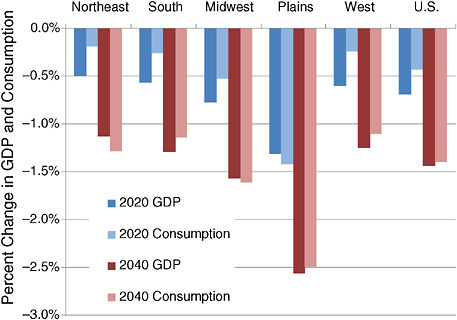
FIGURE 6.1 Estimated changes in GDP and consumption by U.S. region, for an approximately 200 Gt CO2-eqbudget. Differences across regions are attributed to variations in industry mix, energy consumption, energy sources, and assumptions regarding allocation of allowances; the largest losses are projected for the Plains states. SOURCE: Adapted from the EPA analysis of the 2008 Lieberman-Warner bill (S.2191). Available at http://www.epa.gov/climatechange/downloads/s2191_EPA_Analysis.pdf.
on the types of impacts on jobs and workers that might occur. Decline of the manufacturing sector resulted in the loss of relatively higher-wage skilled blue-collar jobs, many of them concentrated in the industrial belt of the U.S. Northeast. Studies have identified a shift in the wage distribution as relative demand for skilled blue-collar workers has declined, while growth of the service sector has generated demand for both highly skilled technicians and low-skill laborers (Appelbaum and Alpin, 1990; Noyelle, 1987).
Impacts on employment will depend on the capacity of the workforce to adjust to rapidly changing circumstances. Those whose jobs are eliminated may or may not have the appropriate skills for emerging jobs, and these jobs may emerge in other regions. In the 1970s and 1980s, job losses were concentrated in the industrial Northeast, while job growth took place in the South and West. Thus, much of the adjustment involved migration of populations. Younger, more educated and skilled workers are more likely
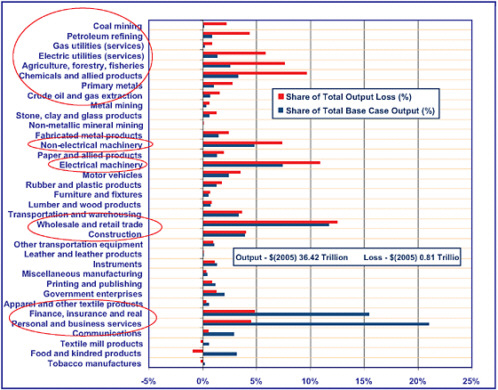
FIGURE 6.2 Projected composition of output and losses by industry in 2030, for a 203 Gt CO2-eq scenario with unlimited domestic offsets. These projections indicate that fossil fuel industries, agriculture, machine manufacturing, and wholesale and retail trade sectors—and the regions where these sectors are more concentrated—would be expected to suffer the largest job losses. SOURCE: Goettle and Fawcett (2009).
to migrate, leaving an older, less educated and less skilled population behind. One social equity concern is the possibility that already distressed cities could be further affected by job losses from policies aimed at limiting climate change.
A recent Congressional Budget Office report that discusses potential impacts of climate limiting policies notes that adjustments associated with the decline of manufacturing jobs took years to accomplish and had significant adverse effects on some workers (CBO, 2009). It seems likely that similar impacts may occur as a result of economic restructuring associated with climate change limiting policies, and these may be concentrated in specific regions and occupations.
At the same time, it seems inevitable that new jobs will be created through investment in improving the energy efficiency of industry, buildings, and transportation and in construction of new power plants and energy infrastructure. Making robust predictions about future job generation, however, is a difficult task. First, it is complex even to define “green jobs,” a concept that could encompass economic activities as diverse as insulating buildings, synchronizing traffic signals, conducting research on carbon capture and storage, or manufacturing more energy-efficient plasma screen televisions. More generally, it is difficult to forecast factors such as the employment effects of investments in new technologies, the specific mix of new jobs across occupations or skill levels, or the particular characteristics of the new green economy (for instance, we cannot foresee future technology breakthroughs, or how carbon prices will affect production or consumption patterns).
A recent study by the Pew Center on Global Climate Change (Pew Center, 2009c) tabulated growth of the “Clean Energy Economy” under five categories: clean energy, energy efficiency, environmentally friendly production, conservation and pollution mitigation, and training and support. As of 2007, some 68,200 businesses across all 50 states accounted for about 770,000 jobs (private-sector employment in 2007 was about 114 million [U.S. Bureau of Labor]). From 1998 to 2007, job growth was 23 percent for clean energy, 18 percent for energy efficiency, and 67 percent for environmentally friendly production. The Pew study confirms that the clean energy economy can in fact be an engine for new economic growth, and these studies are largely consistent with expectations of economic restructuring described above.
Given that new industries and jobs will develop, it is appropriate to consider whether this investment can be used to promote local economic development in high-poverty areas such as inner cities, Appalachia, or Native American reservations, or in the areas that are expected to experience the greatest economic and job losses as a result of policies to limit climate change. Absent deliberate government policy, we would expect new industries to locate competitively (e.g., based on labor force quality and
access, land prices, taxes, access to transport networks, etc.). High-poverty areas are typically not competitive. Inner cities suffer from a lack of a skilled labor force, high land prices and local taxes, and often poor public services. Rural areas have limited labor force and transport network access.
The historical record on economic development efforts in these disadvantaged areas shows that significant, targeted, coordinated, and long-term investments in education, training, and capacity building would be required to be successful. Economic development efforts have taken many forms. Local governments may offer financial assistance or other incentives to businesses (e.g., tax abatement, loans, and grants). In some cases cities invest in major venues (e.g., sports stadia and convention centers) to promote local development. Enterprise zones have been established in economically distressed cities, typically offering financial incentives, special permitting or zoning, infrastructure, and tax credits for job generation or net revenue generation (e.g., Bartik, 1991; Wassmer, 1994; Wren, 1987). The outcomes of economic development programs have exhibited mixed degrees of success. The key explanation for their lack of greater success is that most efforts are driven by public policy goals rather than an understanding of local markets and economies (e.g., Dewar, 1998; Peters and Fisher, 2002; Wolman and Spitzley, 1996).
There are many anecdotal examples of unique programs around the United States aimed at fostering employment in at-risk communities by providing training and placement in green jobs (see Box 6.1). These programs merit careful evaluation to gauge their long-term success and the potential for more widespread implementation.
The Need for Broad Political Participation
As illustrated in the preceding sections, policies that are sufficiently stringent to meet GHG emissions-reduction goals will impose new costs and benefits across industries, regions, and population groups. Stakeholders representing these constituencies can be expected to be actively involved in the policy process. The history of environmental policy is illustrative. The U.S. automobile industry, for example, initially fought against fuel efficiency standards but, once it became evident that standards would be implemented, used their political influence to affect targets and implementation dates (Howitt and Altshuler, 1999). The “auto lobby” (auto manufacturers, suppliers, oil companies, and highway construction) has remained a powerful influence on emissions, safety regulation, and fuel tax policy to the present day (Sperling and Gordon, 2009).
Not all stakeholders, however, are influential or even present in the policy-making
|
BOX 6.1 Examples of Programs to Create Employment in Green Industries Sustainable South Bronx and the BEST Program, South Bronx, New York. The Bronx Environmental Stewardship Training (BEST) Program with Sustainable South Bronx is one of the nation’s first green-collar job training and placement systems. Students graduate with certifications such as water quality management and Occupational Safety & Health Administration Brownfield Remediation. The program is aimed at bringing those with little or no work experience, or those with prison records, into the workforce. Solar Richmond, Richmond, California. Solar Richmond was founded to provide green-collar job training and placement in solar photovoltaics and solar thermal installation jobs. Their intensive training course includes hands-on work on real solar installations. They specifically target installations for low-income residents, churches, and schools, to help these groups reap the rewards of lower energy costs and local job creation. Graduates of the program are given the opportunity to work for Solar Richmond. St. Patrick Center, St Louis, Missouri. The St. Patrick Center, the largest homeless service provider in Missouri, is launching Project GO!Green, in which homeless individuals are trained in horticultural infrastructure and urban farming. The program is now expanding to serve professionals who have recently lost their jobs. Milwaukee Area Investment Board & Student Conservation Association, Milwaukee, Wisconsin. This is a green job training program for high school–aged youth. The work mainly focuses on conservation projects. Summer employment is salaried for all participants. OAI YouthBuild and the City of Chicago’s Green Corps, Chicago, Illinois. Brownfield remediation and environmental certifications are all provided by Chicago’s OAI, inc. A grant from the U.S. Department of Labor was recently awarded to the YouthBuild Program, which targets at-risk youth with a comprehensive training and job placement system. This program directly links into the City of Chicago’s Green Corps that is championed by Mayor Daley. |
process. The poor are less likely to vote, to be aware of relevant policy decisions, to understand the policy process enough to effectively participate, or to have the resources (i.e., time, information, and money) necessary for political participation (e.g., Bartels, 2008). The environmental justice problems of toxics and hazardous facilities location discussed above are attributed at least in part to the lack of political power of the affected communities to influence environmental monitoring or facility location decisions (Capek, 1993; Zimmerman, 1993). Without a “seat at the table,” the needs and concerns of these groups are easily ignored.
One specific example to consider: Pursuing the types of climate change limiting strategies discussed in this report will require siting and building a variety of new facili-
ties—power plants, carbon sequestration facilities, production sites for renewables, and expansion of the electric grid—all of which are subject to environmental review. Because environmental review for major public projects can take years or even decades to complete (Altshuler and Luberoff, 2003), and lengthy review processes add to costs and project risk, there is growing discussion of streamlining these processes. Environmental justice advocates have raised concerns that this sort of streamlining can lead to less powerful interest groups being more easily ignored.
Given the numerous ways in which currently disadvantaged groups could be adversely affected by policies for limiting climate change (as well as by the impacts of climate change itself), careful attention needs to be paid to procedural equity concerns and efforts to ensure full engagement of disadvantaged populations. The affected parties need a seat at the table in discussions of how to avoid harmful impacts from the outset, or how to correct for unanticipated adverse impacts that may arise. Ensuring access of low-income and other disenfranchised populations to programs and incentives for reducing energy demand and utilizing low-carbon energy technologies is not just a matter of fairness. It is also a matter of practical necessity, as achieving major GHG emissions reductions will be very difficult unless all segments of American society are participating in these efforts.
Equity concerns raise a number of substantive policy design and implementation issues to be considered by policy makers. This includes, for example, consideration of policies that redistribute revenues to low-income households to offset the regressive effects of higher energy prices, policies for avoiding co-pollutant hot spots, policies that create new clean-energy jobs and industries in disadvantaged communities, and policies to avoid further penalizing the already limited mobility of many poor and minority communities. Processes for establishing GHG emissions-reduction policies should thus include broad, sustained public participation efforts. There is a substantial literature about the mechanisms for effective public participation in environmental decision making (e.g., Beierle, 1998; NRC, 2008) to which we refer the reader for further consideration of this issue.
KEY CONCLUSIONS AND RECOMMENDATIONS
Low-income groups consume less energy per capita and therefore contribute less to associated GHG emissions. Yet, low-income and some disadvantaged minority groups are likely to suffer disproportionately from adverse impacts of climate change and, absent proactive policies, may also be adversely affected by policies to limit climate change. For instance, energy-related goods make up a larger share of expenditures in
poor households, so raising the price of energy for consumers may impose the greatest burden on these households. Likewise, limited discretionary income may preclude these households from participating in many energy-efficiency incentives. Because these impacts are likely but not well understood, it will be important to monitor the impacts of climate change limiting policies on poor and disadvantaged communities and to adapt policies in response to unforeseen adverse impacts. Some key strategies to consider include the following:
-
Structuring policies to offset adverse impacts to low-income and other disadvantaged households (for instance, structuring carbon-pricing policies to provide relief from higher energy prices to low-income households); designing incentive-based climate change limiting policies to be accessible to poor households (such as graduated subsidies for home heating or insulation improvements);
-
Assuring that efforts to reduce energy consumption in the transport sector avoid disadvantaging those with already limited mobility; and
-
Actively and consistently engaging representatives of poor and minority communities in policy planning efforts.
Major changes to our nation’s energy system will inevitably result in shifting employment opportunities, with job gains in some sectors and regions but losses in others (i.e., energy-intensive industries and regions most dependent on fossil fuel production). Policy makers could help smooth this transition for the populations that are most vulnerable to job losses through additional, targeted support for educational, training, and retraining programs.


