
Appendix G
National Salt Reduction Initiative Coordinated by the New York City Health Department1
In 2008, a national partnership of city and state health departments and public health organizations responded to the need for population sodium intake reduction by convening food industry leaders to introduce a framework for voluntary reductions in food sodium content. The National Salt Reduction Initiative (NSRI), which includes the American Medical Association (AMA), American Heart Association (AHA), American Public Health Association (APHA), along with 45 national health organizations, cities, and states, is intended to promote gradual, achievable, substantive, and measurable reductions in the sodium content of packaged and restaurant foods. The NSRI goal is to reduce population sodium intake by 20 percent over 5 years, which would require an approximate 25 percent reduction in the sodium content of packaged and restaurant foods. The New York City (NYC) Health Department was instrumental in initiating the activities that have resulted in the NSRI.
Based upon the United Kingdom (UK) Salt Reduction Campaign model,2 the NSRI sets targets by individual food category. The program intends the targets to be voluntary, substantive, achievable, gradual, and measurable. The framework includes meetings with major manufacturers and restaurant chains to discuss proposed targets by category, and a strategic plan for ongoing monitoring and evaluation to assess progress toward the targets. Throughout 2009, food category meetings were convened to
|
1 |
This appendix was submitted by the New York City Department of Health and Mental Hygiene. |
|
2 |
Available online: http://www.food.gov.uk/healthiereating/salt/ (accessed April 5, 2010). |
discuss proposed targets and get industry feedback. Based upon these consultations, proposed targets were developed and publicly released for final technical comment in early January 2010. Final targets were announced in Spring 2010.
APPROACH
The NSRI is conducting parallel sodium reduction approaches for packaged food and for restaurant food. The two are similar in terms of time line, metrics, reporting structure, and monitoring. However, differences in patterns of consumption and data sources require unique food categories and target setting approaches. In each case, the steps include defining and establishing food categories, proposing targets, reviewing industry feedback, announcing 2012 and 2014 targets, assessing progress toward food targets, and measuring changes in population sodium intake over time. Two unique databases were created to support this initiative, one specific to packaged food and a second tailored to restaurant food.
Packaged Food
Packaged Food Database
When the NSRI launched, no comprehensive national database existed that linked individual packaged food sales and nutrition information by Universal Product Code (UPC). To create this database, the NYC Health Department purchased sales data from the Nielsen Company (Nielsen), a market research company that aggregates packaged food sales data from major U.S. retailers. The time period for baseline sales data is the 52 weeks ending December 31, 2008; over 240 Nielsen categories were purchased. Nielsen sales and Guiding Stars Licensing Company nutrition data tables were merged by UPC. Product manufacturers’ publicly available nutrition information was used to complete and verify nutrition data. Because sales data for private label products is included in Nielsen, private label market share could be determined; however, nutrition data for private label products could not be linked to Nielsen sales data. Private label sodium information was collected separately for comparison to the category mean and range. A recognized limitation of the database is that it does not include food sold to the foodservice market or retailers that do not submit data to Nielsen.
Packaged Food Categories
As demonstrated by the UK initiative, individual food categories must be sufficiently refined to assure that included products are similar with
respect to sodium content in terms of functional requirements and food safety and with respect to the potential for reduction. In addition, categories should allow for feasible tracking and monitoring of reductions based on data availability.
In order to establish proposed food categories for packaged foods, the Health Department first compared those created by the UK Salt Reduction Campaign with Food and Drug Administration (FDA) categories defined for Reference Amounts Customarily Consumed (RACC)3 and U.S. Department of Agriculture (USDA) food categories (Table G-1), and then reviewed Nielsen categories and categories defined by Information Resources, Inc. (IRI), another market research firm.
The NSRI Packaged Food Database was used to identify items that were outliers in sodium content within each proposed food category. These outliers were more closely assessed to consider category fit. A total of 46 potential food categories were initially proposed. Industry feedback was then solicited through conference calls, written requests, and food category meetings conducted in person, with an option for industry to participate by remote access. Based upon industry comments, changes included the elimination or addition of categories and the movement of select products between categories. Currently, there are more than 60 food categories, with limited further category refinement expected as the process comes to a conclusion.
Packaged Food Targets
Proposed targets by food category were developed first by analysis of the NSRI Packaged Food Database. In response to industry feedback, the metric sodium mg per 100 g of food is used as the unit for reported analysis, setting targets, and monitoring. This metric was preferred over sodium mg per serving size because serving size may vary within a range according to FDA and USDA regulations, preventing accurate comparisons across products.
In order to assess each food category and to set targets that would take into account differences in individual product sales—and therefore differences in contribution to population intake—the sales-weighted mean was calculated. A sales-weighted mean is calculated by weighting each product based on its relative sales before calculating the mean. The sales-weighted mean sodium is based on all branded products with available nutrition information in the top 80 percent of sales of each food category.
Additional summary statistics including the distribution and range of
|
3 |
Available online: http://ecfr.gpoaccess.gov/cgi/t/text/text-idx?c=ecfr&sid=8c5344f04a8ae103e5b0ff5a17c7fa97&rgn=div8&view=text&node=21:2.0.1.1.2.1.1.8&idno=21 (accessed February 24, 2010). |
TABLE G-1 Example of Aligning a Proposed Food Category
|
NSRI Proposed Food Category |
FDA Product Category |
UK Category |
|
Vegetables |
Vegetables |
Canned vegetables |
|
11.1 Frozen vegetables |
All other vegetables with sauce: fresh, canned, or frozen |
No corresponding UK category |
|
11.2 Canned vegetables |
All other vegetables without sauce: fresh, canned, or frozen (vacuum packed or canned in liquid) |
24.1 Canned vegetables |
|
11.3 Canned whole tomatoes |
All other vegetables without sauce: fresh, canned, or frozen (vacuum packed or canned in liquid) |
24.1 Canned vegetables |
|
11.4 Diced, crushed, and stewed tomatoes |
All other vegetables without sauce: fresh, canned, or frozen (vacuum packed or canned in liquid) |
24.1 Canned vegetables |
|
11.5 Vegetable Juice |
Vegetable juice |
No corresponding UK category |
sodium content and the sales-weighted mean by manufacturer were calculated by category (Figures G-1 and G-2). This allowed for the identification of products in each category that were very low or high in sodium per 100 g. These products were carefully considered to better understand the potential opportunities and limitations of salt reduction in each category, and to understand individual manufacturer’s products.
Using the sales-weighted mean sodium (mg/100 g) as a starting point, a 25 percent reduction was calculated to estimate an initial 2014 target. Adjustments were made based on comparisons to UK targets; examples of substantial sodium reductions achieved in the United Kingdom and United States; assessment of the range of standard products (e.g., the range of sodium per 100 grams of tomato soup or cornflakes produced by major manufacturers); and an examination of documented technical challenges including food safety and technical requirements. Based upon adjustments to the proposed 5-year 2014 target, an interim target was proposed for 2012. For a company to meet the category target, calculations will be based on the sales-weighted mean of all of a company’s products in that category.
Once calculations were complete, the NSRI convened food category meetings to share the category analysis, discuss proposed targets, and get industry feedback on technical challenges and opportunities specific to the category. Invited meeting participants included food category manufacturers, private label manufacturers, retailers, industry trade associations, and food service establishments. Meetings were conducted in person
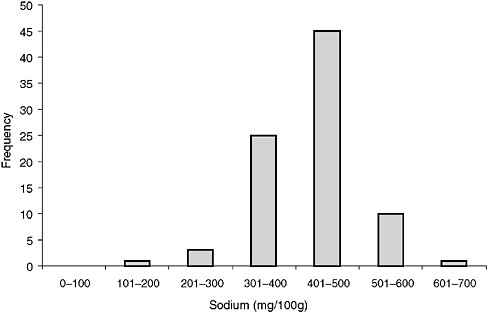
FIGURE G-1 Example: Sodium distribution and proposed targets in a category (sodium mg/100 g).
NOTE: Sales data exclude retailers that do not submit to Nielsen and food sold to foodservice; nutrition data from private label not included. Data based on products that represent top sellers of U.S. market. g = gram; mg = milligram.
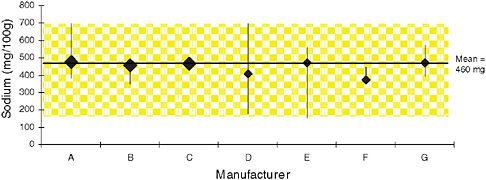
FIGURE G-2 Example: Sales-weighted mean sodium and range in category by manufacturer (sodium mg/100 g).
NOTE: Sales data exclude retailers that do not submit to Nielsen and food sold to foodservice; nutrition data from private label not included. Data based on products that represent top sellers of U.S. market. Large diamonds represent the sales-weighted mean of manufacturers that have at least 10 percent of the category market share. g = gram; mg = milligram.
with Internet-based conferencing available to accommodate those unable to attend. Industry attendees included more than 50 manufacturers and food service companies, 12 trade associations, and 2 food retailers. At these meetings, data charts were reviewed, including those that illustrate sales-weighted means and ranges by individual company (Figures G-1 and G-2). Further discussions with individual manufacturers followed the group meetings by phone, Internet-based conferencing, and email as requested. The opportunity to submit written feedback addressed concerns expressed by some industry participants about sharing sensitive data in group meetings.
Adjustments to the proposed targets have been made based on meeting feedback and the receipt of written documentation, with supporting data, from industry.
Restaurant Food
The restaurant portion of the initiative was launched in February 2009 at a private meeting with representatives from 14 food service companies, restaurant chains, and trade associations.
Restaurant Food Database
The basis of the NSRI Restaurant Food Database is publicly available nutrition data for all restaurants that are in the 2009 QSR 50,4 a ranking of quick-service restaurants based on 2008 sales, and 2008 NPD Crest market share data. Forty-seven of the QSR 50 chains had at least some nutrition and serving weight data available; baseline nutrition data uses publicly available information from early 2009.
Restaurant/Food Service Categories
The first step to define restaurant categories was to identify key food categories that contribute to U.S. population sodium intake. An NYC Health Department food purchase receipt study and National Health and Nutrition Examination Survey (NHANES) analysis of 24-hour dietary intake data provided support for the identification of 25 menu item categories that are key contributors to sodium intake (Bassett et al., 2007).
Categories were defined to correspond to menu categories and items within categories were further reviewed to assess comparability with respect
|
4 |
Available online: http://www.qsrmagazine.com/reports/qsr50/2009/charts/09rank.phtml (accessed August 3, 2009). |
TABLE G-2 Example of Restaurant Key Food Categories for Hamburgers
|
Main NSRI Restaurant Food Category |
Restaurant Key Food Category |
Restaurant Key Food Category Description |
|
Hamburgers |
Hamburgers |
Plain ground beef burgers and ground beef burgers with toppings other than cheese. Excludes turkey burgers, veggie burgers, and any ground beef burger with cheese. |
|
|
Cheeseburgers |
Ground beef cheeseburgers and ground beef cheeseburgers with toppings. Excludes turkey burgers, veggie burgers, and any ground beef burger without cheese. |
to sodium levels (Table G-2). As with packaged foods, once proposed key food categories were developed by NSRI, they were reviewed and modified based upon conference call discussions and meetings with restaurant chains, food service companies, and restaurant trade associations.
Restaurant/Food Service Targets
Proposed targets by food category were developed first by analysis of the NSRI Restaurant Food Database. Market share-weighted mean sodium content (mg/100 g) was calculated for each category.
Proposed key food category targets were set based on a percentage reduction from the mean. Initial 2012 and 2014 targets corresponded to a reduction of 10 percent and an additional reduction of 15 percent from the baseline sodium content. During individual meetings with restaurants, proposed targets for each key food category and a proposed maximum were discussed. Further adjustments were made to proposed targets following discussions at the meetings and receipt of written documentation with supporting data from industry.
Companies are encouraged to submit blinded sales information, so that the company’s category mean is weighted by sales. In addition to a category-specific sodium target, an overall maximum for sodium content as served is proposed for any item for 2012 and 2014. For a restaurant to meet category-specific targets, either the mean sodium or the sales-weighted mean sodium of the restaurant’s products in that category must be at or below the target. For a company to comply with a maximum, the sodium content of all individual items served must be below the defined threshold.
NEXT STEPS, MONITORING AND EVALUATION
All packaged food and restaurant category meetings were completed by the end of 2009. Proposed targets were publicly released in January 2010. Final targets were made public in Spring 2010. Final targets and industry commitments for 2012 and 2014 are available on the Health Department website.5
NSRI progress will be assessed through monitoring changes in the sodium content of food by category and through assessment of changes in population sodium intake. In 2012 and 2014, the NSRI will assess progress toward 2012 and 2014 food category targets, utilizing updated NSRI Packaged Food and Restaurant Food databases. To assure that the most recent reformulation achievements are captured, industry will also be asked to provide nutrition and unit sales data for target years, although analysis will not rely upon industry provision of this information.
In 2010, the NYC Health Department will conduct a 24-hour urinary sodium evaluation on a representative sample of NYC residents to assess current NYC population sodium intake. Plans are to repeat this study in 2014 for analysis of change in population sodium intake.
PARTICIPATING ORGANIZATIONS
As of February 2010, the undersigned agencies and organizations have expressed commitment to the NSRI and have agreed to work toward the goal of reducing population salt intake by at least 20 percent during the next 5 years by setting targets and monitoring progress through a transparent, public process.
Alaska Department of Health and Social Services
American College of Cardiology
American College of Epidemiology
American Heart Association
American Medical Association
American Public Health Association
American Society of Hypertension
Arizona Department of Health Services
Association of Black Cardiologists
Association of State and Territorial Health Officials
Baltimore City Health Department
Boston Public Health Commission
California Department of Public Health
|
5 |
Available online: http://www.nyc.gov/health/salt (accessed March 3, 2010). |
Chicago Department of Public Health
Consumers Union
Council of State and Territorial Epidemiologists
Delaware Department of Health and Social Services, Division of Public Health
District of Columbia Department of Health
InterAmerican Heart Foundation
International Society of Hypertension in Blacks
Joint Policy Committee, Societies of Epidemiology
Los Angeles County Department of Public Health
Maine Center for Disease Control and Prevention
Maryland Department of Health and Mental Hygiene
Massachusetts Department of Public Health
Michigan Department of Community Health
National Association of Chronic Disease Directors
National Association of County and City Health Officials
National Hispanic Medical Association
National Kidney Foundation
New York City Department of Health and Mental Hygiene
New York State Chapter, American College of Cardiology
New York State Department of Agriculture and Markets
New York State Department of Health
North Carolina Department of Health and Human Services, Division of Public Health
Northern Illinois Public Health Consortium
Oregon Department of Health and Human Services, Division of Public Health
Pennsylvania Department of Health
Philadelphia Department of Public Health
Preventive Cardiovascular Nurses Association
Public Health, Seattle and King County
Society for the Analysis of African-American Public Health Issues
Tennessee Department of Health
Washington State Department of Health
West Virginia Department of Health and Human Services, Bureau of Public Health
World Hypertension League
REFERENCE
Bassett, M. T., T. Dumanovsky, C. Huang, L. D. Silver, C. Young, C. Nonas, T. D. Matte, S. Chideya, and T. R. Frieden. 2008. Purchasing behavior and calorie information at fast-food chains in New York City, 2007. American Journal of Public Health 98(8): 1457-1459.


