
4
POTENTIAL TECHNICAL ADVANCES FROM NUCLEAR-EXPLOSION TESTING
The CTBT would make it illegal for signatory nations to conduct nuclear-explosion tests. Its effectiveness would depend on both the technical means available for detecting violations and the commitment to its enforcement by the parties involved. As discussed in Chapter 2, the ability to detect nuclear weapons tests has advanced substantially in the past 10 years, creating increased difficulties for clandestine nuclear weapons programs. However, assessing the potential threats to U.S. national security that undetected nuclear-explosion testing might pose is an important component of the discussion concerning U.S. ratification of the CTBT. Alternative threats to U.S. national security from resumption of full-yield nuclear-explosion testing must also be considered.
Since the 2002 Report, the issues regarding the security implications of the CTBT have changed substantially in some areas and little in other areas. In the following, we will address some key points where changes have occurred or where the committee concludes that clarification is needed. These specifically include changes in the nuclear programs of other NPT-acknowledged Nuclear Weapon States, the lack of a definition of “nuclear explosion” in the CTBT text, the probability of detection, the implications for those hoping to avoid detection, and the feasibility of evasion for avoiding detection. With those basics established, we update the comparison used in the 2002 Report of the potential threats posed by ratification of the CTBT given the possibility of clandestine tests versus the threats posed by a possible return to global full-yield nuclear-explosion testing.
OVERVIEW AND 2002 REPORT FINDINGS
The 2002 Report found that “taking all factors into account and assuming a fully functional IMS,” an evasively-tested nuclear explosion could not “be confidently hidden if its yield is larger than 1 or 2 kilotons” (NRC, 2002 , pp. 7, 48). Two methods of evasive nuclear-explosion testing—mine masking and cavity decoupling—were judged to be potentially effective and were included in the prior assessment. The report concluded that Russia and China, with their substantial prior testing experience, would be in the best position to carry out a successful evasive test. The 2002 Report concluded that Russia and China would be able to extract useful results from low-yield evasive testing, but these would add little to the threat they already posed to the United States (NRC, 2002, pp. 70-73).
In contrast with the cases of Russia and China, the 2002 Report concluded that States with less prior test experience and/or design sophistication are much less likely to succeed in concealing significant nuclear explosion tests. Although low-yield or evasive testing might help lay the groundwork for a future nuclear weapons program, it would not enable mastery of nuclear weapons more advanced than the ones that they could develop and deploy without any testing at all.
Since the 2002 Report, the United States and other Nuclear Weapon States have shown that they can maintain their nuclear arsenals and, in the cases of Russia and China, modernize them under a testing moratorium.
Advances in monitoring technology and capability since the 2002 Report (discussed in Chapter 2) have only made the prospect of evasive nuclear explosion testing more challenging.
The committee judges that, in addition to testing below detection levels, only two other evasion measures, mine masking and cavity decoupling, warrant serious discussion. The committee found no evidence of any new technical developments that would facilitate these evasion scenarios. The use of mine masking as an evasion strategy is challenging because the seismic monitoring of mining regions has improved and because the limitations of mine masking are better understood. With regard to decoupling as an evasion strategy, there is little new technical information since the 2002 Report. The challenges described in that report to a would-be evader attempting to decouple the seismic signal remain pertinent today. A more detailed technical discussion of evasive testing is presented in Appendix E.
NUCLEAR WEAPON STATES (NWS) PROGRAMS UNDER A TEST MORATORIUM
It is important to be clear about what will and will not be technically affected by the CTBT. The CTBT bans nuclear-explosion testing but does not proscribe other activities for maintaining or even expanding a State’s overall nuclear capabilities. As a result, the United States has been able to sustain its nuclear stockpile under the test moratorium that has been in effect for nearly two decades, and to develop science-based tools that ensure the capability to use the results of the substantial U.S. test history in future work on nuclear weapons. It is reasonable to expect (and indeed the record shows) that other advanced weapons States will also use science-based approaches in maintaining and possibly adapting their nuclear weapons. Such activities may be quite extensive, but under a test ban, weapons deployable with confidence will be limited to designs that fall within the range of previously tested designs.1
Here we present a synopsis of how the four other Nuclear Weapon States (NWS) under the NPT are maintaining and to some extent modernizing their stockpiles of nuclear warheads and delivery systems. Among these four States, Russia has nearly an order of magnitude more nuclear warheads than the United Kingdom, France, and China combined. Of the four countries, Russia, the United Kingdom and France have signed and ratified the CTBT; like the United States, China has signed but has not yet ratified.
Russia
Efforts to modernize and reform Russia’s Armed Forces have been ongoing for most of the period following the end of the Soviet Union. The role and structure of Russia’s nuclear arsenal have been part of these general military modernization efforts. Russia continues to maintain its national nuclear weapon design laboratories at Sarov and Snezhinsk and to upgrade research facilities in line with a SSP-like program to maintain its nuclear stockpile. Russia also continues to maintain an active production complex.
__________________
1 There is also the possibility of acquiring information through espionage or transfer, but that is beyond the scope of this report.
Nuclear Test Site
When the Soviet Union ratified the Threshold Test Ban Treaty with the United States in 1990, it declared two official sites for testing nuclear weapons—eastern Kazakhstan (Semipalatinsk) and the island of Novaya Zemlya (Mikhailov, 1996). The former was the primary location for Soviet nuclear-explosion tests from 1949 to 1989 (Adushkin and Leith, 2001) and was closed in 1989. The largest Soviet underground nuclear-explosion tests, however, were conducted at two sites on remote Novaya Zemlya, one of which (the Krasino site on southern Novaya Zemlya) has not been used for testing since 1975. Russia continued testing at its Arctic test site near Matochkin Strait on Novaya Zemlya until 1990 (Khalturin et al., 2005). The Russian nuclear-explosion test site at Novaya Zemlya is now the site of ongoing experiments termed hydrodynamic by Russian spokesmen. Truly hydrodynamic tests have no nuclear explosive yield and thus are, by definition, compliant with the CTBT. However, there is some dispute about whether Russia considers certain nuclear tests (hydronuclear) with very low yields (up to 100 kg—see the section below on “Hydronuclear Testing”) to be compliant with the CTBT. In the absence of access to the test site, it is impossible to determine by physical means whether or not the ongoing activities at Novaya Zemlya include such very-low-yield tests.
Modernization Efforts
Russian President Dmitry Medvedev announced the latest plans for strategic force modernization on March 17, 2009. The 2009 budget allocated 1.5 trillion rubles (about $45 billion), with approximately $12 billion directed toward strategic nuclear forces (Perfilyev, 2009). In February 2010, President Medvedev approved the new military doctrine, “Principles of the State Policy of Nuclear Deterrence until 2020”; this is largely consistent with the previous Russian doctrines released in 1993 and 2000.
As of September 2011, Russia deploys 516 ICBMs, SLBMs, and Heavy Bombers. The New START treaty verification regime counts 1,566 Russian warheads on Deployed ICBMs, SLBMs and Heavy Bombers (U.S. Department of State, 2011a). The New START Treaty limits strategic delivery vehicles to 800, including up to 700 actively deployed and 100 in maintenance or refitting. New START limits the total number of deployed strategic warheads and bombs to 1,550. It is unclear whether the new Treaty will change how Russia structures its land based strategic missile force; the limits would not appear to require a major restructuring.
Although further nuclear arms reductions are foreseen by Russia’s military leadership, they seek to qualitatively transform the strategic forces through life extension programs and new, enhanced long-range missile systems (RIA Novosti, 2009). Russia is reported to deploy 376 intercontinental ballistic missiles (ICBMs) (Nichol, 2011). Russia is slowly replacing its older Soviet-era ICBMs (SS-18 and SS-19) with new ICBMs, including missiles derived from the solid-fueled Topol series. Russia plans to replace these systems by 2022 and is now deploying a modernized version called the Topol-M (SS-27), designed to improve performance against ballistic missile defense, and plans to deploy a MIRVed version of the Topol-M (Perfilyev, 2009). Russia is also reported to be developing a next-generation liquid-fueled heavy ICBM (GSN, 2011).
Improvements to its nuclear-powered ballistic missile submarines (SSBNs) are also being introduced by the Russian navy. “The sea-based leg of the nuclear triad will consist of six Project 667BDRM Delfin (Delta IV) submarines with R-29RM Sineva missiles, which will gradually be replaced by up to eight Project 955 Borey submarines with Bulava missiles…” (Perfilyev, 2009). However, these deployments have been delayed by failed tests and other technical difficulties. At present, only a single Borey class submarine is operational (although
without missiles), with two more under construction (Russian Forces, 2010). According to Russian Navy officials, “The modernized Borey will be the core of Russian naval nuclear forces until 2040” (Sokolova, 2008).
Russia’s 76 plane strategic bomber force consists of “13 Tu-160s (Blackjacks), 32 Tu-95MS6s (Bear H6s), and 31 Tu-95MS16s (Bear H16s). Russia continues to modernize the targeting and navigation systems in many of these strategic aircraft.” Russia’s “advanced nuclear cruise missile (Kh-102) has been in development for more than 10 years but is still not deployed” (Norris and Kristensen, 2011 p. 71).
In addition to strategic forces, Russia maintains a significant number of tactical nuclear weapons. Estimates of their number vary considerably. The Congressional Commission on the Strategic Posture of the United States noted: “As part of its effort to compensate for weaknesses in its conventional forces, Russia’s military leaders are putting more emphasis on non-strategic nuclear forces (NSNF), particularly weapons intended for tactical use on the battlefield. Russia no longer sees itself as capable of defending its vast territory and nearby interests with conventional forces…The combination of new warhead designs, the estimated production capability for new nuclear warheads, and precision delivery systems…open up new possibilities for Russian efforts to threaten to use nuclear weapons to influence regional conflicts” (Congressional Commission, 2009).
The United Kingdom
The United Kingdom has maintained operational nuclear weapons since 1956, but it gradually cut back its arsenal after the breakup of the Soviet Union. Currently the United Kingdom deploys nuclear weapons aboard Vanguard-class submarines that are projected to be operational until 2023. The stated purpose of British nuclear weapons continues to be to serve as a “minimum nuclear deterrent” (UK MOD, 1998, p. 323); the 2006 White Paper on the Future of the UK Nuclear Deterrent, reaffirmed the British policy of maintaining one submarine at sea continuously (United Kingdom Ministry of Defence, 2010). In May 2010, the U.K. Foreign Secretary stated that the U.K. government maintains a total of 225 nuclear weapons and will in the future maintain no more than that number (Hague, 2010).
The U.K. nuclear weapons effort is centered at Atomic Weapons Establishment (AWE) Aldermaston and AWE Burghfield, where most of the nuclear explosive package of the warhead for the submarine-launched ballistic missiles is designed and manufactured. AWE works closely with the U.S. nuclear weapon laboratories, and the Trident missiles for its submarines are leased from the United States. The NPT forbids transfer of nuclear warheads from the United States to the United Kingdom and vice versa. The United Kingdom has no nuclear-explosion test site.
France
France continues to maintain what it regards as a minimum deterrent force under its principle of “strict sufficiency”2 while simultaneously modernizing and shrinking its nuclear arsenal (French Government, 2008). As of 2008, the French nuclear force consisted of fewer than 300 nuclear warheads.3 The key component of the French deterrent force consists of four
__________________
2 “France applies a principle of strict sufficiency: she maintains her arsenal at the lowest possible level compatible with the strategic context” (Sarkozy, 2008).
3 “After this reduction, I can tell you that our arsenal will include fewer than 300 nuclear warheads” (Sarkozy, 2008).
Le Triomphant-class SSBNs. The fourth boat in the class (Le Terrible) was deployed at the end of 2010. Each SSBN can carry 16 missiles armed with 4–6 warheads each.
The French nuclear air force consists of land-and sea- (carrier-) based aircraft configured to launch nuclear cruise missiles (Norris and Kristensen, 2008). The purpose of the aircraft is to provide an alternative mode of strategic nuclear attack to render the overall deterrent more credible. Under the present government, nuclear equipped aircraft stationed in France will be reduced to two squadrons, and one squadron will continue to deploy onboard the aircraft carrier Charles De Gaulle. The French government’s 2008 Defense White Paper states of the new air-launched cruise missile:
“It will be equipped on deployment with the new… warhead. [New warheads] will replace the current warheads as they reach their maximum projected life expectancy, since manufacture of identical replacements cannot be guaranteed without nuclear testing. Because it will not be possible to prove performance by testing, the new missiles will be designed according to a ‘robust warhead’ concept validated during the final series of nuclear tests in 1995.” (p. 162)
France conducted a series of nuclear explosions at its Pacific test site in 1995, prior to signing the CTBT in 1996 and ratifying jointly with the United Kingdom on April 6, 1998. France has since closed and dismantled its test site. France maintains a stockpile stewardship-like program using high-speed computers; a linear electron beam accelerator used to take flash radiographic images of weapons components and is building a National Ignition Facility (NIF)-like facility for “simulation” of thermonuclear explosions (French Government, 2008 p. 54). A recent joint announcement by the U.K. and France establishes a collaborative effort to maintain their separate nuclear forces, including joint pulsed radiographic capability to be built by the U.K. at Valduc, France (Ingram, 2010).
China
China, like the other recognized Nuclear Weapon States under the NPT, has observed a moratorium on nuclear-explosion testing since 1996, when China last tested at the Lop Nor nuclear-explosion test facility. In 1996, China was the second country to sign the CTBT after the United States, but the National People’s Congress of the PRC has yet to ratify the Treaty.
According to the U.S. Department of Defense, “Since 2000, China has shifted from a largely vulnerable, strategic deterrent based on liquid-fueled, intercontinental-range ballistic missiles (ICBMs) fired from fixed locations to a more survivable and flexible strategic nuclear force” (OSD, 2009, p. vii). The key change to the nuclear force involves the introduction of mobile solid-fueled Dong Feng (DF)-31 and DF-31A ICBMs to augment the liquid-fueled silo-based DF-5A and the introduction of new JIN-class SSBNs in an attempt to create a more survivable Chinese strategic deterrent.
According to the most recent DOD annual reports to Congress on Chinese military developments the Chinese maintain 50–75 ICBMs (OSD, 2010, p. 66 and OSD, 2011, p. 78). This estimate includes the DF-5A, DF-31 and DF31A, as well as the more limited range DF-4. The remaining delivery systems serve a medium-and intermediate-range role and are primarily positioned to hold regional targets at risk. According to official U.S. estimates, all Chinese nuclear-capable missiles carry a single warhead, but “China is also currently working on a range of technologies…including maneuvering re-entry vehicles, MIRVs, decoys, chaff, jamming, thermal shielding, and anti-satellite (ASAT) weapons” (OSD, 2010, p. 34; 2011, p. 34). China announced on January 11, 2010, a successful intercept of a mid-range ballistic missile, which further demonstrates China’s capability to destroy satellites in low-earth orbit.
Today “the operational status of China’s single XIA-class ballistic missile submarine (SSBN) and medium-range JL-1 submarine-launched ballistic missiles (SLBM) remain questionable” (OSD 2011, p. 34). In 2009, the U.S. DOD expected as many as five new JIN-class SSBNs to be deployed in the next few years (OSD, 2009, p. 48). Today the first JIN-class SSBN “appears ready, but the associated JL-2 SLBM has faced a number of problems and will likely continue flight tests. The date when the JIN-class SSBN/JL-2 SLBM combination will be fully operational is uncertain” (OSD, 2011, p. 34). Like its parent missile the DF-31, the Julang (JL)-2 has a reported maximum range of 4,500 miles (7,200 km) and would give “the PLA Navy its first credible second-strike nuclear capability” (ONI, 2009, p. 23). To hold targets at risk in the continental United States, the PLA Navy would need to extend submarine patrols beyond Chinese territorial waters; this would be an unprecedented posture change for China. “The PLA has only a limited capability to communicate with submarines at sea, and the PLA Navy has no experience in managing a SSBN fleet that performs strategic patrols with live nuclear warheads mated to missiles” (OSD 2011, p. 34).
China conducted all of its nuclear-explosion tests near Lop Nor in the sparsely populated northwestern part of the country. China stopped such testing in 1996 just prior to signing the CTBT, though it continues activities at its nuclear-explosion test site. As in the case of Russia at Novaya Zemlya, the possibility of very low-yield (hydronuclear) tests cannot be precluded without access to the test site. According to the Department of Defense and Energy, “China has had a fully functional and operating nuclear weapons infrastructure for over thirty years and is the only major nuclear power that is expanding the size of its nuclear arsenal. It is qualitatively and quantitatively modernizing its nuclear forces, developing and deploying new classes of missiles, upgrading older missile systems, and developing methods to counter ballistic missile defenses” (U.S. DOD and DOE, 2008, p. 6ff).
Finding 4-1: The Nuclear Weapon States have been able to maintain their nuclear weapons programs under a nuclear-explosion-test moratorium and are likely to be able to make nuclear weapons modifications that fall within the design range of their test experience without resorting to nuclear-explosion testing.
In the CTBT text, the objectives of the verification regime are expressed in legal rather than technical terms. The absence of a technical definition is troubling for some. As discussed in Chapter 2, the technologies and locations for the International Monitoring System (IMS) are established by the Treaty. The legal definition of a nuclear explosion, which in turn determines what activities would constitute a Treaty violation, is a matter of negotiation history and mutual understanding, and it allows for case-by-case consideration of certain activities that are not prohibited. (See Box 4-1 below.)
The Department of State’s article-by-article analysis of the CTBT outlines the understanding reached on activities not affected by the Treaty. According to this analysis, “Article I prohibits only explosions, not all activities involving a release of nuclear energy” (U.S. Department of State and Medalia, 2010, p. 17). The analysis describes types of activities that do not fall under the CTBT’s prohibition.
BOX 4-1 Activities Not Prohibited Under the CTBT
The publicly available article-by-article Analysis by the U.S. Department of State indicates that specific examples of types of nuclear activities will NOT be prohibited under the CTBT. These activities include:
1. computer modeling.
2. experiments using fast burst or pulse reactors.
3. experiments using pulse power facilities.
4. inertial confinement fusion (ICF) and similar experiments.
5. property research of materials, including high explosives and fissile materials.
6. hydrodynamic experiments, including subcritical experiments involving fissile material 12.
7. operation of nuclear power and research reactors and activities related to the operation of accelerators.
By not defining precisely what is meant by a nuclear explosion, but by providing examples of what does not constitute a prohibition under the Treaty, it has been argued that there is substantial room for interpretation. In late 2011, the U.S. Department of State released a fact sheet that lists P-5 public statements on the scope of the CTBT negotiations and concludes that, “by the end of negotiations, all parties understood that the CTBT should be a true ‘zero yield’ treaty; nuclear weapon test explosions that produce any level of nuclear yield are prohibited” (U.S. Department of State, 2011b). The issue was addressed in the 2002 Report (NRC, 2002, pp. 14-15), which did not attempt a technical definition of nuclear explosion. Neither do we attempt a technical definition in this report. It is not necessary to define a nuclear explosion to analyze the detectability and utility of nuclear explosion tests at various yields.
As described above, the NWS have all proved able to maintain their nuclear weapons programs under a test moratorium. However, any Party to the CTBT must consider that any other party might cheat on its commitment to the CTBT if it were deemed important and could be concealed with confidence. For example, Russia—and, to a lesser extent, China—both have experience with nuclear-explosion tests. They also have the knowledge and capabilities of the methods and difficulties of concealing such tests. Conversely, Russia and China also have a sophisticated science base for understanding nuclear weapons and are likely to be able to make nuclear weapons modifications (at least those that fall within the design-range of their test experience) without resorting to testing. In addition, the Russian and Chinese nuclear test sites are well monitored to very low limits, as described in Chapter 2 and Appendix D. It is possible that tests could be carried out at alternative sites with somewhat less capable detection limits. However, to advance new weapons designs, an extensive suite of test diagnostics must be employed, as well as multiple tests, making concealment of such activities difficult.
Hydronuclear Testing
Hydronuclear tests have merited a special place in the CTBT debate. This is in part because such tests are essentially impossible to detect by any known remote techniques. For example, a hydronuclear test fully contained in a properly designed explosive containment vessel would likely reveal nothing to remote monitors. Even intrusive, persistent local monitoring might find it difficult to detect such tests and to distinguish them from subcritical tests.
The United States historically used a definition of “hydronuclear” as being less than 0.002 tons (2 kgs) of yield.4 However, another definition for a hydronuclear test involves a nuclear yield no larger than the energy provided by the chemical explosive that drove the implosion. Russia has historically defined “hydronuclear” tests as tests with a nuclear yield up to 0.1 ton (100 kg) of high-explosive equivalent.5
A related issue is the relevance or usefulness of such tests. These questions are considered here, under the assessment that hydronuclear tests, or very low-yield testing in general, are potentially of value primarily to experienced Nuclear Weapon States. In particular, there are real differences between U.S. and Soviet Union/Russian test histories with regard to the importance of hydronuclear testing. Some believe that these differences lead to differences in understanding of the testing limitations under the CTBT, either during the current moratorium on testing or possibly even after entry-into-force (EIF) of the CTBT, although, as noted above, the U.S. Department of State cites Russian statements and concludes that the scope of the treaty is not in question. China maintains that it does not conduct hydronuclear tests.6
U.S. Hydronuclear Test Experience
Thirty-five hydronuclear tests were conducted at LANL, and eleven were conducted by LLNL at NTS during the testing moratorium of 1958–61.They were carried out to resolve one-point safety problems in weapon systems already in production. The problems were not recognized until after the moratorium had started, so further nuclear-explosion testing was not an option (Thorn and Westervelt, 1987).
The U.S. hydronuclear tests consisted of reduced quantities of fissile material in generally full-up high explosive configurations. The maximum fission energy release was limited to no more than 0.5x10⁻⁶ kt (1 pound). On this basis, President Eisenhower designated such experiments during the moratorium as not being nuclear weapon tests. The one-point safety tests used the “creep up” method of adding fissile material and predicting the response of the weapon system from the experimental data. The largest fission release was less than 0.5 x 10⁻⁸ kt (0.01 pound).
During the moratorium, some consideration was given to the usefulness of hydronuclear experiments for nuclear weapons development, but the moratorium ended in 1961, and this approach was never pursued. This was more or less the situation until the renewed interest in the CTBT during the Clinton administration. A JASON study concluded that hydronuclear (or supercritical testing in general) was not required to maintain the existing U.S. stockpile, as long as a robust science-based stockpile stewardship program was established and maintained (JASON, 1994).
After more than a decade of experience with the SSP, leadership at the national laboratories advised the committee that hydronuclear experiments were not among the highest priorities for maintaining the existing U.S. stockpile. Even acknowledging that some people knowledgeable of nuclear weapons believe that hydronuclear tests would be valuable because they would exercise the various elements of nuclear testing, the laboratory directors, if they were given the flexibility to do hydronuclear experiments, would rather use the same resources to invest in SSP modeling and experiments (LLNL, October 2009, personal communication). Although hydronuclear experiments would have some technical value (e.g., repeated, identical
__________________
4 That is, the fissioning of 0.12 milligrams of uranium or plutonium, compared with the complete fission of 1.2 kilograms of the plutonium in the Nagasaki bomb.
5 “Minatom defines a hydronuclear test as one with a yield less than 100 kg of high explosive equivalent” (NRC, 2002, pg. 67, ff 4.).
6 Personal communication from a Chinese Academy of Engineering Physics (CAEP) official to two members of this committee.
hydronuclear tests might reveal symptoms of aging of nuclear pits), the committee finds that advanced pulsed radiographic facilities such as DARHT and even marginally subcritical tests at NTS could provide this information in the subcritical range explicitly allowed by all formulations of a nuclear-explosion test under the CTBT.7
Finding 4-2: Hydronuclear tests would be of limited value in maintaining the United States nuclear weapon stockpile in comparison with the advanced tools of the Stockpile Stewardship Program.
Soviet Union/Russian Hydronuclear Test Experience
Statements by Russian experts indicate that about 90 “hydronuclear experiments” were conducted by the Soviet Union and Russia up to 1990 (Mikhailov, 1996; 1998). It is unclear whether any such experiments have continued at the Novaya Zemlya test site since that time. Public statements indicate that perhaps an average of six “non-explosive” nuclear weapon-related experiments are conducted there annually, and it is clear that considerable resources have been devoted to maintaining the northern test site (RIA Novosti, 2006). It is conceivable that at least some of these experiments might have resulted in very low nuclear yields (< 1 ton), which could be completely contained in an explosive test vessel underground.
The histories of the Soviet Union’s test programs note the usefulness of very-low-yield (hydronuclear) tests for weapon safety, as well as for data related to equations-of-state and as sources of radiation effects. Former Russian Minister of Atomic Energy, Viktor Mikhailov, classified experiments with nuclear energy release < 1 ton as “laboratory experiments…not nuclear weapon tests,” and did not include them in the catalog of Soviet Union nuclear-explosion tests (Mikhailov, 1996).
Mikhailov catalogued 85 hydronuclear experiments at the Semipalatinsk test site from 1958 to 1989. These experiments were carried out unconfined on the surface and in tunnels at the Degelen Mountain site. Quoting the Mikhailov hydronuclear catalogue: “A hydronuclear experiment is a physical experiment with a mock-up of a nuclear device with no considerable energy release (its value did not exceed that characteristic for a high explosive)” (Mikhailov, 1998).8
Early in the Soviet test history, a cadre of eminent Soviet physicists developed so-called “non-explosive chain reaction” (NCR) experiments. These apparently were high-energy-density weapon physics experiments that yielded valuable data, for example, related to the equations of state of plutonium and uranium under extremes of pressure and temperature.9 Such testing appears to have been a much more integrated part of the nuclear weapons development program in the Soviet Union than it was in the United States. Thus, it seems at least plausible
__________________
7 Finally, if in the unlikely event that a problem with the stockpile, other than one-point safety, required a return to nuclear-explosion testing, greater yields would be necessary than those associated with hydronuclear tests.
8 This formulation is consistent with a hydronuclear yield limit of 0.1 ton (100 kgs.)
9 According to Styashkin (2002) and Altshuler et al. (1997), “Approximately 40 non-explosive chain reaction (NCR) experiments were conducted in 1958, 1960, 1961, and 1963 for the purpose of creating plutonium and uranium state equations.” Also, “A value of nuclear energy release equivalent to 1 kg of TNT…[was] accepted as the upper boundary of the NTsR [NCR] range.”
The “non-explosive chain reactions” (NCR, also called “unexploded chain reactions” or UCR) thus played an important role in the development of Soviet nuclear weapons, in contrast to the U.S. program for which these hydronuclear reactions with a yield well below 2 kg of TNT were used only for evaluation of nuclear warhead safety.
that repeated NCR experiments could be helpful in maintaining the existing inventory of Russian nuclear weapons, perhaps including life extension and modifying materials to improve safety.
Although a carefully conducted (“contained”) hydronuclear series would in principle go undetected, even by an advanced USAEDS, it might still be revealed by other intelligence methods. For a nascent nuclear-weapons program, such a series would be costly in terms of plutonium or highly-enriched uranium. Still, a state might choose to conduct such tests, which could not be detected by the United States or by the IMS. At the same time, however, we have been unable to identify any significant advantage that could accrue to a State testing at these very low levels (<1 ton).10 See Box 4-2 for further discussion on this point.
Finding 4-3: Based on Russia’s extensive history of hydronuclear testing, such tests could be of some benefit to Russia in maintaining or modernizing its nuclear stockpile. However, it is unlikely that hydronuclear tests would enable Russia to develop new strategic capabilities outside of its nuclear-explosion test experience.
BOX 4-2 Extended Deterrence Implications for Nuclear Testing
The U.S focus for the last 60 years has been on strategic nuclear deterrence of the Soviet Union, and now of Russia. However, the Russian focus, certainly in the last decade, has been on its neighbors and NATO. In addition to its strategic forces, Russia maintains a substantial arsenal of tactical nuclear weapons. Some believe that Russia is planning to develop new or adapted low-yield tactical weapons suitable for use on its own soil as compensation for its conventional military’s perceived inability to resist invasion. Russia could almost certainly field new low-yield tactical weapons based on past designs, without new nuclear-explosion tests. Thus, those capabilities could be developed undetected with or without the CTBT. Although tactical nuclear weapons may not threaten United States’ territory directly, they could threaten U.S. allies, especially those bordering the Russian Federation. The United States must consider such a possibility in its defense planning.
We have not been able to identify any aspect of this potential threat that would require the United States to resume nuclear-explosion testing in order to respond. If it were determined in the future that the United States needed to adapt its existing nuclear arsenal to field comparable capabilities, it is highly likely that the existing U.S. test experience would enable the necessary actions without further nuclear-explosion testing.
China Hydronuclear Test Experience
Given China’s apparent lack of hydronuclear test experience, it is not clear how China might utilize such testing in its strategic modernization.
PROBABILITY OF DETECTION VS. PROBABILITY OF EVASION
The probability of detecting underground nuclear explosion tests is a primary focus in assessing monitoring capabilities, as described in Chapter 2. Assessing the detection probability allows the United States to determine what level of risk could be posed by undetected activities. However, from the perspective of a potential evasive tester (e.g., one intent on testing below the detection limit), the question of interest will be different. Specifically, an evasive tester will wish
__________________
10 The 2002 Report noted that the one benefit a State might gain from such very low yield tests would be to improve one-point safety. Such a step would not, standing alone, impair U.S. security.
to assess the probability that a nuclear-explosion test will go undetected. We will call this the probability of evasion (i.e., the probability of successfully avoiding detection by the seismic monitoring systems). If the consequences of detection are severe, such as being caught violating a major international obligation, the evasive tester will presumably want to ensure that the probability of detection is low and hence will want to test well below the 90 percent detection limit.
To evaluate the evader’s risk, we use the example of seismic monitoring and the same statistical approach that was used in assessing the probability of detection, where we quote the device yield11 that would be detectable 90 percent of the time. For instance, for the specific case of using the IMS network threshold of mb = 3.4 in Asia, Europe and North Africa, the probabilities of detecting an explosion in hard rock are given in Table 4-1 below (see also Chapter 2, Table 2-1, and Box 2-1 on magnitude-yield relations). The detection probability in regions of better propagation is expressed as 90 percent confidence at 90 tons (0.09 kilotons). This means that if ten 90-ton explosions took place, we would expect to detect nine (90 percent) of them. From the evader’s perspective, this level of detectability means that out of 10 attempted nuclear explosions, only 1 would go undetected on the average by seismic monitoring, (i.e., the probability of successful evasion is only 10 percent at 90 tons). Conversely, if the evader wishes to have a 90 percent probability of successful evasion, the level of the test allowed would have to be much lower. For example, the global IMS seismic detection threshold at the 10 percent level is shown in Figure 4-1 and for Asia, Europe and North Africa gives a threshold of detection of about magnitude 3.0. These IMS Asia, Europe and North Africa magnitude thresholds are converted into explosion yields in Table 4-1, in which yield limits are given for 90 percent probability of evasion (10 percent probability of detection). The comparison shows that in order to increase the probability of evasion from 10 percent to 90 percent, the yield of the nuclear-explosion test must be reduced by about a factor of three.
TABLE 4-1: Detection vs. Evasion Probabilities for Fully Coupled Underground Nuclear Explosion Tests: Average for Asia, Europe and N. Africa—Illustration Based on Capabilities Using Only IMS Primary Stations in 2007.
|
|
|||
| Yield (kilotons) Hard Rock, Regions of Better Propagation12 | Yield (kilotons) Hard Rock, Regions of Poorer Propagation13 | Probability of Seismic Detection (fully coupled) | Probability of Evading Seismic Detection (fully coupled) |
|---|---|---|---|
|
|
|||
| 0.09 | 0.22 | 90 percent | 10 percent |
| 0035 | 0.09 | 10 percent | 90 percent |
|
|
|||
SOURCE: Committee
Evasion maps can be made in exactly the same way as the probability of detection maps of Chapter 2. It is possible to look at 90 percent successful evasion thresholds by looking at 10 percent probability of detection maps. An example of this map for the IMS stations is shown in Figure 4-1. (It is analogous to Figure 2-8 except the probability of detection has been changed from 90 percent to 10 percent; i.e., a probability of 90 percent of avoiding seismic detection.)
Finding 4-4: An evader determined to avoid detection would test at levels the evader believes would have a low probability of detection.
__________________
11 The non evasively tested or fully coupled “device” refers to the nuclear explosive under test
12 mb = 4.45 + 1.0 log (yield in kt)
13 mb = 4.05 + 1.0 log (yield in kt)
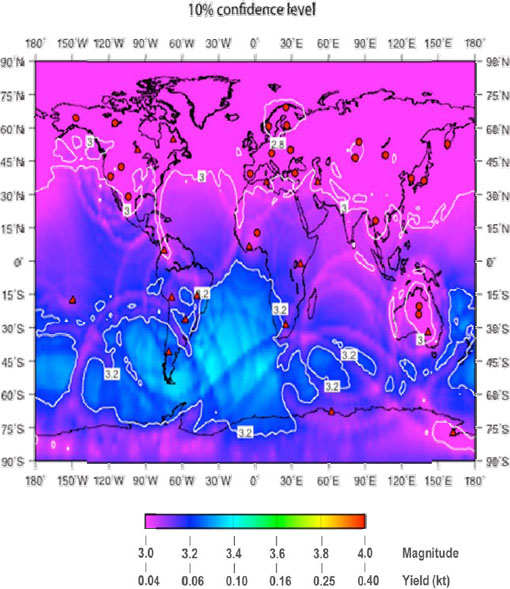
FIGURE 4-1: Map of 10 percent confidence detection levels (90 percent probability of avoiding detection) for the primary IMS Network (2007). The map represents detection capability of IMS primary seismic network, late 2007, with 38 stations sending data to the IDC. Contours indicate the magnitude of the smallest seismic event that would be detected with a 10 percent probability at three or more stations. Red circles are seismic arrays, and triangles are single seismic stations. This map is similar to Figure 2-8, except the probability of detection is 10 percent here rather than 90 percent in Figure 2-8. For reference, the magnitudes 2.8, 3.0, and 3.2 correspond to fully coupled device yields of 0.022 kt, 0.035 kt, and 0.056 kt respectively in regions of better propagation (The magnitude yield relationship comes from Box 2-1 in Chapter 2). SOURCE: Capability map prepared by Tormod Kværna and Frode Ringdal, NORSAR
The probability of repeatedly achieving a certain goal, such as successfully evading detection, goes down rapidly with the number of attempts. For instance if an evasive tester has 90 percent confidence of evading detection on one test, there will be only 81 percent confidence for evading detection on 2 tests and only 73 percent confidence of evading detection on 3 tests, etc. Historically, Nuclear Weapon States have conducted multiple nuclear-explosion tests to
develop sufficient confidence in the performance of a given weapon type. The committee notes, however, that nations could develop rudimentary fission weapons without testing, or more advanced weapons if provided with a previously tested design.
However, even in a world in which nuclear-explosion testing is constrained (e.g., potentially through the CTBT), it is possible that a State—whether currently acknowledged to possess nuclear weapons or not—may derive value by the conduct of just one nuclear-explosion test. For example, a nuclear weapons State may be able to address and/or confirm the resolution of an important technical problem with a warhead. Alternatively, an aspiring nuclear State might, as the United States did with the Trinity test, choose to confirm the performance of an implosion-type warhead. In these cases, a State might be willing to accept the risk level presented by one test only.14
Evasive Underground Testing
The 2002 Report addressed clandestine scenarios for evasive nuclear-explosion testing and concluded that only two warrant serious discussion: cavity decoupling—reducing the size of the seismic signal created by an explosion by muffling the explosion in a large underground cavity, and mine masking—concealing a nuclear explosion by conducting a nuclear-explosion test in a region that has frequent, large chemical explosions associated with mining operations.15 The 2010 committee again concludes that these are the only evasion scenarios that warrant serious technical exploration at the present time. The understanding of decoupling is supported by a very small test base, which is mainly derived from chemical explosions and has not changed appreciably in the past 10 years. As a result, there remain significant uncertainties in predicting the level of decoupling, especially for yields of a kiloton or more and in geological media other than salt. Thus for a clandestine tester to have strong confidence that a test would not be detected, it would be prudent to limit the planned test yield to levels concealable to the lower range expected for decoupling factors. The utility of mine masking is similarly limited, in this case by the well-known temporal signatures of mine blasts, their relatively small size, and the extensive base of seismic knowledge for mining regions. A more detailed technical discussion of evasive testing is presented in Appendix E.
Cavity Decoupling
Cavity decoupling is achieved by conducting the nuclear-explosion test inside a large chamber, such that ground motions are less efficiently generated than if the nuclear device were in close contact with the surrounding rock (the case of a well coupled or fully coupled explosion is used as the comparison point to assign the effectiveness of the technique). When decoupling is successfully accomplished, the explosion is muffled. Decoupling reduces the strength of seismic waves generated by an underground explosion and is characterized by a “decoupling factor” or DF.16
The volume of the cavity needed to achieve full decoupling increases linearly with the explosive yield. To achieve the maximum value of DF possible for a given yield, the pre-existing cavity must be sufficiently large that the surrounding rock does not fracture or deform
__________________
14 It is also possible, as was the case for the DPRK, that a State might wish to demonstrate (for political purposes) that it possesses nuclear weapons, in which case the risk assessment does not apply.
15 “The experimentation needed to explore other approaches to evasion would be highly uncertain of success, costly, and likely in itself to be detected. Thus the only evasion scenarios that need to be taken seriously at this time are cavity decoupling and mine masking” (NRC, 2002, p. 6).
16 DF is the ratio of the actual device yield divided by the apparent yield measured remotely by seismology, DF=1 for a fully-coupled explosion.
permanently (i.e., it is not stressed beyond the elastic limit). Such a “fully decoupled” explosion produces seismic waves in the Earth’s crust, but most of the energy goes into increasing the gas pressure in the cavity, thereby reducing the apparent yield of the original explosion by the factor DF. Once this limit is reached, increasing the volume of a cavity does not further increase the decoupling factor.
Larger explosions (>1 kt) are far more challenging to decouple than are smaller explosions because of the compounding of several difficulties. First, a larger cavity is required, which is more challenging to construct than a smaller cavity (e.g., Leith, 2001). It is noteworthy that the only nuclear-explosion tests known to have been decoupled (a Soviet Azgir test in 1976 and the U.S. Sterling test in 1966) used cavities that had previously been created by much larger well coupled nuclear explosions (see Figure E-1 in Appendix E).17 Second, a greater depth is needed, both to accommodate the larger cavity, and to contain the high gas pressure generated by the explosion.18 Third, the larger and deeper a cavity is, the harder it is to avoid cavity collapse before the nuclear explosion can be detonated.
Large non-spherical cavities in hard rock of the same volume are easier to construct and have been proposed for clandestine testing (Stevens et al., 1991; Leith, 2001; Murphy, 2009). The surface area of non-spherical cavities, however, is greater than that of a sphere of the same volume. Hence, the chance that more faults, cracks and joints would be encountered at the surface of a non-spherical cavity increases the chance that radionuclides could escape and be detected. The shortest dimension of non-spherical openings in hard rock will experience a more intense non-elastic pressure pulse compared with that experienced on the wall of a fully decoupled nuclear explosion of the same size in a spherical cavity.
Because of the challenge of creating sufficiently large cavities, nuclear scientists have long recognized the benefit to conducting experiments in geological salt deposits. There, large cavities can be formed by solution mining19 or cavities from previous nuclear-explosion tests in salt also may be used. In fact, the largest decoupling experiments, Azgir and Sterling, were both conducted in salt, so the most reliable information is available for this medium. Salt is relatively weak so it is difficult to create a large, air-filled cavity, especially at greater depth (Leith, 2001). In contrast, hard rock is strong enough to support large cavities but at much greater effort in excavation through conventional mining techniques (i.e., if one does not use a naturally occurring cavity or one created by a previous well coupled nuclear explosion).
The maximum decoupling factor value documented to date is DF = 70 (+/-8)—for the 380 ton (0.38 kt) Sterling test in a cavity created in a geological salt deposit by a previous much larger nuclear explosion (5.3 kt yield). This means that the waves measured were equivalent to those that would have been produced by a 380/70 = 5.4 ton well-coupled explosion. However, because of the limited nuclear-explosion test history for decoupling, predicting the effectiveness of a decoupling attempt is uncertain. For instance, if a decoupled test were to be attempted in a hard rock area, the available information20 indicates that the decoupling factor would be smaller than that for salt, about 20-40 rather than 70. Observations to date also indicate that explosions with yield above 1 kiloton (e.g., the Soviet test at Azgir) exhibit less decoupling—with DF 10-
__________________
17 The Mill Yard test is not included here because it was not contained and the amount of decoupling is uncertain (OTA, 1989 p. 4; Sykes, 1996; Murphy, 2009). It is briefly summarized in Appendix E.
18 The ‘Latter criterion’ for containment requires that the pressure due to the weight of the overlying rock be at least twice the pressure generated in the cavity by the explosion. Thus a larger explosion requires a larger cavity, greater depth, or both as summarized in Figure E-4. The pressure under a thickness h of rock having density ρ is ρgh, where g = 9.8 m/s2 is the acceleration of gravity (ρ is typically between 1.5 and 3 g/cm3). The Latter criterion is intended to ensure that the rock surrounding a cavity remains in compression during and soon after an explosion, thereby preventing venting of gases.
19 Dissolution of salt by flushing large amounts of water through the growing cavity.
20 The only tests in hard rock involved chemical explosions ranging in yield from a few pounds to about 10 tons.
20—than the sub-kiloton Sterling and chemical explosion tests. It is not well understood why decoupling is less effective at multi-kiloton yields and in hard rock than for sub-kiloton yields and in salt. Part of the problem when comparing chemical with nuclear explosions is the large difference in the source energy density.
The very limited nuclear test data on decoupling are shown in Figure E-1 in Appendix E. Calculations of decoupling have significantly overestimated the decoupling factor (by factors of 1.8-4) compared to observations. It may be that the heterogeneity of the Earth’s crust (including the presence of fractures) and the effects of non-elastic deformation are the cause of these too-high theoretical predictions of decoupling. Additional research taking advantage of advanced computation could help develop a better understanding of these phenomena as an aid to developing more effective monitoring measures. Such computation must be based upon adequate understanding of the material properties of rock on length scales much greater than can easily be measured in the laboratory.
For a potential evader, the uncertainty in the actual amount of decoupling would present a difficult technical challenge.
Mine Masking
Masking is intended to hide the occurrence of a nuclear explosion by conducting the test in a region that has frequent, large chemical explosions associated with mining operations: the motivation is that although the nuclear-explosion test might well be recorded, it would be incorrectly identified as just another conventional explosion associated with the mining operations in the region.
Mining operations detonate large explosions in a “ripple-fired” sequence, not as a single explosion, because fracture and excavation of rock are much more successful with a rapid sequence of blasts than with a single detonation and local seismic damage to infrastructure is minimized. Seismic methods can distinguish between a single, large explosion and its ripple-fired equivalent. Therefore, any single large explosion would be considered suspicious, whether or not it occurred in a mining area. As a confidence building measure, the CTBT provides for voluntary reporting of conventional explosions exceeding 300 tons yield (e.g., for mining, scientific research or other purposes). Some nations, including the United States, now voluntarily publish lists of known mine blasts that generate seismic signals.21
Past research (Smith, 1993) has shown that to mask a nuclear explosion, the event would have to have a yield less than 10 percent that of the masking explosions. It is therefore impractical to mask nuclear-explosion tests having device yields above 10-50 tons (see Appendix E). Moreover, mining regions with large numbers of explosions tend to be well characterized by seismology, because the blasts act as seismic sources that are picked up by regional stations, further limiting the utility of mine masking as a means of evasion. Additional information about mine masking is in Appendix E.
Finding 4-5: Mine masking is a less credible evasion scenario than it was at the time of the 2002 Report because of improvements in monitoring capabilities.
Monitoring Evasive Nuclear-Explosion Tests
The decoupling factors given above are for frequencies below 1–2 Hz. The seismic signal from a decoupled signal is less effectively reduced at the higher frequencies characteristic of regional monitoring (~10-40 Hz), as shown in Figure E-3 of Appendix E. These
__________________
21 See USGS web page: http://earthquake.usgs.gov/earthquakes/eqarchives/mineblast.
higher frequency signals are detectable at shorter distances (up to ~1,600 km [1,000 miles]) than are the lower frequency signals and thus can best be detected where there is a dense network of sensing stations, as is increasingly the case in Eurasia.
Unlike the understanding of decoupling itself, in the past 10 years, the capabilities of detection have advanced significantly. The IMS, when complete, (as summarized in Table 4-1) will provide a 90 percent global seismic detection limit of about 0.2 kt for a fully coupled nuclear-explosion test in hard rock. In addition, regional monitoring and focused monitoring at known or suspected test sites can detect explosions of much lower seismic yield, as for instance the 5-15 ton detection limit at Novaya Zemlya (see Appendix D) that is a result of U.S.—Norwegian cooperation in this area. As noted in the previous section, such limits are conventionally taken as a 90-percent probability of detection.
For 90-percent probability of avoidance of detection, the yield must be reduced by another factor of about 3. For Novaya Zemlya, the probability of successful evasion yield range would be about 2–5 tons. Using the range of decoupling factors that we consider plausible for hard rock (20-40), this corresponds to a device yield of at most 200 tons at this site to reduce the probability of detection to 10 percent. For comparison, applying the factor of 3 reduction for a high probability of successful evasion to the IMS global detection threshold leads to a fully decoupled device yield of about 90 tons (as shown in Table 2-2). In Appendix E, the Seismology Subcommittee describes several other regions of monitoring concern for which the possibility of decoupling leads to threshold capabilities similar to those described above for Novaya Zemlya. In general the Subcommittee argues that it is not credible for decoupled nuclear-explosion testing to be successfully hidden at yields above about 1 kt.
Table 4-2 summarizes the capability of the IMS seismic detection component and open regional systems to detect and locate underground explosions at two probability of detection levels, 10 percent and 90 percent, and in various regions of the world. Columns 3 and 4 show the potential impact of cavity decoupling for evasion with the anticipated DF = 70 for a cavity in salt and for an assumed DF of 20-40 for a cavity in hard rock. With continuing development of new capabilities, up to a 3-fold increase in sensitivity over the values shown in Table 4-2 may be achieved. The technical developments that could support this potential improvement include some combination of the use of array processing as implemented experimentally in the Smart Array experiment in Scandinavia (see Appendix D); waveform correlation methods; or other signal processing enhancements that might lead to further improvement in detection threshold, perhaps combined with the use of additional stations.
The entries in the table are marked (bold) for the 10-percent detection probability, which the Committee judges is the largest that would be used by a potential evader for planning purposes. Detection thresholds for regions of interest to the United States, such as Asia, including Russia and China are noted. The test sites in Russia, China, and North Korea can be monitored by IMS and USAEDS stations considerably more sensitively, and analysis of events around these test sites has been assisted by additional data from open seismic networks, further increasing sensitivity.
TABLE 4-2: Seismic Detection Thresholds of Coupled or Decoupled Underground Nuclear Explosions at 10-Percent (shown in bold face) and 90-Percent Detection Probability Based on Use of Both IMS and Open Monitoring Networks.
|
|
|||
|---|---|---|---|
| Monitoring Confidence Levels (2010 Networks) (1) (2) | Detection Thresholds (2010 Networks) Maximum Explosive Yield (3) | ||
|
|
|||
| Fully Coupled (kilotons) | Cavity Decoupled (kilotons) | ||
| Salt, DF = 70 Bomb-produced or solution-mined cavity | Hard Rock DF = 20-40 | ||
|
|
|||
| 1 | 2 | 3 | 4 |
|
|
|||
| Regional detection low-probability (~10%) detection threshold.(seismic magnitude: 2.2)(4) | 0.006 | 0.4 | 0.1-0.2 |
| Regional detection high-probability (~90%) detection threshold. (seismic magnitude: 2.8) (4) | 0.02 | 1.6 | 0.4-0.9 |
| Teleseismic detection low-probability (~10%) detection threshold for Asia, Europe, N. Africa and N. America, (seismic magnitude: 3.0)(5) | 0.04 | 2.5 | 0.7-1.4 |
| Teleseismic detection high-probability (~90%) detection threshold for Asia, Europe, N. Africa and N. America. (seismic magnitude:3.4) (5) | 0.09 | 6.2 | 1.7-3.6 |
| Teleseismic detection low-probability (~10% detection threshold for other regions. (seismic magnitude :3.4)(5) | 0.09 | 6.2 | 1.8-3.6 |
| Teleseismic detection high-probability (~90%) detection threshold for other regions. (seismic magnitude :3.8)(5) | 0.2 | 16 | 4-9 |
| (1) Explosive yields are estimated from the relationship seismic magnitude mb = 4.45 + 1.0 log Y (Kt) for fully coupled sub-kiloton explosions in a tectonically stable area. In regions that are tectonically active, a comparable seismic magnitude could be associated with a yield about four times larger. (2) Regional refers to event-station distances of less than about 1,600 km (1,000 mi), and teleseismic refers to event-station distances greater than about 1,600 km. (3) There is potential for significant improvement in these thresholds. See text for details. (4) Based on regional networks discussed in Chapter 2. (5) Based on IMS network thresholds described 'r more detail in Chapter 2. | |||
|
|
|||
SOURCE: Committee
Table 4-2 indicates that, in principle, fully decoupled underground nuclear-explosion tests in salt cavities might be conducted (e.g., in remote areas of Russia) with yields up to nearly 3 kt with only a 10-percent probability of teleseismic detection by the IMS. The Table is useful for making comparisons (for example, to demonstrate the importance of regional monitoring vs. teleseismic), but it should not be interpreted to convey practical realities or bottom-line capabilities. Achieving a DF of 70 for an explosion as large as a kiloton is not supported by practical experience (see Appendix E), suitable salt domes in which cavities could
be solution-mined exist in a very limited number of places in the world (most not on the current territory of Russia), and the committee believes that efforts to conduct solution mining of cavities on these sites would likely be detected by various intelligence methods.
Although the committee adopts a DF of 20-40, for hard rock, no cavity-decoupled nuclear explosion has been attempted in hard rock (see Appendix E). In addition, fully decoupled explosions in hard rock do not deform the rock plastically and hence are likely to leak radioactive materials from cracks and joints in the rock.
The data in Table 4-2 are the basis of the following finding.
Finding 4-6: With the inclusion of regional monitoring, improved understanding of backgrounds, and proper calibration of stations, an evasive tester in Asia, Europe, North Africa, or North America would need to restrict device yield to levels below 1 kiloton (even if the explosion were fully decoupled) to ensure no more than a 10-percent probability of detection for IMS and open monitoring networks.
There has been no experience with nuclear explosives tested in cavities in salt prepared by solution mining. Although it is possible for a country to clandestinely solution-mine a cavity in a salt dome, all cavities prepared by nuclear explosives are well located. A State could not mine a cavity in another State without that State’s knowledge. With the breakup of the Soviet Union, Russia no longer contains the many salt domes of the Pre-Caspian Depression in Kazakhstan, and “bedded salt” is less suitable for containing a nuclear explosion than is a cavity in a salt dome—due to greater likelihood of leakage of radioactive materials. Given the lack of experience anywhere in the world with fully decoupled nuclear explosion testing in mined salt or hard rock, and the likelihood that an evasive tester would probably test at or below the 10 percent detection probability, we find that cavity decoupling as a means of escaping detection by the IMS is decreasingly credible at device yields above 1 kt. The exception is in explosively produced cavities in salt domes; such cavity production would be eminently detectable by the IMS, and existing cavities are for the most part unsuitable and in any case could be closely monitored.
Finding 4-7: For IMS and open monitoring networks, methods of evasion based on decoupling and mine masking are credible only for device yields below a few kilotons worldwide and at most a few hundred tons at well-monitored locations.
Finding 4-8: The States most capable of carrying out evasive nuclear-explosion testing successfully are Russia and China. Countries with less nuclear-explosion testing experience would face serious costs, practical difficulties in implementation, and uncertainties in how effectively a test could be concealed. In any case, such testing is unlikely to require the United States to return to nuclear-explosion testing.
Finding 4-9: Better technical understanding of the decoupling process in various types of geologies would likely improve the capability to detect evasive nuclear-explosion testing.
Recommendation 4-1: If the possibility of evasive nuclear-explosion testing through cavity decoupling continues to be a concern, the United States should:
• Apply modern computational and experimental methods to understand the decoupling process in various geologies;
• Identify areas such as geologic salt domes advantageous for decoupling and consider the need for additional monitoring; and
• Identify indicators that a country is using—or may be planning to use—decoupling as an evasion strategy.
TECHNICAL SIGNIFICANCE OF DIFFERENT LEVELS OF TESTING
The information presented in the previous sections concerning the nuclear programs of other States with advanced nuclear weapons (Russia and China), the definition of a nuclear explosion under the CTBT, and the risk of detection entailed in attempts to test evasively, now allow us to return to the key question of this chapter. This is the assessment of the potential threats to U.S. security that undetected testing might pose. In addressing this question, we will consider both the issues of improvements in weapons capabilities of an existing nuclear State, more succinctly termed vertical proliferation, and the spread of nuclear weapons capability to new States or actors, horizontal proliferation.
The committee concludes that the States most able to carry out successful evasive testing are Russia and China. (Note that France has decommissioned its test site, and the United Kingdom utilized the U.S. test site in Nevada.) Russia, based on its more extensive history of using very-low-yield testing as part of its nuclear weapons development program, could use low-yield evasive tests to help modernize its existing nuclear stockpile or even develop new types of lower-yield tactical weapons. How China might utilize low-yield evasive testing in its strategic modernization is unclear. Other States might also benefit from low-yield evasive testing but with higher risk of detection and higher risk that their nuclear weapons, if deployed, would not perform as intended.
The committee agrees with the 2002 Report assessment that the Nuclear Weapon States recognized by the NPT would be more likely to succeed in evasive testing than States with less nuclear experience. However, the committee is not aware of any benefits from such testing that would require the United States to return to testing. Non-Nuclear Weapon States, or those with limited testing experience, might derive some limited benefit from low-yield or evasive testing—albeit with a higher risk of exposure. At the other extreme, a return to full-yield nuclear-explosion testing would likely present new strategic threats to the United States (see Box 4-3 below), not only from Russia and China, but also from proliferant States, either in violation of or outside of the NPT. Whether or not the United States would need to return to testing would depend on complex technical and political factors.
BOX 4-3 Examples of Nuclear Weapons Advanced Development: Limitations Imposed by CTBT Constraints on Testing
There are examples of advanced nuclear weapons technology that the U.S. assessed during the period of nuclear testing. It is likely that the Soviet Union/Russia pursued similar development paths. The examples were not taken beyond technology development to weaponization in the U.S. primarily because there was never a validated military requirement. To weaponize these concepts would have required several multi-kiloton tests. This is still likely to be the case today. Such tests would likely be detectable under the International Monitoring System.
Constraints of a Test Ban
There is no expectation that cessation of nuclear-explosion testing, by itself, will automatically result in elimination of nuclear weapons or will prevent nuclear weapons proliferation. The achievements of the U.S. Stockpile Stewardship Program provide evidence
that an existing nuclear weapons program can be maintained in the absence of testing, even though testing played a crucial role in the original development of nuclear weapons. Similarly the other NWS under the NPT since 1996 have committed publicly to maintain, and in a few cases to modernize, their nuclear weapons capability without testing. Thus for States that already have a nuclear weapons capability, foregoing testing limits vertical proliferation, constraining the development of new nuclear capabilities but not the ability to maintain a nuclear capability.
Similarly, the effect of the CTBT on horizontal proliferation will be to inhibit, but not eliminate, all potential dangers. However, the cost and effort and the risk of discovery to countries pursuing such horizontal proliferation clandestinely will be greatly increased.
Today the widespread availability of scientific knowledge and computing power make the technical barriers to horizontal proliferation, at least by a reasonably technically sophisticated nation, lower than at any time in the past, with or without testing. These technical barriers will continue to diminish as computing power becomes cheaper and as knowledge relevant to weapons spreads globally. The difficulty in obtaining the necessary fissile materials, under the NPT norm, is a barrier at least as great as limitations that would be imposed on testing by the CTBT. Finally, India, Pakistan, and perhaps now North Korea, have developed and are continuing to develop a militarily significant (at least in their region) nuclear weapons capability with only a few tests carried out with no attempt to conceal them from detection.
Finding 4-10: Threats could arise by clandestine nuclear weapons activity. For instance, a country with no testing experience and a modest industrial base could confidently build and deploy a single-stage, unboosted nuclear weapon without any testing, if it had access to sufficient quantities of fissile material. These advances could be made whether or not the CTBT were in force. However, it is highly likely that the United States could counter these threats without returning to nuclear-explosion testing and thus could respond equally well whether or not the CTBT were in force.
Although the broader value of limitations on testing to inhibit both vertical and horizontal proliferation must be considered within the context of diplomatic, military, and economic incentives/disincentives, these matters are beyond the scope of this report. In the following, we will present the technical assessment that is needed to inform policy decisions, which will certainly include consideration of these other factors.
Technical Constraints on Nuclear Weapons Development Posed by Testing with Intent to Avoid Detection by States with Varying Levels of Nuclear-Explosion Test Experience.
Table 4-3 summarizes technical constraints on nuclear weapons development posed by testing with intent to avoid detection by States with various levels of nuclear-explosion test experience: countries with greater prior text experience versus countries of lesser or no test experience. Note that it is assumed here that the States have made the commitment to the risks of clandestine testing and will test only to the level where they could have high confidence that they would escape detection; that is, no detectable indicators of a nuclear explosion. The evasion scenario explicitly considered here is cavity decoupling of underground explosions (see previous discussion on evasive nuclear-explosion testing).
Various levels of yields are shown in Table 4-3, starting with subcritical experiments (permitted under the CTBT), and increasing through levels of nuclear explosion yields up to 10 kt or greater. The table indicates plausible technical improvements at each level of testing that could accrue to countries with and without significant prior test experience.
Concealing a test at the 1 kt level (or higher) with high confidence of not being detected is judged to be unlikely even by an advanced nuclear weapons State such as China or Russia,
especially where a series of such tests would be required for the high confidence development of a destabilizing new nuclear capability. On the other hand, testing below 0.001 kt is judged likely to remain undetected via objective physical or chemical evidence. Testing at levels between these extremes presents increasing risk of discovery with higher yield, and would depend upon the levels of effort and competence to evade detection—e.g., by cavity decoupling.
The significant advances in nuclear explosion detection capabilities discussed in Chapter 2, and the issues of detection (and evasion) probability discussed in this chapter are reflected in this table, which updates a similar table that appeared in the 2002 Report. The committee’s intent in including this assessment is to provide the reader with a general idea of how easy or difficult it is to detect underground testing at different levels relative to the plausible technical achievements for underground testing; this summary does not represent any particular sensor network, medium, or location. Now, as in 2002, the 2012 committee recognizes that any such table risks oversimplifying a complex technical set of issues.
Thus, for the countries with greater nuclear-explosion test experience, capabilities increase from pursuing modifications of previously tested designs using very low yields (< 1 ton), possibly with evasive testing to avoid detection, to virtually unconstrained development of new or modified weapons with yields greater than 1 kt, very likely to be detected even with attempts at evasion.
For the countries with lesser nuclear-explosion test experience or design sophistication, capabilities range from exploring nuclear weapon physics and gaining experience and confidence with weapons physics experiments at very low yields (< 1 ton), to pursuing more complex implosion weapon designs by testing at yields up to and beyond 1 kt.
Regarding members of the “lesser experience” group, the most significant conclusions related to testing are, first, that they rely heavily on indigenous technical sophistication (perhaps with outside assistance) and, second, that they appear to be the most likely of any group to decide that even a single multi-kiloton test (with or without attempts to conceal) would strengthen confidence in their nuclear weapon capability.
The conclusion from the analysis above is that constraints placed on testing by the detection capabilities of the IMS, and the better capabilities of the U.S. NTM, will reduce the likelihood of successful clandestine nuclear-explosion testing, and inhibit the development of new types of strategic nuclear weapons. But the development of weapons with lower capabilities, such as those that might pose a local or regional threat or be used in local battlefield scenarios, is possible with or without the CTBT under various conditions for countries of different levels of nuclear sophistication. Again, such developments would not require the United States to return to testing in order to respond.
TABLE 4-3: Purposes and Plausible Technical Achievements for Underground Testing at Various Yields in the Absence of Horizontal Proliferation.
| Yield (tons of TNT equivalent)* | Countries of lesser prior nuclear-explosion test experience and/or design sophistication** (advances achievable in the specified yield ranges also include all of those achievable at lower yields) | Countries of greater prior nuclear-explosion test experience and/or design sophistication (items in column to left, plus) | |
|---|---|---|---|
|
|
|||
| Subcritical experiments (permissible under the CTBT | • Equation-of-state studies • High-explosive lens tests for implosion weapons • Development and certification of simple, bulky, relatively inefficient unboosted fission weapons (e.g., gun-type weapon) |
• Limited insights relevant to designs for boosted fission weapons | |
| <1 t (likely to remain undetected) | • Building experience and confidence with weapons physics experiments | • One-point safety tests • Validation of some unboosted fission weapon designs • Address some stockpile and design code issues |
|
| 1 t-100 t (may not be detectable, but strongly location dependent without evasion) | • One-point safety tests • Pursue unboosted designs*** |
• Develop low-yield weapons (validation of some unboosted fission weapon designs with yield well below a kiloton) • Possible overrun range for onepoint safety tests | |
| 100 t-1 kt likely to be detected without evasion, reduced probability of detection with evasion (but strong location dependence) | • Pursue improved implosion weapon designs • Gain confidence in certain small nuclear designs |
• Proof tests of compact weapons with yield up to 1kt • Validate some untested implosion weapon designs • Assess stockpile issues and validate some design codes |
|
| 1 kt-10 kt unlikely to be concealable | • Begin development of low-yield boosted fission weapons • Eventual development and full testing of some implosion weapons and low-yield thermonuclear weapons • Eventual proof tests of fission weapons with yield up to 10 kt |
• Development of low-yield boosted fission weapons • Development and full testing of some implosion weapons and lowyield thermonuclear weapons • Proof tests of fission weapons with yield up to 10 kt |
|
| <10 kt not concealable | • Eventual development and full testing of boosted fission weapons and thermonuclear weapons or higher- yield unboosted fission weapons | • Development and full testing of new configurations of boosted fission weapons and thermonuclear weapons • Pursue advanced strategic weapons concepts (e.g., EMP) |
|
Notes: * In this column the committee summarizes the current state of technology for detecting underground nuclear explosions. This summary does not represent any particular sensor network, medium, or location. For example, IMS detection capabilities can be substantially better than what appears in the column for some locations, and detection capability has generally improved over time.
** That is, lacking an adequate combination of nuclear-test data, advanced instrumentation, and sophisticated analytical techniques, and without having received assistance in the form of transfer of the relevant insights.
*** Limited improvements of efficiency and weight of unboosted fission weapons compared to 1st generation weapons not needing testing (NRC, 2002. p. 68)
SOURCE: Committee
Finding 4-11: The value of low-yield evasive underground testing to a particular country depends on that country’s nuclear-explosion test experience and/or design sophistication.
• Nuclear Weapon States could use low-yield evasive testing to partially validate design codes and modernize their arsenals.
• Countries with lesser test experience could build confidence with weapons physics experiments or develop and certify inefficient, unboosted fission weapons that might pose a regional threat.
Because such tests may be undetectable, these advances could be made whether or not the CTBT were in force.
Finding 4-12: Russia and China are unlikely to be able to deploy new types of strategic nuclear weapons that fall outside of the design range of their nuclear-explosion test experience without several multi-kiloton tests to build confidence in their performance. Such multi-kiloton tests would likely be detectable (even with evasion measures) by appropriately resourced U.S. national technical means and a completed IMS network.
Finding 4-13: Other States intent on acquiring and deploying modern, two-stage thermonuclear weapons would not be able to have confidence in their performance without multi-kiloton testing. Such tests would likely be detectable (even with evasion measures) by appropriately resourced U.S. national technical means and a completed IMS network.
This page intentionally left blank.


