
7
Cost-Benefit Analysis for Noise Control
The Federal Aviation Administration (FAA) is developing methods of using cost-benefit analyses to assess noise around airports. The costs and benefits of reducing highway noise have received less attention in the United States and have been emphasized in this chapter. Highway noise barriers are an effective means of noise reduction because they interrupt the propagation path between the noise sources and nearby homes. At highway speeds most of the noise is generated by the interaction between vehicle tires and the road surface. The generation of sound by this interaction is complicated and involves “air pumping” as the tread alternately engages and releases from the road surface, vibration of the sidewalls, and other mechanisms. A layman’s discussion of the various sources can be found in The Little Book of Quieter Pavements, published by the Federal Highway Administration (FHWA; Rasmussen et al., 2007). A great deal of research has been done on the characteristics of pavements that result in lower noise levels. What is needed is a cost-benefit analysis of highway noise reduction to ensure that the best mitigation methods are being applied.
The committee decided to focus on surface transportation noise for several reasons. In a 1981 report the U.S. Environmental Protection Agency (EPA) estimated that 24 million people were exposed to high day-night average sound levels (DNLs; greater than 65 dB) of surface transportation noise (19.3 million for highway noise and 4.7 million for rail noise); in the same report the number of people exposed to air transportation noise was estimated at 2.5 million people. Although no studies have been conducted to determine surface transportation exposures since then, it is likely that population growth, increased residential development near highways, and increased traffic volume have also increased exposures to highway traffic noise.
However, in the past 30 years, air transportation has led the way in technological developments and operational improvements to reduce noise and more recently to reduce environmental impacts; in addition, economic analysis tools have been developed for determining the costs and benefits of these improvements to the environment. In fact, a 2007 study showed that the number of people exposed to high levels of air transport noise in the United States had decreased to approximately 500,000 (Waitz et al., 2007).
As the numbers above reflect, reducing air transportation noise has been the focus of intense efforts by the public and by policy makers since the advent of the jet age. As Figure 7-1 shows, advances in technology and airport management have resulted in significant reductions in airport noise contours (e.g., the perimeter around airports where DNLs exceed 65 dB). As a result, the number of people exposed to noise in excess of 65 dB has decreased dramatically over the past several decades, although there are still many serious noise problems around airports.
Technologies to reduce highway noise generated by surface vehicles have also been investigated. Studies have shown that the most significant source of noise at highway speeds is interaction between tires and highway surfaces. Attempts to modify tires have had limited success because the primary concerns in tire design are safety and performance. However, highway surfaces can be modified to reduce overall noise without compromising safety.
The current approach to addressing noise levels along proposed highways is to construct sound barrier walls in residential areas to protect occupants from excessive noise levels as measured at the property line nearest the highway. However, noise barriers are expensive, and residents often consider them an eyesore because they obstruct views and are sometimes subject to graffiti. In addition, they provide significant noise reduction for only the first one or two rows of houses behind the barrier (FHWA, 2009a).
One question of interest to the committee was whether a greater number of residents would benefit if “quiet” pavement technology were used instead of barriers to reduce the noise level at the source. To make that assessment, the committee believes that cost-benefit analysis tools developed by EPA and the FAA should be used to identify variables and measurable characteristics and relate them to one another in commensu-
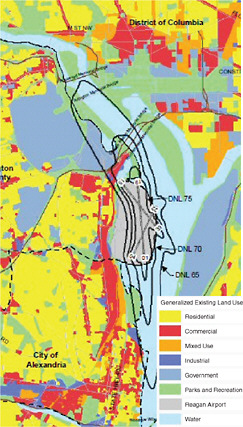
FIGURE 7-1 Contour map showing Day-Night Average Sound Levels (DNL) around Ronald Reagan National Airport in Washington, D.C. Source: Reprinted with permission of EA Engineering, Science and Technology.
rate ways. The committee also recognized that some likely variables for surface transportation noise, such as long-term noise reduction characteristics, installation costs, and maintenance costs of quiet pavements would not be available.
FHWA has developed a software tool called the Traffic Noise Model (TNM; FHWA, 2009b). The TNM is a useful tool for estimating sound pressure levels at various distances from a highway in terms of traffic mix, speeds, and other factors. Using various scenarios, noise reductions in decibels can be predicted by the model. However, no attempts have been made to monetize those benefits in terms of home values, sleep disturbance, or other measures of impact. The TNM could also provide information showing that quiet pavements could eliminate the need to construct a barrier or that a less expensive barrier would provide enough noise reduction, as measured at the property line.
The remainder of this chapter describes how environmental economic analysis techniques have been used by EPA and the FAA for purposes of cost-benefit analysis and how such analyses might be used for surface transportation noise. In addition, European efforts to conduct cost-benefit analyses on highway noise are reviewed, as is pavement research that will lead to lower noise levels and will be a vital input to any cost-benefit analysis model.
ENVIRONMENTAL ECONOMIC ANALYSIS
Microeconomics (i.e., the study of disaggregated entities and behaviors) is generally used rather than macroeconomics (i.e., the study of aggregates) to analyze environmental issues. When resources are scarce, economic analyses can help planners compare options to determine which uses of those resources will generate improvements in well-being for people who live near busy highways. Environmental economic analyses provide a rigorous, quantitative approach to support these decisions.
To compare relative values requires metrics that are comparable in terms of the outcomes each alternative produces (i.e., decibel reductions) as well as in terms of costs, both in dollars and negative effects (including eliminating potential desirable outcomes or benefits). Economists use monetary value to compare alternatives, and the conversion to monetary values of physical or social effects that are not naturally denominated in dollars is called monetization. The primary framework used to compare monetized positive and negative attributes of alternative policies and investment choices is called cost-benefit analysis (CBA) or benefit-cost analysis—the terms are interchangeable.
General guidelines for government entities conducting a CBA have been published by the Office of Management and Budget (OMB) in the form of circulars. For example, Circular A-94, first published in 1992 and updated annually, provides discount rates (OMB, 1992). Because OMB’s audience includes all federal agencies, the guidelines are general, rather than domain specific. Thus, Circular A-94 encourages monetization but does not offer specific guidance on monetization techniques.
Individual agencies often publish their own more detailed domain-specific guidelines. For instance, EPA published Guidelines for Preparing Economic Analyses, which covers nuances of CBA in the environmental arena and provides detailed guidelines for monetization (EPA, 2000). In comparison to the 21-page Circular A-94, EPA’s Guidelines includes more than 200 pages. One area in which EPA has authority to engage in CBA is noise (42 USC 65, Section 4913).
Because the reader may not be familiar with CBA as practiced by economists or with terms such as willingness to pay,
willingness to accept, revealed preference, stated preference, and others, a summary of CBA is included in this report as Appendix F. In the appendix, OMB guidance on CBA is mentioned, but emphasis has been placed on EPA procedures because of the agency’s experience with this subject. Where possible, suggestions have been made as to how EPA procedures would apply to CBA for noise issues.
The FAA has also been developing CBA tools for use around airports. A summary of these activities is given in the next section to provide an introduction to what FHWA might develop for CBA of noise reduction along the nation’s highways.
COST-BENEFIT ANALYSIS OF AIRCRAFT NOISE
The methods being developed by FAA to perform a CBA of measures for mitigating aircraft noise illustrate useful applications of the general concepts described earlier in this chapter.1 It is well documented that aircraft noise has a range of undesirable impacts, primarily felt by people living around airports. These include physical effects, such as annoyance (e.g., interference in speech communication and activities), sleep disturbance, impacts on school learning and academic achievement, physical and mental health effects, building rattling and other noise, and compromised work performance (WHO, 2004). These effects result in monetary impacts, such as lower property values, health costs, and personal and business economic costs. To perform CBA, aircraft noise must be related to these impacts.
The sound at a given point from one aircraft in flight is typically measured (or estimated) and then expressed in decibels in a metric called the effective perceived noise level. This metric is used by the FAA as a measure of airplane noise emission. This metric takes into account the nonuniform response of the human ear, tonal corrections, and other factors. Then the noise from a representative sample of flights (typically for one day) can be combined into a measure, such as the standard DNL metric, in which the sound energy from multiple events is averaged, and a 10-dB correction is made for flights that occur between 10 p.m. and 7 a.m. DNL and other average measures have been shown to correlate with community response to aircraft noise, as shown, for example, in Table 7-1.
It is important to recognize that responses to aircraft noise vary widely among people and communities, as illustrated in Figure 7-2. Note that for aircraft noise levels typical of communities within 5 miles of airports (55 to 65 dB DNL), the proportion of the population “highly annoyed” varies from 0 to 75 percent. This variability in personal and community response suggests that monetization methods based on statistical distributions, or that accept ranges of inputs, may be most relevant. Thus, the DNL metric is most useful for summary assessments but may not adequately describe the effects of noise on a specific impacted population; it is also sometimes difficult to explain the DNL concept to the public. Information on this subject can be found in a report by the National Research Council Transportation Research Board (Eagan, 2007).
Because it is difficult to assess independent impacts of noise on annoyance, sleep, health, school learning, and so on, it is typical to use one of two methods as surrogates for the total impact of noise. The first of these is the change in property value associated with aircraft noise. Many studies have statistically analyzed this relationship, typically presenting it in terms of a noise depreciation index (NDI) with units of percentage of property value loss per decibel. The results of many of these studies are shown graphically in Figure 7-3 (left). Figure 7-3 (right) shows the results of willingness-to-pay (WTP) studies based on carefully designed surveys of people who live near airports; the typical metric is euros per decibel per household per year. The “X” marks an equivalent value between the two measures (assuming an appropriate average house price and depreciation level).
Both measures of economic impact reflect the wide variability that is characteristic of personal and community responses to noise. Nevertheless, both methods (observing real estate transactions and surveying people) produce similar results in terms of overall value and a similar range of values from low to high. Thus, they provide a basis for estimating the economic impacts of aircraft noise—as a surrogate for estimating the large number of individual impacts, many of which overlap in meaning and are difficult to value (e.g., the relationship between sleep disturbance, stress, and school or work performance).
TABLE 7-1 Relationship between Day-Night Average Sound Level and Impacts
|
Day-Night Average Sound Level (dB) |
Hearing Loss Qualitative Description |
Annoyance |
||
|
Percentage of Population Highly Annoyed |
Average Community Reaction |
General Community Attitude |
||
|
≥ 75 |
May occur |
37 |
Very severe |
Noise is likely to be the most important adverse aspect of the community environment. |
|
70 |
Not likely to occur |
22 |
Severe |
Noise is one of the most important adverse aspects of the community environment. |
|
65 |
Will not occur |
12 |
Significant |
Noise is one of the important adverse aspects of the community environment. |
|
60 |
Will not occur |
7 |
Moderate to slight |
Noise may be considered an adverse aspect of the community environment. |
|
≤ 55 |
Will not occur |
3 |
Moderate to slight |
Noise is considered no more important than other environmental factors. |
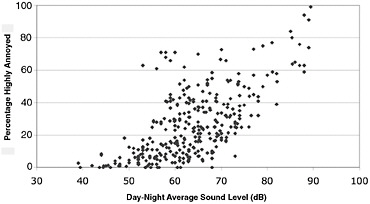
FIGURE 7-2 Relationship between percentage of population highly annoyed and DNL level, in decibels. Sources: Kish (2008) and Fidell and Silvati (2004).
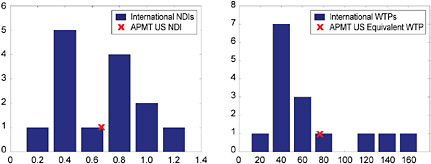
FIGURE 7-3 (left) Noise depreciation indices (NDI) (percent of property value loss per decibel); (right) willingness-to-pay (WTP) values (Euros/household/dB/year) based on a number of North American, European, Japanese, and Australian studies of aircraft noise. APMT = Aviation Environmental Portfolio Management Tool. For reference, “X” marks equivalent values (assuming an average housing price and depreciation value). Source: Kish (2008).
The FAA has recently developed methods that overlay contours of noise levels with census data describing populations and housing values (FAA, 2008; Kish, 2008). With these, statistical distributions and ranges of NDIs and WTP values are used to provide monetized estimates of the negative impacts of noise. These monetized estimates are then compared to policy implementation costs, industry costs, and costs and benefits associated with changes in other interdependent environmental impacts. These tools have recently been developed and, to date, have been used only in sample cost-benefit analyses of technology, operations, and policy options. Nonetheless, the intention is to use them for real analyses after further research and development. More information can be found at http://web.mit.edu/aeroastro/partner/apmt/ and http://web.mit.edu/aeroastro/partner/apmt/noiseimpact.html.
COST-BENEFIT ANALYSIS FOR HIGHWAY NOISE
Since the 1980s, few major CBAs have been done for highway noise in the United States.2 A meta-analysis in 1982 of 17 hedonic pricing estimates for the United States and Canada showed a range of NDIs of 0.16 to 0.63 percent, with a mean value of 0.40 percent per decibel (Nelson, 1982). New studies, using CBA techniques described in this report and economic terms, such as hedonic pricing, stated preference, and WTP, are needed to assess the costs and benefits of both sound barriers and quieter road surfaces with respect to noise abatement, especially to compare the two to ensure that funds currently provided for noise mitigation are being well spent.
The FHWA policy for highway noise abatement includes an implied CBA in determining the “reasonableness” of the abatement method (i.e., sound walls). Following the process outlined in FHWA noise policy 23 CFR 772, each state develops a cost allowance associated with any noise-impacted residence for a proposed highway project (FHWA, 2006). These cost allowances range from a low of $10,000 per residence to a high of $50,000. Some states allow increases in these values based on the severity of the predicted impact and, in some cases, the predicted noise reduction. The cost allowance for all “benefited” residences that receive a 3- to 5-dB reduction from a proposed sound wall are then totaled, and this cost is compared to the cost of the sound wall, using a process specific to individual states.
FHWA policy does not now allow quieter pavement to be considered as a noise abatement method, and therefore it is not included in the CBA. However, a National Cooperative Highway Research Program project (NCHRP 10-76) is under way to develop methodologies for including quieter pavement in CBAs. One of the problems encountered so far is that the noise reduction from quieter pavements typically degrades over time and must be rehabilitated, on some cycle, throughout the life of the highway. Barriers, on the other hand, are typically assumed to have minimal ongoing costs.
Policies on Noise Barriers
According to official FHWA policy, “the use of specific pavement types or surface textures must not be considered as a noise abatement measure” (FHWA, 2009c). Thus, wherever highway noise mitigation is required, noise barriers should be used. A summary of the number of barriers that have been constructed and their costs is given below. Benefits are achieved only relatively close to the highway and are generally measured in terms of a reduction in A-weighted sound pressure level.3 In addition, noise barriers are not feasible in many areas—for example, to protect homes on a hillside above a busy highway.
Barriers are constructed from a variety of materials, including wood, concrete block, precast concrete, brick, and other materials. Earth berms may also be used as noise barriers. Construction of barriers is a cooperative effort between FHWA and the state in which the barrier is constructed, in determination of both the requirements and the costs. FHWA defines two types of highway projects for which barriers are considered. A Type I highway project is a planned new construction project or construction to increase the capacity of an existing highway. Federal laws require that a noise impact statement be prepared, and if noise levels exceed an established limit, noise abatement must be considered. The limits, set by the state, range from 64 to 67 dB(A) in response to the FHWA requirement that abatement be provided for levels “approaching” 67 dB(A) for the loudest hour predicted for the highway project. Given typical urban region traffic patterns, this worst level of 67 dB(A) can result in day-night levels of 69 dB(A) or more (Greene, 2002).4 Once a sound wall is designed, the state determines if it is “reasonable” (cost-effective) and “feasible” (technically) to construct the barrier. Feasible in this context equates to the requirement that the barrier achieve at least a 5-dB noise reduction. If not, the barrier is not feasible, and no abatement is implemented in the project.
Barriers for Type II projects, those undertaken in response to noise complaints, are voluntary. FHWA will provide matching funds for Type II projects, although the requirements for this are often difficult to meet. As a result, construction of barriers for existing highways is rare, and cost is a major factor.
Design and Performance
Information on the technical aspects of barrier design and evaluation are available in I-INCE (1999) and FHWA (2009d). In the I-INCE document (1999), the best estimate by the working group that prepared it was that barrier insertion loss (the difference in A-weighted sound pressure level before and after installation of a barrier) typically ranges from 5 to 12 dB. FWHA (2009d) classifies the insertion loss (attenuation) as follows:
5 dB = simple
10 dB = attainable
15 dB = very difficult
20 dB = nearly impossible
The fundamental quantity in barrier design is the Fresnel number (the difference in path length from source to receiver with and without the barrier, measured in half-wavelengths of the sound). High frequencies have a high number and more attenuation; low frequencies have a lower number and are more difficult to attenuate.
Barriers are most effective when constructed near the highway or near the receiver (which tends to maximize the path-length difference); the exact range of barrier effectiveness depends a great deal on the terrain. For example, in a rising ground level the effectiveness can be small (low Fresnel number), whereas if the ground level goes down, the barrier is more effective. FHWA (2009a) estimates that barriers are most effective within 200 feet of a highway FHWA. Thus, only a few rows of homes are protected by a barrier.
Cost
The costs of barrier construction, as documented by FHWA, are summarized here (FHWA, 2007).5 Costs vary from project to project, and methods of reporting costs are not uniform from state to state. However, available data are a good starting point.
The obvious variables are barrier height and length. According to Polcak (2003), the most reliable cost breakdown is for Type II barriers and can be divided into seven categories:
-
Preliminary. This category includes mobilization costs, clearing and grubbing, field office setup, and other preparatory activities that must be done before construction begins.
-
Drainage. This category includes everything related to maintaining and facilitating drainage of the barrier site, including, but not limited to, inlets, pipes, underdrain systems, ditch treatments, rip-rap, and stormwater management facilities.
-
Excavation. This category includes grading and excavation ditches, benching, construction roads, and other access features.
-
Guardrail. This category includes traffic control devices, signage, jersey barriers, or other protective equipment that may be used for maintenance of traffic requirements or ultimately protecting the newly installed noise barrier from vehicle impacts.
-
Utilities. This category includes temporary or permanent relocations of overhead or underground utilities that may be affected by the noise barrier construction.
-
Barrier system. This category includes basic physical elements of the structural barrier system, including posts, panels, and foundations. Also included are grade beams; special panels; architectural, decorative, or aesthetic finishes; or absorptive-surface treatments. There might also be special foundation requirements to accommodate subsurface conditions or retaining walls.
-
Landscaping. This category includes site restoration when construction is complete, trees and shrubs, seeding, mulching, and so forth.
FHWA requests information every three years from the states on the number of miles of barrier constructed and the costs. Through the end of 2004, 45 states and the Commonwealth of Puerto Rico had constructed 2,205 miles of noise barriers at a cost of $3.4 billion (FHWA, 2009a). Thus, the average cost per mile is approximately $1.54 million in 2004 dollars. Table 7-2 shows the cost breakdown. The apparent discrepancy between the numbers above and below is because not all states are included in the table; data from California for 1998 to 2004 are missing.
Cost elements used to determine project costs vary greatly from state to state; some states report the total bid cost, others just use the cost of the barrier “system.” Even the items included in the reported barrier system may differ. States that use the same or similar approaches may use different underlying assumptions. Thus, detailed comparisons are difficult to make.
If, in the upper left table, Minnesota were eliminated and, in the lower left table, Colorado were eliminated (to be able to compare the same nine states), the average barrier cost per square foot for nine states would be $18.29. The highest cost is for Pennsylvania ($24.88), and the lowest cost is for California ($13.04). However, recent data for California are not included, so Ohio should be considered the low-cost state ($13.51). The 10-state average is thus $1.75 million per linear mile. Table 7-3 shows data for the states in Table 7-2 using common data converted to metric units.
Costs from earlier FHWA data, published by Polcak (2003), show costs per project for many states. For example, Figure 7-4 shows construction costs in Maryland for precast concrete barriers and for all barriers. Note that the vertical
TABLE 7-2 Noise Barrier Construction by State, through 2004
|
|
Square Feet (thousands) |
|
Linear Miles |
|
California |
30,644 |
California |
482.8 |
|
Virginia |
11,227 |
Arizona |
155.1 |
|
Arizona |
11,226 |
Virginia |
127.5 |
|
New Jersey |
9,440 |
Ohio |
112.4 |
|
Ohio |
8,675 |
New Jersey |
96.9 |
|
Maryland |
8,422 |
Colorado |
92.5 |
|
Minnesota |
7,187 |
New York |
90.7 |
|
New York |
7,011 |
Pennsylvania |
87.0 |
|
Florida |
6,700 |
Minnesota |
83.7 |
|
Pennsylvania |
6,415 |
Maryland |
81.8 |
|
10-State Total |
106,946 |
|
1,410.4 |
|
|
Actual Cost at Time of Construction ($ millions) |
|
Cost in 2004 Dollars ($ millions) |
|
California |
399.6 |
California |
592.8 |
|
Arizona |
258.7 |
Arizona |
284.6 |
|
New Jersey |
202.4 |
New Jersey |
277.5 |
|
Maryland |
200.9 |
Maryland |
253.6 |
|
Virginia |
169.6 |
Virginia |
225.3 |
|
New York |
165.9 |
New York |
207.3 |
|
Pennsylvania |
159.6 |
Pennsylvania |
197.8 |
|
Florida |
150.7 |
Florida |
175.9 |
|
Ohio |
117.2 |
Ohio |
139.0 |
|
Colorado |
80.0 |
Minnesota |
107.7 |
|
10-State Total |
1,904.5 |
|
2,461.4 |
scales are costs per square meter. Similar data for Virginia, including all construction materials, are shown in Figure 7-5. As the figures show, there is a great deal of variability in cost from project to project, and the data are only weakly dependent on barrier length. A major factor in the variability is that FHWA data for the states include barriers for both Type I and Type II projects, which by their nature are more likely to have different elements included in the cost figures.
TABLE 7-3 Summary of Barrier Construction and Costs, by State
|
State/Total/Average |
Barrier Area (m2) |
Cost per Square Meter ($) |
Barrier Length (km) |
Barrier Cost per Kilometer ($ thousands) |
|
California |
2,847 |
140.36 |
777.0 |
0760 |
|
Arizona |
1,043 |
248.05 |
249.6 |
1140 |
|
New Jersey |
877 |
230.78 |
155.9 |
1780 |
|
Maryland |
782 |
256.76 |
131.6 |
1930 |
|
Virginia |
1,043 |
162.60 |
205.2 |
1100 |
|
New York |
651 |
254.70 |
146.0 |
1420 |
|
Florida |
622 |
242.11 |
|
— |
|
Ohio |
806 |
145.42 |
180.9 |
0770 |
|
Pennsylvania |
596 |
267.80 |
140.0 |
1410 |
|
TOTAL |
9,268 |
|
1,986.3 |
|
|
AVERAGE |
|
196.87 |
|
1100 |
Quiet Pavement Design
FHWA policy supports research related to quiet pavements. However, predictions of highway noise, and the criteria for whether noise mitigation is allowable for federal cost sharing, are based on an average of all pavement types. Thus, even if the noise characteristics of a particular pavement type are known, they are not used in highway noise predictions. Modifications of source data to account for quieter pavements are allowable only under the stringent requirements of the FHWA Quiet Pavement Pilot Program (FHWA, 2005). In addition, because there are no acceptance tests in place to ensure that a pavement meets planned noise levels, there are no incentives for state or local agencies to build or maintain quieter pavement that would benefit the public. Other issues related to the design and implementation of low-noise road surfaces include measurement of the noise reduction at the source and its relationship to noise measurements in the community, the technology of the design of road surfaces, safety, and durability. Many of these issues were discussed at a workshop sponsored by the National Academy of Engineering (NAE) in February 2007.6
Long-term studies have been under way for several years on the durability of road surfaces (CDOT, 2005; Rochat, 2002), and the results of a 52-month study were recently published (Rochat and Read, 2009). In addition, there have been many studies in Europe (see section below) and other studies in the United States (Corbisier, 2005; Donavan, 2005a,b, 2006; Rasmussen et al., 2007; Reyff, 2007a,b). FHWA maintains a home page on the subject (FHWA, 2009e) as well as guidance for the development of quiet pavement programs (FHWA, 2009c). The Tire-Pavement Noise Research Consortium is funded by eight states and FHWA (TPNRC, 2009). FHWA also sponsors a workshop, “Tire-Pavement Noise 101,” that has been given in many states; the essence of the course material is available in the The Little Book of Quieter Pavements (Rasmussen et al., 2007a,b).
Quiet pavements reduce noise by controlling the surface characteristics of the pavement. Much less documentation is available on the costs for pavement modifications by resurfacing and grinding than on the costs of noise barriers. The literature to date provides data only on pilot projects, with the emphasis on onboard noise measurements, the correlation of these data with pass-by noise, surface characteristics and their relationship to noise emission, and the durability of road surfaces (Donavan, 2006).7 Costs for quiet pavements vary with the extent of treatment (e.g., grinding), the addi-
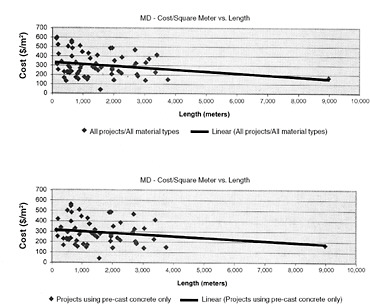
FIGURE 7-4 Cost of barriers per square meter in Maryland for all projects (upper) and for precast concrete (lower). Source: Polcak (2003).
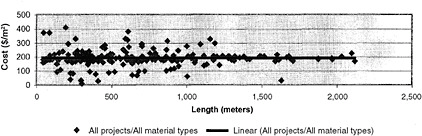
FIGURE 7-5 Cost of barriers per square meter in Virginia for all projects. Source: Polcak (2003).
tion of a thin (25-millimeter) porous layer, the removal of and complete replacement of pavement, and the construction of a new road.
Scofield provides some information on diamond grinding; at an average cost of $3.52 per square yard, the cost for 1 mile would be $61,952 per 30 feet of highway width.8 According to Arizona guidelines from 2007, the cost of a 25-millimeter asphalt rubber asphaltic concrete friction course is $6.55 per square yard;9 thus, the cost for 30 feet of highway width is still well below the cost per mile of a noise barrier. As discussed in the previous section, the average cost of a noise barrier in 10 states was estimated to be $1.75 million per linear mile. According to the Transportation Research Board (Alexandrova et al., 2007), asphalt rubber friction
course overlays also have a positive impact on tire wear, emissions, and air quality.
Based on data compiled by the California Department of Transportation, some analysis has been done comparing the typical costs of barriers to the costs of quieter pavement options (Donavan, 2005b). Assuming that barriers are 16 feet high, the maximum allowed in the state, and that they line both sides of a freeway, the cost was estimated at $5 million per mile. Assuming a six-lane freeway, the cost of a quieter pavement overlay, such as rubberized open-graded asphalt, was estimated at $210,000 to $270,000 per mile. For Portland cement concrete pavement surfaces, the cost of grinding the pavement to reduce tire/pavement noise was estimated at $320,000 to $600,000 per mile.
Noise barriers protect only the first few rows of houses, whereas pavement treatments, which essentially reduce noise emissions, can provide protection at greater distances. Complaints about highway noise may come from long distances from the highway. This was documented in a report by the Transportation Research Board in 2006 (Herman et al., 2006):
A portion of 1-76 near Akron, Ohio, was reconstructed by the Ohio Department of Transportation with concrete pavement to replace the previous asphalt surface. During reconstruction, the concrete surface was textured with random transverse grooves. After construction, residents living in the project area as far as 800 m (2,600 ft) from the roadway perceived an undesirable increase in noise level, which they attributed to the new concrete pavement in the reconstruction project. Therefore, another project was initiated to retexture the pavement surface by diamond grinding. The transverse grooves were replaced with longitudinal grooves. Traffic noise measurements were made before and after grinding at five sites in the project area, at distances of 7.5 m (24.6 ft) and 15 m (49.2 ft) from the center of the near travel lane. The average reduction in the A-frequency-weighted broadband noise levels at 7.5 m (24.6 ft) was 3.5 dB, and the average reduction at 15 m (49.2 ft) was 3.1 dB. Spectrum analysis showed that the greatest reduction in noise occurred at frequencies above 1 kHz and that the retexturing had little to no effect on frequencies less than 200 Hz.
Unfortunately, the report does not note if complaints ended after the grinding or whether before/after noise measurements were made at long distances. A detailed CBA will be necessary to determine if the extensive use of low-noise road surfaces will have a general benefit for people who live near busy highways.
With current technology, noise reduction from tire/road interaction is not as effective as can be achieved by noise barriers. However, because larger reductions are achieved only near the barrier, relatively few people benefit from the reduction. Reduction of the tire/road interaction noise provides a smaller benefit, but it is a noise reduction at the source and therefore can benefit a larger number of people. CBA is an approach to making this kind of trade-off.
EUROPEAN COST-BENEFIT ANALYSES
Many CBAs of mitigation options for aircraft, road, and rail noise have been done in Europe. This section provides a brief summary of selected activities.
In 2001 a workshop on CBA, “A Billion Euro Question,” was held in The Hague, Netherlands, in conjunction with the 2001 International Congress and Exposition on Noise Control Engineering (INTER-NOISE 01).10 The focus of the workshop was on how much should be paid for noise control, and several presentations included descriptions of how aircraft, road, and rail noise were valued. In December 2001 the European Commission sponsored a second workshop, “State-of-the-Art in Noise Valuation,” and a workshop report was published in 2002 (Vainio and Paque, 2002). The workshop participants came to the following conclusions:
-
Contingent valuation and revealed preference (including the hedonic price method) were acceptable methods for valuing the benefits of noise reduction, with the caveat that these methods be followed rigorously to ensure that the results are meaningful.
-
A day-evening-night sound level of 55 dB should be an interim lower cutoff point for noise valuation.
-
A rough assessment of the cost per household per decibel per year for levels above 55 dB should be between 5 and 50 Euros.
On April 14, 2002, a 68-page report was delivered to the European Commission Directorate General Environment on the theoretical basis and valuation techniques for cost-benefit reviews and other studies of noise valuation for road traffic, aircraft noise, rail noise, and industrial noise (Navrud, 2002).
Strategies and Tools to Assess and Implement Noise Reducing Measures for Railway Systems (STAIRRS) was a project to review strategies for reducing noise around railways (Oertli et al., 2002). The program used to determine the costs and benefits in some railway noise emission situations was described by Lenders and Hecq (2002). The results of the study allow the calculation of costs and benefits in any geographical area of Europe. Noise barriers were shown to have a poor (high) ratio of costs and benefits.
The European Commission (EC) issued a 49-page draft report in 2006 (EC, 2006) that included information on several European Union (EU) projects related to CBA. In 2008 the consulting firm CE Delft produced a report for the EC detailing external costs for a number of items in the transportation sector—including noise. The report provides an overview of a number of studies related to noise costs and benefits and
summarizes the results of 11 studies of WTP. Some of these studies relate WTP to per capita income; others use a noise depreciation sensitivity index. The report leans heavily on HEATCO (Harmonized European Approaches for Transport COsting and Project Assessment) studies (HEATCO, 2009). The CE Delft report recommends that, “to value the disutility due to traffic noise, it is recommended to use an annual WTP-value equal to 0.09%–0.11% of capita income per dB, which is in line with the range of WTP-values recommended to the EU in 2002 by Navrud.”
CBA was the subject of two presentations by Ulf Sandberg of the Swedish National Road and Transport Research Institute at an NAE workshop in 2007.11 Sandberg’s talk focused on CBAs in Norway, Sweden, and Denmark. He said that the 1996 Green Paper published by the EU included an estimate that the total cost of transportation noise in 17 European countries was €38 billion, which amounted to 0.65 percent of gross domestic product. One of the expert groups established to follow up on the Green Paper was the Working Group on Health and Socioeconomic Aspects, which published a paper on noise valuation in 2003, reflecting the opinions of the majority of members of the group (Working Group, 2003). Although this was not an official EU document, the group recommended that, when using the day-evening-night sound level (Lden) metric, a value of 25 euros per decibel per household per year be used to evaluate transportation noise. Swedish studies, he said, indicate that much higher values should be used for day-evening-night sound levels of more than 60 dB.
Sandberg described a CBA he conducted in 2001 that assumed the cost of a low-noise road surface of $5 per square meter (reasonably consistent with a Danish study [Larsen and Bendtsen, 2002]), a barrier cost of $500 per meter (lower than costs in the United States), and a road length of 200 meters (Sandberg, 2001). In Sandberg’s analysis the cost of a barrier for a 10-meter-wide roadway was $100,000, whereas the cost for pavement was $10,000. Note that the estimate of $5 per square meter was based on conditions in 2001 for a single-layer porous asphalt pavement. In addition, the estimate did not take into account the expected shorter acoustical lifetime of a quiet pavement. Cost estimates in 2008–2009 for more efficient double-layer porous pavements are three to four times higher, and lifetimes are shorter than for conventional pavements.
The HEATCO project, completed in 2006, included a six-country contingent valuation study by a contractor in Norway, E-CO Tech. The data are given in Euros per person per year, and for road traffic range from €37 for “little annoyed” persons to €85 for “highly annoyed” persons. In contrast, the corresponding numbers are €38 to €59 for rail traffic. The numbers varied greatly from country to country.
Sandberg also referred to a seminar on road noise abatement sponsored by the Danish Road Institute and a 2006 report that included his presentation on a study of tire noise by the Forum of European National Highway Research Laboratories (FEHRL, 2006). The goal of the project, which included a CBA, was to provide information for the EC on the effects of more stringent tire noise limits. Assuming that the benefits of reduced tire noise would be in effect sometime between 2010 and 2022, FEHRL determined that the monetary benefits of a conservative reduction of 0.9 dB(A) in tire noise would be €48 billion, and the benefits of an optimistic reduction of 2.3 dB(A) would be €123 billion (FEHRL, 2006a).
Sandberg also described SILVIA, a study name based on the Latin Silenda via (the road must be silent), better known as the “Sustainable Road Surfaces for Traffic Noise Control Study.” Based on SILVIA, a Guidance Manual for the Implementation of Low-Noise Road Surfaces was produced. Task 3.3 in the manual was the monetization of costs and benefits of quiet pavements. These included the creation of low-noise pavement, including the pavement itself, maintenance, and indirect costs; no charges were necessary against changes in rolling resistance or accident costs, because quiet pavements were found to be neutral in this respect, but there may be some differences in water pollution between standard and porous road surfaces. SILVIA concluded that quiet pavements were justified from a cost-benefit point of view in areas where many people along the road were impacted by high noise levels (FEHRL, 2006b).
At the INTER-NOISE 05 meeting, Jacques Lambert summarized CBAs (Lambert, 2005). He gave an overview of the various methods of doing cost-benefit analysis in Europe and reported on 12 European studies of willingness to pay for noise reduction in several countries. He also presented noise values for six different European countries. These are shown in Table 7-4.
FINDINGS AND RECOMMENDATION
As this brief review shows, much activity in Europe has focused on the costs and benefits of noise control. Despite differences in results among these studies, and even though some were not based on the most recent dose-response data, they make a compelling case for noise reduction. The United States would benefit from similar studies on all sources of transportation noise—road, rail, and air.
EPA has expertise in CBA and the authority to study the economics of noise mitigation. The FAA has a head start on using CBA techniques in evaluating noise around airports.
The FHWA and states have expertise in measuring noise from highway traffic and determining road surface costs. The reported cost of barrier construction varies from state to state for reasons related to building costs and the methods
TABLE 7-4 Noise Values for Selected European Countries
|
Country |
Valuation Technique |
Recommended or Official Noise Value in Euros, 2002 |
Application |
|
Germany |
HP |
46.7 €/dB/person affected/year for Leq day > 55 dB |
Transport project |
|
France |
HP |
0.4 to 1.1%/dB for Leq day > 55 +30% for Leq day > 70 dB & Leq night > 65 dB |
Road and rail project |
|
Norway |
CV HP |
1,000 to 1,170 €/affected person/year (according to the mode of transport) |
Road, rail, and air project, and environmental protection project |
|
Netherlands |
HP |
32.2 €/dB/person affected/year for Leq day > 55 dB |
Transport project |
|
Sweden |
HP |
0 € at 50 dB to 1,810 € at 85 dB (Leq 24h)/person affected/year |
Road project |
|
Switzerland |
CV |
500 €/person affected/year for Leq day > 55 dB and for Leq night >45 dB |
Road project |
states use for reporting to FHWA. Costs also vary by state with prevailing construction costs, design requirements (barrier dimensions of height and length), and the definition of a cost basis for each state. Nevertheless, there appear to be sufficient data to predict costs when the specifics of a building site are known.
Present FHWA policy limits noise mitigation around highways to the construction of barriers, so the relative merits and costs of noise reduction from the installation of quieter road surfaces, although currently being investigated, are not part of noise mitigation policy.
Recommendation 7-1: A formal cost-benefit analysis should be performed to compare the costs and benefits of using pavement technology for noise reduction with the costs and benefits of installing noise barriers. This cost-benefit analysis should be a cooperative effort of the Federal Highway Administration, U.S. Environmental Protection Agency, and the several states with technology programs in road surface design. Inputs to the analysis should include data from analyses of noise reduction efforts around airports.
REFERENCES
Alexandrova, O., K.E. Kaloush, and J.O. Allen. 2007. Impact of asphalt rubber friction course overlays on the tire wear emissions and air quality models for Phoenix, Arizona, airshed. Transportation Research Record, 2011: 98–106. Available online at http://bit.ly/c7z88A.
CDOT (California Department of Transportation). 2005. I-80 Davis OGAC Pavement Noise Study: Traffic Noise Levels Associated with Aging Open Grade Asphalt Concrete Overlay. Available online at http://www.dot.ca.gov/hq/env/noise/pub/IH80_davis_ogacpvmntwtudy_7yrrpt.pdf.
CE Delft. 2008. Handbook on Estimation of External Costs in the Transport Sector. Available online at http://ec.europa.eu/transport/costs/handbook/doc/2008_01_15_handbook_external_cost_en.pdf.
Corbisier, C. 2005. Roadmap to Quieter Highways. Proceedings of NOISE-CON 05, The 2005 National Conference on Noise Control Engineering, Minneapolis, MN, October 17–19. Available online at http://www.bookmasters.com/marktplc/00726.htm.
Donavan, P.D. 2005a. Overview of the Arizona Quiet Pavement Program. Proceedings of NOISE-CON 05, The 2005 National Conference on Noise Control Engineering, Minneapolis, MN, October 17–19. Available online at http://www.bookmasters.com/marktplc/00726.htm.
Donavan, P.D. 2005b. Reducing Traffic Noise with Quieter Pavements. Proceedings of NOISE-CON 05, The 2005 National Conference on Noise Control Engineering, Minneapolis, MN, October 17–19. Available online at http://www.bookmasters.com/marktplc/00726.htm.
Donavan, P.D. 2006. Generation of Noise by Truck and Car Tires on Various Types of Asphalt Concrete Pavements. Proceedings of INTER-NOISE 06, The 2006 International Congress and Exposition on Noise Control Engineering, Honolulu, Hawaii, December 3–6. Available online at http://www.bookmasters.com/marktplc/00726.htm.
Eagan, M.E. 2007. Supplemental metrics to communicate aircraft noise effects. Transportation Research Record, 2011: 175–183. Available online at http://bit.ly/bTjRBo.
EPA (U.S. Environmental Protection Agency). 1981. Noise in America: The Extent of the Noise Problem. EPA/ONAC Report No. 550/9-81-101. Washington, DC: EPA. Available online at http://www.nonoise.org/epa/Roll6/roll6doc7.pdf.
EPA. 2000. Guidelines for Preparing Economic Analyses. Available online at http://yosemite.epa.gov/ee/epa/eed.nsf/webpages/Guidelines.html.
EC (European Commission). 2006. Noise Classification of Road Pavements. Task 2: Cost-Effectiveness of Low Noise Pavements. Available online at http://www.cowiprojects.com/noiseclassification/docs/noise-class_task2report.pdf.
FAA (Federal Aviation Administration). 2008. See, for example, http://faa.gov/about/office_org/headquarters_offices/aep/models/history.
FEHRL (Forum of European National Highway Research Laboratories). 2006a. Final report S12.408210 Tyre/Road Noise, Volume 1.25, Brussels. Available online at http://ec.europa.eu/enterprise/automotive/projects/report_tyre_road_noise1.pdf.
FEHRL. 2006b. SILVIA: Sustainable Road Surfaces for Traffic Noise Control. Available online at http://www.trl.co.uk/silvia/silvia/pdf/silvia_guidance_manual.pdf.
FHWA (Federal Highway Administration). 2005. Guidance on Quiet Pavement Pilot Programs and Tire/Pavement Noise Research. Available online at http://www.fhwa.dot.gov/environment/noise/qpppeml.htm.
FHWA. 2006. Highway Traffic Noise in the United States: Problem and Response. Available online at http://www.fhwa.dot.gov/environment/usprbrsp.pdf.
FHWA. 2007. Summary of Noise Barriers. Available online at http://www.fhwa.dot.gov/environment/noise/barrier/summary.htm.
FHWA. 2009a. Highway Traffic Noise Barriers at a Glance. Available online at http://www.fhwa.dot.gov/environment/keepdown.htm.
FHWA. 2009b. FHWA Traffic Noise Model. Available online at http://www.fhwa.dot.gov/environment/noise/tnm/index.htm. See also http://www.fhwa.dot.gov/environment/noise/qpppmem.htm.
FHWA. 2009c. Highway Traffic Noise Analysis and Abatement Policy and Guidance. Available online at http://www.fhwa.dot.gov/environment/polguid.pdf.
FHWA. 2009d. FHWA Highway Noise Barrier Design Handbook. Available online at http://www.fhwa.dot.gov/environment/noise/design/index.htm.
FHWA. 2009e. Tire-Pavement Noise Home Page. Available online at http://www.fhwa.dot.gov/environment/noise/tp_noise.htm.
FICON (Federal Interagency Committee on Noise). 1992. Federal Agency Review of Selected Airport Noise Analysis Issues. Available online at http://www.fican.org/pdf/nai-8-92.pdf.
Fidell, S., and L. Silvati. 2004. Parsimonious alternative to regression analysis for characterizing prevalence rates of aircraft noise annoyance. Noise Control Engineering Journal 52(2):56–68.
Greene, M. 2002. Typical Diurnal Traffic Noise Patterns for a Variety of Roadway Types. Proceedings of INTER-NOISE 02, The 2002 International Congress and Exposition on Noise Control Engineering, Dearborn, MI, August 19–21.
HEATCO (Developing Harmonized European Approaches for Transport Costing and Project Assessment). 2009. Sixth Framework Programme 2002–2006. Available online at http://heatco.ier.uni-stuttgart.de.
Herman, L., J. Withers, and E. Pinckney. 2006. Surface Retexturing to Reduce Tire-Road Noise for Existing Concrete Pavements. Transportation Research Record 1983: 51–58. Available online at http://bit.ly/96UE5C.
ICAO (International Civil Aviation Organization). 2007. Environmental Report 2007. Montreal, Canada: ICAO. Available online at http://www.icao.int/env/pubs/env_report_07.pdf.
I-INCE (International Institute of Noise Control Engineering). 1999. Technical Assessment of the Effectiveness of Noise Walls. Publication 99-1. See http://www.i-ince.org.
Kish, C. 2008. An Estimate of the Global Impact of Commercial Aviation Noise. Master’s thesis, Massachusetts Institute of Technology, Cambridge.
Lambert, J. 2005. Valuation of the Benefits of Transportation Noise Reduction. Proceedings of INTER-NOISE 2005, The 2005 International Congress and Exposition on Noise Control Engineering, Rio de Janeiro, Brazil. Available online at http://scitation.aip.org/journals/doc/INCEDL-home/cp/.
Larsen, L.E., and H. Bendtsen. 2002. Noise Reduction with Porous Asphalt—Costs and Perceived Effect. Lyngby, Denmark: Danish Transport Research Institute. Available online at http://bit.ly/bTl9xO.
Lenders, A., and W. Hecq. 2002. The Cost and Benefit Functions in the Project STAIRRS: Strategies and Tools to Assess and Implement Noise Reducing Measures for Railway Systems. Proceedings of INTER-NOISE 2002, The 2002 International Congress and Exposition on Noise Control Engineering, Dearborn, Michigan. Available online at http://www.bookmasters.com/marktplc/00726.htm.
Navrud, S. 2002. The State-of-the-Art on Economic Valuation of Noise. Final Report to the European Commission DG Environment. Available online at http://ec.europa.eu/environment/noise/pdf/noise_monetisation.pdf.
Nelson, J. 1982. Highway noise and property values: a survey of recent evidence. Journal of Transport, Economics and Policy 16(2):117–138.
Oertli, J., F. Elbers, and P. van der Stap. 2002. The STAIRRS project: A cost-benefit analysis of different measures to reduce railway noise on a European scale. Proceedings of INTER-NOISE 2002, The 2002 International Congress and Exposition on Noise Control Engineering, Dearborn, MI, August 19–21. Available online at http://www.bookmasters.com/marktplc/00726.htm.
OMB (Office of Management and Budget). 1992. Guidelines and Discount Rates for Benefit-Cost Analysis of Federal Programs. Circular A-94. Washington, DC: OMB. Available online at http://www.whitehouse.gov/omb/circulars/a094/a094.pdf.
Polcak, K.D. 2003. Highway traffic noise barriers in the U.S.—construction trends and cost analysis. Noise/News International 11(3):96–108. Available online at http://www.noisenewsinternational.net/archives_idx.htm.
Rasmussen, R., R. Bernhard, U. Sandberg, and E. Mun. 2007a. The Little Book of Quieter Pavements. Washington, DC: Federal Highway Administration. Available online at http://www.tcpsc.com/LittleBookQuieterPavements.pdf.
Rasmussen, R.O., E.P. Mun, and R.E. DeDios. 2007b. Tire-Pavement and Traffic Noise Research in the State of Colorado. Proceedings of NOISE-CON 07, The 2007 National Conference on Noise Control Engineering, Reno, NV.
Reyff, J.A. 2007a. Reduction of Traffic and Tire/Pavement Noise: 3rd Year Results of the Arizona Quiet Pavement Program—Site III. Proceedings of NOISE-CON 07, The 2007 National Conference on Noise Control Engineering, Reno, NV. Available online at http://www.bookmasters.com/marktplc/00726.htm.
Reyff, J.A. 2007b. REMEL Database Developed for Different PCC Pavement Surfaces. Proceedings of NOISE-CON 07, The 2007 National Conference on Noise Control Engineering, Reno, NV. Available online at http://www.bookmasters.com/marktplc/00726.htm.
Rochat, J.L. 2002. Long-Term, Multiple Pavement Type, Tire/Road Noise Study. Presentation at INTER-NOISE 2002, Dearborn, Michigan, August 19–21. Available online at http://bit.ly/cESj9P.
Rochat, J.L., and D.R. Read. 2009. Noise benefits of asphalt pavements— trends at ages up to 52 months. Noise Control Engineering Journal 52(2):84–93.
Sandberg, U. 2001. Tyre/Road Noise—Myths and Realities. Proceedings of INTER-NOISE 01, The 2001 International Congress and Exposition on Noise Control Engineering, The Hague, Netherlands. Available online at http://scitation.aip.org/journals/doc/INCEDL-home/cp/.
TPNRC (Tire-Pavement Noise Research Consortium). 2009. Transportation Pooled Fund Program. Available online at http://bit.ly/9p8SSo.
Vainio, M., and G. Paque. 2002. Highlights of the Workshop on the “State-of-the-Art in Noise Valuation.” Final report. July. Available online at http://bit.ly/cwTUIf.
Waitz, I., R.J. Bernhard, and C.E. Hanson. 2007. Challenges and promises in mitigating transportation noise. The Bridge 37(3):25–32.
Working Group. 2003. Valuation of Noise. Position paper of the Working Group on Health and Socio-Economic Aspects. Available online at http://bit.ly/9HIyU1.
WHO (World Health Organization). 2004. Transport-Related Health Effects with a Particular Emphasis on Children: Noise. Geneva: WHO Transport, Health and Environment Pan-European Program.


