
1
Report of the Panel on Cosmology and Fundamental Physics
SUMMARY
Astronomical observations have become a vital tool for studying fundamental physics, and advances in fundamental physics are now essential for addressing the key problems in astronomy and cosmology.
The past 15 years have been a period of tremendous progress in cosmology and particle physics:
-
There is now a simple cosmological model that fits a host of astronomical data. Fifteen years ago, cosmologists considered a wide range of possible models; their best estimates of the Hubble constant differed by nearly a factor of two, and estimates of the mass density of the universe differed by as much as a factor of five. Today, the Lambda cold dark matter model is remarkably successful in explaining current observations, and the key cosmological parameters in this model have been measured by multiple techniques to better than 10 percent.
-
Measurements of the cosmic microwave background (CMB), supplemented by observations of large-scale structure (LSS), suggest that the very early universe underwent a period of accelerated expansion that is likely to be attributable to a period of cosmological “inflation.” The inflationary model predicts that the universe is nearly flat and that the initial fluctuations were Gaussian, nearly scale-invariant, and adiabatic. Remarkably, all of these predictions have now been verified.
-
The astronomical evidence for the existence of dark matter has been improving for more than 60 years. Within the past decade, measurements of acoustic peaks
-
in the CMB have confirmed the predictions of big bang nucleosynthesis (BBN) that the dark matter must be nonbaryonic. Gravitational lensing measurements have directly mapped its large-scale distribution, and the combination of lensing and X-ray measurements has severely challenged many of the modified-gravity alternatives to dark matter.
-
Supernova data, along with other cosmological observations, imply that the expansion of the universe is accelerating. This surprising result suggests either a breakdown of general relativity on the scale of the observable universe or the existence of a novel form of “dark energy” that fills space, exerts repulsive gravity, and dominates the energy density of the cosmos.
-
The discovery that neutrinos oscillate between their electron, muon, and tau flavors as they travel, and hence that they have mass, provides evidence for new physics beyond the standard model of particle physics. The effects of oscillations were seen in the first experiment to measure solar neutrinos, and the interpretation was confirmed by measurements of atmospheric neutrinos produced by cosmic rays and by new solar neutrino experiments with flavor sensitivity.
-
In the past few years, a cutoff has been seen in the energy spectrum of ultrahigh-energy cosmic rays (UHECRs) consistent with that predicted to arise from interactions with the CMB. UHECRs have become a powerful tool for probing the active galactic nuclei (AGN), galaxy clusters, or radio sources responsible for accelerating such particles.
Looking forward to the coming decade, scientists anticipate further advances that build on these results.
The Astro2010 Science Frontiers Panel on Cosmology and Fundamental Physics was tasked to identify and articulate the scientific themes that will define the frontier in cosmology and fundamental physics (CFP) research in the 2010-2020 decade. The scope of this panel report encompasses cosmology and fundamental physics, including the early universe; the cosmic microwave background; linear probes of large-scale structure using galaxies, intergalactic gas, and gravitational lensing; the determination of cosmological parameters; dark matter; dark energy; tests of gravity; astronomical measurements of physical constants; and fundamental physics derived from astronomical messengers such as neutrinos, gamma rays, and ultrahigh-energy cosmic rays.
In response to its charge, the panel identified four central questions that are ripe for answering and one general area in which there is unusual discovery potential:
-
How did the universe begin?
-
Why is the universe accelerating?
-
What is dark matter?
-
What are the properties of neutrinos?
-
Discovery area: Gravitational wave astronomy.
How Did the Universe Begin?
Did the universe undergo inflation, a rapid period of accelerating expansion within its first moments? If so, what drove this early acceleration, when exactly did it occur, and how did it end? When introduced in the early 1980s, the inflationary paradigm made a number of generic observational predictions: we live in a flat universe seeded by nearly scale-invariant, adiabatic, Gaussian scalar fluctuations. Over the past decade, cosmological observations have confirmed these predictions. Over the coming decade, it may be possible to detect the gravitational waves produced by inflation, and thereby infer the inflationary energy scale, through measurements of the polarization of the microwave background. It may also be possible to test the physics of inflation and distinguish among models by precisely measuring departures from the predictions of the simplest models.
Why Is the Universe Accelerating?
Is the acceleration of the universe the signature of a breakdown of general relativity on the largest scales, or is it due to dark energy? The current evidence for the acceleration of the universe rests primarily on measurements of the relationship between distance and redshift based on observations of supernovae, the CMB, and LSS. Improved distance measurements can test whether the distance-redshift relationship follows the form expected for vacuum energy or whether the dark energy evolves with redshift. Measurements of the growth rate of LSS provide an independent probe of the effects of dark energy. The combination of these measurements tests the validity of general relativity on large scales. The evidence for cosmic acceleration provides further motivation for improving tests of general relativity on laboratory, interplanetary, and cosmic scales, and for searching for variations in fundamental parameters.
What Is Dark Matter?
Astronomical observations imply that the dark matter is nonbaryonic. Particle theory suggests several viable dark matter candidates, including weakly interacting massive particles (WIMPs)1 and axions. Over the coming decade, the combination of accelerator experiments at the Large Hadron Collider (LHC), direct and indirect dark matter searches, and astrophysical probes are poised to test these and other leading candidates and may identify the particles that constitute dark matter.
Successful detections would mark the dawn of dark matter astronomy: the use of measurements of dark matter particles or their annihilation products to probe the dynamics of the galaxy and the physics of structure formation.
What Are the Properties of Neutrinos?
What are the masses of the neutrinos? What are their mixing angles and couplings to ordinary matter? Is the universe lepton-number symmetric? Solar neutrino astronomy determined the Sun’s central temperature to 1 percent and provided the first evidence for neutrino oscillations. Neutrino events from Supernova 1987A confirmed scientists’ basic ideas about stellar core collapse and placed important new constraints on neutrino properties. Owing to rapid advances in neutrino-detection technologies, over the coming decade astronomers will be able to use neutrinos as precise probes of solar and supernova interiors and of ultrahigh-energy cosmic accelerators. Cosmological measurements of structure growth offer the most sensitive probe of the neutrino mass scale, with the potential to reach the 0.05-eV lower limit already set by oscillation experiments. The next generation of neutrino detectors could detect the cosmic background of neutrinos produced over the history of star formation and collapse. Ultrahigh-energy neutrino detectors will record the neutrino by-products of the interactions of UHECRs with CMB photons, the same interactions that degrade the energy of the charged particles and cause the high-energy cutoff. These experiments offer a unique probe of physics at and beyond the TeV scale. Improved measurements of light-element abundances might relieve the current tension between the predictions of BBN and observations, or they might amplify this tension and point the way to a revised model of neutrino physics or the early universe.
Discovery Area: Gravitational Wave Astronomy
With upcoming and prospective experiments about to open a new window on the universe, gravitational wave astronomy is an area of unusual discovery potential that may yield truly revolutionary results. Gravitational waves, on the verge of being detected, can be used both to study astrophysical objects of central importance to current astronomy and to perform precision tests of general relativity. The strongest known sources of gravitational waves involve extreme conditions—black holes and neutron stars (and especially the tight binary systems containing them), core-collapse supernovae, evolving cosmic strings, and early-universe fluctuations—and studies of these phenomena can advance the understanding of matter at high energy and density. General relativity predicts that gravitational waves propagate at the speed of light and produce a force pattern that is transverse and quadrupolar. Observations of black hole mergers with high signal-to-noise ratios
will make possible extremely precise tests of many predictions of general relativity in the strong-field regime, such as whether black holes really exist and whether the warped space-time that surrounds them obeys the theorems developed by Hawking, Penrose, and others. And because merging black hole binaries act as “standard sirens,” there is a well-understood relationship between their waveform and their intrinsic luminosity. If their optical counterparts can be detected, they will enable a novel approach to absolute distance measurements of high-redshift objects.
A worldwide network of terrestrial laser interferometric gravitational wave observatories is currently in operation, covering the 10- to 1,000-Hz frequency range. This network may soon detect neutron star–black hole mergers and stellar mass black hole–black hole mergers. Operating in the much lower nanohertz (10−9 Hz) frequency range are pulsar timing arrays. The low-frequency range, between 10−5 and 10−1 Hz, is believed to be rich in gravitational wave sources of strong interest for astronomy, cosmology, and fundamental physics. This portion of the gravitational wave spectrum can be accessed only from space. Space-based detections can achieve much higher precision measurements of black hole mergers and thus much stronger tests of general relativity.
Theoretical and Computational Activities
Theory and observation are so closely intertwined in investigations of cosmology and fundamental physics that it is often difficult to define the border between them. Many of the ideas that are central to the next decade’s empirical investigations originated decades ago as theoretical speculations. Many of the tools now being used for these investigations grew out of theoretical studies that started long before the methods were technically feasible. Theory plays an important role in designing experiments, optimizing methods of signal extraction, and understanding and mitigating systematic errors. Theoretical advances often amplify the scientific return of a data set or experiment well beyond its initial design. More-speculative, exploratory theory may produce the breakthrough that leads to a natural explanation of observed phenomena or a prediction of extraordinary new phenomena. In all these areas, high-performance computing plays a critical and growing role. Robust development of a wide range of theoretical and computational activities is essential in order to reap the return from the large investments in observational facilities envisioned over the next decade.
Key Activities Identified by the Panel
The panel identified the following key activities as essential to realizing the scientific opportunities within the decade 2010-2020 (the list is unranked):
Inflation and Acceleration
-
Measure the amplitude of the initial scalar fluctuations of both matter and space-time across all observationally accessible scales through measurements of CMB E-mode polarization, the LSS of galaxies, weak lensing of galaxies and the CMB, and fluctuations in the intergalactic medium.
-
Search for ultra-long-wavelength gravitational waves through measurements of CMB B-mode polarization, achieving sensitivities to the tensor-scalar ratio at the level set by astronomical foregrounds. Detection of these gravitational waves would determine the energy scale of inflation.
-
Search for isocurvature modes, non-Gaussian initial conditions, and other deviations from the fluctuations predicted by the simplest inflationary models.
-
Measure the curvature of the universe to a precision of 10−4, the limit set by horizon-scale fluctuations.
-
Determine the history of cosmic acceleration by measuring the distance-redshift relation and Hubble parameter to sub-percent accuracy over a wide range of redshifts.
-
Determine the history of structure growth by measuring the amplitude of matter clustering to sub-percent accuracy over a wide range of redshifts.
-
Improve measurements that test the constancy of various physical constants and the validity of general relativity.
Dark Matter
-
Probe both spin-independent and spin-dependent dark matter scattering cross sections with searches that explore much of the parameter space of WIMP candidates, through both underground experiments and searches for dark matter annihilating to neutrinos. Although a review of laboratory dark matter detection methods is outside the scope of this panel’s charge, progress in this area (as well as progress at the Large Hadron Collider) is critical for determining the properties of dark matter. As noted in the NRC report Revealing the Hidden Nature of Space and Time,2 the proposed International Linear Collider may turn out to be an essential tool for studying dark matter.
-
Carry out indirect searches for dark matter that probe the annihilation cross sections of weakly interacting thermal relics. Identifying “smoking gun” signals is essential for detecting dark matter annihilation products above the astronomical backgrounds.
-
Improve astrophysical constraints on the local dark matter density and
-
structure on subgalactic scales to test the paradigm of cold, collisionless, and stable dark matter and to look for evidence for alternative dark matter candidates. These astronomical observations, particularly of dwarf galaxies, help to optimize dark matter search strategies and will be critical for determining the implications of dark matter signals for the particle properties of dark matter.
Neutrinos
-
Develop the sensitivity to detect and study the ultrahigh-energy (UHE) neutrinos that can be expected if the cosmic-ray energy cutoff is due to protons annihilating into neutrinos and other particles. UHE neutrino fluxes above those expected from the Greisen-Zatsepin-Kuzmin (GZK) mechanism would be the signature of new acceleration processes.
-
Measure the neutrino mass to a level of 0.05 eV, the lower limit implied by current neutrino mixing measurements, through its effects on the growth of structure.
-
Enable precision measurement of the multiflavor neutrino “light curves” from a galactic supernova.
-
Improve measurements of light-element abundances in combination with big bang nucleosynthesis theory to test neutrino properties and dark matter models.
Gravitational Waves
-
Detect gravitational waves from mergers of neutron stars and stellar mass black holes.
-
Detect gravitational waves from inspiral and mergers of supermassive black holes at cosmological distances.
-
Achieve high signal-to-noise ratio measurements of black hole mergers to test general relativity in the strong-field, highly dynamical regime.
-
Identify electromagnetic counterparts to gravitational wave sources.
-
Open a radically new window on the universe, with the potential to reveal new phenomena in stellar-scale astrophysics, early-universe physics, or other unanticipated areas.
Theory
-
Advance theoretical work that provides the foundation for empirical approaches, through the development of methods, design of experiments, calculation of systematic effects, and statistical analysis.
-
Advance theoretical work that provides interpretation of empirical results in terms of underlying physical models.
-
Push the frontiers of exploratory theory, which can lead to breakthrough ideas needed to address the deep mysteries of cosmology and fundamental physics.
INTRODUCTION
Since the dawn of modern science, advances in fundamental physics have elucidated the deepest mysteries of astronomy. As part of this symbiotic relationship, astronomical observations have stimulated new advances in fundamental physics. Kepler, Galileo, and Newton devised new theories of motion, force, and universal gravity to explain the wandering of the planets across the sky. Quantum mechanics enabled the understanding of stellar spectra and revealed that stars are made primarily of hydrogen and helium rather than of the oxygen, silicon, and iron that dominate Earth and meteorites. Advances in nuclear physics were essential for explaining the unknown energy source of stars. Today, astronomers confront new mysteries: dark matter, cosmic acceleration, and the origin of structure (Figure 1.1). Again, advances in fundamental physics are needed—and astronomy again offers a powerful laboratory for probing fundamental physics.
Over the past three decades, astronomers and physicists have made remarkable progress toward a detailed scientific theory of the cosmos, a “standard model” of cosmology that explains observations that probe an enormous range of time and distance. But this theory is still incomplete, and it relies on three key physical ideas that are at best partly understood: inflation, cold dark matter, and vacuum energy.
The inflation hypothesis, first proposed in the early 1980s, asserts that the universe grew by an enormous factor during its first moments. This accelerating expansion not only erases any pre-existing fluctuations but also generates a nearly scale-invariant spectrum of Gaussian fluctuations that leave an imprint on the CMB and grow to form galaxies and clusters of galaxies. Cold dark matter, composed of weakly interacting particles with low thermal velocities in the early universe, explains the dynamics of galaxies and clusters and allows consistency between CMB and LSS observations. Vacuum energy exerts repulsive gravity, driving the present-day acceleration of cosmic expansion (which is many, many orders of magnitude slower than the acceleration hypothesized to occur during inflation).
Despite its observational successes, this standard model is unsatisfying in several ways. Scientists do not know the physics that caused inflation to happen or to end, nor do they know for sure that inflation is the mechanism that created a large, radiation-filled universe and seeded it with fluctuations. There are several plausible ideas for what the dark matter might be, but it is not known which of them, if any, is correct.
By far the most surprising element of the model is the vacuum energy. While quantum physics does allow “empty” space to be filled with energy, the naively predicted value of this energy is 10120 times larger than the value allowed by ob-
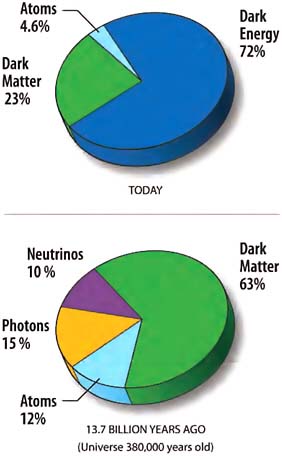
FIGURE 1.1 The composition of the universe has evolved over the 13.7 billion years since the big bang. Today the universe is dominated by dark energy (upper), whereas after the big bang it was dominated by dark matter (lower). SOURCE: NASA/WMAP Science Team.
servations. It may be that the true vacuum energy is zero and a pervasive, previously unknown fundamental field, akin to the field that caused inflation in the early universe, is driving the present-day acceleration. Alternatively, the observed acceleration could be a sign that general relativity itself breaks down on the scale of the observable universe.
The most-studied hypothesized dark matter particles are in many ways analogous to neutrinos in that they interact with baryonic matter only by way of gravity and the weak interaction (although neutrinos are much, much less massive). Over the past four decades, and especially over the past decade, progress in neutrino physics has been driven principally by astronomical observations. Most notably, observations of solar neutrinos and of atmospheric neutrinos produced by cosmic rays have demonstrated that the three neutrino species in the standard model of particle physics have non-zero mass and that they oscillate from one form to an-
other as they propagate through matter or empty space. Cosmological observations set the strongest upper limits on the neutrino mass; they show that the standard-model neutrinos cannot be the main form of dark matter, but it remains possible that a fourth, sterile neutrino species could constitute the dark matter.
These developments, and the successes and limitations of the current cosmological model, suggest the following four questions to guide research in cosmology and fundamental physics over the next decade:
-
How did the universe begin?
-
Why is the universe accelerating?
-
What is dark matter?
-
What are the properties of neutrinos?
The sections that follow elucidate these questions and describe the capabilities needed to answer them.
The panel also identified gravitational wave astronomy as an emerging science area with unusual discovery potential. Scientists expect the next decade to see the first direct detection of gravitational waves, the propagating ripples of space-time predicted by Einstein nearly a century ago. The strongest expected sources of gravitational waves are violent events such as mergers of black holes and neutron stars; gravitational wave measurements will provide unique insights into the physics of these events and allow powerful tests of general relativity in a completely new regime. More enticing still are the prospects for sources that have not yet been imagined or have only been speculated about, perhaps new classes of stellar implosions or collisions, or backgrounds of gravitational waves produced in the early universe. If the history of radio astronomy and X-ray astronomy is any guide, then the dawn of gravitational wave astronomy will fundamentally change our view of the cosmos and the objects that it contains. The panel discusses the extraordinary discovery potential of gravitational wave astronomy and the technical capabilities needed to realize it in the section below titled “CFP Discovery Area—Gravitational Wave Astronomy: Listening to the Universe.”
Three themes connect the observational approaches to all of these questions:
-
The first is the mapping of cosmological initial conditions over the widest possible dynamic range with measurements of CMB temperature and polarization fluctuations, observations of weak lensing, and optical and radio observations that use galaxies and intergalactic gas to map the distribution of matter at lower redshifts. The enormous increase in statistical precision and dynamic range now possible will enable new tests of models of inflation, precision measurements of the geometry of space, the determination of the masses of neutrinos by means of their cosmological effects, and tests of theories for the origin of cosmic acceleration.
-
Realizing these vast improvements in statistical power requires exquisitely careful control of systematic uncertainties, which often present the greatest challenge to these methods.
-
The second theme is the opening of new windows that allow scientists to view astrophysical phenomena in radically new ways. Gravitational waves are the most dramatic example of such a new window, but they are not the only one. Dark matter searches hinge on great advances in the sensitivity and sky coverage of high-energy gamma-ray and cosmic-ray experiments. New facilities should achieve the first detections of ultrahigh-energy neutrinos. Searches for highly redshifted 21-cm radiation will provide the first three-dimensional maps of structure at the epoch of cosmic reionization, and advances in these techniques should eventually allow maps of cosmic initial conditions over unprecedented volumes.
-
The third theme is the universe as a laboratory for fundamental physics. Studies of primordial fluctuations probe early-universe physics at energies that can never be achieved in terrestrial accelerators. The explanation of cosmic acceleration may radically reshape the understanding of gravity, the quantum vacuum, or both. Dark matter experiments provide windows on extensions of the standard model that beautifully complement the traditional tools of particle physics. Astrophysical measurements provide the most powerful and varied constraints on neutrino properties. Gravitational waves probe general relativity in the strong-field regime, a test that can be done only in the extreme environment near black holes.
CFP 1. HOW DID THE UNIVERSE BEGIN?
Although little is understood about the origin of the universe, cosmologists have made significant progress in studying its very early history. In the early 1980s, they theorized that during its first moments, the universe underwent a rapid period of accelerated expansion called inflation. During inflation, microscopic, causally connected regions expanded exponentially, driving the spatial curvature to nearly zero and producing a homogeneous universe. This inflationary paradigm not only explained many of the open questions in cosmology but also predicted that quantum fluctuations of both matter and space-time curvature create nearly scale-invariant, adiabatic, Gaussian random phase fluctuations. During the past decade, observations have shown impressive agreement with these predictions.
Although inflation is a successful paradigm, its underlying mechanism remains a mystery. Inflation may have something to do with grand unified theories that amalgamate the strong and electroweak interactions at an ultrahigh-energy scale. It may derive from a quantum-gravity theory such as string theory. Inflation may arise at some lower-energy phase transition, such as the breaking of the Peccei-Quinn symmetry posited to explain the lack of charge-parity violation in the strong interaction. It may be a consequence of the compactification of large
extra dimensions or of a departure from general relativity at high densities. In any scenario, however, inflation is driven by some new physics at ultrahigh densities and energies well beyond those accessible in the laboratory.
Testing the Inflationary Paradigm and Identifying the Underlying Physics Model
A key aim of cosmological observation and theory in the coming decade will be to test the inflationary paradigm further and to identify the underlying physical model responsible for inflation; cosmologists desire a full description of the high-energy physics responsible for inflation.
Single-Field Slow-Roll Inflation
In the simplest scenario, inflation is driven by the displacement of a scalar field from the minimum of its potential. If the potential has the right shape, then the scalar field will roll slowly toward its minimum, and the vacuum energy associated with this displacement will drive the accelerated expansion. The single-field, slow-roll (SFSR) model makes a number of testable predictions: (1) a flat universe with a curvature scale much larger than the horizon, (2) nearly scale-invariant fluctuations in the spatial distribution of matter, (3) adiabatic fluctuations, (4) Gaussian fluctuations, (5) homogenous and isotropic fluctuations, and (6) a stochastic background of inflationary gravitational waves (IGWs) with a nearly scale-invariant spectrum. The IGW amplitude is proportional to the square root of the height of the scalar-field potential or, equivalently, to the energy density or expansion rate during inflation, whereas the deviations from scale invariance in matter and IGWs describe the potential’s shape. The Wilkinson Microwave Anisotropy Probe (WMAP) and the current generation of ground- and balloon-based experiments have already tested the first five of the above predictions. The Planck spacecraft and the upcoming generation of CMB experiments will test these predictions to even higher precision and hold the promise of potentially detecting the IGW background.
Toward a Full Description of Physics During Inflation
It is quite surprising that single-field “toy models” have done so well in explaining such a large and precise body of data. Most theorists surmise that SFSR models are simply an approximation to more complex inflationary physics. The “true” model could be very different from SFSR models, with the differences including modifications to the kinetic-energy term of the scalar field, multiple fields driving inflation, models with features in the scalar-field potential, and alternative
scenarios such as the ekpyrotic model that posits a collapsing phase prior to the big bang. These alternatives to the simplest SFSR model make new, measurable predictions including non-Gaussian correlations and non-adiabatic (isocurvature) density fluctuations. In addition, physical processes such as phase transitions at the end of inflation can produce topological defects (e.g., cosmic strings) or alter the IGW background.
The primary goal in the coming decade is to test precisely each of the predictions of SFSR inflation. If consistency with the predictions of SFSR inflation persists, then the range of allowable values of the scalar-field potential will need to be narrowed. If departures from the simplest predictions are found, this will provide insights into fundamental physics and into the first moments of the early universe.
Testing the Predictions of Single-Field Slow-Roll Inflation
Flatness
The expected contribution of curvature from inflation is determined by the amplitude of large-scale density fluctuations, Ωk ≈ 10−5 to 10−4. The combination of Planck CMB measurements with baryon acoustic oscillations (BAOs), distance measures from high-redshift galaxies, and 21-cm line surveys can improve constraints on the curvature of the universe by two orders of magnitude from the current limits of Ωk ≈ 10−2. Such values may also be achievable by measuring weak lensing of the CMB with a high-angular-resolution, high-sensitivity CMB polarization experiment. Observations in the coming decade should allow the direct testing of this key inflationary prediction (Figure 1.2).
Scalar Power Spectrum
The mechanism by which structure was generated in the early universe is constrained by the linear power spectrum of fluctuations. On the largest observable spatial scales, the CMB provides the cleanest window into inflation. The Planck satellite should give an order-of-magnitude improvement in the measurement of the slope of the primordial power spectrum and its scale dependence, both measured to 10−3 within the early part of the decade. At angular scales smaller than those accessible with Planck, the kinematic Sunyaev-Zel’dovich (SZ) effect due to the scattering off of moving electrons at low redshift starts to dominate the temperature fluctuations, thus obscuring primordial-spectrum information.
Further improvements in power-spectrum characterization will come from a combination of CMB polarization maps and LSS surveys down to few-megaparsec (Mpc) scales. A variety of LSS observations (galaxy, weak gravitational lensing, Lyman-α, and 21-cm surveys) give a wealth of information about the power spec-
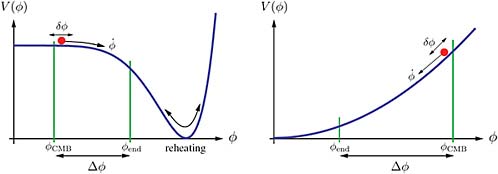
FIGURE 1.2 Cosmic microwave background (CMB) and large-scale structure observations can reveal key information about the shape and amplitude of the inflationary potential. Inflation occurs while the potential’s gradient is small, as the scalar field slowly rolls down the potential. When the gradient of the field becomes too large, at  , inflation ends. Quantum fluctuations in the scalar field,
  , are sensitive to the shape of the potential. They become frozen during inflation, and a snapshot at
  is imprinted in the temperature and polarization of the CMB and the distribution of galaxies and galaxy clusters. The amplitude of CMB B-mode polarization is sensitive to the change in
  during inflation. Two examples of single-field slow-roll inflation potentials are shown: (left) small-field,
  and (right) large field, . For large-field models this primordial signal could well be measurable. SOURCE: Reprinted with permission from D. Baumann, M.G. Jackson, P. Adshead, et al., CMBPol Mission Concept Study: Probing Inflation with CMB Polarization, AIP Conference, copyright 2009, American Institute of Physics.
trum of fluctuations in the early universe through a three-dimensional, rather than two-dimensional, picture of the matter distribution extending to smaller scales inaccessible to the CMB. At present, only 10−6 of the linear spatial modes in the observable universe have been measured.3 Galaxy surveys over larger volumes could survey 108 to 109 modes out to redshift z < 2, characterizing the linear matter power spectrum with statistical uncertainties that approach the cosmic-variance limit.
The 21-cm signal is currently untested as a cosmological probe, but it offers the potential to measure the matter power spectrum from z > 6 down to Mpc (and possibly smaller) scales, with these modes in the linear regime at such redshifts. These observations have the potential to detect far more modes than are accessible in the CMB alone.
Observations of redshifted 21-cm emission at z > 20 will be extremely challenging; lower redshift observations of 21-cm emission, probing the epoch of reionization (EoR), will be an important first step. These observations help outline
a seamless history of the universe from the primordial perturbations laid down by inflation to the diversity of stars, galaxies, and clusters that are seen in the universe today. The Panel on Galaxies Across Cosmic Time discusses these EoR observations in more detail in its report in Chapter 3 of this volume.
Gravitational Waves
Gravitational waves produce a distinctive B-mode signal in the CMB that could provide the most promising method for detecting the “smoking gun” of inflation. Different inflationary models predict different amplitudes for r, the ratio of gravitational wave fluctuations to scalar fluctuations. If the IGW background is detected, additional tests of the inflationary consistency relations can be obtained by measuring its spectrum.
Ground- and balloon-based experiments with high sensitivity but modest angular resolution could detect an IGW amplitude of r ≈ 0.01. Measuring r < 0.01 will require higher signal-to-noise ratios and better angular resolution in both temperature and polarization in order to separate the primordial B modes from those induced by weak lensing. Because a large spectral range will likely be essential for removing galactic foregrounds, a dedicated space-based B-mode survey will be required to obtain the values r ≈ 10−4 to 10−3 required to access the full parameter space implied by grand unified theory (GUT)-scale inflation. Such an experiment would also provide a wealth of other extremely valuable information (including detailed measurements of the gravitational lensing of the CMB), which will constrain the small-scale matter power spectrum at intermediate redshifts. These measurements will be useful for further testing inflation, constraining neutrino masses, studying the effects of dark energy, and determining cosmological parameters with further precision.
Searching for Evidence of Deviations from SFSR Inflation
Non-Gaussianity
The gravitational evolution of primordial fluctuations introduces non-Gaussian correlations in the distribution of matter with a non-Gaussianity parameter fNL4 of order unity, dwarfing those predicted by SFSR inflation (fNL ≈ 10−2). Current limits constrain fNL to be <100. Non-slow-roll inflationary models inspired by string theory, and some alternatives to inflation, however, can have amplified primordial non-Gaussianity that could be detectable. By increasing the number of small-scale modes measured, Planck should improve current constraints on fNL
by a factor of five, to fNL ≈ 4. Obtaining greater sensitivity will require a shift from the two-dimensional CMB map to three-dimensional correlations in LSS, where more modes are accessible. A 100 to 1,000 million galaxy survey would target fNL ≈ 1. If there is a detection of primordial non-Gaussianity, the detailed structure, obtained from the shape dependence of the three-point (and higher) correlation function, can discriminate among inflationary models.
Isocurvature Modes
Multifield inflation models can introduce significant non-adiabatic (isocurvature) fluctuations in the distribution of matter. The Planck satellite’s improved measurements of temperature and polarization will increase sensitivity to these signatures of physics beyond the SFSR models. A post-Planck CMB-polarization map that is cosmic-variance-limited to multipole moments l ≈ 2,000 would provide an additional order-of-magnitude improvement on both correlated and uncorrelated isocurvature modes.
The requirements for testing inflation overlap those for investigating cosmic acceleration. They are summarized together in Box 1.1.
CFP 2. WHY IS THE UNIVERSE ACCELERATING?
Cosmic acceleration is widely regarded as the most profound puzzle in fundamental physics today. Even the least exotic explanations imply an energetically dominant new component of the universe with extraordinary physical properties. Alternative proposals include a breakdown of general relativity on cosmological scales, perhaps tied to extra dimensions or to low-energy manifestations of quantum gravity. While measurements of the distance-redshift relation using Type Ia supernovae provide the most direct evidence for cosmic acceleration, there are now multiple lines of supporting evidence, including the measurements of CMB fluctuations, the integrated Sachs-Wolfe effect, the Hubble constant, BAO, and the growth rate of structure based on X-ray observations and lensing. Cosmic acceleration is a surprising but accepted piece of modern cosmology. The two top-level questions in this field are these:
-
Is this acceleration caused by a breakdown of general relativity or by a new form of energy?
-
If dark energy is causing the acceleration, is its energy density constant in space and time?
Cosmologists describe the evolution of dark energy in terms of its equation-of-state parameter, w = P/(ρc2), where P and ρ are the pressure and mass density, respec-
|
BOX 1.1 Conclusions on Inflation and Acceleration by the Science Frontiers Panel on Cosmology and Fundamental Physics Goals
Needed Capabilities
|
tively. The mass density scales with redshift as ρDE(z) = ρDE,0 × exp[3∫(1 + w(z)) dln(1 + z)]. Vacuum energy, the simplest and arguably best-motivated model for dark energy, is constant with time, and so for this model w = −1 at all z. Alternative forms of dark energy have different values of w(z).
The main line of attack for addressing these questions is to improve measurements of the Hubble parameter H(z), the distance-redshift relation D(z), and the
growth function G(z) that describes the strength of matter clustering. In a spatially flat universe, H2(z) is proportional to the total energy density—the sum of matter, radiation, and dark energy—and D(z) is given by an integral of H−1(z). General relativity predicts a specific relation between H(z) and G(z); modified gravity models could alter this relation, or they could make G(z) dependent on spatial scale. At present, the D(z) relation is measured with a precision of roughly 5 percent at z ≤ 0.8, with much weaker constraints at higher redshift. The function G(z) is known to about 5 percent at low redshift, while direct constraints on the rate of growth dlnG(z)/dz are approximately 25 percent. Current data are consistent with general relativity and w = −1 ± 0.2 (with the exact central value and error bar depending on the adopted data sets and on the assessment of systematic uncertainties). Proposed observations could realistically achieve one to two orders-of-magnitude improvement in the precision on w, and significant measurements of its redshift history if it turns out not to be constant.
Methods for Measuring Distances and Structure Growth
Supernovae
Type Ia supernovae have so far played the most critical role in demonstrating the existence of cosmic acceleration and measuring its evolution. Of the techniques used thus far, this one is the best understood from a practical point of view—both its strengths and its potential limitations. The statistical precision of the method is high, as each well-observed supernova yields a distance estimate with roughly 10 percent uncertainty. The key systematic uncertainties are corrections for dust extinction, the accuracy of photometric calibrations across a wide range of redshift, and the possible cosmic evolution of the supernova population.
Baryon Acoustic Oscillations
The BAO technique measures D(z) and H(z) using a scale imprinted by pressure waves in the pre-recombination universe as a standard ruler (Figure 1.3). This scale (≈150 Mpc) can be calculated precisely using parameters that are well determined by CMB observations, and it can be measured in the clustering of galaxies, quasars, the Lyman-α forest, or 21-cm emission. The ultimate statistical limit for BAO measurements is set by cosmic variance—that is, by the finite volume of the observable universe. For a similar survey volume and redshift range, a spectroscopic survey (with redshift errors smaller than the typical galaxy-peculiar velocity) provides several times higher precision than a photometric survey, and it allows separate determination of D(z) and H(z), whereas a photometric survey yields only the former. Large photometric surveys (e.g., for weak lensing) will yield
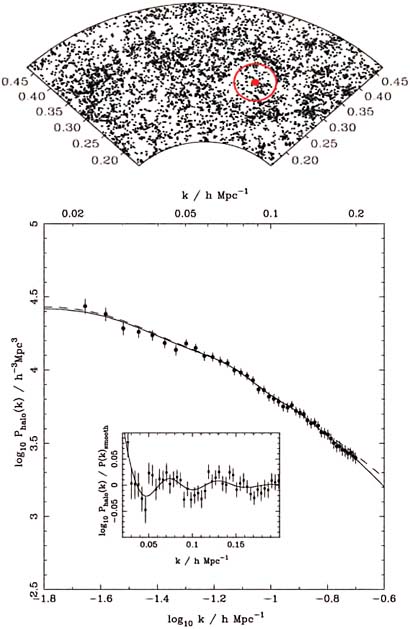
FIGURE 1.3 Upper: A slice of the Sloan Digital Sky Survey (SDSS) luminous red galaxy distribution out to redshift z = 0.47, with a superimposed “bulls-eye” showing the baryon acoustic oscilation (BAO) scale. Lower: The power spectrum measured from the final SDSS galaxy redshift survey, with the inset emphasizing the BAO signature of wiggles relative to the smooth power spectrum that would arise in a baryon-free universe. SOURCE: Upper: Daniel Eisenstein and Sloan Digital Sky Survey (SDSS) Collaboration, http://www.sdss.org. Lower: B.A. Reid, W.J. Percival, D.J. Eisenstein, L. Verde, D.N. Spergel, R.A. Skibba, N.A. Bahcall, T. Budavari, M. Fukugita, J.R. Gott, J.E. Gunn, et al., Cosmological constraints from the clustering of the Sloan Digital Sky Survey DR7 luminous red galaxies, Monthly Notices of the Royal Astronomical Society 404(1):60-85, copyright Royal Astronomical Society, 2010.
BAO measurements as a by-product, but spectroscopic surveys will be needed to harness the power of the BAO technique. There are possible systematic uncertainties from nonlinear bias of galaxies (or other tracers used), but current theory suggests that the systematic errors in the BAO technique will be smaller than the statistical errors, even for experiments that approach the cosmic variance limit.
Weak Lensing
Weak lensing depends on the amplitude of matter clustering, hence G(z), and on the distance-redshift relation D(z). A given weak-lensing data set can be analyzed with multiple statistical methods, including the power spectrum of cosmic shear in bins of photometric redshift (also known as tomography), higher-order measures such as the three-point correlation function, and galaxy-galaxy lensing. These multiple analyses can be used to increase the overall statistical precision, to carry out internal consistency checks for systematic errors, and to break degeneracies among cosmological parameters. The key systematic uncertainties for weak-lensing studies are as follows: the accuracy of shear measurements themselves, intrinsic galaxy alignments (which can mimic cosmic shear), the influence of baryons on small-scale theoretical predictions, and errors in photometric redshift distributions. Statistical errors depend mainly on the total number of galaxies with well-measured shapes.
Cluster Abundance
Measurements of the abundance of galaxy clusters as a function of redshift are sensitive to G(z), which governs the evolution of the mass function, and to D(z), which determines the volume element. In principle, cluster surveys can achieve high statistical sensitivity. The key challenge is that the mean relation between cluster observables and halo mass must be known to high accuracy, and the scatter and redshift evolution of these relations must be known to moderate accuracy. One can fit these relations to the cluster-count data themselves, but this reduces the statistical precision of the cosmological parameter measurements. X-ray, SZ, and optical galaxy selection are all viable approaches to assembling cluster catalogs. At present, weak lensing is the only observable whose fundamental physics is understood well enough to achieve the required, sub-percent-level mass calibration. While weak-lensing measurements are noisy for any individual cluster, they can precisely measure the mean mass profile of clusters binned by observable quantities.
Complementarity
These four methods are more powerful in combination than in isolation. Comparing the two pure distance methods, supernovae can achieve higher statistical
precision than is possible with BAO at z < 0.7, and the control of systematic errors in supernova measurements is easier at low redshifts. BAO surveys are more effective at higher redshift because there is more available volume and because H(z) is more sensitive to dark energy than is D(z). Even though the dynamical effects of dark energy are smaller at high redshift, the sensitivity of a cosmic-variance-limited BAO survey to dark energy (more precisely, to a cosmological constant) is roughly flat over the redshift range 0.5 < z < 2.5. High-redshift BAO measurements also yield precise constraints on curvature, breaking degeneracies among low-redshift measurements.
Weak lensing and cluster surveys provide independent measurements of D(z), and they provide the G(z) constraints needed to test modified gravity models. The galaxy redshift surveys designed for BAO studies can also measure G(z) through redshift-space distortions, the apparent anisotropy of structure induced by galaxy-peculiar velocities. Recent theoretical work suggests that redshift-space distortions could be competitive with weak-lensing measurements of structure growth, but the systematic uncertainties of this method have not yet been explored.
Next-Generation Experiments for Distance and Structure Growth
The next decade should include aggressive observational programs that employ all of the methods described above. In addition to providing complementary information, the mix of methods allows cross-checks that will be crucial to drawing robust conclusions about cosmic acceleration.
Supernova Surveys
Supernova surveys require deep, high-cadence (frequent revisits to the same field), multiband imaging over areas of several square degrees to several tens of square degrees, with follow-up spectroscopy and excellent photometric calibration. Wider, shallower surveys are needed for low-redshift calibration samples. The top priority for supernova studies is to obtain high statistical precision and correspondingly tight control of systematic errors at redshifts z ≤ 0.7, where their precision exceeds that of BAO. Systematic errors can be reduced by including observations in the rest-frame near-infrared (IR), where dust extinction is much lower and the range of luminosities is smaller than in the optical (even when the latter are corrected for light-curve duration). Improvements in photometric calibration systems are essential to supernova cosmology, and they will benefit many other areas of astronomy. Samples of several thousand supernovae can achieve statistical precision of approximately 0.01 mag in multiple redshift bins, and systematic uncertainties could possibly be brought to this level or below.
BAO Surveys
BAO surveys require spectroscopy over large co-moving volumes. At z > 1, samples of 108 to several times 108 galaxies are needed to reach the cosmic variance limit over a large fraction of the sky. Ground-based optical surveys can straight-forwardly reach to redshifts z ~ 1.3, but accessing most of the co-moving volume in the range 1 < z < 2 requires deep near-IR spectroscopy that can be done only from space. At higher redshifts, ground-based optical methods using emission-line galaxies and the Lyman-α forest become feasible, although it is not clear that these can approach the cosmic-variance limit. Intensity mapping of redshifted 21-cm emission is an emerging method that may allow efficient BAO measurements over a wide redshift range.
Weak Lensing and Cluster Surveys
Weak lensing and cluster surveys require high-resolution imaging with a well-characterized point-spread function (PSF) over wide areas (Figure 1.4). Ground-based surveys over 20,000 square degrees could achieve accurate shape measurements for approximately 109 galaxies. Higher-resolution space observations could increase the surface density of usable galaxies by a factor of several, and the more stable PSF obtainable in space could reduce systematic uncertainties in shape measurements. Achieving accurate photometric redshifts requires optical and near-IR photometry for all source galaxies, and spectroscopic samples of approximately 105 galaxies to the depth of the imaging surveys. Large-area X-ray and SZ surveys that overlap these imaging surveys may allow cleaner selection of clusters than is possible from the optical data alone. High signal-to-noise ratio X-ray and SZ measurements of smaller numbers of clusters help illuminate the underlying cluster physics and constrain the scatter of the mass-observable relations.
Space and Ground
Space observations could benefit all of these methods, in different ways. A common theme is the need for deep near-IR imaging and spectroscopy over wide areas, which is a unique space capability. A wide-field near-IR space telescope could provide the following:
-
Rest-frame near-IR photometry for supernovae at z < 1, coordinated with ground-based optical observations;
-
Galaxy redshifts over the huge co-moving volume available at 1 < z < 2, complementing ground-based BAO surveys at other redshifts; and
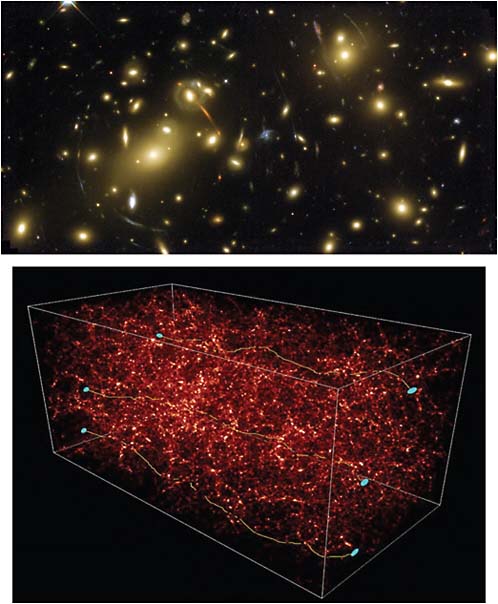
FIGURE 1.4 Upper: Gravitational lensing by the massive galaxy cluster Abell 2218, shown here in a Hubble Space Telescope image, stretches the images of background galaxies into arcs, elongated tangentially with respect to the center of the mass distribution. Far away from massive clusters, the image distortions are much weaker, but they can still be detected statistically because galaxies lensed by the same foreground mass will be stretched in the same direction. Lower: A simulation of light propagation through the distribution of dark matter in a large volume of the universe. The box shown spans a distance of about 1 billion light-years and is displayed so that brighter regions represent a higher density of dark matter. SOURCE: Upper: NASA, A. Fuchler, and the ERO Team (STSci, ST-ECF). Lower: Courtesy of S. Colombi and Y. Mellier (UPMC and CNRS, Institut d’Astrophysique de Paris).
-
IR photometry for the photometric redshifts of weak-lensing source galaxies, and IR spectroscopy of calibration samples. The combination of ground- and space-based shape determinations should reduce systematic uncertainties in the weak-lensing measurements.
Such a space mission would greatly enhance the precision of cosmic acceleration constraints and greatly reduce the associated systematic errors.
Large ground-based surveys could also benefit all of these methods. Large-area imaging surveys will provide optical photometry and independent shape measurements for weak-lensing and cluster studies. With proper choice of cadence, the same surveys can also identify supernovae at z < 1, where supernovae have been the most powerful tool for measuring distances. Ground-based optical spectroscopic surveys are already measuring BAO features at z < 0.7 and can push to higher-redshift windows. Measurements of redshifted 21-cm emission also have the potential of making powerful BAO measurements.
The combination of ground-based and space-based surveys should be able to improve measurements of both distance and growth rate of structure by an order of magnitude.
Precision Measurements and Cosmic Acceleration
Although there are many ideas about possible causes of cosmic acceleration, none of them is compelling. The current cosmological data are consistent with general relativity and a cosmological constant, which is a viable model for acceleration even though the magnitude of acceleration appears surprising. There are divergent opinions within this panel on the a priori likelihood of w = −1. If new measurements over the next decade improve the constraints on w by a factor of 10 and find no evidence for any deviation from general relativity, this would be important progress. However, it would be much less profound than detecting a signature of dynamical dark energy or a breakdown of general relativity.
Fortunately, the ground- and space-based experiments outlined in the previous subsection would generate rich data sets with broad scientific return, and achieving this return should be a strong consideration in designing observational programs, provided that the primary measurements are not impaired. In addition, low-cost but higher-risk experiments that explore a much wider range of new physics should be supported as a complement to the distance and structure-growth measurements.
Clues to the origin of acceleration could come from several directions, such as high-precision tests of general relativity and tests for time variation of fundamental “constants” such as the gravitational constant, the fine-structure parameter, the electron-to-proton mass ratio, and the speed of light. There are few clear targets for an “expected” level of deviations from conventional physics (and the same could
be said for deviations from a cosmological constant). An appropriate metric for evaluating potential investigations might be the number of orders of magnitude of improvement that can be achieved for a given cost.
Panel Conclusions Regarding Inflation and Acceleration
As noted above, the requirements for testing inflation overlap those for investigating cosmic acceleration and so are presented together. The conclusions of the panel, including goals and needed capabilities in these areas, are summarized in Box 1.1.
CFP 3. WHAT IS DARK MATTER?
Dark matter is currently the flagship topic at the interface of cosmology and particle physics. It was first noticed in the 1930s that there must be more matter in galaxy clusters than the luminous matter could provide, and the evidence that accrued over the intervening decades showed that this dark matter must be non-baryonic. The existence of dark matter is now the strongest empirical evidence for physics beyond the standard model, and, as discussed below, the dark matter may well be tied to the physics of electroweak symmetry breaking, one of the central problems in particle physics today.
Over the past decade, galactic rotation curves, weak- and strong-lensing data, the hot gas in clusters, the Bullet Cluster and similar systems (see Figure 1.5), and measurements of large-scale structure and the Lyman-α forest have further constrained the distribution of dark matter and its properties. Dark matter must be long-lived and kinematically cold or warm (slow enough to seed structure formation); it must interact gravitationally but must not have strong interactions with itself or with baryonic matter. Dark matter is an essential ingredient in theories of structure formation, galaxy formation, and galactic dynamics. Efforts to detect and identify dark matter are therefore extremely important and, if successful, may one day lead to the field of “dark matter astronomy,” in which the measured velocities of dark matter particles or spatial distribution of their annihilation products are used to probe the structure of the Milky Way and the physics of galaxy formation.
Although there is no definitive idea about what dark matter is, elementary particle theory provides a particularly compelling class of candidates—weakly interacting massive particles, or WIMPs—that are the target of a variety of experimental searches.
The WIMP Miracle
The origin of the symmetry breaking that provides particles with mass in the standard model of particle interactions remains a mystery, but every proposed
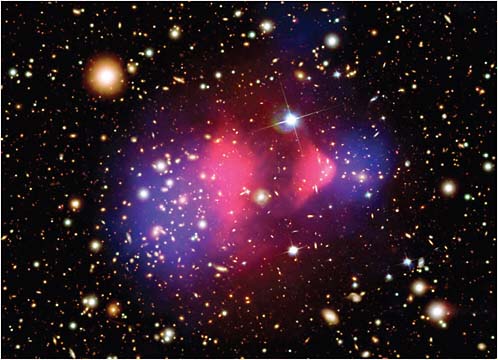
FIGURE 1.5 The Bullet Cluster displays particularly clear visual evidence for dark matter. In this collision of two clusters of galaxies, normal matter (hot gas, red, measured by X-ray emission) is distorted by the collision, but the rest of the cluster mass (dark matter, blue, measured by gravitational lensing) passes through unperturbed. SOURCE: X-ray: NASA/CXC/CfA/M. Markevitch et al. Optical: NASA/STScI; Magellan/University of Arizona/D. Clowe et al. Lensing map: NASA/STScI; ESO WFI; Magellan/University of Arizona/D. Clowe et al.
explanation requires new particles at the weak mass scale mW ~ 10 GeV to a few TeV. Examples of the new weak-scale physics that could provide such particles include supersymmetry (in which every fermion in the standard model has a bosonic partner, and vice versa) and models with extra spatial dimensions. Such particles must have been in thermal equilibrium in the early universe until the χχ → ff interactions (where χ is the WIMP and f a standard model particle) that convert them to ordinary particles became slower than the expansion timescale. If these particles are stable, then there will be relics from this early universe population. The relic density is inversely proportional to the annihilation cross section. Although there is no reason, a priori, to expect the electroweak scale to have anything to do with dark matter, a straightforward calculation shows that WIMP annihilation
cross sections imply relic densities close to ΩDM ~ 0.1. Although there may be no connection between electroweak symmetry and dark matter, the remarkable coincidence between the mass scale required for electroweak symmetry breaking and the current dark matter density, the “WIMP miracle,” provides strong motivation for a broad family of dark matter models. Such WIMPs would, moreover, be effectively collisionless and cold. Combined, these facts provide a very strong case that such particles are the dark matter.
Detection of Dark Matter
An important implication of the WIMP miracle is that if WIMPs make up the dark matter, then there are clear targets for experimental searches for WIMPs. As shown in Figure 1.6, the annihilation process χχ → ff that determines the relic density also implies that dark matter may be indirectly detected by searches for the products of dark matter annihilating now. This interaction also implies that dark matter may elastically scatter off standard model particles through χf → χf or be created at particle colliders through ff → χχ.
Although such experimental efforts have been underway for a number of years, the panel emphasizes that the conditions are now ripe for the detection of dark matter in the coming decade. WIMPs may be produced directly at the Large Hadron Collider; direct searches for dark matter scattering in low-background experiments will dig deeply into the favored WIMP parameter space; and there are a variety of indirect astrophysical signatures of WIMPs that will be probed.
Dark Matter Searches at Particle Accelerators
Although accelerator searches are beyond the scope of the Astro2010 study, it is essential to note the synergy of the science goals of the Large Hadron Collider and the proposed International Linear Collider and those of dark matter searches.
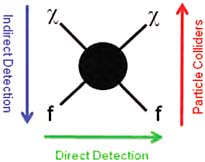
FIGURE 1.6 Three complementary approaches to searching for dark matter. Read from top to bottom, the diagram shows two dark matter particles χ annihilating to produce standard model particles f, which can be detected by indirect searches (e.g., for gamma rays or cosmic rays). Read from left to right, dark matter particles scatter off of standard model particles, producing signatures that are detectable in direct search experiments. Read from bottom to top, collisions of standard model particles can produce dark matter particles, interactions that can be detected in particle colliders like the LHC.
The LHC is very likely to identify the mechanism of electroweak symmetry breaking, thereby dramatically narrowing the range of possible dark matter candidates. The NRC’s Revealing the Hidden Nature of Space and Time5 discusses the essential role of particle accelerators in studying dark matter physics and emphasizes the link between the WIMP miracle and dark matter searches. Astronomical dark matter searches are essential to show that any particle produced in an accelerator is long-lived.
Detection of WIMPs in Underground Laboratories
The χf → χf reaction implies that WIMPs elastically scatter from atomic nuclei. Inelastic collisions are also possible if there are other dark particles with mass nearly identical to that of the dark matter. Direct-detection experiments use low-background detectors to search for the small recoil energy imparted to nuclei from such interactions. The WIMP-nucleus scattering may be either spin-independent (with the cross section depending on the nuclear mass) or spin-dependent (with the cross section depending on the nuclear spin).
Although the crossing symmetry illustrated in Figure 1.6 provides a relation between the relic abundance (determined by annihilation rates) and the elastic scattering cross section, particle physics models predict a range of elastic scattering cross sections over several orders of magnitude. The current bounds on spin- independent to WIMP-nucleon cross sections of σSI ~ 10−42 to 10−43 cm2, for WIMP masses in the range of 10 GeV to 1 TeV, are beginning to probe the parameter space of supersymmetric neutralinos and other WIMP candidates. In the next few years, cryogenic detectors and liquid noble gas detectors, located deep underground in extremely low background environments, are expected to be sensitive to σSI ~ 10−44 to 10−45 cm2. These experiments are exceptionally promising, both because they will improve present bounds so significantly and because the predictions for neutralinos in many models cluster around σSI ~ 10−44 cm2.
By the end of the coming decade, sensitivities extending to σSI ~ 10−46 to 10−47 cm2 should be possible with ton-scale detectors. Such experiments will probe even more deeply into WIMP parameter space or, if a signal is detected earlier, will provide detailed follow-up studies. Additional promising directions are low-threshold experiments extending sensitivities to lower WIMP masses, experiments that significantly improve limits on spin-dependent cross sections, and detectors that are sensitive to WIMP direction.
Astronomical Detection of WIMPs
The reach of astronomical methods is potentially beyond that of direct detection and particle colliders, especially if the dark matter is very heavy, with mass approximately TeV or above, or if it couples dominantly to Higgs bosons or gauge bosons. In the coming decade a wide variety of experiments have the capacity to detect WIMP annihilation products by targeting a variety of final states.
Neutrinos
WIMPs from the galactic halo that pass through the Sun or Earth may scatter from nuclei. If they scatter to a velocity less than the escape velocity, they will be gravitationally captured. These WIMPs may then annihilate through the same processes as in the early universe, producing neutrinos, which may escape the Sun or Earth and be observed in terrestrial under-ice or underwater neutrino observatories. The Sun, typically the more promising target, is focused on here. The resulting neutrinos are distinctive because they come from the Sun but are far more energetic than the solar neutrinos produced by nuclear reactions.
It is emphasized that unlike all other indirect signals, the flux of neutrinos from the Sun is determined by scattering cross sections, and so these searches may be directly compared to direct-detection searches. This is because, given mild assumptions, the neutrino signal is determined by the WIMP capture rate, which is set by WIMP scattering cross sections. Given a particular WIMP candidate, it is straightforward to predict the neutrino flux, with no more astrophysical uncertainty than enters the prediction for the direct-detection rate.
For spin-dependent interactions, neutrino searches currently provide the leading constraints and are on the threshold of constraining regions of parameter space for neutralinos and other types of WIMP dark matter. For spin-independent interactions, neutrino searches are not competitive with direct searches for WIMP masses in the range of approximately 10 GeV to 1 TeV, but future water Čerenkov detectors and cubic-kilometer neutrino telescopes may be able to probe new territory at the low- and high-mass ends, respectively.
Gamma Rays
Gamma rays from dark matter annihilation in or near the center of the Milky Way Galaxy or in nearby dwarf galaxies may be detected by atmospheric Čerenkov telescopes or space-based observatories. The annihilation rates depend sensitively on the detailed dark matter distribution (the radial profile of the halo, substructure, etc.), which introduces considerable theoretical uncertainty.
The rates also depend on the annihilation cross section. For WIMPs, the correct thermal relic density is achieved if the thermally averaged annihilation cross section at freeze-out is  . This provides a rough benchmark to guide expectations. Furthermore, the annihilation rate
  into observable decay products may differ significantly from the annihilation rate into all possible states in the early universe. At WIMP decoupling, v ≈ 0.3 c, whereas the WIMP velocities in the galactic halo are a hundred times smaller. Clearly it is advantageous to achieve the lowest sensitivity limits possible to maximize the range of candidates that can be tested or discovered.
The resulting photons may be continuum photons from decays of an assortment of halo-annihilation products or monoenergetic photons from direct annihilation to gamma rays. The line signal is typically, although not always, significantly suppressed, but it is far more distinctive. Since photons point back to their source, directionality is a useful diagnostic for disentangling signal from background. In the case of detection, gamma-ray signals may be used to constrain dark matter distributions. Gamma rays from inverse Compton scattering in the inner galaxy may also constrain the distribution of electrons and positrons from WIMP halo annihilation.
Charged Particles
Indirect searches also target a variety of charged particles produced by annihilations in the galactic halo. As in the case of gamma rays, these rates depend sensitively on the distribution of dark matter and its annihilation cross sections. Charged-particle targets include the following:
-
Positrons from nearby halo annihilations. Recent results have highlighted the need for a better understanding of astrophysical backgrounds. In some cases, however, direct annihilations χχ → e+e– may yield a sharp feature in the energy spectrum that is not erased by propagation, and future searches may distinguish such signals from conventional astrophysical sources.
-
Antiprotons. In general, antiproton backgrounds can obscure dark matter signals, but antiproton searches will nonetheless provide useful constraints on models for dark matter annihilation in the halo.
-
Antideuterons. Because of the negligible background of antideuterons with kinetic energies below approximately 1 GeV, antideuterons can be a promising search target for dark matter that annihilates significantly to hadrons.
The dominant annihilation channel and the distinctiveness of the resulting signal depend on the dark matter candidate. In the absence of a single compelling candidate, it is of paramount importance to maintain a diverse program. However, given that charged particles do not point back to their source, and in view of
the difficulty of distinguishing generic charged-particle signals from background, “smoking gun” signals that can be cleanly differentiated from background merit special attention. Precise measurements of various cosmic-ray elements over a wide energy range are also necessary to constrain cosmic-ray acceleration and propagation models and to determine the astrophysical background.
Alternative Candidates and Astrophysical Probes
WIMPs are not the only viable dark matter candidates. The axion is another interesting possibility. Motivated by the strong charge-parity problem in particle physics, the axion is extremely light and weakly coupled. There is no reason to expect the axion, unlike WIMPs, to have a relic density near ΩDM. In simple models, however, the axion may be all or much of the dark matter for axion masses in the range approximately 1 to 100 meV. In the next decade, microwave cavity experiments are expected to probe much of this favored parameter range in canonical models, potentially establishing the existence of axion dark matter.
The WIMP and axion dark-matter candidates discussed so far are cold, collisionless, and stable. These are not required properties for dark matter, however, and there are viable candidates that are also motivated independently by particle physics but do not have one or more of these properties. Examples include sterile neutrinos; super-WIMPs (dark matter candidate particles with extremely small cross sections); dark matter candidates produced in decays during or after big bang nucleosynthesis; hidden-sector dark matter—that is, dark matter without standard model gauge interactions; and metastable dark matter with lifetime greater than the age of the universe.
These dark matter candidates may leave their imprint on astrophysical observables. For example, warm dark matter candidates, such as sterile neutrinos and super-WIMPs, may erase small-scale structure, with observable implications for galactic halo profiles and the abundance of dwarf galaxies. Hidden-sector dark matter may be significantly self-interacting and constrained by the Bullet Cluster and similar systems, or by the observation of elliptical halos. Dark matter that decays now may be detectable through cosmic rays or the diffuse photon spectrum. Studies in all of these areas are promising, as they may point to candidates beyond the standard cold dark matter paradigm.
Finally, as is evident from the discussion above, astrophysical inputs are also essential for interpreting WIMP searches. Direct searches and indirect searches for neutrinos are subject to uncertainties in the local dark matter density. Gamma-ray and charged-particle searches are subject to much larger uncertainties from halo profile parameters and structure on subgalactic scales. Precise astrophysical inputs will enhance what can be learned from these observations for many reasons—from setting the search strategies of atmospheric Čerenkov telescopes targeting dwarf
galaxies to interpreting a confirmed signal in terms of particle physics parameters—and they will become essential given the expected progress in the coming decade.
For all of these reasons, astrophysical probes of the gravitational effects of dark matter are complementary to direct, indirect, and collider searches and may play an important role in constraining the nature of dark matter. In particular, theoretical, observational, and computational studies that improve constraints on small-scale structure and the local phase space distribution of dark matter are highly desirable.
Panel Conclusions Regarding Dark Matter
The conclusions of the panel with respect to dark matter are presented in Box 1.2. Included are goals and needed capabilities in this area.
CFP 4. WHAT ARE THE PROPERTIES OF NEUTRINOS?
Neutrinos are among the most abundant and most elusive particles in the universe. Created in enormous numbers by the big bang, they played an essential role in the synthesis of primordial light nuclei and limited the growth of galaxy-size density perturbations. Today, they are created in stars, supernovae, and cosmic-ray interactions, as well as on Earth in nuclear fission reactors, particle accelerators, and by Earth’s natural radioactivity.
The new field of neutrino physics and astronomy has already discovered neutrino mass and neutrino oscillations. Soon after Raymond Davis, Jr., began his historic Homestake Mine experiment in 1968, it became clear that the flux of electron neutrinos coming from the Sun was well below the standard solar model prediction of John Bahcall and his collaborators. In fact, this experiment and follow-up results from other detectors established a pattern of solar neutrino fluxes that was incompatible with any plausible variation in that model. In 1998 neutrino oscillations, long suspected as a possible explanation for the missing solar neutrinos, were discovered by the Super-Kamiokande collaboration, which found a deficit in the muon neutrino flux produced when cosmic rays hit Earth’s atmosphere. Then in 2001 and 2002, the Sudbury Neutrino Observatory showed that oscillations were also responsible for the missing solar neutrinos, directly measuring the flux of muon and tau neutrinos into which the solar electron neutrinos had oscillated. The demonstration of neutrino oscillations is a marvelous example of the use of astrophysics as a laboratory for fundamental physics.
In the coming decade, astrophysical and cosmological observations should resolve several more profound and so-far-unanswered questions about neutrino properties, including the sum of their absolute masses and the pattern of the individual masses. Astrophysical measurements are sensitive to values for the unknown
|
BOX 1.2 Conclusions Regarding Dark Matter by the Science Frontiers Panel on Cosmology and Fundamental Physics Goals
Needed Capabilities
|
mixing angle θ13 far below those that can be measured in other ways, and they may reveal the lepton number of the universe.
Neutrinos are also unique probes of the cosmos. Rapid advances in large and sophisticated neutrino detectors have created new opportunities for measuring the metallicity of the solar core, determining properties of neutron stars, and probing the most distant regions of the universe for nature’s most energetic particle accelerators. These advances include massive ultra-clean low-energy detectors mounted a kilometer or more underground, cubic meter ice and water instruments sensitive to high-energy cosmic neutrinos, and radio and fluorescence detectors designed to measure ultrahigh-energy neutrinos.
Neutrino Mass
Neutrinos have a distinctive effect on cosmological evolution. Contributing approximately 10 percent of the energy density of the universe at the time of decoupling, they leave an imprint on the CMB. As neutrinos are light, they remain relativistic until late, and tend to erase the clustering of matter on small and intermediate scales. Thus, neutrinos produce a distinctive suppression of power in the matter (and hence galaxy) distribution.
The influence of neutrinos on cosmology is connected to a crucial property of neutrinos, the sum of the neutrino masses. Oscillation experiments, whether done with solar, atmospheric, or accelerator neutrinos, only measure the differences in the squares of the neutrino masses. Thus, the absolute scale of these masses is unknown. If that scale is as low as many theories suggest, it may be measurable only through cosmological observations, at least in the foreseeable future. Existing cosmological data and analyses place an upper bound of <0.7 eV on the sum of the masses of the three known neutrinos. Direct laboratory constraints on this mass sum (determined from the tritium beta-decay limit on the electron neutrino mass) have so far reached 6.6 eV, with improvements in the next decade possibly lowering this bound to 0.6 eV. But pushing beyond this level with terrestrial experiments could prove very difficult, requiring some fundamentally new idea.
Neutrino oscillations reveal that the mass could be as small as 0.05 eV. Cosmology is the only known tool for probing such tiny neutrino masses. Although neutrinos today may contribute only approximately 0.1 percent of the energy density of the universe, they still could suppress the power spectrum on galaxy scales by several percent, an effect that may be seen if measurements of the amplitude of the matter power spectrum are improved by an order of magnitude. Specifically, for a mass sum of 0.05 eV, the matter power spectrum is suppressed by 2.1 percent for wave numbers k > 0.6 (1/Mpc) at z = 1.5 and by 3.5 percent at z = 0. The suppression is scale-dependent, and the amplitude is predicted to be larger for larger masses. There are several promising approaches for measuring the small-scale matter power spectrum to this precision, including large galaxy redshift surveys, gravitational lensing, and Lyman-α absorption or 21-cm emission studies. For each method, there are challenges similar to those discussed in the subsection above titled “Precision Measurements and Cosmic Acceleration.” But the critical role of these measurements in both cosmology and neutrino astrophysics makes overcoming these challenges a very high priority.
A determination of the absolute scale of neutrino mass would be of fundamental importance to particle physics, potentially probing new physics phenomena far beyond the reach of accelerators. Models of neutrino mass and the existing results from solar and atmospheric neutrino oscillations suggest physics close to the GUT scale. There is a further exciting possibility: a demonstration that the sum of the
neutrino masses is well below 0.1 eV would demonstrate that the mass pattern is the normal hierarchy, one of the two possibilities described in Figure 1.7.
Ultrahigh-Energy Cosmic Rays and Neutrinos
In 1966, Greisen, and separately Zatsepin and Kuzmin, noted that cosmic-ray protons or nuclei originating from distances greater than approximately 100 Mpc (depending on the composition) will react with the CMB photons, creating pions that decay into electrons and neutrinos, or photo-dissociating, degrading the energy and producing lower-energy secondary particles. Such interactions produce a cutoff in the cosmic-ray spectrum, as UHE protons and nuclei from distant sources will not be able to reach Earth. First the High Resolution Fly’s Eye (HiRes) experiment in Utah and then, with better statistics in 2008, the Pierre Auger Observatory in Argentina appear to find the expected GZK cutoff (see Figure 1.8).
The results from these and other cosmic-ray observatories have stimulated great interest in UHE particle propagation. Some event simulators suggest that
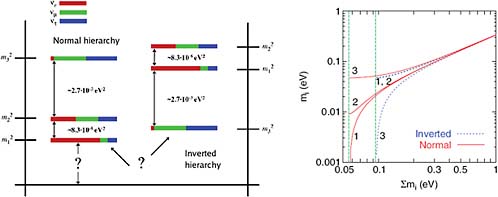
FIGURE 1.7 Left: The electron, muon, and tau neutrinos are each a mixture of three “mass states” m1, m2, and m3. Scientists know two differences of the squares of the masses, indicated by the vertical arrows. Yet we do not know the individual masses (suggested by the left “?”). The ordering where m3 is the most massive is the normal hierarchy on the left, while the inverted hierarchy is on the right. Right: Masses of the neutrino “mass states” 1, 2, and 3 as a function of the sum of the masses that we know are between 0.05 V and 0.7 eV. If measurements show that the sum of the masses is <0.1 eV, we will know that the hierarchy is normal and m3 is near 0.05 eV. SOURCE: Left: F.B. Abdalla and S. Rawlings, Determining neutrino properties using future galaxy redshift surveys, Monthly Notices of the Royal Astronomical Society 381(4):1313-1328, copyright Royal Astronomical Society, 2007. Right: Reprinted from J. Lesgourgues and S. Pastor, Massive neutrinos and cosmology, Physics Reports 429(6):307-379, copyright 2006, with permission from Elsevier.
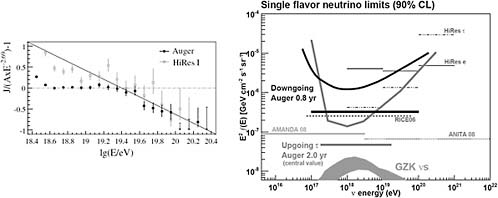
FIGURE 1.8 Left: The flux of ultrahigh-energy cosmic rays recorded by the High Resolution Fly’s Eye (HiRes) experiment (atmospheric fluorescence detectors in Utah) and the Pierre Auger Observatory (water Čerenkov and atmospheric fluorescence detectors in Argentina), both showing the decline above 4 × 10¹⁹ eV—resembling the Greisen-Zatsepin-Kuzmin cutoff. Right: Limits on the flux of ultrahigh-energy neutrinos from HiRes, Auger, Radio Ice Čerenkov Experiment (RICE; Askaryan effect in ice), Antarctic Muon and Neutrino Detector (AMANDA), and IceCube (in South Pole ice), and Antarctic Impulsive Transient Antenna (ANITA; Askaryan effect from long-duration balloon flights over the South Pole). SOURCE: Left: Courtesy of the Pierre Auger Observatory. Figure reprinted with permission from J. Abraham, G. Snow, and the Pierre Auger Collaboration, Observation of the suppression of the flux of cosmic rays above 4 × 10¹⁹ eV, Physical Review Letters 101:061101, 2008, copyright 2008 by the American Physical Society, available at http://link.aps.org/doi/10.1103/PhysRevLett.101.061101. Right: Courtesy of the Pierre Auger Observatory.
events observed at lower energies (1015 to 1016 eV) are protons, while there is a trend toward heavy nuclei at intermediate energies that may persist in part to the GZK cutoff. This interpretation depends in part on the modeling of proton-nucleus and nucleus-nucleus reactions at ultrarelativistic energies that extend beyond the center-of-mass energies that can be tested in collisions at Brookhaven National Laboratory’s Relativistic Heavy Ion Collider or at the European Organization for Nuclear Research (CERN). High-quality data at the GZK cutoff could be particularly helpful in reducing such uncertainties, as the location and even precise shape of this cutoff depend on composition: nuclei and nucleons of the same energy travel at different velocities and thus experience different interactions with the CMB. For this reason new UHE cosmic-ray observatories that can provide additional data on the GZK cutoff are very well motivated.
The detection of GZK neutrinos would complement observatories such as Pierre Auger, as the flux of neutrinos associated with near-GZK hadronic events is a function of the energy distribution and composition of the hadronic events.
Because neutrinos rarely interact with the CMB or other matter and fields and because they point back to their sources, neutrinos also provide a rare opportunity to determine what the ultimate energy limits of cosmological accelerators might be.
Novel techniques are being developed to detect UHE neutrinos. One possibility for extending measurements to and beyond GZK energies is the Askaryan effect, the coherent emission of a radio pulse by electrons swept along by the UHE neutrino shower front. The Antarctic Impulse Transient Array (ANITA) balloon-borne antenna has demonstrated the method over Antarctica in 2006-2009, though so far it has not reported a neutrino with GZK energies, while the Radio Ice Čerenkov Experiment (RICE) explored the effect with antennas in the ice. From the detection of the GZK cutoff in the cosmic-ray protons, one can estimate a baseline level for the UHE neutrino flux (see Figure 1.8). An exciting possibility would be the development of a radio antenna array in the Antarctic ice or elsewhere capable of detecting this flux. This might begin with a coverage of 100 km2 and could be extended well beyond this scale potentially to detect many tens of GZK neutrinos a year. Scientists expect to learn significant astrophysics and physics from UHE neutrinos, including verification of the origin of the cutoff and determination of the origin and evolution with redshift of sources beyond the GZK cutoff.
It is fortunate, in the quest to understand cosmic rays and to exploit them as a probe of new astrophysical sources (and potentially new fundamental physics), that the field has multiple probes, including nucleons and nuclei, neutrinos, and gamma rays. There is a good understanding of the common mechanisms affecting the production and propagation of such “messengers,” and thus multiple opportunities for constraining the properties of their astrophysical sources. Neutrinos, unique as probes of sources at cosmological distances and arbitrary energies, present an exciting frontier where further developments of instrumentation could be rewarded by major discoveries.
Supernova Neutrinos
The approximately 20 neutrinos detected from Supernova 1987A marked the dramatic opening of extrasolar neutrino astronomy. Today, deep-underground neutrino detectors are an order-of-magnitude larger than those operating in 1987, with much improved cleanliness and lower triggering thresholds. A galactic supernova 10 kpc from Earth would produce roughly 10,000 events in Super-Kamiokande’s 50-kiloton volume of water and a similar event rate in NOvA, a 14-kiloton liquid scintillator detector under construction in Minnesota. On the order of 100,000 events might be seen in future megaton-scale experiments.
A precise measurement of the supernova neutrino “light curve” out to long times would provide a great deal of information about the supernova mechanism
and fundamental neutrino properties. These neutrinos are thought to be essential to the explosion, transporting energy and driving the convection responsible for mantle ejection. They also create the explosive, neutron-rich stellar environments in which about half of our galaxy’s heavy elements may have been synthesized—the “star stuff” that is crucial to the evolution of complex structures such as the planets of our solar system and the life that they sustain. The neutrino flux, originating from deep within the supernova, provides one of the best tests of the theoretical understanding of the core-collapse mechanism, long considered one of the major high-performance-computing challenges in theoretical astrophysics.
The neutrino flux provides a very accurate measurement of the gravitational energy released in core collapse, and it also marks the onset of core collapse, providing a “clock” against which gravitational wave and optical signals can be compared. Changes in the late-time neutrino cooling curve could signal the onset of phase transitions at supernuclear densities; a sudden termination would accompany black hole formation. The correlation between neutrino energies and their flavors is a powerful diagnostic of neutrino oscillations. In particular, supernova neutrinos are sensitive to values of the unknown mixing angle θ13 as small as 10−4, two orders of magnitude beyond the goals of reactor and accelerator experiments currently planned. Exotic “matter effects” connected with oscillations in an intense neutrino background could produce distinctive changes in the neutrino flux that depend on the neutrino mass hierarchy (normal or inverted).
Bursts from individual supernovae are rare, but the flux of neutrinos from all past supernovae is continuous and potentially measurable. The detection of this flux would determine an integral over the redshifted neutrino emission of all core-collapse supernovae, from the time of the first stars until now. This would constrain the mass cut for core-collapse supernovae and potentially provide some information on the redshift evolution of these massive stars. Future megaton detectors could record dozens of events per year from this source, in the energy region above the solar neutrino end point.
Light-Element Abundances
Five light nuclei (H, D, 3He, 4He, and 7Li) are fossils from the first few minutes of the big bang. Their abundances are direct probes of physical conditions in the very early universe. As CMB measurements now independently fix the baryon-to-photon ratio, big bang nucleosynthesis predictions for the primordial abundances are largely parameter-free in the context of standard-model physics, subject only to the uncertainties in the input parameters (e.g., the baryon-to-photon ratio and nuclear cross sections).
The agreement between the observed and predicted D/H ratio is a major pillar of the big bang model. Although there is fair agreement for the other nuclei, the precision of the measurements lags behind that of the theory, a situation that should be improved in order to more fully test understanding of the big bang. In detail, there have been persistent discrepancies, such as measurements of the abundance of 4He that are typically below the modern prediction. There are plausible explanations for this discrepancy, including helium flux that was missed in absorption lines and inaccurate atomic data. These possibilities need to be thoroughly explored.
The observed abundance of 7Li in old halo stars is constant to within measurement errors of 5 percent in stars with a wide range of metal abundances and masses, yet the amount of 7Li is a factor of four below BBN predictions. An astrophysical explanation of this anomaly would have to produce this large and near-constant reduction. The exciting alternative is that the 4He or 7Li anomalies are the signature of some new physics beyond standard BBN.
Plausible sources of such new physics exist. Measurements of light-element abundances are sensitive to neutrino properties. The addition of extra neutrino species increases the universe’s expansion rate, leading to more 4He and less D. An excess of neutrinos over antineutrinos (a lepton number asymmetry) decreases the n/p ratio, leading to less 4He and less D. New particles could be involved, such as sterile neutrinos with ultraweak interactions and/or dark matter that decays to change the abundances after BBN.
Improved measurements are required to test such possibilities. Much remains to be done with existing 10-m-class optical telescopes for deuterium, 7Li, and especially 4He, although in other cases observations already stretch the limits of such telescopes. This is especially true for 6Li, which is more fragile than 7Li and hence limits the amount of 7Li that has been destroyed in stellar atmospheres. A telescope in the 30-m range with a high-resolution stable spectrograph, should lead to dramatic improvements in the measurements of the light nuclei. Improved accuracy is also needed for several nuclear reactions at low (MeV) energies and for the atomic rate coefficients that are used to determine the 4He abundance in H II regions. The measurements of the abundance of 6Li in halo stars require improved three-dimensional stellar atmosphere models, whereas interpretation of 7Li measurements would benefit from stellar models that incorporate more physical treatments of turbulence.
Panel Conclusions Regarding Neutrinos
The conclusions of the panel with respect to neutrinos are presented in Box 1.3. Included are goals and needed capabilities in this area.
|
BOX 1.3 Conclusions Regarding Neutrinos by the Science Frontiers Panel on Cosmology and Fundamental Physics Goals
Needed Capabilities
|
CFP DISCOVERY AREA—GRAVITATIONAL WAVE ASTRONOMY: LISTENING TO THE UNIVERSE
In the past century, our ability to view the universe expanded to encompass a vast sweep of the electromagnetic spectrum from gamma rays to radio waves, bringing with it the discovery of many unexpected phenomena. In the coming decade, some of the most exciting discoveries may come from opening a new observational window with the first direct detections of gravitational waves.
In the same way that the sense of hearing complements the sense of sight, gravitational wave observations complement and enrich what can be learned elec-
tromagnetically. Gravitational waves are produced by the bulk motions of matter, and they propagate essentially unabsorbed through even the densest material to convey information about the overall dynamics of the source. In contrast, electromagnetic waves tell only about the thermal and magnetic environment of the gas that surrounds a source, and they can be bent or absorbed along their propagation paths to telescopes.
However, the weak coupling to matter that allows gravitational waves to travel unimpeded also makes them very hard to detect: the merger of two stellar remnant black holes at 10 Mpc would bathe Earth with a peak energy flux exceeding 10 percent of the solar constant, but so little of this energy is captured that the mirrors of a kilometer-scale detector are displaced by less than 10 percent of the width of a proton. Compelling though indirect evidence for their existence can be seen in the orbital decay of binary pulsar systems, whose discovery earned Hulse and Taylor the 1993 Nobel Prize in physics. Efforts at direct detection initially employed massive bar detectors fitted with vibration sensors but are now focused on laser interferometers, which use interference of laser beams to detect the minute motions of mirrors suspended at the ends of kilometers-long evacuated cavities. A worldwide network of terrestrial interferometers is currently in operation, covering the frequency range 10 to 1,000 Hz with the sensitivity to detect relative displacements a thousand times smaller than the width of a proton. Operating in the much lower nanohertz (10–9 Hz) frequency range are pulsar-timing arrays, which seek to detect gravitational waves by the delays that the waves impart on the arrival times of pulses from radio pulsars. The low-frequency range, between 10–5 and 10–1 Hz, is believed to be rich in gravitational wave sources of strong interest for astronomy, cosmology, and fundamental physics. Because terrestrial sources of noise dominate at such low frequencies, this portion of the gravitational wave spectrum can be accessed only from space.
Gravitational Wave Astrophysics
All astrophysical objects emit gravitational radiation at some level, but the extreme stiffness of space-time implies that only systems that pack a large amount of rapidly moving material into a small volume will emit detectable signals. As a general rule, the more massive systems radiate deeper and louder signals. Accordingly, for example, high-frequency ground-based interferometers look for black hole mergers with total mass of 1 to 103 solar masses, whereas low-frequency space-based systems will look for mergers with total mass of 103 to 107 solar masses (Figure 1.9).
Among the anticipated results from ground-based detectors are measurements of the merger rates of binary systems containing two black holes or two neutron stars (or one of each), measurements of the deviations from spherically symmetric
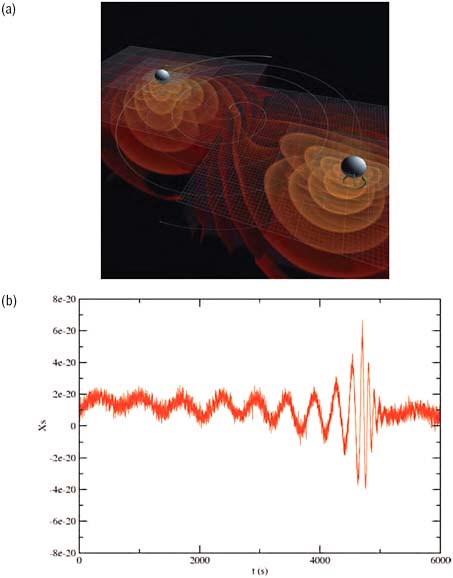
FIGURE 1.9 (a) Recent advances in numerical relativity make it possible to simulate accurately the ripples in the curvature of space-time stirred up by the merger of two black holes. The top image shows two spinning black holes that are spiraling together toward merger. The black hole horizons (gray surfaces) and spin directions (green arrows) are shown. A cross section of the adaptive mesh refinement computational grid is shown, with a cut-away view of the strong dynamical gravitational fields underneath. (b) The simulated response to the late inspiral and merger of two  black holes at z = 15 is superimposed on the galactic foreground from white-dwarf binaries and the instrument noise from a space detector. In contrast to the ground-based detectors, these signals will be clearly visible in the raw data, with signal-to-noise ratios in the hundreds of thousands. The noise in the plot is the unresolved gravitational radiation from the ordinary binary stellar systems in our galaxy. SOURCE: (a) Image courtesy of Chris Henze, NASA Ames Research Center. (b) Figure reprinted with permission from J. Baker, S.T. McWilliams, J.R. van Meter, J. Centrella, D.-I. Choi, B.J. Kelly, and M. Koppitz, Binary black hole late inspiral: Simulations for gravitational wave observations, Physical Review (Section) D: Particles and Fields 75:124024, 2007, copyright 2007 by the American Physical Society.
or pure dipole signals6 that can be supported by millisecond pulsars, constraints on the equation of state of matter at nuclear densities through observations of tidally distorted neutron star mergers, and exploration of the dynamics of nearby corecollapse supernovae. By mid-decade it should known if compact binary mergers are indeed responsible for short-hard gamma-ray bursts, and if gravitational wave emission is indeed balancing the accretion torque in low-mass X-ray binaries. Even the most pessimistic estimates of rates and strengths of signals predict a detection by the advanced ground-based interferometers scheduled to be operational by 2014. Beyond the anticipated discoveries, the opening of a new observational window will likely produce surprising, and perhaps even revolutionary, results.
Pulsar-timing arrays have the potential to detect a stochastic background from the slow inspiral of supermassive black hole binaries (108 to 1010 solar masses) in the frequency range 10−9 to 10−6 Hz, and perhaps to resolve a few of the brighter systems. With modest enhancements to the existing arrays, a positive detection is likely by the latter part of the decade. Such measurements will fix the merger rate of supermassive black holes and provide unique constraints on models of black hole growth.
In the low-frequency (10−5 to 10−1 Hz) portion of the spectrum, accessible only from space, there are likely to be so many sources that a background of waves from weaker systems will be a dominant source of noise. Above this noise it will still be possible to detect black hole mergers in the mass range 3 × 10³ to 107 solar masses out to redshift 20 or greater. These observations will reveal the masses and spins of the black holes and will indicate the merger rate as a function of distance. For example, with typical sensitivity parameters for a space interferometer, including noise from foreground sources, for two  nonspinning black holes merging at z = 10, the total mass of the system could be measured to 0.1 percent, and at z = 1, to 0.001 percent.
This information can be used to test theories of how galaxies and black holes coevolve, and to determine the relative importance of gas accretion and mergers in massive black hole growth. If the basic ideas of massive black hole growth are qualitatively correct, tens to hundreds of events per year for inspirals at the high-mass end may be detectable. For inspirals at the low-mass end, the rates are highly uncertain. Observations of low-redshift systems can be used to confirm the existence of intermediate-mass (500 to 104 solar mass) black holes and to probe their properties.
Also visible out to z ≈ 2 will be the capture of stellar remnants (mostly black holes and neutron stars) by supermassive black holes in galactic nuclei. Observations
of these “extreme mass ratio inspirals” (EMRIs) will allow for precision measurements of the mass and spin of the central black holes, and the rate of these mergers as a function of eccentricity can be used to constrain models of galactic cores.
The most common signals detected from space, however, will be from binary systems of white dwarfs in our own galaxy, and tens of thousands of these systems are expected to be individually resolved. The masses and positions of all short-period binaries (periods less than about 11 minutes) in our galaxy will be measured, providing unique constraints on population-synthesis models and providing a new window for the study of white-dwarf interiors through tidally induced oscillations. Joint electromagnetic/gravitational wave observations of white-dwarf binaries can be used to constrain the mass of the graviton and the polarization pattern of gravitational waves. Once again, opening up several decades of a new observational spectrum is fertile ground for surprises, from the exotic (for example, cosmic superstrings) to others that are wholly unanticipated.
Looking for New Physics with Gravitational Waves
The gravitational waves in the universe today preserve a record of all macroscopic mass-energy flows over the entire history of the universe. They can be used to probe aspects of new physics never before explored. The possibilities include first-order phase transitions leading to bubble nucleation and collision, the dynamics of extra spatial dimensions, inflationary reheating, and a writhing network of cosmic (super)strings. The radiation from these and other exotic processes occurring in the early universe when the temperature was 0.1 to 1,000 TeV will have been redshifted to the frequency range explored by a space-based instrument. This nice coincidence means that gravitational waves have the potential to explore weak-scale physics.
Binary black hole mergers will provide stringent tests of general relativity (Figure 1.10). These systems are “simple,” consisting of pure space-time curvature, while their strong signals, even when emitted from cosmological distances, can dominate over noise in space-based measurements. Because the final inspiral and merger of two compact bodies are dominated by their mutual gravity, the orbit and gravitational wave signal will reflect strong-field, dynamical, curved space-time general relativity in its full glory. Detailed comparisons between the measured waveforms and theoretical waveforms calculated from combinations of analytical and numerical solutions of Einstein’s equations will give a rich variety of tests of the theory in a regime that has hitherto been inaccessible to experiment or observation.
Also detectable will be “ringdown” waves, emitted by the distorted black hole produced by the merger as it settles down to a stationary state. These waves have discrete frequencies and damping rates that depend on the mass and spin of the hole. Thus, measurements of the ringdown will test whether geometry obeys the no-hair theorems predicted by general relativity.
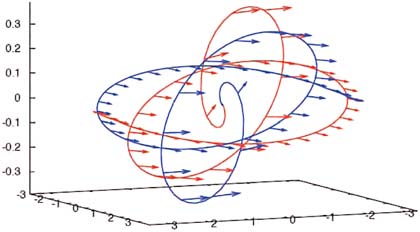
FIGURE 1.10 Simulations of black hole mergers suggest that spin may play a critical role in how black holes merge; depending on the magnitude and alignment of the spins, the mergers could be very rapid or could experience a momentary “hang-up,” with significant consequences for the observed waveform. Shown in this figure are the final few orbits of two black holes (one in red, the other in blue), with arrows denoting their spin magnitude and direction. These complex spin-induced orbital effects are the consequences of “frame dragging,” a fundamental prediction of Einstein’s theory that has been probed in the solar system using Gravity Probe B, Laser Geodynamics (LAGEOS) satellites, and lunar laser ranging, and has been hinted at in observations of accretion onto neutron stars and black holes. Observing the effects of frame dragging in such an extreme environment would be a stunning test of general relativity. Furthermore, with spinning progenitors, the final black hole could experience substantial recoil resulting from the emission of linear momentum in the gravitational waves, large enough to eject it from the host galaxy. SOURCE: Reprinted with permission from M. Campanelli, C.O. Lousto, and Y. Zlochower, Spinning-black-hole binaries: The orbital hang-up, Physical Review (Section) D: Particles and Fluids 74:041501, 2006, copyright 2006 by the American Physical Society.
EMRIs may be observed by a space-based detector and can provide incredibly precise quantitative tests of the space-time geometry of black holes. Over the 104 to 105 eccentric, precessing orbits traced out by the smaller mass, the emitted waves encode details about the space-time structure of the larger hole with a variety of distinct signatures. In addition to providing determinations of the black hole’s mass and angular momentum to fractions of a percent, the observations can also be used to test whether the space-time that encodes the waves is the unique Kerr geometry that general relativity predicts for rotating black holes.
Gravitational waves can also be used to test specific theories alternative to general relativity. If gravity propagates with a speed that depends on wavelength (for example if the putative “graviton” were massive), a strong constraint on its mass could be placed by searching for deviations in the phases of the arriving waves from the general-relativistic predictions. It may be possible to test whether the prediction of only two transverse quadrupolar modes is correct. If astronomers can detect the
electromagnetic signature associated with the inspiral, then differences in arrival times would place powerful constraints on the graviton mass.
Binary black hole inspirals provide standard candles free of calibrations for measuring the distance to the source. For these “clean” systems, there is an expected relationship between the waveform shape and the luminosity of the source. A space-based detector could measure luminosity distances to a few percent at redshift 2, and to tens of percent at z = 10. At the same time, because of the changing orientation of the space array with respect to the source, its sky location could be determined to 10 arcminutes for massive inspirals at z = 1. This positional information can be used to search for electromagnetic counterparts, which can in turn be used to measure the redshift. The combination of several such measurements could give a dark energy bound that begins to be competitive with conventional dark energy approaches. Absent an electromagnetic counterpart, statistical associations of galaxies with EMRIs can be used to measure the Hubble constant to a few percent, and to place constraints on the acceleration rate.
Realizing the Discovery Potential
A number of steps are needed to realize the discovery potential of gravitational wave astronomy. The first is to complete the upgrade of the network of ground-based, high-frequency interferometers in the United States and Europe. If these arrays achieve their proposed sensitivities of roughly 4 × 10⁻²⁴/(Hz)1/2 at 100 Hz, there will be a very good chance of discovery of gravitational waves from stellar remnant inspirals and mergers. Development of pulsar timing arrays with the capability of detecting and timing approximately 40 millisecond pulsars with 100-nanosecond accuracy should be completed. Initially, the primary need is increased time allocations at existing facilities, with advanced kilometer-scale detector arrays envisioned for the future.
For the low-frequency band between 10−5 and 10−1 Hz, a space-based detector is essential, with sensitivity capable of detecting massive black hole mergers to redshift 20 with a signal-to-noise ratio of at least 10. This requirement translates roughly to a strain sensitivity of 3 × 10⁻²¹/(Hz)1/2 in the millihertz range.
The science to be learned from gravitational wave detections will be greatly enhanced if observations of the same phenomena can be done in the electromagnetic (and possibly the neutrino) window. Because many gravitational wave sources are transient in nature (mergers, collapse), this will require wide-angle, high-cadence electromagnetic surveys, together with potentially rapid follow-up observations of sources with large telescopes. Observing electromagnetic counterparts will aid in source identification, sky localization, and redshift determination, and will make possible novel measurements of the distance-redshift relation. For massive black hole inspirals, a space detector could give weeks of warning of the final merger
|
BOX 1.4 Conclusions Relating to Gravitational Waves by the Science Frontiers Panel on Cosmology and Fundamental Physics Goals
Needed Capabilities
|
event together with degree-accurate source positions, permitting narrower fields to be viewed.
Panel Conclusions Regarding Gravitational Waves
The conclusions of the panel with respect to gravitational waves are presented in Box 1.4. Included are goals and needed capabilities in this area.
THEORY AND SYNTHESIS
Theory is and has been essential to what we choose to observe and how we arrange to do so. Many of the ideas that are central to the next decade’s empirical investigations—inflation, supersymmetric dark matter, neutrino oscillations, black holes, and gravitational waves—began life decades ago as theoretical speculations. Many of the tools that are being used for these investigations—CMB polarization, weak lensing, BAO observations, laser interferometers—grew out of theoretical studies that started long before the methods were technically feasible.
As these methods are moving toward implementation, theory plays an important role in designing experiments, optimizing methods of signal extraction, and understanding and mitigating systematic errors. Theory and observation are so closely intertwined in investigations of cosmology and fundamental physics that it is often difficult to define the border between them. Examples include predicting the signals and backgrounds for dark-matter-detection observations, calculating the impact of intrinsic galaxy alignments on weak-lensing measurements, and computing waveforms for template matching in gravitational wave searches. Theoretical advances often amplify the scientific return of a data set or experiment well beyond its initial design. Potentially powerful techniques that are subjects of active theoretical scrutiny include redshift-space distortions as a precision measure of structure growth, and scale-dependent galaxy bias as a sensitive probe of primordial non-Gaussianity. As data come in, theory assumes the pivotal role in tying them back to the underlying physics, whether it be computer models of core-collapse supernovae, phase transitions in the early universe, or extensions of the standard model of particle physics. Finally, more speculative, exploratory theory may produce the breakthrough that leads to a natural explanation of cosmic acceleration, a compelling physical mechanism for inflation, or the prediction of an extraordinary gravitational wave phenomenon yet to be observed.
The above examples illustrate four distinct modes of theoretical work that are essential to progress in the next decade:
-
Before observation. Development of new methods, identification of new observables, and statistical forecasting.
-
During observation. Design of experiments, calculation of systematic effects, and statistical analysis to optimize the use of the data.
-
After observation. Interpretation of empirical results in terms of underlying physical models.
-
Exploratory theory at the frontiers of current knowledge. Although often speculative and high risk, this mode of theoretical research can lead to breakthrough ideas that transform the field.
Advances in high-performance computing are driving rapid progress in many areas of cosmology and fundamental physics. Examples that are central to the themes of this report include numerical simulations of structure formation needed to interpret maps of the galaxy distribution or to predict signals of dark matter annihilation; computational studies of core collapse and thermonuclear supernovae; calculations of gravitational wave emission from mergers of spinning black holes; statistical analyses of large and complex data sets from CMB observations, LSS surveys, neutrino observations, and gravitational wave searches; and massive searches through high-dimensional parameter spaces to evaluate the statistical
uncertainties from varied combinations of data sets. To exploit these advances requires both cutting-edge computer hardware and the software, personnel support, and the training of researchers needed to maximize its scientific reach. This support is needed at many levels, from the handful of ultrapowerful machines that enable the most ambitious calculations, through the larger and more varied tier of supercomputers available at national and state-supported centers, and on to high-performance clusters in individual research groups and the networks of workstations and laptops by which scientists access these facilities and examine the results of their computations.
Although the advances in computational theory are dramatic, it is often penciland-paper theory that leads to novel ideas or identifies the connections between seemingly disparate phenomena. The frontiers of cosmology today present grand theoretical challenges: rooting models of inflation in more fundamental descriptions of underlying physics; explaining the asymmetry between matter and antimatter and thus the origin of the particles that form Earth and the life on its surface; describing the interior structure of black holes and explaining their entropy in terms of quantum gravity; determining whether there are spatial dimensions beyond the three of everyday experience; explaining the surprising magnitude of cosmic acceleration and the seeming coincidence of the densities of baryons, dark matter, and dark energy; and determining whether our observable cosmos is a fully representative sample of the universe or one of many disparate bubbles in a much larger inflationary sea. Robust support for the full span of theoretical activities is essential in order to reap the return from large investments in observational facilities over the next decade, and also to ensure that the scientific opportunities in the 2020-2030 decade will be as exciting as those of today.
BIBLIOGRAPHY
Bahcall, J. 2004. Solar neutrinos: A popular account. Encyclopedia of Physics. Edition 3, arXiv:physics/0411190.
Bertone, G., D. Hooper, and J. Silk. 2005. Particle dark matter: Evidence, candidates and constraints. Physics Reports 405:279.
Blumer, J., R. Engel, and J.R. Horanfel. 2009. Cosmic rays from the knee to the highest energies. Progress in Particle and Nuclear Physics 63:292.
Camilleri, L., E. Lisi, and J. Wilkerson. 2008. Neutrino masses and mixings: Status and prospects. Annual Review of Nuclear and Particle Science 58:343-369.
Fields, B., and K. Olive. 2006. Big bang nucleosynthesis. Nuclear Physics A 777:208.
Frieman, J.A., M.S. Turner, and D. Huterer. 2008. Dark energy and the accelerating universe. Annual Review of Astronomy and Astrophysics 46:385-432.
Hannestad, S. 2006. Primordial neutrinos. Annual Review of Nuclear and Particle Science 56:137-161.
Hoffman, K.D. 2009. High energy neutrino telescopes. New Journal of Physics 11:055006.
Hughes, S.A. 2003. Listening to the universe with gravitational-wave astronomy. Annals of Physics 303:142.
Sathyaprakash, B.S., and B.F. Schutz. 2009. Physics, astrophysics and cosmology with gravitational waves. Living Reviews in Relativity 12:2. Available at http://www.livingreviews.org/lrr-2009-2.
Sommers, P., and S. Westerhoff. 2009. Cosmic ray astronomy. New Journal of Physics 11:055004.
Stecker, F.W., and S.T. Scully. 2009. Searching for new physics with ultra-high energy cosmic rays. New Journal of Physics 11:085003.
Steigman, G. 2009. Primordial nucleosynthesis after WMAP. In Chemical Abundances in the Universe: Connecting First Stars to Planets, Proceedings of the IAU, Volume 265, arXiv 0909.3270.
Uzan, J.-P. 2003. The fundamental constants and their variation: Observational status and theoretical motivations. Reviews of Modern Physics 75:403-455.
Uzan, J.-P. 2009. Fundamental constants and tests of general relativity—Theoretical and cosmological considerations. Space Science Reviews 148:249-265.


