
3
Implementation Progress
This committee is charged with the task of discussing significant accomplishments of the restoration and assessing “the progress toward achieving the natural system restoration goals of the Comprehensive Everglades Restoration Plan (CERP)” (see Chapter 1). The last National Research Council (NRC) review of restoration progress (NRC, 2008) noted that in the first eight years after the Water Resources Development Act of 2000 (WRDA 2000) was authorized, the CERP had been bogged down in budgeting, planning, and procedural matters and was making only scant progress toward achieving restoration goals. Although some project phases were under way, most of the CERP accomplishments were programmatic (e.g., land acquisition, project implementation reports [PIRs]) and served to lay the foundation for later project construction (NRC, 2008).
In this chapter, the committee provides an update to the NRC’s previous assessments of CERP and related non-CERP project planning and implementation progress (NRC, 2007, 2008) as well as an analysis of any natural system benefits resulting from this progress to date. Also included are discussions of programmatic issues related to CERP progress, such as funding and project sequencing.
CERP RESTORATION IMPLEMENTATION
Progress restoring the South Florida ecosystem will come about only through implementation of restoration projects. The analysis of implementation progress provided in this section focuses on CERP projects, although many of these projects build upon restoration benefits provided by non-CERP projects, which are discussed in the next section. Additional detail on implementation progress can be found in Chapter 7 of the South Florida Environmental Report (Williams et al., 2010).
The Yellow Book (USACE and SFWMD, 1999) outlined a conceptual plan for 68 projects and identified a schedule for implementation. The originally ambitious timetable gave way to delays in project planning and lower-than-expected
program funding. As a result, the project implementation schedule has been extended and revised several times since the CERP was launched. (See NRC [2008] for additional discussion of major causes of CERP delays.) The committee’s attempt to track early CERP project implementation is shown in Table 3-1, which represents a merger of the CERP projects within the most recent schedule, termed the Integrated Delivery Schedule (discussed in more detail later in this chapter), and the earliest projects (scheduled for completion by 2010) from the previous Master Implementation Sequencing Plan (MISP) (USACE and SFWMD, 2005a). The projects listed in Table 3-1 are also shown on a map of the South Florida ecosystem in Figure 3-1.
The task of tracking project progress and assessing delays over time is complex because some projects have been reorganized, transferred out of the CERP, or split into phases to achieve incremental restoration where feasible. However, the project status information (available at http://www.evergladesplan.org) has been significantly improved since the committee’s last report. Project planning progress can now be tracked in a single color-coded spreadsheet,1 and quarterly progress reports for multiple projects in a region can be viewed at one time.2
As of June 2010, four CERP restoration projects are actively under construction, and four pilot projects are in an installation and testing phase. Many more projects are in planning and design phases (see Table 3-1). Estimated project completion dates continue to be delayed, and not a single CERP project has been completed as of the production of this report.3 Nevertheless, considering the state of Florida’s extreme budget challenges over the past two years, the project implementation schedule has remained more stable than might have been expected due to increased funding from the federal government for the Everglades restoration efforts, including assistance from the American Recovery and Reinvestment Act of 2009, also known as the economic stimulus. Funding is discussed in more detail later in this chapter. In the following sections the committee highlights CERP progress with a focus on progress in achieving natural system restoration benefits through incremental CERP project implementation and learning achieved through CERP pilot projects.
CERP Projects
In the past two years, the Everglades restoration has seen a resurgence of construction activity, thanks in part to a boost in federal funding and the
|
1 |
See http://www.evergladesplan.org/pm/projects/project_docs/status/csf_milestones_current.pdf. |
|
2 |
See http://www.evergladesplan.org/pm/projects/project_docs/status/central_current.pdf or http://www.evergladesplan.org/pm/projects/project_docs/status/south_current.pdf. |
|
3 |
One original CERP project, Acme Basin B, has been completed, but the project was expedited by the state of Florida and withdrawn from the CERP program. |
TABLE 3-1 South Florida Ecosystem Restoration Project Status as of June 2010
|
Project or Component Name |
Yellow Book (1999) Estimated Completion Date |
MISP 1.0 (2005) Estimated Completion Date |
2008 Estimated Completion Date (NRC, 2008) |
|
PILOT PROJECTS |
|
|
|
|
C-43 ASR Pilot (Fig. 3-2, No. 1) |
2002 |
2006 |
2012 |
|
Hillsboro ASR Pilot (Fig. 3-2, No. 2) |
2002 |
2006 |
2009 |
|
Lake Okeechobee ASR Pilot (Includes Kissimmee River, Port Mayaca, and Moore Haven sites) (Fig. 3-2, No. 5) |
2001 |
2007 |
2012 |
|
Regional ASR Study |
NA |
2010–2015 |
NA |
|
L-31N (L-30) Seepage Management Pilot (Fig. 3-2, No. 4) |
2002 |
2008 |
2010 |
|
Decomp Physical Model |
NA |
2010–2015 |
NA |
|
C-111 Spreader Canal Design Test |
NA |
NA |
NA |
|
RESTORATION PROJECTS |
|
|
|
|
Melaleuca Eradication and Other Exotic Plants |
2011 |
2007 |
2026 |
|
Winsberg Farm Wetlands Restoration (Fig. 3-2, No. 3) |
2005 |
2008 |
2010 |
|
Biscayne Bay Coastal Wetlands (Phase 1) (Fig. 3-2, No. 6) |
2018 |
2008 |
2011 |
|
Picayune Strand Restoration (Fig. 3-2, No. 7) |
2005 |
2009 |
2015 |
|
IDS (March 2010) Estimated Construction Completion Date |
Project Implementation Report (PIR) or Pilot Project Design Report (PPDR) |
Authorization Status |
Planning/Design |
Construction Status; Installation and Testing Status for Pilots |
|
Not specified |
PPDR Final Sept. 2004 |
Authorized in WRDA 2000 |
Completed |
Suspended due to poor site conditions |
|
Not specified (but estimated to be completed in 2011) |
PPDR Final Sept. 2004 |
Authorized in WRDA 1999 |
Completed |
Installed Sept. 2008; Testing ongoing |
|
Not specified |
PPDR Final Sept. 2004 |
Authorized in WRDA 1999 |
Completed |
Installed 2008; Testing ongoing (Kissimmee River only) |
|
Not specified |
NA |
NA |
NA |
Ongoing |
|
2012 |
PPDR Final May 2009 |
Authorized in WRDA 2000 |
Completed |
Not begun |
|
2013 |
NA |
Programmatic Authority WRDA 2000 |
Completed |
Not begun |
|
2011 |
NA |
Programmatic Authority WRDA 2000 |
Completed |
Ongoing |
|
2011 |
Final June 2010 |
Programmatic Authority WRDA 2000 |
Ongoing |
Start anticipated late 2010 |
|
Not specified |
Draft Feb. 2008 |
NA |
Suspended |
Phase 1: Completed outside of CERP |
|
|
|
|
|
Phase 2: Not begun |
|
2012 |
Draft March 2010 |
. |
Completed |
Ongoing; expedited by FL prior to authorization |
|
Merritt: 2012 Faka-Union: 2012 Miller: 2018 |
Final, 2004; submitted to Congress Sept. 2005 |
Construction Authorized in WRDA 2007 |
Completed |
Prairie Canal completed in 2007 (expedited by FL); Merritt ongoing |
|
Project or Component Name |
Yellow Book (1999) Estimated Completion Date |
MISP 1.0 (2005) Estimated Completion Date |
2008 Estimated Completion Date (NRC, 2008) |
|
Indian River Lagoon - South (Fig. 3-2, No. 8) |
|
|
2023 |
|
- C-44 Reservoir* |
2007 |
2009 |
2014 |
|
- Natural Areas Real Estate Acquisition |
Not specified |
2009 |
Not specified |
|
Broward County WPAs |
|
|
|
|
2007 |
2009 |
2014 |
|
|
2008 |
2009 |
2014 |
|
|
- WCA 3A & 3B Levee See page Management* (Fig. 3-2, No. 9,10) |
2008 |
2008 |
2017 |
|
Acme Basin B Discharge (Fig. 3-1, No. 11) |
2006 |
2007 |
2009 |
|
2007 |
2009 |
2013 |
|
|
2008 |
2008 |
|
|
|
Western Project (PIR#1) |
|
|
2011 |
|
Eastern Project (PIR#2) |
|
|
TBD |
|
North Palm Beach County – Part 1 |
Not specified |
|
|
|
- C-51 and Loxahatchee (L-8 Basin) Reservoir (Fig. 3-2, No. 13) |
2011 |
2008 |
2008 |
|
Everglades Agricultural Area Storage Reservoir, Part 1, Phase 1* (Fig. 3-2, No. 14) |
2009 |
2009 |
TBD |
|
IDS (March 2010) Estimated Construction Completion Date |
Project Implementation Report (PIR) or Pilot Project Design Report (PPDR) |
Authorization Status |
Planning/Design |
Construction Status; Installation and Testing Status for Pilots |
|
Not specified |
Final 2004; submitted to Congress Aug. 2004 |
Construction Authorized in WRDA 2007 |
|
|
|
2015 |
Completed by state; ongoing by USACE |
Not begun |
||
|
Not specified |
|
|
NA |
NA |
|
|
Final April 2007 |
|
|
|
|
2019 |
|
|
Ongoing |
Not begun |
|
2015 |
|
|
Ongoing |
Not begun |
|
2023 |
|
|
Ongoing |
Not begun |
|
NA |
Discontinueda |
NA |
Completed |
Completed outside of CERP |
|
2014 |
Final 2006; submitted to Congress Dec. 2006 |
Construction Authorized in WRDA 2007 |
Ongoing |
Not begun |
|
2012 |
Final Dec. 2009 |
|
Completed |
Ongoing; expedited by FL prior to authorization |
|
Not specified |
Not begun |
|
Not begun |
Not begun |
|
Not specified |
In development |
|
Ongoing |
|
|
Not specified |
|
|
Ongoing |
Expedited by FL prior to authorization; on hold pending funding |
|
TBD |
Revised Draft (2006) further revisions on holdb |
|
Completed |
Construction suspendedb |
|
Project or Component Name |
Yellow Book (1999) Estimated Completion Date |
MISP 1.0 (2005) Estimated Completion Date |
2008 Estimated Completion Date (NRC, 2008) |
|
Lake Okeechobee Watershed |
|
|
2015 |
|
-Lakeside Ranch STA |
2010 |
2010–2015 |
Not specified |
|
2001 |
2008 |
Not specified |
|
|
Modify Rotenberger Wildlife Management Area Operation Plan (Fig. 3-2, No. 16) |
Not specified |
2009 |
2009 |
|
C-43 Basin Storage: West Basin Storage Reservoir (Fig. 3-2, No. 1) |
2012 |
2010 |
2013 |
|
WCA 3 Decompartmentalization and Sheetflow Enhancement (Decomp)* |
|
2020 |
|
|
- Decomp Part 1 |
2010 |
2015–2020 |
2016 |
|
- Decomp Part 2 |
2010 |
2015–2020 |
2019 |
|
- Decomp Part 3 |
2019 |
2015–2020 |
Beyond 2020 |
|
ENP Seepage Management |
2010 |
2010–2015 |
2016 |
|
NOTES: Projects in Table 3-1 reflect those that were included in MISP Band 1, those that are now identified in the Integrated Delivery Schedule (March 2010 version) for construction start prior to 2020, and other projects deemed by the committee to be relevant to near-term restoration progress. Gray shading of project names reflects projects being expedited and/or carried out entirely with state funding as of 2010. Gray shading of planning/design or construction cells indicates past or present aspects of projects that were expedited with state funding. In most cases, design and/or construction of these projects was moving forward prior to the finalization of the PIR. Some of these projects are still considered CERP components, while others are now considered outside of the CERP; NA = not applicable; TBD = to be determined *Projects that were conditionally authorized in WRDA 2000, subject to approval of the PIR. aThe South Florida Water Management District (SFWMD) has decided to work with local interests to complete the design and construction of the Acme Basin B Discharge project and the Lakes Park Restoration project outside of the CERP. Cost sharing under the CERP is not anticipated; thus effort on these two PIRs has been discontinued, and CERP planning/design efforts have ended. bThe Everglades Agricultural Area (EAA) Storage Reservoir project is on hold, pending the resolution of planning for the acquisition of U.S. Sugar Corporation lands, although court cases (e.g., USA, et al. v. SFWMD, et al. 1:88-civ-01886-Moreno) may impact the plans for this project. SOURCES: DOI and USACE (2005); USACE, 2009a; L. Gerry, SFWMD, personal communication (2010); E. Bush, USACE, personal communication (2010); D. Tipple, USACE, personal communication (2010); Project Status Reports from www.evergladesplan.org; USACE and SFWMD (1999). |
|||
|
IDS (March 2010) Estimated Construction Completion Date |
Project Implementation Report (PIR) or Pilot Project Design Report (PPDR) |
Authorization Status |
Planning/Design |
Construction Status; Installation and Testing Status for Pilots |
|
2023 |
In development |
|
Ongoing |
|
|
2011 |
|
|
Ongoing |
Ongoing; expedited by FL prior to authorization |
|
Not specified |
|
|
Ongoing |
Ongoing (part of Lakeside Ranch project) |
|
NA |
NA |
NA |
Implement as needed |
NA |
|
2014 |
Final 2009; approved by USACE Chief of Eng. in March 2010 |
|
Completed |
Not begun |
|
2019 |
|
|
|
|
|
2016 |
In development |
|
Ongoing |
Not begun |
|
2018 |
Not begun |
|
Not begun |
Not begun |
|
2019 |
Not begun |
|
Not begun |
Not begun |
|
2016 |
On hold—to resume 2013 |
|
On hold pending pilot |
Not begun |
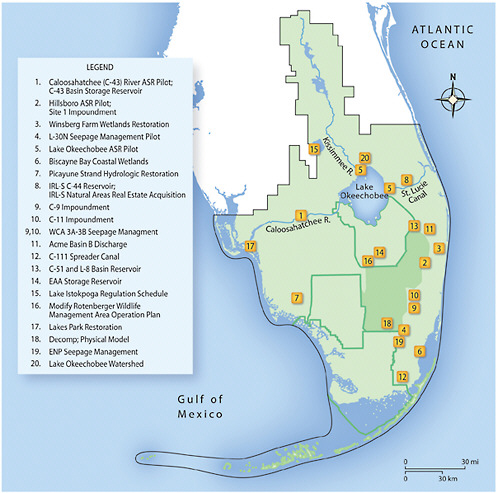
FIGURE 3-1 Locations of CERP projects and pilots listed in Table 3-1. These represent the projects in the November 2009 version of the Integrated Delivery Schedule as well as the projects previously anticipated to be completed by 2010. Based on new project scheduling, some of the projects originally scheduled with early start dates are now delayed beyond the 2020 timeframe. © International Mapping Associates
congressional authorization of three projects in WRDA 2007. As noted in NRC (2008), the lengthy and arduous CERP planning and authorization process had previously caused substantial delays in CERP project implementation. Out of frustration with the pace of progress, the state of Florida expedited several projects with full state funding, bypassing the U.S. Army Corps of Engineers (USACE)
project planning and authorization process at their own risk. However, 10 years post CERP authorization, 7 PIRs out of roughly 45 total have been finalized (although 3 others have been completed in draft form). Four PIRs have been approved by the USACE chief of engineers, and three projects have received congressional authorization for construction (see Box 3-1), enabling the flow of federal funding to these three projects, if appropriated. As of June 2010, four additional CERP projects (C-43 West Basin Storage Reservoir; C-111 Spreader Canal, Western Phase; Broward County Water Preserve Areas; and the Biscayne Bay Coastal Wetlands, Phase 1) are being considered for inclusion in the next WRDA bill, which when passed would greatly expand the number of projects eligible for federal appropriations for construction. Meanwhile, the state of Florida is expediting construction of the C-111 Spreader Canal, Lakeside Ranch stormwater treatment area (STA), and Biscayne Bay Coastal Wetlands projects and some land clearing for the C-43 Reservoir with state funding.
Although no CERP projects are anticipated to be fully constructed by the end of 2010, a few project subcomponents that will deliver restoration benefits have been completed or are nearing completion. These early benefits are described in this section. Also, groundbreaking ceremonies were held in January 2010 for the CERP Picayune Strand and state-expedited construction starts on the C-111 Spreader Canal, Western portion and Biscayne Bay Coastal Wetlands, Phase 1. Additionally, the Acme Basin B Project, originally part of the CERP but no longer considered a CERP project, was completed by the state of Florida as of March 2010. These projects and their documented and/or anticipated benefits are discussed in this section. NRC (2008) reported on a number of CERP proj-
|
BOX 3-1 Summary of Congressionally Authorized Projects with Approved PIRs As of April 2010, three Comprehensive Everglades Restoration Plan (CERP) projects with approved program implementation reports (PIRs) have been congressionally authorized—Indian River Lagoon-South (IRL-S), Picayune Strand Restoration, and Site 1 Impoundment. Ten projects were also conditionally authorized in the Water Resources Development Act of 2000 (WRDA 2000), subject to approval of their PIRs by the authorizing committee (see Table 3-1). However, most of these conditionally authorized projects will need to go through the authorization process again because of substantial changes in project scope or budget during project refinement in the development of the PIRs (S. Appelbaum, USACE, personal communication, 2010). |
|
Indian River Lagoon-South The IRL-S project (Figure 3-1, No. 8), an approximately $1.5 billion component of the CERP (in 2007 dollars), is located northeast of Lake Okeechobee. The C-44 Basin Storage Reservoir is subsumed within the overall IRL-S project, to which are added the C-25 and C-23/C-24 North and South Storage Reservoirs. The original Yellow Book plan (USACE and SFWMD, 1999) was limited to these four storage reservoirs, but the project plans have since been significantly altered. The four storage basins are now proposed to provide 130,000 acre-feet of water storage, a substantial decrease in storage from the 389,000 acre-feet of storage proposed in the Yellow Book. An additional 65,000 acre-feet of storage are proposed through wetland restoration and utilization of three natural storage areas on 92,000 acres of land and in four new STAs. Finally, 7.9 million cubic yards of muck will be dredged from the St. Lucie River and Estuary to provide 2,650 acres of clean substrate within the estuary for recolonization of marine organisms. The original Yellow Book plan aimed to reduce damaging flows to the St. Lucie Estuary and the IRL-S while also providing water supply for agriculture, thereby reducing demands on the Floridan aquifer. However, the PIR included added benefits for enhanced phosphorus and nitrogen reduction, improved estuarine water quality, restored upland habitats, increased spatial extent of wetlands and natural areas, and more natural flow patterns (USACE and SFWMD, 2004a; SFERTF, 2007). In fiscal year (FY) 2010, $26 million in federal funding was appropriated for the IRL-S project. Picayune Strand Restoration Located in western Collier County, the Picayune Strand Restoration project (Figure 3-1, No. 7) will restore and enhance more than 55,000 acres of wetlands in Southern Golden Gate Estates, an area once drained for development. The project will also improve the quality and timing of freshwater flows entering the Ten Thousand Islands National Wildlife Refuge, while maintaining flood protection for neighboring communities. This $393 million project (in 2007 dollars) includes a combination of spreader channels, canal plugs, road removal, pump stations, and flood protection levees. This project is one of the most significant for increasing the spatial extent of natural wetlands (USACE and SFWMD, 2005b; SFERTF, 2007). Site 1 Impoundment (Fran Reich Preserve) Located in Palm Beach County south of the Arthur R. Marshall Loxahatchee National Wildlife Refuge (LNWR), the Site 1 Impoundment (also called the Fran Reich Preserve) Project (Figure 3-1, No. 2) includes an aboveground reservoir adjacent to the Hillsboro Canal with a storage capacity of 6,400 acre-feet, an inflow pump station, spillways, and seepage management structures. Once completed, supplemental deliveries from the impoundment will reduce demands on Lake Okeechobee and LNWR, and the impoundment pool will also provide groundwater recharge and reduce seepage from adjacent natural areas. The impoundment will also serve to reduce freshwater flows and pulsed releases to downstream estuaries. The cost of the project has been estimated at $84 million (in 2007 dollars) (USACE and SFWMD, 2006; Williams et al., 2010). With $41 million in funding from the American Recovery and Reinvestment Act stimulus, construction is anticipated to begin in late 2010 (M. Magley, USACE, personal communication, 2010). |
ects with incremental benefits (e.g., Loxahatchee [L-8 Basin] Reservoir), and that information will not be repeated here unless new information on benefits is available or new progress has occurred in the past two years.
Picayune Strand
The Picayune Strand project (Figure 3-1, No. 7, and Figure 3-2), currently under way, aims to restore and enhance more than 55,000 acres of public lands by plugging and filling canals and returning sheet flow to the project site and adjacent natural areas, including the Fakahatchee Strand State Preserve, Florida
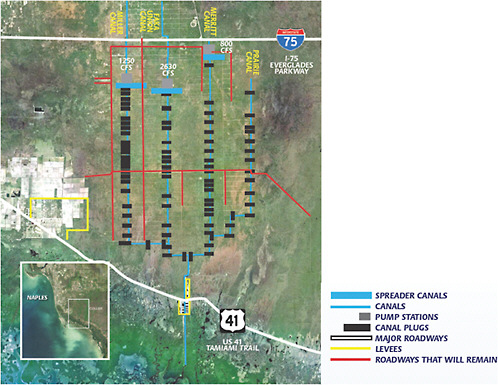
FIGURE 3-2 Components of the Picayune Strand project include road removal, canal plugs, pump stations, spreader canals, and levees.
SOURCE: USACE and SFWMD (2010b).
Panther National Wildlife Refuge, Ten Thousand Islands National Wildlife Refuge, and Collier Seminole State Park. This project was previously expedited by the state of Florida, but the remainder of the project will be funded by the federal government. With expedited state funding, 65 miles of roads were removed, and 7 miles of Prairie Canal adjacent to the road removal area were plugged and filled in 2007. Two pump stations were also designed and permitted. The federal government will complete the project in three additional phases focused on the three remaining canals—Merritt, Faka Union, and Miller. In 2009, the USACE received $65 million in appropriations for this project (including nearly $41 million in stimulus funding) and awarded the contract for the Merritt portion of the project. In the Merritt portion, expected to be completed by 2012, the USACE will plug 13.5 miles of canal and remove non-native vegetation and 95 miles of road. A monitoring program is in place to document hydrologic and vegetation responses to the restoration efforts. Williams et al. (2010) state that water levels have been raised in 13,000 acres of habitat by the work to date by reducing canal-related drawdowns in nearby wetlands, although significant vegetation responses to the hydrologic changes have not yet been documented (Chuirazzi and Duever, 2010). Anticipated hydrologic improvements upon full project construction are shown in Figure 3-3.
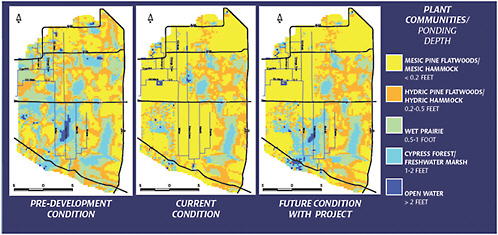
FIGURE 3-3 Average wet season water depths at Picayune Strand under pre-drainage, current, and projected future (with project) conditions.
SOURCE: USACE and SFWMD (2010b).
C-111 Spreader Canal
The C-111 Canal was built in 1966 for flood control in southern Miami-Dade County, to drain agricultural lands south and west of Homestead. The project ultimately redirected water flow to the east, thereby reducing flow through Taylor Slough and into the northeastern portions of Florida Bay, altering the salinity of the bay and the ecology of both regions. The C-111 Spreader Canal project (Figure 3-1, No. 12) is designed to improve the amount and timing of discharges in Taylor Slough, salinity levels in western Florida Bay, and water distribution and timing in the Southern Glades and Model Lands (Figure 3-4; USACE and SFWMD, 1999).
Based on the concept of incremental adaptive restoration (IAR; NRC, 2007), the project has been divided into two phases accompanied by separate PIRs (USACE and SFWMD, 2009b) and includes a pilot-scale test project (described
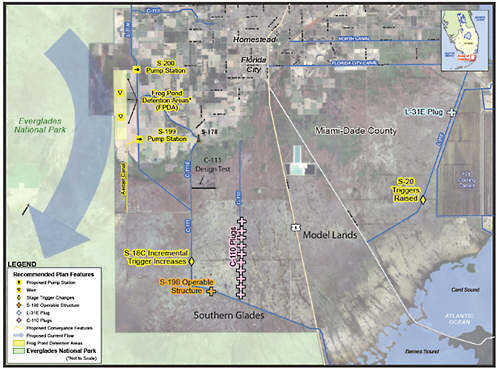
FIGURE 3-4 Features of the western phase of the C-111 Spreader Canal Project.
SOURCE: Modified from USACE (2009b).
later in this chapter). This approach allows for progress on the western features of the project (PIR 1), while uncertainties about certain design features in the spreader canal features (PIR 2) are being resolved. In January 2010, the SFWMD expedited construction on the western phase, which includes a 590-acre Frog Pond detention area, modifications to increase the water level in the Aerojet Canal, and two pump stations (Figure 3-4). These features will create a mound of groundwater (a hydraulic ridge), thereby preventing groundwater seepage out of Everglades National Park and improving water levels and flows in Taylor Slough and increasing water deliveries to northeastern Florida Bay. The project also includes a new structure (S-118) in the C-111 Canal, plugs in the C-110 Canal to reduce drainage of sensitive wetlands, and changes in the open and close trigger stages at two structures (Figure 3-4) to lengthen hydroperiods and increase sheet flow within the Southern Glades and Model Lands while maintaining flood protection. The western project only redistributes existing water and does not provide any new water to the natural system (USACE and SFWMD, 2009a). Given the potential for water quality impacts in Taylor Slough and the Everglades Model Lands such as those noted in Surratt et al. (2010), monitoring in receiving wetlands and adaptive management will need to be important components of the project. The western project is estimated to be completed by 2011; therefore, it is too soon to report upon any observed natural system restoration benefits from this project.
The 2009 biological opinion for the C-111 Spreader Canal Western Phase 1 demonstrates the ability of CERP project delivery teams to work cooperatively with the U.S. Fish and Wildlife Service to adjust initial project designs to allow for incremental implementation of operation, monitoring, and adaptive management for species and habitat restoration (USFWS, 2009a). Like most CERP projects, the C-111 Spreader Canal project has the potential to benefit multiple listed species, but the degree of benefit varies by species and the scale of analysis (e.g., unavoidable local negative impacts vs. landscape-level benefits) and assumes completion of subsequent CERP projects that would actually provide additional water to the system.
After significant delays the project appears to now be progressing. The C-111 Spreader Canal project was conditionally authorized in WRDA 2000 and originally scheduled for completion in 2008. Its estimated cost has risen from $94 million in 1999 to $131 million in 2008 dollars (SFERTF, 2009). In 2004 the state of Florida identified the C-111 Spreader Canal project as an Acceler8 project (see Chapter 2; now called “expedited projects”), and since that time has committed more than $40 million to construction and land acquisition (SFWMD, 2010d). The project is being considered for inclusion in the next WRDA bill, which when passed would allow for appropriations of federal funds to increase the pace of project completion.
Biscayne Bay Coastal Wetlands—Phase 1
The Biscayne Bay Coastal Wetland—Phase 1 project will construct a system of pumps, spreader canals, and culverts to adjust the quantity, quality, timing, and distribution of freshwater to Biscayne Bay. The project aims to significantly reduce the damaging effects of existing point-source discharges to the bay and restore a more natural salinity regime in the coastal tidal wetlands. The project will be implemented in two phases, necessitating two PIRs. A draft of the Phase 1 PIR was released in March 2010 (USACE and SFWMD, 2010d).
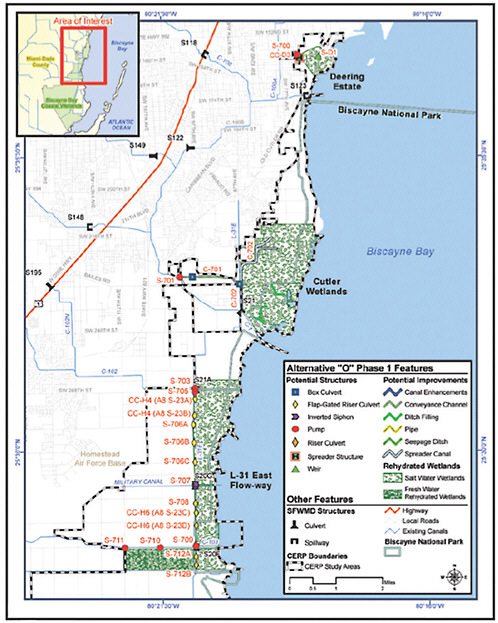
The state of Florida has expedited portions of this project, with construction starts on the L-31E and the Deering Estate components in January and May 2010, respectively. The Deering Estate component involves a 500-foot canal extension, pump station, and spreader structure to improve water delivery. The L-31E Canal component will isolate the L-31E Canal using gated culverts and will move more water into Biscayne Bay wetlands using five new pump stations and several spreader structures (Figure 3-5). A third project component that is not yet under construction, Cutler Flow-way, consists of a pump station, conveyance canal, box culverts, spreader canals, and ditch plugging to increase water flows to saltwater wetlands.
The state of Florida had originally planned to expedite the entire Biscayne Bay Coastal Wetlands—Phase 1 project, but the South Florida Water Management District (SFWMD) is now relying on federal funding for portions of the project due to fiscal constraints. The state is planning to expedite the construction of the entire Deering Estate component, much of the Cutler Flow-way, and 4 (out of 10) culverts in the L-31E Flow-way. As of April 2010, the SFWMD had completed installation of the four culverts in the L-31E component, and the state’s portion of the Deering Estate component was anticipated to be completed by August 2011 (T. Teets, SFWMD, personal communication, 2010). According to the Integrated Delivery Schedule (USACE, 2009a), Phase 1 of the Biscayne Bay Coastal Wetlands project is anticipated to be completed by 2012, but this schedule is dependent upon timely completion of the PIR, congressional project authorization, and subsequent federal appropriations. Given the recent construction starts, it is too early to report any natural system restoration resulting from this project.
Acme Basin B
Phase 2 of the Acme Basin B project (Figure 3-1, No. 11), a 300-acre stormwater impoundment that will divert urban runoff from the A.R.M. Loxahatchee National Wildlife Refuge (LNWR), was anticipated to be completed in June 2010. Phase 1 of this project included canal conveyance improvements and a new pump station to pump the diverted stormwater toward STA-1E for
treatment before it enters LNWR. The state has expedited this project with state and local funds, and although it was originally a CERP project, the CERP planning process has been discontinued, meaning that federal cost sharing of this project is unlikely. However, the Acme Basin B project is the first of the originally proposed CERP projects to be completed, even though it is no longer considered a CERP project (L. Gerry, SFWMD, personal communication, 2010).
Pilot Projects
Pilot projects are important components of the CERP, enabling scientists and engineers to test the capacity of new technologies or approaches and to refine future project design. Although the CERP pilots themselves are not expected to lead directly to natural system restoration progress, the learning that they generate has great value and can be used to improve the extent of natural system restoration and the efficient use of resources. In this light, in the next section the committee discusses what has been learned from the CERP pilot studies to date.
Aquifer Storage and Recovery Pilot Studies and Regional Study
Aquifer storage and recovery (ASR) is a major water storage component of the CERP intended to store as much as 1.7 billion gallons per day (or 6.3 million m3/day) for recovery during wet periods and for use during dry periods. The Yellow Book plan (USACE and SFWMD, 1999) called for about 333 wells, each with a capacity of 5 million gallons per day (MGD). The unprecedented scale of the proposed ASR network raised a number of technical and scientific concerns that were addressed in previous NRC reports (NRC, 2001, 2002a). These concerns included possible regional hydrogeologic impacts of concentrating so many wells in the Upper Floridan aquifer, limited subsurface information for planned well sites, quality of both source water and recovered water, local performance of wells over time, and ecological effects of introducing large volumes of recovered water with altered chemistry into the ecosystem.
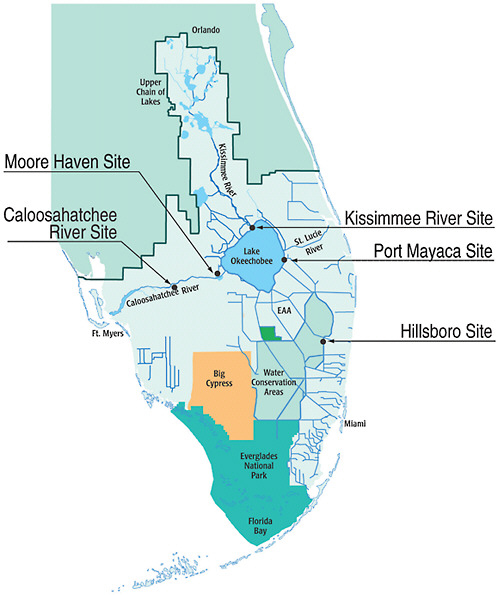
Local pilot ASR wells and regional scientific and engineering studies have been under development since 2003 to address these uncertainties and concerns (see Figure 3-6). Exploratory wells have been drilled at five pilot locations around Lake Okeechobee and along the Hillsboro Canal and the Caloosahatchee River, and 5 MGD ASR systems have been constructed at two sites (Hillsboro Canal, Kissimmee River). Funding limitations prevented construction at two sites (Port Mayaca and Moore Haven) and the Floridan Aquifer proved too sandy for ASR at the Caloosahatchee site. The Port Mayaca pilot was to be a multi-well facility that would test well interactions, an important concern for full ASR implementation.
Geochemical studies of interactions between source water and the water quality and lithology of the Floridan aquifer system have been conducted using data from several operational ASR facilities. Biological studies have included research on microbial communities of the Upper Floridan aquifer and ecological monitoring at the pilot well locations. To address regional issues, extensive hydrogeologic, water quality, and ecological monitoring networks have been installed throughout the CERP area, geophysical studies of the Upper Floridan aquifer have been completed, and large-scale groundwater modeling is under development.
ASR pilot studies have been hindered by funding delays, lengthy contractor negotiations, and slower-than-anticipated permitting processes. Cycle tests to better understand the relationship between storage zone properties, water quality, recovery rates, and recharge are now under way at the Hillsboro Canal and Kissimmee River sites, although these tests will be of shorter duration and with fewer monitoring wells than recommended in the 2002 NRC report. The regional study has made good progress on hydrogeologic and geophysical studies of the Upper Floridan aquifer. Groundwater modeling and studies of biogeochemical processes, water quality, aquifer mixing processes, ecotoxicology, and ecological impacts are roughly 20-50 percent completed in addressing questions raised by the ASR issue team and the NRC. Current plans call for initial groundwater model results by 2010, cycle testing at pilot sites through 2011, completion of the regional study by 2012, and publication of the CERP ASR Project Implementation Report by 2015.
Arsenic leaching could pose a serious challenge to ASR implementation for the CERP. Injection of water with relatively high levels of dissolved oxygen can lead to oxidation of arsenopyrite and release of arsenic into well water during storage. Several operational ASR facilities in Florida have exceeded the new federal arsenic standard of 10 parts per billion (ppb) (Mirecki, 2004), and concentrations reached 140 ppb in water recovered from the first cycle test at the Kissimmee pilot ASR. Longer storage in the second cycle test at Kissimmee decreased concentrations below the regulatory criteria of 10 ppb (Orlando Ramos-Gines, USACE, personal communication, 2010). The operating costs and energy requirements associated with ASR facilities are also of concern. Research is under way to reduce the costs and energy demand by non-pumping recovery under artesian conditions and by optimizing pumping rates for maximum recharge and recovery flow (Mirecki, 2010).
With a planned capacity of 462,000 acre-feet, ASR is the largest planned storage component in the CERP (NRC, 2005). In the 2008 ASR Interim Pilot Report (USACE and SFWMD, 2008), the project team concluded that “no ‘fatal flaws’ have been uncovered that might hinder the implementation of CERP ASR.” Whether fatal or not, the delays, site limitations, and funding constraints
that have compromised the ASR pilots, as well as unanticipated water quality issues, are indicative of the challenges facing large-scale use of ASR. NRC (2005) cautioned against excessive reliance on storage solutions like ASR that would involve complex design and construction measures, require frequent equipment maintenance, and have substantial energy costs for operation. The final ASR pilot report should analyze a reasonable storage capacity for ASR in the CERP, given new information on aquifer conditions and water quality constraints, and should address the benefits and limitations of ASR to meet the storage and water delivery needs of the CERP over both short and long timescales. The final ASR pilot report should also address the capital and operational costs of ASR and objectively compare ASR against other, less energy-intensive storage options. Only with this information can decisions be made about the value of ASR to the CERP and at what scale.
L-31N Seepage Management
The potential for significant eastward groundwater seepage and flooding of urban and agricultural lands in Miami-Dade County is one of the most significant challenges to CERP plans to decompartmentalize the water conservation areas and to increase flows via water conservation area (WCA) 3B into northeast Shark River Slough in Everglades National Park. The L-31N Seepage Management Pilot Project is intended to inform the design of large-scale seepage management solutions for the L-31N levee. To reduce flooding risks the project has been re-located from L-31N to the southeastern corner of WCA-3B along the L-30 levee and canal.
In the pilot project, two seepage management approaches—a slurry cutoff wall and a steel sheet pile wall—are compared using injection and extraction wells to manipulate groundwater levels and flows (Figure 3-7). Two segments of slurry wall, each 450 feet in length, will be placed at an elevation varying between −63 and −68 feet (77 to 82 feet bew ground surface). A 100-foot steel sheet pile wall will be placed between the two slurry wall segments and extended to an elevation of −22 feet. This will leave a 41-foot vertical gap (“window”) underneath the sheet pile wall, allowing seepage flow at depth. Injection wells adjacent to the window (east of the existing L-30 levee) will be installed to create a hydraulic barrier that can be manipulated to vary seepage volumes though the window. Six monitoring wells will be placed on the west side of the window to monitor velocity, temperature, and pH of seepage flowing through the window, and an array of wells will monitor surface and groundwater hydrology and water quality for two years. Seepage management technologies will be evaluated in terms of ease of installation, effectiveness, and cost.
The L-31 pilot project design was approved by the assistant secretary of
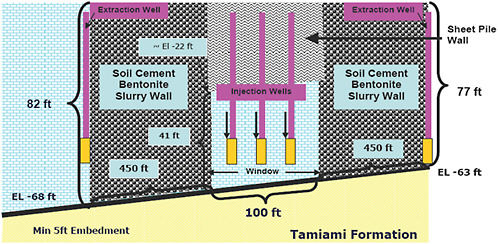
FIGURE 3-7 Schematic diagram of the slurry and sheet pile wall design that will be tested in the L-31N Seepage Management Pilot Project. Placement of injection and extraction wells is also shown.
NOTE: The depths include the wall height 14 feet into the L-31N levee. Extraction wells are located approximately 100 feet form the ends of the barrier wall.
SOURCE: USACE and SFWMD (2009b).
the Army in November 2009. The project is expected to cost $15-16 million. Construction of the seepage management pilot was to begin in September 2009, but the pilot has recently been delayed (USACE and SFWMD, 2009b; K. Tippett, USACE, personal communication, 2010).
An additional small-scale seepage study is under way, funded by the MiamiDade Limestone Products Association (LPA), along the L-31N levee, approximately 1 mile south of the CERP seepage pilot project. The LPA seepage control pilot is part of a larger proposal to privately fund groundwater seepage control adjacent to Everglades National Park to mitigate the effects of expanded limestone mining in the Lake Belt region. In 2009, the LPA constructed a 1,000-foot slurry wall, approximately 18 feet deep. National Park Service scientists evaluated the results and found the effects of the seepage barrier to be inconclusive. The LPA has a groundwater tracer test planned for summer 2010 to better evaluate the changes in flow direction and velocity at the location of the slurry wall and the need for any design changes. The LPA efforts offer the potential
for substantial remediation at little to no public cost (R. Johnson, NPS, personal communication, 2010).
Decomp Physical Model (DPM)
As explained in Chapter 2, canals and levees within the WCAs have disrupted the sheet flow that created and maintained the characteristic Everglades landscape features, such as the ridge and slough. The objective of the WCA-3 Decompartmentalization and Sheet Flow Enhancement (Decomp) project is to restore sheet flow by backfilling selected canals and removing levees. The scheduled completion date is 2020 at a cost of $315 million (SFERTF, 2009), although these numbers depend on timely completion of Mod Waters and resolution of political challenges and scientific uncertainties. Recreational hunting and fishing groups prefer to keep the canals open, but scientists hypothesize that complete backfilling may be required to restore flow patterns and sediment transport processes that maintain the ridge and slough landscape. There is also uncertainty about the need for partial versus complete removal of levees and about the impact of higher water levels in WCA-3B and northeast Shark River Slough on seepage to the Lower East Coast.
The Decomp Physical Model (DPM) is a large-scale field experiment to inform project planning decisions by reducing uncertainty associated with (1) the hydrologic and ecological necessity to backfill canals and (2) the relationship between flow and ecological processes in the ridge and slough landscape (Figure 3-8). The study will install 10 gated 60-inch pipe culverts on the L-67A levee to provide a maximum discharge capacity of 750 cubic feet per second (cfs) and open a 3,000-foot gap in the L-67C levee (Figure 3-9). A 3,000-foot section of the adjacent L-67C canal will be divided into three 1,000-foot sections for complete, partial, or no backfilling. The culverts will be managed to create two annual pulsed flow events between October and January that should generate downstream flow velocities sufficient to entrain and redistribute sediments. A before-after-control-impact (BACI) design will be used to compare hydrology, sediment transport, water quality, and biotic variables in the flow-way below the three canal treatments and in a control region outside of the flow-way. According to the current schedule, the DPM will be installed and tested between July 2011 and July 2014. The before and after monitoring periods will consist of 24 months each, beginning October 2010. Two pulsed-flow events are scheduled for 2012 and 2013 (Sklar et al., 2009a; USACE and SFWMD, 2010c).
In reviewing Decomp progress and the DPM in particular, the committee considered three basic questions: (1) Is there sufficient scientific uncertainty to warrant a relatively costly (>$10 million) and time-consuming study to compare alternatives for restoring sheet flow to the ridge and slough landscape? (2) Can a
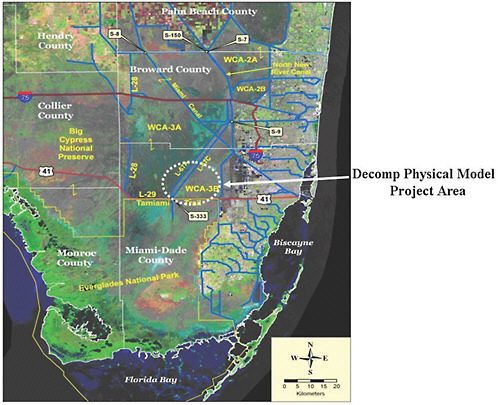
FIGURE 3-8 Location of the Decomp Physical Model.
SOURCE: http://www.evergladesplan.org/pm/projects/docs_12_wca3_model.aspx.
short-term manipulation at the scale and duration of the DPM reduce uncertainties enough to warrant the investment? (3) Is the DPM as designed capable of resolving the debate regarding levee removal and canal backfilling?
Scientific uncertainty. CERP scientists have highlighted six uncertainties associated with Decomp (Sklar et al., 2009a), including (1) the need for complete canal backfilling; (2) ecological benefits from restoring sheet flow and connectivity; (3) effects of levee removal and the need for complete levee removal; (4) depth and hydroperiod tolerance of tree islands and other ridge and slough communities; (5) effects of water levels in WCA-3B and northeast Shark River Slough
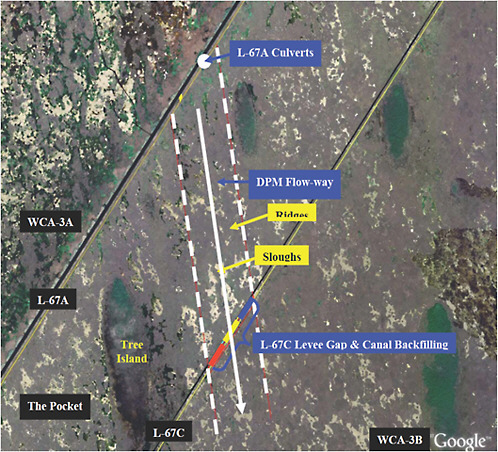
FIGURE 3-9 Schematic illustrating the features of the Decomp Physical Model. The major hydrologic elements (L-67A culvert, flow-way, L-67C canal backfilling, and L-67C gap) are highlighted in blue, the ecological elements (ridges, sloughs, and tree islands) in yellow, and location identifiers in black. The gap in the L-67C is 3,000 feet.
SOURCE: Sklar et al. (2009a).
on seepage to the Lower East Coast; and (6) better parameterization of hydrologic models used to evaluate design alternatives. The DPM mainly addresses questions 1 and 2. A 2003 NRC report recognized the ecological role of sheet flow as a critical uncertainty in CERP implementation (NRC, 2003a). Field and laboratory research since that time, which is summarized in Chapter 6, has elucidated present flow regimes and their relationship to sediment transport in well-preserved and degraded ridge and slough landscapes (Harvey et al., 2005, 2009; Larsen et al., 2007, 2009a; Ho et al., 2009; Variano et al., 2009). Although
much scientific uncertainty remains about the flow regimes that established the ridge and slough system (Noe et al., 2010), and although the DPM will certainly contribute to understanding the hydroecological implications of restoring sheet flow, this committee concludes that the DPM’s cost would probably not be justified if based mainly on uncertainty about the ecological benefits of restoring sheet flow and connectivity to WCA-3.
Instead, the main justification for the DPM is to help resolve the debate over the need for complete versus partial or no canal backfilling. This debate is as much political and economic as it is scientific; complete levee removal and backfilling of canals would seem an obvious choice if restoration of predrainage flows were the only consideration. The two main arguments against complete backfilling are (1) the highly valued sports fishery supported by the existing canal network and (2) the high cost of completely backfilling 84 miles of existing canals (USACE and SFWMD, 2010c).
From a scientific perspective, it is well known that features such as channels, levees, and topographic depressions that alter wetland hydraulic conditions can strongly affect the storage and flows of nutrients and materials by trapping sediment and by creating preferential flow paths or “short circuits” (e.g., Kadlec, 1994; Lightbody et al., 2008;0 Noe et al., 2010). However, the magnitude of differences in wetland hydraulics associated with different backfilling strategies, and the ecological implications of those differences, cannot be predicted with much certainty. If the DPM can in fact improve the scientific credibility, reliability, and cost-effectiveness of the Decomp design then it could be worth the associated delays and expenses.
Ability of the DPM to reduce uncertainty. The DPM study is limited by an overall cost cap of $10.3 million, access and environmental considerations, and operational constraints such as L-29 Canal stages and flood control concerns (Sklar et al., 2009a; USACE and SFWMD, 2010c). The L-67A culvert design and the proposed 3,000-foot gap in L-67C should suffice to generate localized flow-way velocities in excess of 3 cm/sec assuming that sufficient water is made available. The experiment will help quantify the stage response, infiltration, and seepage during re-watering of WCA-3B under Decomp. It can also refine and test hypothesized relationships between flow dynamics, sediment re-distribution, and biogeochemical processes with fast response times such as plant nutrient uptake, plant production, and decomposition. The short duration of the DPM severely limits study of the relationship between flow regime and community composition or landscape structure, which would be expected to change much more gradually to restoration of sheet flow (Larsen and Harvey, 2010).
The DPM will produce the most detailed observation data to date on the hydrology and ecology of sheet flow in the ridge and slough system. Neverthe-
less, two years may not be enough to generate a sufficient range of conditions to distinguish hydrodynamics and geomorphic processes in the different canal treatments (Noe et al., 2010). The short duration will especially limit the ability to sort out the implications of altered nutrient levels and distribution or responses of plants and animals to different treatments given year-to-year vagaries of climate and weather (e.g., precipitation and temperature extremes) and the complex effects of canals on population processes (Rehage and Trexler, 2006). The cost cap could also prove problematic if the project hits unforeseen delays or higher than expected construction costs.
Ability to detect significantly different responses among alternatives. The BACI design is a well-established approach to environmental impact assessments but is not without its limitations (Stewart-Oaten and Bence, 2001). BACI control sites are not strictly experimental controls but rather “covariate” sites whose value improves with replication. BACI designs are based on variations in time and thus are sensitive to inertia, lags, and serial autocorrelation in observed variables. These are issues that can be addressed using appropriate statistical models, longer time series, and greater replication (Stewart-Oaten and Bence, 2001), but the DPM design is short and provides only two “control sites” and three replicates at each time-space sampling point.
The power analysis provided in the Science Plan (Sklar et al., 2009a), which is based on the simplest form of BACI model, provides some indication of the relatively low power of the DPM design for strict hypothesis testing. For example, grand means of variables before and after treatments must differ by more than four times the within-period variability to detect an effect at a significance level (p-value) less than 0.05. It would not be surprising if canal backfilling options did not differ at this significance level given the limited time and DPM design.
The committee raises the issue of replication to highlight a question that seems inadequately treated in current planning documents: How will DPM results be used in resolving the current debate and stakeholder conflicts over levee and canal modifications? The DPM Science Plan describes hypothesis testing and model refinement as the main outcomes. But as discussed by Stewart-Oaten (1996), passing or failing a 0.05 significance test is a poor basis for environmental decision making. Refinements to models such as the South Florida Water Management Model (SFWMM) and the Everglades Landscape Model (ELM) and validation of the RASCAL (Ridge and Slough Cellular Automata Landscape) are important benefits of the DPM (USACE and SFWMD, 2010c) but are unlikely to help to resolve conflict over canal backfilling. The DPM study is the first major application of active adaptive management to CERP implementation, so it is especially important that the process for applying DPM findings to Decomp design be included in DPM project planning. Given the limitations of
DPM in terms of duration and replication, CERP scientists and planners should consider other means of synthesizing and communicating results to facilitate decision making under uncertainty (Raiffa, 1968; Morgan and Henrion, 1990). For example, a Bayesian hierarchical modeling approach (Qian and Shen, 2007; Biggs et al., 2009; Cressie et al., 2009) could be used to evaluate results, which would give a more flexible (and many would argue, realistic) basis for evaluating the likelihood that canal treatments differ without reliance on an arbitrary significance value. Such an approach allows the posterior (post-analysis) probability distributions of differences among treatments to be analyzed, and the likelihood of particular outcomes to be assessed without reliance on a pre-determined and arbitrary “yes/no” criteria.
As another alternative, information gap analysis has proven useful in supporting decision making under uncertainty when probabilistic models are unreliable (Ben-Haim, 2001). This non-probabilistic, set-based approach requires a process model, a performance requirement, and a model of uncertainty, and allows decision makers to weigh expected benefits against risks as a function of uncertainty. Applications to water resources management and conservation management are described by Hipel and Ben-Haim (1999), Hine and Hall (2010), and Regan et al. (2005).
To summarize, the Decomp Physical Model will improve understanding of the effects of different degrees of canal backfilling on wetland hydraulics and sheet flow, provide useful information on surface and subsurface hydrology in WCA-3B as it is re-watered, and result in exceedingly detailed hydrogeomorphic and ecological data during pulsed-flow events. For these reasons the committee supports the project as a way of advancing and improving the design of Decomp. However, it is unlikely that the experiment can definitively resolve the debate over the need for canal backfilling. That decision will need to be made in the face of political disagreement and scientific uncertainty.
C-111 Spreader Canal Pilot
As described previously in this chapter, the C-111 Spreader Canal project has been divided into two separate phases, with a pilot project to support the planning of PIR 2, or the “eastern” project. The eastern project will replace existing portions of the lower C-111 Canal with a spreader canal to enhance sheet flow to Florida Bay and restoration efforts within the Southern Glades and Model Lands. During plan formulation, two major decision-critical uncertainties were identified that were preventing consensus on the appropriate design for the eastern phase (USACE, 2009b):
-
Based on the amount of water available for the spreader canal, what is the most appropriate alignment and design for the spreader canal that will maximize ecological restoration without adversely impacting privately owned lands?
-
Can an infiltration basin and/or source controls sufficiently improve the quality of S-178 discharges to the degree necessary to ensure that water discharged from the future spreader canal is “marsh ready”?
A canal design test was developed to address the first of these decision-critical uncertainties. Specifically, the test would address the following questions:
-
How would a spreader canal affect surface- and groundwater levels to the north and south of its alignment?
-
How much of the source water introduced into the spreader canal will return to C-111 and C-111E via groundwater?
The features of the design test include a 0.5-mile spreader canal, a 0.5-mile pipe to convey water to the spreader canal while keeping the test area separate from groundwater drawdown influences in neighboring canals, and a 50-cfs water discharge rate into the spreader canal. The test began operation in May 2010, with increasing durations of pumping into the spreader canal (ranging from 12 hours to 5 days) and associated surface- and groundwater monitoring at more than 40 locations before, during, and after the tests. The test is anticipated to take approximately 6 months to complete once initiated, and the results will be used to determine the appropriate design of the eastern project (USACE, 2009b; L. Gerry, SFWMD, personal communication, 2010). The test may result in some incremental restoration benefits of the surrounding wetlands, albeit over a very small area, but the pilot project should result in important learning benefits to improve the remainder of the project.
The committee is not aware of any efforts under way to address the second decision-critical uncertainty regarding the water quality of S-178 discharges. Everglades National Park scientists have voiced concerns over increased cattail growth in Taylor Slough suspected to be caused by water management changes that have increased hydroperiods and thus increased phosphorus loading. Therefore, CERP planners should take steps to help resolve the decision-critical uncertainties related to water quality discharges in the C-111 so that future progress on the eastern project can proceed.
NON-CERP RESTORATION IMPLEMENTATION
Some of the largest accomplishments and some of the greatest challenges in South Florida ecosystem restoration have been associated with non-CERP proj-
ects that are directly related to the success of the CERP in achieving its restoration goals. Projects such as the Modified Water Deliveries Project to Everglades National Park (Mod Waters) and the Everglades Construction Project have been in the works for decades, even as the CERP was being developed. The progress of the CERP is dependent upon the successful implementation and effective operation of these non-CERP projects. Therefore, although the focus of this committee’s charge is on natural system restoration progress related to the CERP, progress on related non-CERP foundation projects, including documented natural system restoration benefits where feasible, is summarized in Appendix C. In this section, major non-CERP accomplishments and documented benefits from the past two years are discussed. This section builds upon the committee’s prior assessments of natural system restoration progress and challenges associated with STAs, the Kissimmee River restoration, and Mod Waters (NRC, 2007, 2008).
Mod Waters
A major development since NRC (2008) is the start of construction of the 1-mile bridge on the eastern end of the Tamiami Trail, which is part of the Mod Waters project. The contract for the bridge was issued in October 2009, and the groundbreaking occurred on December 4, 2009. In its prior report (NRC, 2008), the committee outlined the long and often discouraging history of the project, focusing on the most recent barriers to improvement of the Tamiami Trail. NRC (2008) stated: “If this relatively modest restoration project cannot proceed and provide some restoration benefits, the outlook for the CERP is dismal.” The committee commends the restoration program on the recent progress and recognizes the congressional leadership required to move the 1-mile bridge project forward.
NRC (2008), however, recognized that the 1-mile bridge plan was “a substantially smaller step toward restoration than was originally envisioned for Mod Waters.” The previous committees stated, “It should be recognized that moving forward with the 2008 recommended [1-mile bridge] plan increases the urgency to proceed more quickly to implement the additional necessary Tamiami Trail modifications through the CERP, or some other mechanism, so that the restoration benefits for Everglades National Park outlined in the WRDA 2007 conference report4 can be achieved as soon as possible.”
The Department of the Interior released an analysis of alternatives and a proposed plan for additional bridging along Tamiami Trail in May 2010 (SFNRC,
2010). These efforts recognize that the 1-mile bridge under construction and the raising of the road to an elevation of 8.5 feet represent a substantially smaller step toward restoration than was originally envisioned for Mod Waters. The preferred alternative (6E) identified in SFNRC (2010) consists of an additional 5.5 miles of bridging (in four separate bridges) and road raising to support a stage of 9.7 feet in the L-29 Canal along the eastern 10.7-mile portion of Tamiami Trail, at an estimated cost of $330 million. SFNRC (2010) states that the plan would provide the capability to convey the historical volumes of water that once passed into Everglades National Park without damage to Tamiami Trail and would accommodate flows from future projects, including the CERP. The plan also offers the potential for substantial improvements in ecological connectivity between Everglades National Park and WCA-3. Although SFNRC (2010) was released too late for detailed review by the committee, the proposal appears to be responsive to the recommendations in NRC (2008).
Everglades National Park is also moving forward with the Spreader Swale Pilot Project, which will test the capacity of spreader swales downstream of Tamiami Trail to improve the conveyance capacity of existing culvert features. The construction of two 1,000-foot by 30-foot spreader swales is anticipated to begin in June 2010. A recent modeling study (Chin, 2010) reported large increases in volumetric flows, ranging from 60 percent to 830 percent at stages of 6 feet in the L-29 Canal depending on the length of the spreader swale, the culvert dimensions, the downstream stage, and the assumed roughness in the downgradient marsh. The study, however, did not consider the effects of spreader swales at canal heights greater than 8.5 feet, even though the CERP would require canal heights as high as 9.7 feet. A full understanding of the potential value of spreader swales should consider canal stages up to 9.7 feet and compare these results to that achievable through additional culverts or bridges.
In addition to the commencement of the Tamiami Trail work, the Mod Waters project involves flood mitigation for the 8.5-square-mile area adjacent to Everglades National Park, conveyance and seepage control features, and implementation plans for monitoring and operation. Previously, the 8.5-square-mile area was protected from flooding by a much larger and more powerful pump (S-331), which drew more water than required and exacerbated seepage from Everglades National Park. A newly constructed pump station (S-357; Figure 3-10) is expected to provide flood mitigation to developed areas while reducing groundwater losses in Northeast Shark River Slough. The new pump station first became available in May 2009, and an interim operating plan including the new pump station was also approved. Unfortunately, downstream detention pond storage capacity has been insufficient to hold the captured water without creating additional flooding in the southwest corner of the 8.5-square-mile area, and the new pump station has ceased operation until additional detention storage as part of the C-111 South Dade project will be constructed.
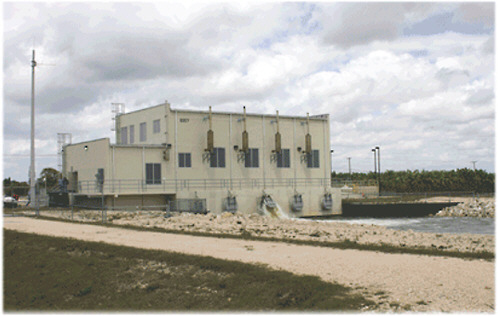
FIGURE 3-10 The S-357 pump station, which began removing water from the 8.5-square-mile area on May 30, 2009.
SOURCE: USACE (2009c).
Decisions have not yet been made regarding plans for Mod Waters conveyance features along the L-67 levees, which were intended to move more water from WCA-3A through WCA-3B and ultimately through the existing S-355 structures in the L-29 levee into Northeast Shark River Slough. These features would restore some level of sheet flow in WCA-3B and reduce unnatural ponding of water in WCA-3A (see also Chapter 4). Planning for conveyance features in the L-67 levees could become part of the multi-agency process to develop a Combined Operating Plan, starting in January 2011, which would govern the operations of Mod Waters and C-111 South Dade project features. However, based on recent budgetary decisions, construction of these conveyance features is now uncertain (R. Johnson, NPS, personal communication, 2010).
Kissimmee River Restoration
The Kissimmee River was a meandering stream with an extensive flood plain draining into the northern edge of Lake Okeechobee (Figure 3-11). During the mid-to-late 20th century its channel was replaced with an artificially aligned channel that was hydrologically isolated from its flood plain (see also Chapter 2).
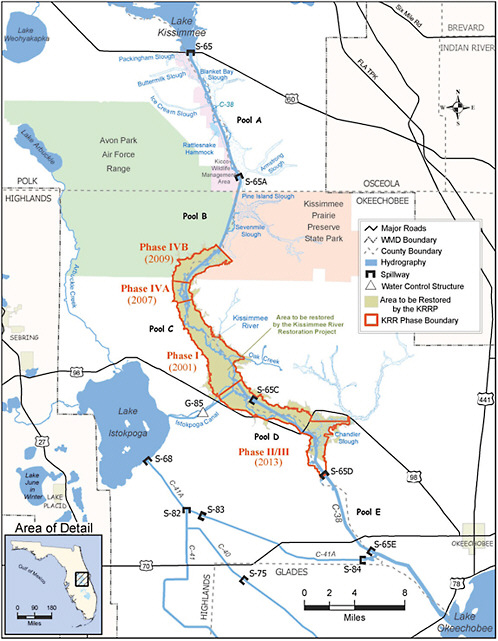
The S-65 control structure (at the outlet of Lake Kissimmee) altered flows into the river from its upstream watershed, changing flow magnitudes, frequencies, durations, and timing. Restoration efforts include recarving 10 miles of the original river, backfilling 22 miles of channel, and changing the operation of the S-65 control structure so that flows into the river are more like natural flows that once occurred in the river.
The reconstruction of the river channel and the re-connection of its flood plain to the channel have progressed considerably since the project began in 1999 (Table 3-2, and Figure 3-11). The reconstruction originally was visualized in four sequential phases (I through IVA and IVB), but subsequent funding opportunities rearranged their order. Three of the project phases (I, IVA, and IVB) are now complete, with the last phase completed in 2010. As of 2010, about 60 percent of the overall project milestones have been achieved as measured by channel backfilled, river channel recarved, channel length with flow reestablished, total flood plain area reconnected to the flow, and wetland area gained (see Table 3-2). The final combined Phases II and III will begin in 2011 and will be complete by 2013 (Jones et al., 2010).
Interim releases from the inflow gates for the Kissimmee River (S-65) have not yet provided all the expected ultimate benefits in flow characteristics or water quality. The full regulation schedule will not be implemented until 2013, and until that time, the USACE has authorized the SFWMD to make releases into the river when upstream lake levels are sufficient and the releases are not required for other purposes. The expected benefits are likely to be evident once the entire project is complete and the schedules of upstream releases into the river are in place. Low levels of dissolved oxygen, for example, are likely to improve once releases increase the discharge of the river during dry periods.
Restoration goals for flow in the Kissimmee River reflect characteristics that contribute to diverse and functional habitats, involving factors such as flow volume, temporal variability patterns, stage (depth), and velocities. Restoration has already achieved the objective of avoiding days when there is no flow in the river. Additional restoration goals include restoring substantial variability to flow magnitudes on two timescales: annual and monthly. At the annual scale, the objective has been to create a more natural pattern of flows with distinct high flows in the rainy season and lower flows in the dry part of the year. Managers have been successful in instituting this annual variation in regulated flows. Flow variation within shorter time segments of individual months, however, has not been restored to pre-drainage variability. Year-long trends in flow depths are producing over-bank flooding of floodplains for substantial periods each year, except during major droughts such as the 2006–2007 period, and floodplains are being functionally reconnected with channel flows. Velocities of flow in the channel are meeting target values about 85 percent of the time.
TABLE 3-2 Phased Construction of the Kissimmee River Restoration Project
|
Construction Sequence |
Name of Construction Phase |
Timeline |
Backfilled Canal (miles) |
River Channel Recarved (miles) |
River Channel to Receive Reestablished Flow (miles) |
Total area (acres) |
Wetland Gained (acres) |
Location and Other Notes |
|
1 |
Phase I project area |
June 1999 - February 2001 (complete) |
8 |
1 |
14 |
9,506 |
5,792 |
Most of Pool C. small section of lower Pool B |
|
2 |
Phase IVA project area |
June 2006 -September 2007 (complete) |
2 |
1 |
4 |
1,352 |
512 |
Upstream of Phase I in Pool B to Wier #1 |
|
3 |
Phase IVB project area |
June 2008 - February 2010 (projected) |
4 |
4 |
6 |
4,183 |
1,406 |
Upstream of Phase IVA in Pool B (upper limit approximately at location of Wier #3) |
|
4 |
Phase II/III project area |
October 2011 - September 2D13 (projected) |
9 |
4 |
16 |
9,921 |
4,688 |
Downstream of Phase I (lower Pool C and Pool D south to the CSX Railroad bridge) |
|
|
|
Restoration Project Totals |
22 |
10 |
40 |
24,963 |
12,398 |
|
|
SOURCE: Jones et al. (2010). |
||||||||
Water quality goals for restoration of the river focus on dissolved oxygen (DO) and total phosphorus (TP) in the stream. Expectations for two measures of DO (mean daily values and DO within 1 meter of the stream bottom) are yet to be met, and DO in the Kissimmee River is generally lower than in values in reference streams. Shallow water areas of the river, however, exhibit healthy levels of DO for fish, and as the restoration progresses, more such areas should become available. TP loads in the Kissimmee River vary widely with climatic conditions (e.g., lower TP loads in drought periods), but in general TP loads have not declined (Jones et al., 2010). As more floodplain areas become hydrologically connected to the river, TP levels may decline because of storage of phosphorus in floodplain ecosystems.
Wading birds and water fowl are also indicators of the general health of the Kissimmee River ecosystems. Nesting bird colonies have dramatically increased in numbers over the past two years, especially for cattle egrets and great egrets. Colonies for new residents such as tri-colored herons and white ibis have appeared in substantial numbers. Densities of wading birds have substantially increased since the initiation of the Kissimmee River restoration, and expected targets have been surpassed. Waterfowl densities also have increased, except during the exceptional drought years. Vegetation responses have also followed expected changes with the river restoration, with a near doubling of area of emergent vegetation compared to baseline data and a 66 percent reduction in floating and mat-forming vegetation (Bousquin et al., 2009). In sum, reasonable progress is being made in the restoration of the hydrology and geomorphology of the Kissimmee River, and the ecosystem has improved quickly in response to these changes. The Kissimmee River project results should be cause for cautious optimism that similar responses might be expected from the CERP.
Stormwater Treatment Areas
Since 1994, approximately 45,000 acres of STAs (effective treatment area) have been constructed in the Everglades Agricultural Area (see Figure 1-3) to remove excess phosphorus from surface waters before it enters the water conservation areas (WCAs) and Everglades National Park (also known as the Everglades Protection Area). As discussed in Chapter 5 in more detail, these STAs continue to remove large quantities of phosphorus from surface waters, although some have faced operation and maintenance challenges. However, since the last NRC report, a phosphorus “exceedance” as defined in the Consent Decree has been reported in the Arthur R. Marshall Loxahatchee National Wildlife Refuge (or WCA-1; SFWMD, 2009d), reflecting a violation of the Consent Decree. This exceedance reflected two sampling events (November 2008, June 2009) that
exceed the “long-term level” within 12 consecutive monthly samples.5 A plan to resolve these water quality issues is anticipated in September or October 2010, in response to recent court rulings.6
There is increasing recognition that the existing STA capacity is insufficient to treat the combined volumes and concentrations of phosphorus laden inflow. As of June 2010, construction of STA Compartments B and C is under way, which will add more than 11,000 acres of STAs (see Figure 5-6). Restoration planners anticipate that Compartment B, located west and south of STA-2, will enhance the performance of STA-2 by expanding its wetland treatment area. Compartment C, located between the existing boundaries of STA-5 and STA-6, is designed to expand the size and enhance the performance of these two STAs. Compartments B and C are expected to be flow-capable by the end of 2010, and construction should be completed by 2011 (Pietro et al., 2010). Nevertheless, these additional STAs do nothing to address the water quality violations in Loxahatchee, and additional treatment mechanisms and/or source controls are needed. See Chapter 5 for an in-depth discussion of water quality challenges in the Everglades restoration.
River of Grass
On June 24, 2008, Florida’s governor Charlie Crist announced that the SFWMD was going to enter into negotiations to acquire 187,000 acres of agricultural land from the U.S. Sugar Corporation for $1.75 billion to maximize restoration opportunities for the South Florida ecosystem. Although not ideal as currently configured, these lands potentially offer the opportunity for additional water storage and treatment at a scale not previously envisioned in the CERP for the benefit of the Everglades ecosystem, Lake Okeechobee, and the St. Lucie and Caloosahatchee rivers and estuaries. Since the original announcement of
this “River of Grass” initiative, the SFWMD has negotiated several changes to the land purchase agreement. The SFWMD governing board in December 2008 voted to accept a proposal to acquire more than 180,000 acres of land for $1.34 billion—a reduced price brokered by Governor Crist for a land-only acquisition. However, on April 2009 the two parties agreed to revise the contract because of the dramatic economic downturn and uncertain economic future. Under the April 2009 revised contract, the SFWMD would purchase 73,000 acres for $536 million, and the U.S. Sugar Corporation offered an option to purchase the remaining 107,000 acres over the next 10 years.
The SFWMD identified numerous potential benefits from this land acquisition. Increased water storage in the Everglades Agricultural Area (EAA) would help reduce harmful freshwater discharges from Lake Okeechobee to Florida’s coastal rivers and estuaries, and this excess water could be treated and redistributed to the south, potentially providing increased water volumes to restore the southern Everglades. The lands could also be used to construct new STAs to help address current water quality concerns and improve the functionality of the current STAs. The options for managing Lake Okeechobee could also be improved, as harmful phosphorus flows would be prevented from entering the lake and the need for “back-pumping” water would be eliminated.
The SFWMD created a comprehensive public planning effort to facilitate stakeholder input and to build consensus on the design of the River of Grass initiative. During Phase I of this process (January to September 2009), the SFWMD held a series of workshops where nine working groups developed alternative configurations for constructing a managed system of water storage and treatment. All configurations proposed by the stakeholders contained storage, treatment, and conveyance project features using up to 180,000 acres without constraints regarding land swaps, but the approaches, restoration benefits, and costs differed widely among the groups’ proposed plans. Information generated during this first phase was intended to be utilized by the SFWMD governing board to support future planning and decision making related to the land acquisition.
In Phase II, which began in December 2009, the SFWMD used more extensive and detailed modeling tools to evaluate system performance and to consider constraints not previously examined. The hydrologic targets were also revisited in a series of science workshops to help refine the River of Grass storage needs. By the end of Phase II, the SFWMD intended to recommend approximately 2-4 design configuration alternatives and associated project footprints (with at least one scenario with land swaps and one without to account for the fact that not all of the U.S. Sugar Corporation lands are ideally suited for restoration purposes).7 However, Phase II has been halted (at least temporarily) to allow time for the
SFWMD to develop a plan to address several pressing legal issues concerning current water quality in Loxahatchee National Wildlife Refuge (LNWR) and the construction status of the EAA Reservoir.
On August 4, 2010, the SFWMD announced that the U.S. Sugar Corporation land purchase had been downsized again, considering the economic challenges facing the state of Florida. Under the latest agreement, the SFWMD would purchase 26,800 acres of land for approximately $197 million in cash, while retaining the option to acquire more than 153,000 additional acres over the next 10 years (see Figure 3-12). This agreement sidesteps a current legal challenge to the state’s right to use Certificates of Participation to finance the purchase, which was awaiting a decision by the Florida Supreme Court as of August 2010. The early acquisition represents 17,900 acres of citrus land in the C-139 basin, west of existing STAs 5 and 6, and 8,900 acres of sugarcane land northwest of LNWR—two areas with historically high phosphorus loads (SFWMD, 2010e).
Although no specific plans for the use of the lands have been announced as of August 2010, the SFWMD stated: “This acquisition, together with the Talisman lands, would give the District access to more than 50,000 acres of land south of Lake Okeechobee needed for project construction that will bring meaningful water quality and environmental improvements to the Everglades” (SFWMD, 2010e). These lands, perhaps with land swaps, could also help address recent violations of the Consent Decree. Yet, this represents only a small step toward the goals envisioned for the River of Grass initiative. Beyond this immediate acquisition, the future prospects for the River of Grass initiative and subsequent land acquisitions remain highly uncertain. The SFWMD developed an engaging planning process to examine a wide range of restoration projects that could be built using the U.S. Sugar Corporation lands and created an impressive set of data visualization tools to support the planning process. However, the availability of funding will be the limiting factor for additional land purchases that could be used to create additional water storage and to enhance the effectiveness of the CERP and the likelihood of reaching its goals. Additionally, it remains unclear how successfully other political and economic constraints can or will be addressed regarding the “option” lands (e.g., reality of land swaps, opportunity costs, stakeholder concerns) or how future River of Grass plans will be coordinated with the CERP.
Everglades Restoration Transition Plan
The USACE, with support from a multi-agency team, is leading a new initiative to examine operational flexibilities and improve water management within WCA-3 and Everglades National Park. This effort, called the Everglades Restoration Transition Plan, was necessitated by the pending expiration of
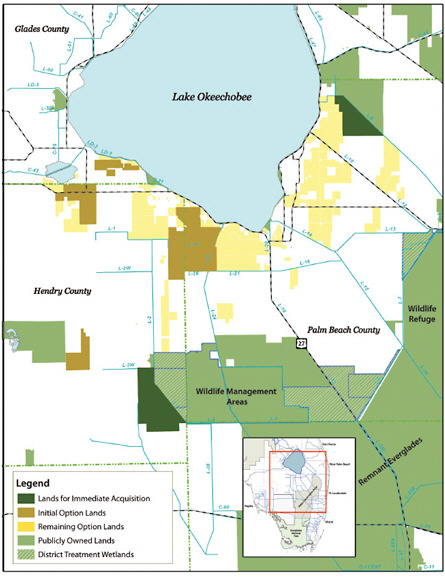
FIGURE 3-12 U.S. Sugar Corporation land to be acquired by the SFWMD, including option lands.
SOURCE: https://my.sfwmd.gov/portal/page/portal/xrepository/sfwmd_repository_pdf/rog_map_2010_0804.pdf
the 2006 biological opinion in support of the Interim Operational Plan (IOP), which outlines the current water management rules in WCA-3 to protect the Cape Sable seaside sparrow and its habitat (USACE, 2002). In particular, the IOP established a schedule for closures of the S-12 structures along the southwest edge of WCA-3A, which has led to problems with high water in southern
WCA-3A (see Chapter 4 for a discussion of water management in WCA-3A). With the pending expiration of the biological opinion on the IOP in November 2010, restoration managers saw the opportunity to improve upon the existing operational schedule for the benefit of multiple species, including the snail kite, wood stork, Cape Sable seaside sparrow, and tree islands, while maintaining the Central and South Florida project purposes.
The new operational plan needs to be in place by November 2010, and the team has had only approximately one year to review existing science and to evaluate potential strategies for improving water management within current constraints (e.g., no new structures, no impacts to water supply and flood control, water quality criteria). The changes under consideration are discussed in Chapter 4. The November 2010 deadline will limit the range of options that can be considered, because significant changes and any new structures would trigger a lengthy National Environmental Policy Act review. However, team members envision a continuing process, whereby the multi-agency team could continue to improve the operation schedule over time based on new information to maximize benefits for multiple species sooner rather than later, while awaiting further structural improvements through the CERP. The committee commends the restoration team for this initiative to expedite restoration progress (see also Chapter 4).
PROGRAMMATIC PROGRESS
In the first 10 years of the CERP, progress was primarily programmatic, with the development of an institutional structure and guidance to support CERP planning and adaptive management, which laid the groundwork for the construction progress now under way. Many of the programmatic challenges noted in NRC (2008) still remain, including the complex project planning and approval process required for federal funding. However, some improvements have occurred over the past two years, including agreement on a new integrated schedule for the restoration, adoption of a “master agreement” between the state of Florida and the federal government to address some long-standing procedural constraints, and increasing federal restoration funding. These and other programmatic issues are discussed in the following sections.
Project Scheduling
In response to advice from the Government Accountability Office (2007) and NRC (2007), CERP planners worked for more than a year to develop a revised project implementation schedule for the South Florida ecosystem restoration, termed the “Integrated Delivery Schedule” (IDS; Figure 3-13). In the IDS, the
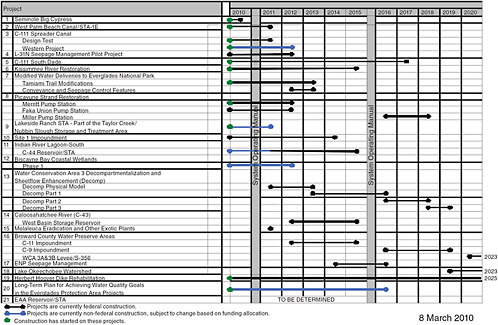
USACE and the SFWMD, in consultation with numerous stakeholders, reprioritized the timing of future restoration activities according to anticipated funding streams, although it is envisioned to be a living document that will be updated as needed. The IDS replaces the Master Implementation Sequencing Plan (MISP) for CERP projects, which was last updated in 2005.
Workshops were held with the South Florida Ecosystem Restoration Task Force (Task Force) and the Working Group to help build consensus on the new schedule. The guiding principles for the planning process emphasized the need to deliver restoration benefits at the “earliest practicable time,” consistent with recommendations of NRC (2007), and recognized the importance of supporting ongoing commitments to key non-CERP projects that contribute to the success of the CERP (Appelbaum, 2008). A description of the development process and rationale for the IDS was released in June 2010, but the document does not include justification for specific sequencing decisions. The “leaflet” explains that the IDS uses a “hybrid approach” that starts with CERP and non-CERP projects that are already authorized or otherwise committed, and adjusts the schedule, pulling some non-authorized projects forward or pushing other authorized projects back based on their ability to deliver “meaningful restoration benefits as early as possible” (USACE, 2010b). CERP planners state that the IDS represents the “optimum sequence for implementation of South Florida ecosystem restoration projects” consistent with incremental adaptive restoration as proposed by the NRC (2007), construction authority, and available funding (USACE, 2010b). The IDS is updated every few months to reflect changes in funding, project implementation progress, and changes in prioritization, and the March 2010 version is shown in Figure 3-13. The IDS shows that a large number of CERP projects are being pushed back beyond the 2020 timeframe. However, Appelbaum (2008) noted that “no CERP projects are being taken off the table.”
The near-term IDS (as of March 2010) includes several pre-CERP and CERP projects—specifically Mod Waters, C-111 (South Dade), and Decomp—that have the potential to significantly alter the distribution and timing of water flows through the WCAs and into Everglades National Park. These projects have repeatedly been identified as highest priority for reversing ecosystem decline and progressing toward ecological restoration of the remnant Everglades (e.g., Ad Hoc Senior Scientists, 2007). However, their benefits cannot be fully realized without provision of additional water, which will require addressing water quality issues and providing significant new storage. As discussed in the next two chapters, even allowing for the completion of the stalled EAA Reservoir, until larger volumes of clean water are made available, water managers will face ecological tradeoffs among subregions of the WCAs and Everglades National Park. Increased water storage in the EAA and in the northern Everglades will almost certainly become a high priority in the years ahead.
Revisions to the Programmatic Regulations
The Programmatic Regulations established a procedural framework and set specific requirements that guide the implementation of the CERP to ensure that the goals and purposes of the CERP are achieved. The Programmatic Regulations were promulgated in 2003 and were slated to undergo a five-year review in 2008. This review provided an opportunity for the USACE to propose revisions that could improve the project planning and evaluation process and to address some of the procedural impediments identified in NRC (2008). However, little apparent progress has been made on proposed revisions, even though this represents an important opportunity to enhance future planning progress.
Master Agreement
A significant programmatic accomplishment of the restoration organizations has been a “master agreement” signed on August 13, 2009, by the Department of the Army and the South Florida Water Management District. The agreement was intended to promote cooperation between the two agencies for construction, operation, maintenance, and repair of CERP projects.
In addition to specifying a common terminology for projects, the agreement provided for financial sharing of CERP obligations. Consistent with the original CERP agreement, the federal government and the SFWMD agreed to have a 50:50 cost share of CERP construction. The Master Agreement specifies reporting, allowable scope for the joint responsibility, and processes to provide accounting for this cost sharing. For example, monitoring performed during the construction of a CERP project is allowed within the construction expense. Similarly, expenses incurred for land acquisition can be included in allowable construction expenses and a process for valuing such acquisitions is specified, settling previous long-standing disagreements. Methods of payment and valuation of in-kind services are also specified. However, the actual expenditures by the federal government still depend upon project authorizations and appropriations enacted by Congress.
Coordination of project management activities is also required by the Master Agreement. The agencies agreed to share budget and cost information, schedules, and quality assurance and quality control. As CERP projects are completed and enter into operation, expenses for operations, maintenance, repair, and renovation are also to be shared equally as long as federal funds are available.
As CERP projects enter into more active construction phases, the existence of the Master Agreement provisions should smooth the processes of project management, budgeting, and scheduling. As a result, coordination between the USACE and the SFWMD should be enhanced.
Funding
Florida state funding for Everglades restoration peaked at $800 million in fiscal year (FY) 2007 with activity on state expedited projects, previously known as Acceler8 (Figure 3-14). With the economic recession and negotiations for the U.S. Sugar Corporation land acquisition, funding levels dropped in 2008-2009. In the FY 2010 budget adopted in October 2009, the SFWMD plans funding of $1.1 billion for Everglades restoration (CERP and non-CERP), representing a significant increase, although included in this budget was $536 million in Certificates of Participation for the acquisition of 73,000 acres of U.S. Sugar Corporation land (SFWMD, 2009c) that has now been downscaled to $197 million. Thus, even though the budget appears to be a sizeable increase in investment, it reflects a major decrease in funding for existing restoration programs compared to prior years. According to the draft Task Force cross-cut budget (K. Berger, SFERTF, personal communication, 2010), anticipated state funding for CERP projects declined to $146 million in FY 2010, a level that is less than
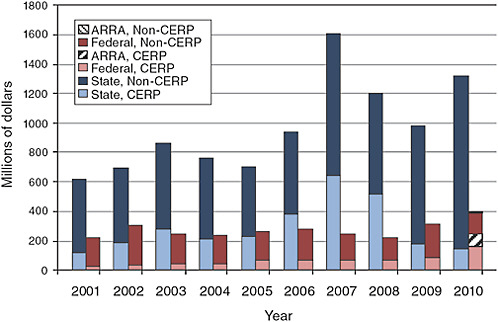
FIGURE 3-14 Federal and state Everglades restoration funding amounts including CERP and non-CERP activities (enacted 2001-2009 and requested 2010). ARRA funding reflects funding enacted as of September 2010.
SOURCE: Data from SFERTF cross-cut budget (2010); K. Berger, SFERTF, personal communication, 2010.
federal CERP funding for the first time since the launch of the CERP. This budget stress has also caused the state to scale back on its expedited project initiatives.
Federal funding for Everglades restoration has long trailed funding from the state of Florida. Because of the lack of congressional authorizations for CERP project construction prior to 2007 and to address the large backload of unfinished non-CERP foundation projects that are essential to restoration, most of the federal funding has been concentrated on non-CERP projects (e.g., Kissimmee River Restoration, Mod Waters). But in the past two years, the federal government has substantially increased funding for Everglades restoration, including CERP and non-CERP projects (see Figure 3-14). In FY 2010, the USACE received $180 million for South Florida ecosystem restoration (USACE budget only), representing nearly 10 percent of the agency’s civil works construction budget ($2.03 billion). The federal government also provided nearly $88 million in American Recovery and Reinvestment Act (ARRA, or economic stimulus) funding for CERP projects over FY 2009 and 2010, and an additional $7.5 million for non-CERP projects (M. Magley, USACE, personal communication, 2010).
This recent increase in federal spending has created a new programmatic hurdle related to CERP federal-state (50:50) cost sharing. To qualify for federal cost sharing, non-federal CERP expenditures must be formally “credited” or certified. Before the crediting process can begin, a project must be authorized by Congress and have a signed project partnership agreement (PPA), which reflects the legal and technical design agreements between the federal and state sponsor related to project construction. The USACE is prohibited from exceeding the overall credited expenditures from non-federal partners at any time, and federal funding would be halted before it exceeded non-federal credited expenditures. As shown in Figure 3-14, prior state CERP expenditures have greatly exceeded federal expenditures, but many of these expenditures (e.g., land acquisition, construction work on expedited projects) have not yet been credited. PPAs recently signed for the Site 1 Impoundment and the Indian River Lagoon-South (IRL-S) projects provide enough credited expenditures to allow continued federal funding (at the current pace) through approximately 2014. Continued project authorizations, however, are needed to prevent a halt in federal funding for the CERP after this date (E. Bush, USACE, personal communication, 2010).
Rehabilitation of the Herbert Hoover Dike also represent a substantial portion of the overall USACE budget. In 2008 and 2009, respectively, $55 million and $74 million were appropriated in the USACE Jacksonville District budget for rehabilitation of the dike, and $123 million was appropriated in FY 2010 (SFERTF, 2009; H.R. 3183 Conference Report). The construction efforts are required to maintain the safety and stability of the dike and should not be considered part of the South Florida ecosystem restoration funding; therefore, they are not included in Figure 3-14. The estimated financial requirement for
the entire Herbert Hoover Dike rehabilitation effort is estimated to be $1 billion (SFERTF, 2009). It remains uncertain whether the political will can remain to support continued large federal expenditures for the Florida USACE budget. Continued support for federal funding of Everglades restoration projects is critical to maintain the momentum and create near-term restoration benefits. The Task Force tracks and compiles expenditures and financial requirements for all South Florida restoration projects as reported by the sponsoring agencies in the annual Integrated Financial Plan (SFERTF, 2009). The estimated financial requirements and expenditures through FY 2009 for different categories of CERP projects are shown in Table 3-3. The largest expenditures have been for surface-water storage, natural area habitat restoration, and other related hydrology projects. Of an estimated $13 billion in financial requirements for CERP projects, only 2 percent has been spent through FY 2009, leaving financial requirements of more than $12 billion. More progress on CERP projects is expected in the future as CERP precursor projects are completed.
In 2004, the estimated cost of CERP was $11 billion (DOI and USACE, 2005), which was to be split equally between the federal and state governments. Five years later, the Task Force (SFERTF, 2009) made an estimate of $12.8 billion to adjust for inflation and any approved changes to project designs; thus, the 50 percent federal share is now estimated at $6.4 billion. This total does not include expenditures on non-CERP projects. Moreover, this CERP total is likely to grow
TABLE 3-3 Total Estimated Financial Requirements for the CERP and Funds Expended Through FY 2009 (in 2008 Dollars)
with inflation over time. At a continued funding rate of $200 million per year for CERP projects (with funding increasing with inflation at the same rate as construction costs), the federal portion of the CERP would be fully funded in roughly 32 years. With increased annual federal expenditures on CERP or a scaled-back CERP plan, this timeframe would be shorter. Conversely, increased costs would lengthen this timeframe. Fiscal constraints dictate a long-term approach over a period of multiple decades for completion of CERP.
The CERP was expected to take several decades to complete, but the pace of restoration over the past decade suggests 40–60 years as a more realistic timeframe. Political and financial support for Everglades restoration will certainly erode steadily over such a long time in the face of so many competing needs for public funding unless tangible ecological and public benefits can be demonstrated through CERP monitoring and assessment activities.
CONCLUSIONS AND RECOMMENDATIONS
During the past two years the restoration program has made tangible progress, and four CERP projects are now under construction. Continued federal commitment is especially important at this time. The Everglades restoration program has completed the arduous federal planning and authorization processes for three projects and is now moving forward with construction of the Picayune Strand project with federal funding. Additionally, despite budget challenges, the state of Florida continues to expedite the construction of three projects (C-111 Spreader Canal, Biscayne Bay Coastal Wetlands, and Lakeside Ranch STA). After years of delay, it is critically important to maintain this momentum to minimize further degradation of the system during CERP implementation.
Some restoration benefits can be attributed to partial restoration of Picayune Strand; however, the completion of additional ongoing and planned projects will be required to see substantial restoration benefits for the Everglades ecosystem. The SWFMD (Williams et al., 2010) reports that plugging one canal in Picayune Strand raised water tables on approximately 13,000 acres of adjacent wetlands, representing partial hydrologic restoration on approximately one-fourth of the project area. Construction is also under way on the C-111 Spreader Canal and the Biscayne Bay Coastal Wetlands projects, but no significant restoration benefits have yet resulted from these efforts. Each of these projects is being implemented in phases to deliver early restoration benefits when possible with available funding.
Pilot projects and field-scale experiments are addressing some important design uncertainties but could be better linked to decision making and implementation. In addition to the originally conceived CERP pilot projects, CERP planners have recently initiated two field-scale experiments (the C-111 Spreader
Canal design test and the Decomp Physical Model [DPM]). These projects are intended to reduce design uncertainties that were points of contention among stakeholders, which limited progress on project planning. The C-111 design test will address important hydrologic uncertainties; additional pilot components are needed to address the potential impacts of elevated nutrients on receiving wetlands. The DPM will produce the most detailed observation data to date on the hydrology and ecology of sheet flow in the ridge and slough system. Nevertheless, limited replication and the two-year duration limit the statistical power of the experiment. The DPM will provide information on hydraulic, hydrologic, and short-term ecological differences between canal backfilling options and will improve understanding of the hydrologic response of WCA-3B to re-watering, but the experiment will likely require additional replication to settle the current debate over the efficacy of different canal treatments. CERP scientists and planners should consider other means of synthesizing and communicating results beyond traditional hypothesis tests to facilitate stakeholder discussions and decision making under uncertainty.
Aquifer storage and recovery (ASR) pilot studies have contributed valuable hydrogeologic and geochemical information, but the administrative delays, site limitations, funding constraints, and arsenic leaching encountered are indicative of serious challenges facing large-scale use of ASR. The final ASR pilot report should address the impacts of these factors on use of ASR at the unprecedented scale envisioned for the CERP and should compare the long-term costs and benefits of ASR against other less energy-intensive storage alternatives.
Initiation of construction of a 1-mile bridge on the Tamiami Trail is an important, albeit partial, step forward. NRC (2008) called the Mod Waters project, of which the bridge is one component, “one of the most discouraging stories in Everglades restoration,” and stated that if the downsized 1-mile bridge could not be built, the outlook for the CERP was dismal. With leadership from the administration and Congress, the federal government was able to overcome numerous obstacles to ultimately break ground on the project in December 2009. Although the benefits derived from the 1-mile bridge represent only a fraction of those envisioned in earlier Mod Waters plans, planning is under way to consider additional bridging that could take advantage of a downturn in construction costs.
The River of Grass initiative could create options for additional water storage and water quality treatment to help meet CERP objectives. The SFWMD governing board recently approved the purchase of nearly 27,000 acres of U.S. Sugar Corporation lands—substantially less than what was previously announced—near areas with historically high phosphorus loads. These lands could help the SFWMD come into compliance with current water quality requirements, yet this represents only a small step toward the goals of the River
of Grass initiative. Prior to this announcement, the SFWMD had facilitated an engaging and inclusive River of Grass planning process and created an impressive set of data visualization tools to support the effort. As of mid-2010, the specific benefits that will accrue to the CERP from the River of Grass initiative cannot be determined, because the planning and design process has not been completed and the availability of funding to support future land purchases is unknown. Also, it remains unclear how successfully other political and economic constraints can or will be addressed for the remaining “option” lands (e.g., reality of land swaps, opportunity costs, stakeholder concerns) and how the initiative will be coordinated with the CERP.
Given the slower-than-anticipated pace of implementation and unreliable funding schedule, projects should be scheduled with the aim of achieving substantial restoration benefits as soon as possible. The latest Integrated Delivery Schedule appears consistent with this goal and should generate substantial restoration benefits by 2020. Although many projects have been delayed, aggressive schedules have been maintained (as of the March 2010 IDS) for the Decomp project, seepage management, and critical foundation projects. These projects offer significant restoration benefits to the remnant Everglades ecosystem, but the benefits cannot be fully realized without the provision of additional water, which will require substantial new storage and associated water quality treatment.
Maintaining political and public support for Everglades restoration will be critical to future CERP progress. Multiple decades of sustained commitment and a high level of public funding will be needed to complete the CERP. Maintaining this commitment will be a continuing challenge, and early, demonstrable public and ecological benefits from restoration activities are keys to retaining public support.


