
4
Sediment and Current Ecological Restoration Activities
The Corps of Engineers has implemented numerous projects along the Missouri River under the 2000/03 Biological Opinion to improve habitat for endangered, native bird and fish species. The projects are grouped into two programs within the overarching Missouri River Recovery Program (MRRP) described in Chapter 3: emergent sandbar habitat (ESH) projects mainly for the benefit of bird species, and shallow water habitat (SWH) projects mainly for the benefit of pallid sturgeon. These projects entail dredging, movement, and placement of sediment in order to construct or create sandbars or chutes, or to make structural adjustments in engineered projects, such as notching a levee. The Corps of Engineers began constructing many of these projects less than ten years ago. Some monitoring and evaluation efforts have followed. Given the slow response times of complex ecosystems with long-lived species to management actions, the monitoring and evaluation programs can be considered relatively young.
In addition to the ESH and SWH projects, there are four other components of Biological Opinion compliance under the MRRP: mitigation, flow modification, a cottonwood management plan, and science. Under the mitigation program, lower Missouri River floodplain lands are purchased from willing sellers and many SWH projects are constructed in these areas. The Gavins Point Dam “spring rise” flow modification component of the Biological Opinion in part is intended to redistribute channel sediments and contribute to SWH and ESH creation and maintenance. The cottonwood forest management plan identifies newly deposited sediments as sites for cottonwood regeneration. Lastly, the science program is intended
to conduct the monitoring and research within an adaptive management framework to evaluate the integrated contribution of ESH, SWH, mitigation lands, cottonwood regeneration, and flow modifications towards meeting the Biological Opinion Reasonable and Prudent Alternatives (RPA) and recovering listed species and the ecosystems upon which they depend. This chapter focuses on the prominent ESH and SWH projects, but it is important to recognize that the ESH and SWH programs are implemented within the larger Missouri River Recovery Program and that they have important ecological and institutional linkages with these other MRRP programs.
This chapter addresses Question 7 in this report’s statement of task, which asks, “Are current Corps’ management strategies, restoration tools (e.g., channel widening, creation of chutes, shallow water habitat, etc.), and other activities adequate and comprehensive enough to address issues associated with sediment and nutrients in the system? If not, how might such strategies and activities be improved?”
The 2000/03 Biological Opinion specifies the use of an adaptive management strategy to implement, evaluate, and adjust mitigation projects for endangered species. The topic also is frequently referenced in related initiatives and guidance documents for the MRRIC and the MRRP. This chapter thus begins with discussion of the concept and practice of adaptive management.
ADAPTIVE MANAGEMENT ALONG THE MISSOURI RIVER
Adaptive Management Concepts
In its 2000 Biological Opinion, the U.S. Fish and Wildlife Service directed the Corps of Engineers to implement adaptive management to promote flexibility of management actions in response to new information and changing environmental conditions to benefit the listed species:
The Corps should embrace an adaptive management process that allows efficient modification/implementation of management actions in response to new information and to changing environmental conditions to benefit the species …
This approach embraces the uncertainties of ecosystem responses and attempts to structure management actions to best address those uncertainties, recognizing that learning is a critical outcome. Adaptive management is viewed as a continuous process of actions based on testing, evaluating, informing, and improving … It will be the basis from which the Service can identify and evaluate performance (USFWS, 2000).
Adaptive management therefore has an overarching importance and role in Corps of Engineers Missouri River programs for endangered species and related sediment management actions and programs.
The 2003 Reasonable and Prudent Alternatives (RPAs) from the Fish and Wildlife Service present three elements of an adaptive management plan: an Agency Coordination Team (ACT), an endangered species and habitat monitoring program, and an annual reporting requirement. Additionally, the charter of Missouri River Recovery and Implementation Committee (MRRIC) acknowledges that adaptive management will play a role in Missouri River resources management. It defines adaptive management as
A type of natural resource management in which decisions are made as part of an ongoing science-based process. Adaptive management involves testing, monitoring, and evaluating applied strategies and incorporating new knowledge into management approaches that are based on scientific findings and the needs of society. Results are used to modify management policy, strategies, and practices. The purpose of adaptive management is to help meet environmental, social, and economic goals, increase scientific knowledge, and reduce tensions among stakeholders (MRRIC, 2008).
The adaptive management concept is widespread in the environmental management literature and in several prominent ecosystem restoration programs. Much of the conceptual thinking behind this concept derives from three seminal texts: Holling (1978), Walters (1986), and Lee (1993). Adaptive management can be broadly defined as
Adaptive management is a decision process that promotes flexible decision making that can be adjusted in the face of uncertainties as outcomes from management actions and other events become better understood. Careful monitoring of these outcomes both advances scientific understanding and helps adjust policies or operations as part of an iterative learning process. Adaptive management also recognizes the importance of natural variability in contributing to ecological resilience and productivity. It is not a “trial and error” process, but rather emphasizes learning while doing. Adaptive management does not represent an end in itself, but rather a means to more effective decisions and enhanced benefits. Its true measure is in how well it helps meet environmental, social, and economic goals, increases scientific knowledge, and reduces tensions among stakeholders (NRC, 2004).
The adaptive management concept and its applications have been discussed in numerous forums and publications. There is no single definition, and the term leaves room for interpretation.1 A common feature among many of these programs is recognition and implementation of an adaptive management cycle that follows an iterative linked series of steps: (1) assess
and define the problem, (2) identify management options, (3) implement alternative management actions, (4) monitor responses to these actions, (5) assess results, and (6) adjust or revise management actions based on learning. Adaptive management principles are being applied to several large-scale aquatic ecosystem restoration programs in the United States including the Everglades (CERP, 2008), the Colorado River (GCMRC, 2001), and the Platte River (PRRIP, 2008).
The adaptive management paradigm and its operational components present an attractive management approach in settings like the Missouri River: large geographical extent; many ecological uncertainties; numerous stakeholder groups, some of whom have very different preferences; and no clear, simple path ahead for the management of this system and its many resources. Indeed, in many ways an adaptive approach in such settings is inescapable, and there is a compelling rationale behind the notion of acknowledging uncertainties, the need to take action in the face of unknowns, learn from management actions, keep options open to the extent possible, and seek ways to maintain and promote flexibility in physical systems and decisions.
Just as there is no single definition, there is no single, widely accepted set of operational principles. However, the Department of the Interior Adaptive Management Technical Guide (Williams et al., 2007) addresses this challenge by recommending nine operational steps grouped into setup and iterative phases. Goals and objectives will be site specific and shaped by environmental conditions, stakeholder preferences, and prevailing laws and policies. In defining overall program goals (or “ends”), and the means employed to reach those goals, it is important to distinguish between the two. Failure to clearly distinguish ends from means can lead to inappropriate trade-offs, misleading performance tracking, and overly prescriptive management strategies (Failing and Gregory, 2003). Adaptive management processes and components are employed not as ends in themselves, but rather as means for achieving larger goals, such as reducing jeopardy by contributing to self-sustaining populations of a listed species.
A recent background document for Missouri River recovery discusses the challenges associated with a long-term, viable adaptive management program:
Perhaps the primary challenges raised concern long-term commitment to ecosystem monitoring, data analysis, and adherence to a decision framework that incorporates scientifically based thresholds for change in management actions. That is the “iterative phase” of adaptive management and it may take decades. However, most agencies are subject to much shorter funding cycles that rarely mirror scientific recommendations for monitoring ecosystem development following management actions.
Additionally, the costs of adaptive management may be high because quality data collection and management are labor-intensive activities.
Some exceedingly complicated adaptive management programs have been determined to be prohibitively expensive prior to implementation. Committing funds to experimental management actions is sometimes perceived as a risk. However, these costs should be weighed against the costs of failure to achieve restoration and recovery goals if an adaptive management approach is not used (Diefenderfer and Fleming, 2008).
One upshot of these challenges and realities is that formal adaptive management programs require years, if not decades, to implement, evolve, and mature. Moreover, the adaptive management paradigm will not eliminate environmental uncertainties and unknowns, nor will it necessarily resolve differences and disputes among stakeholder groups. Even in areas of the nation where adaptive management has been practiced explicitly for many years—such as in the Colorado River below Glen Canyon Dam and in the Florida Everglades—there is a need for more monitoring; environmental surprises still occur; laws, policies, and priorities change and shift; and stakeholders have differing priorities and points of view.
Although the adaptive management learning-by-doing approach is appealing, in large-scale, high-profile programs—such as the North American waterfowl adaptive harvest management plan (Nichols et al., 2007), some (but not all) components of the Everglades restoration program (CERP, 2008), and Glen Canyon flow release experiments (Melis et al., 2010)—there are few examples of unambiguous successes.2 Possible explanations are that adaptive management is often invoked in resource management contexts without clear articulation of what decisions need to be made, a clear definition of learning, how success or effectiveness is measured, how to choose among potentially conflicting values and priorities, and how to use results from monitoring and research to reduce uncertainty and implement change in often entrenched monitoring programs.
Perhaps more frequently encountered than clear-cut successes are evaluations of why adaptive management did not work as anticipated. These case studies can provide insights for the MRRP and MRRIC to avoid or redress similar pitfalls (see Walters [1997, 2007] for discussion of several institutional challenges in adaptive management programs). Decision makers often fail to comprehend the need for management experiments when they appear to contradict conventional wisdom or obvious intuition. Decision makers often are reluctant to acknowledge uncertainty in making policy choices and may lack the necessary authority to carry out the complicated administrative steps involved in planning and implementing new and complex management programs.
The scientific knowledge bases where adaptive management has been applied have been improved through more monitoring and collaborative
discussions, and experiments have enabled stakeholder groups to gain appreciation for respective points of view. The adaptive management principles of incorporating stakeholder, manager, and scientist inputs into setting objectives, implementation, monitoring, and program adjustment can improve efficiencies in terms of costs, communication, and scientific advances.
Corps of Engineers Adaptive Management Actions and Strategies
The 2000/03 Biological Opinion and Development of Adaptive Management Guidance
One observation in the implementation of adaptive management actions and programs to enhance the habitat of Missouri River endangered species is that there has been a mismatch between, on the one hand, the large amount of resources devoted to ESH and SWH project construction activities along the river and, on the other hand, the relatively modest efforts aimed at development of adaptive management guidance, protocols, performance goals, and stronger science-based monitoring and evaluation to guide and learn from that ongoing project construction.
The need to take decisive actions to improve habitat in accord with the Biological Opinion is understandable, and a tenet of adaptive management is that actions often need to be taken in the face of uncertainties. At the same time, mitigation and restoration actions (i.e., means) that are not guided by a larger programmatic structure that includes ecologically relevant performance goals (i.e, ends) run the risk of being uncoordinated and possibly result in wasted expenditures and frustrations among stakeholders and budget authorities. Along the Missouri, only after years of project construction and considerable expenditures were preliminary adaptive management guidance documents initiated (Diefenderfer and Fleming, 2008; Thom et al., 2009). In addition, the Corps established an Adaptive Management Cooperation for Recovery (CORE) Team in October 2009, which currently is preparing a framework for an Adaptive Management Process using the Department of the Interior Adaptive Management Technical Guide (Williams et al., 2007) to guide the overall Missouri River Recovery Program (MRRP) at achieving the Biological Opinion RPA elements. This group also is drafting specific adaptive management plans for emergent sandbar habitat and shallow water habitat. Currently, these plans include two phases (Fleming, 2009). Phase 1 will apply adaptive management steps and principles to implementation of ongoing Biological Opinion RPA elements, including ESH and SWH programs and specific projects within them (e.g., creation of a specific sandbar or channel chute). Phase 1 also proposes to develop adaptive management decision support tools (models, analyses, information reports), and work with decision makers and stakeholders to
develop a learning process. Phase 2 has been identified as addressing the Missouri River Ecosystem Restoration Plan (MRERP) and its environmental impact statement process.
Performance Objectives for Restoration Projects
Part of the reasonable and prudent alternative developed in the 2000/03 Biological Opinion called for restoration of “a portion of suitable riverine aquatic habitats and hydrologic conditions necessary for successful reproduction and recruitment of the three species” (USFWS, 2003). Monitoring and evaluation efforts of the RPA to date have largely addressed compliance with the Biological Opinion targets of acres of shallow water habitat and emergent in-channel sandbar habitat (USFWS, 2003). Although a metric of “acres created” may have relevance and importance for improving conditions for endangered species, such a single, areal metric is limited in that it does not consider the numerous population-level environmental variables (e.g., water temperatures, velocities, predation) that affect life cycles and histories of Missouri River endangered species. Performance metrics such as targeted tern fledgling ratios that are currently part of the least tern program, or targeted pallid sturgeon age-class structure (not currently part of the pallid sturgeon population monitoring program) would represent more ecologically relevant outcomes of management actions that can inform decision makers about whether habitat creation is supporting self-sustaining populations of listed species.
The Corps of Engineers is implementing two major habitat mitigation programs along the Missouri River: the ESH project and the SWH project. The following section discusses details of implementation and monitoring efforts associated with those projects.
EMERGENT SANDBAR AND SHALLOW WATER HABITAT PROJECTS
As was explained in Chapter 2, a longstanding goal of engineering activities along the Missouri River channel downstream of Sioux City, Iowa, has been to stabilize river banks and maintain a channel with adequate depth to support commercial navigation. The Corps of Engineers constructed hundreds of miles of dikes and revetments to this end, much of which was accomplished under the 1945 Bank Stabilization and Navigation Project. (Box 4-1 defines the many types of river engineering structures that have been used along the Missouri.) Dikes extending from the floodplain into the channel were constructed to constrict river flows and produce a single channel. The dikes also resulted in accretion of sediment to form new floodplain areas, reducing channel width. Revetments were installed to
|
BOX 4-1 Engineering Structures Along the Missouri River Levee: an earthen embankment running parallel to and near the channel bank, intended to hold floodwaters within the channel and protect floodplain lands outside the channel from inundation. Virtually the entire lower river section is leveed, and some sites have two or more levees. Revetment: a structure running on and along the channel bank, intended to prevent erosion of the bank. Commonly built of wood or rock. Dike (also called wing dike or jetty): a structure extending from the bank part way into the channel, intended to focus high-velocity flows within a narrow central portion of the channel, to scour the bed and maintain adequate water depth for navigation. Today within the BSNP area, almost all bends of the river have a field of dikes on the inside bank of the bend and revetment along the outside bank of the bend. Constructed chute: In the Missouri River, the term chute refers to almost any secondary channel that is connected to the main channel (at both ends) and carries flow either year round or seasonally. Chutes were naturally occurring features of the river, but many were eliminated by construction of the BNSP. Constructed chutes are created by excavation of inactive chutes, or by digging entirely new chutes on the floodplain. They are commonly several thousand feet long. They are intended to provide lower-velocity, shallower, more complex habitat than the main navigation channel. Constructed backwater: a linear, branched, or oblong depression on the floodplain, connected to the main channel at one end only and holding water either |
reduce bank erosion, reduce shoreline sediment input, and fix the channel in place. By 1950, 59 percent of dikes and 69 percent of revetments had been constructed. By 1970, 95 percent of both dike and revetment construction had been completed (USACE, 1980). By 1980, levees were constructed along most of the length of the channel to protect the existing and newly accreted floodplain lands from floods (USFWS, 1980).
In response to shifting social preferences and federal environmental laws, the Corps of Engineers began to modify some river engineering structures in the 1970s to improve habitat for riverine fishes. The 1986 Water Resources Development Act (WRDA) authorized the Bank Stabilization and Navigation Fish and Wildlife Mitigation Project, under which the Corps of Engineers implemented projects to restore habitat lost due to the BSNP. This mitigation project, which was amended in the 1999 WRDA, is not species-specific but addresses channel-floodplain habitat rehabilitation for the benefit of overall ecosystem biodiversity. Some of the mitigation project
|
year round or seasonally. They provide areas of low velocity that serve as refuge for fish and other organisms during high flows, and shallow water habitat during other seasons. Revetment chute or pilot channel: a trench along the revetment between the revetment and the floodplain bank, formed by excavation or by erosion during floods that fills with water and becomes aquatic habitat. Notches often are cut into the revetment to increase hydraulic connectivity of the revetment chute and the main channel. Bank notch: a notch cut in an existing dike along the bank, typically one in each dike within a dike field. They are intended to create a secondary channel along the bank that is faster than typical flow within the dike field. Type B notch: a notch cut into an existing dike and the adjacent bank, with most of the notch cut into the bank. Intended to allow some bank erosion, increase top width of the river, and increase diversity of depth and velocity within the dike field. Dike notch: a notch cut in an existing dike, allowing water flow through the gap. Scour holes and shoals or sand bars form downstream of the gap, creating diversity of water depth and velocity intended to benefit aquatic species. Major dike modification (dike lowering and chevrons): Existing dikes are lowered to a level below typical water level within the channel and extending back into the bank, and chevrons are constructed between the dikes at the channel edge of the dike field. Dike lowering is intended to allow bank erosion and increase channel top width. A chevron is a V-shaped structure built of rock, with the point of the V at the upstream end and a gap at the point, intended to create a sandbar downstream of the chevron, create scour and deposition on the bank side of the chevron, and direct flows toward the navigation channel to reduce shoal formation. |
sites overlap with projects being implemented under the Biological Opinion (Bell and Bitner, 2010).
Emergent Sandbar Habitat
In response to the 2000/03 Biological Opinion, the Emergent Sandbar Habitat (ESH) program was initiated in 2004. The project area extends from Garrison Dam in North Dakota downstream to Sioux City, Iowa. The ESH project areas include reservoir reaches and remnant floodplain areas, including the National Park Service’s Missouri National Recreational River in Nebraska and South Dakota. The endangered least tern and piping plover depend on bare sandbars for successful nesting and fledgling (USFWS, 2003). Because such habitat is limited along the river, and because bare sandbars will become vegetated without scouring flows, the Corps of Engineers is increasing the extent of ESH by creating new sandbars largely from
dredged material and by clearing vegetation from existing sandbars. The removal of early-succession woody vegetation from sandbars to provide habitat for terns and plovers may conflict with other Corps of Engineers programs to enhance cottonwood forest establishment on islands and floodplains, and the Corps has recognized the need to coordinate this program with its other programs that enhance cottonwood forest established on islands and floodplains (USACE, 2010b).
River sandbars are labile landforms created in disturbed environments. Their morphology fluctuates with cycles of erosion and deposition, and even without erosion or deposition their surface area alternates between aquatic and terrestrial environments as river stage fluctuates seasonally. Hydrogeomorphic processes of flow, sediment erosion, and deposition provide disturbance mechanisms that strongly affect the rate at which a sandbar becomes a permanent vegetated island (Corenblit et al., 2007).
Sandbars provide the environmental conditions for vegetation establishment (Dixon, 2003; Gurnell and Petts, 2002; Johnson, 2000). However, bare sandbars also contribute unique ecological value to a diversity of biota within the active channel of large rivers. Exposed bare substrate characteristic of sandbars is important to nesting riverine turtles (Plummer, 1977) and roosting (Kinzel et al., 2009) and nesting birds (Smith and Renken, 1991), and shorebirds use recently exposed sandbar shorelines for feeding. As described in Chapter 2, the preregulation Missouri River channel was characterized during summer by large expanses of shifting, open, unvegetated sandbars or emergent sandbar habitat. This habitat is important for nesting and foraging by the two endangered bird species on the Missouri River today, the interior least tern and the northern Great Plains population of piping plovers.
An important issue in the context of this report is how the construction of sandbars affects the sediment regime of the river. When emergent sandbar habitat material is derived from the river bed, there is no net impact on the river sediment budget. Over a few years, the bar will be eroded and the sediment will reenter the river bed. This change takes place against the backdrop of reduced sediment transport in the twentieth century due to both sediment storage behind the dams and to stabilization of formerly temporary storage sites, such as bars and banks, due to reduced cut-and-fill alluviation associated with flood cessation and reduction (NRC, 2002).
Under the 2003 Amendment to the Biological Opinion, the Corps is required to maintain specified acreages of natural sandbar habitat “through flow regulation or other means” (USFWS, 2003, p. 194) and to create ESH when targets cannot be met in other ways. The acreage required varies, depending on the reach, from 10 to 40 acres per river mile in 2005, increasing to 20 to 80 acres per river mile by 2015. The characteristics of the natural and created ESH habitat are specified in terms of sediment size, vegetation and detritus cover, and bar size and shape. Current rates of ESH creation
are not adequate to meet Reasonable and Prudent Alternative targets in the Biological Opinion for habitat creation (USACE, 2010a, App. A), due to a variety of reasons including construction challenges, vegetation regrowth, and potential impacts on adjacent private lands.
Shallow Water Habitat
The Corps’ Shallow Water Habitat program aims to create habitat considered necessary for the recovery of endangered pallid sturgeon. These habitats are important nurseries for many young-of-year riverine fish species, providing rich invertebrate forage, escape from predation by larger fishes that cannot access the shallows, and refugia from fast mid-channel flows. Fine organic matter that forms the base of the aquatic food web and coarse organic matter (large woody debris) that is important as cover for small fish tend to accumulate in shallow water areas. Shallow water habitat was abundant along channel margin and sandbar shorelines in the historical Missouri River channel, but most was lost with channelization and bank stabilization below Sioux City, Iowa. What remains has been identified by the Fish and Wildlife Service as critical habitat for recovery of pallid sturgeon.
Under the 1986 Bank Stabilization and Navigation Fish and Wildlife Mitigation Project, the Corps of Engineers began constructing chutes and backwaters in 1991 along the main channel in an effort to restore shallow water habitat. As of 2001, these projects have been incorporated within the SWH project under Biological Opinion compliance.
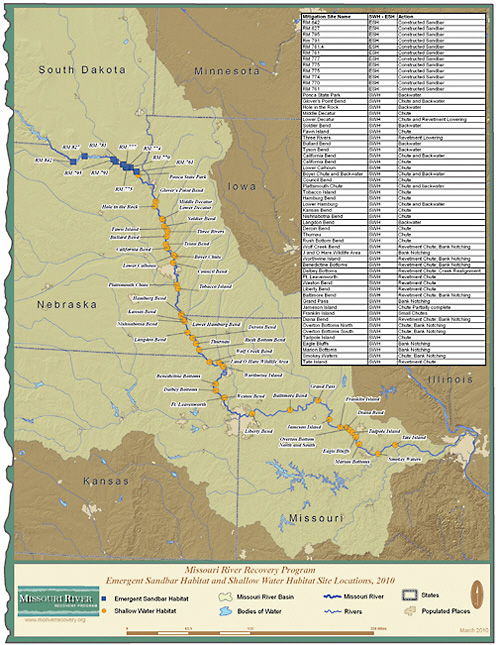
The Reasonable and Prudent Alternatives specified in the 2000/03 Biological Opinion required reconstruction or rehabilitation of 20 percent of the shallow water habitat that existed prior to the construction of the Bank Stabilization and Navigation Project. The SWH project area extends from near Ponca, Nebraska, downstream to the mouth of the Missouri near St. Louis (see Figure 4-1). Plans are to ensure that 20 to 30 acres of shallow/slow-water habitat per river mile exist below Ponca by 2020 to meet this requirement.
The 2003 amended Biological Opinion defined shallow water habitat as locations with water depths less than 5 feet (<1.5m) and water velocities less than 2 feet per second (<0.6 m/s) (USFWS, 2003). Natural shallow water habitats in the Missouri River include side channels, backwaters, submerged sandbar and bankline margins, and low-lying depressions in the floodplain adjacent to the channel. Using natural shallow water habitat as a model, constructed shallow water habitats under the revised definition are expected to have a predominance of shallow depths intermixed with deeper holes and secondary side channels, lower velocities, and higher water temperatures than main-channel habitats. The criteria for depth (<1.5 m) and
for velocity (<0.6 m/s) may be modified as understanding of large-river ecology improves. The shallow water habitat structures in the main channel aim to enhance habitat diversity by creating zones of higher and lower flow through dike fields and in chute-like areas behind dikes and revetments.
Two types of shallow water habitat projects are being constructed: habitat creation at the margins of the navigable portion of the main river channel, and construction or modification of chutes and backwaters on floodplains (Missouri River Recovery Program, 2010). Construction of shallow water habitat at the channel margin can be accomplished through a variety of structures and techniques, such as notching dikes and building wing dikes. (Box 4-1 lists additional approaches that could be used.)
Constructed chutes are intended to be hydrologically connected to the main channel at both high and low flows, have active bed sediment transport, and provide habitats that mimic historical depth and velocity conditions. Chutes provide shallower, more complex habitat than is found within the navigation channel. Constructed backwaters are connected to the main channel at only one end, and therefore provide habitat with lower flow velocities. Chutes are designed to evolve over time, developing sinuosity and sandbars. Both chutes and backwaters will develop more natural, vegetated banks than the main channel since their banks are largely unprotected by revetments or dikes.
Chutes and backwaters require floodplain lands for construction, and they have been implemented only on public lands, including some land previously in state or federal ownership and land newly acquired under the 1986/99 Mitigation Project and the U.S. Fish and Wildlife Service Big Muddy Fish and Wildlife Refuge. The Mitigation Project authorizes the Corps to acquire 166,750 acres of floodplain land from willing sellers by 2042 (Bell and Bitner, 2010). As of September 2009, 56,606 acres—or 34 percent—of the authorized total acreage had been acquired (ibid.). Through these programs, land will be acquired and available for habitat creation projects (although not all of this area will be converted to flooded habitat).
As chutes and backwater areas are constructed on the floodplain, excavated sediment is either deposited directly in the river or piled on adjacent banks. As a chute evolves after construction, widening and/or lateral migration will deliver most or all of the sediment piled on the bank to the flow. In addition, the chute will trap some sediment in bars. The result is a net addition of sediment to the river during construction and the early post-construction adjustment phase. Over time, with lateral migration and additional sinuosity, erosion within the chute is likely to be roughly balanced by deposition. Backwater areas do not experience significant flows, and any excavated sediment deposited on their banks is less likely to be introduced into the river. Flow into and out of the backwater during high flow periods, as well as maturation of the banks, may
introduce minor amounts of sediment into the flow, but overall the net effect of constructed backwaters will be to trap sediment from transport in the main channel.
The use of chutes to enhance habitat diversity and promote river and ecosystem restoration is a relatively new practice, and there is only a small body of existing projects or research findings that could be used to guide Missouri River chute construction and adjustments. An example of Missouri River-specific studies is being led by USGS scientists and their work on river corridor habitat dynamics (see Jacobson et al., 2004b, for evaluation focused specifically on Missouri River chutes). Beyond the Missouri, chute projects have been implemented and evaluated in Europe (see Buisje et al., 2002). The limited number of past projects and substantive research results lends support for the adaptive approach to these projects that is being promoted by the USGS, the Corps of Engineers, and others.
Monitoring ESH and SWH Project Outcomes
As described in the first part of this chapter, monitoring the effectiveness of restoration activities is a building block of adaptive management. In general, effectiveness monitoring of restoration projects is intended to determine whether the project is producing the desired ecosystem conditions and outcomes stated in the project goals. Monitoring should be driven by a series of related questions:
-
Are habitat restoration actions successful at creating the kinds of habitat that species need? Which actions are most successful?
-
Are populations of the target species increasing?
-
Are populations of the target species well distributed?
-
If so, are the population increases and distribution the result of habitat creation activities, or related to other causes?
-
Are constructed habitats functioning such that they will increase fledgling success, or other performance measures? If so, what specific characteristics of the constructed environment are responsible?
Other related questions also may need to be addressed. For example, an adaptive management program may have developed a model of how the ecosystem functions (conceptual ecosystem model). If the life cycle and habitat needs of the target species are not adequately understood, monitoring may need to provide answers to questions such as “What habitats are the target species using and when? Are there specific habitat characteristics that are critical to successful species use?”
Monitoring of both target species and habitat characteristics, such as water depth, water quality, primary production, or food availability, is thus
important, and the two aspects need to be coordinated so that linkages are understood. Events and conditions outside of the project may influence species response, and monitoring of control sites (sites where no habitat creation is done) is typically used to sort out these factors. Habitat creation may have effects on other organisms and aspects of the ecosystem, so a broader data collection effort may be necessary to address this issue. In a dynamic environment like the Missouri River, the question of persistence of created habitat over time is important. It is unlikely that any created habitat will last for many decades without repeated maintenance, but better knowledge of differences in short- to medium-term persistence (less than one reproduction season vs. a decade) among alternative designs would be useful in designing more efficient habitat restoration.
Emergent Sandbar Habitat
In 2007, the Corps of Engineers began development of a monitoring plan designed to evaluate the effectiveness of the emergent sandbar habitat program (USACE, 2008). Before 2007, monitoring consisted primarily of determining numbers of least terns and piping plovers and nests by habitat type (USACE, 2007, 2008). Monitoring was not designed to yield the type of information on effectiveness of restoration activities needed to adjust those activities under adaptive management. The new monitoring plan is intended to integrate monitoring of biological response (tern and plover nesting, nest fate and fledging; invertebrates) and physical habitat characteristics of constructed ESH, to determine whether the ESH program (including both the bar construction and vegetation clearance methods) is increasing least tern and piping plover habitat (Sherfy et al., 2008). Analysis of the ESH program through a Programmatic Environmental Impact Statement (PEIS) is under way and a Final PEIS and Record of Decision are expected in late 2010 (USACE, 2010c). In addition, a study to determine effectiveness of various vegetation removal techniques, such as mowing, spraying herbicides, and mechanical removal, has been underway for several years, and is projected to be available in fall 2010 (USACE, 2010a). One gap in the ESH program is the absence of information evaluating ecological benefits and physical persistence of constructed sandbars. A report from an independent consulting team involved in ESH program design and implementation found that a database of “lessons learned” in the planning and implementation of individual projects would be beneficial (GeoVal, Inc., 2009a).
The proposed design for new ESH construction and monitoring (USACE, 2010c) holds promise to better integrate various elements of the program and support a more structured adaptive management approach to ESH goals. Improvements in the ESH program are especially important
given that an independent evaluation team has determined that the 2015 ESH acreage goals cannot be met, due both to logistical and financial challenges (GeoVal. Inc., 2009a). Moreover, it remains to be seen if habitat proves to be the primary limiting factor to recovering tern and plover populations along the Missouri River.
Shallow Water Habitat
Shallow water habitat projects in the main channel, such as dike notching, bank notching, or chevrons, have been monitored under the Habitat Assessment and Monitoring Program (HAMP) since 2004. HAMP monitoring includes both biological response (fish species composition and richness) and habitat response (water depth, velocity. and substrate) to SWH creation, with sampling designed to relate these two components. The HAMP monitoring follows a standard approach in ecological monitoring: a comparison of before-project conditions with after-project conditions, and comparison of river bends with projects to those without projects. The main findings to date are that fish use of SWH is highly variable in project and control reaches (Sampson and Hall, 2009). It therefore is not yet possible to draw clear conclusions about biological effectiveness of the monitoring or the projects.
An independent science review of the HAMP research design found that the monitoring design was sound, but that statistical design and support were inadequate, and monitoring implementation was not strongly based on conceptual models (Sustainable Ecosystems Institute, 2005). Further, it was found that sampling methods had varied from year to year, making it difficult to produce useable results. In response to the review, in 2007 and 2008 the Corps simplified and standardized the HAMP sampling methods (USACE, 2008). The independent review also suggested that physical habitat monitoring be better integrated with biological monitoring (ibid.).
Another limitation of the HAMP monitoring program has been the lack of overall, synthetic assessment. Monitoring is conducted separately for the Omaha and Kansas City districts, and there is no overall synthesis and interpretation of results from the two districts. Furthermore, as in the case of the ESH program, it is not clear that physical habitat monitoring is designed to evaluate alternative methods of creating SWH to support adaptive management. Understanding both the physical and biological outcomes of these projects is crucial to an adaptive management process. As in the ESH program, the engineers themselves recognized the need for evaluating effectiveness of SWH creation. For example, a study of the SWH program found that a “lessons learned” database on SWH projects would be beneficial (GeoVal, Inc., 2009b). This suggests a need for more detailed
monitoring (whether formal or informal) and assessment of shallow water habitat creation activities.
Shallow water habitat is also created through construction of chutes off the main channel, originally as part of the Missouri River Fish and Wildlife Mitigation Project. Monitoring results of this project for 2006-2008 are summarized and analyzed in a 2009 report (Sterner et al., 2009), which includes monitoring of both fish response and geomorphic/habitat response. This report may be more useful for adaptive management than the HAMP reports, as it includes conclusions about what strategies are most effective and recommendations for future project design and implementation. In addition to the formal Missouri River Recovery Program monitoring programs (see http://www.moriverrecovery.org/mrrp/f?p=136:1:3775197112319747) and in the annual Corps of Engineers Biological Opinion reports (USACE 2007, 2008, 2009a, 2010a), several studies of geomorphology, physical habitat, hydrology and ecological evolution of natural and created chutes have been conducted by scientists from outside the Corps of Engineers (Jacobson et al., 2004a; Jacobson, 2006).
Toward More Systematic, Hypothesis-Directed Monitoring and Evaluation
One observation of the ESH and SWH programs is that the processes and programs for monitoring outcomes of these restoration projects have been slow to start, spotty, and incomplete, making it difficult to draw conclusions about successes and progress. Also, there is little evidence that the products of the monitoring programs are being used to evaluate the performance of habitat restoration projects—a key element of the Biological Opinion Reasonable and Prudent Alternatives—towards reducing jeopardy to the listed species. The research and monitoring reports from the ESH and SWH programs tend to include raw data tables, but little analysis of project status (e.g., success, failure, or in need of modification). For example, annual Corps of Engineers Biological Opinion reports (USACE 2007, 2008, 2009a, 2010a) have thus far largely addressed compliance with the (RPA) metrics of acres created of emergent sandbar and shallow water habitat. The “acres created” metric may be an important variable, but its causal connection to the fundamental objectives (“ends”) of population increases of the listed birds and sturgeon remains untested. There also is a need to consider broader ecological outcomes of the projects, such as short-term changes in physical river conditions or longer-term changes in species populations. As mentioned, these annual reports contain a great deal of data, but they lack evaluation of those data that are necessary to understand if compliance actions are reducing jeopardy to the listed species.
Missouri River endangered bird and fish species are affected by nu-
merous environmental factors. For example, pallid sturgeon survival and reproduction are affected by water temperature, predation, illegal harvest, contaminants, invasive species, sediment reductions, habitat availability, and magnitude of seasonal floods, among others (Wildhaber et al., 2007). The relative importance of each factor and how their importance rankings may change over time are not adequately known. Current research and monitoring programs emphasize physical habitat factors such as flow velocity and water depth, which represent only a small subset of potentially causative factors.
Especially lacking is the development and use of formalized conceptual models that organize and consolidate information in order to represent what is known or hypothesized about the effects of multiple environmental factors (stressors) on the listed species. Conceptual ecological models (CEMs) also can be used as a construct or platform to articulate alternative, even competing, hypotheses, that involve the expected effects of habitat construction projects on habitat conditions and the demographics of listed species. Some initial products involving conceptual models are now available for pallid sturgeon (Bajer and Wildhaber, 2007; Wildhaber et al., 2007), the piping plover (Plissner and Haig, 2000), emergent sandbar habitat (Ledwin et al., 2008), and for Missouri River riparian vegetation (Dixon et al., 2010). Further development and application of these approaches and models will lead to better understanding of the relative importance of environmental variables on the life cycles of endangered species. These models also will be useful in gauging the effectiveness of management actions, such as the ESH and SWH projects, and in promoting the propagation and recovery of endangered species.
To date, however, these efforts have been not been conducted or employed as part of larger, systemwide management strategies by the Corps of Engineers, the Fish and Wildlife Service, and other entities working on Missouri River recovery programs. The foundation of recovery efforts on the Missouri River, especially those directed at protecting and enhancing endangered species habitat, will be strengthened by further development and use of these conceptual ecological models. This will promote more systematic evaluation and learning of the relative influences of multiple variables on the life histories and cycles of endangered species.
SUMMARY
The Corps of Engineers has been constructing numerous ESH and SWH projects along the Missouri River as directed by the 2000/03 Fish and Wildlife Service Biological Opinion. The Corps is seeking to implement and operate those projects according to principles of adaptive management as recommended in the Biological Opinion. The Corps responded to the Biological Opinion mandates by beginning ESH and SWH project construc-
tion, especially after the 2003 Biological Opinion amendment. The Corps also has been monitoring the ESH and SWH projects and developing adaptive management guidance documents.
Adaptive management is an attractive paradigm for managing large complex ecosystems like the Missouri River system. It is being pursued elsewhere in the nation and the world. In some instances it has proven to be a useful management paradigm and “it may be particularly suited to large, complex ecosystem restoration projects, which entail large degrees of risk and uncertainty, multiple and changing objectives, and phased components” (NRC, 2004). Given the size of the Missouri River and its basin, the many states it covers, the complexities of river ecology and the life cycles of endangered species, and the many institutions and stakeholders involved, it is reasonable to acknowledge these challenges and uncertainties and proceed with a conscious effort to continuously learn from the results of management actions and adjust them as necessary. However, adaptive management applications for Missouri River recovery have encountered many of the difficulties in implementing functional adaptive management programs described in this chapter. Without a decision-relevant, science-based management framework, habitat restoration and endangered species programs along the Missouri run the risk of being uncoordinated, chaotic, inefficient, and ineffective.
To date, the Corps of Engineers ESH and SWH projects have been implemented and monitored with only limited strategic guidance and have not been part of a systematic, long-term adaptive management program. The reversal or slowing of declines of endangered and threatened bird and fish species cannot be accomplished immediately. Similarly, management of sediments and nutrients associated with these projects will be an ongoing, long-term process that will be affected and guided by new scientific information, possible changes in laws and water quality standards, and shifting social preferences regarding Missouri River management and resources.
If a more systematic form of adaptive management is to be developed and applied to Missouri River ecosystem, sediment, and related resources management, it will entail more than development of appropriate guidance documents. At a minimum, it will require a sustained commitment of resources for monitoring and science programs, stakeholder participation and discussions, expert input and advice, and patience in working with large ecological systems and species that do not respond quickly or predictably to management actions.
If federal agencies and others are to implement a more structured adaptive approach to habitat and broader ecosystem restoration and to other currently authorized and future authorized purposes, those efforts will be more effective if they are founded on science-based evaluation, including uncertainties and outcomes of interventions like ESH and SWH projects
and their effects on endangered species and river ecology. This report’s recommendations for strengthening these programs—all of which should contribute to a more science-based and adaptive approach to Missouri River ecosystem management—are the following:
Develop performance objectives that are based on ecological and biological variables and designed to determine if compliance actions are reducing jeopardy to listed species.
The development of metrics more closely linked to life cycles of endangered species will complement the “acres created” metric and should help more clearly determine the extent of habitat mitigation project success.
Conceptual ecological models (CEM) for the three endangered species, which will consider and evaluate all variables that affect reproduction and survival, should be developed. Development and refinement of these types of models will allow for testing of multiple hypotheses regarding environmental variables and their influences on species life cycles, recruitment, and regeneration.
Ensure that ecosystem monitoring is targeted to testing of hypotheses derived from the conceptual models, and that findings are used to further refine the models and gauge progress toward attaining management goals.
Monitoring to date has been extensive and can form a good platform for future evaluation. There will, however, have to be a stronger link between monitoring and answers that are needed for effective adaptive management, both to improve the habitat creation programs and to understand trends in populations of terns, plovers, and sturgeon.
Explicitly assess progress of relevant MRRP programs towards achieving the 2000/03 Biological Opinion goal of reducing jeopardy to the three listed species.
Corps management strategies to address sediment and nutrient issues in the Missouri River are undertaken through multiple interdependent programs within the MRRP under their Biological Opinion compliance responsibilities as directed by the U.S. Fish and Wildlife Service Reasonable and Prudent Alternatives. The adequacy of sediment management and restoration actions like creation of ESH and SWH, therefore, depends on an effective and efficient MRRP informing the FWS, and the FWS responding to new knowledge gained. An essential element for successful adaptive management is that management actions are reviewed frequently based on monitoring and assessment programs, and that management alternatives are revisited and modified as needed. An effective adaptive management process requires confirming that existing management actions directed by the Biological Opinion and implemented through the MRRP are necessary, sufficient, and appropriate for contributing to species recovery, or whether MRRP program elements or Biological Opinion R and Prudent Alternatives need to be adjusted based on evaluation of results and what was learned.
This chapter has discussed Corps of Engineers ESH and SWH projects that are being implemented along the lower Missouri River in compliance with directives from the Biological Opinion. The ultimate outcomes of these site-level projects, and whether they will result in jeopardy status being removed for endangered bird and fish species, is not known—nor will it be known for years. Adaptive management principles dictate that, in addition to these ongoing projects, consideration be given to alternatives that might be implemented if ESH and SWH project objectives are not or cannot be achieved as originally planned. Further, beyond requirements specified in the Biological Opinion, there are several new, major systemwide studies and initiatives such as the Missouri River Ecosystem Restoration Plan (MRERP), the Missouri River Recovery Implementation Committee (MRRIC), and the Missouri River Authorized Purposes Study (MRAPS). These new initiatives consider not only ongoing projects for endangered species recovery, but also management actions at a systemwide scale that can address a fuller array of restoration options and authorized system uses.
Given the uncertainties associated with outcomes from Corps of Engineers Emergent Sandbar Habitat and Shallow Water Habitat programs, it is possible that they may not meet requirements of the Biological Opinion to avoid jeopardizing the continued existence of the tern, plover, and sturgeon. The ESH and SWH programs, and the suite of new Missouri River system initiatives and studies, thus should formulate alternative actions that eventually may need to be implemented to increase the likelihood of endangered species recovery.


