
Summary
Natural disasters—including hurricanes, earthquakes, volcanic eruptions, and floods—caused over 220,000 deaths worldwide in the first half of 2010 and wreaked havoc on homes, buildings, and the environment. To withstand and recover from natural and human-caused disasters, it is essential that citizens and communities work together to anticipate threats, limit their effects, and rapidly restore functionality after a crisis.
Increasing evidence indicates that collaboration between the private and public sectors could improve the ability of a community to prepare for, respond to, and recover from disasters. Several previous National Research Council reports have identified specific examples of the private and public sectors working cooperatively to reduce the effects of a disaster by implementing building codes, retrofitting buildings, improving community education, or issuing extreme-weather warnings. State and federal governments have acknowledged the importance of collaboration between private and public organizations to develop planning for disaster preparedness and response. Despite growing ad hoc experience across the country, there is currently no comprehensive framework to guide private–public collaboration focused on disaster preparedness, response, and recovery.
To address these concerns, the Department of Homeland Security (DHS) Human Factors Behavioral Sciences Division asked the National Research Council to form a committee of experts to assess the current state of private–public sector collaboration dedicated to strengthening community resilience, to identify gaps in knowledge and practice, and to recommend research that could be targeted for investment (see Box S.1). The committee comprised researchers and practitioners who had expertise in emergency management, local-government management and administration, community collaboration, critical-infrastructure protection, disaster management, and on-the-ground experience establishing and maintaining community resilience initiatives and private–public partnerships. The committee received useful input from practitioners and researchers during a national workshop it convened in September 2009, and published a first report that summarized the major
|
BOX S.1 Statement of Task A National Research Council committee will assess the current state of the art in private–public sector partnerships dedicated to strengthening community resilience, identify gaps in knowledge and practice, and recommend research areas that could be targeted for research investment by the DHS Human Factors Division. In its report, the committee will:
The study will be organized around a public workshop that explores issues including the following through invited presentations and facilitated discussions among invited participants:
|
workshop themes. The present report includes the committee’s conclusions and guidelines in response to its charge. A key finding of the report is that local-level private–public collaboration is essential to the development of community resilience. Sustainable and effective resilience-focused private–public collaboration is dependent on several basic principles that increase communication among all sectors of the community, incorporate flexibility
into collaborative networks, and encourage regular reassessment of collaborative missions, goals, and practices.
DISASTERS
As populations continue to grow and migrate to urban areas, devastation caused by disasters will increase. In developing countries, disasters tend toward a higher rate of fatalities, in part due to inadequate infrastructure, lack of building codes, and poor land use. In the developed world, the cascading consequences of disasters increase as supply chains and critical infrastructure become more interdependent in a global economy. Combined decadal economic and insured losses to natural disasters have increased by a factor of nearly 7 since the 1980s.
As global climate changes, natural disasters, such as hurricanes, coastal storms, floods, droughts, and wildfires, may become more frequent and more intense. Given projections related to climate change, combined with demographic and economic trends that suggest population growth in higher risk coastal areas, the nation could face a future of more disasters, resulting in greater loss of life, greater economic impacts, and greater social disruption. Even in a moderate climate, disasters and technologic disruptions can trigger serious and cascading effects; for example, the 2010 winter snowstorms on the mid-Atlantic coast closed the federal government for five days at an estimated cost of $100 million a day.
The increasing pace of social change, innovation, and technologic advances can combine to create additional vulnerabilities. Regional and global dependencies may make it difficult for individual business operations or entire industries to tolerate disruptions that occur on the other side of the globe. Current inventory and delivery strategies and outsourcing models can result in profitable business, but they leave businesses vulnerable to technology failure. This was the case following the Icelandic volcano eruption in 2010 that grounded a large percentage of global air travel. Local and international commerce worldwide dependent on rapid inventory shipments were severely stressed. For example, commercial flower growers in Africa could not deliver their products to their European markets.
Nationwide, emergency-management policies and systems highlight an all-hazards approach to disaster preparation. Such approaches call for formulated emergency-management responses to likely threats, such as release of hazardous materials, earthquakes, or terrorist attacks with weapons of mass destruction. The committee recognizes the challenges in mobilizing communities against low-probability but high-consequence events, and that particular types of hazards—such as pandemic influenza, bioterrorism, and chemical hazards—require specialized expertise and the development of specialized collaborative subnetworks; however, it also finds that communities prepared for the most common disruptions are those most likely to adapt in the face of more severe or unexpected threats.
COMMUNITY AND COMMUNITY RESILIENCE
Communities are dynamic and respond to changes in population, political leadership, the economy, and environmental factors. Resilient communities can withstand hazards, continue to operate under stress, adapt to adversity, and recover functionality after a crisis. However, community resilience is not just about disasters. The term resilience describes the continued ability of a person, group, or system to function during and after any sort of stress. A healthy community with a strong economy, commitment to social justice, and strong environmental standards will be able to bounce back better after a disaster; such communities exhibit a greater degree of resilience. Building and maintaining disaster resilience depends on the ability of a community to monitor change and then modify plans and activities appropriately to accommodate the observed change. The committee finds that private–public collaboration is crucial to the building of networks and trust vital to creating and sustaining healthy, resilient communities.
In considering disaster resilience, a community cannot be defined solely by jurisdictional boundaries because disasters do not fall neatly within geographic limits. In this report, community is defined as a group of people who have a common domain of interest—in this case, disaster resilience. The committee finds it very important to engage representatives of the full fabric of the community in decisions related to the full disaster cycle: disaster mitigation, preparedness, response, and recovery. Effective private–public collaboration includes government emergency-response agencies, other public-sector organizations, and all elements of the private sector. The committee defines the private sector to include businesses, nongovernment organizations, volunteer, academic and technical institutions, faith-based organizations, and other civic-minded organizations. Successful collaboration is ideally informed by people from all walks of life, including minorities, the disenfranchised, those with disabilities, children, the elderly, and other populations that are potentially vulnerable. It is essential to have representation for those who deal continually with crises such as poverty, crime, violence, serious illness, and unemployment—the most vulnerable in the community—because survival often takes precedence over issues associated with disaster preparedness and resilience among those members of the community. Engaging the full community in resilience-focused activities, rather than merely providing resources to those who require assistance, allows communities to leverage fully the resources and capacities resident in the community. Through collaboration, participants and those they represent become empowered community members.
THE NECESSITY OF PRIVATE–PUBLIC COLLABORATION
Collaborative arrangements emerge when key public- and private-sector actors recognize that individual and community goals cannot be effectively achieved through
independent efforts alone. The private and public sectors each have resources, capabilities, and access to different parts of the community. Through their collective efforts to identify interdependencies, needs, and resources in advance, a community can significantly improve its disaster resilience.
Private–public collaboration for disaster resilience can benefit the entire community, and in ways beyond its disaster-related focus. Collaborative relationships will be more productive and sustainable if they provide incentives, value, and rewards to all stakeholders. In commercial enterprise, for example, profit is important, and the return on investment in resilience-focused private–public collaboration may not be immediately obvious to a business owner. Disaster-related private–public collaboration may benefit business by building trusted networks, providing greater knowledge of interdependencies and local critical infrastructure, and improving coordination with other community stakeholders before, during, and after a disaster. Companies that actively lead such efforts may enjoy greater acknowledgement and standing in the community. Other benefits include communitywide identification of potential hazards, enabling more accurate risk and benefit analyses, and minimizing the consequences of disruption. In addition, by strengthening the resilience of individual businesses, the entire community benefits from a more sustainable economy.
However, without the shared expectation within a community that resilience-focused private–public collaboration is beneficial for the entire community, community resilience will not be easily created or sustained.
A FRAMEWORK FOR RESILIENCE-FOCUSED PRIVATE–PUBLIC SECTOR COLLABORATION
The committee developed a conceptual model for private–public collaboration on the premise that 1) disaster resilience correlates strongly with community resilience; 2) private–public collaboration is based on relationships in which two or more private and public entities coordinate resources toward common objectives; 3) effective collaboration depends on a community-engagement approach; and 4) principles of comprehensive emergency management ideally guide resilience-focused collaboration. The conceptual model, illustrated in Figure S.1, was developed based in large part on community-coalition action theory used in public health applications.
The committee finds that collaboration is best developed in stages and assessed as community networks are developed. Private–public collaboration is more sustainable if it begins as a bottom-up enterprise at the grassroots level—instigated by a leader or organization in the community—rather than dictated top down from a command-and-control structure. The collaborative partnership will ideally reflect and accommodate the unique factors of the community it serves. Such factors include jurisdictional challenges, politics, public policy, geography, local priorities, and access to resources.
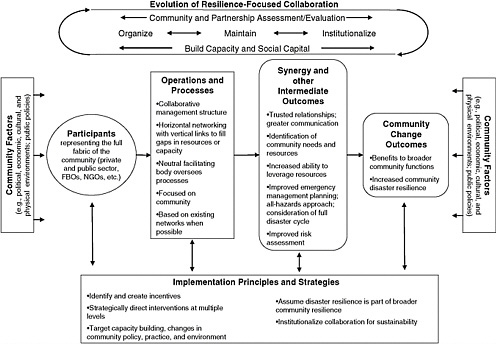
Collaboration may begin through the inspiration of one or more community leaders in any sector. Successful growth of a collaborative partnership is most likely if the mission and structure of partnership are developed initially by a core team of community leaders and then broadened to include other key community stakeholders, as capacity and funding are available to ensure stability and effectiveness. Because priorities will be determined by active participants, identifying the right community representatives is a strategic decision. Failure to identify key stakeholders effectively may result in failure to develop the community’s full capacity. Inadequate planning with all segments of the population in New Orleans, for example, contributed to the failure to evacuate large portions of the population before Hurricane Katrina. Community-level networking may expand to include existing social networks when feasible. New networks may be needed to reach the disenfranchised or to create greater efficiencies. Networking with higher levels of government or industry—for example, at the state and national levels—is an important means of gaining additional support, but the committee concludes that collaboration is most effective when its leadership is at the local level.
As the collaborative network grows, implementation principles and strategies based on collaborative goals and missions are best decided on collectively to win community acceptance and build trust. Strategies are most successful when they are based on available resources and capacities. It is in a community’s interest to design interventions and strategies that can be applied to multiple purposes or are scalable to situations of different proportions; it is a waste of community resources to reinvent the wheel for each new scenario. Resilience-building interventions will be most successful if directed to the entire community and communicated in ways that are meaningful to different populations within the community.
Collaborative goals that effect real change in community policies, practice, and environment are vital, but it is essential that goals also include the sustainability and effectiveness of the collaborative mechanism itself. Sustainable private–public collaboration depends on trust, communication, strong bonds between the private and public sectors, and acceptable returns on investment for all involved. Collaboration requires structure, leadership, and institutional acceptance of the overall mission. The most appropriate structural organization and leadership is representative of community characteristics and common goals. Effective decision making is grounded in trusted relationships and common purpose. Because different community sectors and populations are motivated by different factors, the collaborative structure itself will be strongest if it is trusted and perceived as neutral, nonpartisan, and focused on the greater good of the community. There are examples of successful centralized and decentralized approaches to private–public collaboration, but the committee considers decentralized approaches more conducive to relevant and sustainable resilience-focused collaboration. Regardless of the structure chosen, however, successful collaborative entities often employ staff to serve in a neutral
body whose primary function is to facilitate collaboration, activities, and fundraising in advance of a disaster. The experience of these staff ultimately reduces jurisdictional confusion and wrangling after a disaster and allows more efficient pooling of resources and faster recovery.
Synergy in the community will be the result of effective resilience-focused private–public collaboration even before the ultimate goal of increased community disaster resilience is reached. Effective collaboration will increase communication and trust in the community, identify community needs and resources, increase the ability to leverage resources for the benefit of the community, and improve emergency and community planning.
OVERARCHING GUIDELINES
The committee developed a series of guidelines on the basis of its framework and conceptual model intended for those who wish to create an environment supportive of community-level collaboration. The committee was tasked with developing a set of guidelines for private-sector engagement, but finds that the overarching guidelines may be applied by and to all sectors. Effective and sustainable collaboration fosters rather than controls the building of community disaster resilience. It is important to design disaster resilience partnerships themselves to function well in the event of partial or catastrophic failure of community infrastructure. The committee’s overarching guidelines are summarized in Box S.2. Challenges to collaboration, however, are inevitable. Successful collaboration is sensitive to the challenges associated with capacity building and access for vulnerable populations; public perception of risk and uncertainty; the difference in scales of organizational operation and scales of needed action; the diverging interests of community stakeholders; trust and information sharing; the need to span organizational boundaries; fragmentation and lack of coordination; and the lack of metrics to measure resilience, the strength of collaboration, and collaboration outcomes.
Though this report addresses primarily community-level private–public collaboration for enhancing disaster resilience, the guidelines are applicable to collaboration—or those wishing to support collaboration—at any level.
RESEARCH DIRECTIONS
Research in many disciplines can be applied to community-level resilience-focused private–public collaboration. However, because most resilience-focused collaborative efforts are largely in nascent stages throughout the nation and because social environments and vulnerability to hazards evolve rapidly, a program of research run parallel to the development of collaborative efforts is imperative, and embedding research within collaborative efforts is
|
BOX S.2 Overarching Guidelines for Successful Resilience-Focused Private–Public Collaboration These guidelines can be used in concert with the committee’s conceptual model for resilience-focused private–public sector collaboration (Figure S.1) that shows the relationship between collaborative elements and outcomes.
|
ideal. The latter would allow the collection of information that could inform collaborative decision making in real time while informing future collaborative efforts.
Series of research and demonstration projects across the nation could be conceptualized as living laboratories, providing opportunities for both researchers and practitioners, and could be designed and undertaken with the explicit goal of documenting effectiveness, costs, and benefits—and the metrics for these variables—and to provide longitudinal and comparative data for future efforts. Below is a set of research initiatives that could be targeted for investment by the DHS and others interested in deepening knowledge on resilience-focused private–public sector collaboration.
-
Investigate factors most likely to motivate businesses of all sizes to collaborate with the public sector to build disaster resilience in different types of communities (for example, rural and urban).
-
Focus research on how to motivate and integrate community-based, faith-based, and other nongovernment organizations—including those not crisis oriented—into resilience-focused collaboration.
-
Focus research on how the emergency-management and homeland security sectors can be moved toward a “culture of collaboration” that engages the full fabric of the community in enhancing resilience.
-
Focus research on ways to build capacity for resilience-focused private–public sector collaboration.
-
Focus on research and demonstration projects that quantify risk and outcome metrics, enhance disaster resilience at the community level, and document best practices.
-
Focus on research and related activities that produce comparable nationwide data on both vulnerability and resilience.
-
Establish a national repository and clearinghouse, administered by a neutral entity, to archive and disseminate information on community resilience-focused private–public sector collaboration models, operational frameworks, community disaster-resilience case studies, evidence-based best practices, and resilience-related data and research findings. Relevant stakeholders in all sectors and at all levels should convene to determine how to structure and fund this entity.
A nation is resilient when it is made up of resilient communities. Private–public collaboration is a key step for building such resilience.


