
Conducting Microgravity Research:
U.S. and International Facilities
This chapter is designed to provide detailed information on U.S. and international microgravity science and research facilities and accommodations, as well as their current status and availability. Like Chapter 2, it helps set the stage for the panel chapters that follow because it provides a reasonably complete and coherent picture of the research capabilities that are referred to frequently, but in a more fragmented manner, in the remainder of the report. This chapter covers major facilities for microgravity research. It is intended to help scientists and researchers understand microgravity research capabilities available nationally and internationally for specific areas of research. It includes hardware currently in development or proposed for future development and facilities that were canceled but considered high priority by the scientific community. The details provided in this chapter were obtained from various official international space agency sources describing hardware and capabilities. Units included in descriptions are retained as originally provided and therefore vary between standards.
Facilities and hardware designed to accommodate microgravity experiments can be divided into space- and ground-based, pressurized and nonpressurized, and automated and non-automated.
The International Space Station (ISS) is the sole space-based facility providing long-term laboratory modules for scientists worldwide to carry out pressurized and nonpressurized microgravity experiments. The ISS can accommodate a wide range of life and physical sciences research in its six dedicated laboratory modules and, in addition, provides external truss and exposed facility sites to accommodate external attached payloads for technology development, observational science, and other tests. There are also free-flyers* and satellites dedicated to physical and life sciences research, providing a platform for long-duration missions. However, free-flyers typically do not allow access to astronauts and are fully automated.
Ground-based facilities for microgravity physical sciences include parabolic flights, drop towers, and sounding rockets. In addition, space life science researchers require access to highly specialized ground facilities, for instance the NASA Space Radiation Laboratory (NSRL) at Brookhaven National Laboratory (BNL), and the National Aeronautics and Space Administration (NASA) bed rest facilities at Johnson Space Center (JSC).
This chapter is divided into four sections addressing the types of facilities involved in microgravity research and associated infrastructure: (1) facilities aboard the ISS, (2) global space transportation systems, (3) free-flyers, and (4) U.S. and international ground-based microgravity research facilities. While these descriptions of major, relevant facilities have been included in the report for the convenience of the reader, it should be kept in mind that
___________
* Free-flyers have their own dedicated section titled “Free-Flyers” below in this chapter, following the “Global Space Transportation” section.
the selection of facilities and their capabilities continue to evolve. Readers are referred to NASA websites for the most current information on facilities and equipment for research.†
The major intended purpose of the ISS is to provide an Earth-orbiting research facility that houses experiment payloads, distributes resource utilities, and supports permanent human habitation for conducting science and research experiments in a microgravity environment. It is expected to serve as a world-class orbiting national and international laboratory for conducting high-value scientific research and providing access to microgravity resources for major areas of science and technology development. The ISS sustains a habitable living and working environment in space for extended periods of time, and astronauts become not only the operators of experiments but also the subjects of space research. NASA has partnered with four other space agencies on the ISS Program: the Russian Federal Space Agency (Roscosmos), the Canadian Space Agency (CSA), the Japanese Aerospace Exploration Agency (JAXA), and the European Space Agency (ESA).
Based on international barters, the United States owns 50 percent of all science/experiment racks located in the ESA and JAXA laboratory modules. The U.S. principal investigators working with NASA have access to these facilities but not necessarily to facilities owned and operated exclusively by ISS partners. Exclusively owned Russian facilities are a good example of the latter.
The ISS can support a variety of fundamental and applied research for the United States and international partners. It provides a unique, continuously operating environment in which to test countermeasures for long-term human space travel hazards, to develop and test technologies and engineering solutions in support of exploration, and to provide ongoing practical experience living and working in space. However, with the retirement of the space shuttle fleet, there will be no U.S. government space transportation system available to carry astronauts or payloads to the ISS.
The main advantages for conducting life and physical sciences research on the ISS are the access to the microgravity environment, long-duration time periods for research, and the extended flexibility the crew and principal investigators will have to perform the experiments onboard. The ISS also provides the opportunity to repeat or modify experiments in real time when necessary. In addition, the human aspect of crew participation, as both experimenter and subject, is invaluable in human life sciences research. Finally, the ISS provides an analog environment for simulating long-term deep-space human exploration, which allows NASA the opportunity to prepare humans, machines, and organizational and mission planning for the rigors of the next chapter in human space exploration.
Science payload operations on the ISS are supported by a wide variety of programs, equipment, and laboratory modules. The following are significant payload components:
• U.S. Laboratory,
• Facility-Class Payloads,
• Attached External Payloads,
• Centrifuge Accommodation Module (this program was canceled),‡
• Japanese Experiment Module,
• Columbus Orbital Facility, and
• Russian Research Modules.
The U.S. Laboratory, also known as Destiny, is the major U.S. contribution of scientific capacity to the ISS. It provides equipment for research and technology development and houses all the necessary systems to support a controlled-environment laboratory. Destiny provides a year-round, shirtsleeve atmosphere for research in areas such as life sciences, physical sciences, Earth science, and space science research. This pressurized module is
_____________
† See http://www.nasa.gov/mission_pages/station/research/facilities_by_name.html.
‡ Utilization of this major component for onboard experiments was to commence in 2008, and was included because it has been cited in past NRC reports as a critical capability for space life sciences research.
designed to accommodate pressurized payloads and has a capacity for 24 rack locations, of which the International Standard Payload Racks (ISPRs) will occupy 13 (see Figure 3.1).
The ISPRs inside the ISS pressurized modules provide the only means of accommodating payload experiments. Each ISPR consists of an outer shell that holds interchangeable racks and that maintains a set of standard interfaces, a support structure, and equipment for housing research hardware. It can accommodate one or several experiments. Through the ISPRs, the ISS payload experiments will be able to interface with the following ISS resources contained on Destiny:
• Electrical power,
• Thermal control,
• Command/data/video,
• Vacuum exhaust/waste gas, and
• Gaseous nitrogen.
The EXPRESS (expedite the processing of experiments to space station) Rack System was developed to provide ISS accommodations and resources such as power, data, and cooling to small, subrack payloads and is housed within ISPRs aboard the space station. An EXPRESS rack accommodates payloads originally fitted to shuttle middeck lockers and International Subrack Interface Standard drawer payloads, allowing previously flown payloads to evolve to flight on the ISS.
Figure 3.2 depicts one possible standard EXPRESS rack configuration with eight middeck size drawers and two smaller, International Subrack Interface Standard drawers. The EXPRESS Rack System provides payload accommodations that allow quick, simple integration by using standardized hardware interfaces through which ISS resources can be distributed to the experiment, experiment commands can be given, and data and video can be transmitted.
A facility-class payload is a long-term or permanent ISS-resident facility that provides services and accommodations for experiments in a particular science discipline. It includes general capabilities for main areas of science research. Facility-class payloads are located on ISPRs. These facilities are designed to allow easy change-out of experiments by the crew and to accommodate varied experiments in the same area of research. There are facility-class payload racks dedicated to life sciences, material sciences, and fluids and combustion.
• Window Observational Research Facility. The Window Observational Research Facility (WORF)1 provides a crew workstation window in the U.S. Destiny module to support research-quality optical Earth observations. Some of these observations include “rare and transitory Earth surface and atmospheric phenomena.”2
• Life Sciences Glovebox. This glovebox, which occupies one rack location, provides a sealed workspace3 within which biological specimens and chemical agents can be handled while remaining isolated from the ISS cabin. Its design was based on experience with other gloveboxes flown on previous Spacelab§ missions aboard the space shuttle.
• Microgravity Science Glovebox. The Microgravity Science Glovebox (MSG) also provides a sealed environment and is intended to enable scientists from multiple disciplines to participate actively in the assembly and operation of experiments in space with much the same degree of involvement that they have in their own research laboratories.4 The MSG core work volume slides out of the rack to provide additional crew access capability from the side ports.5
• Cold Storage: Minus Eighty Degree Laboratory Freezer for the ISS, Glacier, and Microgravity Experiment Research Locker/Incubator. The Minus Eighty Degree Laboratory Freezer for the ISS (MELFI)6 is designed
_____________
§ Spacelab was a reusable laboratory module flown in the space shuttle’s cargo bay and used for microgravity experiments that were operated and/or monitored by astronauts.
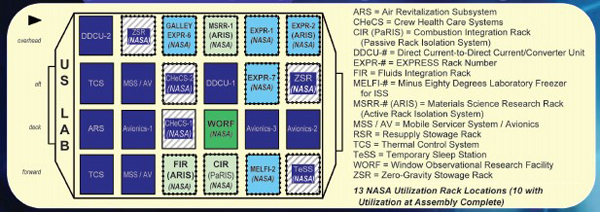
FIGURE 3.1 Destiny module research rack topology at assembly complete, Flight STS-130, Stage 19A. NOTE: 13 NASA Utilization Rack Locations (10 with Utilization at Assembly complete). ARS, Air Revitalization Subsystem; CHeCS, Crew Health Care Systems; CIR (PaRIS), Combustion Integration Rack (Passive Rack Isolation System); DDCU-#, Direct-Current-to-Direct Current/Converter Unit; EXPR-#, EXPRESS Rack Number; FIR, Fluids Integration Rack; MELFI-#, Minus Eighty Degrees Laboratory Freezer for ISS; MSRR-# (ARIS), Materials Science Research Rack (Active Rack Isolation System); MSS/AV, Mobile Servicer System/Avionics; RSR, Resupply Stowage Rack; TCS, Thermal Control System; TeSS, Temporary Sleep Station; WORF, Window Observational Research Facility; ZSR, Zero-Gravity Stowage Rack. SOURCE: J. Robinson, ISS Program Scientist, “International Space Station: Research Capabilities in Life and Physical Sciences, Early Utilization Results,” presentation to the Committee for the Decadal Survey on Biological and Physical Sciences in Space, May 7, 2009.
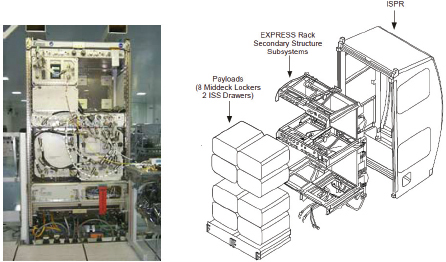
FIGURE 3.2 EXPRESS rack configuration. SOURCE: Left: NASA, International Space Station Familiarization Training Manual, ISS FAM C TM 21109, June 3, 2004. Right: NASA, International Space Station Users Guide, ISS User’s Guide-Release 2.0, NASA Johnson Space Center, Houston Tex., 2000
to operate optimally at −80°C (−112°F) but has independent activation/deactivation and temperature control for each Dewar. Dewars are certified to operate at one of three set points: −95°C, –35°C, and +2°C. The MELFI can preserve samples that require all biochemical action to be stopped but do not require cryogenic temperatures. Cell culture media and bulk plant material, as well as blood, urine, and fecal samples, are among the types of items that can be stored in the MELFI.7
Although the MELFI is not certified for operation at temperatures other than its current three set points, the Glacier freezer aboard the ISS is capable of operating at any temperature between +4°C and −99°C, and can go as low as −130°C (which requires water cooling and more power available via the EXPRESS racks). There will be two GLACIER freezers aboard the ISS after shuttle retirement. Glacier provides powered cooling on ascent and descent, and following shuttle retirement can return to Earth with payloads via SpaceX’s Dragon capsule.8
The Microgravity Experiment Research Locker/INcubator (MERLIN) is an on-orbit incubation and low-temperature storage facility for science experiments, as well as stowage transportation to and from orbit. It contains seven flight units owned by the University of Alabama. It can support samples from +4°C to +48.5°C in air cooling mode while stored in the space shuttle’s middeck, and −20°C to +48.5°C in water cooling mode when housed in an EXPRESS rack.9
• Attached External Payloads. Attached payload sites for external experiments are located on the trusses of the ISS outside the pressurized volume. Attached payloads have access to station power, the command and data handling system, and video. The crew interfaces with attached payloads using robotics for installation and removal of the payload, with no nominal extravehicular activity operations anticipated.10
• Centrifuge Accommodation Module (canceled). The Centrifuge Accommodation Module was a research facility especially designed to study the effects of selected gravity levels (0.01 g to 2 g) on the structure and function of plants and animals, as well as to test potential countermeasures for the changes observed in microgravity.11
More detailed descriptions of the above facilities are given below in this chapter, in the section “Major ISS Facilities by Discipline.”
U.S. Partner ISS Facilities and Modules
Meaning “dawn” in Russian, the Rassvet Mini-Research Module-112 is used for science research and cargo storage, as well as providing an additional docking port for Russian Soyuz and Progress vehicles at the ISS. This facility will serve as a home to biotechnology and biological science experiments, fluid physics experiments, and education research. The module contains a pressurized compartment with eight workstations, including a sealed glovebox to keep experiments separated from the cabin environment, two incubators to accommodate high- and low-temperature experiments, and a vibro-protective platform to protect payloads and experiments from onboard vibrations.13
The Poisk Mini-Research Module-2 is a multipurpose extension of the ISS connected to the Zvezda module. It provides an additional docking port for visiting Russian spacecraft and serves as an extra airlock for spacewalkers wearing Russian Orlan spacesuits.
ESA contributed the Columbus module and three Multi-Purpose Logistics Modules (MPLMs). One of the modules will become a permanent fixture of the ISS through an agreement with the Italian Space Agency, which built the modules. Columbus is ESA’s single largest contribution to the space station, and at 23 ft long and 15 ft wide, it can accommodate 10 internal ISPRs of experiments and four external payload facilities (up to 370 kg each). Five of the ISPRs belong to NASA. Columbus houses a Biolab, Fluid Science Laboratory, European Physiology Module, and European Drawer Rack. It is equipped with two video cameras and a monitor audio system, as well as an external payload facility. The laboratory can support up to three crew members and can operate in temperatures between 16°C and 27°C and at air pressures between 959 and 1013 hPa.
The MPLMs and Columbus share a similar architecture and basic systems and have essentially the same dimensions. Approximately 21 ft long and 15 ft in diameter, the MPLMs can accommodate 16 payload racks, 5 of which can be furnished with power, data, and fluid to support a refrigerator-freezer.14 Built by the Italian Space Agency but owned and operated by NASA, the MPLMs ferry pressurized material to the station and return waste, experiment racks, and other miscellaneous items (e.g., failed equipment) to Earth via the space shuttle. One of the MPLMs, Leonardo, was converted into the Permanent Multipurpose Module of the ISS, which was launched to the ISS on the STS-133 mission on February 24, 2011 (ISS Assembly Mission ULF5).
The Japanese Experiment Module Kibo, which is Japanese for “hope,” is Japan’s first human space facility and its primary contribution to the ISS. The Kibo laboratory consists of a pressurized module and an exposed facility, which have a combined focus on space medicine, biology, Earth observations, material production, biotechnology, and communications research. The laboratory consists of six components:15
• Two research facilities, the pressurized module and the exposed facility;
• A logistics module attached to each facility;
• Remote Manipulator System; and
• Inter-Orbit Communication System unit.
Kibo’s pressurized module can hold up to 23 racks, including 10 experiment racks. Five of these racks belong to NASA. They provide access to power, communications, air conditioning, hardware cooling, water control, and experiment support functions.16
Kibo’s exposed facility is located outside the pressurized module and is continuously exposed to the space environment. Experiments conducted on the exposed facility focus on Earth observation, communications, science, engineering, and materials science. The facility measures 18.4 ft wide, 16.4 ft high, and 13.1 ft long, and can support up to 10 experiment payloads at a time. Kibo uses Experiment Logistics Modules, which are both pressurized and exposed to the space environment and which serve as on-orbit storage areas housing materials for experiments, maintenance tools, and supplies. The pressurized section of each logistics module is a cylinder attached to the top of Kibo’s pressurized module and can hold eight experiment racks. The exposed section of each logistics module is a pallet that can hold three experiment payloads, measuring 16.1 ft wide, 7.2 ft high, and 13.8 ft long.
Laboratory support equipment aboard the ISS includes automatic temperature controlled stowage, centrifuges, combustion chambers, biological culture apparatus, experiment preparation units, human restraint system, incubators (with a temperature range of −20°C to +48.5°C, interferometers, laptop computers, microscopes, multi-electrode electroencephalogram mapping module, optical and infrared cameras, optics benches, refrigerators and freezers that can store samples down to −185°C, solid-state power control module, spectrophotometers, temperature-controlled units, ultrasound, vacuum access system, and vibration isolation frames.
Major ISS Facilities by Discipline
Life Sciences
Human Research Facility 1
The Human Research Facility 1 (HRF-1)17 provides investigators with a laboratory platform to study how long-duration spaceflight affects the human body. The HRF-1 includes a clinical ultrasound and a device for measuring mass.18 Equipment is housed either on a rack based on the EXPRESS rack design or in stowage until needed. HRF-1 operates at ambient temperature, utilizing the ISS moderate temperature cooling loop, and has access ports for a nitrogen delivery system, vacuum system, and laptop. HRF-1’s Workstation 2 is a computer system that provides operators with a platform to install and run software used in investigations. Components and equipment include the following: ultrasound drawer containing ultrasound/Doppler equipment, Workstation 2, two cooling stowage drawers that maintain a uniform temperature, Space Linear Acceleration Mass Measurement Device,19 and the Continuous Blood Pressure Device.
Human Research Facility 2
The Human Research Facility 2 (HRF-2),20 like HRF-1, addresses the effects of long-duration spaceflight on the human body. HRF-2 contains different equipment than HRF-1 contains, such as a refrigerated centrifuge and devices for measuring blood pressure and heart and lung functions. It is based on the EXPRESS Rack System and, like HRF-1, is able to provide power, data handling, cooling air and water, pressurized gas, and vacuum to experiments. Components and equipment include the following: refrigerated centrifuge, Workstation 2 (same as in HRF-1), two cooling stowage drawers, and the Pulmonary Function System. Included in the Pulmonary Function System are the Photoacoustic Analyzer Module, Pulmonary Function Module, Gas Analyzer System for Metabolic Analysis Physiology,21 and the Gas Delivery System.
The 6-chamber refrigerated centrifuge can hold samples sized from 2 to 50 mL, while the 24-chamber refrigerated centrifuge can hold samples ranging from 0.5 to 2.2 mL. These refrigerated centrifuges can spin from 500 to 5,000 revolutions per minute for durations of 1 to 99 minutes, or they can be set to run continuously. The centrifuges were designed to be capable of maintaining a chamber temperature of +4°C, with selectable set points in increments of 1°C. The refrigeration capability of the centrifuges does not work currently, but they still function nominally as centrifuges.22
The Pulmonary Function System is a NASA-ESA collaboration that allows two different respiratory instruments to be created through the interconnection of components: the Mass spectrometer-based Analyzer System and the Photoacoustic-based Analyzer System. Combined with the Gas Analyzer System for Metabolic Physiology, Pulmonary Function Module, and Gas Delivery System, these instruments can “determine the concentration of respired gas components,” take “cardiovascular and respiratory measures, including breath-by-breath lung capacity and cardiac output,” and “measure the concentration of gases in inspired and expired air.”23
Biological Experiment Laboratory
The Biological Experiment Laboratory (BioLab)24 is an on-orbit biology laboratory located in the Columbus module that is used to study how microgravity and space radiation affect unicellular and multicellular organisms
including bacteria, insects, protists (simple eukaryotic organisms), seeds, and cells. The facility is divided into two sections: one automated (that can also receive commands from ground operators) and one designed for crew interaction with experiments. Onboard instrumentation includes a large incubator, two centrifuges, a microscope, a spectrophotometer, a sample-handling mechanism (robotic arm), automatic and manual temperature-controlled stowage units, an experiment preparation unit, and a glovebox (called the BioGloveBox). BioLab’s life support system can also regulate atmospheric content, including humidity. Biological samples for experimentation are transported from the ground in experiment containers or in small vials and manually inserted into the BioLab rack.
European Physiology Module
The European Physiology Module (EPM)25,26,27 is designed to improve understanding of the effects of space flight on the human body. EPM research covers neurological, cardiovascular, and physiological studies and investigations of metabolic processes. It consists of three science modules: two active modules (Cardiolab and the Multi Electrodes Encephalogram Measurement Module) and one sample collection kit that enables collection of biological samples (blood, urine, and saliva). Up to three “active” human body experiments can be tested at one time; each subject is required to supply baseline samples and data before spaceflight for comparison to experimental data.
Muscle Atrophy Research And Exercise System
The Muscle Atrophy Research and Exercise System (MARES)28,29,30 is used in studying human musculoskeletal, biomechanical, and neuromuscular physiology with respect to microgravity. This general-purpose instrument includes a human restraint system, a vibration isolation frame, a laptop, and a direct drive motor to provide the core mechanical stimulus. The system can be used in conjunction with other instrumentation, such as the Percutaneous Electrical Muscle Stimulator II and an electromyogram device. Although its primary function is research, it can also be used solely for exercise purposes. Components and equipment include an electromechanical box, human restraint system, linear adapter, vibration isolation frame, and laptop computer.
Saibo Experiment Rack
The Saibo Rack31,32 is a Japanese experiment platform that includes subracks designed for living-cell biology experiments. It includes a glovebox (called the Clean Bench) and a cell biology experiment facility that includes a CO2 gas incubator with controlled atmosphere and centrifuges that support operations from 0.1 g to 2.0 g. The Clean Bench includes a HEPA filter and high-performance optical microscope. Located in the Japanese Kibo module, Saibo is housed in an ISPR that can be divided in multiple payload segments.
Physical Sciences
Fluids and Combustion Facility
The Fluids and Combustion Facility consists of two racks, the Combustion Integrated Rack (CIR) and the Fluids Integrated Rack (FIR). The CIR33–36 features a 100-liter combustion chamber and is used to perform combustion experiments in microgravity and consists of an optics bench, a combustion chamber, a fuel and oxidizer management system, environmental management systems, interfaces for science diagnostics and experiment-specific equipment, five cameras, gas supply package, exhaust vent system and gas chromatograph, and environmental control subsystems (including water and air thermal control, and fire detection and suppression). The CIR has been designed for use with the Passive Rack Isolation System, which connects the rack to the ISS structure and attenuates much of the U.S. Laboratory’s vibration.37 CIR experiments are conducted by remote control from the Telescience Support Center at NASA Glenn Research Center.38
The FIR39,40 is a fluid physics research facility, complementary to the CIR, that is designed to support investigations in areas such as colloids, gels, bubbles, wetting and capillary action, and phase changes in microgravity such as boiling and cooling. It uses the Active Rack Isolation System and is capable of incorporating different modules that support widely varying types of experiments. Components and equipment include an optics bench and a light microscopy module, gas interface panel (providing ISS gaseous nitrogen and vacuum), Fluids Science
Avionics Package, and Mass Data Storage Unit. While most FIR experiment operations are performed from the ground by teams at NASA Glenn Research Center, the ISS crew installs and configures the necessary hardware.
Materials Science Research Rack-1
The Materials Science Research Rack-1 (MSRR-1)41 is used for materials science experiments and research in microgravity. It provides instrumentation and thermal chambers for the study and mixing of materials, growing crystals, and quenching/solidifying metals or alloys. It occupies a single ISPR and is equipped with the Active Rack Isolation System. While MSRR-1 is a highly automated facility, it requires crew attention for maintenance and to install exchange modules. The first experiment module installed in the MSRR-1 is the Materials Science Laboratory (MSL) built by ESA. MSL takes up almost half of the MSRR-1 housing, is designed for materials processing and advanced diagnostics, and features multiple on-orbit, replaceable, module inserts also developed by ESA. The MSL can also be used for stowage and transportation back to Earth.42,43,44 Components and equipment include a solid-state power control module, master controller, vacuum access system, and thermal and environmental control system. MSRR-1 currently hosts ESA’s Material Science Laboratory.
Fluid Science Laboratory
The Fluid Science Laboratory (FSL)45,46 was developed by ESA and designed to conduct fluid physics research in microgravity. It can be operated as a fully automatic or semi-automatic facility controlled either by ISS crew or in telescience mode from the ground. A drawer system allows for different configurations to accommodate a variety of experiments and for easy access for upgrades and maintenance of the system. FSL experiments must be installed in an FSL experiment container with a typical mass of 30 to 35 kg and dimensions of 400 × 270 × 280 mm3. Researchers may choose to activate the Canadian Space Agency-developed Microgravity Vibration Isolation Subsystem (via magnetic levitation) to isolate the experiment from space station “g-jitter” perturbations.47 Components and equipment include optical and infrared cameras, multiple interferometers, illumination sources, two central experiment modules, a video management unit, storage, and a workbench.
Microgravity Science Glovebox
More than twice the size of gloveboxes flown aboard the space shuttle, MSG48,49 (Figure 3.3) is an extendable and retractable 9-ft3 sealed work area (at negative pressure relative to ISS cabin pressure) accessible to the crew through glove ports and to ground-based scientists through real-time data links. MSG is well suited for small and medium-sized investigations in many different kinds of microgravity research, such as fluid physics, combustion science, materials science, biotechnology, and fundamental physics. Components and equipment include three stowage drawers, a powered video drawer containing four video cameras, four recorders, two monitors (digital or 8 mm), standard and wide-angle lenses for each camera, and a laptop computer.
Mini-Research Module 1 Rassvet
As noted above, MRM150,51 is used for science research and cargo storage, as well as providing an additional docking port for Russian Soyuz and Progress vehicles at the ISS. Measuring 19.7 ft long and 7.7 ft in diameter, the facility has been planned to serve as a site for biotechnology and biological science experiments, fluid physics experiments, and education research. The module plans describe a pressurized compartment with eight workstations, a sealed glovebox to keep experiments separated from the cabin environment, two incubators to accommodate high- and low-temperature experiments, and a vibroprotective platform to protect payloads and experiments from onboard vibrations.
The eight workstations or arc-frames have extendable module-racks. The MRM1 glovebox can handle sterile or hazardous substances or bulk matter, as well as providing airlock, cleaning, and sterilization aids at 99.9 percent pure atmosphere. Its usable volume is 0.25 m3. The High Temperature Universal Biotechnological Thermostat is designed to provide the temperature conditions required for handling biological objects (+2°C to +37°C). The Low Temperature Biotechnological Thermostat is similar, but it has an operating temperature of −20°C. The Universal Vibration Protection Platform protects scientific equipment up to 50 kg in mass from ambient vibration at frequencies from 0.4 to 250 Hz with a coefficient not less that 20 dB.
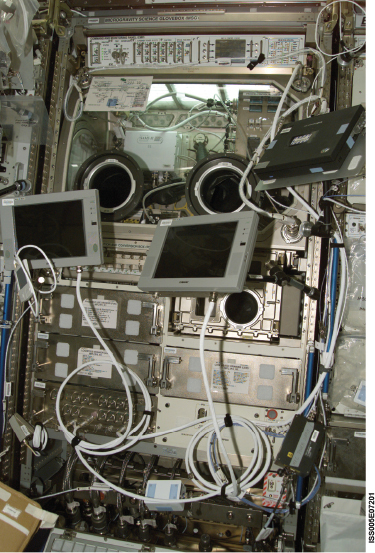
FIGURE 3.3 Microgravity Science Glovebox on the ISS. SOURCE: NASA Marshall Space Flight Center, available at http://msglovebox.msfc.nasa.gov/capabilities.html.
Ryutai Experiment Rack
Japanese for “fluid,” the Ryutai Experiment Rack is housed in an ISPR in the Japanese Kibo module. Ryutai52,53 provides standard interfaces to accommodate modular payloads in various research areas. It is designed to contain multiple JAXA subrack facilities. Components and equipment and subracks include a fluid physics experiment facility, protein crystallization research facility, solution crystallization observation facility, and image processing unit.
Space Sciences Payloads
EXPRESS Racks
The EXPRESS Rack System54 was developed to provide the ISS with standardized accommodations for small, subrack payloads. Currently, eight EXPRESS racks are in use or scheduled for use on the ISS. The EXPRESS Rack System also includes transportation racks to transport payloads to and from the ISS and suitcase simulators to allow a payload developer to verify ISS power and data interfaces at the development site. Each EXPRESS rack can accommodate 10 “standard-sized small experiments” (the equivalent in up to 80 individual experiments), and approximately 50 percent of the EXPRESS payload housing capability is available for use as part of the U.S. National Laboratory aboard the space station. Of the eight EXPRESS racks, one rack, EXPRESS-6, is used in part for crew galley purposes. EXPRESS racks 7 and 8 were added specifically for the National Laboratory.55 Subracks accommodated on an EXPRESS rack include the European Module Cultivation System installed on EXPRESS Rack 3A, Advanced Protein Crystal Facility on EXPRESS Rack 1, Biotechnology Specimen Temperature Controller on EXPRESS Rack 4, Commercial Generic Bioprocessing Apparatus, BioServe Culture Apparatus, General Laboratory Active Cryogenic ISS Experiment Refrigerator, Microgravity Experiment Research Locker Incubator, Biotechnology Temperature Refrigerator, ARCTIC Refrigerator/Freezer, Portable Astroculture Chamber, Advanced Space Experiment Processor, Advanced Biological Research System, and Common Refrigerator Incubator Module-Modified.
Columbus External Payload Facility
The Columbus External Payload Facility56,57 (attached to the outside of ESA’s Columbus module) has four powered external attachment points for scientific payloads: one on the nadir side, one on the zenith side, and two on the starboard sides of the Columbus module. Each attachment can provide 1.25 kW of power via two 120-Vdc redundant power feeds. Modules attached to these locations are interchangeable via extravehicular activity. The maximum mass the Columbus External Payload Facility can accommodate (including the adapter plate) is 290 kg, and payload dimensions should not exceed 86.4 × 116.8 × 124.5 cm, not including the adapter plate. The first set of experiments attached to the Columbus External Payload Facility consisted of the European Technology Exposure Facility58 and the Sun Monitoring on the External Payload Facility of Columbus.59 The Atomic Clock Ensemble in Space60 will be delivered at a date yet to be determined.
European Drawer Rack
The European Drawer Rack61,62 is a multidiscipline experiment rack housed in an ISPR with seven experiment modules, each of which has separate access to power, cooling, data communications, vacuum, nitrogen supply, and venting. Experiments are largely autonomous, but can also be controlled remotely via telescience, or in real-time by the crew through a dedicated laptop. The European Drawer Rack provides power, cooling, and communications equipment for each of its payloads and is also equipped to supply vacuum, vents, and nitrogen if necessary.
Japanese Experiment Module—Exposed Facility
This exposed facility on the Japanese Experiment Module63 provides an external platform that can accommodate up to 10 experiments in the space environment. The first JAXA instruments installed in this facility are the Space Environment Data Acquisition Equipment-Attached Payload, and the Monitor of All-sky X-ray Image Payload. The first NASA instruments will be a hyperspectral imager and ionosphere detector.
Earth Sciences Payloads
WORF
WORF64 is based on the ISPR and utilizes avionics and hardware adapted from the EXPRESS Rack System, providing 0.8 m3 of payload volume. It is used in conjunction with and in support of the U.S. Laboratory Science Window for Earth observation science in the U.S. Destiny module. WORF’s primary function is to control the external shutter of the window and as a mounting for imaging hardware. It is designed to minimize reflections and glare and hosts both crew-tended and automated activities. WORF can handle up to three payloads simultane-
ously, depending on available space and resources. WORF also includes the Agricultural Camera (AgCam), which provides images within 2 days directly to requesting farmers, ranchers, foresters, natural resource managers, and tribal officials for use in environmental and land management. It can take images in the visible and infrared light spectra.65 WORF components include standard ISPR avionics, support systems, plus imaging systems.
Other ISS Payloads
European Transportation Carrier
The European Transportation Carrier (ETC)66,67,68 is used for on-orbit stowage for ESA payload items and support for other European facilities. Its primary use is as a transport rack in conjunction with the MPLM to and from the ISS aboard the space shuttle or European Automated Transfer Vehicle, but it can also be used as a workbench for other experiments. The ETC can hold up to 410 kg (881 lb) of payload.
EXPRESS Logistics Carriers on External Trusses
The EXPRESS Logistics Carrier69 is designed to support external payloads mounted to the starboard and port external trusses of the ISS with either Earth or space views. Five carriers are to be delivered by the time that the space shuttle is retired. Each can accommodate up to 12 fully integrated payloads, Orbital Replacement Units, or loads of outfitting cargo to the ISS in the space shuttle cargo bay. The truss segments can provide each carrier with two 3-kW, 120-Vdc electric feeds, and there are two types of data ports (High-Rate Data Link and Low-Rate Data Link) to connect the carriers to the ISS.
GLOBAL SPACE TRANSPORTATION SYSTEMS
Of the ISS partners, four provide launch services for crew or payload: the United States (NASA), Russia (Roscosmos), Europe (ESA), and Japan (JAXA). Only the United States, Russia, and China currently launch humans into space, and the United States has the greatest payload-to-orbit capability, but all four ISS partners are instrumental in supplying and maintaining the orbiting laboratory.
The debate surrounding the use of commercial launch services is unique to the United States, and the committee has indicated, to the best of its knowledge, commercial companies either involved in or trying to enter the launch services industry. Because this is a rapidly changing field, the committee focused on companies that either have Space Act agreements with NASA for hardware development specifically related to commercial crew and cargo or currently provide actual services.70
Space Transportation System (NASA)
Commonly known as the “space shuttle,” the U.S. Space Transportation System has been the primary means of U.S. support to the ISS. The system consists of two reusable solid rocket boosters, external liquid hydrogen and liquid oxygen fuel tanks, and a reusable orbiter that can carry large payloads of up to 24,400 kg to low Earth orbit (LEO), along with typically seven crew members.71 It has been used to deliver entire modules and segments of the ISS and for logistics, resupply, and sample retrieval purposes, typically using the MPLM. The space shuttle is launched from Kennedy Space Center in Florida.
Currently, there is no U.S. government launch vehicle that can be counted on with certainty for U.S. crew and payload operations to the ISS beyond 2011. As of this writing, the space shuttle is slated for retirement in 2011, but the U.S. Congress may choose to extend shuttle operations beyond that date. The successor system to the space shuttle, the Ares I rocket and Orion Crew Vehicle, were in development, although recent policy decisions may end their development in favor of commercial industry-designed and industry-built launch vehicles and capsules or a combination of government and industry development.
Under the original plan devised during the administration of President George W. Bush in 2004, the Constellation Program would build two new rockets, a crewed rocket (Ares I) and a heavy-lift payload rocket (Ares V), to replace the space shuttles. Ares I was planned to go on line in 2015.
Taurus II-Cygnus (Orbital Sciences Corporation)—In Development
The Taurus II launch vehicle72 is currently under development through NASA’s Commercial Orbital Transportation Services program and has been awarded a Space Station Commercial Resupply Services contract for future resupply missions to the ISS.73 It is slated for its first launch in 2011. The Taurus II has a payload capacity of up to 7,000 kg to LEO.74 For ISS resupply missions, it will carry an uncrewed Cygnus spacecraft to deliver up to 2,700 kg of pressurized and unpressurized cargo.75 Taurus II missions are initially planned to be launched from the NASA Wallops Flight Facility, but the rocket is compatible with many other U.S. launch facilities that could be used, depending on demand.76
Falcon 9-Dragon (Space Exploration Technologies Corporation)—In Development
Following its selection for the Commercial Orbital Transportation Services program, the Space Exploration Technologies Corporation (SpaceX) has been awarded a Space Station Commercial Resupply Services contract for ISS resupply using its Falcon 9 launch vehicle.77,78 The Falcon 9 launch vehicle is partially reusable and is capable of lifting 10,450 kg to LEO when launched from Cape Canaveral Air Force Station. The reusable SpaceX Dragon spacecraft could be available for ISS resupply missions of up to 6,000 kg payloads to LEO or for crew transfer missions of up to seven crew members. The capsule will also be able to return up to 3,000 kg of payload to Earth. For non-ISS missions, the spacecraft operates under the “DragonLab” name as an emergent microgravity research and sample return capability.79
Inflatable Habitats (Bigelow Aerospace)—In Development
Bigelow Aerospace is developing inflatable space-based habitats. Two prototypes, Genesis I and Genesis II, were launched and operated in LEO in 2006 and 2007, respectively. Future versions of larger modules and concepts for modular space stations based on the Genesis concept are also under development.80
CST-100 (The Boeing Company and Bigelow Aerospace)—In Development
A cooperative project between Bigelow Aerospace and the Boeing Company has been awarded a Space Act Commercial Crew Development (CCDev) contract valued at $18 million for the development of the CST-100 crew capsule,81,82 which could be launched by either the United Launch Alliance Evolved Expendable Launch Vehicle or the SpaceX Falcon 9 rocket.83
United Launch Alliance CCDev Project—In Development
Although not currently tasked with resupply for the ISS or actively engaged in microgravity research support missions, the United Launch Alliance has been awarded a $6.7 million CCDev contract for development of an Emergency Detection System (EDS) to be used on Delta IV, Atlas V, and other launch vehicles.84,85 Development includes detection system definition, testing, demonstration, and crew interface design.86
DreamChaser CCDev Project (Sierra Nevada Corporation)—In Development
The DreamChaser87,88 is a reusable crewed spacecraft concept based on the NASA HL-20 lifting body concept launched atop an Atlas V Evolved Expendable Launch Vehicle. It is supported by a $20 million NASA CCDev contract.89
Blue Origin, LLC—In Development
Blue Origin90,91 has a Space Act Agreement with NASA to develop two technologies that will help reduce risk associated with orbital spaceflight. The first of these technologies is a “pusher escape system” that replaces the traditional emergency capsule escape tower affixed to the front of a crew capsule, with a separation system
mounted on the back of the capsule. Unlike an escape tower, the pusher escape engine will not be consumed during normal launch operations and can be reused, thus lowering costs. The other technology is a “composite pressure vehicle” that will use composite panels bonded together.
Currently, Blue Origin is developing a suborbital vehicle that will carry three or more astronauts to an altitude of 350,000 ft.
Soyuz-Soyuz/Progress (Roscosmos, Starsem)
The Soyuz launch vehicle is a significant asset for transferring both crew and cargo to and from the ISS. It is utilized by Russian, U.S., and European astronauts. Soyuz and the space shuttle are the only human-rated launch vehicles currently available. For crew rotation missions, the Soyuz family of rockets carries the Soyuz spacecraft with three seats; the Soyuz-derived Progress spacecraft is used for cargo missions and has a 1,700-kg cargo capacity.92 Soyuz capsules, which remain on the ISS for extended periods, also provide a crew rescue capacity in case of emergencies.
Proton (Roscosmos, Khrunichev)
The Proton rocket is an expendable launch vehicle capable of transferring payloads up to 20,700 kg to LEO. It is not used in a regular ISS resupply capacity, but it is used in directly delivering larger ISS modules, including the Zarya and Zevsda modules.
Ariane 5–Automated Transfer Vehicle (ESA, Centre National d’Etudes Spatiales, Arianespace, EADS Astrium)
The Ariane 5 is a heavy-lift launch vehicle operated by Arianespace for both commercial and ESA services. It is operated and launched from the Guyana Space Center in Kourou, French Guyana.93 In support of the ISS, the Ariane 5 is used to launch the Automated Transfer Vehicle (ATV) developed by EADS Astrium.
The ATV is an autonomous (but human-rated) resupply vessel capable of ferrying a total of 7,667 kg of pressurized and unpressurized cargo, as well as transferable fuel, to the ISS. Furthermore, the ATV is capable of providing orbit-raising boosts to the ISS and can remain berthed to it for extended periods of time to provide for additional living space.94 The pressurized cargo section of the ATV is derived from the MPLM and can accommodate up to eight standard racks.95 The ATV is also able to remove up to 6,300 kg of waste from the ISS on its destructive atmospheric re-entry. Re-entry and return systems for ATV evolution concepts have been under study by ESA to allow for eventual options to return cargo and crew to Earth.96 The first ATV, named “Jules Verne,” docked with the ISS on April 3, 2008, after an extensive on-orbit testing phase and re-entered the atmosphere on September 5, 2008.97 The second ATV, “Johannes Kepler,” is scheduled to launch in late 2010,98 with the third ATV, “Edoardo Amaldi,” undergoing development for the following year.99
Vega Intermediate Experimental Vehicle—In Development
ESA and Arianespace are developing the Vega launch vehicle to place smaller (300-2,000 kg) payloads into orbit economically.100 While specifically designed to place scientific Earth-observation satellites into polar orbits, Vega is slated to launch the Intermediate Experimental Vehicle in 2012 as a test vehicle for a comprehensive atmospheric re-entry technology development and demonstration program.101 This test vehicle features a lifting-body configuration and will be used to test dynamic guidance and control technologies during re-entry.102 While the Vega is not designed to directly support microgravity research, results from the Intermediate Experimental Vehicle are expected to transfer to the development of a crew and cargo transfer capability.
The H-IIB–H-II Transfer Vehicle (JAXA, Mitsubishi Heavy Industries) is a Japanese launch vehicle used in ISS resupply and other missions. It has a lift capacity of 16,500 kg to a LEO with a 51.6° inclination.103 This is the insertion orbit for the H-II Transfer Vehicle (HTV), a partially pressurized cargo spacecraft to resupply the ISS that has a resupply payload capacity of approximately 6,000 kg.104 The Japanese have successfully launched the HTV on resupply missions to the ISS.
Free-flyers are satellites that can be used for automated microgravity research in both biological and physical sciences, such as growing bacteria in space or exposing materials to the space environment, among many other uses. Mission durations, satellite bus and payload sizes, and mission purposes vary widely. Free-flyers can operate either with or without human interaction, and may or may not return samples or data back to Earth autonomously. Some free-flyers will only transmit data back to Earth and are not designed for re-entry.
In many respects, the ISS is itself a very large free-flyer, albeit a permanently crewed one. Traditional free-flyers are typically not designed for or expected to interact with human operators following their launch, unless samples are returned to Earth from orbit. Although it has been proposed that the ISS act as a node for free-flyers, at which visiting vehicles can rendezvous and be refurbished with new payloads, hardware, and software,105 there is no indication that the ISS will be used in this way.
The NASA Authorization Act of 2005 established a provision that mandated the use of free-flyers as part of the 15 percent allocation of ISS research funds beginning in fiscal year (FY) 2006.106,107
NASA’s Ames Research Center is home to NASA’s Microsatellite Free Flyer program, which is part of the center’s ISS Non-Exploration Projects effort focused on implementing peer-reviewed fundamental space biology investigations on a microsatellite free-flyer platform. The Microsatellite Free Flyer program was created to add additional research capacity to U.S. scientists in fundamental space biology: life at molecular and cellular levels, interactions between organisms, and life across generations. Many of these flights, like NASA’s GeneSat and PharmaSat, are flown on a relatively new type of satellite platform known as a CubeSat.
The CubeSat108 was developed in 1999 at the California Polytechnic State University with a universal standard that can be adopted and built anywhere in the world. A CubeSat consists of one, two, or three cube units (1U, 2U, and 3U, respectively) to make a single satellite. An individual cube measures 10 cm per side with a mass of up to 1.33 kg. The primary mission of the CubeSat is to provide access to space for small payloads at costs that are inexpensive compared with traditional satellite platforms. CubeSats are traditionally launched as secondary payloads, making them subject to the launch parameters of the host payload and thus imposing constraints on CubeSat experiments out of the researchers’ control. They can be used for experiments in the biological, physical, materials, and Earth sciences. With the mass and size restraints of the CubeSat platform, it remains to be seen what future capabilities CubeSats will have, but already they have been used to expose materials to the space environment, grow cultures in space, and take pictures of Earth.
The Foton is an uncrewed, Russian-built retrievable capsule, providing an intermediate microgravity platform. It was first launched by the Soviet Union in 1985 and today is launched out of the Baikonur Cosmodrome in Kazakhstan. The Kazakhstan-Russia border is the general area from which capsules are retrieved. Fotons are launched into near-circular LEOs by a three-stage Soyuz-U rocket. Such flights provide researchers with gravity levels less than 10−5g for missions lasting around 2 weeks. ESA’s participation in the Foton program began in 1991 with a protein crystallization experiment. The Foton capsule is useful for experiments in biology, fluid and combustion physics, astrobiology/exobiology, and materials science.109
Payloads usually fly about 2 years after experiment approval, with the possibility of relatively late experiment installation (“late access”) 48-72 h before launch. The Foton also allows for the use of interactive experiment operations (telescience).
The capsule measures 3.2 m long and 2.5 m wide, with an attitude control system that is used for spacecraft alignment in preparation for its re-entry. While in orbit, the attitude control system is not used, and the spacecraft does experience a low level of spin (around 0.1 rpm), which has little effect on the magnitude of microgravity. It can hold up to 650 kg of scientific payload, with a volume measuring 1.6 m3 for experiment hardware. The size and mass of a single payload is not limited by any specific criteria and will be established by ESA on a case-by-case and mission-by-mission basis.
Power comes from a battery module containing lithium cells and AgZn batteries, providing an average daily power electrical budget of 800 W during a typical 2-week mission.
Capsule pressure is generally kept around 1 atm but can range from 0.454 atm to 1.5 atm; the temperature range is 19°C to 26°C. The capsule is subjected to three types of radiation sources: background radiation (0.055 rad/day), solar flares (50 rad, possible at any point during the mission), and gamma-ray sources inside the re-entry capsule with a total radiation dose of 0.104 rad/day at a distance of 500 mm from the source.
To orient the reader, general types of ground-based facilities are discussed first, according to the general field of research in which they are used: physical sciences, life sciences (including biomedical research), and space radiation research. A more specific inventory of facilities relevant to microgravity research follows, starting with U.S. facilities and then describing major capabilities in Europe, Russia, Japan, and China.
General Types by Field of Research
Facilities for Physical Sciences
There are three major types of ground-based facility that can be used for microgravity experiments in the physical sciences: drop towers, parabolic flights, and sounding rockets. A drop tower is a tall vertical shaft, multiple stories high, where drop experiments can be conducted. As they free-fall down the shaft, in a casement that protects the experiment from the effects of drag, a microgravity environment will be experienced for a short time, usually a few seconds.
Similar to the idea of a drop tower, sounding rockets provide microgravity by allowing experiments to free-fall but through a much larger distance. Sounding rockets can reach altitudes of up to 700 to 800 km before releasing the experimental payload and allowing it to free-fall. The NASA program in polar ballooning (with its fruitful partnership with the National Science Foundation)110 also offers the possibility of reaching the edge of space with potential for free-fall payloads similar to sounding rockets.
Microgravity is achieved during a parabolic flight by flying an airplane on a parabolic trajectory. At the start of the parabolic climb, a period of increased gravity is followed by approximately 20 s of microgravity before another period of increased gravity, after which the plane pulls out of the parabolic trajectory and gravity returns to a 1-g state.
Facilities for Life Sciences
In addition to parabolic flights and sounding rockets (drop towers have not been routinely used by life scientists), space life sciences researchers use a range of specialized ground-based facilities to understand effects of the spaceflight environment on biological systems. These facilities are often highly specialized and target a specific component of spaceflight. For example, the Controlled Environment Systems Research Facility at the University of Guelph in Ontario, Canada, allows specific research on closed environment activities related to plant growth, such as testing whether low-pressure environments could be used to reduce system mass when growing plants in space
as part of a bioregenerative life support system. Similar specialized ground facilities are essential components of research to understand the effects of space radiation on microbial, plant, and animal biology in space. Facilities for ground-based research in biomedical sciences are available in the United States, Europe, and Asia.
Facilities for Space Radiation Research
Exposure to radiation in space involves predominantly exposure to galactic cosmic rays and solar particle events. Although galactic cosmic rays may be formed from most of the elements in the periodic table, about 90 percent of the particles are protons. The remaining 10 percent are helium, carbon, oxygen, magnesium, silicon, or iron ions, exposure to which is much more damaging per unit dose than similar exposures to conventional medical x-rays or gamma rays used in radiation therapy. Solar particle events involve exposures to energetic protons, which are similar in their radiobiological effects to x-rays and gamma rays. However, protons as well as most heavy ions have dose-distribution features in biological systems that are different from conventional radiotherapy qualities of radiation and may have unique biological effects on the host. Space radiation of various types has been only poorly studied in the literature and requires unique facilities available at only a few places on Earth.
Recent approaches to patient radiotherapy have found protons to be beneficial in treating some forms of cancer, and several radiation therapy groups in the United States have constructed proton irradiation devices to carry out specialized proton therapy for particular cancers. Among these are the Loma Linda University and the University of Pennsylvania facilities, both of which are permitting NASA-funded proton irradiation experiments when patients are not being treated. These facilities have been used to mimic solar particle irradiation that involves mostly exposure to protons. Nevertheless, because the needs of the space radiation community cannot be met by such limited resources, NASA developed the NSRL.111
The United States has a multitude of facilities across the country for studying microgravity sciences and the effects of spaceflight on humans. The bulk of these facilities are operated at NASA centers, but others operate out of U.S. National Laboratories and some universities.
NASA Ames Research Center
Microgravity Test Facility (Propulsion and Navigation Testing)112
The MicroGravity Test Facility was originally developed for testing and validating propulsion, autonomous navigation, and control of the Personal Satellite Assistant and was designed to simulate the microgravity environment on board the ISS’s U.S. Laboratory module. Six degrees of freedom (DOF) are achieved with a 3-DOF gimbal system suspended from a 3-DOF translation crane, allowing vehicle motion in all directions. Precision sensors measure vehicle thrust in the x, y, and z axes to within a fraction of an ounce. These measurements are then used to actuate external motor controllers in the suspension system, which simulate the vehicle’s motion in a microgravity environment. The technology developed for this facility could be scaled to support even larger and more complex simulations such as rendezvous and docking maneuvers for two independently operated vehicles, as well as terrestrial lander studies for various microgravity environments.
Genome Research Facility (Fundamental Biology)113
The goal of the Genome Research Facility is to support NASA research objectives in the areas of nanotechnology, fundamental space biology, and astrobiology, specifically through the development of devices that can detect single molecules of nucleic acids, decode DNA sequence variations in the genome of any organism, and apply functional genomic assays to determine molecular information processing functions in model organisms. The Genome Research Facility also makes use of NASA Advanced Supercomputing114 capabilities to develop bioinformatics algorithms used to support the optimization of oligonucleotide array design and molecular dynamic modeling of ion signatures in nanopores.
Life Sciences Data Archive (Fundamental Biology)115
The NASA Life Sciences Data Archive is intended to support NASA’s Human Research program by facilitating the capture and flow of life science evidence data at a single site. These data document the effects of spaceflight and are available for use by researchers. In addition, this archive also includes space-flown biospecimens available to scientific researchers who are pursuing answers to questions relevant to the Human Research Program.
Centrifuge Facilities (Gravitational Biology)116
NASA Ames centrifuge facilities consist of four main centrifuges: a human-rated 20-g centrifuge and three nonhuman accelerator facilities. Of the latter, the 24-ft-diameter centrifuge was designed to create hypergravitational research conditions for small animal, plant, and hardware payloads, while the 8-ft-diameter centrifuge was designed specifically to accommodate habitats developed for the ISS.117 The last of the nonhuman accelerator facilities, the Low Vibration Rotational Device, is a single-arm centrifuge with a 10-ft radius and hydrostatic oil film bearing. When this centrifuge is configured with an onboard tissue culture incubator to study the effects on cultured cells of exposure to short- or long-duration hypergravity, it is referred to as the Hypergravity Facility for Cell Culture.118
Bioengineering Branch (Human Research Facility)119
The Bioengineering Branch in the Space Biosciences Division at NASA Ames is developing advanced technologies required for future human exploration missions in space. It includes NASA’s Exploration Life Support program, which is charged with developing the advanced technologies and systems that support humans in extended space exploration. The development of these technologies is focused on the need to increase mission self-sufficiency by minimizing mass, power, and volume requirements through regeneration of vital resources.
NASA Glenn Research Center
Exercise Physiology and Countermeasures Project (Human Research Facility)120
The Exercise Physiology and Countermeasures Project supports the lead project office at NASA JSC in developing exercise countermeasure prescriptions and exercise devices for space exploration that are effective, optimized, and validated to meet medical, vehicle, and habitat requirements. Current projects include the development of a more comfortable harness for use on the ISS treadmill; an enhanced zero-gravity locomotion simulator, which is a new ground-based simulator developed to address the negative physiological effects of spaceflight on the musculoskeletal system; and assessments of locomotion in simulated lunar gravity relating to critical mission tasks that may be required by a crew member on a lunar mission.
Digital Astronaut Project (Human Research Facility/Fundamental Biology)121
As described by NASA, “The Digital Astronaut Project, led out of the JSC and in partnership with Glenn Research Center and the University of Mississippi Medical Center, is an effort to create a detailed computer model of the entire functioning human physiology that can be used to predict the effects of spaceflight on each physiological system. All body systems, such as the cardiovascular and vestibular systems, will be simulated at the level of detail required to understand the effects of spaceflight. As part of this computational effort, Glenn Research Center is responsible for creating detailed modules that predict functional cardiac changes, alterations in bone remodeling physiology, and changes in muscle activation resulting from extended-duration reduced-gravity exposure. Additionally, Glenn Research Center recently completed work on a module simulating renal stone formation and transport in microgravity. This center is also responsible for leading project-wide verification and validation of the integrated model.”
Exploration Medical Capability Project (Human Research Facility)122
The portion of the Exploration Medical Capability Project performed at the Glenn Research Center includes development of the Intravenous Fluid Generation for Exploration (IVGEN) project, the Integrated Medical Model, biosensors, and in-flight lab analysis techniques. The IVGEN project’s goal is to meet the requirement for intra-
venous fluid during exploration missions by constructing a filtration system that will generate fluid using in situ resources. The Integrated Medical Model program develops protocols relating to planned responses for potential injuries to astronauts in space such as bone fracture, insomnia, kidney stones, head injuries, and other ailments. The current biosensors being developed can be used to measure a variety of biological data and are designed to be worn with or without spacesuits. The in-flight laboratory analysis group is developing in-flight biological test methods that do not require disposable testing components, as this waste would be cumbersome on a longer-duration flight.
2.2 Second Drop Tower123
The NASA Glenn 2.2 Second Drop Tower is one of two drop towers located at the NASA site in Brookpark, Ohio. As detailed by NASA, “The drop tower’s 2.2-second microgravity test time is created by allowing an experiment package to free-fall a distance of 79 ft (24 m). The drop tower uses an experiment/drag shield system to minimize the aerodynamic drag on the free-falling experiment. Experiments are assembled in a rectangular aluminum frame, which is enclosed in an aerodynamically designed drag shield (which weighs 725 lb, 330 kg). This package is hoisted to the top of the tower, where it is connected to monitoring equipment (e.g., high-speed video cameras and onboard computers) before being dropped. The experiment itself falls 7.5 inches (19 cm) within the drag shield while the entire package is falling. The drop ends when the drag shield and experiment are stopped by an airbag at the bottom of the tower. The drop tower can accommodate experiments up to 350 kg.”
Zero Gravity Research Facility124
The Zero Gravity Research Facility provides a near-weightless or microgravity environment for a duration of 5.18 s by allowing the experiment vehicle to free-fall in a vacuum for a distance of 432 ft (132 m). A five-stage vacuum pumping process is used to reduce the pressure in the chamber to 0.05 torr. Evacuating the chamber to this pressure reduces the aerodynamic drag on the freely falling experiment vehicle to less than 0.00001 g.125 The Zero Gravity Research Facility can perform experiments with payloads of up to 1,000 lb and up to 66 inches in height and 38 inches in diameter.
Microgravity Emissions Laboratory126
The Microgravity Emissions Laboratory was developed for the support, simulation, and verification of the ISS microgravity environment. It uses a low-frequency acceleration measurement system to characterize rigid-body inertial forces generated by various operating components of the ISS. These acceleration emissions could, if too large, hinder the science performed on the ISS by disturbing the microgravity environment. Typical test components are disk drives, pumps, motors, solenoids, fans, and cameras. Other test articles have included onboard electric power systems for spacecraft, optical measurement systems, and crystal growth experiment package assemblies.
Microgravity Data Archive127
The Microgravity Data Archive is a database intended to hold both Experiment Data Management Plans (EDMPs) and any publications or presentations that were generated from combustion or fluids experiments (flight- and ground-based). The EDMPs contain information about flight experiments such as the project scientist, a summary of the experiment, what data were collected during the experiment, what data are available from the experiment, and what the results of the experiments were. Also included on an EDMP is a list of what publications or presentations were written about the experiment. The publications and presentations information includes author, title, where and when published, and the abstract from the paper.
Telescience Support Center128
The Telescience Support Center allows researchers on Earth to operate experiments onboard the ISS and the space shuttles. NASA’s continuing investment in the required software, systems, and networks provides distributed ISS ground operations that enable payload developers and scientists to monitor and control their experiments via this ground-based center. The goal of the center is to enhance the quality of scientific and engineering data, while reducing the long-term operational costs of experiments by allowing principal investigators and engineering teams to operate their payloads from their home institutions.
The Cleveland Clinic Foundation Center for Space Medicine129
Supported by a cooperative agreement from NASA’s Glenn Research Center, the Cleveland Clinic’s Center for Space Medicine provides a focal point for the clinic’s overall space medicine research, giving researchers access to the network of more than 2,000 physicians and scientists employed by the Cleveland Clinic Foundation. The center’s creation coincided with President George W. Bush’s Vision for Space Exploration and NASA’s push for human lunar missions. The center conducts research in the major physiological research fields that affect astronauts in space: musculoskeletal, neurosensory, and cardiovascular systems and radiation. The center also works with the John Glenn Biomedical Engineering Consortium and receives grants from NASA Headquarters and the National Space Biomedical Research Institute.
NASA Goddard Space Flight Center
NASA Sounding Rocket Program, Wallops Flight Facility130
Sounding rockets carry scientific instruments into space along parabolic trajectories, providing nearly vertical traversals along their upleg and downleg, while appearing to “hover” near their apogee location. Microgravity missions are conducted on high-altitude, free-fall parabolic trajectories, which provide microgravity environments that lack the vibrations frequently encountered on human-tended platforms. Currently, Wallops Flight Facility in Wallops Island, Virginia, is the only facility in the United States that designs, manufactures/fabricates, integrates, tests, and launches sounding rockets.131
High Capacity Centrifuge132
NASA Goddard’s 120-ft-diameter centrifuge can accelerate a 2.5-ton payload up to 30 g, well beyond the force experienced in a launch. This centrifuge is used only for equipment testing and has not been rated for human testing at high speeds.
Space Environment Simulator133
The Space Environment Simulator is a thermal vacuum chamber that exposes spacecraft components and other payloads to environmental conditions similar to those they will experience in space. The chamber has mechanical vacuum pumps augmented by cryopumps. These pumps work together to eliminate nearly all of the air in the chamber, achieving conditions down to about a billionth of Earth’s normal atmospheric pressure. To simulate the hot and cold extremes possible in space, the thermal vacuum chamber can reach temperatures in a 600-degree range from 302°F to −310°F.134 The cylindrical chamber is 40 ft tall and 27 ft wide.
NASA Johnson Space Center
Johnson Space Center is the primary site in the United States for astronaut operations, and as such maintains extensive resources that support both intramural and extramural investigations in microgravity science. For example, active research labs are maintained for cardiovascular, neuro-vestibular, nutrition, exercise, musculoskeletal, and behavioral health research. Each laboratory is led by a dedicated scientist with an experienced research team. These investigators both initiate their own intramural research programs and are also available to collaborate with extramural investigators on NASA-approved science experiments. A fully equipped biochemistry laboratory provides laboratory services to approved investigators. Crew quarters are present on site for behavioral research as well as support for landing day research activities. The Houston Mission Control Payload Operations Center provides continuous support for flight experiments, including, for example, real-time remote guidance for ultrasound and other clinical research activities. An extensive system of high-fidelity training sites for all experimental modules is available in dedicated buildings both for science and for operations. These are supported by a large neutral buoyancy laboratory for simulating EVA activities and ISS operations, as well as four human-rated vacuum chambers, two human-rated hypobaric chambers, and one human-rated hyperbaric chamber. A partial-gravity simulation system (POGO) is available to simulate space operational activities, including spacesuit function at reduced gravitational gradients. These research activities are supported by the Johnson Space Center Flight Medicine Clinic, which is
affiliated with the University of Texas Medical Branch at Galveston (UTMB) aerospace medical residency. The UTMB Clinical Translational Sciences Center has a bed rest facility that is available to provide support for bed rest studies.
Human Test Subject Facility135
The Human Test Subject Facility is responsible for providing qualified test participants for ground-based research. The Flight Analogs Project Team at JSC is planning a series of studies over the next 10 years that support the scientific needs of the space program. Two studies for which participants are currently being recruited are a bed rest study136 and the Lunar Analog Feasibility Study.137
Microgravity University138
The Reduced Gravity Student Flight Opportunities Program provides an opportunity for undergraduate students to propose, design, fabricate, fly, and evaluate a reduced-gravity experiment of their choice over the course of 4 to 6 months. The overall experience includes scientific research, hands-on experimental design, test operations, and educational/public outreach activities.139 Each accepted submission is flown on a NASA reduced-gravity aircraft, which generally flies 30 parabolic maneuvers over the Gulf of Mexico. Student experiments must be organized, designed, and operated by student team members alone.
Reduced Gravity Research Program140
The NASA Reduced Gravity Research Program, operated out of JSC, provides NASA researchers with a free-fall environment via parabolic flights to simulate a microgravity environment for test and training purposes. The program uses a C-9B aircraft (a McDonnell-Douglas DC-9) to conduct the reduced-gravity parabolic flights tests, which last for 2 to 3 h and average 40 to 50 parabolas. The aircraft has a cargo test area approximately 45 ft long, 104 inches wide, and 80 inches high.
Currently, the C-9B is not NASA’s primary vehicle for conducting parabolic flight tests, and the agency awarded a contract to Zero Gravity Corporation in 2008 to provide these services. The C-9B is still operational at JSC, and on occasion it conducts parabolic flight tests as well as meets other miscellaneous agency needs.¶
NASA Kennedy Space Center
Baseline Data Collection Facility141
The Baseline Data Collection Facility (BDCF) provides a research infrastructure and a technical workforce to support human research and testing in response to spaceflight and the conditions of a microgravity environment with potential research applications for the general population. This series of laboratories housing experiment-unique equipment is used to perform physiology testing on space shuttle crew members before, during (monitoring and/or ground controls), and after flight. Kennedy Space Center provides physicians, nurses, and specialized technicians for these activities. The BDCF is one of only two facilities in the United States capable of studying astronaut response to spaceflight immediately upon an astronaut’s return to Earth. (The other facility is the Postflight Science Support Facility, located at Dryden Flight Research Center, Edwards Air Force Base, California.) Astronauts who land in Russia can either be studied in Star City, Russia, or flown immediately back to the United States where delayed investigations can be performed at JSC <24 h after landing.
The BDCF is equipped with multiple kinds of microscopy, including transmitted-light brightfield, darkfield, differential interference contrast, epi-fluorescence, and phase contrast. The facility has microbial, sterility, clinical, and hematology testing, as well as indoor air quality investigative surveys. The facility can create specialized gas mixtures and contains autoclaving services (steam, dry heat), an ethylene oxide sterilization system, and radioisotope-rated laboratories. There are both refrigerated and nonrefrigerated centrifuges, as well as refrigerators and freezers for controlled specimen and reagent storage (+4°C, −20°C, −80°C). The facility provides calibration,
_____________
¶ More information on NASA and Zero-G Corporation’s relationship, and services provided by Zero-G Corp., can be found below in the section “Zero-G Corporation.”
installation, and operation of specialized equipment such as magnetic resonance imaging assemblies, densitometers, cardiovascular devices, and vestibular testing equipment (rotating chair devices, treadmills, head-and-gaze systems, and obstacle courses). BDCF personnel also coordinate, schedule, and perform experiment protocol reviews and validate the integrity of research methods and relevant device systems. BDCF personnel also coordinate customer use of unique chemicals, radioisotopes, and custom-blended breathing gases.
NASA Marshall Space Flight Center
Marshall Space Flight Center is home to the ISS Payload Operations Center, linking researchers around the world with their experiments and astronauts aboard the ISS. The Payload Operations Center integrates research requirements, plans science missions, integrates crew and ground team training and research mission timelines, manages use of space station payload resources, handles science communications with the crew, and manages commanding and data transmissions to and from the ISS. The Operations Center is staffed 24 h every day by three shifts of flight controllers.
Marshall Space Flight Center also manages the MSG, which was launched to the ISS in June 2002.142
NASA Space Radiation Laboratory
The $34 million NSRL at BNL is the result of an agreement between the Department of Energy, which owns BNL, and NASA, which designed the NSRL and makes it available to investigators through a beamtime-request-based approach. The NSRL is dedicated to studying the effects of space radiation on biological specimens with the ultimate goal of developing effective countermeasures for deep-space human exploration.143 For several years, research supported by NASA on the radiobiological effects of high-energy heavy ions had been conducted at the Lawrence Berkeley National Laboratory BEVALAC linear accelerator in California. That operation ended in the early 1990s, and now BNL’s Alternating Gradient Synchotron (AGS) is the only accelerator in the United States capable of providing heavy-ion beams at the energies of interest for space radiobiology.144
NSRL became operational in 2003. Radiobiology and physics experiments are conducted three to four times per year for 6 weeks, for up to several weeks per run.145 NASA uses the facility for many different kinds of experiments, such as studying model organisms, cell and tissue cultures, and various materials bombarded with beams of carbon, silicon, iron, and gold ions at energies generally ranging from 0.3 to 1.0 billion electron volts (GeV) per nucleon.146 Investigators with NASA funding can apply to the NSRL for beam time for an experiment; the experiment is reviewed by a committee and either approved for beam time or rejected (and thereby sent back for modification if possible).
Facility users include NASA (JSC, NASA Specialized Center of Research and Training, and the National Space Biomedical Research Institute), national laboratories and research institutes (BNL, Lawrence Berkeley National Laboratory, Medical Research Council in England, and the National Institute of Health in Italy), and numerous universities in the United States and around the world.147 Most of these users have funding from NASA to conduct studies on space radiation effects in biological systems (cells and animals).
Currently the NSRL has the ability to produce not only protons but also other types of high linear energy transfer (LET) radiation,** including mixed-field irradiation.†† Upgrades are planned to increase the number of potential particles that are available for a particular run. Although the NSRL was designed with biological experiments in mind (including incubators and microscopes, cell counters, other equipment for cell culture, and animal housing capabilities for rodents and some larger mammals), studies of shielding effects are also possible.
The continued availability of the NSRL is considered critical by the NASA space radiation biology community because there are few if any places in the world that can produce radiation with the characteristics appropriate for space studies. While some high LET radiation sources are available in Germany and Japan, these do not exactly
_____________
** Linear energy transfer (LET) is the amount of energy deposited per unit distance that a charged particle travels. “High LET” radiation includes the heavier-than-protons charged particle radiations found in galactic cosmic rays.
†† “Mixed fields” are mixtures of protons with heavier charged particles or of a variety of heavy particles.
mimic space radiation and have limited time available for experimental studies and limited facilities to handle cell and animal research.
Zero-G Corporation
NASA first purchased parabolic flights for microgravity research from the Zero-G Corporation in 2005, and in 2008 signed a contract with the company to become the operational branch of the existing Reduced Gravity Program at JSC and replace JSC’s C-9B aircraft. In addition to services provided for NASA, Zero-G also offers its services to private researchers. Private researchers can buy a portion of the parabolas in a given flight, thus sharing the aircraft with other researchers, or purchase the entire aircraft for a flight. The number of parabolas and specifications thereof are negotiable between researchers and Zero-G. The cargo area for testing is 20 ft long and 5 ft wide.
When private researchers charter Zero-G’s services, they are subject to Federal Aviation Administration rules and regulations regarding flight safety and conduct. However, when NASA sponsors flight tests, it rather than the Federal Aviation Administration has authority over the aircraft. This impacts the type of experiments that can be conducted on Zero-G’s aircraft.
European Ground-Based Facilities
ESA has three types of ground-based microgravity facilities, but it also supports other facilities and environments on Earth that simulate the space environment. The three facility types are drop towers, parabolic flights, and sounding rockets.148 ESA also has two primary locations for human spaceflight research: one in Toulouse, France; the other in Cologne, Germany. Finally, ESA has multiple user support and operation centers (USOCs), which are based in national centers distributed throughout Europe. These centers are responsible for the use and implementation of European payloads onboard the ISS.
Zentrum für Angewandte Raumfahrt Microgravitation (ZARM) Drop Tower
The ZARM drop tower,149 located in Bremen, Germany, is ESA’s primary drop tower facility. At 146 m tall, the concrete shaft can provide near-weightlessness for experiments up to three times a day. Experiments dropped from the top of the tower experience 4.74 s of microgravity, and experiments catapulted up the tower from the bottom experience 9.48 s of microgravity measurements. The catapult system doubles the standard drop microgravity time by accelerating the capsule (anywhere from 300 kg up to 500 kg) up the shaft at a speed of up to 48 m/s within 0.28 s.
The cylindrical experiment containment capsule has a diameter of 800 mm and a length of 1.6 m or 2.4 m depending on the space required. The capsule can be dropped through the drop tube vacuum from a maximum height of 120 m, reaching an ultimate microgravity quality with residual accelerations less than 10−5g. Nominal capsule pressure is set to 1.013 hPa, and the temperature can be adjusted to between −20°C and +60°C. The operational voltage range for experiments is from 26.4 to 35 Vdc. The ZARM drop tower has been used as a platform for fundamental physics experiments, materials science, cell biology, and fluid and combustion physics.
Airbus A-300 “Zero-G”
ESA has been using its Airbus A-300 “Zero-G”150 since 1997 to conduct parabolic flights, based out of the Bordeaux-Mérignac airport in France. The aircraft generally executes a series of 31 parabolic maneuvers per flight. Starting from normal horizontal flight at 6,000 m and 810 km/h, the A-300 ascends for about 20 s, experiencing acceleration between 1.5 and 1.8 g. At an altitude of 7,500 m, the aircraft assumes an upward angle of 47 degrees relative to the horizontal and an airspeed of 650 km/h; the engine thrust is reduced to the minimum required to compensate for air drag. The aircraft then follows a free-fall ballistic trajectory lasting approximately 20 s, during which weightlessness is achieved, reaching the peak of the parabola at around 8,500 m, by which time
the speed of the aircraft has dropped to 390 km/h. The period between the start of each parabola is 3 min, with a 1-min parabolic phase (20 s at 1.8 g, 20 s of weightlessness, 20 s at 1.8 g) followed by a 2-min period at steady level 1-g flight. Parabolas are executed in sets of five, after which a longer time is allowed to elapse to allow for modifications to experiments.
Cabin pressure is around 0.79 atmospheres during parabolic maneuvers, with a cabin temperature maintained between 18°C and 25°C.
Parabolic flights can be used for experiments in fundamental physics, materials science, biology, technology, fluid and combustion physics, and physiology.
ESA Sounding Rockets
ESA has been using sounding rockets for microgravity research since 1982.151 Today, the agency has four types of sounding rockets (from smallest to largest): MiniTEXUS, TEXUS, MASER, and MAXUS. All of the rockets are launched from the Esrange launch site east of Kiruna in northern Sweden, located 200 km above the Arctic Circle. ESA’s sounding rockets are useful for experiments in fundamental physics, biology, fluid and combustion physics, and materials science.
MiniTEXUS is a two-stage solid propellant short-duration sounding rocket capable of carrying one to two experiment modules for 3-4 min of microgravity (≤10−4g) at a spin rate of 5 Hz, reaching a peak acceleration of 21 g during the first stage. The rocket can handle scientific payloads up to 100 kg, with a payload diameter of 43.8 cm and a length of 1 m. MiniTEXUS reaches an apogee of 140 km.
The TEXUS two-stage solid propellant rocket, which has been in operation since 1977, is the workhorse of the ESA sounding rocket family, having launched more than 75 experiments. TEXUS is able to haul up to 260 kg of scientific hardware for approximately 6 min of microgravity (≤10−4g) at a spin rate of 3-4 Hz, reaching a peak acceleration of 10 g during the first stage. The payload capsule measures 0.43 m in diameter and can accommodate a maximum payload length of 3.4 m. TEXUS reaches an apogee of 260 km. Both TEXUS and MiniTEXUS are operated by an industrial consortium led by EADS-ST out of Bremen, Germany.
MASER (Material Science Experiment Rocket) is a Swedish two-stage solid propellant rocket that has been in operation since 1987. It is managed by the Swedish Space Corporation. MASER is capable of launching up to 260 kg of scientific hardware for approximately 6 min of microgravity (≤10−4g) at a spin rate of 3-4 Hz, reaching a peak acceleration of 10 g during the first stage. Like TEXUS, MASER reaches an apogee of 260 km.
ESA’s MAXUS rocket is the most powerful of the ESA sounding rocket family. Operated by a joint venture formed by EADS-ST and the Swedish Space Corporation, the one-stage solid propellant rocket is capable of launching up to 480 kg of scientific hardware for 12-13 min of microgravity (≤10−4g) at a spin rate of ≤0.5 Hz, reaching a peak acceleration of 13 g. At apogee, the MAXUS rocket reaches 705 km, about 250 km higher than the orbit of the ISS.
Although these four rockets provide experimental environments that differ in some regards (e.g., outer structure heating during re-entry), all payloads are protected prior to launch in environmentally controlled capsules at temperatures around 18°C with a range of ±5°C. After impact of the payloads on the ground, the experiment modules are exposed to snow and cold air for a period of up to 2 h.
Institute for Space Medicine and Physiology
The Institute for Space Medicine and Physiology (MEDES)152 was created in 1989 to develop expertise in human spaceflight medicine, prepare for future interplanetary human missions, and apply the results of space research in health care back on Earth. MEDES, which is based in Toulouse, France, has four main research areas focusing on space missions support, clinical research, health applications, and telemedicine. The institute provides medical support to the integrated team at the European Astronauts Center. The MEDES role includes selection and training of astronauts, performing aptitude tests, providing medical support during space flights, and ensuring crew rehabilitation and safety.
MEDES clinical research takes place at its 1,000 m2 Space Clinic, located within the Toulouse Rangueil
Hospital. Primary areas of research are in physiology, pharmacology, and the evaluation of biomedical devices. Part of this research includes simulating the effects of the space environment (involving but not limited to bed rest, confinement, and circadian rhythms), both to study physiological effects and to develop preventive methods and medicine.
MEDES health applications research is focused on mitigating the hazardous effects of the space environment on astronauts, and on identifying potential benefits for Earth-based health care for diseases linked to conditions such as aging, lack of physical activity, and osteoporosis. In the area of telemedicine, MEDES is developing satellite applications for remote medical consultation, epidemiology, training (in particular through the use of interactive satellite television), and patient care.
Simulation Facility for Occupational Medicine Research
The 300 m2 Simulation Facility for Occupational Medicine Research (AMSAN)153 is operated by the German Aerospace Center’s (DLR) Department of Flight Physiology. It investigates aviation and space medicine-related issues and conducts human factors research. The facility can hold up to eight subjects at a time, providing environmental control (e.g., artificial light, climate, and sound-proofing). AMSAN can be used by other departments of DLR and by external clients. Research is focused on:
• Examinations of the effects of nocturnal aircraft noise on sleep and performance (assessment and evaluation of criteria);
• Standardized metabolic balance studies in a controlled environment for question in space physiology (calcium, muscle, and bone metabolism; cardiovascular and volume regulation);
• Investigations under the conditions of simulated weightlessness (bed rest, 6° head-down-tilt);
• Simulating critical duty rosters of aircrews;
• Assessing changes in the circadian system through time zone flights (jet-lag), shift work, and irregular duty-hours; and
• Clinical studies for assessing the efficacy of drugs in the aerospace environment.
European User Support and Operations Centers
ESA operates nine USOCs throughout Europe, each of which is responsible for oversight and operations relating to specific ISS ESA payloads.154 USOCs act as the link between experiment users and the ISS and are also responsible for preparation of payloads before launch, experimental procedure development, optimization and calibration of payloads, and supporting training activities for ISS crew. These centers are supported by the Columbus Control Centre, located at the German Space Operations Center of DLR in Oberpfaffenhofen, Germany.
Columbus Control Centre, Oberpfaffenhofen, Germany
Although most of the Columbus laboratory’s functions are automated, the Columbus Control Centre155 is staffed and operated 24 h/day, 7 d/wk. All ground services for Columbus, such as communications (voice, video, and data), are provided by the Columbus Control Centre for ISS users, the ATV Control Centre, the European Astronaut Centre, industrial support sites, and ESA management. The center is in close contact with mission control centers in Houston and Moscow. In addition, it coordinates operations with the ISS Payload Operations and Integration Center at NASA Marshall Space Flight Center.
Biotechnology Space Support Centre, Zurich, Switzerland
The Biotechnology Space Support Centre156 is a program of the Space Biology group at the Swiss Federal Institute of Technology, Zurich.157 This USOC is responsible for the operations of Swiss programs on the ISS and acts as the Facility Responsible Center for KUBIK, a transportable incubator, and as the Facility Support Center for Biolab, an experimental biology facility in Columbus. It also provides ground infrastructure and training for ESA-approved space experiments and acts as an information center and public outreach group.
Belgian User Support and Operations Centre, Brussels, Belgium
Located at the Belgian Institute for Space Aeronomy, the Belgian USOC158 is tasked with promoting space research programs and flight opportunities for Belgian scientists in industry, academia, and federal and regional institutions. It provides scientific support in a variety of fields, including microgravity, Earth observation, space sciences, and technology. The Belgian USOC acts as the Facility Responsible Center for the external Solar Monitoring Facility on the Columbus module on the ISS and as a co-Facility Support Center for the European Drawer Rack/Protein Crystallization Diagnostics Facility.
Centre d’Aide au Développement des activités en Micro-pesanteur et des Opérations Spatiales, Toulouse, France
Operated by the French Centre National d’Etudes Spatiales, the Centre d’Aide au Développement des activités en Micro-pesanteur et des Opérations Spatiales (CADMOS)159 is a program designed to help scientific teams prepare and develop experiments for the microgravity environment. CADMOS was founded as the office responsible for all French human flights performed on the Mir space station or shuttle spacecraft. It has directly overseen several recent missions including a joint ISS French-Russian mission in 2001, for which CADMOS assumed all responsibilities including preparation, development, and certification of payloads and direct mission operations.
Danish Medical Centre of Research, Odense, Denmark
The Danish Medical Centre of Research (Damec)160 is a high-technology company with a focus on advanced medical instrumentation and other engineering fields pertaining to space applications. Primary ISS contributions include respiratory equipment, the Cevis ergometer for the NASA Destiny laboratory, and the Pulmonary Function System for ESA.161 Damec is the USOC and Facility Support Center for the Pulmonary Function System. In addition, the center has participated in several ESA parabolic flight campaigns to test scientific equipment in simulated microgravity conditions.162
Erasmus User Support and Operations Centre, Noordwijk, The Netherlands
The Erasmus USOC is located in the Erasmus Building of ESA’s European Space Research and Technology Centre in Noordwijk, the Netherlands.163 This USOC is the Flight Responsible Center for the European Drawer Rack, and it has overall responsibility for the rack, as well as for stand-alone Columbus module payloads aboard the ISS. This USOC also acted as the Flight Responsible Center for the European Technology Exposure Facility. Via teleoperations, the Erasmus USOC operates specific payloads and experiments onboard the ISS and works with multiple Facility Support Centers and User Home Bases located at institutes and universities across Europe. This USOC prepares, plans, and coordinates payload flights and ground operations; monitors experiments and payloads around the clock; tests and validates new operations; and prepares new facilities and experiments.
Spanish User Support and Operations Centre, Madrid, Spain
The Spanish USOC164 is a center of the Polytechnic University of Madrid and acts on behalf of ESA as the point of contact for Spanish user teams developing experiments requiring a microgravity environment. The Spanish USOC is the Facility Support Center for the Fluid Science Laboratory, an ESA experimental payload on the ISS Columbus module. It is also the Spanish point of contact for all of ESA’s low-gravity platforms, including drop towers, parabolic flights, sounding rockets, and Foton retrievable capsules.
Telespazio, Naples, Italy
In 2009, Telespazio incorporated the Microgravity Advanced Research and Support Center165 and now acts as an Italian support center for European experiments on the ISS. Telespazio works in all areas of development and experimentation, including payload integration, in-orbit operations, astronaut training, and dissemination of scientific data. In particular, Telespazio has devoted resources to the European Union’s scientific and technological research project ULISSE, a program designed to assimilate data from ISS experiments with data from other microgravity missions. In addition to contributions to ISS operations, Telespazio participates in research for direct
exploration missions to near-Earth objects through ESA’s Space Situational Awareness program and in lunar and Mars exploration programs promoted by ESA.
Microgravity User Support Centre, Cologne, Germany
DLR’s primary microgravity research facility is the Microgravity User Support Centre,166 which supports users in materials physics, aerospace medicine, and astrophysics. Specific tasks include preliminary research on functionally identical ground models of flight hardware, on-orbit operation of payloads, experiment analysis, and data archiving. Its ISS facilities include Biolab, Expose, Matroshka, and the Materials Science Laboratory. In addition, this center is responsible for space readiness qualification of space experiments to be flown on the ISS, largely through testing on the European A300 parabolic flight test aircraft.167
Norwegian User Support and Operations Centre, Trondheim, Norway
The Norwegian USOC168 is the Facility Responsible Center for the European Modular Cultivation System,169 and the USOC has contributed to planning, development, integration, and execution of the different experiments that utilize this system onboard the ISS. The center provides system users with communication and data-processing capabilities that call for real-time data monitoring and control of experiments.
Russian Ground-Based Facilities
Atlas Aerospace
Atlas Aerospace170 is a private company based in Russia and offering parabolic microgravity flights aboard an IL-76 aircraft. It also operates the “hydrospace” neutral buoyancy services and centrifuge tests and simulators at the Yuri Gagarin Cosmonaut Training Center in support of space research, as well as for tourism and recreational purposes.
Yuri Gagarin Cosmonaut Training Center
The Yuri Gagarin Cosmonaut Training Center171 operates several facilities to support microgravity operations including spacecraft simulators and mock-ups, a neutral buoyancy hydrolab, centrifuges, airplanes, and pressure chambers.
Japanese Ground-Based Facilities
JAXA Tsukuba Space Center (TKSC), Tsukuba
The TKSC,172 which sits on a 530,000 m2 site located in Tsukuba Science City, is a consolidated operations facility with world-class equipment and testing facilities. As the center of Japan’s space network, the TKSC plays an important role in Japan’s spacefaring activities. For example, the Japanese Experiment Module Kibo for the ISS was developed and tested at the TKSC. Astronaut training and space medicine research are also in progress there, including simulation of the effects of weightlessness and other factors of the space environment (confinement, circadian rhythms), ground-based control experiments, testing of equipment, medical screening and check-up of astronauts, practice with various tasks in simulated weightlessness (water buoyancy), and wearing spacesuits specifically designed for this purpose. TKSC capabilities include expertise in human factors, confinement, isolation, simulated weightlessness, human physiology, and research on circadian rhythms, human performance, sleep, etc.
Parabolic Flight Center, Diamond Air Service (DAS) Incorporation, Aichi
Parabolic pattern flights by jet aircraft provide a microgravity condition for about 20 s (at less than 3 × 10⁻²g) in the cabin per pattern. MU-300 and G-II aircraft are used for these microgravity flights. The experimental support system in the cabin was developed by JAXA.
Short Arm Human Centrifuge Center, Nihon University School of Medicine, Tokyo
This human centrifuge has a short-radius arm, which can be adjusted to lengths between 1.6 m and 2.1 m. It has a seat located in the cabin, which is freely movable, allowing its top to lean toward the center of rotation. The long axis of the subject’s body is thus parallel to the resultant force vector determined by the gravitation force of Earth and the force generated by the centrifuge. This centrifuge accelerates and maintains gravity levels of one to three times Earth’s gravity.
Chinese Ground-Based Facilities
China Astronaut Research and Training Center, Beijing
Facility capabilities include simulation of the effects of weightlessness by bed rest, etc.
Short Arm Human Centrifuge at the Fourth Military Medical University, Xi’ an Shaanxi
Facility capabilities include the examination of human physiology under various gravitational forces by short-arm human centrifuge.
1. NASA. International Space Station. Fact Sheet. Window Observational Research Facility. Available at http://www.nasa.gov/mission_pages/station/research/experiments/WORF.html.
2. NASA. 2001. NASA Fiscal Year 2002 Congressional Budget. Released April 9, p. HSF 1-29. Available at http://www.nasa.gov/pdf/118805main_Budget2002.pdf.
3. NASA Ames Research Center. Humans in Space: Life Sciences Glovebox. Available at http://www.nasa.gov/centers/ames/research/humaninspace/humansinspace-lifescienceglovebox.html.
4. NASA Science and Mission Systems. Microgravity Science Glovebox. Overview. Available at http://msglovebox.msfc.nasa.gov/.
5. European Space Agency. Microgravity Science Glovebox. Document EUC-ESA-FSH-023, Revision 1.2. Available at http://www.spaceflight.esa.int/users/downloads/factsheets/fs023_11_msg.pdf.
6. NASA. International Space Station. Fact Sheet. Minus Eighty-Degree Laboratory Freezer for ISS. Available at http://www.nasa.gov/mission_pages/station/research/experiments/MELFI.html.
7. Hutchison, S., and Campana, S., ISS Payloads Office, NASA. 2010. “NASA Conditioned Stowage Capability,” presentation for the NASA ISS Research Academy/Pre-application Meeting, August 3-5, 2010, League City, Texas, dated August 2. Available at http://www.nasa.gov/pdf/478102main_Day2_P11m_IP_JSC_ColdStow_Hutchison.pdf.
8. Hutchison, S., and Campana, S., ISS Payloads Office, NASA. 2010. “NASA Conditioned Stowage Capability,” presentation for the NASA ISS Research Academy/Pre-application Meeting, August 3-5, 2010, League City, Texas, dated August 2. Available at http://www.nasa.gov/pdf/478102main_Day2_P11m_IP_JSC_ColdStow_Hutchison.pdf.
9. Hutchison, S., and Campana, S., ISS Payloads Office, NASA. 2010. “NASA Conditioned Stowage Capability,” presentation for the NASA ISS Research Academy/Pre-application Meeting, August 3-5, 2010, League City, Texas, dated August 2. Available at http://www.nasa.gov/pdf/478102main_Day2_P11m_IP_JSC_ColdStow_Hutchison.pdf.
10. NASA. Human Space Flight. Space Station Assembly. Elements: EXPRESS Pallet. Available at http://spaceflight.nasa.gov/station/assembly/elements/ep/index.html.
11. Lomax, T. 2003. “ISS Centrifuge Accommodation Module (CAM) and Contents,” presentation to the Space Station Utilization Advisory Subcommittee, July 29. Available at http://spaceresearch.nasa.gov/docs/ssuas/lomax_8-2003.pdf.
12. NASA. International Space Station. A New “Dawn” in Space. Available at http://www.nasa.gov/mission_pages/station/science/10-051.html.
13. NASA. International Space Station. A New “Dawn” in Space. Available at http://www.nasa.gov/mission_pages/station/research/10-051.html.
14. NASA Marshall Space Flight Center. 2005. International Space Station: Marshall Space Flight Center’s Role in Development and Operations. NASA Facts. FS-2005-05-49-MSFC. Pub 8-40398. May. Available at http://www.nasa.gov/centers/marshall/pdf/115945main_iss_fs.pdf.
15. NASA. International Space Station. Space Station Assembly. Kibo Japanese Experiment Module. Available at http://www.nasa.gov/mission_pages/station/structure/elements/jem.html.
16. NASA. International Space Station. Space Station Assembly. Kibo Japanese Experiment Module. Available at http://www.nasa.gov/mission_pages/station/structure/elements/jem.html.
17. NASA. International Space Station. Fact Sheet. Human Research Facility-1 (HRF-1). Available at http://www.nasa.gov/mission_pages/station/science/experiments/HRF-1.html.
18. NASA. International Space Station. Fact Sheet. Human Research Facility-1 (HRF-1). Available at http://www.nasa.gov/mission_pages/station/science/experiments/HRF-1.html.
19. The Space Linear Acceleration Mass Measurement Device was moved to HRF-1 from HRF-2 during Expedition 11 and swapped with GASMAP.
20. NASA. International Space Station. Fact Sheet. Human Research Facility-2 (HRF-2). Available at http://www.nasa.gov/mission_pages/station/research/experiments/HRF-2.html.
21. GASMAP was moved to HRF-2 from HRF-1 and swapped with the Space Linear Acceleration Mass Measurement Device during Expedition 11.
22. NASA. International Space Station. Fact Sheet. Refrigerated Centrifuge (RC). Available at http://www.nasa.gov/mission_pages/station/science/experiments/RC.html.
23. NASA. International Space Station. Fact Sheet. Human Research Facility-2 (HRF-2). Available at http://www.nasa.gov/mission_pages/station/research/experiments/HRF-2.html.
24. NASA. International Space Station. Fact Sheet. Biological Experiment Laboratory (BioLab). Available at http://www.nasa.gov/mission_pages/station/research/experiments/BioLab.html.
25. NASA. International Space Station. Fact Sheet. European Physiology Module (EPM). Available at http://www.nasa.gov/mission_pages/station/science/experiments/EPM.html.
26. European Space Agency. European Physiology Module. Document EUC-ESA-FSH-014, Revision 1.1. Available at http://www.spaceflight.esa.int/users/downloads/factsheets/fs014_11_epm.pdf.
27. European Space Agency. Human Spaceflight and Exploration. European Physiology Modules. Available at http://esamultimedia.esa.int/docs/hsf_research/EPM_description.pdf.
28. NASA. International Space Station. Fact Sheet. Muscle Atrophy Research and Exercise System (MARES). Available at http://www.nasa.gov/mission_pages/station/research/experiments/MARES.html.
29. European Space Agency. MARES. Document EUC-ESA-FSH-046, Revision 1.0. Available at http://www.spaceflight.esa.int/users/downloads/factsheets/fs046_10_mares.pdf.
30. European Space Agency. Human Spaceflight Research. ISS User Guide. Counter Measure Devices. Available at http://esamultimedia.esa.int/docs/hsf_research/ISS_User_Guide/33_CounterMeasures_web.pdf.
31. NASA. International Space Station. Fact Sheet. Saibo Experiment Rack (Saibo). Available at http://www.nasa.gov/mission_pages/station/research/experiments/Saibo.html.
32. Japanese Aerospace Exploration Agency. Experiment Facilities Onboard Kibo’s Pressurized Module (PM). Available at http://kibo.jaxa.jp/en/experiment/pm/.
33. NASA. International Space Station. Fact Sheet. Combustion Integrated Rack (CIR). Available at http://www.nasa.gov/mission_pages/station/science/experiments/CIR.html.
34. Weiland, K.J., Gati, F.G., Hill, M.E., and O’Malley, T.F., and Zurawski, R.L. 2005. The Fluids and Combustion Facility: Enabling the Exploration of Space. NASA/TM-2005-213973. NASA Glenn Research Center, Cleveland, Ohio. December. Available at http://gltrs.grc.nasa.gov/reports/2005/TM-2005-213973.pdf.
35. NASA Glenn Research Center. Space Flight Systems. ISS Research Project. Combustion Integrated Rack (CIR). Available at http://issresearchproject.grc.nasa.gov/FCF/CIR/.
36. NASA Glenn Research Center. Space Flight Systems. ISS Research Project. ISS Fluids and Combustion Facility. Available at http://issresearchproject.grc.nasa.gov/FCF/.
37. NASA. International Space Station. Fact Sheet. Combustion Integrated Rack (CIR). Available at http://www.nasa.gov/mission_pages/station/research/experiments/CIR.html.
38. NASA. International Space Station. Fact Sheet. Combustion Integrated Rack (CIR). Available at http://www.nasa.gov/mission_pages/station/research/experiments/CIR.html.
39. NASA. International Space Station. Fact Sheet. Fluids Integrated Rack-Fluids and Combustion Facility (FIR). Available at http://www.nasa.gov/mission_pages/station/science/experiments/FIR.html.
40. NASA Glenn Research Center. Space Flight Systems. ISS Research Project. Fluids Integrated Rack (FIR). Available at http://issresearchproject.grc.nasa.gov/FCF/FIR/.
41. NASA. International Space Station. Fact Sheet. Materials Science Research Rack-1 (MSRR-1). Available at http://www.nasa.gov/mission_pages/station/science/experiments/MSRR-1.html.
42. NASA. International Space Station. Fact Sheet. Materials Science Research Rack-1 (MSRR-1). Available at http://www.nasa.gov/mission_pages/station/research/experiments/MSRR-1.html.
43. European Space Agency. Materials Science Laboratory. Document EUC-ESA-FSH-022, Revision 1.1. Available at http://www.spaceflight.esa.int/users/downloads/factsheets/fs022_11_msl.pdf.
44. European Space Agency. ESA Human Spaceflight. Users. MSL. Available at http://www.spaceflight.esa.int/users/index.cfm?act=default.page&level=11&page=782.
45. NASA. International Space Station. Fact Sheet. Fluid Science Laboratory (FSL). Available at http://www.nasa.gov/mission_pages/station/science/experiments/FSL.html.
46. European Space Agency. Fluid Science Laboratory (FSL). About FSL. Welcome. Available at http://spaceflight.esa.int/users/virtualinstitutes/fsl/index1.html.
47. European Space Agency. Fluid Science Laboratory (FSL). About FSL. Welcome. Available at http://spaceflight.esa.int/users/virtualinstitutes/fsl/index1.html.
48. NASA Science and Mission Systems. Microgravity Science Glovebox. Overview. Available at http://msglovebox.msfc.nasa.gov/.
49. NASA Science and Mission Systems. Microgravity Science Glovebox. Overview. Available at http://msglovebox.msfc.nasa.gov/.
50. S.P. Korolev Rocket and Space Corporation. News. May 18, 2010. MCC-M - S.P. Korolev RSC Energia, Korolev, Moscow Region. Available at http://www.energia.ru/en/iss/mim1/photo_05-18.html.
51. NASA. International Space Station. Fact Sheet. A New “Dawn” in Space. Available at http://www.nasa.gov/mission_pages/station/science/10-051.html.
52. NASA. International Space Station. Fact Sheet. Ryutai Experiment Rack (Ryutai). Available at http://www.nasa.gov/mission_pages/station/science/experiments/Ryutai.html.
53. Japanese Aerospace Exploration Agency. RYUTAI Rack. Available at http://iss.jaxa.jp/kibo/kibomefc/ryutai_rack.html.
54. NASA. International Space Station. Fact Sheet. Expedite the Processing of Experiments for Space Station Racks (EXPRESS_Racks). Available at http://www.nasa.gov/mission_pages/station/research/experiments/EXPRESS_Racks.html.
55. Jones, R., ISS Payloads Office, NASA. 2008. “International Space Station National Lab Status,” presentation to the Biotechnology Utilization Planning for the International Space Station National Laboratory, November 13-14, 2008. Available at http://www.nasa.gov/pdf/296699main_R.%20Jones.pdf.
56. NASA. International Space Station. Fact Sheet. Columbus-External Payload Facility (Columbus-EPF). Available at http://www.nasa.gov/mission_pages/station/science/experiments/Columbus-EPF.html.
57. European Space Agency. Columbus payload accommodation. Section 7.6.3 of European Users Guide to Low Gravity Platforms. UIC-ESA-UM-001, Issue 2, Revision 0. Available at http://www.spaceflight.esa.int/users/downloads/userguides/colaccom.pdf.
58. European Space Agency. Columbus. European Technology Exposure Facility (EuTEF). Available at http://www.esa.int/esaMI/Columbus/SEM7ZTEMKBF_0.html.
59. NASA. International Space Station. Fact Sheet. Sun Monitoring on the External Payload Facility of Columbus (Solar). Available at http://www.nasa.gov/mission_pages/station/research/experiments/Solar.html.
60. European Space Agency. Atomic Clock Ensemble in Space. Document EUC-ESA-FSH-031, Revision 1.0. Available at http://www.spaceflight.esa.int/users/downloads/factsheets/fs031_10_aces.pdf.
61. NASA. International Space Station. Fact Sheet. European Drawer Rack (EDR). Available at http://www.nasa.gov/mission_pages/station/research/experiments/EDR.html.
62. European Space Agency. Columbus. European Drawer Rack (EDR). Available at http://www.esa.int/esaMI/Columbus/ESA5NM0VMOC_0.html.
63. NASA. International Space Station. Fact Sheet. Japanese Experiment Module-Exposed Facility (JEM-EF). Available at http://www.nasa.gov/mission_pages/station/science/experiments/JEM-EF.html.
64. NASA. International Space Station. Fact Sheet. Window Observational Research Facility (WORF). Available at http://www.nasa.gov/mission_pages/station/science/experiments/WORF.html.
65. NASA. International Space Station. Fact Sheet. Agricultural Camera-AgCam name used historically from 2005-2010, later version known as ISAAC (AgCam). Available at http://www.nasa.gov/mission_pages/station/science/experiments/AgCam.html.
66. NASA. International Space Station. Fact Sheet. European Transportation Carrier (ETC). Available at http://www.nasa.gov/mission_pages/station/science/experiments/ETC.html.
67. European Space Agency. Available at http://www.spaceflight.esa.int/users/downloads/factsheets/fs032_10_etc.pdf.
68. European Space Agency. European Transport Carrier. Document EUC-ESA-FSH-032, Revision 1.0. Available at http://www.esa.int/esaMI/Columbus/SEM39T63R8F_0.html.
69. NASA. International Space Station. Fact Sheet. EXPRESS Logistics Carrier (ELC). Available at http://www.nasa.gov/mission_pages/station/science/experiments/ELC.html.
70. NASA. Commercial Crew and Cargo Program Office. Commercial Partners. Available at http://www.nasa.gov/offices/c3po/partners/index.html.
71. Aerospace-technology.com. NASA Space Shuttle Orbiter Vehicles—Discovery, Atlantis and Endeavor, USA. Specifications. Available at http://www.aerospace-technology.com/projects/discovery/specs.html.
72. NASA. Commercial Crew and Cargo Program Office. C3PO. Orbital. Available at http://www.nasa.gov/offices/c3po/partners/orbital/index.html.
73. NASA. 2008. NASA Awards Space Station Commercial Resupply Services Contracts. Press Release. December 23. Available at http://www.nasa.gov/home/hqnews/2008/dec/HQ_C08-069_ISS_Resupply.html.
74. Orbital Sciences Corporation. 2011. Taurus® II Medium-Class Space Launch Vehicle. Fact Sheet. Available at http://www.orbital.com/NewsInfo/Publications/TaurusII_fact.pdf.
75. Orbital Sciences Corporation. Cygnus™ Advanced Maneuvering Spacecraft. Fact Sheet. Available at http://www.orbital.com/NewsInfo/Publications/Cygnus_fact.pdf.
76. Orbital Sciences Corporation. Taurus II. Medium-Class Launch Vehicle. Brochure. Available at http://www.orbital.com/NewsInfo/Publications/TaurusII_Bro.pdf.
77. NASA. Commercial Crew and Cargo Program Office. C3PO. Space Exploration Technologies (SpaceX). Available at http://www.nasa.gov/offices/c3po/partners/spacex/index.html.
78. NASA. 2008. NASA Awards Space Station Commercial Resupply Services Contracts. Press Release. December 23. Available at http://www.nasa.gov/home/hqnews/2008/dec/HQ_C08-069_ISS_Resupply.html.
79. SpaceX. Falcon 9 Overview. Available at http://www.spacex.com/falcon9.php.
80. Bigelow Aerospace. Orbital Complex Construction. Available at http://www.bigelowaerospace.com/orbital-complex-construction.php.
81. NASA. Commercial Crew and Cargo Program Office. C3PO. Boeing. Available at http://www.nasa.gov/offices/c3po/partners/boeing/index.html.
82. Boeing Space Exploration. 2010. NASA Selects Boeing for American Recovery and Reinvestment Act Award to Study Crew Capsule-based Design. News Release. February 2. Available at http://boeing.mediaroom.com/index.php?s=43&item=1054.
83. Boeing Space Exploration. 2010. NASA Selects Boeing for American Recovery and Reinvestment Act Award to Study Crew Capsule-based Design. News Release. February 2. Available at http://boeing.mediaroom.com/index.php?s=43&item=1054.
84. NASA. Commercial Crew and Cargo Program Office. C3PO. United Launch Alliance. Available at http://www.nasa.gov/offices/c3po/partners/unitedlaunchalliance/index.html.
85. Lindenmoyer, A., NASA Johnson Space Center. 2010. “Commercial Crew and Cargo Program,” presentation to the 13th Annual FAA Commercial Space Transportation Conference, Arlington, Virginia, February 11. Available at http://www.aiaa.org/pdf/industry/presentations/Lindenmoyer_C3PO.pdf.
86. Lindenmoyer, A., NASA Johnson Space Center. 2010. “Commercial Crew and Cargo Program,” presentation to the 13th Annual FAA Commercial Space Transportation Conference, Arlington, Virginia, February 11. Available at http://www.aiaa.org/pdf/industry/presentations/Lindenmoyer_C3PO.pdf.
87. Lindenmoyer, A., NASA Johnson Space Center. 2010. “Commercial Crew and Cargo Program,” presentation to the 13th Annual FAA Commercial Space Transportation Conference, Arlington, Virginia, February 11. Available at http://www.aiaa.org/pdf/industry/presentations/Lindenmoyer_C3PO.pdf.
88. NASA. Commercial Crew and Cargo Program Office. C3PO. Sierra Nevada. Available at http://www.nasa.gov/offices/c3po/partners/sierranevada/index.html.
89. Lindenmoyer, A., NASA Johnson Space Center. 2010. “Commercial Crew and Cargo Program,” presentation to the 13th Annual FAA Commercial Space Transportation Conference, Arlington, Virginia, February 11. Available at http://www.aiaa.org/pdf/industry/presentations/Lindenmoyer_C3PO.pdf.
90. NASA. Blue Origin Space Act Agreement. Space Act Agreement No. NNJ1OTAO2S. Commercial Crew and Cargo Program Office, NASA Johnson Space Center, Houston, Texas. Available at http://www.nasa.gov/centers/johnson/pdf/471971main_NNJ10TA02S_blue_origin_SAA_R.pdf.
91. NASA. Commercial Crew and Cargo Program Office. C3PO. Blue Origin. Available at http://www.nasa.gov/offices/c3po/partners/blueorigin/index.html.
92. NASA. International Space Station. Space Station Assembly. Available at http://www.nasa.gov/mission_pages/station/structure/elements/progress.html.
93. Arianespace. Launch Services. Launcher Family. Available at http://www.arianespace.com/launch-services/launch-services-overview.asp.
94. European Space Agency. Automated Transfer Vehicle. Document EUC-ESA-FSH-003, Revision 1.2. Available at http://www.spaceflight.esa.int/users/downloads/factsheets/fs003_12_atv.pdf.
95. European Space Agency. Automated Transfer Vehicle. Mission Concept and the Role of ATV. Available at http://www.esa.int/esaMI/ATV/SEMOP432VBF_0.html.
96. European Space Agency. Automated Transfer Vehicle. ATV Evolution: Advanced Reentry Vehicle (ARV). Available at http://www.esa.int/esaMI/ATV/SEMNFZOR4CF_0.html.
97. European Space Agency. Automated Transfer Vehicle. ATV-1: Jules Verne. Available at http://www.esa.int/esaMI/ATV/SEM92X6K56G_0.html.
98. European Space Agency. Automated Transfer Vehicle. ATV-2: Johannes Kepler. Available at http://www.esa.int/esaMI/ATV/SEM8HX6K56G_0.html.
99. European Space Agency. Automated Transfer Vehicle. ATV-3: Edoardo Amaldi. Available at http://www.esa.int/esaMI/ATV/SEMIZP6K56G_0.html.
100. European Space Agency. Launch Vehicles. Launchers. Vega. Available at http://www.esa.int/SPECIALS/Launchers_Access_to_Space/ASEKMU0TCNC_0.html.
101. European Space Agency. Launchers. Intermediate Experimental Vehicle—New Video. News. October 9, 2008. Available at http://www.esa.int/esaMI/Launchers_Home/SEMQDO4N0MF_0.html.
102. European Space Agency. 2006. IXV: The Intermediate Experimental Vehicle. ESA Bulletin 128. November. Available at http://www.esa.int/esapub/bulletin/bulletin128/bul128h_tumino.pdf.
103. Japanese Aerospace Exploration Agency. HTV/H-IIB Special Site. Overview of the H-IIB Launch Vehicle. Available at http://www.jaxa.jp/countdown/h2bf1/overview/h2b_e.html.
104. Japanese Aerospace Exploration Agency. HTV/H-IIB Special Site. Overview of the HTV. Available at http://www.jaxa.jp/countdown/h2bf1/overview/htv_e.html.
105. Antol, J., and Headley, D.E. 1999. The International Space Station As a Free Flyer Servicing Node. NASA Langley Research Center, Hampton, Va. Available at http://ntrs.nasa.gov/archive/nasa/casi.ntrs.nasa.gov/20040086756_2004091347.pdf.
106. NASA Ames Research Center. ISS Research Project. Microsatellite Free Flyer. Available at http://microsatellitefreeflyer.arc.nasa.gov/nasa_a_a.html.
107. NASA Authorization Act of 2005, Section 204. Public Law 109-155. Available at http://legislative.nasa.gov/PL109-155.pdf.
108. CubeSat Program. CubeSat Design Specification. Rev. 12. California Polytechnic State University, San Luis Obispo, Calif. Available at http://cubesat.org/images/developers/cds_rev12.pdf.
109. European Space Agency. Foton retrievable capsules. Section 6 of European Users Guide to Low Gravity Platforms. UIC-ESA-UM-001, Issue 2, Revision 0. Available at http://www.spaceflight.esa.int/users/downloads/userguides/chapter_6_foton.pdf.
110. NASA Goddard Space Flight Center. NASA’s Scientific Ballooning Program. Available at http://astrophysics.gsfc.nasa.gov/balloon/.
111. NASA/Brookhaven National Laboratory Space Radiation Program. NASA Space Radiation Laboratory at Brookhaven. Available at http://www.bnl.gov/medical/NASA/NSRL_description.asp.
112. NASA Ames Research Center. Ames Technology Capabilities and Facilities. Microgravity Test Facility. Available at http://www.nasa.gov/centers/ames/research/technology-onepagers/microgravity_test_facility.html.
113. NASA Ames Research Center. Genome Research Facility. Objectives. Available at http://phenomorph.arc.nasa.gov/.
114. NASA. High-End Computing Capability. Resources. Columbia Supercomputer. Available at http://www.nas.nasa.gov/Resources/Systems/columbia.html.
115. NASA Ames Research Center. Space Biosciences Division. Data Archive Project. Available at http://spacebiosciences.arc.nasa.gov/page/data-archive-project.
116. NASA Ames Research Center. Space Biosciences Division. 20-G Centrifuge. Available at http://spacebiosciences.arc.nasa.gov/page/20-g-centrifuge.
117. NASA Ames Research Center. Space Biosciences Division. 24-Foot Diameter Centrifuge. Available at http://spacebiosciences.arc.nasa.gov/page/24-foot-diameter-centrifuge.
118. NASA Ames Research Center. Space Biosciences Division. Low Vibration Rotational Device. Available at http://spacebiosciences.arc.nasa.gov/page/low-vibration-rotational-device.
119. NASA Ames Research Center. Greenspace. Bioengineering Branch. Available at http://www.nasa.gov/centers/ames/greenspace/bioengineering.html.
120. NASA Glenn Research Center. Space Flight Systems. Human Research Program. Exercise Physiology and Countermeasures Project (ExPC): Keeping Astronauts Healthy in Reduced Gravity. Available at http://spaceflightsystems.grc.nasa.gov/Advanced/HumanResearch/Exercise/.
121. NASA Glenn Research Center. Space Flight Systems. Human Research Program. Digital Astronaut Simulates Human Body in Space. Available at http://spaceflightsystems.grc.nasa.gov/Advanced/HumanResearch/Digital/.
122. NASA Glenn Research Center. Space Flight Systems. Human Research Program. Exploration Medical Capability. Available at http://spaceflightsystems.grc.nasa.gov/Advanced/HumanResearch/Medical/.
123. NASA Glenn Research Center. 2.2 Second Drop Tower. Facility Overview. Available at http://facilities.grc.nasa.gov/drop/.
124. NASA Glenn Research Center. Zero Gravity Research Facility. Quick Facts. Available at http://facilities.grc.nasa.gov/zerog/quick.html.
125. NASA Glenn Research Center. Zero Gravity Research Facility. Facility Overview. Available at http://facilities.grc.nasa.gov/zerog/.
126. NASA Glenn Research Center. Microgravity Emissions Laboratory. Facility Overview. Available at http://facilities.grc.nasa.gov/mel/index.html.
127. NASA Glenn Research Center. Microgravity Data Archive. Our Mission. Available at http://microgravity.grc.nasa.gov/fcarchive/.
128. NASA Glenn Research Center. Space Flight Systems. ISS Research Project. GRC Telescience Support Center. Available at http://spaceflightsystems.grc.nasa.gov/Advanced/ISSResearch/TSC/.
129. Cleveland Clinic. The Cleveland Clinic Center for Space Medicine. Available at http://www.lerner.ccf.org/csm/.
130. NASA Goddard Space Flight Center. NASA Sounding Rocket Program Science and User’s Website. Available at http://rscience.gsfc.nasa.gov/index.html.
131. NASA Sounding Rocket Operations Contract (NSROC). NSROC Online. Available at http://www.nsroc.com/front/html/mmframe.html.
132. NASA Goddard Space Flight Center. About Goddard. Unique Resources at Goddard. Available at http://www.nasa.gov/centers/goddard/about/unique_resources.html.
133. NASA Goddard Space Flight Center. About Goddard. Unique Resources at Goddard. Available at http://www.nasa.gov/centers/goddard/about/unique_resources.html.
134. NASA. 2008. NASA Goddard Provides Environmental Testing for Hubble Components. March 13. Available at http://www.nasa.gov/mission_pages/hubble/servicing/series/testing_chambers.html.
135. NASA Johnson Space Center. Human Test Subject Facility. Human Test Subject Facility (HTSF). Available at https://bedreststudy.jsc.nasa.gov/.
136. NASA Johnson Space Center. Human Test Subject Facility. Bed Rest Study. Available at https://bedreststudy.jsc.nasa.gov/Bedrest.aspx.
137. NASA Johnson Space Center. Human Test Subject Facility. Lunar Analog Feasibility Study. Available at https://bedreststudy.jsc.nasa.gov/Lunar.aspx.
138. NASA Johnson Space Center. Microgravity University. Welcome. Available at http://microgravityuniversity.jsc.nasa.gov/.
139. NASA. 2009. Undergraduate Students Fly High for Weightless Science. Press Release 09-295. December 22. Available at http://www.nasa.gov/home/hqnews/2009/dec/HQ_09-295_Edu_Micro-g_Flights.html.
140. NASA Johnson Space Center. NASA Reduced Gravity Program. About the NASA Reduced Gravity Research Program. Available at http://jsc-aircraft-ops.jsc.nasa.gov/Reduced_Gravity/index.html.
141. NASA. Exploration. Human Research. Kennedy Space Center. Available at http://www.nasa.gov/exploration/humanresearch/HRP_NASA/research_at_nasa_KSC.html.
142. NASA Science and Mission Systems. Microgravity Science Glovebox. Overview. Available at http://msglovebox.msfc.nasa.gov/.
143. NASA/Brookhaven National Laboratory Space Radiation Program. NASA Space Radiation Laboratory at Brookhaven. Available at http://www.bnl.gov/medical/nasa/NSRL_description.asp.
144. NASA/Brookhaven National Laboratory Space Radiation Program. Space Radiobiology. Available at http://www.bnl.gov/medical/nasa/LTSF.asp.
145. NASA/Brookhaven National Laboratory Space Radiation Program. NASA Space Radiation Laboratory at Brookhaven. Available at http://www.bnl.gov/medical/nasa/NSRL_description.asp.
146. NASA/Brookhaven National Laboratory Space Radiation Program. Discovering Space Travelers’ Exposure Risks. Available at http://www.bnl.gov/medical/NASA/CAD/Administrative/NSRL_Fact_Sheet.asp.
147. Brookhaven National Laboratory. 2003. NASA space radiobiology research takes off at new Brookhaven facility. Discover Brookhaven, Volume 1, No. 3, Fall. Available at http://www.bnl.gov/discover/Fall_03/NSRL_3.asp.
148. See the section “Free-Flyers” for information on the Foton capsule.
149. European Space Agency. Drop tower. Section 3 of European Users Guide to Low Gravity Platforms. UIC-ESA-UM-001, Issue 2, Revision 0. Available at http://www.spaceflight.esa.int/users/downloads/userguides/chapter_3_drop_tower.pdf.
150. European Space Agency. Parabolic flights. Section 4 of European Users Guide to Low Gravity Platforms. UIC-ESA-UM-001, Issue 2, Revision 0. Available at http://www.spaceflight.esa.int/users/downloads/userguides/chapter_4_parabolic_flights.pdf.
151. European Space Agency. Sounding rockets. Section 5 of European Users Guide to Low Gravity Platforms. UIC-ESA-UM-001, Issue 2, Revision 0. Available at http://www.spaceflight.esa.int/users/downloads/userguides/chapter_5_sounding_rockets.pdf.
152. See the Institute for Space Medicine and Physiology home page at http://www.medes.fr/home_en.html.
153. Institute of Aerospace Medicine. Biomedical Science Support Center. Facilities. Simulation Facility for Occupational Medicine Research (AMSAN). Available at http://www.dlr.de/me/en/desktopdefault.aspx/tabid-1961/2779_read-4525/.
154. European Space Agency. International Space Station. Human Spaceflight and Exploration. European Participation. On the Ground. Control Centres. Available at http://www.esa.int/esaHS/ESAOYJ0VMOC_iss_0.html.
155. European Space Agency. International Space Station. Human Spaceflight and Exploration. European Participation. On the Ground. Control Centres. Available at http://www.esa.int/esaHS/ESAOYJ0VMOC_iss_0.html.
156. ETH Zurich. Space Biology Group. BIOTESC (Biotechnology Space Support Center). Available at http://www.spacebiol.ethz.ch/biotesc/.
157. ETH Zurich. Space Biology Group. BIOTESC (Biotechnology Space Support Center). Available at http://www.spacebiol.ethz.ch/biotesc/index.
158. B.USOC (Belgian User Support and Operation Centre). What is the B.USOC? Available at http://www.busoc.be/en/whatisbusoc.htm.
159. See the CADMOS (Centre d’Aide au Développement des activités en Micro-pesanteur et des Opérations Spatiales) home page at http://cadmos.cnes.fr/en/index.html.
160. Damec Research Aps. Background. Available at http://www.damec.dk/damec2/02-Background/022-Background.asp.
161. Damec Research Aps. Space Experience. Space Station. Available at http://www.damec.dk/damec2/05-SpaceExperience/055-ISS.asp.
162. Damec Research Aps. Space Experience. Parabolic Flights. Available at http://www.damec.dk/damec2/05-SpaceExperience/055-ParbFlight.asp.
163. European Space Agency. Human Spaceflight Research. Erasmus Centre. Erasmus User Support and Operations Centre. Available at http://www.esa.int/SPECIALS/HSF_Research/SEMCICF280G_0.html.
164. E-USOC (Spanish User Support and Operations Centre). About Us. Available at http://www.eusoc.upm.es/en/e-usoc/introduction.html.
165. Telespazio. Scientific Programs. Available at http://www.telespazio.com/programm_S_e.html.
166. German Aerospace Center (DLR). Space Operations and Astronaut Training. Microgravity User Support Center (MUSC). Available at http://www.dlr.de/musc.
167. German Aerospace Center (DLR). Space Operations and Astronaut Training. Microgravity User Support Center (MUSC). Parabolic Flights. Available at http://www.dlr.de/rb/en/desktopdefault.aspx/tabid-4536/admin-1//7433_read-11192/.
168. NTNU Samfunnsforskning AS (Center for Interdisciplinary Research in Space). Projects. Norwegian User Support and Operations Centre. Available at http://www.n-usoc.no/.
169. NTNU Samfunnsforskning AS (Center for Interdisciplinary Research in Space). Projects. Norwegian User Support and Operations Centre. Available at http://www.n-usoc.no/.
170. Atlas Aerospace. Simulators. General Description. Available at http://www.atlasaerospace.net/eng/tren.htm.
171. Yu. A. Gagarin Cosmonaut Training Center. Facilities of the Centre. Cosmonaut Training Base. Available at http://www.gctc.ru/eng/facility/default.htm.
172. Japanese Aerospace Exploration Agency. About JAXA. Field Centers. Tsukuba Space Center (TKSC). Overview. Available at http://www.jaxa.jp/about/centers/tksc/index_e.html.


