
NASA has a strong and successful track record in human spaceflight made possible by a backbone of scientific and engineering research accomplishments. At this time, the United States finds itself at a stage where future decisions regarding space exploration and activities will depend on the generation of new knowledge in the life and physical sciences to ensure successful implementation of the human exploration options chosen. This decadal survey identifies a number of research questions that need to be addressed to provide a sound basis for any future crewed space program, as well as research questions that can be addressed uniquely using the space environment. The relative urgency of resolving these questions will depend on policy decisions about the future direction of the space exploration program. For example, conducting an extended crewed mission to the Moon or beyond will require a focus on one set of priorities, whereas capitalizing on space assets to resolve terrestrial scientific challenges will involve a different set of priorities. Irrespective of such policy decisions, however, the committee concluded that a number of fundamental questions and research areas will have to be addressed as part of an integrated approach that allows sufficient flexibility for policymakers to choose viable, cost-effective paths for the U.S. crewed space program in the future. Some of these research areas relate to understanding the impacts of extended exposure to microgravity conditions and how to mitigate those impacts. Other fundamental research areas address the need for technological advances that can reduce the cost of space exploration, as well as the challenges posed for humans by extended space travel with only very remote possibilities for logistical support and replenishment. These questions are identified and priorities discussed in the preceding chapters, with Chapters 4 through 10 each focusing on a number of specific research disciplines in a related area.
In this chapter, the committee presents an integrated research portfolio that synthesizes the highest-priority recommendations developed in Chapters 4 through 10 by the panels and the committee that reflects broad priorities that cut across all the discipline areas. The committee believes that the research questions crystallized through the individual panels and summarized in this chapter go to the core of challenges that need to be resolved to advance future human space exploration. It is understood that as a result of scientific gains, additional questions and issues may arise that will need novel solutions beyond the priorities and recommendations listed in this report. However, the committee believes that a plan with sufficient flexibility with regard to an order of implementation is provided here to serve as a blueprint, when guided by overall directions and goals identified by informed policymakers, for NASA to expand and refine its space exploration program.
It is also the committee’s strong belief that undertaking an integrated portfolio of research will require programmatic reforms at NASA to establish a strong life and physical sciences enterprise, as discussed in Chapter 12.
BOX 13.1
Summary of Support for NASA’s Robust Life and Physical
Sciences Research Program, 1996-2001
In fiscal year 1996 the budget for NASA’s Office of Life and Microgravity Science and Applications covered a portfolio that mirrors much of the set of integrated recommendations presented in this report as well as the development of a great deal of hardware for the conduct of that portfolio on the International Space Station (ISS). By 2001, some hardware was still being developed, but hardware expenditures had dropped off significantly, allowing the number of funded tasks to begin to increase. By 2010, however, the breadth of the portfolio had shrunk considerably, and the number of tasks had dropped by about two-thirds. Currently there is no single source for obtaining a full accounting of all ground- and space-based life and microgravity science research conducted by NASA, but by any measure both the content of the funded current portfolio and the sum of supported tasks are considerably lower than in 1996-2001.
| Fiscal Year | Number of Tasksa | Budget (million $) | Program Contents |
| 1996 | 872 | ~500 | Technology and applications for space research and human support in space, environmental health (microbiology, toxicology, barophysiology, and radiobiology), advanced life support, space human factors, advanced space suits, space biology research, plant biology, combustion science, materials science, fluids, fundamental physics, and supporting orbital operations and research |
| 2001 | 1,014 | ~300 | Advanced human support, biomedical countermeasures, gravitational biology and ecology, microgravity research, materials science, environmental health, tissue engineering, telescience, human factors, radiation research |
| 2010 | 364 | ~150 | Research supporting human exploration and ISS life and physical sciences research, including the Human Research Program and the small portion of research within the Exploration Technology Demonstration Program that is related to life and physical sciences research |
NOTE: Numbers obtained from NASA task books and presentations to the Committee for the Decadal Survey on Biological and Physical Sciences in Space.
aCorrelates closely with number of principal investigators.
Such an enterprise will serve as a necessary foundation for the agency to build a solid, robust, and transparent research base shaped by the recommendations from this decadal survey coupled with future policy directions.
The committee points out that a large integrated portfolio of research similar to the complete set of research recommendations contained in this study was supported by NASA in the mid-1990s through the early 2000s (Box 13.1).
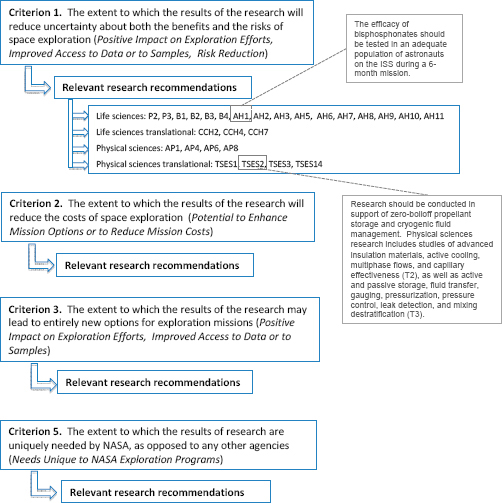
In assembling the recommended integrated portfolio of research, the committee has mapped the chapters’ highest-priority recommendations against eight prioritization criteria that it believes are relevant to broadly informing policy decisions with regard to future space program options (Box 13.2). The recommendations address unanswered questions related to the health and welfare of humans undertaking extended space missions; to technologies needed to support such missions; and to logistical issues potentially affecting the health of space travel-
BOX 13.2
Criteria Used for Categorization of Research Recommendations
In its categorization of research, whether basic, applied, or translational, the committee used the following eight prioritization criteria developed to capture the potential value of the results of research (information, engineered systems, publications, or new concepts).
• Prioritization Criterion 1: The extent to which the results of the research will reduce uncertainty about both the benefits and the risks of space exploration (Positive Impact on Exploration Efforts, Improved Access to Data or to Samples, Risk Reduction)
• Prioritization Criterion 2: The extent to which the results of the research will reduce the costs of space exploration (Potential to Enhance Mission Options or to Reduce Mission Costs)
• Prioritization Criterion 3: The extent to which the results of the research may lead to entirely new options for exploration missions (Positive Impact on Exploration Efforts, Improved Access to Data or to Samples)
• Prioritization Criterion 4: The extent to which the results of the research will provide full or partial answers to grand science challenges that the space environment provides a unique means to address (Relative Impact Within Research Field)
• Prioritization Criterion 5: The extent to which the results of the research are uniquely needed by NASA, as opposed to any other agencies (Needs Unique to NASA Exploration Programs)
• Prioritization Criterion 6: The extent to which the results of the research can be synergistic with other agencies’ needs (Research Programs That Could Be Dual-Use)
• Prioritization Criterion 7: The extent to which the research must use the space environment to achieve useful knowledge (Research Value of Using Reduced-Gravity Environment)
• Prioritization Criterion 8: The extent to which the results of the research could lead to either faster or better solutions to terrestrial problems or to terrestrial economic benefit (Ability to Translate Results to Terrestrial Needs)
The committee did not weight these criteria, a step that would require assumptions about policy decisions not yet made, or subject to change in the future. The criteria and priorities outlined in this chapter, based on clear metrics, provide a basis for a complete, transparent, and robust research program, which the committee believes is required to fully address NASA’s future needs for the life and physical sciences research essential to successful space exploration.
ers, such as adequate nutrition, exposure to radiation, thermoregulation, immune function, stress, and behavioral aspects. The eight criteria listed in Box 13.2 are also offered as a tool that will allow further down-selection to a focused research program that can support any future policy decisions and the associated technology development or knowledge requirements.
Although suggestions are provided below for further prioritization of recommendations already identified as being of the highest priority for specific research areas, none of these high-priority recommendations should be interpreted as being unnecessary. Recognizing that the relative order in which the recommendations will be addressed is likely to depend on the future directions of NASA’s exploration and research programs, the committee underscores that all of the recommendations individually are of high merit and collectively constitute important components of an integrated research portfolio. Adoption of such a portfolio will serve as a foundation for the success of future U.S. space exploration efforts, which will require integration, diverse teams, and a translational scientific approach as discussed in Chapter 12.
In addition to the recommendations forming an integrated research portfolio, most of the discipline panels identified a set of important priorities more extensive than what is summarized in this chapter. Although the subset of recommendations provided here should form the core of a renewed physical and life sciences research program,
rebuilding an integrated program commensurate with the scale of past microgravity work by NASA will require that the larger set of priorities identified by the panels also be considered as priorities for implementation. Some of the key issues to be addressed in the integrated research portfolio are the effects of the space environment on life support components, the management of the risk of infections to humans, behavior having an impact on individual and group functioning, risks and effects of space missions on human physiological systems, fundamental physical challenges, applied fluid physics and fire safety, and finally, translational challenges arising at the interface bridging basic and applied research in both the life and physical sciences.
Chapters 4 through 10 identify research questions important both to successful space exploration and to advances in fundamental physics and biology enabled by access to space. These two, very connected concepts—the science enabled by exploration and the science that enables exploration—speak strongly to the powerful role of science within the human spaceflight endeavor. Each recommendation listed in Table 13.1 is identified by the committee as either enabling or enabled by exploration. (Some of the recommended research fits both categories.) Further, the research recommendations are also dependent on and define the resources needed to accomplish identified goals. Those resources include hardware and flight opportunities together with robust ground-based programs that place highly evolved experiments in the best position for success upon access to spaceflight.
Ultimately, the research recommended in this decadal study must be further prioritized based on future policy developments, a task that the information summarized in Tables 13.2 and 13.3 is meant to facilitate. Examples of how these tables can be used to develop a research portfolio for a mission-focused policy decision and a knowledge-focused policy decision (see Boxes 13.3 and 13.4 below in this chapter) are meant to indicate a possible approach, and not to be prescriptive.
FACILITY AND PLATFORM REQUIREMENTS
Microgravity research facilities can be divided into two classes: space-based and ground-based. The International Space Station (ISS), discussed in Chapters 3 and 11, is the only space-based facility providing a long-term environment for scientists worldwide to carry out microgravity experiments. Short-term space-based facilities are free-flyers and satellites. Ground-based facilities include parabolic flights, drop towers and sounding rockets, bed rest facilities, accelerators, and medical clinics. A research portfolio that draws on communities of investigators using model organisms, robust technology, and all available ground and flight platforms will greatly facilitate this endeavor. Such an approach will allow solidifying critical new discoveries, decrease the time from selection to flight, shorten the discovery confirmation process, and enhance the outcomes of mission-driven life and physical sciences research.
Ground-Based Research Platforms
Ground-based research provides the basis for the design of flight-based research and can, at low cost, address fundamental scientific questions that enable space research and applications by resolving measurement and system feasibility issues. Ground-based fundamental physics research in heat, mass, and momentum transport, materials physics, combustion, and granular materials supports the design of human flight systems and launch capabilities. Space radiation in particular can be simulated well in ground-based laboratories. Accelerators at the NASA Space Radiation Laboratory at Brookhaven National Laboratory produce both high-energy protons and the energetic nuclei of heavier elements, allowing focused, mechanistic studies of the biological consequences for mammalian cells and other relevant model systems (plants, microbes, etc.) of exposure to radiation. Continued availability of space radiation facilities to NASA investigators is critical, as is broad access provided in a timely fashion to meet agency needs.
Aircraft (parabolic zero-gravity flight) and drop towers, which provide a few seconds of microgravity conditions at a time, can enable tests of technical feasibility and also serve as platforms for experiments that can be completed during a single drop or atmospheric flight. For translational programs such as in situ resource utilization (ISRU), analog field tests can be used to demonstrate system interactions, to evaluate repair and maintenance needs,
TABLE 13.1 Summary of Highest-Priority Recommendations Made in Chapters 4 through 10
| Recommendation Identifiera | Recommendation | Enabled by (EB) and/or Enabling (E) Space Exploration |
| Plant and Microbial Biology (Chapter 4) | ||
| P1 | Establish a microbial observatory program on the ISS to conduct long-term, multigenerational studies of microbial population dynamics. | EB |
| P2 | Establish a robust spaceflight program of research analyzing plant and microbial growth and physiological responses to the multiple stimuli encountered in spaceflight environments. | EB |
| P3 | Develop a research program aimed at demonstrating the roles of microbial-plant systems in long-term life support systems. | EB/E |
| Behavior and Mental Health (Chapter 5) | ||
| B1 | Develop sensitive, meaningful, and valid measures of mission-relevant performance for both astronauts and mission control personnel. | E |
| B2 | Conduct integrated translational research in which long-duration missions are simulated specifically for the purpose of studying the interrelationships among individual functioning, cognitive performance, sleep, and group dynamics. | E |
| B3 | Determine the genetic, physiological, and psychological underpinnings of individual differences in resilience to stressors during extended space missions, with development of an individualized medicine approach to sustaining astronauts during such missions. | E |
| B4 | Conduct research to enhance cohesiveness, team performance, and effectiveness of multinational crews, especially under conditions of extreme isolation and autonomy. | EB/E |
| Animal and Human Biology (Chapter 6) | ||
| AH1 | The efficacy of bisphosphonates should be tested in an adequate population of astronauts on the ISS during a 6-month mission. | EB/E |
| AH2 | The preservation/reversibility of bone structure/strength should be evaluated when assessing countermeasures. | EB/E |
| AH3 | Bone loss studies of genetically altered mice exposed to weightlessness are strongly recommended. | EB |
| AH4 | New osteoporosis drugs under clinical development should be tested in animal models of weightlessness. | EB |
| AH5 | Conduct studies to identify underlying mechanisms regulating net skeletal muscle protein balance and protein turnover during states of unloading and recovery. | EB/E |
| AH6 | Conduct studies to develop and test new prototype exercise devices and to optimize physical activity paradigms/prescriptions targeting multisystem countermeasures. | EB/E |
| AH7 | Determine the daily levels and pattern of recruitment of flexor and extensor muscles of the neck, trunk, arms, and legs at 1 g and after being in a novel gravitational environment for up to 6 months. | EB |
| AH8 | Determine the basic mechanisms, adaptations, and clinical significance of changes in regional vascular/interstitial pressures (Starling forces) during long-duration space missions. | EB/E |
| AH9 | Investigate the effects of prolonged periods of microgravity and partial gravity (3/8 or 1/6 g) on the determinants of task-specific, enabling levels of work capacity. | EB/E |
| AH10 | Determine the integrative mechanisms of orthostatic intolerance after restoration of gravitational gradients (both 1 g and 3/8 g). | EB/E |
| Recommendation Identifiera | Recommendation | Enabled by (EB) and/or Enabling (E) Space Exploration |
| AH11 | Collaborative studies among flight medicine and cardiovascular epidemiologists are recommended to determine the best screening strategies to avoid flying astronauts with subclinical coronary heart disease that could become manifest during a long-duration exploration-class mission (3 years). | EB/E |
| AH12 | Determine the amount and site of the deposition of aerosols of different sizes in the lungs of humans and animals in microgravity. | EB/E |
| AH13 | Multiple parameters of T cell activation in cells should be obtained from astronauts before and after re-entry to establish which parameters are altered during flight. | EB |
| AH14 | Both to address the mechanism(s) of the changes in the immune system and to develop measures to limit the changes, data from multiple organ/system-based studies need to be integrated. | EB/E |
| AH15 | Perform mouse studies of immunization and challenge on the ISS, using immune samples acquired both prior to and immediately upon re-entry, to establish the biological relevance of the changes observed in the immune system. Parameters examined need to be aligned with those in humans influenced by flight. | EB |
| AH16 | Studies should be conducted on transmission across generations of structural and functional changes induced by exposure to space during development. Ground-based studies should be conducted to develop specialized habitats to support reproducing and developing rodents in space. | EB |
| Crosscutting Issues For Humans in the Space Environment (Chapter 7) | ||
| CC1 | To ensure the safety of future commercial orbital and exploration crews, quantify post-landing vertigo and orthostatic intolerance in a sufficiently large sample of returning ISS crews, as part of the immediate post-flight medical exam. | EB/E |
| CC2 | Determine whether artificial gravity (AG) is needed as a multisystem countermeasure and whether continuous large-radius AG is needed or intermittent exercise within lower-body negative pressure or short-radius AG is sufficient. Human studies in ground laboratories are essential to establish dose-response relationships, and what gravity level, gradient, rotations per minute, duration, and frequency are adequate. | E |
| CC3 | Conduct studies on humans to determine whether there is an effect of gravity on micronucleation and/or intrapulmonary shunting or whether the unexpectedly low prevalence of decompression sickness on the space shuttle/ISS is due to underreporting. Conduct studies to determine operationally acceptable low suit pressure and hypobaric hypoxia limits. | E |
| CC4 | Determine optimal dietary strategies for crews and food preservation strategies that will maintain bioavailability for 12 or more months. | E |
| CC5 | Initiate a robust food science program focused on preserving nutrient stability for 3 or more years. | E |
| CC6 | Include food and energy intake as an outcome variable in dietary intervention trials in humans. | EB/E |
| CC7 | Conduct longitudinal studies of astronauts for cataract incidence, quality, and pathology related to radiation exposures to understand both cataract risk and radiation-induced late tissue toxicities in humans. | E |
| CC8 | Expand the use of animal studies to assess space radiation risks to humans from cancer, cataracts, cardiovascular disease, neurologic dysfunction, degenerative diseases, and acute toxicities such as fever, nausea, bone marrow suppression, and others. | E |
| Recommendation Identifiera | Recommendation | Enabled by (EB) and/or Enabling (E) Space Exploration |
| CC9 | Continue ground-based cellular studies to develop end points and markers for acute and late radiation toxicities, using radiation facilities that are able to mimic space radiation exposures. | E |
| CC10 | Expand understanding of gender differences in adaptation to the spaceflight environment through flight- and ground-based research, particularly potential differences in bone, muscle, and cardiovascular function and long-term radiation risks. | EB/E |
| CC11 | Investigate the biophysical principles of thermal balance to determine whether microgravity reduces the threshold for thermal intolerance. | EB/E |
| Fundamental Physical Sciences in Space (Chapter 8) | ||
| FP1 | Research on complex fluids and soft matter. Microgravity provides a unique opportunity to study structures and forces important to the properties of these materials without the interference caused by Earth-strength gravity. | EB/E |
| FP2 | Understanding of the fundamental forces and symmetries of nature. High-precision measurements in space can test relativistic gravity, fundamental high-energy physics, and related symmetries in ways that are not practical on Earth. Novel effects predicted by new theoretical approaches provide distinct signatures for precision experimental searches that are often best carried out in space. | EB |
| FP3 | Research related to the physics and applications of quantum gases. The space environment enables many investigations, not feasible on Earth, of the remarkably unusual properties of quantum gases and degenerate Fermi gases. | EB/E |
| FP4 | Investigations of matter near a critical phase transition. Experiments that have already been designed and brought to a level of flight readiness can elucidate how materials behave in the vicinity of thermodynamically determined critical points. These experiments, which require a microgravity environment, will provide insights into new effects observable when such systems are driven away from equilibrium conditions. | EB |
| Applied Physical Sciences in Space (Chapter 9) | ||
| AP1 | Reduced-gravity multiphase flows, cryogenics and heat transfer database and modeling, including phase separation and distribution (i.e., flow regimes), phase-change heat transfer, pressure drop, and multiphase system stability. | EB/E |
| AP2 | Interfacial flows and phenomena (including induced and spontaneous multiphase flows with or without phase change) relevant to storage and handling systems for cryogens and other liquids, life support systems, power generation, thermal control systems, and other important multiphase systems. | EB/E |
| AP3 | Dynamic granular material behavior and subsurface geotechnics to improve predictions and site-specific models of lunar and martian soil behavior. | E |
| AP4 | Development of fundamentals-based strategies and methods for dust mitigation during advanced human and robotic exploration of planetary bodies. | E |
| AP5 | Experiments on the ISS to understand complex fluid physics in microgravity, including fluid behavior of granular materials, colloids and foams, biofluids, non-Newtonian and critical point fluids, etc. | EB |
| AP6 | Fire safety research to improve methods for screening materials for flammability and fire suppression in space environments. | E |
| AP7 | Combustion processes research, including reduced-gravity experiments with longer durations, larger scales, new fuels, and practical aerospace materials relevant to future missions. | EB/E |
| Recommendation Identifiera | Recommendation | Enabled by (EB) and/or Enabling (E) Space Exploration |
| AP8 | Research on numerical simulation of combustion to develop and validate detailed single phase and multiphase combustion models for interpreting and facilitating combustion experiments and tests. | E |
| AP9 | Reduced-gravity research on materials synthesis and processing and control of microstructure and properties, to improve the properties of existing and new materials on the ground. | EB/E |
| AP10 | Development of new and advanced materials that enable operations in harsh space environments and reduce the cost of human space exploration. | E |
| AP11 | Fundamental and applied research to develop technologies that facilitate extraction, synthesis, and processing of minerals, metals, and other materials available on extraterrestrial surfaces. | EB/E |
| Translation to Space Exploration Systems (Chapter 10) | ||
| TSES1 | Conduct research to address issues for active two-phase flow relevant to thermal management. (T1) | E |
| TSES2 | To support zero-boiloff propellant storage and cryogenic fluid management technologies, conduct research on advanced insulation materials research, active cooling, multiphase flows, and capillary effectiveness (T2), as well as active and passive storage, fluid transfer, gauging, pressurization, pressure control, leak detection, and mixing destratification (T3). | E |
| TSES3 | NASA should enhance surface mobility; relevant research includes suited astronaut computational modeling, biomechanics analysis for partial gravity, robot-human testing of advanced spacesuit joints and full body suits, and musculoskeletal modeling and suited range-of-motion studies (T4). plus studies of human-robot interaction (including teleoperations) for the construction and operation of planetary surface habitats (T26). | E |
| TSES4 | NASA should develop and demonstrate technologies to mitigate the effects of dust on extravehicular activity (EVA) systems and suits, life support systems, and surface construction systems. Supporting research includes impact mechanics of particulates, design of outer-layer dust garments, advanced material and design concepts for micrometeoroid mitigation, magnetic repulsive technologies, and the quantification of plasma electrodynamic interactions with EVA systems (T5); dynamics of electrostatic field coupling with dust (T23); and regolith mechanics and gravity-dependent soil models (T27). | E |
| TSES5 | NASA should define requirements for thermal control, micrometeoroid and orbital debris impact and protection, and radiation protection for EVA systems, rovers, and habitats and develop a plan for radiation shelters. (T19) | E |
| TSES6 | NASA should conduct research for the development and demonstration of closed-loop life support systems and supporting technologies. Fundamental research includes heat and mass transfer in porous media under partial gravity and microgravity conditions (T6) and understanding the effect of variable gravity on multiphase flow systems. (T21, T22) | E |
| TSES7 | NASA should develop and demonstrate technologies to support thermoregulation of habitats, rovers, and spacesuits on the lunar surface. (T20) | E |
| TSES8 | NASA should perform critical fire safety research to develop new standards to qualify materials for flight and to improve fire and particle detectors. Supporting research is necessary in materials qualification for ignition, flame spread, and generation of toxic and/or corrosive gases (T7) and in characterizing particle sizes from smoldering and flaming fires under reduced gravity (T8). | E |
| Recommendation Identifiera | Recommendation | Enabled by (EB) and/or Enabling (E) Space Exploration |
| TSES9 | NASA should develop a standard methodology for qualifying fire suppression systems in relevant atmospheres and gravity levels and would benefit from strategies for safe post-fire recovery. Specific research is needed to characterize the effectiveness of fire suppression agents and systems under reduced gravity (T9) and to assess the toxicity of various fire products (T10). | E |
| TSES10 | Research should be conducted to allow regenerative fuel cell technologies to be demonstrated in reduced-gravity environments. (T11) | E |
| TSES11 | To support the development of new energy conversion technologies, research should be done on high-temperature energy conversion cycles, device coupling to essential working fluids, heat rejection systems, materials, etc. (T12). Research is also required on more efficient surface-base primary power and on the technologies to enable solar electric propulsion as an option to transfer large masses of propellant and cargo to distant locations (T18). | E |
| TSES12 | To make fission surface power systems a viable option, research is needed on high-temperature, low-weight materials for power conversion and radiators and on other supporting technologies. (T13) | E |
| TSES13 | Development and demonstration of ascent and descent system technologies are needed, including ascent/descent propulsion technologies, inflatable aerodynamic decelerators, and supersonic retro propulsion systems. The required research includes propellant ignition, flame stability, and active thermal control (T14); lightweight flexible materials (T15); and rocket plume aerothermodynamics and vehicle dynamics and control (T16). | E |
| TSES14 | Research is required to support the development and demonstration of space nuclear propulsion systems, including liquid-metal cooling under reduced gravity, thawing under reduced gravity, and system dynamics. (T17) | E |
| TSES15 | Research is needed to identify and adapt excavation, extraction, preparation, handling, and processing techniques for a lunar water/oxygen extraction system. (T24) | E |
| TSES16 | NASA should establish plans for surface operations, particularly ISRU capability development and surface habitats. Research is needed to characterize resources available at lunar and martian surface destinations (T25) and to define surface habitability systems design requirements (T28). | E |
aIdentifiers correspond to the identifiers given to the highest-priority recommendations listed at the ends of Chapters 4 through 10, which provide context and clarifying discussion.
TABLE 13.2 Highest-Priority Recommendations That Provide High Support in Meeting Each of Eight Specific Prioritization Criteria
| <-------------------------------------------Prioritization Criteria-------------------------------------------> | |||||||||
| (1) Positive Impact on Exploration Efforts, Improved Access to Data or to Samples, Risk Reduction | (2) Potential to Enhance Mission Options or to Reduce Mission Costs | (3) Positive Impact on Exploration Efforts, Improved Access to Data or to Samples | (4) Relative Impact Within Research Field | (5) Needs Unique to NASA Exploration Programs | (6) Research Programs That Could Be Dual-Use | (7) Research Value of Using Reduced-Gravity Environment | (8) Ability to Translate Results to Terrestrial Needs | ||
| Life Sciences | P2, P3, B1, B2, B3, B4, AH1, AH2, AH3, AH5, AH6, AH7, AH8, AH9, AH10, AH11 | P3, B1, B2, B3, B4, AH6, AH9, AH10, AH11 | P3, B4, AH1, AH2, AH3, AH5, AH6, AH7, AH8, AH9, AH10, AH11 | P1, P2, B3, B4, AH9, AH10, AH11, AH16 | P1, P2, P3, AH1, AH2, AH3, AH4, AH5, AH6, AH7, AH8, AH9, AH10, AH11, AH16 | B1, B2, B3, B4, AH1, AH2, AH3, AH4, AH5, AH6, AH7, AH9, AH10 | P1, B1, B4, AH12, AH16 | B1, B2, B3, B4, AH1, AH2, AH3, AH4, AH5, AH6, AH7 | |
| Translational Life Sciences | CCH2, CCH4, CCH7 | CCH2, CCH4, CCH6, CCH7 | CCH2, CCH4, CCH6, CCH7, CCH8 | CCH2, CCH6 | CCH1, CCH2, CHH3, CCH6, CCH7, CCH8 | CCH1, CHH2, CHH3, CCH7, CCH11 | |||
| Physical Sciences | AP1, AP4, AP6, AP8, AP11 | AP1, AP2, AP10, AP11 | AP1, AP2, AP3, AP10, AP11 | FP1, FP2, FP3, AP5, AP7, AP8, AP9 | AP1, AP2, AP3, AP4, AP6, AP11 | AP7, AP8, AP9, AP10 | FP1, FP2, FP3, FP4, AP1, AP2, AP5, AP6, AP7, AP9 | AP1, AP2, AP7, AP8, AP9 | |
| Translational Physical Sciences | TSES1, TSES2, TSES3, TSES14 | TSES1, TSES3, TSES5, TSES10 | TSES14 | TSES2, TSES3, TSES4, TSES5, TSES6, TSES7, TSES12, TSES13, TSES14, TSES16 | TSES10, TSES11, TSES12 | TSES1, TSES2, TSES3, TSES4, TSES5, TSES12, TSES13, TSES14, TSES15, TSES16 | TSES10 | ||
NOTE: Identifiers are as listed in Table 13.1 and correspond with the recommendations listed there and also presented with clarifying discussion in Chapters 4 through 10.
TABLE 13.3 Level of Support Provided by High-Priority Recommendations for Each of Eight Prioritization Criteria
| Recommendation Identifiera Within Suggested Program Elements | <-------------------------------------------------------------------------Prioritization Criteria-----------------------------------------------------------> | ||||||||
| (1) Positive Impact on Exploration Efforts, Improved Access to Data or to Samples, Risk Reduction | (2) Potential to Enhance Mission Options or to Reduce Mission Costs | (3) Positive Impact on Exploration Efforts, Improved Access to Data or to Samples | (4) Relative Impact Within Research Field | (5) Needs Unique to NASA Exploration Programs | (6) Research Programs That Could Be Dual-Use | (7) Research Value of Using Reduced-Gravity Environment | (8) Ability to Translate Results to Terrestrial Needs | ||
| Plant and Microbial Biology Research | |||||||||
| P1 | Medium | Low | Low | High | High | Medium | High | Medium | |
| P2 | High | Medium | Medium | High | High | Medium | Medium | Medium | |
| P3 | High | High | High | Low | High | Medium | Medium | Medium | |
| Human Behavior and Mental Health Research | |||||||||
| B1 | High | High | Low | Medium | Low | High | High | High | |
| B2 | High | High | Low | Medium | Low | High | Low | High | |
| B3 | High | High | Medium | High | Low | High | Low | High | |
| B4 | High | High | High | High | Medium | High | High | High | |
| Animal and Human Biological Research | |||||||||
| AH1 | High | Medium | High | Medium | High | High | Medium | High | |
| AH2 | High | Medium | High | Medium | High | High | Medium | High | |
| AH3 | High | Medium | High | Medium | High | High | Medium | High | |
| AH4 | Medium | Medium | Medium | Medium | High | High | Medium | High | |
| AH5 | High | Medium | High | Medium | High | High | Medium | High | |
| AH6 | High | High | High | Medium | High | High | Medium | High | |
| AH7 | High | Medium | High | Medium | High | High | Medium | High | |
| AH8 | High | Medium | High | Medium | High | Medium | Medium | Medium | |
| AH9 | High | High | High | High | High | High | Medium | Medium | |
| AH10 | High | High | High | High | High | High | Medium | Medium | |
| AH11 | High | High | High | High | High | Medium | Medium | Medium | |
| AH12 | Medium | Medium | Medium | Medium | Medium | Low | High | Medium | |
| AH13 | Medium | Low | Medium | Medium | Medium | Medium | Medium | Medium | |
| AH14 | Medium | Low | Medium | Medium | Medium | Medium | Medium | Medium | |
| AH15 | Medium/Low | Low | Medium | Medium | Medium | Medium | Medium | Medium | |
| AH16 | Medium/Low | Medium/Low | Medium/Low | High | High | Low | High | Medium | |
| Recommendation Identifiera Within Suggested Program Elements | <-------------------------------------------------------------------------Prioritization Criteria-----------------------------------------------------------> | ||||||||
| (1) Positive Impact on Exploration Efforts, Improved Access to Data or to Samples, Risk Reduction | (2) Potential to Enhance Mission Options or to Reduce Mission Costs | (3) Positive Impact on Exploration Efforts, Improved Access to Data or to Samples | (4) Relative Impact Within Research Field | (5) Needs Unique to NASA Exploration Programs | (6) Research Programs That Could Be Dual-Use | (7) Research Value of Using Reduced-Gravity Environment | (8) Ability to Translate Results to Terrestrial Needs | ||
| Crosscutting Research for the Human System | |||||||||
| CC1 | Medium | Low | Low | Low | High | Low | High | Medium | |
| CC2 | High | High | High | High | High | Low | High | Low | |
| CC3 | Medium | Medium | Medium | Low | High | Low | High | Low | |
| CC4 | High | High | High | Medium | Medium | Medium | Medium | Medium | |
| CC5 | Medium | Medium | Medium | Medium | Medium | Medium | Medium | Medium | |
| CC6 | Medium | High | High | High | High | Medium | Low | Medium | |
| CC7 | High | High | High | Low | High | Low | High | Low | |
| CC8 | Medium | Medium | High | Low | High | Low | Low | Low | |
| CC9 | Medium | Low | Low | Low | Medium | Low | Low | Low | |
| CC10 | Medium | Medium/Low | Medium | Low | Medium | Medium | Low | Medium | |
| CC11 | Medium | Medium/Low | Medium | Low | Medium | Medium/Low | Low/Medium | Medium | |
| Fundamental Physical Sciences Research | |||||||||
| FP1 | Low | Low | Medium | High | Low | Medium | High | Medium | |
| FP2 | Low | Low | Low | High | Low | Medium | High | Medium | |
| FP3 | Low | Low | Medium | High | Low | Medium | High | Medium | |
| FP4 | Low | Low | Low | Medium | Low | Medium | High | Medium | |
| Applied Physical Sciences Research | |||||||||
| AP1 | High | High | High | Medium | High | Low | High | High | |
| AP2 | Medium | High | High | Medium | High | Medium | High | High | |
| AP3 | Medium | Medium | High | Low | High | N/A | Low | low | |
| AP4 | High | Medium | Medium | Low | High | N/A | Medium | Low | |
| AP5 | Low | low | Medium | High | Low | Medium | High | Medium | |
| AP6 | High | Medium | Low | Low | High | Low | High | Medium | |
| AP7 | Medium | N/A | N/A | High | Medium | High | High | High | |
| AP8 | High | Medium | Low | High | Medium | High | N/A | High | |
| AP9 | N/A | N/A | Low | High | Low | High | High | High | |
| AP10 | Low | High | High | Medium | Medium | High | Low | Medium | |
| AP11 | High | High | High | Low | High | N/A | Medium | N/A | |
| Translation to Space Exploration Systems Research | ||||||||
| TSES1 | High | High | Low | Low | Medium | Medium | High | Low |
| TSES2 | High | High | Medium | Low | High | Medium | High | Medium |
| TSES3 | High | High | High | Low | High | Medium | High | Medium |
| TSES4 | Medium | Medium | High | Low | High | Low | High | Lou |
| TSES5 | Medium | Medium | High | Low | High | Low | Medium | Lou |
| TSES6 | Medium | Medium | Medium | Low | High | Low | Medium | Lou |
| TSES7 | Medium | Medium | High | Low | High | Medium | Medium | Medium |
| TSES8 | Lou | Low | Low | Low | Medium | Medium | High | Medium |
| TSES9 | Lou | Low | Low | Low | Medium | Medium | High | Medium |
| TSES10 | Medium | High | Low | Low | Medium | High | Medium | Medium |
| TSES11 | Medium | Medium | Low | Low | Medium | High | Lou | Medium |
| TSES12 | Medium | Medium | Low | Low | High | High | High | Medium |
| TSES13 | Medium | Medium | Low | Low | High | Medium | High | Medium |
| TSES14 | High | Medium | High | Medium | High | Medium | High | Medium |
| TSES15 | Medium | Medium | Low | Low | Medium | Low | High | Lou |
| TSES16 | Medium | Medium | Low | Low | High | Low | High | Low |
aIdentifiers are listed in Table 13.1 and correspond with the recommendations listed there and also presented the ends of Chapters 4 through 10, which provide context and clarifying discussion.
and to demonstrate long-lived operations. Terrestrial analog field tests are essential to demonstrate the long-term reliability of candidate systems and to develop operational protocols.
Ground-based research is also important for the development of exercise countermeasures, including bed rest studies. Findings from animal models have generated fundamental knowledge concerning the effects of microgravity on muscle and bone physiology. Further, new avenues of animal research can unfold in the areas of epigenetics of gene expression and protein turnover in response to unloading stimuli. Such ground-based studies will benefit from shared specimens and data from space experiments using new technological approaches such as transcript profiling.
Analog environments (e.g., the ISS as an analog for remote and low-gravity planetary surfaces; polar and undersea research facilities) and rigorously designed experimental simulations (e.g., long-duration chamber studies) that faithfully mirror actual mission parameters (e.g., isolation, confinement, workload, long and uncertain time duration, communication delays, disruption of diurnal sleep-wake cycles) can help to support a balanced research portfolio. Analog opportunities offered through the ISS are discussed in Chapter 11.
Uncrewed flight opportunities on free-flyers provide a venue to conduct short-duration experiments, ideally with an animal centrifuge available to provide proper 1-g controls for animal specimens and to address the impact of microgravity on biological systems. Free-flyers are well suited for experiments involving virulent organisms or toxic, radioactive, or otherwise dangerous materials that pose a risk to humans. Suborbital platforms and parabolic flights are key in providing a short-duration microgravity environment for biological and physical sciences studies of phenomena and behaviors that may show significant effects during the transitions between 1 g and microgravity that will occur in planetary arrivals and departures.
Free-flying spacecraft can also be used for fundamental physics experiments that require an extremely low-noise and low-stray-acceleration environment or a specific orbit. Future possibilities include a rotating free-flyer (with or without a tether), perhaps with an emptied cargo vessel for long-duration experiments. Before ISS cargo vessels are destroyed, they can potentially be used for relatively large-scale microgravity experiments, such as fire safety tests. The absence of g-jitter also makes them an ideal platform for crystal growth experiments that are particularly sensitive to vibrations.
Planetary or Lunar Surfaces as Platforms
Many biological processes are compromised in microgravity, and the gravity threshold for restoring proper function is unknown. Availability of lunar bases for carrying out biological experimentation and for testing bioregenerative life support systems would allow assessment of whether biological functions will be normal (similar to those in 1 g) in partial gravity. Lunar or martian bases would also be useful for conducting planetary research described in other studies,1,2 such as fundamental seismographic studies, yielding insight into planets’ interiors and their geological history, as well as allowing studies of their regolith compositions, magnetic fields, and atmospheric phenomena (in the case of Mars) that are relevant to human exploration. In the longer term, such bases might also be used as platforms for large telescopes and provide a stable, long-term laboratory setting for reduced-gravity experimentation. Robotic exploration of the Moon could verify conditions near the lunar poles, develop resource maps, and demonstrate ISRU system end-to-end operations in the lunar environment. Robotic missions may be of particular importance for near-term exploration paths not directly focused on lunar exploration that could use landers or compact rovers. Lunar assets, such as thermal wadis comprising regolith-derived thermal mass materials, could serve as platforms that enable rovers and other exploration hardware to survive periods of cold and darkness.
Space Platforms for Research Beyond 2020
Although most of the recommendations in this report address the current decade, the committee recognizes the long time constant inherent in the implementation of some of the recommendations and thus the importance of planning for the period 2020-2029. The efforts for that decade include extension of research findings from the 2010-2019 decade and completion of remaining gaps. Although specific gaps are challenging to predict, it can be expected that some projects started in the 2010-2019 decade will not reach maturity in that period. Likely to be available in 2020-2029, for example, are new transport vehicles capable of carrying astronauts well beyond low Earth orbit—emphasizing the need for research leading to compact low-power yet highly effective devices that will provide countermeasures for changes in multiple human systems during long voyages in microgravity. Further, the role of partial gravity in preventing deterioration in important physiological systems will have to be clearly understood and countermeasures developed, if necessary, to mitigate those effects. NASA should therefore consider a flexible infrastructure of experimental facilities that could be upgraded to novel exploration systems.
A lunar outpost established as a key national scientific resource could prove to be an important research platform for ongoing studies in partial gravity, providing, among other benefits, sustainable research laboratories for biological research on model systems addressing key scientific areas related to microgravity.
HIGHEST-PRIORITY RESEARCH AREAS AND OBJECTIVES
Table 13.1 summarizes, by discipline, the research elements selected by the panels, in close coordination with the committee, as having the highest priority, and which this survey recommends for inclusion in NASA’s new portfolio of biological and physical sciences research. The committee concluded that the elements listed in Table 13.1 are important in the creation of a compelling program of life and physical sciences research that can address both fundamental scientific goals and exploration technology needs. These research elements are not described in detail here; instead, unique identifiers listed in Table 13.1 allow locating related full descriptions in Chapters 4 through 10 (where each identifier is listed after a recommendation selected as having highest priority). These identifiers are also shown in Tables 13.2 and 13.3, which map the research elements to the eight prioritization criteria used by the committee. The committee believes that these recommended research areas are the most critical to advancing the national space research program, and that these elements collectively constitute the core of an integrated research portfolio in microgravity. It should be kept in mind that this list of recommendations represents the distillation of priorities from an exceptionally large number of disciplines that have in the past typically been treated in separate, more narrowly focused studies. Most of the panel chapters contain additional recommended research—important to a program in that discipline—that was not selected for the integrated portfolio.
RESEARCH PORTFOLIO SELECTION OPTIONS
In Table 13.2, the committee maps the highest-priority recommendations (each indicated by the unique identifier listed in Table 13.1) from Chapters 4 through 10 to the eight prioritization criteria defined in Box 13.2. The research areas listed under a given criterion in Table 13.2 are those categorized in Table 13.3 as providing “high” support for that particular criterion. This mapping is intended to help provide a basis for policy-related ordering of an integrated research portfolio, depending on future policy decisions.
As examples of how the information in Table 13.2 might be used, consider two bounding policy options that could drive a research portfolio. The first is a decision to send humans to Mars (Box 13.3). Clearly Prioritization Criteria 1 and 2 would be the most important for prioritizing the research to support this policy, and supporting the associated recommended research areas in an integrated program with clear translational end points would be essential. These translational end points must enable realization of specific design goals that would be unachievable without successful research. In this first example Prioritization Criteria 3 and 5 would also have to be taken into consideration when selecting the science necessary to achieve this policy goal.
The second sample policy option is a decision to hold off on advanced human missions until a new base of capability is developed and to focus instead in the near term on advancing leading-edge science (Box 13.4) and
BOX 13.3
Sample Bounding Policy Option One
Goal: Send Humans to Mars
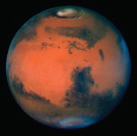
Prioritization Criteria 1 and 2 will be the most important functions in prioritizing research to support the goal of sending humans to Mars, and a way must be found to support the recommendations associated with these priorities in an integrated program with clear translational end points. Prioritization Criteria 3 and 5 will also have to be taken into consideration to achieve the science necessary to achieve this policy goal.
BOX 13.4
Sample Bounding Policy Option Two
Goal: Develop New Capabilities by Advancing Leading-Edge Science
The goal of developing new capabilities by advancing leading-edge science represents a decision to postpone an advanced human mission until a new base of capability is developed with which to plan. The focus in the near term will be on advancing leading-edge science and the value of space assets to terrestrial needs. In this case, Prioritization Criteria 4, 5, and 8 will have primary importance, and Prioritization Criteria 6 and 7 may alsobe of importance in building the integrated research portfolio that best supports this policy goal.
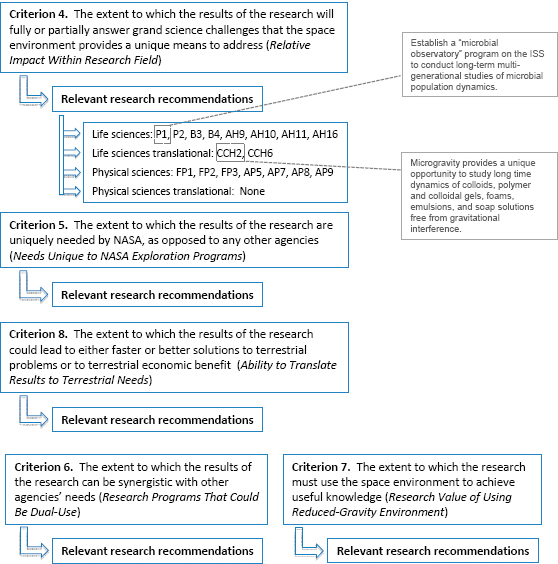
the value of our space assets to terrestrial needs. In this case, Prioritization Criteria 4, 5, and 8 would have primary importance, and Prioritization Criteria 6 and 7 might also be of importance in building the integrated research portfolio that best supports this policy goal.
In addition to providing a basis for prioritization, Table 13.2 also illustrates the interdependence among the different individual research recommendations, none of which, as pointed out above, should be seen in isolation. Although an exact order of dependency among the individual recommendations is not specified, their grouping clearly indicates their interdependence and underscores the importance of an integrated approach.
TIMELINE FOR THE CONDUCT OF RESEARCH
The committee was tasked with developing a timeline for the conduct of its recommended research, and except where indicated otherwise the panel chapters contain rough estimates—based on assumptions of robust programmatic support and reasonable access to flight opportunities—of time frames for the individual research areas. The committee identified priority areas and questions that need to be addressed during the present decade (2010-2020), as well as more overarching areas going beyond 2020. It refrained from suggesting a detailed timeline for the overall research portfolio, because this will depend to a major extent on future policy and funding decisions. It is the committee’s belief and hope that the high-priority recommended research and its categorization according to eight prioritization criteria will serve to inform policymakers about knowledge needed irrespective of decisions that might favor long-term human space exploration, planetary surface habitation and presence, or more basic and fundamental research. In the committee’s view, all of these endeavors will require a science portfolio integrated so as to enable NASA to derive optimal benefits and science return from its investments in research, as well as from support provided by other government agencies and/or commercial sources.
An integrated research portfolio can also enable the identification and execution of radical new options to reduce cost and risk for the U.S. space program. Specifically, new options that offer significant reductions in cost and/or risk can best be conceived and developed in the context of integrated solutions to science and engineering challenges and inclusion of translational end points.
Many of the thematic chapters include information on the current status of research and what would be reasonable expectations with regard to accomplishments for the decade 2010-2019 versus 2020 and beyond. Much of this estimation is based on the time required to conduct experiments and on the near-term expected availability of platforms for conducting research. For a detailed summary of the rationale for and the respective targets of research for the decades 2010-2019 and 2020-2029, the reader is referred to each of the thematic chapters (4 through 10). In addition, the mapping of research areas to prioritization criteria presented in Table 13.2 offers an approach to considering timelines for research, as does Table 13.3, in which the disciplinary panels have further classified each high-priority recommendation as being of high, medium, or low applicability with respect to each of the eight prioritization criteria.
The committee chose this tabular presentation to avoid redundancy and to provide a ready means for NASA to identify specific components of an integrated research portfolio judged most likely to contribute to capability and flexibility for achieving space exploration program goals, as represented by the eight prioritization criteria shown. Thus, for example, in considering a martian exploration mission (see Box 13.3), each recommendation can be seen in Table 13.2 as ranked at a finer granularity with regard to its importance in addressing that specific goal. If NASA were to decide to increase synergism with other agencies in building its research program, the recommendations most relevant to addressing this priority would be found under Prioritization Criteria 6 in Table 13.2, and the relative importance of all identified high-priority recommendations for this specific action item would be as indicated in Table 13.3.
The committee anticipates that the categorization offered in Table 13.3 will guide NASA’s decision making on timeline and urgency issues. The committee realizes that a careful assessment of timeline goals will require a comprehensive and broad overview of space-relevant research and will require a strong life and physical sciences research organization in the agency. Hence, the programmatic focus and recommendations summarized in Chapter 12 will be a key mechanism to ensure that specific, thematic committee recommendations can be adapted to a flexible timeline responsive to NASA’s overarching goals.
IMPACT OF SCIENCE ON DEFINING U.S. SPACE EXPLORATION POLICY
Implicit in this report are integrative visions of the science advances necessary to underpin and enable major new components, revolutionary systems, and bold exploration architectures for human space exploration. Essential to achieving affordable, safe, and productive space exploration systems, such advances are central to the U.S. space exploration policy and agenda. Their system-level aspects are fully addressed in the technical literature cited in Chapters 4 through 10. The panels drew on their collective knowledge of science and technology and both the references and their associated issues to define the scientific barriers, unit-processes, and physical challenges worthy of inclusion in the recommendations in this report.
Impediments to revitalizing the U.S. space exploration agenda include costs, past inability to accurately predict costs and schedule, and uncertainties about mission and crew risk. The technical communities recognize their obligations to deal with those impediments. Indeed, typical flow-downs from science as discussed in this report include improvements in function and efficiency, subsequent reductions in mass, and direct or implied reductions in cost. The starting point for much of the life sciences research is reducing mission and crew risk, an undertaking for which new understanding is required to make safe human passage possible to, for example, Mars. Better scientific understanding will also greatly improve the fidelity of overall cost and schedule predictions associated with development of new systems.
A few examples from preceding chapters of this report illustrate these points. One revolutionary and mission architecture-changing system involves on-orbit depots for cryogenic rocket fuels. The scientific foundations required to make this Apollo-era notion a reality are specified in the report. For some lunar missions, such a depot could produce the major cost savings of an Ares 1 launch system replacing the Ares 5. The highly publicized collection or production of large amounts of water from the Moon or Mars will require scientific understanding of how to retrieve and refine water-bearing materials from the extremely cold, rugged regions on those bodies. Once produced, that water could be transported to surface bases or to orbiting facilities for conversion into liquid oxygen and hydrogen by innovative solar-powered cryogenic processing systems and then stored in the on-orbit depots. All of these hardware and systems implementations require or will be enhanced by new scientific understanding. Such advances point the way to a new era in defining space exploration.
Part of gaining support for crewed Mars missions is being able to address with confidence the questions of protecting the health, safety, and job performance capabilities of crew members during the months-long transits to and from Mars. The life sciences research portfolio recommended in this report constitutes an integrated complex of scientific pursuits pertaining to multiple different biological systems and aimed at reducing to a minimum the health hazards of space explorers, thereby providing quantitative answers to the questions associated with visiting Mars. In other words, sustained research successes are required before humans can safely go to Mars and return.
Thus, this report is much more than a catalog of research recommendations; it identifies the scientific resources and provides tools to help in defining and developing with greater confidence the future of U.S. space exploration and scientific discovery.
1. National Research Council. 2003. New Frontiers in the Solar System: An Integrated Exploration Strategy. The National Academies Press, Washington, D.C.
2. National Research Council. 2007. The Scientific Context for Exploration of the Moon. The National Academies Press, Washington, D.C.
This page intentionally left blank.


