
Enabling Discovery in Solar and Space Physics
EARTH’S DYNAMIC SPACE ENVIRONMENT
We live on a planet whose orbit traverses the tenuous outer atmosphere of a variable magnetic star, the Sun. This stellar atmosphere is a rapidly flowing plasma—the solar wind—that envelops Earth as it rushes outward, creating a cavity in the galaxy that extends to some 140 astronomical units (AU).1 There, the inward pressure from the interstellar medium balances the outward pressure of the solar plasma, forming the heliopause, the boundary of our home in the universe. Earth and the other planets of our solar system are embedded deep in this extended stellar atmosphere, or heliosphere (Figure 1.1), the domain of solar and space physics.
The energy Earth receives from the Sun determines Earth’s environment. This energy, primarily visible light, but also including ultraviolet and X-ray radiation, establishes the temperature, structure, and composition of Earth’s uppermost atmosphere and ionosphere. The Sun also has a corpuscular output—the magnetized solar wind and energetic particles—that expands throughout interplanetary space, interacting with Earth and affecting humans in numerous ways (see Chapter 3). Because these latter sources of the Sun’s power are highly variable in location, intensity, and time, Earth’s near-space environment is profoundly dynamic and hosts numerous phenomena that present hazards to spacecraft, humans in space, and society’s ground-based technological infrastructure.
Solar and space physics research seeks to understand the history, evolution, and detailed workings of the Sun and to characterize and understand Earth’s space environment, including its upper atmosphere, and its response to the periodic, but highly variable, forcing by the Sun. The Earth system and its parent star also provide an accessible cosmic laboratory for studies that can lead to understanding the environs of other planets, stars, and cosmic systems. The research elements of solar and space physics span solar electromagnetic and radiative processes, the generation of solar magnetic fields, the solar wind and interplanetary magnetic fields, and their evolution, development, and interaction with planets and moons that
________________________
1 An astronomical unit (AU) is the mean distance between Earth and the Sun; it is approximately 150 million kilometers (km). For comparison, the distance from the Sun to the Pluto-Charon system is currently approximately 32 AU.
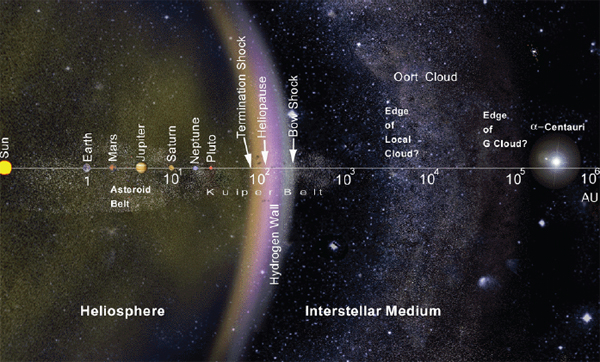
FIGURE 1.1 The solar system and its nearby galactic neighborhood are illustrated here on a logarithmic scale extending from <1 to 1 million AU. The Sun and its planets are shielded by a bubble of solar wind—the heliosphere—and the boundary between the solar wind and interstellar plasma is called the heliopause. Beyond this bubble is a largely unknown region—interstellar space. NOTE: The G cloud is a cloud of interstellar gas near the Local Interstellar Cloud in which the solar system is embedded. SOURCE: Image and text adapted from NASA and available at http://interstellar.jpl.nasa.gov/interstellar/probe/introduction/scale.html. Also see, “Living in the Atmosphere of the Sun,” at http://sunearthday.nasa.gov/2007/locations/ttt_heliosphere_57.php.
have their own magnetospheres2 and atmospheres. These magnetosphere-atmosphere systems are often strongly coupled, and they mediate the solar wind interaction with the planet (or moon) in ways unique to each body. Moreover, as human exploration extends farther into space—by means of both robotic probes and human spaceflight—and as society’s technological infrastructure is linked increasingly to space-based assets and impacted by the dynamics of the space environment, the need to characterize, understand, and predict the dynamics of our environment in space becomes ever more pressing.
As a discipline, modern solar and space physics—now also referred to as heliophysics—can trace its origins back to the evening of January 31, 1958, when a Juno (Jupiter-C) rocket blasted into space, lofting the first U.S. artificial Earth satellite into orbit. This spacecraft, dubbed Explorer I, joined Sputnik II, a satellite that had been launched 2 months earlier by the Soviet Union. The Explorer I mission was truly groundbreaking because it carried a small scientific payload, prepared by a team of university researchers led by James A. Van Allen, that would make the first revolutionary discovery of the space age, namely, that
________________________
2 Earth’s magnetosphere is formed by the interaction of the solar wind and our planet’s intrinsic magnetic field.
Earth is enshrouded in what later became known as the Van Allen belts, toroidal bands of extraordinarily high-energy, high-intensity radiation.3
The scope of studies in solar and space physics has since expanded to encompass the study of Earth’s space environment, the solar wind and its interactions with other planets, and the Sun’s role in creating and controlling the electrically charged plasma that fills the heliosphere. Progress in the field has critical impacts on society because we are increasingly dependent on a growing array of technologically advanced, but vulnerable, electronic devices in space. Because the Sun’s output is highly variable in location, intensity, and time, Earth’s near-space environment is a profoundly dynamic one and hosts numerous phenomena that present hazards to spacecraft, humans in space, and ground-based infrastructure on Earth (see Box 1.1, “Severe Space Weather Events—Understanding Societal and Economic Impacts”).
Beyond understanding our local environment, space physics strives to understand how particles are accelerated to very high energies and how such particles subsequently move in magnetic fields around distant planets, distant stars, and—by extension—distant galaxies. Space physics provides the fundamental knowledge to prescribe how energy is transported and converted to form the remarkable tapestry of cosmic objects that have been observed. Studying the Earth system and its parent star provides the cosmic laboratory and the prototype that form the basis for understanding the environs of virtually all other planets, stars, and entire cosmic systems.
The programs, initiatives, and investments in the field that are outlined in this report are designed to make fundamental advances in current scientific knowledge of the governing processes of the space environment—from the interior of the Sun, to the atmosphere of Earth, to the local interstellar medium. These advances also enable predictive capabilities to be improved to the point that highly reliable forecasts can be made regarding the state of the space environment, particularly the disruptive space weather disturbances that threaten society and the economy, and their important technical infrastructure. The wealth of scientific insights that this recommended program will enable will also provide direct benefits to other scientific fields, including astrophysics, planetary science, and laboratory plasma physics. Many of the proposed activities will involve international collaboration and cooperation, thereby leveraging U.S. investments while simultaneously sustaining a U.S. leadership role in this science. Quite importantly, action on this decadal survey’s recommendations will attract into the field the new talent that is required to ensure the continued vitality of solar and space physics.
FRAMING THE 2013-2022 DECADAL SURVEY
In this report, the Committee on a Decadal Strategy for Solar and Space Physics (Heliophysics) provides specific recommendations to its sponsors, NASA and the National Science Foundation (NSF), but its guidance is relevant to other federal departments and agencies, especially the National Oceanic and Atmospheric Administration (NOAA), the Department of Defense (DOD), the U.S. Geological Survey, and the Federal Emergency Management Agency. In developing its recommendations, the committee considered programs that vary widely in scale, ranging from what NASA’s Heliophysics Division denotes as a flagship-class mission—one costing over $1 billion—to NSF grants programs that are smaller by some four orders of magnitude. In addition, the survey committee gave considerable attention to the cadence at which recommended programmatic elements should be repeated. For example, large spaceflight missions at NASA may be so complex and place such high demands on the community that they can be implemented only once or twice per decade. By contrast, smaller missions in the Explorer-class of spacecraft, or NSF ground-based facilities, can be developed and brought to scientific fruition on timescales of 3 to 5 years.
________________________
3 Explorer II failed to reach orbit; data from Explorer III and Explorer I together provided the information that is credited with the discovery of the radiation belts.
BOX 1.1 SEVERE SPACE WEATHER EVENTS—UNDERSTANDING SOCIETAL AND ECONOMIC IMPACTS
The societal impact of space weather was dramatically demonstrated approximately a century before the launch of Explorer 1 when awe-inspiring auroral displays were seen over nearly the entire world on the night of August 28-29, 1859. In New York City, thousands watched “the heavens … arrayed in a drapery more gorgeous than they have been for years.” The aurora witnessed that Sunday night, the New York Times told its readers, “will be referred to hereafter among the events which occur but once or twice in a lifetime.”1 Even more spectacular displays occurred on September 2, 1859. For residents of Havana, Cuba, the sky that night “appeared stained with blood and in a state of general conflagration.”2 Earth had experienced a one-two punch from the Sun, the likes of which have not been recorded since. From August 28 through September 4, 1859, auroral displays of remarkable brilliance, color, and duration were observed around the world, as far south as Central America in the Northern Hemisphere and as far north as Santiago, Chile, in the Southern Hemisphere.
Even after daybreak, when the auroras were no longer visible, disturbances in Earth’s magnetic field were so powerful that ground-level magnetic field monitoring sensors were driven off scale. Telegraph networks in many locations experienced major disruptions and outages. In several regions, operators disconnected their systems from the batteries and sent messages using only the current induced by the aurora. In fact, telegraphs were completely unusable for nearly 8 hours in most places around the world.
Humanity was just beginning to develop a dependence on high-tech systems in 1859. The telegraph was the technological wonder of its day. There were no high-power electrical lines crisscrossing the continents or sensitive satellites orbiting Earth, both of which are vulnerable to events of the sort that disrupted telegraph systems in the 19th century. There certainly was not yet a dependence on instantaneous communication and satellite remote imaging of Earth’s surface. Now, in the early part of the 21st century, as the Sun is ramping up its activity in solar cycle 24, decision makers are asking: Has there been adequate preparation for severe space weather events, and what might be the consequences of worst-case events like that of the storm of 1859?3
To evaluate the nation’s capabilities for forecasting and monitoring storms in space and for coping with their effects on Earth, the Space Studies Board of the National Research Council invited representatives of industry, academia, and the government to participate in a workshop in 2008 on the impacts of severe space weather on society and the economy. The workshop participants explored a number of issues, including the following:4
• The electric power, spacecraft, aviation, and Global Positioning System (GPS)-based industries are the main industries whose operations can be adversely affected by severe space weather. With increasing aware-
And data analysis, theory, and modeling programs for both NASA and NSF can make great strides even more quickly on timescales as short as 1 to 3 years.
Currently, the globally connected Sun-Earth system is studied by a multi-element system of solar and space physics observatories—the Heliophysics Systems Observatory (HSO; see Figure 1.2)—that are supported by NASA and NSF. Augmented by a constellation of missions operated by NOAA and DOD and by the implementation of the components recommended in this report, the system has remarkable potential to support simultaneous observing from distributed, strategically chosen vantage points. However, despite its evident strengths, much of the HSO’s collective capabilities are somewhat fragile due to the aging of the current satellite feet and ground-based facilities. Long-term, continuous observations of key parts of
ness and understanding of space weather’s effects on vulnerable technological systems, these industries have adopted procedures and technologies designed to mitigate the impacts of space weather on their operations and customers.
• Relying on space weather forecasts and real-time data, power system operators modify the way the grid is operated during severe geomagnetic disturbances to protect against outages and equipment damage.
• Spacecraft manufacturers draw on current scientific knowledge of the space environment in an attempt to cost-effectively design and build commercial spacecraft that can operate 24/7 under severe space weather conditions. Spacecraft operators factor space weather conditions into decision making about whether to launch or to perform certain on-orbit operations.
• New signals and codes are being implemented in GPS satellites that are expected to help mitigate the effects of ionospheric disturbances on space-based navigation. Nonetheless, the Federal Aviation Administration will maintain a backup navigation system that is independent of the GPS.
• To preserve reliable communications during intense solar energetic particle events, airline companies re-route, at considerable expense, flights scheduled for polar routes. A secondary reason flights are diverted is to reduce the cumulative dose of radiation to which passengers and, especially crew, are exposed.
• Such measures notwithstanding, the potential for the space-weather-related disruption of critical technologies remains. Of particular concern is the vulnerability of the electric power grid on which the U.S. national infrastructure depends and which, despite the mitigation procedures adopted since 1989, could, in the event of an unusually strong geomagnetic storm, experience both widespread power outages and permanent equipment damage.
____________
1 New York Times, “The Aurora Borealis; The Brilliant Display on Sunday Night; Phenomena Connected with the Event; Mr. Meriam’s Observations on the Aurora—E.M. Picks Up a Piece of the Aural Light; The Aurora as Seen Elsewhere—Remarkable Electrical Effects,” August 30, 1859.
2 M.A. Shea and D.F. Smart, Compendium of the eight articles on the “Carrington Event” attributed to or written by Elias Loomis in the American Journal of Science, 1859-1861, Advances in Space Research 38:313-385, 2006, p. 326.
3 For example, the Federal Emergency Management Agency held an exercise at the NOAA Space Weather Prediction Center in Boulder, Colorado, to investigate the consequences of a worst-case scenario. See Jon Hamilton, “Solar Storms Could Be Earth’s Next Katrina,” NPR News, February 26, 2010, available at http://www.npr.org/templates/story/story.php?storyId=124125001.
4 Adapted from National Research Council, Severe Space Weather Events—Understanding Societal and Economic Impacts, The National Academies Press, Washington, D.C., 2009.
the heliospheric system are particularly hard to maintain as the rising cost4 of developing and launching individual observing elements limits the number of investigations that can be accomplished within available budget resources.
The diminished frequency of spacecraft launches is an example of a threat to the program recommended in this report. Its long-term detrimental consequences include reduced opportunities to retain
________________________
4 Rising mission costs are the result of external factors such as the increased cost of launch vehicles over the past decade; they also reflect internal programmatic weaknesses. See National Research Council, Controlling Cost Growth of NASA Earth and Space Science Missions, The National Academies Press, Washington, D.C., 2010.
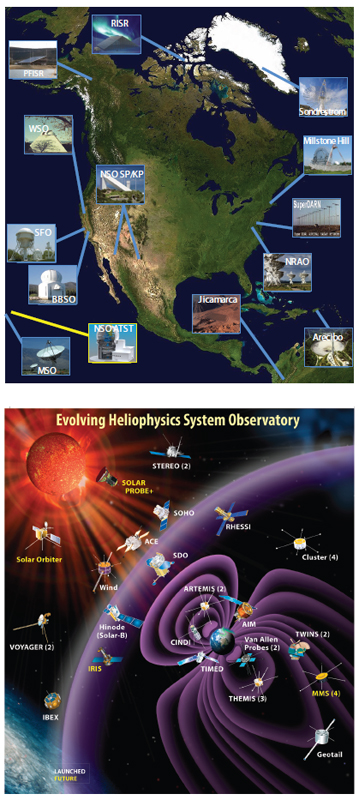
FIGURE 1.2 NSF and NASA’s current and near-future (indicated by yellow text) program of solar and space physics missions, which form the Heliophysics Systems Observatory (HSO). Details about NSF facilities are available at http://www.nsf.gov/funding/pgm_summ.jsp?pims_id=12808&org=AGS&from=home and http://www.nsf.gov/div/index.jsp?div=AST; details about NASA missions are available at http://www.nasa.gov/topics/solarsystem/sunearthsystem/main/Missions_Heliophysics.html. SOURCE: Top: Courtesy of NSF. Bottom: Courtesy of NASA.
experienced flight hardware development personnel and the inability to attract fresh talent to the field. Another prominent threat is the lack of availability of a U.S. medium-class launch vehicle with a track record comparable to that of the Delta-II, which ended production as a result of the decline in orders from the U.S. Air Force. The limited availability of a medium-class space launch system places severe constraints on new missions, restricting them to smaller and lighter scientific payloads suitable for available launchers like the Pegasus or Taurus, or requiring the use of heavier-lift and much more expensive evolved expendable launch vehicles. New entrants to the field, most prominently Space Exploration Technologies’ (SpaceX’s) Falcon 9, which NASA has begun to use for resupply missions to the International Space Station, and Orbital Sciences’Antares (neé Taurus II) launch vehicle, which had its first test flight in April 2013, offer the potential for reduced launch costs and medium-lift capabilities. Both vehicles are still early in their development and utilization, and it remains to be seen if they can meet future needs for reliable, low-cost launch vehicles (see Box 1.2, “Access to Space,” for further analysis of this issue).
An already-lean solar and space physics program is also threatened by the prospect of level or even declining budgets for the foreseeable future. The rising cost of executing space missions only exacerbates this problem,5 and the resultant shortfalls affect programs and, indirectly, the “pipeline” of future engineers and scientists who choose to enter the field (see Appendix D). In the coming years, the solar and space physics enterprise will be challenged by demands to maintain and expand the breadth of its system-level observatory to meet the needs of a space-faring nation.
The International Traffic in Arms Regulations (ITAR), a set of U.S. government regulations that controls the export of spaceflight hardware, designs, or design and development information, is also a threat to progress. Although there are efforts within the government to streamline and rationalize the process for review and approval of such exports, ITAR remains an obstacle to international cooperation in space research and, thereby, an impediment to opportunities to enhance science returns and reduce costs in many scientific missions. Notably, problems with ITAR compliance extend even to collaborations with nations that are close allies of the United States.
In summary, although the survey committee found the solar and space physics community generally to be vibrant and more integrated among relevant government agencies than in prior eras, it also found significant weaknesses and threats to the continued health of the enterprise. Nevertheless, the survey committee concluded that if stakeholders (including agencies, the science community, and policy makers) vigorously exploit the community’s capabilities, great opportunities for science and for society are still within reach. It is within this context that the survey committee makes its recommendations for programs and activities that will build on existing capabilities in an affordable and cost-effective manner and make fundamental contributions worthy of public investment.
KEY SCIENCE GOALS FOR A DECADE
Significant accomplishments in solar and space physics over the past decade have set the stage for transformative advances in the decade to come. Reports from the survey’s three interdisciplinary study panels (Chapters 8-10) enumerate the scientific opportunities and priorities for the interval addressed by this decadal survey, 2013-2022; these provide detail and context for the survey committee’s four key science goals.
________________________
5 NRC, Controlling Cost Growth, 2010.
BOX 1.2 ACCESS TO SPACE
NASA procures launch services primarily through the NASA Launch Services (NLS) contract. The latest NLS contract, NLS II, was announced on September 16, 2010, and includes launch vehicle offerings from four vendors.1 This contract was subsequently amended in 2012 through its “on-ramp” provision to add SpaceX’s Falcon 9 and Orbital Sciences’ Antares launch vehicles.2,3 Prior to this, NASA added the United Launch Services’ Delta II launch vehicle—long a workhorse for launching NASA science missions—back to its NLS II contract. However, that contract modification was limited to a maximum of five Delta II purchases, as opposed to the indefinite procurement nature of the other contracts.4 Therefore, the Delta II is being phased out once again through attrition. Of the launch vehicles available through NLS II, four are in current production (the Pegasus, Taurus, Falcon 9, and Atlas V). The Atlas V and Falcon 9 meet or exceed Delta II-class capability, but prices for the Atlas V have increased dramatically. Pricing for the Falcon 9—though currently less costly—remains uncertain for the time being. Furthermore, Orbital Sciences’ Taurus launch vehicle failed in three of its last four launch attempts (the 2001 QuikTOMS, 2009 Orbiting Carbon Observatory, and 2011 Glory missions—all NASA Earth science missions), resulting in a suspension of its use by NASA indefinitely. Currently, the Pegasus is the only small-class launch vehicle manifested for future launches, but even then it is currently slated to launch only one mission in the near future: the Interface Region Imaging Spectrograph (IRIS) mission in 2013.5
The challenges facing the launch vehicle industry that have played out over the past decade or more have also resulted in a lower launch cadence for NASA science missions. Decreasing launch rates exacerbate a tendency for missions in development to grow in size and complexity as longer development times, higher overall mission costs, and fewer overall missions increase community expectations for the few missions that do make it to space. This situation creates a feedback loop, with increasing costs driving increasing expectations and decreasing risk tolerance, which can further increase costs.
Although increased competition is projected for higher-performance launch vehicles, plans to develop alternative small-class launch vehicles appear less firm. SpaceX has ceased development of its Falcon 1/1e offerings in favor of its Falcon 9.6 The publicly available launch manifest shows just one Falcon 1e launch in 2014, compared with 37 Falcon 9/F9 Dragon/Falcon heavy launches through 2017.7
The development of SpaceX’s Falcon 9 and Orbital Sciences’ Antares launch vehicles has garnered a great deal of attention in the Earth and space sciences community, especially since both meet or exceed Delta II capabilities. However, neither has the long historical record of the Delta II for the simple fact that there have not been many launches of the Falcon 9 and the first launch of Antares is not scheduled until 2013. The Falcon 9 was selected as the launch vehicle for the Jason-3 mission to be launched in 2014 for a price of approximately $82 million.8 Nevertheless, its successes to date have been few in number and limited to the delivery of cargo to the International Space Station (in May and October 2012 and March 2013). The Falcon 9 has not yet placed a robotic spacecraft in Earth orbit, although it did successfully place its Dragon cargo capsule in orbit for a few hours before deorbiting it in a controlled reentry. While encouraged by these early achievements, the space sciences community can only be cautiously optimistic until new launch service providers have a more exten-
Key Science Goal 1. Determine the origins of the Sun’s activity and predict the variations in the space environment. The Sun and its variability drive space weather on a wide variety of timescales. Research driven by this goal investigates the origin of this variability inside the Sun and how its influence penetrates to near-Earth space to interact with other, terrestrial drivers of change in Earth’s space environment.
sive track record. The new providers promise significant cost savings; however, the high launch demand from government customers that would allow for such savings is by no means guaranteed, especially in the austere budget environment that is anticipated for at least the next several years, and despite 24 planned launches on SpaceX’s manifest from commercial industry customers through 2017.
Noncommercial vehicles (e.g., Minotaur) exist that are capable of launching Delta II-class payloads, but the Commercial Space Act9 precludes their use absent special dispensation (e.g., use of the Minotaur for a non-DOD payload requires a waiver from the Secretary of Defense). International launch vehicles (e.g., Ariane, H-II) are also widely available; however, international launch vehicles would require a partnership arrangement with a foreign agency and no exchange of funds.
The need for reliable and affordable access to space is by no means new or unique to NASA’s Earth science program. The loss in 2009 and 2011 of two NASA Earth science missions due to launch vehicle failures, however, underscores the urgency of addressing the need.
____________
NOTE: Unless indicated otherwise, the information supplied here was current as of Spring 2012.
1 See NASA, “NASA Awards Launch Services Contracts,” press release, September 16, 2010, available at http://www.nasa.gov/home/hqnews/2010/sep/C10-053_Launch_Services_Contract.html. NOTE: This contract was amended in May and June 2012, respectively, to add SpaceX’s Falcon 9 and Orbital Sciences’ Antares launch vehicles.
2 See NASA, “NASA Modifies Launch Service Contract to Add Falcon 9 Rocket,” press release, May 14, 2012, available at http://www.nasa.gov/home/hqnews/2012/may/HQ_C12-019_NLS_Falcon_9.html.
3 See NASA, “NASA Adds Orbital’s Antares to Launch Services II Contract,” press release, June 26, 2012, available at http://www.nasa.gov/home/hqnews/2012/jun/HQ_C12-027_NLS_II_mod.html.
4 See NASA, “NASA Modifies Launch Service Contract to Add Delta II Rocket,” press release, September 30, 2011, available at http://www.nasa.gov/home/hqnews/2011/sep/HQ_C11-044_Delta_Ramp.html.
5 See NASA, “NASA Launch Services Manifest,” available at http://www.nasa.gov/pdf/315550main_NASA%20FPB%2007_24_12%20Manifest%20Release%2008_01_2012_508.pdf, accessed October 9, 2012. IRIS was launched in late June 2013.
6 Production of the Falcon 1 was suspended in 2011; see G. Norris, “SpaceX Puts Falcon 1 on Ice,” Aviation Week, September 28, 2011, available at http://www.aviationweek.com/Article.aspx?id=/article-xml/asd_09_28_2011_p01-01-375285.xml.
7 See SpaceX, “Launch Manifest,” available at http://www.spacex.com/launch_manifest.php, accessed October 9, 2012.
8 See NASA, “NASA Selects Launch Services Contract for Jason-3 Mission,” press release, July 16, 2012, available at http://www.nasa.gov/home/hqnews/2012/jul/HQ_C12-029_RSLP-20_Launch_Services.html.
9 See Public Law 105-303, available at http://www.nasa.gov/offices/ogc/commercial/CommercialSpaceActof1998.html. To use a Minotaur, the NASA administrator must obtain approval from the secretary of defense and certify to Congress that use of a noncommercial launch vehicle will result in cost savings to the federal government, meet all mission requirements, and be consistent with international obligations of the United States.
SOURCE: Material presented here is drawn from National Research Council, Earth Science and Applications from Space: A Midterm Assessment of NASA’s Implementation of the Decadal Survey, The National Academies Press, Washington, D.C., 2012.
Earth’s star is far more complex and variable than it appears to the naked eye in the daytime sky. (See Figure 1.3.) Sunspots as large as several Earths dot the surface with intense magnetic fields thousands of times stronger than the average background field. Each active region on the Sun can grow, decay, and reorganize on timescales of minutes to months, and collectively the spots emerge in groups that define the roughly 11-year activity cycle and 22-year magnetic cycle of the Sun. The typical solar wind speed and solar irradiance vary in concert with the cycle. As often as three times per day during solar maximum, the
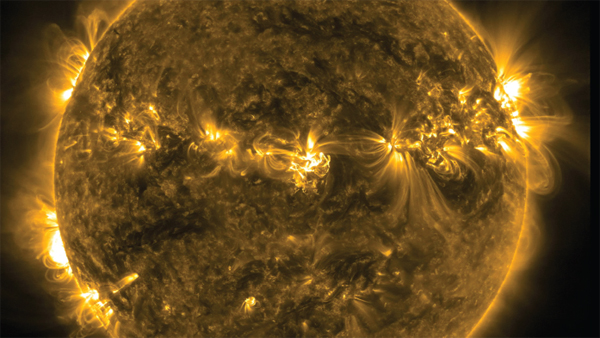
FIGURE 1.3 A series of active regions, lined up one after the other across the upper half of the Sun, twisted and interacted with each other over 4.5 days from September 28 to October 2, 2011. As seen in extreme ultraviolet light, the magnetically intense active regions sported coils of arcing loops. SOURCE: Courtesy of NASA Solar Dynamics Observatory Atmospheric Imaging Assembly.
Sun ejects billions of tons of material with embedded magnetic fields. These coronal mass ejections (CMEs), when aimed at Earth, can reach our planet in less than a day at speeds more than five times that of the background solar wind, the expanding solar atmosphere that fills the entire solar system and heliosphere. CMEs can cause large geomagnetic storms that affect terrestrial systems such as electric power grids. They are often associated with solar flares, the most intense explosions in the solar system.
Solar flares bathe Earth in excess radiation across the electromagnetic spectrum, but it is the intense X-ray and ultraviolet radiation that significantly affects Earth’s dayside ionosphere and the communication and navigation systems that are vulnerable to the state of the ionosphere. Flares release enormous energy in minutes and can remain intense over many hours. While the largest flares occur about once per solar cycle, several hundred per solar cycle are categorized as strong to extreme. Solar particle events are yet another signature of the variable Sun. Relativistic-energy particles, created near the Sun and by shock waves propagating toward Earth, can arrive at Earth in as little as 15 minutes. Historically, the most intense events occur about once per solar cycle, whereas strong to extreme particle storms occur about 15 times per cycle. Extreme particle storms affect human and robotic activities in space; they can also disrupt airline operations over polar routes, and they have potentially important long-term health impacts on flight crews. Almost every aspect of the Sun is variable and affects life on Earth.
The most recent solar minimum (comprising the end of cycle 23) was longer and deeper than any in the past century. Cycle 24 started 13 years after cycle 23 and may be weaker than any during the space
age. Yet, despite increasingly accurate measurements of the flows beneath the solar surface and more sophisticated models of the dynamo that drives the activity, scientists cannot confidently make a physical prediction of the emergence of a strong sunspot, let alone the level of activity that will be present at the end of the coming decade. The missing information will come, in part, from measurements of the hard-to-view solar poles. The deep, ponderous flows that carry patterns of magnetic flux to the poles regulate the seeding of the deep-seated dynamo that generates subsequent solar cycles.
While large-scale dynamics drive cyclic solar changes, the actual mechanisms of variability—brightness, heating, mass flow—depend also on the summation of the myriad interactions that take place on the smallest scales. Against that seething background of continual small-scale activity, global structures store immense energy on a vast scale. The build-up of magnetic stress can be modeled, but not observed directly. What triggers catastrophic energy release in a flare or CME remains a puzzle. Only by sensing the solar wind directly with a probe near the Sun will it be possible to distinguish what accelerates the ordinary wind and more energetic particles.
Key Science Goal 2. Determine the dynamics and coupling of Earth’s magnetosphere, ionosphere, and atmosphere and their response to solar and terrestrial inputs. The regions of Earth’s space environment are coupled by interactions among neutral gas, electrically charged particles, and plasma waves occurring over a range of spatial and temporal scales. The transport of energy and momentum through this environment exhibits varying degrees of feedback and complexity, requiring research approaches that treat it as a coupled system.
The space environment of Earth is profoundly affected by the solar wind. When the entrained solar wind magnetic field encounters Earth’s magnetic field where the two magnetic fields are pointing in opposite directions, they can annihilate through the process of magnetic reconnection. (See Figure 1.4.) Magnetic reconnection drives convection that carries energetic particles toward Earth where they are injected and trapped in orbits around Earth to form the outer radiation belt. Although the broad view of how reconnection takes place and drives convection in the magnetosphere is now well established, the underlying physics of magnetic reconnection in the magnetosphere is not yet understood well enough to predict when, where, and how fast this process will occur and how it contributes to the transport of mass, energy, and momentum. Understanding charged-particle acceleration, scattering, and loss, which control the intensification and depletion of the radiation belts, is therefore a priority of solar and space physics.
During magnetic storms intense ion upwelling from the ionosphere—the inner boundary of the magnetosphere—into the magnetosphere is so strong that it can alter magnetospheric dynamics by modifying magnetic reconnection both on the dayside and on the nightside. The ionosphere is also the site of fundamental plasma-neutral gas interactions that must be unraveled to understand the dynamics of the neutral atmosphere-ionosphere system. When magnetospheric currents are disrupted, it is the ionosphere that provides the alternate path for magnetospheric currents to flow, heating Earth’s atmosphere.
Research and observations are clearly needed to understand energy transport, cooling, and structuring across this system. The intense energy input from the magnetosphere, reaching up to a terawatt or more, typically occurs in regions spanning less than 10 degrees in latitude, but during storms energy is redistributed throughout the polar regions and down to middle latitudes. Theory still cannot explain how the global thermosphere “inflates” several hours after the onset of high-latitude heating, nor have studies yet captured the subsequent cooling with the fidelity that is needed to predict changes in satellite orbits occurring during magnetic storms.
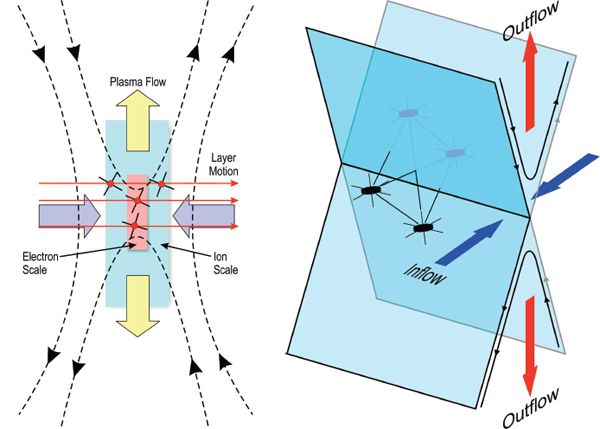
FIGURE 1.4 Schematic of magnetic reconnection fields, flows, and diffusion regions. The four-spacecraft Magnetospheric Multiscale (MMS) mission is targeted to resolve fundamental questions regarding the physics of magnetic reconnection. The nominal configuration of the MMS spacecraft during transit of magnetopause and magnetotail current layers is shown to scale with the key physical scale lengths. SOURCE: Courtesy of MMS-SMART Science Team, J.L. Burch, principal investigator, Southwest Research Institute.
Earth’s upper atmosphere and ionosphere are a rich laboratory for the investigation of radiative processes and plasma-neutral coupling in the presence of a magnetic field. The behavior can be extraordinarily complex: plasma-neutral collisions and associated neutral winds drive turbulence that cascades to very small spatial scales and regularly disrupts communications. The primary mechanism through which energy and momentum are transferred from the lower atmosphere to the upper atmosphere and ionosphere is through the generation and propagation of waves. Although the presence and importance of waves are without dispute, the relevant coupling processes operating between the neutral atmosphere and ionosphere involve a host of multiscale dynamics that are not understood at present. Understanding the energy budget, dynamical behavior, and day-to-day variability in this region that is heavily influenced by wave energy from below and above presents a significant challenge to solar and space physics.
The release of greenhouse gases (e.g., carbon dioxide and methane) into the atmosphere is changing the global climate, warming the lower atmosphere but cooling the upper atmosphere. In the lower atmosphere the opacity of greenhouse gases traps energy by capturing the radiant infrared energy from Earth’s surface and transferring it to thermal energy via collisions with other molecules. In the thermosphere, however, where intermolecular collisions are less frequent, greenhouse gases promote cooling by acquiring energy via collisions and then radiating this energy to space in the infrared.
Continued cooling of the thermosphere will alter atmosphere-ionosphere coupling, thereby altering global currents in the magnetosphere-ionosphere system and thus fundamentally altering magnetosphere-ionosphere coupling. These trends are only now apparent from the long-term set of satellite data and ground-based ionosonde networks, the latter of which show that the ionosphere is dropping to lower altitudes over time. This is a remarkable planetary change attributable, at least in part, to human society’s modification of the atmosphere.
Key Science Goal 3. Determine the interaction of the Sun with the solar system and the interstellar medium. The outer regions of the heliosphere remain only sparsely explored.6 Regions of high intrinsic interest, they are also the location where anomalous cosmic rays are generated. Anomalous and galactic cosmic rays penetrate into the inner solar system, posing a danger for humans and spacecraft traveling to locations beyond those afforded protection by Earth’s magnetic field.
The supersonic flow of the solar wind transitions to a subsonic flow that merges with the local interstellar medium at a distance of about 100 AU from the Sun. The heliosheath lies beyond this “termination shock” and extends out to the heliopause, an as-yet-unexplored region that separates the domain of the Sun from the local interstellar medium. The two Voyager spacecraft, launched in 1977, crossed the termination shock in 2004 and 2007, and they are now exploring the heliosheath—a region of prodigious particle acceleration (see Figure 1.5). In terms of the total amount of energy placed into energetic particles, the heliosheath is a more copious accelerator than the Sun.
The heliosheath and the heliopause are the principal barriers against entry of galactic cosmic rays (GCRs) into the solar system, with the largest reduction in GCR intensity occurring in these regions. How this reduction occurs, how it depends on solar activity, and what is the maximum intensity at which GCRs can penetrate into the inner heliosphere are not known. GCRs generate isotopes in Earth’s atmosphere that are preserved as an archive of historical solar activity—for example, carbon-14 abundance can be measured in tree rings. Understanding the production and formation of these unique records of past changes in solar activity is essential for interpreting changes in Earth’s climate over the past millennium.
The Voyager spacecraft are currently at widely separated locations, and their measurements are limited by their 35-year-old instrumentation. Nevertheless, recent Voyager measurements have enabled discovery of unanticipated structures in the heliosheath. Measurements from the Interstellar Boundary Explorer (IBEX) have revealed that the interstellar magnetic field organizes the distribution of energetic ions. These unique measurements from the Voyagers as they cross the heliopause into the local interstellar medium, along with measurements from IBEX and the proposed IMAP mission, promise a new understanding of the important acceleration processes occurring in these unexplored regions. In particular, they will help
________________________
6 The Voyager spacecraft continue to make in situ measurements of the outer heliosphere, and their entry into interstellar space sometime in the next decade will be an historic event. Remote sensing measurements from instruments on near-Earth spacecraft complement Voyager measurements and facilitate a multipronged attack on fundamental science questions.
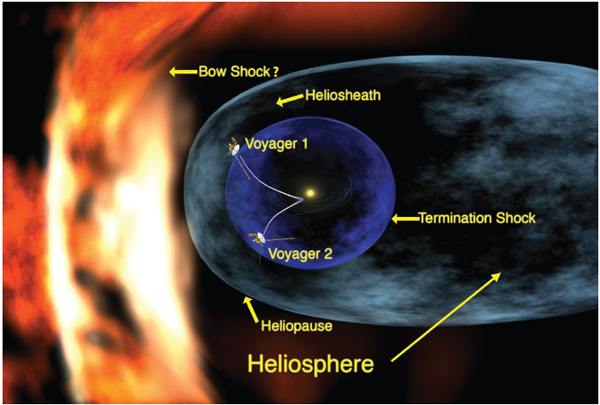
FIGURE 1-5 A schematic image of the regions of the heliosphere, including the approximate locations of Voyagers 1 and 2. Voyager 1 crossed the termination shock at 94 AU in December 2004, and Voyager 2 crossed at 84 AU in August 2007. For details, see http://science1.nasa.gov/missions/voyager/. SOURCE: Courtesy of NASA/JPL/Walt Feimer. NOTE: This figure was prepared several years ago when scientists expected Voyager to discover a bow shock. New results from the Interstellar Boundary Explorer (IBEX) have shown that instead of a shock, there is a softer interaction—a bow wave, similar to how water piles up ahead of a moving boat. For IBEX results, see D.J. McComas, D. Alexashov, M. Bzowski, H. Fahr, J. Heerikhuisen, V. Izmodenov, M.A. Lee, E. Moebius, N. Pogorelov, N.A. Schwadron, and G.P. Zank, The heliosphere’s interstellar interaction: No bow shock, Science 336:1291, doi: 10.1126/science.1221054, May 2012.
researchers understand the mechanisms by which the solar system is protected against GCRs and how effective this protection is likely to be in the face of changing solar conditions.
Key Science Goal 4. Discover and characterize fundamental processes that occur both within the heliosphere and throughout the universe. Advances in understanding of solar and space physics require the capability to characterize fundamental physical processes that govern how energy and matter are transported. Such understanding is also needed to improve the capability to predict space weather.
Underlying the extraordinarily complex and dynamic space environment are identifiable fundamental processes that can sometimes be explored as independent problems. These fundamental processes can also play a role in other astrophysical settings. In that sense, the Sun, the heliosphere, and Earth’s magnetosphere and ionosphere serve as cosmic laboratories for studying universal plasma phenomena, with applications to laboratory plasma physics, fusion research, and plasma astrophysics.7 Discoveries from these fields, of course, also contribute to the scientific progress in solar and space physics.
There are numerous examples of the universal processes that control the dynamics of the space environment:
• Dynamos. Turbulence in the convection zone of the solar interior twists and transports magnetic fields and ultimately determines the large-scale solar dipolar magnetic field, which reverses polarity on average every 11 years. Similar dynamos produce magnetic fields in stars, magnetars, and even in galaxies, black holes, and other compact objects. Earth’s ionosphere exhibits several neutral wind dynamo processes that at high latitudes generate large-scale electric fields that affect the magnetosphere, and at low latitudes control the growth of plasma densities generated by solar radiation.
• Solar and planetary winds. The heating and subsequent outward expansion of the solar atmosphere create the solar wind. Produced by a variety of mechanisms, winds are features of essentially all stars. Winds from the poles of Earth—the polar wind—can similarly fill the magnetosphere with ionospheric plasma.
• Magnetic reconnection. Magnetic fields in regions of opposing field direction can annihilate each other to convert magnetic energy into high-speed flows, heated plasma, and energetic particles. This explosive release of energy drives flares on the Sun and other stars and possibly the magnetospheres of galactic accretion disks and astrophysical jets. Reconnection in Earth’s magnetosphere leads to the erosion of Earth’s protective magnetic shield during storms and is the driver of magnetospheric substorms.
• Collisionless shocks. Shock waves appear throughout the heliosphere where they facilitate the transition from supersonic to subsonic flow, heat the plasma, and act as accelerators of energetic particles. Shocks are widely observed in astrophysical systems in the form of supernova shocks, which are a predicted source of galactic cosmic rays, at the termination of astrophysical jets, and more generally during collisions and mergers of galaxies.
• Turbulence. Plasma turbulence is ubiquitous in the space environment and throughout the broader universe. It carries energy from the interior of the Sun to its surface and drives the solar dynamo. It is also one of the proposed mechanisms for heating the ambient corona and accelerating energetic particles in flares. Turbulence drives the transport of particles, and energy in the magnetosphere—the region of space dominated by Earth’s magnetic field and radiation belt—heats electrons and ions in the auroral region and is ubiquitous in the charged upper layers of Earth’s atmosphere (the ionosphere). The recognition that turbulence may facilitate accretion has transformed understanding of the environments of compact astrophysical objects and even of the mechanisms of star and planetary formation.
• Plasma-neutral interactions. The interaction of the ionized plasma in Earth’s magnetosphere and neutral particles in the ionosphere/thermosphere lead to ionization, outflows into the magnetosphere, and the generation of neutral winds whose rich dynamics have only recently been appreciated. Similar interactions between neutral and ionized particles take place at the Sun and in the solar wind. In the broader universe, plasmas are often only partially ionized, so that plasma motions are often constrained by mass loading due to neutrals. The observed structuring of molecular clouds is believed to result from the ionization dynamics of radiation and plasma-neutral interaction.
________________________
7 See National Research Council, Plasma Physics of the Local Cosmos, The National Academies Press, Washington, D.C., 2004.
With the above key science goals in mind, and recognizing that many of the outstanding problems in solar and space physics require an integrated observational approach, the survey committee’s strategy was to construct a program that can achieve progress across the coupled domains that define the entire field. The strategy builds on existing and planned programs, optimally deploys recommended new assets at an appropriate cadence, and includes actions and decisions that should be taken in the event that the expected funding profile cannot be attained or, conversely, if it is augmented. The survey committee’s overall strategy is summarized in the seven steps outlined in Box 1.3.
The Heliophysics Systems Observatory, made up of NASA’s existing heliophysics flight missions and NSF’s ground-based facilities, is an ever-rich source of observations that address increasingly interdisciplinary and long-term science objectives. The success of these exciting and productive activities at NASA and NSF is fundamentally important to long-term scientific progress in solar and space physics. With prudent management and careful cost containment, the survey committee concluded that completion of the ongoing program is precisely the right first step for the next decadal interval and as such represents the baseline priority.
In framing its recommendations for progress over the next decade, the survey committee identified five assets of the solar and space physics program as necessary to realize the full scientific potential of the field. They are the (cross-agency) enabling foundation, ground-based facilities, and small, moderate-scale, and large-scale (major) space missions. Making optimal use of these assets, which differ widely in cost and expected operating lifetime, requires careful attention to deployment cadence and overlap. Further details are presented below.
BOX 1.3 STEPS OF A STRATEGY FOR OPTIMIZING A SOLAR AND SPACE PHYSICS SCIENCE PROGRAM FOR 2013-2022
1. Identify the highest-priority science goals and major programmatic assets for each of the subdisciplines of solar and space physics.
2. Recognize that to make meaningful scientific progress, the Sun-heliosphere-Earth system must be studied as a coupled system.
3. Recognize that understanding the coupled Sun-heliosphere-Earth system requires that each subdiscipline must be able to make reasonable progress in achieving its highest-priority science goals.
4. Recognize that to make balanced progress across the subdisciplines, all the assets available to solar and space physics—the enabling foundation of theory, modeling and data analysis; ground-based facilities; and small, moderate, and large space missions—must be optimally deployed.
5. Recognize that each asset available to solar and space physics has a cadence at which it can most effectively be a successful contributor.
6. Construct a program that can achieve such balanced progress across the subdisciplines, optimally deploying all of the assets, each with a reasonable cadence.
7. Determine the actions and decisions that will be taken in the event that the expected funding profile cannot be attained or some other disruptive event occurs or, conversely, in the event that the budget is augmented or the cost to missions is reduced.
The enabling foundation for solar and space physics is common across its subdisciplines; it includes theory, modeling, and data analysis; innovative platforms and technologies; and education.8 The survey committee found an immediate need to strengthen this foundation to garner maximum knowledge from data being collected from space and from the ground. Further benefits include the introduction of new innovative and cost-effective approaches to space exploration, and the generation and continued development of a world-leading science community.
This insight motivated the survey committee to amalgamate thrusts in these areas into a multiagency initiative, labeled DRIVE—Diversify, Realize, Integrate, Venture, and Educate. The elements of DRIVE are described in detail in Chapter 4, which also includes DRIVE-related recommendations, several of which are designed to strengthen the enabling foundation. The DRIVE initiative encompasses specific augmentations to existing enabling programs. Its implementation will provide opportunities to realize scientific discoveries from existing data, to build more comprehensive models, to make theoretical breakthroughs, and to innovate.
NSF ground-based solar and space physics facilities, which are managed within two of its divisions, are key existing elements of the Heliophysics Systems Observatory. The Astronomy Division of the Mathematics and Physical Sciences Directorate manages the National Solar Observatory (NSO), with ongoing synoptic observations and the ATST under construction. It is also the home of the National Radio Astronomy Observatory, which includes solar observational capability. The Atmospheric and Geospace Sciences Division (AGS) of the Geosciences Directorate manages the National Center for Atmospheric Research (NCAR) and its High Altitude Observatory (HAO), which supports a broad range of research from the Sun to Earth and operates the Mauna Loa Solar Observatory. AGS also supports the SuperDARN coherent-scatter radar system and four large incoherent-scatter radar facilities including the Arecibo Radio Observatory, which remains the largest-aperture telescope in the world for astrophysical, planetary, and atmospheric studies. University-based observatories are also funded by both NSF and NASA.
When it begins operation in 2018, the 4-meter ATST will be, by far, the largest optical solar telescope in the world. It will provide revolutionary measurements of the solar magnetism that controls energetic mass eruptions and variability in the Sun’s output. ATST measurements at the currently unreachable small size of density fluctuations will reveal how magnetic fields and mass interact at their fundamental size scales. ATST will also provide the first measurements of magnetic fields low in the corona where mass and energy are injected to form the heliosphere. It will be revolutionary in the capabilities it will provide to measure the dynamics of the magnetic field at the solar surface down to the fundamental density length scale. It will also be able to remotely sense coronal magnetic fields in locations where they have never been measured. For full realization of its potential, ATST requires adequate, sustained funding from NSF for operation, data analysis, development of advanced instrumentation, and research grant support for the ATST user community. DRIVE “Realize” includes a recommendation for a significant increase in funding allocation to properly operate and to realize the full and remarkable scientific potential of ATST.
Important ground-based research is also accomplished through midscale research projects that are larger in scope than typical single principal-investigator (PI)-led projects (like those funded by NSF’s Major Research Instrumentation line) and smaller than facilities (such as those developed under NSF’s Major
________________________
8 See National Research Council, An Enabling Foundation for NASA’s Space and Earth Science Missions, The National Academies Press, Washington, D.C., 2010.
Research Equipment and Facilities Construction line). The Advanced Modular Incoherent Scatter Radar (AMISR) is an example of a midscale project widely seen to have transformed research in ground-based solar and space physics.
Although different NSF directorates have programs to support unsolicited midscale projects at various levels, these may be overly prescriptive and uneven in their availability, and practical gaps in proposal opportunities and funding levels may be limiting the effectiveness of midscale research across the agency. It is unclear, for instance, how projects like the AMISR would be initiated and accomplished in the future, because no budget line is available that matches this scale of facility development. Mechanisms for the continued funding of management and operations at existing midscale facilities are also not entirely clear. In addition, there is a need for a means of funding midscale projects, many of which have been identified by this decadal survey committee as cost-effective additions of high priority to the overall program. These include the Frequency-Agile Solar Radiotelescope (FASR), the Coronal Solar Magnetism Observatory (COSMO), and several other projects exemplifying the kind of creative approaches that are necessary to fill gaps in observational capabilities and to move the survey’s integrated science strategy forward. A mid-scale funding line will have a major impact on conducting science at ground-based facilities, and it would rejuvenate broadly utilized assets by taking advantage of innovations to address key science challenges. DRIVE “Diversify” includes a recommendation for a new, competitively selected midscale funding line at NSF.
Since the 2003 decadal survey,9 a new experimental capability has emerged for very small spacecraft, which can act as stand-alone measurement platforms or can be integrated into a greater whole. These platforms are enabled by innovations in miniature, low-power, highly integrated electronics and nanoscale manufacturing techniques, and they provide potentially revolutionary approaches to experimental space science. For example, small, low-cost satellites may be deployed into regions where satellite lifetimes are short but where important, hitherto insufficiently characterized scientific linkages take place. The vulnerability of microsatellites to this radiation environment is also of interest from a space-weather viewpoint. NSF’s CubeSats initiative promotes science done by very small satellites, and the enthusiastic response from the university community argues for a launch cadence greater than the current one per year. DRIVE “Diversify” includes a recommendation targeting the development of very-small-satellite flight opportunities as a key growth area for both NASA and NSF.
NASA’s Explorer space projects have proven historically to be highly successful and cost-effective, providing insights into both the remotest parts of the universe and the detailed dynamics of Earth’s local space environment. The 1997 Advanced Composition Explorer (ACE) now stands as a sentinel to measure, in situ, transient disturbances from the Sun and the energetic particles that are a danger to humans in space. RHESSI and the recently retired TRACE spacecraft study the dynamics of the solar corona, where large flares and potentially damaging solar storms originate. The relatively recently launched THEMIS constellation and the Aeronomy of Ice in the Mesosphere mission were both accomplished under the aegis of the Explorer program and are revolutionizing understanding of magnetospheric dynamics and global atmospheric changes, respectively. IBEX, which observes the heliospheric boundary from high Earth orbit, found a bright ribbon of energetic neutral atom emission whose origin is requiring reconsideration of fundamental concepts of the heliosphere and local interstellar medium interaction. The Interface Region Imaging Spectrograph (IRIS), the most recently selected Heliophysics Explorer, will explore the flow of
________________________
9 National Research Council, The Sun to the Earth—and Beyond: A Decadal Research Strategy in Solar and Space Physics, The National Academies Press, Washington, D.C., 2003; and National Research Council, The Sun to the Earth—and Beyond: Panel Reports, The National Academies Press, Washington, D.C., 2003.
energy and plasma at the foundation of the Sun’s atmosphere. In summary, Explorers are among the most competitive solicitations in NASA science, and they offer relatively frequent opportunities for all researchers to propose new and exciting ideas that are selected on the basis of science content, relationship to overall NASA strategic goals, and feasibility of execution.
The survey committee believes that an adequate cadence for Heliospheric Explorers is one mission every 2 to 3 years, a rate that was possible before the major reduction in 2005 in the Explorer program. The survey committee also notes that competition for the MIDEX class of Explorers, which historically has offered an opportunity to resolve the highest-level science questions, has not been possible under the current Explorer budget. Finally, the survey committee notes that the Explorer program is the home for Missions of Opportunity, which make it possible to achieve fundamental science at a fraction of the cost of stand-alone missions by hosting payloads through partnering with other agencies, nations, or commercial spaceflight providers. For example, the Solar-C mission now confirmed by Japan presents a future opportunity for the United States to provide instrumentation to a major foreign mission and in so doing to obtain a high science return for relatively low cost. Thus, an augmentation to the Explorer program and restoration of the MIDEX component of Explorers, described in detail in Chapter 4, are required to achieve the optimal cadance and to leverage resources with commercial, interagency, and international opportunities.
Many of the most important solar and space physics science questions cannot be addressed by Explorer-class missions. The survey committee has considered the most critical topics that can be realistically addressed by moderate-scale NASA missions and lists the community’s top three priorities below (see Chapter 4 for details). To achieve an acceptable flight rate, the survey committee recommends that the Heliophysics Division’s Solar-Terrestrial Probes (STP) program be reconfigured as a moderate-mission program modeled after the successful Discovery and New Frontiers programs of NASA’s Planetary Science Division. Like these planetary missions, the new Solar-Terrestrial Probes should be led by a principal investigator, selected competitively, cost-capped, and managed in a manner similar to Explorers. Such programs exhibit superior cost-performance history compared with the more traditional mode for major missions (see Appendix E).
The survey committee believes that an adequate cadence for moderate-scale space missions is one every 4 years. In view of the expected budget constraints discussed below, it is evident that it will not be possible to achieve this cadence until the end of the decade. Although moderate missions are to be selected competitively, each moderate mission’s science goal has to be defined in advance to achieve the strategic objective of balanced progress.
In Chapter 4, the survey committee presents the rationale for and priority order of science investigations that best achieve these objectives. In descending order for implementation they are as follows:
1. A mission to understand the interaction of the outer heliosphere with the interstellar medium—one that will be coordinated with NASA’s Voyager mission and will also provide critical data on solar wind inputs to the terrestrial system. An illustrative example is the Interstellar Mapping and Acceleration Probe (IMAP).
2. A mission designed to substantially advance understanding of the variability in space weather driven by lower-atmosphere weather on Earth, illustrated by the Dynamical Neutral Atmosphere-Ionosphere Coupling (DYNAMIC) mission.
3. A mission that probes how the magnetosphere-ionosphere-thermosphere system is coupled and how it responds to solar and magnetospheric forcing, illustrated by the Magnetosphere Energetics, Dynamics,
and Ionospheric Coupling Investigation (MEDICI). The survey committee notes that MEDICI could not begin before 2024 absent a NASA Heliophysics Division budget augmentation or a reduction in the cost of other missions.
Each of the survey committee’s recommended STP moderate-scale space missions was subjected to a cost and technical evaluation (CATE) process (Box 1.4), and projected cost assessments were found to be consistent with the proposed life-cycle cost of $520 million for a mission in this renewed STP line. However, these costs are possible only so long as the STP missions are executed as competitively selected, cost-capped, and PI-led missions, as recommended.
Certain very-high-priority science investigations are of such scope and complexity that they can be undertaken only with major-mission-based research. In the current decade, two such missions are already underway—the Magnetospheric Multiscale mission, which is scheduled for launch in 2014, and the Solar Probe Plus (SPP) mission, which is scheduled for launch in 2018. In its deliberations, the survey committee
BOX 1.4 SURVEY PRIORITIZATION AND THE CATE PROCESS
In September 2010, shortly after the present decadal survey commenced, the survey committee distributed widely to the solar and space physics community a request for information (RFI) for “a concept paper (e.g., about a mission or extended mission, observation, theory, or modeling activity) that promises to advance an existing or new scientific objective, contribute to fundamental understanding of the Sun-Earth system, and/or facilitate the connection between science and societal needs (e.g., improvements in space weather prediction).”1
Each submission was assigned to one or more of the survey’s three study panels for review, and each submission was assigned to a specific reader who prepared a short presentation that was discussed by the panel. Concepts of particular interest were discussed in more detail at a subsequent session, and, at the end of a lengthy review process, panels developed a short list of concepts for consideration by the survey committee. In making their selections, panels mapped concepts against their prioritization of science targets and also considered factors such as technical readiness, scientific impact on a particular discipline or disciplines, and, in some cases, operational utility. It is important to note that the concepts that were eventually forwarded to the survey committee were in some cases an amalgam of more than one submission; they also drew on the expertise of panel members.
At a meeting of the decadal survey committee, 12 mission concepts were selected for further study by the Aerospace Corporation, which under contract to the National Research Council provided a preliminary cost and technical evaluation (CATE) of the concepts. At a subsequent meeting, the survey committee reviewed the results of the pre-CATE and selected six concepts for a more thorough analysis, including an evaluation of the options for descopes and other trade-offs that would affect estimated cost. Details of this process are explained in Appendix E.
The CATE process provided an independent analytical approach to realistically assessing the cost and risk related to recommended initiatives that are typically expected at an early stage of formulation. Each of the Solar-Terrestrial Probes and Living With a Star missions recommended in this report were chosen from among the six candidate missions that underwent the detailed CATE process.
____________
1 Further information about the RFI along with a compilation of submissions, which numbered nearly 300, is available on the decadal survey website at http://sites.nationalacademies.org/SSB/CurrentProjects/SSB_056864#White_Papers_and_Community_Input.
found a need for the development and launch of constellations of spacecraft, which are necessary to provide simultaneous measurements from broad regions of space and thereby separate spatial from temporal effects to reveal the true couplings between adjacent regions of space. By necessity, constellation missions require large investments, and their design, assembly, and execution are challenging. The expected budget profile for NASA’s Heliophysics program is such that launch of the next major mission in heliophysics cannot be reasonably expected before 2024, or 6 years after SPP. This constraint—and not the absence of proposals to undertake compelling science investigations—defines a cadence for major missions.
In contrast to the STP program, which the survey committee recommends be community-based like the Explorers, major missions are appropriately undertaken by NASA centers. NASA’s LWS program is the proper vehicle for large-class, center-led, major missions. In Chapter 4 the survey committee describes the next science target best addressed by the LWS program when the budget of the Heliophysics Division allows: a mission to understand how Earth’s atmosphere absorbs solar wind energy, illustrated by the Geospace Dynamics Constellation (GDC).
The foundational assets described above form the cornerstones of the solar and space physics research program for the coming decade. Each is of exceptional importance; however, maximizing science return while operating in a highly constrained fiscal environment requires that they be prioritized and then implemented at an appropriate cadence. Further, a strategy is needed to address unforeseen technical or budgetary problems, such as budget problems attributable to the cost growth of individual program elements or unexpected changes in the overall (top-line) budget. Described below is the survey committee’s approach to prioritizing program elements and formulating decision rules to address budget shortfalls.
Funding Priorities for NASA’s Heliophysics Program
By employing the assets described above at an appropriate cadence, and using the decision rules described below, a viable program can be crafted that should allow solar and space physics to preserve the strategic goal of balanced progress even under less favorable budgetary circumstances. The DRIVE initiative has the fastest cadence (new competitions annually for many of its components), followed by a 2- to 3-year cadence for the Explorer program, a 4-year cadence for the moderate-scale mission STP program, and a 6-year cadence for the LWS major mission program. It follows that the first new NASA implementation priority is the augmentation required by the DRIVE initiative, followed by the augmentation for the Explorer program, the initiation of the STP moderate-scale mission program, and finally the continuation of the LWS major mission program. Chapter 6 provides a detailed discussion of the survey committee’s proposed implementation of these program elements within the budget projected by NASA over the next 5 years and extrapolated by the committee for an additional 5 years.
Decision rules are strategies to preserve an orderly and effective program for solar and space physics in the event that less funding than anticipated is available, or some other disruptive event occurs. As described in more detail in Chapter 6, the rules, with one exception, affect the year that mission and foundational activities commence and the cadence at which they repeat in the coming decade. The survey committee also provides decision rules to aid in implementing a program under a more favorable budget. In particular,
TABLE 1.1 Fulfilling the Key Science Goals of the Decadal Survey
|
|
||||
| Advances in Scientific Understanding and Observational Capabilities | Goals | |||
|
|
||||
| Advances owing to implementation of the existing program | Twin Radiation Belt Storm Probes will observe Earth’s radiation belts from separate locations, finally resolving the importance of temporal and spatial variability in the generation and loss of trapped radiation that threatens spacecraft. | 2, 4 | ||
| The Magnetospheric Multiscale mission will provide the first high-resolution, three-dimensional measurements of magnetic reconnection in the magnetosphere by sampling small regions where magnetic field line topologies reform. | 2, 4 | |||
| Solar Probe Plus will be the first spacecraft to enter the outer atmosphere of the Sun, repeatedly sampling solar coronal particles and fields to understand coronal heating, solar wind acceleration, and the formation and transport of energetic solar particles. | 1, 4 | |||
| Solar Orbiter will provide the first high-latitude images and spectral observations of the Sun’s magnetic field, flows, and seismic waves, relating changes seen in the corona to local measurements of the resulting solar wind. | 1, 4 | |||
| The 4-meter Advanced Technology Solar Telescope will resolve structures as small as 20 km, measuring the dynamics of the magnetic field at the solar surface down to the fundamental density length scale and in the low corona. | 1, 4 | |||
| The Heliophysics Systems Observatory will gather a broad range of ground- and space-based observations and advance increasingly interdisciplinary and long-term solar and space physics science objectives. | All | |||
| New starts on programs and missions to be | The DRIVE initiative will greatly strengthen researchers’ ability to pursue innovative observational, theoretical, numerical, modeling, and technical advances. | All | ||
| implemented within the next decade | Solar and space physicists will accomplish high-payoff, timely science goals with a revitalized Explorer program, including leveraged Missions of Opportunity. | All | ||
| The Interstellar Mapping and Acceleration Probe, in conjunction with the twin Voyager spacecraft, will resolve the interaction between the heliosphere—our home in space—and the interstellar medium. | 2, 3, 4 | |||
| A new funding line for mid-size projects at the National Science Foundation will facilitate long-recommended ground-based projects, such as COSMO and FASR, by closing the funding gap between large and small programs. | All | |||
| New starts on missions to be launched early in the next decade | The Dynamical Neutral Atmosphere-Ionosphere Coupling mission’s two identical orbiting observatories will clarify the complex variability and structure in near-Earth plasma driven by lower-atmosphere wave energy. | 2, 4 | ||
| The Geospace Dynamics Constellation will provide the first simultaneous, multipoint observations of how the ionosphere-thermosphere system responds to, and regulates, magnetospheric forcing over local and global scales. | 2, 4 | |||
| Possible new start this decade given budget augmentation and/or cost reduction in other missions | The Magnetosphere Energetics, Dynamics, and Ionospheric Coupling Investigation will target complex, coupled, and interconnected multiscale behavior of the magnetosphere-ionosphere system by providing global, high-resolution, continuous three-dimensional images and multipoint in situ measurements of the ring current, plasmasphere, aurora, and ionospheric-thermospheric dynamics. | 2, 4 | ||
|
|
||||
by increasing the cadence of the recommended mission and foundational activities in DRIVE, Explorers, and the STP and LWS lines, a commensurate increase in program value can be obtained.
A DECADE OF TRANSFORMATIVE SCIENCE
Implementation over the coming decade of the multifaceted program recommended in this report will allow substantial progress to be achieved in meeting the survey’s four key science goals. Indeed, as summarized in Table 1.1, the survey committee anticipates a decade of transformative advances in scientific understanding and observational capabilities, both space- and ground-based, upon implementation of the existing program and execution of the recommended program.
Throughout this report, the committee emphasizes the necessity of adopting a systems approach to achieve appropriately balanced progress in understanding an interconnected solar-heliospheric-terrestrial and planetary system. Of particular importance is the capability to advance solar and space physics science that is directly relevant to societal needs. However, the resources assumed in crafting this survey’s recommended program are barely adequate to make required progress; with reduced resources, progress will be inadequate. It is also evident that with increased resources, the cadence of the assets by which the nation pursues the recommended program can be increased, with a concomitant increase in the pace of scientific discovery and in the value added for society.


