
Satellites: Active Worlds and Extreme Environments
This chapter is devoted to the major satellites of the giant planets: those large enough to have acquired a roughly spherical shape through self-gravity. There are 17 of these worlds (four at Jupiter, seven at Saturn, five at Uranus, and one at Neptune), ranging in diameter from 5,260 kilometers (Ganymede) to 400 kilometers (Mimas) (Figure 8.1, Table 8.1). They are astonishingly diverse, with surface ages spanning more than four orders of magnitude, and surface materials ranging from molten silicate lava to nitrogen frost. This diversity makes the satellites exceptionally interesting scientifically, illuminating the many evolutionary paths that planetary bodies can follow as a function of their size, composition, and available energy sources, and allowing researchers to investigate and understand an exceptional variety of planetary processes. However, this diversity also presents a challenge for any attempt to prioritize exploration of these worlds, as we move from initial reconnaissance to focused in-depth studies.
The sizes, masses, and orbits of all the large satellites are now well known and are key constraints on the origin of the planetary systems to which they belong. Additional constraints come from their detailed compositions, which scientists are just beginning to investigate. Several worlds have unique stories to tell us about the evolution of habitable worlds, by illuminating tidal heating mechanisms, providing planetary-scale laboratories for the evolution of organic compounds, and harboring potentially habitable subsurface environments. Many of these worlds feature active planetary processes that are important for understanding these bodies themselves as well as worlds throughout the solar system. These processes include silicate volcanism, ice tectonics, impacts, atmospheric escape, chemistry, dynamics, and magnetospheric processes.
While much can still be learned from ground-based and near-Earth telescopic observations, particularly in the temporal domain, and from analysis of existing data, missions to these worlds are required to produce new breakthroughs in understanding. During the past decade, understanding of these worlds has been substantially expanded by the Cassini spacecraft and its Huygens probe that descended to Titan in 2005. Data from Cassini continue to revise and expand what is known about Saturn’s moons. In addition, continued analysis from past missions such as Galileo has produced surprises as well as helping to inform the planning for future missions.
All three of the crosscutting science themes for the exploration of the solar system motivate further exploration of the outer planet satellites; their study is vital to addressing many of the priority questions in each of the themes. For example, in the building new worlds theme, the satellites retain chemical and geological records of the processes of formation and evolution in the outer solar system—records no longer accessible in the giant planets themselves. As such the satellites are key to attacking the question, How did the giant planets and their satellite systems accrete, and is there evidence that they migrated to new orbital positions? The planetary habitats
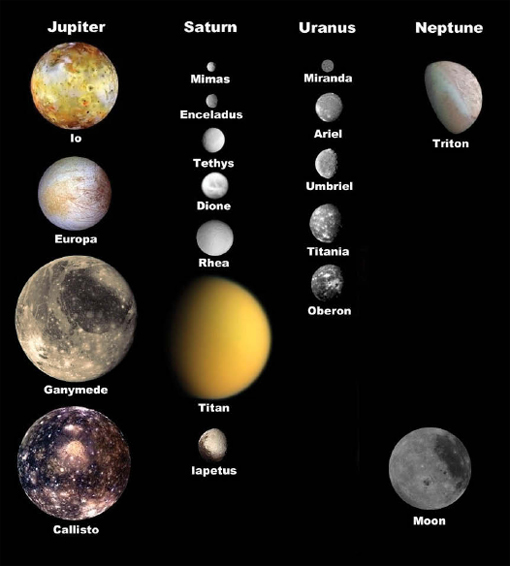
FIGURE 8.1 Montage of the major outer planet satellites, with Earth’s Moon for scale. Ganymede’s diameter is 5,262 km. The Moon’s diameter is 3,476 km. SOURCE: NASA.
theme includes the question, What were the primordial sources of organic matter, and where does organic synthesis continue today? The surfaces and interiors of the icy satellites display a rich variety of organic molecules—some believed to be primordial, some likely being generated even today; Titan presents perhaps the richest planetary laboratory for studying organic synthesis ongoing on a global scale. Europa, Enceladus, and Titan are central to another key question in this theme: Beyond Earth, are there modern habitats elsewhere in the solar system with necessary conditions, organic matter, water, energy, and nutrients to sustain life, and do organisms live there now? Exhibiting a global methane cycle akin to Earth’s hydrologic cycle, Titan’s complex atmosphere is key to understanding the workings of the solar system theme and the question, Can understanding the roles of physics,
TABLE 8.1 Characteristics of the Large- and Medium-Size Satellites of the Giant Planets
| Primary | Satellite | Distance from Primary(km) | Radius (km) | Bulk Density (g cm-3) | Geometric Albedo | Dominant Surface Composition | Surface Atmospheric Pressure (bars) | Dominant Atmospheric Composition | Notes |
| Jupiler | Io | 422,000 | 1,822 | 3.53 | 0.6 | S, SO2, silicates | 10-9 | SO2 | Intense tidally driven voleanism, plumes, high mountains |
| Europa | 671,000 | 1,561 | 3.01 | 0.7 | H2O, hydrates | 10--12 | O2 | Recent complex resurfacing, probable subsurface ocean | |
| Ganymede | 1,070,000 | 2,631 | 1.94 | 0.4 | H2O, hydrates | 10--12 | O2 | Magnetic field, ancient tectonism, probable subsurface ocean | |
| Callislo | 1,883,000 | 2,410 | 1.83 | 0.2 | H2O Phyllosilicates? | Partially undifferentiated, heavily cratered, probable subsurface ocean | |||
| Salurn | Mimas | 186,000 | 198 | 1.15 | 0.6 | H2O | Heavily cratered | ||
| Enceladus | 238,000 | 252 | 1.61 | 1.0 | H2O | Intense recent tectonism, active water vapor/ice jets | |||
| Tethys | 295,000 | 533 | 0.97 | 0.8 | H2O | Heavily crate red, fractures | |||
| Dione | 377,000 | 562 | 1.48 | 0.6 | H2O | Limited resurfacing, fractures | |||
| Rhea | 527,000 | 764 | 1.23 | 0.6 | H2O | Heavily crate red, fractures | |||
| Tiian | 1,222,000 | 2,576 | 1.88 | 0.2 | H2O, organics, liquid CH4 | 1.5 | N2,CH4 | Active hydrocarbon hydrologic cycle, complex organic chemistry | |
| Iapetus | 3,561,000 | 736 | 1.08 | 0.3 | H2O, organics? | Heavily cratered, extreme albedo dichotomy | |||
| Primary | Satellite | Distance from Primary(km) | Radius (km) | Bulk Density (g cm-3) | Geometric Albedo | Dominant Surface Composition | Surface Atmospheric Pressure (bars) | Dominant Atmospheric Composition | Notes |
| Uranus | Miranda | 130,000 | 236 | 1.21 | 0.3 | H2O | Complex and inhomogeneous resurfacing | ||
| Ariel | 191,000 | 579 | 1.59 | 0.4 | H2O | Limited resurfacing, fractures | |||
| Umbriel | 266,000 | 585 | 1.46 | 0.2 | H2O, dark material | Heavily cratered | |||
| Titania | 436,000 | 789 | 1.66 | 0.3 | H2O | Limited resurfacing, fractures | |||
| Oberon | 584,000 | 761 | 1.56 | 0.2 | H2O, dark material | Limited resurfacing | |||
| Neplune | Triton | 355,000 | 1,353 | 2.06 | 0.8 | N2,CH4,H2O | 10-5 | N2,CH4 | Captured; recent resurfacing, complex geology, active plumes |
chemistry, geology, and dynamics in driving planetary atmospheres and climates lead to a better understanding of climate change on Earth? Finally, the giant-planet satellites exhibit an enormous spectrum of planetary conditions, chemistry, and processes—contrasting with those of the inner solar system and stretching the scientific imagination in addressing the question, How have the myriad chemical and physical processes that shaped the solar system operated, interacted, and evolved over time?
SCIENCE GOALS FOR STUDIES OF PLANETARY SATELLITES
The planetary science community has made remarkable progress over the past decade in understanding the major satellites of the giant planets (Table 8.2), but despite this progress, important questions remain unanswered. The committee developed some specific high-level goals and associated objectives to guide the continued advancement of the study of planetary satellites. The goals cover the broad areas of origin and evolution, processes, and habitability. They are as follows:
• How did the satellites of the outer solar system form and evolve?
• What processes control the present-day behavior of these bodies?
• What are the processes that result in habitable environments?
Each of these goals is described in more detail in subsequent sections.
HOW DID THE SATELLITES OF THE OUTER SOLAR SYSTEM FORM AND EVOLVE?
Understanding the origin and evolution of the satellites is a key goal of satellite exploration. Satellite composition and internal structure (particularly the state of differentiation) provide important clues to the formation of
TABLE 8.2 Major Accomplishments by Ground- and Space-Based Studies of the Satellites of the Giant Planets in the Past Decade
| Major Accomplishment | Mission and/or Technique |
| Discovered an active meteorological cycle on Titan involving liqui ydrocarbons instead of water | Cassini and Huygens; ground-based observations |
| Discovered endogenic activity on Enceladus and found that the Enceladus plumes have a major impact on the saturnian environment | Cassini |
| Greatly improved understanding of the origin and evolution of Titan’ tmosphere and inventory of volatiles and its complex organic chemistry | Theory and modeling based on Cassini and Huygen ata |
| Major improvement in characterizing the processes, composition, an istories for all the saturnian satellites | Theory and modeling based on Cassini data |
| Developed new models improving understanding of Europa, Io, and th ther Galilean satellites | Theory and modeling based on Galileo data; ground-based observations; and Cassini and New Horizons |
these worlds and their parent planet; of particular interest are the origin and evolution of volatile species. Orbital evolution, and its intimate connections to tidal heating, provide a major influence on satellite evolution. Tidal and other energy sources drive a wide range of geologic processes, whose history is recorded on the satellite surfaces.
Objectives associated with the goal of understanding the formation and evolution of the giant-planet satellites include the following:
• What were the conditions during satellite formation?
• What determines the abundance and composition of satellite volatiles?
• How are satellite thermal and orbital evolution and internal structure related?
• What is the diversity of geologic activity and how has it changed over time?
Subsequent sections examine each of these objectives in turn, identifying important questions to be addressed and future investigations and measurements that could provide answers.
What Were the Conditions During Satellite Formation?
The properties of the existing regular satellite systems provide clues about the conditions in which they formed. The regular satellites of Jupiter, Saturn, and Uranus orbit in the same planes as the planets’ equators, suggesting that the moons likely formed in an accretion disk in the late stages of planet formation.1 Neptune has one large irregular satellite, Triton, in an inclined and retrograde orbit (opposite from the direction of Neptune’s rotation). Triton may be a captured Kuiper belt object, and moons that might have formed in a neptunian accretion disk were probably destroyed during the capture. Each of the regular systems has unique characteristics. Jupiter has four large satellites (the Galilean satellites), the inner two of which are essentially rocky bodies while the outer two moons are rich in ice. The saturnian system has a single large satellite, whereas closer to Saturn there are much smaller, comparably sized icy moons. The regular uranian satellites lie in the planet’s equatorial plane that is tilted by 97° to the ecliptic (i.e., the plane of Earth’s orbit).
The outer planet satellites have also been modified by endogenic (e.g., internal differentiation and tides) and exogenic (e.g., large impacts) processes that have strongly influenced what is seen today. Although the present orbital dynamical, physical, and chemical states of the satellites preserve information about their origins, such information can have been hidden or erased by processes occurring during the evolution of the moons.
The Cassini mission has opened our eyes to the wonders of the saturnian satellites. Titan’s surface is alive with fluvial and aeolian activity,2 yet its interior is only partially differentiated,3 has no magnetic field, and probably has no metallic core. On tiny Enceladus, water vapor plumes have been discovered emanating from south polar
fissures, warmed by an unusual amount of internal heat.4 These observations together with the satellite’s density have important implications for the interior of Enceladus that in turn impose limitations on its formation and evolution. Iapetus is remarkably oblate for its size, and its ancient surface features a singular equatorial belt of providing unique constraints on its early history. Cassini observations of the other saturnian moons—Rhea, Dione, Mimas, and Tethys—have increased our knowledge of their surfaces, compositions, and bulk properties.
Measurements of volatile abundances are enabling the reconstruction of the planetesimal conditions at the time of accretion of the satellites, but those conditions are still far from understood. Titan’s dense atmosphere makes it especially interesting: The dominance of molecular nitrogen and the absence of the expected accompanying abundance of primordial argon are important results that constrain its origin.5
Important Questions
Some important questions concerning the conditions during satellite formation include the following:
• Why are Titan and Callisto apparently imperfectly differentiated whereas Ganymede underwent complete differentiation?
• Why did Ganymede form an iron-rich core capable of sustaining a magnetic dynamo?
• What aspects of formation conditions governed the bulk composition and subsequent evolution of Io and Europa?
• In what ways did the formation conditions of the saturnian satellites differ from the conditions for the jovian satellites?
• Is it possible to discern in the uranian satellites any evidence of a very different origin scenario (a giant impact on Uranus, for example), or is this satellite system also the outcome of a process analogous to processes by which the other giant-planet satellites originated?
• What features of Triton are indicative of its origin?
Future Directions for Investigations and Measurements
An investigation key to understanding the conditions during satellite formation is to establish the thermodynamic conditions of satellite formation and evolution by determination of the bulk compositions and isotopic abundances. These results would directly constrain conditions of formation, for example the radial temperature profile in the planetary accretion disk from which the regular satellites formed. Two other crucial areas of investigation are to better constrain the internal mass distributions of many of the satellites by measuring the static gravitational fields and topography and to probe the existence and nature of internal oceans by measuring tidal variations in gravity and topography and by measuring electromagnetic induction in the satellites at multiple frequencies. Internal oceans may date to a satellite’s earliest history, given that they can be difficult to re-melt tidally once frozen, and thus their presence constrains formation scenarios.
What Determines the Abundance and Composition of Satellite Volatiles?
Volatiles on the outer planet satellites are contained mainly in ices, although volatiles can also be retained in the rocky components (e.g., hydrated silicates on Europa or Io). Clathration (i.e., the incorporation of gas molecules within a modified water-ice structure) is a likely process for retention of many volatiles in satellite interiors, and it helps to explain the current composition of Titan.6 Alternatives like trapping of gases in amorphous ice have also been suggested.
The building blocks for the satellites may have originated from the solar nebula or formed in the planetary subnebula.7 In either case, the thermodynamic conditions and composition of the gas phase determine the formation conditions of ices.
Huygens probe results and Cassini results have motivated a great deal of modeling of the formation conditions for the Saturn system and Titan in particular. Planetesimal formation in the solar nebula with only modest subnebula
processing may be representative of the satellite formation process in the Saturn system,8 and clathration may have had an important role, presumably aided by collisions between planetesimals to expose “fresh” ice. In the Galilean satellites, by contrast, extensive processing in the jovian subnebula may have occurred. However, the formation conditions of the Galilean satellites are not well constrained at this time, due to the lack of measurements of volatiles for these satellites, including noble gases and their stable isotopes. The origin and evolution of methane on Titan are receiving much attention, with some workers favoring ongoing outgassing from the interior to balance the continual destruction over geologic time. The argon content of the atmosphere implies that nitrogen arrived as ammonia rather than as molecular nitrogen, yet how ammonia evolved into molecular nitrogen is not known.
Ground-based spectroscopy continues to expand our knowledge of inventories of volatiles on satellite surfaces, for instance with the discovery of carbon dioxide ice on the uranian satellites.9
Important Questions
Some important questions concerning the abundance and composition of satellite volatiles include the following:
• In what ways do the highly volatile constituents differ between Callisto and Ganymede?
• Are volatiles present at the surface or in the ice shell of Europa that are indicative of internal processing or resurfacing?
• How, and to what extent, have volatiles been lost from Io?
• What does the plume material from Enceladus tell us about the volatile inventory of that body?
• Why does Titan uniquely have an exceptionally thick atmosphere?
• What does the volatile inventory of Titan tell us about its history? In particular, how is the methane resupplied, given its rapid photochemical destruction in the upper atmosphere?
Future Directions for Investigations and Measurements
Investigations and measurements relevant to the abundance and composition of satellite volatiles include determination of the volatile composition of the ices, the stable isotope ratios of carbon, hydrogen, oxygen, and nitrogen, and the abundances of the noble gases to help untangle nebula and subnebula processes using highly precise remote and in situ determinations of atmospheric and surface compositions; improved observations of currently active processes of loss of volatiles; and improved understanding of the thermodynamics of volatiles and the efficiency of clathration of volatiles as a function of the formation conditions.
How Are Satellite Thermal and Orbital Evolution and Internal Structure Related?
Like those of planets, the structure and evolution of satellites are strongly affected by mass and composition. Unlike planets, satellites are very close to the central body and can therefore be greatly affected by tides and tidally mediated resonances (i.e., periodic mutual gravitational interactions).10 This leads to a rich diversity of outcomes (Figure 8.2), understanding of which can reveal the history of the system and a satellite’s internal structure. At least three bodies (Io, Europa, and Enceladus) are thought to be currently undergoing large tidal heating, and others (Ganymede, Triton, possibly Titan, and maybe more) may have been heated in this way in the past. Tidal effects are ultimately limited by orbital evolution and the energy budget this allows. Unlike heating caused by energy released from radioactive substances, the magnitude and the spatial and temporal variability of tidal heating are very sensitive to the structure of a satellite. The evolution of the internal structure of a satellite is also affected by the radiogenic heating of the rocky component, and this alone will guarantee convection in the ice-rich parts of the larger satellites.11 Convection can in turn drive surface tectonics and may cause outgassing or cryovolcanism.
Although Enceladus was already recognized at the time of the 2003 planetary science decadal survey as a likely location of tidal heating, it has emerged as an active body of great interest, primarily through Cassini observations. The plume activity and estimates of thermal emission imply a level of tidal heating that is unexpectedly high for a
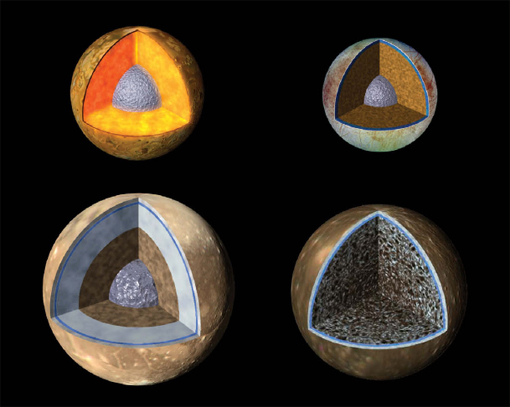
FIGURE 8.2 Schematic of the highly diverse interiors of the Galilean satellites, inferred from Galileo data. Io (upper left), Europa (upper right), and Ganymede (lower left) have metallic cores surrounded by silicate mantles that, in the case of Europa and Ganymede, are overlain by water ice and subsurface oceans (blue). Europa’s ocean, unlike Ganymede’s, is in contact with the underlying silicate mantle. Callisto (lower right) also hosts an ocean but is only partially differentiated, and its interior consists primarily of mixed silicates and ice. Ganymede’s diameter is 5,262 km. SOURCE: NASA/JPL.
body so small. Enceladus’s forced eccentricity and tidal heating may not, however, be constant through geologic time.12 Progress has also continued on a more complete understanding of Io and Europa, through continued analysis of Galileo data combined with ground-based and Earth orbit telescopic observations. Recent work appears to support the idea that Io is in thermal but not orbital equilibrium.13 Cassini gravity data suggest that Titan is not fully differentiated,14 perhaps like Callisto but unlike Ganymede. These data mainly elucidate formation conditions but might also inform researchers about tidal heating in Ganymede or the role of later impacts.
Important Questions
Some important questions about the thermal and orbital evolution of satellites and how it relates to their internal structure include the following:
• What is the history of the resonances responsible for the tidal heating, and how is this heating accomplished?
• How does this heat escape to the surface?
• How is this heat transfer related to the internal structure (thickness of an outer solid shell, or composition of the interior) and formation?
• How hydrostatic are the satellites?
There are also body-specific questions:
• Does Io have a magma ocean, and what is the compositional range of its magmas?
• What is the origin of the topography of Io?
• What are the magnitude and the spatial distribution of Io’s total heat flow?
• What are the thickness of Europa’s outer ice shell and the depth of its ocean?
• What is the magnitude of Europa’s tidal dissipation, and how is it partitioned between the silicate interior and the ice shell?
• What is the relationship between Titan’s surface morphology and its internal processes, particularly for the history of the methane budget and lakes or seas and possible replenishment of methane from the interior or subsurface?
• Does Titan have an internal liquid-water ocean?
• What is the spatial distribution of Enceladus’s heat output, and how has it varied with time?
• Does Enceladus have an ocean or some other means of providing large tidal dissipation, and to what extent is its behavior dictated by its formation conditions (e.g., presence or absence of a differentiated core)?
• What does the diversity of the uranian moons indicate about the evolution of small to medium-size icy satellites? What drove such dramatic endogenic activity on Miranda and Ariel?
• What powers past or possible ongoing activity on Triton, which currently has negligible tidal heating?
Future Directions for Investigations and Measurements
Many of the future investigations needed to understand satellite formation arise here as well because of the interplay of formation conditions and subsequent thermal evolution. A better understanding of the internal structure and thermal evolution of satellites requires measurements of static gravitational fields and topography to probe interior structure and of tidal variations in gravity and topography, as well as electromagnetic induction in the satellites at multiple frequencies to search for oceans. The presence and nature of intrinsic magnetic fields also constrain internal thermal evolution and initial conditions. Another needed key investigation is subsurface sounding (e.g., radar) to investigate the structure of the upper lithosphere. Heat flow can be sufficiently large to be detected through thermal infrared techniques. This provides a powerful constraint on the satellite’s thermal state. Improved maps of composition and geology of the satellite surfaces will constrain the extent and nature of transport of heat from the interior. Critical to interpretations from these investigations are improved laboratory determinations of the thermophysical and mechanical properties of relevant candidate materials to better constrain interior processes.
What Is the Diversity of Geologic Activity and How Has It Changed Over Time?
The surfaces of solar system bodies provide important clues to their history and evolution. Collectively, outer planet satellites show the scars of almost every surface process, including impact cratering, tectonic deformation, cryovolcanism, and aeolian and fluvial erosion. Many of these processes are still mysterious. Icy-satellite is often extensional,15 sometimes bringing interior materials up to the surface, but strike-slip faulting is also observed. Compressive tectonism is less evident on icy satellites; however, it is likely responsible for Io’s towering mountains.16 Much of Europa’s surface is disrupted by extensive and mysterious chaos regions.17 Solid-state convection is likely to be an important driver of icy-satellite geology, but details are unclear. The large range of ages and processes provides a valuable window into solar system history, constraining thermal and compositional evolution and allowing a better understanding of how planetary systems form and evolve.
The science return from the Cassini mission has been phenomenal. Multiple flybys of Titan have confirmed the presence of numerous methane lakes on the surface—the only bodies of surface liquid on any known world other than Earth—along with fluvial channels (Figure 8.3), and evidence for seasonal variations.18 Images of Enceladus reveal a long and complex geologic history that continues to the present day, and includes ridges that are morphologically similar to Europa’s ubiquitous double ridges.19 Wispy features on Dione and Rhea’s trailing hemisphere have been revealed to be huge cliffs, evidence of a tectonically active past.20 Images of Iapetus show
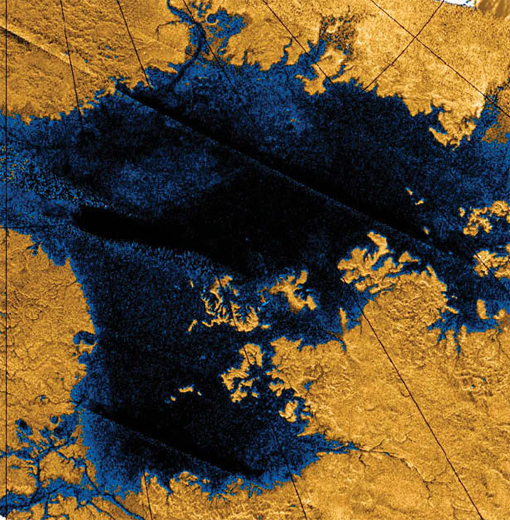
FIGURE 8.3 False-color Cassini radar image of a methane sea near Titan’s north pole, fed by dendritic drainage channels. The image is 360 km from top to bottom. SOURCE: NASA/JPL/USGS.
an ancient equatorial belt of mountains, a remnant of Iapetus’s early evolution. Cassini images have shown unusual impact crater morphologies on Hyperion. Continued analysis of Galileo images has constrained the population of primary and secondary impactors in the outer solar system21 and provides continued new insights into the remarkable geology of Europa.
Important Questions
Some important questions about the diversity of geologic activity and how it has changed over time include the following:
• One of the key missing pieces in the understanding of satellite surface geology is adequate knowledge of the cratering record in the outer solar system.22 What are the impactor populations in the outer solar system, and how have they changed over time, and what is the role of secondary cratering?
• What are the origins of tectonic patterns on Europa, including the ubiquitous double ridges (Figure 8.4) and chaos regions?
• How much non-synchronous rotation has Europa’s ice shell undergone, and how have the resulting stresses manifested at the surface?
• How is contraction accommodated on Europa?
• Has material from a subsurface Europa ocean been transported to the surface, and if so, how?
• What caused Ganymede’s surface to be partially disrupted to form grooved terrain, and is the grooved terrain purely tectonic or partly cryovolcanic in origin?
• Did Ganymede suffer a late heavy bombardment that affected its appearance and internal evolution?
• What is the age of Titan’s surface, and have cryovolcanism and tectonism been important processes? Have there been secular changes in the surface methane inventory?
• Why is Enceladus’s geology so spatially variable, and how has activity varied with time?
• What geologic processes have created the surfaces of the diverse uranian moons, particularly the dramatic tectonics of Miranda and Ariel?
• Has viscous extrusive cryovolcanism occurred on icy satellites, as suggested by features on Ariel and Titan?
• What geologic processes operate on Triton’s unique surface, how old is that activity, and what do its surface features reveal about whether Triton is captured?
Future Directions for Investigations and Measurements
Advancing understanding of the full range of surface processes operative on outer planet satellites requires global reconnaissance with 100-meter scale imaging of key objects, particularly Europa, Titan, and Enceladus as well as topographic data and high-resolution mapping (~10 meters/pixel) of selected targets to understand details of their formation and structure. In particular, understanding of tidally induced tectonics requires such global maps. Improved knowledge about subsurface structure is essential to constrain the nature and extent of endogenic geologic processes, for example the lithospheric thickness, fault penetration depths, porosity, thermal structure, and the presence of subsurface liquid. Maps of compositional variations at high spatial and spectral resolution and over a broad range of wavelengths are key to understanding how surface materials are emplaced and evolve.
Critical to accurate interpretation of such spacecraft data are better laboratory reflectance and emission spectra of materials relevant to the outer solar system (some of which do not exist at standard temperature and pressure). A comprehensive spectral database of ices and minerals covering a wide temperature range would have wide-ranging applications to outer solar system satellites.
WHAT PROCESSES CONTROL THE PRESENT-DAY BEHAVIOR OF THESE BODIES?
Many planetary satellites are highly dynamic, alive with geologic and/or atmospheric activity, and even the more sedate moons have active chemical and physical interactions with the plasma and radiation environments that
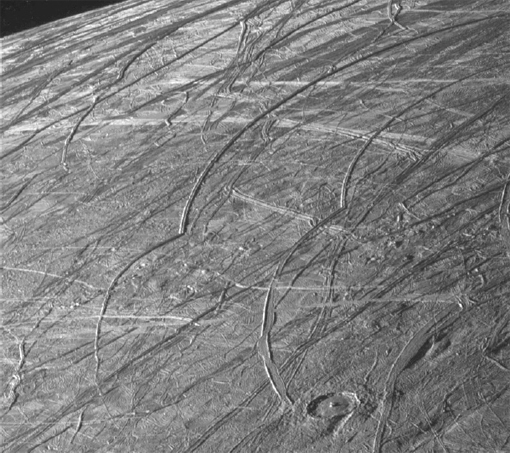
FIGURE 8.4 Cycloid ridges on Europa, seen by Galileo in 1998. The planform of these ridges probably results from diurnal variations in tidal stresses, placing limits on the strength of the ice shell, but the reason that the ridges are double, like so many on Europa, remains a mystery. The image is about 150 km across. SOURCE: NASA/JPL.
surround them. Study of these active processes provides an invaluable opportunity to understand how planetary bodies work.
Important objectives include the following:
• How do active endogenic processes shape the satellites’ surfaces and influence their interiors?
• What processes control the chemistry and dynamics of satellite atmospheres?
• How do exogenic processes modify these bodies?
• How do satellites influence their own magnetospheres and those of their parent planets?
Subsequent sections examine each of these objectives in turn, identifying key questions to be addressed and future investigations and measurements that could provide answers.
How Do Active Endogenic Processes Shape the Satellites’ Surfaces and Influence Their Interiors?
Watching active geology as it happens provides unique insights into planetary processes that can be applied to less active worlds. Active endogenic geologic processes, both volcanic and tectonic, can be observed directly on Io and Enceladus, and Europa’s low crater density implies that ongoing activity is also plausible there. An isolated active region on Europa comparable in size to Enceladus’s south polar province could easily have been missed by previous missions. Evidence for ongoing endogenic activity on Titan has been suggested, and Triton’s plumes may be driven by ongoing endogenic processes.23
Cassini measurements have revealed active cryovolcanism on Enceladus, which provides a window into its interior structure and composition and provides a case study for tidal heating of icy satellites; associated tectonic and other resurfacing activity is seen along and near the tiger stripes (the active geologic features near south pole) (Figures 8.5 and 8.6), shedding light on the origin of similar double ridges on Europa.24 Cassini images of Titan’s surface show many enigmatic features, some of which may result from active cryovolcanism. The source of the current atmospheric methane which should be destroyed on geologically short timescales remains problematic, and cryovolcanic supply remains plausible.25
At Jupiter, the Pluto-bound New Horizons spacecraft demonstrated the potential of high data rates and sensitive instrumentation for illuminating active volcanic processes on Io, capturing spectacular images and movies of its volcanic plumes (Figure 8.7).26
Important Questions
Much remains to be learned about active volcanic and tectonic processes. Some important questions include the following:
• What mechanisms drive and sustain Enceladus’s plumes and active tiger stripe tectonics?
• What are the magnitude, spatial distribution, temporal variability, and dissipation mechanisms of tidal heating within Io, Europa, and Enceladus?
• Is there active cryovolcanism on Titan?
• What are the eruption mechanisms for Io’s lavas and plumes and their implications for volcanic processes on early and modern Earth?
Future Directions for Investigations and Measurements
Key investigations and measurements into active tectonic and volcanic processes include (1) exploration of Io’s dynamic volcanism in the temporal domain at high spatial resolution, over timescales ranging from minutes (for the dynamics of active plumes) to weeks or decades (for the evolution of lava flows and volcanic centers), (2) global maps of Titan’s surface morphology and surface composition to search for evidence for present-day geologic activity, and (3) acquisition of higher-resolution thermal and visible imaging of the active south pole of Enceladus, including temporal coverage, to elucidate plume generation mechanisms. Other important objectives include a search for activity on other satellites such as Europa by looking for thermal anomalies, gas and dust plumes, or surface changes, as well as collection of additional in situ measurements of the composition of the endogenic materials lofted into the atmospheres or plumes of these satellites.
What Processes Control the Chemistry and Dynamics of Satellite Atmospheres?
Satellite atmospheres are exceptionally varied (see Table 8.1), and a great range of processes govern their structures, chemistries, and dynamics. Surface pressures range over 12 orders of magnitude, from picobars to
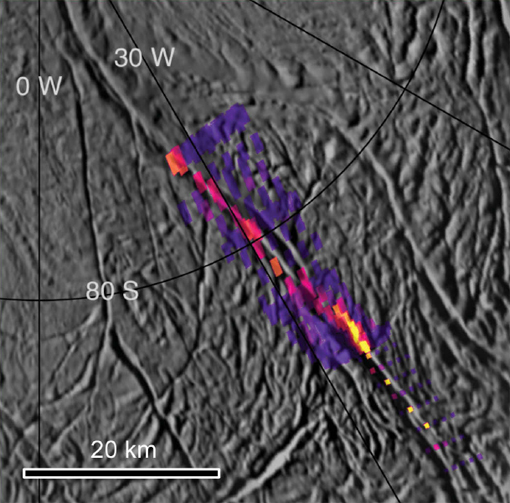
FIGURE 8.5 Thermal emission from a small part of Baghdad Sulcus, a “tiger stripe” fissure near Enceladus’s south pole, seen by Cassini at a wavelength of 9 to 16 μm in 2009. Thermal emission intensity is color coded from blue (negligible) to yellow (most intense). Inferred surface temperatures exceed 180 K. SOURCE: NASA/JPL/GSFC/Southwest Research Institute/Space Science Institute.
1.5 bar (~1.5 times Earth’s surface pressure). The thinnest atmospheres, including those of Europa, Ganymede, and probably Callisto, are created by sputtering (i.e., ejection of particles from the surface by plasma bombardment) and are dominated by oxygen molecules that are too sparse to interact significantly with each other.27 Io’s patchy atmosphere, dominated by sulfur dioxide, results from a combination of volcanic supply and surface frost evaporation,28 whereas Triton’s denser global molecular nitrogen-dominated atmosphere is supported entirely by the evaporation of surface frosts.
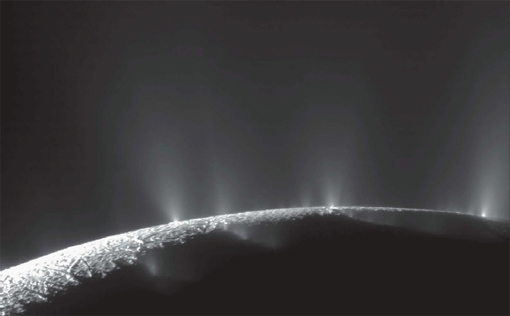
FIGURE 8.6 Multiple jets, dominated by water vapor and ice particles but containing a rich mixture of other compounds, emanate from the active warm fractures at Enceladus’s south pole. This Cassini image is 130 km across. SOURCE: NASA/JPL/Space Science Institute.
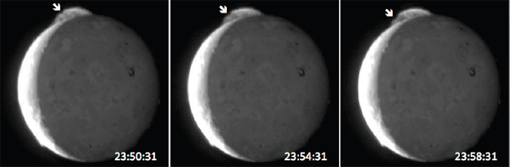
FIGURE 8.7 Three frames from a movie of Io’s Tvashtar plume, showing plume motion on minute timescales, taken by New Horizons during its 2007 Jupiter flyby. The motion of one feature in the plume is highlighted by the arrows. Io’s diameter is 3,642 km. SOURCE: NASA/Applied Physics Laboratory/Southwest Research Institute.
Ground-based observations have furthered understanding of the distribution of the atmosphere-supporting molecular nitrogen and methane frosts over the surface of Triton.29 Ground-based and Hubble Space Telescope observations have demonstrated that Io’s atmosphere is concentrated in the equatorial regions and shows stable 10-fold variations in density with longitude.30
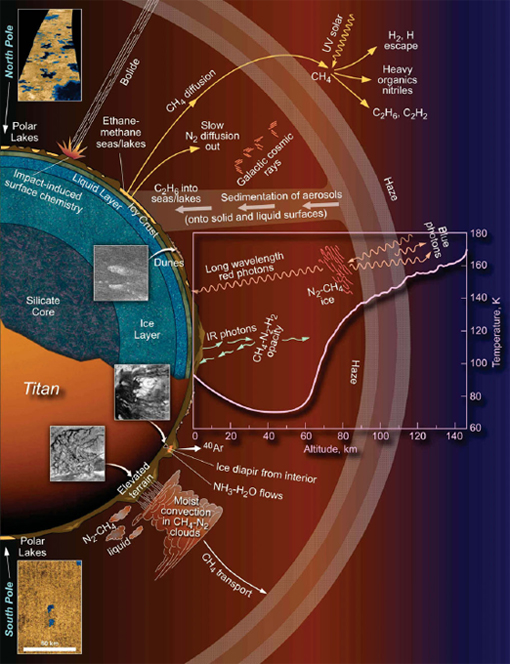
By far the largest satellite atmosphere is Titan’s, dominated by nitrogen molecules, which dwarfs Earth’s atmosphere, and which originated from the outgassing of volatiles during its formation, continuing into at least the recent past. Titan’s atmosphere experiences a range of dynamical and chemical processes31 (Figure 8.8). The second most abundant constituent, methane, exists as a gas, a liquid, and a solid, and cycles from the surface to the atmosphere, with clouds, rain, and lakes. The temperature profile manifests greenhouse warming and “anti-greenhouse” cooling. The dynamics of Titan’s atmosphere range in scale from global circulation patterns to local methane storms. Titan’s atmospheric composition is affected primarily by the dissociation of methane and nitrogen by solar ultraviolet radiation and magnetospheric electrons, which leads to a complex chemistry that extends from the ionosphere down to the surface.
Measurements by Cassini and Huygens, complemented by ground-based observations, have revolutionized understanding of Titan’s atmosphere. Cassini and ground-based telescopes have begun to characterize the seasonal variations in Titan’s clouds and circulation patterns, for example recently observing the appearance of clouds at the beginning of northern spring, and Cassini has revealed surface terrains shaped by rain, rivers, and wind, which point to weather possesses similar to those on Earth with convection, evaporation, and rainfall. measurements have also revealed that Titan’s ion chemistry and photochemistry produce a multitude of heavy organic molecules, likely containing amino acids and nucleotides.
Important Questions
Some important questions concerning the chemistry and dynamics of satellite atmospheres include the following:
• What is the temporal and spatial variability of the density and composition of Io’s atmosphere, how is it controlled, and how is it affected by changes in volcanic activity?
• What are the relative roles of sublimation, molecular transport, sputtering, and active venting in generating tenuous satellite atmospheres?
• Do the large organic molecules detected by Cassini in Titan’s haze contain amino acids, nucleotides, and other prebiotic molecules?
• What processes control Titan’s weather?
• What processes control the exchange of methane between Titan’s surface and the atmosphere?
• Are Titan’s lakes fed primarily by rain or by underground methane-ethane “aquifers”?
• How do Titan’s clouds originate and evolve?
• What is the temperature and opacity structure of Titan’s polar atmosphere, and what is its role in Titan’s general circulation?
• What is Triton’s surface distribution of molecular nitrogen and methane, and how does it interact with the atmospheric composition and dynamics?
Future Directions for Investigations and Measurements
Improved understanding of the chemistry and dynamics of Io’s atmosphere will require improved mapping of the spatial distribution and temporal variability of its atmosphere and associated correlations with local time and volcanic activity, as well as measurement of the diurnal variation in frost temperatures, and direct sampling of the atmosphere to determine composition. New advances in characterizing the tenuous atmospheres of the icy Galilean and saturnian satellites can be achieved by direct sampling from flybys and, where possible, by their ultraviolet emissions.
Continued observations of seasonal changes on Titan will be vital to understanding the dynamics of its atmosphere and its interaction with the surface. Improved understanding of its organic chemistry will require in situ
atmospheric compositional measurements capable of characterizing complex organic molecules. New insights into atmosphere-surface interactions and energy balance on Titan will require global and regional morphological and compositional mapping of the surface as well as measurements of lake composition and evaporation processes. Future measurements of the vertical structure of Titan’s hazes and clouds, their densities, and particle sizes and shapes are needed to understand cloud and haze formation and evolution, particularly in the polar regions.
Advancing the exploration of Triton will require detailed surface compositional and temperature maps coupled with ultraviolet stellar and radio occultations, as well as direct samples of the atmosphere from spacecraft flybys.
New laboratory data on the spectroscopy of mixtures including molecular nitrogen, methane, ethane, and propane liquid and ice, as well as methane gas at high pathlength (1029 m–2) and low temperature (~85 K), are critical to understand the volatile inventory on Titan and the composition of Triton’s surface and atmosphere.
How Do Exogenic Processes Modify These Bodies?
Most of the large satellites are embedded in the hot corotating plasmas of their planets’ magnetospheres. The plasmas erode the surfaces of these satellites through ion sputtering and also chemically modify them through electron-induced radiolysis (i.e., radiation-driven chemistry).32 With the exception of Ganymede (which is protected by its own magnetic field), the trailing hemispheres of the satellites bear the brunt of the corotating plasma onslaught (Figure. 8.9). Ion sputtering results in the formation of tenuous atmospheres and even circumplanetary ion and neutral tori (such as around the orbits of Io and Europa), and potentially allows orbital measurement of surface composition via sputtered products. Europa may lose around 2 centimeters of its surface to plasma sputtering every million years.33 Implantation of exogenic species can be significant (for instance, sulfur of likely ionian origin is found on Europa’s trailing side), and radiolytic processing generates reactive species such as molecular oxygen and hydrogen peroxide in surface ices, which might, in the case of Europa or Enceladus, deliver chemical energy to underlying bodies of liquid water in quantities sufficient to power biological activity.34
Micrometeoroids play a crucial role in regolith generation and in redistributing radiolytic products to the subsurface layers through impact gardening. Regolith thickness may be many meters. Impacts may eject surface dust
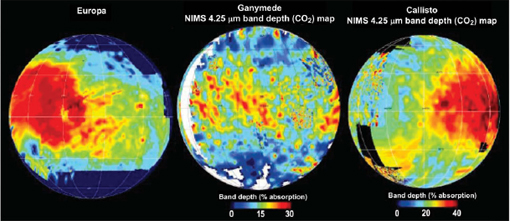
FIGURE 8.9 Near-infrared maps from the Galileo mission of non-water-ice surface materials on Europa (left, sulfate hydrates), Ganymede (middle, carbon dioxide), and Callisto (right, carbon dioxide). The color red indicates high non-water-ice abundance regions for Europa and Callisto that are centered on the trailing hemispheres, consistent with expected magnetospheric effects. SOURCE: John Cooper.
samples to altitudes where they can be analyzed by orbiting or flyby spacecraft. Macroscopic impacts are the major landform generators on many satellites, and are powerful probes of the structure and composition of the subsurface that they penetrate. Crater populations provide information on relative ages of surface units and on the population of projectiles over time.
Solar radiation also alters planetary surfaces. Extreme ultraviolet photolysis (i.e., photon-driven chemistry) modifies surface composition (though it is dominated by particle radiation on Jupiter’s moons), and solar ultraviolet radiation has a major influence on the atmospheric chemistry of Titan. Solar-driven frost sublimation is an important process in atmospheric support and the modification of surface albedo and composition.
Recent studies based on Cassini data indicate that in Saturn’s magnetosphere, the loss of surface material from plasma sputtering from the icy satellites is minimal (less than a few grams per second for all of the satellites). Cassini observations show that the rate of loss of heavy ions from Titan due to solar and magnetospheric effects is much larger than expected, and a mass as large as the mass to the present day atmosphere may have been lost to space over the lifetime of Titan, a conclusion supported by evidence for significant nitrogen-15/nitrogen-14 fractionation.35 Analysis of Cassini data from Iapetus suggests that its long-mysterious extreme albedo dichotomy results from a combination of exogenic processes (infall of dark dust and the resulting sublimation and migration of water ice), while Enceladus’s plumes have influenced the albedos and the leading and trailing photometric asymmetries of the inner Saturn satellites.
Important Questions
Some important questions concerning exogenic processes include the following:
• Is Io’s intense magnetospheric interaction responsible for its volatile depletion?
• How is the strong ionosphere of Triton generated?
• How do exogenic processes control the distribution of chemical species on satellite surfaces?
• How are potential Europa surface biomarkers from the ocean-surface exchange degraded by the radiation environment?
• What do the crater populations on the satellites reveal about the satellites’ histories and subsurface structure and about the populations of projectiles in the outer solar system and the evolution thereof?
Future Directions for Investigations and Measurements
Important investigations and measurements into exogenic processes include improved mapping of satellite surface composition to understand and separate the distributions of endogenic and exogenic materials. Because most of the exogenic materials are carried between the moons by plasma processes, in situ measurements of the field and plasma environments are required to understand the relative roles of exogenic and endogenic processes in defining the surface chemistries of the moons. These measurements may also be able to discover active venting from satellites. Improved remote sensing of impact structures, including topography and subsurface sounding (e.g., to reveal melt sheets and crustal thinning), will enhance understanding of impact processes and their effects on surface evolution. New laboratory studies should be performed to characterize the effects of irradiation on ices infused with exogenic and endogenic materials. Obtaining data on bulk ices and not just thin films is important because energetic electrons and photons often travel large distances before interacting with the contact material. More laboratory data are also needed to understand how the spectral characteristics of the icy satellites are modified by ion-induced sputtering, electron irradiation, micrometeoroid bombardment, and energetic photon bombardment in the cold, low-pressure environments of the icy satellites.
How Do Satellites Influence Their Own Magnetospheres and Those of Their Parent Planets?
The magnetospheres of Jupiter, Saturn, and Neptune (but not Uranus) derive a large fraction of their plasma and neutral content from their embedded satellites. In Jupiter’s magnetosphere, Io’s volcanoes deliver between
1 and 2 tons per second of material (mostly sulfur dioxide, sulfur, and oxygen) through Io’s atmosphere to the magnetosphere, and changes in plasma density may be related to changes in volcanic activity.36 Saturn’s magnetosphere is dominated by material from Enceladus, as detailed below.
The plasma in Neptune’s magnetosphere appears to be dominated by positive nitrogen ions derived mainly from the atmosphere of its moon Triton. Escape of electrically neutral particles from Triton supplies a neutral torus with a peak density of ~400 cm–3 near the orbit of Triton.37
Ganymede’s magnetosphere derives its plasma from its own sputter-generated atmosphere and also captures plasma from the magnetosphere of Jupiter. The residence time of plasma is quite short, and the overall densities of charged particles are small.38
Ground-based telescopic observations of Io’s torus and the associated fast neutral nebula continue to improve understanding of how Io refills its torus and ultimately supplies plasma to Jupiter’s magnetosphere. Continued analysis of Galileo and Cassini data have stressed the importance of Europa as another important source of plasma in Jupiter’s magnetosphere, revealing that a neutral atomic- and molecular-hydrogen torus is present near the orbit of Europa.39
Cassini has revealed that most of the material in Saturn’s magnetosphere, predominantly water, hydroxyl, and oxygen, is derived from the south polar plume of Enceladus.40 Unlike at Jupiter, this material is largely in a neutral rather than an ionized state. Saturn’s E-ring is continually resupplied by ice particles from the Enceladus plumes. Titan also loses a considerable amount of neutral material from its atmosphere, yet there is no evidence of the presence of plasma derived from Titan in the magnetosphere of Saturn.
Important Questions
Some important questions concerning how satellites influence their own magnetospheres and those of their parent planets include the following:
• Why is Jupiter’s magnetosphere dominated by charged particles whereas Saturn’s magnetosphere is dominated by neutral species?
• What fraction of the material in Jupiter’s magnetosphere originates from Europa and other icy satellites?
• Is the reconnection in Ganymede’s magnetosphere steady or patchy and bursty?
• How rapidly does Saturn’s magnetosphere react to the temporal variability of Enceladus’s plume?
• Do other saturnian icy satellites such as Dione and Rhea contribute a measurable amount of neutrals or plasma to Saturn’s magnetosphere?
• What is the nature of Triton’s inferred dense neutral torus?
Future Directions for Investigations and Measurements
Investigations and measurements important to advancing understanding of how satellites influence their own magnetospheres and those of their parent planets include (1) measurement of the composition of the jovian plasma and concurrent observations of Io’s volcanoes and plumes to understand the roles of Io and the icy satellites (especially Europa) in populating Jupiter’s magnetosphere and (2) simultaneous multiple spacecraft measurements of the jovian system to help to address the problem of temporal versus spatial change in Jupiter’s and Ganymede’s magnetospheres and to enhance understanding of how plasma populations move around in these magnetospheres. Also key are continued field and plasma measurements and monitoring of Enceladus’s plume to better elucidate the roles of Enceladus and other icy satellites in populating Saturn’s magnetosphere. A survey of the fields and plasmas of Neptune’s magnetosphere, supplemented by low-energy neutral-atom imaging of the magnetosphere, would dramatically improve understanding of Triton’s neutral torus.
WHAT ARE THE PROCESSES THAT RESULT IN HABITABLE ENVIRONMENTS?
The understanding of humanity’s place in the universe is a key motivation for the exploration of the solar system in general and planetary satellites in particular. Satellites provide many of the most promising environments for the evolution of extraterrestrial life, or for understanding the processes that led to the evolution of life on our own planet. Important objectives relevant to this goal include the following:
• Where are subsurface bodies of liquid water located, and what are their characteristics and histories?
• What are the sources, sinks, and evolution of organic material?
• What energy sources are available to sustain life?
• Is there evidence for life on the satellites?
Subsequent sections examine each of these objectives in turn, identifying key questions to be addressed and future investigations and measurements that could provide answers.
Where Are Subsurface Bodies of Liquid Water Located, and
What Are Their Characteristics and Histories?
A fundamental requirement for habitability is the presence of liquid water. Several of the larger satellites are thought to possess at least some liquid water in their interiors.41 In the coming decade, two key objectives will be to further characterize the known subsurface oceans, and to determine whether other bodies also possess such oceans.
One of the key results of the Galileo mission was the use of Jupiter’s tilted magnetic field to detect subsurface oceans via magnetic induction on Europa, Ganymede, and Callisto.42 However, neither the thickness nor the conductivity (and thus composition) of these oceans can be uniquely determined with the current observations.
The plumes on Enceladus include salt-rich grains, for which the most likely source is a salty subsurface body of liquid.43 A global ocean that permits greater tidal flexing and heating of the ice shell is also suggested by the observed surface heat flux; however, a regional “sea” beneath the South Pole is also possible.
Because of Titan’s size and the likely presence of ammonia, a subsurface ocean is plausible44 and expected to be a long-lived feature.
Important Questions
Some important questions concerning the location and characteristics of subsurface bodies of liquid water include the following:
• What are the depths below the surface, the thickness, and the conductivities of the subsurface oceans of the Galilean satellites? The depth of the ocean beneath the surface is important because it controls the rate of heat loss from the ocean and the probability of material exchange with the surface. The thickness indicates the likely ocean lifetime, and for Ganymede and Callisto constrains the ocean temperature.
• Which satellites elsewhere in the solar system possess long-lived subsurface bodies of liquid water? Titan and Enceladus are obvious candidates, but other mid-size icy satellites, including those of Uranus and Neptune, could in theory have retained internal oceans to the present day.45 Triton in particular, with its geologically young surface and current geysering, is another interesting candidate.
• For all satellites, what is the lifetime of potential oceans? Ocean lifetime is a key to habitability. If Enceladus is only intermittently active, for instance, as suggested by several lines of evidence, and thus only intermittently supports liquid water, it is less attractive as a potential habitat.46
Future Directions for Investigations and Measurements
Important investigations and techniques for exploring subsurface liquid water include further characterization of the Galilean satellite oceans with satellite orbiters that can measure the induction response at both Jupiter’s spin frequency and the satellite’s orbital frequency. With two frequencies, both the ocean depth and conductivity (which constrains composition) can be solved for independently.47 For Saturn’s satellites, the negligible tilt of Saturn’s magnetic field precludes induction studies by flybys, but studies may be possible from satellite orbit by exploiting the satellite’s orbital eccentricity. A flyby detection of an ocean would be possible at Triton or the uranian satellites. Measurement of tidal flexing, for example at Europa, can provide strong constraints on the thickness of the overlying ice shell and the presence of an ocean. Geodetic studies of the rotation states of these bodies might provide additional constraints on ocean characteristics. Other important investigations and measurements for probing satellite interiors should include use of subsurface sounding from orbit (e.g., using radar) to investigate the presence of near-surface water and perhaps the ice-ocean interface on Europa. In the far term in situ measurements from the surface would provide additional information on the surface composition and environment and the subsurface structure (via seismology or magnetometry). Improved compositional measurements of gas and dust ejected from the Enceladus plume (and potential Europa plumes) would provide valuable insights into the presence of liquid water at the plume source.
What Are the Sources, Sinks, and Evolution of Organic Material?
Life as we know it is made of organic material (i.e., complex carbon-based molecules). Organic molecules can be abiotically produced in the laboratory, and it is well known that the solar system and the interstellar medium are rich in nonbiological organics. The satellites have much to teach us about the formation and evolution of complex organics in planetary environments, with implications for the origin and evolution of terrestrial life.
Perhaps the clearest example of organic synthesis in the solar system is on Titan, where Cassini and Huygens have provided abundant new information.48 Methane and nitrogen in the atmosphere are decomposed by particle and solar radiation, starting a chemical reaction cycle that produces a range of gaseous organic molecules, with molecular weights up to and exceeding 5,000, and a haze of solid organics and liquid condensates.
Once on the surface the organics accumulate and apparently are responsible for the huge dunes seen in Titan’s equatorial regions. The atmospheric organics probably accumulate in the lakes seen in the polar regions.
Cassini has revealed that the plume of Enceladus hosts a rich organic chemistry, including methane and a rich suite of hydrocarbons.49 The source of the organics is not clear. Possibilities include thermal decay of organics brought in with the accreting material, Fischer-Tropsch type synthesis in a subsurface environment, rock-water reactions that can produce hydrogen, and finally, if most speculatively, methanogenic microorganisms.
Europa may have organics on its surface but this has not been conclusively demonstrated, and the radiation environment makes the survival of organics uncertain over a few million years.50 If organics are found on the surface of Europa, the next step would be to determine if these organics may have derived from the underlying ocean and if so, whether they might be biological in origin.
Important Questions
Some important questions about the sources, sinks, and evolution of organic material include the following:
• What is the nature of the atmospheric processes on Titan that convert the small organic gas-phase molecules observed in the upper atmosphere (such as benzene) into large macromolecules and ultimately into solid haze particles?
• What is the fate of organics on the surface of Titan and their interaction with the seasonally varying lakes of liquid hydrocarbons?
• Are organics present on the surface of Europa, and if so, what is their provenance?
• What is the source of the organic material in the plume of Enceladus?
Future Directions for Investigations and Measurements
Observations of the surface of Europa should include the capability to determine the presence of organics, for instance by reflectance spectroscopy or low-altitude mass spectroscopy of possible out-gassing and sputter products. Observations should also provide correlation of any surface organics with surface features related to the ocean and provide site selection for a future landed mission. Ultimately, however, a lander will probably be required to fully characterize organics on the surface of Europa. Studies of the organic processes on Titan in the atmosphere and on the surface will be best done with in situ platforms. The diversity of surface features on Titan related to organic solids and liquids suggests that long-range mobility is important. Measurements of the concentration of hydrogen and organics in the lower atmosphere and in surface reservoirs would allow for more quantitative determination of energy sources. Further studies of the high-elevation haze region would help provide a more complete picture of the formation of organic macromolecules. Finally, detailed investigations of the organic chemistry of the plume of Enceladus, with improved mass range and resolution compared to those provided by Cassini, are needed to determine the source of this material. Similar measurements would be important for any plumes that might be found on Europa.
What Energy Sources Are Available to Sustain Life?
On Earth, life derives the energy for primary productivity from two sources: sunlight and chemical redox couples (i.e., pairs of ions or molecules that can pass electrons back and forth). However, for sunlight to be an effective energy source, habitable conditions are required on the surface of a planet, with atmospheric shielding of solar ultraviolet and particle radiation. In the solar system, only Earth and Titan meet these requirements. Elsewhere in the solar system, the habitable zones, if they exist, are below the surface, cut off from sunlight. In these subsurface habitats, chemical redox couples are the most likely source of energy.
On Earth we have discovered three microbial ecosystems that survive without sunlight on redox couples that are produced geologically. Two of these ecosystems are based on hydrogen released by the reaction of water with basaltic rocks and the reaction of this hydrogen with carbon dioxide.51 Such an energy source could be operative in the ocean on Europa or in a liquid-water system on Enceladus. The third system on Earth is based on oxidants produced by the dissociation of water due to natural radioactivity,52 which produces oxidants and hydrogen. The oxidants produced generate sulfate that is then used by sulfur-reducing bacteria with the hydrogen. These three systems provide an analog for energy sources suggested for Europa and Enceladus in which oxidants are produced on the surface by ionizing radiation and are carried to the water reservoirs below the surface.53
On Titan the availability of chemical energy is obvious. The atmospheric cycle of organic production results in the formation of organics such as acetylene and ethane, with less hydrogen per carbon than methane. These compounds, as well as the solid organic material, will react with atmospheric hydrogen to release energy in amounts that can satisfy the needs of typical Earth microorganisms.
On Europa and Enceladus there are clearly geothermal energy sources. But the availability of a biologically usable chemical energy source (methanogen or oxidant based) remains speculative though possible.
Important Questions
Some important questions about the available energy sources for sustaining life include the following:
• What is the nature of any biologically relevant energy sources on Europa?
• What are the energy sources that drive the plume on Enceladus? These may lead to understanding the possibilities for biologically relevant energy sources.
• On Titan, how is chemical energy delivered to the surface?
Future Directions for Investigations and Measurements
Important directions for future investigations relating to energy sources for life include (1) measurement of the oxidant content and studies to increase understanding of its formation mechanisms on the surface ice of Europa and Enceladus, (2) through remote sensing, efforts to improve understanding of geologic processes that might deliver surface oxidants to subsurface liquid water, and (3) for Titan, improved measurements of atmospheric and surface chemistry to increase understanding of the biological availability of chemical energy.
Is There Evidence for Life on the Satellites?
The search for evidence of life is an emerging science priority for the moons of the outer solar system. Organic material produced biologically is distinguishable from abiotic sources.54 Studies of the plume of Enceladus and any organics on the surface of Europa (or in potential Europa plumes) may provide evidence of biological complexity even if the organisms themselves are no longer present or viable. Titan has a liquid on its surface—methane, not water—and there are speculations that it may be a suitable medium for organic life as well.55
The detection of organic material in the icy plume of Enceladus indicates the possibility of conditions suitable for biological processes, present or past. On Titan organic molecules are clearly present and interacting with liquids (certainly liquid hydrocarbons and possibly ammonia-water mixtures), but these interactions are not necessarily of biological origin.
Important Questions
Some important questions relevant to evidence for life on the satellites include the following:
• Does (or did) life exist below the surface of Europa or Enceladus?
• Is hydrocarbon-based life possible on Titan?
Future Directions for Investigations and Measurements
A key future investigation of the possibility of life on the outer planet satellites is to analyze organics from the interior of Europa. Such analysis requires either a lander in the far term or the discovery of active Enceladus-style venting, which would allow analysis from orbit with a mission started in the next decade. A detailed characterization of the organics in the plume of Enceladus is important to search for signatures of biological origin, such as molecules with a preferred chirality or unusual patterns of molecular weights. A major investigation should be to characterize the organics on Titan’s surface, particularly in liquids, to reveal any potentially biological processes occurring there.
Connections with Other Parts of the Solar System
The satellites of the outer planets embody processes that operate throughout the solar system. Io’s silicate volcanism provides living examples of volcanic processes that have been important now or in the past on all the terrestrial planets and the Moon. Eruptions seen in recent years are comparable to the largest terrestrial eruptions witnessed in human history. Io’s high heat flow provides an analog to the terrestrial planets shortly after their formation, and its loss of atmospheric mass illuminates mechanisms of the loss of volatiles throughout the solar system. Ganymede’s surprising magnetic field may help elucidate the dynamos in terrestrial planets, and the poorly differentiated interiors of Callisto and Titan constrain timescales for assembly of the solar system. An understanding of Titan’s methane greenhouse might improve understanding of anthropogenic greenhouse warming on Earth, or Venus’s greenhouse, and Titan’s organic chemistry illuminates terrestrial prebiotic chemical processes. Triton provides a valuable analog for large evolved bodies in the Kuiper belt such as Pluto and Eris.
In turn, studies of other bodies in the solar system help to advance understanding of the giant-planet satellites. The composition and internal structure of the giant planets constrain the raw materials and formation environments of the satellites, while the populations and compositions of primitive bodies illuminate the current and past impact environments of the satellites.
Connections with Heliophysics
There is much overlap between planetary satellite science goals and NASA solar and space physics goals,56 because many giant-planet satellites are embedded in their planetary magnetospheres and interact strongly with those magnetospheres, producing a rich variety of phenomena of great interest to both fields.
Connections with Extrasolar Planets
The first detections of extrasolar planetary satellites may not be far off (Kepler may detect satellite-induced planetary wobble via transit timings, for instance). When such satellites are found, our understanding of our own giant-planet satellite systems will be essential for interpretation of the data on extrasolar satellites, both for the direct understanding of those worlds and for their use as constraints on the evolution of their primary planets. Extrasolar satellite systems will provide more habitable environments than their primaries in many cases, and understanding of those environments will depend heavily on our understanding of satellites in the solar system.
SUPPORTING RESEARCH AND RELATED ACTIVITIES
In recent years, NASA’s research and analysis (R&A) activities for the outer solar system have been increased through the establishment of the Cassini Data Analysis Program, the Outer Planets Research Program, and the Planetary Mission Data Analysis Program. All of these programs have enabled growth in the understanding of outer solar system bodies and the training of new researchers. They are essential to harvesting the maximum possible science return from missions, whether past (Voyager, Galileo), present (New Horizons, Cassini), or future (Juno, Jupiter Europa Mission).
INSTRUMENTATION AND INFRASTRUCTURE
Satellite science will benefit from continued development of a wide range of instrument technologies designed to improve resolution and sensitivity while reducing mass and power, and to exploit new measurement techniques. Specific instrumentation requirements for the next generation of missions to the satellites of the outer planets include the following:
• In the immediate future, continued support for Europa orbiter instrument development. Europa instruments face unique challenges: they must survive not only unprecedented radiation doses, but also prelaunch reduction of microbial bioburden to meet planetary protection requirements. Instrumentation for future missions will also benefit from Europa instrument development, e.g., radiation-hardened technology for Io and Ganymede missions and the ability to survive reduction of microbes for missions to Enceladus.
• Development of instruments for future Titan missions, particularly remote-sensing instruments capable of mapping the surface from orbit and in situ instruments, needed for detailed chemical, physical, and astrobiological exploration of the atmosphere, surface, and lakes, which must operate under cryogenic conditions.57,58
Technology Development
Aerocapture should be considered as an option for delivering more mass to Titan in the future Titan flagship mission studies, and is likely to be mission-enabling for any future Uranus and Neptune orbiters (Chapters 7, 11,
and Appendix D) mission. Further risk reduction will be required before high value and highly visible missions will be allowed to utilize aerocapture techniques.
Plutonium power sources are of course essential for most outer planet satellite exploration, and completion of development and testing of the new Advanced Stirling Radioisotope Generators (ASRGs) is necessary to make most efficient future use of limited plutonium supplies. However, maintenance of the Multi-Mission Radioisotope Thermoelectric Generator (MMRTG) technology is also required because such a device is better suited to use on a Titan hot-air balloon than is an ASRG.
Hot-air balloons at Titan will be of great utility for understanding the atmospheric processes and chemistry. There is currently a European effort to advance this technology.59,60 Titan aircraft provide a potential alternative to balloons if plutonium supplies are insufficient to fuel an MMRTG but sufficient for an ASRG.61
The identification of trajectories that enable planetary missions or significantly reduce their cost is an essential and highly cost-effective element in the community’s tool kit.62 The history of planetary exploration is replete with examples, and the Enceladus orbiter mission concept discussed in this report is an example of a mission enabled by advanced trajectory analysis. A sustained investment in the development of new trajectories and techniques for both chemical propulsion and low-thrust propulsion mission designs would provide a rich set of options for future missions.
A radiation effects risk reduction plan is in place and would be implemented as part of the Phase A activities for a Jupiter Europa Orbiter (JEO). Future missions to Io and Ganymede will benefit from this work, which will have to be sustained to ensure that the technology base is adequate to meet the harsh radiation environment that JEO and future missions will encounter.
Other Infrastructure
The base for thermal protection system (TPS) technology used for atmospheric entry is fragile, and is important for satellite science applications including aerocapture at Titan from heliocentric orbit, and Neptune aerocapture. The technology base that supports the thermal protection systems for re-entry vehicles was developed in the 1950s and 1960s, with small advances thereafter. The near loss of the TPS technology base endangered the development of Mars Science Laboratory, which required the use of phenolic impregnated carbon ablator (PICA). Although PICA is an old technology, its use for MSL was enabled by the significant investment in the Orion TPS project that was required to resurrect a technology base that had atrophied. One very important lesson learned in this process was that several years of intense and expensive effort can be required to implement even modest improvements in TPSs.63
ADVANCING STUDIES OF THE SATELLITES OF THE GIANT PLANETS
The committee considered a wide range of potential mission destinations and architectures, guided by community input provided in white papers, with particular emphasis on the recommendations of the Outer Planet Assessment Group (OPAG).64 The committee evaluated their cost-effectiveness in addressing the goals and objectives discussed earlier. The feasibility of several missions studied was influenced by the availability of gravity assists from Jupiter or Saturn, and the necessary planetary alignments should be considered when developing long-term strategies for solar system exploration (Figure. 8.10).
The challenges posed by the physical scale of the outer solar system and resulting long flight times, and the relative immaturity of current understanding of outer planet satellites, are best met with the economies of mission scale: large missions are the most cost-effective. Cassini has spectacularly demonstrated the value of large, well-instrumented missions, for instance in its multi-instrument discovery and detailed characterization of on Enceladus. A role for smaller missions remains, however, and mission studies prepared for the committee (Appendix G) demonstrated that scientifically exciting and worthwhile missions can be conducted for less than the cost of the flagship missions.
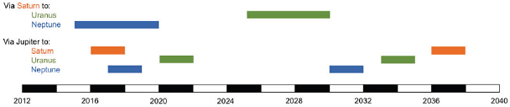
FIGURE 8.10 Approximate launch windows for Jupiter gravity-assist trajectories to the outer planets and their moons. Note the paucity of opportunities between 2020 and 2030, the likely range of launch dates for missions that have new starts in the coming decade. Arrival dates are much more dependent on the details of mission design, and are thus not shown here.
Previously Recommended Missions
Cassini Extended Mission
The Cassini spacecraft has been in Saturn orbit since 2004 and continues to deliver a steady stream of remarkable discoveries. Recent satellite science highlights have included direct observations of changing lake levels on Titan and high-resolution observations of the Enceladus plumes and their source regions that are refining understanding of plume composition and source conditions. The extension of the mission through northern hemisphere summer solstice in 2017—the Cassini Solstice mission—will provide major opportunities for satellite science.65 Seasonal change is key to understanding the dynamics of Titan’s atmosphere and interactions with the surface, and the mission extension will more than double the seasonal time base, including the critical period when the northern hemisphere lakes and polar vortex respond to major increases in insolation as spring advances. Twelve additional Enceladus flybys will map its gravity field, search for temporal and spatial changes in plume activity and composition, and provide unprecedented detail on the south polar thermal emission and heat flow. In addition, flybys of Rhea and Dione will probe their interiors and search for endogenic activity.
Europa Geophysical Explorer
Europa, with its probable vast subsurface ocean sandwiched between a potentially active silicate interior and a highly dynamic surface ice shell, offers one of the most promising extraterrestrial habitable environments, and a plausible model for habitable environments beyond our solar system. The larger Jupiter system in which Europa resides hosts an astonishing diversity of phenomena, illuminating fundamental planetary processes. While Voyager and Galileo have taught us much about Europa and the Jupiter system, the relatively primitive instrumentation of those missions, and the low data volumes returned, have left many questions unanswered, and it is likely that major discoveries remain to be made (Figure 8.11).
The Europa Geophysical Explorer mission was endorsed by the NRC’s 2003 planetary science decadal survey as its number one recommended flagship mission to be flown in the decade 2003-2013.66 That report states, in words that remain true today, “The first step in understanding the potential for icy satellites as abodes for life is a Europa mission with the goal of confirming the presence of an interior ocean, characterizing the satellite’s ice shell, and understanding its geological history. Europa is important for addressing the issue of how far organic chemistry goes toward life in extreme environments and the question of how tidal heating can affect the evolution of worlds. Europa is key to understanding the origin and evolution of water-rich environments in icy satellites” (p. 196). A Europa orbiter mission was subsequently given very high priority by the 2006 Solar System Exploration Roadmap67 and the 2007 NASA Science Plan,68 and it is the highest-priority large mission recommended by OPAG.69
The Europa Jupiter System Mission (EJSM), now under advanced study by NASA,70 takes the goals of the Europa Geophysical Explorer mission and adds Jupiter system science for an even broader science return. The
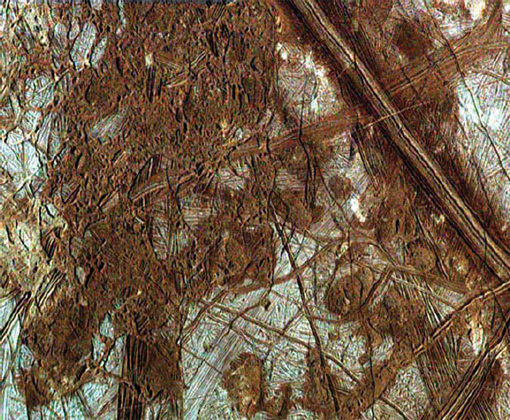
FIGURE 8.11 Galileo color image of Europa, showing the disruption of the ubiquitous ridged plains by chaos, associated with dark hydrated material that may be derived from the subsurface ocean. Small-scale patches of brighter color are artifacts resulting from noise in the original data. The image is about 150 km across. SOURCE: NASA/JPL.
proposed mission will be a partnership with the European Space Agency (ESA) and will have two components, to be launched separately: a Jupiter Europa Orbiter (JEO), which will be built and flown by NASA, and a Jupiter Ganymede Orbiter (JGO), which will be built and flown by ESA and will accomplish numerous Callisto flybys before going into orbit around Ganymede (Figure 8.12). Both spacecraft will be in the jovian system at the same time, allowing for unprecedented synergistic observations.71 Even if ESA’s JGO does not fly, the NASA JEO mission will enable huge leaps in understanding of icy satellites, giant planets, and planetary systems, addressing a large fraction of the science goals outlined in this chapter.
The overarching goals of this mission are as follows, in decreasing priority order:
1. Characterize the extent of the ocean and its relation to the deeper interior.
2. Characterize the ice shell and any subsurface water, including their heterogeneity, and the nature of surface-ice-ocean exchange.
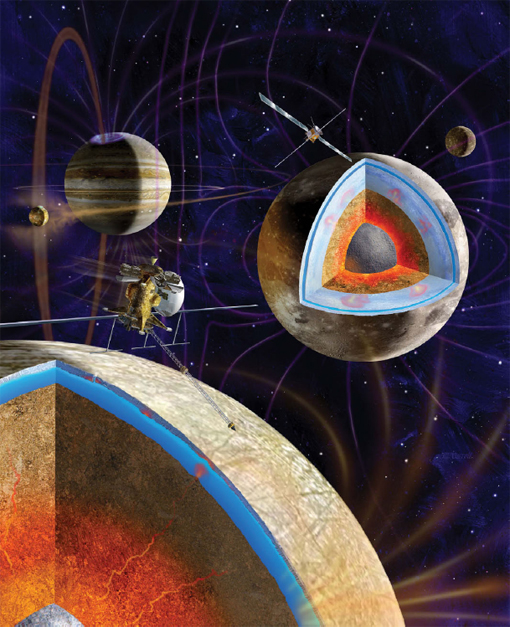
3. Determine global surface compositions and chemistry, especially as related to habitability.
4. Understand the formation of surface features, including sites of recent or current activity, and identify and characterize candidate sites for future in situ exploration.
5. Understand Europa’s space environment and interaction with the magnetosphere.
6. Conduct Jupiter system science (Jupiter’s atmosphere, magnetosphere, other satellites, and rings).
Launched in 2020, JEO would enter the Jupiter system in 2026, using Io for a gravity assist prior to Jupiter orbit insertion. This strategy increases the delivered mass to Europa by significantly decreasing the required Jupiter orbit insertion propellant in exchange for a modest increase in the radiation shielding of the flight system. The JEO mission design features a 30-month jovian system tour, which includes four Io flybys, nine Callisto flybys (including one near-polar), six Ganymede flybys, and six Europa flybys along with ~2.5 years of observing Io’s volcanic activity and Jupiter’s atmosphere, magnetosphere, and rings.
After the jovian tour phase, JEO would enter orbit around Europa and spend the first month in a 200-kilometer circular orbit before descending to a 100-kilometer circular orbit for another 8 months. The mission would end with impact onto Europa.
Flagship-class missions historically have a greatly enhanced science return compared to that of smaller missions—the whole is greater than the sum of the parts—and so the higher cost of a flagship mission compared to a New Frontiers-class mission is well justified. Europa remains the highest priority for satellite exploration, and a Europa mission deserves sufficient resources to realize its phenomenal scientific potential. Therefore, a Europa mission should take precedence over smaller missions to outer solar system targets during the next decade. If ESA’s Jupiter Ganymede Orbiter also flies, then the science return will be even higher.
The intense jovian radiation environment remains the largest challenge for the JEO spacecraft and its instruments, although thanks to extensive study of the issue in the past decade, the risks and mitigation strategies are now well understood. This work has included characterization of the radiation hardness of key electronic components (including development of an “approved parts and materials list” for use by instrument developers), improved modeling of expected radiation fluxes, and detailed consideration of shielding strategies. NASA should continue to work closely with instrument developers to understand and mitigate the impact of radiation on JEO instruments, prior to final payload selection.
Io Observer
Io provides the ideal target to study tidal dissipation and the resulting variety of volcanic and tectonic processes in action, with fundamental implications for the thermal co-evolution of the Io-Europa-Ganymede system as well as for habitable zones around other stars. As such, an Io mission is of high scientific priority,72 as highlighted in the 2003 planetary science decadal survey73 and subsequent 2008 New Frontiers recommendations.74 An Io mission was studied in detail at the committee’s request. The study (Appendix G) and subsequent cost and technical evaluation (CATE) analysis (Appendix C) found this mission to be a plausible candidate for the New Frontiers program.
The science goals of the Io Observer mission include the following:
• Study Io’s active volcanic processes;
• Determine the melt fraction of Io’s mantle;
• Constrain tidal heating mechanisms;
• Study tectonic processes;
• Investigate interrelated volcanic, atmospheric, plasma-torus, and magnetospheric mass- and energy-exchange processes;
• Constrain the state of Io’s core via improved constraints on whether Io generates a magnetic field; and
• Investigate endogenic and exogenic processes controlling surface composition.
Two baseline options were studied; one used ASRGs and the other was solar powered. Each was a Jupiter orbiter carrying a narrow-angle camera, ion-neutral mass spectrometer, thermal mapper, and magnetometers
and performing ten Io flybys. A floor mission with reduced payload and six flybys was also studied, as was an enhanced payload including a plasma instrument. A high-inclination orbit (~45°) provides polar coverage to better constrain the interior distribution of tidal heating and significantly reduces accumulated radiation: the total radiation dose is estimated to be half that of the Juno mission. No new technology is required. All objectives are addressed by the floor mission and accomplished to much greater extent by the baseline and enhanced missions. This mission provides complementary science to that planned by JEO (which is limited by JEO’s low-inclination orbit, less Io-dedicated instrumentation, and small number—three—of Io science flybys, plus one non-science Io flyby).
The Io Observer mission could also, with the addition of suitable particles and fields instrumentation (perhaps funded separately), address some of the science goals of the Io Electrodynamics mission considered by the 2003 solar and space physics decadal survey.75
New Missions: 2013-2022
Flagship Missions
Further exploration of Titan is a very high priority for satellite science. White papers from the community provide strong support for Titan science,76,77,78,79 and OPAG endorsed a Titan flagship mission as its second-highest priority flagship mission as part of an outer planets program.80
Titan Saturn System Mission
Many Titan mission concept studies have been conducted over the past decade including the most recent outer planet flagship mission study.81 In that study, completed in 2009, NASA and ESA worked jointly to define a flagship-class mission that would achieve the highest priority science. The resulting concept is called the Titan Saturn System Mission (TSSM) and has three overarching science goals:
1. Explore and understand processes common to Earth that occur on another body, including the nature of Titan’s climate and weather and their time evolution, its geologic processes, the origin of its unique atmosphere, and analogies between its methane cycle and Earth’s water cycle.
2. Examine Titan’s organic inventory, a path to prebiotic molecules. This includes understanding the nature of atmospheric, surface, and subsurface organic chemistry, and the extent to which that chemistry might mimic the steps that led to life on Earth.
3. Explore Enceladus and Saturn’s magnetosphere—clues to Titan’s origin and evolution. This includes investigation of Enceladus’s plume for clues to the origin of Titan ices and a comparison of its organic content with that of Titan, and understanding Enceladus’s tidal heating and its implications for the Saturn system.
The purpose of Goal 1 is characterization of the physical processes, many of which are similar to those on Earth, that shape Titan’s atmosphere, surface, and evolution.
Goal 2 motivates investigation of Titan’s rich organic chemistry. An extensive study is particularly important because it will elucidate the chemical pathways that occur in two environments, which may resemble those of early Earth. Measurements of the composition of the thermosphere will determine whether amino acids are made in the upper atmosphere. The chemical pathways that lead to these prebiotic molecules will be investigated to determine whether this formation mechanism is typical, and whether prebiotic molecules are common in irradiated methane- and nitrogen-rich atmospheres, perhaps typical of early Earth. Measurements of the surface will investigate the progress of Titan’s organic chemistry over longer time periods.
Goal 3 involves investigation of Enceladus, whose plumes provide a unique view of the composition and chemistry of the interior, which is likely representative of the same types of icy materials that formed Titan. This goal could possibly be addressed by a separate Enceladus mission as described below, but Enceladus science remains a high priority for a Titan mission, if Enceladus is not targeted separately. The TSSM mission design includes Enceladus flybys prior to Titan orbit insertion, but some Titan mission architectures, such as aerocapture directly
from heliocentric orbit, might preclude Enceladus science unless the spacecraft subsequently left Titan orbit for Enceladus, and these trade-offs require further study as mission concepts are developed further.
The study of such a complex system requires both orbital and in situ elements, and the TSSM concept includes three components—an orbiter, a balloon, and a lander (Figure 8.13).
The TSSM science was rated by both NASA and ESA science review panels as being on a level equivalent to the science of the Europa Jupiter System Mission. The science was rated as excellent and science implementation rated as low risk, although the need for continued technology development for TSSM was noted. Based on technical readiness, a joint NASA-ESA recommendation in 2009 prioritized EJSM first, followed closely by TSSM. The multi-element mission architecture is appropriate because it enables complementary in situ and remote-sensing observations. The TSSM study demonstrated the effectiveness of such an approach for accomplishing the diverse science objectives that are high priorities for understanding Titan. However, the details of such an implementation are likely to evolve as studies continue.
Technology needs for Titan, including surface sampling, balloons, and aerocapture, which may enable delivery of additional mass to Titan, were prominent in OPAG’s technology recommendations.82 Technology development priorities for this mission are those needed to address the mission design risks identified by the outer planet flagship review panel.83 Specific components highlighted as requiring development include the following:
• In situ elements enabling extensive areal coverage. The Montgolfière (hot-air) balloon system proposed for TSSM is a promising approach,84,85 but an aircraft, which could use an ASRG rather than an MMRTG,86 might be more appropriate if there is a limited supply of plutonium-238;
• Mature in situ analytical chemistry systems that have high resolution and sensitivity; and
• Sampling systems that can operate reliably in cryogenic environments. (See Chapter 11 for additional details.)
Furthermore, mission studies have shown that any future mission to Saturn will require the use of suitable radioisotope power sources, thus placing a high priority on the completion of the ASRGs and the restart of the plutonium production program by the U.S. Department of Energy.
The committee commissioned a detailed study of a Titan Lake Probe (Appendixes D and G) for considering the mission and instrument capabilities needed to examine the lake-atmosphere interaction as set forth in the TSSM study report.87 In addition, the Titan Lake Probe study evaluated the feasibility and value of additional capability to directly sample the subsurface and lake bottom. The integrated floater/submersible concepts in that study were designed to make measurements at various lake depths and even sample the sediment on the bottom of
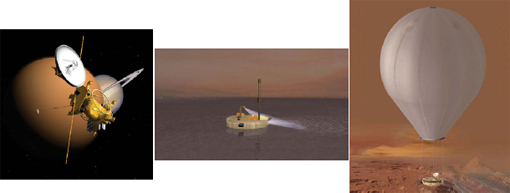
FIGURE 8.13 The three elements of the 2009 TSSM mission architecture: a Titan orbiter, a lake lander, and a hot-air balloon. SOURCE: ESA/NASA.
the lake. The findings indicated that such a system that includes floater and submersible components and enhanced instrumentation would result in significantly increased science, but also significantly increased mass relative to the simpler TSSM lake lander concept. Following from the results of that study, further studies are needed to refine lander concepts as part of a flagship mission. Stand-alone lake lander concepts, independent of TSSM, were also studied (Appendixes D and G) but were judged to be less cost-effective than a lake lander integrated with TSSM.
Enceladus Orbiter
Enceladus, with its remarkable active cryovolcanic activity, including plumes that deliver samples from a potentially habitable subsurface environment, is a compelling target for future exploration,88,89,90,91 and OPAG recommended study of mid-size Enceladus missions for the coming decade.92 Mission studies commissioned by the committee indicated that a focused Enceladus orbiter mission is both scientifically compelling and would cost less than Europa or Titan flagship missions (Appendix C). Enceladus orbiters have been the subject of several previous mission studies, most recently in 2007 (Figure 8.14).93
The most important science goals for an Enceladus mission, in priority order, are the following:
1. What is the nature of Enceladus’s cryovolcanic activity, including conditions at the plume source, the nature of the energy source, delivery mechanisms to the surface, and mass-loss rates?
2. What are the internal structure and chemistry (particularly organic chemistry) of Enceladus, including the presence and chemistry of a global or regional subsurface ocean?
3. What is the nature of Enceladus’s geologic history, including tectonism, viscous modification of the surface, and other resurfacing mechanisms?
4. How does Enceladus interact with the rest of the saturnian system?
5. What is the nature of the surfaces and interiors of Rhea, Dione, and Tethys?
6. Characterize the surface for future landing sites.
The committee commissioned a broad study of possible mission architectures including flybys, simple and flagship-class orbiters, landers, and plume sample return missions, and concluded that a simple orbiter would provide compelling science (Appendix G). A follow-up detailed study (Appendix G) found that the above science goals could be addressed well using a simple orbiter with a payload consisting of a medium-angle camera, thermal mapper, magnetometer, mass spectrometer, dust analyzer, and radio science. Sophisticated use of leveraged flybys of Saturn’s mid-size moons before Enceladus orbit insertion was found to reduce delta-V requirements, and thus mass and cost, compared to previous studies.94 The mission requires plutonium for power, in the form of ASRGs, but requires little other new technology development. However, planetary protection is an issue for Enceladus because of the possibility of contamination of the probable liquid-water subsurface environment, and mission costs could increase somewhat if it proves necessary to sterilize the spacecraft to meet planetary protection guidelines.
Ice-Giant Orbiters
The exploration of the uranian satellites could potentially be accomplished by the Uranus Orbiter and Probe mission discussed in Chapter 7. The proposed satellite tour (Appendix G), which includes two targeted flybys of each of the five major satellites, would help to fill a major gap in understanding of planetary satellites, because the sides opposite to those seen by Voyager 2 would be illuminated, flybys would be closer than those of Voyager (for instance potentially enabling magnetic sounding of satellite interiors), and because of instrumentation improvements relative to Voyager. Neptune orbiter and flyby missions (Appendixes D and G) could potentially address many science goals for Triton.
Rationale for Prioritization of Missions and Mission Studies
The committee’s decision to give higher priority to the Jupiter Europa Orbiter than to the Titan Saturn System Mission was made as follows. The likely science return from both the Europa and Titan missions would be very
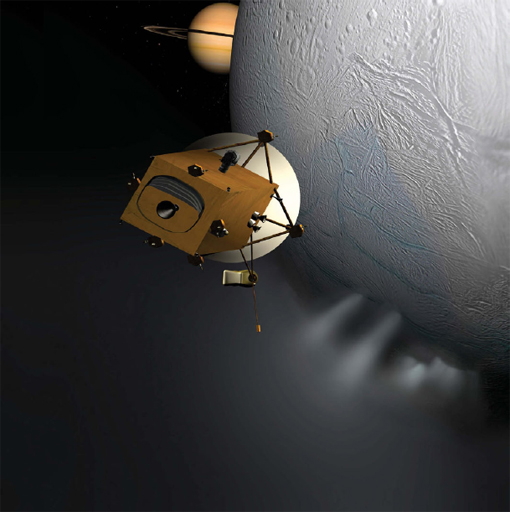
FIGURE 8.14 The Enceladus Orbiter mission concept, studied by the committee, flying above Enceladus’s active south pole. SOURCE: NASA/JPL/Caltech.
high and comparable in value, but the Jupiter Europa Orbiter mission was judged to have greater technical readiness. The technical readiness of the Europa mission results from a decade of detailed study dating back to the original Europa Orbiter concept, for which an Announcement of Opportunity was issued in 1999. The biggest technical issue for the Europa mission, the high radiation dose, remains challenging but has been mitigated by the extensive preparatory work. The Titan Saturn System Mission concept is considerably less mature, with more potential for the emergence of unanticipated problems. Also, the Titan mission is much more dependent for achievement of its
science goals on integration with non-U.S. mission components. Although the Jupiter Europa Orbiter is intended as an element of a multi-spacecraft mission, operating in tandem with the ESA-supplied Jupiter Ganymede Orbiter, the missions are launched and flown separately, and so integration issues are relatively minor. Also, the majority of the Jupiter Europa Orbiter science goals are achieved independently of the Jupiter Ganymede Orbiter. In contrast, many key science objectives of the Titan mission rely on the balloon and lander elements, which are in an early stage of development. The use of three spacecraft elements at Titan (orbiter, lander, and balloon) also increases the complexity of spacecraft integration and mission operations, and thus the associated risk.
For these and other reasons, the NASA-sponsored evaluation of the 2008 flagship mission studies rated the Europa mission as having mission implementation and cost risk lower than those for the Titan mission. Costs to NASA as estimated for the decadal survey (Appendix C) were lower for the Jupiter Europa Orbiter ($4.7 billion in FY2015 dollars) than for the Titan Saturn System Mission (at least $5.7 billion, after subtraction of the estimated $1 billion cost of the ESA-supplied balloon and lake lander from the $6.7 billion estimate for an all-NASA mission, and addition of any potential costs associated with dividing the mission between NASA and ESA). Finally, the outer planets community, as represented by the Outer Planets Assessment Group (OPAG), ranked the Europa mission as its highest-priority flagship mission, followed by the Titan mission.
JEO is also given higher priority than the Enceladus Orbiter for two primary reasons. JEO’s flagship-class payload will return a greater breadth and volume of science data than would the more focused payload of the Enceladus Orbiter (see the discussion of mission size above). Also the severe limitations of the Galileo data set, due to Galileo’s low data rate and the older technology of its instrument payload, mean that knowledge of Europa and the Jupiter system is now poorer than knowledge of Enceladus and the Saturn system, giving a particularly high potential for new discoveries by JEO at Europa and throughout the Jupiter system.
Among the smaller missions studied by the panel, the Enceladus Orbiter was given highest priority because of the breadth of science questions that it can address (with the potential for major contributions to understanding the chemistry, active geology and geophysics, and astrobiological potential of Enceladus), coupled with its relatively simple implementation, requiring little new technology. The Io Observer was chosen as a New Frontiers candidate because of its compelling science and because it was the only outer planet satellite mission studied for which cost estimates placed it plausibly within the New Frontiers cost cap. Of the other satellite missions studied (Appendix D) the stand-alone Titan Lake Lander was rated lower priority because of its relatively narrow science focus and relatively challenging technology requirements. The Ganymede Orbiter was rated as lower priority for a NASA mission because of the probability that ESA’s planned Jupiter Ganymede Orbiter will achieve most of the same science goals.
Other stand-alone Titan mission concepts that could achieve a subset of the goals of the TSSM mission are also possible. However, implementation of such stand-alone missions is challenging, as evidenced by the fact that only one additional mission that could replace an element of TSSM was proposed in any of the community white papers submitted to the decadal survey: a stand-alone Titan airplane.95 This concept is intriguing, and is noted above as a possible alternative to a balloon as an element of a flagship mission. However, high data rates are required to obtain full benefit from the remote sensing that would be a key measurement goal of an aircraft or a balloon. High data rates are difficult to achieve without the use of a relay spacecraft, making aircraft or balloons less attractive as stand-alone mission candidates than the lake lander chosen for detailed study. One additional stand-alone mission, the Titan Geophysical Network, was proposed in a white paper96 but was not chosen for detailed study because the science goals, which go beyond those of TSSM, were judged to be of lower priority, and the required low-power radioisotope power supplies would entail significant additional development. A stand-alone Titan orbiter without the in situ elements might also be considered, but was not chosen for study because it was not proposed by community white papers, and because of the advantages of an integrated orbiter and in situ elements both for delivery to Saturn and for data relay.
Summary
To achieve the primary goals of the scientific study of the satellites of the giant-planet systems as outlined in this chapter, the following actions are needed.
• Flagship missions—The planned continuation of the Cassini mission through 2017 is the most cost-effective and highest-priority way to advance understanding of planetary satellites in the near term. The highest-priority satellite-focused missions to be considered for new starts in the coming decade are, in priority order: (1) Jupiter Europa Orbiter component of EJSM as described in the Jupiter Europa Orbiter Mission Study 2008: Final Report97 and refined subsequently (including several Io science flybys); (2) Titan Saturn System Mission, with both Titan-orbiting and in situ components; and (3) Enceladus Orbiter. JEO is synergistic with ESA’s JGO. However, JEO’s priority is independent of the fate of ESA’s JGO. The Uranus Orbiter and Probe mission discussed in Chapter 7 would return very valuable satellite science, but it is not prioritized here relative to the satellite-focused missions discussed in this chapter.
• New Frontiers missions—An Io Observer, making multiple Io flybys from Jupiter orbit, is the high-priority medium-size mission. The Ganymede Orbiter concept studied at the committee’s request (Appendixes D and G) was judged to be of lower priority for a stand-alone NASA mission.
• Technology development—After the development of the technology necessary to enable JEO, the next highest priority goes to addressing the technical readiness of the orbital and in situ elements of TSSM. Priority areas include the balloon system, low-mass and low-power instruments, and cryogenic surface sampling systems.
• International cooperation—The synergy between the JEO, JGO, and Japan Aerospace Exploration (JAXA’s) proposed Jupiter Magnetospheric Orbiter is great. Continued collaboration between NASA, ESA, and JAXA to enable the implementation of all three components of EJSM is encouraged. Also encouraged is the NASA-ESA cooperation needed to develop the technologies necessary to implement a Titan flagship mission.
1. P.R. Estrada, I. Mosqueira, J.J. Lissauer, G. D’Angelo, and D.P. Cruikshank. 2009. Formation of Jupiter and conditions for accretion of the Galilean satellites. Pp. 27-58 in Europa (R. Pappalardo, W. McKinnon, and K. Khurana, eds.). of Arizona Press, Tucson, Ariz.
2. R. Jaumann, R.L. Kirk, R.D. Lorenz, R.M.C. Lopes, E. Stofan, E.P. Turtle, H.U. Keller, C.A. Wood, C. Sotin, L.A. Soderblom, and M.G. Tomasko. 2009. Geology and surface processes on Titan. Pp. 75-140 in Titan from Cassini-Huygens (R. Brown, J-P. LeBreton, and J.H. Waite, eds.). Springer, Heidelberg, Germany.
3. L. Iess, N.J. Rappaport, R.A. Jacobson, P. Racioppa, D.J. Stevenson, P. Tortora, J.W. Armstrong, and S.W. Asmar. 2009. Gravity field, shape, and moment of inertia of Titan. Science 327:1367.
4. J.R. Spencer, A.C. Barr, L.W. Esposito, P. Helfenstein, A.P. Ingersoll, R. Jaumann, C.P. McKay, F. Nimmo, C.C. Porco, and J.H. Waite. 2009. Enceladus: An active cryovolcanic satellite. Pp. 683-724 in Saturn from Cassini-Huygens (M. Dougherty, L. Esposito, and T. Krimigis, eds.). Springer, Heidelberg, Germany.
5. J. Lunine, M. Choukroun, D. Stevenson, and G. Tobie. 2009. The origin and evolution of Titan. Pp. 75-140 in Titan from Cassini-Huygens (R. Brown, J.-P. LeBreton, and J.H. Waite, eds.). Springer, Heidelberg, Germany.
6. S. Atreya, R. Lorenz, and J.H. Waite 2009. Volatile origin and cycles: Nitrogen and methane. Pp. 177-199 in Titan from Cassini-Huygens (R. Brown, J.-P. LeBreton, and J.H. Waite, eds.). Springer, Heidelberg, Germany.
7. O. Mousis, J.I. Lunine, M. Pasek, D. Cordier, J.H. Waite, K.E. Mandt, W.S. Lewis, and M.-J. Nguyen. 2009. A primordial origin for the atmospheric methane of Saturn’s moon Titan. Icarus 204:749-751.
8. J. Lunine, M. Choukroun, D. Stevenson, and G. Tobie. 2009. The origin and evolution of Titan. Pp. 75-140 in Titan from Cassini-Huygens (R. Brown, J.-P. LeBreton, and J.H. Waite, eds.). Springer, Heidelberg, Germany.
9. W.M. Grundy, L.A. Young, J.R. Spencer, R.E. Johnson, E.F. Young, and M.W. Buie. 2006. Distributions of H2O and CO2 ices on Ariel, Umbriel, Titania, and Oberon from IRTF/SpeX observations. Icarus 184:543-555.
10. G. Schubert, H. Hussmann, V. Lainey, D.L. Matson, W.B. McKinnon, F. Sohl, C. Sotin, G. Tobie, D. Turrini, and T. Van Hoolst. 2010. Evolution of icy satellites. Space Science Reviews 153:447-484.
11. G. Schubert, H. Hussmann, V. Lainey, D.L. Matson, W.B. McKinnon, F. Sohl, C. Sotin, G. Tobie, D. Turrini, and T. Van Hoolst. 2010. Evolution of icy satellites. Space Science Reviews 153:447-484.
12. J. Meyer and J. Wisdom. 2008. Tidal evolution of Mimas, Enceladus, and Dione. Icarus 193:213-223.
13. V. Lainey, J.-E. Arlot, O. Karatekin, and T. van Hoolst. 2009. Strong tidal dissipation in Io and Jupiter from astrometric observations. Nature 459:957-959.
14. L. Iess, N.J. Rappaport, R.A. Jacobson, P. Racioppa, D.J. Stevenson, P. Tortora, J.W. Armstrong, and S.W. Asmar. 2009. Gravity field, shape, and moment of inertia of Titan. Science 327:1367.
15. L. Prockter and G.W. Patterson. 2009. Morphology and evolution of Europa’s ridges and bands. Pp. 237-258 in Europa (R. Pappalardo, W. McKinnon, and K. Khurana, eds.). University of Arizona Press, Tucson, Ariz.
16. P.M. Schenk and M.H. Bulmer. 1998. Origin of mountains on Io by thrust faulting and large-scale mass movements. Science 279:1514.
17. G. Collins and F. Nimmo. 2009. Chaotic terrain on Europa. Pp. 237-258 in Europa (R. Pappalardo, W. McKinnon, and K. Khurana, eds.). University of Arizona Press, Tucson, Ariz.
18. R. Jaumann, R.L. Kirk, R.D. Lorenz, R.M.C. Lopes, E. Stofan, E.P. Turtle, H.U. Keller, C.A. Wood, C. Sotin, L.A. Soderblom, and M.G. Tomasko. 2009. Geology and surface processes on Titan. Pp. 75-140 in Titan from Cassini-Huygens (R. Brown, J-P. LeBreton, and J.H. Waite, eds.). Springer, Heidelberg, Germany.
19. J.R. Spencer, A.C. Barr, L.W. Esposito, P. Helfenstein, A.P. Ingersoll, R. Jaumann, C.P. McKay, F. Nimmo, C.C. Porco, and J.H. Waite. 2009. Enceladus: An active cryovolcanic satellite. Pp. 683-724 in Saturn from Cassini-Huygens (M. Dougherty, L. Esposito, and T. Krimigis, eds.). Springer, Heidelberg, Germany.
20. R. Jaumann, R.N. Clark, F. Nimmo, A.R. Hendrix, B.J. Buratti, T. Denk, J.M. Moore, P.M. Schenk, S.J. Ostro, and R. Srama. 2009. Icy satellites: Geological evolution and surface processes. Pp. 636-682 in Saturn from Cassini-Huygens (M. Dougherty, L. Esposito, and T. Krimigis, eds.). Springer, Heidelberg, Germany.
21. E.B. Bierhaus, C.R. Chapman, and W.J. Merline. 2005. Secondary craters on Europa and implications for cratered surfaces. Nature 437:1125-1127.
22. L. Dones, C.R. Chapman, W.B. McKinnon, H.J. Melosh, M.R. Kirchoff, G. Neukum, and K.J. Zahnle. 2009. Icy of Saturn: Impact cratering and age determination. Pp. 613-635 in Saturn from Cassini-Huygens (M. Dougherty, L. Esposito, and T. Krimigis, eds.). Springer, Heidelberg, Germany.
23. S.D. Wall, R.M. Lopes, E.R. Stofan, C.A. Wood, J.L. Radebaugh, S.M. Hörst, B.W. Stiles, R.M. Nelson, L.W. Kamp, M.A. Janssen, and R.D. Lorenz. 2009. Cassini RADAR images at Hotei Arcus and western Xanadu, Titan: Evidence for geologically recent cryovolcanic activity. Geophysical Research Letters 36:L04203.
24. F. Nimmo, J.R. Spencer, R.T. Pappalardo, and M.E. Mullen. 2007. Shear heating as the origin of the plumes and heat flux on Enceladus. Nature 447:289-291.
25. E.B. Bierhaus, C.R. Chapman, and W.J. Merline. 2005. Secondary craters on Europa and implications for cratered surfaces. Nature 437:1125-1127.
26. J.R. Spencer, S.A. Stern, A.F. Cheng, H.A. Weaver, D.C. Reuter, K. Retherford, A. Lunsford, J.M. Moore, O. Abramov, R.M.C. Lopes, J.E. Perry, et al. 2007. Io volcanism seen by New Horizons: A major eruption of the Tvashtar volcano. Science 318:240.
27. M.A. McGrath, E. Lellouch, D.F. Strobel, P.D. Feldman, and R.E. Johnson. 2004. Satellite atmospheres. Pp. 457-483 in Jupiter: Planet, Satellites, and Magnetosphere (F. Bagenal, T. Dowling, and W. McKinnon, eds.). Cambridge University Press, Cambridge, U.K.
28. M.A. McGrath, E. Lellouch, D.F. Strobel, P.D. Feldman, and R.E. Johnson. 2004. Satellite atmospheres. Pp. 457-483 in Jupiter: Planet, Satellites, and Magnetosphere (F. Bagenal, T. Dowling, and W. McKinnon, eds.). Cambridge University Press, Cambridge, U.K.
29. W. Grundy and L. Young. 2004. Near-infrared spectral monitoring of Triton with IRTF/SpeX I: Establishing a baseline for rotational variability. Icarus 172:455-465.
30. L.M. Feaga, M. McGrath, and P.D. Feldman. 2009. Io’s dayside SO2 atmosphere. Icarus 201:570-584.
31. D.F. Strobel, S.K. Atreya, B. Bézard, F. Ferri, F.M. Flasar, M. Fulchignoni, E. Lellouch, and I. Müller-Wodarg. 2009. Atmospheric structure and composition. Pp. 234-258 in Titan from Cassini-Huygens (R. Brown, J-P. LeBreton, and J.H. Waite, eds.). Springer, Heidelberg, Germany.
32. O. Grasset, M. Blanc, A. Coustenis, W. Durham, H. Hussmann, R. Pappalardo, and D. Turrini, eds. 2010. Satellites of the outer solar system: Exchange processes involving the interiors. Space Science Reviews 153(1-4):5-9.
33. C. Paranicas, J.F. Cooper, H.B. Garrett, R.E. Johnson, and S.J. Sturner. 2009. Europa’s radiation environment and its effects on the surface. Pp. 529-544 in Europa (R. Pappalardo, W. McKinnon, and K. Khurana, eds.). University of Arizona Press, Tucson, Ariz.
34. C.F. Chyba. 2000. Energy for microbial life on Europa. Nature 403381-382.
35. R.E. Johnson, O.J. Tucker, M. Michael, E.C. Sittler, H.T. Smith, D.T. Young, and J.H. Waite. 2009. Mass loss processes in Titan’s upper atmosphere. Pp. 373-391 in Titan from Cassini-Huygens (R. Brown, J.-P. LeBreton, and J.H. Waite, eds.). Springer, Heidelberg, Germany.
36. P.A. Delamere, A. Steffl, F. Bagenal. 2004. Modeling temporal variability of plasma conditions in the Io torus during the Cassini era. Journal of Geophysical Research (Space Physics) 109:10216.
37. J.D. Richardson, J.W. Belcher, A. Szabo, and R. McNutt. 1995. The plasma environment of Neptune. Pp. 279-340 in Neptune and Triton (D. Cruikshank, ed.). University of Arizona Press, Tucson, Ariz.
38. M.G. Kivelson, F. Bagenal, W.S. Kurth, F.M. Neubauer, C. Paranicas, and J. Saur. 2004. Magnetospheric interactions with satellites. Pp. 513-536 in Jupiter: Planet, Satellites, and Magnetosphere (F. Bagenal, T. Dowling, and W. McKinnon, eds.). Cambridge University Press, Cambridge, U.K.
39. C. Paranicas, J.F. Cooper, H.B. Garrett, R.E. Johnson, and S.J. Sturner. 2009. Europa’s radiation environment and its effects on the surface. Pp. 529-544 in Europa (R. Pappalardo, W. McKinnon, and K. Khurana, eds.). University of Arizona Press, Tucson, Ariz.
40. T.I. Gombosi, T.P. Armstrong, C.S. Arridge, K.K. Khurana, S.M. Krimigis, N. Krupp, A.M. Persoon, and M.F. Thomsen. 2009. Saturn’s magnetospheric configuration. Pp. 203-255 in Saturn from Cassini-Huygens (M. Dougherty, L. Esposito, and T. Krimigis, eds.). Springer, Heidelberg, Germany.
41. G. Schubert, H. Hussmann, V. Lainey, D.L. Matson, W.B. McKinnon, F. Sohl, C. Sotin, G. Tobie, D. Turrini, and T. Van Hoolst. 2010. Evolution of icy satellites. Space Science Reviews 153:447-484.
42. K.K. Khurana, M.G. Kivelson, K.P. Hand, and C.T. Russell. 2009. Electromagnetic induction from Europa’s ocean and the deep interior. Pp. 571-586 in Europa (R. Pappalardo, W. McKinnon, and K. Khurana, eds.). University of Arizona Press, Tucson, Ariz.
43. F. Postberg, S. Kempf, J. Schmidt, N. Brilliantov, A. Beinsen, B. Abel, U. Buck, and R. Srama. 2009. Sodium salts in E-ring ice grains from an ocean below the surface of Enceladus. Nature 459:1098-1101.
44. C. Sotin, G. Mitri, N. Rappaport, G. Schubert, and D. Stevenson. 2009. Titan’s interior structure. Pp. 61-73 in Titan from Cassini-Huygens (R. Brown, J.-P. LeBreton, and J.H. Waite, eds.). Springer, Heidelberg, Germany.
45. H. Hussmann, F. Sohl, and T. Spohn. 2006. Subsurface oceans and deep interiors of medium-sized outer planet satellites and large trans-neptunian objects. Icarus 185:258-273.
46. J.R. Spencer, A.C. Barr, L.W. Esposito, P. Helfenstein, A.P. Ingersoll, R. Jaumann, C.P. McKay, F. Nimmo, C.C. Porco, and J.H. Waite. 2009. Enceladus: An active cryovolcanic satellite. Pp. 683-724 in Saturn from Cassini-Huygens (M. Dougherty, L. Esposito, and T. Krimigis, eds.). Springer, Heidelberg, Germany.
47. K.K. Khurana, M.G. Kivelson, K.P. Hand, and C.T. Russell. 2009. Electromagnetic induction from Europa’s ocean and the deep interior. Pp. 571-586 in Europa (R. Pappalardo, W. McKinnon, and K. Khurana, eds.). University of Arizona Press, Tucson, Ariz.
48. F. Raulin, C. McKay, J. Lunine, and T. Owen. 2009. Titan’s astrobiology. Pp. 215-233 in Titan from Cassini-Huygens (R. Brown, J.-P. LeBreton, and J.H. Waite, eds.). Springer, Heidelberg, Germany.
49. J.H. Waite, Jr., W.S. Lewis, B.A. Magee, J.I. Lunine, W.B. McKinnon, C.R. Glein, O. Mousis, D.T. Young, T. Brockwell, J. Westlake, M.-J. Nguyen, et al. 2009. Liquid water on Enceladus from observations of ammonia and 40Ar in the plume. Nature 460:487-490.
50. K.P. Hand, C.F. Chyba, J.C. Priscu, R.W. Carlson, and K.H. Nealson. 2009. Astrobiology and the potential for life on Europa. Pp. 589-629 in Europa (R. Pappalardo, W. McKinnon, and K. Khurana, eds.). University of Arizona Press, Tucson, Ariz.
51. F.H. Chapelle, K. O’Neill, P.M. Bradley, B.A. Methé, S.A. Ciufo, L.L. Knobel, and D.R. Lovley. 2002. A hydrogen-based subsurface microbial community dominated by methanogens. Nature 415:312-315.
52. L.-H. Lin, P.-L. Wang, D. Rumble, J. Lippmann-Pipke, E. Boice, L.M. Pratt, B. Sherwood Lollar, E.L. Brodie, T.C. Hazen, G.L. Andersen, T.Z. DeSantis, D.P. Moser, D. Kershaw, and T.C. Onstott. 2006. Long-term sustainability of a high-energy, low-diversity crustal biome. Science 314:479-482.
53. C.F. Chyba. 2000. Energy for microbial life on Europa. Nature 403:381-382.
54. See, for example, National Research Council, Exploring Organic Environments in the Solar System, The National Academies Press, Washington, D.C., 2007, pp. 11-19.
55. C.P. McKay and H.D. Smith. 2005. Possibilities for methanogenic life in liquid methane on the surface of Titan. Icarus 178:274-276.
56. National Research Council. 2003. The Sun to the Earth—and Beyond: A Decadal Research Strategy in Solar and Space Physics. The National Academies Press, Washington, D.C.
57. P.M. Beauchamp, W. McKinnon, T. Magner, S. Asmar, H. Waite, S. Lichten, E. Venkatapathy, T. Balint, A. Coustenis, J.L. Hall, M. Munk, et al. 2009. Technologies for Outer Planet Missions: A Companion to the Outer Planet Assessment Group (OPAG) Strategic Exploration White Paper. White paper submitted to the Planetary Science Decadal Survey, National Research Council, Washington, D.C.
58. D. Schultze-Makuch, F. Raulin, C. Phillips, K. Hand, S. Neuer, and B. Dalton. 2009. Astrobiology Research Priorities for the Outer Solar System. White paper submitted to the Planetary Science Decadal Survey, National Research Council, Washington, D.C.
59. A. Coustenis. 2009. Future in situ balloon exploration of Titan’s atmosphere and surface. White paper submitted to the Planetary Science Decadal Survey, National Research Council, Washington, D.C.
60. J. Nott. 2009. Advanced Titan Balloon Design Concepts. White paper submitted to the Planetary Science Decadal Survey, National Research Council, Washington, D.C.
61. L. Lemke. 2009. Heavier Than Air Vehicles for Titan Exploration. White paper submitted to the Planetary Science Decadal Survey, National Research Council, Washington, D.C.
62. N. Strange. 2009. Astrodynamics Research and Analysis Funding. White paper submitted to the Planetary Science Decadal Survey, National Research Council, Washington, D.C.
63. E. Venkatapathy. 2009. Thermal Protection System Technologies for Enabling Future Outer Planet Missions. White paper submitted to the Planetary Science Decadal Survey, National Research Council, Washington, D.C.
64. W. McKinnon. 2009. Exploration Strategy for the Outer Planets 2013-2022: Goals and Priorities. White paper submitted to the Planetary Science Decadal Survey, National Research Council, Washington, D.C.
65. L. Spilker. 2009. Cassini-Huygens Solstice Mission. White paper submitted to the Planetary Science Decadal Survey, National Research Council, Washington, D.C.
66. National Research Council. 2003. New Frontiers in the Solar System: An Integrated Exploration Strategy. The National Academies Press, Washington, D.C.
67. NASA. 2006. Solar System Exploration: 2006 Solar System Exploration Roadmap for NASA’s Science Mission Directorate. CL#06-1867-A. Jet Propulsion Laboratory, Pasadena, Calif. Available at http://solarsystem.nasa.gov/multimedia/downloads/SSE_RoadMap_2006_Report_FC-A_med.pdf.
68. NASA. 2007. Science Plan for NASA’s Science Mission Directorate 2007-2016. Available at http://science.nasa.gov/media/medialibrary/2010/03/31/Science_Plan_07.pdf.
69. W. McKinnon. 2009. Exploration Strategy for the Outer Planets 2013-2022: Goals and Priorities. White paper submitted to the Planetary Science Decadal Survey, National Research Council, Washington, D.C.
70. K. Clark et al. 2009. Jupiter Europa Orbiter Mission Study 2008: Final Report—The NASA Element of the Europa Jupiter System Mission (EJSM). Jet Propulsion Laboratory, Pasadena, Calif.
71. The possibility of adding a third spacecraft, the Japan Aerospace Exploration Agency-supplied Jupiter Magnetospheric Orbiter, has been discussed.
72. D. Williams. 2009. Future Io Exploration for 2013-2022 and Beyond, Part 1: Justification and Science Objectives. White paper submitted to the Planetary Science Decadal Survey, National Research Council, Washington, D.C.
73. National Research Council. 2003. New Frontiers in the Solar System: An Integrated Exploration Strategy. The National Academies Press, Washington, D.C.
74. National Research Council. 2008. Opening New Frontiers in Space: Choices for the Next New Frontiers Announcement of Opportunity. The National Academies Press, Washington, D.C.
75. National Research Council. 2003. The Sun to the Earth—and Beyond: A Decadal Research Strategy in Solar and Space Physics. The National Academies Press, Washington, D.C.
76. A. Coustenis. 2009. Future In Situ Balloon Exploration of Titan’s Atmosphere and Surface. White paper submitted to the Planetary Science Decadal Survey, National Research Council, Washington, D.C.
77. J. Lunine. 2009. The Science of Titan and Its Future Exploration. White paper submitted to the Planetary Science Decadal Survey, National Research Council, Washington, D.C.
78. J.H. Waite. 2009. Titan Lake Probe. White paper submitted to the Planetary Science Decadal Survey, National Research Council, Washington, D.C.
79. M. Allen. 2009. Astrobiological Research Priorities for Titan. White paper submitted to the Planetary Science Decadal Survey, National Research Council, Washington, D.C.
80. W. McKinnon. 2009. Exploration Strategy for the Outer Planets 2013-2022: Goals and Priorities. White paper submitted to the Planetary Science Decadal Survey, National Research Council, Washington, D.C.
81. K. Reh. 2009. Titan Saturn System Mission Study Final Report on the NASA Contribution to a Joint Mission with ESA. JPL D-48148. Jet Propulsion Laboratory, Pasadena, Calif.
82. P.M. Beauchamp. 2009. Technologies for Outer Planet Missions: A Companion to the Outer Planet Assessment Group (OPAG) Strategic Exploration White Paper. White paper submitted to the Planetary Science Decadal Survey, National Research Council, Washington, D.C.
83. C. Niebur. 2009. Outer Planet Satellites Review Panel Report. Summary Presentation available at http://www.lpi.usra.edu/opag/march09/presentations/02Niebur.pdf.
84. A. Coustenis. 2009. Future In Situ Balloon Exploration of Titan’s Atmosphere and Surface. White paper submitted to the Planetary Science Decadal Survey, National Research Council, Washington, D.C.
85. J. Nott. 2009. Advanced Titan Balloon Design Concepts. White paper submitted to the Planetary Science Decadal Survey, National Research Council, Washington, D.C.
86. L. Lemke. 2009. Heavier Than Air Vehicles for Titan Exploration. White paper submitted to the Planetary Science Decadal Survey, National Research Council, Washington, D.C.
87. K. Reh. 2009. Titan Saturn System Mission Study Final Report on the NASA Contribution to a Joint Mission with ESA. JPL D-48148. Jet Propulsion Laboratory, Pasadena, Calif.
88. P. Tsou. 2009. A Case for Life, Enceladus Flyby Sample Return. White paper submitted to the Planetary Science Decadal Survey, National Research Council, Washington, D.C.
89. J. Lunine. 2009. The Science of Titan and Its Future Exploration. White paper submitted to the Planetary Science Decadal Survey, National Research Council, Washington, D.C.
90. T. Hurford. 2009. The Case for Enceladus Science. White paper submitted to the Planetary Science Decadal Survey, National Research Council, Washington, D.C.
91. T. Hurford. 2009. The Case for an Enceladus New Frontiers Mission. White paper submitted to the Planetary Science Decadal Survey, National Research Council, Washington, D.C.
92. W. McKinnon. 2009. Exploration Strategy for the Outer Planets 2013-2022: Goals and Priorities. White paper submitted to the Planetary Science Decadal Survey, National Research Council, Washington, D.C.
93. A. Razzaghi. 2007. Enceladus Flagship Mission Concept Study. NASA Goddard Space Flight Center, Greenbelt, Md.
94. A. Razzaghi. 2007. Enceladus Flagship Mission Concept Study. NASA Goddard Space Flight Center, Greenbelt, Md.
95. L. Lemke. 2009. Heavier Than Air Vehicles for Titan Exploration. White paper submitted to the Planetary Science Decadal Survey, National Research Council, Washington, D.C.
96. R. Lorenz, T. Hurford, B. Bills, F. Sohl, J. Roberts, C. Sotin, and H. Hussmann. 2009. The Case for a Titan Geophysical Network Mission. White paper submitted to the Planetary Science Decadal Survey, National Research Council, Washington, D.C.
97. K. Clark et al. 2009. Jupiter Europa Orbiter Mission Study 2008: Final Report—The NASA Element of the Europa Jupiter System Mission (EJSM). Jet Propulsion Laboratory, Pasadena, Calif.


