
7
Recommendations
In accordance with its statement of task, the committee’s primary recommendation is for a research agenda that will assist the National Institutes of Health (NIH) in enhancing its research efforts in the area of LGBT health. The committee also formulated recommendations in several areas that would advance understanding of LGBT health: data collection, methodological research, research training, and policy on research participation.
RESEARCH AGENDA
Recommendation 1. NIH should implement a research agenda designed to advance knowledge and understanding of LGBT health.
The committee believes that building the evidence base on LGBT health issues will not only benefit LGBT individuals but also provide new research on topics that affect heterosexual and non-gender-variant individuals as well. Given the large number of areas in LGBT health in which research is needed, the committee formulated a research agenda that reflects those areas of highest priority. Within each of these areas, the conceptual frameworks identified in Chapter 1 are evident as cross-cutting perspectives that should be considered. Figure 7-1 illustrates the interactions between the priority research areas identified by the committee and these cross-cutting perspectives.
As noted earlier in the report, although lesbians, gay men, bisexual men and women, and transgender people each are separate populations, they frequently are considered as a group. The primary driving force behind
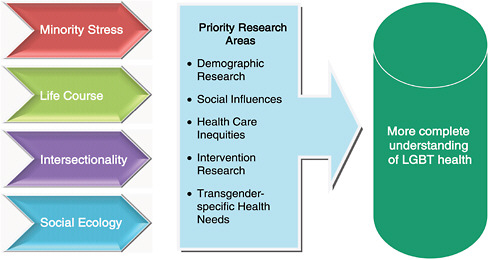
FIGURE 7-1 Research agenda. A number of different conceptual perspectives can be applied to priority areas of research in order to further the evidence base for LGBT health issues.
combining these populations is that they are nonheterosexual or gender nonconforming and are frequently stigmatized as a consequence. These populations also are often combined in some way for research purposes. For example, researchers frequently merge lesbians, gay men, and bisexual people into a group labeled “nonheterosexual.” Similarly, in some HIV research, study participants are combined in a single category that may include gay men, bisexual men, transgender women, and men who do not identify as any of the above but still have sex with other men. Combining these populations in this way obscures differences among them.
Given that lesbians, gay men, bisexual women and men, and transgender people are in fact separate populations, it is important to note that most of the research on these populations has focused on lesbians and gay men. Much less research has been conducted on bisexual and transgender people. The committee therefore recommends research that focuses on these populations.
Cross-Cutting Perspectives
Chapter 1 introduces four conceptual frameworks that are useful for understanding the health of LGBT people: the minority stress model, a life-course perspective, intersectionality, and social ecology. In this report’s review of the existing literature, these frameworks are present to greater and lesser degrees, sometimes implicit and sometimes explicit. They are introduced once again here as cross-cutting perspectives that should be pursued
in research on each of the priority areas identified by the committee. Each of these perspectives is discussed in turn below, followed by a discussion of each of the priority areas. It is important to note that these perspectives represent a current but probably partial list that the committee believes would be brought to bear profitably in the study of LGBT health. Other perspectives not yet named or published may well serve this enterprise in the future in ways yet to be determined.
A Minority Stress Perspective
As the minority stress model illustrates, sexual and gender minorities are subjected to chronic stress as a result of their stigmatization as a minority group. Minority stress processes are both proximal (subjective) and distal (objective); they are also external (enacted stigma) and internal (felt stigma, self-stigma) (see Chapter 2). The shared and common experience of stigma and the influences and impact of minority stress should be considered as central to LGBT health in addressing all of the areas on the committee’s recommended research agenda.
A Life-Course Perspective
The committee drew on life-course theory because it serves as a framework for understanding a range of health issues that occur throughout life. The influence of cohort and age differences on health needs must be recognized. Longitudinal cohort studies, which are largely absent from LGBT research, are an excellent way of gaining insight into health issues by following participants over a period of time. Such studies would be useful for understanding many health issues related to sexual and gender minorities, including the development of gender-variant youth in their social contexts, the effects of pathways to family formation on the health of sexual and gender minorities, men who have sex with men in the context of HIV, identity as an LGBT person (i.e., member of a sexual and/or gender minority) over the life course, and changes in patterns of substance use over time.
In addition to longitudinal cohort studies, there is a particular need for more research focused on later life. The committee also encourages the analysis of data with age as a factor or variable in studies encompassing a broad age range that crosses over cohorts and into later life.
An Intersectional Perspective
The concept of intersectionality emphasizes that sexual- or gender-minority status is just one of many factors that influence the lives and health of individuals. Contextual factors, and therefore life experiences,
vary greatly among LGBT populations. However, research examining the health status of LGBT people that takes account of this diversity is still rare. There is a need to understand the role of geography, race, ethnicity, socioeconomic status, and other factors, as well as the combined effect of their interaction, in the health status of LGBT people. Thus, multiple identities should be considered in research on LGBT health.
A Social Ecological Perspective
The social ecology model illustrates that an individual influences and in turn is influenced by the social environment, including the family, other relationships, the community, culture, and society at large. Thus, one’s community and social circumstances affect one’s health, and integrating these multiple levels into research will provide a richer understanding of LGBT health. For example, community-based participatory research stresses the collaboration and partnership between the community and the researcher, often resulting in the community’s sense of investment in the research. Whether examining mechanisms of risk or designing and testing interventions, researchers should consider both individuals and the contexts in which they live.
Research Areas
While recognizing that many areas in the field of LGBT health are in need of and deserve more attention, the committee also understands the importance of identifying priorities for research. Therefore, the committee identified the following areas as being especially important in taking an early step toward building a solid evidence base and as being likely to make the greatest contributions to the field at this point in time: demographic research, social influences on the lives of LGBT people, inequities in health care, intervention studies, and transgender-specific health needs. As noted, the cross-cutting perspectives described above should be considered across these areas.
Demographic Research
To better understand the health needs of sexual and gender minorities, more data on these populations are needed, beginning with demographic data. In the broadest sense, this means that more demographic information about lesbian, gay, bisexual, and transgender people across the life course is needed. However, there is also a pressing need for a better demographic understanding of the subpopulations that make up the LGBT community as a whole. Only with a better understanding of the racial, ethnic, geographic,
and other demographic variations within the larger LGBT community can the health needs of all LGBT individuals be clarified and addressed.
Social Influences on the Lives of LGBT People
Many social structures—such as biological families, families of choice, marriages/partnerships, friends, schools, workplaces, and community organizations—can be sources of either stress or support for LGBT people. These social structures and the roles they play in the lives of LGBT people are underresearched. For example, little attention has been paid to the potentially positive role families and other social structures can play in the lives of LGBT adolescents. The role of parenthood in adult development among LGBT people also is not well understood. Similarly, how biological families and families of choice affect LGBT elders has not yet been studied in any detail. Recognizing that social support plays an important role in mental health, the committee believes that research examining the formation and experiences of families among LGBT individuals, as well as other social influences, would contribute to a fuller understanding of LGBT health.
Inequities in Health Care
LGBT individuals face barriers to equitable health care that can have a profound impact on their overall well-being (see Chapter 2). Lack of health insurance, fear of discrimination from providers, lack of providers who are well trained in the health needs of LGBT individuals, and dissatisfaction with services can all limit the extent to which sexual and gender minorities access health services. More research on LGBT health inequities is needed. Understanding the experiences of LGBT individuals seeking care, outcome disparities, provider attitudes and education, and ways in which the care environment could be improved would provide a solid base from which to address these inequities.
Intervention Research
Research is needed to develop and test the effectiveness of interventions designed to address health inequities experienced by LGBT populations. Studies focused on increasing access to care or addressing the mental or physical conditions that lead to impaired health among LGBT individuals would assist in reducing these inequities. For example, interventions are needed to identify and test effective ways of reducing homelessness among LGBT youth and reaching transgender people at risk of HIV infection. In many cases, it may be clear that a negative health outcome exists, but the
underlying mechanisms of risk have not been identified. Conducting research on the mechanisms of risk among selected populations would help in developing appropriate interventions. Another approach might consist of modifying existing interventions from other areas, such as interventions addressing bullying and eating disorders.
A growing body of research examines the use of technology for delivering interventions. Some studies have used text messaging as a means of communicating preventive health information or interventions, while others have used geographic information systems to examine various risk factors and determine where to direct resources and interventions. The committee believes that as communication technology continues to evolve, it may hold potential for extending interventions to difficult-to-reach LGBT populations and that its use for this purpose warrants further research.
Transgender-Specific Health Needs
All aspects of the evidence base for transgender-specific health care need to be expanded. Research methods that will yield the data needed to inform decisions about transgender-specific health should be developed. In addition, there is a need for more research on the health implications of hormone use (e.g., randomized controlled trials of puberty-delaying hormones, masculinizing and feminizing hormone therapies, and the consequences of long-term hormone use). More research would also help inform the discussion around the diagnosis of gender identity disorder. Currently, this diagnosis forms the basis for access of transgender people to procedures that may be medically necessary for many of these individuals. Studies on transition-related care and body modification and an evaluation of the Standards of Care for the treatment of gender identity disorder would contribute to this discussion.
Research Gaps and Opportunities
The above research agenda is drawn from the myriad of research opportunities that exist in the field of LGBT health. All of the priority research areas identified by the committee represent multiple opportunities for research that extend across the life course. Some of the areas focus on specific populations or fields, while others encompass types of research or particular contexts. The committee is recommending this research agenda to address the most pressing needs for advancing knowledge and understanding of LGBT health.
As part of the process of creating this research agenda, the committee was asked to identify research gaps and opportunities in the area of LGBT health. After completing its review of the available literature, the committee
found that the idea of identifying research gaps was not particularly useful in the context of this study. When identifying research gaps, one sets out to review a body of evidence that needs additional work on a selected number of topics. In the case of LGBT health, however, the committee found that the body of evidence assembled to date is sparse, and the work ahead must be more substantial than simply filling in gaps. While some research has been conducted in a number of areas pertaining to LGBT health, most areas are lacking research altogether or require considerable additional work. As an analogy, one might say that work has begun on a foundation, but it is not yet complete, and without a substantive foundation, it will be difficult to construct an understanding of LGBT health needs. In terms of opportunities, this means that there are many research questions that remain unanswered. At the end of Chapters 2 through 6, some key areas that are missing from the literature are noted. Table 7-1 lists many of the research opportunities that exist across the life course (presented in alphabetical order and not necessarily in order of importance). Although this is not an exhaustive listing, conducting effective and rigorous research in any of these areas will contribute to the body of evidence that is needed in the field of LGBT health.
DATA COLLECTION
Recommendation 2. Data on sexual orientation and gender identity should be collected in federally funded surveys administered by the Department of Health and Human Services and in other relevant federally funded surveys.
The need for demographic data is reflected in the above research agenda. Collecting data on sexual orientation and gender identity in federally funded surveys would generate these data. While the Department of Health and Human Services administers a number of surveys that relate directly to health, other federal agencies also administer surveys that could provide information on a number of dimensions that affect health. For example, recognizing the interaction between social and economic circumstances and health, data from social and economic surveys could provide valuable information on the context for health disparities experienced by LGBT people. Similarly, surveys on crime and victimization, housing, and families would provide data on variables that relate to the health of sexual and gender minorities.
Like race and ethnicity data, data on sexual and gender minorities should be included in the battery of demographic information that is collected in federally funded surveys. This data collection would be aided
TABLE 7-1 Research Opportunities for Studying Lesbian, Gay, Bisexual, and Transgender Health Across the Life Course
|
|
Childhood/Adolescence |
Early/Middle Adulthood |
Later Adulthood |
|
Demographic and Descriptive Information |
|
|
|
|
Family and Interpersonal Relations |
|
|
|
|
|
Childhood/Adolescence |
Early/Middle Adulthood |
Later Adulthood |
|
Health Services |
|
|
|
|
Mental Health |
|
|
|
|
Physical Health |
|
|
|
by the development of standardized measures for sexual orientation and gender identity (see Recommendation 4 below).
In contrast to surveys that collect data at a certain point in time, longitudinal studies allow for the collection of data over a period of years. At NIH, data on sexual orientation and gender identity are already being collected in the National Longitudinal Study of Adolescent Health. The collection of these data should be extended to other longitudinal studies. These data collection efforts could be expected to generate national, population-level data that could be used to glean information on LGBT populations in general, as well as to explore characteristics of LGBT subpopulations.
In addition, including variables to measure sexual orientation and gender identity in a variety of studies (e.g., through the addition of appropriate questions on gender identity and sexual orientation to the demographic section of questionnaires) would generate much-needed data on LGBT populations that could assist in assembling a reliable body of evidence regarding their health status.
Recommendation 3. Data on sexual orientation and gender identity should be collected in electronic health records.
The Office of the National Coordinator for Health Information Technology within the Department of Health and Human Services should include the collection of data on sexual orientation and gender identity as part of its meaningful-use objectives for electronic health records. One of
the meaningful-use objectives is Record Demographics, including preferred language, gender, race, ethnicity, and date of birth. Sexual orientation and gender identity could be included in the required set of demographic data. However, the collection of such data will need to be performed with adequate privacy and security protections. While all data collected in electronic health records are subjected to high levels of privacy and security protection, overseen by the Office of the National Coordinator, information on sexual orientation and gender identity could be perceived by some as being more sensitive than other information.
At present, some barriers exist to collecting useful data on sexual orientation and gender identity through electronic health records. These barriers include possible discomfort on the part of health care workers with asking questions about sexual orientation and gender identity, a lack of knowledge by providers of how to elicit this information, and some hesitancy on the part of patients to disclose this information. While recognizing that obstacles to the collection of meaningful data on sexual orientation and gender identity exist, the committee encourages the Office of the National Coordinator to begin planning for the collection of these data as part of the required set of demographic data for electronic health records. Detailed patient-level data such as those found in electronic health records could provide a rich source of information about LGBT populations and subpopulations.
METHODOLOGICAL RESEARCH
Recommendation 4. NIH should support the development and standardization of sexual orientation and gender identity measures.
NIH should support the rigorous development of valid, reliable measures for the collection of data on sexual orientation and gender identity. This call for additional research on measures does not mean that measures do not exist. Existing measures of sexual orientation and gender identity are used differently in various studies depending on the research question. This is an appropriate practice, and researchers should be able to use measures as they see fit. At this time, however, there is no generally accepted and well-validated set of questions that can cover a variety of situations, including studies among different age cohorts, surveys that focus on topics other than sexual behavior, and research in which participants may not understand terms such as “gender identity.” Developing and validating suitable measures would make it easier for researchers to collect data on sexual orientation and gender identity.
One of the greatest challenges to synthesizing scientific knowledge about the health of sexual and gender minorities has been the lack of stan-
dardized measures in federal surveys. The development and adoption of standardized measures for use in federal surveys would assist in the collection and analysis of data from large-scale sample surveys and advance the evidence base on LGBT health.
Recommendation 5. NIH should support methodological research that relates to LGBT health.
NIH should support research that will assist in addressing the methodological challenges associated with conducting research on LGBT health. Particularly helpful would be studies aimed at developing innovative ways to conduct research with small and difficult-to-reach populations; overcoming challenges involved in combining multiple data sets to obtain a sample with sufficient numbers of sexual- and gender-minority respondents to permit analysis; and determining the best ways to collect information on sexual and gender minorities in research, health care, and other settings.
RESEARCH TRAINING
Recommendation 6. A comprehensive research training approach should be created to strengthen LGBT health research at NIH.
The committee recognizes that, in addition to its well-developed training program, NIH supports a variety of training activities through research grants. However, the field of sexuality research in general has been neglected and, at times, marginalized. Currently, there are limited opportunities for conducting NIH-sponsored research on LGBT health. To create a more robust cadre of researchers in LGBT health, NIH should expand its existing research training framework for both intramural and extramural training. Three audiences should be targeted: researchers who are working with or considering working with LGBT populations, other researchers who may not be aware of LGBT health issues, and NIH staff.
In its intramural training program, NIH should develop postdoctoral training opportunities in the area of LGBT research (for example, research on youth and families). Similarly, NIH should expand the curriculum of its postbaccalaureate NIH Academy to include LGBT-specific issues in addition to the racial and ethnic disparities that are currently studied within the program. To implement these research training activities, NIH should increase its capacity to provide on-site experts as mentors for researchers examining LGBT health issues.
As part of a broad effort to raise awareness about LGBT health issues, NIH should conduct intramural training on these issues with researchers who are not specifically studying LGBT populations. LGBT health issues
cut across a large number of research topics. An awareness of LGBT health issues among researchers focusing on these topics would assist them in finding appropriate opportunities to include LGBT study participants (see Recommendation 7 below). Additionally, training these researchers to collect data on sexual orientation and gender identity effectively would expand the body of knowledge about LGBT health and more broadly inform understanding of the diverse experiences of human development.
Within its existing extramural program, NIH should increase the number of individual awards offered to researchers studying LGBT health issues, including postdoctoral, graduate student, and career awards. In addition, the current loan repayment program should be expanded to assist students who choose to study LGBT health issues. In particular, the development of researchers of color who will study LGBT health should be encouraged.
At the institutional level, NIH should create multisite training programs designed to allow students to gain expertise in LGBT health research from a number of different institutions. A similar model has been used in family psychology. The benefit of such a program is that it would draw upon the knowledge of multiple centers and expose students to opportunities afforded by various training sites. Similarly, the idea of centers of excellence for LGBT health research should be explored. Like multisite training programs, these centers would allow researchers to be trained in various sites rather than having to be trained at NIH.
Finally, NIH should provide its employees with recurring training on LGBT research issues. While many project officers at NIH are knowledgeable about LGBT issues, NIH would benefit as an institution if all staff had a firm understanding of the key issues in LGBT health research.
POLICY ON RESEARCH PARTICIPATION
Recommendation 7. NIH should encourage grant applicants to address explicitly the inclusion or exclusion of sexual and gender minorities in their samples.
Using the NIH policy on the inclusion of women and minorities in clinical research as a model, NIH should encourage grant applicants to address explicitly the extent to which their proposed sample includes or excludes sexual and gender minorities. Researchers would thereby be prompted to consider the scientific implications of including or excluding sexual and gender minorities and whether these groups will be included in sufficient numbers to permit meaningful analyses.


