
Summary
The Chesapeake Bay (Figure S-1) is North America’s largest and most biologically diverse estuary, as well as an important commercial and recreational resource. However, excessive amounts of nitrogen, phosphorus, and sediment from human activities and land development (e.g., agriculture, urban and suburban runoff, wastewater discharge, air pollution) have disrupted the ecosystem, causing harmful algae blooms, degraded habitats, and diminished populations of many species of fish and shellfish. In 1983, the Chesapeake Bay Program (CBP) was established, based on a cooperative partnership among the U.S. Environmental Protection Agency (EPA), the state of Maryland, the commonwealths of Pennsylvania and Virginia, and the District of Columbia, to address the extent, complexity, and sources of pollutants entering the Bay. By 2002, the states of Delaware, New York, and West Virginia committed to the CBP’s water quality goals by signing a Memorandum of Understanding.
In 2008, the CBP launched a series of initiatives to increase the transparency of the program and heighten its accountability, and in 2009 an executive order1 injected new energy into the Chesapeake Bay restoration. By 2010, a total maximum daily load (TMDL) was established by the EPA that determined the limits (maximum loads) on the amount of nitrogen, phosphorus, and sediment from point and nonpoint sources that would be necessary to attain adopted water quality standards in the Bay, and each of the Bay jurisdictions (i.e., the six states and the District of Columbia) developed watershed implementation plans outlining the pollutant control
_____________________
1 Executive Order 13508.
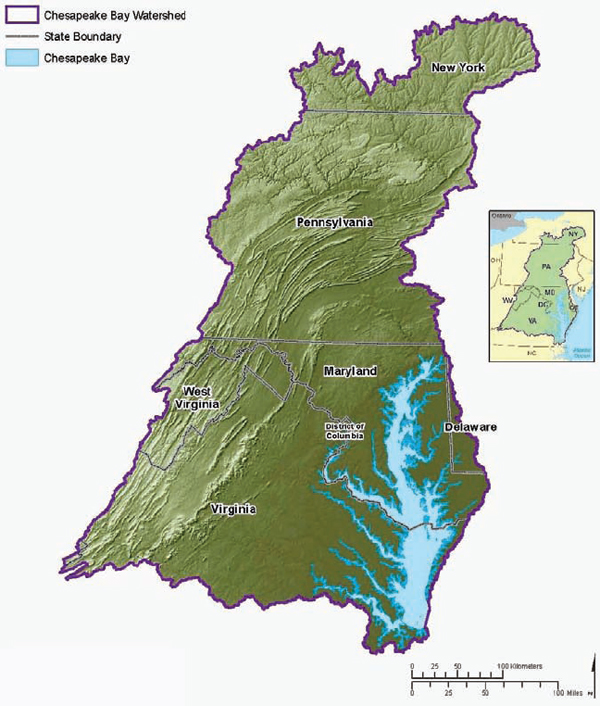
FIGURE S-1 The Chesapeake Bay and its watershed.
SOURCE: CBP (2008). Available at http://www.chesapeakebay.net/maps.aspx?menuitem=16825.
measures that would be implemented by 2025 to reach the TMDL. In addition, as part of the effort to improve the pace of progress and increase accountability in the Bay restoration, a two-year milestone strategy was introduced aimed at reducing overall pollution in the Bay by focusing on incremental, short-term commitments from each of the Bay jurisdictions.
The National Research Council (NRC) established the Committee on the Evaluation of Chesapeake Bay Program Implementation for Nutrient Reduction to Improve Water Quality in 2009 in response to a request from the EPA and with funding from EPA Virginia, Maryland, Pennsylvania, and the District of Columbia. The committee was charged to assess the framework used by the states and the CBP for tracking nutrient and sediment control practices that are implemented in the Chesapeake Bay watershed and to evaluate the two-year milestone strategy. The committee was also charged to assess existing adaptive management strategies and to recommend improvements that could help the CBP to meet its nutrient and sediment reduction goals (see Box S-1).
BOX S-1
Statement of Task
The Water Science and Technology Board appointed a committee to undertake an evaluation of the Chesapeake Bay Program’s nutrient reduction program. Specifically, the committee was to address the following questions:
Evaluation Theme I: Tracking and Accountability
1. Does tracking for implementation of nutrient and sediment point and nonpoint source pollution (including air) best management practices appear to be reliable, accurate, and consistent?
2. What tracking and accounting efforts and systems appear to be working, and not working, within each state (i.e., the six states in the watershed and DC), including federal program implementation and funding? How can the system be strategically improved to address the gaps?
3. How do these gaps and inconsistencies appear to impact reported program results?
Evaluation Theme II: Milestones
4. Is the two-year milestone strategy, and its level of implementation, likely to result in achieving the CBP nutrient and sediment reduction goals for this milestone period?
5. Have each of the states (i.e., the six states in the watershed and DC) and the federal agencies developed appropriate adaptive management strategies to ensure that CBP nutrient and sediment reduction goals will be met?
6. What improvements can be made to the development, implementation, and accounting of the strategies to ensure achieving the goals?
TRACKING AND ACCOUNTING
The term “tracking,” as applied in the CBP, describes approaches to document the implementation of urban and agricultural nutrient and sediment reduction practices (also called best management practices, or BMPs) and treatment technology upgrades as well as the basic associated practice characteristics. The term “accounting” describes the process of analyzing and reporting the practice information and estimating the resulting load reductions. Accurate tracking of BMPs is of paramount importance because the CBP relies upon the resulting data to estimate current and future nutrient and sediment loads to the Bay. However, many Bay jurisdictions and localities are struggling with limited resources, complex and rapidly changing data reporting mechanisms, data privacy constraints, and quality assurance/quality control needs. Verifying the continued functioning and effectiveness of historical activities presents a significant challenge. Although state tracking and accounting programs are unlikely to be identical, the CBP has recently made strides toward common reporting goals and data requirements.
The current accounting of BMPs is not consistent across the Bay jurisdictions. Additionally, given that some source-sector BMPs are not tracked in all jurisdictions, the current accounting cannot on the whole be viewed as accurate. Although the Bay jurisdictions have a good understanding of point-source (i.e., wastewater) discharges, numerous issues affect the accuracy, reliability, and consistency of BMP reporting to the CBP. Only five of the seven Bay jurisdictions conduct any level of field verification of agricultural practices, and there are known problems with double counting that agencies are working to resolve. Only one Bay jurisdiction specifies a lifespan for practices recorded in the database, and few jurisdictions have mechanisms to identify and remove from the database practices that are no longer functioning or even in place. Current tracking systems do not account for agricultural practices that are not cost-shared by a government agency. Given these limitations, current accounting can be considered, at best, an estimate.
The committee was unable to determine the reliability and accuracy of the BMP data reported by the Bay jurisdictions. Independent (third-party) auditing of the tracking and accounting at state and local levels would be necessary to ensure the reliability and accuracy of the data reported.
The committee was not able to quantify the magnitude or the likely direction of the error introduced by BMP reporting issues. On the one hand, there is under-counting of BMPs because the jurisdictions do not currently report non-cost-shared (or voluntary) practices, although the model calibration may include the effects of some of these practices. On the other hand, there is over-counting of BMPs because few states account for the
loss of BMPs when they are no longer properly maintained, functioning, or in place. Furthermore, there are errors introduced by site-level variability in BMP effectiveness, insufficient data on the location of BMPs, and discrepancies between state and CBP definitions of BMP management.
A consolidated regional BMP program to account for voluntary practices and increase geo-referencing of BMPs presents opportunities to improve the tracking and accounting process. A regional BMP program with incentives for participation as well as penalties for lack of participation has been used effectively in Florida to increase participation and improve data quality. Geo-referencing enables managers and modelers to identify the parcel-level location of BMPs, which would aid in inspecting, tracking, and assigning proper delivery ratios and BMP efficiencies, thereby improving the accuracy of the modeled estimates of nutrient and sediment loads delivered to the Bay.
Targeted monitoring programs in representative urban and agricultural watersheds and subwatersheds would provide valuable data to refine BMP efficiency estimates, particularly at the watershed scale, and thereby improve Watershed Model predictions. Current BMP load reduction efficiency estimates used in the Watershed Model are reasonable estimates of the short- to intermediate-term reduction efficiencies of newly installed BMPs at the field scale and gross representations of the same at the watershed scale. These estimates contain significant uncertainties caused by site-specific factors, practice design, extent of maintenance, and challenges in scaling up the data from the plot or field scale. Pilot studies in several sub-watersheds should be conducted to quantify BMP performance, particularly for the most common practices with the greatest uncertainty in their efficiency estimates. The CBP has recently implemented a review process to refine BMP efficiencies used in the Watershed Model based on emerging research findings.
Additional guidance from the EPA on the optimal extent of field verification of practices in relation to expected benefits would improve tracking and accounting of both cost-shared and voluntary practices. Field verification is costly, and several states have questioned its value given the resource constraints that limit BMP implementation. Although independent random, or probabilistic verification programs increase public confidence that reported data are accurate and reliable, attention should be given to developing ways to optimize field verification efforts that enhance the reliability of the BMP data sets, perhaps through the combined use of remote sensing data, written surveys, phone calls, and in-person visits.
Electronic tracking and data transfer systems are likely to improve the quality of reporting and reduce the jurisdictions’ tracking and accounting burden but may currently be contributing to delayed assessments of implementation progress. Despite the concerns in tracking and accounting noted above, a great deal of information is available, and a plausible and
collective effort seems to be under way to resolve some of the hindrances to data access, collection, and standardization. However, because implementation data are now reported electronically, several jurisdictions noted that the data are less accessible for assessments of statewide progress. Some Bay jurisdictions have mechanisms in place to compile progress updates as needed, but others have to wait approximately 9 months after the end of the reporting period for a summary of BMP implementation progress from the CBP. The recently launched tracking and accountability system for the TMDL (BayTAS) and ChesapeakeStat, which documents each jurisdiction’s progress in a publicly accessible website, should incorporate mechanisms for more timely reporting and consolidation of federal and state data submissions.
TWO-YEAR MILESTONES
To accelerate Bay restoration efforts and increase accountability, the CBP introduced two-year milestones in May 2009. In the past, Bay recovery goals involved decadal increments and did not identify particular strategies for achieving the necessary pollution reductions. Thus, the prior strategy was considered “a ladder without rungs” (CBP, 2009b). The two-year milestone strategy requires Bay jurisdictions to meet short-term implementation goals for nutrient and sediment reduction. The CBP envisioned that through a series of two-year milestone periods with routine assessments of the pace of progress by 2025 the Bay jurisdictions could implement all of the nutrient and sediment control practices needed for a restored Bay, although actual Bay water quality response and recovery might lag behind the 2025 implementation target.
The two-year milestone strategy commits the states to tangible, near-term implementation goals and improves accountability and, therefore, represents an improvement upon past CBP long-term strategies. However, the strategy, in and of itself, does not guarantee that implementation goals will be met, and consequences for nonattainment remain unclear. The two-year timeframes should encourage frequent reevaluations and adjustments for Bay jurisdictions that fall short of their intended implementation goals. However, without timely updates and synthesis of statewide progress from the CBP, some states lack the information necessary to make appropriate mid-course corrections.
CBP jurisdictions reported mixed progress toward their first two-year milestone goals. However, data were insufficient to meaningfully evaluate implementation or anticipated load reduction progress relative to the goals. The jurisdictions reported numerous efforts to control urban and agricultural nutrient and sediment loads, although they experienced greater successes in implementation of some practices than others. Without associated load reduction estimates for the implemented practices, the committee was
unable to evaluate how implementation shortfalls in some areas or greater than expected progress in others affect the likelihood that the Bay jurisdictions will meet their overall nutrient load reduction goals.
The first two-year milestone goals will likely be the easiest to achieve. Not surprisingly, the states are investing in the “low-hanging fruit”—the least expensive or most cost-effective among the nutrient reduction options—for the first accounting period. Large gains have been made with advanced treatment technologies applied to large publicly-owned wastewater treatment facilities, which to date have been relatively cost-effective per pound of nutrient removed compared to land-based BMPs. Additionally, states are working to document practices implemented prior to the current milestone period but not yet credited in the Watershed Model. Available water quality improvement options during subsequent milestone periods will likely become less cost-effective. It is possible that nonstandard control strategies, especially those that do not require high capital investments (see Chapter 5), may need to be considered.
ADAPTIVE MANAGEMENT
Since 2008, the CBP has advocated for the use of adaptive management at both the state and federal levels as a way to enhance overall management of the program and to strengthen scientific support for decision making. The committee examined the partners’ efforts to implement adaptive management and the potential barriers to and possible successful applications of adaptive management for nutrient and sediment reduction in the Bay watershed.
Neither the EPA nor the Bay jurisdictions exhibit a clear understanding of adaptive management and how it might be applied in pursuit of water quality goals. Reviewing activities, assessing progress toward goals, and adopting contingencies were cited as examples of adaptive management. However, effective adaptive management involves deliberate management experiments, a carefully planned monitoring program, assessment of the results, and a process by which management decisions are modified based on new knowledge. Learning is an explicit benefit of adaptive management that is used to improve future decision making. The committee did not find convincing evidence that the CBP partners had incorporated adaptive management principles into their nutrient and sediment reduction programs. Instead, the current two-year milestone strategy approach is best characterized as an evolutionary (or trial and error) process of adaptation in which learning is serendipitous rather than an explicit objective. In the trial and error process, when failures occur, jurisdictions have limited capacity to understand why, and contingencies represent the next thing to try rather than a deliberate adaptation.
Successful application of adaptive management in the CBP requires
careful assessment of uncertainties relevant to decision making, but the EPA and Bay jurisdictions have not fully analyzed uncertainties inherent in nutrient and sediment reduction efforts and water quality outcomes. Each CBP goal brings with it uncertainties, not all of which can or should be addressed through adaptive management. Therefore, the EPA and Bay jurisdictions should carefully and realistically analyze uncertainties associated with potential actions to determine which are candidates for adaptive management. Bay jurisdictions may be more successful using adaptive management for a limited number of components or for programs in smaller basins, where effects of management actions can be isolated and well-designed monitoring and evaluation can be undertaken to clearly quantify outcomes.
Targeted monitoring efforts by the states and the CBP will be required to support adaptive management. Monitoring plans need to be tailored to the specific adaptive management strategies being implemented. Presently, CBP and jurisdictional monitoring programs have not been designed to effectively support adaptive management. In addition, adaptive management will require better integration of monitoring and modeling activities. Excessive reliance on models in lieu of monitoring can magnify rather than reduce uncertainties.
Additional federal actions are needed to fully support adaptive management in the CBP. The federal accountability framework being promoted through the TMDL and the threatened consequences for failure will dampen the Bay jurisdictions’ enthusiasm for adaptive management. To support adaptive management, the EPA should modify its accountability framework and offer explicit language indicating that carefully designed management experiments with appropriate monitoring, evaluation, and adaptive actions are acceptable, and that failures resulting from genuine adaptive management efforts will not be penalized. If the Bay jurisdictions perceive that the costs of failure are too high, then they may not be willing to pursue the benefits that adaptive management can offer. Additionally, federal guidance and training to the states on effective adaptive management strategies at the local or state level are needed. One or more examples of adaptive management designed and implemented at the federal level, perhaps on federal land, would be helpful to the states as they seek acceptable and effective management options.
Without sufficient flexibility of the regulatory and organizational structure within which CBP nutrient and sediment reduction efforts are undertaken, adaptive management may be problematic. Depending upon how Clean Water Act (CWA) language and TMDL rules are interpreted, opportunities for certain types of adaptations may be limited. Truly embracing adaptive management requires recognition that the TMDL, load allocations, and possibly even water quality standards might need to be modified
based on what is learned through adaptive management. However, the jurisdictions may find that the formal processes required under the CWA to modify load allocations, TMDLs, or water quality standards constrain or even preclude using adaptive management. Successful application of adaptive management in the CBP will require greater regulatory flexibility. Approaching the TMDL as a process, not an endpoint, and facilitating adaptive implementation of the TMDL is one way to provide that flexibility.
STRATEGIES FOR MEETING THE GOALS
Reaching the long-term CBP nutrient and sediment reduction goals will require substantial commitment from each of the Bay jurisdictions and likely some level of sacrifice from those who live and work in the watershed. Jurisdictions are required not only to significantly reduce current loads, but they will need to take additional actions to address future growth and development over the next 15 years. Additionally, the Bay partners will need to adapt to future changes (e.g., climate change, changing agricultural practices) that may further impact water quality and ecosystem responses to planned implementation strategies. To reach the long-term load reduction goals, Bay jurisdictions and the federal government will need to prepare for the challenges ahead and consider a wide range of possible strategies, including some that are receiving little, if any, consideration today.
Success in meeting CBP goals will require careful attention to the consequences of future population levels, development patterns, agricultural production systems, and changing climate dynamics in the Bay watershed. Nutrient and sediment management efforts are taking place in the context of a quickly changing landscape and uncertain outcomes that could significantly affect the strategies needed to attain the TMDL goals. For example, an increase in the concentration of livestock or dairy animals near processing and distribution centers would mean a greater concentration of manure nutrients in these areas than has existed in the past. Additionally, Bay jurisdictions may need to adjust future milestone efforts to larger than anticipated population and more intensive land-use development scenarios, as well as climate change influences. Further and continued study of future scenarios is warranted to help Bay partners adapt to a changing future.
Helping the public understand lag times and uncertainties associated with water quality improvements and developing program strategies to account for them are vital to sustaining public support for the program, especially if near-term Bay response does not meet expectations. Although the science and policy communities generally recognize the uncertainties inherent in water quality modeling, load projections, and practice effectiveness and expect that water quality successes will lag implementation, the
same may not be true of the broader public. If the public expects visible, tangible evidence of local and Bay water quality improvements in fairly short order, they will almost certainly become frustrated. In the absence of a concerted effort to engage Bay residents in a conversation about the dynamics of the Bay and how and when improvements can be expected, CBP partners should anticipate and be prepared to respond to an impatient or disillusioned public. By developing small watershed-scale monitoring efforts that highlight local-scale improvements and associated time lags in water quality as they occur, the CBP can better understand and inform the public about anticipated responses to, and expectations for, nutrient control measures.
The committee identified potential strategies that could be used by the CBP partners to help meet their long-term goals for nutrient and sediment reduction and ultimately Bay recovery. The committee did not attempt to identify every possible strategy that could be implemented but instead focused on approaches that are not being implemented to their full potential or that may have substantial, unrealized potential in the Bay watershed. Because many of these strategies have policy or societal implications that could not be fully evaluated by the committee, the strategies are not prioritized but are offered to encourage further consideration and exploration among the CBP partners and stakeholders. Examples include:
Agricultural Strategies
• Improved and innovative manure management. Possible strategies include expanded concentrated animal feeding operation (CAFO) permitting programs, guidelines and/or regulations to control the timing and rates of manure application, innovative manure application methods, transport of manure to watersheds with the nutrient carrying capacity to accept it, alternative uses (e.g., bioenergy production), animal nutrition management to reduce nutrient loading, and limits on the extent of animal operations based on the nutrient carrying capacity of the watershed.
• Incentive-based approaches and alternative regulatory models. Several approaches have been used successfully elsewhere to increase the use of agricultural BMPs for the purpose of improving water quality. Florida developed a voluntary, incentive-based BMP program that provides regulatory relief in exchange for BMP implementation, maintenance, and reporting. Denmark’s nutrient management program provides an alternative model that couples agricultural regulatory requirements with incentives and has resulted in large reductions in nutrient surpluses. The Chesapeake Bay Program could facilitate an analysis of the costs and potential effectiveness of various incentive-based and regulatory alternatives.
Urban Strategies
• Regulatory models that address stormwater, growth and development, and residential fertilizer use. Watershed-based permitting for urban stormwater can lead to cost savings if a consortium of permittees chooses to organize to distribute pollutant load allocations and contribute to monitoring and tracking efforts in their local or regional watersheds. Restrictions on nitrogen and phosphorus residential fertilizer application are cost-effective methods of nutrient load management in urban and suburban areas. Communities could also adopt regulations to restrict land-use changes that would increase nutrient loads from stormwater runoff or cap wastewater treatment plant discharges at current levels, requiring offsets for any future increases.
• Enhanced individual responsibility. Enhancing individual responsibilities, either through education and incentives or through regulations, can also contribute to the success of Bay restoration and to water quality improvements. Examples of actions that individuals can take to improve water quality include increasing application of low-impact design and residential stormwater controls, changing residential landscape management, maintaining and upgrading septic systems, and changing diets.
Cross-cutting Strategies
• Additional air pollution controls. Although the Chesapeake Bay has realized substantial benefits from the Clean Air Act, the atmosphere remains a major source of nitrogen entering the Bay. More stringent controls on nitrogen emissions from all sources, including NOx and agricultural ammonia emissions, will benefit both the Bay and the people who reside in its watershed.
Innovative funding models will be needed to address the expected costs of meeting Bay water quality goals. Targeting agricultural BMP cost-share programs is not always politically popular, but it can produce greater reductions at lower cost than will distributing resources broadly with little attention to water quality impacts. Although nutrient trading among point and nonpoint sources is often cited as a mechanism to reach nutrient reduction goals at lower cost, its potential for reducing costs is limited. Stormwater utilities offer a viable funding mechanism to support stormwater management efforts of municipalities. Funding for monitoring will also be needed, and successful regional monitoring cooperatives in other parts of the United States may be useful models.
Establishing a Chesapeake Bay modeling laboratory would ensure that the CBP would have access to a suite of models that are state-of-the-art and could be used to build credibility with the scientific, engineering, and management communities. The CBP relies heavily on models for setting goals and evaluating nutrient control strategies; thus, the models are essential management tools that merit substantial investment to ensure that they can fulfill present and future needs. Currently, only a few technical professionals are fully knowledgeable of the details of the models and their development. The models are not widely used outside the CBP and, therefore, are unfamiliar to the broader scientific community. Credibility of the models is essential if the CBP goals and strategies are to be accepted and have widespread support. A Chesapeake Bay modeling laboratory would bring together academic scientists and engineers with CBP modelers to examine various competing models with similar objectives and work to enhance the quality of the simulations. An important component of the work of a modeling laboratory would be the integration of monitoring with modeling efforts. Joint research investigations focused on evaluating the success of the Bay recovery strategies could be centered in the laboratory, such as studies on the role of lag times in the observed pollutant loads and Bay responses. A close association with a research university would bring both critical review and new ideas. A laboratory could also facilitate improvements to the models to support the 2017 reevaluation of the TMDL and the WIPs.
* * *
Recovery of the Chesapeake Bay from excessive nutrient and sediment loads will require profound changes in the Bay watershed. These changes include a greater awareness of each watershed inhabitant’s contribution to the Bay nutrient load, extensive adoption of urban and agricultural nutrient control practices, and widespread willingness to balance the cost of restoration programs with the quality of life values provided by the Bay and its land uses. The CBP has taken important steps toward improving the pace of implementation and accountability, including implementing the two-year milestone strategy. However, opportunities exist to improve upon the current tracking and accounting strategies, provide support for effective applications of adaptive management, and enhance the credibility of modeling strategies. To reach the long-term goals, Bay partners will likely need to consider innovative strategies, including some that are receiving little attention today. Meanwhile, given that nutrient legacy effects in the watershed will significantly delay the Bay’s full water quality response to land-based BMPs, the CBP should help the public understand lag times and uncertainties and develop program strategies to better quantify them.


