
Reference Guide on Estimation of Economic Damages
Mark Allen, J.D., is Senior Consultant at Cornerstone Research, Menlo Park, California.
Robert Hall, Ph.D., is Robert and Carole McNeil Hoover Senior Fellow and Professor of Economics, Stanford University, Stanford, California.
Victoria Lazear, M.S., is Vice President at Cornerstone Research, Menlo Park, California.
CONTENTS
II. Damages Experts’ Qualifications
III. The Standard General Approach to Quantification of Damages
A. Isolating the Effect of the Harmful Act
B. The Damages Quantum Prescribed by Law
V. Quantifying Damages Using a Market Approach Based on Prices or Values
A. Is One of the Parties Using an Appraisal Approach to the Measurement of Damages?
B. Are the Parties Disputing an Adjustment of an Appraisal for Partial Loss?
C. Is One of the Parties Using the Assets and Liabilities Approach?
D. Are the Parties Disputing an Adjustment for Market Frictions?
E. Is One of the Parties Relying on Hypothetical Property in Its Damages Analysis?
F. What Complications Arise When Anticipation of Damages Affects Market Values?
VI. Quantifying Damages as the Sum of Discounted Lost Cash Flows
A. Is There Disagreement About But-For Revenues in the Past?
C. Is There Disagreement About the Plaintiff’s Actual Revenue After the Harmful Event?
D. What Is the Role of Inflation?
2. Are the parties using a discount rate properly matched to the projection?
3. Is one of the parties assuming that discounting and earnings growth offset each other?
E. Are Losses Measured Before or After the Plaintiff’s Income Taxes?
F. Is There a Dispute About the Costs of Stock Options?
G. Is There a Dispute About Prejudgment Interest?
H. Is There Disagreement About the Interest Rate Used to Discount Future Lost Value?
I. Is One of the Parties Using a Capitalization Factor?
A. Is the Defendant Arguing That Plaintiff’s Damages Estimate Is Too Uncertain and Speculative?
B. Are the Parties Disputing the Remoteness of Damages?
C. Are the Parties Disputing the Plaintiff’s Efforts to Mitigate Its Losses?
D. Are the Parties Disputing Damages That May Exceed the Cost of Avoidance?
E. Are the Parties Disputing a Liquidated Damages Clause?
VIII. Other Issues Arising in General in Damages Measurement
A. Damages for a Startup Business
1. Is the defendant challenging the fact of economic loss?
2. Is the defendant challenging the use of the expected value approach?
3. Are the parties disputing the relevance and validity of the data on the value of a startup?
B. Issues Specific to Damages from Loss of Personal Income
1. Calculating losses over a person’s lifetime
2. Calculation of fringe benefits
D. Is There a Dispute About Whether the Plaintiff Is Entitled to All the Damages?
E. Are the Defendants Disputing the Apportionment of Damages Among Themselves?
2. Are the defendants disputing the apportionment because the wrongdoer is unknown?
F. Is There Disagreement About the Role of Subsequent Unexpected Events?
IX. Data Used to Measure Damages
B. Are the Parties Disputing the Validity of the Data?
1. Criteria for determining validity of data
2. Quantitative methods for validation
C. Are the Parties Disputing the Handling of Missing Data?
X. Standards for Disclosing Data to Opposing Parties
D. Special Masters and Neutral Experts
C. Damages of Individual Class Members
D. Have the Defendant and the Class’s Counsel Proposed a Fair Settlement?
XII. Illustrations of General Principles
A. Claim for Lost Personal Income
1. Is there a dispute about projected earnings but for the harmful event?
2. Are the parties disputing the valuation of benefits?
3. Is there disagreement about how earnings should be discounted to present value?
4. Is there disagreement about subsequent unexpected events?
5. Is there disagreement about retirement and mortality?
6. Is there a dispute about mitigation?
7. Is there disagreement about how the plaintiff’s career path should be projected?
B. Lost Profits for a Business
1. Is there a dispute about projected revenues?
2. Are the parties disputing the calculation of marginal costs?
3. Is there a dispute about mitigation?
4. Is there disagreement about how profits should be discounted to present value?
5. Is there disagreement about subsequent unexpected events?
This reference guide identifies areas of dispute that arise when economic losses are at issue in a legal proceeding. Our focus is on explaining the issues in these disputes rather than taking positions on their proper resolutions. We discuss the application of economic analysis within established legal frameworks for damages. We cover topics in economics that arise in measuring damages and provide citations to cases to illustrate the principles and techniques discussed in the text.
We begin by discussing the qualifications required of experts who quantify damages. We then set forth the standard general approach to damages quantification, with particular focus on defining the harmful event and the alternative, often called the but-for scenario. In principle, the difference between the plaintiff’s economic value in the but-for scenario and in actuality measures the loss caused by the harmful act of the defendant. We then consider damages estimation for two cases: (1) a discrete loss of market value and (2) the loss of a flow of income over time, where damages are the discounted value of the lost cash flow. Other topics include the role of inflation, issues relating to income taxes and stock options, adjustments for the time value of money, legal limitations on damages, damages for a new business, disaggregation of damages when there are multiple challenged acts, the role of random events occurring between the harmful act and trial, data for damages measurement, standards for disclosing data to opposing parties, special masters and neutral experts, liquidated damages, damages in class actions, and lost earnings.1
Our discussion follows the structure of the standard damages study, as shown in Figure 1. Damages quantification operates on the premise that the defendant is liable for damages from the defendant’s harmful act. The plaintiff is entitled to recover monetary damages for losses occurring before and possibly after the time of the trial. The top line of Figure 1 measures the losses before trial; the bottom line measures the losses after trial.2
The goal of damages measurement is to find the plaintiff’s loss of economic value from the defendant’s harmful act. The loss of value may have a one-time character, such as the diminished market value of a business or property, or it may take the form of a reduced stream of profit or earnings. The losses are net of any costs avoided because of the harmful act.
The essential elements of a study of losses are the quantification of the reduction in economic value, the calculation of interest on past losses, and the appli-
1. For a discussion of specific issues relating to estimating damages in antitrust, intellectual property, and securities litigation, see Mark A. Allen et al., Estimation of Economic Damages in Antitrust, Intellectual Property, and Securities Litigation (June 2011), available at http://www.stanford.edu/~rehall/DamagesEstimation.pdf.
2. Our scope here is limited to losses of actual dollar income. However, economists sometimes have a role in the measurement of nondollar damages, including pain and suffering and the hedonic value of life. See generally W. Kip Viscusi, Reforming Products Liability (1991).
Figure 1. Standard format for a damages study.
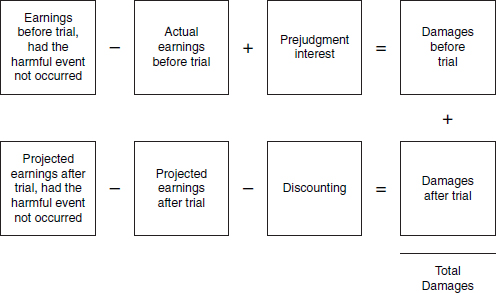
cation of financial discounting to future losses. The losses are the difference between the value the plaintiff would have received if the harmful event had not occurred and the value the plaintiff has or will receive, given the harmful event. The plaintiff may be entitled to interest for losses occurring before trial. Losses occurring after trial are usually discounted to the time of trial. The plaintiff may be due interest on the judgment from the time of trial to the time the defendant actually pays. The majority of damages studies fit this format; thus, we have used such a format as the basic model for this reference guide.
We use numerous brief examples to explain the disputes that can arise. These examples are not full case descriptions; they are deliberately stylized. They attempt to capture the types of disagreements about damages that arise in practical experience, although they are purely hypothetical. In many examples, the dispute involves factual as well as legal issues. We do not try to resolve the disputes in these examples and hope that the examples will help clarify the legal and factual disputes that need to be resolved before or at trial. We introduce many areas of potential dispute with a question, because asking the parties these questions can identify and clarify the majority of disputes over economic damages.
The reader with limited experience in the economic analysis of damages may find it most helpful to begin with Sections II and III and then read Section XII.A, which provides a straightforward application of the principles. Sections IV, V, and VI may be particularly helpful for readers knowledgeable in accounting and valuation. The other sections discuss specific issues relating to damages, and some readers may find it useful to review only those specific to their needs. Section XII.B
discusses an application of some of these more specific issues in the context of a damages analysis for a business.
II. Damages Experts’ Qualifications
Experts who quantify damages come from a variety of backgrounds. The expert should be trained and experienced in quantitative analysis. For economists, the common qualification is the Ph.D. Damages experts with business or accounting backgrounds often have M.B.A. degrees or other advanced degrees, or C.P.A. credentials. Both the method used and the substance of the damages claim dictate the specific areas of specialization the expert needs. In some cases, participation in original research and authorship of professional publications may add to the qualifications of an expert. However, relevant research and publications are not likely to be on the topic of damages measurement per se but rather on topics and methods encountered in damages analysis. For example, a damages expert may need to restate prices and quantities for a but-for market with more sellers than are present in the actual market. For an expert undertaking this task, direct participation in research on the relation between market structure and performance would be helpful.
Many damages studies use statistical regression analysis.3 Specific training is required to apply regression analysis. Damages studies sometimes use field surveys.4 In this case, the damages expert should be trained in survey methods or should work in collaboration with a qualified survey statistician. Because damages estimation often makes use of accounting records, most damages experts need to be able to interpret materials prepared by professional accountants. Some damages issues may require assistance from a professional accountant.
Experts also benefit from professional training and experience in areas relevant to the substance of the damages claim. For example, in antitrust, a background in industrial organization may be helpful; in securities damages, a background in finance may assist the expert; and in the case of lost earnings, an expert may benefit from training in labor economics.
An analysis by even the most qualified expert may face a challenge under the criteria associated with the Daubert and Kumho cases.5 These criteria are intended to exclude testimony based on untested and unreliable theories. Relatively few economists serving as damages experts succumb to Daubert challenges, because
3. For a discussion of regression analysis, see generally Daniel L. Rubinfeld, Reference Guide on Multiple Regression, in this manual.
4. For a discussion of survey methods, see generally Shari Seidman Diamond, Reference Guide on Survey Research, in this manual.
5. Daubert v. Merrell Dow Pharms., Inc., 509 U.S. 579 (1993); Kumho Tire Co. v. Carmichael, 526 U.S. 137 (1999). For a discussion of emerging standards of scientific evidence, see Margaret A. Berger, The Admissibility of Expert Testimony, Section IV, in this manual.
most damages analyses operate in the familiar territory of measuring economic values using a combination of professional judgment and standard tools. But the circumstances of each damages analysis are unique, and a party may raise a Daubert challenge based on the proposition that the tools have never before been applied to these circumstances. Even if a Daubert challenge fails, it can be an effective way for the opposing party to probe the damages analysis prior to trial.
III. The Standard General Approach to Quantification of Damages
In this section, we review the elements of the standard loss measurement in the format of Figure 1. For each element, there are several areas of potential dispute. The sequence of issues discussed here should identify most of the areas of disagreement between the damages analyses of opposing parties.
A. Isolating the Effect of the Harmful Act
The first step in a damages study is the translation of the legal theory of the harmful event into an analysis of the economic impact of that event. In most cases, the analysis considers the difference between the plaintiff’s economic position if the harmful event had not occurred and the plaintiff’s actual economic position.
In almost all cases, the damages expert proceeds on the hypothesis that the defendant committed the harmful act and that the act was unlawful. Accordingly, throughout this discussion, we assume that the plaintiff is entitled to compensation for losses sustained from a harmful act of the defendant. The characterization of the harmful event begins with a clear statement of what occurred. The characterization also will include a description of the defendant’s proper actions in place of its unlawful actions and a statement about the economic situation absent the wrongdoing, with the defendant’s proper actions replacing the unlawful ones (the but-for scenario). Damages measurement then determines the plaintiff’s hypothetical value in the but-for scenario. Economic damages are the difference between that value and the actual value that the plaintiff achieved.
Because the but-for scenario differs from what actually happened only with respect to the harmful act, damages measured in this way isolate the loss of value caused by the harmful act and exclude any change in the plaintiff’s value arising from other sources. Thus, a proper construction of the but-for scenario and measurement of the hypothetical but-for plaintiff’s value by definition includes in damages only the loss caused by the harmful act. The damages expert using the but-for approach does not usually testify separately about the causal relation between damages and the harmful act, although variations may occur where there are issues about the directness of the causal link.
B. The Damages Quantum Prescribed by Law
In most cases, the law prescribes a damages measure that falls into one of the following five categories:
- Expectation: Plaintiff restored to the same financial position as if the defendant had performed as promised.
- Reliance: Plaintiff restored to the same position as if the relationship with the defendant or the defendant’s misrepresentation (and resulting harm) had not existed in the first place.
- Restitution: Plaintiff compensated by the amount of the defendant’s gain from the unlawful conduct, also called compensation for unjust enrichment, disgorgement of ill-gotten gains, or compensation for unbargained-for benefits.6
- Statutory: Plaintiff’s compensation is a set amount per occurrence of wrongdoing. This occurs in cases involving violations of state labor codes and in copyright infringement.
- Punitive: Compensation rewards the plaintiff for detecting and prosecuting wrongdoing to deter similar future wrongdoing.
Expectation damages7 often apply to breach of contract claims, where the wrongdoing is the failure to perform as promised, and the but-for scenario hypothesizes the absence of that wrongdoing, that is, proper performance by the defendant. Expectation damages are an amount sufficient to give the plaintiff the same economic value the plaintiff would have received if the defendant had fulfilled the promise or bargain.8
6. Courts and commentators often subsume unjust enrichment in defining restitution. Professor Farnsworth, for example, states: “[T]he object of restitution is not the enforcement of a promise, but rather the prevention of unjust enrichment…. The party in breach is required to disgorge what he has received in money or services….” See, e.g., E. Allen Farnsworth, Contracts § 12.1, at 814 (1982). However, others have argued that restitution and unjust enrichment are different concepts. See, e.g., James J. Edelman, Unjust Enrichment, Restitution, and Wrongs, 79 Tex. L. Rev. 1869 (2001); Peter Birks, Unjust Enrichment and Wrongful Enrichment, 79 Tex. L. Rev. 1767 (2001); and Emily Sherwin, Restitution and Equity: An Analysis of the Principle of Unjust Enrichment, 79 Tex. L. Rev. 2083 (2001). Judge Posner discusses restitution (defined as returning the breaching party’s profits from the breach) in relation to contract damages and unjust enrichment (defined as compensation for unbargained-for benefits) in connection with implied contracts. See Richard A. Posner, Economic Analysis of Law 130, 151 (1998). See also Restatement (Third) of Restitution and Unjust Enrichment (2011).
7. See John R. Trentacosta, Damages in Breach of Contract Cases, 76 Mich. Bus. J. 1068, 1068 (1997) (describing expectation damages as damages that place the injured party in the same position as if the breaching party completely performed the contract); Bausch & Lomb, Inc. v. Bressler, 977 F.2d 720, 728–29 (2d Cir. 1992) (defining expectation damages as damages that put the injured party in the same economic position the party would have enjoyed if the contract had been performed).
8. See Restatement (Second) of Contracts § 344 cmt. a (1981). Expectation has been called “a queer kind of ‘compensation,’’’ because it gives the promisee something it never had, i.e., the benefit
Reliance damages generally apply to torts and to some contract breaches. Such damages restore the plaintiff to the same financial position it would have enjoyed absent the defendant’s conduct as well as, in the case of torts, compensation for nonpecuniary losses such as pain and suffering.9 Reliance most often includes out-of-pocket costs, but may also include compensation for lost opportunities, when appropriate. In such cases, reliance damages may approach expectation damages. For a tort, reliance damages place the plaintiff in a position economically equivalent to the position absent the harmful act.10 For a breach of contract, measuring damages as the amount of compensation needed to place the plaintiff in the same position as if the contract had not been made in the first place will result in refunding the part of the plaintiff’s reliance investment that cannot be recovered in other ways.11 Thus, reliance damages may be appropriate when the plaintiff made an investment relying on the defendant’s performance.
of its bargain. L.L. Fuller & William R. Perdue, Jr., The Reliance Interest in Contract Damages: 1, 46 Yale L.J. 52, 53 (1936). The policy underlying expectation damages is that they promote and facilitate reliance on business agreements. Id. at 61–62.
9. Generally, the objective of reliance damages is to put the promisee or nonbreaching party back to the position in which it would have been had the promise not been made. See E. Allan Farnsworth, Legal Remedies for Breach of Contract, 70 Colum. L. Rev. 1145, 1148 (1979). See also Restatement (Second) of Contracts § 344(b). Reliance damages include expenditures made in preparation for performance and performance itself. Restatement (Second) of Contracts § 349.
10. See, e.g., East River Steamship Corp. v. Transamerica Delaval Inc., 476 U.S. 858, 873 n.9 (1986) (“tort damages generally compensate the plaintiff for loss and return him to the position he occupied before the injury”). The compensatory goal of tort damages is to make the plaintiff whole as nearly as possible through an award of money damages. See Randall R. Bovbjerg et al., Valuing Life and Limb in Tort: Scheduling “Pain and Suffering,” 83 Nw. U. L. Rev. 908, 910 (1989); John C.P. Goldberg, Two Conceptions of Tort Damages: Fair v. Full Compensation, 5 DePaul L. Rev. 435 (2006). Often, the damages expert is not asked to provide guidance relating to estimating damages for nonpecuniary losses such as pain and suffering. However, hedonic analysis may sometimes be used.
11. Economists and legal scholars have debated contract damages and the concepts of expectation and reliance for decades. Fuller and Perdue’s definition of reliance included the plaintiff’s foregone lost opportunities in addition to his expenditures. But courts that award reliance damages typically award only out-of-pocket expenditures. See, e.g., Michael B. Kelly, The Phantom Reliance Interest in Contract Damages, 1992 Wis. L. Rev. 1755, 1771 (1992). Farnsworth has suggested that this is most likely explained by difficulties in damages proof rather than any rule excluding lost opportunities from reliance damages—that is, that the reason for barring the expectation measure (most often lack of proof of damages with reasonable certainty) will apply equally to bar lost opportunities. E Allan Farnsworth, Precontractual Liability and Preliminary Agreements: Fair Dealing and Failed Negotiations, 87 Colum. L. Rev. 217, 225 (1987). Reliance damages including lost opportunities may be awarded in cases where the expectation is unavailable because the agreement is illusory or too indefinite to be enforceable. See, e.g., Grouse v. Group Health Plan, Inc., 306 N.W.2d 114 (Minn. 1981), where the plaintiff employee resigned one job and turned down the offer of another in reliance on defendant’s promise of employment, but the promised employment would have been at will. The court stated that the proper measure of damages was not what the plaintiff would have earned in his employment with the defendant, but what he lost in quitting his job and turning down an additional offer of employment. Id. at 116. Finally, we note that in a competitive market, reliance damages including lost opportunities
Example: Agent contracts with Owner for Agent to sell Owner’s farm. The asking price is $1,000,000, and the agreed fee is 6%. Agent incurs costs of $1,000 in listing the property. A potential buyer offers the asking price, but Owner withdraws the listing. Agent calculates damages as $60,000, the agreed fee for selling the property. Owner calculates damages as $1,000, the amount that Agent spent to advertise the property.
Comment: Under the expectation remedy, Agent is entitled to $60,000, the fee for selling the property. However, the Agent has only partly performed under the contract, and thus it may be appropriate to limit damages to $1,000. Some states limit recovery in this situation by law to the $1,000, the reliance measure of damages, unless the property is actually sold.12
Restitution damages13 are often the same, from the perspective of quantification, as reliance damages. If the only loss to the plaintiff from the defendant’s harmful act arises from an expenditure that the plaintiff made that cannot otherwise be recovered, the plaintiff receives compensation equal to the amount of that expenditure.14
Interesting and often difficult issues arise in cases that involve elements of both contract and tort. Consider a contract for a product that turns out to be defective. Generally, under what has become known as the economic loss rule, if the defective product only causes economic or commercial loss, the dispute is a private matter between the parties, and the contract will likely control their dispute. But if the product causes personal injury or property damage (other than to the product itself), then tort law and tort damages will likely control.15
are generally equivalent to expectation damages. See, e.g., Robert Cooter & Melvin Aron Eisenberg, Damages for Breach of Contract, 73 Cal. L. Rev. 1432, 1445 (1985).
12. Compare Hollinger v. McMichael, 177 Mont. 144, 580 P.2d 927, 929 (1978) (broker earned his commission when he “procured a purchaser able, ready and willing to purchase the seller’s property”) with Ellsworth Dobbs, Inc. v. Johnson, 50 N.J. 528, 236 A.2d 843, 855 (1967) (broker earns commission only when the transaction is completed by closing the title in accordance with the provisions of the contract). See generally Steven K. Mulliken, When Does the Seller Owe the Broker a Commission? A Discussion of the Law and What It Teaches About Listing Agreements, 132 Mil. L. Rev. 265 (1991).
13. The objective of restitution damages is to put the promisor or breaching party back in the position in which it would have been had the promise not been made. Note the traditional legal distinction between restitution and reliance damages: Reliance damages seek to put the promisee or nonbreaching party back in the position in which it would have been if the promise had not been made. See E. Allan Farnsworth, Legal Remedies for Breach of Contract, 70 Colum. L. Rev. 1145, 1148 (1979). Both measures seek to restore the status quo ante. See also Restatement (Third) of Restitution and Unjust Enrichment (2011).
14. See Restatement (Second) of Contracts § 344(c).
15. Judge Posner has advocated using the term “commercial” rather than “economic” loss because, since personal injuries and property losses destroy values that can be monetized, they are economic losses also. See Miller v. United States Steel Corp., 902 F.2d 573, 574 (7th Cir. 1990). See generally Dan B. Dobbs, An Introduction to Non-Statutory Economic Loss Claims, 48 Ariz. L. Rev. 713
Fraud actions can present particularly difficult problems. For example, if the claim is that the defendant fraudulently induced the plaintiff to enter into an agreement that caused purely commercial losses, the economic loss rule may apply to limit the plaintiff’s recovery to only commercial losses for breach of contract, and thus not allow recovery of additional damages recoverable under fraud, such as punitive damages. Generally, courts have taken three approaches to this problem. Some courts have found that the economic loss rule applies to bar the tort claim completely, so that the plaintiff can proceed only under a breach of contract theory. Other courts have found that fraud is an exception to the economic loss doctrine, allowing fraud actions to proceed. A third approach allows a separate fraud action, but only if the fraud is “independent of” or “extraneous to” the contract promises.16
A plaintiff asserting fraud can generally recover either out-of-pocket costs or expectation damages,17 but courts today more commonly award expectation damages to place the plaintiff in the position it would have occupied had the fraudulent statement been true.18 In cases where the court interprets the fraudulent statement as an actual warranty, then the appropriate remedy is expectation damages. Courts, though, have awarded expectation damages even when the fraudulent statement is not interpreted as an actual warranty. Some of these cases may be situations where a contract exists but is legally unenforceable for technical reasons.
As an alternative, the but-for analysis may consider the value the plaintiff would have received in the absence of the economically detrimental relationship created by the fraud. In this case, the but-for analysis for fraud may adopt the premise that the plaintiff would have entered into a valuable relationship with an entity other than the defendant. For example, if the defendant’s misrepresentations have caused the plaintiff to purchase property unsuited to the plaintiff’s planned use, then the but-for analysis might consider the value that the plaintiff would have received by purchasing a suitable property from another seller.19
(2006); Richard A. Posner, Common-Law Economic Torts: An Economic and Legal Analysis, 48 Ariz. L. Rev. 735 (2006).
16. See, e.g., Dan B. Dobbs, An Introduction to Non-Statutory Economic Loss Claims, 48 Ariz. L. Rev. 713, 728–30 (2006); Ralph C. Anzivino, The Fraud in the Inducement Exception to the Economic Loss Doctrine, 90 Marq. L. Rev. 921, 931–36 (2007); Richard A. Posner, Common-Law Economic Torts: An Economic and Legal Analysis, 48 Ariz. L. Rev. 735 (2006); R. Joseph Barton, Note: Drowning in a Sea of Contract: Application of the Economic Loss Rule to Fraud and Negligent Misrepresentation Claims, 41 Wm. & Mary L. Rev. 1789 (2000). See also Marvin Lumber and Cedar Co. v. PPG Industries, 34 F. Supp. 2d 738 (D.C. Minn. 1999) aff’d, 223 F.3d 873 (7th Cir. 2000) (economic loss doctrine barred fraud claim of merchant against manufacturer where facts supporting such claim were not independent of those supporting its UCC contract claims).
17. See Restatement (Second) of Torts § 549 (1974). Under the Restatement, expectation damages are available only to “the recipient of a fraudulent misrepresentation in a business transaction,” and only for intentional, not negligent, misrepresentation. Id. §§ 549(2), 552.
18. See, e.g., Richard Craswell, Against Fuller and Perdue, 67 U. Chi. L. Rev. 99, 148 (2000).
19. This measure is equivalent to the reliance interest with recovery for lost opportunities, which can approach expectation damages. See supra note 11.
Plaintiffs cannot normally seek punitive damages in a claim for breach of contract,20 but may seek them in addition to compensatory damages in connection with a tort claim. Although punitive damages are rarely the subject of expert testimony, economists have advanced the concept that punitive damages compensate a plaintiff who brings a case for a wrongdoing that is hard to detect or hard to prosecute. Thus under this concept, punitive damages should be calculated so that the expected recovery for a randomly chosen victim is equal to the victim’s loss. To do this, actual damages are multiplied by a factor that is equal to the reciprocal of the probability of both detecting the harmful act and prosecuting the wrongdoer. This adjustment to the damages estimate ensures that the expected recovery from a randomly chosen victim is equal to the victim’s loss.21
In some situations, the plaintiff may have a choice of remedies under different legal theories. For example, in determining damages for fraud in connection with a contract, damages may be awarded under tort law for deceit or under contract law for breach.22
Example: Buyer purchases a condominium from Owner for $900,000. However, the condominium is known by the Owner to be worth only $800,000 at the time of sale because of defects. Buyer chooses to compute damages under the expectation measure of damages as $100,000 and to retain the condominium. Owner computes damages under the reliance measure owed to Buyer as $900,000 and also seeks the return of the condominium to Owner, despite the fact that the condominium is now worth $1,200,000.
Comment: Owner’s application of the reliance remedy is incomplete. Absent the fraud, Buyer would have purchased another condominium and enjoyed the general appreciation in the market. Thus, correctly applied, the two measures are likely to be similar.
20. Posner explains that most breaches are either involuntary, where performance is impossible at a reasonable cost, or voluntary but efficient. The policy of contract law is not to compel adherence to contracts, but only to require each party either to perform under the contract or compensate the other party for any resulting injuries. See Richard A. Posner, Economic Analysis of Law, supra note 6, at 131. For an argument in favor of punitive damages in contracts, see William S. Dodge, The Case for Punitive Damages in Contracts, 48 Duke L. J. 629 (1999).
21. See A. Mitchell Polinsky & Steven Shavell, Punitive Damages: An Economic Analysis, 111 Harv. L. Rev. 879 (1998).
22. This assumes that the economic loss rule does not apply. Generally, plaintiffs will prefer tort remedies to contract remedies because such remedies are broader, affording the possibility of recovery for nonpecuniary losses and punitive damages. For fraud actions, most jurisdictions do not allow recovery for nonpecuniary loses such as emotional distress, although some do if the distress is severe. See, e.g., Nelson v. Progressive Corp., 976 P.2d 859, 868 (Alaska 1999). The Restatement advocates restricting fraud recovery to pecuniary losses. See Restatement (Second) of Torts § 549.
A plaintiff may argue that a harmful act has caused significant losses for many years. The defendant may reply that most of the losses that occurred from the injury are the result of causes other than the harmful act. Thus, the defendant may argue that the injury was caused by multiple factors only one of which was the result of the harmful act, or the defendant may argue that the observed injury over time was caused by subsequent events.
Example: Worker is the victim of a disease caused either by exposure to xerxium or by smoking. Worker makes leather jackets tanned with xerxium. Worker sues the producer of the xerxium, Xerxium Mine, and calculates damages as all lost wages. Defendant Xerxium Mine, in contrast, attributes most of the losses to smoking and calculates damages as only a fraction of lost wages.
Comment: The resolution of this dispute will turn on the legal question of comparative or contributory fault. If the law permits the division of damages into parts attributable to exposure to xerxium and smoking, then medical evidence on the likelihood of cause may be needed to make that division. We discuss this topic further in Section VIII.B. on disaggregation of damages.
Example: Real Estate Agent is wrongfully denied affiliation with Broker. Agent’s damages study projects past earnings into the future at the rate of growth of the previous 3 years. Broker’s study projects that earnings would have declined even without the breach because the real estate market has turned downward.
Comment: The difference between a damages study based on extrapolation from the past, here used by Agent, and a study based on actual data after the harmful act, here used by Broker, is one of the most common sources of disagreement in damages. This is a factual dispute that hinges on the broker demonstrating that there is a relationship between real estate market conditions and the earnings of agents. The example also illustrates how subsequent unexplained events can affect damages calculations, discussed in Section VIII.E.
Frequently, the defendant will calculate damages on the premise that the harmful act had no causal relationship to the plaintiff’s losses—that is, that the plaintiff’s losses would have occurred without the harmful act. The defendant’s but-for scenario will thus describe a situation in which the losses happen anyway. This is equivalent to arguing that the harmful act occurred but the plaintiff suffered no losses.
Example: Contractors conspired to rig bids in a construction deal. State seeks damages for subsequent higher prices. Contractors’ damages estimate is
zero because they assert that the only effect of the bid rigging was to determine the winner of the contract and that prices were not affected.
Comment: This is a factual dispute about how much effect bid rigging has on the ultimate price. The analysis should go beyond the mechanics of the bid-rigging system to consider how the bids would be different had there been no collaboration among the bidders.
The defendant may also argue that the plaintiff has overstated the scope of the harmful act. Here, the legal character of the harmful act may be critical; the law may limit the scope to proximate effects if the harmful act was negligence, but may require a broader scope if the harmful act was intentional.23
Example: Plaintiff Drugstore Network experiences losses because defendant Superstore priced its products predatorily. Drugstore Network reduced prices in all its stores because it has a policy of uniform national pricing. Drugstore Network’s damages study considers the entire effect of national price cuts on profits. Defendant Superstore argues that Network should have lowered prices only on the West Coast and its price reductions elsewhere should not be included in damages.
Comment: Whether adherence to a policy of national pricing is the reasonable response to predatory pricing in only part of the market is a question of fact.
One party’s damages analysis may hypothesize the absence of any act of the defendant that influenced the plaintiff, whereas the other’s damages analysis may hypothesize an alternative, legal act. This type of disagreement is particularly common in antitrust and intellectual property disputes. Although disagreement over the alternative scenario in a damages study is generally a legal question, opposing experts may have been given different legal guidance and therefore made different economic assumptions, resulting in major differences in their damages estimates.
Example: Defendant Copier Service’s long-term contracts with customers are found to be unlawful because they create a barrier to entry that maintains Copier Service’s monopoly power. Rival’s damages study hypothesizes
23. See generally Prosser and Keeton on the Law of Torts § 65, at 462 (Prosser et al. 5th ed., 1984). Dean Prosser states that simple negligence and intentional wrongdoing differ “not merely in degree but in the kind of fault…and in the social condemnation attached to it.” Id.
no contracts between Copier Service and its customers, so Rival would face no contractual barrier to bidding those customers away from Copier Service. Copier Service’s damages study hypothesizes medium-term contracts with its customers and argues that these would not have been found to be unlawful. Under Copier Service’s assumption, Rival would have been much less successful in bidding away Copier Service’s customers, and damages are correspondingly lower.
Comment: Assessment of damages will depend greatly on the substantive law governing the injury. The proper characterization of Copier Service’s permissible conduct usually is an economic issue. However, the expert must also have legal guidance as to the proper legal framework for damages. Counsel for plaintiff may instruct plaintiff’s damages expert to use a different legal framework from that of counsel for the defendant.
The analysis of some types of harmful events requires consideration of effects, such as price erosion,24 that involve changes in the economic environment caused by the harmful event. For a business, the main elements of the economic environment that may be affected by the harmful event are the prices charged by rivals, the demand facing the seller, and the prices of inputs. For example, misappropriation of intellectual property can cause lower prices because products produced with the misappropriated intellectual property compete with products sold by the owner of the intellectual property. In contrast, some harmful events do not change the plaintiff’s economic environment. The theft of some of the plaintiff’s products would not change the market price of those products, nor would an injury to a worker change the general level of wages in the labor market. A damages study need not analyze changes in broader markets when the harmful act plainly has minuscule effects in those markets. The plaintiff may assert that, absent the defendant’s wrongdoing, a higher price could have been charged and therefore that the defendant’s harmful act has eroded the market price. The defendant may reply that the higher price would lower the quantity sold. The parties may then dispute how much the quantity would fall as a result of higher prices.
24. See, e.g., General Am. Transp. Corp. v. Cryo-Trans, Inc., 897 F. Supp. 1121, 1123–24 (N.D. Ill. 1995), modified, 93 F.3d 766 (Fed. Cir. 1996); Rawlplug Co., Inc. v. Illinois Tool Works Inc., No. 91 Civ. 1781, 1994 WL 202600, at *2 (S.D.N.Y. May 23, 1994); Micro Motion, Inc. v. Exac Corp., 761 F. Supp. 1420, 1430–31 (N.D. Cal. 1991) (holding in all three cases that the patentee is entitled to recover lost profits due to past price erosion caused by the wrongdoer’s infringement).
Example: Valve Maker infringes patent of Rival. Rival calculates lost profits as the profits Rival would have made plus a price-erosion effect. The amount of price erosion is the difference between the higher price that Rival would have been able to charge absent Valve Maker’s presence in the market and the actual price. The price-erosion effect is that price difference multiplied by the combined sales volume of Valve Maker and Rival. Defendant Valve Maker counters that the volume would have been lower had the price been higher and measures damages using the lower volume.
Comment: Wrongful competition is likely to cause some price erosion25 and, correspondingly, some enlargement of the total market because of the lower price. The more elastic the demand, the lower the volume would have been with a higher price. The actual magnitude of the price-erosion effect could be determined by economic analysis.
Price erosion is a common issue in quantifying intellectual property damages. However, price erosion may be an issue in many other commercial disputes. For example, a plaintiff may argue that the disparagement of its product due to false advertising has eroded the product’s price.26
In more complicated situations, the damages analysis may need to focus on how an entire industry would be affected by the defendant’s wrongdoing. For example, one federal appeals court held that a damages analysis for exclusionary conduct must consider that other firms beside the plaintiff would have enjoyed the benefits of the absence of that conduct. Thus, prices would have been lower, and the plaintiff’s profits correspondingly less than those posited in the plaintiff’s damages analysis.27
Example: Computer Printer Maker has used unlawful means to exclude rival suppliers of ink cartridges. Rival calculates damages on the assumption that it would have been the only additional seller in the market absent the exclusionary conduct, and that Rival would have been able to sell its cartridges at the same price actually charged by Printer Maker. Printer Maker counters that other sellers would have entered the market and driven the price down, and so Rival has overstated its damages.
25. See, e.g., Micro Motion, 761 F. Supp. at 1430 (citing Yale Lock Mfg. Co. v. Sargent, 117 U.S. 536, 553 (1886), in which the Micro Motion court stated that “[i]n most price erosion cases, a patent owner has reduced the actual price of its patented product in response to an infringer’s competition”).
26. See, e.g., BASF Corp. v. Old World Trading Co., Inc., 41 F.3d 1081 (7th Cir. 1994) (finding that the plaintiff’s damages only consisted of lost profits before consideration of price erosion, prejudgment interest, and costs due to the presence of other competitors who would keep prices low).
27. See Dolphin Tours, Inc. v. Pacifico Creative Servs., Inc., 773 F.2d 1506, 1512 (9th Cir. 1985).
Comment: Increased competition lowers price in all but the most unusual situations. Again, determination of the number of entrants attracted by the elimination of exclusionary conduct and their effect on the price probably requires a full economic analysis.
A comparison of the parties’ statements about the harmful event and the likely impact of its absence will likely reveal differences in legal theories that can result in large differences in damages claims.
Example: Client is the victim of unsuitable investment advice by Broker (all of Client’s investments made by Broker are the result of Broker’s negligence). Client’s damages study measures the sum of the losses of the investments made by Broker, including only the investments that incurred losses. Broker’s damages study measures the net loss by including an offset for those investments that achieved gains.
Comment: Client is considering the harmful event to be the recommendation of investments that resulted in losses, whereas Broker is considering the harmful event to be the entire body of investment advice. Under Client’s theory, Client would not have made the unsuccessful investments but would have made the successful ones, absent the unsuitable advice. Under Broker’s theory, Client would not have made any investments based on Broker’s advice.
A clear statement about the plaintiff’s situation but for the harmful event is also helpful in avoiding double counting that can arise if a damages study confuses or combines reliance28 and expectation damages.
Example: Marketer is the victim of defective products made by Manufacturer; Marketer’s business fails as a result. Marketer’s damages study adds together the out-of-pocket costs of creating the business in the first place and the projected profits of the business had there been no defects. Manufacturer’s damages study measures the difference between the profit margin Marketer would have made absent the defects and the profit margin Marketer actually made.
28. See Section III.B. Reliance damages are distinguished from expectation damages. Reliance damages are defined as damages that do not place the injured party in as good a position as if the contract had been fully performed (expectation damages) but in the same position as if promises were never made. Reliance damages reimburse the injured party for expenses incurred in reliance of promises made. See, e.g., Satellite Broad. Cable, Inc. v. Telefonica de Espana, S.A., 807 F. Supp. 218 (D.P.R. 1992) (holding that under Puerto Rican law an injured party is entitled to reliance but not expectation damages due to the wrongdoer’s willful and malicious termination or withdrawal from precontractual negotiations).
Comment: Marketer has mistakenly added together damages from the reliance principle and the expectation principle.29 Under the reliance principle, Marketer is entitled to be put back to where it would have been had it not started the business in the first place. Damages are total outlays less the revenue actually received. Under the expectation principle, as applied in Manufacturer’s damages study, Marketer is entitled to the profit on the extra sales it would have received had there been no product defects. Out-of-pocket expenses of starting the business would have no effect on expectation damages because they would be present in both the actual and the but-for cases and would offset each other in the comparison of actual and but-for value.
Most damages measurements deal, one way or another, with the question of the economic value of streams of profit or income. In this section, we introduce some of the basic concepts of valuation. In the following two sections, we first address market approaches that use current data on prices and values to estimate value directly. Second, we address income approaches that start by estimating future flows and then discounting them back to a reference date (often referred to as discounting cash flows). The income approaches apply to losses of personal earnings as well as to business losses from lost streams of profits or income, where damages are calculated as the present value of a lost stream of earnings. Although commonly called income approaches, the methods include discounting any form of cash flow, such as revenues and costs as well as income, to arrive at an estimate of damages.
The choice between the two types of approaches is a matter of expert judgment. In some cases, an expert will use both types of approaches. Much of our discussion is stated in terms of business valuation, but the discussion also applies to real estate and other assets.
Some of the ways experts implement a market approach, based on market prices or values, to determine damages include
- Relying on comparables such as a similar business or property,
- Using balance sheet information such as assets and liabilities,
29. The injured party cannot recover both reliance and expectation damages if such recovery would result in double counting. See, e.g., West Haven Sound Development Corp. v. City of West Haven, 514 A.2d 734, 746–47 (Conn. 1986) (plaintiff could seek recovery of reliance expenditures instead of lost profits, but not in addition to lost profits, because reliance expenditures were part of the value of the business as a going concern). See also George M. Cohen, The Fault Lines in Contract Damages, 80 Va. L. Rev. 1225, 1262 (1994).
- Using known ratios from valuing comparables to measure losses, and
- Multiplying existing valuations by changes in market values from publicly available information.
Different methods that experts use to implement an income approach, based on discounting cash flows, to determine damages include
- Projecting revenues and costs with and without the alleged bad act,
- Adjusting profit streams to present value using measures of inflation and the real rate of interest, and
- Projecting profit streams to present value implicitly using capitalization rates.
Each approach presents challenges. The expert must identify the most appropriate method and implement it properly.
Although these methods may seem different and may rely on different information about the firm, each should generate similar numbers. If not, then there is usually an underlying difference in assumptions. Section V discusses the issues and pitfalls frequently encountered when damages are computed from prices or values, while Section VI discusses the issues and pitfalls frequently encountered when damages are computed relying on discounted cash flows.
V. Quantifying Damages Using a Market Approach Based on Prices or Values
An expert can sometimes measure damages as of the time of the wrongdoing directly from market prices or values. For example, if the defendant’s negligence causes the total destruction of the plaintiff’s cargo of wheat, worth $17 million at the current market price, damages are simply that amount. The only task for the expert is to restate the damages as the economic equivalent at time of trial, through the calculation of prejudgment interest, a topic we consider in Section VI.G.
In many cases, the expert does not take a market price and apply it directly. The price of the product or object at issue may not itself be known from a market, but the expert can approximate the market value from the prices of similar products or objects. Appraisers are experts whose task is to estimate the fair market value of real estate, equipment, and works of art. Experts who assess the value of businesses—some of whom specialize as business valuation experts—often perform similar functions based on the known market values of comparable businesses.
A. Is One of the Parties Using an Appraisal Approach to the Measurement of Damages?
Damages analyses based on appraisals usually have two parts. The first is an appraisal of the property, and the second is an application of that appraisal to quantify the loss from the harmful act. The starting point for an appraisal is the choice of comparable properties or businesses. For real estate, the comparables are nearby similar properties. For businesses, the comparables are businesses similar in as many ways as possible to the business at issue, based on characteristics such as type of business, type of customers, size, type of location, and so forth. Only in the case of publicly traded companies is there a known market value at virtually all times. For real estate and private businesses, the comparables must have traded hands at a known transaction price fairly recently. Numerous firms sell databases of transaction prices and other data for the use of business valuation experts.
The second step in an appraisal is the adjustment of the comparables to account for differences between each comparable business or property and the one at issue. Business values are often restated as valuation ratios, such as the ratio of price to revenue or to earnings. Real estate is restated as value per square foot of land or interior space. Such ratios usually need to be specific to the type of business or real estate. In particular, rapidly growing businesses and real estate in growing areas have higher valuation ratios than those with zero or negative growth outlooks.
Example: Oil Company deprives Gas Station Operator of the benefits of Operator’s business. Oil Company’s damages study starts by calculating the ratio of sales value to gasoline sales for five nearby gas station businesses that have sold recently. The ratio is $0.26 per gallon of sales per year. The Operator sells 1.6 million gallons per year, so the business was worth $0.26 × 1,600,000 = $416,000, according to the Oil Company’s expert. The Gas Station Expert argues that the sales used by the Oil Company occurred before a major business relocated nearby. Thus, the sales value to gasoline sales should be increased to $0.30 to reflect the new growth rate as a result of the expected increase in business. He calculates his business to be worth $0.30 × 1,600,000 = $480,000.
B. Are the Parties Disputing an Adjustment of an Appraisal for Partial Loss?
In most cases where the appraisal approach is appropriate, the plaintiff has not suffered a total loss of property or business, but rather some impairment of its value. In that case, the damages expert will adapt the appraisal to measure the loss from the impairment. Here, again, the use of valuation ratios is common.
Example: Oil Company breaches an earlier agreement with Gas Station Operator and opens another station near Operator’s station. Operator’s gasoline sales fall by 700,000 gallons per year. Oil Company’s damages study applies the ratio of $0.26 per gallon of sales per year to the loss: $0.26 × 700,000 = $182,000. Operator’s damages study uses a regression analysis of the valuation of recently sold businesses and finds that each gallon of added sales raises value by $0.47 and so calculates damages as $0.47 × 700,000 = $329,000.
Comment: Because of fixed costs, the average valuation of gasoline sales will be less than the marginal valuation, and the latter is the conceptually correct approach.
C. Is One of the Parties Using the Assets and Liabilities Approach?
The assets and liabilities approach starts with the accounting balance sheet of a company and adjusts assets and liabilities to approximate current market values. It then nets the assets and the liabilities to compute the net asset value of the firm. The asset values include the value of intangibles. Because these values are hard to determine, the assets and liabilities method is not generally suited to the valuation of businesses with substantial intangible assets.
D. Are the Parties Disputing an Adjustment for Market Frictions?
Purely competitive markets have what economists term a “frictionless” market structure. These markets have (1) a large number of buyers and sellers of a single, homogeneous product; (2) fully informed participants; and (3) the feature that sellers can easily enter or exit from the market. A “friction” is anything that prevents the market from being purely competitive. The markets for businesses and properties have frictions that may make transaction values depart from the usual concept of the price negotiated by a willing seller and a willing buyer. In the case of a forced sale and thus a less willing seller, the transaction price may understate the value. Adverse selection, which occurs when one party knows more about a property or business than the other, may cause severe understatements in some markets.30 Because equipment with hidden defects is more likely to be offered for sale than equipment in unusually good condition, and sales prices are lower as a result, owners of the good equipment tend not to offer it on the market.
30. See, e.g., George A. Akerlof, The Market for “Lemons”: Quality Uncertainty and the Market Mechanism, 84 Q. J. Econ. 488 (1970).
Example: Negligence of Tire Maker causes the total loss of a 747 aircraft. Tire Maker’s damages analysis uses the prices of 747s of similar age in the used airplane market to set a value of $23 million on the ruined airplane. However, Airline offers the testimony of an economist expert who explains that only a small fraction of 747s are ever put up for sale in the used airplane market. Rather, airlines choose to sell only defective planes because they continue to fly nondefective 747s. He then adjusts for the adverse selection of inferior airplanes in the used market and places a value of $42 million on the plane.
Comment: Although merited in principle, the airline’s adjustment is challenging to carry out and is likely to be the subject of expert disagreement.
A major source of friction in property and business markets is the capital gains tax. Because capital gains are taxed only at realization, after-tax sales prices will generally understate the value of a business or property to the existing owners if they have no plans to sell except in the more distant future. The forced sale implicit in any act that harms a business or property imposes a loss on the owners in excess of their after-tax loss. We discuss this topic later in Section VI.E on taxes.
E. Is One of the Parties Relying on Hypothetical Property in Its Damages Analysis?
Plaintiffs may argue that undeveloped land or a business opportunity yet to be pursued was taken from them by the defendant’s harmful act and that the value lost should include the value of the still hypothetical improvements. We consider this topic in more detail in Section VIII.A in its most important form, damages for harm to a startup business.
Example: Property Owner sues County for the value of undeveloped property condemned for a rapid transit extension. Owner’s damages claim is $18 million, the appraisal value of a hypothetical condominium development on the property less the anticipated cost of building the development. The County’s expert, an appraiser, argues that the market value of the property is $2 million, based on comparable undeveloped land nearby.
Comment: In principle, the current market value of undeveloped land and the market value of the same land with proper development, less the cost of that development, should be the same, because buyers would bid based on the value of the undeveloped land. Property Owner probably understated the development costs. But the value of the nearby property may understate the value of the condemned property—it is for sale because it lacks certain features that make it less desirable to
develop, such as a view. On the other hand, the Property Owner’s valuation does not reflect the probability that the Property Owner may not succeed in building the condominium.
F. What Complications Arise When Anticipation of Damages Affects Market Values?
For publicly traded companies, the harmful act may depress the market value of the company itself. For example, suppose that a manufacturer of wood windows treats its windows with a preservative that is defective, causing the windows to rot. The window manufacturer sues the manufacturer of the preservative for damages from lost sales in addition to the cost of replacing the defective windows. The window manufacturer’s expert may be tempted to use the decline following the harm as a measure of damages. In cases when the news of the harm reaches the public discretely, say in a single day, the technique of an event study, commonly used in securities fraud cases, can be used to isolate the special component of the decline in market value.
The problem with using the plaintiff’s market value is that the market will anticipate recovery in the form of damages, and this will offset at least some of the decline in market value. In the extreme, if stock traders expect that the plaintiff will receive exactly full compensation, the plaintiff’s market value will not change at all when knowledge of the wrongdoing—including the fact that a damages award will be made—hits the stock market. Thus, the use of the observed decline in the value of the plaintiff company at the time of the injury understates the actual amount of harm by an unknown amount, so the expert should consider using other valuation techniques. Note that this understatement arises when the publicly traded company itself stands to recover damages.
Changes in market values have a different role in situations, such as fraud on the market, where the public company is the defendant. If the release of previously fraudulently concealed adverse information causes both a reduction in the value of the company because of the information and a further reduction because the market anticipates that the company will pay damages to investors who overpaid for their shares during the period when the information was concealed, damages may be overstated by an unknown amount.
VI. Quantifying Damages as the Sum of Discounted Lost Cash Flows
The fundamental principle of economics governing the second approach to valuation is that the value of a business is the present value of its expected future cash
flows.31 In forming a present value, the expert multiplies each future year’s cash flows by the value today for a dollar received in that future year. This price is the discount factor. Thus, the discount factor reflects the decreased value for a dollar received in the future compared to the value of a dollar received today.
In broad summary, the damages expert using the discounted cash flow approach projects historical and future but-for revenue and cost, actual historical revenue and cost, and projected actual revenue and cost. The difference between revenue and cost is cash flow, and the difference between but-for and actual cash flow is the loss of cash flow attributable to the harmful act. The expert then applies discount rates to each year’s lost cash flow to determine damages.
A. Is There Disagreement About But-For Revenues in the Past?
A common source of disagreement about the likely profitability of a business is the absence of a track record of earlier profitability. Whenever the plaintiff is a startup business, the issue will arise of reconstructing the value of a business with no historical benchmark.
Example: Plaintiff Xterm is a failed startup. Defendant VenFund has breached a venture capital financing agreement. Xterm’s damages study projects the profits it would have made under its business plan. VenFund’s damages estimate, which is much lower, is based on the value of the startup as revealed by sales of Xterm equity made just before the breach.
Comment: Both sides confront factual issues to validate their damages estimates. Xterm needs to show that its business plan was still a reasonable forecast as of the time of the breach. VenFund needs to show that the sale of equity places a reasonable value on the firm, that is, that the equity sale was at arm’s length and was not subject to discounts. This dispute can also be characterized as whether the plaintiff is entitled to expectation damages or reliance damages. The jurisdiction may limit damages for firms with no track record.
Where the injury takes the form of lost sales volume, the plaintiff usually has avoided the cost of production for the lost sales. Calculation of these avoided costs is a common area of disagreement about damages. Conceptually, avoided cost is the difference between the cost that would have been incurred at the higher volume of
31. This discussion follows that in Shannon Pratt, Business Valuation Body of Knowledge 85–95 (2d ed. 2003).
sales but for the harmful event and the cost actually incurred at the lower volume of sales achieved. In the format of Figure 1, the avoided-cost calculation is done each year. The following are some of the issues that arise in calculating avoided cost:
- For a firm operating at capacity, expansion of sales is cheaper in the long run than in the short run, whereas, if there is unused capacity, expansion may be cheaper in the short run.
- The costs that can be avoided if sales fall abruptly are smaller in the short run than in the long run.
- Avoided costs may include marketing, selling, and administrative costs as well as the cost of manufacturing.
- Some costs are fixed, at least in the short run, and are not avoided as a result of the reduced volume of sales caused by the harmful act.
Sometimes putting costs into just two categories is useful: those that vary with sales (variable costs) and those that do not vary with sales (fixed costs). This breakdown is approximate, however, and does not do justice to important aspects of avoided costs. In particular, costs that are fixed in the short run may be variable in the longer run. Disputes frequently arise over whether particular costs are fixed or variable. One side may argue that most costs are fixed and were not avoided by losing sales volume, whereas the other side may argue that many costs are variable.
Certain accounting concepts relate to the calculation of avoided cost. Profit- and-loss statements frequently report the “cost of goods sold.”32 Costs in this category are frequently, but not uniformly, avoided when sales volume is lower. But costs in other categories, called “operating costs” or “overhead costs,” also may be avoided, especially in the long run. One approach to the measurement of avoided cost is based on an examination of all of a firm’s cost categories. The expert determines how much of each category of cost was avoided.
An alternative approach uses regression analysis or some other statistical method to determine how costs vary with sales as a general matter within the firm or across similar firms. The results of such an analysis can be used to measure the costs avoided by the decline in sales volume caused by the harmful act.
C. Is There Disagreement About the Plaintiff’s Actual Revenue After the Harmful Event?
When the plaintiff has mitigated the adverse effects of the harmful act by making an investment that has not yet paid off at the time of trial, disagreement may arise about the value that the plaintiff has actually achieved.
32. See, e.g., United States v. Arnous, 122 F.3d 321, 323 (6th Cir. 1997) (finding that the district court erred when it relied on government’s theory of loss because the theory ignored the cost of goods sold).
Example: Manufacturer breaches agreement with Distributor. Distributor starts a new business that shows no accounting profit as of the time of trial. Distributor’s damages study makes no deduction for actual earnings during the period from breach to trial. Manufacturer’s damages study places a value on the new business as of the time of trial and deducts that value from damages.
Comment: Some offset for economic value created by Distributor’s mitigation efforts may be appropriate. Note that if Distributor made a good-faith effort to create a new business, but was unsuccessful because of adverse events outside its control, the issue of the treatment of unexpected subsequent events will arise.33
D. What Is the Role of Inflation?
Persistent inflation in the U.S. economy complicates projections of future losses. Although inflation rates in the United States since 1987 have been only in the range of 1% to 3% per year, the cumulative effect of inflation has a pronounced effect on future dollar quantities. At 3% annual inflation, a dollar today buys what $4.38 will buy 50 years from now. Under inflation, the unit of measurement of economic values becomes smaller each year, and this shrinkage must be considered if future losses are measured in the smaller dollars of the future. Calculations of this type are often termed “escalation.” Dollar losses grow in the future because of the use of the shrinking unit of measurement. For example, an expert might project that revenues for a firm will rise at approximately 5% per year for the next 10 years—3% because of general inflation and 2% more because of the growth of the firm.34
Alternatively, the expert may project future losses in constant dollars without explicitly accounting for escalation for future inflation.35 The use of constant dollars avoids the problems of dealing with a shrinking unit of measurement. In the example just given, the expert might project that revenues will rise at 2% per year in constant dollars. Constant dollars must be stated with respect to a base year. Thus, a calculation in constant 2009 dollars means that the unit for future measurement is the purchasing power of the dollar in 2009.
33. See Section VIII.F.
34. See Section VI.D.2.
35. See, e.g., Willamette Indus., Inc. v. Commissioner, 64 T.C.M. (CCH) 202 (1992) (holding expert witness erred in failing to take inflation escalation into account).
2. Are the parties using a discount rate properly matched to the projection?
For future losses, a damages study calculates the amount of compensation needed at the time of trial to replace expected future lost income. The result is discounted future losses;36 it is also sometimes referred to as the present value of future losses.37 Discounting is conceptually separate from the adjustment for inflation considered in the preceding section. Discounting is typically carried out in the format shown in Table 1.
Table 1. Calculation of Discounted Loss at 5% Interest
| Years in Future | Loss | Discount Factor | Discounted Lossa |
| 0 | $100 | 1.000 | $100 |
| 1 | 125 | 0.952 | 119 |
| 2 | 130 | 0.907 | 118 |
| Total | $337 | ||
| aDiscounted Loss = Loss x Discount Factor. | |||
“Loss” is the estimated future loss, in either escalated or constant-dollar form. “Discount factor” is a factor that calculates the number of dollars needed at the time of trial to compensate for a lost dollar in the future year. The discount factor is the ratio of the value at a future date of a cash flow received today to its value today. It is calculated from the discount rate, which is the interest rate that values a cash flow at a future date. If the current 1-year interest rate is 5%, then the discount rate is 1.05—the value of $1 will be $1.05 a year from now. The discount factor will therefore be $1/$1.05. The 2-year discount rate is the square of 1.05, and the discount factor will be 1/(1.05 × 1.05) Thus, the discount factor is computed by compounding the discount rate forward from the base year to the future year and then taking the reciprocal.
For example, in Table 1, the interest rate is 5%. As discussed, the discount factor for the next year is calculated as the reciprocal of 1.05, and the discount factor for 2 years in the future is calculated as the reciprocal of 1.05 squared. Future discounts would be obtained by multiplying by 1.05 a suitably larger number of times and then taking the reciprocal. The discounted loss is the loss multiplied by the discount factor for that year. The number of dollars at time of trial that compensates for the loss is the sum of the discounted losses, $337 in this example.
36. See generally Michael A. Rosenhouse, Annotation, Effect of Anticipated Inflation on Damages for Future Losses—Modern Cases, 21 A.L.R. 4th 21 (1981) (discussing discounted future losses extensively).
37. See generally George A. Schieren, Is There an Advantage in Using Time-Series to Forecast Lost Earnings? 4 J. Legal Econ. 43 (1994) (discussing effects of different forecasting methods on present discounted value of future losses). See, e.g., Wingad v. John Deere & Co., 523 N.W.2d 274, 277–79 (Wis. Ct. App. 1994) (calculating present discounted value of future losses).
To discount a future loss projected in escalated terms, one should use an ordinary interest rate. For example, in Table 1, if the losses of $125 and $130 are in dollars of those years, and not in constant dollars of the initial year, then the use of a 5% discount rate is appropriate if 5% represents an accurate measure of the current interest rate, also known as the time value of money. The ordinary interest rate is often called the nominal interest rate to distinguish it from the real interest rate.
To discount a future loss projected in constant dollars, one should use a real interest rate as the discount rate. A real interest rate is an ordinary interest rate less an assumed rate of future inflation.38 In Table 1, the use of a 5% discount rate for discounting constant-dollar losses would be appropriate if the ordinary interest rate was 8% and the rate of inflation was 3%.39 Then the real interest rate would be 8% minus 3%, or 5%. The deduction of the inflation rate from the discount rate is the counterpart of the omission of escalation for inflation from the projection of future losses.
3. Is one of the parties assuming that discounting and earnings growth offset each other?
An expert might make the assumption that future growth of losses will occur at the same rate as the discount rate. Table 2 illustrates the standard format for this method of calculating discounted loss.
Table 2. Calculation of Discounted Loss When Growth and Discounting Offset Each Other
| Years in Future | Loss | Discount Factor | Discounted Lossa |
| 0 | $100 | 1.000 | $100 |
| 1 | 105 | 0.952 | 100 |
| 2 | 110 | 0.907 | 100 |
| Total | $300 | ||
| aDiscounted Loss = Loss × Discount Factor. | |||
When growth and discounting exactly offset each other, the present discounted value is the number of years of lost future earnings multiplied by the
38. Some experts rely on the real interest rate inferred from the price of TIPS (Treasury Inflation Protected Securities).
39. Technically, the formula is: (1 + real rate of interest) = (1 + ordinary rate of interest)/(1 + inflation). However, the difference is diminimus unless the ordinary rate of interest is high. Thus, using this formula, the real interest rate is 4.85%.
current amount of lost earnings.40 In Table 2, the loss of $300 is exactly three times the base year’s loss of $100. Thus the discounted value of future losses can be calculated by a shortcut in this special case. The explicit projection of future losses and the discounting back to the time of trial are unnecessary. However, the parties may dispute whether the assumption that growth and discounting are exactly offsetting is realistic in view of projected rates of growth of losses and market interest rates at the time of trial.
In Jones & Laughlin Steel Corp. v. Pfeifer,41 the Supreme Court considered the issue of escalated dollars with nominal discounting against constant dollars with real discounting. It found both acceptable, although the Court seemed to express a preference for the second format.
E. Are Losses Measured Before or After the Plaintiff’s Income Taxes?
A damages award compensates the plaintiff for lost economic value. In principle, the calculation of compensation should measure the plaintiff’s loss after taxes and then calculate the magnitude of the pretax award needed to compensate the plaintiff fully, once taxation of the award is considered. In practice, the tax rates applied to the original loss and to the compensation are frequently the same. When the rates are the same, the two tax adjustments are a wash. In that case, the appropriate pretax compensation is simply the pretax loss, and the damages calculation may be simplified by the omission of tax considerations.42
In some damages analyses, explicit consideration of taxes is essential, and disagreements between the parties may arise about these tax issues. If the plaintiff’s lost income would have been taxed as a capital gain (at a preferential rate), but the damages award will be taxed as ordinary income, the plaintiff can be expected to include an explicit calculation of the extra compensation needed to make up for the loss of the tax advantage. Sometimes tax considerations are paramount in damages calculations.43
40. Certain state courts have, in the past, required that the offset rule be used so as to avoid speculation about future earnings growth. In Beaulieu v. Elliott, 434 P.2d 665, 671–72 (Alaska 1967), the court ruled that discounting was exactly offset by wage growth. In Kaczkowki v. Bolubasz, 421 A.2d 1027, 1036–38 (Pa. 1980), the Pennsylvania Supreme Court ruled that no evidence on price inflation was to be introduced and deemed that inflation was exactly offset by discounting.
41. 462 U.S. 523 (1983).
42. There is a separate issue about the effect of taxes on the interest rate for prejudgment interest and discounting. See discussion infra Sections VI.G, VI.H.
43. See generally John H. Derrick, Annotation, Damages for Breach of Contract as Affected by Income Tax Considerations, 50 A.L.R. 4th 452 (1987) (discussing a variety of state and federal cases in which courts ruled on the propriety of tax considerations in damage calculations; courts have often been reluctant to award difference in taxes as damages because it is calling for too much speculation).
Example: Trustee wrongfully sells Beneficiary’s property at full market value. Beneficiary would have owned the property until death and deferred the capital gains tax.
Comment: Damages are the difference between the actual capital gains tax and the present value of the future capital gains tax that would have been paid but for the wrongful sale, even though the property sold at its full value.
In some cases, the law requires different tax treatment of loss and compensatory awards. Again, the tax adjustments do not offset each other, and consideration of taxes may be a source of dispute.
Example: Driver injures Victim in a truck accident. A state law provides that awards for personal injury are not taxable, even though the income lost as a result of the injury would have been taxable. Victim calculates damages as lost pretax earnings, but Driver calculates damages as lost earnings after tax.44 Driver argues that the nontaxable award would exceed actual economic loss if it were not adjusted for the taxation of the lost income.
Comment: Under the principle that damages are to restore the plaintiff to the economic equivalent of the plaintiff’s position absent the harmful act, it may be recognized that the income to be replaced by the award would have been taxed. However, the law in a particular jurisdiction may not allow a jury instruction on the taxability of an award.45
Example: Worker is wrongfully deprived of tax-free fringe benefits by Employer. Under applicable law, the award is taxable. Worker’s damages estimate includes a factor so that the amount of the award, after tax, is sufficient to replace the lost tax-free value.
Comment: Again, to achieve the goal of restoring plaintiff to a position economically equivalent absent the harmful act, an adjustment of this type is
44. See generally Brian C. Brush & Charles H. Breedon, A Taxonomy for the Treatment of Taxes in Cases Involving Lost Earnings, 6 J. Legal Econ. 1 (1996) (discussing four general approaches for treating tax consequences in cases involving lost future earnings or earning capacity based on the economic objective and the tax treatment of the lump sum award). See, e.g., Myers v. Griffin-Alexander Drilling Co., 910 F.2d 1252 (5th Cir. 1990) (holding loss of past earnings between the time of the accident and the trial could not be based on pretax earnings).
45. See generally John E. Theuman, Annotation, Propriety of Taking Income Tax into Consideration in Fixing Damages in Personal Injury or Death Action, 16 A.L.R. 4th 589 (1981) (discussing a variety of state and federal cases in which the propriety of jury instructions regarding tax consequences is at issue). See, e.g., Bussell v. DeWalt Prods. Corp., 519 A.2d 1379 (N.J. 1987) (holding that trial court hearing a personal injury case must instruct jury, upon request, that personal injury damages are not subject to state and federal income taxes); Gorham v. Farmington Motor Inn, Inc., 271 A.2d 94 (Conn. 1970) (holding court did not err in refusing to instruct jury that personal injury damages were tax-free).
appropriate. The adjustment is often called “grossing up” damages.46 To accomplish grossing up, divide the lost tax-free value by one minus the tax rate. For example, if the loss is $100,000 of tax-free income, and the income tax rate is 25%, the award should be $100,000 divided by 0.75, or $133,333.
F. Is There a Dispute About the Costs of Stock Options?
In some firms, employee stock options are a significant part of total compensation. Stock options are often used by startup businesses because the options do not require the business to pay out any cash. However, at a future date, the options may be exercised and the option holder will pay only the price per share at the time the options are received as opposed to the price per share at the time the options are exercised. In this way, the firm transfers part of the compensation costs incurred today to the firm’s shareholders.
The parties may dispute whether the value of options should be included in the costs avoided by the plaintiff as a result of lost sales volume. The defendant might argue that stock options should be included, because their issuance is costly to the shareholders. The defendant might place a value on newly issued options and amortize this value over the period from issuance to vesting. The plaintiff, in contrast, might exclude options costs because the options cost the firm no cash payout, even though they impose costs on the firm’s shareholders.
Example: Firm A pays its sales manager $2000 for every machine sold at $100,000 as well as options to purchase 1600 shares in a year at the existing price of $10 per share. As a result of B’s disparagement of A, A asserts that it lost $10,000,000 in sales (100 machines). In its damages analysis, A states that the lost sales represent lost profits of $5,800,000: $10,000,000 less $4,000,000 in avoided production costs and $200,000 in avoided sales commissions. Defendant B calculates that each stock option is worth $5 today based on an analysis using accepted financial models to value the options. Thus, B asserts that damages are $5,000,000: $10,000,000 less $4,000,000 in avoided production costs and $1,000,000 in sales commissions ($200,000 plus $5 × 100 × 1600).
Comment: The costs of the options will never show up on the profit-and-loss statements for Firm A, even if exercised. However, Firm A will receive a lower value for each share it sells either to an investor or through an IPO to reflect the potential future dilution in its shares outstanding.
46. See Cecil D. Quillen, Jr., Income, Cash, and Lost Profits Damages Awards in Patent Infringement Cases, 2 Fed. Circuit B.J. 201, 207 (1992) (discussing the importance of taking tax consequences and cash flows into account when estimating damages).
G. Is There a Dispute About Prejudgment Interest?47
The law may specify how to calculate interest for losses prior to a verdict on liability, generally termed “prejudgment interest.” The law may exclude prejudgment interest, specify prejudgment interest to be a statutory rate, or exclude compounded interest. Table 3 illustrates these alternatives. With simple uncompounded interest, losses from 5 years before trial earn five times the specified interest, and so compensation for a $100 loss from 5 years ago is $135 at 7% interest. With compound interest, the plaintiff earns interest on past interest. Compensation at 7% interest compounded is about $140 for a loss of $100 five years before trial. The difference between simple and compound interest becomes much larger if the time from loss to trial is greater or if the interest rate is higher. Because interest receipts in practice do earn further interest, economic analysis generally supports the use of compound interest.
Table 3. Calculation of Prejudgment Interest (in Dollars)
| Years Before Trial | Loss Without Interest | Loss with Compound Interest at 7% | Loss with Simple Uncompounded Interest at 7% |
| 10 | 100 | 197 | 170 |
| 9 | 100 | 184 | 163 |
| 8 | 100 | 172 | 156 |
| 7 | 100 | 161 | 149 |
| 6 | 100 | 150 | 142 |
| 5 | 100 | 140 | 135 |
| 4 | 100 | 131 | 128 |
| 3 | 100 | 123 | 121 |
| 2 | 100 | 114 | 114 |
| 1 | 100 | 107 | 107 |
| 0 | 100 | 100 | 100 |
| Total | 1100 | 1579 | 1485 |
47. See generally Michael S. Knoll, A Primer on Prejudgment Interest, 75 Tex. L. Rev. 293 (1996) (discussing prejudgment interest extensively). See, e.g., Ford v. Rigidply Rafters, Inc., 984 F. Supp. 386, 391–92 (D. Md. 1997) (specifying a method of calculating prejudgment interest in an employment discrimination case to ensure plaintiff is fairly compensated rather than given a windfall); Acron/Pacific Ltd. v. Coit, No. C-81-4264-VRW, 1997 WL 578673, at *2 (N.D. Cal. Sept. 8, 1997) (reviewing supplemental interest calculations and applying California state law to determine the appropriate amount of prejudgment interest to be awarded); Prestige Cas. Co. v. Michigan Mut. Ins. Co., 969 F. Supp. 1029 (E.D. Mich. 1997) (analyzing Michigan state law to determine the appropriate prejudgment interest award).
Where the law does not prescribe the form of interest for past losses, the experts will normally apply a reasonable interest rate to bring those losses forward. The parties may disagree on whether the interest rate should be measured before or after tax. The before-tax interest rate is the normally quoted rate. To calculate the corresponding after-tax rate, one subtracts the amount of income tax the recipient would have to pay on the interest. Thus, the after-tax rate depends on the tax situation of the plaintiff. The format for calculation of the after-tax interest rate is shown in the following example:
- Interest rate before tax: 9%
- Tax rate: 30%
- Tax on interest (line 1 times line 2): 2.7%
- After-tax interest rate (line 1 less line 3): 6.3%
Even where damages are calculated on a pretax basis, economic considerations suggest that the prejudgment interest rate should be on an after-tax basis: Had a taxpaying plaintiff actually received the lost earnings in the past and invested the earnings at the assumed rate, income tax would have been due on the interest. The plaintiff’s accumulated value would be the amount calculated by compounding past losses at the after-tax interest rate.
Where there is economic disparity between the parties, there may be a disagreement about whose interest rate should be used—the borrowing rate of the defendant or the lending rate of the plaintiff, or some other rate. There may also be disagreements about adjustment for risk.48
Example: Crop Insurance Company disputes payment of insurance to Farmer. Farmer calculates damages as the payment due plus the large amount of interest charged by a personal finance company; no bank was willing to lend to her, given her precarious financial condition. Crop Insurer calculates damages as a lower payment plus the interest on the late payment at the normal bank loan rate.
Comment: The law may limit claims for prejudgment interest to a specified interest rate, and a court may hold that this situation falls within the limit. Economic analysis does support the idea that delays in payments are more costly to people with higher borrowing rates and that the actual rate incurred may be considered damages.
48. See generally James M. Patell et al., Accumulating Damages in Litigation: The Roles of Uncertainty and Interest Rates, 11 J. Legal Stud. 341 (1982) (extensive discussion of interest rates in damages calculations).
H. Is There Disagreement About the Interest Rate Used to Discount Future Lost Value?
Discount calculations should use a reasonable interest rate drawn from current data at the time of trial for losses projected to occur after trial. The interest rate might be obtained from the rates that could be earned in the bond market from a bond of maturity comparable to the lost stream of receipts. As in the case of prejudgment interest, there is an issue as to whether the interest rate should be on a before- or after-tax basis. The parties may also disagree about adjusting the interest rate for risk. A common approach for determining the interest on lost business profit is to use the Capital Asset Pricing Model (CAPM)49 to calculate the risk-adjusted discount rate. The CAPM is the standard method in financial economics to analyze the relation between risk and discounting. In the CAPM method, the expert first measures the firm’s “beta”—the ratio of the percent variation in one firm’s value to the percent variation in the value of all businesses. That is, if the index of value for a representative set of firms50 increases by 10% over a year and the firm has a beta of 1.5, then its value is expected to increase by 15% over a year. Then the risk-adjusted discount rate is the risk-free rate from a U.S. Treasury security plus the beta multiplied by the historical average risk premium for the stock market.51 The calculation may be presented in the following format:
- Risk-free interest rate: 4.0%
- Beta for this firm: 1.2
- Market equity premium: 6.0%
- Equity premium for this firm (line 2 times line 3): 7.2%
- Discount rate for this firm (line 1 plus line 4): 11.2%
I. Is One of the Parties Using a Capitalization Factor?
Another approach to discounting a stream of losses uses a market capitalization factor. A capitalization factor is the ratio of the value of a future stream of income to the current amount of the stream; for example, if a firm is worth $1 million and its current earnings are $100,000, its capitalization factor is ten.
The capitalization factor generally is obtained from the market values of comparable assets or businesses. For example, the expert might locate a comparable business traded in the stock market and compute the capitalization factor as
49. See, e.g., Cede & Co. v. Technicolor, Inc., No. Civ.A.7129, 1990 WL 161084 (Del. Ch. Oct. 19, 1990) (Mem.) (assessing the propriety of using CAPM to determine the discount rate); Gilbert v. MPM Enters., Inc., No. 14416, 1997 WL 633298, at *8 (Del. Ch. Oct. 9, 1997) (finding that petitioner’s expert witnesses’ use of CAPM is appropriate).
50. For example, the S&P 500.
51. Richard A. Brealey et al., Principles of Corporate Finance 213–22 (9th ed. 2008).
the ratio of stock market value to operating income. In addition to capitalization factors derived from markets, experts sometimes use rule-of-thumb capitalization factors. For example, the value of a dental practice might be taken as 2 year’s gross revenue (the capitalization factor for revenue is 2). Often the parties dispute whether there is reliable evidence that the capitalization factor accurately measures value for the specific asset or business.
Once the capitalization factor is determined, the calculation of the discounted value of the loss is straightforward: It is the current annual loss in operating profit multiplied by the capitalization factor. A capitalization factor approach to valuing future losses may be formatted in the following way:
- Ratio of market value to current annual earnings in comparable publicly traded firms: 13
- Plaintiff’s lost earnings over past year: $200,000
- Value of future lost earnings (line 1 times line 2): $2,600,000
The capitalization factor approach might also be applied to revenue, cash flow, accounting profit, or other measures. The expert might adjust market values for any differences between the valuation principles relevant for damages and those that the market applies. For example, the value in the stock market may be considered the value placed on a business for a minority interest, whereas the plaintiff’s loss relates to a controlling interest. In this case, the expert would adjust the capitalization factor upward to account for the value of the control rights. The parties may dispute almost every element of the capitalization calculation.
Example: Lender is responsible for failure of Auto Dealer. Plaintiff Auto Dealer’s damages study projects rapid growth of future profits based on the current year’s profit but for Lender’s misconduct. The study uses a discount rate calculated as the after-tax interest rate on Treasury bills. As a result, the application of the discount rate to the future stream of earnings implies a capitalization rate of 12 times the current pretax profit. The resulting estimate of lost value is $10 million. Defendant Lender’s damages study uses data on the actual sale prices of similar dealerships in various parts of the country. The data show that the typical sales price of a dealership is six times its 5-year average annual pretax profit. Lender’s damages study multiplies the capitalization factor of six by the 5-year average annual pretax profit of Auto Dealer of $500,000 to estimate lost value as $3 million.
Comment: Part of the difference between the two damages studies comes from the higher implied capitalization factor used by Auto Dealer. Another reason for the differences may be that the 5-year average pretax profit is less than the current-year profit.
The law imposes four important limitations on a plaintiff’s ability to recover losses as damages: (1) a plaintiff must prove its damages with reasonable certainty, (2) a plaintiff may not recover damages that are too remote, (3) a plaintiff has a duty to mitigate its damages, and (4) a liquidated damages clause may limit the amount of damages by prior agreement.
A. Is the Defendant Arguing That Plaintiff’s Damages Estimate Is Too Uncertain and Speculative?
In general, damages law holds that a plaintiff may not recover damages beyond an amount proven with reasonable certainty.52 This rule permits damages estimates that are not mathematically certain but excludes those that are speculative.53 Failure to prove damages to a reasonable certainty is a common defense. The determination of what constitutes speculation is increasingly a matter of law to be determined prior to trial in a Daubert proceeding.54
Courts and commentators have long recognized the difficulties in defining what constitutes reasonable certainty or speculation in a damages analysis. The exclusion of damages on grounds of excessive uncertainty regarding the amount of damages may result in an award of zero damages when it is likely that the plaintiff suffered significant damages, even though the actual amount is quite uncertain.
There are three contexts in which reasonable certainty or speculation can arise: (1) where the outcome is uncertain, (2) where it is argued that the expert has not used the best method or data, or (3) where the damages suffered by a specific plaintiff are uncertain.
Traditionally, damages are calculated without reference to uncertainty about outcomes in the but-for scenario. Outcomes are taken as actually occurring if they are the expected outcome and as not occurring if they are not expected to occur. This approach may overcompensate some plaintiffs and undercompensate others. For example, suppose that a drug company was deprived of the opportunity to bring to market a drug that had a 90% chance of receiving Food and Drug
52. See, e.g., Restatement (Second) of Contracts § 352 (“Damages are not recoverable for loss beyond an amount that the evidence permits to be established with reasonable certainty”).
53. Comment a to Restatement (Second) of Contracts § 352 states, in pertinent part: “Damages need not be calculable with mathematical accuracy and are often at best approximate.”
54. See, e.g., Cole v. Homier Distributing Co., Inc., 599 F.3d 856, 866 (8th Cir. 2010) (expert testimony on lost profits excluded under Daubert standard because it “failed to rise above the level of speculation”). See also Webb v. Braswell, 930 So. 2d 387 (Miss. 2006). In Webb, the plaintiff’s expert sought to testify as to future damages resulting from unplanted crops, without establishing that the crops would have been profitable. The court excluded the testimony based on Mississippi’s adoption of the Daubert standard, stating that “damages for breach of contract must be proven with reasonable certainty and not based merely on speculation and conjecture.” Id. at 398.
Administration (FDA) approval, at a profit of $2 billion, and a 10% chance of not receiving FDA approval, with losses of $1 billion. The court may treat 90% as near enough to certainty and ignore the 10% risk of failure and award damages of $2 billion.
By contrast, economists quantify losses of uncertain outcomes in terms of expected values, where the value in each outcome is weighted by its probability. Under that approach, economic losses in our example should be calculated as the $2 billion economic loss assuming FDA approval times 90% plus the $1 billion economic loss times 10%, or (0.9) × ($2 billion) + (0.1) × (−$1 billion) = $1.7 billion. The plaintiff would be overcompensated by $300 million under the approach that ignored the small probability of failure.
Now suppose the drug has only a 40% chance of FDA approval with the same economic payoffs. The plaintiff may recover no damages on grounds of uncertainty and speculation even though the economic loss is (0.4) × ($2 billion) + (0.6) × (−$1 billion) = $200 million. This issue also arises with respect to new businesses and is discussed further in Section VIII.A.
The second context where speculation arises when a damages expert fails to conduct his analysis in accordance with the principles discussed in Daubert.55
In general, the expert should provide all available information about the degree of uncertainty in an estimate of damages particularly when the claim is that inadequate data are available.
Example: A fire destroyed Broker’s business including its business records. Defendant Smoke Detector Manufacturer argues that determining the profitability of the Broker’s business is impossible without the business records. Therefore, damages are speculative and damages should not be awarded. Broker argues that the information would have been available absent the failure of Smoke Detector Manufacturer’s product, and so Broker should be permitted wide latitude to measure damages from fragmentary records.
This issue also arises in labor cases where the defendant has failed to maintain the records as required by law.
Example: A class of workers was denied lunch breaks as required by state law. The class estimates damages assuming that no lunch breaks were ever taken. Defendant Can Maker argues that lunch breaks were often taken and provides testimony by a few employees as proof. The class argues that it is entitled to damages on the hypothesis that no lunch breaks were ever taken because Can Maker failed to keep proper records.
55. See Margaret A. Berger, The Admissibility of Expert Testimony, in this manual.
Disputes about what constitutes a reasonable damages analysis can range from the plaintiff’s assertion that lack of records entitles it to damages under the worst-case scenario to defendant’s assertion that damages are zero because any calculation is speculative. Furthermore, the latitude afforded the plaintiffs sometimes appears to depend on the egregiousness of the defendants’ improper actions. The difficulties in finding a middle ground are greater when the defendant fails to make an affirmative estimate of damages but only attacks the plaintiff’s quantification as speculative. Defendants frequently avoid offering a jury an affirmative damages analysis for fear that the jury will take the affirmative analysis as a concession of fault.
The question of speculative damages also arises in a third context when the certainty of damages for a specific plaintiff is not knowable at the time of trial.
Example: Vaccine Maker’s duck flu vaccine given to children has been proven to harm one-quarter of the children who receive it, but determining which children will be affected is impossible. The harm is the onset of dementia at age 50, with economic losses of $1 million per person. Trial occurs well before any of the vaccinated children has reached this age. The expert for the class measures damages as $250,000 per recipient of the vaccine. The expert for Vaccine Maker argues that damages are zero because it is more likely than not that any given child was not harmed.
Comment: The class might not recover damages even though the average class member’s economic loss is the expected value of $250,000. The case might be resolved at an early stage by denial of class certification because it is not possible to define a class in which all members were proven to be harmed.56 Note that a possible solution would be to create a trust with $250,000 per class member, let it earn market returns, and pay out that amount plus the returns to each class member who develops dementia.
This difficulty in determining the probability of damages may be part of a challenge to class certification and is discussed further in Section XI.
B. Are the Parties Disputing the Remoteness of Damages?
A second legal limitation on damages is that a plaintiff may not recover damages that are too remote. In tort cases, this restriction is expressed in terms of proximate cause,57 which often is equivalent to reasonable foreseeability. In contract
56. See, e.g., In Re New Motor Vehicles Canadian Export Antitrust Litig., 522 F.3d 6 (1st Cir. 2008).
57. See William L. Prosser, Palsgraf Revisited, 52 U. Mich. L. Rev. 1 (1953); Osborne M. Reynolds, Jr., Limits on Negligence Liability: Palsgraf at 50, 32 Okla. L. Rev. 63 (1979).
cases, the limitation is similarly embodied in the idea of foreseeability—a party may not recover damages that were not reasonably foreseeable by the parties at the time of the agreement.58 The foreseeability rule has two parts. First, a party is liable for what are known as direct or general damages—those damages that arise naturally from the breach itself. Second, a defendant may also be liable for consequential or special damages—damages apart from those arising naturally from the breach—if such damages were reasonably foreseeable at the time of the agreement.59 Although sometimes there are differences between proximate cause in torts and foreseeability in contracts, the general concept is the same: The law imposes a limit on damages that are too remote.60
The rule is often at issue in cases in which the injured party’s loss greatly exceeds the benefit the breaching party received in return.
Example: Manufacturer hires Repairman to replace a part in a machine in its plant. Repairman negligently performs the service, causing Manufacturer’s plant to cease production for two weeks. Manufacturer’s damages demand includes a claim for two weeks of lost profits. Repairman counters that, although he may be liable for the cost of proper repairs, the foreseeability rule bars a claim for lost profits because such damages were not a probable consequence reasonably foreseeable at the time of the agreement.
Similar examples involve cases in which a package delivery firm or courier service is sued for remote consequential damages resulting from its failure to deliver a package.61
These limitations on damages are closely related to mitigation and the proper protection from losses resulting from the failure of agents or counterparties. A responsible company would not risk large losses from the failings of a repairman or delivery service. Rather, the company would use redundancy or other standard measures to limit the chances that such a failure would cause huge losses.
C. Are the Parties Disputing the Plaintiff’s Efforts to Mitigate Its Losses?
A third limitation on damages is that a party may not recover for losses it could have avoided, and is often expressed by stating that the injured party has a duty to mitigate, or lessen, its damages. The economic justification for the mitigation rule
58. See E. Allan Farnsworth, Legal Remedies for Breach of Contract, 70 Colum. L. Rev. 1145, 1199–1210.
59. Id.
60. See, e.g. Richard A. Posner, Economic Analysis of Law 203–04 (1998).
61. See Hampton by Hampton v. Fed. Express Corp., 917 F. 2d 1124 (8th Cir. 1990).
is that the injured party should not cause economic waste by needlessly increasing its losses.62
In a dispute about mitigation, the law places the burden of proof on the defendant to show that the plaintiff failed to take reasonable steps to mitigate.63 The defendant will propose that the proper offset is the earnings the plaintiff should have achieved, under proper mitigation, rather than actual earnings. In some cases, the defendant may presume the ability of the plaintiff to mitigate in certain ways unless the defendant has specific knowledge to the contrary at the time of a breach. For example, the defendant might presume that the plaintiff could mitigate by locating another source of supply in the event of a breach of a supply agreement. Damages are limited to the difference between the contract price and the current market price in that situation.
For personal injuries, the issue of mitigation often arises because the defendant believes that the plaintiff’s failure to work after the injury is a withdrawal from the labor force or retirement rather than the result of the injury.64 For commercial torts, mitigation issues can be more subtle. Where the plaintiff believes that the harmful act destroyed a company, the defendant may argue that the company could have been put back together and earned profit, possibly in a different line of business.65 The defendant will then treat the hypothetical profits as an offset to damages.66
Alternatively, where the plaintiff continues to operate the business after the harmful act and includes subsequent losses in damages, the defendant may argue that the proper mitigation was to shut down after the harmful act.67
Example: Franchisee Soil Tester starts up a business based on Franchiser’s proprietary technology, which Franchiser represents as meeting government standards. During the startup phase, Franchiser notifies Soil Tester that the technology has failed. Soil Tester continues to develop the business but sues Franchiser for profits it would have made from successful technology. Franchiser calculates much lower damages on the theory that Soil Tester should have mitigated by terminating the startup.
62. See E. Allan Farnsworth, Legal Remedies for Breach of Contract, 70 Colum. L. Rev. 1145, 1183–84.
63. See, e.g., Broadnax v. City of New Haven, 415 F.3d 265, 268 (2d Cir. 2005) (defendant employer seeking to avoid a claim of lost wages bears the burden of proving that the plaintiff failed to mitigate his damages by, among other things, taking reasonable steps to obtain alternate employment).
64. See William T. Paulk, Commentary, Mitigation Through Employment in Personal Injury Cases: The Application of the “Reasonable” Standard and the Wealth Effects of Remedies, 58 Ala. L. Rev. 647–64 (2007).
65. See Seahorse Marine Supplies v. Puerto Rico Sun Oil, 295 F.3d 68, 84–85 (1st Cir. 2002).
66. Id. at 84.
67. Id. at 85. Also see In re First New England Dental Ctrs., Inc., 291 B.R. 240 (D. Mass. 2003).
Comment: This is primarily a factual dispute about mitigation. If the failure of the technology was unambiguous, it would appear that Soil Tester was deliberately trying to increase damages by continuing its business. On the other hand, Soil Tester might argue that the notification overstated the defects of the technology and was an attempt by Franchiser to avoid its obligations under the contract.
Disagreements about mitigation may be hidden within the frameworks of the plaintiff’s and the defendant’s damages studies.
Example: Defendant Board Maker has breached an agreement to supply circuit boards. Plaintiff Computer Maker’s damages study is based on the loss of profits on the computers to be made from the circuit boards. Board Maker’s damages study is based on the difference between the contract price for the boards and the market price at the time of the breach.
Comment: There is an implicit disagreement about Computer Maker’s duty to mitigate by locating alternative sources for the boards not supplied by the defendant. The Uniform Commercial Code spells out the principles for resolving these legal issues under the contracts it governs.68
D. Are the Parties Disputing Damages That May Exceed the Cost of Avoidance?
An important consideration in capping damages may be the costs of steps that the plaintiff could have taken that would have eliminated damages. This argument is closely related to mitigation, but has an important difference: The defendant may argue that the plaintiff’s failure to undertake a costly step that would have avoided losses was reasonable, but that the failure to take that step shows that the plaintiff knew that damages were much smaller than its later damages claim.
Example: Insurance Company suffered a business interruption because a fire made its offices unusable for a period of time. Insurance Company’s damages claim for $10 million includes not only the lost business until the offices were usable but also damages for permanent loss of business from customers who found other sources during the period the
68. See, e.g., Aircraft Guaranty Corp. v. Strato-Lift, Inc., 991 F. Supp. 735, 738–39 (E.D. Pa. 1998) (Mem.) (finding that according to the Uniform Commercial Code, plaintiff-buyer had a duty to mitigate if the duty was reasonable in light of all the facts and circumstances, but that failure to mitigate does not preclude recovery); S.J. Groves & Sons Co. v. Warner Co., 576 F.2d 524 (3d Cir. 1978) (holding that the duty to mitigate is a tool to lessen plaintiff’s recovery and is a question of fact); Thomas Creek Lumber & Log Co. v. United States, 36 Fed. Cl. 220 (1996) (finding that under federal common law the U.S. government had a duty to mitigate in breach-of-contract cases).
offices were unusable. Defendant argues that the plaintiff’s failure to relocate to temporary quarters shows that their losses were less than the $350,000 cost of that relocation.
Comment: Defendant’s argument has the unstated premise that Insurance Company could have carried on its business and avoided any of its later losses by relocating. Insurance Company will likely argue that a decision not to relocate was commercially appropriate because relocation would not have avoided much of the lost business.
E. Are the Parties Disputing a Liquidated Damages Clause?
In addition to legally imposed limitations on damages, the parties themselves may have agreed to impose limits on damages should a dispute arise. Such clauses are common in many types of agreements. Once litigation has begun, the parties may dispute whether these provisions are legally enforceable. The law may limit enforcement of liquidated damages provisions to those that bear a reasonable relation to the actual damages. In particular, the defendant may attack the amount of liquidated damages as an unenforceable penalty. The parties may disagree on whether the harmful event falls within the class intended by the contract provision.
Changes in economic conditions may be an important source of disagreement about the reasonableness of a liquidated damages provision. One party may seek to overturn a liquidated damages provision on the grounds that new conditions make it unreasonable.
Example: Scrap Iron Supplier breaches supply agreement and pays only the specified liquidated damages. Buyer seeks to set aside the liquidated damages provision because the price of scrap iron has risen, and the liquidated damages are a small fraction of actual damages under the expectation principle.
Comment: There may be conflict between the date for judging the reasonableness of a liquidated damages provision and the date for measuring expectation damages, as in this example. Generally, the date for evaluating the reasonableness of liquidated damages is the date the contract is made. In contrast, the date for measuring expectation damages is the date of the breach. The conflict may be resolved by the substantive law of the jurisdiction. Enforcement of the liquidated damages provision in this example will induce inefficient breach.
VIII. Other Issues Arising in General in Damages Measurement
A. Damages for a Startup Business
Failure rates for startups are high even without any actionable harm. More than two-thirds of venture-funded startups return nothing to their founding entrepreneurs, although the expected value of venture outcomes is several million dollars per entrepreneur.69 Thus, a damages calculation for harm to a startup puts particular stress on the treatment of uncertainty in damages, as we discussed earlier in Section VII.A. At one time, legal principles barred recovery because damages were too speculative, but today most courts will allow a new business to recover damages for lost profits if such damages can be proven with reasonable certainty.70 Whether a court will award damages for an injured startup if the plaintiff’s damages expert testifies that the likelihood was less than 50% that the company would have become profitable is still unresolved.
1. Is the defendant challenging the fact of economic loss?
Expert testimony on damages does not usually include separate consideration of the fact of damages, because an opinion that damages are positive amounts to an opinion about the fact, and a zero-damages opinion amounts to an opinion against the fact. Damages for startups may be an exception. Analysis by the plaintiff’s expert may conclude that there is a significant probability that the startup would not have been profitable and, in that contingency, damages would have turned out to be zero (or even negative, in the sense that the defendant’s action prevented the plaintiff from incurring a loss). Thus, a defendant may argue that the plaintiff has not proven the fact of damages. In most cases involving an existing business, the fact of economic loss is often self-evident, but in a case involving a new business, the fact of economic loss may be at issue.
2. Is the defendant challenging the use of the expected value approach?
The expected value approach to uncertain damages weights each outcome by its probability of occurring. The expected value can be positive, indicating damages, even if the odds favor a company making a loss. Application of the expected value approach involves studying the various outcomes of the new business in relation to risk factors. Risks can be categorized as idiosyncratic (i.e., risks specific to the
69. See Robert E. Hall & Susan E. Woodward, The Burden of the Nondiversifiable Risk of Entrepreneurship, 100 Am. Econ. Rev. 1163 (2010).
70. See Mark A. Allen & Victoria A. Lazear, Valuing Losses in New Businesses, in Litigation Services Handbook: The Role of the Financial Expert §§ 11.1–.26 (Roman L. Weil et al. eds., 4th ed. 2007).
venture) or systematic (i.e., risks that affect the venture in the same way as other businesses). Idiosyncratic risks include whether the venture will succeed, the firm’s ability to obtain financing, whether a competitor will develop a similar product, and risks related to the pricing of the product or competitive products, such as the price of inputs. Examples of systematic risks are financial crisis, inflation, collapse of the stock market, and recession.
The expert proceeds first by identifying the idiosyncratic risks associated with the venture and creating an appropriate model. Analyses usually model these types of risk as different scenarios, each with a specific probability of occurring. The expert computes the lost profits for each scenario, multiplies the lost profits by the probability of the event occurring, and then sums the weighted profits to arrive at expected lost profits. The result is a stream of future lost profits before adjustment for general economic variables such as inflation, stock market fluctuations, or wage growth. Because the expert has adjusted for idiosyncratic factors, the remaining risks of lost profits for a new business are the same as those for a similar, existing business. Then experts usually adjust lost profits for systematic risks using the CAPM (see Section VI.H) to estimate the cost of capital.
The actual calculation of expected damages is usually straightforward. Damages are the stream of expected lost profits discounted to present value. However, sometimes the alternatives and interactions between the possible outcomes become so complex that other methods are required. In such cases, experts often generate hundreds or thousands of possible outcomes using techniques such as Monte Carlo or bootstrap simulation. These techniques generate random values for the variables that change with different outcomes.71 Expected damages are then the average of lost profits across all outcomes.
An alternative to calculating new business damages based on lost profits uses market valuations of the firm. For a publicly traded business, the valuation is implicit in the stock price—it is the market capitalization of the firm. For a new venture, the valuation is implicit in financing decisions. Startup firms are often financed by venture capitalists who invest funds in exchange for ownership in the venture. The valuation at the time of financing is the amount of financing divided by the ownership transferred. For example, if venture investors pay $4 million for 10% of the firm, the total value of the firm is $4 divided by 0.10, or $40 million.
3. Are the parties disputing the relevance and validity of the data on the value of a startup?
The expert seeking to establish economic loss on behalf of a new business will often face a lack of data and therefore will need to use additional resources for the
71. Monte Carlo relies on random draws from the hyposized distributions for the variables. Bootstrap takes the observed variables as the population of outcomes and relies on repeated random draws from this population.
analysis. Although the expert may have access to third-party data on factors such as overall success rates for comparable ventures, the expert will often need to rely on the plaintiff and other experts to refine the probability of success. If success reflects consumer preferences, then the expert may use market research techniques such as surveys. For example, a survey could evaluate the desirability of a new feature for a product and the premium that consumers will pay for it. Other sources of information include studies of success rates on behalf of venture capitalists. Such studies typically show the success rates for new businesses at different stages of investment and the actual returns that the venture capitalists have realized.
B. Issues Specific to Damages from Loss of Personal Income
As with all cases, many of the disputes that arise in estimating damages for lost personal income can be resolved by carefully applying the basic damages framework. Damages are the difference between the but-for and actual worlds, where the actual world reflects any mitigating factors. Estimating such damages also involves issues that are unique, such as calculating losses over a person’s lifetime, valuing fringe benefits, estimating lost income in wrongful death cases, and calculating damages for economic losses other than lost wages. We discuss these issues below.
1. Calculating losses over a person’s lifetime
In nearly all cases involving lost income, the effects continue past trial and sometimes until the plaintiff’s death. Therefore, quantifying damages for loss of personal income necessarily involves projecting the plaintiff’s work history and retirement. Conceptually, the estimate of income for each year, either but-for or actual, is the expected income multiplied by the probability that the person will be working for that year. The probability that the person will be working for that year is the product of the probability that the person will survive the year, the probability that the person will be in the labor force, the probability that the person will be employed, given that the person worked in the prior year.72 We refer to this as the standard framework for calculating personal losses.
In many cases, such as those involving wrongful termination, the projection that the plaintiff was working is the same for both the but-for world and the actual world. However, in wrongful death cases and some personal injury cases, these projections may differ,73 and the expert will need to compute separate projections for the but-for and actual worlds before taking the difference between the two.
72. Except for wrongful death cases, the probability that the persons will be working is usually 1 for both the but-for and actual cases. In wrongful death cases the probability is still usually 1 in the but-for case, but 0 in the actual.
73. This situation may arise in a personal injury case if, as a result of the accident, the injured person is less likely to be able to work. If so, then the person may have an increased likelihood of
These projections usually rely on data from the Bureau of Labor Statistics (BLS) and include tables on survival, labor force participation, and employment. The expert usually needs to manipulate this information in order to generate the conditional probabilities needed.
To simplify the calculations, sometimes the expert uses the person’s expected lifespan and retirement age based on his or her age at trial using standard tables from the BLS. Then the expert need only sum the discounted losses for each year until the expected age at death. This method, often referred to as the life expectancy method, will considerably simplify the calculations associated with determining lost retirement benefits. However, the standard and the life expectancy methods will usually generate the same estimate of losses only if the expert is assuming that the expected discounted income in each year is the same—that is, that the expected increase in income is offset by the discount rate (see Section VI.D.3).
BLS data are generally only available by age and sex. Other data specify these statistics by race, location, or broad occupation categories but only by groups of ages. More specific tables are commercially available, but the reliability of these data may be disputed because of questions about the methodology used to generate the tables.
2. Calculation of fringe benefits
Fringe benefits are often a component of lost pay and may include medical insurance and retirement benefits such as social security. Although sick days and vacation are also fringe benefits, they are included already in lost-pay calculations. An exception occurs if these days are accrued but not taken, where, for example, the employee lost the cash payout that would have occurred at a normal termination or lost the benefit of future days off with pay.
a. Medical insurance benefits
In the following discussion, we assume that the plaintiff no longer has the benefit of the employer-provided insurance as a result of the actions of the defendant. Such situations typically arise in wrongful termination or wrongful death cases.
Calculating damages for lost medical insurance is straightforward if the plaintiff can purchase insurance under COBRA, or from his current employer, or on the open market. Then the value of the lost medical insurance is the employee’s portion of the premium. If insurance coverage available to the plaintiff differs significantly between the but-for and the actual worlds, then the expert will need to project the impact of the difference in policy coverage.
leaving the labor force for each age compared with the likelihood prior to the incident. Similarly, the injured person may be more likely to retire at an earlier age.
If the plaintiff chooses not to purchase insurance even though the option is vailable, or the plaintiff is unable to purchase insurance,74 then the plaintiff may argue that the value of insurance is the sum of his actual expenses less the premium in the but-for world. The defendant will likely respond that the plaintiff assumed the risk that the incurred medical expenses could exceed the plaintiff’s portion of the premium, and therefore that the defendant’s responsibility should be limited to the plaintiff’s portion of the premium foregone. The plaintiff may counter that his pay was insufficient to afford the insurance.
b. Retirement benefits
For lost retirement benefits, the issues are similar to those involving lost medical benefits, but the calculations are more complex. There are basically two types of retirement plans: defined benefit plans and defined contribution plans. Defined benefit plans are those where the benefits paid out after retirement are guaranteed to be a definite amount upon retirement. In contrast, defined contribution plans are those where the employer makes a predefined contribution for the employee but the benefits paid out depend on the return earned on the money invested.
The expert can calculate both types of retirement plans on the basis of either the amounts paid in or the amounts paid out by the employer. If the expert uses the amount the employer paid for the benefits, which may be a function of the amount the plaintiff earned, then the calculation is analogous to computing the loss in plaintiff’s earnings. The disadvantage of this approach is that the amounts paid in may not adequately predict the benefits paid out, particularly when the plan is a defined benefit plan. We discuss this topic below in connection with social security benefits, where the problem is particularly acute.
(1) Defined benefit plan
To determine the present value of the benefits received under a defined benefit plan, the calculation is simplified if the expert uses the life expectancy method to calculate the plaintiff’s losses. In this situation, the expert must determine the number of years that the plaintiff would have worked at the firm upon retirement, his retirement age, his expected lifespan, and his salary at the firm over time. These factors must be consistent with the expert’s belief about the projected trajectory of plaintiff’s employment in both the but-for and actual worlds.
However, if the expert instead uses probability tables for each year, then the calculation is more complex. For each year in which the plaintiff may cease to be in the labor force for reasons other than death, the expert must determine the likelihood that the plaintiff would be receiving benefits from the plan because of
74. For example, a preexisting condition may make it impossible to purchase insurance on the open market or may limit the plaintiff’s coverage to exclude a preexisting condition either permanently or for a period of time.
disability (if the plan permits) or retirement. Complicating this determination is that the payout from the plan may depend on the age of retirement. Thus, the calculation must incorporate the probability for each possible payout. Depending on the plan, defining possible outcomes can be extremely complex.
A special and common example of a defined benefit plan is Social Security.75 Determining benefits from Social Security can be forbiddingly complex because the number of potential outcomes is so large. For example, a person can retire at almost any age, and disability payments are made if he is unable to work. In addition, calculating the benefit at any age depends on the person’s average salary over the most recent 35 years. If social security benefits are critical to the magnitude of damages, the expert may choose to simplify the calculation by relying on the life expectancy method.
(2) Defined contribution plan
For a defined contribution plan, the expert’s task is to project the employer’s contribution, the number of years that the employee would have worked at the firm, as well as the employee’s age at retirement. Generally, this determination is straightforward because it is based on the same factors the expert uses to project the employee’s salary in the but-for and actual worlds. The present value of the employer’s contributions will be the expected payouts from the plan.
Traditionally, under common law, the right of recovery ended with a person’s death and thus damages for wrongful death were not recoverable. Today, states have remedied this situation through the passage of wrongful death and survival statutes. A wrongful death action focuses on the impact of the decedent’s death on persons other than the decedent. In contrast, a survival action continues the action the decedent could have maintained had he lived and compensates the decedent’s estate for damages the decedent sustained. Some states have separate wrongful death and survival statutes; others have hybrid statutes that combine elements of both actions. Rules for recovery vary widely by state.
Generally, calculation of economic damages for wrongful death depends on whether the claimant is a relative of the decedent or is the estate. If the claimant is a relative of the decedent, economic damages are limited to the economic value that the relative would have received had the decedent lived. If the relative is a dependent, the recovery may be substantial, whereas if the decedent is a child or unmarried and childless and the only relatives are parents, the recovery may be small, because most parents receive little economic value from their children. In
75. Social Security is generally regarded as a defined benefit plan although it has some elements of a defined contribution plan.
contrast, if the beneficiary is the estate, the recovery may include all of the lost economic value.
Where the claimant is a relative, damages from lost wages may be reduced to reflect the decedent’s own consumption spending had he continued living. Such expenses may be relatively small if the claimant is a spouse with children under the theory that much of the decedent’s income would have been spent to support the dependents. If the decedent had no children or if there is another earner in the family, the offset for the spending of the decedent on himself may be higher.
An important issue is whether a plaintiff may recover compensation for shortened life expectancy caused by an injury. This issue may arise, for example, in medical malpractice cases in which a doctor fails to diagnose and treat a condition or where a surgeon fails to remove a medical device used during surgery. Some states allow such a recovery; others do not.76
A related issue is whether dependents in a wrongful death action may recover economic damages for support the decedent would have provided had the decedent lived—that is, whether such damages can be recovered over the remainder of the decedent’s expected lifetime, had he lived. Again, rules regarding such recovery vary widely by state, but quantifying such damages requires a projection of the decedent’s life expectancy using the methods discussed above.
5. Damages other than lost income
a. Loss of services
Economic damages may include loss of services in addition to lost wages. For example, in a case involving the death or disability of a housewife, the husband may seek recovery for money necessary to hire someone to take care of the children and the home.
b. Medical expenses
Damages for wrongful death or injury may also include past and future medical expenses. Recoverable medical expenses may include compensation for someone to provide medical assistance to the plaintiff, such as nursing care, or expenses for special equipment necessary for living. These expenses are usually calculated by an expert in this area. The role of the economic damages expert is usually confined to computing the present value of these expenses.
76. See, e.g., Dillon v. Evanston Hospital, 771 N.E.2d 357 (Ill. 2002); Swain v. Curry, 595 So. 2d 168 (Fla. Dist. Ct. App. 1992).
c. Expenses not incurred
If the plaintiff is not employed, she may not be incurring certain expenses that she otherwise would have incurred had the wrongful termination or personal injury never taken place. Applying the but-for world analysis, the defendant may argue that these expenses should be an offset in the calculation of plaintiff’s economic damages.77 Examples of such expenses are union dues or transportation costs. See Section VIII.D for a general discussion. Legal standards vary by jurisdiction.
d. Other damages
Sometimes an expert may be asked to opine on damages for pain and suffering and other diminution in the quality of life. There has been some development in using hedonic models to estimate such losses, but the research is still preliminary. In general, the expert relies upon whoever is best positioned to place an economic value on the diminution of life suffered by the plaintiff. The expert may then be asked to calculate the present value of the estimate.
C. Damages with Multiple Challenged Acts: Disaggregation
Plaintiffs sometimes challenge a number of a defendant’s acts and offer an estimate of the combined effect of those acts. If the court determines that only some of the challenged acts are illegal, the damages analysis needs to be adjusted to consider only those acts. This issue seems to arise most often in antitrust cases, but can arise in any type of case. Ideally the damages testimony would equip the factfinder to determine damages for any combination of the challenged acts, but that may be tedious. If there are, say, 10 challenged acts, it would take more than 1000 separate studies to determine damages for every possible combination of findings about the unlawfulness of the acts.
There have been several cases where the jury has found partially for the plaintiff, but the jury lacked assistance from the damages experts on how the damages should be calculated for the combination of acts the jury found to be unlawful. Although the jury has attempted to resolve the issue, appeals courts have sometimes rejected damages found by juries without supporting expert testimony.78
77. In wrongful death actions, these expenses may be included in the deduction for the amount the decedent would have spent on himself. See supra Section VIII.B.3.
78. See e.g., Litton Sys., Inc. v. Honeywell, Inc., 1996 U.S. Dist. LEXIS 14662 (C.D. Cal. July 26, 1996) (granting new trial on damages only “[b]ecause there is no rational basis on which the jury could have reduced Litton’s ‘lump sum’ damage estimate to account for Litton’s losses attributable to conduct excluded from the jury’s consideration,…”); Image Technical Servs., Inc. v. Eastman Kodak Co., 125 F.3d 1195, 1224 (9th Cir. 1997), cert. denied, 118 S. Ct. 1560 (1998) (plaintiffs “must segregate damages attributable to lawful competition from damages attributable to Kodak’s monopolizing conduct”).
One solution to this problem is to make the determination of the illegal acts before damages testimony is heard, termed “bifurcation” of liability and damages. The damages experts can adjust their testimony to consider only the acts found to be illegal.
In some situations, damages are the sum of separate damages for the various illegal acts. For example, there may be one injury in New York and another in Oregon. Then, the damages testimony may consider the acts separately, and disaggregation is not challenging.
When the challenged acts have effects that interact, it is not possible to consider damages separately and add up damages for each individual act. This is an area of great confusion. When the harmful acts substitute for each other, the sum of damages attributable to each separately is less than their combined effect. As an example, suppose that the defendant has used exclusionary contracts and anticompetitive acquisitions to ruin the plaintiff’s business. However, the plaintiff’s business could not survive if either the contracts or the acquisitions were found to be legal. Damages for the combination of acts are the value of the business, which would have thrived absent both the contracts and the acquisitions. Now consider damages if only the contracts but not the acquisitions are illegal. In the but-for analysis, the acquisitions are hypothesized to occur because they are not illegal, but not the contracts. But plaintiff’s business cannot function in that but-for situation because the acquisitions alone were sufficient to ruin the business. Hence damages—the difference in value of the plaintiff’s business in the but-for and actual situations—are zero. The same would be true for a separate damages measurement for the acquisitions, with the contracts taken to be legal but not the acquisitions. Thus, the sum of damages for the individual acts is zero, but the damages if both acts are illegal are the value of the business.
When the effects of the challenged conduct are complementary, the sum of damages for each type of conduct by itself will be more than damages for all types of conduct together. For example, suppose a party claims that a contract is exclusionary based on the combined effect of the contract’s duration and its liquidated damages clause that includes an improper penalty provision. The actual amount of the penalty would cause little exclusion if the duration were brief, but substantial exclusion if the duration were long. Similarly, the actual duration of the contract would cause little exclusion if the penalty were small but substantial exclusion if the penalty were large. A damages analysis for the penalty provision in isolation compares but-for—without the penalty provision but with long duration—to actual, where both provisions are in effect. Damages are large. Similarly, a damages estimate for the duration in isolation gives large damages. The sum of the two estimates is nearly double the damages from the combined use of both provisions.
Thus, a request that the damages expert disaggregate damages for different combinations of challenged acts is far more than a request that the total damages estimate be broken down into components that add up to the damages attributable to the combination of all the challenged acts. In principle, a separate damages
analysis—with its own carefully specified but-for scenario and analysis—needs to be done for every possible combination of illegal acts.
Example: Hospital challenges Glove Maker for illegally obtaining market power through the use of long-term contracts and the use of a discount program that gives discounts to consortiums of hospitals if they purchase exclusively from Glove Maker. The jury finds that Glove Maker has attempted to monopolize the market with its discount programs, but that the long-term contracts were legal because of efficiencies. Hospital states that its damages are the same as in the case in which both acts were unlawful because either act was sufficient to achieve the observed level of market power. Glove Maker argues that damages are zero because the lawful long-term contracts would have been enough to allow it to dominate the market.
Comment: The appropriate damages analysis is based on a careful new comparison of the market with and without the discount program. The but-for analysis should include the presence of the long-term contracts because they were found to be legal.
Apportionment, sometimes referred to as disaggregation, can arise in a different setting. A damages measure may be challenged as encompassing more than the harm caused by the defendant’s harmful act. The expert may be asked to apportion his estimate of damages between the harm caused by the defendant and the harm caused by factors other than the defendant’s misconduct. In this case, the expert is being asked to restate the improper actions, not to disaggregate the damages estimate for the improperly inclusive damages estimate. If the expert uses the standard format and thus properly isolates the effects of only the defendant’s wrongful actions, no modification of the expert’s estimate of damages is needed. In the standard format, the but-for analysis differs from the actual world only by hypothesizing the absence of the harmful act committed by the defendant. The comparison of the but-for world with the actual world automatically isolates the causal effects of the harmful act. No disaggregation of damages caused by the harmful act is needed once the standard format is applied.
D. Is There a Dispute About Whether the Plaintiff Is Entitled to All the Damages?
When the plaintiff is in some sense a conduit to other parties, the defendant may argue that the plaintiff is entitled to only those damages that it would have retained in the but-for scenario. In the following example, a regulated utility is arguably a conduit to the ratepayers:
Example: Generator Maker overcharges Utility. Generator Maker argues that the overcharge would have been part of Utility’s rate base, and so Utility’s regulator had set higher prices because of the overcharge. Utility, therefore, did not lose anything from the overcharge. Instead, the ratepayers paid the overcharge. Utility argues that it stands in for all the ratepayers and that the damages award will accrue to the ratepayers by the same principle—the regulator will set lower rates because the award will count as revenue for rate-making purposes.
Comment: In addition to the legal issue of whether Utility does stand in for ratepayers, there are two factual issues: Was the overcharge actually passed on to ratepayers? Will the award be passed on to ratepayers?
Similar issues can arise in the context of employment law.
Example: Plaintiff Sales Representative sues for wrongful denial of a commission. Sales Representative has subcontracted with another individual to do the actual selling and pays a portion of any commission to that individual as compensation. The subcontractor is not a party to the suit. Defendant Manufacturer argues that damages should be Sales Representative’s lost profit measured as the commission less costs, including the payout to the subcontractor. Sales Representative argues that she is entitled to the entire commission.
Comment: Given that the subcontractor is not a plaintiff, and Sales Representative avoided the subcontractor’s commission, the literal application of standard principles for damages measurement would appear to call for the lost-profit measure. The subcontractor, however, may be able to claim his share of the damages award. In that case, damages would equal the entire lost commission, so that, after paying off the subcontractor, Sales Representative receives exactly what she would have received absent the breach. Note that the second approach would place the subcontractor in exactly the same position as the Internal Revenue Service in our discussion of adjustments for taxes in Section VI.E.
The issue also arises acutely in the calculation of damages on behalf of a nonprofit corporation. When the corporation is entitled to damages for lost profits, the defendant may argue that the corporation intentionally operates its business without profit. The actual losers in such a case are the people who would have enjoyed the benefits from the nonprofit that would have been financed from the profits at issue.
E. Are the Defendants Disputing the Apportionment of Damages Among Themselves?
When the defendants are not jointly liable for the harmful acts, but rather each is responsible for its own harmful act, the damages expert needs to quantify damages separately for each defendant. The issues in apportionment among defendants are similar to those discussed above for disaggregation among the harmful acts.
In the simplest case, there are no interactions among the harmful acts of different defendants, and the expert can proceed as if there were separate trials with separate damages analyses.
However if there are interactions among the harmful acts, then apportionment among defendants involves puzzles that cannot be resolved by economic principles. If either of the harmful acts of two defendants would have caused all the harm that occurred, then either defendant can argue for zero damages on the ground that the harm would have occurred anyway, because of the other defendant’s act.
Example: Tire Maker supplies faulty tire and Landing Gear Maker supplies faulty landing gear. Either one would have resulted in the loss of the airplane upon landing. Airline measures damages as the value of the airplane and proposes that the two defendants split the amount equally. But Tire Maker asserts that the damages it owes the plaintiff are zero because the crash would have occurred anyway because of the Landing Gear Maker’s faulty landing gear. Similarly, the Landing Gear Maker asserts the damages it owes the plaintiff to be zero because the crash would have occurred anyway because of the Tire Maker’s faulty tire.
The issue also arises when the interaction is more complicated.
Example: Teenager drives through a red light and injures Driver. The injury is more serious than it would have been otherwise because Driver’s airbag failed to deploy. Airbag Maker argues that it should pay nothing because there would have been no harm if Teenager had obeyed the red light. Teenager argues that Airbag Maker should pay the difference between the actual harm to Driver and the harm if the airbag had worked properly.
2. Are the defendants disputing the apportionment because the wrongdoer is unknown?
A second issue in apportioning damages arises when the harmful product is known, but more than one defendant made the product, and it is not known which made the product that caused the injury. One approach is to determine the probability that each defendant made the product that caused the plaintiff’s loss. In some cases, a reasonable assumption may be that the probability that the defendant caused the plaintiff’s losses may be determined from its market share. Thus, for example, a drug manufacturer’s responsibility would be proportional to the likelihood that a plaintiff consumed one of its pills.
F. Is There Disagreement About the Role of Subsequent Unexpected Events?
Random events occurring after the harmful event can affect the plaintiff’s actual loss. The effect might be either to amplify the economic loss from what might have been expected at the time of the harmful event or to reduce the loss.
Example: Housepainter uses faulty paint, which begins to peel a month after the paint job. Owner measures damages as the cost of repainting. Painter disputes on the ground that a hurricane that actually occurred 3 months after the paint job would have ruined a proper paint job anyway.
Comment: This dispute will need to be resolved on legal rather than economic grounds. Both sides can argue that their approach to damages will, on average over many applications, result in the right incentives for proper house painting.
The issue of subsequent random events should be distinguished from the legal principle of supervening events.79 The subsequent events occur after the harmful act; there is no ambiguity about who caused the damage, only an issue of quantification of damages. Under the theory of a supervening event, there is precisely a dispute about who caused an injury. In the example above, there would be an
79. See, e.g., Derdiarian v. Felix Contracting Corp., 414 N.E.2d 666 (N.Y. 1980) (interpreting state law to hold that a jury could find that the defendant is ultimately liable to plaintiff for negligence, even though a third person’s negligence was a supervening event); Lavin v. Emery Air Freight Corp., 980 F. Supp. 93 (D. Conn. 1997) (holding that under Connecticut law, a party seeking to be excused from a promised performance as a result of a supervening event must show the performance was made impracticable, non-occurrence was an assumption at the time the contract was made, impracticability did not arise from the party’s actions, and the party seeking to be excused did not assume a greater liability than the law imposed).
issue of the role of a supervening event if the paint had not begun to peel until after the hurricane.
Disagreements about the role of subsequent random events are particularly likely when the harmful event is fraud.
Example: Seller of property misstates condition of property. Buyer shows that he would not have purchased the property absent the misstatement. Property values in general decline sharply between the fraud and the trial. Buyer measures damages as the difference between the purchase price and the market value of the property at the time of trial. Seller measures damages as the difference between the purchase price and the market value at the time of purchase, assuming full disclosure.
Comment: Buyer may be able to argue that retaining the property was the reasonable course of action after uncovering the fraud; in other words, there may be no issue of mitigation here. In that sense, Seller’s fraud caused not only an immediate loss, as measured by Seller’s damages analysis, but also a subsequent loss. Seller, however, did not cause the decline in property values. The dispute needs to be resolved as a matter of law.
As a general matter, it is preferable to exclude the effects of random subsequent effects, especially if the effects are large in relation to the original loss.80 The reason is that plaintiffs choose which cases to bring, which may influence the approach to damages. If random subsequent events are always included in damages, then plaintiffs will bring the cases that happen to have amplified damages and will not pursue those where the random later event makes damages negative. Such selection of cases will overcompensate plaintiffs. Similarly, if plaintiffs can choose whether to include the effects of random subsequent events, plaintiffs will choose to include those effects when they are positive and exclude them when they are negative. Again, the result will be to overcompensate plaintiffs.81 If random subsequent events are always excluded, then the plaintiff is compensated for his loss, however temporary, and the defendant pays for the damages he actually caused.
80. See Franklin M. Fisher & R. Craig Romaine, Janis Joplin’s Yearbook and the Theory of Damages, in Industrial Organization, Economics, and the Law 392, 399–402 (John Monz ed., 1991); Fishman v. Estate of Wirtz, 807 F.2d 520, 563 (7th Cir. 1986) (Easterbrook, J., dissenting in part).
81. See William B. Tye et al., How to Value a Lost Opportunity: Defining and Measuring Damages from Market Foreclosure, 17 Res. L. & Econ. 83 (1995). For a discussion of disclosure of expert reports under Federal Rule of Civil Procedure 26(a)(2), see Margaret A. Berger, The Admissibility of Expert Testimony, Section V.B.1, in this manual. For a discussion of disclosure of data supporting expert testimony, see Daniel L. Rubinfeld, Reference Guide on Multiple Regression, Section V, in this manual.
IX. Data Used to Measure Damages
Electronic data have four general formats: (1) proprietary, (2) electronic character, (3) scanned, and (4) survey.
Examples of proprietary formats are those used by the SAS statistical software, the Oracle database system, and Microsoft’s Access and Excel. Although these formats are proprietary, the ones we have listed are de facto industry standards and are the most convenient ways to transmit data among experts and from parties to experts. All of these software systems can create data files in Excel format, which is the effective universal standard for sharing smaller bodies of data.
Electronic character representations are almost always in Adobe’s Portable Document Format (PDF), a public domain standard. Essentially any computer software can produce a PDF document. The PDF format is convenient for the electronic sharing of documents formatted for visual presentation (as opposed to files formatted to be read by computers), but is not a useful way to move data, especially in large volumes. Reading data from a PDF document into analytical software requires endless human intervention.
Scanned documents are represented internally as pixels, not as characters. The automatic reading of scanned numerical documents into analytical software is close to impossible, because optical character recognition software is unreliable with numerical material and requires large amounts of human intervention, character by character.
Much confusion exists between electronic character documents and scanned documents, because both are part of the PDF standard. It is easy to tell them apart. With any amount of magnification, an electronic character document shows perfectly crisp characters, while a scanned document shows its granular pixels.
Although the overwhelming majority of business records are kept in computer form today, historical data may be available only in paper form. The data usually reach the expert as scanned document images. Then, the expert needs to deal with the problems of accurately reading scanned data.
In some instances, the expert is faced with more information than is possible to process. This situation is most likely to arise if human review of each data record is part of the processing. Even if processing all of the data may be ultimately necessary, processing a sample of the data for preliminary analyses may be appropriate.
If the expert elects to study a sample of the data, the expert needs to have carefully considered how the information will be used to ensure that the data sample is large enough and contains sufficient information. Usually, this requires that the expert has constructed a model of damages and a related sampling plan that includes an estimate of the sampling error. Unless the expert is a trained statistician, the expert should seek outside help in designing the sampling plan.
Another situation arises when the data can only be obtained by interviewing individuals. This often arises because damages hinge on consumer preference. For example, the issue may be how many bicycles of a certain brand would have been sold absent a misappropriated braking system. Another example might be the number of people who would have ordered their prescription contact lenses over the Internet if the wholesalers had not conspired to restrict sales to the Internet retailers.
A need for a survey can also arise when the plaintiffs comprise a class. In this situation, it may be prohibitive to interview every class member, and the damages expert will need to construct both a sampling plan and a survey instrument so that the results can be reliably used to estimate damages.
The principles in constructing a sampling to collect data for analysis from a dataset apply to constructing a sample of individuals to be surveyed: The expert needs to have carefully considered how the information will be used to ensure that the data sample is large enough and contains sufficient information. In addition, complexities arise because some respondents selected to be surveyed will not be reachable or will be unwilling to complete a survey. The expert must devise a plan to deal with such contingencies and be confident that such problems do not bias the results.
Care must also be taken in developing the survey instrument. Generally, it is advantageous to work with experts in survey to ensure that the responses can be reliably interpreted and are not biased.82
B. Are the Parties Disputing the Validity of the Data?
Validation of any dataset is critical. The expert needs to have a firm basis for relying on the chosen data. Opposing parties frequently try to impeach damages estimates by challenging the reliability of the data or an expert’s validation of the data.
82. For a discussion of the issues in designing sample plans and survey instruments particularly for use in litigation, see Shari Diamond, Reference Guide on Survey Research, in this manual.
1. Criteria for determining validity of data
The validity of data is ultimately a matter of judgment. Experts often need to use data that are not mathematically precise, because the only relevant data may be known to contain some errors. Experts generally have an obligation to use data that are as accurate as possible, meaning that the expert has used every practical means to eliminate erroneous information. Experts should also perform cross checks with other data, to the extent possible, to demonstrate completeness and reliability. When data are inherently inaccurate because of random influences, validity requires absence of bias or adjustment for bias. Validation of data turns in part on commonsense indicators of accuracy and bias. The following is a list, in rough order of presumptive validity, of data sources often used in damages measurement:
- Official government publications and databases, such as from the Census Bureau, the BLS, and the Bureau of Economic Analysis;
- A company’s audited financial statements and filings with the Securities and Exchange Commission;
- A company’s accounting records maintained in the normal course of business;
- A company’s operating reports prepared for management in the normal course of business;
- A survey designed by the damages expert with assistance from survey professionals, conforming to established standards of survey design and execution;
- A marketing research study conforming to established standards for these studies;
- Industry reports and other materials prepared by unaffiliated organizations and consultants;
- Newspaper articles;
- A company’s study of damages from the harmful event, prepared in the normal course of business; and
- A company’s study of damages, prepared for litigation.
Other factors can alter this presumptive order of validity. When audited financial statements are accused of being fraudulent, they lose their presumption of validity. The most fully researched articles in the best newspapers have a higher presumption of validity. Some private industry reports are highly reliable. Rules of evidence may also affect when and how these various data sources can be used in expert reports and at trial. However, when internal data are unavailable through no fault of the plaintiff, then courts often will make allowances for the lack availability if the expert has made every effort to demonstrate that the data relied upon are reasonable.
2. Quantitative methods for validation
One important aspect of validation is to verify that the data are complete. If a separate summary document is available that shows the number of records in the database together with summary statistics such as total amounts paid, completeness is easy to establish. Other methods for establishing completeness include examining serial numbers for records and finding other sources of information about transactions that should be in the data and verifying the presence of all or a sample of them.
Another validation method is to examine specific observations. For example, if the dataset consists of purchasing records, then the expert may examine all of the records for sampled customers, or the expert may examine the information for selected transactions. This type of validation is particularly useful if damages depend on certain types of transactions that are identified by additional data on the purchasing records but are not summarized in other records.
Another approach is to test the internal integrity of the data. For example, a company may keep separate records of sales of products at its stores and shipments to the stores. The expert can compare sales to shipments to establish data integrity.
Not surprisingly, validation of data usually reveals some inconsistent or missing data. Some ways to handle these issues are discussed in the next section.
C. Are the Parties Disputing the Handling of Missing Data?
In dealing with missing data, it is critical to ascertain why the data are missing and to attempt to isolate the extent of the missing data. If only a small fraction of data is missing and the pattern appears to be random, then potentially the issue of the missing data can be disregarded and inferences can be drawn using only the available data.
However, missing data are seldom random. For example, suppose that only 1% of transactions are missing, but the transactions that are missing are large ones accounting for a third of all volume. Validation by summarizing across different characteristics will usually identify missing data that are not random. Such errors might occur if all of the missing transactions were submitted in a different format that the program for reading the data does not handle. For example, a manufacturer might record sales to Wal-Mart separately from all other customers.
Identifying and adding the missing data to the database is the best correction for missing data, but this is often not possible. In this case, the expert needs to address the problem in another way. The simplest method is to “gross up” damages to reflect the missing data. For example, if 10% of the transactions are randomly missing, then the expert may correct for the missing transactions by dividing calculated damages by 0.9. This method implicitly assumes that the percent missing is known and that the missing and nonmissing transactions reflect the same damages.
A related approach is to rely on partial, detailed data to measure damages as a fraction of another variable, such as sales. With this approach, other reliable and complete company records such as audited financials may be used to identify the company’s total revenues, and damages are then calculated as the fraction of total sales as calculated above. The expert may choose to patch together incomplete data from one source and infer complete, reliable data in other ways. Such ways can include using a survey of customers or workers to measure damages per dollar of sales or per dollar of earnings and then applying those ratios to reliable data on total sales or total earnings.
Example: Credit Card Issuer sells cardholders fraudulent overcharges for insurance against theft for computer purchases. But the insurance does not cover theft of additional purchases such as a printer. The overcharge is found to be 1% of the price of the computer. The transactions reflected in the only available data include computers bundled with printers. Defendant uses the assumption that all transactions over $800 include the purchase of a printer and deducts $150 as the average amount spent for the printer. Credit Card Issuer’s damages estimate is 1% × (total purchases less $150 times the number of purchases for more than $800). The expert for the class of insurance purchasers surveys a sample of purchasers and finds that fewer printers were actually purchased in the sample than implied by Issuer’s damages formula and thus calculates a higher total overcharge for the class.
Comment: The parties have competing approximations to solve the same problem in the data. The resolution depends on which one is more accurate. A proper survey would probably be the better answer unless the expert for the Issuer can offer additional evidence about the reliability of the approach used.
X. Standards for Disclosing Data to Opposing Parties
The usual procedure for disclosure of work performed by the damages expert in federal cases is to provide electronic data at the same time or soon after the delivery of the expert’s Rule 26(a)(2) report.83 The data enable the opposing expert to replicate and investigate the damages expert’s work in preparation for the expert’s deposition and the opposing expert’s rebuttal analysis. Even the most complete Rule 26(a)(2) report falls far short of enabling replication of damages calculations
83. For a discussion of disclosure of expert reports under Federal Rule of Civil Procedure 26(a) (2), see Margaret A. Berger, The Admissibility of Expert Testimony, Section V.B.1, in this manual.
in all but the simplest damages case. The fundamental standard for data disclosure pursuant to Rule 26(a)(2) should be all the materials, starting from original data sources through all intermediate calculations up to the final computer output reflecting the results shown in the Rule 26(a)(2) report. This disclosure should also include all scripts (including programs or any instructions to any program used) as well as all data involved in any step of the computations in the format used by the corresponding software. In particular, Excel or other such programs should include the cell instructions in the worksheet. In addition to the backup for the calculations described in the expert’s report, the disclosure should include the materials relating to any other opinion the expert has reached. If confidential data are involved, appropriate protective orders can be sought.
Disclosure of data should be in standard formats. In general, the formats used by damages experts include Access, Oracle, and other relational databases; Excel, SAS, and Stata datasets; and flat files containing uniformly formatted data in character form. It is critical that the data be provided as actual data files on computer media such as DVDs or data disks, not paper or electronic printouts or reports formatted for visual presentation. As noted earlier, materials formatted for visual presentation are generally difficult to convert back to formats suitable for computer analysis.
The disclosure should include data dictionaries when variable formats and descriptions are not obvious. Data dictionaries should state the format for each variable, the range of appropriate values, and how to interpret the data. This information is particularly important for historic data because specific data formatting may have been used to convey information. For example, positive income values might be used to indicate total household income but negative values might indicate the income of individuals in the household. This specific formatting may have evolved because the underlying data came from multiple sources or data storage was at a premium. Problems of this nature occur less often in more current data because the price of data storage has declined dramatically.
Often, the expert will receive multiple databases from an opposing party. In this situation, the expert needs the requisite information for linking the datasets together. Also, the expert needs to know how the data were compiled in order to understand how to interpret inconsistent information. For example, if the database consists of events corresponding to subscriptions to a newspaper, the expert may encounter overlapping dates for subscriptions to weekday-only service and subscriptions to both weekday and weekend service. Such issues become acute when the data have not been reviewed for errors or difficulties in interpretation.
In the example presented, the expert may be advised that the most reliable data are the starting dates and that the end dates should be ignored unless the entire subscription is terminated.
Friction between parties over disclosure of electronic backup is unfortunately common. Some common accusations are
- Failing to disclose the intermediate steps that were performed to generate the data used in the final calculations from the source data;
- Disclosing data and other materials only on paper or as scanned images, not in electronically readable form;
- Disclosing data as reports formatted as tables (although the expert may have originally received the data in this format);
- Concealing the logic of an Excel spreadsheet by revealing only the cell values and not the formulas used to generate the values;
- Failing to provide data dictionaries explaining the meaning of the underlying data; and
- Omitting calculations related to opinions other than the actual damages calculation.
A judge, magistrate, or special master overseeing discovery should become familiar with these issues to resolve the disputes fairly and to ensure full disclosure of each expert’s numerical work to the opposition.
A tool that may be effective, but that is rarely used in the United States, is to have the experts meet without attorneys and identify where they agree and where they disagree.84 Such an arrangement would generally require the consent of the parties.
84. New Zealand allows such expert conferences in certain circumstances. For example, High Court Rule 9.44 provides:
(1) The court may, on its own initiative or on the application of a party to a proceeding, direct expert witnesses to—(a) confer on specified matters; (b) confer in the absence of the legal advisers of the parties; (c) try to reach agreement on matters in issue in the proceeding; (d) prepare and sign a joint witness statement stating the matters on which the expert witnesses agree and the matters on which they do not agree, including the reasons for their disagreement; (e) prepare the joint witness statement without the assistance of the legal advisers of the parties. (2) The court must not give a direction under subclause (1)(b) or (e) unless the parties agree.
Judicature Act 1908 No. 89 (as at 24 May 2010), Schedule 2 High Court Rules, Part 9 Evidence, Subpart 5—Experts, Rule 9.44.
D. Special Masters and Neutral Experts
Court-appointed individuals with the appropriate backgrounds can be useful in cases with complex damages calculations. If such an individual is assisting the court, the parties are unlikely to fail to cooperate speedily in disclosing their underlying computer work, knowing that any failure of cooperation would be recognized immediately.
Damages play a large and increasing role in the certification of a class. Courts are exhibiting an increasing tendency to deny certification unless the class has a well-developed method for measuring damages for individual class members. One aspect of this tightening of standards is the use of a damages model to limit the membership of the class to individuals who are known to have incurred losses from the harmful conduct. Whereas earlier standards for damages were mainly the assurance of a qualified expert that damages could be measured later in the proceeding, some courts now require the expert to present a more fully developed method for quantifying damages.85 Disputes about the practicality of damages measurement are more and more likely in proposed class actions.86
A court operating under the rule that class certification requires a fully developed damages quantification will need to grant discovery prior to class certification to support the class’s damages analysis and the defendant’s opposition.
The class’s damages expert normally measures and testifies to classwide damages using methods discussed elsewhere in this chapter. In many class actions, damages ultimately will be paid to class members who file claims in a phase that occurs after settlement or trial. In principle, the damages experts will need to forecast the number of claimants as well as the average amount of damages per claimant. The propensity of class members to file claims depends critically on the amount of their likely recovery. Asbestos victims have high claim rates, whereas individuals who overpaid their cell phone bills by a few dollars have low rates.
85. See David S. Evans, The New Consensus on Class Certification: What It Means for the Use of Economic and Statistical Evidence in Meeting the Requirements of Rule 23 (Jan. 2009), available at http://ssrn.com/abstract=1330594.
86. See, e.g., In Re New Motor Vehicles Canadian Export Antitrust Litig., 522 F.3d 6 (1st Cir. 2008).
C. Damages of Individual Class Members
Damages experts may also have a role in the process of disbursing funds from verdict or settlement to individual class members. An expert can develop software that measures individual damages based on evidence supplied by individuals through a claims-processing facility. For example, in Millsap v. McDonnell-Douglas,87 more than 1000 class members, victims of the defendant’s challenged layoffs, completed sworn questionnaires describing their post-layoff experiences. McDonnell-Douglas supplied additional information from its employee records. The class’s damages expert used standard methods for valuing claims for lost earnings to calculate estimates for each class member. Because the settlement compromised a number of disputes about the law and about the facts underlying the layoffs, the total cash from the settlement was less than the sum of these estimates, and class members received a fraction of the amount indicated by the damages model.
D. Have the Defendant and the Class’s Counsel Proposed a Fair Settlement?
The classwide damages measure has a key role in resolving class-action cases, because courts refer to it in determining the fairness of proposed settlements. The court’s careful review of the benefits proposed for the class is essential because the interests of the class’s counsel are not aligned with those of the class members with respect to settlement.
Example: Lender required excessive escrow deposits for property taxes from a class of mortgage borrowers, although the excess was repaid at the end of each year. Under the terms of the proposed settlement negotiated between Lender’s lawyers and those for the class, the excess is to be refunded to the class members immediately, with 30% of that amount paid to class counsel as fees.
Comment: This settlement is unreasonable and leaves the class worse off than they were under the excessive escrows. The loss to the class from placing funds in an escrow is the foregone interest on the amount in the escrow, which would likely be no more than 10% of the excess amount of the escrow. By granting 30% of the refund as fees to class counsel, the class members are at least 20% worse off than they would be if the excess were repaid with a delay.
87. No. 94-CV-633-H(M), 2003 WL 21277124 (N.D. Okla. May 28, 2003).
At one time, settlements granted coupons to class members rather than cash compensation, but this practice is now discouraged. The valuation of the coupons is controversial.88
Example: In a case brought by the Department of Justice, airlines were found culpable for price fixing. The settlement of the derivative consumer class action granted class members coupons for discounts on air travel. Alaska Airlines, not a defendant in the government case or earlier in the class action, petitioned the court to be added as a defendant so that it too could gain the marketing advantage of the coupons.89
Comment: Alaska’s petition made it clear that the coupons were beneficial to the airlines, not costly, and so the corresponding value to the class was presumptively small.
XII. Illustrations of General Principles
In the sections below, we provide concrete examples of how damages may be calculated in two common situations: (1) lost personal earnings and (2) lost profits for a business. The discussions are intended to illustrate how to apply the general ideas presented in the previous sections.
A. Claim for Lost Personal Income
Claims for lost personal earnings generally arise from wrongful termination, discrimination, injury, or death. The earnings usually come from employment in a firm, but essentially the same issues arise if self-employment or partnership earnings are lost. Most damages studies for personal lost earnings closely fit the model of Figure 1. The but-for world is usually based on the projected employment trajectory absent the harmful act. Here we present an example of a moderately realistic lost personal income damages quantification.
A construction worker sues for lost personal income after he is severely injured when the defendant runs through a red light and hits him. He asserts that he is disabled and unable to work for the rest of his life. Moreover, his injuries
88. See Figueroa v. Sharper Image Corp., 519 F. Supp. 2d 1302–29 (S.D. Fla. 2007).
89. In Re Domestic Air Transp. Antitrust Litig., 148 F.R.D. 297 (N.D. Ga. 1993). According to a spokesman for Alaska Air, “The airlines using those coupons are going to see substantial additional ticket sales because of them…. We asked to be named in the case because, once we saw the settlement, we realized it was to our competitive disadvantage not to do so.” Anthony Faiola, In Settling with Airlines, There’s No Free Ride; Coupons for Travelers, $16 Million for Lawyers, Washington Post, Mar. 20, 1995, at A1. For a general discussion of coupon settlements, see Christopher R. Leslie, A Market-Based Approach to Coupon Settlements in Antitrust and Consumer Class Action Litigation, 49 UCLA L. Rev. 91 (2002).
are so severe that his lifespan has been shortened by 3.5 years. Although he was a construction worker at the time of the accident, he had been going to school to become a CPA. The plaintiff’s damages study presumes that he will not be able to work at all in the future. The defendant argues that the plaintiff should have continued his education after the accident and worked as a CPA. The defendant also disputes the reliability of the reduced life expectancy calculation. The judge has ruled that a jury should decide if there is a sufficient basis to conclude that the calculation of lost personal earnings should reflect the plaintiff’s reduced life expectancy.
1. Is there a dispute about projected earnings but for the harmful event?
A plaintiff who seeks compensation for lost earnings will normally estimate damages based on wages or salary; other cash compensation, such as commissions, overtime, and bonuses; and the value of fringe benefits. Employees in similar jobs whose earnings were not interrupted form a natural benchmark for earning growth between the harmful event and trial. The plaintiff may make the case that a promotion or job change would have occurred during that period. Disputes involving the more variable elements of cash compensation are likely to arise. The plaintiff may measure bonuses and overtime during a period when these parts of compensation were unusually high, while the defendant may choose a longer period, during which the average is lower.
In our example, the construction worker claims that he would have made $75,000 working for one more year in construction while completing his degree. After that, he would have worked as a CPA earning $100,000 a year until retirement at age 70 based on the average salary for all CPAs. As a result of his injury, he only receives $22,000 a year from disability payments. Table 4 shows these projections.
The defendant’s damages study presumes that the plaintiff could have continued his education after the injury and begun working as a CPA a year later. However, he argues the plaintiff would have earned only $75,000 as a CPA because of the plaintiff’s lackluster record as an undergraduate and his career as a construction worker, where his work resulted in a depreciation of the skills that a CPA needs. This salary is based on the median salary for all CPAs. Table 5 shows the defendant’s projections.
2. Are the parties disputing the valuation of benefits?
Lost benefits are an important part of lost personal earnings damages. As discussed in Section VIII.B, strict adherence to the format of Figure 1 can help resolve these disputes.
In the example, plaintiff includes only disability payments because of the injury. Absent his injury, he would have received higher benefits than the disability payments after retirement at age 70. The defendant projects higher social
Table 4. Plaintiff’s Estimate of Lost Personal Income
| Age | Actual Earnings | Actual Social Sec Benefits | Total Actual Income | Probability of Surviving | Probability of Working | Expected Income | But-for Earnings | But-for Social Sec Benefits | But-for Total But-for Income | But-for Probability of Surviving | But-for Probability of Working | But-for Expected Income | Total Lost Income | Discount Rate | Discount Rate Index | Discounted Lost Income | |
| 56-57 | 0 | 22,008 | 22,008 | 1.00 | 0.00 | 22,008 | 75,000 | 75,000 | 1.00 | 0.90 | 67,500 | 45,492 | 0.01 | 1.00 | 45,492 | ||
| 57-58 | 0 | 22,008 | 21,727 | 0.99 | 0.00 | 21,727 | 87,083 | 87,083 | 0.99 | 1.00 | 86,341 | 64,615 | 0.01 | 0.99 | 63,975 | ||
| 58-59 | 0 | 22,008 | 21,428 | 0.97 | 0.00 | 21,428 | 100,000 | 100,000 | 0.98 | 1.00 | 98,238 | 76,810 | 0.01 | 0.98 | 75,297 | ||
| 59-60 | 0 | 22,008 | 21,107 | 0.96 | 0.00 | 21,107 | 100,000 | 100,000 | 0.97 | 1.00 | 97,258 | 76,151 | 0.01 | 0.97 | 73,911 | ||
| 60-61 | 0 | 22,008 | 20,761 | 0.94 | 0.00 | 20,761 | 100,000 | 100,000 | 0.96 | 1.00 | 96,195 | 75,434 | 0.01 | 0.96 | 72,491 | ||
| 61-62 | 0 | 22,008 | 20,387 | 0.93 | 0.00 | 20,387 | 100,000 | 100,000 | 0.95 | 1.00 | 95,039 | 74,653 | 0.01 | 0.95 | 71,029 | ||
| 62-63 | 0 | 22,008 | 19,984 | 0.91 | 0.00 | 19,984 | 100,000 | 100,000 | 0.94 | 1.00 | 93,788 | 73,804 | 0.01 | 0.94 | 69,527 | ||
| 63-64 | 0 | 22,008 | 19,556 | 0.89 | 0.00 | 19,556 | 100,000 | 100,000 | 0.92 | 1.00 | 92,448 | 72,892 | 0.01 | 0.93 | 67,988 | ||
| 64-65 | 0 | 22,008 | 19,104 | 0.87 | 0.00 | 19,104 | 100,000 | 100,000 | 0.91 | 1.00 | 91,024 | 71,920 | 0.01 | 0.92 | 66,417 | ||
| 65-66 | 0 | 22,008 | 18,629 | 0.85 | 0.00 | 18,629 | 100,000 | 100,000 | 0.90 | 1.00 | 89,514 | 70,885 | 0.01 | 0.91 | 64,813 | ||
| 66-67 | 0 | 22,008 | 18,130 | 0.82 | 0.00 | 18,130 | 100,000 | 100,000 | 0.88 | 1.00 | 87,916 | 69,786 | 0.01 | 0.91 | 63,177 | ||
| 67-68 | 0 | 22,008 | 17,605 | 0.80 | 0.00 | 17,605 | 100,000 | 100,000 | 0.86 | 1.00 | 86,220 | 68,615 | 0.01 | 0.90 | 61,501 | ||
| 68-69 | 0 | 22,008 | 17,052 | 0.77 | 0.00 | 17,052 | 100,000 | 100,000 | 0.84 | 1.00 | 84,414 | 67,362 | 0.01 | 0.89 | 59,780 | ||
| 69-70 | 0 | 22,008 | 16,467 | 0.75 | 0.00 | 16,467 | 100,000 | 100,000 | 0.82 | 1.00 | 82,483 | 66,016 | 0.01 | 0.88 | 58,006 | ||
| 70-71 | 0 | 22,008 | 15,849 | 0.72 | 0.00 | 15,849 | 31,152 | 31,152 | 0.80 | 0.00 | 25,053 | 9,203 | 0.01 | 0.87 | 8,007 | ||
| 71-72 | 0 | 22,008 | 15,197 | 0.69 | 0.00 | 15,197 | 31,152 | 31,152 | 0.78 | 0.00 | 24,365 | 9,168 | 0.01 | 0.86 | 7,897 | ||
| 72-73 | 0 | 22,008 | 14,506 | 0.66 | 0.00 | 14,506 | 31,152 | 31,152 | 0.76 | 0.00 | 23,626 | 9,121 | 0.01 | 0.85 | 7,778 | ||
| 73-74 | 0 | 22,008 | 13,775 | 0.63 | 0.00 | 13,775 | 31,152 | 31,152 | 0.73 | 0.00 | 22,832 | 9,058 | 0.01 | 0.84 | 7,648 | ||
| 74-75 | 0 | 22,008 | 13,005 | 0.59 | 0.00 | 13,005 | 31,152 | 31,152 | 0.71 | 0.00 | 21,982 | 8,977 | 0.01 | 0.84 | 7,505 | ||
| 75-76 | 0 | 22,008 | 12,200 | 0.55 | 0.00 | 12,200 | 31,152 | 31,152 | 0.68 | 0.00 | 21,074 | 8,875 | 0.01 | 0.83 | 7,346 | ||
| 76-77 | 0 | 22,008 | 11,364 | 0.52 | 0.00 | 11,364 | 31,152 | 31,152 | 0.65 | 0.00 | 20,113 | 8,748 | 0.01 | 0.82 | 7,170 | ||
| 77-78 | 0 | 22,008 | 10,505 | 0.48 | 0.00 | 10,505 | 31,152 | 31,152 | 0.61 | 0.00 | 19,098 | 8,594 | 0.01 | 0.81 | 6,973 | ||
| 78-79 | 0 | 22,008 | 9,628 | 0.44 | 0.00 | 9,628 | 31,152 | 31,152 | 0.58 | 0.00 | 18,035 | 8,408 | 0.01 | 0.80 | 6,755 | ||
| 79-80 | 0 | 22,008 | 8,740 | 0.40 | 0.00 | 8,740 | 31,152 | 31,152 | 0.54 | 0.00 | 16,927 | 8,187 | 0.01 | 0.80 | 6,512 | ||
| 80-81 | 0 | 22,008 | 7,852 | 0.36 | 0.00 | 7,852 | 31,152 | 31,152 | 0.51 | 0.00 | 15,780 | 7,928 | 0.01 | 0.79 | 6,244 | ||
| 81-82 | 0 | 22,008 | 6,973 | 0.32 | 0.00 | 6,973 | 31,152 | 31,152 | 0.47 | 0.00 | 14,602 | 7,629 | 0.01 | 0.78 | 5,949 | ||
| 82-83 | 0 | 22,008 | 6,112 | 0.28 | 0.00 | 6,112 | 31,152 | 31,152 | 0.43 | 0.00 | 13,401 | 7,289 | 0.01 | 0.77 | 5,627 | ||
| 83-84 | 0 | 22,008 | 5,283 | 0.24 | 0.00 | 5,283 | 31,152 | 31,152 | 0.39 | 0.00 | 12,188 | 6,906 | 0.01 | 0.76 | 5,279 | ||
| 84-85 | 0 | 22,008 | 4,494 | 0.20 | 0.00 | 4,494 | 31,152 | 31,152 | 0.35 | 0.00 | 10,976 | 6,481 | 0.01 | 0.76 | 4,905 | ||
| 85-86 | 0 | 22,008 | 3,758 | 0.17 | 0.00 | 3,758 | 31,152 | 31,152 | 0.31 | 0.00 | 9,777 | 6,019 | 0.01 | 0.75 | 4,510 | ||
| 86-87 | 0 | 22,008 | 3,082 | 0.14 | 0.00 | 3,082 | 31,152 | 31,152 | 0.28 | 0.00 | 8,605 | 5,523 | 0.01 | 0.74 | 4,097 | ||
| 87-88 | 0 | 22,008 | 2,475 | 0.11 | 0.00 | 2,475 | 31,152 | 31,152 | 0.24 | 0.00 | 7,474 | 5,000 | 0.01 | 0.73 | 3,673 | ||
| 88-89 | 0 | 22,008 | 1,941 | 0.09 | 0.00 | 1,941 | 31,152 | 31,152 | 0.21 | 0.00 | 6,400 | 4,459 | 0.01 | 0.73 | 3,243 | ||
| 89-90 | 0 | 22,008 | 1,484 | 0.07 | 0.00 | 1,484 | 31,152 | 31,152 | 0.17 | 0.00 | 5,394 | 3,911 | 0.01 | 0.72 | 2,816 | ||
| 90-91 | 0 | 22,008 | 1,102 | 0.05 | 0.00 | 1,102 | 31,152 | 31,152 | 0.14 | 0.00 | 4,469 | 3,367 | 0.01 | 0.71 | 2,401 | ||
| 91-92 | 0 | 22,008 | 793 | 0.04 | 0.00 | 793 | 31,152 | 31,152 | 0.12 | 0.00 | 3,634 | 2,841 | 0.01 | 0.71 | 2,005 | ||
| 92-93 | 0 | 22,008 | 551 | 0.03 | 0.00 | 551 | 31,152 | 31,152 | 0.09 | 0.00 | 2,895 | 2,344 | 0.01 | 0.70 | 1,638 | ||
| 93-94 | 0 | 22,008 | 369 | 0.02 | 0.00 | 369 | 31,152 | 31,152 | 0.07 | 0.00 | 2,256 | 1,887 | 0.01 | 0.69 | 1,306 | ||
| 94-95 | 0 | 22,008 | 236 | 0.01 | 0.00 | 236 | 31,152 | 31,152 | 0.06 | 0.00 | 1,716 | 1,480 | 0.01 | 0.69 | 1,014 | ||
| 95-96 | 0 | 22,008 | 145 | 0.01 | 0.00 | 145 | 31,152 | 31,152 | 0.04 | 0.00 | 1,272 | 1,127 | 0.01 | 0.68 | 765 | ||
| 96-97 | 0 | 22,008 | 84 | 0.00 | 0.00 | 84 | 31,152 | 31,152 | 0.03 | 0.00 | 916 | 832 | 0.01 | 0.67 | 559 | ||
| 97-98 | 0 | 22,008 | 46 | 0.00 | 0.00 | 46 | 31,152 | 31,152 | 0.02 | 0.00 | 640 | 594 | 0.01 | 0.67 | 395 | ||
| 98-99 | 0 | 22,008 | 24 | 0.00 | 0.00 | 24 | 31,152 | 31,152 | 0.01 | 0.00 | 433 | 410 | 0.01 | 0.66 | 270 | ||
| 99-100 | 0 | 22,008 | 11 | 0.00 | 0.00 | 11 | 31,152 | 31,152 | 0.01 | 0.00 | 283 | 272 | 0.01 | 0.65 | 177 | ||
| 0 | 22,008 | 0 | 0.00 | 0.00 | 0 | 31,152 | 31,152 | 0.00 | 0.00 | 0 | 0 | 0.01 | 0.65 | 0 | |||
| 100 and over | Total Lost Personal Income | 1,043,866 | |||||||||||||||
Table 5. Defendant’s Estimate of Lost Personal Income
| Age | Actual Earnings | Actual Social Sec Benefits | Total Actual Income | Probability of Surviving | Probability of Working | Expected Income | But-for Earnings | But-for Social Sec Benefits | But-for Total But-for Income | But-for Probability of Surviving | But-for Probability of Working | But-for Expected Income | Total Lost Income | Discount Rate | Discount Rate Index | Discounted Lost Income | |
| 56-57 | 0 | 0 | 0 | 1.00 | 0.00 | 0 | 75,000 | 75,000 | 1.00 | 0.80 | 60,000 | 60,000 | 0.05 | 1.00 | 60,000 | ||
| 57-58 | 75,000 | 0 | 74,361 | 0.99 | 1.00 | 74,361 | 75,000 | 75,000 | 0.99 | 1.00 | 74,361 | 0 | 0.05 | 0.95 | 0 | ||
| 58-59 | 75,000 | 0 | 73,678 | 0.98 | 1.00 | 73,678 | 75,000 | 75,000 | 0.98 | 1.00 | 73,678 | 0 | 0.05 | 0.91 | 0 | ||
| 59-60 | 75,000 | 0 | 72,944 | 0.97 | 1.00 | 72,944 | 75,000 | 75,000 | 0.97 | 1.00 | 72,944 | 0 | 0.05 | 0.86 | 0 | ||
| 60-61 | 75,000 | 0 | 72,146 | 0.96 | 1.00 | 72,146 | 75,000 | 75,000 | 0.96 | 1.00 | 72,146 | 0 | 0.05 | 0.82 | 0 | ||
| 61-62 | 75,000 | 0 | 71,280 | 0.95 | 1.00 | 71,280 | 75,000 | 75,000 | 0.95 | 1.00 | 71,280 | 0 | 0.05 | 0.78 | 0 | ||
| 62-63 | 75,000 | 0 | 70,341 | 0.94 | 1.00 | 70,341 | 75,000 | 75,000 | 0.94 | 1.00 | 70,341 | 0 | 0.05 | 0.75 | 0 | ||
| 63-64 | 75,000 | 0 | 69,336 | 0.92 | 1.00 | 69,336 | 75,000 | 75,000 | 0.92 | 1.00 | 69,336 | 0 | 0.05 | 0.71 | 0 | ||
| 64-65 | 75,000 | 0 | 68,268 | 0.91 | 1.00 | 68,268 | 75,000 | 75,000 | 0.91 | 1.00 | 68,268 | 0 | 0.05 | 0.68 | 0 | ||
| 65-66 | 75,000 | 0 | 67,135 | 0.90 | 1.00 | 67,135 | 75,000 | 75,000 | 0.90 | 1.00 | 67,135 | 0 | 0.05 | 0.64 | 0 | ||
| 66-67 | 75,000 | 0 | 65,937 | 0.88 | 1.00 | 65,937 | 75,000 | 75,000 | 0.88 | 1.00 | 65,937 | 0 | 0.05 | 0.61 | 0 | ||
| 67-68 | 75,000 | 0 | 64,665 | 0.86 | 1.00 | 64,665 | 75,000 | 75,000 | 0.86 | 1.00 | 64,665 | 0 | 0.05 | 0.58 | 0 | ||
| 68-69 | 75,000 | 0 | 63,310 | 0.84 | 1.00 | 63,310 | 75,000 | 75,000 | 0.84 | 1.00 | 63,310 | 0 | 0.05 | 0.56 | 0 | ||
| 69-70 | 75,000 | 0 | 61,863 | 0.82 | 1.00 | 61,863 | 75,000 | 75,000 | 0.82 | 1.00 | 61,863 | 0 | 0.05 | 0.53 | 0 | ||
| 70-71 | 0 | 30,864 | 24,821 | 0.80 | 0.00 | 24,821 | 31,152 | 31,152 | 0.80 | 0.00 | 25,053 | 232 | 0.05 | 0.51 | 117 | ||
| 71-72 | 0 | 30,864 | 24,140 | 0.78 | 0.00 | 24,140 | 31,152 | 31,152 | 0.78 | 0.00 | 24,365 | 225 | 0.05 | 0.48 | 108 | ||
| 72-73 | 0 | 30,864 | 23,408 | 0.76 | 0.00 | 23,408 | 31,152 | 31,152 | 0.76 | 0.00 | 23,626 | 218 | 0.05 | 0.46 | 100 | ||
| 73-74 | 0 | 30,864 | 22,621 | 0.73 | 0.00 | 22,621 | 31,152 | 31,152 | 0.73 | 0.00 | 22,832 | 211 | 0.05 | 0.44 | 92 | ||
| 74-75 | 0 | 30,864 | 21,779 | 0.71 | 0.00 | 21,779 | 31,152 | 31,152 | 0.71 | 0.00 | 21,982 | 203 | 0.05 | 0.42 | 84 | ||
| 75-76 | 0 | 30,864 | 20,879 | 0.68 | 0.00 | 20,879 | 31,152 | 31,152 | 0.68 | 0.00 | 21,074 | 195 | 0.05 | 0.40 | 77 | ||
| 76-77 | 0 | 30,864 | 19,927 | 0.65 | 0.00 | 19,927 | 31,152 | 31,152 | 0.65 | 0.00 | 20,113 | 186 | 0.05 | 0.38 | 70 | ||
| 77-78 | 0 | 30,864 | 18,922 | 0.61 | 0.00 | 18,922 | 31,152 | 31,152 | 0.61 | 0.00 | 19,098 | 177 | 0.05 | 0.36 | 63 | ||
| 78-79 | 0 | 30,864 | 17,868 | 0.58 | 0.00 | 17,868 | 31,152 | 31,152 | 0.58 | 0.00 | 18,035 | 167 | 0.05 | 0.34 | 57 | ||
| 79-80 | 0 | 30,864 | 16,771 | 0.54 | 0.00 | 16,771 | 31,152 | 31,152 | 0.54 | 0.00 | 16,927 | 156 | 0.05 | 0.33 | 51 | ||
| 80-81 | 0 | 30,864 | 15,634 | 0.51 | 0.00 | 15,634 | 31,152 | 31,152 | 0.51 | 0.00 | 15,780 | 146 | 0.05 | 0.31 | 45 | ||
| 81-82 | 0 | 30,864 | 14,467 | 0.47 | 0.00 | 14,467 | 31,152 | 31,152 | 0.47 | 0.00 | 14,602 | 135 | 0.05 | 0.30 | 40 | ||
| 82-83 | 0 | 30,864 | 13,277 | 0.43 | 0.00 | 13,277 | 31,152 | 31,152 | 0.43 | 0.00 | 13,401 | 124 | 0.05 | 0.28 | 35 | ||
| 83-84 | 0 | 30,864 | 12,076 | 0.39 | 0.00 | 12,076 | 31,152 | 31,152 | 0.39 | 0.00 | 12,188 | 113 | 0.05 | 0.27 | 30 | ||
| 84-85 | 0 | 30,864 | 10,874 | 0.35 | 0.00 | 10,874 | 31,152 | 31,152 | 0.35 | 0.00 | 10,976 | 101 | 0.05 | 0.26 | 26 | ||
| 85-86 | 0 | 30,864 | 9,686 | 0.31 | 0.00 | 9,686 | 31,152 | 31,152 | 0.31 | 0.00 | 9,777 | 90 | 0.05 | 0.24 | 22 | ||
| 86-87 | 0 | 30,864 | 8,525 | 0.28 | 0.00 | 8,525 | 31,152 | 31,152 | 0.28 | 0.00 | 8,605 | 80 | 0.05 | 0.23 | 18 | ||
| 87-88 | 0 | 30,864 | 7,405 | 0.24 | 0.00 | 7,405 | 31,152 | 31,152 | 0.24 | 0.00 | 7,474 | 69 | 0.05 | 0.22 | 15 | ||
| 88-89 | 0 | 30,864 | 6,341 | 0.21 | 0.00 | 6,341 | 31,152 | 31,152 | 0.21 | 0.00 | 6,400 | 59 | 0.05 | 0.21 | 12 | ||
| 89-90 | 0 | 30,864 | 5,344 | 0.17 | 0.00 | 5,344 | 31,152 | 31,152 | 0.17 | 0.00 | 5,394 | 50 | 0.05 | 0.20 | 10 | ||
| 90-91 | 0 | 30,864 | 4,428 | 0.14 | 0.00 | 4,428 | 31,152 | 31,152 | 0.14 | 0.00 | 4,469 | 41 | 0.05 | 0.19 | 8 | ||
| 91-92 | 0 | 30,864 | 3,600 | 0.12 | 0.00 | 3,600 | 31,152 | 31,152 | 0.12 | 0.00 | 3,634 | 34 | 0.05 | 0.18 | 6 | ||
| 92-93 | 0 | 30,864 | 2,868 | 0.09 | 0.00 | 2,868 | 31,152 | 31,152 | 0.09 | 0.00 | 2,895 | 27 | 0.05 | 0.17 | 5 | ||
| 93-94 | 0 | 30,864 | 2,235 | 0.07 | 0.00 | 2,235 | 31,152 | 31,152 | 0.07 | 0.00 | 2,256 | 21 | 0.05 | 0.16 | 3 | ||
| 94-95 | 0 | 30,864 | 1,700 | 0.06 | 0.00 | 1,700 | 31,152 | 31,152 | 0.06 | 0.00 | 1,716 | 16 | 0.05 | 0.16 | 2 | ||
| 95-96 | 0 | 30,864 | 1,260 | 0.04 | 0.00 | 1,260 | 31,152 | 31,152 | 0.04 | 0.00 | 1,272 | 12 | 0.05 | 0.15 | 2 | ||
| 96-97 | 0 | 30,864 | 908 | 0.03 | 0.00 | 908 | 31,152 | 31,152 | 0.03 | 0.00 | 916 | 8 | 0.05 | 0.14 | 1 | ||
| 97-98 | 0 | 30,864 | 634 | 0.02 | 0.00 | 634 | 31,152 | 31,152 | 0.02 | 0.00 | 640 | 6 | 0.05 | 0.14 | 1 | ||
| 98-99 | 0 | 30,864 | 429 | 0.01 | 0.00 | 429 | 31,152 | 31,152 | 0.01 | 0.00 | 433 | 4 | 0.05 | 0.13 | 1 | ||
| 99-100 | 0 | 30,864 | 280 | 0.01 | 0.00 | 280 | 31,152 | 31,152 | 0.01 | 0.00 | 283 | 3 | 0.05 | 0.12 | 0 | ||
| 100 + | 0 | 30,864 | 0 | 0.00 | 0.00 | 0 | 31,152 | 31,152 | 0.00 | 0.00 | 0 | 0 | 0.05 | 0.12 | 0 | ||
| Total Lost Personal Income | 61,104 | ||||||||||||||||
security benefits based on a longer period and higher level of contributions to social security. The parties agree that the plaintiff would have retired at age 70 absent the accident.
3. Is there disagreement about how earnings should be discounted to present value?
Because personal lost earnings damages may accrue over the remainder of a plaintiff’s working life, the issues of predicting future inflation and discounting earnings to present value are likely to generate quantitatively important disagreements. As we noted in Section VI.D, projections of future compensation can be calculated in constant dollars or escalated terms. In the first case, the interest rate used to discount future constant-dollar losses should be a real interest rate—the difference between the ordinary interest rate and the projected future rate of inflation. All else being the same, the two approaches will give identical calculations of damages.
In our example, both the plaintiff and defendant use constant dollars and use a real rate of interest for discounting. However, the plaintiff calculates the real rate of interest as 1%, relying on the implied rate from inflation-adjusted Treasury bonds. In contrast, the defendant uses a discount rate of 5% based on the historic real rate of return to investments in general.
4. Is there disagreement about subsequent unexpected events?
Disagreements about subsequent unexpected events are likely in cases involving personal earnings, as discussed in general in Section VIII.E. For example, the plaintiff may have suffered a debilitating illness that would have caused him to quit his job a year later even if the wrongful act had not occurred. Alternatively, the plaintiff may have been laid off as a result of employer hardship a year later notwithstanding the wrongful act. In these examples, the defendant may argue that damages should be limited to one year. The plaintiff might respond that subsequent events were unexpected at the time of the termination and therefore should be excluded from consideration in the calculation of damages. Thus, the plaintiff would argue that damages should be calculated without consideration of these events.
In our example, the defendant points out that the unemployment rate for construction workers was 50% beginning six months after the accident. The plaintiff argues that the unemployment rate for construction workers at the time of the accident was only 19% and therefore the revised unemployment rate after the accident is irrelevant.
5. Is there disagreement about retirement and mortality?
Closely related to the issue of unexpected events is how future damages should reflect the probability that the plaintiff will die or decide to retire. Sometimes an
expert will assume a work-life expectancy and terminate damages at the end of that period. Tables of work-life expectancy incorporate the probability of both retirement and death. Another approach is to multiply each year’s lost earnings by the probability that the plaintiff will be alive and working in that year. That probability declines gradually with age and can be inferred from data on labor force participation and mortality by age.
In our example, the plaintiff projects that his life expectancy was reduced by 3.5 years and uses revised survival rates as a result. The defendant disagrees, arguing that the survival tables relied upon by the plaintiff are unreliable. However, both agree that the plaintiff would have worked until age 70 absent the accident because the unemployment rate for CPAs is essentially zero in the area where the plaintiff lives.
6. Is there a dispute about mitigation?
Actual earnings before trial, although known, may be subject to dispute if the defendant argues that the plaintiff took too long to find a job or the job taken was not sufficiently remunerative. Even more problematic may be the situation in which the plaintiff continues to be unemployed. Parties disputing the length of job search frequently offer testimony from job placement experts. Testimony from a psychologist also may be offered if the plaintiff has suffered emotional trauma as a result of the defendant’s actions. Recovery from temporarily disabling injuries may be the subject of testimony by experts in vocational rehabilitation.
In our example, the plaintiff argues that he is disabled and unable to work for the remainder of his life. The defendant argues that the plaintiff could have finished his education and could then have worked as a CPA. Both provide the testimony from experts in vocational rehabilitation to support their conclusions.
7. Is there disagreement about how the plaintiff’s career path should be projected?
The issues that arise in projecting but-for and actual earnings after trial are similar to the issues that arise in measuring damages before trial. In addition, the parties are likely to disagree about the plaintiff’s future increases in compensation. A damages analysis should be internally consistent. For example, the compensation paths for both but-for and actual earnings should be based on consistent assumptions about general economic conditions, about conditions in the local labor market for the plaintiff’s type of work, the age-earnings profile for the career path, and particularly about the plaintiff’s likely increased skills and earning capacity. The analysis probably should project a less successful career for mitigation if it is projecting a slow earnings growth absent the harm.
In our example, the plaintiff argues that he would have worked as a CPA but for the accident but that he is too injured to complete his education and work as a CPA. The defendant argues that working as a CPA is a viable option for the
plaintiff. Although there is a disagreement about how much the plaintiff would have earned as a CPA, the plaintiff’s argument that he is too disabled to work accounts for most of the damages. As shown in Tables 4 and 5, the plaintiff is seeking just over $1 million while the defendant calculates that damages are only $61,000. Differences of this magnitude between quantifications of lost personal earnings by plaintiffs and defendants are common. Our example illustrates some of the main reasons for the large differences.
B. Lost Profits for a Business
Claims for lost profits for a business generally arise from a lost stream of revenue. However, lost profits can also arise from increased costs. As an example, a breach of a supply contract may increase the victim firm’s costs. Generally, an expert will likely be most involved in cases in which the plaintiff is seeking recovery for expectation, reliance, or restitution damages. Most damages studies will follow Figure 1 where earnings are the lost profits. For explication, the following is an example of a business lost profits case:
Plaintiff HSM makes cell phone handsets. Defendant TPC is a cell phone carrier. By denying HSM technical information and by informing HSM’s potential customers that HSM’s handsets are incompatible with TPC’s network, TPC has imposed economic losses on HSM. TPC asserts that HSM has failed to mitigate its losses and overstates its lost revenues. Trial is set for the end of 2010. The respective damages analyses are shown in Tables 6 and Table 7 and discussed below.
Table 6. HSM’s Damages Analysis (Dollars in Millions)
| (2) | (3) | (4) | (5) | (6) | (7) | (8) | |
| Year | But-For Revenue | But-For Costs | But-For Earnings | Actual Earnings | Lost Earnings | Discount Factor | Damages |
| 2008 | $561 | $374 | $187 | $34 | $153 | 1.21 | $185 |
| 2009 | 600 | 400 | 200 | 56 | 144 | 1.14 | 164 |
| 2010 | 639 | 426 | 213 | 45 | 168 | 1.07 | 180 |
| 2011 | 681 | 454 | 227 | 87 | 140 | 1.00 | 140 |
| 2012 | 726 | 484 | 242 | 96 | 147 | 0.96 | 141 |
| 2013 | 777 | 518 | 259 | 105 | 153 | 0.92 | 142 |
| 2014 | 828 | 552 | 276 | 116 | 160 | 0.89 | 142 |
| 2015 | 882 | 588 | 294 | 127 | 167 | 0.85 | 143 |
| Total | $1236 | ||||||
Table 7. TPC’s Damages Analysis (Dollars in Millions)
| (2) | (3) | (4) | (5) | (6) | (7) | (8) | |
| Year | But-For Revenue | But-For Costs | But-For Earnings | Actual Earnings | Lost Earnings | Discount Factor | Damages |
| 2008 | $404 | $303 | $101 | $79 | $22 | 1.21 | $27 |
| 2009 | 432 | 324 | 108 | 85 | 23 | 1.14 | 26 |
| 2010 | 460 | 345 | 115 | 81 | 34 | 1.07 | 36 |
| 2011 | 492 | 369 | 123 | 98 | 25 | 1.00 | 25 |
| 2012 | 524 | 393 | 131 | 108 | 23 | 0.87 | 20 |
| 2013 | 560 | 420 | 140 | 119 | 21 | 0.76 | 16 |
| 2014 | 596 | 447 | 149 | 130 | 19 | 0.66 | 12 |
| 2015 | 636 | 477 | 159 | 143 | 16 | 0.57 | 9 |
| Total | $171 | ||||||
1. Is there a dispute about projected revenues?
Projecting lost revenues can be straightforward if the disrupted revenue stream occurs immediately following the bad act and the firm recovers relatively quickly. More complex cases can arise if the effect is delayed or the recovery is slow, intermittent, or nonexistent.
In the example above, the plaintiff’s expert would argue that revenues would have been higher absent TPC’s conduct and thus projects revenues based on the revenue growth prior to the bad act, which reflects increasing sales and increasing prices. The projected revenue for the plaintiff is shown in Table 6, column 2. The defendant’s expert would argue that HSM’s projections use a growth factor that improperly includes the period when HSM initially entered the market and, therefore, projects HSM’s sales using the growth rate for the previous 2 years and assumes that prices would have remained unchanged. TPC’s projection of HSM’s revenue is shown in Table 7, column 2.
Some additional examples of complexities can found in antitrust cases. For example, assume a company is disadvantaged because a rival has constructed barriers to entry by entering into contracts that require customers to use its add-on products such as ink for a printer. In such cases, the plaintiff’s expert may assert that the only suppliers in the but-for market for printer ink would consist of the defendant and the plaintiff, and that the profit would reflect pricing for a duopoly. The defendant may respond that there would be five firms in addition to the plaintiff who would have entered the market as suppliers, and that therefore the pricing would be close to that of a highly competitive market.
Other complexities may arise in intellectual property cases where the revenue stream is reduced because the intellectual property for a product has been misappropriated. In these cases, the expert may need to identify how much of the
plaintiff’s revenue stream should be attributed to the misappropriated intellectual property and how much should be attributed to other aspects of the product. For example, our printer manufacturer may believe that its printers are popular because of its proprietary method to increase the printing speed. However, the defendant may argue that the increase in printing speed has little to do with the popularity of the plaintiff’s printer but rather the sharpness of the printing. Or the defendant may argue that at the time of the bad act the plaintiff’s product was the fastest printer, but 2 years later, a noninfringing printer is faster and the plaintiff’s sales therefore would have dropped to zero.
The projection of the revenue stream is likely to be the most controversial part of any damages estimate in a business case because it requires so many assumptions on the part of both experts with respect to the other players in the market and customer demand.
2. Are the parties disputing the calculation of marginal costs?
Another area of dispute that can arise is the measurement of marginal costs. Generally, if the business is an ongoing concern, then the costs can be determined from existing data. Often this is done either by directly modeling the costs needed for the additional revenues or using regression analysis that captures how costs have varied with revenues. The relevant concept is the measure of costs that would have been expended to generate the lost revenues.
In our example, plaintiff’s expert would project that the additional costs would reflect the marginal cost ratio that was derived from a regression model of costs against revenues. The defendant’s expert might use the average ratio of costs to revenues, arguing that this would be more appropriate because additional workers and equipment would have been needed to generate the increased revenues. The projected costs for both parties are shown in column 3 of Tables 6 and 7.
Costs are often expressed as a percentage of revenues, which simplifies the projection of costs. However, this approach can be problematic if there is reason to believe that the profit rate will change over time. The rate may change because the change in revenues will be so large as to require that an increasing percentage of fixed costs will need to be included, the mix of costs will change over time, or the components of cost will grow at disparate rates. If computing costs as a percentage of revenues is not viable, then the projected costs should reflect the same assumptions about growth and inflation that were used in the revenue projection.
3. Is there a dispute about mitigation?
Defendant’s expert may argue that the plaintiff’s actual profits are understated because the plaintiff failed to mitigate its losses. For example, the plaintiff’s losses may have been minimized by closure of its business. Or the plaintiff perhaps should have invested in alternative facilities while its business was interrupted because it could not use its existing facilities.
In our example, the defendant’s expert would argue that HSM could have mitigated its losses by obtaining the technical information it needed from other sources and could have counteracted TPC’s disparagement with vigorous marketing. HSM’s actual earnings are shown in column 5 of Table 6, and TPC’s calculation of HSM’s earnings with mitigation are shown in column 5 of Table 7.
4. Is there disagreement about how profits should be discounted to present value?
Generally, interest for lost earnings prior to trial is computed at a statutory rate, often not compounded. In our example, trial is at the end of year 2010 and the statutory rate is assumed to be 7% simple (i.e., without compounding). If the prejudgment rate is not set by law, economists favor the use of the cost of borrowing for the defendant, because damages are a forced loan to the defendant by the plaintiff.90
The rate used to discount future losses back to the time of the trial is not set by law and substantial disputes will arise about the discount rate. Generally, economists believe that the discount rate should equal the after-tax cost of capital for the plaintiff.
In our example, HSM argues that the proper discount rate should be based on a 4%, after-tax interest rate, obtained by applying HSM’s corporate tax rate to TPC’s medium-term borrowing rate. TPC, however, believes that the proper discount rate should be HSM’s cost of capital, reflecting HSM’s cost of equity and cost of debt. Column 7 of Tables 4 and 5 shows the respective discount rates after trial. The resulting damages are shown in column 8 of Tables 6 and 7.
5. Is there disagreement about subsequent unexpected events?
Disagreements about subsequent unexpected events are likely in cases involving lost profits. For example, the market for the plaintiff’s goods may have suffered a substantial contraction a year after the bad act, with plaintiff likely to be forced into bankruptcy even if the wrongful act had not occurred. Or the costs of the plaintiff may have increased dramatically a year later because of shortages that would have necessitated that the plaintiff retool its business even if the wrongful act had not occurred. The plaintiff might respond that subsequent events were unexpected at the time of the bad act and so should be excluded from consideration in the calculation of damages. Plaintiff, therefore, would argue that damages should be calculated without consideration of these events. The defendant would respond that damages should be limited to 1 year because the unexpected events would have forced the closure of the plaintiff’s business. This topic is discussed more fully in Section VIII.E.
90. See James M. Patell et al., Accumulating Damages in Litigation: The Roles of Uncertainty and Interest Rates, 11 J. Legal Stud. 341–64 (1982).
appraisal. A method of determining the value of the plaintiff’s claim on an earnings stream by reference to the market values of comparable earnings streams. For example, if the plaintiff has been deprived of the use of a piece of property, the appraised value of the property might be used to determine damages.
avoided cost. Cost that the plaintiff did not incur as a result of the harmful act. Usually it is the cost that a business would have incurred in order to make the higher level of sales the business would have enjoyed but for the harmful act.
but-for analysis. Restatement of the plaintiff’s economic situation but for the defendant’s harmful act. Damages are generally measured as but-for value less actual value received by the plaintiff.
capitalization factor. Factor used to convert a stream of revenue or profit into its capital or property value. A capitalization factor of 10 for profit means that a firm with $1 million in annual profit is worth $10 million.
compound interest. Interest calculation giving effect to interest earned on past interest. As a result of compound interest at rate r, it takes (1 + r)(1 + r) = 1 + 2r + r2 dollars to make up for a lost dollar of earnings 2 years earlier.
constant dollars. Dollars adjusted for inflation. When calculations are done in constant 1999 dollars, it means that future dollar amounts are reduced in proportion to increases in the cost of living expected to occur after 1999.
discount rate. Rate of interest used to discount future losses.
discounting. Calculation of today’s equivalent to a future dollar to reflect the time value of money. If the interest rate is r, the discount applicable to 1 year in the future is:
discount rate = 1/(1 + r).
The discount for 2 years is this amount squared; for 3 years, it is this amount to the third power, and so on for longer periods. The result of the calculation is to give effect to compound interest.
earnings. Economic value received by the plaintiff. Earnings could be salary and benefits from a job, profit from a business, royalties from licensing intellectual property, or the proceeds from a one-time or recurring sale of property. Earnings are measured net of costs. Thus, lost earnings are lost receipts less costs avoided.
escalation. Consideration of future inflation in projecting earnings or other dollar flows. The alternative is to make projections in constant dollars.
expectation damages. Damages measured on the principle that the plaintiff is entitled to the benefit of the bargain originally made with the defendant.
fixed cost. Cost that does not change with a change in the amount of products or services sold.
mitigation. Action taken by the plaintiff to minimize the economic effect of the harmful act. Also often refers to the actual level of earnings achieved by the plaintiff after the harmful act.
nominal interest rate. Interest rate quoted in ordinary dollars, without adjustment for inflation. Interest rates quoted in markets and reported in the financial press are always nominal interest rates.
prejudgment interest. Interest on losses occurring before trial.
present value. Value today of money due in the past (with interest) or in the future (with discounting).
price erosion. Effect of the harmful act on the price charged by the plaintiff. When the harmful act is wrongful competition, as in intellectual property infringement, price erosion is one of the ways that the plaintiff’s earnings have been harmed.
real interest rate. Interest rate adjusted for inflation. The real interest rate is the nominal interest rate less the annual rate of inflation.
regression analysis. Statistical technique for inferring stable relationships among quantities. For example, regression analysis may be used to determine how costs typically vary when sales rise or fall.
reliance damages. Damages designed to reimburse a party for expenses incurred from reliance upon the promises of the other party.
restitution damages. Damages measured on the principle of restoring the economic equivalent of lost property or value.
variable cost. Component of a business’s cost that would have been higher if the business had enjoyed higher sales. See also avoided cost.


