
Antarctica and the surrounding Southern Ocean remains one of the world’s last frontiers. Covering nearly 14 million km2 (an area approximately 1.4 times the size of the United States), Antarctica is the coldest, driest, highest, and windiest continent on Earth. While it is challenging to live and work in this extreme environment, this region offers many opportunities for scientific research.
The icy landscape of Antarctica and the Southern Ocean may seem distant, but the natural processes that occur there are intimately linked to those on the rest of the planet. For example, the Southern Ocean is an extremely important region of the globe for air-sea exchange of carbon dioxide, second only to the northern North Atlantic. To understand the effects of increasing emissions of carbon dioxide on the climate, it is vitally important to understand the processes that occur in the Antarctic region.
Ever since the first humans set foot on Antarctica a little more than a century ago, the discoveries made there have advanced our scientific knowledge of the region, the world, and the universe—but there is still much more to learn. Recent findings in the region have included enormous lakes and mountain ranges buried beneath ice and entire ecosystems of never-seen-before life forms. The rocks, sediments, and ice of Antarctica hold a trove of information about the past history of Earth’s climate, continents, and life forms. The remarkable clarity and stability of the atmosphere above Antarctica allows scientists to look out to the upper reaches of the atmosphere and into the universe beyond—observations that could contribute to understanding of the origins of the universe and the nature of the solar system.
However, conducting scientific research in the harsh environmental conditions of Antarctica is profoundly challenging. Substantial resources are needed to establish and maintain the infrastructure needed to provide heat, light, transportation, and drinking water, while at the same time minimizing pollution of the environment and ensuring the safety of researchers.
The U.S. Antarctic Program (USAP) within the National Science Foundation (NSF) is the primary U.S. agency responsible for supporting science in Antarctica and the Southern Ocean. In 2010, the NSF Office of Polar Programs, in coordination with the Office of Science Technology Policy, initiated two activities to provide guidance to the USAP program. This report, authored by the National Research Council’s Committee on Future Science Opportunities in Antarctica and the Southern Ocean, represents the first
TABLE S.1 Important Areas of Research in Antarctica and the Southern Ocean
|
Global Change |
Discovery |
|
|
How will Antarctica contribute to changes in global sea level? |
What can records preserved in Antarctica and the Southern Ocean reveal about past and future climates? |
|
|
What is the role of Antarctica and the Southern Ocean in the global climate system? What is the response of Antarctic biota and ecosystems to change? |
How has life adapted to the Antarctic and Southern Ocean environments? What can the Antarctic platform reveal about the interactions between Earth and the space environment? |
|
|
What role has Antarctica played in changing the planet in the past? |
How did the universe begin, what is it made of, and what determines its evolution? |
|
activity; the committee’s task was to identify and summarize the changes to important science conducted on Antarctica and the surrounding Southern Ocean that will demand attention over the next two decades. The second activity is an NSF-organized Blue Ribbon Panel intended to assist in making strategic decisions to improve the logistical support of the U.S. science program in Antarctica and the Southern Ocean over the next two decades.
In response to its charge, the committee has highlighted important areas of research by encapsulating each into a single, overarching question (see Table S.1). The questions fall into two broad themes: (1) those related to global change and (2) those related to fundamental discoveries. In addition, the committee also identified several opportunities to be leveraged to sustain and improve the science program in Antarctica and the Southern Ocean in the coming two decades.
Over the past century, temperatures on land and in the ocean have been increasing. Sea level is rising, global weather patterns are shifting, and the chemical and biological processes of the planet are changing. The poles are particularly susceptible to climate change, with the Arctic already displaying large temperature changes. The situation in Antarctica and the Southern Ocean is complicated by the influence of the Antarctic ozone hole, another human-induced change that has uniquely affected this region. Thus, the Antarctic region provides an unparalleled natural laboratory in which to study these changing conditions.
How Will Antarctica Contribute to Changes in Global Sea Level?
Antarctica’s ice sheets exist in a state of dynamic equilibrium: snow and ice accumulate over the continent and flow to the coasts with the movement of glaciers. When the ice comes into contact with the relatively warm ocean, it melts, or chunks of it break off and are lost to the sea in a process called calving.
Rising global temperatures now threaten to push the equilibrium out of balance. As more of the Antarctic ice sheets melt, the volume of the world’s oceans will increase—and so too will global sea level. The Antarctic ice sheets hold about 90 percent of the world’s ice; if all of this ice were to melt, it would raise global sea levels by more than 60 meters. Therefore, it is critical that scientists understand how rapidly the world will warm, if ice loss will accelerate, and how quickly sea level will rise. Key to improving this understanding in the next 20 years is increased observations and model development to learn more about the interactions of ice sheets at the ice-ocean and ice-bedrock boundaries.
What Is the Role of Antarctica and the Southern Ocean in the Global Climate System?
The climate system of the Antarctic region is inextricably linked to that of the rest of the planet. The strong westerly winds that circle the Antarctic continent influence global atmospheric circulation. To improve projections of future changes in atmospheric circulation, enhanced observations and modeling capacity are needed to understand the role of the Antarctic ozone hole and the influence of global climate change.
Similarly, the Southern Ocean circulation is central to the global ocean circulation, affecting not only the Southern Hemisphere but also the circulation of the North Atlantic Ocean, with impacts on the climate of Europe and North America. In addition, understanding the carbon dioxide exchange between the Southern Ocean and the atmosphere is a fundamental part of understanding the global carbon cycle and climate change. Again, improved observational and modeling capabilities are needed to improve the understanding of the role of the Southern Ocean in the global ocean system.
Changes in the patterns of sea ice in the Southern Ocean strongly affect atmospheric and oceanic circulations as well as carbon dioxide uptake; therefore, improved monitoring and modeling of sea ice will be important in the next two decades. There is also an urgent need to better understand the dynamics of the ocean-glacial ice interaction
beneath floating ice shelves, which will contribute to better projections of future sea level rise caused by melting of glacial ice in Antarctica.
More information on Antarctica’s influence over globally interacting systems will allow scientists to better understand the global climate system and predict how it will change in the future. A systems approach, with increased observations and improved modeling, is critical to further the understanding of all aspects of the climate system over the next 20 years.
What Is the Response of Antarctic Biota and Ecosystems to Change?
Although recent research has revealed a surprising diversity of life forms in Antarctica, even in habitats once considered lifeless, Antarctic ecosystems are relatively simple compared to those in other areas of the globe. This makes it easier to detect the impacts of global climate change and other environmental changes in Antarctic ecosystems than elsewhere on the planet.
Furthermore, Antarctic ecosystems are particularly vulnerable to change. The marine and land-based ecosystems of this region evolved in isolation from the rest of the planet, but now factors such as the global transport of pollutants, the introduction of invasive species, and increases in ultraviolet radiation are altering these communities. Increasing human presence, due to tourism and research, has brought concerns about habitat destruction, overfishing, pollution, and other toxic effects on the environment.
Of all the human influences, the impact of human-induced climate change may prove to be the largest. On land and sea, warming and ice melt will increase the area of surfaces exposed to the elements, providing new habitats for colonization by organisms—with the potential to change the functioning and structure of ecosystems. As warming continues, biotic factors such as predation, competition, and pathogens will likely have a greater influence on ecosystem functioning than the physical processes that have, until now, dominated the region’s ecosystems. Changes in the ecosystems of the Antarctic region may be a harbinger of larger changes to come, and therefore monitoring Antarctic change could allow scientists to predict future ecosystem change elsewhere.
What Role Has Antarctica Played in Changing the Planet in the Past?
The movement, fragmentation, and collision of tectonic plates can have dramatic consequences on the planet, including causing earthquakes and volcanoes, constructing
new mountain ranges, opening gateways between vast oceans, and triggering global climate shifts.
About 180 million years ago, the movement of tectonic plates caused Gondwana, a massive supercontinent consisting of Antarctica, India, Australia, South America, and Africa, to begin to break apart. Antarctica—which at that time was covered with dense forests inhabited by dinosaurs and mammals—started to move toward its present polar position, opening up new ocean passages and causing great shifts in the circulation of the ocean and atmosphere. These shifts reduced the amount of heat brought to the region and caused glaciation to begin, turning the lush, green continent into a white continent encased in ice. Understanding the opening of the Southern Ocean as Gondwana fragmented is critical to understanding how Antarctica became glaciated, and how global climate came to be in its present state.
Antarctica and the Southern Ocean provide a natural laboratory for scientific discovery. The tiny air bubbles trapped within the ice hold a record of the planet’s atmosphere through time; the living things in the ocean and on land can teach scientists about survival strategies in extreme environments; and Antarctica provides an excellent platform for looking out to the solar system and the universe beyond. The committee highlighted several areas of science that will be important in discovery-driven scientific research in Antarctica and the Southern Ocean over the next two decades.
What Can Records Preserved in Antarctica and the Southern Ocean Reveal About Past and Future Climates?
Records of the Antarctic region’s past conditions come from drilling into rocks, sediments, and ice, and from examining geological features. This information has allowed scientists to reconstruct past climatic conditions, an important step toward understanding present climate and predicting future climate change.
The fossil records in rocks and sediments can tell scientists the geographical range of an organism’s habitat and the timeline of its existence. Physical and chemical analyses of cores drilled into the sediments at the bottom of the Southern Ocean can provide records of ocean temperatures, salinity, circulation, and biological productivity through time. Studying the composition of ice cores and the impurities and gases trapped in ice sheets has yielded information on past climate conditions and atmospheric greenhouse gas concentrations. Better understanding of the regular cycles
and processes that affect Earth’s climate will continue to accumulate from these analyses, and details of abrupt climate change events in Earth’s history may provide insight on how rapidly Earth’s climate could change in the future.
How Has Life Adapted to the Antarctic and Southern Ocean Environments?
Organisms native to Antarctica have evolved characteristics that allow them to thrive in the region’s harsh conditions. These adaptations include changes in body shape, cardiovascular control, and metabolism that allow organisms to avoid hypothermia or hypoxia (low oxygen levels). For example, because prey is available at great depths in the Southern Ocean, many of the mammal and bird species able to survive in the harsh climate of the Antarctic region have developed the ability to dive deeply, swim under water for long periods, and resurface without suffering damage from low oxygen levels or getting the bends. More information about these specialized biochemical and physiological adaptations could hold the key to understanding and preventing a host of pathological problems that plague humans, such as heart attacks, strokes, and decompression sickness. In addition, learning how life tolerates the extremes of Antarctica could help scientists engineer frost-resistant plants and develop an array of temperature-stable products, from ice cream to vaccines. New tools are emerging that will allow scientists to study the genomics, metagenomics, and proteomics of how life has adapted to survive and prosper in the frigid and inhospitable Antarctic and Southern Ocean environments.
What Can the Antarctic Platform Reveal About the Interactions Between the Earth and the Space Environment?
As society becomes more dependent on space-based technologies such as satellites for communications and navigation, it is becoming more vulnerable to severe space weather events—magnetic storms on the Sun that can spew high-energy particles toward Earth. Space weather can disrupt the proper functioning of Global Positioning System satellites, as well as electrical power distribution at the surface.
In 1859, the most powerful solar storm in recorded history caused visible auroras all over the globe and made telegraph systems all over Europe and the United States fail, spark, and catch fire. If such an event were to occur today, it could cause trillions of dollars worth of damage, and many areas of the United States and the rest of the world could be left without electrical power and communications for several months.
The alignment of Earth’s magnetic field places the planet’s poles in an optimal position to monitor space weather. The region around the South Pole is an ideal location to monitor changes in space weather, as compared to the North Pole, where shifting sea ice makes building a permanent research station impractical. Increased space weather observations in Antarctica over the next 20 years can improve our ability to predict potentially catastrophic space weather events.
How Did the Universe Begin, What Is It Made of, and What Determines Its Evolution?
Antarctica’s atmospheric conditions of cold temperatures, low levels of water vapor, high altitude, and stable temperatures allow scientists to view far out into the cosmos. Measurements from Antarctica of cosmic microwave background radiation can be used to test theories of how the universe formed (the Big Bang) and how it evolves (the accelerating expansion of the universe, or “inflation”). Ordinary matter makes up less than 5 percent of the universe, and very little is known about the “dark matter” and “dark energy” that constitutes the rest. Astrophysical measurements from Antarctica can provide insight into the fundamental question—of what is our universe made?
In addition, Antarctica’s vast supply of homogeneous and transparent ice has allowed scientists to build a detector for neutrinos—high-energy, nearly massless particles that are very difficult to detect. Scientists have embedded photodetectors into a cubic kilometer of clear ice located deep below the surface at the South Pole research station. Understanding neutrinos could provide insights into the long-standing mystery of the origin of ultra-high-energy cosmic rays, a key piece of understanding how the universe works.
OPPORTUNITIES TO ENHANCE RESEARCH IN ANTARCTICA AND THE SOUTHERN OCEAN
The committee identified several opportunities to be leveraged to ensure a strong and efficient U.S. Antarctic Program into the future—collaboration; energy, technology, and infrastructure; and education—and identified two new initiatives—expansion of an observing network with data integration and improvements in scientific modeling capabilities—that are critical to achieving rapid and meaningful advances in science in Antarctica and the Southern Ocean in the coming 10-20 years.
Collaboration
Scientific research in Antarctica has thrived and grown over the past half century, largely because of collaboration—across national borders, across disciplinary boundaries, between public- and private-sector entities, and between scientists and the providers of logistical support. This report examines opportunities to enhance each of these types of collaboration, with the overall conclusion that, by working together, scientists can reach their goals more quickly and more affordably.
Energy, Technology, and Infrastructure
Advances related to energy and technology have the potential to facilitate scientific research in Antarctica, making the endeavor more cost effective and allowing a greater proportion of funds to support research directly, instead of to establish and maintain infrastructure. As one example, most of the energy required to power the research stations and field camps, as well as transport people and materials, comes from the burning of fossil fuels. In addition to the cost of the fuel, the combustion of fossil fuels pollutes the air, and fuel leaks during storage and transport have the potential to contaminate the surrounding environment. Innovations such as new, more cost-effective overland transportation systems for fuel, or the use of wind power generators, promise to reduce the cost and pollution associated with fuel transport. Antarctica has been and can continue to be an important testing ground for energy innovations.
One important area for development is the access to fully and partially ice-covered seas provided by surface ships and, in particular, icebreakers. There is a critical shortage of U.S. icebreaking capacity in Antarctica and the Southern Ocean at this time. Options to address this shortage include the purchase of any new polar class icebreaker by the United States either alone or in partnership with other countries and the leasing of icebreakers flagged by other countries. Based on the scientific research needs outlined in this report, the committee strongly supports the conclusion from previous reports that the United States should develop sufficient icebreaking capacity, either on a national or international basis. Any arrangement should ensure that the scientific needs in Antarctica and the Southern Ocean, both for research and for the annual break-in done to supply the McMurdo Research Station with fuel and materials, can be met by secure and reliable icebreaking capacity.
Education
Antarctica and the Southern Ocean offer great opportunities for inspiring popular interest in science in much the same way that space exploration did in the latter half of the 20th century. NSF has supported a broad range of educational efforts to spark interest in polar science, including television specials, radio programs, and a multimedia presentation that toured U.S. science centers, museums, and schools. These efforts can both increase public awareness and understanding of the research taking place in Antarctica, and help to inspire the future generations of polar scientists needed to implement the research studies described in this report. Current educational efforts related to Antarctic and Southern Ocean science at NSF could benefit from a more coordinated program of activities.
Observing Network with Data Integration and Scientific Modeling
A common theme throughout the scientific research questions described in this report is the importance of integrated and sustained observations for answering these questions. In particular, achieving rapid and meaningful advances in science in Antarctica and the Southern Ocean in the coming 10-20 years will require an expanded observing network with data integration. The committee identifies an overarching need for NSF to develop and lead a coordinated international Antarctic observing system network encompassing the atmosphere, land, ocean, ice, and ecosystems, as well as their interfaces. Based on previous examples such as the Arctic Observing Network and the proposed Pan-Antarctic Observation System, this initiative would provide the framework for intensive data collection, management, dissemination, and synthesis across projects and across disciplines; lay the foundation for many future Antarctic and Southern Ocean observations; utilize models to evaluate and plan the optimal locations for observations; and maximize the scientific output from the deployment of resource-intensive observing platforms.
Any observing system would be incomplete without the simultaneous development of new models that can assimilate the observational data and provide sophisticated tools for data analysis and synthesis. Improved data reanalysis of new and existing data sets could benefit modeling efforts internationally. Earth system models for Antarctica and the Southern Ocean depend on component models (atmosphere, ice sheets, etc.) that are unique to the Antarctic region.
The committee identified key science questions that will drive research in Antarctica and the Southern Ocean in coming decades, and highlighted opportunities to be leveraged to sustain and improve the U.S. research efforts in the region. Here, the committee suggests actions for the United States to achieve success for the next generation of Antarctic and Southern Ocean science.
Lead the development of a large-scale, interdisciplinary observing network and support a new generation of robust Earth system models
To record the ongoing changes in the Antarctic atmosphere, ice sheets, oceans, and ecosystems, scientists need observing systems that can collect the necessary data. This network should be able to measure and record ongoing changes, develop an advanced understanding of the drivers of change, and provide input for models that will enable the United States to better project and adapt to the global impacts of the changing Antarctic environment. Improvements in scientific models of the Antarctic region are urgently needed to strengthen the simulation and prediction of global climate patterns. These initiatives will require interdisciplinary approaches at the system scale that would be best addressed with a coordinated, long-term, international effort. Given the scope of its research program and support infrastructure in the Antarctic region, the United States has the opportunity to play a leading role in this effort.
Continue to support a wide variety of basic scientific research in Antarctica and the Southern Ocean, which will yield a new generation of discoveries
Basic science in Antarctica and the Southern Ocean covers a wide breadth of research questions, including the climatic shifts that Earth has undergone in its history, the
RECOMMENDATIONS
Lead the development of a large-scale, interdisciplinary observing network and support a new generation of robust Earth system models.
Continue to support a wide variety of basic scientific research in Antarctica and the Southern Ocean, which will yield a new generation of discoveries.
Design and implement improved mechanisms for international collaboration.
Exploit the host of emerging technologies.
Coordinate an integrated polar educational program.
Continue strong logistical support for Antarctic science.
adaptation of polar species to the rigors of life in Antarctica, the predictability of space weather, and the origins of the universe. This research is expected to lead to remarkable new insights into our planet and the universe over the next two decades.
Design and implement improved mechanisms for international collaboration
The vast size of the Antarctic continent and the logistical challenges of working in the region mean that international teamwork is needed to reach the goals set out in this report. The International Polar Year, held from 2007 to 2008, demonstrated how successful international collaboration can facilitate research that no nation could complete alone. The United States can best retain its leadership role in global science by taking the lead in future international activities. Mechanisms to ensure timely and integrated international collaborative research would greatly enhance this effort.
Exploit the host of emerging technologies
Conditions in Antarctica and the Southern Ocean are often challenging for observers and instruments alike. The advancement of technology, both in the instruments that make measurements and in the platforms that support those instruments, can help to overcome those challenges and open up new capabilities. Continued efforts to adopt new technologies including cyberinfrastructure and novel and robust sensors could facilitate research and monitoring of the Antarctic region and would promote the efficiency of U.S. scientific research efforts.
Coordinate an integrated polar educational program
The polar regions have a powerful appeal to people of all ages. Antarctica and the Southern Ocean could be used as focal points to help recruit, train, and retain a diverse and skilled scientific workforce. The committee envisions building upon existing educational activities to develop a more integrated polar educational program, which would encompass all learners including K-12, undergraduates, graduate students, early career investigators, and lifelong learners. The goal of this effort is to engage the next generation of scientists and engineers required to support an economically competitive nation and foster a scientifically literate U.S. public.
Continue strong logistical support for Antarctic science
Because conducting the far-reaching and innovative work recommended in this report will continue to require extensive logistical support, the committee encourages the NSF-led Blue Ribbon Panel to develop a plan to support Antarctic science in the next two decades with the following goals:
• Improve the efficiency of the support provided by the contractors, and enhance the oversight and management of the contractors by the scientific community.
• Increase the flexibility and mobility of the support system to work in a continent-wide and ocean-wide manner, utilizing as much of the year and continent as possible, and fostering innovative “cutting-edge” science.
• Maintain and enhance the unique logistical assets of the United States, including the research stations, aircraft, and research vessels with increased icebreaking capabilities, and heavy icebreakers for reliable resupply of the U.S. Antarctic Program.
Despite the challenges of working in the harsh environment of Antarctica and the Southern Ocean, the region offers great insight into the changing planet and is an invaluable and unique platform for scientists to make new discoveries. Preserving the unique environment of the Antarctic region for new observations and experimental science requires a continued commitment to stewardship.
Making use of international and multidisciplinary collaboration, emerging technologies and sensors, and educational opportunities, the next 20 years of Antarctic research have the potential to advance understanding of this planet and beyond. A robust and efficient U.S. Antarctic Program is needed to realize this potential.
This page intentionally left blank.
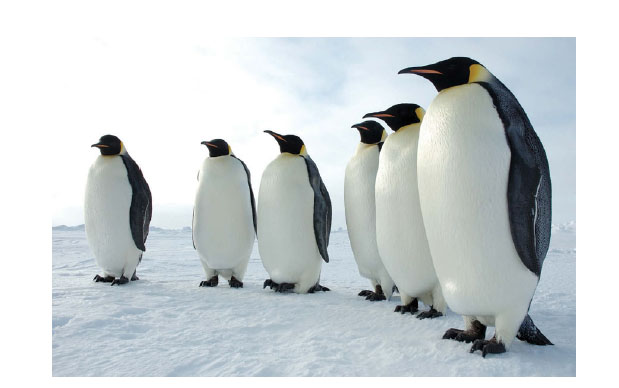
Emperor penguins are the largest of all penguins, standing up to 42 inches (115 cm) tall and weighing 84 lb (38 kg). SOURCE: Glenn Grant/NSF.


