
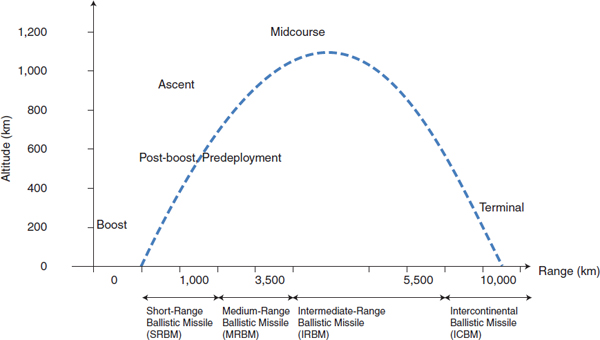
The tasking for the Committee on an Assessment of Concepts and Systems for U.S. Boost-Phase Missile Defense in Comparison to Other Alternatives, stated in Section 232 of the Duncan Hunter National Defense Authorization Act for Fiscal Year 2009 (Public Law 110-417), is provided in Appendix A of this report.1 In short, the congressional tasking requests an assessment of the feasibility, practicality, and affordability of U.S. boost-phase missile defense compared with that of the U.S. non-boost missile defense when (1) countering short-, medium-, and intermediate-range ballistic missile threats from rogue states to deployed forces of the United States and its allies and (2) defending the territory of the United States against limited ballistic missile attack. Box S-1 and Figure S-1 introduce some of the terminology used in this summary and the rest of the unclassified report.
To provide a context for this analysis of present and proposed U.S. boost-phase and non-boost missile defense concepts and systems, the committee considered the following to be the missions for ballistic missile defense (BMD): (1) protection of the U.S. homeland against nuclear weapons, other weapons of mass destruction (WMD), or conventional ballistic missile attacks; (2) protection of U.S. forces, including military bases, logistics, command and control facilities, and deployed forces themselves in theaters of operation against ballistic missile attacks armed with WMD or conventional munitions; and (3) protection of U.S. allies, partners, and host nations against ballistic-missile-delivered WMD and
_____________
1Biographies for the committee members are provided in Appendix B.
BOX S-1
Ballistic Missile Defense Intercept Technology
For purposes of this report, ballistic missile defense intercept can occur in three phases of flight: boost phase, midcourse phase, and terminal phase. This terminology is defined below:
“Boost-phase intercept” (BPI) will be used exclusively for intercept of the threat missile prior to the end of powered flight of the main stages of the missile. Intercept during this phase is noteworthy because, if successful, the missile’s payload cannot reach its intended target. Whether the payload itself survives boost-phase intercept depends on where on the target missile the intercept occurs. The degree of payload shortfall depends on when during the target missile’s boost phase the intercept occurs. The main challenge associated with boost-phase intercept is the short time associated with powered flight, typically between 60 and 300 seconds depending on the missile’s range and propellant type.
“Midcourse intercept” refers to exoatmospheric intercept after threat booster burnout. During this phase, all objects follow ballistic trajectories under the sole influence of Earth’s gravitational field. The midcourse phase is noteworthy because it is the longest phase of a missile’s flight (for those missiles that leave the atmosphere), thereby providing more time for observing and reacting to the threat. However, it is also the phase where decoys may be most effective because all objects follow ballistic trajectories regardless of their mass. The terms “ascent phase intercept” and “early intercept” are redundant because they refer to intercept after the end of the boost phase of flight but prior to apogee, which makes them part of midcourse intercept. Intercepting threat missiles as early as possible during the midcourse phase increases battle space and defends large footprints from a single forward site, thereby adding shot opportunities that use interceptors more efficiently.
“Terminal defense intercept” refers to endoatmospheric intercept after the midcourse defense opportunity. The presence of substantial dynamic forces make this phase unique as far as ballistic missile defense is concerned because light objects such as decoys, which slow down faster due to atmospheric drag, follow substantially different trajectories than heavy objects such as reentry vehicles. The altitude at which the transition from midcourse to terminal defense occurs is somewhat ambiguous, with light decoys being slowed appreciably relative to reentry vehicles at altitudes between 70 and 100 km and appreciable aerodynamic forces on the reentry vehicle occuring at altitudes below approximately 40 km.

NOTE: Postboost, predeployment intercept (PBDI) refers to intercept of a missile’s postboost vehicle (PBV) or payload deployment module, if any, after the main rocket engines burn out and prior to the complete deployment of multiple objects contained in the missile’s payload (reentry vehicles, decoys, and other countermeasures). This distinction is important because intercepts during the PBDI phase potentially eliminate some objects depending on how early in the PBDI phase the intercept occurs, PBVs are more easily detected and tracked, and PBVs may undergo lower power maneuvers as they deploy their multiple objects. The duration of the PBDI phase depends on PBV design and mission. However, it can be very or vanishingly short as noted in a recent Defense Science Board report entitled Science and Technology Issues of Early Intercept Ballistic Missile Defense Feasibility (September 2011).
conventional weapons.2 A fourth mission, protection of the U.S. homeland, allies, and partners against accidental or unauthorized launch, was considered as a collateral benefit of any BMD but not as a goal that drives system requirements.3 Consistent with U.S. policy and the congressional tasking, the committee conducted its analysis on the basis that it is not a mission of U.S. BMD systems to defend against large-scale deliberate nuclear attacks by Russia or China.4 Furthermore, although not the focus of this study, it is important to recognize that any effective defense of the U.S. homeland or allies against limited ballistic missile attack, whether the attack or the defense uses kinetic or directed energy, inherently has the capability, without significant modification, to also intercept satellites passing within its field of fire. Accordingly, great care should be taken by the United States in ensuring that negotiations on space agreements not adversely impact missile defense effectiveness. Specifically, in keeping with the National Space Policy presented to Congress in 2010, the emphasis in international space agreements should be on establishing norms of behavior with respect to shared access to space and on limiting and reducing debris rather than on setting kinematic or functional constraints that would be likely to restrict defense system effectiveness.
In conducting its study, the committee received briefings from a wide variety of public and government sources and reviewed classified reports from the intelligence community and Department of Defense (DOD), in particular missile defense programs sponsored by the Missile Defense Agency (MDA).5 Included in these briefings were, among other things, funding data for U.S. boost-phase and non-boost-phase alternatives (e.g., midcourse and terminal BMD systems). Figure S-2 displays 20-yr life-cycle costs for the BMD systems (present and proposed)
_____________
2For brevity, missions (2) and (3) are usually considered together because they so often involve defense against hostile missiles of similar character, although being defended against for different purposes.
3Any BMD system would provide some inherent capabilities for defense against an accidental or unauthorized Russian or Chinese launch or, for that matter, one by another power. However, defense against such attacks should not drive the design or evaluation of defense concepts, because the greater sophistication (or numbers) of such an attack would tend to establish unrealistic and perhaps infeasible or unaffordable requirements compared with those appropriate for defenses focused on the rogue state threat.
4Aside from political and stability effects, such defense is not practical, given the size, sophistication, and capabilities of Russian and Chinese forces and both countries’ potential to respond to U.S. defense efforts, including by increasing the size of the attack to the point at which defenses are simply overwhelmed by numbers. The fourth mission is discussed in greater detail in classified Appendix J.
5A summary of the committee’s meetings is provided in Appendix C. Acronyms and abbreviations are listed in Appendix D.
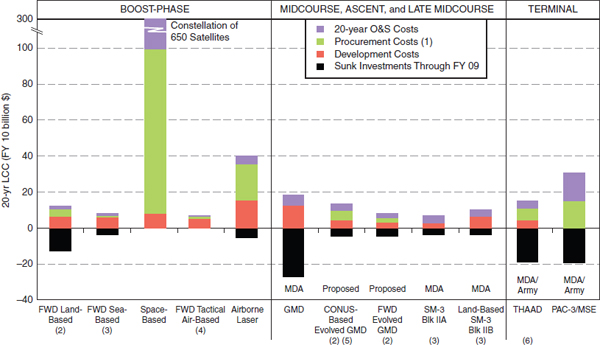
FIGURE S-2 Twenty-year life-cycle costs for the BMD systems examined in this report. (1) Where applicable, MILCON costs included as part of procurement costs; (2) sunk investments based on kinetic energy interceptor heritage; (3) sunk investment based on Aegis block development upgrade, design, and production heritage of SM-2 Block IV; (4) CONOPS based on multimission use of retrofitted available F-15Cs and/or F-35s; (5) procurement cost includes MILCON estimates for recommended missile field and facilities infrastructure construction costs on new northeastern CONUS site; and (6) sunk investment cost for THAAD does not include separately identified past funds for AN/TPY-2 radar. MILCON, military construction; CONOPS, concept of operations; CONUS, continental United States; THAAD, Terminal High-Altitude Area Defense; AN/TPY, Army Navy transportable radar surveillance.
examined in this report.6 Here, the total estimated costs are broken down into development costs; acquisition plus MILCON, combined as procurement costs; operations and support (O&S) costs; and sunk investments. These costs do not include supporting sensors, which are discussed in Chapter 4 of this report.
As a starting point for the study, and to force a rigorous assessment of U.S. boost-phase and non-boost systems, as requested by the congressional tasking, the committee developed scenarios it believed the United States, and in some cases its allies, partners, and host nations, would face in each of the four missile defense missions stated in the second paragraph. These scenarios and missions are congruent with the threats described in the congressional tasking as well as with the DOD Ballistic Missile Defense Review.7 In particular, as part of its analysis, the committee examined U.S. ballistic missile defense capabilities against threats from regional actors such as North Korea and Iran.
CONTEXT OF STUDY IN TODAY’S ENVIRONMENT
At the outset of the study in 2010, several decisions were taken by the Secretary of Defense (SECDEF) and reflected in the administration’s defense policies; the decisions can be summarized as follows:
(1) Termination of the Kinetic Energy Interceptor (KEI) program and conversion of the Airborne Laser (ABL) program to a research and development activity in recognition of the operational and technical difficulties of intercepting missiles during the boost phase of flight.
(2) Replacement of the prior administration’s proposed third site missile defense deployment in Europe by what is now known as the Phased Adaptive Approach (PAA).
(3) Termination of work on the multiple kill vehicle (MKV) technology because the threats anticipated in the next few years are not likely to be accompanied by penetration aids sophisticated enough to defeat the existing systems.
(4) Emergence of MDA’s “early intercept” strategy aimed at attacking threats during or shortly after deployment of their payloads but before apogee.
For the reasons described in this report, the committee endorses decision (1) but has reservations about how (2), (3), and (4) are evolving.
_____________
6Chapters 2, 3, and 4 provide background information and analysis on these present and proposed BMD systems, including the operational, technical, and cost issues surrounding each. In conducting its analysis, the committee also developed two BMD systems—the continental United States (CONUS)-based, evolved Ground-Based Midcourse Defense (GMD) system and the forward-based evolved GMD system—as improvements to the current GMD system. Ultimately, the committee recommended that the MDA implement an evolutionary approach to the current GMD system, called GMD-E and discussed in detail in Chapter 5 of this report.
7Department of Defense. 2010. Ballistic Missile Defense Review Report. Washington, D.C., February.
Finally, while the committee sought and received a look into the analyses and rationales behind MDA-sponsored programs, it used its own independent systems analysis, simulation, and costing expertise and its expertise in many military and technical areas related to boost-phase missile defense and non-boost alternatives in order to arrive at its findings and recommendations.8 The basis for these can be found in the unclassified report, and some additional analysis can be found in the classified annex. The report’s major findings and recommendations are provided in the next section.
MAJOR FINDINGS AND RECOMMENDATIONS
Findings
The committee’s major findings are divided into two groups: (1) boost-phase systems and (2) non-boost-phase systems. They are summarized below and then formally articulated.
Boost-Phase Systems
The fundamental problem for boost-phase defense is that the window for intercept is short and the range of interceptors (whether propelled by kinetic or directed energy) is limited so that the platform for a boost-phase defense system must be relatively close to the threat trajectory if intercept is to be possible. Here, the duration of an attacking missile’s boost phase depends on the type of fuel (solid-propellant rocket motors have significantly shorter burn times than liquid fuel ones) and the range of the threat missile (longer ranges require longer burn times). For example, an intercontinental ballistic missile (ICBM) with a liquid fuel rocket motor launched from central Iran to the U.S. East Coast would have about 250 sec of boost-phase flight (out of a total flight time of approximately 40 min), whereas an ICBM solid fuel rocket motor launched from the same loca-
_____________
8Four different engagement simulation models are used as part of the committee’s analysis. All of them include proprietary information, although the models themselves have been validated against National Air and Space Intelligence Center detailed trajectory models, as well as industry six degrees of freedom (DOF) simulations used to design and analyze ballistic missiles and interceptors. For example, one model—BMD TRADES—used to fly out threats and interceptors over a detailed oblate rotating Earth can graphically display the resulting footprint coverage and battle space. Another model, based in part on a rotating spherical Earth simulation, is used to fly out threats and interceptors from launch through the standard atmosphere using a three-DOF plus vehicle model (two translational plus one or two rotational). It is capable of graphically displaying the resulting footprint coverage and battle space. Two other two-body three-DOF plus planar engagement simulations are used to model both threat missiles and interceptors flying through the standard atmosphere with real controllability constraints, after which they are compared with the missile models used in the more global models and to cross-check the results of the first two more complex models. For this study, the committee believes the models are of sufficient detail to access accurately the capabilities and limitations of BMD systems.
tion would have about 180 sec of boost-phase flight. Moreover, intercept must take place not just before burnout of the threat booster but also before it can reach a velocity that would threaten any area to be protected. For example, since boost-phase intercept is unlikely to destroy a nuclear warhead, the “debris” would not be just fragments of the attacking rocket but potentially an intact, armed nuclear weapon.
In addition to the time and range limitations associated with boost-phase defense (i.e., for a kinetic system, the distance a kinetic interceptor can cover in the time available; for a directed-energy system, the distance at which a laser beam retains sufficient power and coherence to be effective), the interceptor platform cannot for its own survivability be so close to the territory of the adversary as to be vulnerable to perimeter defenses. This constraint on platform location is particularly restrictive for airborne platforms and ships.
There is a potentially significant qualification to this pessimistic assessment. In combat scenarios where an air supremacy has been achieved, it might be possible to maintain airborne boost-phase interceptors in intercept-effective locations that would not otherwise be feasible. This could be particularly important where the issue was defending deployed forces or friendly territory—as would be the case, for example, in a war on the Korean peninsula and in scenarios where hostile missile launches occur late enough in the war so that an opponent’s air defenses have been thoroughly suppressed. Similarly, there are some threat trajectories—say, from North Korea toward Japan or Guam—where it might be feasible to station boost-phase interceptors in locations where they could be effective.9 For almost all other plausible engagements, boost-phase intercept is not practical given the limited burn time and the requirement to be close to the intercept point. In summary, with one or two minor exceptions, land-, sea-, or air-based boost-phase defense is not feasible when timeline, range, geographical/geopolitical, or cost constraints are taken into account.
Major Finding 1: While technically possible in principle, boost-phase missile defense—whether kinetic or directed energy, and whether based on land, sea, air, or in space—is not practical or feasible for any of the missions that the committee was asked to consider. This is due to the impracticalities associated with space-based boost-phase missile defense (addressed in Major Finding 2), along with geographical limits on where terrestrial (nonspace) interceptors would have to be placed and the timeline within which such interceptors must function in order to defend the intended targets.
_____________
9For example, Aegis with SM-3 IIA on station in the East Sea could be effective in defending Hawaii and is discussed as one of three potential scenarios for intercepting hostile missiles in the boost phase of flight (see Chapter 2).
• Intercept must take place not just before burnout of the threat booster but also before it reaches a velocity that can threaten any area to be protected. Because of the short burn times of even long-range ballistic missile boosters, the interceptor launch platform cannot for its own survivability be so close to the territory of an adversary as to be vulnerable to the adversary’s perimeter defenses, but it must be close enough to the boost trajectory so that the interceptor can reach the threat missile before it reaches its desired velocity.
• Surface-based boost-phase interceptors are not feasible against a large country like Iran for missiles of any kind unless the interceptor platforms are based in the southern Caspian Sea. While it has been suggested that unmanned stealthy aircraft could loiter inside or close to the borders of an adversary, the committee does not believe it to be a feasible approach against a country with an effective air defense like Russian S-300 SAMs, in the face of which stealth aircraft will have a limited time of invulnerability as they maintain station in an environment with a high-density air defense sensor.
Major Finding 2: While space basing for boost-phase defense would in principle solve the problems of geographical limits that make surface-based boost-phase intercept impractical, the size and cost of such a constellation system is extremely high and very sensitive to the timeline in which interceptors must be launched. As a result it is susceptible to countermeasures such as salvo launches that either delay and reduce its coverage or squander space-based intercepts.
• In principle, a constellation of satellites equipped with boost-phase interceptors could be configured so as always to be geographically in range for an intercept. The number of satellites required depends, in part, on the burn time and altitude of the threat missiles. Shorter powered flights of solid-fueled threat missiles require many more satellites for coverage. Shorter range missiles with their shorter burn times and lower burnout altitudes cannot be engaged by space-based boost-phase intercepts.
• The total life-cycle cost of placing and sustaining the constellation in orbit is at least an order of magnitude greater than that of any other alternative and impractical for that reason alone.
Non-Boost-Phase Systems
The formidable difficulties of being able to maintain boost-phase interceptors in the locations necessary to enable defense against long-range attacks mean that any operationally feasible defense against such attacks will have to effect intercept after the boost phase is complete. Moreover, while terminal defenses may provide a useful backup protection to extremely high value (or limited area) assets, the footprint limitations of terminal defenses mean that an effective defense will usually have to occur during midcourse. Furthermore, as shown in some of
the engagements analyzed in Chapter 5, at best, early intercept does not occur early enough to avoid the need for midcourse discrimination.
In short, any practical missile defense system must rely primarily on intercept during the midcourse phase of flight. The attraction of midcourse (exoatmospheric) defense is that interceptors at a few sites can protect an entire country or even an entire continent, committing the first intercepts only after multiple phenomenology attack assessment. Put another way: Midcourse defense can adapt in real time to defend whatever is threatened and still have sufficient shot opportunities to deal with imperfections in target designation and with intercept failures. On the other hand, it must at some point also deal with exoatmospheric countermeasures, which in principle can be light in weight yet credible and easily deployed.
The hard fact is that no practical missile defense system can avoid the need for midcourse discrimination—that is, the requirement to identify the actual threat objects (warheads) amid the cloud of material accompanying them in the vacuum of space. This discrimination is not the only challenge for midcourse defense, but it is the most formidable one, and the midcourse discrimination problem must be addressed far more seriously if reasonable confidence is to be achieved.
Decoys are not, of course, the only countermeasures a midcourse defense system must face. Other possible countermeasures include structured attacks involving simultaneous launches and/or attacks on key components of the defense, notably its sensors. As the threat evolves, defenses must adapt to these threats, as well as to increasingly sophisticated decoy-type countermeasures.10
The art of midcourse discrimination, developed over many decades, does not provide perfect selection of reentry vehicles. However, by designing a BMD architecture based on the capabilities described in this report, an adequate level of discrimination performance can—in the committee’s judgment—be achieved in the near term and provide a reasonable chance of keeping the United States generally ahead in the contest between countermeasures and counter-countermeasures over time, at least against emerging missile states like North Korea and Iran.11 In particular, the committee believes that the best approach for addressing the midcourse discrimination problem is the synergy between X-band radar observations
_____________
10MDA has programs of record associated with sensor development with emphasis on airborne and space-based electro-optics/infrared (EO/IR), ground-ship-based X-band software, and the development of the sea-based X-band radar (SBX). For example, a notional airborne infrared sensor with a 20 cm diameter could provide precision track data to support surface-based interceptors provided two platforms are available for stereo tracking, each with long-wavelength infrared (LWIR) sensors and low noise figures that allow for cold body detection. Tracking ranges on the order of 1,000 km should be achievable.
11There is no unequivocal answer to the question of whether a missile defense can work against countermeasures. It depends on the resources expended by the offense and the defense and the knowledge each has of the other’s systems. Thus, defense effectiveness against countermeasures inevitably will vary with time as the offense-defense competition unfolds.
and optical sensors onboard the interceptors with the proper shoot-look-shoot firing doctrine described below.
The midcourse discrimination issue aside, MDA and the Services appear to be on the right track for developing BMD systems for countering short-, medium-, and intermediate-range ballistic missile threats from rogue states directed at the deployed forces of the United States and its allies. However, while Aegis, Terminal High-Altitude Area Defense (THAAD), and Patriot (PAC-3) are well developed and suited to their individual missions against these types of threats, there has been limited interface among them until recently. The committee is pleased to see that MDA is closing this gap.
Finally, there has been little evidence either of serious cost-benefit analysis or of systems analysis and engineering before embarking on new initiatives within MDA. In the committee’s view, past systems proposed for U.S. boost-phase defense as well as the current GMD system architecture are classic examples. The concept of spiral development in no way justifies not defining the objectives and requirements for the desired end state. MDA’s efforts have spawned an almost “hobby shop” approach, with many false starts on poorly analyzed concepts. For example, analysis of successful programs with missiles of comparable complexity—that is, with the comparison costs at a similar point of development maturity and at 2010 dollars—suggests that the current GMD interceptors are approximately 30 to 50 percent more expensive than they should be at this point in the program.
Major Finding 3: There is no practical missile defense concept or system operating before terminal phase for either the U.S. homeland or allies that does not depend on some level of midcourse discrimination, even in the absence of deliberate decoys or other countermeasures. The only alternative is to engage all credible threat objects (the Multiple Kill Vehicle program was such a hedge). Therefore it is important to face the problem of midcourse discrimination squarely and to maximize the probability of accomplishing it.
• Initially the nonthreatening objects may be “unintentional”—for example, spent upper stages, deployment modules or attitude control modules, separation debris, debris from unburned fuel, insulation, and other parts of the booster. However, as threat sophistication increases, the defense is likely to have to deal with purposeful countermeasures—decoys and other penetration aids and tactics, including salvo launches and antisimulation devices—that adversaries will have deliberately designed to frustrate U.S. defenses.
• The midcourse discrimination problem must be addressed far more seriously if reasonable confidence is to be achieved.
Major Finding 4: The synergy between X-band radar observations and concurrent optical sensor observations on board a properly designed interceptor (which
could be a modified ground-based interceptor) closing on the target complex has not been exploited. The committee believes a combination of a proper operational concept and firing doctrine taking advantage of the battle space available for SLS offers the greatest potential for effective discrimination in the face of potential future countermeasures. Although it is by no means a certain solution, the committee believes this approach is not adequately exploited in current U.S. midcourse defense systems (such as GMD) and needs to be if the United States is to have an effective defense against limited attacks.
• The importance of this three-way synergy—X-band radar observations concurrent with optical sensor observations on board a properly designed interceptor together with SLS capability—cannot be overemphasized.
• This will require implementing a more realistic and robust program to gather data from flight tests and experiments (including on flights of U.S. missiles) from the full range of sensors, and making full use of the extensive data collected from past experiments to continue developing the applied science from which robust discrimination techniques and algorithms can be developed.
Major Finding 5: Based on information presented to the committee, it does not appear that MDA takes into account how the signatures of various threat objects behave when observed concurrently for several hundred seconds by both interceptor-mounted optical sensors closing on the threat complex and X-band radar measurements. Moreover, it appears that virtually all of the effective analytical work at MDA in optical signatures was terminated several years ago, ostensibly for budget reasons. The Midcourse Space Experiment (MSX) and the High-Altitude Observatory 2 (HALO 2) programs, for example, provided significant amounts of useful data. Yet the committee could not find anyone at MDA who could show it those data or explain them let alone the data from ground-based interceptor flight tests.
• Forty years of optical signature data from well-instrumented past and recent flight tests are lying fallow and unanalyzed with respect to current technological capabilities. These include programs with acronyms such as designating optical tracker (DOT), fly along infrared (FAIR), the Homing Overlay Experiment (HOE), the Queen Match Discrimination Experiment, and others.
• While radar and optical midcourse discrimination technologies have been pursued for years, they have largely been on separate tracks and more in competition rather than in collaboration.
Major Finding 6: To be credible and effective, a ballistic missile defense system must be robust even if any of its elements fail to work as planned, whether that failure is due to a failure of discrimination or to something else. Moreover, a properly configured midcourse defense is the most cost-effective and resilient
method of defending the U.S. homeland against ballistic missile attack. What is needed is a system that is resilient to failure, in particular the failure to discriminate successfully. This implies making use of the shoot-look-shoot (SLS) doctrine that exploits the potential battle space. The committee has analyzed the effectiveness of the discrimination capability of the GMD system and finds that the system can, if it works as designed, deal successfully with the initial threats from North Korea. However, the current GMD system has been developed in an environment of limited objectives (e.g., dealing with an early-generation North Korean threat of very limited numbers and capability) and under conditions where a high value was placed on getting some defense fielded as quickly as possible, even if its capability was limited and the system less than fully tested. As a result, the GMD interceptors, architecture, and doctrine have shortcomings that limit their effectiveness against even modestly improved threats and threats from countries other than North Korea. Nevertheless, 30 GMD interceptors exist (or soon will), and they and their support network of sensors—including additional properly chosen and located and already fully developed ground-based forward X-band radar elements—and communications could, at an affordable cost and on a timeline consistent with the expected threat, be modified, emplaced, and employed so as to be far more effective for the homeland defense mission.
• The foundation for these modifications has already been laid by MDA.
• For example, GMD interceptors require a Block II ground-based interceptor incorporating KEI-like booster technology having a shorter burn time and a new kill vehicle with talk-back capability to permit using downlinked information from a closing kill vehicle.
Major Finding 7: The Aegis ship-based SM-3 Block II interceptors with launch or engage on remote—both of which capabilities are under development—together with the THAAD and PAC-3 systems and their elements will provide, where appropriate, adequate coverage for defense of U.S. and allied deployed forces and of Asian allies.12
• With two or three Aegis ashore sites in Europe, that same combination can provide a layered late midcourse and high-altitude terminal defense for Europe.
• No interceptor with fly-out speeds less than 5.0 km/sec based in Poland or Romania or elsewhere in Europe can engage or interfere with Russia’s nuclear deterrent ICBMs or submarine-launched ballistic missiles.
_____________
12In the launch-on-remote concept, the engagement is controlled and in-flight target updates are provided from the launching ship. The Aegis program is also working to develop an engage-on-remote capability by 2015, whereby (1) the interceptor can be launched using any available target track and (2) engagement is controlled from and in-flight target updates can be provided to the interceptor missile from any Aegis AN/SPY-1 or AN/TYP-2 radar. The committee applauds the MDA’s progress in achieving launch-on-remote capability for Aegis.
• Coverage of Israel and other Middle East areas against the anticipated threat will require additional Aegis and THAAD assets. (Turkey will require its separate defense using THAAD or the equivalent against shorter-range threats.) These requirements assume that single-shot defense of most areas is acceptable.
• Universal SLS capability, which is desirable for effective discrimination and other purposes, will require additional sites or terminal defense.
Major Finding 8: The first three phases of the European Phased Adaptive Approach (PAA) are expected to provide defense for Europe against a limited ballistic missile attack for deployed U.S. and allied forces within the region and the Middle East, provided the sensor architecture and the missile defense command and control (C2) center for the European PAA architecture can implement engage-on-remote capability.
• If modestly sophisticated countermeasures are anticipated for the intermediate-range ballistic missile (IRBM) threat, then the European PAA will need to include multiple X-band radar and long-range IR sensors (e.g., airborne infrared) that can provide concurrent data on IRBM trajectories similar to the countermeasures proposed for U.S. national missile defense. However, the IR data will need to come from external sensors because the SM-3 and THAAD kill vehicles have limited seeker range and limited divert capability. Fortunately, Aegis and THAAD are both capable of continuous communication between the kill vehicle and the C2 center.
• Europe can be covered with a SLS firing doctrine assuming enough sites are deployed, where the number of sites required depends on the interceptor speed—for example, two or three sites would be required if the interceptor speed is greater than 4.0 km/sec.
• SLS, when combined with the sensor architecture and C2 center noted above, is expected to provide a relatively robust defense of Europe against a range of potential future countermeasures.
• Turkey, as a member of NATO, will require separate BMD elements to ensure its protection. THAAD is probably the most appropriate system for this purpose owing to the stand-alone capability of its X-band radar and its ability to intercept shorter range missiles.
Major Finding 8a: Phase IV of the European PAA may not be the best way to improve U.S. homeland defense.
• The speed of the Phase IV interceptor will need to be greater than can be achieved with a 21-in. missile to avoid being overflown by lofted ICBM trajectories from Iran if the interceptor is based in northern Europe (Poland).
Major Finding 9: The proposed Precision Tracking and Surveillance System (PTSS) does not appear to be justified in view of its estimated life-cycle cost
versus its contribution to defense effectiveness. Specifically, the justification provided to the committee for developing this new space-based sensor system was questionable, and the committee’s analysis shows that its objective can be better accomplished by deployment of forward-based X-band radars based on the Army Navy/transportable radar surveillance model 2 (AN/TPY-2) system design at much lower total-life-cycle cost.
• The AN/TPY-2 radar already developed for THAAD and already deployed can be exploited to provide the required capabilities for all foreseeable defense missions.
• Taking advantage of the existing manufacturing base and the learning curve as more units are built would be a very cost-effective way of supporting the recommendations in this report.
Major Recommendations
The committee’s major recommendations are divided into two groups: (1) boost-phase systems and (2) non-boost-phase systems.
Boost-Phase Systems
Major Recommendation 1: The Department of Defense should not invest any more money or resources in systems for boost-phase missile defense. Boost-phase missile defense is not practical or cost-effective under real-world conditions for the foreseeable future.
• All boost-phase intercept (BPI) systems suffer from severe reach-versus-time-available constraints. This is true for kinetic kill interceptors launched from Earth’s surface, from airborne platforms, or from space. It is also true for a directed-energy (laser) weapon in the form of the airborne laser (ABL), where reach is limited by problems of propagating enough beam over long distances in the atmosphere and focusing it onto a small spot, even with full use of sophisticated adaptive optical techniques.
• While there may be special cases of a small country such as North Korea launching relatively slow burning liquid-propellant ICBMs in which some boost-phase intercepts are possible, the required basing locations for interceptors are not likely to be politically acceptable.13 This recommendation is not intended to preclude funding of generic research and development such as the ABL test
_____________
13For example, while a North Korean ICBM aimed at Hawaii and some other Pacific locations could be intercepted in boost phase by a properly located Aegis ship, the United States cannot realistically or prudently expect that BPIs intended for defense against North Korean or Iranian attacks can be stationed in Russian or Chinese airspace or over other nonallied territory (or where overflights of such territory would be necessary to reach on-station locations), at least short of a full resolution of Russian and Chinese concerns about U.S. missile defense and agreement on extensive cooperation in such defense.
bed, which is currently involved in boost-phase intercept, or funding of adaptive optics concepts or advances in high-power lasers that may be useful for other applications.
Non-Boost-Phase Systems
Major Recommendation 2: The Missile Defense Agency should reinstitute an aggressive, balanced midcourse discrimination research and development effort focused on the synergy between X-band radar data and concurrent interceptor observation while closing on the threat. Such an R&D effort should have the following attributes among others:
• Recognition that discrimination is strongly dependent on BMD system architecture, and known synergies should be exploited.
• A continuing program of test and analysis should be implemented to maintain the technical capacity that will be needed to support an adequate level of discrimination as new countermeasures are developed and deployed.
• A serious effort to gather and understand data from past and future flight tests and experiments (including flights of U.S. missiles) from the full range of sensors and to make full use of the extensive data collected from past experiments to generate robust discrimination techniques and algorithms.
• The committee believes that the effort required for success in this endeavor does not need to be overlarge but does require that high-quality expertise be brought to bear. The annual budget outlay, if planned correctly, can be modest compared to current expenditures.
Major Recommendation 3: The Missile Defense Agency should strengthen its systems analysis and engineering capability in order to do a better job of assessing system performance and evaluating new initiatives before significant funding is committed. Cost-benefit analysis should be central to that capability.
• In addition to terminating U.S. boost-phase missile defense systems, MDA should terminate the PTSS unless a more convincing case can be made for its efficacy for the mission that it is supposed to carry out.
• PTSS provides no information that a combination of the Space-Based Infrared System (SBIRS) and the proposed suite of X-band radars with the interceptor sensors will not provide better and at lower cost both initially and over the life cycle. Moreover, as proposed, PTSS contributes little if anything to midcourse discrimination.
Major Recommendation 4: As a means to defend deployed U.S. forces and allies from short-, medium-, and intermediate-range ballistic missile threats, the Missile Defense Agency and the Services should continue investing in non-boost systems
such as Aegis, THAAD, and PAC-3, with continued attention to architecture integration of sensors with shooters (sometimes referred to as an integrated battle command system, or IBCS), specifically to implement launch-on-remote (LOR) and engage-on-remote (EOR) firing doctrines.
• EOR is essential for effective coverage of Europe from a small number—say, two or three—of interceptor sites.
• Inputs to the IBCS already include those from Defense Support Program (DSP), SBIRS, and upgraded UHF early warning radars. Maximum use should be made of these data to relieve X-band radars of unnecessary volume or fan search functions, permitting them to concentrate radar resources on tracking and discrimination at the longer ranges permitted when properly cued to the targets. This involves little or no new investment. Data latency is a potential problem for the IBCS that should not be ignored.
Major Recommendation 5: As a means to provide adequate coverage for defense of the U.S. homeland against likely developments in North Korea and Iran over the next decade or two at an affordable and efficient 20-yr life-cycle cost, the Missile Defense Agency should implement an evolutionary approach to the Ground-Based Midcourse Defense (GMD) system, as recommended in this report.
• Chapter 5 recommends an evolutionary path from the present GMD system to a system having substantially greater capability and a lower cost than a simple expansion of the present GMD system. The recommended path builds on existing developments and technologies working together to make a more effective system. The concepts are not new and have been well known for at least 40 years. Existing advances in optical and radar technology will enable its realization.
• The evolutionary approach would employ smaller, lower cost, faster burning, two-stage interceptors building on development work by MDA under the KEI program carrying heavier more capable kill vehicles (KVs).
• The evolutionary approach would employ much longer concurrent threat observation by both X-band radars and the interceptor KV’s onboard sensor over the entire engagement. The importance of the synergy between these concurrent observations together with SLS battle space in maximizing midcourse discrimination effectiveness cannot be overemphasized.
• An additional interceptor site with the new evolved ground-based interceptor in CONUS together with the recommended radar additions provides SLS coverage of virtually the entire United States and Canada against the sort of threat that can prudently be expected to emerge from North Korea or Iran over the coming decade or so. The recommended evolution would add one additional site in the United States in the Northeast, together with additional X-band radars to more effectively protect the eastern United States and Canada, particularly against Iranian ICBM threats should they emerge.
• This improved capability obviates the need for early intercept from bases in Europe, unless they are required for European defense.
• Defense of Hawaii should be provided by Aegis with launch-on-remote capability: THAAD would provide a second intercept opportunity as backup for the Aegis engagement. Hawaii is very small target area for threats from North Korea, Iran, or any other country and can be covered by one Aegis ship located west of the islands. By contrast, modifying the GMD system to provide effective defense of Hawaii against an evolved threat would add substantial complexity and cost.
• Maximize the opportunity for observing the threat complex during most of the threat trajectory until intercept. Addition of stacked TPY-2 radars is recommended for this purpose.
• Make effective use of the high-accuracy data from SBIRS to cue forward X-band radar and concurrent IR sensors on the interceptor kill vehicle, which together contribute most of the discrimination capability.
• The ability to create, communicate, and interpret target object maps (TOMs) among the radar, the battle manager, and the interceptor during the entire engagement—typically hundreds of seconds for a midcourse intercept—increases the probability of successful discrimination. The resulting TOMs with object rankings should be exchanged frequently with the interceptor kill vehicle during its fly-out. This exchange requires taking advantage of the radar’s large aperture and power to close that communication link over longer distances. The TOM’s data exchange ability builds on the capabilities demonstrated by programs such as HOE and exoatmospheric reentry interceptor system (ERIS) and additionally builds on the MDA Integrated Flight Test Plan for GMD, Aegis, and THAAD interceptor that uses sensor elements with the addition of downlinks from the interceptor to the BMC3 element.


