
6
IMPACTS OF RESEARCH ON THE LABOR MARKET AND CAREER DEVELOPMENT
Several speakers during the workshop contended that the most important influence of research is the training it provides for undergraduates, graduate students, and postdoctoral fellows, who then bring those experiences and skills into the workplace. Three speakers at the workshop looked specifically at that assertion. Economic analyses can reveal the value of these workers to the economy, while survey results can uncover the preferences and goals of workers and employers. However, many questions still surround the processes through which supply and demand interact.
R AND D SPENDING AND THE R AND D WORKFORCE
In the short term, the relationship between R and D and the workforce is relatively weak, said Anthony Carnevale, Director of the Georgetown University Center on Education and the Workforce. But in the longer term, the relationship can be much stronger.
Explaining the Residual
Economists explain economic growth and productivity increases in part by citing the development of human capital and investments in physical infrastructure. But those two factors explain only part of the growth of the economy. The residual—“between 65 and 40 percent, depending on who you read,” Carnevale said—comes from advances in knowledge.
Many economists think of these advances in knowledge as being embodied in technologies, but in fact the residual consists of everything
that cannot be measured as a direct investment in the economy. Carnevale said that he preferred to think of advances in knowledge as the way people combine and use resources, whether human, technological, or otherwise. So advances in knowledge include the development of Walmart as opposed to mom and pop hardware stores, not just the direct effects of technology.
R and D Spending and Economic Growth
Connecting federal spending on R and D to these advances in knowledge is a difficult problem. For example, R and D directly involves a fairly limited number of people. About 1.4 million U.S. workers spend at least 10 percent of their time doing R and D, out of a total workforce of about 150 million people. (The former number includes social scientists, although the Center on Education and the Workforce typically does not include social scientists among workers in science, technology, engineering, and mathematics, or STEM.) The relatively small size of the STEM workforce explains why federal investments in research have relatively small short-term impacts on employment.
The STEM workforce engages in both research, which Carnevale identified as scientific investigations—and development—or the application of scientific knowledge. While research has sometimes led directly to technologies that are economically important, development is a much more important source of innovations, according to Carnevale. “Historically, science owes a whole lot more to the invention of the steam engine than the steam engine ever owed to science. That is, most of the development of economies occurs in application, not in labs.” A strong argument also can be made, he said, that the economic value from development has been growing more rapidly than the economic development from research. “A lot of wealth creation in the world now has to do with process improvements, not so much invention.” Even in industries such as pharmaceuticals, where discoveries lead to new products, the commercialization and distribution networks bring in much of the new revenue.
The Growth of the STEM Workforce
The STEM workforce, which is larger than the number of people doing R and D, is growing, said Carnevale. Today, people who work in science, technology, engineering, or mathematics—not counting social
scientists—represent 5 percent of the workforce, and this percentage is increasing.
The STEM workforce represents the endpoint of a long process of attrition, Carnevale pointed out. Many people with high mathematics scores in grade school and high school do not want to be STEM workers and do not pursue those subjects when they go to college. Among those who enter college declaring an interest in STEM subjects, many switch to other majors before they graduate. Even among STEM majors, many go into other careers. And among those who begin in STEM careers, many move out of the STEM workforce, especially after the age of 35.
In part, this attrition results from opportunities in other fields. Wages for STEM workers are relatively high, but the wages in other fields associated with high test scores in areas such as mathematics are even higher. Competencies developed in STEM fields are in demand in a large and growing share of occupations that pay well, which translates into many opportunities for people who have those competencies.
Also, workers who switch out of STEM fields tend to have values and interests that are different than those associated with STEM occupations, Carnevale said. Among STEM workers, the values and interests recorded by industrial psychologists are relatively narrow, whereas the values and interests in the general workforce are relatively broad, especially for high-achieving students who have many choices.
Given these observations, said Carnevale, the United States is going to have to rely more and more on foreign-born STEM workers. International diversity is now greater than the domestic diversity in the STEM workforce, and a healthy and productive STEM workforce will require focusing on both sources of diversity.
SURVEYS OF GRADUATE STUDENTS AND POSTDOCTORAL FELLOWS
Existing surveys reveal valuable information about the career trajectories of graduate students, postdoctoral fellows, and early career scientists and engineers, but they also have many limitations. Henry Sauermann, Assistant Professor of Strategic Management at the Georgia Institute of Technology, profiled existing surveys and described a new survey that he and a colleague conducted that has provided valuable additional information.
Existing Sources of Data
Several different data sources provide information on the aggregate flows and stock of scientists and engineers. The National Science Foundation’s Survey of Earned Doctorates, which Ph.D. recipients fill out when they graduate, provides much valuable data and now includes financial information such as salaries, at least for the people who have job offers. In addition, the Survey of Doctorate Recipients (SDR), the National Survey of Recent College Graduates (NSRCG), and the National Survey of College Graduates (NSCG) – NSF’s other personnel surveys—all provide important data on the stock of intellectual capital available to the economy. In addition, some information on postdoctoral fellows is available through the Sigma Xi survey and through the SDR.
Once students become active scientists, they begin to produce publications and patents, which can be used to track where people go, what they do, and the extent of their collaborations. Finally, a new federal data collection program, STAR Metrics (discussed in detail in Chapter 8) collects information on funding for public research and the extent to which that funding is used to support postdocs, Ph.D.’s, or other students.
Sauermann described what he called his “wish list” of data that would be very useful to have. For example, when a student reports moving from Stanford University to a company, the move reflects a labor market transaction. But the data do not reveal what the student or the company wants. More information is needed on both sides to know how well the job market is operating. On the supply side, the data might include aspirations, intentions, and skill sets. On the demand side, what kinds of jobs are open and what kinds of skills do firms need? For example, an ongoing argument, said Sauermann, is over whether the United States has too few scientists who know something about business and who can work in larger teams and companies. “It’s a question about the match between the training that individuals receive and what is required on the demand side.”
It is also important to understand more about how the labor market works, Sauermann observed. Supply and demand might match in the aggregate, but there may be great inefficiency in that process. Not every job seeker knows all the potential employers, and not all the potential employers know about all the people they might hire. How do students collect information? Who tells them about different careers? To what
extent do advisors know what an industry or government job entails? All of these questions are important.
It also would be interesting in know more about the training experience itself and how training translates into future career outcomes, Sauermann said. An ideal data set would track individuals when they enter a Ph.D. program, ask them why they are seeking a doctorate, track their learning experiences, and determine how their experiences changed their intentions. “This is really important if you think of graduate school as the place that trains people and socializes people into becoming scientists.”
Current data reveal very little about people who do not graduate. Do they consider their time in graduate school to have been wasted? Was it good for them to realize that graduate school might not have been a good fit? How do institutions make selection decisions?
Finally, current data provide little information on people who earn doctoral degrees outside the United States, though some efforts are under way to get more data about these individuals.
A Science and Engineering Ph.D. and Postdoctoral Fellow Survey
To learn more about the attitudes and actions of graduate students and postdocs, Roach and Sauermann (2010) conducted the Science and Engineering Ph.D. and Postdoc Survey (SEPPS) at 39 leading research universities in the United States. They collected contact information for 30,000 individuals, conducted the survey in the spring of 2010, and had about a 30 percent response rate. The survey focused on advanced Ph.D. students who had passed any necessary exams and postdocs in the life sciences, chemistry, physics, engineering, and computer science.
One question they asked was, “Thinking back to when you began your Ph.D. program, how important were the following factors in your decision to pursue a Ph.D.?” Respondents agreed more strongly with the statements that they were always interested in research, were curious to learn about a specific field, or needed a Ph.D. for a desired career. They agreed less strongly with the statement that they admired the status of people holding Ph.D.’s, and they agreed least with the statement that they had difficulty finding another job. Research “is a career that people consciously choose as opposed to being forced into it because there’s nothing else to do,” Sauermann concluded. Also, although some foreign graduate students and postdocs agreed that getting a Ph.D. offers
opportunities to secure a visa, on average this motivation did not rank highly.
When postdocs were asked the same question about their fellowships, they agreed most strongly with the statements that a postdoc would increase their chance to get a desired job and deepen their skills in a particular area. They agreed moderately with the idea that a postdoc gave them more time before deciding on a career and agreed less strongly with the statement that they had difficulty finding another job.
When asked about their current funding sources, between 70 and 80 percent responded that they were funded by federal sources. About 60 percent got university fellowship and assistantship funding. Private foundations were quite active, especially in some of the fields, while very few respondents received industry funding. Postdocs in the biological and life sciences got fewer university fellowships and assistantships but more industry funding.
When postdocs were asked, “How involved were you in securing your most important source of funding?” respondents in the biological sciences averaged 50 points on a scale from 0 to 100, while people from physics averaged 38, people from computer science 29, people from chemistry 38, and people from engineering 39.
The survey asked whether their research contributes fundamental insights or theories, or whether it creates knowledge to solve practical problems, with people being allowed to respond affirmatively to both questions. They were also asked whether they were interested in doing basic research or applied research later in their careers. Among the life scientists, people who got federal funding were much more likely to be engaged in basic research than people who did not get federal funding. Similarly, those getting industry funding were much less likely to be engaged in basic research than those who did not. People receiving funding from foundations were also more likely to be engaged in applied research.
Interestingly, there was not much relationship between funding source and career aspiration or what people wanted to do later. The only exception is that people who got industry funding tended not to be interested in working in basic research later.
Two other question asked, “How much freedom do you have in choosing your research topics?” and “How much freedom do you actually have in influencing the direction of your research projects?” People with multiple funding sources reported an increased level of
choice in terms of what they wanted to work on as well as in terms of deciding how they want to work on these things. The only individual funding source that made a big difference was foundation funding, where people felt much more freedom in their choice of research topics. “Presumably, that’s not because the funding makes them free, but because they have a pet project, or they’re enthusiastic about something, and they go apply to different foundations. . . . In that sense, foundations seem to provide a lot of freedom—not because people get their money first and then choose but because they choose first.” In contrast, industry funding tends to have a slightly negative impact on freedom, but only for postdocs.
Finally, the survey asked about the types of jobs respondents found most appealing, whether teaching at a college or university or doing research at a college or university, a government research institution, an established firm, or a startup (Figure 6-1). Most of the respondents in the life sciences wanted to have a faculty R and D job, with 50 percent finding that the most interesting career. Physicists and computer scientists rated that option even higher, but chemists and engineers had less interest in a faculty R and D position and more interest in R and D jobs at established firms. People who received industry funding were less interested in a faculty research career and more interested in working either for a start-up or for an established firm.
The experiences people have during their education shape their involvement in the labor market, Sauermann concluded. “We need to understand more of what these labor market processes look like to see how we can direct or change, if we want to, these labor market outcomes.”
THE COMPLEX NETWORK OF SKILLS AND INVESTMENTS
Recent discussions of U.S. science and technology policy have emphasized the concept of global competitiveness. As James Evans, Assistant Professor of Sociology at the University of Chicago, pointed out, this concept inevitably poses the question: What is a globally competitive STEM workforce, and how does the government best invest in developing this kind of workforce?
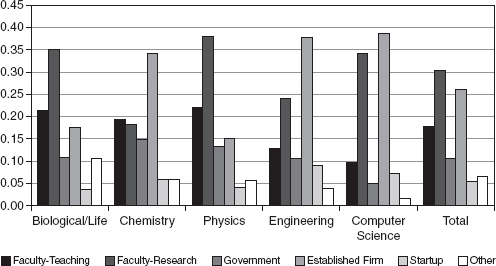
FIGURE 6-1 When postdoctoral fellows were asked “Please rank the following careers from most likely to pursue to least likely to pursue,” Ph.D.’s in the biological and life sciences, physics, and computer science were more likely to favor faculty teaching jobs, while chemistry and engineering students were more likely to opt for jobs with established firms.
SOURCE: Sauerman, 2010
Competitiveness as Size
One framing emphasizes the much repeated concerns about the supply or size of the STEM workforce. For example, in a 2007 op-ed article in the Washington Post, Bill Gates wrote, “Demand for specialized technical skills has long exceeded the supply of native-born workers with advanced degrees, and scientists and engineers from other countries fill this gap. This issue has reached a crisis point.” This framing produces a one-dimensional indicator of competitiveness that is fairly easy to measure, said Evans. However, with only 5 percent of the world population, the United States inevitably will drop below the 35 to 45 percent of global science and engineering activity that it retained through the end of the twentieth century. As the world continues to develop, more countries will be producing more scientific activity, and these scientists will receive more publications, more citations, and more attention.
Existing measurements of the STEM workforce are closely cued to size, Evans observed. Inputs to the workforce include the gross amounts spent on training grants and an unknown proportion of research grants spent on personnel in training. Outputs in surveys such as the SED, SDR, and STAR Metrics are the numbers of doctorates, the sectors of their
jobs, their incomes, and self-reports of activities and outcomes (such as articles and patents). Given these measures, it is impossible to assess the efficiency with which the system matches inputs with outputs.
Competitiveness as Efficiency
Another framing is to think of competitiveness in the STEM workforce as efficiency in producing a sufficient supply of the skills in demand. From this perspective, the United States can be seen as the most efficient investor in science and engineering skill. Wages for STEM workers have been largely flat, said Evans. Reports of low supplies of scientists and engineers typically come from hot industries and from potentially self-interested parties, suggesting that there is no undersupply of skill. In fact, there may be an oversupply of skill or an oversupply of the wrong types of skill.
This framing leads to a more nuanced concern about the efficiency or the relevance of training investments in the STEM workforce. From this perspective, the relevant inputs are the size of the training investments and the relevant outcomes are the incomes of STEM workers, assuming that the market is clearing. But to make such an assessment, improved measurements would be needed. The first such improvement would be the educational components of research grants. The second would be improved information about STEM workers, such as some of the information described in the previous presentation. Measurements of efficiency also would require a better sense of preferences to judge the elasticity of individual human capital investments. For example, how much is it worth for students to have control over the subject of their research? Some natural experiments have yielded information on this issue. For example, when the size of a research grant goes up, the student response goes up in an approximately linear fashion. But real experiments should be organized, Evans said, because the presence of confounders can make natural experiments hard to interpret.
The problem with this framing is that it typically responds to past rather than future labor needs, Evans noted. For example, this perspective has motivated initiatives such as the Alfred P. Sloan Foundation’s advocacy of programs that award the professional science master’s as a terminal degree. But this effort may undervalue the doctorate, even if society or U.S. companies benefit more from a doctorate than does the recipient of that degree.
Competitiveness as Quality
A third framing equates competitiveness with quality. From this perspective, the United States can be seen as the elite global supplier of science and engineering skill, Evans observed. This indicator of competitiveness is very difficult to measure because it has such a high dimension. It also renders obsolete the idea of thinking about competitiveness in terms of a labor market. Instead, actual skills and their actual and potential value must be considered within the broader system of innovation. Researchers and their contributions can no longer be treated as independently and identically distributed. Even bibliometric methods are inadequate, because particular articles and patents fit within the system in certain places, and understanding those places is the key to the allocation problem. “When we open the box of content, instead of just measuring the numbers of papers, we have to look at the papers, we have to look at the content, and it’s a daunting exercise.”
Coauthorship and citation networks are one way to measure the contributions of individuals, though “it’s not clear how much insight” they can produce, said Evans. Authors and papers can be identified as more central or more peripheral. Visualization techniques also make it possible to determine how clusters are linked together to form modules in a network. In addition, natural language processing and machine learning can increasingly discern the landscape in millions of papers to identify features of those landscapes. Together, these techniques “can give us a much richer and more powerful view of the value of investments,” said Evans.
Doctoral STEM Education
Students who undergo a doctoral education emerge with a specialized set of skills and techniques, including meta-techniques, such as being able to design a research project. This observation raises several linked questions: What is the role of deep, specialized knowledge in exploring new knowledge or skills? What is the role of social networks developed or entered into through education in spreading knowledge or skills? And what is the role of interdisciplinary laboratories in managing novel combinations of knowledge or skills?
Evans studied these questions through an investigation of almost 20,000 publications involving Arabidopsis thaliana (a small flowering plant used as a model organism) in which he identified principal
investigators, organizations, subfields, countries, genes, gene products, methods, and metabolites used. He found that the more persistent researchers were within these identified terms, the more central they were within the coauthorship network. At the same time, with these researchers it was more likely that industry collaboration and funding would influence their work to become more theoretically unexpected. In essence, government sponsorship encouraged validation and moved work toward the center of the network. Industry sponsorship encouraged novelty and pushed work toward the periphery of the network.
“This suggests an interesting and important complementarity between government and industrial efforts,” Evans concluded. Governments sponsor hubs of knowledge, while industry involvement encourages the exploration of high-value novel combinations.
Network analysis of geographic localization also has shown that knowledge flows within communities and within firms. Furthermore, many ties in the biosciences are formed through doctoral committees and communities.
The important point, concluded Evans, is that analysts need to look beyond labor markets to the relative values of skilled people. Investigating this issue will require linking individuals and their preferences with the papers and patents they produce. “Labor market issues cannot be separated from the content of science.”
In response to a question from a workshop participant about the importance of the arts and humanities in generating economic value, Evans noted that he was very interested in the complex combinations of STEM knowledge and the arts and humanities in such areas as design. “It’s silly to cordon those things off in the context, especially, of industry and productivity.”
Sauermann added that many people do not work in the field in which they studied, and these numbers are especially low for the social sciences. “Many people are studying stuff they don’t use. Maybe that’s by choice. Maybe not. Again, I think it would be interesting to know.”
A workshop participant asked about the tendency of professors to train students for positions in academia rather than industry, to which Sauermann replied that some faculty members are very active in industry and have their students work on industry grants. However, in a separate
survey, he asked students what level of money, freedom, equipment, and so on they expected to have in different kinds of careers, and many more students marked “Don’t know” when asked about start-ups and established firms than when asked about academia. “It could be that they don’t search it out because they don’t want to be in industry. [But] there is probably less information out there.”
Carnevale added that the U.S. Department of Education is supporting the development of an online system that will collect information on all transcripts of students, including those in college and graduate school, and connect that information to wage records supplied by every employer in America. Currently, in 26 states, a student in a Ph.D. program in physics can find out how many of last year’s graduates got a job, whether it was in physics, what their wages were, and the duration of their employment.


