
1
Charter and Organization of the Board
THE ORIGINS OF THE SPACE SCIENCE BOARD
The National Academy of Sciences (NAS) was created in 1863 by an Act of Congress, signed by President Abraham Lincoln, to provide scientific and technical advice to the government of the United States. Over the years, the breadth of the institution has expanded, leading to the establishment of the National Academy of Engineering (NAE) in 1964 and the Institute of Medicine (IOM) in 1970. The National Research Council (NRC), the operational arm of the National Academies, was founded in 1916. The NAS, NAE, IOM, and NRC are collectively referred to as “The National Academies.” More information is available at http://nationalacademies.org.
The original charter of the Space Science Board was established in June 1958, 3 months before the National Aeronautics and Space Administration (NASA) opened its doors. The Space Science Board and its successor, the Space Studies Board (SSB), have provided expert external and independent scientific and programmatic advice to NASA on a continuous basis from NASA’s inception until the present. The SSB has also provided such advice to other executive branch agencies, including the National Oceanic and Atmospheric Administration (NOAA), the National Science Foundation (NSF), the U.S. Geological Survey (USGS), and the Department of Defense, as well as to Congress.
The fundamental charter of the Board today remains that defined by NAS president Detlev W. Bronk in a letter to Lloyd V. Berkner, first chair of the Board, on June 26, 1958, which established the Space Science Board:
We have talked of the main task of the Board in three parts—the immediate program, the long-range program, and the international aspects of both. In all three we shall look to the Board to be the focus of the interests and responsibilities of the Academy-Research Council in space science; to establish necessary relationships with civilian science and with governmental science activities, particularly the proposed new space agency, the National Science Foundation, and the Advanced Research Projects Agency; to represent the Academy-Research Council complex in our international relations in this field on behalf of American science and scientists; to seek ways to stimulate needed research; to promote necessary coordination of scientific effort; and to provide such advice and recommendations to appropriate individuals and agencies with regard to space science as may in the Board’s judgment be desirable.
As we have already agreed, the Board is intended to be an advisory, consultative, correlating, evaluating body and not an operating agency in the field of space science. It should avoid responsibility as a Board for the conduct of any programs of space research and for the formulation of budgets relative thereto. Advice to agencies properly responsible for these matters, on the other hand, would be within its purview to provide.
The Space Science Board changed its name to the Space Studies Board in 1989 to reflect its expanded scope, which now includes space applications and other topics. Today, the SSB exists to provide an independent, authoritative forum for information and advice on all aspects of space science and applications, and it serves as the focal point within the National Academies for activities on space research. It oversees advisory studies and program assess-
ments, facilitates international research coordination, and promotes communications on space science and science policy among the research community, the federal government, and the interested public. The SSB also serves as the U.S. National Committee for the Committee on Space Research (COSPAR) of the International Council for Science.
The Space Studies Board is a unit of the NRC’s Division on Engineering and Physical Sciences (DEPS). DEPS is one of six major program units of the NRC through which the institution conducts its operations on behalf of NAS, NAE, and IOM. Within DEPS there are a total of 14 boards that cover a broad range of physical science and engineering disciplines and mission areas.
Members of the DEPS Committee on Engineering and Physical Sciences (DEPSCOM) provide advice on Board membership and on proposed new projects to be undertaken by ad hoc study committees formed under the SSB’s auspices. Every 3 years, DEPSCOM reviews the overall operations of each of the DEPS boards. The next review of the SSB will take place in 2012.
The “Space Studies Board” encompasses the Board itself, its standing committees (see Chapter 2) and ad hoc study committees (see Chapter 3), and its staff. The Board is composed of prominent scientists, engineers, industrialists, scholars, and policy experts in space research appointed for 2-year staggered terms. They represent seven space research disciplines: space-based astrophysics, heliophysics (also referred to as solar and space physics), Earth science, solar system exploration, microgravity life and physical sciences, space systems and technology, and science and technology policy. In 2010, there were 22 to 23 Board members, with 29 individuals serving on the Board at some time. The chairs of the SSB’s standing committees are members of the Board, and of its Executive Committee (XCOM). The chair of the NRC’s Aeronautics and Space Engineering Board (ASEB) and the U.S. representative to COSPAR are ex officio members. A standing liaison arrangement also has been established with the European Space Science Committee (ESSC), part of the European Science Foundation, and the NRC’s Ocean Studies Board.
Organization
The organization of the SSB in 2010 is illustrated in Figure 1.1. Taken together, the Board and its standing and ad hoc study committees generally hold as many as 40 meetings during the year.
Major Functions of the Space Studies Board
The Board provides an independent, authoritative forum for information and advice on all aspects of space science and applications and serves as the focal point within the National Academies for activities on space research. The Board itself does not conduct studies, but it oversees advisory studies and program assessments conducted by ad hoc study committees (see Chapter 3) formed in response to a request from a sponsor. All projects proposed to be conducted by ad hoc study committees under the auspices of the SSB must be reviewed and approved by the chair and vice chair of the Board (as well as other NRC officials).
Decadal surveys are a signature product of the SSB, providing strategic direction to NASA, NOAA, and other agencies on the top priorities over the next 10 years in astronomy and astrophysics, solar system exploration, solar and space physics, and Earth science. (The astronomy and astrophysics decadal survey is a joint effort with the NRC’s Board on Physics and Astronomy (BPA).) A decadal survey on biological and physical sciences in space, a joint effort with ASEB, was formed in 2009 in response to a congressional request for a study to establish priorities and provide recommendations for life and physical sciences space research, including research that will enable exploration missions in microgravity and partial gravity for the 2010-2020 decade.
The Board serves as a communications bridge on space research and science policy among the scientific research community, the federal government, and the interested public.
The Board ordinarily meets three times per year (March, June, and November) to review the activities of its committees and to be briefed on and discuss major space policy issues. The November Board meeting typically involves a workshop on a topic of current interest and results in a workshop report. In 2010, the topic was “Sharing the Adventure with the Public”—The Value and Excitement of “Grand Questions” of Space Science and Exploration (see Chapter 4).
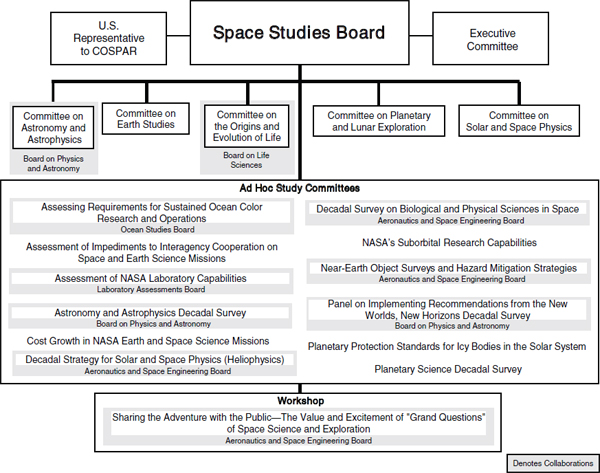
FIGURE 1.1 Organization of the Space Studies Board, its standing committees, ad hoc study committees, and special projects in 2010. Shaded boxes denote activities performed in cooperation with other National Research Council units.
International Representation and Cooperation
The Board serves as the U.S. National Committee for COSPAR, an international, multidisciplinary forum for exchanging space science research. Board members may individually participate in COSPAR scientific sessions to present their research or present the results of an SSB report to the international community, or conduct informal information exchange sessions with national entities within COSPAR scientific assemblies. See Chapter 2 for a summary of COSPAR’s 2010 activities.
The Board also has a regular practice of exchanging observers with the ESSC, which is part of the European Science Foundation (see http://www.esf.org/).
Space Studies Board Committees
Executive Committee
The Executive Committee, composed entirely of Board members, facilitates the conduct of the Board’s business, permits the Board to move rapidly to lay the groundwork for new study activities, and provides strategic planning advice. XCOM meets annually for a session on the assessment of SSB operations and future planning. Its
membership includes the chair and vice chair of the Board, the chairs of the standing committees, and one Board member for each discipline that does not have a standing committee.
Standing Committees
Discipline-based standing committees are the means by which the Board conducts its oversight of specific space research disciplines. Each standing committee is composed of about a dozen specialists, appointed to represent the broad sweep of research areas within the discipline. Like the Board itself, each standing committee serves as a communications bridge with its associated research community and participates in identifying new projects and prospective members of ad hoc study committees. Standing committees do not, themselves, write reports, but oversee reports written by ad hoc study committees created under their auspices. Standing committees typically go on hiatus during their discipline’s decadal survey.
In 2010, SSB had five standing committees:
• Committee on Astronomy and Astrophysics (CAA),
• Committee on Earth Studies (CES),
• Committee on the Origins and Evolution of Life (COEL),
• Committee on Planetary and Lunar Exploration (COMPLEX), and
• Committee on Solar and Space Physics (CSSP).
Ad Hoc Study Committees
Ad hoc study committees are created by NRC action to conduct specific studies at the request of sponsors. These committees typically produce NRC reports that provide advice to the government and therefore are governed by Section 15 of the Federal Advisory Committee Act (FACA). Ad hoc study committees usually write their reports after holding two or three information-gathering meetings, although in some cases they may hold a workshop in addition to or instead of information-gathering meetings.
In other cases, workshops are organized by ad hoc planning committees that serve as organizers only, where a workshop report is written by a rapporteur and does not contain findings or recommendations. In those cases, the study committee is not governed by FACA Section 15, since no NRC advice results from the workshop.
The ad hoc study committees that were in place during 2010 are summarized in Chapter 3.
COLLABORATION WITH OTHER NATIONAL RESEARCH COUNCIL UNITS
Much of the work of the SSB involves topics that fall entirely within its principal areas of responsibility and can be addressed readily by its members and committees. However, there are other situations in which the need for breadth of expertise, alternative points of view, or synergy with other NRC projects leads to collaboration with other units of the NRC.
The SSB has engaged in many such multi-unit collaborations. Among the NRC boards with which the SSB works most often are the ASEB, the BPA, the Board on Atmospheric Sciences and Climate, the Board on Life Sciences, and the Ocean Studies Board. This approach to projects has the potential to bring more of the full capability of the National Academies to bear in preparing advice for the federal government and the public. Multi-unit collaborative projects also present new challenges—namely, to manage the projects in a way that achieves economies of scale and true synergy rather than just adding cost or complexity. Collaborative relationships between the SSB and other NRC units during 2009 are illustrated in Figure 1.1.
ASSURING THE QUALITY OF SPACE STUDIES BOARD REPORTS
A major contributor to the quality of the SSB reports (Table 1.1 lists the 2010 releases) is the requirement that NRC reports be peer-reviewed. Except for the Space Studies Board Annual Report—2009, all of the reports were subjected to extensive peer review, which is overseen by the NRC’s Report Review Committee (RRC). Typically 7 to 10 reviewers (occasionally as many as 15 or more) are selected on the basis of recommendations by NAS and NAE section liaisons, SSB members, and staff. The reviewers are subject to approval by the NRC. The identities
TABLE 1.1 Space Studies Board Reports Released in 2010
| Report Title | Sponsors | Oversight Boarda | Principal Federal Agency Audiencesb | ||||
| NASA/SMD | NASA/ESMD | NOAA | NSF | Other | |||
| Assessment of Impediments to Interagency Collaboration on Space and Earth Science Missions [prepublication version] | NASA | SSB | X | X | X | DOE | |
| Capabilities for the Future: An Assessment of NASA Laboratories for Basic Research | NASA | LAB | X | ||||
| Controlling Cost Growth of NASA Earth and Space Science Missions | NASA | SSB | X | ||||
| Defending Planet Earth: Near-Earth Object Surveys and Hazard Mitigation Strategies | NASA | SSB | X | ||||
| Life and Physical Sciences Research for a New Era of Space Exploration: An Interim Report | NASA | SSB | X | ||||
| New Worlds, New Horizons in Astronomy and Astrophysics | NASA | BPA-led | X | X | DOE | ||
| Panel Reports—New Worlds, New Horizons in Astronomy and Astrophysics [prepublication version] | NASA | BPA-led | X | X | DOE | ||
| Report of the Panel on Implementing Recommendations from New Worlds, New Horizons Decadal Survey [prepublication version] | NASA | BPA-led | X | ||||
| Revitalizing NASA’s Suborbital Program: Advancing Science, Driving Innovation, and Developing a Workforce | NASA | SSB | X | X | X | ||
| Space Studies Board Annual Report—2009 | NASA | SSB | X | X | X | X | DOE USGS |
NOTE: NAS, National Academy of Sciences; NASA, National Aeronautics and Space Administration; NSF, National Science Foundation.
aOversight board within the National Research Council:
| BPA | Board on Physics and Astronomy | |
| LAB | Laboratory Assessments Board | |
| SSB | Space Studies Board |
bFederal agencies that have funded or shown interest in SSB reports:
| DOE | Department of Energy | |
| NASA | National Aeronautics and Space Administration | |
| NASA/ESMD | NASA Exploration Systems Mission Directorate | |
| NASA/SMD | NASA Science Mission Directorate | |
| NOAA | National Oceanic and Atmospheric Administration | |
| NSF | National Science Foundation | |
| USGS | United States Geological Survey |
of external reviewers are not known to a report’s authors until after the review has been completed and the report has been approved by the RRC. The report’s authors, with the assistance of SSB staff, must provide some response to every specific comment from every external reviewer. To ensure that appropriate technical revisions are made to the report and that the revised report complies with NRC policy and standards, the response-to-review process is overseen and refereed by an independent arbiter (called a monitor) that is knowledgeable about the report’s issues. In some cases, there is a second independent arbiter (called a coordinator) that has a broader perspective on policy issues affecting the National Academies. All of the reviews emphasize the need for scientific and technical clarity and accuracy and for proper substantiation of any findings and recommendations presented in the report. Names of the external reviewers, including the monitor (and coordinator if one was appointed), are published in the final report, but their individual comments are not released.
Another important method to ensure high-quality work derives from the size, breadth, and depth of the cadre of experts who serve on the SSB and its committees or participate in other ways in the activities of the SSB. Some highlights of the demographics of the SSB in 2010 are presented in Tables 1.2 and 1.3. During 2010, a total of
277 individuals from 81 colleges and universities and 54 other public or private organizations served as formally appointed members of the Board and its committees. More than 306 individuals participated in SSB activities either as presenters or as invited workshop participants. The report review process is as important as the writing of reports, and during 2010, 57 different external reviewers contributed to critiques of draft reports. Overall, more than 634 individuals from 84 academic institutions, 73 industry or nonprofit organizations, and 27 government agencies or offices participated in SSB activities. That number included 48 members of NAS, NAE, or IOM. Being able to draw on such a broad base of expertise is a unique strength of the NRC advisory process.
The Space Studies Board’s efforts have been relevant to a full range of government audiences in civilian space research—including NASA’s Science Mission Directorate (SMD), NASA’s Exploration Systems Mission Directorate (ESMD), NASA’s Program Analysis and Evaluation Office, NSF, NOAA, USGS, and the Department of Energy (DOE). Reports on NASA-wide issues were addressed to multiple NASA offices or the whole agency; reports on science issues, to SMD; and reports on exploration systems issues, to ESMD. Within NASA, SMD has been the leading sponsor of SSB reports. Reports have also been sponsored by or of interest to agencies besides NASA—for example, NOAA, NSF, DOE, and the USGS.
TABLE 1.2 Experts Involved in the Space Studies Board and Its Committees, January 1, 2010, to December 31, 2010
| Number of Board and Committee Members | Number of Institutions or Agencies Represented | |
| Academia | 124 | 22 |
| Government and national facilities | 31 | 13 |
| Private industry | 32 | 9 |
| Nonprofit and othera | 19 | 8 |
| Totalb,c | 206 | 52 |
aOther includes foreign institutions and entities not classified elsewhere.
bIncludes 35 National Academy of Sciences, National Academy of Engineering, and Institute of Medicine members.
cIncludes 28 Board members, 249 committee members.
TABLE 1.3 Summary of Participation in Space Studies Board Activities, January 1, 2010, to December 31, 2010
| Academia | Government and National Facilities | Private Industry | Nonprofit and Other | Total Individuals | |
| Board/committee members | 124 | 31 | 32 | 19 | 206 |
| Guest experts | 29 | 61 | 10 | 10 | 110 |
| Reviewers | 4 | 0 | 12 | 6 | 22 |
| Workshop participants | 63 | 12 | 38 | 62 | 175 |
| Total | 220 | 104 | 92 | 97 | 513 |
NOTE: Counts of individuals are subject to an uncertainty of ±3 due to possible miscategorization.
| Total number of NAS, NAE, and/or IOM members | 41 |
| Total number of non-U.S. participants | 8 |
| Total number of countries represented, including United States | 5 |
| Total number of different institutions represented | |
|
Academia |
59 |
|
Government and national facilities |
12 |
|
Industry |
12 |
|
Nonprofit and other |
12 |
Enhancing outreach to a variety of interested communities and improving dissemination of SSB reports is a high priority. In 2010, the SSB continued to distribute its quarterly newsletter by electronic means to subscribers.
The Board teamed with other NRC units (including the Division on Earth and Life Studies, the BPA, the National Academies Press, the Office of News and Public Information, and the Proceedings of the National Academy of Sciences) to take exhibits to national meetings of the American Geophysical Union and the American Astronomical Society. Popular versions of four of the decadal surveys (Astronomy and Astrophysics in the New Millennium, New Frontiers in the Solar System, The Sun to the Earth—and Beyond, and Earth Science and Applications from Space: National Imperatives for the Next Decade and Beyond) continue to be widely distributed to the science community and the general public. More than 2,000 reports were disseminated in addition to the copies distributed to study committee members, the Board, and sponsors.
Formal reports delivered to government sponsors constitute one of the primary products of the work of the SSB, but the dissemination process has a number of other important elements. The Board is always seeking ways to ensure that its work reaches the broadest possible appropriate audience and that it has the largest beneficial impact. Copies of reports are routinely provided to key executive branch officials, members and staffs of relevant congressional committees, and members of other interested NRC and federal advisory bodies. Members of the press are notified about the release of each new report, and the SSB maintains a substantial mailing list for distribution of reports to members of the space research community. The SSB publishes summaries of all new reports in its quarterly newsletter. The SSB also offers briefings by committee chairs and members or SSB staff to officials in Congress, the executive branch, and scientific societies. Reports are posted on the SSB Web home page at http://www7.nationalacademies.org/ssb and linked to the National Academies Press Web site for reports at http://www.nap.edu.
LLOYD V. BERKNER SPACE POLICY INTERNSHIP
The Space Studies Board has operated a very successful competitive internship program since 1992. The Lloyd V. Berkner Space Policy Internship is named after Dr. Berkner, the Board’s first chair, who played an instrumental role in creating and promoting the International Geophysical Year, a global effort that made it possible for scientists from around the world to coordinate observations of various geophysical phenomena.
The general goal of each internship is to provide a promising undergraduate student an opportunity to work in civil space research policy in the nation’s capital, under the aegis of the National Academies. Interns work with the Board, its committees, and staff on one or more of the advisory projects currently underway. Other interns, paid or unpaid, also join the SSB staff on an ad hoc basis.
For intern opportunities at the SSB, and a list of past SSB interns, visit the SSB Web site at http://sites.nationalacademies.org/SSB/ssb_052239.


