Acute Exposure Guideline Levels
PREFACE
Under the authority of the Federal Advisory Committee Act (FACA) P.L. 92-463 of 1972, the National Advisory Committee for Acute Exposure Guideline Levels for Hazardous Substances (NAC/AEGL Committee) has been established to identify, review, and interpret relevant toxicologic and other scientific data and develop AEGLs for high-priority, acutely toxic chemicals.
AEGLs represent threshold exposure limits for the general public and are applicable to emergency exposure periods ranging from 10 minutes (min) to 8 hours (h). Three levels—AEGL-1, AEGL-2, and AEGL-3—are developed for each of five exposure periods (10 and 30 min and 1, 4, and 8 h) and are distinguished by varying degrees of severity of toxic effects. The three AEGLs have been defined as follows:
AEGL-1 is the airborne concentration (expressed as parts per million [ppm] or milligrams per cubic meter] mg/m3]) of a substance at or above which it is predicted that the general population, including susceptible individuals, could experience notable discomfort, irritation, or certain asymptomatic, non-
________________________
1This document was prepared by the AEGL Development Team composed of Robert Young (Oak Ridge National Laboratory) and Tom Hornshaw (National Advisory Committee [NAC] on Acute Exposure Guideline Levels for Hazardous Substances). The NAC reviewed and revised the document and AEGLs as deemed necessary. Both the document and the AEGL values were then reviewed by the National Research Council (NRC) Committee on Acute Exposure Guideline Levels. The NRC committee has concluded that the AEGLs developed in this document are scientifically valid conclusions based on the data reviewed by the NRC and are consistent with the NRC guidelines reports (NRC 1993, 2001).
sensory effects. However, the effects are not disabling and are transient and reversible upon cessation of exposure.
AEGL-2 is the airborne concentration (expressed as ppm or mg/m3) of a substance above which it is predicted that the general population, including susceptible individuals, could experience irreversible or other serious, long-lasting adverse health effects, or an impaired ability to escape.
AEGL-3 is the airborne concentration (expressed as ppm or mg/m3) of a substance above which it is predicted that the general population, including susceptible individuals, could experience life-threatening health effects or death.
Airborne concentrations below the AEGL-1 represent exposure levels that could produce mild and progressively increasing but transient and nondisabling odor, taste, and sensory irritation or certain asymptomatic, nonsensory effects. With increasing airborne concentrations above each AEGL, there is a progressive increase in the likelihood of occurrence and the severity of effects described for each corresponding AEGL. Although the AEGLs represent threshold levels for the general public, including susceptible subpopulations, such as infants, children, the elderly, persons with asthma, and those with other illnesses, it is recognized that individuals, subject to idiosyncratic responses, could experience the effects described at concentrations below the corresponding AEGL.
SUMMARY
Phosphorus oxychloride is a colorless fuming liquid with a pungent odor. It is stable to over 300°C but is highly reactive with water yielding phosphoric acid and hydrogen chloride. It is used in the manufacture of plasticizers, hydraulic fluids, gasoline additives, fire-retarding agents, and in the manufacture of alkyl and aryl orthophosphate trimesters.
Information regarding exposure of humans to phosphorus oxychloride are qualitative reports that indicate notable dermal, ocular, pharyngeal, and pulmonary irritation following acute and subchronic (intermittent) exposures. Most reports lacked exposure concentrations, with the exception of one report of occupational exposure to phosphorus oxychloride of 1.6-11.2 ppm. Effects often persisted after cessation of exposure, especially in individuals experiencing more severe effects. Neither odor detection data nor lethality data are available for humans.
Quantitative data in animals are limited to reports of lethality. These data include a 4-h LC50 (concentration lethal to 50% of test animals) of 44.4 ppm for rats and 52.5 ppm for guinea pigs, and an unverified 4-h LC50 of 32 ppm for rats. A 5-15 min exposure of rats and guinea pigs to phosphorus oxychloride at 0.96 ppm was stated to be a “threshold response” in one report. A brief report from industry indicated immediate adverse responses (at 2 min) and death (18 min) after exposure to a very high concentration (25,462 ppm). The studies affirm the extreme irritation properties of phosphorus oxychloride, although the exposures
described also resulted in lethality. No information was available on reproductive and developmental toxicity, genotoxicity, or carcinogenicity.
There are no definitive data regarding the metabolism or precise mechanism of action of phosphorus oxychloride toxicity. On the basis of the available human and animal toxicity data and the chemical properties of phosphorus oxychloride, it was assumed that the primary effect is damage to mucosal surfaces and, for respiratory effects, subsequent pulmonary edema. The lethal potency of phosphorus oxychloride, however, does not appear to be explained simply by the action of its degradation products (phosphoric acid and hydrogen chloride).
AEGL-1 values were not derived for phosphorus oxychloride. No human or animal data relevant to the derivation of any AEGL-1 for phosphorus oxychloride were located.
AEGL-2 values were not derived for phosphorus oxychloride. No exposure-response data relevant to the derivation of any AEGL-2 were located. Estimating AEGL-2 values by a reduction in AEGL-3 values was considered tenuous and difficult to justify in the absence of such data.
AEGL-3 values were developed using an estimate of the lethality threshold on the basis of a 4-h LC50 of 48.4 ppm in rats (Weeks et al. 1964). Although exposure-response data were unavailable, the lethality threshold was estimated as one-third of the 4-h LC50 (48.4 ppm ÷ 3 = 16.1 ppm). This is also justified because many respiratory tract irritants have exposure-response relationships in which the transition from progressive irritation and repairable epithelial tissue damage to lethal pulmonary damage occurs abruptly. Because of uncertainties regarding species variability in the lethal response to phosphorus oxychloride and the lack of lethality data in humans, an order-of-magnitude uncertainty adjustment was applied for interspecies variability. Contact irritation resulting in damage to mucosal surfaces appears to be involved in the toxic response to phosphorus oxychloride. This response is probably a function of the extreme reactivity of phosphorus oxychloride and its dissociation products with tissues (especially pulmonary mucosal surfaces), and probably does not vary greatly among individuals. Therefore, the uncertainty adjustment selected for intraspecies variability was 3. A larger uncertainty factor would result in AEGL-3 values that are inconsistent with human data. The concentration exposure and time relationship for many irritant and systemically acting vapors and gases may be described by the equation Cn × t = k, where the exponent n ranges from 0.8 to 3.5. In the absence of an empirically-derived exponent (n), conservative and protective AEGL values were calculated by temporal scaling; n = 3 when extrapolating to shorter time points and n = 1 when extrapolating to longer time points.
The AEGL values for phosphorus oxychloride are presented in Table 5-1. The range of interspecies variability remains uncertain because of sparse animal data and the lack of quantitative exposure-response data for humans. The lack of exposure-response data for nonlethal effects in animals or humans is a significant data deficiency.
1. INTRODUCTION
Phosphorus oxychloride is a colorless, clear, fuming liquid with a musty, pungent odor. No odor threshold data are available. Phosphorus oxychloride is a chlorinating agent used in the manufacture of plasticizers, hydraulic fluids, gasoline additives, and fire retarding agents (O’Neil et al. 2001). It is also used extensively in the manufacture of alkyl and aryl orthophosphate triesters. The physicochemical data on phosphorus oxychloride are presented in Table 5-2. The chemical is stable to >300ºC but is highly reactive with water yielding phosphoric acid and hydrogen chloride. The decomposition reaction is:
POCl3 + 3H2O → H3PO4 + 3HCl
TABLE 5-1 Summary of AEGL Values for Phosphorus Oxychloridea
| Classification | 10 min | 30 min | 1 h | 4 h | 8h | End Point (Reference) |
| AEGL-1 (Nondisabling) | Not recommended | |||||
| AEGL-2 (Disabling) | Not recommended | |||||
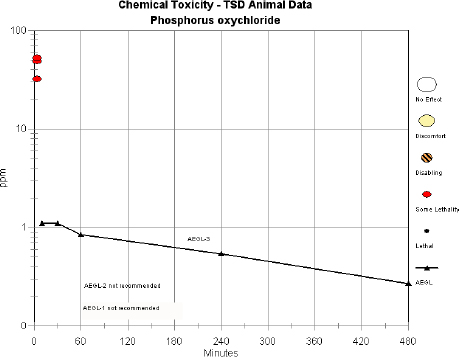
| AEGL-3 (Lethality | 1.1 ppm (6.9 mg/m3) | 1.1 ppm (6.9 mg/m3) | 0.85 ppm (5.3 mg/m3) | 0.54 ppm (3.4 mg/m3) | 0.27 ppm (1.7 mg/m3) | Estimate of lethality threshold in rats (16.1 ppm); 3-fold reduction in 4-h LC50 of 48.4 ppm (Weeks et al. 1964) |
aAbsence of AEGL-1 and AEGL-2 values does not imply that exposure below the AEGL-3 is without adverse effect.
TABLE 5-2 Chemical and Physical Data for Phosphorus Oxychloride
| Parameter | Value | Reference |
| Synonyms | Phosphoryl chloride, phosphorus chloride, phosphorus oxytrichloride, trichlorophosphine oxide, trichlorophosphorus oxide | Fee et al. 1996; O’Neil et al. 2001; RTECS 2009 |
| CAS registry number | 10025-87-3 | O’Neil et al. 2001 |
| Chemical formula | POCl3 | O’Neil et al. 2001 |
| Molecular weight | 153.33 | O’Neil et al. 2001 |
| Physical state | Liquid | O’Neil et al. 2001 |
| Melting point | 1.25°C | O’Neil et al. 2001 |
| Boiling point | 105.8°C | O’Neil et al. 2001 |
| Density | 1.645 at 25°C | O’Neil et al. 2001 |
| Solubility | Decomposes in water and alcohol | Fee et al. 1996 |
| Vapor pressure | 40 mmHg (27.3°C) | HSDB 2009 |
| Conversion factors in air | 1 ppm = 6.27 mg/m3 1 mg/m3 = 0.16 ppm |
NIOSH 2005 |
2. HUMAN TOXICITY DATA
2.1. Acute Lethality
No data were available regarding the acute lethality of phosphorus oxychloride in humans.
2.2. Nonlethal Toxicity
Most information on acute exposure of humans to phosphorus oxychloride is from secondary sources (ACGIH 1991; O’Neil et al. 2001). The following signs and symptoms were reported for acute exposures: headache, respiratory tract and eye irritation, chest pain, dyspnea, and nephritis. Chronic asthma-like conditions after acute exposure have also been reported (Sassi 1954; HSDB 2009). However, exposure-response data for these responses are lacking. Although there are no reports that provide quantitative data appropriate for AEGL development, they do affirm that the respiratory tract is a primary target for toxic responses following acute inhalation exposure to phosphorus oxychloride.
An accident involving an explosive release of phosphorus oxychloride, hydrogen chloride, oxalic acid, phosphorus pentachloride, and oxalyl chloride was reported by Rosenthal et al. (1978). Eight men and three women, ages 22-56 years, were exposed for approximately 30 sec to 2 min (the time required to escape from the contaminated area). The major signs and symptoms of exposure were wheezing, shortness of breath, conjunctivitis, and coughing. Nine people exhibited effects on ventilatory function; six recovered within a few days. In the other three individuals, disturbances in respiratory function returned to normal after 4 wk in one patient and 2.5 mo in the second, but persisted after 2 y in the third patient. The applicability of this report to AEGL development is questionable because of the lack of data on exposure concentrations and of concurrent exposure to other chemicals that have similar toxic effects.
Sassi (1954) described 20 cases of acute and subchronic occupational exposure in the manufacture of phosphorus oxychloride. Exposure concentrations varied from 10-20 mg/m3 (1.6-3.2 ppm) for normal conditions to 70 mg/m3 (11.2 ppm) for accidents. The signs and symptoms of acute exposures included irritation of the eyes and throat, dyspnea, dry cough, and bronchial stenosis (occurring several days after exposure). Long-term exposures resulted in more severe effects, including conditions characterized as asthmatic bronchitis and emphysema. Although concentrations for various exposure situations were provided in the report, there were no information on exposure durations.
Velsicol Chemical Corporation (1978) reported eye irritation in a worker exposed to phosphorus oxychloride. No information was provided on the concentrations to which the worker was exposed nor the severity of the irritation. The worker did, however, return to work; a 3-d “probable length of disability” was noted.
A health hazard evaluation conducted by the National Institute of Occupational Safety and Health (NIOSH) of the FMC Corporation plant in Nitro, West Virginia, reported that workers with known repeated exposures to phosphorus oxychloride or phosphorus trichloride experienced a significantly higher (p < 0.001) prevalence (65%) of respiratory symptoms (chest tightness, wheezing, difficulty breathing) compared with unexposed workers (5%) (Tharr and Singal 1980). However, no correlation was found between results of pulmonary function tests on the workers and exposure to these chemicals. The study involved 37 exposed workers and 22 unexposed workers. Most air samples were below detection limits, although one employee (wearing a chlorine gas mask) was exposed to phosphorus oxychloride at approximately 4 mg/m3 for about 25 min; no effects reported for this individual.
A follow-up study by NIOSH on 26 of the exposed workers and 11 of the unexposed workers at FMC Corporation reported that half of the exposed workers reported significantly (p < 0.002) more episodes of respiratory effects (wheezing, breathlessness, and chest tightness) compared to the unexposed workers who reported no such effects (Moody 1981). Results of pulmonary function tests did not reveal significant effects from exposure to phosphorus oxychloride (or phosphorus trichloride). No significant difference in pulmonary function (FEV1) was found in the exposed workers compared with the unexposed workers over a 2-y period. The small sample size reduces the power of the study to detect such changes and, therefore, compromises the apparent negative finding. Additionally, it appeared that the pulmonary function tests were performed after the occurrence of the symptoms noted in the questionnaires completed by the workers.
On January 22, 1984, approximately 6,500 gallons of phosphorus oxychloride were released from a large storage tank at a chemical plant in Sauget, Illinois, as a result of an icicle shearing a pipe nipple off the tank (T. Hornshaw, Office of Chemical Safety, Illinois EPA, pers. communication, 2009). The plume affected seven employees, and moved into neighboring Rush City, Illinois. Thirty five citizens were treated at area hospitals, most from a neighborhood approximately one-half mile from the plant. The most common signs and symptoms were respiratory tract irritation and stomach pain. Five citizens were admitted overnight but none were in serious condition, and were later released. All of the affected employees were examined by a company physician and were cleared to resume work the same day. No measurements of airborne concentrations were taken.
2.3. Developmental and Reproductive Toxicity
No human developmental and reproductive toxicity data concerning phosphorus oxychloride were found.
2.4. Genotoxicity
No human genotoxicity data on phosphorus oxychloride were found.
2.5. Carcinogenicity
No human data were found regarding the carcinogenic potential of phosphorus oxychloride.
2.7. Summary
Most information on the toxic response of humans to phosphorus oxychloride is from secondary reports that lack quantitative exposure-response data. The chemical appears to be extremely irritating to the respiratory tract and other mucous membranes. Both port-of-entry and systemic effects have been reported. Primary reports describe occupational exposures to phosphorus oxychloride, but they involve simultaneous exposures to other irritating chemicals (e.g., hydrogen chloride, oxalic acid, phosphorus pentachloride, oxalyl chloride) and lack information on exposure concentrations and durations. The reports affirm signs and symptoms of nasopharyngeal, ocular, and dermal irritation, and ventilatory dysfunction following acute exposures. Concurrent exposures to other chemicals, especially those having the same effects and targets as phosphorus oxychloride, compromise the usefulness of human exposure data for quantitative determination of AEGL values.
3. ANIMAL TOXICITY DATA
3.1. Acute Lethality
Quantitative data on the acute lethality of phosphorus oxychloride are from a single study in rats and guinea pigs, and an unverified 4-h LC50 value for rats.
3.1.1. Rats
Weeks et al. (1964) reported on the acute lethality of phosphorus oxychloride in female rats. The experimental protocol consisted of a group of 20 young adult female rats (strain not specified) exposed to phosphorus oxychloride (concentrations not provided) followed by a 14-d observation period. Another group of 20 rats was similarly exposed to phosphorus oxychloride and ammonia (for neutralization of hydrolysis products). The test vapors were generated by passing dried nitrogen through the liquid test article. The vapors were then mixed
with influent air before being pumped into the chamber. Test article concentrations were determined by collection and weighing of material on a filter. These samples were also analyzed for phosphorus, nitrogen, and chloride. The test atmospheres were calculated as microgram of phosphorus per liter of air (μg/L) and as micromoles of phosphorus oxychloride per mole of air (µmole/mole). The latter expression assumed no hydrolysis of the test material (hydrolysis, however, was calculated to be about 15%). During exposure, rats exhibited signs of irritation (pawing and scratching of the nose and head) and had porphyrin secretions around the eyes. Gasping and convulsions preceded death which occurred within 48 h. No further details were provided regarding time of deaths. The 4-h LC50 for rats was reported as 48.4 μmole/mole (48.4 ppm). Neutralization with ammonia lowered the 4-h LC50 to 44.4 μmole/mole (44.4 ppm). Although simultaneous exposure to ammonia reduced or eliminated signs of irritation, it resulted in gross and microscopic pathologic findings (dark red lungs, desquamation of respiratory tract epithelium, and plugging of bronchial and bronchiolar lumens). The LC50 values do not necessarily imply that the test material was in a vapor from. In fact, it is probable that vapor and aerosol forms were present in the exposure atmosphere. With the exception of the median lethal concentration values, no other exposure-response data were provided.
In a study by Molodkina (1974), acute inhalation exposure of rats to lethal or near-lethal concentrations of phosphorus oxychloride resulted in immediate signs of irritation (rubbing of faces and restlessness). The rats exhibited inactivity and decreased respiration after 5-15 min, followed by convulsions. Rats that survived showed continued lacrimation and corneal opacities, and ulcers around the mouth several days after exposure ended. The report identified a “threshold concentration” of 0.006 mg/L (0.96 ppm) on the basis of “integrated characteristics.” It is unclear as to what effect this threshold pertains or the precise nature of the “integrated characteristics.” Information in this report affirms the irritation and lethal capacity of phosphorus oxychloride after acute inhalation exposure.
Details regarding a 4-h LC50 of 32 ppm for rats in a 1972 study (Marhold 1972 as cited in RTECS 2009) were unavailable for analysis and could not be verified.
The results of an inhalation study in rats were provided in a brief report by Monsanto (1991). Male Sprague-Dawley rats (number not specified) were exposed to phosphorus oxychloride at 159.7 mg/L (25,462 ppm) for 18 min. Conditions in the 35-L chamber were: 25°C, 85% humidity, and 4.0 L/min airflow. The concentration of the test material was such that there was a fog in the chamber. Within 2 min the rats were having difficulty breathing and their eyes were closed. After 10 min, weakness, convulsions, and collapse were observed, and one rat died. All rats were dead after 18 min. Necropsy revealed lung congestion. No further details were provided.
3.1.2. Guinea pigs
Weeks et al. (1964) conducted experiments using groups of 10 male guinea pigs. The experimental protocol was the same as that described for the experiments with rats. The response of the guinea pigs was consistent with exposure to an irritating chemical (restlessness, lacrimation, pawing at nose and head). The 4-h LC50 was 52.5 μmole/mole (52.5 ppm). Deaths occurred within 48 h after exposure; no further details were provided. Neutralization of the phosphorus oxychloride with ammonia resulted in a lowering of the LC50 to 41.3 μ mole/mole (41.3 ppm). As in the study with rats, simultaneous exposure of the guinea pigs to ammonia appeared to decrease the irritation responses to the phosphorus oxychloride but increase overall toxicity. The series of exposures and the respective responses used to obtain the median lethal concentration were not provided and, therefore, no other exposure-response data are available.
The previously discussed (Section 3.1.1) study by Molodkina (1974) also examined the response of guinea pigs to acute inhalation of phosphorus oxychloride. Lacrimation and corneal opacities were reported for animals after acute exposure to lethal or near lethal concentrations. No other details were reported.
3.2. Nonlethal Toxicity
Definitive exposure-response data for nonlethal toxicity in animals were not available. Weeks et al. (1964) and Molodkina (1974) reported that acute inhalation of phosphorus oxychloride (for up to 4 h) by rats and guinea pigs resulted in severe irritation (rubbing of face, lacrimation, porphyrin secretions, desquamation of pulmonary epithelium), but the precise concentrations and exposure durations were not provided. The only exposure-duration data provided were median lethality values. Thus, it is difficult to determine concentrations of phosphorus oxychloride that might cause nonlethal responses without potential for lethality.
3.3. Developmental and Reproductive Toxicity
No animal developmental and reproductive toxicity data concerning phosphorus oxychloride were found.
3.4. Genotoxicity
No animal genotoxicity data on phosphorus oxychloride were found.
3.5. Carcinogenicity
No animal data were found regarding the carcinogenic potential of phosphorus oxychloride.
3.6. Summary
Quantitative exposure-response toxicity data in animals were from lethality studies rats and guinea pigs (Table 5-3). A report by Weeks et al. (1964) provided an adequate description of the experimental protocol and 4-h LC50 value for rats (44.4 ppm) and guinea pigs (52.5 ppm). A study by Molodkina (1974) also examined the toxic response of rats and guinea pigs to inhaled phosphorus oxychloride; exposure to phosphorus oxychloride at 0.96 ppm for 5-15 min was considered a threshold response. However, the characteristics of the responses or what constituted the “threshold” were not provided. A brief report from Monsanto (1991) showed immediate adverse responses (after 2 min) and death (after 18 min) after exposure to phosphorus oxychloride of 25,462 ppm. Acute lethality values from a secondary source could not be verified. The available studies affirm the extreme irritation properties of phosphorus oxychloride, although the exposure concentrations described also resulted in lethality. No information was available regarding reproductive and developmental toxicity, genotoxicity, or carcinogenicity.
4. SPECIAL CONSIDERATIONS
4.1. Metabolism and Disposition
No data on the metabolism and disposition of phosphorus oxychloride were found.
TABLE 5-3 Acute Lethality of Phosphorus Oxychloride in Laboratory Animals
| Species | Lethality Value | Reference |
| Rat | 4-h LC50 = 48.4 ppm | Weeks et al. 1964 |
| Rat | 4-h LC50 = 32 ppm (not verified) | Marhold 1972 as cited in RTECS 2009 |
| Rat | 100% lethality = 25,462 ppm after 18 min | Monsanto 1991 |
| Guinea pig | 4-h LC50 = 52.5 ppm | Weeks et al. 1964 |
4.2. Mechanism of Toxicity
The precise mechanism of toxicity of inhaled phosphorus oxychloride has not been elucidated. The irritant properties of phosphorus oxychloride might be from its decomposition products, phosphoric acid and hydrogen chloride. However, the acute lethality of phosphorus oxychloride appears to be greater than from the decomposition products alone. For example, the 1-h LC50 values for phosphoric acid and hydrochloric acid in rats are >212 ppm and 3,124 ppm, respectively, whereas the 1-h LC50 for phosphorus oxychloride is 76 ppm (estimated by temporal extrapolation from 4-h data). Although the acute lethality of inhaled phosphorus oxychloride probably results from damage to the respiratory epithelium and pulmonary edema, the role of delivery to this target tissue remains uncertain. Exposure to phosphorus oxychloride might allow the formation of larger concentrations of phosphoric acid and hydrochloric acid in the lungs than would be possible from exposures to each of the chemicals alone. This would cause greater damage and explain, in part, the greater toxicity of phosphorus oxychloride.
4.3. Structure-Activity Relationships
Barbee et al. (1995) conducted an acute toxicity study in which groups of 10 rats were exposed to oxalyl chloride (COCl)2 at 0, 462, 866, 1,232, 1,694, or 2,233 ppm for 1 hr. The 1-h LC50 was 1,840 ppm. The acute lethality of oxalyl chloride was similar to that of hydrogen chloride, but oxalyl chloride was much less toxic than phosphorus oxychloride. Because the toxicity of phosphorus oxychloride appears to be greater than that of hydrogen chloride, it is unlikely that the mechanisms of toxicity for the two chemicals are the same. Thus, the development of AEGL values on the basis of analogy to hydrogen chloride production alone might underestimate the toxic potential of phosphorus oxychloride.
Phosphorus trichloride produces many of the same signs and symptoms as phosphorus oxychloride after acute inhalation exposures (Weeks et al. 1964; ACGIH 1991) and also undergoes rapid hydrolysis to hydrogen chloride and phosphonic acid. Data from rats and guinea pigs (Weeks et al. 1964) suggest that the lethal potency of phosphorus oxychloride might be similar to that of phosphorus trichloride. The rat 4-h LC50 values for both chemicals are approximately 50 ppm which supports the contention that they have similar toxicity. Information on human exposures to phosphorus trichloride verify a potential for irritation of the respiratory tract, nasopharyngeal region, eyes, and skin, and effects on ventilatory function (Wason et al. 1982, 1984). These human exposure reports provide qualitative information on the toxic response to the chemical, but lack measurements of exposure.
4.4. Other Relevant Information
4.4.1. Species Variability
Data are insufficient to reliably describe species variations in toxic responses to inhaled phosphorus oxychloride. Rats and guinea pigs appeared to respond similarly in a study by Weeks et al. (1964) and on the basis of an unverified LC50 in rats (RTECS 2009).
4.4.2. Concurrent Exposure Issues
No concurrent exposure issues of special concern have been identified that would directly affect the derivation of AEGL values for phosphorus oxychloride. Simultaneous exposure to other irritating or corrosive chemicals would necessitate adjustments in emergency response planning for potential exposures to phosphorus oxychloride.
5. DATA ANALYSIS FOR AEGL-1
5.1. Summary of Human Data Relevant to AEGL-1
Quantitative exposure-response data in humans are not available for development of AEGL-1 values for phosphorus oxychloride. Information on the human experience is based on qualitative descriptions of signs and symptoms of acute exposure. Although exposure concentrations were not provided, the available reports indicate that very short exposures might result in notable respiratory, ocular, and dermal irritation. There is evidence that respiratory effects might persist for an extended period after exposure is ceased.
5.2. Summary of Animal Data Relevant to AEGL-1
Data are not available on responses in animals that would be consistent with AEGL-1 effects.
5.3. Derivation of AEGL-1
Exposure-response data were not available for developing AEGL-1 values for phosphorus oxychloride (Table 5-4).
TABLE 5-4 AEGL-1 Values for Phosphorus Oxychloride
| 10 min | 30 min | 1 h | 4 h | 8h |
| Not recommended | ||||
6. DATA ANALYSIS FOR AEGL-2
6.1. Summary of Human Data Relevant to AEGL-2
Quantitative exposure-response data in humans are not available for development of AEGL-2 values for phosphorus oxychloride. Information regarding the human experience is based on qualitative and semi-quantitative information regarding signs and symptoms (respiratory tract irritation that might persist for extended periods and ocular and dermal irritation) of exposed individuals. The information in these reports suggest very brief exposure to phosphorus oxychloride at low concentrations (1.6-3.2 ppm) might cause irritation severe enough to impair egress from a contaminated area. Additionally, data from animal studies suggest that acute exposure to phosphorus oxychloride might cause contact irritation damage (e.g., corneal opacities) that could be irreversible. However, definitive exposure concentration and duration measurements were lacking for these animal studies, thereby preventing exposure-response assessments for AEGL-2 development.
6.2. Summary of Animal Data Relevant to AEGL-2
Animal data on effect severity consistent with AEGL-2 were based on qualitative descriptions of responses in animals exposed to lethal or near-lethal concentrations. Signs of exposure in these studies were consistent with extreme irritation of the eyes, nasopharyngeal region, and the respiratory tract. However, exposure concentration data and exposure duration data were not available.
6.3. Derivation of AEGL-2
Exposure-response data were not available for developing AEGL-2 values for phosphorus oxychloride (Table 5-5). The lack of information regarding the exposure-response relationship makes estimating AEGL-2 values by reducing AEGL-3 values difficult to justify.
7. DATA ANALYSIS FOR AEGL-3
7.1. Summary of Human Data Relevant to AEGL-3
Information is not available regarding lethality in humans exposed to phosphorus oxychloride.
TABLE 5-5 AEGL-2 Values for Phosphorus Oxychloride
| 10 min | 30 min | 1 h | 4 h | 8h |
| Not recommended | ||||
7.2. Summary of Animal Data Relevant to AEGL-3
Lethality data are based on 4-h LC50 values for rats and guinea pigs. Two 4-h LC50 values are available for rats: 48.4 ppm (Weeks et al. 1964) and 32 ppm (Marhold 1972 as cited in RTECS 2009, unverifiable). A single 4-h LC50 for guinea pigs is 52.5 ppm (Weeks et al. 1964). The range of exposure used to determine these median lethal concentrations, however, were not reported. Therefore, it is not possible to assess the exposure-response relationship. The available data suggest that species variability in the lethal response to phosphorus oxychloride is not great. However, there is still uncertainty regarding the range of susceptibility among species because data are available from only one well described study on two species.
7.3. Derivation of AEGL-3
In lieu of additional data, the available 4-h LC50 values may be considered for developing AEGL-3 values for phosphorus oxychloride. Because the rat appears to be a slightly more sensitive species than the guinea pig, the 4-h LC50 of 48.4 ppm identified by Weeks et al. (1964) was used as the basis for the AEGL-3 values. The 32-ppm value reported in RTECS (2009) was not verified and, therefore, was not used.
In the absence of complete data regarding the exposure-response curve and assuming that the difference between nonlethal and lethal exposures is small, the lethality threshold was estimated to be one-third of the 4-h rat LC50 (48.4 ppm/3 = 16.1 ppm). This extrapolation is also justified because many respiratory tract irritants have exposure-response relationships in which the transition from progressive irritation and repairable epithelial tissue damage to lethal pulmonary damage occurs abruptly. A total uncertainty factor of 30 (10 for interspecies variability and 3 for intraspecies variability) was used. The interspecies uncertainty factor of 10 was maintained because there are data on only two species (a single 4-h LC50 each for rats and guinea pigs) and no lethality data in humans. Additionally, the study by Weeks et al. (1964) showed rats to be notably more sensitive to phosphorus oxychloride (4-h LC50 of 48.4 ppm) than to phosphorus trichloride (4-h LC50 of 104. 3 ppm). Although signs of exposure in humans are qualitatively similar to those observed in laboratory animals, there are no quantitative exposure-response data in humans. An intraspecies uncertainty factor of 3 was selected because a critical mechanism of phosphorus oxychloride toxicity appears to involve irritation and destruction of pulmonary mucosal surfaces; lethality resulting, at least in part, from damage to respiratory tract epithelium. It is assumed that a basic contact irritation mechanism would not vary greatly among individuals and that a 3-fold reduction would be sufficient to protect individuals with moderately compromised respiratory function. Further reduction of the AEGL-3 values by a greater uncertainty factor would result in values inconsistent with occupational exposures reported by Sassi
(1954), where repeated exposures to concentrations up to 3.2 ppm resulted in irritation and minor respiratory difficulties but not death. There are no data available to determine a time-scaling factor. The concentration-exposure-time relationship for many irritant and systemically acting vapors and gases may be described by Cn × t = k, where the exponent, n, ranges from 0.8 to 3.5 (ten Berge et al. 1986). In the absence of an empirically derived exponent (n), and to obtain conservative and protective AEGL values, temporal scaling was performed using n = 3 when extrapolating to shorter time points and n = 1 when extrapolating to longer time points. Because of uncertainties in extrapolating a 4-h exposure to a 10-min exposure, the 10-min AEGL-3 is set equivalent to the 30-min AEGL-3 rather than using exponential scaling. The derivation of AEGL-3 values is shown in Appendix A and the resulting values are summarized in Table 5-6.
8. SUMMARY OF PROPOSED AEGLS
8.1. AEGL Values and Toxicity Endpoints
The available toxicity data for phosphorus oxychloride indicate that irritation of the skin, eyes, nose, and respiratory tract are the most notable and often reported signs of toxicity. Although these end points relevant to AEGL-1 and AEGL-2 values, quantitative exposure-response data are lacking for development of these values. Quantitative data on lethality in animals were available and were considered appropriate for the basis of AEGL-3 development. The data were, however, limited to a single study and two species.
8.2. Comparison with Other Standards and Guidelines
The World Health Organization (WHO 1989) reported that exposure guidelines for phosphorus oxychloride range from 0.05-3 mg/m3 (0.008-0.48 ppm) in different countries. Standards and criteria for phosphorus oxychloride are presented in Table 5-7.
8.3. Data Quality and Research Needs
Although qualitative data are available regarding the acute inhalation toxicity of phosphorus oxychloride in humans, quantitative exposure-response data are lacking. Animal data include one study reporting LC50 values in rats and guinea pigs. The animal data were sufficient for developing AEGL-3 values. However, there are no data pertaining to the nonlethal responses in animals following inhalation exposure to phosphorus oxychloride. There are also insufficient data for determining the range of susceptibility among different species or between the test animal species and humans.
TABLE 5-6 AEGL-3 Values for Phosphorus Oxychloride
| 10 min | 30 min | 1 h | 4 h | 8h |
| 1.1 ppm | 1.1 ppm | 0.85 ppm | 0.54 ppm | 0.27 ppm |
TABLE 5-7 Standards and Guidelines for Phosphorus Oxychloride
| Guideline | Exposure Duration | ||||
| 10 min | 30 min | 1 h | 4 h | 8 h | |
| AEGL-1 | Not recommended | ||||
| AEGL-2 | Not recommended | ||||
| AEGL-3 | 1.1 ppm | 1.1 ppm | 0.85 ppm | 0.54 ppm | 0.27 ppm |
| TLV-TWA (ACGIH)a | 0.1 ppm | ||||
| REL-TWA (NIOSH)b | 0.1 ppm | ||||
| REL-STEL (NIOSH)c | 0. 5 ppm (15 min) | ||||
| MAK Spitzenbegrenzung (Germany)d | 1.33 mg/m3 (0.2 ppm) | ||||
| MAC (The Netherlands)e | 0.6 mg/m3 (0.1 ppm) | ||||
aTLV-TWA (Threshold Limit Value-time-weighted average of the American Conference of Governmental Industrial Hygienists) (ACGIH 2003) is the time-weighted average concentration for a normal 8-h workday and a 40-h work week to which nearly all workers may be repeatedly exposed, day after day, without adverse effect.
bREL-TWA (recommended exposure limits-time-weighted average, National Institute for Occupational Safety and Health) (NIOSH 2005) is analogous to the ACGIH-TLV-TWA.
cREL-STEL (recommended exposure limits-short-term exposure limit, National Institute for Occupational Safety and Health) (NIOSH 2005) is analogous to the ACGIH-TLV-STEL.
dMAK Spitzenbegrenzung (Kategorie II,2) [maximum workplace concentration (peak limit category II,2)] (DFG 2002) constitutes the maximum average concentration to which workers can be exposed for a period up to 30 min, with no more than two exposure periods per work shift; total exposure may not exceed 8-h MAK.
eMAC (maximaal aanvaarde concentratie [maximum accepted concentration]), Dutch Expert Committee for Occupational Standards, The Netherlands (MSZW 2004) is analogous to the ACGIH-TLV-TWA.
9. REFERENCES
ACGIH (American Conference of Governmental Industrial Hygienists). 1991. Phosphorus oxychloride. Pp. 1255-1256 in Documentation of the Threshold Limit Values and Biological Exposure Indices, Vol. II, 6th Ed. American Conference of Governmental Industrial Hygienists, Cincinnati, OH.
ACGIH (American Conference of Governmental Hygienists). 2003. TLVs and BEIs Based on the Documentation of the Threshold Limit Values for Chemical Substances and Physical Agents and Biological Exposure Indices: Phosphorus Oxychloride. American Conference of Governmental Hygienists, Cincinnati, OH.
AIHA (American Industrial Hygiene Association). 2009. Current AIHA ERPG Values (2009). American Industrial Hygiene Association, Fairfax, VA [online]. Available: http://www.aiha.org/foundations/GuidelineDevelopment/ERPG/Documents/ERPerpglevels.pdf [accessed Nov. 23, 2010].
Barbee, S.J., J.J. Stone, and R.J. Hilaski. 1995. Acute inhalation toxicology of oxalyl chloride. Am. Ind. Hyg. Assoc. J. 56(1):74-76.
DFG (Deutsche Forschungsgemeinschaft). 2002. List of MAK and BAT Values 2002. Maximum Concentrations and Biological Tolerance Values at the Workplace Report No. 38. Weinheim, Federal Republic of Germany: Wiley VCH.
Fee, D.C., D.R. Gard, and C.H. Yang. 1996. Phosphorus compounds. Pp. 761-765 in Kirk-Othmer Encyclopedia of Chemical Technology, Vol. 18. Paper to Pigment Dispersions, 4th Ed., J. Kroschwitz, and M. Howe-Grant, eds. New York: Wiley.
HSDB (Hazardous Substances Data Bank). 2009. Phosphorus Oxychloride (CASRN 10025-87-3). TOXNET, Specialized Information Services, U.S. National Library of Medicine, Bethesda, MD [online]. Available: http://toxnet.nlm.nih.gov/cgibin/sis/htmlgen?HSDB [accessed Nov. 23, 2010].
Marhold, J.V. 1972. Sbornik Výsledkù Toxikologického Vysetrení Látek a Pripravkù. Institut pro Výchovu Vedoucich Pracovniku Chemického Prumyslu, Praha, Czechoslovakia (as cited in RTECS 2009).
Molodkina, N.N. 1974. Comparative toxicity of the chloride compounds of phosphorus (POCl3, PCl3, PCl5) in single and repeated exposures [in Russian]. Toksikol. Nov. Prom. Khim. Veshchestv. 13: 107-114.
Monsanto Co. 1991. Initial Submission: Toxicity Studies on Phosphorus Oxychloride (Final Report) with Cover Letter Dated 11/26/91. EPA Document No. 88-920 000388. U.S. Environmental Protection Agency, Washington, DC.
Moody, P.L. 1981. Health Hazard Evaluation Report: FMC Corporation, Nitro, West Virginia. HETA 81-089-965. U.S. Department of Health and Human Services, Centers for Disease Control, National Institute for Occupational Safety and Health, Cincinnati, OH.
MSZW (Ministerie van Sociale Zaken en Werkgelegenheid). 2004. Nationale MAC-lijst 2004: Fosforyltrichloride. Den Haag: SDU Uitgevers [online]. Available: http://www.lasrook.net/lasrookNL/maclijst2004.htm [accessed Nov. 23, 2010].
NIOSH (National Institute for Occupational Safety and Health). 2005. NIOSH Pocket Guide to Chemical Hazards: Phosphorus Oxychloride. U.S. Department of Health and Human Services, Centers for Disease Control and Prevention, National Institute for Occupational Safety and Health, Cincinnati, OH. September 2005 [online]. Available: http://www.cdc.gov/niosh/npg/npgd0508.html [accessed Nov. 23, 2010].
NRC (National Research Council). 1984. Emergency and Continuous Exposure Limits for Selected Airborne Contaminants, Vol. 2. Washington, DC: National Academy Press.
NRC (National Research Council). 1993. Guidelines for Developing Community Emergency Exposure Levels for Hazardous Substances. Washington, DC: National Academy Press.
NRC (National Research Council). 2001. Standing Operating Procedures for Developing Acute Exposure Guideline Levels for Hazardous Chemicals. Washington, DC: National Academy Press.
O’Neil, M.J., A. Smith, and P.E. Heckelman, eds. 2001. Phosphorus oxychloride. P. 1318 in The Merck Index: An Encyclopedia of Chemicals and Drugs, 13th Ed. Whitehouse Station, NJ: Merck.
Rosenthal, T., G.L. Baum, U. Fraud, and M. Molho. 1978. Poisoning caused by inhalation of hydrogen chloride, phosphorus oxychloride, phosphorus pentachloride, oxalyl chloride, and oxalic acid. Chest 73(5):623-626.
RTECS (Registry of Toxic Effects of Chemical Substances). 2009. Phosphoryl chloride. RTECS No. TH4897000. National Institute for Occupational Safety and Health [online]. Available: http://www.cdc.gov/niosh-rtecs/TH4AB8E8.html [accessed Nov. 29, 2010].
Sassi, C. 1954. Occupational poisoning by phosphorus oxychloride [in Italian]. Med. Lav. 45(3):171-177.
ten Berge, W.F., A. Zwart, and L.M. Appelman. 1986. Concentration-time mortality response relationship of irritant and systemically acting vapours and gases. J. Hazard. Mater. 13(3):301-309.
Tharr, D.G., and M. Singal. 1980. Health Hazard Evaluation Determination Report: FMC Corporation, Specialty Chemicals Division, Nitro, West Virginia. HHE 78-90-739. U.S. Department of Health and Human Services, Centers for Disease Control, National Institute for Occupational Safety and Health, Cincinnati, OH.
Velsicol Chemical Corporation. 1978. Letter from Velsicol Chemical Corporation to U.S. EPA Submitting Information on Phosphorus Oxychloride with Attachments. EPA Document No. 88-7800080. Microfiche No. OTS 0200064. U.S. Environmental Protection Agency, Washington, DC.
Wason, S., I. Gomolin, P. Gross, and F.H. Lovejoy, Jr. 1982. Phosphorus trichloride exposure—a follow-up study of 27 exposed patients. Vet. Hum. Toxicol. 24(4):275-276.
Wason, S., I. Gomolin, P. Gross, S. Mariam, F.H. Lovejoy, Jr. 1984. Phosphorus trichloride toxicity: Preliminary report. Am. J. Med. 77(6):1039-1042.
Weeks, M.H., N.P. Mussleman, P.P. Yevich, K.H. Jacobson, and F.W. Oberst. 1964. Acute vapor toxicity of phosphorus oxychloride, phosphorus trichloride and methyl phosphonic dichloride. Am. Ind. Hyg. Assoc. J. 25:470-475.
WHO (World Health Organization). 1989. Phosphorus Trichloride and Phosphorus Oxychloride. Health and Safety Guide No. 35. IPCS International Programme on Chemical Safety. Geneva: World Health Organization [online]. Available: http://www.inchem.org/documents/hsg/hsg/hsg035.htm [accessed Dec. 1, 2010].
APPENDIX A
DERIVATION OF AEGL VALUES FORPHOSPHORUS OXYCHLORIDE
Derivation of AEGL-1
AEGL-1 values are not recommended because insufficient data. Absence of AEGL-1 values does not imply that exposure below the AEGL-3 values are without adverse effects.
Derivation of AEGL-2
AEGL-2 values are not recommended because of insufficient data. Absence of AEGL-2 values does not imply that exposure below the AEGL-3 values are without serious or possibly irreversible adverse effects.
| Derivation of AEGL-3 | |
| Key study: | Weeks et al. 1964 |
| Toxicity end point: | Lethality threshold of 16.1 ppm in rats, estimated by 3-fold reduction in 4-h LC50 of 48.4 ppm. |
| Scaling: | Cn × t = k (n = 3 for extrapolating from longer to shorter exposure periods and n = 1 for extrapolating from shorter to longer exposure periods) |
| (16.1 ppm)1 × 4 h = 64.4 ppm-h | |
| (16.1 ppm)3 × 4 h = 16,693.12 ppm-h | |
| Uncertainty factors: | 10 for interspecies variability |
| 3 for intraspecies variability | |
| 10-min AEGL-3 | 1.1 ppm, set equal to the 30-min AEGL-3 |
| 30-min AEGL-3 | C3 × 0.5 h = 16,693.12 ppm-h |
| C = 32.2 ppm | |
| 30-min AEGL-3 = 32.2 ppm/30 = 1.1 ppm | |
| 1-h AEGL-3 | C3 × 1 h = 16,693.12 ppm-h |
| C = 25.56 ppm | |
| 1-h AEGL-3 = 25.56 ppm/30 = 0.85 ppm | |
APPENDIX B
ACUTE EXPOSURE GUIDELINES FORPHOSPHORUS OXYCHLORIDE
Derivation Summary for Phosphorus Oxychloride
AEGL-1 VALUES
| 10 min | 30 min | 1 h | 4 h | 8 h |
| Not | Not | Not | Not | Not |
| recommended | recommended | recommended | recommended | recommended |
| Reference: Not applicable | ||||
| Test Species/Strain/Number: Not applicable | ||||
| Exposure Route/Concentrations/Durations: Not applicable | ||||
| Toxicity End Point: Not applicable | ||||
| Time Scaling: Not applicable | ||||
| Concentration/Time Selection/Rationale: Not applicable | ||||
| Uncertainty Factors/Rationale: Not applicable | ||||
| Modifying Factor: Not applicable | ||||
| Animal to Human Dosimetric Adjustments: Not applicable | ||||
| Data adequacy: Exposure-response data on nonlethal toxic responses were not available for developing AEGL-2 values for phosphorus oxychloride. The absence of such data precludes estimating AEGL-2 values by reducing AEGL-3 values. Therefore, AEGL-2 values are not recommended. The absence of AEGL-2 values does not imply that exposure below AEGL-3 levels is without serious or possibly irreversible effect. | ||||
AEGL-2 VALUES
| 10 min | 30 min | 1 h | 4 h | 8 h |
| Not | Not | Not | Not | Not |
| recommended | recommended | recommended | recommended | recommended |
| Reference: Not applicable | ||||
| Test Species/Strain/Number: Not applicable | ||||
| Exposure Route/Concentrations/Durations: Not applicable | ||||
| Toxicity End Point: Not applicable | ||||
| Time Scaling: Not applicable | ||||
| Concentration/Time Selection/Rationale: Not applicable | ||||
| Uncertainty Factors/Rationale: Not applicable | ||||
| Modifying Factor: Not applicable | ||||
| Animal to Human Dosimetric Adjustments: Not applicable | ||||
| Data adequacy: Exposure-response data on nonlethal toxic responses were not available for developing AEGL-2 values for phosphorus oxychloride. The absence of such data precludes estimating AEGL-2 values by reducing AEGL-3 values. Therefore, AEGL-2 values are not recommended. The absence of AEGL-2 values does not imply that exposure below AEGL-3 levels is without serious or possibly irreversible effect. | ||||
AEGL-3 VALUES
| 10 min | 30 min | 1 h | 4 h | 8 h |
| 1.1 ppm | 1.1 ppm | 0.85 ppm | 0.54 ppm | 0.27 ppm |
| Reference: Weeks, M.H., N.P. Mussleman, P.P. Yevich, K.H. Jacobson, and F.W. Oberst. 1964. Acute vapor toxicity of phosphorus oxychloride, phosphorus trichloride and methyl phosphonic dichloride. Am. Ind. Hyg. Assoc. J. 25:470-475. | ||||
| Test Species/Strain/Number: Rats (strain not specified)/20 per group | ||||
| Exposure Route/Concentrations/Durations: Inhalation/concentrations varied but not specified/4 h | ||||
| Toxicity End Point: 4-h LC50 (48.4 ppm) for guinea pigs | ||||
| Time Scaling: Cn × t = k, n = 3 for extrapolating from longer to shorter exposure periods and n = 1 for extrapolating from shorter to longer exposure periods | ||||
| Concentration/Time Selection/Rationale: A 3-fold reduction of 4-h LC50 (48.4 ppm/3 = 16.1 ppm) for rats (the more sensitive species) was considered an estimate of the lethality threshold | ||||
| Uncertainty Factors/Rationale: | ||||
| Total Uncertainty: 30 | ||||
| Interspecies: 10 | ||||
| Intraspecies: 3 was considered sufficient because the primary mechanism of action involves a direct effect on respiratory epithelium which is unlikely to vary greatly among individuals. The factor also is considered to be adequate for the protection of individuals with moderately compromised respiratory function. Additional reduction of the AEGL-3 values by a greater uncertainty factor would result in AEGL-3 values that are inconsistent with occupational data and other guidelines. | ||||
| Modifying Factor: None applied | ||||
| Animal-to-Human Dosimetric Adjustments: Insufficient data | ||||
| Data Adequacy: LC50 values available for only two species. These data were considered sufficient for developing AEGL-3 values. Interspecies variability remains uncertain because of the lack of data in additional species and definitive exposure data in humans. | ||||