
The premise of the workshop was that NASA and its associated science and exploration communities have not been as effective as they could be in communicating with the public about what NASA does or how its activities contribute to resolving critical problems on Earth. Although not explicitly stated, an underlying assumption seemed to be that if the public had a better understanding, it would be more supportive of NASA, which in turn could generate more political support for the organization. In the case of global climate change, the broader issue is how to convince the public of the magnitude of the problem and the need for solutions. The role of new social media tools like Facebook and Twitter in interacting with the public was an integral part of the discussion.
HAS COMMUNICATION BEEN EFFECTIVE TO DATE?
Throughout the workshop, the topic of global climate change was put forward as a primary example of where communication between the scientific community and the public has failed. Specifically, many of the scientists concluded that the “Climategate”1 incident demonstrated the fragility of the public’s trust in the scientific community and in the data showing that climate change is human induced. Charles F. Kennel, Space Studies Board (SSB) chair, related that polls by the Pew Trust showed that the public’s belief and trust that climate change was real and that scientists were telling the truth dropped 20 points after Climategate, an unprecedented drop in the history of Pew’s polling.
Kennel characterized Climategate as a dramatic lesson for the climate science community that thought it had “discovered the key for communicating with decision-makers” through the “elaborate peer review process” embedded in the International Panel for Climate Change (IPCC). SSB member Berrien Moore III, former co-chair of the National Research Council’s (NRC’s) decadal survey on Earth science and applications from space, passionately held that the climate science community has failed to communicate successfully the seriousness of the climate change problem to the public.
Some of the communicators,2 however, disagreed. Christie Nicholson, journalist and online contributor for Scientific American, asked Moore how he could consider it a failure when people think about Earth “all the time now.” She and other communicators explained how the public makes decisions on issues for which they have little background or understanding, like climate change, by using “information shortcuts” and “confirmation biases” to decide who to believe or not believe. During the panel discussion for Session 5, Moore initially resisted the notion that climate change is a belief-based issue—“the data are there,” he said—but Nicholson and Andrew Lawler, a science journalist, helped him understand that it is indeed a matter of belief.
Lawler said that although he had learned to trust and believe the data Moore presented, there has been a loss of trust, and he sees this in journalism, too—people do not know who to believe. He acknowledged that scientists have a difficult time understanding that some people do not believe the data
________________
1 Charles Kennel’s explanation of “Climategate” is summarized in Session 1.
2 For simplicity, participants in the workshop are categorized in this discussion as scientists or communicators since the purpose was to bring those two communities together. The terms should not be interpreted precisely, however. The communicators are essentially the non-space and Earth scientists in the group even though some, like Joan Johnson-Freese, are academics and not in the communications profession. Also, some of the scientists, like Joan Vernikos, have encompassed communications in their current careers.
charts. Nicholson concurred, adding that even two scientists can draw different conclusions from the same data. She called it a confirmation bias—the tendency for a person to believe one scientist versus another based on that person’s preconceived ideas, adding: “I don’t know when climate change … became such a strong belief system on the level of religion and political beliefs, but it has.” By the end of the discussion, Moore said that he now understood that it is not whether people believe or not in global warming, it is whether they believe or not “in what we said” and thanked Lawler and Nicholson “because I learned something.”
Science fiction author Kim Stanley Robinson tied his grave concern about climate change to the question of how best to communicate about the human spaceflight program, which many of the participants cited as a particularly difficult sell. Robinson emphasized that one could not discuss human spaceflight without reference to the “planetary environmental emergency that we are now in without being escapist and doing more harm than good.” He asserted that talking about human space exploration could be “easily misinterpreted as escapist and elitist, involving only a small percentage of the human population,” and the focus should be on space and Earth science, especially the connection between the two, for example comparative planetology. He reacted to assertions by others that the public in general does not trust scientists by commenting that there should be posters reminding people that their doctors and the people who build and fly airplanes are scientists too. As for the climate issue, he argued that the climate science community, as a community, should “bite the bullet” and tell the public that “we are in a fight for the hearts and minds of our own population.”
Washington Post science reporter Marc Kaufman’s complaint about communicating with the public about the human spaceflight program, or exploration, was that he could not imagine a worse scenario than what has happened in the past 10 years. The 2003 space shuttle Columbia tragedy was followed by President George W. Bush’s Vision for Space Exploration to return humans to the Moon by 2020 and then go on to Mars. That idea was endorsed by Congress but not funded adequately, which tells people that we are not serious, he said. When the Obama administration determined there was not enough money to execute President Bush’s Vision for Space Exploration and do many other things on NASA’s plate, it “understandably decided to blow up the whole process,” he asserted. In terms of communicating with the public about all of this, Joan Vernikos, former director of life sciences at NASA and an SSB member, emphasized that actions speak louder than words, and if they are disparate the result is “disastrous.” That was her assessment of the situation with the human spaceflight program today.
Kaufman thinks President Obama’s “commercial crew” concept of relying on the commercial sector to build and operate systems that will take government astronauts, as well as tourists, back and forth to low Earth orbit, and especially the International Space Station (ISS), will reinvigorate public interest in space. Former CNN science correspondent Miles O’Brien, who gave the keynote address, also finds commercial crew to be a “very exciting” story because “we’re taking free enterprise into orbit” and there are great storylines there. Linda Billings of George Washington University’s School of Media and Public Affairs strongly disagreed. A former journalist who covered commercial space companies for many years and worked in the industry later in her career, she said she firmly believes that space exploration will continue to be the domain of government agencies for the foreseeable future. The private sector’s interest is profit not the public interest, she insisted. However, she also is “deeply skeptical about prospects for the human future in space” today.
Robinson opined that only wealthy people could afford to go into space as tourists, referring to the practice as “bungee jumping for the ultra-rich,” and that having space as a “gated community” is a “misuse” of space because space exploration is more important than that. He emphasized that eventually humans would make the solar system their “neighborhood,” but now is not the time. Instead, this is the time to focus on the health of Earth, in his view.
Kaufman concluded that the public is more interested in space science than exploration in any case. He uses the number of times an electronic newspaper story is shared on Facebook as a measure of its popular appeal and said that stories about space exploration do not get the same number of Facebook shares as science stories: “Science trumps [human] exploration by orders of magnitude.” Using his metric of Facebook shares, Kaufman observed that looking at the websites of the Washington Post and
the New York Times it is easy to tell that the public is fascinated by stories about space science, especially astrobiology—the search for life elsewhere—as well as supermassive black holes and “gas bubbles in the middle of the Milky Way.” Overall he is convinced that the public is interested in stories that respond to a sense “of potential transcendence, of curiosity answered, of wonder peaked.”
Conversely, Dietram Scheufele, professor and chair of science communication at the University of Wisconsin-Madison, said that he does not believe the public agrees that there is an intrinsic value to science, but rather that its interest is driven by global competitiveness. Citing the Apollo era as a period when Americans were strongly supportive of science because of the competition with the Soviet Union, he argued that the same approach needs to be taken to generate excitement again. If China does something spectacular in space, Americans will want to spend more on space to compete with them, he said. Lawler disputed that idea, arguing that the science community is still “hooked” on the Apollo model, but everything has changed, and it does not work anymore.
Some of the scientists and communicators felt that astrobiology is an area where scientists generally have done a good job of engaging with the public, although SSB member Robert T. Pappalardo, a senior research scientist at the Jet Propulsion Laboratory (JPL) at the California Institute of Technology, wondered if the public understands that the search is for microbes, not intelligent life. He also observed that astrobiology raises issues at the “boundary of the triple junction among science, religion, and philosophy,” adding to the complexity of discussions about it.
There have been communication missteps with astrobiology and other space science stories, however, in the views of many of the scientists and communicators. Three examples cited repeatedly in the workshop were the following:
• Mars meteorite ALH 84001. In 1996, NASA announced that scientists had discovered biosignatures in a meteorite discovered in Antarctica that originated on Mars, which was reported in the press as demonstrating that Mars once supported life. Many scientists did not concur in that interpretation. O’Brien said that the NASA public relations department “got way ahead of the science” and had the “president of the United States saying we found life on Mars, and it really wasn’t quite there yet.” Kaufman said it left the public with a confusing message. Lawler added, however, that public interest translated into more money to explore Mars, even though many scientists were skeptical of the claims.
• Pluto. When the International Astronomical Union reclassified Pluto as a “dwarf planet” instead of a planet in 2006, the astronomy community did not adequately explain the rationale to the public. Heidi B. Hammel, senior research scientist and co-director of the Space Science Institute in Boulder, Colorado, and Lawler criticized the astronomers for ignoring the need to explain it to the public in understandable terms, thus creating unnecessary controversy.
• Gliese 581. A team of U.S. scientists announced in 2010 that they had discovered a planet in the habitable zone of the red dwarf star Gliese 581. The data were not released prior to the announcement, but once they were, a scientific team in Switzerland refuted the claim. Sara Seager, professor of planetary science and physics at the Massachusetts Institute of Technology, observed that the degree of uncertainty in the U.S. finding was not adequately conveyed to the public. It had a confidence level of 99.7 percent, she said, which is acceptable in science, but there are three chances in a thousand that “it could be wrong.”
Overall, however, some of the communicators felt that the space science community is doing a good job in communicating with the public. In addition to Nicholson’s comments about how the climate change community has made people think about Earth “all the time,” SSB member Joan Johnson-Freese, a political scientist and professor at the Naval War College, observed that the scientists at the workshop “have been way, way too hard on themselves.” She later added, “I think you’ve been doing a heck of a job, but we can always get better.”
WHO ARE SCIENTISTS TRYING TO COMMUNICATE WITH AND WHY?
Johnson-Freese and others asked a key question about what the scientists really are seeking to do in sharing the adventure with the public. “I have to ask, toward what goal?” she inquired. Nicholson similarly asked what the target audience for these efforts is. These questions were raised but not directly answered.
Billings emphasized that there “is no monolithic public” for space exploration, but rather many publics. She also is not convinced that better communications would result in increased public support, stating, “Public information, public education, public interest, public engagement, public understanding, and public support are all different social processes and phenomena, and one does not necessarily lead to another.” Public participation is also different, she continued, and government agencies “tend to be resistant to true public participation in planning and policy making,” but that may be the only path to “enduring public involvement.”
Billings believes that the space community “continually underestimates its audiences” and that it should think “more broadly and deeply about the values, functions, and meanings of space exploration and worry less about marketing the concrete benefits.” She believes that the key is “public participation in exploration planning and policy making,” involving “community consultations, citizen advisory boards, and policy dialogues.” It would be “complicated and time-consuming” and require “power sharing,” but it is a democratic approach and in keeping with President Obama’s promise of “transparency, openness and participation in government.”
Social Media
A major theme of the workshop was the tremendous ongoing changes in traditional media, especially the decline of newspapers and the reduction in the number of print and broadcast science reporters, versus the emergence of the new social media. Discussion focused on how the space community is or is not taking advantage of social media tools like Twitter and Facebook to communicate within their own communities and with the public.
Two of the scientists, Hammel and Seager in particular, lauded the benefits of the social media and exhorted their colleagues to at least try it. The reluctance on the part of many of their colleagues was palpable, however. Alan Dressler, astronomer at the Observatories of the Carnegie Institution and an SSB member, said that social media was worrisome because of all the “kook mail” he gets. Moore agreed, saying that the climate science community was not embracing it because of the “hate tweets” they have been getting since Climategate.
Nicholson was the most ardent of the communicators in encouraging scientists to at least try the various types of social media to see if any meet their goals. If a particular platform does not achieve those goals after a trial period, she advised them to stop and try another platform. She said social media can provide visibility and promotion, community and networking, monitoring of conferences (such as this workshop), testing the waters for different ideas, keeping a finger on the pulse of what is happening, and improving writing skills, especially brevity. The main advantage of social media, she repeatedly emphasized, is that it allows “many to talk to many” instead of “one to many” as in traditional communications. Scientists should first decide on the message they want to convey, and then choose which of the tools facilitates that, she said. She excitedly explained that communications is moving across platforms now—video, audio, text, and graphics: “We’re in the very beginning of all of this” and have not yet begun to use the Web fully yet, she said.
O’Brien and others complimented JPL for embracing Twitter, especially in the case of the Mars Phoenix mission, which was the first space mission to “tweet.” JPL’s Veronica McGregor tweeted in the first person as though she was the spacecraft. In a taped interview that O’Brien played for the audience,
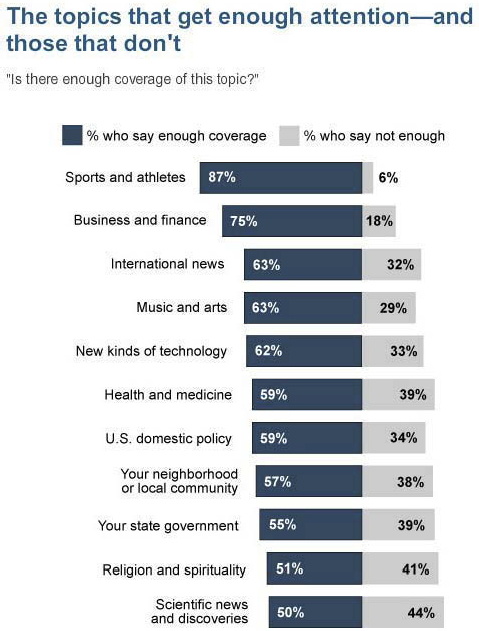
FIGURE 1 Coverage of science news and discoveries. SOURCE: K. Purcell, L. Rainie, A. Mitchell, T. Rosenstiel, and K. Olmstead, Understanding the Participatory News Consumer, Pew Research Center’s Internet & American Life Project, Washington, D.C., March 1, 2010. Courtesy of Pew Research Center’s Internet & American Life Project, Washington, D.C.
McGregor said that people who thought they were not interested in following space missions found that they were fascinated if they could get the information in “tiny updates day by day.”
O’Brien provided data showing that 44 percent of people polled want more coverage of scientific news and discoveries (Figure 1). He believes social media is the way to provide that coverage. He recommended that scientists not think about how to get on the CBS Evening News, but about how to use social media instead: “All of you should be tweeting” and “sharing the enthusiasm of what you all do.”
Kaufman emphasized that the Facebook/Twitter era does not mean the end of books. He believes that people want long as well as short treatments of topics, noting that he just finished writing a book on astrobiology.
Seager read a Facebook message she received from a colleague in Canada who wanted to point out that there have been many new forms of communications in the past century and social media are just the latest, and their full implications are not yet known. Kennel offered his opinion that the social media
revolution probably “has the same degree of importance as the invention of printing.” He added that “we don’t know … how all of that will work out” and NASA and scientists are groping to find out how to use these new ways, but “if we learn to adapt we … will be among the groups that … survive this change in the way we communicate.”
Tips on Connecting with the Public
A recurring theme from the communicators was that the space community has to take the public “along for the ride” on space missions and build that feature into missions from the beginning. O’Brien said “NASA is run by engineers, and there are no mission requirements for public affairs.” That has to change, he said, adding, “It cannot be tacked on” at the end, but must be part of the mission from the beginning—a “clean sheet mission requirement.”
One question, however, was how to keep the public interested in programs that proceed on an incremental basis with sometimes slow progress. Varying points of view were expressed. Pappalardo wondered, “If we find microbes” and not people on Mars, “will the people care?” Steven Benner, distinguished fellow at the Foundation for Applied Molecular Evolution, however, said that he detects no intolerance on the part of the public for the “struggle” and “incrementalism” inherent in science. Kaufman agreed, but cautioned that there is “danger when incremental change is miniscule,” because with a dwindling cadre of science writers, the media may decide that something is no longer a story worth covering. O’Brien initially said that the media does a poor job of covering incremental stories, but amended that later in the workshop by observing that with the new social media, that may change.
Storytelling, narratives, frames, and “people-izing”—making stories more compelling by incorporating the personal stories and enthusiasm of the scientists involved—were all techniques communicators advised would make science communication more effective. Nicholson explained that telling stories is a narrative art, and when they involve human drama “you have a slam dunk almost every time.” Inspiring awe is another method, she added, citing a New York Times article in February 20103 that looked at the most emailed stories and showed they had one thing in common—they all inspired awe, and science can do that, in her view. She also offered that it is important to decide how to frame the issue and gave examples from health communications, where different messages can be framed as a gain or a loss. Messages concerning cancer prevention are communicated quite differently if the goal is to get people to use sunscreen versus getting a mammogram. Scheufele expressed a similar theme, saying that frames, narratives, and terminology are critical aspects of relating to the public. As an example, he noted that, at the time of the economic crisis, the story was about “bank bailouts,” but it quickly changed to “rescues” because while people do not want to bail out a bank, they do want to rescue the economy.
Some of the communicators advised that messages need to be conveyed in a manner that the public can absorb. Lawler said he was struck at how stark a picture Moore painted about the climate change situation. It is “doom and gloom,” Lawler said, a story to which people do not respond well. Using storytelling would be better, he concluded, citing Roger-Maurice Bonnet’s presentation in Session 5 as an example. Bonnet, executive director of the International Space Science Institute in Switzerland, used the ISS as an analogy to Earth in order to get across points such as population limits and the need for certain systems—like a thermal protection system (which for Earth is its atmosphere)—to function correctly for the “crew” to survive.
Such analogies were cited as an effective communication technique and one often used by scientists. Hammel used a Humpty Dumpty analogy in Session 4 for explaining how the theory of solar system creation has completely changed since she defended her dissertation in 1988. Saying that people connect to a story through narratives, Lawler commended Hammel for her skill at telling the story of the solar system as though it was a “living creature.”
________________
3 J. Tierney, “Will you be e-mailing this column? It’s awesome,” February 8, 2010, The New York Times, available at http://www.nytimes.com/2010/02/09/science/09tier.html.
Robinson cautioned, however, that analogies can be misleading. He asserted that space is not like the New World or the Wild West, but more like Antarctica, which he found to be difficult and boring when he was there.
Scientists and communicators also discussed the need for accuracy in reporting about science, although Kaufman said all science stories in publications like his are likely to have factual errors. The discussion included the fact that scientific interpretations may evolve over time, and discovery by its nature means an ever-changing landscape. As to how to communicate that to the public, Benner stressed that it is not the job of scientists or the media to represent science as anything other than what it is—there are wrong answers or sometimes the need for the reinterpretation of data. Scientists “are not better than the average bear” and should not be represented that way, he said.
Kennel suggested that scientists should use the media as intermediaries, but Vernikos strongly disagreed. She said that scientists were excited about what they were doing, and “it’s an energy transfer” when they tell their stories. Bonnet agreed in general, but added that climate scientists did not communicate effectively and could have benefited from taking advantage of professional communicators. Instead, they have opened the door to undue criticisms, in his view.
Scheufele remarked that engaging with the interested public is easy, but the question is how to reach the people who are not inclined, for example, to go to science museums. Fifty percent of highly educated Americans go to museums at least once a year, which means that the other 50 percent never go, he pointed out. For people who only went to high school, attendance is less than 10 percent. Science is not an issue the public cares about, he asserted. He also noted that half of the American public does not know how long it takes Earth to move around the Sun.
What to Avoid
Hammel said astronomers “failed miserably” in explaining to the public why Pluto was demoted from being a planet. She insisted that it was an easy story to tell, and it only takes her 15 minutes to explain it, but astronomers did not think they had to tell it. Lawler agreed, saying that astronomers did not understand that there is “a real emotional tie that people have with planets,” going back to astrology. They are mythical figures and “when you mess with [them], people get upset.” He said that the public felt Pluto was being “knocked off its throne,” and they needed a new story, not just for their old story to be destroyed. Hammel tells that new story, he said.
Kennel cited a colleague who believes the public needs to be better educated so that scientists can communicate with them, but thinks any such effort will fail. He wryly noted that the message from the communicators is that there is a new way to communicate now, but many scientists have not mastered the old way.
Scheufele listed five ways to ensure a communications failure:
• Be reactive instead of proactive; i.e., only start going public after a crisis/event occurs.
• Address only issues and ignore values, emotions, etc., that people bring to the table.
• Assume that science will ultimately prevail.
• Assume that new and social media do not matter as much as traditional media.
• Assume that communication is an art rather than a science.
ASSESSMENTS OF NASA’S PUBLIC AFFAIRS EFFORTS
Kaufman offered an unsolicited compliment that NASA public affairs “is far and away the best one I’ve dealt with,” and while there may be problems with how some information in conveyed, he felt the agency deserved a “shout out” because it is doing a better job than most agencies.
Later, NASA official Alan Ladwig directly asked for feedback on how NASA is doing. Dexter Cole of the Science Channel and Lawler both agreed with Kaufman’s assessment that NASA is better than typical federal agencies. However, Lawler also offered a list of improvements NASA could make both at headquarters and the NASA field centers.
Separately, Billings observed that NASA’s efforts over the decades have focused on branding and marketing, which she concludes is ineffective. “The aim of marketing is to build public support, and what we all are talking about here is … informing people about the work of the science and scientists.” She believes the key to success is public participation, as described above.
IMPLICATIONS OF THE NEW COMMUNICATION ERA AND HOW THE NATIONAL ACADEMIES SHOULD RESPOND
In his remarks at the conclusion of the workshop, SSB chair Kennel commented that the convergence of computing and communications via the Internet and space communications at end of the 20th century has accelerated to this day. That, too, is a product of the science and technology revolution, he said, but because it changes relationships between human beings, it has the potential—combined with science—to produce a second enlightenment in the century we are now entering.
It is that second enlightenment, created by a partnership between science and communication, that will be critically needed to cope with stark problems of climate change and sustainability, Kennel believes. He feels that in the climate change area, the science community’s “honest attempts to communicate” failed. While a failure of communication in inspirational areas of space science may have consequences such as delaying funding, the failure of communication in the climate area “threatens our entire civilization,” he said.
In closing, Kennel voiced a clarion call to the National Academies to adjust to the revolution in communications.
[The] final message … is for our own National Academy. It is the principal social tool by which the United States translates scientific knowledge into the public and policy arena and therefore it cannot neglect the revolution in communications. We have also heard of how venerable media institutions who did not react to this revolution have failed and we have heard how those who did have continued to prosper in the present world because of the importance … of their brand and what they do. I think it is essential for the Academy in the next couple of years—and that is the time scale on which things are occurring—it is necessary for the Academy to adjust to the revolution in communications and the new media.
This doesn’t mean getting a few geeks into the back room and providing equipment to people, it means, like everything else, adjusting the social processes by which science is communicated and the people who work on it. I’m not sure I know how that will be done, but I think I can see the need. I am hoping that as we go forth with our study of the potential for human exploration beyond 2020 that we will be able to stimulate—this is an area where this kind of work is critical—and I hope we will be able to stimulate and help the Academy go through this transition. The one thing that is clear, it draws on the talents of many of the smartest people in the United States and it certainly can do it and I’m sure it will.


