
The NRC Committee on Benchmarking the Technology and Application of Lightweighting was asked to (1) assess the relevance of the definition of lightweighting within the materials community; (2) assess and benchmark the current state of lightweighting implementation in land, sea, and air vehicles, focusing on military applications; and (3) recommend ways in which use of lightweight materials and solutions might be better implemented.
Although the committee found good examples of vehicle lightweighting in all three areas (air, sea, and land), its review of barriers and opportunities indicates that there is still much that can be done. Viewing lightweighting broadly, and at the systems level, may help bring these opportunities to light. In this chapter, the committee describes its view and definition of lightweighting and offers some recommendations for how lightweighting might be better implemented in military vehicles.
The committee believes that lightweighting has been viewed narrowly in terms of both benefits and mechanisms. It adopted a broad view of lightweighting, recognizing it as a means of achieving not only reduced fuel consumption and costs and the associated logistical requirements, but also a variety of other desirable features. The committee defined lightweighting in military systems1 as follows:
Lightweighting is the process of reducing the weight of a product, component, or system for the purpose of enhancing certain attributes, notably (1) performance capability, (2) operational supportability, and (3) survivability.
In the committee’s view, lightweighting should be a means not only of reaping the benefits of improved fuel economy but also of achieving an improved vehicle. The goals of lightweighting can include better performance, in areas such as vehicle speed, maneuverability, payload capacity, and range; easier and less costly operational supportability, encompassing fuel consumption as well as transportability, durability, reliability, maintainability, and repairability; and improved survivability, in forms such as resistance to blast and ballistic threats, tolerance
________________
1 Although this definition also applies to civilian vehicles, the main focus of this report is military vehicles, and so the attributes of interest and the wording used are tailored for military applications.
of damage and environmental conditions, and avoidance of detection. Lightweighting can also confer a further benefit in the form of flexibility and adaptability.
The means of reducing vehicle weight has also been viewed narrowly, as a process of replacing the materials in a system with lighter2 alternatives. Although this is indeed one approach to reducing weight, lightweighting can be achieved in many other ways: for instance, by changing structural shape or tailoring the spatial configuration of dissimilar materials (as is done with fiber composites and sandwich panels) to make the most efficient use of each material.
Most importantly, lightweighting can be achieved at a systems level, which involves considering the potential for lightweighting from the beginning of the design process. For example, creative architectural designs that involve multifunctionality in components or make use of multifunctional materials can emerge when lightweighting approaches are integrated into the engineering of new systems. A systems-level perspective also incorporates considerations such as the availability of new or advanced manufacturing methods that enable the development and processing of new materials and materials combinations, the production of shaped parts from the materials, and the reduction of manufacturing defects (which improves durability and service life).
System engineering design could support the use of more aggressive design strategies to optimize structure and function, based on (1) optimization of system design and topology using available or new technologies and components, (2) improved understanding of response and failure mechanisms of materials, (3) improved associated physics-based computational models, and (4) improved associated tools for prediction of product performance and life.
The committee notes that strategic, national-level concerns can be addressed in part by lightweighting, or can seriously impede lightweighting. The committee identified three of these concerns as having particular strategic importance: (1) the protracted time required to develop and field military vehicles; (2) unsustainable energy use, which has implications for both military operations and long-term national security and economic prosperity; and (3) the declining domestic capability for manufacturing, which threatens the ability to achieve lightweighting. The committee notes that programs to support the manufacturing capabilities needed to produce lightweighting technologies could also constitute part of a national strategy to rebuild cutting-edge manufacturing capabilities in the United States. Table 6-1 illustrates the relationship between these national-level concerns and the committee’s definition of lightweighting.
Below, the committee offers five recommendations for improving the implementation of lightweighting in military (and civilian) vehicles. They reflect the committee’s broad view of lightweighting and what it can accomplish. The connections between the three national concerns outlined above and these five recommendations are shown in Figure 6-1.
6.2 DIGITAL DESIGN TOOLS FOR SYSTEMS ENGINEERING
Finding 1: One consequence of lengthy acquisition processes is that changes in threats and operational requirements in areas of conflict can outpace the development of new military vehicles and vehicle technologies. The ability to keep up with evolving requirements could be improved by both reducing the time required for development and improving the capability to design flexibility and adaptability into vehicle systems. Both goals require increased capability in digital design, especially for the integration of materials and design configurations. Such capability could significantly improve the effectiveness of current systems engineering processes.
________________
2 “Light” and “lightweight” as used in this report denote materials having high specific properties (e.g., high specific strength, defined as strength divided by density) or, more generally, high specific performance. Historically lightweighting has been achieved by focusing on lower-density materials with high property values (e.g., composites). However the converse is equally viable—using traditional-density materials with enhanced property values, which then allow reduced total weight via reduced cross sections.
TABLE 6-1 Relationship Between National Concerns and the Committee’s Definition of Lightweighting
|
|
||
| National Concerns | Vehicle Characteristics That Can Be Enhanced by Lightweighting |
Connection |
|
|
||
| Protracted time to develop and field new military vehicles |
Performance Survivability |
The long time periods required to develop new vehicles as well as new materials prevent both (1) responses to evolving threats, which may require new or better performance and survivability, and (2) the rapid integration of new materials, technologies, and designs that could provide these improvements. |
| Energy use | Operational supportability | Energy use in military vehicles is unsustainable. Lower fuel use means reduced energy costs and less exposure to risk associated with supplying fuel to deployed forces. Reduced dependence on petroleum fuels reduces concerns about national energy security and about economic stability. |
| Declining domestic capability for manufacturing |
Performance Survivability |
Lack of domestic capability to produce new materials and the parts made from them hinders the U.S. ability to realize the full benefits of lightweighting. Increasing this capability would help to improve the national manufacturing picture. |
|
|
||
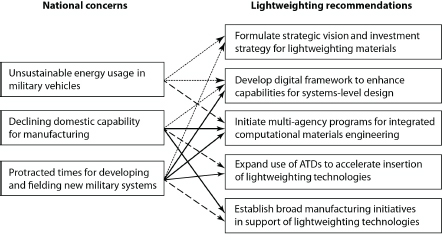
Weight of line indicates strength of connection
FIGURE 6-1 National concerns and associated lightweighting recommendations.
Recommendation 1:3 The DoD should initiate a program to develop and integrate high-fidelity models of materials, processes, and performance into a comprehensive digital system-design process for future air, maritime, and land vehicles. Although many individual models exist or are being developed, these models often are not integrated, and the focus of a larger organization such as the DoD is required to facilitate coordination.
________________
3 During the course of this study, the Obama Administration announced the new Materials Genome Initiative, which addresses many of these needs. See Box 6-1.
Box 6-1
The Materials Genome Initiative
During the course of this study, President Obama announced a 10-year initiative, the Materials Genome Initiative, a “new, multistakeholder effort to develop an infrastructure to accelerate advanced materials discovery and deployment in the United States.”1 This ambitious initiative is expected to significantly advance integrated computational materials engineering (ICME) tool development and provide the mate-rials innovation infrastructure that this committee believes is needed as well as develop the work force. Development of ICME capabilities aimed at materials problems of pressing national importance is explicitly included in this initiative.
The committee's recommendations 1, 2a, and 2b could be addressed by making the development of models and ICME tools needed for lightweight materials and lightweight vehicle design a prominent activity within this initiative. Such capabilities would have obvious dual uses within the commercial vehicle sector.
________________
10ffice of Science and Technology Policy. 2011. “Materials Genome Initiative for Global Competitiveness.” June. Available at http://www.whitehouse.gov/sites/default/files/microsites/ostp/materials_genome_initiative-final.pdf.
This process would have numerous benefits, including:
- Significant reduction in the time required to implement new lightweighting solutions;
- Reduction in the extent of manufacturing and testing required to critically assess new designs;
- Reduction in acquisition costs;
- A more rapid response to changing threat environments and vulnerabilities of military systems;
- A more comprehensive assessment of the tradeoffs among attributes related to weight and system performance;
- Accelerated insertion of new materials into military systems, potentially bringing into closer alignment the timing of the materials development cycle and the timing of product development; and
- Reduction in the risk and cost of advanced technology demonstration (ATD) projects.
Finding 2: In addition to the models themselves, a framework for their effective integration into the vehicle design environment is required. An important element of this framework is integrated computational materials engineering (ICME), a strategy that extends from materials design through structural design in an integrated fashion, thereby including the ability to design new materials as part of achieving optimal structural performance. In the committee’s judgment, ICME tools and methods offer the greatest opportunity to accelerate the development and validation of new materials and processes for lightweighting, which would bring the current lengthy development cycle for these new materials and processes more into line with the generally much shorter design cycles for vehicles and products. Although numerous programs and specific applications have demonstrated the feasibility and benefits of ICME, broad development and implementation will require comprehensive, sustained effort and investment, along with coordinated actions among numerous stakeholders, to have a significant effect on future components, vehicles, and systems.
Recommendation 2a:4 The DoD should expand its leadership role as a champion of ICME. It should develop and lead a comprehensive, sustained, multi-agency ICME program, with some specific focus on lightweighting materials and technologies. The program should:
________________
4 During the course of this study, the Obama Administration announced the new Materials Genome Initiative, which addresses many of these needs. See Box 6-1.
- Identify and support foundational engineering problems5 that specifically address lightweighting for air, maritime, and land applications;
- Foster the development and stewardship of national curated knowledge repositories relevant to lightweighting materials;
- Coordinate with other stakeholders in the training and education of an ICME workforce; and
- Support the development of a suite of predictive tools for materials manufacturing, sustainment, and maintenance. These should address processes, performance, and properties and should include physics-based materials models of behavior under extreme loading conditions.
To accelerate development and broaden the research base required for development of ICME tools, the committee recommends that the definition of DoD basic research be broadened to include development of the fundamental building blocks of ICME and materials design, as distinct from materials discovery.
The DoD and industry have invested in materials model development for many years, and several programs have successfully demonstrated the feasibility of developing and integrating selected materials, processing, and microstructure-property models with an overall benefit to component design and development for the selected cases.6
What has not yet occurred is the broad, systematic development and implementation of ICME across industry and government. The committee believes that such broad development and implementation would be enabled, especially for lightweighting materials technologies, by an initiative supporting these general areas:
- Physics and materials-science-based model development;
- Sponsorship of selected foundational engineering problems targeting specific material classes and applications (such as lightweight composite materials and structures), with an emphasis on integration of analytical tools;
- Development and implementation of comprehensive national databases for support of ICME development; and
- Guidelines and processes for verification and validation of ICME tools and for determination of their maturity. This is essential if such tools are to be integrated at a systems level with design, structural analyses, life (or durability) prediction, and determination of key attributes such as ballistic performance.
Development of linked models for ICME is needed for all materials. Approaches are developing, albeit slowly, for materials and structures used in commercial vehicles. A problem unique to military vehicles, however, is that they are required to operate and survive under extreme loading conditions. In this context, there appears to be a particularly acute need for new physics-based models to predict the behavior of materials under extreme loading conditions: principally under dynamic loadings (including the domain of high-strain-rate loading and shocks), but also at elevated temperature and in the presence of corrosive/oxidative environments flowing at high velocities such as those present in turbine engines. Numerical simulation tools (based, for example, on finite element methods) need to be extended beyond the existing commercial codes in order to properly account for the pertinent fracture phenomena and the corresponding length scales that characterize the fracture processes. The latter include extended or augmented finite element methods as well as particle-based computational methods. These methods are required for representation of phenomena such as damage-evolution, fragmentation, and comminution of materials under dynamic loading conditions. They could also be used to better understand complex fluid-structure interactions that occur, for example, when a buried explosive is detonated and the resulting shock wave and soil ejecta impact a ground vehicle. Such models would then enable substantially improved capability to design lightweighting into the vehicle while concurrently optimizing for survivability.
________________
5 NRC. 2008. Integrated Computational Materials Engineering: A Transformational Discipline for Improved Competitiveness and National Security. Washington, D.C.: The National Academies Press. Available at http://www.nap.edu/catalog.php?record_id=12199.
6 Leo Christodolou, DARPA, “Accelerated Insertion of Materials,” presentation by to the NRC Committee on Integrated Computational Materials Engineering, November 20, 2006. Available at http://www7.nationalacademies.org/nmab/CICME_Mtg_Presentations.html.
Recommendation 2b:7 The DoD should foster the development, maturation, and advancement of physics-based materials models as well as numerical simulation tools and codes.
6.3 TRANSITION OF LIGHTWEIGHTING TECHNOLOGY VIA ADVANCED
TECHNOLOGY DEMONSTRATION PROGRAMS
Finding 3: Advanced technology demonstration (ATD) programs have, in numerous instances, proven to be successful in introducing breakthrough technologies into DoD platforms.
In contrast to the rigorous risk-reduction approaches taken for major engineering system development and certification, which require that new technologies be relatively mature at the time that critical system architecture decisions are made, ATDs allow for more aggressive pursuit of higher-risk, higher-payoff technologies with significantly reduced requirements for testing, validation, and certification. With the appropriate technical vision and management, ATDs could be equally effective in accelerating the implementation of lightweighting technologies.
There is increased risk involved in fielding ATD systems that have undergone less stringent testing and validation. But the risk can be mitigated in part by ensuring that all systems-level requirements are introduced and properly addressed early in the development of the new technology. Good management of a gated process is needed to ensure a continuing focus on system requirements and the military’s operational capabilities. Advanced concept technology demonstrations (ACTDs) offer a proving ground for advanced concepts that may provide an opportunity to incorporate ICME tools and methods.
Recommendation 3: The DoD should expand the use of ATDs to implement lightweighting technologies rapidly in air, maritime, and land demonstration platforms. To improve the transition value of ATDs for lightweighting, it is important that the DoD incorporate all system and operational requirements into projects, so that lightweighting technologies can be fully optimized from the outset.
The committee proposes the following guiding principles for developing effective lightweighting ATD projects:
- Include material suppliers, manufacturers and end users as part of preliminary design integrated project teams.
- Develop a path to qualification, even if the technology does not actually undergo qualification. Address the overall requirements of the target platform in order to increase the likelihood of technology transition.
- Draw on technologies developed in the private/commercial sectors in which performance is at a premium (such as auto or boat racing).
- Reassess existing prescriptive requirements for legacy systems that may appear overly onerous and may preclude technology development and transition.
- Maintain sufficient flexibility in initial ATD design to accommodate improvements as the technology is being evaluated.
- Establish up-front the lightweighting targets and performance metrics as well as allowable cost premiums.
- Identify clear pathways for producing, fielding, and maintaining the technologies.
- To facilitate incorporation of lightweight materials and lightweight design early in the ATD process, incorporate available ICME tools into ATD projects during design, development, validation, and demonstration. Where such tools are lacking, their development should be conducted in parallel with the ATD.
The DoD may also wish to consider using ACTDs as a proving ground for using ICME tools and methods in the development of advanced technologies and concepts.
________________
7 During the course of this study, the Obama Administration announced the new Materials Genome Initiative, which addresses many of these needs. See Box 6-1.
6.4 A DOD-WIDE INITIATIVE ON AFFORDABLE MANUFACTURING
TECHNOLOGY TO FACILITATE LIGHTWEIGHTING
Finding 4: The cost of fielding military systems that incorporate lightweighting solutions is high in part because production volumes are low and performance requirements are highly exacting. The focus on reducing acquisition costs has resulted in increased reliance on foreign technology sources,8 thus eroding U.S. strategic manufacturing advantages. The problems are exacerbated by the lack of parallel commercial markets that could significantly reduce the costs of technology development and make initial investments more attractive.
One consequence has been a continuing cycle of “boom-to-bust” for defense contractors. The aerospace industry has been somewhat successful in this regard, since lightweighting is almost equally important in commercial and military aircraft. In contrast, for ground vehicles (especially their protection systems), there are few parallel commercial markets. The military ship industry also lacks close commercial parallels. Notable exceptions include the Navy’s joint high-speed vessel and the Lockheed Martin littoral combat ship, both derivatives of fast-ferry designs developed overseas.
The economic viability of fast ferries is extremely weight-sensitive. If a viable, national high-speed ferry network were to develop, it would have the potential to foster a domestic, competitive capability for manufacturing lightweight ships.
Recommendation 4a:9 The DoD should establish broad manufacturing initiatives—using the ManTech program framework as a model—that encompass a variety of lightweighting strategies, materials, and technologies, with the goal of achieving quantum improvements in performance, affordability, sustainability, and reliability.
The manufacturing challenges to be addressed include joining technology, parts consolidation and miniaturization, tool-less fabrication of low-volume production parts (using, for example, rapid prototyping/additive manufacturing and direct-material deposition technologies), improved non-destructive evaluation methods, and virtual process modeling. The manufacturing technologies to be covered should include those needed for advanced materials that have been developed but are not yet used by the DoD or in the private sector. Consideration must also be given to enhancing domestic sources that produce structural commodities in product form (for example, plates, fibers, and resins) from raw materials.
Recommendation 4b:10 In concert with other government agencies, the DoD should explore the merits and requirements of parallel commercial markets that could reduce the development and acquisition costs of military vehicles as well as accelerate the availability and use of lightweighting materials and technologies.
6.5 A STRATEGIC VISION FOR MATERIALS CRITICAL TO LIGHTWEIGHTING
Finding 5: The committee believes that there remains insufficient high-level DoD awareness of and strategic vision for ensuring sustained domestic supplies of materials that are essential to the realization of effective lightweighting and would facilitate revolutionary advances in military systems. Although there is growing recognition of the importance of individual metals and rare-earth elements, the domestic availability, supply, sustainment, maintenance, and manufacturing of lightweighting-enabling materials, such as high-performance SiC fibers,
________________
8 “DOD Undertakes Crash Study on Defense Industrial Base,” Manufacturing & Technology News, May 31, 2011, Vol. 18, No. 9, pp. 1-2; “DOD Industrial Policy Shop Adds Manufacturing to Its Mission,” Manufacturing & Technology News, April 29, 2011, Vol. 18, No. 7, p. 7; “Rising Labor Costs in China Are Still 96% Lower Than Those in the US,” Manufacturing & Technology News, April 15, 2011, Vol. 18, No. 6, pp. 3-4.
9 During the course of this study, the Obama Administration announced the new Advanced Manufacturing Partnership, which could address many of these points. See Box 6-2.
10 During the course of this study, the Obama Administration announced the new Advanced Manufacturing Partnership, which could address many of these points. See Box 6-2.
Box 6-2
The Advanced Manufacturing Partnership
During the course of this study, President Obama announced the Advanced Manufacturing Partnership, “a national effort bringing together industry, universities, and the federal government to invest in the emerging technologies that will create high quality manufacturing jobs and enhance our global competitiveness.”1 The partnership implements the recommendations of a report from the President’s Council of Advisors on Science and Technology (PCAST), which calls for "a partnership between government, industry, and academia to identify the most pressing challenges and transformative opportunities to improve the technologies, processes and products across multiple manufacturing industries.”2
Some or all of the present committee's recommendations 4a and 4b could be addressed within the context of this partnership.
________________
1White House. 2011. “President Obama Launches Advanced Manufacturing Partnership.” Press Release. Available at http://www.whitehouse.gov/the-press-office/2011/06/24/president-obama-launches-advanced-manufacturing-partnership.
2Office of Science and Technology Policy. 2011. Report to the President on Ensuring American Leadership in Advanced Manufacturing. June. Available at http://www.whitehouse.gov/sites/default/files/microsites/ostp/pcast-advanced-manufacturing-june2011.pdf.
thick-section magnesium, and polyethylene fibers, must become targeted priorities of the DoD for lightweighting to become widespread.
One existing program, the Defense Production Act Title III program, includes a number of materials projects relevant to lightweighting, such as production of SiC powder for ceramic armor, low-cost titanium, and continuous-filament boron fiber, but does not include some of the materials and manufacturing processes that the committee believes would have the greatest impact on lightweighting.
Recommendation 5: In cooperation with other agencies, the DoD should establish a federal investment strategy that (a) determines which structural materials are most important to future lightweighting and (b) establishes the resources to ensure continuous development of these materials and their associated manufacturing processes.
As part of this holistic approach, the existing Title III program should be expanded to include a larger number of materials critical to lightweighting of military aircraft, vessels, and vehicles. In expanding the program, the DoD should recognize the need for the long-term, continuous development of these materials and of the manufacturing techniques and capacity needed to produce them.
Although many elements, such as titanium and magnesium, are readily available in Earth’s crust, the high cost of their extraction, reduction, and processing restricts their widespread use, even when their properties are highly favorable for lightweighting. Advanced materials, such as SiC and C fibers, that would facilitate high-performance structural applications are not available in sufficiently large quantities domestically to be used in DoD platforms, despite their being synthesized in the laboratory. There is also a lack of domestic manufacturing infrastructure to fabricate the primary metal alloys or the intermediate engineering forms (sheet, plate, bar, and so on) and to manufacture final, shaped products. This lack of infrastructure affects the use of lightweighting materials in both the defense and civilian sectors. For instance, although there is a military specification for the use of thick-section magnesium alloy (AZ31) in ballistic armor applications, it is not used in existing platforms both because of its high costs and because there are currently insufficient sources of the alloy to be used for armor applications. Similarly, while engine manufacturers have identified SiC fibers as essential for future CMC applications, these fibers are
manufactured in significant quantities only in Japan and are permitted for use only in restricted (non-weapon) applications by the U.S. government and U.S. industries.
In assessing the status of lightweighting in air, sea, and land vehicles, the committee found that there are good examples of lightweighting implementation in military vehicles. However, many opportunities still exist to take fuller advantage of this strategy. The committee notes that viewing lightweighting in a much broader sense than has traditionally been the case could help bring those opportunities to light.
The recommendations outlined above could help the DoD to capitalize on these opportunities. The committee notes that, because the recommendations address issues of broad national interest, they could have far-reaching benefits for the nation’s energy use, balance of trade, and jobs.


