
2
Outcomes and Risks Associated with Investments in Maintenance and Repair
Buildings, structures, and infrastructure pass through a number of stages during their lifetimes: planning, design, construction, operations and maintenance, renewal and revitalization, and disposal (Figure 2.1). The total cost of ownership of facilities is the total of all expenditures that an owner will make over all of those phases (NRC, 2008).
However, the amounts and distributions of those expenditures are not equal. Design and construction which require large capital expenditures but will typically last fewer than 5 years account for 5 to 10 percent of the total cost of ownership. In contrast, the operations and maintenance of facilities will require annual expenditures for 30 or more years and will account for as much as 80 percent of the total cost of ownership (NRC, 1998).
Buildings, structures, and infrastructure are composed of many separate but interrelated systems, including roofs, walls, windows, doors, cladding mate rials, foundations, mechanical, electrical, plumbing, heating, cooling, ventilation, communications, control systems, information technologies, security, fire, and safety. Each type of system is composed of individual components (such as valves, switches, coils, drainage pans, and materials), all of which must be kept in good working order if facilities are to perform as they were designed to do. A facility’s overall performance is a function of the interactions of those systems and components, of interactions with the occupants, of the original design, and of operations and maintenance procedures.
How long facilities’ systems and components actually perform at a satisfactory level (service lives) depends on many factors, including the quality of the original design, the durability of materials, the incorporated technology, location and climate, use and intensity of use, and the amount and timing of investment in
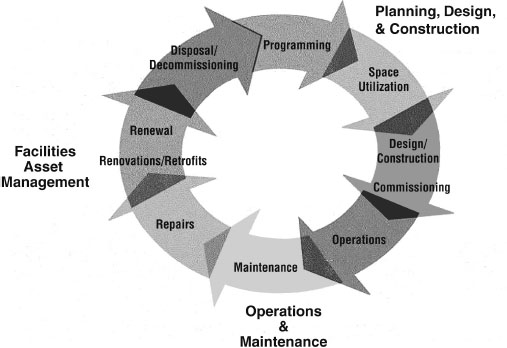
FIGURE 2.1 Facilities life-cycle model. SOURCE: NRC, 2008.
maintenance and repair activities. The service lives of systems and components can be optimized or at least improved by timely and adequate maintenance and repairs. Conversely, when maintenance and repair investments are not made when they are needed, the service lives of systems and components will be shortened (Figure 2.2).
TYPICAL OUTCOMES OF INVESTMENTS IN MAINTENANCE AND REPAIR
A typical maintenance and repair program includes several types of activities that address different aspects or components of facilities’ systems and have different objectives and outcomes. Maintenance is typically a continuous activity that addresses routine work that is accomplished on a recurring basis and includes some minor repairs. More important and often more expensive repair requirements are typically identified as separate projects. When federal facilities managers identify specific maintenance and repair requirements in funding requests, the funding for maintenance activities is typically presented as one lump sum and individual repair projects above some dollar threshold are identified separately. Projects that are identified as required but not funded make up the bulk of the backlog of deferred maintenance and repair projects.
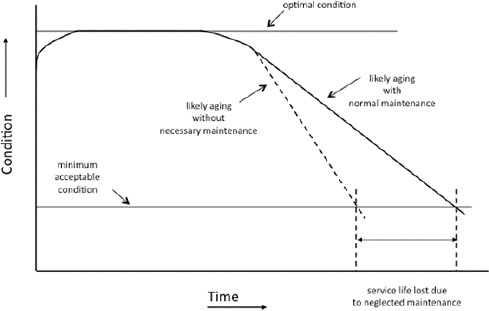
FIGURE 2.2 Effect of adequate and timely maintenance and repairs on the service life of a facility. SOURCE: NRC, 1993, 1998.
Maintenance and repair activities include the following (FFC, 1996):
• Preventive maintenance, which includes planned, scheduled, periodic inspection, adjustment, cleaning, lubrication, parts replacement, and minor repair of equipment and systems.
• Programmed major maintenance, which includes maintenance tasks whose cycle exceeds 1 year (such as painting, roof maintenance, road and parking lot maintenance, and utility system maintenance).
• Predictive testing and inspection activities that involve the use of technologies to monitor the condition of systems and equipment and to predict their failure.
• Routine repairs to restore a system or piece of equipment to its original capacity, efficiency, or capability.
• Emergency service calls or requests for system or equipment repairs that— unlike preventive maintenance work—are unscheduled and unanticipated.
All of these activities and projects are intended to do one or more of the following:
• Prevent a situation, breakdown, or failure that could result in unplanned outages and downtime that disrupt the delivery of programs or operations
undertaken in support of organizational missions or that could result in the loss of life, property, artifacts, or research.
• Comply with legal regulations for safety and health.
• Extend the service life of building systems and components.
• Upgrade the condition of building systems and components to bring them back to original operating performance.
• Avoid higher future costs through timely investment and efficient operations.
• Respond to stakeholder requests.
Because of the interrelated nature of the systems and components embedded in facilities, maintenance or repair of one system or component can result in improvements in others. For that reason, investments in maintenance and repair can result in multiple outcomes that achieve several purposes. Maintenance and repairs that reduce energy and water use, for example, will also lower operating costs and provide for more efficient operations.
The beneficial outcomes that can result from maintenance and repair investments are shown in Table 2.1 and described below. They are grouped by their primary purposes in recognition that an outcome can be related to more than one purpose.
TABLE 2.1 beneficial Outcomes Related to Investments in Maintenance and Repair
| Mission-Related Outcomes | Compliance-Related Outcomes | Condition-Related Outcomes | Efficient Operations | Stakeholder-Driven Outcomes |
| Improved reliability Improved productivity Functionality Efficient space utilization |
Fewer accidents and injuries Fewer building-related illnesses Fewer insurance claims, lawsuits, and regulatory violations |
Improved condition Reduced backlog of deferred maintenance and repairs |
Less reactive, unplanned maintenance and repair Lower operating costs Lower life-cycle costs Cost avoidance Reduced energy use Reduced water use Reduced greenhouse gas emissions |
Customer satisfaction Improved public image |
Mission-Related Outcomes
Improved Reliability. Federal agencies require reliable supplies of power, heating, ventilation, air-conditioning, water, and other services to conduct their programs and achieve their missions. In such facilities as hospitals, research laboratories, museums, and military headquarters, those services are required 24 hours per day, 365 days per year to keep people safe and comfortable, to power equipment and computers, to ensure the integrity of research experiments, and to provide the constant temperature and humidity needed to protect cultural and historical artifacts, and works of art. Maintenance and repair activities are undertaken to ensure that mechanical, electrical, heating, ventilation, air-conditioning, and other systems are reliable and can perform without substantial interruptions, so that agencies can operate continuously on a routine basis, and during and after military operations, natural disasters, or manmade crises.
Improved Productivity. Maintenance and repair activities that support reliability also support improved productivity. Productivity for an individual or an organization has been defined as the quantity and/or the quality of the product or service delivered (Boyce et al., 2003). Productivity is most easily measured in manufacturing or similar functions where some number of units (such as cars or computer chips) with a given value can be expected to be produced per hour. If production goals fail to be met because of equipment or mechanical downtime, it is relatively easy to assign a dollar value to the effect. For example, the number of units that are not produced because of downtime can be multiplied by the sales value or the profit margin to arrive at a dollar value of lost productivity.
Productivity is less easily quantified for people engaged in administrative tasks, research, policy development, or many other tasks performed by federal employees, although it can be done in some situations. For example, the U.S. Patent and Trademark Office measures productivity by the number of patent applications reviewed per week (Campbell, 2011).
Functionality. Functionality is an assessment of how well a facility functions in support of an organizational mission. It also addresses a facility’s capacity to meet the needs of occupants to navigate space and carry out activities (NIBS, 2008). Functionality loss, which is independent of condition, results from technical obsolescence, changes in user requirements, and changes in laws, regulations and policies. Thus, a facility can be in good condition but inadequate for its function. For example, a laboratory built in the 1970s may be well-maintained but still be technologically obsolete in light of today’s research practices. Similarly, a facility that is in an earthquake zone but does not meet current seismic standards will be obsolete with regard to safety. Obsolete facilities that are in use not only fail to support organizational missions adequately, but siphon off resources for maintenance and repair. In some cases, it is more cost-effective to demolish an obsolete facility and replace it with one that is state-of-the-art, than to renovate and continue to operate it (NRC, 1993).
efficient Space Utilization. The amount and type of space required by an agency to support its programs can be affected by changing missions, by such new work practices as telework, and by changing space standards. Vacant space or under used capacity within an occupied facility requires operating and maintenance resources as though the facility was fully utilized and siphons off the resources available for maintenance and repair activities of mission-critical facilities. efficient use of space, in contrast, supports more cost-effective investment practices for maintenance and repair.
Compliance-Related Outcomes
Federal agencies, like other organizations, must comply with an array of safety and health regulations or face penalties for not doing so. Those regulations are intended to protect the health, safety, and welfare of workers and the public. They include regulations related to accessibility for people who have disabilities, potable water quality, occupational safety and health, and life-safety codes for fire suppression. Maintenance and repair activities that are undertaken to comply with regulatory standards include the replacement of obsolete, worn out or leaking plumbing components to bring them up to current standards and codes, the installation or modification of equipment to support accessibility for workers and members of the public who have disabilities, and preventive maintenance and testing of fire suppression and other life-safety systems.
Fewer Accidents and Injuries. Maintenance and repair investments are made to protect the safety of building occupants and visitors by eliminating hazards that can lead to accidents and injuries. Inadequate or dim lighting in buildings and stairways, torn carpeting and other hazards, can cause slips, trips, and falls that result in work-related injuries. Quality of lighting is also a factor in providing security and crime prevention in the workplace. Projects to upgrade floor coverings and provide slip-retardant surfaces or to provide better lighting can prevent accidents and injuries for workers and the visiting public. Projects to bring facilities up to current seismic codes can reduce the loss of life and property and reduce injuries if an earthquake occurs.
Fewer Building-Related Illnesses. The quality of indoor environments— concentrations of indoor contaminants such as chemicals and bioaerosols, temperature and humidity, lighting, ventilation, and noise levels—can influence a person’s health, comfort, and ability to perform his or her job productively. Building-related illnesses and symptoms are substantially preventable through timely intervention to limit or eliminate exposure to causal agents, appropriate building design and construction, and good maintenance, operations, and cleaning practices (FFC, 2005). Maintenance and repair activities that can help to prevent building-related illnesses include the prevention of water intrusion that can result in indoor dampness and mold, regular replacement of filters in equipment, cleaning of coil drainage pans, and removal or encapsulation of asbestos.
Fewer Insurance Claims, Lawsuits, and Regulatory Violations. Preventing building-related accidents, injuries and illnesses, and complying with regulations can also result in fewer insurance claims and lawsuits, and fewer violations of health and safety regulations, and all their associated costs.
Condition-Related Outcomes
Improved Condition. Condition refers to the state of a facility with regard to appearance, quality, and performance. Investments to improve the condition of facilities, particularly in respect to the efficient performance of systems and components, often result in multiple beneficial outcomes.
Reduced Backlogs of Deferred Maintenance and Repair. This is an amount, expressed in terms of dollars, of the total deferred maintenance and repair work necessary to bring facilities back to their original designed performance capability, including updates required to meet current building and life-safety codes.
The importance of the existence of deferred maintenance is that it “implies that the quality and/or reliability of service provided by infrastructure on which maintenance has been deferred is lower than it should be, and thus the infrastructure is not or will not later be adequately servicing the public” (Urban Institute, 1994, p. 1). Another report found that “in the short-term deferring maintenance will diminish the quality of building services. In the long-term, deferred maintenance can lead to shortened building life and reduced asset value” (APWA, 1992, p. 1). As noted in Chapter 1, increasing backlogs of maintenance and repair projects create a fiscal exposure for the government which, in turn, affects the government’s fiscal soundness.
Outcomes Related to efficient Operations
Less Reactive, Unplanned Maintenance and Repair. A facilities management organization is more efficient when maintenance and repair activities are planned and scheduled not only to prolong the service lives of existing components and equipment but to replace them before a breakdown results in adverse events. Manpower is wasted when a large percentage of staff time is spent in reacting to unexpected breakdowns and through lack of planning that fails to incorporate potential efficiencies.
Lower Operating Costs. Operating costs include such elements as energy and water use, custodial services, security, fire suppression and detection, alarm testing and servicing, and grounds care. Timely maintenance and repair investments to ensure that heating, ventilation, and air-conditioning (HVAC) systems are operating properly can reduce energy use and costs and improve indoor environmental quality. Similarly, efficient plumbing systems can reduce the use and costs of water, and efficient fire systems can reduce false alarms, testing costs, and lost productivity due to unnecessary building evacuations.
Lower Life-Cycle Costs. In some cases, a modest investment in maintenance and repair can result in longer-term cost savings or extended service life. For example, replacement of a low-efficiency heat pump could pay for itself in a few years through savings in energy costs. Similarly, regular floodcoating of roofs could extend their service lives and delay the need to invest in replacement roofs.
Cost Avoidance. Cost avoidance results from making investments in the near term that avoid making larger investments later—a key objective of preventive maintenance activities. Examples include lubricating equipment components to avoid replacing the entire system, fixing minor roof leaks to avoid total roof replacement, applying protective coatings to avoid replacing the siding on a building or to avoid replacing equipment because of corrosion, and realigning equipment periodically to avoid shortening of service life due to wear and tear. Timely maintenance and repair can also avoid the need to keep large inventories of spare parts on hand and avoid unplanned service calls.
Reductions in Energy Use, Water Use, and in Greenhouse Gas Emissions.Maintenance and repair activities—such as replacement of malfunctioning cooling systems, replacement of lighting-system components with more efficient ones, and replacement of worn out roofs with “cool” roofs1—can result in reductions in energy use, water use, and greenhouse gas emissions. These actions often can help agencies to meet various mandates for high-performance facilities and related public policy objectives.
Stakeholder-Driven Outcomes
Stakeholders in maintenance and repair investments include not only facility managers, users, and tenants, but also the OMB, which is responsible for investment oversight; Congress; the administration; and the public. Each group of stakeholders has different expectations for the outcomes that should be achieved through investments in maintenance and repair of federal facilities (Figure 2.3).
Customer Satisfaction. Customer satisfaction as used in this report is an outcome related to the quality of services provided to facilities’ users and tenants. Continuous and efficient operations of systems helps to create productive, safe, and healthy indoor environments. Conversely, failure of systems causes work disruptions, and inefficient operations or poor maintenance may result in poor indoor air quality and other adverse effects. Customer service calls related to temperature (too hot or too cold), humidity levels, moisture intrusion, air quality (odors), lack of ventilation, and water quality (tastes bad) can indicate that systems are not operating properly and require maintenance, repair, or replacement.
Improved Public Image. The appearance and upkeep of federal buildings can create a favorable or unfavorable impression for all stakeholders. Maintaining

1Cool roofs include white roofs, which stay cooler in the sun by reflecting incident sunlight back into space, and green (vegetative) roofs, which absorb rainwater and then cool by evapotranspiration.
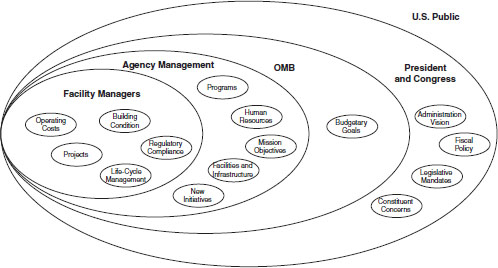
FIGURE 2.3 Stakeholders in federal facilities investments. SOURCE: NRC, 2004a.
the physical appearance and user accessibility of such iconic buildings as the U.S. Capitol, the White House, and the Washington Monument, is important for the national image of the United States in the eyes of its citizens and visitors. The upkeep and appearance of national park facilities, national museums, archives, and other facilities regularly visited by the public are important for visitors’ experience and for their perception of how wisely tax money is being spent.
RISKS POSED BY DETERIORATING FACILITIES
The beneficial outcomes that can result from maintenance and repair investments are related not only to the total resources invested, but to how those resources are invested. Because the demands for resources for all federal programs will exceed available resources in coming years, priorities will need to be established for investments, and tradeoffs will need to be made. Risk assessment is an important tool for decision-making in a resource-constrained operating environment.
Risk-assessment processes have been used by federal, state, and local government agencies, by industry, and by academia for many years and for many applications. Organizations typically use risk assessment to inform themselves and the public about hazards presented by food, drugs, toys, air and water quality, and terrorism, and about the different actions or policy options that are available to manage the risks (NRC, 2009).
The essence of risk assessment as applied to facilities and building system components is captured by the three questions posed originally for risk assessment of nuclear reactors by Kaplan and Garrick (1981):
1. What can go wrong?
2. What are the chances that something with serious consequences will go wrong?
3. What are the consequences if something does go wrong?
The equivalent questions for risk management were posed later by Haimes (1991):
4. What can be done and what options are available?
5. What are the associated tradeoffs in terms of all costs, benefits, and risks?
6. What are the impacts of current management decisions on future options?
More recently, Greenberg (2009) framed the risk management questions, as follows:
4. How can the consequences be prevented or reduced?
5. How can recovery be enhanced if the scenario occurs?
6. How can key local officials, expert staff, and the public be informed to reduce concern and increase trust and confidence?
Just as maintenance and repair investments can result in an array of beneficial outcomes, the lack of investment and the deferral of needed maintenance and repair projects can result in adverse events (what can go wrong). Adverse events include more interruptions or stoppages of operations, more accidents, injuries, and illnesses, more lawsuits and insurance claims, increased operating costs, shortened service lives of equipment and components, failure to meet public policy objectives, and damage to the federal government’s public image.
Risk—a measure of the probability and severity of adverse effects—will increase as federal facilities, building systems, and components continue to deteriorate through wear and tear and lack of investment. (The likelihood of an event occurring and of its consequences is also related to geography, climate, and other factors.) The risks associated with deteriorating facilities and systems identified by the committee are the following:
• Risk to federal agencies’ missions. The risks related to lack of reliability including unplanned interruptions and downtime of facilities’ systems and components; related to the diversion of resources to excess, obsolete, and underutilized facilities; and related to lowered productivity.
• Risk to safe, healthy, and secure workplaces. The risks related to increased injuries, illnesses, or even deaths involving federal personnel, contractor personnel, and the public; related to more lawsuits and claims resulting from facilities-related hazards; related to poor indoor environmental quality; and related to failure to comply with regulations.
• Risk to the government’s fiscal soundness and public image. The risks related to the ownership of excess, underutilized, and deteriorating buildings; related to growing backlogs of deferred maintenance and repair projects; and related to higher operating and life-cycle costs.
• Risk to efficient operations. The risks related to underperforming facilities that drive up agency operating costs; related to customer dissatisfaction; and related to practices that fail to result in cost avoidances and other operational efficiencies.
• Risk to achieving public policy objectives. The risks related to the excessive use of energy, water, and other natural resources and to the production of greenhouse gas emissions.


