




Below is the uncorrected machine-read text of this chapter, intended to provide our own search engines and external engines with highly rich, chapter-representative searchable text of each book. Because it is UNCORRECTED material, please consider the following text as a useful but insufficient proxy for the authoritative book pages.
PREPUBLICATION COPY: UNCORRECTED PROOF D SELECTED BIBLIOGRAPHY Ainsworth, E. A., A. D. B. Leakey, D. R. Ort, and S. P. Long. 2008. FACE-ing the facts: inconsistencies and interdependence among field, chamber and modeling studies of elevated CO2 impacts on crop yield and food supply. New Phytologist 179(1):5-9. Alali, W. Q., S. Thakur, R. D. Berghaus, M. P. Martin, and W. A. Gebreyes. 2010. Prevalence and distribution of Salmonella in organic and conventional broiler poultry farms. Foodborne Pathogens and Disease 7:363-371. Alexandratos, N. 2009. World Food and Agriculture to 2030/50: Highlights and Views from Mid-2009. Expert Meeting on How to feed the World in 2050. Rome, Italy: FAO (Food and Agriculture Organization of the United Nations). Alston, J. M., M. A. Andersen, J. S. James, and P. G. Pardey. 2010. Persistence Pays: U.S. Agricultural Productivity Growh and the Benefits from Public R&D Spending. New York: Springer. Alston, J. M., B. A. Babcock and P. G. Pardey, eds. 2010. The Shifting Patterns of Agricultural Production and Productivity Worldwide. CARD-MATRIC on-line volume. Ames: Iowa State University. 2010. Available at www.matric.iastate.edu/shifting_patterns. American Meat Institute. 2010. Comments of the American Meat Institute on USDAâs Proposed GIPSA Rule. http://www.meatami.com/ht/d/sp/i/61286/pid/61286. See http://www.regulations.gov/#!home. (see GIPSA-2010-PSP-0001-RULEMAKING). Ash, C., B. R. Jasny, D. A. Malakoff, and A. M. Sugden. 2010. Feeding the future. Science 327(12):797. Battisti, D. S., and R. L. Naylor. 2009 Historical warnings of future food insecurity with unprecedented seasonal heat. Science 323:240-244. Bauman, D. E., and J. L. Capper. 2011. Future Challenges and Opportunities in Animal Nutrition. 26th Southwest Nutrition & Management Conference. Tempe, AZ. Bertini, C., A. Schumacher Jr., and R. L. Thompson. 2006. Modernizing Americaâs Food and Farm Policy: Vision for a New Direction. Chicago: The Chicago Council on Global Affairs. Bossio, D., and K. Geheb. eds. 2008. Conserving land, protecting water: Comprehensive Assessment of Water Management in Agriculture Series 6. Wallingford, UK: CABI; Colombo, Sri Lanka: IWMI (International Water Management Institute); and Colombo, Sri Lanka: CGIAR Challenge Program on Water and Food:xi-xviii. Brookes, G., and P. Barfoot. 2011. GM Crops: Global Socio-Economic and Environmental Impacts 1996- 2009. Dorchester, UK: PG Economics Ltd. Bruinsma, J. 2009. The resource outlook to 2050: by how much do land, water and crop yields need to increase by 2050? Expert Meeting on How to Feed the World in 2050. Rome, Italy: FAO. Bushell, M. 2009. Presentation at CGIAR workshop. Available at http://www.cgiar.org/pdf/pscnov2009/4.1%20Mike%20Bushell%20- %20Identifying%20research%20priorities%20and%20setting%20objectives.pdf Byerlee, D., and K. Deininger. UNU-WIDER The Rise of Large Farms: Drivers and Development Outcomes. Call, D. R., M. A. Davis, and A. A. Sawant. 2008. Antimicrobial resistance in beef and dairy cattle production. Animal Health Research Reviews 9:159-167. Calvo, C. M. 1998. Options for Managing and Financing Rural Transport Infrastructure. Washington, DC: The World Bank. 101
PREPUBLICATION COPY: UNCORRECTED PROOF Capper, J. L., E. Castañeda-Gutiérrez, R. A. Cady, and D. E. Bauman. 2008. The environmental impact of recombinant bovine somatotropin (rbST) use in dairy production. Proceedings of the National Academy of Sciences 105:9668-9673. Capper, J. L., R. A. Cady, and D. E. Bauman. 2009. The environmental impact of dairy production: 1944 compared with 2007. Journal of Animal Science 87:2160-2167. Capper, J. L. 2010. The environmental impact of conventional, natural and grass-fed beef production systems. Proc. Greenhouse Gases and Animal Agriculture Conference 2010. Banff, Canada. Clark, W. C., P. Kristjanson, B. Campbell, C. Juma, N. M. Holbrook, G. Nelson, and N. Dickson. 2010. Enhancing Food Security in an Era of Global Climate Change: An Executive Session on Grand Challenges of the Sustainability Transition. San Servolo Island, Venice â June 6-9, 2010. CID Working Paper 198. Center for International Development at Harvard University. Clause, R. 2010. Organic Beef Profile. Agricultural Marketing Resource Center. Available at http://www.agmrc.org/commodities__products/livestock/beef/organic_beef_profile.cfm. Accessed May 2011. Clay, J. W. 2009. The political economy of water and agriculture. Pp. 29-37 in Water and Agriculture: Implications for Development and Growth. Washington, DC: Center for Strategic and International Studies. Clay, J. 2010. Agriculture from 2000 to 2050-The Business as Usual Scenario. Washington, DC: Global Harvest Initiative. Clay, J. 2010. How big brands can help save biodiversity. Available at Video on TED.com. Costanza, R., R. dâArge, and M. van den Belt. 1997. The value of the worldâs ecosystem services and natural capital. Nature 387(6630):253-260. Crosson, R. 1992. Sustainable agriculture. Quarterly Newsletter. Washington, DC: Resources of the Future. CSIS (Center for Strategic and International Studies). 2010. Cultivating Global Food Security: A Strategy for U.S. Leadership on Productivity, Agricultural Research, and Trade. Washington, DC: CSIS Task Force on Food Security. Davies, P. R. 2011. Intensive swine production and pork safety. Foodborne Pathogens and Disease 8(2):189-201. Deininger, K., and D. Byerlee with J. Lindsay, A. Norton, H. Selod, and M. Stickler. 2011a. Rising Global Interest in Farmland: Can it Yield Sustainable and Equitable Benefits? Washington, DC: The World Bank. Deininger, K., and D. Byerlee. 2011b. The Rise of Large Farms in Land Abundant Countries: Do They Have a Future? Washington, DC: The World Bank. Dugan, P., V. V. Sugunan, R. L. Welcomme, C. Bene, R. E. Brummett, M. C. M. Beveridge, K. Abban, U. Amerasinghe, A. Arthington, M. Blixt, S. Chimatiro, P. Katiha, J. King, J. Kolding, S. N. Khoa, and J. Turpie. 2007. Inland Fisheries and Aquaculture. Pp. 459-483 in Water for Food, Water for Life: A Comprehensive Assessment of Water Management in Agriculture, D. Molden, ed. London, UK: Earthscan and Colombo, Sri Lanka: IWMI. Dyer, J. C., L. C. Stringer, and A. J. Dougill (submitted). Jatropha curcas: Sowing local seeds of success in Malawi. Submitted to Journal of Arid Environments. Eastwood, R., M. Lipton, and A. Newell. 2010. Farm size. Handbook of Agricultural Economics, P. L. Pingali and R. E. Evenson, eds. North Holland: Elsevier. Elbert, W., B. Weber, B. Büdel, M. O. Andreae, and U. Pöschl. 2009. Microbiotic crusts on soil, rock and plants: neglected major players in the global cycles of carbon and nitrogen. Biogeosciences 6:6983-7015. Ericksen, P. J. 2007. Conceptualizing food systems for global environmental change research. Global Environmental Change. FAO (Food and Agriculture Organization of the United Nations). 2009a. Feeding the World, Eradicating Hunger, Background Document WSFS 2009/INF/2 of the World Summit on Food Security. Rome, Italy: FAO. 102
PREPUBLICATION COPY: UNCORRECTED PROOF FAO. 2009b. How to Feed the World in 2050. Rome, Italy: FAO. FAO. 2009c. The State of Food Insecurity in the World 2009: Economic CrisisâImpact and Lesson Learned. Rome, Italy: FAO FAO. 2010a. Global Forest Resources Assessment 2010. Rome, Italy: FAO. FAO. 2010b. The State of Food Insecurity in the World 2010: Addressing Food Insecurity in Protracted Crises. Rome, Italy: FAO. FAO. 2011. Harvesting agricultureâs multiple benefits: Mitigation, Adaptation, Development and Food Security. Rome, Italy: FAO. Fernà ndez, M. I., and B. W. Woodward. 1999. Comparison of conventional and organic beef production systems I. Feedlot performance and production costs. Livestock Production Science 61:213-225. Fischer, G., H. van Velthuizen, M. Shah, and F. Nachtergaele. 2002. Global Agro-ecological Assessment for Agriculture in the 21st Century: Methodology and results. Laxenburg, Austria: IIASA. Flynn, H. C., and P. Smith. 2010. Greenhouse gas budgets of crop production â current and likely future trends. Paris, France: International Fertilizer Industry Association. Fuglie, K. O., J. M. MacDonald, and E. Ball. 2007. Productivity Growth in U.S. Agriculture. Economic Brief 9. Washington, DC: USDA Economic Research Service. Gabriel, D., S. J. Carver, H. Durham, W. E. Kunin, R. C. Palmer, S. M. Sait, S. Stagl, T. G. Benton. 2009. The spatial aggregation of organic farming in England and its underlying environmental correlates. Journal of Applied Ecology 46(2):323-333. Gabriel, D., S. M. Sait, J. A. Hodgson, U. Schmutz, W. E. Kunin, and T. G. Benton. 2010. Scale matters: the impact of organic farming on biodiversity at different spatial scales. Ecology Letters 13(7):858-869. Gallai, N., J. M. Salles, J. Settele, and B. E. Vaissiere. 2009. Economic valuation of the vulnerability of world agriculture confronted with pollinator decline. Ecological Economics 68(3):810-821. General Assembly of North Carolina. Session 2007. Session Law 2007-397, Senate Bill 3, Promote Renewable Energy/Baseload Generation. Available at http://www.ncga.state.nc.us/Sessions/2007/Bills/Senate/PDF/S3v6.pdf. Giordano, M. and K.Villholth. eds. 2007. The agricultural groundwater revolution: opportunities and threats to development: Comprehensive Assessment of Water Management in Agriculture Series 3. Wallingford, UK: CABI: 419. Godfray, H. C. J., J. R. Beddington, I. R. Crute, L. Haddad, D. Lawrence, J. F. Muir, J. Pretty, S. Robinson, S. M. Thomas, and C. Toulmin. 2010. Food Security: The Challenge of Feeding 9 Billion People. Science 327(5967):812-818. Green, R. E., S. J. Cornell, J. P. W. Scharlemann, and A. Balmford. 2005. Farming and the fate of wild nature. Science 307(5709):550-555. Guha-Khasnobis, B., S. S. Acharya and B. Davis, eds. 2007. Food Insecurity, Vulnerability and Human Rights Failure. Hampshire, UK: Palgrave Macmillan. Hengsdijk, H., and J. W. A Langeveld. 2009. Yield trends and yield gap analysis of major crops in the world. Werkdocument 170. Netherlands: Wageningen University. Hertel, T. 2011. The Global Supply and Demand for Land in 2050: A Perfect Storm? American Journal of Agricultural Economics 93(1). Hodgson, J.A., W. E. Kunin, C. D. Thomas, T. G. Benton, and D. Gabriel. 2010. Comparing organic farming and land sparing: optimizing yield and butterfly populations at a landscape scale. Ecology Letters 13(11):1358-1367. House Small Business Subcommittee on Agriculture, Energy and Trade. 2011. Regulatory Injury: How USDAâs Proposed GIPSA Rule Hurts Americaâs Small Businesses. Available at http://smbiz.house.gov/Calendar/EventSingle.aspx?EventID=249313 IFDC. IFDC Report 35(4). Available at www.ifdc.org. International Assessment of Agricultural Knowledge, Science and Technology for Development. 2008. Available at http://www.agassessment.org/index.cfm?Page=IAASTD%20Reports&ItemID=2713 103
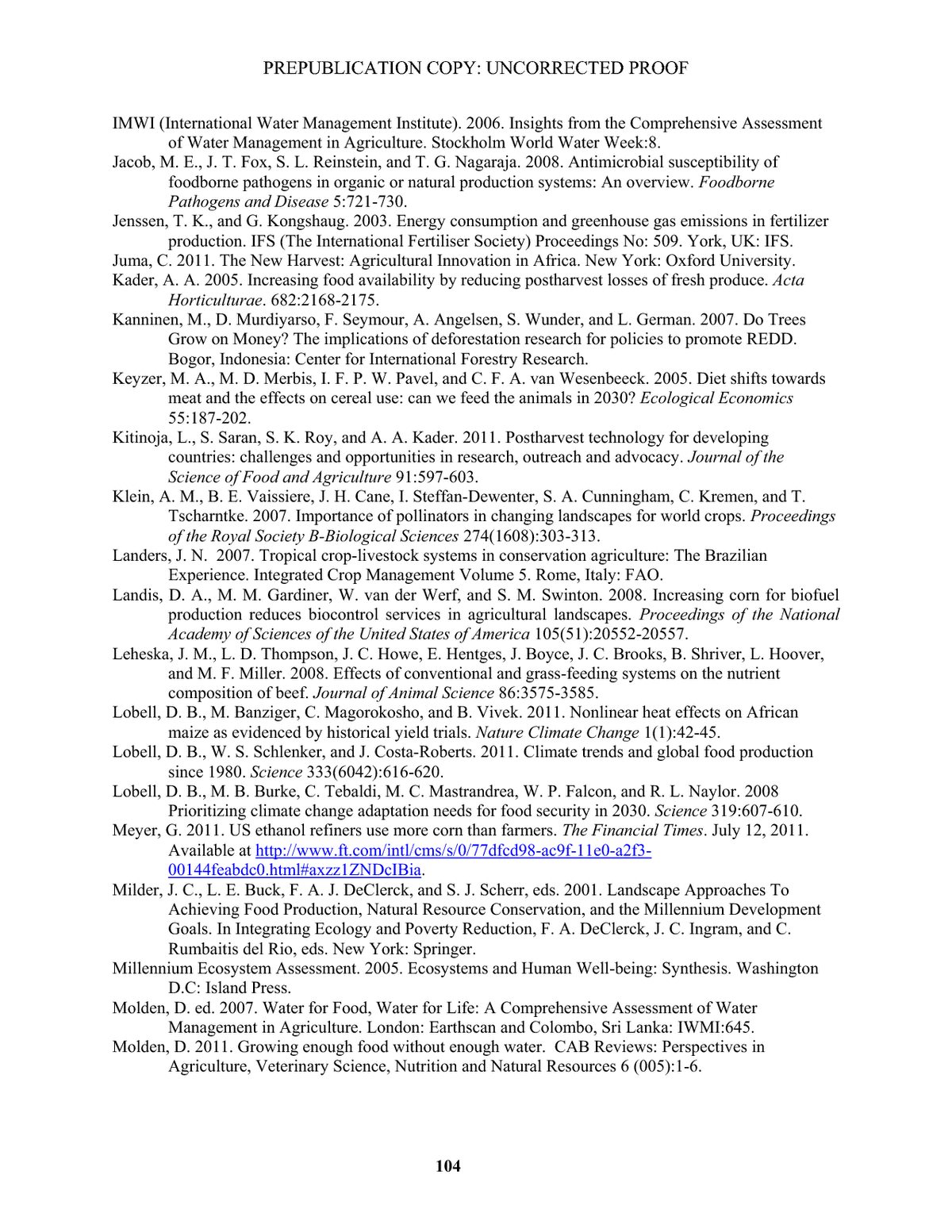
PREPUBLICATION COPY: UNCORRECTED PROOF IMWI (International Water Management Institute). 2006. Insights from the Comprehensive Assessment of Water Management in Agriculture. Stockholm World Water Week:8. Jacob, M. E., J. T. Fox, S. L. Reinstein, and T. G. Nagaraja. 2008. Antimicrobial susceptibility of foodborne pathogens in organic or natural production systems: An overview. Foodborne Pathogens and Disease 5:721-730. Jenssen, T. K., and G. Kongshaug. 2003. Energy consumption and greenhouse gas emissions in fertilizer production. IFS (The International Fertiliser Society) Proceedings No: 509. York, UK: IFS. Juma, C. 2011. The New Harvest: Agricultural Innovation in Africa. New York: Oxford University. Kader, A. A. 2005. Increasing food availability by reducing postharvest losses of fresh produce. Acta Horticulturae. 682:2168-2175. Kanninen, M., D. Murdiyarso, F. Seymour, A. Angelsen, S. Wunder, and L. German. 2007. Do Trees Grow on Money? The implications of deforestation research for policies to promote REDD. Bogor, Indonesia: Center for International Forestry Research. Keyzer, M. A., M. D. Merbis, I. F. P. W. Pavel, and C. F. A. van Wesenbeeck. 2005. Diet shifts towards meat and the effects on cereal use: can we feed the animals in 2030? Ecological Economics 55:187-202. Kitinoja, L., S. Saran, S. K. Roy, and A. A. Kader. 2011. Postharvest technology for developing countries: challenges and opportunities in research, outreach and advocacy. Journal of the Science of Food and Agriculture 91:597-603. Klein, A. M., B. E. Vaissiere, J. H. Cane, I. Steffan-Dewenter, S. A. Cunningham, C. Kremen, and T. Tscharntke. 2007. Importance of pollinators in changing landscapes for world crops. Proceedings of the Royal Society B-Biological Sciences 274(1608):303-313. Landers, J. N. 2007. Tropical crop-livestock systems in conservation agriculture: The Brazilian Experience. Integrated Crop Management Volume 5. Rome, Italy: FAO. Landis, D. A., M. M. Gardiner, W. van der Werf, and S. M. Swinton. 2008. Increasing corn for biofuel production reduces biocontrol services in agricultural landscapes. Proceedings of the National Academy of Sciences of the United States of America 105(51):20552-20557. Leheska, J. M., L. D. Thompson, J. C. Howe, E. Hentges, J. Boyce, J. C. Brooks, B. Shriver, L. Hoover, and M. F. Miller. 2008. Effects of conventional and grass-feeding systems on the nutrient composition of beef. Journal of Animal Science 86:3575-3585. Lobell, D. B., M. Banziger, C. Magorokosho, and B. Vivek. 2011. Nonlinear heat effects on African maize as evidenced by historical yield trials. Nature Climate Change 1(1):42-45. Lobell, D. B., W. S. Schlenker, and J. Costa-Roberts. 2011. Climate trends and global food production since 1980. Science 333(6042):616-620. Lobell, D. B., M. B. Burke, C. Tebaldi, M. C. Mastrandrea, W. P. Falcon, and R. L. Naylor. 2008 Prioritizing climate change adaptation needs for food security in 2030. Science 319:607-610. Meyer, G. 2011. US ethanol refiners use more corn than farmers. The Financial Times. July 12, 2011. Available at http://www.ft.com/intl/cms/s/0/77dfcd98-ac9f-11e0-a2f3- 00144feabdc0.html#axzz1ZNDcIBia. Milder, J. C., L. E. Buck, F. A. J. DeClerck, and S. J. Scherr, eds. 2001. Landscape Approaches To Achieving Food Production, Natural Resource Conservation, and the Millennium Development Goals. In Integrating Ecology and Poverty Reduction, F. A. DeClerck, J. C. Ingram, and C. Rumbaitis del Rio, eds. New York: Springer. Millennium Ecosystem Assessment. 2005. Ecosystems and Human Well-being: Synthesis. Washington D.C: Island Press. Molden, D. ed. 2007. Water for Food, Water for Life: A Comprehensive Assessment of Water Management in Agriculture. London: Earthscan and Colombo, Sri Lanka: IWMI:645. Molden, D. 2011. Growing enough food without enough water. CAB Reviews: Perspectives in Agriculture, Veterinary Science, Nutrition and Natural Resources 6 (005):1-6. 104
PREPUBLICATION COPY: UNCORRECTED PROOF Nelson, G. C., M. W. Rosegrant, A. Palazzo, I. Gray, C. Ingersoll, R. Robertson, S. Tokgoz, T. Zhu, T. B. Sulser, C. Ringler, S. Msangi, and L. You. 2010. Food Security and Climate Change: Challenges to 2050 and Beyond. IFPRI Issue Brief 66. Washington, DC: IFPRI. NRC (National Research Council). 2006. Food Insecurity and Hunger in the United States: An Assessment of the Measure. Washington, DC: National Academies Press. NRC. 2008. Emerging Technologies to Benefit Farmers in Sub-Saharan Africa and South Asia. Washington, DC: National Academies Press. NRC. 2010a. Mitigating the Nutritional Impacts of the Global Food Price Crises: Workshop Summary. Washington, DC: National Academies Press. NRC. 2010b. Toward Sustainable Agricultural Systems in the 21st Century. Washington, DC: The National Academies Press. Oerke, E. C. 2006. Crop losses to pests. The Journal of Agricultural Science 144:31-43. Organic Trade Association. 2010. U.S. Organic Product Sales Reach $26.6 Billion in 2009. Available http://www.organicnewsroom.com/2010/04/us_organic_product_sales_reach_1.html .Accessed May 2011. Organic Trade Association. 2011. U.S. Organic Industry Valued at Nearly $29 billion in 2010. U.S. organic industry valued at nearly $29 billion in 2010. Accessed May 2011. Parrlberg, R. 2010. Attention Whole Food Shoppers: Stop obsessing about arugula. Your âsustainableâ mantra â organic, local, and slow â is no recipe for saving the worldâs hungry millions. Foreign Policy May/June:80-85. Paarlberg, R. 2011. Governing the Dietary Transition: Linking Agriculture, Nutrition, and Health. 2020 Conference Paper 8: Leveraging Agriculture for Improving Nutrition and Health, New Delhi, India. Pardey, P.G., and P. L. Pingali. 2010. Reassessing International Agricultural Reseasrch for Food and Agriculture. Report prepared for the Global Conference on Agricultural Research for Development (GCARD). Montpellier, France, March 28-31, 2010. Parfitt, J., M. Barthel, and S. Macnaughton. 2010. Food waste within food supply chains: quantification and potential for change to 2050. Philosophical Transactions of the Royal Society B: Biological Sciences 365(1554):3065-3081. Pelletier, N., and P. Tyedmers. 2010. Forecasting potential global environmental costs of livestock production 2000â2050. Proceedings of the National Academy of Sciences doi: 10.1073/pnas.1004659107. Pinstrup-Andersen, P., and A. Herforth. 2008. Food Security: Achieving the Potential. Environment 50(5):48-62. Pinstrup-Andersen, P. 2009. Food Security: Definition and Measurement. Food Security 1:5-7. Pinstrup-Andersen, P. 2010. Understanding the Interactions between Agriculture and Health. IFPRI 2020 panel discussion. Washington, DC: IFPRI. Pinstrup-Andersen, P., and D. D. Watson. Pursuing Triple Wins Within the Context of Climate Change. 2010. Paper presented at the Tenth International Conference on Development of Drylands, Cairo, Egypt, December 12-15, 2010. Pinstrup-Andersen, P. 2011. The Food System and Its Interaction with Human Health and Nutrition. 2020 Conference Brief 13: Leveraging Agriculture for Improving Nutrition and Health, New Delhi, India. Pinstrup-Andersen, Per, ed. 2011. The African Food System & its Interaction with Human Health & Nutrition. Ithaca, NY: Cornell University. Pretty, J. 2006. Agroecological Approaches to Agricultural Development. The preparation of the World Development Report 2008 âAgriculture for Development.â Available at http://www.rimisp.org/getdoc.php?docid=6440. Pretty, J. 2008. Agricultural sustainability: concepts, principles and evidence. Philosophical Transactions of The Royal Society B 363:447â465. 105
PREPUBLICATION COPY: UNCORRECTED PROOF Pretty, J. 2011. Editorial: Sustainable intensification in Africa. Pp. 1-9 in Sustainable intensification: increasing productivity in African food and agricultural systems, J. Pretty, C. Toulmin and S. Williams, eds. London, UK: Earthscan. Raab, C., and D. Grobe. 2005. Consumer knowledge and perceptions about organic food. Journal of Extension 43:online. Rabobank Group. 2010. Sustainability and Security of the Global Food Supply Chain. Utrecht, The Netherlands: Rabobank Nederland. Ravallion, M. 2011. Paper presented at the National Academies first workshop, Measuring Food Insecurity and Assessing the Sustainability of Global Food Systems. February 16-17, 2011. Washington, DC. Reardon, T. and A. Gulati. 2008. The Rise of Supermarkets and their Development Implications. IFPRI Discussion Paper 00752. Reganold, J. P., D. Jackson-Smith, S. S. Batie, R. R. Harwood, J. L. Kornegay, D. Bucks, C. B. Flora, J. C. Hanson, W. A. Jury, D. Meyer, A. Schumacher Jr., H. Sehmsdorf, C. Shennan, L. A. Thrupp, and P. Willis. 2011. Transforming U.S. Agriculture. Science 332:670-671. Regulations.gov. Comments of the National Pork Producers Counsel on USDAâs Proposed GIPSA Rule (see GIPSA-2010-PSP-0001-RULEMAKING). 2010. Available at http://www.regulations.gov/#!home. Reichenberger S., M. Bach, A. Skitschak, and H.-G. Frede. 2007. Mitigation strategies to reduce pesticide inputs into ground- and surface water and their effectiveness: a review. The Science of the Total Environment 384:1-35. Ricketts, T. H., G. C. Daily, P. R. Ehrlich, and C. D. Michener. 2004 Economic value of tropical forest to coffee production. Proceedings of the National Academy of Sciences of the United States of America 101:12579-12582. Rockstrom, J., N. Hatibu, T. Y. Oweis, S. Wani, J. Barron, A. Bruggeman, J. Farahani, L. Karlberg, and Z. Qiang. 2007. Managing water in rainfed agriculture. Pp. 315-352 in Water for Food, Water for Life: A Comprehensive Assessment of Water Management in Agriculture, D. Molden, ed. London, UK: Earthscan; Colombo, Sri Lanka: IWMI. Schlenker, W. and D. B. Lobell. 2010. Robust negative impacts of climate change on African agriculture. Environmental Research Letters 014010:8. Schlenker, W. and M. J. Roberts. 2009. Nonlinear temperature effects indicate severe damages to U.S. crop yields under climate change. Proceedings of the National Academy of Sciences 106(37):15594-15598. Shah, T. 2007. The groundwater economy of South Asia: an assessment of size, significance and socio- ecological impacts. Pp. 7-36 in The agricultural groundwater revolution: opportunities and threats to development: Comprehensive Assessment of Water Management in Agriculture Series 3, M. Giordano and K. G. Villholth, eds. Wallingford, UK: CABI. Simmons, J. 2011. Making Safe, Affordable and Abundant Food a Global Reality. Greenfield, IN: Elanco Animal Health. Smith, P., P. J. Gregory, D. van Vuuren, M. Obersteiner, P. Havlik, M. Rounsevell, J. Woods, E. Stehfest, and J. Bellarby. 2010. Competition for land. Philosophical Transactions of the Royal Society B- Biological Sciences 365:2941-2957. Smithfield Foods, Inc. 2010. Corporate Social Responsibility Report: 2009/10. New York, NY: Robinson Kurtin Communications! Inc:6-9, 35, 40 and 42. Smithfield Foods, Inc. 2011. Corporate Social Responsibility Report: 2010/11. New York, NY: Robinson Kurtin Communications! Inc:11-12. Syngenta. 2011. Contributing to food security. Available at http://www2.syngenta.com/en/grow-more- from-less. TEEB. 2010. The Economics of Ecosystems and Biodiversity: Mainstreaming the Economics of Nature: A synthesis of the approach, conclusions and recommendations of TEEB. UNEP ISBN 978-3- 9813410-3-4. 106
PREPUBLICATION COPY: UNCORRECTED PROOF The Danish Academy of Technical Sciences. 2010. Recommendation report: Food For All Forever. Copenhagen: ATV, Danish Academy of Technical Sciences. The World Bank. 2007. World Development Report 2008 â Agriculture for Development. Washington, DC: World Bank:182. The World Bank. 2011. Global Economic Prospects 2011: Maintaining Progress Amid Turmoil. Washington, DC: The World Bank. Then, C., and R. Tippe. 2010. Agro-Biotechnology: Cloned Farm Animals - A âKilling Applicationâ? Risks and Consequences of the Introduction of Cloned Animals for Food Production, Test Biotech Institute, Munich, Germany. Tubiello, F. N., J. S. Amthor, K. J. Boote, M. Donatelli, W. Easterling, G. Fischer, R. M. Gifford, M. Howden, J. Reilly, and C. Rosenzweig. 2007. Crop response to elevated CO2 and world food supply: A comment on âFood for Thought.â by Long et al. Science 312:1918-1921. 2006. European Journal of Agronomy 26(3):215-223. Uauy, R. 2011. Measures of Overnutrition/Obesity. Paper presented at the National Academies first workshop, Measuring Food Insecurity and Assessing the Sustainability of Global Food Systems. February 16-17, 2011. Washington, DC. UK Foresight Programme. 2011. The Future of Food and Farming: Challenges and Choices for Global Sustainability. Available at http://www.bis.gov.uk/assets/bispartners/foresight/docs/food-and- farming/11-546-future-of-food-and-farming-report.pdf. UNEP (United Nations Environment Programme). 2009. Agriculture: A Catalyst for Shifting to a Green Economy. A UNEP Brief. United Nations. 2011. Agroecology and the Right to Food. Report presented at the 16th Session of the United Nations Human Rights Council. A/HRC/16/49. United Nations. 2011. World Population Prospects: 2010 Revision. The Population Division of the United Nations Department of Economic and Social Affairs. United Nations. 2011. World Population to reach 10 billion by 2100 if Fertility in all Countries Converges to Replacement Level. Available at http://esa.un.org/unpd/wpp/Other- Information/Press_Release_WPP2010.pdf. Unnevehr, L. J. 2007. Food Safety as a Global Public Good: Is There Underinvestment? Contributions of Agricultural Economics to Critical Policy Issues, K. Otsuka and K. Kalirajan, eds. Malden: Blackwell. U.S. Congressional Budget Office. 2010. Using Biofuel Tax Credits to Achieve Energy and Environmental Policy Goals:9. Available at http://www.cbo.gov/ftpdocs/114xx/doc11477/07-14- Biofuels.pdf. U.S. Congressional Budget Office. 2009. The Impact of Ethanol Use on Food Prices and Greenhouse-Gas Emissions: 6. Available at http://www.cbo.gov/ftpdocs/100xx/doc10057/04-08-Ethanol.pdf. USDA (U.S. Department of Agriculture). 2005. Dietary Guidelines for Americans 2005. Washington, DC: USDA. USDA. 2007. Dairy 2007, Part I: Reference of Dairy Cattle Health and Management Practices in the United States. Fort Collins, CO: USDA-APHIS-VS. USDA. 2011. Data and Statistics. http://www.nass.usda.gov/Data_and_Statistics/Quick_Stats/index.asp. Washington, DC: USDA. Accessed May 2011. USDA. 2011. World Agricultural Supply and Demand Estimates 498. Available at http://www.usda.gov/oce/commodity/wasde/latest.pdf. USDA Economic Research Service. 2008. Global Agriculture Supply and Demand: Factors Contributing to the Recent Increase in Food Commodity Prices. Available at http://www.ers.usda.gov/Publications/WRS0801/WRS0801.pdf. USDA/NASS (National Agricultural Statistics Service). 2010a. 2008 Organic Production Survey. Washington, DC: USDA. USDA/NASS. 2010b. Overview of the United States Cattle Industry. Washington, DC: USDA. 107
PREPUBLICATION COPY: UNCORRECTED PROOF U.S. Department of State. 2011. Free Trade Agreements. Available at http://www.state.gov/e/eeb/tpp/bta/fta. U.S. Government Printing Office. 2010. Implementation of Regulations Required under Title XI of the Food, Conservation and Energy Act of 2008; Conduct in Violation of the Act, Proposed Rule. Federal Register 75(119):35338-35354. Vandermeer, J., I. Perfecto, and S. M. Philpott. 2010. Ecological complexity and pest control in organic coffee production: uncovering an autonomous ecosystem service. Bioscience 60:527-537. Vandermeer, J., I. Perfecto, and H. Liere. 2009 Evidence for hyperparasitism of coffee rust (Hemileia vastatrix) by the entomogenous fungus, Lecanicillium lecanii, through a complex ecological web. Plant Pathology 58:636-641. Vandermeer, J., I. Perfecto, and S. M. Philpott. 2008 Clusters of ant colonies and robust criticality in a tropical agroecosystem. Nature 451:457-U3. VFRC (Virtual Fertilizer Research Center). VFRC Brochure: Global Research to Nourish the World. Alabama: IFDC. Available at http://www.ifdc.org/Alliances/VFRC. Vitousek, P. M., R. Naylor, T. Crews, M. B. David, L. E. Drinkwater, E. Holland, P. J. Johnes, J. Katzenberger, L. A. Martinelli, P. A. Matson, G. Nziguheba, D. Ojima, C. A. Palm, G. P. Robertson, P. A. Sanchez, A. R. Townsend, and F. S. Zhang. 2009 Nutrient Imbalances in Agricultural Development. Science 324:1519-1520. Vlek, P. L. G., Q. B. Le, and L. Tamene. 2010. Assessment of land degradation, its possible causes and threat to food security in sub-Saharan Africa. Pp. 57-86 in Advances in Soil Sciences - Food Security and soil quality, R. Lal and B.A. Stewart, eds. Boca Raton: CRC Press. Vlek, P. L. G., Q. B. Le, and L. Tamene. 2008. Land Decline in Land-Rich Africa: A Creeping Disaster in the Making. Rome: CGIAR Science Council Secretariat. von Witzke, H. and S. Noleppa. 2010. EU agricultural production and trade: Can more efficiency prevent increasing land-grabbing outside of Europe? Research Report, University of Piacenca. Available at http://www.appgagscience.org.uk/linkedfiles/Final_Report_Opera.pdf. Walid, W. Q., S. Thakur, R. D. Berghaus, M. P. Martin, and A. G. Wondwossen. 2010. Prevalence and distribution of Salmonella in organic and conventional broiler poultry farms. Foodborne Pathogens and Disease 7:1363-1371. Wani, S.P., T.K. Sreedevi, J. Rockstrom, and Y.S. Ramakrishna. 2009. Rainfed agriculture: past trends and future prospects. Pp. 1-35 in Rainfed agriculture: unlocking the potential: Comprehensive Assessment of Water Management in Agriculture Series 7, S. P. Wani, J. Rockstrom, and T. Oweis, eds. Wallingford, UK: CABI; Patancheru, Andhra Pradesh, India: International Crops Research Institute for the Semi-Arid Tropics; Colombo, Sri Lanka: IWMI. Weber, C. L. and H. S. Matthews. 2008 Food-miles and the relative climate impacts of food choices in the united states. Environmental Science & Technology 42:3508-3513. Wenderoff, J. 2011. Moms Across America Uniting to Preserve Effectiveness of Antibiotics: Poll of 800+ Moms Shows More than Three Out of Four Concerned about Use of Antibiotics in Food Animal Production, Support Government Action to Limit Such Use. Available at http://www.saveantibiotics.org/newsroom/pr_3may2011.html. The Pew Charitable Trusts. Accessed May 2011. WHO (World Health Organization). 2002. WHO global strategy for food safety: safer food for better health. Available at http://www.who.int/foodsafety/publications/general/en/strategy_en.pdf WHO. 2011a. Obesity and overweight: Fact sheet N°311. WHO/FAO. 2003. Diet, Nutrition and the Prevention of Chronic Diseases. WHO Technical Report Series 916, Report of a Joint WHO/FAO Expert Consultation, section 3.4. Available at http://www.fao.org/DOCREP/005/AC911E/ac911e05.htm. Wilcox, C. 2011. Mythbusting 101: organic farming conventional agriculture. Scientific American. Available at http://blogs.scientificamerican.com/science-sushi. Wilhelm, B., A. Raji , L. Waddell, S. Parker, J. Harris, K. C. Roberts, R. Kydd, J. Greig, and A. Bayntonet. 2009. Prevalence of zoonotic or potentially zoonotic bacteria, antimicrobial resistance 108
PREPUBLICATION COPY: UNCORRECTED PROOF and somatic cell counts in organic dairy production: Current knowledge and research gaps. Foodborne Pathogens and Disease 6:525-539. World Commission on Environment and Development. 1987. Our Common Future. New York: Oxford University. WWF (World Wildlife Fund). 2010. Living Planet Report: Biodiversity, Biocapacity and Development. Washington, DC: WWF. Zhang, J., S. K. Wall, L. Xu, and P. D. Ebner. 2010. Contamination rates and antimicrobial resistance in bacteria isolated from âgrass-fedâ labeled beef products. Foodborne Pathogens and Disease 7:1331-1336. Zlotnik, H. 2009.World Population To Exceed 9 Billion By 2050: Developing Countries to Add 2.3 Billion Inhabitants with 1.1 Billion Aged Over 60 and 1.2 Billion of Working Age. UN Population Division. Available at http://www.un.org/esa/population/publications/wpp2008/pressrelease.pdf. 109
