
Effluent Releases from Nuclear Power Plants and Fuel-Cycle Facilities
This chapter addresses the following charge in the statement of task for this study (see Sidebar 1.1 in Chapter 1):
- Availability, completeness, and quality of information on gaseous and liquid radioactive releases and direct radiation exposure from nuclear facilities required to estimate doses for an epidemiologic study.
There are two potential sources of data on radiation releases from nuclear facilities that could be used to estimate doses for an epidemiologic study:
(1) Measurements of radioactivity contained in airborne1 and liquid effluents that are released from nuclear facilities.
(2) Measurements of radiation in the environment around nuclear facilities.
This chapter describes these effluent release and environmental monitoring data and assesses their suitability for dose estimation. The primary focus is on effluent release data; as will be shown in this chapter, these data are more useful than currently available environmental monitoring data for estimating radiation doses for an epidemiologic study.
1 The committee uses the term airborne to refer to gaseous and particulate releases to air and liquid or waterborne to refer to releases to water.
The effluent release and meteorological data collected by plant licensees and reported to the U.S. Nuclear Regulatory Commission (USNRC) are intended to demonstrate compliance with applicable USNRC regulations. These data were not intended to be used for dose reconstruction to support an epidemiologic study. The suitability of this information to support an epidemiologic study depends on the intended use of the dose reconstruction. For example, it might be necessary to obtain hourly or daily data on effluent releases and meteorological conditions at each facility to reconstruct doses to specific individuals living near those facilities. One the other hand, data that are averaged over longer time periods (weeks and months) might be sufficient to obtain rough estimates of annual doses to populations as a function of distance and direction from those facilities. Dose reconstruction is discussed in Chapter 3.
2.1 EFFLUENT RELEASES FROM NUCLEAR PLANTS
The operation of nuclear plants produces large quantities of radioactive materials (Appendix D). Quantities of radioactive materials are most readily expressed in terms of activity, defined as the rate of radioactive decay of that material. Activity is usually expressed in units of becquerels (abbreviated Bq; 1 Bq = 1 decay per second) or curies (abbreviated Ci; 1 Ci = 3.7 × 10¹⁰ [37 billion] decays per second).2 An operating nuclear reactor can contain on the order of 1014 Ci of activity excluding very-short-lived radionuclides (NCRP, 1987). Most of this activity is the result of fission of the reactor fuel (see Appendix D).
A small fraction3 of this activity is typically emitted to the environment each year as a result of normal plant operations. Radioactive effluents are released in airborne and liquid form. They originate from several sources within a nuclear plant:
- Fission of residual uranium contained on the exterior of the fuel rods, referred to as tramp uranium.
- Leaks from failed fuel rods.
- Diffusion of radioactive gases through intact fuel rods.
- Activation of materials in reactor cooling water.
2 These units are used interchangeably in this chapter, depending on the source of data. In ternational organizations generally use becquerels. Nuclear facility licensees and the regulator generally use curies.
3 As will be shown elsewhere in this chapter (see Figures 2.1 through 2.4), operating nuclear plants currently release a few curies to a few hundred curies of activity per year to the envi ronment. However, some plants emitted several hundred thousand curies of activity per year to the environment in the past.
- Erosion and entrainment of activated materials from pipes, valves, and pumps in the cooling system.
Effluent releases from nuclear plants are permitted under regulations promulgated by the USNRC, but they must be controlled, monitored, and reported to regulatory authorities. Appendix F describes USNRC requirements for reporting effluent releases from nuclear plants, and Appendix G describes the Radiological Effluents Technical Specifications (RETS) guidance for monitoring and reporting such releases.
Nuclear plant licensees are required to report emissions of radionuclides to the environment to the USNRC on an annual basis. Because nuclear power plants are industrial sites, plant licensees also are subject to environmental reporting requirements mandated by other federal and state regulatory agencies. These include industrial waste discharges (Clean Water Act), air emissions (Clean Air Act), chemical inventory reporting (Emergency Planning Community Right-to-Know Act), hazardous waste disposal (Resource Conservation and Recovery Act), storage tank management, and spill prevention (Oil Pollution Act).
Tables 2.1 and 2.2 provide lists of the radionuclides that are typically reported in effluent releases from nuclear plants. The characteristics and quantities of typical releases are described in the following sections. The radioactive isotope carbon-14, which is not shown in the tables, is mainly produced by neutron activation of oxygen-17 in the coolant of reactors of all types. The production of carbon-14 is estimated to be about 5 Ci per gigawatt (thermal)-year (GWth -y) in boiling-water reactors (BWRs) and 4
TABLE 2.1 Common Radionuclides in Reported Airborne Effluent Releases from Nuclear Plants
|
|
|
| Category | Commonly Reported Radionuclides |
|
|
|
| Fission and activation gases | Krypton (85, 85m, 87, 88) Xenon (131, 131m, 133, 133m, 135, 135m, 138) Argon (41) |
| Iodines/halogens | Iodine (131, 132, 133, 134, 135) Bromine (82) |
| Particulates | Cobalt (58, 60) Cesium (134, 137) Chromium (51) Manganese (54) Niobium (95) |
| Tritium | Hydrogen (3) |
|
|
|
| SOURCE: USNRC (2007), Table 2.1. | |
TABLE 2.2 Common Radionuclides in Reported Liquid Effluent Releases from Nuclear Plants
|
|
|
| Category | Commonly Reported Radionuclides |
|
|
|
| Mixed Fission and Activation Products | Iron (55) Cobalt (58, 60) Cesium (134, 137) Chromium (51) Manganese (54) Zirconium (95) Niobium (95) Iodine (131, 133, 135) |
| Tritium | Hydrogen (3) |
| Dissolved and Entrained Noble Gases |
Krypton (85, 85m, 87, 88) Xenon (131, 133, 133m, 135, 135m) |
|
|
|
| SOURCE: USNRC (2007), Table 2.2. | |
Ci per GWth-y in pressurized-water reactors (PWRs) (EPRI, 2010). Most of the activity produced is released into the atmosphere. Effluent releases of carbon-14 have not been required to be reported to the USNRC in the past. However, starting in 2010, plant licenses are required to estimate and report releases of this radionuclide to the USNRC. It has been estimated by some that the atmospheric releases of carbon-14 result in a relatively large contribution to population dose (Kahn et al., 1985; NEA, 2003). Additional discussion of the carbon-14 contribution to dose is provided in Chapter 3.
2.1.1 Airborne Effluent Releases
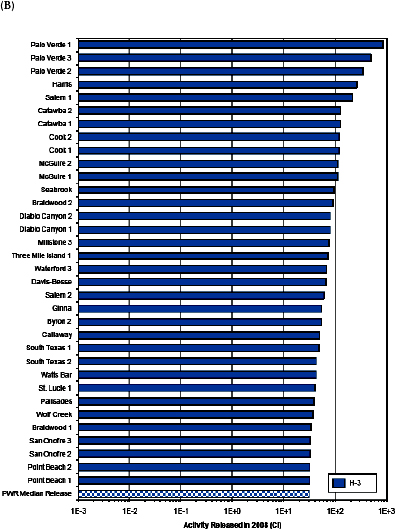
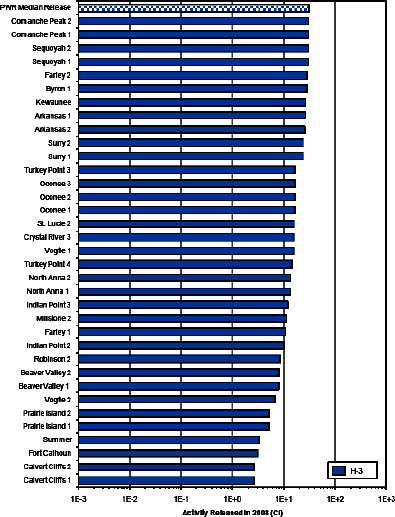
Figures 2.1 through 2.4 provide graphical illustrations of selected airborne effluent releases reported to the USNRC for operating plants in the United States in 2008. The figures show noble gas releases (Figure 2.1), iodine-131 releases (Figure 2.2), particulate releases (Figure 2.3), and tritium releases (Figure 2.4) from BWRs and PWRs.
The following observations emerge from an inspection of these figures:
- At present, nuclear plants typically release between a few curies and several hundred curies per year in airborne effluents.
- Most of the activity released in airborne effluents is from fission/ activation gases and tritium. The median activities of these releases are (currently) approximately the same for BWRs and PWRs, in spite of the fact that tritium production in PWRs is higher than in
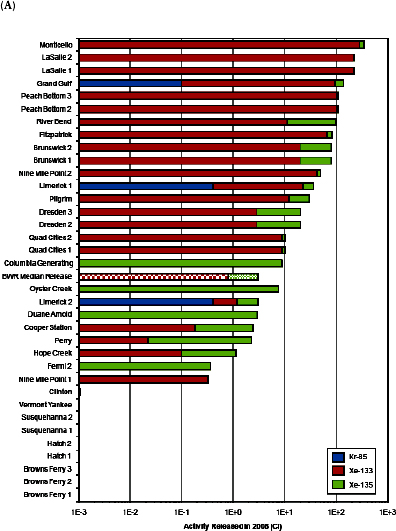
FIGURE 2.1 Noble gas releases from (A) BWRs and (B) PWRs in 2008. SOURCE: Daugherty and Conatser (2008).
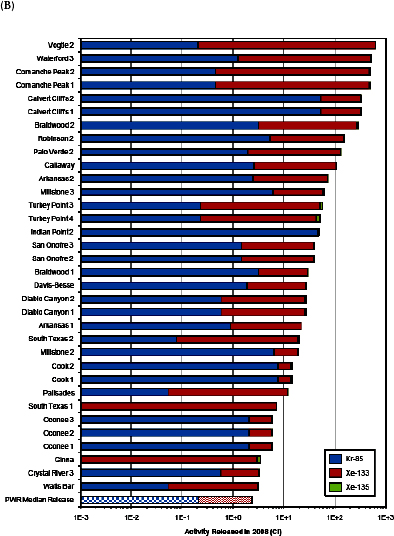
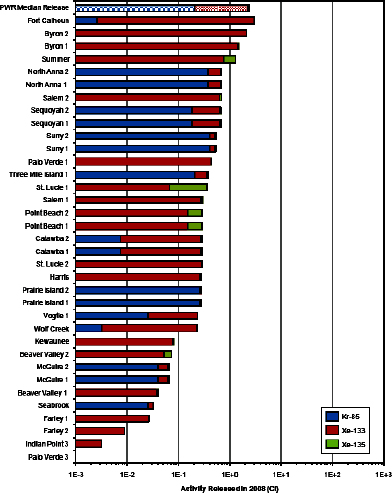
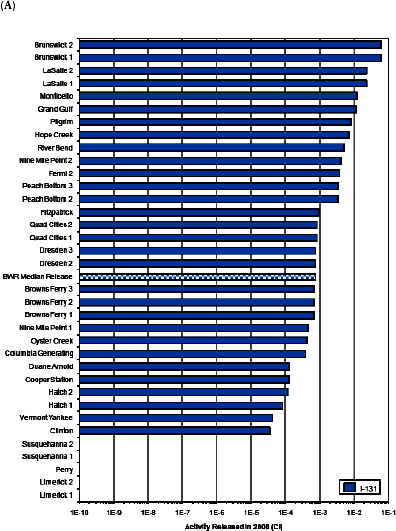
FIGURE 2.2 Iodine-131 releases from (A) BWRs and (B) PWRs in 2008. SOURCE: Daugherty and Conatser (2008).
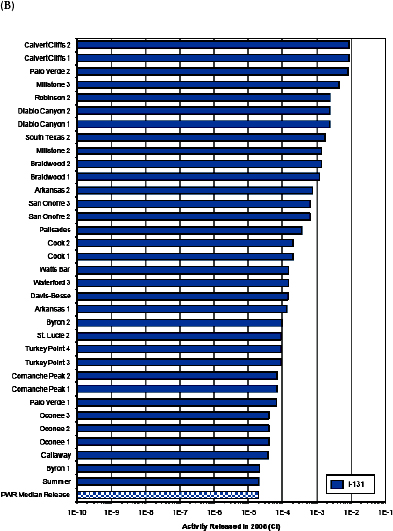
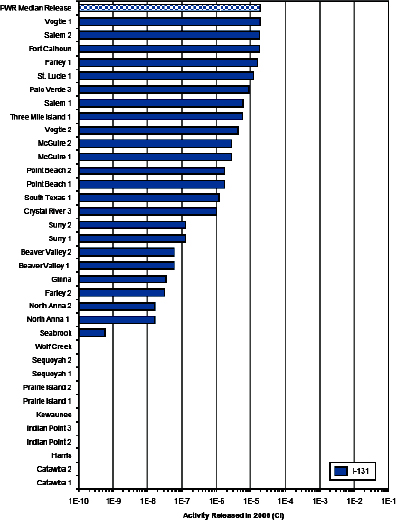
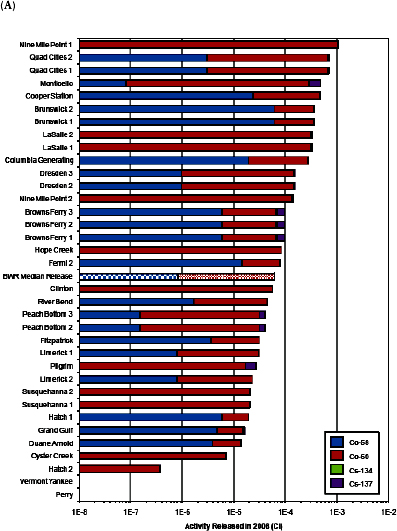
FIGURE 2.3 Particulate releases from (A) BWRs and (B) PWRs in 2008. SOURCE: Daugherty and Conatser (2008).
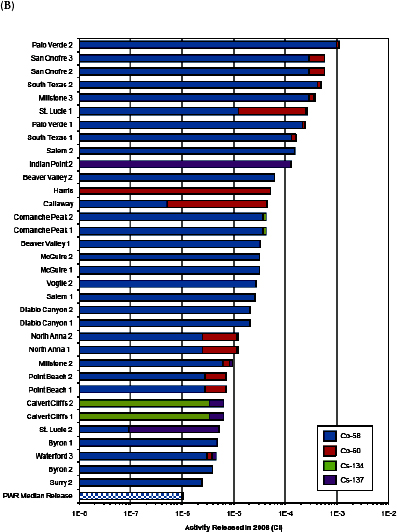
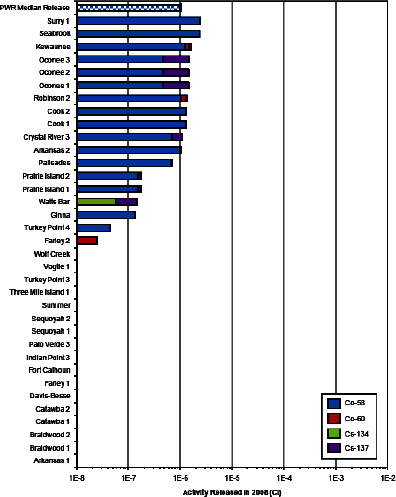
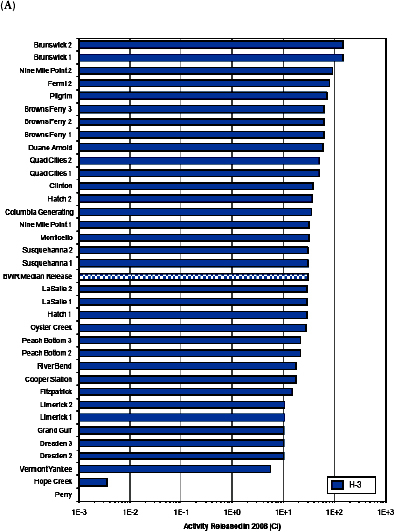
FIGURE 2.4 Tritium (H-3) releases from (A) BWRs and (B) PWRs in 2008. SOURCE: Daugherty and Conatser (2008).
-
BWRs.4 However, as will be discussed later in this chapter, BWRs generally released greater quantities of radionuclides than PWRs prior to about 1980.
- The activities of iodine and particulates in releases are typically several orders of magnitude lower than activities from fission/activation gases and tritium. Additionally, median activities of iodine and particulates are about one to two orders of magnitude lower in PWRs than in BWRs.
- Both BWRs and PWRs exhibit significant variability in releases of all airborne effluent categories: about six orders of magnitude of variability in noble gas releases; over seven orders of magnitude of variability in iodine releases; over four orders of magnitude of variability in particulate releases; and (with one exception) about three orders of magnitude of variability in tritium releases. In general, the variability differences are greater among PWRs than BWRs.
- The variability in airborne effluent releases that are exhibited in these figures is the result of several factors, including differences in the plant designs and operations; designs and operations of radioactive waste management and effluent control systems; plant equipment performance; and analytical methods used to monitor effluent releases. A detailed discussion of these differences is beyond the scope of this report; additional information is available in NCRP (1987) and in Marley (1979).
Airborne effluent releases from nuclear plants also display significant variability across time. To illustrate, Figure 2.5 provides comparative examples of annual releases of noble gases from operating PWR and BWR nuclear plants for two different years separated by two decades. In general, noble gas releases have decreased over time, even though plant capacity factors have increased and some plants have received power uprates.5 This decrease is likely due to several factors, including improved fuel cladding performance and improved design and operation of effluent control and waste treatment systems.
The intraplant variability of releases as a function of time can also be high, as illustrated in Figure 2.6, which compares atmospheric releases of
4 Although tritium is produced in both reactors as a result of ternary fission and activation of deuterium that is naturally present in cooling water, PWRs also produce tritium from neu tron capture in boron that is added to the cooling water to control reactivity, i.e., through the reaction 10B(n, 2a)T (see Appendix D).
5 A nuclear reactor is licensed by the USNRC to operate up to a specified maximum power. Plant licensees can request approval from the USNRC to increase (or uprate) the maximum power at which the reactor can operate. A reactor’s power is typically increased by changing the enrichment or other design elements of the reactor fuel.
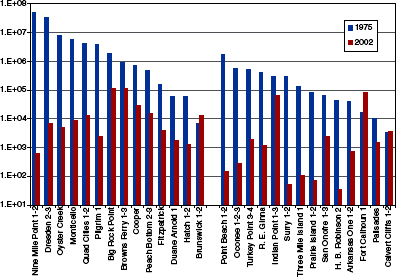
FIGURE 2.5 Comparison of atmospheric releases of noble gases for selected BWRs (left) and PWRs (right) in the United States. The units on the vertical scale are in gigabecquerels (GBq = 0.03 Ci). SOURCE: Data from the United Nations Scientific Committee on the Effects of Atomic Radiation (UNSCEAR).
noble gases, iodine-131, and radioactive particulates from the Dresden plant (located near Chicago, Illinois) from 1975 to 2002. Noble gases constituted the largest source of releases from the Dresden plant during this time period, which again is typical for effluent releases from nuclear plants. Notice also that the total quantities of releases decreased from the mid 1970s to the mid 1990s, likely the result of improvements in effluent controls and plant operations. The increase in emissions starting in the mid 1990s was likely due in part to an increase in power output (Figure 2.7). Improved operating practices resulted in higher plant utilization levels as well as higher allowed power levels.
A further illustration of intraplant variability of effluent releases from nuclear plants is shown in Table 2.3. This table shows releases from four plants (two BWRs and two PWRs) for two time periods (1980 and 2008-2010). Note particularly the much higher noble gas releases in 1980 compared to 2008-2010, which reflects higher releases of short-lived nuclides such as krypton-87 (76-minute half-life) and krypton-88 (2.8-hour half-life) from BWRs. In 2008-2010, effluent releases were primarily xenon-133 (5.2-day half-life).
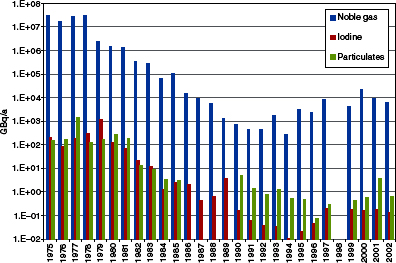
FIGURE 2.6 Comparison of annual atmospheric releases of noble gases (blue bars), iodine-131 (red bars), and radioactive particulates (green bars) for the Dresden plant from 1975 to 2002. The units on the vertical scale are in GBq (=0.03 Ci). SOURCE: Data from UNSCEAR.
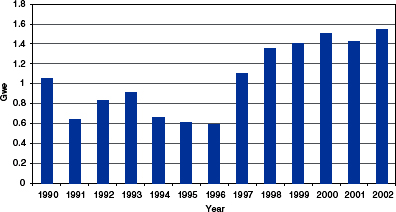
FIGURE 2.7 Variation with time of the electricity generated by the Dresden plant. SOURCE: UNSCEAR (2008).
TABLE 2.3 Comparison of Airborne Radioactive Effluent Releases (in curies) from Four Nuclear Plants, 1980 and 2008-2010
| Millstone Point 2 &3 (PWR) |
Dresden 2 & 3 (BWR) |
Oyster Creek (BWR) |
North Anna | |||||
| Radionuclide | 1980 | 2010 | 1980 | 2009 | 1980 | 2008 | 1980 | 2010 |
| Helium-3 | 850 | 12 | 1180 | 2.3 | 9.4 | 28 | 56 | 4.8 |
| Cobolt-60 | 0 | 0.64 | 3.20 × 10⁻⁴ | 8.90 × 10⁻³ | 7.20 × 10⁻⁶ | 5.30 × 10⁻⁶ | 0 | |
| Krypton-85 | 9.7 | 2.1 | 0 | 0 | 2.4 | 5.5 | ||
| Krypton-85M | 2.5 | 0 | 0.093 | 2.1 | 1260 | 0 | 0.65 | 0 |
| Krypton-87 | NR | 0 | 0.042 | 1.3 | 4260 | 0 | 0.018 | 0 |
| Krypton-88 | 7.6 | 0 | 0.0017 | 1.7 | 4060 | 0 | 0.24 | 0 |
| Iodine-131 | 6.30 × 10⁻³ | 7.20 × 10⁻⁵ | 3.5 | 1.20 × 10⁻² | 0.95 | 4.10 × 10⁻⁵ | 1.20 × 10⁻² | 8.20 × 10⁻⁴ |
| Iodine-133 | 3.30 × 10⁻³ | 3.30 × 10⁻⁴ | 11 | 3.50 × 10⁻³ | 3.2 | 1.30 × 10⁻³ | 1.40 × 10⁻³ | 0.00 |
| Xenon-133 | 1280 | 0.025 | 10800 | 3.6 | 861 | 0 | 3390 | 27 |
| Xenon-135 | 63 | 0.022 | 10800 | 8.7 | 6980 | 68 | 84 | 0.095 |
| Xenon-138 | NR | 6.60E-05 | 15000 | 28 | 10300 | 0 | nm | 0 |
| Cesium-137 | 7.60 × 10⁻³ | 0 | 8.00 × 10⁻² | 2.00 × 10⁻⁶ | 4.50 × 10⁻³ | 0 | 3.30 × 10⁻⁴ | 0 |
SOURCE: BNL (1983) for 1980 data; Annual Radioactive Effluent Release Reports for 2008-2010 data.
In fact, releases of shorter-lived radionuclides (i.e., iodine-133, xenon-135) from nuclear plants have been reduced in recent years compared to earlier years. This is a result of increased holdup times6 to reduce effluents and doses to meet ALARA7 goals. This reduction in releases also accounts for much of the dramatic decrease in population doses8 from airborne effluent releases: For example, xenon-133 emits only weak gamma rays, whereas the krypton isotopes and some of the other xenon isotopes emit relatively high-energy gamma radiation. The relatively lower activities of airborne effluents from PWRs compared to BWRs is also partly due to the fact that most of the PWR releases are batch releases; releasing effluents in batches allows more time for decay of short-lived radionuclides.
2.1.2 Liquid Effluent Releases
Liquid radioactive effluents that are released in surface waters (rivers, estuaries, and oceans) are monitored. In addition, uncontrolled leaks of liquid radioactive effluents have resulted in contamination of groundwater. Groundwater contamination is discussed in Section 2.1.4.3.
Figures 2.8 through 2.11 provide graphical illustrations of selected liquid effluent releases for nuclear plants in the United States. The figures show the variation with time of liquid effluent releases from the Dresden plant (BWR) (Figure 2.8); a comparison of liquid effluent releases from a number of other BWRs and PWRs in 1975 and 2002 (Figures 2.9 and 2.10), and the variation with time of tritium releases in liquid effluents for selected BWRs and PWRs (Figure 2.11). The following observations emerge from an inspection of these figures:
- Currently, nuclear plants typically release between a few curies and one thousand curies per year of tritium in liquid effluents; releases
6 That is, effluents were stored in the plant for longer times before being released to the environment. Such storage is especially effective for reducing concentrations of short-lived radionuclides through radioactive decay.
7 ALARA stands for As Low As (is) Reasonably Achievable. ALARA is defined in Title 10, Part 20.1003 of the Code of Federal Regulations (CFR) to mean “making every reasonable effort to maintain exposures to radiation as far below the dose limits in this part as is practical consistent with the purpose for which the licensed activity is undertaken, taking into account the state of technology, the economics of improvements in relation to state of technology, the economics of improvements in relation to benefits to the public health and safety, and other societal and socioeconomic considerations, and in relation to utilization of nuclear energy and licensed materials in the public interest.”
8 The distribution of dose versus distance from a nuclear plant depends on the half-lives of the radionuclides in released effluents as well as the energy of their emitted radiations. The longer the half-life, the longer the radionuclide persists in the environment and the more people who are potentially exposed.
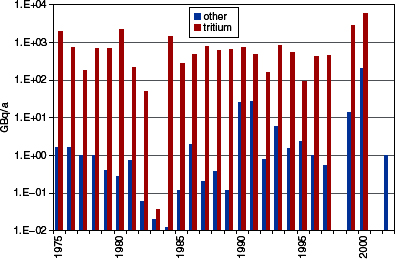
FIGURE 2.8 Variation of annual liquid radioactive effluent releases from the Dresden plant between 1975 and 2003.
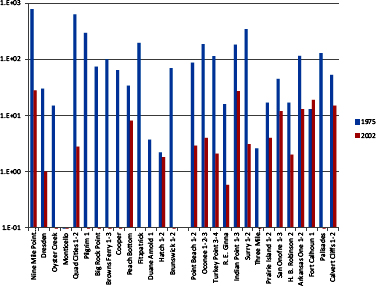
FIGURE 2.9 Comparison of liquid radioactive effluent releases, excluding tritium, for selected BWRs (left) and PWRs (right) in 1975 and 2002. SOURCE: Data from UNSCEAR.
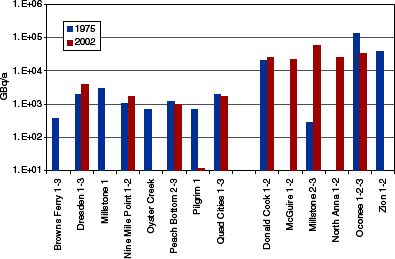
FIGURE 2.10 Tritium released in liquid effluents for selected nuclear plants (left, BWRs; right, PWRs) in 1975 and 2002. NOTE: The North Anna and McGuire plants were not operational in 1975. SOURCE: Data from UNSCEAR.
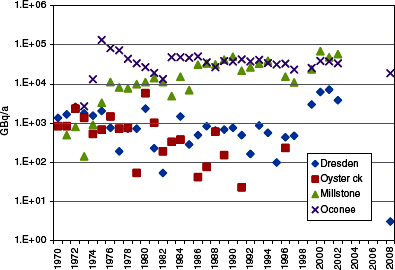
FIGURE 2.11 Variation of annual tritium releases in liquid effluents from selected nuclear plants. SOURCE: Data from UNSCEAR.
-
of mixed fission and activation products are much smaller (in the range from 0.001 to 0.01 curies per year).
- Tritium activity in liquid effluents is much greater for PWRs (about 500 curies per year) than for BWRs (about 30 curies per year). Tritium releases have changed little through time.
- Releases of mixed fission and activation products are greater for BWRs than for PWRs and show a decreasing trend with time.
Table 2.4 compares levels of selected radionuclides in liquid effluent releases in 1980 and 2008-2010 for the two PWR and two BWR plants shown in Table 2.3. For the PWRs (Millstone and North Anna), tritium levels were higher in 2010, whereas the other liquid effluents were much lower in 2008-2010 for both types of plants.
2.1.3 Availability of Information on Effluent Releases
Information on releases of airborne and liquid radioactive effluents from nuclear plants to the environment is available in reports that are submitted by plant licensees to the USNRC. These reports are available in pdf format for all operating nuclear plants in the United States beginning in 2005 (http://www.nrc.gov/reactors/operating/ops-experience/tritium/plant-info.html). Electronic summaries of the data in these reports for the period 1998-2007 are also available in the Effluent Database for Nuclear Power Plants, which is available on the USNRC website (www.reirs.com/effluent/).
Several summaries of total airborne and liquid radioactive effluent releases (and sometimes total tritium and iodine-131 releases) have been published over the years. The United Nations Scientific Committee on the Effects of Atomic Radiation (UNSCEAR) has published summaries of data from nuclear plants worldwide that list total releases of noble gases, particulates, and iodine from 1975 up to 2004 (UNSCEAR, 1982, 1988, 1993, 2000, 2008). The U.S. Environmental Protection Agency (USEPA) published a report (Phillips, 1978) summarizing more detailed isotopic releases for the period 1973-1976. Additional information on airborne emissions is provided in Harris and Miller (2008), Hull (1973), and Marley (1979).
These summary data are useful for understanding the magnitudes of and trends in effluent releases, but they are not sufficiently detailed for use in reconstructing doses to persons living near nuclear facilities to support an epidemiologic study. For this purpose, more detailed information on radionuclide releases are required, including release quantities of specific radionuclides; method of release (i.e., continuous or batch); points of release (i.e., locations of stacks, vents, and liquid discharge points); time of release; and local meteorological conditions at the time of release. These
TABLE 2.4 Comparison of Liquid Radioactive Effluent Releases (in curies) from Four Nuclear Plants, 1980 and 2008-2010
|
Millstone 2 &3 (PWR) |
Dresden 2 & 3 (BWR) |
Oyster Creek (BWR) |
North Anna (PWR) |
|||||
| Radionuclide | 1980 | 2010 | 1980 | 2009 | 1980 | 2008 | 1980 | 2010 |
| Helium-3 | 268 | 427 | 62 | 6.8 | 154 | <MDL | 403 | 1270 |
| Chromium-51 | 0.14 | 1.40 × 10⁻⁵ | 1.60 × 10⁻² | 1.00 × 10⁻⁴ | 9.60 × 10⁻³ | <MDL | 3.90 × 10⁻³ | |
| Manganese-54 | 0.12 | 1.20 × 10⁻⁴ | 4.00 × 10⁻² | 6.60 × 10⁻⁴ | 5.70 × 10⁻² | <MDL | 6.80 × 10⁻³ | 3.60 × 10⁻⁵ |
| Cobalt-58 | 0.69 | 1.24 × 10⁻³ | 8.90 × 10⁻³ | 2.00 × 10⁻⁵ | 6.08 × 10⁻³ | <MDL | 5.50 × l0-1 | 3.50 × 10⁻³ |
| Cobalt-60 | 0.91 | 3.29 × 10⁻³ | 2.00 × l0-1 | 1.10 × 10⁻³ | 3.20 × l0-1 | <MDL | 2.20 × l0-1 | 3.10 × 10⁻³ |
| Zirconium-95 | 0.022 | 1.34 × 10⁻⁴ | 1.50 × 10⁻² | 0.00 | <MDL | 5.50 × 10⁻⁴ | ||
NOTE: MDL, minimum detection limit.
SOURCE: BNL (1983) for 1980 data; Annual Radioactive Effluent Release Reports for 2009-2010 data.
detailed data are available in reports provided to the USNRC by nuclear plant licensees.
The committee undertook a detailed investigation for a sample of plants to determine whether these reports are available for all years of plant operations. The committee selected the following six plants for this investigation: Dresden (Illinois), Millstone (Connecticut), Oyster Creek (New Jersey), Haddam Neck (Connecticut), Big Rock Point (Michigan), and San Onofre (California). These plants were selected because they provide a broad representation of the nuclear plant designs and operating histories:
- Dresden, Big Rock Point, and Oyster Creek are BWRs; Haddam Neck, Millstone, and San Onofre are PWRs.
- Plant sizes range from 240 MWt (Big Rock Point) to 6876 MWt (San Onofre 2 and 3).
- Reactors at these plant sites began operations from the late 1950s (Dresden) to the early 1980s (San Onofre). Two plants (Big Rock Point and Haddam Neck) are no longer operating.
The committee first assessed the availability of these semiannual reports through the USNRC’s public records system (ADAMS).9 The committee, with the assistance of USNRC staff, searched ADAMS and visited the Public Reading Room at USNRC headquarters in Rockville, Maryland, to examine microfiche records. The committee was not able to locate many of the reports for these plants, especially prior to 1975, and some of the reports on microfiche were not legible.
The committee then asked the Nuclear Energy Institute (NEI)10 to contact plant licensees to determine whether they have maintained records of effluent releases and associated meteorological data. Licensees at these six plants were asked the following questions:
- Does the plant licensee maintain records of its effluent monitoring reports that are submitted to the USNRC?
- If so, how far back in time are these records maintained?
- If meteorology data are not included in the effluent monitoring reports, are records of those data also maintained? If so, for how far back in time?
9 The Agencywide Documents Access and Management System (ADAMS) is the USNRC’s official recordkeeping system (see http://www.nrc.gov/reading-rm/adams.html). Two collections of documents are available through this system: The Publicly Available Records System contains full-text documents released since November 1, 1999. The Public Legacy Library contains more than 2 million bibliographic citations for earlier documents. These earlier documents are stored on microfiche.
10 NEI is the policy arm of the nuclear and technology industry. See nei.org.
- In what format(s) are effluent monitoring and meteorology records maintained (i.e., digital or paper)?
- Would these effluent monitoring and meteorology records be made available to support a USNRC-requested epidemiologic study if requested?
The committee obtained the following information from NEI (Ralph Andersen, NEI, verbal communication to K.D. Crowley, February 23, 2012):
- Licensees of operating nuclear plants maintain records of effluent monitoring reports that are submitted to the USNRC. Licensees are not required by the USNRC to maintain these records after their licenses are terminated, but most licensees maintain these records anyway to meet insurance company requirements.
- Prior to the mid 1980s, effluent release and meteorology data are available only in hard copy (paper or microfiche) format. Between the mid 1980s and mid 1990s, these data are available in mixed (i.e., digital or hard copy) format. Some data may be available in digital format from the mid 1990s forward.
- Some plant licensees may be able to provide digital data if requested. Licensees would probably defer to the USNRC for hard copy records because of the significant expense of retrieving these records from their archives.
Information on effluent releases may be available from other sources as well. In the late 1970s the USNRC contracted with Brookhaven National Laboratory to enter the semiannual effluent data from each nuclear plant into an electronic database.11 This effort continued until 1990 and was then replaced by the Effluent Database for Nuclear Power Plants which was described previously. Annual reports summarizing these data are available electronically. However, these annual reports do not provide specific information about effluent release points or associated meteorological data required to estimate atmospheric dispersion. They also do not distinguish batch releases from continuous releases.
11 These data are available in paper form for the following years: 1974 (NUREG-0077, June 1976); 1975 (NUREG-0218, March 1977); 1976 (NUREG-0367, March 1978); 1977 (NUREG-0521, January 1979); 1978 (NUREG/CR-1497 [BNL-NUREG-51192], March 1981); 1979 (NUREG/CR-2227 [BNL-NUREG-51416], November 1981); 1980-1994 (NUREG-CR-2907, vol.1-14).
More detailed data on effluent releases were provided to Pacific Northwest Laboratory (now Pacific Northwest National Laboratory12) researchers who were contracted by the USNRC to develop annual estimates of population exposures around nuclear plants.13 The committee was able to locate the electronic media containing these data covering the years 1978 and 1981-1989 along with some of the corresponding meteorological data used to calculate atmospheric dispersion.14 (Often the meteorological data were averaged over several years.)
The committee judges that these PNL data will be of marginal utility for dose estimation to support an epidemiologic study. The data do not distinguish between batch and continuous releases and reflect only two release heights, “elevated” and “mixed” (i.e., a combination of elevated and ground level). It is also not clear whether the files contain all of the radionuclides that were reported by plant licensees. These data may be helpful if the effluent releases for some particular site cannot be located, but otherwise there appears to be little data in these files beyond what is contained in the reports cited in footnote 12.
Detailed data on effluent releases will need to be obtained from the plant licensee’s effluent release reports to the USNRC. It may be necessary to contact plant licensees to obtain these reports if they cannot be located in the USNRC library. Additionally, data relating to dispersion of effluents in surface waters and to the use that is made of the environment may have to be requested from plant licensees. Obtaining and digitizing these data will be a large and costly job.
2.1.4 Data Quality and Suitability for Estimating Radiation Doses
The committee assessed the quality of the effluent release data and its suitability for use in dose estimation for an epidemiologic study. These assessments are described below.
12 PNL was renamed Pacific Northwest National Laboratory (PNNL) in 1995. This laboratory is located in Richland, Washington, adjacent to the Hanford Site.
13 PNL issued a series of reports entitled Dose Commitments Due to Radioactive Releases from Nuclear Power Plant Sites that covered nuclear plant operations from 1977-1992. The first four reports in the series were issued as PNL-2439 (1977), NUREG/CR-1125/PNL-2940 (1979), NUREG/CR-1498/PNL-3324 (1980), and NUREG/CR-2201/PNL-4039 (1982). The remaining reports were issued from 1982 to 1996 as NUREG/CR-2850 (PNL-4221), vols. 1-14.
14 The data were stored on 5.25-inch and 3.5-inch floppy disks. The committee was able to obtain these disks from a PNNL storage facility and transfer almost all of the data to a CD. The data are available in the Public Access File for this study.
2.1.4.1 Airborne Effluent Releases
As noted in Section 2.1.3, estimating doses to individuals living near nuclear plants from airborne effluent releases in a thorough manner requires detailed information on release quantities of specific radionuclides, method of release (i.e., continuous or batch), points of release (i.e., locations of air and liquid discharge points), time of release, and local meteorological conditions at the time of release (see Section 2.4). In its review of available data, the committee noted that the format of reported data, the specific radionuclides monitored, and the completeness of the data varied significantly from plant to plant, particularly during their early years of operation (i.e., prior to the mid 1980s). As discussed previously, the population doses from airborne releases in early years of plant operations were from short-lived radionuclides in the effluents. The estimated release rates for short-lived radionuclides are very sensitive to the assumed stack flow rate and probable holdup times.
The quality of the reported data was likely much poorer in the early years of operation prior to implementation over time of improved quality-assurance (QA) procedures. There are some unpublished data suggesting that plant licensees may have sometimes overestimated stack flow rates and thus actual effluent activities of shorter-lived radionuclides. There are also documented instances of facilities discovering errors in flow rates (and thus the magnitude of releases), sometimes years after the fact.15
The committee evaluated the quality and availability of airborne effluent release data for a few selected plants and years (see Section 2.1.3). However, a plant-by-plant evaluation will be required to assess data availability and sufficiency for use in a Phase 2 epidemiologic study. The committee judges that if such data are available, they are likely to be sufficiently accurate to develop credible dosimetry estimates that will adequately reflect variations in annual dose from plant to plant as a function of distance and direction from plant boundaries.
The releases of some nuclides may be very uncertain or not available, particularly for earlier years of operation. Also, as previously noted, atmospheric releases of carbon-14 have not been reported until 2010, although their contribution to the collective dose may be substantial (Dominion, 2010a; Kahn et al., 1985). However, because it can be assumed that carbon-14 activity released is approximately proportional to the thermal energy
15 For example, from ML09057085 (2009): “The Dresden Nuclear Power Station (DNPS) Units 2/3 Chimney flow indication was found to be inaccurate in 2008, due to fouling of its flow elements. Further investigation showed that this issue began in April 2004, which resulted in non-conservative reporting of station effluents and calculated offsite doses for this period. This affected the data reported in the Annual Radioactive Effluent Release Reports for the calendar years 2004, 2005, 2006, and 2007 … and the Annual Radiological Environmental Operating Reports for the calendar years 2004, 2005, and 2006.”
generated by the plants, the annual doses resulting from carbon-14 releases can be crudely estimated. It is likely that simplifying assumptions will have to be made to reconstruct complete sets of airborne releases during the entire periods of operation of the nuclear plants considered in any Phase 2 epidemiologic study.
2.1.4.2 Liquid Effluent Releases
Estimating doses from liquid releases in surface waters requires detailed information on the specific radionuclides released; the total amount of activity of each radionuclide released; the time of release; the hydrology at the time of release; and the use that humans make of the water. In its review of available data, the committee noted that, as was the case for airborne effluent releases, the availability and completeness of the data varied significantly from plant to plant, particularly during the early years of operation. Also, the quality of the reported data was likely much poorer in the early years of operation prior to implementation of improved QA procedures.
The committee evaluated the quality and availability of liquid effluent release data for a few selected plants and years (see the discussion in Section 2.1.3). However, a plant-by-plant evaluation will be required to assess data availability and sufficiency for use in a Phase 2 epidemiologic study. The committee judges that if release data are available, they are likely to be sufficiently accurate to develop credible dose estimates. The most important uncertainties in terms of data sufficiency involve liquid effluent releases, particularly the determination of the dispersion of liquid effluents in receiving waters, the evaluation of the contamination of sediments, and the use of the contaminated water for human purposes (e.g., drinking water, consumption of aquatic foodstuffs, and consumption of irrigated terrestrial foodstuffs).
2.1.4.3 Uncontrolled Liquid Releases
Although there are no specific regulatory requirements for licensees to conduct routine onsite environmental surveys and monitoring for potential abnormal spills and leaks of radioactive liquids, regulations do require that licensees keep records of information important to the safe and effective decommissioning of their plants. Because the decommissioning of a nuclear plant requires licensees to clean up radioactive spills and leaks at the site, facility records include information on known spills or other unusual occurrences involving the spread of contamination that might require action as part of any decommissioning activities. These records can be limited to instances where significant contamination remains after procedures to remediate an uncontrolled liquid release, or when there is reasonable likelihood that contamination may have spread to inaccessible areas.
Table 2.5 provides a summary of known uncontrolled/inadvertent releases of radioactive liquids at nuclear plants over the period 1986 to 2006 (USNRC, 2006). These releases include leaks from spent fuel pool or condensate storage tank structures and/or associated equipment. They also include routine liquid releases initially prepared and monitored in accordance with regulatory guidance, but which were discharged to an unanalyzed environmental pathway as a result of degraded radioactive waste equipment or piping.
TABLE 2.5 Summary of Inadvertent Releases of Radioactive Liquid Effluents at Nuclear Plants
|
|
|||
| Nuclear Power Plant | Date of Release Discovery | Source of Release | Radionuclides Detected |
|
|
|||
| Braidwood | March 2005 | Vacuum breaker valves on the circulating water blowdown line | Tritium |
| Byron | February 2006 | Vacuum breaker valves on the circulating water blowdown line | Tritium |
| Callaway | June 2006 | Vacuum breaker valves on the circulating water blowdown line | Tritium, cobalt-58, cobalt-60, cesium-134, cesium-137 |
| Dresden | August 2004, January 2006 | Non-safety related HPCI suction and return line | Tritium |
| Hatch | December 1986 | Fuel transfer canal due to operator action | Tritium |
| Indian Point | August 2005-Unit 1 leakage predates August 2005 | Unit 1 and Unit 2 spent fuel pools | Tritium nickel-63, cesium-137, strontium-90, and cobalt-60 |
| Oyster Creek | September 1996 | Condensate transfer system due to operator action | Tritium |
| Palo Verde | March 2006 | Rain condensing onto property after a gaseous release | Tritium |
| Perry | March 2006 | Feedwater venturi | Tritium |
| Point Beach | 1999 | Retention pond | Tritium, cesium-137 |
| Seabrook | June 1999 | Spent fuel pool | Tritium |
| Salem | September 2002 | Spent fuel pool | Tritium |
| Three Mile Island | May 2006 | Condensate storage tank | Tritium |
| Watts Bar | August 2002 | Effluent release pipe and SFP transfer tube sleeve | Tritium and mixed fission products |
|
|
|||
| SOURCE: USNRC (2006). | |||
Many of the uncontrolled liquid release events documented in Table 2.5 have resulted in groundwater contamination at plant sites. Liquid leakage that enters the subsurface can frequently go undetected because groundwater monitoring within a licensee’s site is only required if the groundwater is used for drinking or irrigation purposes. In the offsite environment, groundwater monitoring is required only if groundwater sources are likely to be impacted by the operation of the nuclear plant. Consequently, there are no regulatory requirements for the regular monitoring of groundwater for the purpose of detecting inadvertent radioactive contamination and its fate and transport either on- or offsite.
As a result of lack of historical groundwater monitoring data, estimation of public dose impacts arising from uncontrolled liquid releases at many sites has required licensees to retroactively undertake the following activities:
- Install new groundwater and/or surface water monitoring networks to evaluate current and potential movement of the released liquid(s).
- Conduct additional radionuclide analyses to define the actual source-term radionuclides and their quantities.
- Perform supplemental bounding dose calculations to back-calculate potential public health impacts associated with releases.
The USNRC’s Liquid Radioactive Release Lessons Learned Task Force (USNRC, 2006) examined available data on uncontrolled release events, including additional monitoring data gathered by licensees after releases were identified. The Task Force did not find any instances where the available data indicated that the near-term health of the public was impacted by uncontrolled liquid releases to the environment (USNRC, 2006, p. 13):
Based on currently available data for sites with detailed evaluations or monitoring, the inadvertent releases of radioactive liquids to surface and/ or to ground-water pathways had a negligible impact on public radiation doses. For many of the identified sites, the lack of a public dose impact resulted from the radioactive contamination remaining within owner controlled areas. For the few events which resulted in detectable radionuclide concentrations in the surface and/or ground-water samples collected outside of the owner controlled area, Dose impacts on members of the public still were determined to be negligible. However, several of the reviewed abnormal release event scenarios did, or potentially could, impact ground-water sources relative to established EPA drinking water standards.
It is beyond the scope of the present study to evaluate the results of this USNRC report. However, if this finding is correct, there is no obvious scientific
advantage16 to including these data as part of any Phase 2 dosimetry study.
A complete understanding of the dose impacts to the public arising from uncontrolled liquid release events would require detailed knowledge of the liquid source terms at the time of release as well as the distribution of released radionuclide concentrations in the environment through time; the latter would require a comprehensive spatial and temporal understanding of the environmental parameters influencing the fate and transport of the released liquid(s). There is considerable uncertainty associated with source terms, subsurface environmental conditions, and subsurface fate and transport behavior at most nuclear plant sites where uncontrolled liquid releases have occurred. The same is true at industrial sites where hazardous chemicals have inadvertently been released to groundwater.
Indeed, it is notoriously difficult to recreate distributions of released subsurface contaminants over time and, hence, difficult to estimate the risks such contaminants have posed, or continue to pose, to public health. The quality and completeness of available data on uncontrolled liquid releases at nuclear plants differs from site to site but, in all cases, uncertainty exists in how these liquids have migrated over time and, thus, the exposure pathways and possible historic doses associated with these releases.
As a result of groundwater contamination associated with uncontrolled liquid releases, the nuclear industry took action in 2006 to implement a voluntary Groundwater Protection Initiative (GPI) (Yhip et al., 2010). In January 2010, the NEI also issued guidelines for the management of buried pipe integrity (NEI, 2010); these guidelines are intended to provide proactive assessment and management of buried piping systems at plants to reduce possibilities of future inadvertent radioactive liquid releases. Both steps have potential to provide future data that might better inform dose impacts to the public living in the vicinity of a nuclear power plant, depending on the quantity and quality of the data being gathered.
2.2 EFFLUENT RELEASES FROM FUEL-CYCLE FACILITIES
Unlike nuclear plants, it is difficult to make general statements about airborne effluent releases from front-end nuclear fuel-cycle facilities, beyond the fact that the majority of releases involve uranium and uranium progeny with lesser amounts of other radionuclides (see Appendix E). Four examples of recent effluent release data for front-end nuclear fuel-cycle facilities are shown in Tables 2.6 through 2.9.
16 The committee notes that there may be other advantages to taking account of these data in dose estimates, including addressing public concerns.
TABLE 2.6 Stack Effluent Release Rates for the Second Quarter of 2011 for the White Mesa Mill in Utah
|
|
||||
| Effluent Release Rates at Release Point (µCi/s) | ||||
|
|
||||
| Radionuclide | North YC Dryer, Run 1 | North YC Dryer, Run 2 | Yellowcake Baghouse | Grizzly Baghouse |
| Natural U | 9.21 * 10-3 | 7.56 * 10-3 | 8.22 * 10-3 | 5.96 * 10-6 |
| Thorium-230 | 9.25 * 10-7 | 1.04 * 10-6 | 1.89 * 10-5 | 6.67 * 10-8 |
| Radium-226 | 2.20 * 10-8 | 2.35 * 10-8 | 1.88 * 10-7 | Not required |
| Lead-210 | 3.94 * 10-6 | 3.90 * 10-6 | 7.97 * 10-7 | Not required |
|
|
||||
| Not required Not requiredNOTE: Radon is not measured at this site. Instead, the radiation dose from radon is estimated through calculation. SOURCE: Denison Mines (2011). |
||||
TABLE 2.7 Airborne and Liquid Effluent Releases from the Honeywell Conversion Facility during the Period January 1, 2010, to June 30, 2010
|
|
||
| Reported Releases (curies) | ||
|
|
||
| Radionuclide | Airborne Effluents | Liquid Effluents |
| Natural U | 4.28 * 10-2 (measured) | 9.12 * 10-1 (measured) |
| Radium-226 | 1.20 * 10-5 (calculated) | 3.08 * 10-3 (measured) |
| Thorium-230 | 1.22 * 10-4 (calculated) | 1.60 * 10-3 (measured) |
|
|
||
| SOURCE: Honeywell (2010). | ||
- Table 2.6 shows airborne effluent releases from the White Mesa Mill near Blanding, Utah, for the second quarter of 2011. The releases include natural uranium, thorium-230, radium-226, and lead-210.
- Table 2.7 shows airborne effluent releases from the Honeywell Conversion Facility in Metropolis, Illinois, for the first half of calendar year 2010. The releases include natural uranium and two progeny, radium-226 and thorium-230.
- Table 2.8 shows airborne effluent releases for the Paducah Gaseous Diffusion Plant for calendar year 2006. Released effluents include the three naturally occurring isotopes of uranium (uranium-234, 235, and 238), uranium decay progeny (thorium-230), and one fission product (technetium-99) and two actinide isotopes (neptunium-237 and plutonium-239).17
17 Recycled uranium (i.e., uranium obtained from reprocessing spent nuclear fuel) was enriched at the Paducah Gaseous Diffusion Plant between 1953 and 1975. This plant is still reporting releases of fission product and actinide effluents from this recycled uranium, albeit in very small quantities.
TABLE 2.8 Airborne Effluent Releases for the Paducah Gaseous Diffusion Plant for Calendar Year 2006
| Reported Release from Location (curies) | |||||||||||||
| Radionuclide | C-400 Grouped Sources |
C-400 Cylinder Drying Station |
C-709/ C-710 Drying Hoods |
C-310 Stack |
Seal Exhaust/ Wet Air Group |
C-409 Dissolver |
C-360 | Total | |||||
| Uranium-234 | 1.39 × 10⁻⁴ | 1.27 × 10⁻⁵ | 5.91 × 10⁻⁴ | 2.04 × 10⁻³ | 1.05 × 10⁻² | 1.03 × 10⁻⁷ | 1.31 × 10⁻⁴ | 1.34 × 10⁻² | |||||
| Uranium-235 | 4.84 × 10⁻⁶ | 4.42 × 10⁻⁷ | 2.05 × 10⁻⁵ | 7.09 × 10⁻⁵ | 3.64 × 10⁻⁴ | 3.59 × 10⁻⁹ | 4.56 × 10⁻⁶ | 4.65 × 10⁻⁴ | |||||
| Uranium-238 | 2.86 × 10⁻⁵ | 9.94 × 10⁻⁶ | 5.49 × 10⁻⁵ | 2.12 × 10⁻⁴ | 3.65 × 10⁻³ | 1.88 × 10⁻⁸ | 1.36 × 10⁻⁵ | 3.97 × 10⁻³ | |||||
| Technetium-99 | 9.40 × 10⁻³ | 1.56 × 10⁻⁸ | 0.00 | 3.65 × 10⁻⁴ | 3.96 × 10⁻⁵ | 1.07 × 10⁻⁷ | 0.00 | 9.80 × 10⁻³ | |||||
| Thorium-230 | 3.95 × 10⁻⁷ | 8.73 × 10⁻⁹ | 0.00 | 3.48 × 10⁻⁶ | 0.00 | 1.25 × 10⁻⁹ | 0.00 | 3.66 × 10⁻⁶ | |||||
| Neptunium-2 3 7 | 1.76 × 10⁻⁵ | 3.01 × 10⁻⁷ | 1.31 × 10⁻⁷ | 2.93 × 10⁻⁵ | 1.22 × 10⁻⁵ | 2.59 × 10⁻⁹ | 1.66 × 10⁻⁵ | 7.61 × 10⁻⁵ | |||||
| Plutonium-239 | 4.65 × 10⁻⁸ | 5.99 × 10⁻⁹ | 0.00 | 1.47 xl0-6 | 0.00 | 8.5 x l0-10 | 0.00 | 1.52 × 10⁻⁶ | |||||
SOURCE: USEC (2008).
TABLE 2.9 Airborne Effluent Releases for the Nuclear Fuel ServicesFacility in Erwin, Tennessee for the Period July 1, 2010, to December 31, 2010
| Quantity Released for Radionuclide (curies) | ||||||||
| Release Point | Technetium- 99 |
Thorium- 228 |
Thorium- 230 |
Thorium- 232 |
Uranium- 234 |
|||
| Main Stack 416 | 1.17 × 10⁻⁷ | 1.17 × 10⁻⁷ | 1.17 × 10⁻⁷ | 2.76 × 10⁻⁵ | ||||
| Stack 185 | 2.67 × 10⁻⁷ | 1.00 × 10⁻⁷ | ||||||
| Stack 234 | ||||||||
| Stack 327 | 1.83 × 10⁻⁵ | 1.45 × 10⁻⁵ | ||||||
| Stack 421 | 8.07 × 10⁻⁷ | 1.01 × 10⁻⁶ | ||||||
| Stack 424 | 2.14 × 10⁻⁷ | 3.81 × 10⁻⁸ | ||||||
| Stack 501 | 4.22 × 10⁻⁹ | 5.42 × 10⁻⁹ | 3.62 × 10⁻⁹ | 1.12 × 10⁻⁸ | ||||
| Stack 502 | 0.00 | 0.00 | 0.00 | 0.00 | ||||
| Stack 503 | 2.66 × 10⁻¹⁰ | 3.42 × 10⁻¹⁰ | 2.28 × 10⁻¹⁰ | 7.03 × 10⁻¹⁰ | ||||
| Stack 573 | 1.92 × 10⁻⁷ | 4.32 × 10⁻⁸ | ||||||
| Stack 600 | 2.93 × 10⁻⁵ | 4.18 × 10⁻⁵ | ||||||
| Stack 615 | 1.07 × 10⁻⁷ | 3.46 × 10⁻⁸ | ||||||
| Stack 646 | 2.28 × 10⁻⁷ | 4.23 × 10⁻⁸ | ||||||
| Stack 649 | 1.48 × 10⁻⁷ | 2.59 × 10⁻⁸ | ||||||
| Stack 701 | 1.85 × 10⁻⁶ | 1.43 × 10⁻⁶ | ||||||
| Stack 702 | 6.21 × 10⁻⁷ | 2.52 × 10⁻⁷ | ||||||
| Stack 703 | 1.08 × 10⁻⁷ | 6.22 × 10⁻⁸ | 8.83 × 10⁻⁸ | 6.76 × 10⁻⁷ | ||||
| Stack 704 | 6.53 × 10⁻⁹ | 3.76 × 10⁻⁹ | 5.34 × 10⁻⁹ | 4.09 × 10⁻⁸ | ||||
| Stack 773 | 4.47 × 10⁻⁸ | 5.75 × 10⁻⁸ | 3.83 × 10⁻⁸ | 1.18 × 10⁻⁷ | ||||
| Stack 774 | 2.74 × 10⁻⁷ | 2.16 × 10⁻⁷ | 2.38 × 10⁻⁷ | 5.93 × 10⁻⁶ | ||||
SOURCE: NFS (2011).
- Table 2.9 shows airborne effluent data for the Nuclear Fuel Services facility in Erwin, Tennessee, for the last half of calendar year 2010. Released effluents include the three naturally occurring isotopes of uranium; natural thorium (thorium-232); uranium and thorium progeny (thorium-228, 230); one fission product (technetium-99); and several actinide isotopes (plutonium-238, 239, 240, and 241 and americium-241).18
A key take-away message from an examination of Tables 2.6 through 2.9 is that reported effluent releases from fuel-cycle facilities in recent years
18 The presence of plutonium-238 in the effluents would not be expected to result from commercial nuclear fuel production. This isotope is produced by irradiating uranium-238 with deuterons and is produced for use in thermoelectric generators. The fission products and actinide effluents are likely from the processing of recycled uranium.
| Uranium- | Uranium- | Plutonium- | Plutonium- | Plutonium- | Plutonium- | Americium- |
| 235 | 238 | 238 | 239 | 240 | 241 | 241 |
| 1.06 × 10⁻⁶ | 2.93 × 10⁻⁷ | |||||
| 3.10 × 10⁻⁹ | 8.26 × 10⁻⁹ | |||||
| 1.15 × 10⁻⁸ | 9.60 × 10⁻⁸ | 3.39 × 10⁻⁸ | 8.55 × 10⁻⁷ | 5.66 × 10⁻⁸ | ||
| 4.50 × 10⁻⁷ | 5.65 × 10⁻⁷ | |||||
| 3.13 × 10⁻⁸ | 2.50 × 10⁻⁸ | |||||
| 1.18 × 10⁻⁹ | 6.63 × 10⁻⁹ | |||||
| 1.96 × 10⁻⁹ | 3.92 × 10⁻⁹ | 4.80 × 10⁻⁷ | ||||
| 0.00 | 0.00 | 4.44 × 10⁻⁷ | ||||
| 1.24 × 10⁻¹⁰ | 2.47 × 10⁻¹⁰ | 3.90 × 10⁻⁸ | ||||
| 1.34 × 10⁻⁹ | 5.93 × 10⁻⁹ | |||||
| 1.29 × 10⁻⁶ | 9.05 × 10⁻⁷ | |||||
| 1.07 × 10⁻⁹ | 3.32 × 10⁻⁹ | |||||
| 1.31 × 10⁻⁹ | 7.06 × 10⁻⁹ | |||||
| 8.00 × 10⁻¹⁰ | 4.56 × 10⁻⁹ | |||||
| 4.43 × 10⁻⁸ | 5.72 × 10⁻⁸ | |||||
| 7.80 × 10⁻⁹ | 1.92 × 10⁻⁸ | |||||
| 6.98 × 10⁻⁸ | 8.51 × 10⁻⁸ | 2.48 × 10⁻⁶ | ||||
| 4.22 × 10⁻⁹ | 5.14 × 10⁻⁹ | 2.36 × 10⁻⁷ | ||||
| 2.08 × 10⁻⁸ | 4.15 × 10⁻⁸ | 2.09 × 10⁻⁶ | ||||
| 2.52 × 10⁻⁷ | 2.95 × 10⁻⁷ | 6.01 × 10⁻⁶ | ||||
are substantially smaller than reported releases from nuclear plants, typically only fractions of curies for each radionuclide.19 However, it is quite likely that releases were significantly higher in the early years of operation of these facilities similar to what was found for nuclear plants.
The reported releases shown in the table are for normal operations only; they do not include unplanned releases. As for any operating industrial facility, significant unplanned releases from fuel-cycle facilities (as well from nuclear plants) could have large impacts on doses to populations. Moreover, the toxicological risks of uranium releases (in addition to the radiation risks) also need to be taken into account in any epidemiologic study.
19 Release quantities do not tell the whole story about relative risks. Intake of alpha emitters through inhalation or ingestion can result in substantially higher doses per unit activity released than external exposure to gamma emitters.
2.2.1 Availability of Information on Effluent Releases
With one exception, fuel-cycle facility licensees are required to report their effluent releases to the USNRC (or to agreement-state regulators20) on a semiannual basis. The exception is for licensees of gaseous diffusion plants (e.g., the Paducah Gaseous Diffusion Plant; see Table 1.2 in Chapter 1). Prior to 2008, gaseous diffusion plant licensees were required to report their effluent releases on a quarterly basis. From 2008 onward, licensees are only required to report their effluent releases when they renew their facility operating licenses. However, annual reporting of effluent releases to the USEPA is required to meet the 40 CFR 6121 requirements. In cases where unplanned releases have occurred, such releases would need to be taken into account when making dose estimates for an epidemiologic study To the committee’s knowledge, data on radioactive effluent releases from individual fuel-cycle facilities have not been compiled into summary form. Consequently, it will be necessary to obtain this information for each facility, either through ADAMS or from plant licensees directly, for use in an epidemiologic study. Given the range of facility types, the fact that some facilities were operating as far back as the 1950s as part of the U.S. weapons program with oversight from the Atomic Energy Commission and its successor agencies (presently the U.S. Department of Energy), and the fact that reporting requirements have varied over the years, the availability of effluent release data prior to the mid 1970s (when the USNRC assumed regulatory responsibility for many of these plants) is unclear.
The committee contacted the licensee for the Nuclear Fuel Services (NFS) facility in Erwin, Tennessee, to determine whether records of effluent releases could be made available. The NFS plant was selected because it has a long operating history (it initiated operations in 1957) and has nearby residents who are concerned about effluent releases from the plant. The committee obtained the following information from NFS (Marie Moore, NFS, verbal communication to K.D. Crowley, February 15, 2012):
- NFS maintains a computerized list of its vital records that were submitted to the USNRC. Almost all of these records are in hard copy (paper or microfiche), and their retrieval would be difficult
20 Under the USNRC’s agreement-state program, states can assume authority to license and regulate certain activities within their borders, including the production and utilization of byproduct materials (radioisotopes), source materials (uranium and thorium), and certain quantities of special nuclear materials. Under the agreement-state program, for example, Utah has assumed the authority to license and regulate the White Mesa Mill in Blanding, Utah.
21 National Emission Standards for Hazardous Air Pollutants.
-
and labor intensive. NFS began scanning vital records into an electronic format in 2010.
- A meteorological station was installed at NFS in the mid 1980s, but detailed meteorological data that support environmental monitoring report submittals to the USNRC are only available from 1999 to present.
2.2.2 Data Quality and Suitability for Estimating Radiation Doses
The committee judges that if release data are available, they are likely to be adequate for estimating doses for a Phase 2 epidemiologic study (see Chapter 3). The licensee reports provide effluent data for individual radionuclides for both air emissions and liquid effluents at each point of release. The committee was not able to assess the availability and quality of data for early years of plant operations when releases were highest. However, as was the case for nuclear power plants, the quality of effluent release data in recent years is likely much better than for the early years of operation due to more stringent QA requirements as well as stricter requirements to ensure releases and doses meet regulatory requirements.
Nuclear plants and fuel-cycle facilities are required to have Radiological Environmental Monitoring Programs (REMPs) to monitor radioactivity in the environment around their sites. This program is described in Appendix H. In principle, the data gathered by a licensee’s REMP could be used to validate doses estimated from effluent releases and/or provide independent estimates of radiation exposure at the monitoring sites. The potential usefulness of environmental monitoring data for this purpose is discussed in this section.
It is important to note that REMPs at nuclear facilities are not intended to provide a comprehensive assessment of radionuclide distributions and concentrations in the environment surrounding the facilities. Instead, their purpose is to demonstrate that facility operations are in compliance with regulations. Monitoring therefore focuses on sampling of environmental media that might serve as pathways for radiation exposure to humans, based on effluent release pathways and the local site characteristics. The media of interest are air, water, and foodstuffs. Pathways for exposure are internal and external radiation.
The following sections provide examples of environmental monitoring data for nuclear plants. Similar kinds of data are generated for monitoring around fuel-cycle facilities but are not presented in this chapter for the sake of brevity.
2.3.1 Atmospheric Monitoring
For environmental pathways associated with airborne releases, monitoring usually involves air sampling and TLD22 measurements at various locations in the vicinity of the plant, in addition to the monitoring of foodstuffs (see Section 2.3.3), to determine if radioactive effluent releases are detectable in the environment. Typically, air sampling measurements are made at a minimum of five stations: three stations near the plant boundary in the direction of prevailing winds (i.e., downwind); one in the vicinity of a nearby community likely to have the greatest chance of radiation exposure; and one at a control location 15 to 30 km distant in the opposite direction of prevailing winds (i.e., upwind).
Several types of analyses are carried out on the air samples: Radioio-dine is measured weekly, and gross beta activity of particulates (captured on filters) is also measured weekly. Analyses to identify alpha- and beta-emitting radionuclides are made quarterly on composite samples. Typically, radionuclide concentrations measured in air samples at downwind stations are comparable with those at the control station. That is, normal operations of a plant do not result in measurable radionuclide concentrations in air, even though the measurement techniques are quite sensitive and can identify occurrences of releases at distance (e.g., Figure 2.12).
Measurements of direct radiation exposure using TLDs are discussed in detail in Section 2.3.4. These measurements are generally not sensitive enough to detect increases above background levels except at locations close to plant boundaries.
Examples of environmental monitoring data collected at the North Anna (located in Virginia) and Dresden plants are shown in Tables 2.10 through 2.13. The data in these tables further illustrate that, for the 1970s as well as in recent years, environmental monitoring programs did not detect radioactive materials above control (or background) levels at these plants.
2.3.2 Water Monitoring
For environmental pathways associated with liquid effluent releases, monitoring usually involves sampling of surface water, groundwater, and drinking water in locations near the plant, as well as shoreline sediments from existing or potential recreational facilities (see Appendix G). Surface and groundwater samples are analyzed for gamma-emitting isotopes and tritium; drinking water samples are analyzed for gross beta, gammaemitting
22 Thermoluminescent dosimeters (TLDs) contain inorganic crystalline materials, typically calcium fluoride (CaF2) and lithium fluoride (LiF), that record exposure to ionizing radiation.
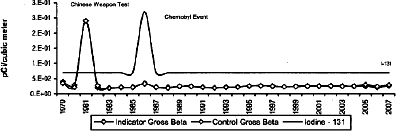
FIGURE 2.12 Measurements of gross beta and iodine-131 activity in air samples at the Fermi plant (located in Michigan) from 1979 to 2007. The measurements are sensitive enough to detect air emissions from Chinese nuclear weapons testing in the early 1980s and the Chernobyl accident in 1986. SOURCE: Detroit Edison (2007).
TABLE 2.10 Results of Environmental Monitoring at the North Anna Plant for 2009
|
|
||
| Indicator Locations, Mean Range (10-3 pCi/m3) | Control Locations, Mean Range (10-3 pC/m3) | |
|
|
||
| Air particulates, gross beta | 5.80-32.9 | 7.65-36.3 |
| Air iodine (I-131) |  LLD LLD |
LLD |
| Air particulates, beryllium-7a | 101-267 | 139-171 |
| Air particulates, cesium-134 | 1.83-3.34 | LLD |
| Air particulates, cesium-137 | LLD |
LLD |
| Air particulates, strontium-89 | LLD |
LLD |
| Air particulates, strontium-90 | LLD |
LLD |
|
|
||
| NOTE: LLD, lower limit of detection. aBeryllium-7 is naturally present in the environment. SOURCE: Dominion (2010b). |
||
TABLE 2.11 Results of Environmental Monitoring at the North Anna Plant carried out by the Virginia Department of Health for 2009
|
|
||
| Indicator Location | Control Location | |
|
|
||
| Air particulates, gross beta, 10-3 pCi/m3 | 20-40 | 20-30 |
| Air iodine (iodine-131), pCi/m3 | 0.05-0.12 |
0.10-0.26 |
|
|
||
| SOURCE: Virginia Department of Health (2009). | ||
TABLE 2.12 Results of Environmental Monitoring at the Dresden Plant for 2009
|
|
||
| Indicator Locations, Mean Range (10-3 pCi/m3) | Control, Mean Range(10-3 pCi/m3) | |
|
|
||
| Air particulates, gross beta | 7-43 | 8-42 |
| Air iodine (iodine-131) | 10-70 |
15-69 |
| Air particulates, cesium-137 | 2-4 |
2-4 |
| Air particulates, cesium-134 | 2-4 |
2-4 |
|
|
||
| SOURCE: Exelon (2010). | ||
TABLE 2.13 Results of Environmental Monitoring at the Dresden Plant for 1975
|
|
||
| Indicator Locations, Mean Range | Control, Mean Range | |
|
|
||
| Air particulates, gross beta, 10-3 pCi/m3 | 5-6 | 5-7 |
| Air iodine (iodine-131), pCi/m3 | 0.03 |
0.03 |
|
|
||
| SOURCE: Commonwealth Edison (1976). | ||
isotopes, tritium, and in some cases iodine-131; and sediments are analyzed for gamma-emitting isotopes.
The committee examined water monitoring data from the environmental monitoring reports for Dresden (BWR) and Millstone (PWR) plants. Reports were selected from a recent monitoring period, namely 2009, and an earlier monitoring period, namely 1975. The committee observed that the spatial distribution of monitoring stations for surface water, groundwater, well water, and sediments at these plants were not sufficient to provide a spatial map of environmental radioactivity resulting from liquid effluent releases. This is not surprising given that the goal of the REMP is to obtain measurements to demonstrate regulatory compliance, not to obtain measurements for making radiation dose estimates.
The most frequently detected radiological contaminant in water samples is tritium; see, for example, the measurements around the North Anna plant in Figure 2.13. However, reported tritium concentrations were below USEPA drinking water standards.23 Cesium-137 was reported in sediment samples at both control and indicator measurement stations around the plant and is thus likely present in the environment due to fallout from above-ground nuclear weapons testing.
Many of the radiological concentration measurements collected under REMP yield values below detection levels. Table 2.14 presents environmental monitoring data for the Dresden plant from the plant licensees’ 2009 REMP report (Exelon, 2010). All sampling locations are located within 3 km of the site. Radionuclide concentrations were below detection limits in the vast majority of cases. Tritium was detected in surface and groundwater samples but at levels well below those established by USEPA for drinking water. Monthly composites of surface water samples revealed gross beta concentrations that are similar at indicator and control locations.
23 The USEPA has established an annual-average maximum contaminant level for tritium in drinking water of 20,000 picocuries per liter (740 becquerels per liter) based on an annual dose equivalent to the whole body of 4 mrem, assuming consumption of 2 liters per day of drinking water.
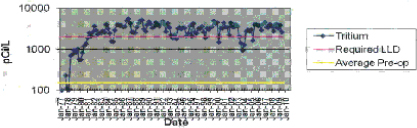
FIGURE 2.13 Variations in tritium concentrations at a surface water monitoring station in the vicinity of the North Anna plant from 1977 to 2010. SOURCE: Dominion (2010b).
Cesium-137 was detected in sediment samples and is likely due to fallout from above-ground nuclear weapons testing.
Dresden has experienced a number of leaks over its 40-year-plus operating history from underground lines and spills from above-ground systems containing radioactive water. These leaks and spills have created areas of subsurface contamination within the plant’s protected area.24 Starting in 2006, Dresden embarked on a Radiological Groundwater Monitoring Program to understand the extent and threat posed by this contamination. The program includes 39 groundwater monitoring wells within the protected area, 26 wells outside the protected area, and 6 surface water sampling points at five different canals and one cooling pond within the controlled area. These 71 locations are sampled twice per year. Short-term monitoring of select areas of shallow groundwater near historic leak points is also conducted using “sentinel” wells.
Appendix F in the 2009 Annual Radiological Environmental Operating Report includes the results of measurements of tritium and 14 radionuclides (beryllium-7, potassium-40, manganese-54, cobalt-58, iron-59, cobalt-60, zinc-65, niobium-95, zirconium-95, iodine-131, cesium-134, cesium-137, barium-140, and lanthanum-140) for the two annual sampling rounds. In 2009, only potassium-40 (in 6 out of 65 samples) and tritium (in 22 of the 39 wells inside the protected area and in 5 of the 26 wells outside the protected area) were found to be above the detectable limits. These data are probably sufficient to create spatial patterns of radiological concentrations
24 Nuclear plants are demarcated into zones for security purposes. The controlled area of a nuclear plant includes the land on which the plant is built and any surrounding area that is controlled by the plant licensee. Public access to some parts of the controlled area may be allowed by the licensee. The protected area of the plant is a smaller parcel of land within the controlled area that has physical controls (fences, gates, and guards) to prevent public access without licensee permission.
TABLE 2.14 Environmental Monitoring Data for the Dresden Plant for 2009
| Media | Frequency | Total Number of Samples | Analysis Type | Required LLD (pCi/L) |
Indicator Location, Mean Range (pCi/L) |
Control Location Mean Range (pCi/L) |
| Surface Water (3 stations) |
Monthly | 36 | Gross beta | 4 | 4.8-10.9 (12/12) |
4.0-10.4 (22/24) |
| Monthly | 36 | Gamma | ||||
| Manganese-54 | 15 | < LLD | < LLD | |||
| Cobalt-58 | 15 | < LLD | < LLD | |||
| Iron-59 | 30 | < LLD | < LLD | |||
| Cobalt-60 | 15 | < LLD | < LLD | |||
| Zinc-65 | 30 | < LLD | < LLD | |||
| Niobium-95 | 15 | < LLD | < LLD | |||
| Zirconium-95 | 30 | < LLD | < LLD | |||
| Iodine-131 | 15 | < LLD | < LLD | |||
| Cesium-134 | 15 | < LLD | < LLD | |||
| Cesium-137 | 18 | < LLD | < LLD | |||
| Barium-140 | 60 | < LLD | < LLD | |||
| Lanthanum-140 | 15 | < LLD | < LLD | |||
| Quarterly | 12 | Tritium (H-3) | 2000 | 181-537 (2/4) |
465-621 (3/8) |
|
| Ground/ well water (2 stations) |
Quarterly or more |
16 | Tritium (H-3) | 2000 | 250-725 (12/16) |
N/A |
| Quarterly or more |
16 | Gamma | ||||
| Manganese-54 | 15 | < LLD | N/A | |||
| Cobalt-58 | 15 | < LLD | N/A | |||
| Iron-59 | 30 | < LLD | N/A | |||
| Cobalt-60 | 15 | < LLD | N/A | |||
| Zinc-65 | 30 | < LLD | N/A | |||
| Niobium-95 | 15 | < LLD | N/A | |||
| Zirconium-95 | 30 | < LLD | N/A | |||
| Iodine-131 | 15 | < LLD | N/A | |||
| Cesium-134 | 15 | < LLD | N/A | |||
| Cesium-137 | 18 | < LLD | N/A | |||
| Barium-140 | 60 | < LLD | N/A | |||
| Lanthanum-140 | 15 | < LLD | N/A | |||
| Media | Frequency | Total Number of Samples | Analysis Type | Required LLD (pCi/L) |
Indicator Location, Mean Range (pCi/L) |
Control Location Mean Range (pCi/L) |
| Aquatic sediment (1 station) |
Semi- 2 annually |
Gamma | pCi/kg dry |
|||
| Manganese-54 | N/A | < LLD | N/A | |||
| Cobalt-58 | N/A | < LLD | N/A | |||
| Iron-59 | N/A | < LLD | N/A | |||
| Cobalt-60 | N/A | < LLD | N/A | |||
| Zinc-65 | N/A | < LLD | N/A | |||
| Niobium-95 | N/A | < LLD | N/A | |||
| Zirconium-95 | N/A | < LLD | N/A | |||
| Iodine-131 | N/A | < LLD | N/A | |||
| Cesium-134 | 150 | < LLD | N/A | |||
| Cesium-137 | 180 | 87 (1/2) | N/A | |||
| Barium-140 | N/A | < LLD | N/A | |||
| Lanthanum-140 | N/A | < LLD | N/A | |||
| Dredge spoils (2 stations) |
When river 6 was dredged | Gamma | pCi/kg dry |
|||
| Manganese-54 | N/A | < LLD | N/A | |||
| Cobalt-58 | N/A | < LLD | N/A | |||
| Iron-59 | N/A | < LLD | N/A | |||
| Cobalt-60 | N/A | < LLD | N/A | |||
| Zinc-65 | N/A | < LLD | N/A | |||
| Niobium-95 | N/A | < LLD | N/A | |||
| Zirconium-95 | N/A | < LLD | N/A | |||
| Iodine-131 | N/A | < LLD | N/A | |||
| Cesium-134 | 150 | < LLD | N/A | |||
| Cesiums-137 | 180 | 95-142 (4/6) | N/A | |||
| Barium-140 | N/A | N/A | ||||
| Lanthanum-140 | N/A | N/A | ||||
NOTE: LLD, lower limit of detection. SOURCE: Exelon (2010, Table A-1).
for tritium. However, reported offsite concentrations of tritium are very low (208 to 322 pCi/L, just above minimum levels of detection). It would thus appear that most groundwater contamination currently remains onsite, limiting the value of these data for use in estimating doses for an epidemiologic study. Nonetheless, this monitoring program is important for understanding potential future risks.
Table 2.15 presents results from the environmental monitoring program at the Millstone plant for 2009. As can be seen in the table, radioisotope concentrations were below detection limits in the vast majority of instances. Tritium was detected in seawater samples at one location (location 32), which is in the vicinity of the plant’s discharge point and probably has not undergone significant aquatic mixing that would dilute radiological concentrations. However, levels of tritium were well below USEPA drinking water standards. Detectable levels of naturally occurring potassium-40 were also reported in seawater, well water, and bottom sediment samples. Cesium-137 was detected in sediment samples and is likely due to fallout from above-ground nuclear weapons testing. Thorium-228 was also detectable in a number of sediment samples.
The Connecticut Department of Environmental Protection (DEP) performs independent checks on certain of Millstone’s environmental measurements. A DEP comprehensive review of historical Millstone environmental monitoring data in 2006 (DEP, 2006) concluded that “the collective sampling in and around Millstone Power Station show expected levels of residual fallout from weapons testing and the Chernobyl event and are unrelated to the operation of the Millstone Power Station.”
At Millstone, a cross-comparison between the liquid effluent monitoring program and the REMP program can be made by comparing tritium monitoring results at location 32-I, which is in the vicinity of the plant’s effluent discharge location. Figure 2.14 shows a 5-year cross-comparison provided by the licensee. The cross-comparison indicates good agreement between the measurements from the effluent monitoring and environmental monitoring programs, providing a level of confidence in the data reported by both programs.
2.3.3 Foodstuff Monitoring
Nuclear plant licensees are required to monitor for radioactivity in foodstuffs that are grown in the vicinity of their plants. This includes monitoring for radioactivity in milk, fish and invertebrates, food products (e.g., corn and other grains), and broad-leaf vegetables. The following sampling and analysis activities are required:
- Milk: Samples from milking animals at three locations within 5 km having the highest dose potential and one sample from milking
TABLE 2.15 Environmental Monitoring Data for the Millstone Plant for 2009
| Environmental Media | Radionuclide | Indicator Mean | Control Mean |
| Well water (pCi/L) | Barium-140 | LLD | |
| Beryllium-7 | LLD | ||
| Cobalt-58 | LLD | ||
| Cobalt-60 | LLD | ||
| Chromium-51 | LLD | ||
| Cesium-134 | LLD | ||
| Cesium-137 | LLD | ||
| Iron-59 | LLD | ||
| Tritium | LLD | ||
| Iodine-131 | LLD | ||
| Potassium-40 | 79 | 49 | |
| Lanthanum-140 | LLD | ||
| Manganese-54 | LLD | ||
| Niobium-95 | LLD | ||
| Rutheium-103 | LLD | ||
| Ruthenium-106 | LLD | ||
| Antimony-125 | LLD | ||
| Strontium-89 | LLD | ||
| Strontium-90 | LLD | ||
| Thorium-228 | LLD | ||
| Zinc-65 | LLD | ||
| Zirconium-95 | LLD | ||
| Seawater (pCi/L) | Barium-140 | LLD | |
| Beryllium-7 | LLD | ||
| Cobalt-58 | LLD | ||
| Cobalt-60 | LLD | ||
| Chromium-51 | LLD | ||
| Cesium-134 | LLD | ||
| Cesium-137 | LLD | ||
| Iron-59 | LLD | ||
| Tritium | 848 | ||
| Iodine-131 | LLD | ||
| Potassium-40 | 286 | 279 | |
| Lanthanum-140 | LLD | ||
| Manganese-54 | LLD | ||
| Niobium-95 | LLD | ||
| Ruthenium-103 | LLD | ||
| Ruthenium-106 | LLD | ||
| Antimony-125 | LLD | ||
| Thorium-228 | LLD | ||
| Zinc-65 | LLD | ||
| Zirconium-95 | LLD | ||
| Environmental Media | Radionuclide | Indicator Mean | Control Mean |
| Bottom sediment (pCi/g dry) | Silver-110m | LLD | |
| Beryllium-7 | LLD | ||
| Cobalt-58 | LLD | ||
| Cobalt-60 | LLD | ||
| Chromium-51 | LLD | ||
| Cesium-134 | LLD | ||
| Cesium-137 | 0.153 | ||
| Iron-59 | LLD | ||
| Iodine-131 | LLD | ||
| Potassium-40 | 18.1 | 14.2 | |
| Manganese-54 | LLD | ||
| Niobium-95 | LLD | ||
| Ruthenium-103 | LLD | ||
| Ruthenium-106 | LLD | ||
| Antimony-125 | LLD | ||
| Thorium-228 | 2.71 | ||
| Zinc-65 | LLD | ||
| Zirconium-95 | LLD | ||
NOTE: LLD, lower limit of detection.
SOURCE: Dominion Nuclear Connecticut, Inc. (2010, Section 3.1).
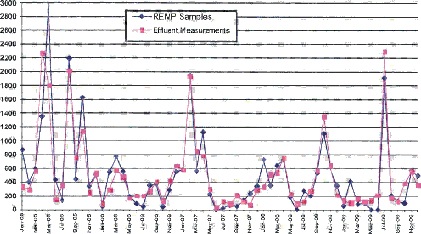
FIGURE 2.14 Five-year comparison between liquid effluent monitoring data and environmental monitoring data for tritium at location 32-I at the Millstone Plant. SOURCE: Dominion Nuclear Connecticut, Inc. (2010).
-
animals at a control location. The samples must be analyzed for gamma isotopes and iodine-131.
- Fish and invertebrates: Samples of each commercially and recreationally important species in the vicinity of plant discharge areas as well as samples in areas outside the influence of plant discharges. The edible portions of samples must be analyzed for gamma isotopes.
- Food products: One sample of each principal class of food products from areas irrigated with water into which liquid effluents have been discharged. The edible portions must be analyzed for gamma isotopes.
- Broad-leaf vegetables: If milk sampling is not performed,25 three different kinds of broad-leaf vegetables must be sampled and analyzed for gamma isotopes and iodine-131. Additionally, samples of broad-leaf vegetables grown 15-30 km distant from the plant in the least prevalent wind direction must also be analyzed for gamma isotopes and iodine-131.
Some nuclear plants have arranged with local landowners to sample from their properties. In some cases, licensees have established gardens on plant sites to obtain the necessary samples.
Environmental measurements of foodstuffs around nuclear plants generally show no activity above control levels. In fact, most measurements are below detection limits.
2.3.4 Direct Radiation Monitoring
Direct radiation exposure primarily occurs as a result of external irradiation from radioactive materials released into the atmosphere (mainly noble gases), deposited on the ground (mainly iodine and particulates), or contained in surface water and sediments (lakes or streams). Direct exposure can also occur as a result of exposure to external irradiation from radioactive waste and spent fuel stored onsite and from induced radioactivity in BWR turbines. Exposure to direct radiation from onsite sources would only be a concern for plant workers and persons living close to the plant boundary.
The USNRC requires licensees to monitor direct radiation in the environment. Licensees are required to use specific characteristics at each site to develop a surveillance program that meets regulatory requirements. The USNRC provides generic guidance to licensees on sampling and measurement types, numbers, and frequencies (USNRC, 1977, 1978). Each facility
25 Not all nuclear plants are located in proximity to dairy farms.
develops its own site-specific sampling plan subject to approval by the USNRC (e.g., Exelon, 2011).
TLD measurements are generally made at several dozen locations in rings around the plant boundary. The inner ring is generally located close to the plant boundary, whereas the outer ring is generally located at a distance of about 5-10 km from the boundary. Additional dosimeters are placed at one or more distant control locations and at other locations of special interest, such as more highly populated areas or in prevailing downwind areas. Figure 2.15 shows the arrangement of environmental monitoring stations around the Millstone plant. Plants may supplement or substitute the passive detectors at some locations with active detectors such as continuous monitors (e.g., high-pressure ionization chambers [HPICs] or scintillation detectors). The passive detectors generally are measured (and replaced) quarterly, whereas the active detectors, if used, provide real-time data.
In addition to radiation monitors, continuous air sampling is also carried out as described in Section 2.3.1. The air sampling data can be used to estimate (or bound) the deposition density of iodine and particulates, and resultant external exposure rate, for comparison with model calculations based on measured particulate and iodine release rates.
The purpose of direct exposure monitoring is to demonstrate that the
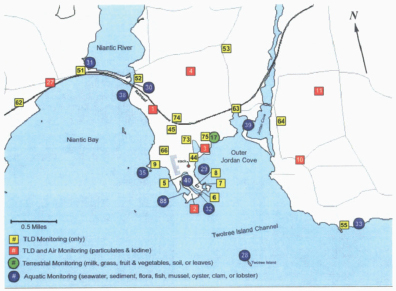
FIGURE 2.15 Environmental monitoring sites around Millstone Point Nuclear Power Station located in Connecticut. SOURCE: Dominion Nuclear Connecticut, Inc. (2010).
integrated radiation exposure at any location outside the facility boundary does not exceed levels that might have resulted in a dose to any individual greater than the operational limits set by regulations. The ability to demonstrate this depends on whether the quarterly integrated passive detector measurements are accurate and precise enough to allow one to distinguish increases in integrated exposures from the facility from the temporal and spatial variations in natural background exposures at the site (see below).
The quality of environmental measurements using TLDs has improved steadily over the years (Klemic et al., 1999). Nevertheless, measured exposures are uncertain due to fading and calibration error (energy response).26 Contemporary intercomparisons of TLD and other dosimeters used for monitoring environmental radiation levels have demonstrated that over 80 percent of the dosimeters tested were able to predict a field reference value within 30 percent (one standard deviation), only about 60 percent were able to reproduce a laboratory calibrated dosimeter value within 10 percent (one standard deviations) (NCRP, 2007).
Earlier intercomparisons suggested even greater uncertainty. In an intercomparison exercise conducted in 1974, the predicted exposure by 50 sets of passive dosimeters exposed to an integrated exposure of 16 millirad (mrad) varied around the actual exposure value by 25 percent (one standard deviation) (Beck, 1975). A study by USEPA at the Haddam Neck Station in 1974 determined that the TLD data reported by the facility predicted background levels inconsistent with USEPA’s independent measurements (Kahn et al., 1985).
A careful TLD measurement program should be capable of identifying increases over background levels that might approach the design objectives for power reactors of 15 mrem to any organ.27 However, such programs are generally not capable of verifying the small predicted increases in exposures due to routine effluent releases from nuclear plants. For example, TLD data reported for the Dresden plant during the 2009 July-September quarter (Exelon, 2010) varied from 20-28 mR over 16 locations in the inner ring around the plant. Two sets of dosimeters (two CaF2, two LiF) were exposed at each location. At two locations the quarterly exposures differed by as much as 5 mR (22 vs. 27 and 22 vs. 26).
A location far from the facility in a sector toward which the wind blows infrequently is often used as a control site to demonstrate that no significant increases occurred at any of the measurement locations closer
26 Note that for detecting increases in exposure due to facility releases, it is measurement precision that is most important; the accuracy of the integral exposure at a particular loca tion is generally biased due to shielding of the TLDs as a result of their placement on walls of buildings or on telephone poles.
27 Operating limits are established to control the amounts of radioactive materials released from nuclear plants. The USNRC requires these limits to be established in accordance with the design objectives in 10 CFR 50, Appendix I.
to the plant due to effluent releases. However, this assumes that ambient temporal variations in natural background at the control location were the same as at the other measurement locations, which is not necessarily a valid assumption. Annual exposures can vary temporally by as much as 10 mR per year due to variations in soil moisture, and they can vary spatially, even at locations only a few hundred meters apart, due to variations in soil composition (Beck and Miller, 1982), consistent with the spatial variation in the Dresden plant TLD data (see Section 3.5 in Chapter 3).
Lang et al. (1987) studied TLD data collected at the Hatch plant (located in Georgia) over a 4-year period. They concluded that it would be very difficult to detect increases in 3-month exposures below 10 percent of average background levels from TLD data because of measurement error and spatial and temporal variations in natural background radiation levels.
The maximum (i.e., MEI) annual external radiation exposure from airborne effluent releases from nuclear plants is currently estimated as 1 mR per year (USNRC, 2009). Although airborne effluent releases from some nuclear plants in the 1970s and 1980s were up to 1000 times higher than current releases (UNSCEAR, 1982,1988, 1993, 2000, 2008; see also Section 2.1.1 in this chapter), estimated maximum quarterly integrated exposures for most plants were still likely less than 1-2 mR (see Chapter 3). Even if changes on the order of a few mR per quarter could be detected, they could not be unambiguously attributed to effluent releases from nuclear plants because of variations in natural background. Consequently, the passive monitoring systems around nuclear plants cannot be used to quantify increases in exposure resulting from routine effluent releases and therefore cannot be used to validate estimated population doses.
Real-time monitors, when used, can provide quantitative information on actual increases in exposure rates at a plant due to airborne effluent releases and can be used to validate estimates based on measured release rates. Several sites do monitor external radiation levels using HPIC detectors. For example, the state of Illinois maintains an array of HPIC detectors around the Dresden plant. An example of HPIC measurements made at various distances from a nuclear plants site in the northeastern United States is shown in Figure 2.16 (Beck et al., 1972).
As discussed later in this chapter, fluctuations in exposure rates above background can be integrated to estimate exposure for comparison with the estimated levels calculated from the reported plant effluent releases. This provides an independent verification of the reported effluent release levels.
2.3.5 Monitoring Deposited Radionuclides
Continuous air sampling measurements generally have lower limits of detection that are below the levels of airborne particulates and iodine that actually occur as a result of plant releases during normal operations. Consequently,
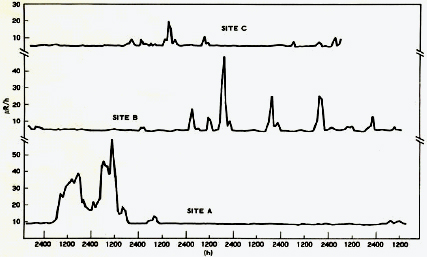
FIGURE 2.16 Mean hourly exposures over a 1-week period at three sites near at the Millstone plant. Site A is located inside the fence line; Site B is located approximately 2 km from the stack; and Site C is located several kilometers away from the stack. SOURCE: Beck et al. (1972).
such measurements are generally not useful for validating specific calculations of air activities, and possible ground contamination, based on measured release rates.28 Plant licensees collect and analyze soil samples at a few locations around their facilities at least annually. But even after years of plant operation, the total increase in soil activity is either too low to detect or too low to distinguish from background levels. Soil and air sampling data can, however, be used to provide an upper bound on dose estimates. Because predicted levels of exposure rates from deposited radionuclides released by a plant are only small fractions of the estimated exposures from noble gas releases, these potential direct radiation exposures cannot generally be detected by the plant’s passive monitoring systems either.
Monitoring programs based on arrays of passive detectors are adequate (as intended) for demonstrating compliance with operational limits on maximum exposure to any individual (i.e., the MEI), but they are not useful for confirming direct exposure at any specific location based on measured release rates, nor are they useful for estimating population doses for an epidemiologic study. Air sample data collected by plant licensees are not
28 However, air monitors are useful for detecting and quantifying activity in air that might result from an accident or abnormal release that could result in potential doses approaching or exceeding regulatory limits.
sensitive enough to estimate deposition of radionuclides from the plant, nor are analyses of soil or vegetation samples.
2.3.6 Independent Validation Studies of Environmental Monitoring Programs
A number of independent entities conduct studies on radioactive effluent releases, environmental radioactivity, and maximum dose estimates to independently corroborate data collected by plant licensees. In the early years of nuclear plant operations, USEPA and Atomic Energy Commission research organizations conducted numerous independent studies in the environment around plants, measuring external radiation levels and radionuclide concentrations in plants, animals, and water (e.g., Beck et al., 1972; Blanchard et al., 1976; Carter et al., 1981; Kahn et al., 1970, 1971,1974; Gogolak, 1973; Gogolak and Miller, 1974a, b; Voilleque et al., 1981; Weiss et al., 1974).
In almost all instances, these studies did not detect radionuclides attributable to nuclear plants in environmental samples, even when plants were emitting much greater amounts of activity than at present. Independent estimates of MEI doses from noble gases and iodine-131 in milk were also generally of the same order as those reported by plant operators, generally confirming that radioactive effluents from the plants were not being significantly underestimated. Some of the studies also provided direct confirmation of reported release and atmospheric diffusion calculations.
Some states also conduct independent monitoring around nuclear plants.29 For example, the state of Texas conducts environmental monitoring activities within the 10-mile emergency planning zones of its two nuclear plants (Comanche Peak and South Texas). The state deploys solidstate detectors to measure direct radiation and air monitors to measure gaseous effluents, particulates, and radioiodine. The state also samples liquids, vegetation, sediments, and fish and invertebrates for radioactivity.
The state of Illinois conducts independent monitoring near its six operating nuclear plants (Braidwood, Byron, Clinton, Dresden, LaSalle, and Quad Cities) as well as some shut down facilities. The state maintains a network of 415 environmental dosimeters to measure and document ambient gamma radiation levels within 10-mile (~16 km) radii of these plants. The state also collects samples of water, sediment, fish, milk, and vegetables from 132 locations (see iema.illinois.gov). A committee subgroup observed
29 The USNRC provided funding to states to carry out environmental monitoring around nuclear plants from 1979 to 1997. Support was discontinued because state programs were seen to duplicate licensee REMPs. Several states (e.g., Illinois, New Jersey, Pennsylvania, Texas, and Washington) have continued to conduct environmental monitoring with their own funding.
real-time data being collected by the state around the Dresden plant using an HPIC detector.
Some states have their own onsite inspectors at nuclear plants in addition to the USNRC’s resident inspectors. For example, the Pennsylvania Bureau of Radiation Protection assigns a nuclear engineer to each of the state’s five nuclear plants (Beaver Valley, Limerick, Peach Bottom, Susquehanna, and Three Mile Island) to review operating procedures, conduct inspections, and maintain an awareness of environmental monitoring programs run by plan licensees.30 The Bureau also monitors environmental dosimeters at 30 locations. New Jersey also has its own REMP.31
Environmental monitoring around one nuclear plant is also being carried out by a private entity. The C-10 Foundation32 is monitoring airborne radioactivity and wind speeds and directions in Massachusetts and New Hampshire communities that are located within the 10-mile emergency planning zone for the Seabrook plant. The monitoring data are available in near real time.
In addition to the various validation studies specific to nuclear plants described above, there have been a number of more recent studies validating atmospheric transport models similar to those used at USNRC-licensed facilities (Brown, 1991; Napier et al., 1994; Rood et al., 1999; Thiessen et al., 2005). There have also been a number of other recent studies that describe the validation of models used for estimating doses resulting from releases of various radionuclides to the environment that are similar to the models used for estimating doses from USNRC-licensed facilities (BIOMOVS, 1991; IAEA, 2003; Till et al., 2000) (see Chapter 3 for a discussion of dose assessment).
2.3.7 Utility of Environmental Monitoring Data for Estimating Radiation Doses
As described in Sections 2.3.1 to 2.3.3, nuclear plant licensees are required to measure radioactivity in the environment surrounding their facilities, including in the air, water, and foodstuffs. Almost all environmental measurements reported by plant licensees, even in early years of plant operations when radioactive effluent releases were much higher than
30 See http://www.nei.org/resourcesandstats/publicationsandmedia/insight/insight-web-extra/revealing-the-green-side-of-nuclear-energy-power-plants-closely-monitored-to-protect-the-environment/.
31 See http://www.nj.gov/dep/rpp/bne/index.htm.
32 This not-for-profit foundation was established in 1991, when the Seabrook plant began operations. The foundation’s environmental monitoring activities are carried out under con tract with the Massachusetts Department of Public Health.
at present, are either below minimum detection limits (MDLs) or are not sensitive enough for use in dose estimation. Consequently, monitoring data can play only a minimal role in the calculation of doses received by populations residing in the vicinity of nuclear facilities.
Environmental concentrations of radionuclides released from nuclear plants and the resulting absorbed doses must instead be calculated from estimated effluent releases, as described in Chapter 3. The committee judges, however, that the measured environmental concentrations, even if they are usually below MDL, are useful for assessing upper bounds of dose in the vicinity of nuclear plants. In addition, the usually rare measurements above the MDL can be used to assess the validity of the reported effluent releases or the method of calculation of environmental concentrations.
2.4 AVAILABILITY OF METEOROLOGICAL DATA
Estimates of doses from airborne emissions require detailed information on both radioactive effluent releases and the local meteorology at the time those releases occurred. All nuclear plants are required to conduct meteorological monitoring (see Appendix F) for use in estimating offsite doses from airborne effluents. For continuous releases, facilities generally use average annual values for wind speed and direction as a function of atmospheric stability and release height to estimate offsite doses. However, to estimate doses for sporadic batch releases, data are required for the actual times of release because local meteorology can vary significantly over short time intervals.
As discussed previously in this chapter, airborne releases of primary importance from nuclear plants are noble gases, tritium, and carbon-14. One needs to know the direction and strength of the wind and the state of the atmosphere to estimate transport of these releases. Transport of noble gases is unaffected by rain. However, this would not be the case for facilities that release radioactive particulates, which would include many fuel cycle facilities.
The committee could not determine the extent to which detailed meteorology data are readily available for all plants and years of operation. Some plant licensees report annual meteorological data in their REMP reports. More detailed meteorology data may need to be recovered directly from facility licensees or from nearby meteorological stations. If detailed meteorology data are not available for plants with significant batch releases or highly time-variable continuous releases, then estimated doses may be significantly more uncertain than those for plants with relatively timeinvariable continuous releases. However, batch releases are generally significant only for PWRs. However, as shown earlier in this chapter, airborne releases for PWRs tend to be lower than for BWRs.
2.5 FINDINGS AND RECOMMENDATIONS
This chapter provides the committee’s assessment of the availability, completeness, and quality of information on airborne and liquid radioactive effluent releases and direct radiation exposure from nuclear facilities to support an epidemiologic study. Based on its assessment, the committee finds that:
- Effluent release and direct exposure data collected by facility licensees, when available, are likely to be sufficiently accurate to develop a population-level dose reconstruction that provides rough estimates in annual variations in dose as a function of distance and direction from nuclear facilities (see Sections 2.1.3 and 2.2.2). However, even when available, such data would not be sufficient to support detailed reconstructions of doses to specific individuals living near nuclear facilities, which would require very precise information on the whereabouts and dietary habits of the individuals under consideration. Facility-specific evaluations will be required to determine the availability and quality of the effluent release and direct exposure data. These data are likely to be of better quality for later years of facility operations relative to earlier years because of improved QA procedures (see Sections 2.1.4 and 2.2.3).
- Carbon-14 releases from nuclear plants may make a significant contribution to population dose, especially in recent years. However, plant licensees have not been required to estimate or report carbon-14 releases until 2010. It will be necessary to develop a methodology for estimating releases of carbon-14 prior to 2010 to support dose estimation for an epidemiologic study.
- Meteorology data collected by nuclear plants and fuel-cycle facilities are probably adequate to support estimates of radiation doses for continuous effluent releases. However, the committee was unable to determine the extent to which detailed meteorology data are readily available for all facilities and years of operation. Facility-specific evaluations will be required to determine the availability and quality of meteorology data to support dose estimation for an epidemiologic study (see Section 2.4).
- Environmental monitoring data have limited usefulness for estimating doses from effluent releases around nuclear plants and fuel-cycle facilities. Almost all environmental measurements reported by facilities are either below the MDLs or are not sensitive enough to allow for the development of adequate dose estimates. Data from environmental monitoring that are above MDLs can, however, be used to validate reported effluent releases or the methods of dose calculation (see Sections 3.3 and 3.6 in Chapter 3).
- Obtaining and digitizing effluent release and meteorology data for use in an epidemiologic study will be a large and costly effort. Existing digitized data for nuclear plants are of marginal usefulness (see Section 2.1.3), and to the committee’s knowledge such data do not exist in electronic form for fuel-cycle facilities. It may be necessary to contact individual licensees to obtain these data, in addition to information on surface water dispersion of effluents, and information on the use that is made of the environment around facilities. Data may not be available for all facilities and all years of operation.
In light of these findings (especially Findings 1, 2, and 5), the committee recommends that a pilot study be undertaken to demonstrate the feasibility of obtaining sufficient data on effluent releases, dispersion of the released activities in the atmosphere and surface waters, and the use that is made of the environment around facilities for use in dose estimation to support an epidemiologic study. This pilot study should:
- Obtain effluent release, direct exposure, and meteorology data for the six nuclear plants and one fuel-cycle facility discussed in Section 2.1.3 for their entire periods of operation; the committee suggests Dresden (Illinois), Millstone (Connecticut), Oyster Creek (New Jersey), Haddam Neck (Connecticut), Big Rock Point (Michigan), San Onofre (California), and Nuclear Fuel Services (Tennessee) for the reasons described in Section 2.1.3. If data from these facilities are not available, then other facilities having similar characteristics should be selected.
- Digitize these data into a form that is usable for dose estimation (see Chapter 3).
- Develop interpolation algorithms for estimating effluent releases for sites and/or years when detailed effluent release data are not available.
- Develop a methodology for estimating releases of carbon-14 from the six nuclear plants for all years of plant operations.
The results of this pilot study should be used to inform decisions about any Phase 2 epidemiologic study effort.
Finally, the USNRC did not ask the National Academy of Sciences to review effluent release monitoring and reporting requirements as part of this study. Nevertheless, the committee notes that it would be useful for the USNRC to review these requirements to determine if they can be adjusted to improve the usefulness of effluent release, meteorological, and environmental monitoring data for future dose reconstructions. Making such data
freely available to the public in summary form (as the USNRC is doing now with its Effluent Database for Nuclear Plants; see Section 2.1.3) could be an important step for informing the public about these releases.
REFERENCES
Beck, H. L. (1975). Techniques for Monitoring External Environmental Radiation around Nuclear Facilities, Proceedings of the 8th Annual Conference on Nuclear Safety Research (In Japanese), May.
Beck, H. L., and K. M. Miller (1982). Temporal Variations of the Natural Radiation Field. Transactions of the Second Special Symposium on the Natural Radiation Environment, Wiley Eastern.
Beck, H. L., J. A. DeCampo, C. V. Gogolak, W. M. Lowder, J. E. Mclaughlin, and P. D. Raft (1972). New perspectives on low level environmental radiation monitoring around nuclear facilities. Nucl. Tech. 14:232239.
BIOMOVS (Biospheric Model Validation Study) (1991). Multiple Model Testing Using Chernobyl Fallout Data of I-131 in Forage and Milk and Cs-137 in Forage, Milk, Beef and Grain. BIOMOVS Technical Report 13. Stockholm: Swedish Radiation Protection Institute.
Blanchard, R. L., W. L. Brink, H. E. Kolde, H. L. Krieger, D. M. Montgomery, S. Gold, A. Martin, and B. Kahn (1976). Radiological Surveillance Studies at the Oyster Creek BWR Nuclear Generating Station, Report EPA-520/5-76-003. Cincinnati, Ohio: U.S. Environmental Protection Agency, Office of Radiation Programs, June.
BNL (Brookhaven National Laboratory) (1983). Radioactive Materials Released from Nuclear Power Plants, 1980. NUREG/CR-2907, BNL-NUREG-51581, Vol. 1, January.
Brown, K. J. (1991). Rocky Flats 1990-91 Winter Validation Tracer Study. Report AG91-19. Salt Lake City, Utah: North American Weather Consultants.
Carter, J. W., K. A. Morgan, J. W. Poston, and B. Khan (1981). Assessment of Public Health Risk Associated with Radioactive Air Emissions from Two Minnesota Nuclear Power Plants. Report, School of Nuclear Engineering, Georgia Institute of Technology, Atlanta.
Commonwealth Edison (1976). Dresden Nuclear Power Station Radioactive Waste, Environmental Monitoring and Occupational Personnel Radiation Exposure, July through December 1975 (February).
Daugherty, N., and R. Conatser (2008). Radioactive Effluents from Nuclear Plants: Annual Report 2008. Washington, DC: Office of Nuclear Reactor Regulation, U.S. Nuclear Regulatory Commission.
Denison Mines (2011). Semi-Annual Effluent Monitoring Report for Period January 1, 2011 through June 30, 2011 (August).
DEP (Connecticut Department of Environmental Protection) (2006). Reassessment of Millstone Power Station’s Environmental Monitoring Data. Division of Radiation (March).
Detroit Edison (2007). Fermi 2—2007 Annual Radioactive Effluent Release and Radiological Environmental Operating Report for the period of January 1, 2007 through December 31, 2007.
Dominion (2010a). North Anna Power Station Unit Nos. 1 and 2 Independent Spent Fuel Storage Installation (ISFSI) Annual Radioactive Effluent Release Report (April 26).
Dominion (2010b). North Anna Power Station Unit Nos. 1 and 2 Independent Spent Fuel Storage Installation (ISFSI) Annual Radiological Environmental Operating Report (April 26).
Dominion Nuclear Connecticut, Inc. (2010) Millstone Power Station Units 1, 2, and 3 2009 Annual Radiological Environmental Operating Report (April 28).
EPRI (Electric Power Research Institute) (2010). Estimation of Carbon-14 in Nuclear Power Plant Gaseous Effluents. EPRI Technical Report 1021106.
Exelon (2010). Dresden Nuclear Power Station Units 1, 2 and 3. Annual Radiological Environmental Operating Report, 1 January through 31 December 2009 (May).
Exelon (2011). Dresden Nuclear Power Station Units 1, 2 and 3 Annual Radiological Environmental Operating Report, 1 January through 31 December 2010 (May).
Gogolak, C. V. (1973) Comparison of Measured and Calculated Radiation Exposure from a Boiling Water Reactor Plume, Report HASL-277. New York: U.S. Atomic Energy Commission.
Gogolak, C. V., and K. M. Miller (1974a). Method for obtaining radiation exposure due to a boiling water reactor plume from continuously monitoring ionization chambers, Health Phys. 27:132.
Gogolak, C. V., and K. M. Miller (1974b). Determination of gamma ray exposure in the vicinity of a boiling water power reactor, presented at the Symposium on Population Exposures, Conf. Report 741018, p. 207 (October).
Harris, J. T., and D. W. Miller (2008). Radiological effluents released by U.S. commercial nuclear power plants from 1995–2005. Health Phys. 95(6):734-743.
Honeywell (2010). Facility Effluent Report, January 1, 2010–June 30, 2010. Honeywell-Metropolis Works (August).
Hull, A. P. (1973). Average Effluent Releases from U.S. Nuclear Power Reactors, Compared with Those from Fossil-Fueled Plants, in Terms of Currently Applicable Environmental Standards. Informal report, Brookhaven National Laboratory, Health Physics and Safety Division.
IAEA (International Atomic Energy Agency) (2003). Testing of Environmental Transfer Models using Data from the Atmospheric Release of Iodine-131 from the Hanford Site, USA, in 1963. Report of the Dose Reconstruction Working Group of the Biosphere Modelling and Assessment (BIOMASS) Programme, Theme 2. Vienna: IAEA.
Kahn, B., R. L. Blanchard, H. L. Krieger, H. E. Kolde, D. G. Smith, A. Martin, S. Gold, W. J. Averett, W. L. Brinck, and G. J. Karches (1970). Radiological Surveillance Studies at a Boiling Water Nuclear Power Reactor, EPA Report BRH/DER 70-1.
Kahn, B., R. L. Blanchard, H. E. Kolde, H. L. Krieger, S. Gold, W. L. Brinck, W. J. Averett, D. B. Smith, and A. Martin (1971). Radiological Surveillance Studies at a Pressurized Water Nuclear Power Reactor, Report RD 71-1.
Kahn, B., R. L. Blanchard, W. L. Brinck, H. L. Krieger, H. E. Kolde, W. J. Averett, S. Gold, A. Martin, and G. Gels (1974). Radiological Surveillance Study at the Haddam Neck Nuclear Power Station, EPA Report EPA-520/3-74-007.
Kahn, B., M. W. Carter, and J. W. Poston (1985). Verification of Radiation Exposure from Airborne Effluent at a PWR Nuclear Power Station”, in Environmental Radiation ‘85, Rocky Mountain Chapter, Health Physics Society, 1404 Bridger St., Laramie WY 82070. January 6-10, pp. 575-582.
Klemic, G., J. Hobe, S. Sengupta, P. Shebell, K. Miller, P. T. Carolan, G. Holeman, H. Kahnhauser, P. Lamperti, C. Soares, N. Azziz, and M. Moscovitch (1999). State of the art of environmental dosimetry:11th International Intercomparison and Proposed Performance Tests. Radiat. Prot. Dosim. 85(1):201-206.
Lang, E., J. Hardeman, and B. Kahn (1987). Use of environmental TLD data at a nuclear power station to estimate detection limits for radiation exposure due to station operation. Health Phys. 52(6):775-785.
Marley, R. C. (1979). Radioactivity Releases to the Environment by Nuclear Power Plants— Locally and for the Total Fuel Cycle. MIT Energy Laboratory Report MIT-EL 79-014 (March).
Napier, B. A., J. C. Simpson, P. W. Eslinger, J. V. Ramsdell, Jr., M. E. Thiede, and W. H. Walters. (1994). Validation of HEDR Models. PNWD-2221 HEDR UC-000 (May), Battelle Pacific Northwest Laboratories, Richland, Washington.
NCRP (National Council on Radiation Protection and Measurements) (1987). Public Radiation Exposure from Nuclear Power Generation in the United States. NCRP Report 92. Bethesda, Maryland: NCRP.
NCRP (2007). Uncertainties in the Measurement and Dosimetry of External Radiation. NCRP Report 158. Bethesda, Maryland: NCRP.
NEA (Nuclear Energy Agency). (2003). Effluent Release Options from Nuclear Installations: Technical Background and Regulatory Aspects. Paris: NEA/Organisation for Economic Co-Operation and Development.
NEI (Nuclear Energy Institute) (2010). Guideline for the Management of Buried Pipe Integrity. Report NEI-09-14. Washington, DC: NEI (January).
NFS (Nuclear Fuel Services, Inc.) (2011). Biannual Effluent Monitoring Report, July through December 2010 (February).
Phillips, J. W. (1978). Summary of Radioactivity Released in Effluents from Nuclear Power Plants from 1973 thru 1976. Report EPA-520-3-77-012. Washington, DC: Office of Radiation Programs.
Rood, A. S., G. G. Killough, and J. E. Till (1999). Evaluation of atmospheric transport models for use in Phase II of the Historical Public Exposures Studies at the Rocky Flats Plant. Risk Anal. 19(4):559-576.
Thiessen, K. M., B. A. Napier, V. Filistovic, T. Homma, B. Kanyár, P. Krajewski, A. I. Kryshev, T. Nedveckaite, A. Nényei, T. G. Sazykina, U. Tveten, K. L. Sjöblom, and C. Robinson (2005). Model testing using data on 131I released from Hanford. J. Environ. Rad. 84(2):211-224.
Till, J. E., G. G. Killough, K. R. Meyer, W. S. Sinclair, P. G. Voillequé, S. K. Rope, and M. J. Case. (2000). The Fernald Dosimetry Reconstruction Project. Technology 7:270-295.
UNSCEAR (United Nations Scientific Committee on the Effects of Atomic Radiation). (1982). Ionizing Radiation: Sources and Biological Effects. United Nations Publications.
UNSCEAR (1988). Sources, Effects and Risks of Ionizing Radiation. United Nations Publications.
UNSCEAR (1993). Sources and Effects of Ionizing Radiation. United Nations Publications.
UNSCEAR (2000). Sources and Effects of Ionizing Radiation. United Nations Publications.
UNSCEAR (2008). Sources of Ionizing Radiation. United Nations Publications.
USEC (United States Enrichment Corporation) (2008). Paducah Gaseous Diffusion Plant, Docket No. 70-7001, Application for Renewal of Certificate of Compliance, GDP-1 (April).
USNRC (U.S. Nuclear Regulatory Commission) (1977). Regulatory Guide 1.111, Methods for Estimating Atmospheric Transport and Dispersion of Gaseous Effluents in Routine Releases from Light-Water-Cooled Reactors. Revision 1 (July).
USNRC (1978). Regulatory Guide 4.1, Programs for Monitoring Radioactivity in the Environs of Nuclear Power Plants.
USNRC (2006). US NRC Liquid Radioactive Release Lessons Learned Task Force Final Report (September).
USNRC (2007). Radioactive Effluents from Nuclear Power Plants, Annual Report 2007. Washington, DC: USNRC, Office of Nuclear Reactor Regulation.
USNRC (2009). Radioactive Effluents from Nuclear Power Plants, Annual Report 2008.
Virginia Department of Health (2009). Environmental Radiation Surveillance Data, Annual Report 2009. Division of Radiological Health.
Voilleque, P. G., B. Kahn, H. L. Krieger, D. M. Montgomery, J. H. Keller, and B. H. Weiss (1981). Evaluation of the Air-Grass-Milk Pathway for 1311 at the Quad Cities Nuclear Power Station. NUREG/CR-1600.
Weiss, B. H., P. G. Voilleque, J. H. Keller, B. Kahn, H. L. Krieger, A. Martin, and C. R. Phillips (1974). Detailed measurements of 131I in air, vegetation and milk around three operating reactor sites. Environmental Survelliance Around Nuclear Installations, p. 169. Vienna: IAEA.
Yhip, K. C., G. J. Oliver, and R. L. Andersen (2010). The Industry Groundwater Protection Initiative: A Watershed Moment. Radwaste Solutions (March/April).


