
Origin of Radioactivity in Fuel-Cycle Facilities
Fuel-cycle facilities are involved in the extraction and processing of uranium to produce fuel for nuclear reactors. Consequently, the most important radioactive effluent releases from these facilities involve uranium and its decay products (Table E.1).
Uranium and its decay products are present in equilibrium at mining and milling facilities (Figure E.1). The uranium decay products are removed during the milling process1 and disposed of onsite as mill tailings (Figure E.2), which are potential sources of radioactive particulate and radon gas effluent releases from these facilities.
Other radioactive isotopes are sometimes present in effluent releases from enrichment and fuel fabrication facilities, usually at trace levels. These include cesium-137, technetium-99, as well as a number of actinide isotopes, most notably uranium-236, neptunium-237, and plutonium-239/240. These isotopes are produced by fission and neutron-capture reactions (these reactions are described in Appendix D). Their presence in an effluent release indicates that the facility has processed uranium that was previously irradiated in a nuclear reactor.2
1 However, the decay products “grow back” into the uranium with time, especially those decay products near the top of the uranium decay chains, which have short half-lives (see Figure E.2).
2 For example, recycled uranium (i.e., uranium obtained from reprocessing spent nuclear fuel) was enriched at the Paducah Gaseous Diffusion Plant between 1953 and 1975. This plant is still reporting releases of radioactive effluents from this recycled uranium.
TABLE E.1 Typical Effluent Releases from Fuel-Cycle Facilities
|
|
|
| Facility Type | Typical Radioactive Effluents |
|
|
|
| Mining (in situ leaching) | Uranium, radon, and progeny |
| Milling | Uranium, radon, and progeny |
| Conversion | Uranium, radium-226, thorium-230 |
| Enrichment | Natural uranium, uranium-235, thorium-230, technetium-99, neptunium-237, plutonium-239, 240 |
| Fuel Fabrication | Uranium-234, 235, 236, 238 |
|
|
|
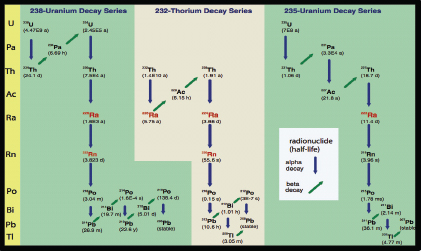
FIGURE E.1 Schematic illustration of the uranium-235, thorium-232, and ura-nium-238 decay chains showing decay modes (i.e., alpha or beta decay), half-lives, and progeny. SOURCE: U.S. Geological Survey, http://gulfsci.usgs.gov/tampabay/data/2_biogeochem/images/decaychain.gif.
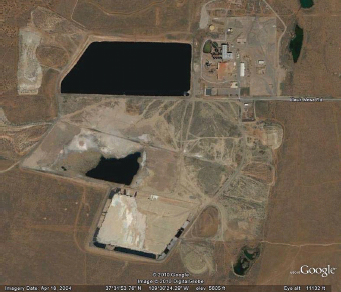
FIGURE E.2 Aerial view of the White Mesa Uranium Mill near Blanding, Utah. The mill facilities can be seen in the upper right quadrant of the photo. The filled and active mill tailings ponds cells occupy most of the remainder of the photo. SOURCE: Elise A. Striz (USNRC) presentation at the Atlanta committee meeting.


