
3
Contributions to Global Sea-Level Rise
Sea-level rise is governed by processes that alter the volume of water in the global ocean—primarily thermal expansion of sea water and transfers of water from terrestrial reservoirs, such as land ice and groundwater, to the ocean. The Intergovernmental Panel on Climate Change (IPCC) Fourth Assessment Report found that thermal expansion accounted for about one-quarter of the observed sea-level rise for 1961–2003, melting of land ice accounted for less than half, and changes in land water storage accounted for less than 10 percent (Bindoff et al., 2007). For the last 10 years of that period (1993–2003), the IPCC estimated that thermal expansion and land ice melt each contributed about half to the total sea-level rise. The improved agreement between estimates of the individual contributions and the total sea-level rise for the later time period was attributed to the availability of satellite altimetry data and other global ocean data sets and to better knowledge of the processes causing sea-level rise. Subsequent work has corrected instrument biases, reducing estimates of the thermal expansion contribution to sea-level rise, and recorded increased rates of land ice loss. In the most recent estimate, for 1993–2008, the contribution from land ice increased to 68 percent, the contribution from thermal expansion decreased to 35 percent, and land water storage contributed -3 percent (sea-level fall; Church et al., 2011).
This chapter evaluates the contributions of thermal expansion, glaciers, ice sheets, and other terrestrial sources of water to global sea-level rise. Each section begins with a summary of findings from the IPCC Fourth Assessment Report, then evaluates more recent results.
Sea level is affected by changes in the density of sea water, induced by temperature changes (thermosteric) or by salinity changes (halosteric). Freshening of the water column (halosteric expansion) has been estimated to account for about 10 percent of the global average steric sea-level rise during recent decades (e.g., Antonov et al., 2002; Munk, 2003; Ishii et al., 2006). However, only about 1 percent of the halosteric expansion contributes to the global sea-level-rise budget because ocean mixing increases the salinity and thus decreases the volume of the added freshwater (Bindoff et al., 2007). Consequently, only the thermosteric component is discussed below.
When the ocean warms, seawater becomes less dense and expands, raising sea level. Because warm water expands more than cold water with the same amount of heating, and seawater at higher pressure expands more than seawater at lower pressure, global sea-level change depends on the distribution of ocean temperature change throughout the ocean, from top to bottom. Thermosteric sea-level change is calculated from temperature and pressure measurements made from a wide variety of instruments that descend through the water column, are towed from ships, or are attached to moored and drifting buoys and profiling floats (see Johnson et al., 2006).
Estimates from the IPCC Fourth Assessment Report
The IPCC Fourth Assessment Report found that warming in all three of the major ocean basins has occurred over the past few decades (Bindoff et al., 2007). Further, thermal expansion of the global ocean (thermosteric sea-level rise) exhibits significant decadal and interannual variations. Thermosteric sea-level rise was estimated to account for approximately one-quarter of the observed rate of global sea-level rise from 1961 to 2003, contributing 0.32 ± 0.12 mm yr-1 down to 700 m depth and 0.42 ± 0.12 mm yr-1 down to 3000 m depth. For the last 10 years of that period (1993–2003), the contribution of thermal expansion was estimated to have increased to 1.5 ± 0.5 mm yr-1 above 700 m and 1.6 ± 0.5 mm yr-1 above 3,000 m, about half of the observed rate of global sea-level rise.
Recent Estimates
At about the time the IPCC Fourth Assessment Report was published, systematic efforts began to be made to correct for biases in the expendable bathythermograph (XBT) and mechanical bathythermograph (MBT) data, which constitute the majority of ocean temperature observations prior to 2002, and in Argo data (Box 3.1). These biases affected the temperature inferred from measurements and thus the calculated rate of thermosteric sea-level rise. Thermosteric sea-level trends have recently been reanalyzed using bias-corrected temperature data, and the record has been extended by new observations. In addition, a few new estimates of the thermosteric fraction of sea level have been made using data assimilation products and satellite data.
BOX 3.1
Bathythermograph and Argo Measurements
Bathythermographs are dropped from ships and transmit temperature via a thin wire as they sink through the water column. Mechanical bathythermographs (MBTs) record temperature at 5 m depth intervals down to approximately 285 m. Thus, they are useful only for studying the thermal structure of the upper ocean. The successor expendable bathythermographs (XBTs) can provide temperature profiles to depths of approximately 760 m (standard instruments) or 1,830 m (special instruments). Data from MBTs and/or XBTs are available since 1948.
Ocean profiling floats are deployed under the multi-national Argo program and by individual countries. Argo profiling floats began measuring the temperature and salinity of the upper 1,000–2,000 m of the ocean in 2000. The Argo array currently comprises more than 3,000 ocean profiling floats distributed around the world (see Figure). Data from these floats are collected via satellite.
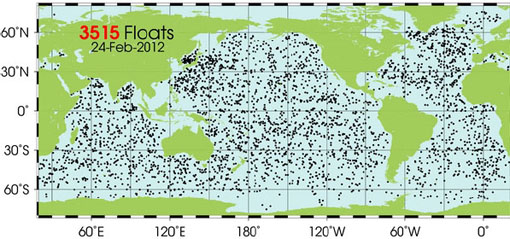
FIGURE Distribution of Argo profiling drifters on February 24, 2012. These floats measure salinity and temperature over the upper 1,000–2,000 m of the ocean. SOURCE: These data were collected and made freely available by the International Argo Program and the national programs that contribute to it (<http://www.argo.ucsd.edu>, <http://argo.jcommops.org>).
In Situ Data
A time-varying warm bias (systematically warmer temperature than the true value) has been found in the global XBT data, and a cold bias (systematically colder temperature than the true value) has been found in a small fraction of Argo float data (e.g., Gouretski and Koltermann, 2007; Wijffels et al., 2008; Ishii and Kimoto, 2009; Willis et al., 2009). XBT and MBT temperature observations are subject to instrument bias, such as depth bias. The depth of each temperature observation is calculated using a fall-rate equation and the time elapsed since the XBT entered the water. Inaccuracies in the fall rate affect the apparent depth at which the temperature profile is taken, which in turn causes a temperature bias that varies with depth. The MBT depth bias may have resulted from a delayed response by the diaphragm used to sense pressure and thus infer depth (Gouretski and Koltermann, 2007). The Argo biases were associated with a particular set of instruments deployed mainly in the Atlantic Ocean (Willis et al., 2009). The sensors on these instruments use pressure measurements to infer depth, but a flaw caused temperature and salinity values to be associated with incorrect pressure values, biasing the data.
Correcting for XBT depth bias reduced the magnitude of the interdecadal variability previously seen in the thermosteric sea-level signal during the 1970s (Domingues et al., 2008). An apparent sharp rise in thermosteric sea level during the 1970s was greatly decreased in the corrected data of Levitus et al. (2009), and essentially disappeared in the corrected data of Ishii and Kimoto (2009; compare the dotted and solid red and blue lines in Figure 3.1, top). Correcting for depth bias also changed the estimated rate of global thermosteric sea-level rise. For example, Ishii et al.’s (2006) original estimate of thermosteric sea-level rise for the upper 700 m was 0.26 ± 0.06 mm yr-1 from 1951 to 2005. After correcting XBT and MBT temperatures for depth bias and using an improved temperature climatology, Ishii and Kimoto (2009) found a slightly higher rate of 0.29 ± 0.06 mm yr-1 for the same time period (Table 3.1).
Discarding biased Argo profiles removed an apparent cooling trend from 2003 to 2006 (Willis et al., 2009). The linear trend from January 2005 to September 2011 in the newly analyzed data is 0.48 ± 0.15 mm yr-1 (Figure 3.2, Table 3.1).
Recent observational estimates of thermosteric sea-level rise have all been corrected for XBT and MBT depth bias (Table 3.1). The new estimates are based on updates of the Ishii and Kimoto (2009) data set (e.g., Ishii, personal communication; Kuo and Shum, personal communication), which corrects for depth bias, or the Ingleby and Huddleston (2007) data set (e.g., Domingues et al., 2008), which corrects for both XBT fall-rate bias and undersampling bias. Their estimates of the long-term thermosteric trend (beginning 1951–1961) in the upper 700 m of the ocean range from 0.29 ± 0.06 mm yr-1 to 0.52 ± 0.08 mm yr-1 (Table 3.1). The latter, by Domingues et al. (2008), is higher than the rates estimated by IPCC (2007) for the same period and by other investigators for similar periods. Estimates of the thermosteric trend in the upper ocean since 1993 range from 0.71 ± 0.31 mm yr-1 to 1.23 ± 0.30 mm yr-1 (Table 3.1). These rates are generally lower than those estimated by the IPCC (2007) for 1993 to 2003.
Observations for the deep ocean are sparse, so thermal expansion estimates for the full ocean depth are more uncertain than those for the upper ocean. The only recent estimates of the rate of thermosteric sea-level rise for the full ocean depth are by Domingues et al. (2008) and Church et al. (2011), who used a thermal expansion value of 0.2 ± 0.1 mm yr-1 and 0.17 mm yr-1, respectively, for the deep ocean. This deep-ocean value is comparable to a recent estimate of ~0.15 ± 0.08 mm yr-1 based on abyssal (below 4,000 m) and deep ocean (1,000–4,000 m) observations south of the SubAntarctic Front taken in the 1990s and 2000s (Purkey and Johnson, 2010). Kouketsu et al. (2011) estimated thermosteric sea-level change of ~0.11 mm yr-1 for the ocean below 3,000 m from the 1990s and to the 2000s based on observed data, and 0.12 mm yr-1 based on an ocean model data assimilation product. The IPCC (2007) assessment, based on work by Antonov et al. (2005), was 0.1 mm yr-1 from 700 m to 3,000 m (Bindoff et al., 2007). Given the scarcity of data, however, it is difficult to assess the uncertainty in deep ocean warming.
Domingues et al. (2008) estimated that thermosteric sea-level rise for the full ocean depth increased from 0.72 ± 0.13 mm yr-1 for 1961–2003 to 1.0 ± 0.4 mm yr-1 for 1993–2003 (Table 3.1). The Church et al. (2011) estimates for 1993–2008 are 0.88 ± 0.33 mm yr-1. For comparison, the committee calculated thermosteric sea-
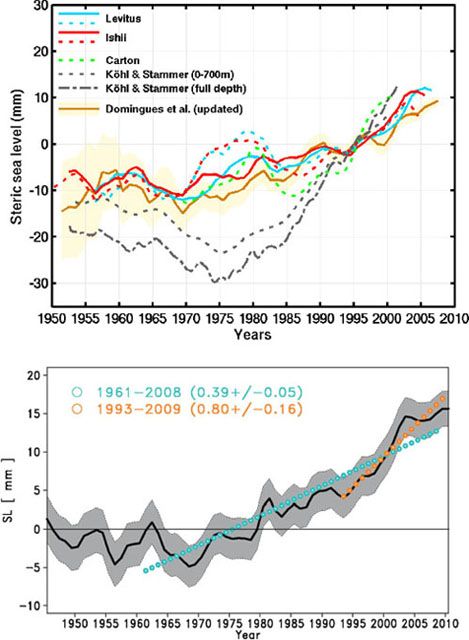
FIGURE 3.1 (Top) Estimates of global mean thermosteric sea level for the past six decades. The dotted blue and red lines are the IPCC (2007) estimates for the upper 700 m. The solid blue and red lines are the equivalent curves after correction for XBT biases. Also shown are a bias-corrected estimate for the upper 700 m by Domingues et al. (2008; brown line with 1 standard deviation shaded) and an uncorrected estimate down to 1,000 m from the Simple Ocean Data Assimilation model by Carton et al. (2005; green dotted line). Estimates from the ocean data assimilation model of Kohl and Stammer (2008) to 700 m (gray dotted line) and full depth (gray dash-dotted line) also are shown. SOURCE: Church et al. (2010). (Bottom) New estimate of global mean thermosteric sea-level rise for the upper 700 m using an updated version of bias-corrected data from Ishii and Kimoto (2009). The orange and blue symbols and values are linear thermosteric sea-level trends for different time periods. The gray shading represents 1 standard deviation. SOURCE: Ishii and Kimoto (2009).
TABLE 3.1 Recent Estimates of Global Mean Thermosteric Sea-Level Rise
| Source | Period | Depth Range (m) | Instrument Bias Corrections | Thermosteric Sea-Level Rise (mm yr-1) |
| IPCC (2007) | 1961–2003 | 0–700 0–3,000 |
None | 0.32 ± 0.12 0.42 ± 0.12 |
| Domingues et al. (2008) | 1961–2003 | 0–700 Full depth |
XBT fall-rate bias | 0.52 ± 0.08 0.72 ± 0.13 |
| Ishii and Kimoto (2009) | 1951–2005 | 0–700 | XBT and MBT depth bias | 0.29 ± 0.06 |
| Kuo and Shum (personal communication, 2011)a | 1955–2009 | 0–700 | XBT and MBT depth bias | 0.33 ± 0.01 |
| Ishii (personal communication, 2011)b | 1961–2008 | 0–700 | XBT and MBT depth bias | 0.39 ± 0.05 |
| IPCC (2007) | 1993–2003 | 0–700 0–3,000 |
None | 1.5 ± 0.5 1.6 ± 0.5 |
| Domingues et al. (2008) | 1993–2003 | 0–700 Full depth |
XBT fall-rate bias | 0.79 ± 0.39 1.0 ± 0.40 |
| Ishii and Kimoto (2009) | 1993–2005 | 0–700 | XBT and MBT depth bias | 1.23 ± 0.30 |
| Ishii (personal communication,2011)b | 1993–2009 | 0–700 | XBT and MBT depth bias | 0.80 ± 0.16 |
| Church et al. (2011)c | 1993–2008 | 0–700 Full depth |
XBT fall-rate bias, ARGO pressure bias |
0.71 ± 0.31 0.88 ± 0.33 |
| Willis (personal communication, 2011)d | 2005–2011 | 0–900 | Biased ARGO data removed | 0.48 ± 0.15 |
a Based on the Ishii and Kimoto (2009) data set, calculated for a different time period.
b Updated from Ishii and Kimoto (2009) using the latest observational data.
c Updated from Domingues et al. (2008) and other recently updated data sets, including ARGO.
d Updated from Leuliette and Willis (2011) for thermosteric sea level.
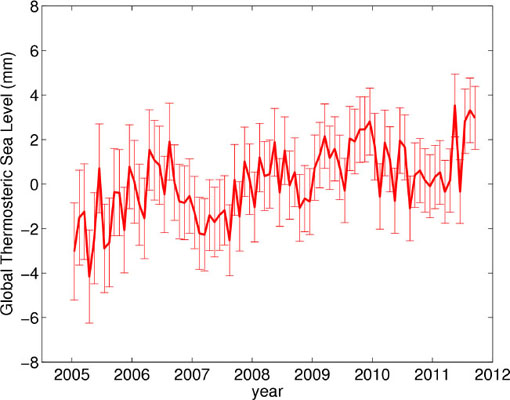
FIGURE 3.2 Thermosteric sea-level rise estimated from Argo data for the upper 900 m using updated data from Leuliette and Willis (2011). The error bars are 1 standard deviation. SOURCE: Courtesy of J.K. Willis, Jet Propulsion Laboratory, California Institute of Technology.
level rates for the full ocean depth using measured rates for the upper 700 m by other investigators (Table 3.1) and the Domingues et al. (2008) value for the deep ocean below 700 m (Table 3.2). For the longer observational period (approximately five decades), the committee calculated rates ranging from 0.5 ± 0.12 mm yr-1 (based on Ishii and Kimoto, 2009) to 0.59 ± 0.11 mm yr-1 (based on Ishii, personal communication, 2011). These rates are lower than the Domingues et al. (2008) rates, but they are comparable within errors. For the post-1993 observational period, the committee’s calculated rates are 1.0 ± 0.19 mm yr-1 and 1.43 ± 0.31 mm yr-1 (Table 3.2). The most recent estimate of Ishii (personal communication, 2011) is comparable to estimates of Domingues et al. (2008) and Church et al. (2011), within their reported errors.
The above estimates of the global thermosteric sea-level trend and its variability on interannual and decadal timescales differ, sometimes substantially. For example, Domingues et al. (2008) shows a continued thermosteric sea-level rise after 2004, whereas Levitus et al. (2009) and Ishii and Kimoto (2009) show a plateau (top panel of Figure 3.1). These differences result from uncertainties in the data and the choice of instrument bias corrections, processing approach, baseline mean climatology, mapping technique, and treatment of unsampled or undersampled areas. Correcting for XBT fall-rate bias reduced the errors in the thermosteric sea-level trend (S. Levitus, personal communication, 2011). However, uncertainties in the bias corrections remain the dominant source of error, especially for recent decades (Ishii and Kimoto 2009; Willis et al., 2009; Gouretski and Reseghetti, 2010; Lyman et al., 2010).
Different data processing approaches also may account for some differences among thermosteric sea-level estimates, such as the relatively high estimates of Domingues et al. (2008) for 1961–2003 and the relatively low estimates of Ishii (personal communication, 2011) for 1961–2008 for the upper 700 m. The treatment of data in unsampled and undersampled regions of the world’s oceans also can introduce uncertainties (Purkey and Johnson, 2010). Sampling problems are particularly acute in the Southern Ocean and likely result in estimates of thermosteric sea-level rise that are biased low (Gille, 2008; Church et al., 2010).
Models
The warming observed in the upper ocean also has been inferred from ocean-atmosphere climate models. For example, Pierce et al. (2006) found general consistency between models and observations for ocean warming, with the signal disappearing around 600 m depth. Climate model simulations also suggest heat uptake by the deep ocean (Katsman and van Oldenborgh, 2011; Meehl et al., 2011). Song and Colberg (2011), using an ocean general circulation model constrained by sea-surface temperature and atmospheric radiation measurements, found a strong warming signal of 1.1 mm yr-1 below 700 m for the 1993–2008 period. This value is much higher than observational estimates (Purkey and Johnson, 2010; Kouketsu et al., 2011; Loeb et al., 2012), for reasons that are currently under debate.
Data Assimilation
Ocean data assimilation techniques can be used to obtain estimates of deep-ocean warming and the resulting thermosteric sea-level rise by constraining the numerical models with available data. There are, however, significant differences between the various data assimilation products and direct observations, arising in part from uncertainties in direct observa-
TABLE 3.2 Committee Estimates of Thermosteric Sea-Level Rise for the Full Ocean Depth
|
Data Source Used in the Estimate |
Period |
Thermosteric Sea-Level Rise Estimates, This Report (mm yr-1)a |
|
Ishii and Kimoto (2009) |
1951–2005 |
0.5 ± 0.12 |
|
Kuo and Shum (personal communication, 2011) |
1955–2009 |
0.53 ± 0.14 |
|
Ishii (personal communication, 2011) |
1961–2008 |
0.59 ± 0.11 |
|
Ishii and Kimoto (2009) |
1993–2005 |
1.43 ± 0.31 |
|
Ishii (personal communication, 2011) |
1993–2009 |
1.0 ± 0.19 |
a Calculated from estimates of the upper 700 m of the ocean by various investigators and the Domingues et al. (2008) rate of 0.2 ± 0.1 mm yr-1 for the deep ocean below 700 m.
tions and differences in data-assimilation approaches for estimating the state of the ocean (e.g., Church et al., 2010). The Simple Ocean Data Assimilation model (Carton et al., 2005; Carton and Giese, 2008) uses a multivariate sequential approach to force the ocean model toward observed temperature and salinity data. Ocean dynamics and other properties are not preserved. Using this approach, the estimated thermosteric sea-level trend from 1968 to 2001 is similar to the observed estimates (Figure 3.1). Kohl and Stammer (2008) used a more sophisticated approach, which synthesizes the observed data into a dynamically consistent model using the adjoint assimilation technique. To ensure dynamical consistency, the model forcing fields are modified. The estimated thermosteric sea-level trend using this method shows a large decrease until 1975 and then a larger rise afterward (Figure 3.1).
Ocean data assimilation has been an active research topic only since the 1990s. Over time, it may become a more reliable source for studies of decadal sea-level variability and change (Church et al., 2010).
Satellites
A few investigators have inferred global steric sea-level rise from the Gravity Recovery and Climate Experiment (GRACE) and altimeter data (e.g., Lombard et al., 2007; Cazenave et al., 2009). Satellite altimetry measures the total sea-level change (steric plus ocean mass) and GRACE measures ocean mass change. The difference between the two measurements provides an independent estimate of the steric sea-level change. However, estimates made this way vary significantly.
Summary
The thermal expansion estimates in the IPCC Fourth Assessment Report were made before temperature biases due to the XBT and MBT depth errors were discovered. Efforts to improve the IPCC (2007) estimates have focused on using new temperature data, correcting instrument bias, and improving data processing methods. New estimates of thermosteric sea-level rise are generally higher than those estimated by the IPCC (2007) for the past four or five decades and generally lower than those estimated by the IPCC (2007) for the past 10–15 years (Figure 3.3). However, the new estimates overlap significantly with the IPCC (2007) estimates, within errors.
Estimates of thermosteric sea-level rise for the upper 700 m of the ocean have lower uncertainties than
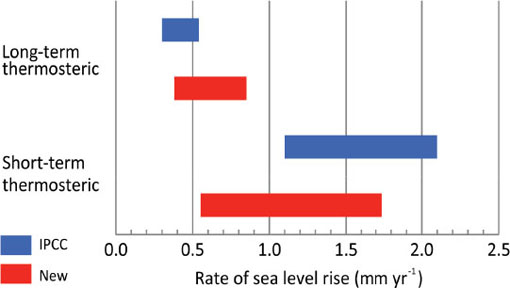
FIGURE 3.3 Comparison of thermosteric sea-level estimates for the full ocean depth from IPCC (2007; blue) and subsequent estimates (red). The bars represent the highest and lowest estimates. Long-term trends are for 1961–2003 (IPCC) and 1951–2005 (new estimates); short-term trends are for 1993–2003 (IPCC) and 1993–2008 (new estimates). SOURCE: IPCC estimates from Bindoff et al. (2007); new estimates are from Tables 3.1 and 3.2 based on data from Domingues et al. (2008), Ishii and Kimoto (2009), and Church et al. (2011).
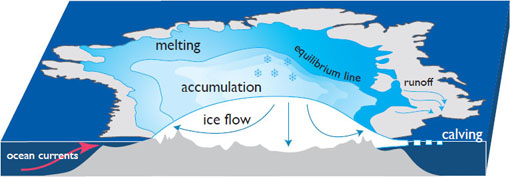
FIGURE 3.4 Glacier and ice sheet mass balance components. Ice accumulates at high elevations and is lost at lower elevations through melting, sublimation, or iceberg calving. The boundary between areas of net gain and loss is called the equilibrium line.
estimates for the full ocean depth due to the paucity of deep-ocean measurements. Studies suggest that sampling problems cause a low bias in upper-ocean thermosteric sea-level rise estimates, and also make it difficult to assess the uncertainty in the deep-ocean thermosteric sea-level rise. Data assimilation and model results are not yet robust enough to be used to fill in missing data.
GLACIERS, ICE CAPS, AND ICE SHEETS
Loss of land-based ice is a major contributor to global sea-level rise, equal to or exceeding the contribution of thermal expansion. The equivalent of at least 65 m of sea level is stored in glaciers, ice caps, and ice sheets. The Greenland and Antarctic ice sheets store the equivalent of about 7 m and 57 m of sea level, respectively (Bamber et al., 2001; Zhang et al., 2003),1 and glaciers and ice caps store the equivalent of 0.6 ± 0.07 m, about one-third of which is around the periphery of Greenland and Antarctica (Radic and Hock, 2010).
The response of glaciers and ice sheets to climate change depends on processes acting at the upper surface; at the base, where glacial meltwater and the properties of the bedrock affect the rate of ice flow; and, in some locations, at the marine margin, where iceberg calving and melting occur (Figure 3.4). Glaciers, ice caps, and ice sheets typically gain mass through snow accumulation and lose mass through melting and runoff (ablation), iceberg calving, and, to a lesser extent, sublimation and wind erosion and transport. Calving can be the dominant mechanism of mass loss, accounting for 50–100 percent of the loss on the Antarctic Ice Sheet, about 50 percent of the loss on the Greenland Ice Sheet (Rignot and Jacobs, 2002; van den Broeke et al., 2010), and, where it has been measured, about 50 percent of loss from ocean-terminating ice cap complexes (Blaszczyk et al., 2009). In general, mass is gained at higher elevations and on the upper surface of a glacier or ice sheet, and mass is lost at lower elevations and at the base. The difference between accumulation and ablation is called the mass balance, and it is determined through a combination of in situ and satellite measurements (Box 3.2), often combined with models.
To determine the contributions of land ice to sea-level rise, mass balance estimates are converted to sea-level equivalent (SLE), the change in global average sea level that would occur if a given amount of water or ice were added to or removed from the oceans. SLE is computed by dividing the observed mass change of the ice by the surface area of the world’s oceans (362 × 106 km2). When working with changing ice volume (e.g., rates of iceberg flux), the volume is converted to mass using the density of ice (900 kg m3). Using these values, 1.11 km3 ice = 1 km3 of water = 109 kg water = 1 GT water, and 362 GT water = 1 mm SLE. For glacier ice resting on bedrock below sea level, a
__________
1 See also data compiled for the Sea-level Response to Ice Sheet Evolution (SeaRISE) assessment project, <http://websrv.cs.umt.edu/isis/index.php/SeaRISE_Assessment>.
BOX 3.2
Measuring the Earth’s Ice
Monitoring the world’s land ice masses is a challenging task complicated by the size, wide distribution, and generally remote and hostile environments in which most glaciers are located. Changes in glacier or ice sheet volume can be calculated by mass budget methods (balancing input and output fluxes), by repeated geodetic measurements, by combinations of the two, and by measurements of mass change through gravity surveys using the GRACE satellite system. Quantitative determination of glacier and ice sheet mass balance requires a variety of data sets, including ice surface elevation and ice thickness, the rate of ice flow, and the rate of ice (snow) accumulation and ablation. Measurements are made both in situ (ideal for individual glaciers and process studies) and remotely (ideal for covering large regions). Satellite remote sensing instruments collect data at visible, near-infrared, and microwave wavelengths and may image the surface in blocks or along the ground track below the satellite (see the review in Quincey and Luckman, 2009).
Ice Thickness. The thickness of glaciers and ice sheets is generally measured using radar sounding from aircraft or at the ice surface. The 25–400 MHz radar signal penetrates to the bedrock below the ice, and the difference between returns from the upper and lower surfaces is used to calculate the ice thickness. Radar sounding works best in cold, clean ice. Ice with substantial fractions of liquid water or crevasses scatter radar energy, creating complications for radar soundings of fast-moving outlet glaciers, especially those in warmer environments.
Surface Topography. Topography is measured using aerial photogrammetry, airborne and satellite laser altimetry, and satellite radar altimetry. Radar altimeters on satellites (ERS-1, -2, Envisat, and CryoSat-2) are used to measure ice sheet surface elevation with decimeter accuracy, but the footprint of the sensor (the area on the surface within the field of view of the antenna) is relatively large (a few kilometers) and varies with surface roughness and slope. Laser altimeters have much smaller footprints (tens of meters; about 70 m for NASA’s Geoscience Laser Altimeter) and may be mounted on aircraft or on satellites. Laser altimeters mounted on small aircraft are used for repeat surveys of glaciers in Alaska, where optimal flight lines are poorly suited for satellite orbital paths (Larsen et al., 2007). Repeat mapping of surface topography can be used to derive volume change, as long as neither the density nor the bed topography change between surveys.
Ice Velocity. The rate of ice flow can be calculated using repeated measurements of the locations of features, either a survey monument or a natural feature (e.g., a crevasse intersection), on the ice surface. Locations can be determined using ground-based optical survey measurements, Global Positioning System surveys, photogrammetry, or satellite image processing. Ice flow also can be determined from radar interferometry (e.g., Figure), which uses the change between observations in the phase of the returning radar wave to make a high-precision measurement of ground displacement relative to the spaceborne radar.
Gravity. Ice sheet mass changes since 2002 can be determined from the GRACE satellite system (see Box 2.4). The ice sheet changes must be separated from other mass change signals such as those caused by glacial isostatic adjustment. In some instances the modeled corrections are robust, but in others the uncertainties can be large. The spatial resolution of the measurements depends on details of the processing and the latitude of interest (Wahr et al., 2004).
Mass Balance. Accumulation and ablation are traditionally determined using in situ measurements made at least twice yearly, at the end of the accumulation season and ablation season. This technique remains the only way to make direct observations of the components of the mass budget, but it is too time consuming and expensive to be used as an operational tool on the ice sheets. Accordingly, remote sensing methods are used extensively, with reliance on limited point climate and meteorological observations and on meteorological and surface energy balance models. Snow accumulation can be estimated from atmospheric models coupled with satellite observations or by analyzing annual layers in ice cores and interpolating between core sites using radar sounding of the ice layers. Melt can be estimated using energy balance models driven by atmospheric models. Runoff cannot be measured remotely, and in most cases is determined solely by modeling.
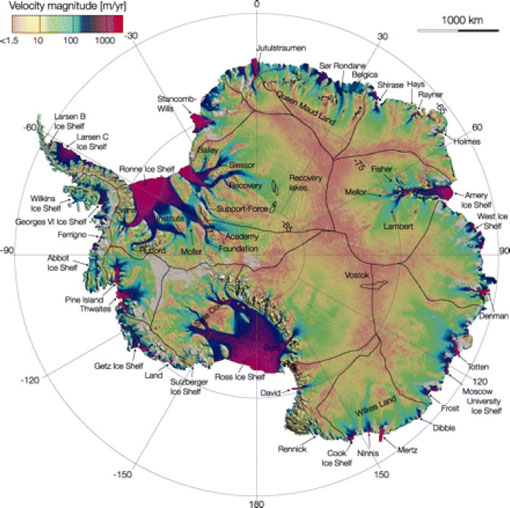
FIGURE Antarctic glacier velocity (in m yr-1) derived from radar interferometry. Black lines delineate major ice divides. Velocities can reach a few km yr-1 on fast-moving glaciers (e.g., Pine Island) and floating ice shelves. SOURCE: Rignot et al. (2011b).
correction term is added to account for the ice volume below the water line that has already affected sea level by its presence. On sufficiently long timescales, a correction for glacial isostatic adjustment of the underlying bedrock, based on forward models, also may be made.
The conversion of ice mass loss to SLE assumes that all land ice melt enters the ocean. Land storage of ice melt may be significant for land-terminating glaciers in continental interiors (e.g., high mountains in Asia), but its occurrence is unconfirmed. SLE is a globally uniform value and thus may be higher or lower than the sea-level value in any particular region.
Estimates from the IPCC Fourth Assessment Report
The IPCC Fourth Assessment Report estimated that losses from glaciers and ice caps contributed 0.58 ± 0.18 mm yr-1 to sea-level rise from 1961 to 2003 and 0.77 ± 0.22 mm yr-1 from 1993 to 2003 (Bindoff et al., 2007), with the most rapid ice losses occurring in Patagonia, Alaska, northwest United States, and southwest Canada (Lemke et al., 2007). Uncertainties in the net loss rate were significant, however, because of sparse point observations and incomplete knowledge of global glacier area and volume distribution for upscaling point observations. On the Greenland Ice Sheet, the IPCC (2007) found that mass was gained at high elevations because of increasing snowfall, and mass was lost near the coast because of increases in melting and in the flow speed of outlet glaciers. The IPCC estimated that the Greenland Ice Sheet contributed 0.05 ± 0.12 mm yr-1 to sea-level rise from 1961 to 2003 and 0.21 ± 0.07 mm yr-1 from 1993 to 2003. Changes in Antarctica were more challenging to interpret because of the relatively small changes in snow accumulation rates (Monaghan et al., 2006) and to different trends in the flow of individual West Antarctic outlet streams. The IPCC estimated that the Antarctic Ice Sheet contribution was between -0.28 and +0.55 mm yr-1 from 1961 to 2003 and between -0.14 and +0.55 mm yr-1 from 1993 to 2003, allowing for the possibility that the Antarctic mass change may have reduced sea-level rise, especially prior to 1993 (Bindoff et al., 2007; Lemke et al., 2007). The rate of ice loss appears to have increased since 1993 because of increasing surface melt on the Greenland Ice Sheet and faster flow of some outlet glaciers in both Greenland and Antarctica.
Recent Results
Since the IPCC Fourth Assessment Report was published, more observations are available, and rapid flow changes at marine margins of ice sheets and glaciers, which were recognized but not included in the IPCC (2007) projections, are now represented in some projections. Ice sheet velocity and mass balance distributions are now better mapped, but the potential for rapid future increases in calving losses from ocean-terminating outlet glaciers is still poorly understood, in part because of inadequate knowledge of the underlying physics.
Glacier and Ice Cap Assessments
Owing to the delay in assimilation of new observations and the incomplete but evolving glacier inventory, most post-IPCC (2007) assessments of glacier and ice cap change (Table 3.3) are based on data collected prior to 2007. The various analyses span different periods and use different methods to average sparse data and to scale up regionally heterogeneous trends to estimate the global total, resulting in significant uncertainties. Estimated rates of ice loss, expressed as SLE, vary in time and space. For example, gravity observations indicate that the rate of mass loss in the Gulf of Alaska decreased from 2004 to 2008 (Luthcke et al., 2008; Table 3.3), but increased in the Canadian Arctic over a similar interval (Gardner et al., 2011). These patterns reflect the influence of rapid changes in the rate of ice flow (rapid dynamical response) associated with ice-ocean interaction in coastal regions.
The most recent published compilation (Cogley, 2012), and the only one to use data from after 2007, shows a substantial decrease in glacier and ice cap loss rates from 1.41 mm yr-1 SLE for 2001–2005 to 0.92 mm yr-1 for 2005–2010. The cause of this decrease is unclear, but suggests the potential for significant variability on 5- to 10-year timescales and highlights the difficulty of extracting meaningful trends from short-term observations. Jacob et al. (2012) determined an overall loss rate for global glaciers and ice caps of 0.41 ± 0.08 mm yr-1 for 2003–2010, but this value does not include the glaciers and ice caps on the periphery of the Greenland and Antarctic ice sheets. They estimated the contribution of these peripheral glaciers and ice
TABLE 3.3 Estimates of Glacier and Ice Cap Sea-Level Equivalent
| Source | Period | Region | Method | Sea-Level Equivalent (mm yr-1) |
| Global Estimates | ||||
| IPCC (2007) | 1993–2003 1961–2003 |
Global | Combination of various estimates | 0.77 ± 0.22 0.58 ± 0.18 |
| Leclercq et al. (2011) | 1850–2005 | Global | Glacier length | 0.06 ± 0.01 |
| Kaser et al. (2006) | 2001–2004 | Global | Combination of three independent methods: Cogley (2009), Dyurgerov (2010), and Ohmura (2004) | 0.98 ± 0.19 |
| Cogley (2009) | 2001–2005 | Global | Spatial polynomial interpolation | 1.41 ± 0.20 |
| Dyurgerov (2010) | 2002–2006 | Global | Area weighting | 0.95 ± 0.05 |
| Cazenave and Llovel (2010) | 2003–2007 | Global | Uncertainty-weighted average of available estimates | 1.03 ± 0.06 |
| Cogley (2012) | 2005–2009 | Global | Spatial polynomial interpolation | 0.92 ± 0.05a |
| Jacob et al. (2012) | 2003–2010 | Global | GRACE | 0.41 ± 0.08b |
| Regional Estimates | ||||
| Matsuo and Heki (2010) | 2003–2009 | High mountain Asia | GRACE | 0.13 ± 0.04 |
| Jacob et al. (2012) | 2003–2010 | High mountain Asia | GRACE | 0.01 ± 0.05 |
| Luthcke et al. (2008) | 2004 2007 |
Gulf of Alaska | GRACE | 0.39 ± 0.06 0.13 ± 0.06 |
| Gardner et al. (2011) | 2004 2006 |
Canadian Arctic | GRACE | 0.09 ± 0.02 0.25 ± 0.03 |
a Representative of 2005/6–2009/10, but reports for the 2009/10 balance year are still incomplete. Value updated from Cogley (2012) and upscaled to all glaciers, including peripheral glaciers surrounding the ice sheets, using the method of Kaser et al. (2006).
b Value excludes peripheral glaciers surrounding the Greenland and Antarctic ice sheets. Estimated loss rate (SLE), including peripheral glaciers given in Jacob et al. (2012), is 0.63 ± 0.23 mm yr-1.
caps using a simple adjustment factor and arrived at a global total of 0.63 ± 0.23 mm yr-1, assigning substantially less confidence in this rate than in the rate without peripheral glaciers and ice caps.
Glaciers in high mountain Asia (more than 110,000 km2 of glacier area, including the Himalayas, Karakoram, Pamirs, Caucasus, and Tien Shan regions) have experienced losses in recent decades, but the region is sparsely observed and uncertainties are generally large. Shortly after the publication of the IPCC Fourth Assessment Report, which contained an error concerning the disappearance of Himalayan glaciers, several other erroneous reports were published, all based in part on gray literature and media stories. These created considerable confusion about the state of glaciers in the Himalayas and their near-term fate (see the summary in Cogley et al., 2010). Subsequent analyses continue to show substantial uncertainties, however. Matsuo and Heki (2010) used GRACE gravity methods to determine ice losses from high mountain Asia and estimated that the sea-level contribution of the entire region was 0.13 ± 0.04 mm yr-1 SLE for 2003–2009. This value was somewhat higher than the loss rate of 0.10 mm yr-1 determined by Dyurgerov and Meier (2005) for 1993–2003 and 1998–2003, but Matsuo and Heki (2010) arrived at their value by assigning 0.027 mm yr-1 SLE (10 GT yr-1) to groundwater extraction. This may be an underestimate of groundwater extraction, given that the region includes the plains south of the Himalayas and part of the region where Tiwari et al. (2009) saw losses of ~54 GT yr-1 for 2002–2008. If a larger groundwater extraction signal were used, the GRACE data used by Matsuo and Heki (2010) would indicate a smaller high mountain Asia glacier loss rate. The most recent and detailed analysis of high mountain Asia is presented in Jacob et al (2012), who found a much lower total loss rate of 4 ± 20 GT yr-1 for 2003–2010, corresponding to 0.01 ± 0.05 mm yr-1 SLE. The authors ascribe the difference between their totals and other GRACE analyses (e.g., Matsuo and Heki, 2010) to better treatment of mass concentration (mascon) calculations in the GRACE processing and improved removal of the terrestrial groundwater signal through modeling.
All glacier and ice cap loss rates reported to date are based on a global glacier and ice cap inventory that represents only ca. 48 percent of the world’s 704 ± 56 × 103 km2 of glacier-covered area exclusive of the ice sheets (Figure 3.5). The Randolph Glacier
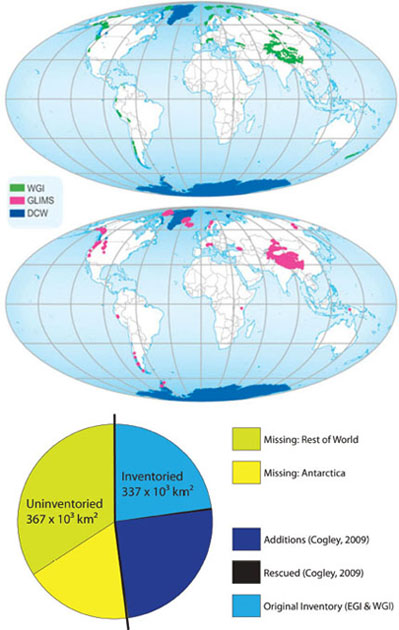
FIGURE 3.5 (Top) Map coverage of global glacier inventories—including the World Glacier Inventory (WGI), Global Land Ice Measurements from Space (GLIMS), and Digital Chart of the World (DCW)—used in published assessments. The figure shows the status prior to publication of the Randolph Glacier Inventory. SOURCE: United Nations Environment Programme, <http://www.grid.unep.ch/glaciers/>. (Bottom) Completeness of global glacier and ice cap inventories used in published assessments. Approximately one-third of the uninventoried area is in the peripheral glaciers and ice caps surrounding the two ice sheets, and most of the rest is in North America. “Missing” indicates that data are absent in the Cogley (2009) extended inventory. SOURCE: Cogley (2009).
Inventory, a new, complete inventory providing 100 percent coverage of glaciers and ice caps, including those on the peripheries of ice sheets, has recently been completed.2 Several groups are working to update present-day analyses and projections using the new inventory. The glacier and ice cap loss rates presented here are likely to change once the new inventory is fully incorporated into assessments.
In addition to deficiencies in the global glacier and ice cap inventory, measurements of mass balance terms are sparse (Dyurgerov, 2002; Kaser et al., 2006). Observations of glacier variations extend back into the 18th century, but in situ mass balance measurements that reveal climatic patterns do not begin until the early- to mid-20th century, and most records are less than a few decades long (Zemp et al., 2009). As a result, scaling methods have been developed to translate local measurements to a global estimate (Bahr et al., 1997; Dyurgerov, 2002; Kaser et al., 2006; Cogley, 2009). The incomplete inventory and the small number of long-term observational mass balance records worldwide are the largest (and hardest to quantify) sources of uncertainty in present-day rates of glacier and ice cap mass loss.
Differences in methodology and in error reporting make quantitative comparison of the various mass balance estimates difficult. Slangen and van de Wal (2011) found that projections of future change in these systems were about equally sensitive to uncertainty in the glacier inventory as to the scaling factor used to relate temperature change to mass imbalance. Cazenave and Llovel (2010) combined all available estimates to arrive at an uncertainty-weighted average of 1.03 ± 0.06 mm yr-1 SLE from glaciers and ice caps, or approximately 41 percent of the total observed sea-level rise for the 2003–2007 period.
Computing mean SLE rates using the published literature requires time series data and knowledge of the uncertainties associated with the various estimates. Such information is not always available or presented in a useful way. In this sense, the best mass balance compilation available is Cogley’s (2009) glacier and ice cap data set (updated in Cogley, 2012, but released as this report was being completed). For the most recent period (2005–2009), the loss rates reported for glaciers and ice caps are 0.92 ± 0.05 mm yr-1.
Ice Sheet Assessments
Systematic assessments of ice sheets began in the mid 1980s (e.g., Bindschadler, 1985; Oerlemans, 1989). With each assessment, the mass balance has become increasingly negative (i.e., net mass loss) in both Greenland and Antarctica. A number of ice sheet assessments have been published since the IPCC Fourth Assessment Report (Table 3.4). Methods for measuring ice sheet mass balance are comparable to those used for glacier mass balance. Since 2002, however, detection of mass change using the GRACE satellite system has become a widely used tool for ice sheet mass balance owing to the operational difficulties of other measurement methods over large areas. Interpretation of GRACE data is complicated by its intrinsic mixing of gravity signals (Box 3.2). Glacial isostatic adjustment must be corrected by modeling the lithospheric response to loading changes (Velicogna and Wahr, 2006a,b; Tregoning et al., 2009), but other mass change terms (e.g., changes in terrestrial water storage) are smaller on the ice sheets than elsewhere.
As shown in Table 3.4, the reported rates of mass loss vary substantially, in part because of different uncertainties among measurement methods and improvements in the analysis of GRACE data. In addition, the ice sheet loss rates appear to experience not only a long-term trend toward faster losses but also significant interannual and multi-annual variability, so measurements made over different time intervals can be difficult to compare. The brevity of the record and differences in the spatial coverage, the quantities used to infer mass change, and the treatment of data gaps further complicate comparisons and trend assessment. The committee estimated ice sheet loss rates for the most recent period reported (2002–2009) by making a weighted average of the values in Table 3.4.3 The average loss rates for 2002–2009 were 0.56 ± 0.13 mm yr-1 for the Greenland Ice Sheet and 0.37 ± 0.14 mm yr-1 for the Antarctic Ice Sheet.
__________
2 See <http://www.glims.org/RGI/randolph.html>.
3 For each year, all available published values are weighted according to assessed confidence in the quality of the particular estimate, and then averaged. Some studies provide yearly values for their respective reporting periods; others provide only average values over a multi-year period, and in these cases, the average rate was assumed to apply in each year in the interval. For a multi-year interval, the weighted average is obtained through a simple linear average of the annual averages in that interval.
TABLE 3.4 Estimates of Sea-Level Equivalent from Ice Sheet Mass Loss
| Source | Period | Method | Sea-Level Equivalent (mm yr-1) | |
| Greenland Ice Sheet | ||||
| IPCC(2007) | 1993–2003 1961–2003 |
Combination of various estimates | 0.21 ± 0.07 0.05 ± 0.12 |
|
| Rignot et al. (2011a) | 1992–2000 2000–2003 2003–2007 |
Mass balance method + GRACE | 0.14 ± 0.14 0.47 ± 0.14 0.68 ± 0.14 |
|
| Velicogna (2009) | 2002–2003 2007–2009 |
GRACE | 0.38 ± 0.09 0.79 ± 0.09 |
|
| Schrama and Wouters (2011) | 2003–2010 | GRACE | 0.55 ± 0.05 | |
| Cazenave et al. (2009) | 2003–2008 | GRACE | 0.38 ± 0.05 | |
| Luthcke et al. (2008) | 2004–2009 | GRACE | 0.52 ± 0.20 | |
| Zwally et al. (2011) | 1992–2002 2003–2007 |
ICESAT | 0.02 ± 0.01 0.47 ± 0.01 |
|
| Sørensen et al. (2011) | 2003–2008 | ICESAT | 0.58 ± 0.06 | |
| Wu et al. (2010) | 2002–2008 | GRACE + GPS | 0.29 ± 0.06 | |
| Rignot et al. (2008) | 1960s 1970s–1980s |
Man balance method | 0.30 ± 0.19 0.08 ± 0.14 |
|
| van den Broeke et al. (2009) | 2000–2008 2003–2008 |
Man balance method | 0.46 0.66 |
|
| Antarctic Ice Sheet | ||||
| IPCC(2007) | 1993–2003 1961–2003 |
Combination of various estimates | 0.21 ± 0.35 0.14 ± 0.41 |
|
| Rignot el al. (2011a) | 1992–2000 2000–2003 2003–2007 2007–2010 |
Man balance method + GRACE | 0.18 ± 0.25 0.46 ± 0.25 0.56 ± 0.25 0.71 ± 0.25 |
|
| Velicogna (2009) | 2002–2003 | GRACE | 0.29 ± 0.20 | |
| Chen et al. (2009) | 2002–2003 | GRACE | 0.52 ± 0.21 | |
| Cazenave et al. (2009) | 2003–2008 | GRACE | 0.55 ± 0.06 | |
| Wu et al. (2010) | 2002–2008 | GRACE | 0.23 ± 0.12 | |
| Wingham et al. (2006) | 1992–2003 | Radar altimetry | 0.07 ± 0.08 | |
Rapid Dynamic Change
The possibility of rapid dynamic response to environmental change as a mechanism of rapid sea-level rise is a long-standing idea in glaciology (Mercer, 1978; Thomas and Bentley, 1978). Rapid flow processes have been observed on ice sheets (e.g., Bentley, 1987) and at marine-terminating glaciers for many years (Meier and Post, 1987). Increases in the rate of rapid transfer of ice from land to the ocean by glacier flow and iceberg calving were observed in Greenland between ca. 1995 and 2005 (e.g., Rignot and Kanagaratnam, 2006) and in Antarctica. These observations were published late in the compilation of results for the IPCC Fourth Assessment, so the report included the observations, but not an extensive analysis or interpretation.
A variety of observational studies are now available which, together with process studies, suggest a small set of underlying causes for changes in outlet glacier flow around the Greenland Ice Sheet, the Antarctic Peninsula, and the Amundsen Sea sector of the West Antarctic Ice Sheet. Warming ocean water appears to be increasing the rates of calving and melting (e.g., Holland et al., 2008; Nick et al., 2009; Straneo et al., 2010; Motyka et al., 2011), which in turn changes the coupling between glacier ice and the adjacent bedrock, increasing the rate of ice flow. In some extreme cases, the discharge speed increased by an order of magnitude at glacier termini, although the rate of change varied from year to year (e.g., Joughin et al., 2004; Howat et al., 2007). Climate-driven changes in sea ice in the coastal fjord environment may also be important (Amundson et al., 2010). Rapid changes at the outlet glacier terminus propagate into the interior over timescales and with magnitudes that depend on both the climate and glacier dynamics (Pfeffer, 2007). Ice sheet mass balance over the next century depends in part on how far and how rapidly that propagation proceeds (see “Recent Global Sea-Level Projections” in Chapter 5).
The position of the grounding line—the transition at which ice resting on bedrock goes afloat—depends on the ice thickness and varies with the ice flux through the transition zone. Regions where the base of the ice rests below sea level and the grounding line is relatively unprotected by adjacent floating ice are the most vulnerable to rapid acceleration and thinning (Thomas et al., 1979; Scambos et al., 2004; Schoof, 2007). Rapid retreat is possible where the bed is below sea level and slopes down toward the interior because both the thickness of the ice, and thus ice flux, and the thickness required to overcome buoyancy increase in the inland direction (Pfeffer, 2007; Schoof, 2007).
Despite rapid changes along the margins of the Greenland and Antarctic ice sheets, it is unlikely that the ice sheets will disappear over the next millennium. The ice sheets are so thick (Figures 3.6 and 3.7) that much of the surface is in higher, relatively cooler parts of the atmosphere, allowing a positive mass balance to be maintained even as the climate warms. However, if dynamic thinning reduced the Greenland Ice Sheet, for example, below some threshold size, winter snow would not compensate for the loss and the ice sheet would not re-grow under current climate conditions (Toniazzo et al., 2004; Ridley et al., 2010). Studies of such thresholds suggest that widespread denudation of Greenland and West Antarctica is possible in some warming scenarios, such as four times the preindustrial carbon dioxide (Ridley et al., 2010) or 5°C ocean warming (Pollard and DeConto, 2009), but requires thousands of years (e.g., Marshall and Cuffey, 2000; Pollard and DeConto, 2009; Ridley et al., 2010).
The rapid dynamic response from glaciers outside the ice sheets is less important than ice sheet dynamics over the long term because glaciers do not contain significant volumes of marine-grounded ice. However, the potential for significant short-term contributions is large. Between 1996 and 2007, Columbia Glacier, on Alaska’s south coast, lost mass at an average rate of 6.80 GT yr-1, or 0.019 mm yr-1 SLE, approximately 0.7 percent of the rate of global sea-level rise during this period (Rasmussen et al., 2011, corrected here for ice already grounded below sea level). The volume of Columbia Glacier, approximately 150 km3, is too small to contribute to sea level at such a rate for long, but marine-terminating glaciers of this size can be significant factors on decadal scales.
Summary
Most post-IPCC (2007) assessments of glacier and ice cap change have been made using data collected
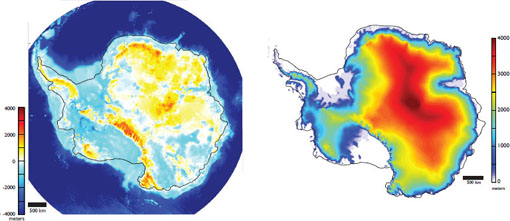
FIGURE 3.6 (Left) Antarctic bedrock elevations. Transition from light blue to dark blue marks the edge of the continental shelf. (Right) Antarctic surface elevations. Black line marks the approximate edge of the present-day ice (floating and grounded). Areas where the bed of the ice sheet is below sea level (e.g., West Antarctic Ice Sheet) are expected to be more vulnerable to rapid change than regions where the bed is above sea level. SOURCE: Data from Le Brocq et al. (2010).
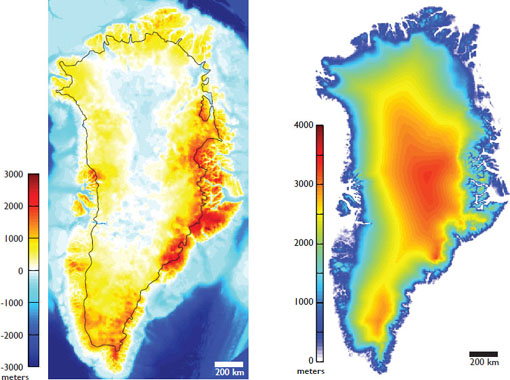
FIGURE 3.7 Greenland bedrock elevation (left) and surface elevation (right). Black line marks the approximate edge of the present-day ice (floating and grounded). SOURCE: Original bedrock elevation from Bamber et al. (2001), modified to include data in the Jakobshavn Isbrae region from the Center for Remote Sensing of Ice Sheets, <http://websrv.cs.umt.edu/isis/index.php/Present_Day_Greenland>.
prior to 2007. The new estimates of the glacier and ice cap contribution to sea-level rise tend to be at the high end of the estimates provided in the IPCC Fourth Assessment Report (Table 3.3). Most new assessments of ice sheet change are based on GRACE data, which have been available since 2002, although a few long-term assessments have been made using mass balance methods. Different methods for estimating ice-sheet mass balance yield substantially different results. Estimates made using more recent data (Table 3.4) show that the contribution of Greenland to sea-level rise is significantly higher than the IPCC (2007) estimate and the contribution of Antarctica has shifted toward the positive side of the range (raising sea level).
Since about 2006, the rate of ice loss in Greenland has increased substantially and the rate of change in Antarctica, while more difficult to quantify, appears to have shifted from negative to positive (e.g., Vaughan, 2006; Rignot and Kanagaratnam, 2006; Rignot et al., 2008; van den Broeke et al., 2009; Cazenave and Llovel, 2010; see also Table 3.4). This growing contribution arises from increases in both the amount of surface melting and the rate of ice discharge through coastal outlet glaciers. Calculated loss rates from glaciers and ice caps have decreased since about 2005 (Cogley, 2012), due to significant short-term variability in the global glacier loss rate signal and, to a lesser extent, to improvements in the global glacier inventory. Short-term (pentads
to decades) glacier loss rates are strongly negative but with no clear pattern of variability, whereas the longer term trend (decade to century) is consistently negative and accelerating. In the most recent periods reported, the loss rates are 0.56 ± 0.13 mm yr-1 from 2002 to 2009 for the Greenland Ice Sheet, 0.37 ± 0.14 mm yr-1 from 2002 to 2009 for the Antarctic Ice Sheet, and 0.92 ± 0.05 mm yr-1 from 2005 to 2009 for glaciers and ice caps.
Water lost or gained by the continents generally results in a corresponding gain or loss of water by the oceans. Terrestrial water is stored in soils and the subsurface (groundwater, aquifers), in snowpack and permafrost, in surface water bodies (e.g., rivers, lakes, reservoirs, wetlands), and in biomass. Some of the water withdrawn from these sources as a result of human activities such as groundwater pumping, wetland drainage, diversion of surface water for irrigation, and deforestation eventually reaches the ocean, raising sea level at global, regional, and local scales (e.g., Bindoff et al., 2007; Milly et al., 2010). Conversely, some water that would normally reach the ocean is diverted through processes such as impoundment of water behind dams, subsurface infiltration beneath dams, and infiltration of irrigation water to depths beneath the root zone, thus lowering sea level or reducing the rate of sea-level rise.
Some changes in terrestrial water storage can be evaluated with reasonable precision at local scales, including changes caused by groundwater withdrawal, deforestation, agriculture, wetland drainage, and reservoir construction. On global scales, however, the terrestrial water balance is far more difficult to estimate. Not only must all hydrological fluxes be evaluated, but also geographic coverage of in situ measurements, such as river and stream gage records, is spotty. In some parts of the world, instrument coverage is even declining.4 For example, the number of stream gages monitoring freshwater discharge into the Arctic Basin declined by 38 percent between 1985 and 2004 (Corell, 2005).
Terrestrial hydrologic models can be used to close observational gaps and, when coupled with global climate models, to estimate surface boundary conditions such as temperature and precipitation. Because of the complexity of hydrological processes and the wide range of spatial and temporal scales involved, fully deterministic models are generally not used. A variety of nondeterministic approaches have been developed (Eagleson, 1994; Famiglietti et al., 2009), and efforts to develop deterministic, quasi-deterministic, and hybrid models are being pursued (e.g., Kollet and Maxwell, 2008; Wood et al., 2011). These models are strongly dependent on observations, which are coming increasingly from remote sensing (Box 3.3).
The GRACE satellite system (Boxes 2.4 and 3.3) provide a sensitive means of detecting changes in land water mass, provided that other confounding mass change signals can be independently assessed and removed. Changes in groundwater mass and biomass can be observed at a precision necessary for detecting, for example, seasonal changes in soil moisture content. The limited spatial resolution of GRACE is a minor impediment to its utility in groundwater investigations, given the distributed character of most
BOX 3.3
Terrestrial Water Measurements
Prior to the launch of the GRACE gravity experiment, changes in terrestrial water storage were nearly impossible to measure directly, and the terrestrial component of the water budget was estimated largely by modeling. Reservoir impoundment was estimated by tallying the construction of reservoirs. Groundwater mining was estimated, for example, by balancing population-based estimates of well water extraction with well recharge modeled using groundwater hydrological methods.
The launch of the GRACE satellite system in 2002 provided scientists with the first means to directly measure changes in the mass of water on the Earth’s surface and in the ground. Water mass can be determined at resolutions ranging from approximately 8 mm of water equivalent within a 750 km radius sample near the poles to approximately 25 mm of water equivalent near the equator (Wahr et al., 2006). The principal difficulty in interpreting GRACE data for hydrological studies lies in separating out undesired signals, including those arising from glacial isostatic adjustment (corrected using measurements or models) and from adjacent mass changes such as glacier and ice sheet changes (addressed using processing techniques that mask signals outside of the desired region; Luthcke et al., 2008).
__________
4 See <http://water.usgs.gov/nsip/history1.html>; <http://www.bafg.de/cln_031/nn_266918/GRDC/EN/02_Services/services_node.html?_nnn=true>.
groundwater storage, except in areas where confounding mass change signals are immediately adjacent. Distinguishing mass losses from Himalayan glaciers from groundwater losses in adjacent agricultural land to the south, for example, requires careful processing and interpretation of GRACE data.
Estimates from the IPCC Fourth Assessment Report
The IPCC Fourth Assessment Report and other previous assessments found large interannual and decadal fluctuations in the storage of water on land, likely associated with changes in precipitation, but no significant trend in land water storage due to climate change (e.g., Bindoff et al., 2007). Because land hydrology records are short, sparse, and poorly distributed for global calculations, the magnitude of changes in water storage is highly uncertain. However, the average magnitude of change over annual and longer timescales during the reporting period (1961–2003) must have been small, given that the combined contributions of land ice and thermal expansion alone nearly match observed changes in sea level since 1993. The IPCC Fourth Assessment Report estimated that the contribution of land hydrology to sea-level change was <0.5 mm yr-1 (Bindoff et al., 2007).
Recent Advances
The terrestrial hydrologic processes contributing to sea-level change remain poorly constrained, although the importance of water storage in artificial reservoirs has become increasingly clear. Apart from changes in precipitation patterns and land ice volume, the primary terrestrial water fluxes are now thought to be reservoir construction, which lowers sea level, and groundwater depletion, which raises sea level. The continual development of processing techniques for analyzing data from the GRACE satellites (e.g., Ramillien et al., 2008) as well as methods for modeling global groundwater transport (e.g., Oleson et al., 2010) have made it possible to more precisely determine changes in land water storage. Several new data sets have been published since the IPCC Fourth Assessment Report, but many do not specify analysis periods, making it difficult to compare estimates or analyze trends.
Groundwater Depletion
In arid regions with significant populations and/or agricultural or industrial activity (e.g., portions of the United States, Mexico, Australia, China, Spain, and North Africa; see Shiklomanov, 1997), the rate of groundwater extraction often exceeds the rate of recharge. Huntington (2008) compiled published estimates of groundwater depletion, which ranged from 0.21 mm yr-1 to 0.98 mm yr-1 SLE (Table 3.5), but the time period to which this rate applies was not specified and the estimates are geographically incomplete. Based on hydrological modeling, Wada et al. (2010) estimated global groundwater depletion of 0.35 ± 0.1 mm yr-1 SLE for 1960, increasing to 0.8 ± 0.1 mm yr-1 SLE for 2000. Milly et al. (2010), also using modeling methods, estimated lower values of 0.12 mm yr-1 SLE for 1981–1998, 0.25 mm yr-1 SLE for 1993–1998, and 0.2–0.3 mm yr-1 SLE for “recent years.” Milly et al. (2010) acknowledged, but did not quantify, considerable uncertainty in their estimates. Konikow (2011) estimated global groundwater depletion from 1900 to 2008, and found it increased significantly to 0.4 mm yr-1 during 2001–2008, double the rate of the 1990s. Most recently, Wada et al. (2012a) made an extensive assessment of groundwater extraction and depletion, arriving at a value of 0.54 ± 0.09 mm yr-1 SLE for 1993–2008.
Reservoir Storage
Until recently, additions to sea level from groundwater extraction were thought to be largely offset by increasing reservoir storage, although few studies estimated uncertainties in reservoir storage. Chao et al. (2008) estimated the water volume stored in 29,484 reservoirs constructed since about 1900 using the International Commission on Large Dams’ World Register of Dams. Summing their stated water impoundment as the reservoirs were constructed provided the volume of water impounded as a function of time. Converting to SLE yielded a reservoir storage rate of -0.55 mm yr-1 for the 20th century (Chao et al., 2008). Lettenmaier and Milly (2009) found the equivalent impoundment to be -0.35 mm yr-1 SLE for 1940–1950 (Table 3.5). Milly et al. (2010) used results from Gornitz (2001) and others to estimate that the impoundment rate of global reser-
TABLE 3.5 Estimates of Groundwater Extraction and Reservoir Impoundment
| Source | Period | Method | Sea-Level Equivalent (mm yr-1) | |
| Net terrestrial depletion | ||||
| IPCC (2007) | 1910–1990 1990 |
Synthesis of reports | -1.5 -1.1-+1.0 |
|
| Church et al. (2011) | 1993–2008 | Synthesis | -0.27-+0.11 | |
| Groundwater extraction | ||||
| IPCC (2007) | None given | Synthesis of reports | <0.5 | |
| Huntington (2008) | None given | Synthesis | 0.21–0.98 | |
| Wada et al. (2010) | 1960–2000 | Hydrologic models | 0.35–0.8 | |
| Milly et al. (2010) | 1981–1998 1993–1998 “Recent years” |
Synthesis, models | 0.12 0.25 0.2–0.3 |
|
| Konikow(2011) | 2001–2008 | Synthesis, models | 0.4 | |
| Wada et al. (2012a) | 1993–2008 | Synthesis, models | 0.45–0.63 | |
| Reservoir impoundment | ||||
| Chao et al. (2008) | Past half-century | Model | -0.55 | |
| Lettenmaier and Milly (2009) | 1940–1950 | Model | -0.35 | |
| Milly et al. (2010) | Before 1978 After 1978 |
Synthesis, models | -0.5 -0.28 |
|
| Wada et al. (2012b) | 1993–2008 | Update of Chao et al. (2008) with seepage correction | ~-0.20- -0.40 | |
voir storage declined from approximately -0.5 mm yr-1 SLE before 1978 to approximately -0.25 mm yr-1 SLE after 1978. They attributed this decrease to slowing in the rate of reservoir construction and to sedimentation, which slightly offset the storage capacity of existing reservoirs (Figure 3.8). How much sedimentation in reservoirs affects sea-level rise is a matter of debate. Huntington (2008) found that sedimentation results in a time-dependent loss of reservoir volume, which affects the rate of sea-level rise. On the other hand, Chao et al. (2008) argued that sedimentation displaces water behind dams and thus should have no effect on the contribution of reservoir storage to sea-level rise. Regardless, the effect of sedimentation is likely to be small compared with the decline in the number of reservoirs constructed. Wada et al. (2012b) estimated that decreased dam building lowered the contribution of reservoir storage to about 0.3 ± 0.1 mm yr-1 for 1993–2008.
Other Contributors
Snow accumulation and loss dominate seasonal variations in the terrestrial water contribution to global mean sea level but do not contribute to a long-term trend (Milly et al., 2003; Biancamaria et al., 2011). The effects of changes in permafrost on sea level are currently unknown, although the secondary hydrological effects (e.g., changes in soil hydraulic conductivity) of thawing the global permafrost area of 22 ± 3 × 10⁶ km2 (Gruber, 2011) may become significant in the near future. Changes in global lake storage contributed about +0.11 mm yr-1 to sea level during the 1992–2008 period (Milly et al., 2010), but paleoclimatic records show that lake levels exhibit strong interannual and interdecadal variability, so this rate is not a good indicator of future trends. The magnitude and sometimes even the sign of other land water sources to sea level, including irrigation, wetland drainage, urbanization, and deforestation, are unknown (Milly et al., 2010).
Summary
Transfers of water (excluding ice melt) between the land and oceans are dominated by groundwater depletion, which raises sea level, and reservoir impoundment, which lowers sea level. Although more data (e.g., GRACE) and model results are available now than were for the IPCC Fourth Assessment Report, it remains difficult to constrain the contributions of terrestrial water to sea-level rise and uncertainties are large. Recent estimates for groundwater depletion and reservoir impoundment are in line with the IPCC (2007) estimates, on the order of 0.5 mm yr-1. The two terms sum to near zero, within stated uncertainties. As
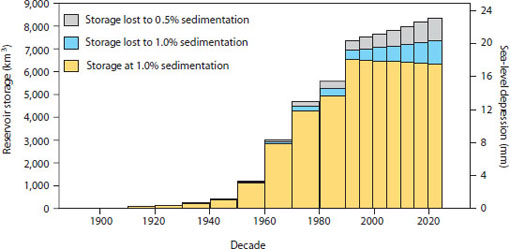
FIGURE 3.8 Accumulated global reservoir water storage in dams from 1900 to 2025 (yellow bars), based on observations and projections. The rate of water storage in dams higher than 15 m or with a capacity of more than 3 million m3 has begun declining over the past decade because of sedimentation (blue and gray bars), potentially reducing the rate of sea-level rise. SOURCE: Lettenmaier and Milly (2009).
this report was nearing completion, a new evaluation by Wada et al. (2012b) found a net positive contribution to global sea-level rise of 0.25 ± 0.09 mm yr-1 during the 1990–2000 period as a result of a decrease in reservoir construction and an increase in groundwater depletion. If this result holds, terrestrial water storage could become a significant contributor to future sea-level rise.
The most comprehensive recent assessments of global sea-level rise is given in the IPCC Fourth Assessment Report, which evaluated data and research results published up to about mid-2006, and Church et al. (2011), which provided updated data on the components of sea-level rise. The IPCC (2007) found that the relative contributions to global sea-level rise varied over time, with thermal expansion contributing significantly more to sea-level rise for 1993–2003 than for 1961–2003. Since then, thermal expansion estimates have been corrected for instrument biases, which gave systematically warmer temperatures than the true value globally and cooler temperatures than the true value in a portion of the Atlantic Ocean. The corrected rates of thermosteric sea-level rise for the two IPCC (2007) periods are more similar, with a higher thermal expansion contribution for 1961–2003 and a lower thermal expansion contribution for the 1993–2003 period.
In addition, new types of measurements, notably the GRACE satellite system, and expanded data sets have become available since the IPCC Fourth Assessment Report was published. Estimates incorporating the new data suggest a faster growing contribution of land ice to sea-level change than was seen in IPCC (2007) for the two periods. Since 2006, ice loss rates have accelerated in the ice sheets and declined in glaciers and ice caps, likely reflecting interannual to multi-annual variability and possibly uncertainties in data processing or interpretation of short records. The most recent published estimate is that land ice melt accounted for about 65 percent of global sea-level rise for 1993–2008 (Church et al., 2011). The prospect of increased ice sheet melting is important to future sea-level rise because the Greenland and Antarctic ice sheets store the equivalent of at least 65 m of sea level.
New data and models also are available for estimating the contribution of terrestrial water (besides ice melt) to global sea-level rise. Although the contributions of the two largest terms—groundwater depletion, which transfers water to the ocean and raises sea level, and reservoir impoundment, which prevents water from reaching the ocean and lowers sea level—are significant, they are difficult to measure. As a result, most recent assessments have not assigned a rate to terrestrial storage or assigned a rate of zero, within the limits of uncertainty.
This page intentionally left blank.


