
In 2009, the Government Accountability Office (GAO) released the report Warfighter Support: Independent Expert Assessment of Army Body Armor Test Results and Procedures Needed Before Fielding, which commented on the conduct of the test procedures governing acceptance of body armor vest-plate inserts worn by military service members (GAO, 2009). This GAO report, as well as other observations—for example, the Army Audit Agency report to the Program Executive Officer Soldier on Body Armor Testing (AAA, 2009)—led the Department of Defense (DoD) Director, Operational Test & Evaluation (DOT&E) to request that the National Research Council (NRC) Division on Engineering and Physical Sciences (DEPS) conduct an ad hoc study to investigate issues related to the testing of body armor materials for use by the U.S. Army and other military departments. Box S-1 contains the statement of task for the three-phase study. Phases I and II resulted in two NRC letter reports: one in 2009 and one in 2010.1 This is the Phase III report.
________________________
1Findings and recommendations from the Phase I and Phase II reports are in Appendixes K and L respectively.
The National Research Council will convene specialists in committee form to consider the technical issues relating to the testing of body armor. To do this the National Research Council shall conduct a 3-phase study:
In Phase I a committee will comment on the validity of using laser-profilometry/ laser-interferometry techniques to determine the contours of an indent made by a ballistic test in a non-transparent clay material at the level of precision established in the Army’s procedures for testing personal body armor. If laser-profilometry / laser-interferometry is not a valid method, the committee will consider whether a digital caliper can be used instead to collect valid data. The Committee will also provide interim observations regarding the column drop performance test described by the Army for assessing the part to part consistency of a clay body used in testing body armor. The committee will prepare a letter report documenting the findings from its Phase I considerations. This is a six week effort beginning November 1 2009 and ending mid December 2009.
In Phase II a committee will consider in greater detail the validity of using the column drop performance test described by the Army for assessing the part-to-part consistency of a clay body within the level of precision that is identified by the Army test procedures. The committee will prepare a letter report documenting the findings from its Phase II considerations. This is a three months effort beginning November 1 2009 and ending early February 2010.
In Phase III a committee will consider test materials, protocols and standards that should be used for future testing of personal armor by the Army. The committee will also consider any other issues associated with body armor testing that the committee considers relevant, including issues raised in the Government Accountability Office Report—-Warfighter Support, Independent Expert Assessment of Body Armor Test Results and Procedures Needed Before Fielding (GAO-10-119). The committee will prepare a final report. This is a 14-months effort beginning November 1 2009 and ending January 2011.
The final report will document the committee’s findings pertaining to the following issues that are of particular immediate concern to DOT&E including the following:
•The best methods for obtaining consistency of the clay, and of conditioning and calibrating the clay backing used currently to test armor.
•The best instrumentation (e.g., laser scanning system, digital caliper, etc.) and procedures to use to measure the back face deformation (BFD) in the clay.
•The appropriate use of statistical techniques (e.g., rounding numbers, choosing sample sizes, or test designs) in gathering the data.
•The appropriate criteria to apply to determine whether body armor plates can provide needed protection to soldiers; this includes the proper prescription for determining whether a test results in a partial or complete penetration of body armor, including, as appropriate, the soft armor underlying hard armor.
The final report will also document the committee’s findings regarding any other issues regarding body armor testing that the committee found relevant. The study team will have access to all data with respect to body armor testing that the team needs for the conduct of the study.
The last task for Phase III of the study was to document in its final report any other issues regarding body armor testing that the committee found relevant. In response, this report also addresses the following tasks:
- Provide a road map to reduce the variability of clay processes and show how to migrate from clay to future solutions.
- Consider the use of statistics to permit a more scientific determination of sample sizes to be used in body armor testing.
- Develop ideas for revising or replacing the Prather study methodology.
- Review and comment on methodologies and technical approaches to military helmet testing.
- Consider the possibility of combining various national body armor testing standards.
The preponderance of body armor testing is conducted by the U.S. Army Aberdeen Test Center (ATC) in support of the body armor acquisition authority, which is the U.S. Army Program Executive Office Soldier (PEO Soldier). In developing its report, the Phase III Committee on Testing of Body Armor Materials for Use by the U.S. Army (the Phase III committee) built on the work of the Phase I and Phase II committees, conducting data-gathering sessions at the ATC in Maryland and visiting testing facilities of the Army and commercial testers. Appendix B provides a list of committee briefings and activities.
The broad purposes of the study were to verify and validate current test procedures for body armor plates, to investigate long-standing issues related to the testing process, and to recommend approaches that will improve testing methodologies and procedures in the future. Committee responses to specific issues raised in the GAO Report are contained in Appendix F. This summary includes the numbered recommendations from each chapter of the report with principal findings of the study highlighted in italic typeface.
OVERVIEW OF BODY ARMOR TESTING
Ceramic materials have been used successfully in personal armor systems to defeat small-arms threats in both Iraq and Afghanistan, and there have been no known instances where a death resulting from small arms fire can be attributable to a failure of issued ceramic body armor. Since hard body armor systems add a significant weight to the burden on the soldier, the testing of body armor has an implied goal of ensuring that survivability standards are met while allowing sufficient soldier mobility and flexibility.
In 1977, a study was performed to correlate the depth that a 200-g, 80-mm hemispherical missile impacting at approximately 55 m/sec penetrated live-animal tissue and other media (Prather et al., 1977). The goal of the Prather study was to develop a simple, readily available backing material for characterizing both the penetration and deformation effects of ballistic impacts on body armor materials
and to relate this information to the injury potential of nonpenetrating ballistic impacts.
When there was no penetration of the armor, the researchers noticed that dynamic ballistics forces caused an indent in the recording material behind the point where the bullet struck the front side of the armor. This deformation in the backing material was termed a “backface deformation” (BFD). The depth of the deformation into various media, such as modeling clay or ballistics gelatin, as a function of time was compared to the probability of lethality for an identical degree of deformation inflicted on a live-animal model.
The Prather study observed strong correlations between lethality probability and the deformation of ballistic gelatin2 and of a modeling clay, Roma Plastilina #1 (RP #1). Ballistic gel required the use of high-speed photography to record the BFDs because the gel was elastic and returned to its original shape immediately after the projectile firing. To avoid the need to use high-speed photography, which was expensive at that time, clay was selected as an alternative and is used today as the medium for recording the BFDs in body armor testing.
RP #1 in its current formulation is the standard recording medium for testing, even though there are imperfect correlations between existing medical data and the BFD testing approach. In a nonpenetrating impact, kinetic energy must be dissipated by the armor through deformation or fragmentation of the armor, bullet, and underlying body wall. The transfer of energy to the body has the potential to cause serious injury or death. Nonpenetrating impact injury is termed “behind-armor blunt trauma” (BABT).
Numerous studies and experiments have been conducted and are ongoing to better determine the relationships among blunt force trauma, human injury, and the body armor testing processes. Since past research was based on smaller and slower bullets, the committee recognized that the existing research raises concerns regarding the correlation between damage measured in RP #1 and bodily injury at the very high rates typical of BFDs caused by rifle rounds in hard body armor.
CLAY AND BACKING MATERIALS
The committee assessed the use of clay in testing and described how the variability inherent in the backing material might be incorrectly attributed to variability in the armor. The study investigated the role of the backing material as a recording medium, the properties and limitations of RP #1 clay in body armor testing, and alternatives for future backing materials and systems for testing.
________________________
2Ballistic gelatin is a clear or yellowish gelatin that is the standard medium for evaluating what happens to bullets on impact with soft tissue.
Clay as a Recording Medium
The qualitative assertion that RP #1 exhibits little recovery has been interpreted to mean that the level of elastic recovery is small enough to be safely neglected. This has led to an assumption that the shape of the resultant cavity provides a record of the BFD. Since the relative degree of elastic and plastic deformation will vary as a function of strain rate, the backing material must be characterized under conditions that are relevant to those under which the tests will be performed. The cavity that results from live-fire ballistic testing is indeed related to the deformation on the back face of the armor, but it is not a true record of maximum deflection. It remains unknown how the dimensions of the cavity relate to the true BFD and how such a relationship may depend on the rate at which the cavity is formed.
RP #1 was originally developed as a modeling clay for artists. Over time its composition changed and the clay became stiffer to suit the ceramic arts community’s needs. Consequently, testers recognized the need for a method for calibrating the clay. The so-called column drop test was developed in response to this need. Because the oil-based modeling clay is readily softened by heating, ovens are now used on the firing range to warm the clay so that the newer formulations respond in the same way as the older ones.
Experiments conducted by the ATC show that RP #1 exhibits highly variable penetrations under nominally identical conditions. This unambiguously indicates that RP #1 is an inherently imprecise recording medium.
The committee found that both the spatial and the temporal variations of the modeling clay are significant. Experiments can be conducted to determine the variation due to box geometry and location of the drop in relation to the side of the box. Also, the scaling relationship between drop tests and ballistic tests remains mostly unexplored.
Understanding the structure-property relationships of oil-based modeling clay as they pertain to mechanical working, thermal processing, friction, and how the various ingredients of the clay modify behavior could lead to alternative clay systems with more favorable properties. A clay working group consisting of interested government and civilian experts from the body armor testing community is working to develop a near-term replacement clay that can meet the calibration specification of the column drop test at ambient temperature and whose properties are little affected by temperature.
Recommendation 4-1: The Office of the Director, Operational Test and Evaluation, and the Army should continue to expedite the development of a replacement for the current Roma Plastilina #1 oil-based modeling clay that can be used at room temperature.
Clay Conditioning and Handling
Interim opportunities for improvements in clay conditioning and handling were recommended in Phase II of the study, because in the short term, testing will continue to be conducted with available RP #1. As long as heating the clay is necessary, cooling will take place, and a post-test calibration drop test, as recommended in the Phase II Report (NRC, 2010), will continue to be an urgent requirement for the Army test operating procedure (TOP).
There is also a continuing need for detailed and systematic characterization of both the medium and the testing process. The comprehensive thermomechanical characterization of RP #1 that was recommended in the Phase II Report (NRC, 2010) will quantify the effect of shear history and thermal history on the storage and dissipative components of mechanical deformation. Such a characterization will also quantify the times associated with recovery of properties as well as the thermal properties, including thermal expansion, thermal conductivity, thermal diffusivity, heat capacity, and thermal arrests associated with phase changes.
In the drop test, the strain rate experienced by the clay is qualitatively lower than the rate experienced in the live-fire ballistic test of armor, and there is little information on clay behavior in these two strain-rate domains. Further, the volumes of cavities formed in the drop tests and the live-fire tests differ significantly. The testing community would benefit greatly from devising an alternative to the column drop test and certifying the validity of the current drop tests for calibration.
Medium-Term and Long-Term Replacements for Modeling Clay
There are two broad classes of backing material replacements for consideration in the medium and longer terms: (1) elastic materials that recover their original shape after unloading and (2) plastic materials that preserve a permanent cavity whose dimensions can be correlated to lethality probability. There is no compelling rationale for expending resources to achieve an interim solution using an elastic material such as ballistic gelatin. The committee also found that for the foreseeable future, plastically deforming recording media appear to be the proper choice of backing material for production testing of body armor.
The committee assessed the potential of the anthropomorphic test module (ATM) technology currently used by the Army for ballistics injury research. The committee concluded that the use of the ATM represents a transition to a challenging methodology with only limited ability to extend results to injury prediction. Also, it is too costly to be used as a production testing alternative to RP #1 at this time. The ATM is judged a research tool that is not practical or appropriate for widespread deployment in ballistic testing ranges.
There are several other test devices that are potentially suitable for use in the development of a test methodology for ballistic BABT, but they all need
significant development and validation experimentation. Much depends on the degree to which it is desirable to rank armor or predict injury probability, which would have to be addressed. Overall, instrumented electronic sensor response elements are in a primitive state for the evaluation and assessment by medical researchers of ballistic BABT with rifle round threats. They also are too costly to be used in high-volume production testing. More research and detailed validation is necessary before electronic sensors can be considered as a practical medium-or long-term alternative to the use of RP #1.
The report describes near-term actions, medium-term needs, and long-term goals that are consistent with earlier recommendations of the Phase II study (NRC, 2010).
Recommendation 4-2: The Office of the Director, Operational Test and Evaluation, and the Army should provide resources and execute the road map described in this chapter and graphically shown in Figure S-1 with the objective of developing a standard ballistics backing material for testing body armor. The properties and behaviors of the material should be well understood. It should exhibit minimal variability due to temperature, working, and aging and require simple calibration techniques and equipment, and it should enable reliable and accurate recording of body armor test results.
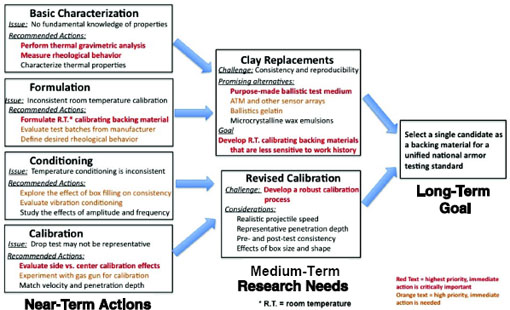
FIGURE S-1 Road map showing suggested near-term actions, medium-term research needs, and a long-term goal to develop a more consistent backing material and a more reliable process for evaluating hard armor. The color coding shows “highest priority” items in red text with “high priority” actions in orange.
INSTRUMENTATION AND PROCEDURES FOR MEASURING AN INDENT IN THE BACKING MATERIALS
The committee was tasked to determine the best instrumentation and procedures for measuring BFD (see Box S-1). To do this, it reviewed technical specifications, viewed demonstrations of the operation and use of current and prospective systems, and evaluated factors such as human handling variability, process transparency, and software variability judgment.
The committee found that given the current clay variation, a measurement precision (standard deviation) of 0.5 mm is sufficient; instruments featuring greater precision add little practical value to the testing process. Future improvements in the inherent variability of the backing material will require instruments that are correspondingly more precise. It is important that quantified data from actual tests be obtained for all instruments and measurement scenarios in order to make valid comparisons of instrumentation for different applications.
In evaluating the instrumentation methods, the committee noted that there is unknown variability associated with the software smoothing algorithm used by the Faro laser scanner system.
Recommendation 5-1: An organization such as the National Institute of Standards and Technology should conduct a controlled study to determine the most reasonable and consistent Faro smoothing settings to be used while measuring backface deformations (BFDs) in body armor testing. Similarly, any other software selections that could cause relevant changes to BFD measurements should be studied. Corresponding values for the precision and accuracy of each software setting will need to be quantified.
It is possible that a standard BFD cavity artifact could be used by testers to help to ensure that all measuring devices provide standard measures of accuracy and precision at different locations.
Recommendation 5-2: An organization such as the National Institute of Standards and Technology should develop a standard backface deformation artifact system and procedures to allow operators to ensure that different measurement devices at different locations are able to meet specified levels of accuracy and precision.
Finally, the committee derived criteria for a “best utility” measuring instrument based on its assessment of the characteristics of instrumentation systems presently used by military and commercial testers.
Recommendation 5-3: In anticipation of future test measurement requirements, the Office of the Director, Operational Test and Evaluation, and/or the Army should charter an organization such as the National Institute of Standards and Technology to conduct an analysis of available candidate commercial instruments
with inputs from vest users, manufacturers, testers, policy makers, and others. The goal is to identify one or more devices meeting the characteristics of “best utility” measuring instruments as defined in this study to the government, industry, and private testing labs.
The list of best utility instruments should be shared with the National Institute of Justice (NIJ), international allies, and others, as appropriate, to promote measuring instrument standardization for body armor testing nationally and internationally. A formal gauge or “artifact standard” repeatability and reproducibility study is required to quantify accuracy and precision as inputs to the best utility analysis.
STATISTICAL CONSIDERATIONS IN BODY ARMOR TESTING
The Phase II committee was asked to review a statistically based protocol that had been developed by DOT&E with assistance from Army statisticians and testers, and the Phase II report (NRC, 2010) provided initial insights on statistics-related issues. The committee reviewed historical test protocols as well as the new DOT&E first article testing (FAT) protocol and a proposed lot acceptance testing (LAT) protocol with regard to the assumptions underlying the statistical methods and design trade-offs.
The committee found that because of their differences, and as demonstrated in the DoD Inspector General calculations, neither the historical Army protocols nor the U.S. Special Operations Command (USSOCOM) protocols met the key protocol design requirement as a common standard DoD-wide. In addition, the historical Army protocol did not meet the key design requirement as a statistically principled test.
During the course of the committee’s research and deliberations, the DOT&E, Army, and USSOCOM have endeavored to establish statistically principled test standards that are realistically achievable with the current body armor designs. The committee found these collaborative efforts to be commendable.
The new DOT&E protocol meets both key protocol design requirements; it is statistically principled and it provides a minimum DoD-wide body armor test standard. However, since the distribution for some combinations of vendor, threat, and design may not be normally distributed, the tolerance-bound calculation that is specified by the protocol may not be appropriate in all cases.
The committee found that use of the Clopper-Pearson method for calculating the lower confidence limit is conservative, resulting in actual confidence levels that are at least as great as, and often greater than, the confidence level specified in the standard. The actual confidence level varies substantially as a function of the probability of no penetration [Pr(nP)] of the plates, and it can be quite different for small changes. For most lot sizes, and over
the higher levels of Pr(nP), the S-4 inspection level3 results in a greater probability that a lot will pass the LAT.
The committee concluded that using a statistically principled protocol enables decision makers to explicitly address the necessary and inherently unavoidable risk trade-offs that must be faced in testing. Furthermore, while additional research and coordination may be necessary to finalize the protocol design, and continuing review will likely be required as manufacturing conditions and plate designs change over time, a statistically principled protocol ensures that decision makers have sound information about body armor performance in order to ensure the quality of a critical soldier safety item.
Recommendation 6-1: The Office of the Director, Operational Test and Evaluation (DOT&E) should continue to conduct due diligence to carefully and completely assess the effects, large and small, of its statistical protocol as it is adopted across the body armor testing community. In particular, DOT&E should continue to
- Collaborate with the Army and the United States Special Operations Command (USSOCOM) to revise the test protocol as necessary, based on the results of Army and USSOCOM “for government reference” first article testing test results and other empirical evidence, to ensure that currently acceptable plate designs are not eliminated under the new protocol; and
- Regularly assess the impact or impacts of the new protocol on plate design, particularly plate weight, to ensure the test protocol results in body armor that achieves the requisite soldier safety while not negatively, inappropriately, or inadvertently affecting plate design.
Recommendation 6-2: The Office of the Director, Operational Test and Evaluation, should consider modifying the first article testing protocol to
- Generalize the description of the backface deformation (BFD) upper tolerance interval calculation to allow for nonnormal BFD distributions;
- Specify a confidence interval calculation methodology that has better coverage properties, such as the Agresti-Coull interval recommended by Brown et al. (2001) and described in detail in Agresti and Coull (1998); and
- Specify guidelines that will accommodate deviations in environmental conditions and/or plate size from the current 60-plate design matrix.
________________________
3Sample sizes in the protocol are based on special inspection level S-4 of ANSI/ASQ Z1.4-2008 (American Society for Quality, 2008).
Recommendation 6-3: The Office of the Director, Operational Test and Evaluation, and the Army should continue to consult and engage statisticians throughout the process of assessing and revising protocols, comparing the performance of the new and old protocols, assessing the effects of the new protocols, and considering possible changes.
Testers and statisticians should continue to work together as a team to (1) quantify in a statistically rigorous manner the amount of variation in BFD attributable to the testing process and that attributable to the plates and (2) ensure these results are appropriately reflected in an updated protocol. In particular, the statisticians involved with developing and implementing the statistically principled protocol should be involved with the clay experimentation discussed and recommended in the study.
Over the course of the committee’s research and deliberations, the DOT&E, the Army, and USSOCOM have endeavored to establish statistically principled test standards that are realistically achievable with the current body armor designs.
Recommendation 6-4: The Office of the Director, Operational Test and Evaluation, the Army, and the United States Special Operations Command should work together to arrive at an acceptable set of test standards for lot acceptance testing that is both statistically principled and is realistically achievable with current body armor designs.
HELMET TESTING
A specific tasking for Phase III of the study was to provide ideas for future improvement of helmet testing. Helmet testing follows a methodology similar to that for the testing of body armor plates. Head forms filled with the same RP #1 modeling clay are heated and subjected to drop tests to assure uniformity. The helmet to be tested is placed over a head form and a test round is fired into the front and side of the helmet. Ballistic forces from the bullet cause an indent in the clay similar to the BFD behind the armor plate, and the indent must be within specifications for it to pass the test.
The committee found that existing helmet test methodologies, including the current Army test methodology, do not relate directly enough to human injury to confidently assess injury risk from back-face trauma to the head. Improving the link between test methodology and human injury is an urgent matter in light of the newer helmet systems with lower areal densities and increased threat velocities. Also, it is uncertain how clay response correlates with human head/skull/brain response. Yet, clay response serves as the basis for current clay-based helmet methodologies. From a broader systems perspective the same problem exists with body armor plate methodologies. That is, it is uncertain how clay response is correlated with human injury in the thorax.
Recommendation 7-1: The Army should perform research to define the link between human injury and the testing methodology for head behind-armor blunt trauma.
Recommendation 7-2: The Aberdeen Test Center should ensure the following:
- Dynamic mechanical strain/deformation response of the head surrogate is similar for both types of loading at loading rates typical of behind-helmet response;
- Response of the head surrogate is similar to that of the human head;
- Required head quality control calibration is either performed on the head surrogate itself or is shown to be demonstrably represented by a surrogate for the head itself (i.e., by a sample box filled with clay) in controlled testing using a standard test procedure; and, 6.
- Response of the clay for the low-rate calibration tests is shown to be similar or scalable to the high-rate backface deformation response of the surrogate in controlled testing using a standard test procedure.
The Army Research Laboratory has developed what is referred to as the “Peepsite” head form to deal with some of the shortcomings of existing test head forms. The committee found that the Peepsite head form reduces or eliminates several potential problems with the NIJ head form that is used in the current clay test methodology.
A potentially important aspect of ballistic protective helmet design is the suspension system that provides helmet stand-off from the head, an important factor in ballistic protection. This complicates any analysis of injury risk due to deformation of the helmet.
Recommendation 7-3: The Army should investigate use of the Peepsite headform currently in development by the Army Research Laboratory with room-temperature clay. This headform and procedure has potential as a near-term alternative to testing using the National Institute of Justice clay head form tested at elevated clay temperatures.
MEDICAL BASIS FOR FUTURE BODY ARMOR TESTING
Much is to be gained by applying medical knowledge to body armor design and test processes. The committee reviewed applicable advances in medicine and biomechanics since the Prather study and concluded that the researchers at the time made good use of the data that were available (Prather et al., 1977). However, advances in imaging and measurement technology since then could facilitate a better understanding of the injury mechanisms, which will help to identify different and more appropriate engineering tests for armor qualification.
Thoracic Ballistic Test Methodologies
As previously noted, injuries to the thorax due to deformation of the armor are often termed BABT. Dynamic pressures transmitted to the thorax can cause local and remote fractures, contusions, and hemorrhage, as has been demonstrated in numerous animal studies. The committee found that carried mass, such as that associated with body armor, may decrease a soldier’s mobility and lead to fatigue. Further, body armor can prevent high-velocity bullets from penetrating the body but may not protect personnel from the shock wave from the initial projectile impact and the trauma induced by the BFD.
The committee found that the details surrounding the force that is transmitted from the body armor to the person wearing the armor, including the amount, the timing, and the immediate and long-term consequences of this force, are unknown. Techniques are needed not only to identify and treat BABT injuries, but also to assess the risk of BABT injury to those who wear the body armor. An instrumented surrogate (dummy) has been used effectively in many fields of injury biomechanics to evaluate the risk of injury from blunt trauma. Elements of this technique include a biofidelic surrogate, an engineering measurement system, an injury risk evaluation, and validation by physical injury model (such as by tests on animals or cadavers). Development of a relationship between a robust surrogate for injury and a validated injury model is crucial for success of this approach.
The body armor plates were designed to resist penetration by threat projectiles as detailed in the performance specifications. As a consequence, the plates are tested primarily on their ability to defeat the threat projectiles. In combat, the vests and plates also may provide warfighters with an unknown degree of protection against other battle hazards, including blast effects. The design for future body armor vests should consider blast effects as well as trade-offs between bulk, weight, and protection. Discrepancies between published measurements of changes in intrathoracic pressure for human subjects exposed to blasts from explosives with and without vests need to be resolved.
Recommendation 8-1: The Army medical and scientific testing communities should adequately fund and expedite the research necessary to experimentally and epidemiologically quantify the physiologic and medical impact of blunt force trauma on the body from both ballistic and blast threats to soldiers.
Cadaveric Experiments for Behind-Armor Blunt Trauma
Although there are several studies using animal and cadaveric experiments to study BABT injuries for hard body armor, the committee found that the current work does not allow the development of a thoracic BABT injury criterion from existing studies. Additional animal and/or cadaveric experimentation is necessary to develop a BABT injury criterion. Also, there is a need for a robust and widely used ballistic trauma injury classification scale.
Although there are a number of existing injury scales, including a widely used scale for automobile injuries, the abbreviated injury scale promulgated by the Association for the Advancement of Automotive Medicine, none is well suited to ballistic trauma. Data on which to base a satisfactory injury scale will require the collection of military epidemiological data on a large scale.
Models used by blunt trauma researchers do not reflect realistic battlefield threats, and the fidelity of anatomical, physical, and mathematical finite-element models simulating the human thorax, heart, lungs, liver, and kidneys, is limited at the present time. Thus, damage from transmitted pressures associated with blunt trauma to such organs as the intestines, spinal cord, brain, or vascular system cannot be predicted.
Recommendation 8-2: The Army should perform high-speed ballistic tests using human cadavers and large animal cadavers to provide responses to deforming hard armor impacted by velocities likely to be encountered in combat. These tests should be extensively instrumented to determine dynamic deformation characteristics in the human and animal torsos to provide data that can be correlated with clay response at the same rates (or with alternative media or other test methodology) and with epidemiology and medical outcomes in the soldier. The studies should ensure that velocity and backface deformation regimes replicate those for current and future desired body armor testing protocols.
The observations and data needed for large animal studies are far more extensive than data collected in the past. As described in Appendix J, studies will require extensive use of pressure transducers, cineradiography, metabolic imaging and neurochemical cerebral spinal fluid and blood assays.
Recommendation 8-3: The Army should perform live large-animal, live-fire tests to simulate the behavior of current and proposed new body armor against expected threats.
Instrumented Alternatives to Determine BABT
Technologies developed for research to evaluate injury effects, such as the ATM and clay sensors, have been considered by the Army for use in developing alternative testing methodologies. The committee found that instrumented response elements are in a primitive state for the evaluation of ballistic BABT for hard body armor against rifle round threats. Although several devices have associated instrument response and injury criteria that have been validated against a small range of loading conditions, there is no test device suitable for use without further development and validation. Also, instrumented anatomical surrogates are not detailed enough to assess ballistic BABT for hard body armor with rifle round threats.
Recommendation 8-4: The Army should develop finite-element simulation models of human and live-animal thoracic response to behind-armor blunt impact.
The validation of this simulation should be hierarchical from the small scale to the large scale. This includes the dynamic local response of constituent materials such as skin, bone, muscle, lung, liver, and other tissues; the regional response of the tissues under loading; and the global response of the whole torso. It should also include deformations from soft and hard body armor impacted with appropriate threats.
Recommendation 8-5: The Army medical community should enhance the current trauma registries to provide a program of injury epidemiology for ballistic impact, including behind-armor blunt trauma. This should include collection of both injury and noninjury events and should be similar to the federal crash databases used by the Department of Transportation—for example, the Fatality Analysis Reporting System and the National Automotive Sampling System for traffic injuries/fatalities, including injuries induced by both penetrations and backface deformations.
Recommendation 8-6: Using experimentally determined links to injury, response, and epidemiology, the Army should ensure that the clay or other alternative test methodology for hard body armor has humanlike dynamic response and is suitable for the development of behind-armor blunt trauma injury criteria.
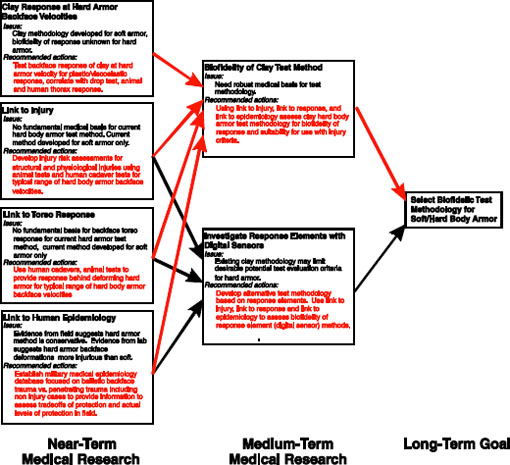
Recommendation 8-7: To achieve improvements in behind-armor blunt trauma (BABT) research methodology in the medium term, the Army should develop instrumented thoracic simulators as response elements (sensors). Necessary preludes to this effort include the following:
- Establishing BABT phenomenology and injury criteria using human cadavers, animal models, and field injury epidemiology coupled with well-validated finite-element simulations.
- Establishing human BABT mechanical response for the range of design conditions for personal protective body armor. This should include impact on soft and hard body armor of anticipated threats.
Recommendation 8-8: In the long term, beyond simple clay torso surrogates and one-layer torso simulants, the Army should use the road map in Figure S-2 to investigate the use of detailed anatomical surrogates (such as cadavers, instrumented models, etc.) as research devices to evaluate behind-armor blunt trauma.
FUTURE IMPROVEMENTS IN TESTING METHODOLOGY
In addition to the several recommendations that propose refinements to improve or replace the standing methodology for body armor testing, the committee reflected on ways that the existing national standards used to guide body armor testing for military and police force applications might be better synchronized in the future.
The committee found that the current body armor testing methodology that has evolved from the early work of Prather and others should be retained and improved on while investigating alternative methods. Recommended priorities for near-term actions are illustrated in Figure S-1.
The committee discerned differences between production testers and medical researchers relating to experimentation methods, objectives, and test instruments. Most importantly, it found that recording medium data from medical research and production testing need to be correlated using identical sensors having the requisite time resolution. The results need to be shared among the stakeholders.
Recommendation 9-1: The Director of Operational Testing and Evaluation should take the lead in aligning the production testing, medical research, and body armor/helmet technology development communities so that the data outputs from their various processes can be easily correlated. This will lead to a better understanding of the relationships among body armor testing performance, human/animal survivability, and other trade-offs. Specifically, two policies should be adopted and applied: (1) specify acceptable ranges for projectile weights and velocities used to generate behind-armor dynamic forces during testing and research and (2) investigate the use of standardized sensors behind armor to measure the amount of dynamic force that is produced during testing and research.
The overall need is for a coordinating committee to provide oversight and facilitate the exchange of information between stakeholder groups. The committee believes that the nationally recognized coordination committee recommended in the Phase II report is needed to align and accelerate efforts of technologists, production testers, and biomedical researchers in BABT/BFD-related research for both body armor and helmets. As an important step in this process, the ad hoc clay working group approach that was started by and is currently chaired by DOT&E offers an organizational nucleus for a way ahead for DoD. The committee agreed that the original ad hoc clay working group could be expanded to form DoD’s portion of the national body armor testing standardization committee recommended in the Phase II report.
The committee’s last recommendation is conceptually the same as Recommendation 15 in the Phase II report (NRC, 2010) but has been expanded to include helmet testing. Helmets and body armor plates have different
requirements, and there will likely be different testing standards for them for the foreseeable future.
Recommendation 9-2: The Office of the Director, Operational Test and Evaluation and the National Institute of Justice (NIJ), in collaboration with the military services, unified commands, government testing organizations, NIJ-certified testing laboratories, medical researchers and governmental and commercial material developers should convene a national body armor testing standard committee to review all appropriate considerations and develop recommendations that could lead to updated national body armor configurations and testing standards for body armor and helmet testing.
REFERENCES
AAA (U.S. Army Audit Agency). 2009. Body Armor Testing. A-2009-0086-ALA. Alexandria, Va.: U.S. Army Audit Agency.
Agresti, A., and B. Coull. 1998. Approximate Is Better Than “Exact” for Interval Estimation of Binomial Proportions. The American Statistician 52(2):119-126.
American Society for Quality. 2008. American National Standard Sampling Procedures and Tables for Inspection by Attributes. ANSI/ASQ Z1.4-2008. Milwaukee, W.I.: American Society for Quality.
Brown, L., T. Cai, and A. DasGupta. 2001. Interval Estimation for Binomial Proportions. Statistical Science 16(2):101-117.
GAO (United States Government Accountability Office). 2009. Independent Expert Assessment of Army Body Armor Test Results and Procedures Needed Before Fielding. GAO-10-119. Washington, D.C.: Government Accountability Office.
NRC (National Research Council). 2009. Phase I Report on Review of the Testing of Body Armor Materials for Use by the U.S. Army: Letter Report. Washington, D.C.: National Academies Press.
NRC. 2010. Phase II Report on Review of the Testing of Body Armor Materials for Use by the U.S. Army. Washington, D.C.: National Academies Press.
Prather, R., C. Swann and C. Hawkins. 1977. Backface Signatures of Soft Body Armors and the Associated Trauma Effects. ARCSL-TR-77055. Aberdeen Proving Ground, MD: U.S. Army Armament Research and Development Command Technology Center.


