
The consequences of dam and levee failure on physical and social infrastructures reach far beyond the flood zone, making a comprehensive approach to dam and levee safety that extends beyond the core traditional goals of safety programs necessary. At the request of the Federal Emergency Management Agency (FEMA), the National Research Council convened a panel of experts to consider how dam and levee safety, in concept and practice, can be expanded to promote the core values of the FEMA mission.1 The study is intended to aid development of initiatives that help community decision makers reduce risk of, and increase community resilience to, dam or levee failure (see Box S.1 for the statement of task). Two underlying principles are the foundation of discussion in this report. The first is that although the likelihood of uncontrolled water flow from dams and levees can be reduced in most cases, failures will still occur. The second principle is that communities can prepare for and mitigate the consequences of failure and can become adaptable in their responses and recoveries. To enhance community resilience, communities (including dam and levee safety professionals) can institute adaptive processes chosen through collective and collaborative efforts on the basis of mutual appreciation of community priorities, hazards, and consequences.
This report will be of interest to a broad audience, but much of the discussion is directed to dam and levee professionals in both private and public infrastructure safety programs, and at all levels of government. Dam and levee safety professionals include infrastructure owners, operators, and regulators, the majority of whom are technical experts in such areas as geotechnical, geologic, hydrologic, hydraulic, and civil-structural engineering. They are defined by their occupations and organizational responsibilities, not by proximity to dams or levees or by exposure to risk. Because a large percentage of dam and levee infrastructure is privately owned, many professionals are not government employees. These individuals
_____________
BOX S.l
Statement of Task
An ad hoc committee of the National Research Council will analyze and provide conclusions on how dam and levee safety programs may be broadened to include community- and regional-level preparation, response, mitigation, and recovery from potential infrastructure failure. The study will examine
• Holistic systematic approaches to safety analysis. Links between the geotechnical, geologic, hydrologic and hydraulic, and civil-structural engineering aspects of safety and the risks to communities and other stakeholders will be identified. The committee will consider how incorporating mitigation, preparedness, response, and recovery into safety programs can enhance long-term community- and regional-level resilience.
• Communication and engagement. The committee will describe current practices for identifying local and regional stakeholders, and for collecting and disseminating information among them, including how concerns are reassessed as infrastructure conditions change, safety issues emerge, and community needs and interests evolve. Conclusions regarding the improvement of these practices will be provided.
• Decision-making and decision-support systems. The committee will summarize how safety information, including stakeholder input, and inspection, monitoring, analysis, and impacts data are used in safety programs for decision making for both infrastructure management and improving community- and regional-level resilience against the primary (e.g., inundation) and secondary impacts (e.g., regional power loss) of infrastructure failure. The committee will provide conclusions regarding how stakeholder input may be incorporated into the design of safety and communication decision processes.
The committee will identify tools, products, and guidance that could be developed at the federal level to address the issues above. The human behavioral drivers that may promote or inhibit the expansion of dam and levee safety programs to promote community resilience will be considered. The committee's conclusions will assist the federal government in developing a more comprehensive and effective dam and levee safety program, but no policy or funding recommendations will be made.
ultimately will be responsible for improving dam and levee safety practice. The report communicates, especially to them, concepts of community resilience and the roles of professionals in increasing community resilience.
This report is not a comprehensive discussion of community resilience, nor does it offer a general framework for building community resilience. It is a discussion of how dam and levee safety professionals at the community level can become part of broader resilience-focused community efforts, and how professionals at higher (state and federal) levels may assist them. It describes the holistic approach and some of the major changes in safety
engineering practice required of many dam and levee professionals in terms that will be informative to them. Once a holistic approach is adopted by a safety program, safety professionals will need to apply it to their areas of expertise and responsibility as appropriate, given the unique qualities of the physical and social infrastructures of affected communities.
The committee’s major conclusions related to the concepts and processes necessary to bring about these changes are presented. Each conclusion builds on the preceding. A framework for process selection is provided, but because operations to enhance safety and resilience will be necessarily unique for each community, specific steps for enhancing resilience are not provided. The first three conclusions define community, community resilience, and the responsibility of dam and levee professionals with respect to resilience. The fourth conclusion addresses policy and practice with respect to information access. The fifth and sixth conclusions relate to collaborative risk management and approaches. The seventh summarizes necessary shifts in safety program practice and culture. The eighth addresses how the federal government might assist. The ninth and tenth conclusions address assessment of safety program and community processes for enhancing resilience and a framework for doing so.
DAM AND LEVEE SAFETY GOVERNANCE
Governance of dams differs from levee governance. Over 30 years, the National Dam Safety Program (NDSP) has assisted in enhancing state dam safety programs which regulate individual dam owners and their programs. As a result, safety is often equated with reducing the likelihood of dam failure. However, many state programs are unable to meet NDSP objectives, and individuals, property, and institutions are at risk for direct and indirect consequences of failure. A lack of unified standards and policies across the regulatory community causes many dam owners to grapple with conflicting standards that often ignore downstream issues and effects, and that do not address community-wide risk.
In contrast with dam programs, there is little governance or guidance for levee programs that are outside the federal domain where the Army Corps of Engineers provides some specific guidance. The National Flood Insurance Program (NFIP)—managed by FEMA to map flood-prone areas, establish floodplain management regulations, and provide flood insurance—has established a 100-year base flood elevation criterion that has become a de facto standard in the absence of more definitive guidance. However, development close to levees may increase risk to people and property, with little or no liability or accountability on the part of developers. This increases the dilemma for levee infrastructure owners and managers.
RESILIENCE AND COMMUNITY
The terms resilience and community may be defined differently by engineers, social scientists, emergency managers, and others. The ability to institutionalize many of the suggestions in this report depends, in part, on a common understanding of these terms. This report uses a definition of resilience consistent with that of FEMA: the ability of a system to absorb change and disturbance while maintaining its basic structure and function. Resilience, however, does not imply that a system will necessarily return to its original state after an adverse event. Because communities are not static systems, resilient communities are those able to adapt to changing conditions, continue to meet the critical needs of community members, and maintain a sense of community identity.
Conclusion 1. The dam and levee community comprises dam and levee safety professionals, and other individuals, groups, and institutions that benefit from the continued and safe functioning of dam and levee infrastructure—whether or not those benefits are recognized by the individual community members.
Community, as defined in this report, includes all persons and organizations exposed to direct consequences (the physical effects of inundation such as loss of life or property) or indirect consequences (such as financial burden, loss of public services, or loss of benefits from the ecosystem) of dam or levee failure. Indirect consequences of failure may affect those outside the geographic vicinity of dam or levee infrastructure or floodplains, defined as stakeholders in this report. Interested and affected parties therefore include dam and levee safety professionals, persons and property at risk, social-economic systems (such as governance organizations, emergency management offices, political and social networks, and environmental and cultural resources), and members of the wider economy. The dam or levee community could, in some cases, extend regionally and globally and include manufacturing interests whose supply chains may be disrupted, financial institutions, commercial risk managers, the insurance market, and FEMA (as manager of the NFIP).
Conclusion 2. Community resilience is a community effort, and dam and levee safety professionals are part of the community.
As a system, a community depends on the proper functioning of its components. Community resilience depends on the interactive functioning of those components, especially during times of stress. Dams and levees, as part of the nation’s critical infrastructure, contribute to the functioning of many communities. The expertise and practice of dam and levee professionals, as the designers and caretakers of dams and levees, are critical for community resilience. However, dam and levee infrastructure also depends on other components
of the community, and dam and levee professionals are interconnected with the communities they serve and often live in.
Conclusion 3. Those subject to the direct or indirect impacts of dam or levee failure are also those with the opportunity to reduce the consequences of failure through physical and social changes in the community, community growth planning, safe housing construction, financial planning (including bonds and insurance), and development of the capacity to adapt to change.
Understanding the purpose, benefits, and associated risks of dam and levee infrastructure can motivate a community to assess, anticipate, minimize, and absorb potential threats over the short and long terms. Although those who suffer the consequences of infrastructure failure may have little or no control over the infrastructure, everyone can help reduce the consequences, if not the risk, of failure. Understanding individual and organizational roles and responsibilities with respect to personal, financial, and other types of risk associated with potential dam and levee failure scenarios is a starting point for enhancing community resilience. Safety and resource management programs can provide safety and risk information related to dam and levee functions and can participate in decision making that helps a community prepare, mitigate, respond, recover, and adapt in response to potential infrastructure failure. In turn, the technical decisions (e.g., to raise or lower water levels under given circumstances) may be more supportive of community resilience given improved understanding of community functions and priorities.
ENABLING INFORMATION ACCESS
Conclusion 4. Current policy and practices restrict access to information critical to public risk awareness, mitigation, preparedness, response, recovery, and community capacity for adaptation. Dam and levee safety processes and products (such as inspections, Emergency Action Plans [EAPs], and inundation maps) are intended to support decision making and enhanced community resilience, but are not readily available to all community members and stakeholders who make those decisions.
The availability of hazard- and risk-related data is essential for informed decision making on the part of dam and levee professionals and the broader community. Decisions or practices intended to support national security, protect proprietary interests, or minimize liability concerns, however, can also prevent dissemination of information critical to risk assessment and decision making related to safety and resilience. Dam and levee infrastructure could be managed better with greater understanding of upstream and downstream risk
factors. For example, in the absence of accurate inundation maps, FEMA maps are often used to identify flood risks, but they do not depict the areal extent or the severity of floods that can result from dam or levee failure. Communities therefore cannot establish informed priorities or take informed action. Insurers and financial institutions make decisions without knowing potential catastrophic flood risks of any one location, or the potential aggregate effects. Common understanding of potential hazard scenarios, risks, and consequences is critical for the development of long-term sustainable solutions.
COLLABORATIVE RISK MANAGEMENT
Conclusion 5. Enhancing resilience will be most successful when dam and levee safety professionals and other community members and stakeholders identify and manage risk collaboratively in ways that increase understanding and communication of risks, shared needs, and opportunities.
Resilience-focused collaboration is a means of increasing understanding and communication of risks, shared needs, and opportunities if all elements of the community can be engaged and robustly vested in the outcomes of collaborative efforts. Social capital—the connections within community networks that can be used to meet societal objectives—is vital for community resilience. Resilient communities use their social and physical infrastructures and lifeline systems effectively to communicate and coordinate activities to mitigate, prepare for, respond to, recover from, and learn and adapt in response to disasters. Enhancing community resilience therefore implies greater interaction between dam and levee owners and the broader community than has been traditional in most dam and levee safety practices.
Collaborative identification of individual and collective issues, needs, resources, and solutions provides a means to manage systems, such as communities, that are too complex for any individual or entity to understand adequately. The benefits of collaborative engagement to dam and levee owners can include increased profitability and decreased liability (both as a result of reduced risk) and increased trust in and of the broader community. Regulators acquire a means to better promote public safety. Long-term benefits to dam and levee professionals come through the ability to contribute to and influence community planning and decision making (e.g., with respect to emergency management and recovery and land-use and financial planning).
Dam and levee safety programs, however, often operate independently of other community functions, and dam and levee professionals often fail to understand the value of community engagement and social capital to their own programs. Encouraging dam and levee professionals’ participation in community resilience efforts will be most effective if the case is made from within the profession. Moving concepts of resilience into the mainstream
of safety practice will take considerable effort on the part of professional associations and all agencies involved in dam and levee safety. Dam and levee professionals and the communities they serve need assistance identifying mechanisms for engagement in the form of tools, guidance, and examples of best practices, whether for the purpose of enhancing safety related to infrastructure operations, or for providing expertise, for example, in the management of land use, floodplains, or financial risk.
Conclusion 6. Risk-informed approaches allow dam and levee professionals to improve their understanding of infrastructure-system operations, performance, vulnerabilities, and the consequences of potential failures, and allow them and the broader community to make better decisions related to dam and levee infrastructure and resilience.
Risk-informed approaches are practices based on the information gathered through risk assessment and are not regularly applied in many dam and levee safety programs. Engineering design and operating procedures for dams and levees are primarily standards-based—for example, based on a defined level of infrastructure performance given a specific hazard. Standards-based approaches do not explicitly quantify performance uncertainty or risk. Risk-informed approaches, however, take into account the likelihood and consequences of different failure scenarios and can provide designers and operators more information with which to make technical decisions that improve safety. Communities also benefit from having information on the nature of potential failures, risks, and consequences. Resources can then be allocated more strategically based on the consequences for different community or stakeholder groups.
A CULTURAL SHIFT
Conclusion 7. Improving dam and levee safety programs to emphasize processes that enhance community resilience requires a culture shift among dam and levee professionals. This new emphasis requires embracing the responsibilities—and the benefits—associated with developing and implementing collaborative risk-management processes that facilitate enhanced community resilience.
A new norm for dam and levee safety practice requires overcoming institutional obstacles and establishing new goals that move practice beyond mere regulatory compliance. Dam and levee professionals will need to identify and engage community members and stakeholders, recognize shared goals and resources, and develop and implement processes that enhance community resilience. These include understanding factors critical for community well-being, creating more effective EAPs, being more aware of community land use
and planning, and reducing liabilities as a result of reduced flood risk. This shift is more likely to be successful through incremental expansion of traditional dam and levee safety practices.
Whereas a cultural shift is necessary, the work to engage community members and stakeholders does not have to start from scratch. Models of collaborative engagement exist from which to draw, and dam and levee professionals already may have professional relationships with well-networked emergency-management professionals, local government and community leaders, local industry, chambers of commerce, and other community groups. Collaborative networks for enhancing community resilience may already exist in some communities for dam and levee professionals to join. Dam and levee professionals do not need to invent or lead collaborative efforts, but do have a responsibility to share their unique knowledge for their own benefit, the benefit of the organizations they represent, and the benefit of the larger community.
Figure S.1 is a conceptual framework for resilience-focused collaboration for the dam and levee safety community. Central to the framework are collaborative processes for resource and floodplain management including those for operational and risk communication, risk assessment, and preparedness and mitigation. Participation in, feedback from, and evaluation of collaborative processes by the community are necessary for effective and sustainable collaboration. Figure S.1 also illustrates that political, economic, cultural, physical environmental, and other community factors influence the effectiveness of collaboration, but may also be influenced as a result of collaborative efforts. Social capital, more informed decision making, and other resilience-related outcomes are among the benefits of collaboration that may lead to increased resilience.
BENCHMARKING PROGRESS IN SAFETY AND ENGAGEMENT
Conclusion 8. The federal government can aid resilience-enhancing efforts by identifying, cataloging, further developing, communicating, and facilitating the use of tools and guidance that already exist in the published literature and in federal and state guidelines. Many existing tools may need little or no modification to be useful for enhancing community resilience for specific situations. Cataloging existing tools is a first step in identifying and setting priorities for developing necessary new tools.
Integration of the ideas in this report into practice will be supported by the identification and selection of appropriate guidelines, methods, and means of selecting or implementing best practices for a given process. Examples of tools are dam inspection guidelines and floodplain zoning criteria. Because safety and resilience are community- and situation-specific, recommendation of the “best” tools is neither possible nor helpful. The federal
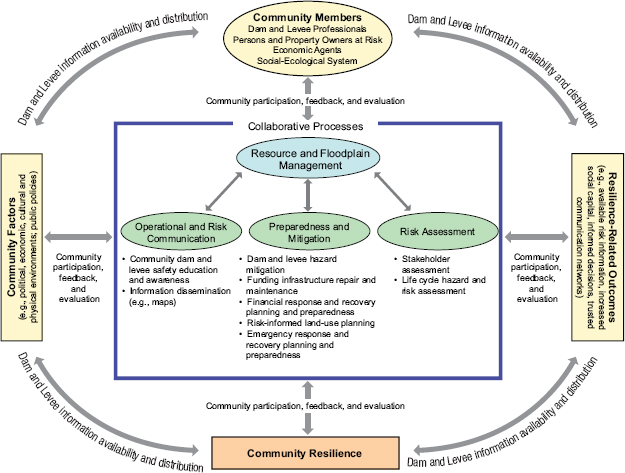
FIGURE S.1 Conceptual framework for resileince-focused collaboration related to dam and related to dam and levee safety.
government can best contribute to community-level resilience in a supportive role—through training and provision of information, guidance, tools, and appropriately considered best practices (all referred to as tools in this report). Because multiple federal agencies are involved in efforts to enhance community resilience, many tools may already exist and can be applied to safety and resilience efforts. Federal agencies with roles in dam and levee safety could review their own processes for enhancing safety and community resilience, and collaborate with states and representative owners to identify useful tools and resources, both existing and those that could be developed, that would most productively facilitate community-level resilience efforts. Cataloging and evaluating existing tools and best practices described in the published literature and elsewhere would result in a database that could be shared broadly.
Development of new tools is best informed through collaborative processes that take advantage of the expertise of key community members, stakeholders, and dam and levee professionals at all levels. Given the uniqueness of communities, tools and guidance are more useful if scalable, flexible, and able to provide the right level of analysis in different circumstances. One-size-fits-all tools, for example, may not be useful for both local- and state-level decision makers. The most effective means of making tools available at the community level need to be determined and acted on.
Attention by the federal government could be focused on the tools, training, and information that would help dam and levee professionals identify and engage community members and stakeholders; the community-specific processes for disseminating risk-related information; and identification of community priorities and resources. Also necessary is attention to improving risk-reduction and mitigation measures, land-use management, financial resilience and preparedness, and on the means to benchmark progress in all aspects of the larger effort to improve resource and floodplain management and community resilience.
Conclusion 9. Collaborative efforts that become a normal part of community functioning will enhance resilience more successfully in the long term. Continuous improvements in community resilience are more likely if such processes as community and stakeholder engagement assessment are institutionalized by dam and levee safety programs and the broader community.
Efforts to enhance safety and resilience can be sustained over the long term only with the widespread expectation that such efforts are necessary to improve community well-being. Formalized (e.g., institutionalized) programwide changes that expand current safety program goals of merely achieving regulatory compliance will need widespread acceptance. Community resilience cannot be created and sustained through short-term initiatives or activities of only a few in the community. Incremental steps that integrate activities of multiple community networks are required. Long-term plans that consider life-cycle benefits and costs of dam and levee infrastructure need to be widely communicated, understood,
and acted on by the community in consideration of how actions fit into the larger resilience picture. Community engagement and the means of assessing and transforming engagement to inform long-term management of safety programs will make improving social capital, benchmarking processes, and identifying opportunities to improve community resilience part of the operational norm.
The greater community also needs to institutionalize engagement with dam and levee safety professionals into community functioning, perhaps as part of an already-existing all-inclusive community resilience strategy. An institutionalized forum for collaboration is needed in which community members, stakeholders, and dam and levee professionals can address community resilience issues, including resource and floodplain management; operational and risk communication; safety and resilience education and awareness; community member and stakeholder analyses; life-cycle hazard and risk assessment and mitigation; risk-informed land-use planning; funding for infrastructure repair and maintenance; financial preparedness, recovery, and response; and emergency response and recovery planning and preparedness. The mechanism for participation and feedback needs to be nonpartisan and not be tied to any particular administration or community-member bias.
Conclusion 10. Enhancing resilience requires frequent and collective evaluation of risk, safety, and collaborative processes. The proposed Maturity Matrix for Assessing Community Engagement can be used by dam and levee safety professionals, community members and stakeholders, and government entities at all levels to benchmark and manage the progress of industry and community processes related to safety and engagement. Details of assessment are necessarily unique for each community. The federal government can assist communities by providing an initial framework for the assessment tool, and providing information and training for its development and continued use at the community level.
Metrics for direct evaluation of community resilience, or the effectiveness of tools and processes to improve resilience, do not exist. The effectiveness of a tool or process depends in large part on its appropriate use given the abilities and collective goals of a community. The Maturity Matrix for Assessing Community Engagement (see Table S.1 for a generic example) can assist dam and levee professionals and the broader community in gauging the level of safety and resilience practice with respect to community engagement, and in improving understanding of how individual processes are parts of the larger resilience picture. The tool can allow communities to communicate operations already in place, identify weaknesses, decide on community resilience goals and priorities, and identify the means of meeting the goals.
The Maturity Matrix for Assessing Community Engagement is based on concepts developed in the software and systems engineering industry. It uses a matrix—called a
TABLE S.1 Sample Entries for a Maturity Matrix for Assessing Community Engagement
| Elements | Level I | Level II | Level III |
| Dam or levee safety reviews | No activity | Standards-based only | Introduction of additional review criteria (e.g., failure mode analysis) |
| Other programs related to conventional dam/levee safety activities | Each tool is defined at different levels to show progression from minimum activity (Level I) through best industry practice to full community member and stakeholder engagement and collaboration (Level V) | ||
| Emergency action plans | No activity | EAPs developed internally by owner | EAPs developed with input from emergency management agency |
| Specific tools related to emergency planning response, including development of community preparedness measures, warning and evacuation procedures, and recovery plans | Each tool is defined at different levels showing progression from minimum activity (Level I) through best industry practice to community member and full stakeholder engagement and collaboration (Level V) | ||
| Floodplain management | No floodplain management plans | Floodplain management plans in place | Floodplain management plans accommodate shadow floodplain associated with catastrophic dam or levee failure |
| Specific tools such as those related to land-use planning and floodplain management, including initiatives for financial incentives and zoning reform | Each tool is defined at different levels showing progression from minimum activity (Level I) through best industry practice to community member and full stakeholder engagement and collaboration (Level V) | ||
| Level IV | Level V | Examples of Possible Outcomes |
| Application of quantitative risk assessment by using criteria developed by owner or regulator with input from community members and stakeholders | Application of quantitative risk assessment by using criteria that reflect the community’s societal values | Community is fully apprised of current level of risk |
| EAPs developed with input from community members and stakeholders and emergency management agency and shared with selected community representatives | Community collaboration with owners or operators to develop integrated EAPs that reflect community values | Community collaboration results in EAPs that minimize consequences of defined emergencies by incorporating community values and the potential for community resilience |
| Floodplain management plans integrated into community comprehensive or general plans | Floodplain management plans fully integrated into dam and levee owners’ planning processes | Full participation by both community and dam and levee owners in floodplain management facilitates adoption of complementary resilience- enhancing measures |
maturity matrix—to assess how advanced or “mature” a program is with respect to a specific goal. A dam or levee safety program may create a maturity matrix with rows that describe specific program or community processes, such as dam or levee safety reviews, EAP development, floodplain management, and land-use planning. Columns under each maturity-level heading are populated with tools that are in place in the program or community for a specific function, and tools that should be in place at given increased levels of community engagement related to that function. The maturity levels represent a continuum of practice: from no activity or a small amount of structure-centric activity to fully informed community-centric processes that include incorporation of community priorities in decision making.
Maturity matrices are unique to each community and can be as complex as community needs dictate. It may be necessary to include several subheadings in any given row to address a specific goal fully. The community engagement process to create a maturity matrix is as useful as the developed matrix itself. Populating each cell of the matrix facilitates a complete assessment of a program’s safety, communication, and engagement processes. Compiling the matrix compels dam and levee owners to scrutinize current goals and processes, helps them set goals for increased safety, engagement, and resilience, and to set priorities among goals. The exercise of developing the matrix is useful to bridge communication gaps among those who have different expertise, and the matrix itself is a vehicle for communicating with the broader community. Evaluating and choosing processes collaboratively helps generate a common vocabulary among community members and stakeholders.
Once developed, the matrix becomes a transparent mechanism for planning and evaluating community resilience. Regular self- and community assessment of safety and resilience programs using the matrix results in a visual reminder of status of the program or community with respect to specific goals. A community will never reach “100 percent maturity,” because there is always opportunity for improvement or the need to respond to change. Similarly, maturity does not necessarily mean communities are free from risk. As the matrix is updated to reflect changing community or infrastructure conditions, it can be used to communicate where a program is more or less mature, and to prioritize community and program resource use to sustain and increase resilience, and to sustain the resilience-focused collaboration.
The assessment tool is scalable and readily modified for a large variety of resilience-related activities, programs, or types of infrastructure that affect resilience at different levels (local, state, regional, and national). Table S.1 is a generic matrix for dam and levee safety programs that, to be useful, must be customized by each community and each safety organization. The federal government can be instrumental in developing further the basic framework for the Maturity Matrix for Assessing Community Engagement and in developing guidance for its use.
To populate a community-specific matrix, safety programs and communities will need
assistance determining characteristics of resilience in their communities, determining strategies for identifying and engaging community members and stakeholders, and determining the vulnerabilities and risks associated with all hazards and alternatives for reducing or mitigating them. Federal agencies that have responsibility for dams and levees can collaborate to examine safety programs, identify the means to improve their own knowledge of risk communication, advise communities how risk can be communicated in clear, understandable, and actionable terms, and to explore the role of community factors including legislation and land-use planning, in the severity of hazards and consequences to a community.


