The binary decision-making framework outlined in Chapter 2 provides an alternative to probabilistic estimates of contamination constrained by the uncertain and/or unknowable factors included in the Coleman-Sagan equation. The decision-making framework can be visualized in a number of different ways. The committee’s preferred depiction (see Figure 2.2) may not be the one most familiar to all relevant scientific and technical communities. Indeed, engineers tend to visualize decision networks as event sequence diagrams.
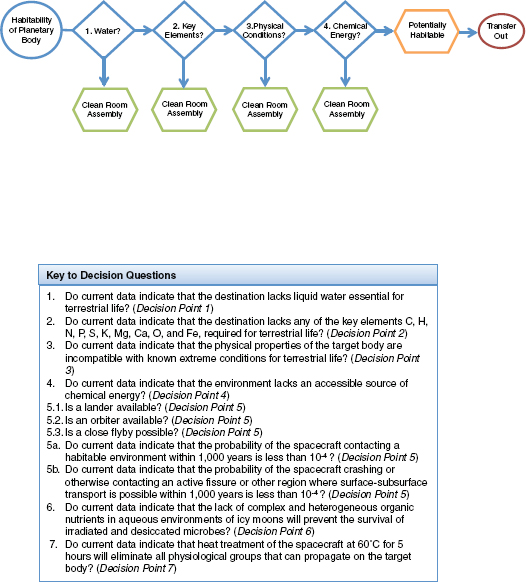
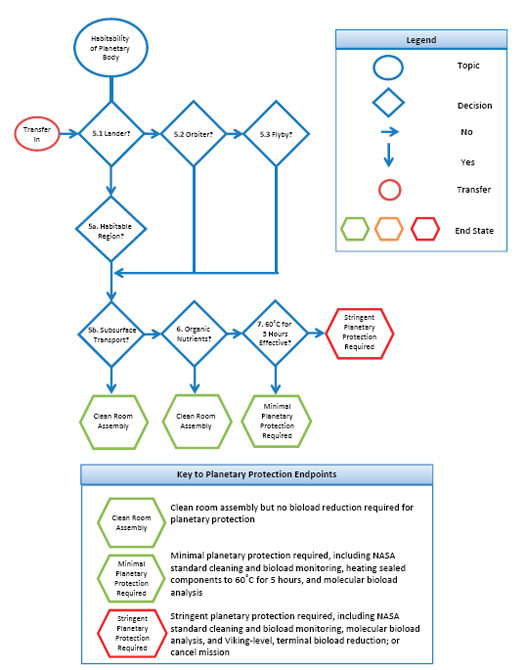
The event sequence diagram presented in Figure C.1 is included to provide mission planners with the functional equivalent of the decision-making framework in Chapter 2, but in a more familiar format.
Figure C.1 indicates the process to be applied for the two determinations necessary, the first of which is related to potential habitability of the icy body target (that is, its “fragility” against bio-propagation), and the second related to the type of mission proposed so as to address the potential for “initiating” a bio-contamination of a potentially habitable icy body. This bimodal determination process (that is, the determination of the fragility of the process, design, target) and the determination of the potential for damage initiation are consistent with the general process of risk determination used across a variety of applications.1,2
The left-hand portion of Figure C.1 represents the decision of whether the planetary body of interest should be considered to be potentially habitable. Four criteria are used to judge the habitability of the planetary body and specifically question whether the planetary body is known to possess liquid water, the key elements considered essential for terrestrial life, environments known to be compatible with known extreme conditions of terrestrial life, and accessible sources of chemical energy. If the planetary body does not possess one or more of these attributes, then it is judged as uninhabitable by terrestrial life and, although assembly of spacecraft intended for these bodies should be performed in a clean room, no bioload reduction is required for planetary protection. If the planetary body does possess these four essential attributes for habitability by terrestrial life, or if this information remains undetermined at the time of the mission, then the planetary body is deemed to be potentially habitable.
The right-hand portion of Figure C.1 considers the nature of the mission itself (e.g., flyby, orbiter, lander) as relevant to determining planetary protection requirements for missions to potentially habitable planetary bodies. Consideration must be given to whether the mission employs a lander and/or an orbiter and whether a flyby attempt will be made of the given planetary body. If a lander is employed, the likelihood of the spacecraft interacting with a habitable region must be evaluated, and for all missions the probability of the lander crashing or otherwise interacting with a region where surface-subsurface transport is possible must be assessed. If this likelihood is less than 10–4 over a period of 103 years, then no bio-load reduction measures are required for planetary protection
beyond clean-room assembly. If the probability for interacting with habitable regions exceeds 10–4 over a period of 103 years, then specific consideration must be given to whether the lack of complex and heterogeneous organic nutrients in aqueous environments of icy moons would preclude the propagation of any microbes that may have survived extreme irradiation and desiccation environments in transport. If the lack of nutrients indeed precludes propagation, then clean-room assembly is deemed sufficient; however, if the potential for propagation remains, then at least minimal planetary protection methods are required, and the final-decision question then considers whether heat treatment at 60°C for 5 hours would fail to eliminate all physiological groups that could potentially propagate on the target body. If so, then stringent planetary protection methods are required for the mission to proceed, or else the mission must either be reformulated or cancelled.
REFERENCES
1. J. Fragola, B. Putney, and J. Minarck III, An Evaluation of Containment Assurance Risk for Earth Entry Vehicle and Space Shuttle Sample Return, Earth Entry Vehicle Office, NASA Langley Research Center Hampton, Va., September 30, 2002.
2. J. Fragola, B. Putney, and J. Minarck III, Mars Sample Return Probabilistic Risk Assessment Final Report: An Evaluation of Containment Assurance Risk for Earth Entry Vehicle and Space Shuttle Sample Return, Contract No. 123-4119, NASA Langley Research Center, Hampton, Va.