
Summary of a Workshop on Innovation in Computing and Information Technology for Sustainability
INTRODUCTION
On May 26, 2010, the Committee on Computing Research for Environmental and Societal Sustainability held the Workshop on Innovation in Computing and Information Technology for Sustainability in Washington, D.C. The goal of the workshop was to survey sustainability challenges, current research initiatives, and results from previously held topical workshops and related industry and government development efforts in these areas. The workshop featured invited presentations and discussions that explored research themes and specific research opportunities that could advance sustainability objectives and also could result in advances in computer science (CS). Participants were also asked to consider research modalities, with a focus on applicable computational techniques and long-term research that might be supported by the National Science Foundation (NSF), with an emphasis on problem- or user-driven research.
This appendix summarizes the discussion of the workshop panelists and the attendees. The summaries of the four workshop sessions provided in this appendix are a digest both of the presentations and of the subsequent discussion, which included remarks offered by others in attendance. Although this summary was prepared by the committee on the basis of workshop presentations and discussions, it does not, in keeping with the guidelines of the National Research Council on the development of workshop summaries, necessarily reflect a consensus view of the committee.
The sessions at the workshop were entitled:
• Session 1: Expanding Science and Engineering with Novel CS/IT Methods: “The Need to Turn Numbers into Knowledge”;
• Session 2: Understanding, Tracking, and Managing Uncertainty Throughout the Science-to-Policy Pipeline;
• Session 3: Creating Institutional and Personal Change with Humans in the Loop;
• Session 4: Overcoming Obstacles to Scientific Discovery and Translating Science to Practice.
The workshop agenda is provided at the end of Appendix A.
SESSION 1: EXPANDING SCIENCE AND ENGINEERING WITH NOVEL CS/IT METHODS: “THE NEED TO TURN NUMBERS INTO KNOWLEDGE”
Discussions during the first session of the workshop focused on the role of computer science in helping solve sustainability challenges. A broad definition of sustainability was employed. Vijay Modi, Columbia University, provided examples of sustainability areas where computer science could help address some challenges; Robert Pfahl, International Electronics Manufacturing Initiative, discussed changes in electronic systems and products to improve sustainability; Neo Martinez, Pacific Ecoinformatics and Computational Ecology Lab, explored the role of computer science in improving ecological sustainability; Adjo Amekudzi, Georgia Institute of Technology, examined planning and management issues around infrastructure; and Thomas Harmon, University of California, Merced, discussed water challenges.
Following are examples given of the ways in which computer science can play a role in addressing sustainability challenges:
• Urban electricity consumption. Gathering fine-grained accurate measurements and statistics on energy usage of individual buildings can be difficult, due in part to the variety and diversity of building types. With better measurements, one could develop a useful model of energy usage over the course of a day and find opportunities, for instance, to store extra energy throughout the day for use at peak times.
• Infrastructure planning. The planning and development of effective infrastructure are very difficult to do at scale for the time span required. Compounding these challenges is a dearth of data on how and where people actually live and what their movements are throughout the day.
This limited knowledge of the movement of people and the limited understanding of where infrastructure needs exist make it difficult to plan infrastructure accordingly. Advances in remote sensing, to improve understanding of the use of current infrastructure, can help cities and utilities to formulate better infrastructure planning.
• Clean water. Access to clean water is an ongoing and increasingly challenging problem worldwide. One of the more difficult components of this challenge is detecting water below the surface of Earth. Although detection of water at and just below the surface is well understood, technology for finding water at deeper levels is limited. Better sensing technologies are needed to help differentiate between sand, wet sand, water that is flooding the sand, and so on.
The examples above are a just a few of the areas in which computer science has contributions to make to sustainability. Workshop participants examined a wide array of sustainability challenges in which specific CS/ information technology (IT) advances could contribute to resolving these challenges. In many cases, it is a matter of developing new approaches for turning raw data (numbers) into knowledge and, ultimately, prompting action that results in more sustainable outcomes. Research opportunities cited by workshop participants in the areas of ecological sustainability (that is, relating to diverse and productive biological systems), transportation, and water resources are described below, along with associated computer science challenges. The first session concluded with a brief examination of the policy challenges of interdisciplinary work and of turning knowledge into actionable items.
Electronic Systems and Products and Sustainability
The International Electronics Manufacturing Initiative (iNEMI) is a consortium of electronics manufacturers and affiliates focused on environmental issues in electronics.1 Every 2 years, iNEMI creates a roadmap that charts future opportunities for and challenges to electronics manufacturing for reaching sustainability objectives.2 The iNEMI efforts began by focusing on hazardous materials. The early goals of the consortium were aimed at eliminating chlorofluorocarbons from the cleaning of electronics, removing lead from electronics, and reducing the use of halogenated flame retardants and polyvinyl chloride (PVC) materials. More recently, the focus has been on the complete energy use of products, as discussed
_______________
1A list of iNEMI members is available at http://www.inemi.org/news/council-members.
2The 2011 iNEMI roadmap is available at http://www.inemi.org/2011-inemi-roadmap.
below. Sound scientific methodologies are needed to take into account total trade-offs among conflicting device requirements and to model longterm reliability and life of these devices.
Products that are recyclable, use non-hazardous materials, or minimize the use of energy and matter tend to be less harmful for the environment. Often there are trade-offs among these concerns. For example, using fewer hazardous materials may increase the resources needed to manufacture a certain type of equipment. When considering the size of items, there is often a trade-off of size for function. For example, cellular telephones have grown larger in recent years as functionality has increased. This matters especially with regard to calculating potential waste over a product’s entire life cycle, although in the case of cell phones, the increased functionality may mean that other, even larger devices are no longer needed. Digitization is another example in which the functionality of electronics has decreased the amount of hardware needed. As digital music players have become more ubiquitous, compact disc players—and discs—are becoming less and less necessary.
Life-cycle analysis is key to understanding the complete energy use of products, including the energy used in mining raw materials, producing semiconductors and other components, assembly, transportation, and, ultimately, consumer use of the product. Computing research can assist in the tracking and understanding of all of these inputs throughout the life cycle of products.
“Green computing”—making computers themselves more environmentally friendly—plays a role in the reduction of energy consumption. For example, basic assumptions about computers’ operating environments can be rethought, to yield significant energy savings. The 2011 iNEMI roadmap recommends that server farms and machines be redesigned so that the temperatures of server rooms can be increased in order to reduce the amount of energy required for cooling.
Participants noted that a holistic approach to technology is needed to contribute further to sustainability in electronics. Continued work in the following areas is needed: in digital semiconductor technology, work is needed in order to increase density and reduce cost; in the incorporation of sensor networks, work is needed to provide detailed energy-use data; in electronic packaging technology; and in innovation in CS and IT algorithms and applications. Additionally, participants suggested that standards may play an important role here.
Ecological Sustainability
Threats to ecological sustainability include loss of biodiversity, species extinction and invasion, and the exploitation of ecosystems. Each of
these threats has consequences for the robustness, resilience, and stability of the respective ecosystems. Computer science can play an important role in enhancing the understanding of the consequences to ecosystems of particular courses of action by assisting in measuring the current impacts of actions and predicting future impacts on these ecosystems.
Databases play a crucial role in the understanding of ecosystems. For example, the Global Ex-vessel Fish Price Database of the Fisheries Economics Research Unit is a valuable, large data set.3 The database provides information on hundreds of types of fish and their market prices over an extended period, thus enabling a better understanding of conditions in the oceans and of the potential effects of fishing.
Computing will also play a vital role in helping researchers and decision makers understand collected data, which come from a variety of sources. Hardware and software will be needed to help analyze large sets of heterogeneous data. Advances in modeling and simulation will also contribute to the understanding of the information collected. Ecological networks are complex, high-dimensional, non-linear systems. Therefore, simpler mathematical representations are not adequate. Ecological systems need to be simulated over time. Participants noted that currently, the various time series and relevant data for the simulation of an ecological system can only be summarized. More accessible data including quantitative information from simulations is needed so that others can use the data and contribute to the work. Some of the challenges created by large, heterogeneous data sets and researchers’ resource limitations have been resolved with remote-computing capabilities (currently referred to as cloud computing). The shared resource of cloud computing can allow for simulations to be run much faster. Additional advances are needed so that data simulations can be stored easier and computing power can be more easily shared.
Interdisciplinary research on networks has led to a greater understanding of food webs and other ecological systems. For example, paleontological food web analysis has provided a better understanding of the network structures of current food webs.4 Gaining an understanding of food chains on the globe over vast timescales can help provide researchers with a sense of how some kinds of ecosystems evolved. If economic
_______________
3The Global Ex-vessel Fish Price Database and its various uses are described in U. Rashid Sumaila, Dale Marsden, Reg Watson, and Daniel Pauly, Global Ex-Vessel Fish Price Database: Construction, Spatial and Temporal Applications, Fisheries Centre Working Paper #2005-01, Vancouver, B.C., Canada: University of British Columbia (2005).
4The Pacific Ecoinformatics and Computational Ecology Lab has done much of the work related to paleontological food web analysis. A list of its publications is available at http://www.foodwebs.org/.
information to account for things such as price and biomass can be incorporated into models based on the understanding of modern food webs, the effect of economic exploitation on ecological systems can be better understood. For example, in a simple three-species food chain (such as large fish eating small fish eating plants), adding economic information to the model also allows for a separation of the effects of exploitation by humans for economic reasons from the effects of human exploitation for the purpose of subsistence. Participants discussed how network-based analyses might be useful in other areas of sustainability. Rules derived about ecological networks, for instance, may also apply to energy and economic networks. Can useful comparison be made between economic and food networks? Does food function like money in any sort of actionable way?
Computing-enabled “citizen science” provides ways for volunteers to collect and report information from their own environments and to contribute to the sustainability of those environments. Citizen science programs have existed since the early 1900s, beginning with the Audubon Society’s Christmas Bird Count.5 Now, new mobile technologies and social networking tools make collecting and reporting much easier. Volunteers can easily collect data, for example, on a particular invasive species and send the information to experts to examine.
Transportation and Social Sustainability
Participants discussed the connections between traditional measures of sustainability, which may typically be functions of space and time, and measures of social sustainability. With social sustainability, as shown in Figure A.1, the sustainability footprint becomes the rate of change of quality of life as a function of one’s impact on the environment. Participants argued that social sustainability can be and needs to be more rigorously accounted for in discussions about other forms of sustainability.
Social sustainability can be considered when looking at transportation sustainability, for instance. Definitions of “transportation sustainability” typically focus on moving items (people, goods, and information) in ways that reduce the impact on the environment, economy, and society. Transportation plans have been required in all major metropolitan areas since the 1960s. Although customer satisfaction has been included in transportation planning for some time, assumptions regarding customer needs are often incorrect. Traditionally satisfaction has been seen as a
_______________
5For information on and a history of the Audubon Christmas Bird Count, see http://birds.audubon.org/christmas-bird-count.
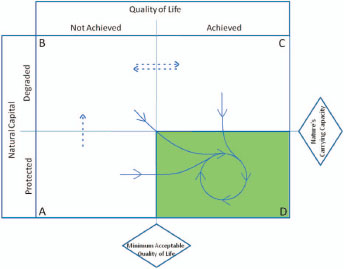
FIGURE A.1 Achieving quality of life within the means of nature. SOURCE: Jamie Montague Fisher and Adjo Amekudzi, Quality of life, sustainable civil infrastructure, and sustainable development: Strategically expanding choice, Journal of Urban Planning and Development 137(1):39-78 (2011). Reprinted with permission from the American Society of Engineers.
linear function of performance: for example, if a road is twice as smooth, customers are supposedly twice as happy. Research in this space has found, however, that this curve does not apply to all performance attributes. Gains in positive performance often have less of an impact on satisfaction, whereas reductions in negative performance are often more important to customers.
In this case, to build transportation plans that are sustainable both in the traditional sense and socially, customer satisfaction data, both subjective and objective, need to collected and woven into these plans. Data need to be collected on a wide range of attributes (safety, quality of life, smoothness), on the relative importance of the different factors, and on how customers rate the different attributes. Such information allows planners to distinguish between performance improvements that have positive and negative effects on quality of life and to negotiate the trade-offs between the two.
Computer science can contribute to such efforts by developing effective systems for collecting data from the public and providing better dataanalysis tools to help, for instance, in the assessment of different choices regarding routes and other planning decisions. Real-time data processing and tools for planning and forecasting transportation needs can help urban planners and decision makers balance economic and policy challenges in planning future infrastructure.
Sustainable Sources of Water
Computer science research can help with the complicated problems of finding, tracking, and monitoring the sources of, need for, and sustain able use of water. Better sensors for measuring, better models for analyses, and better algorithms for optimization are all areas in which CS research can contribute. For example, more hydrological data and better models could help scientists to create a virtual watershed that would allow for quick studies of impacts and could potentially enable forecasts of the amount and quality of water available, much like weather forecasts.
In addition to creating virtual watersheds for analysis, areas in which improvements in CS and IT are needed in order to add to the understanding of water resources include the following:
• Remote sensing. Because it is not feasible to have sensors everywhere, models will continue to be important. Research is still needed on model-oriented science. Sensors, however, can be used to calibrate and fine-tune these models. A multiscale observation network can combine coarse-grained collection with more densely nested sensors deployed at a smaller scale.
• Hyperspectral signal processing. A wealth of information can be garnered from the reflected visible and non-visible energy from plants and water. Although much has already been learned from analyzing this information, more can be learned through a better understanding of the reflective spectrum patterns.
• Spatial analyses. Geographic Information Systems (GIS) and spatial analysis could be used for novel recognition and classification techniques and to identify the characteristics of an ecosystem. GIS imagery could also be used to detect shifts in an ecosystem.
• Heterogeneous data integration. Data combined from embedded sensors in rivers and from satellite images could provide a valuable picture of resources.
• Workflows. Tools are needed that are adept at scraping data from a variety of sources and combining them with spatial data repositories. The software tools could create input files and capture the history of simulations
so that researchers need not start from scratch. See the discussion in the section entitled “Scientific Workflows,” below.
• Computation. Non-trivial optimization tools are needed in order to search for solutions to sustainability problems and to manage trade-offs. Powerful computing is needed to facilitate the scaling up of systems and to couple these with other contributing factors (economics, subsistence, and so on).
Policy Shifts
Although the solving of computing challenges will be one bridge to reaching further sustainability goals, challenges in interdisciplinary partnerships and in turning research into action and policy will need to be addressed as well. Participants noted that the traditional ways of building models tend to be incredibly time-consuming and isolating. Steps include the following: collecting the data, archiving the data, and selecting an individual (typically a doctoral student) to learn the model and then to deploy the model. A result of such an endeavor tends to be that several years later, only one person knows how to use the model effectively. Some progress might be achieved in this way, but to have a larger impact, computing support involving large data sets and complicated workflows will be needed. But such progress can only take place as far as unique partnerships across disciplines will push it. Participants noted that there tends to be a limited connection between the CS researchers and domain practitioners. More and better communication between the field and the laboratory could inform more useful research.
Better partnerships with computing and software experts could move research toward higher-impact results more quickly. As noted throughout the workshop, science and engineering are becoming increasingly dependent on software development. Fostering close collaboration between software experts and domain scientists is likely to be more effective than forcing domain scientists to learn advanced software engineering.
In addition to the computing research opportunities discussed above, participants urged that shifts be made in how research is translated into policy and action. More bridges need to be built between computer scientists and other disciplines, between researchers and practitioners, and between the academic and the industrial and the consumer settings. Technology from academic laboratories needs to move more quickly to the industrial and consumer world. This change would require collaboration and coordination at the research and development (R&D) level and the intervention of the research supply chain. With fewer and fewer industry-managed research labs, participants suggested that there has been a reduction in the integration of research and consumer products
(of the sort that used to exist at Bell Labs) and that collaboration tends not to happen as smoothly. This lack of collaboration may prevent new technologies that would improve sustainability from reaching consumers.
Furthermore, planning and design are frequently done by economists, urban planners, and other decision makers, not by domain scientists or sustainability experts. Participants noted that these domain scientists need to be part of the process in order to provide feedback and more timely data, and they urged that academics more actively engage with policy makers.
SESSION 2: UNDERSTANDING, TRACKING, AND MANAGING UNCERTAINTY THROUGHOUT THE SCIENCE-TO-POLICY PIPELINE
When scientific information is provided to decision makers by the scientific community, explicit representation of uncertainty is rare. The loss of uncertainty information along the science-to-policy pipeline begins with the initial measurements, which may be recorded into databases just as numbers and without any additional information on how the data were captured or intercepted. From such a data set one might produce a predictive map, and any uncertainty that was captured may then be lost by means of an optimization process. Workshop participants noted that outputs from predictive and simulation models are often treated as exact or overly precise and accurate during policy making. In the end, without careful consideration of uncertainty, policy and decision mechanisms cannot be expected to achieve results.
The goal of the second session of the workshop was to explore some of the computational methods available to address loss of information about uncertainty, to consider what additional methods are needed, and to outline a potential research agenda. Panelists were asked to examine the following questions in relation to sustainability challenges during their talks:
• What are the sources of uncertainty that should be explicitly captured?
• What methods are suitable for explicitly representing uncertainty?
• Is the technological state of the art sufficient to model the many different flavors of uncertainty present in large-scale sustainability problems? If not, what characterizes the types of uncertainty that are insufficiently modeled?
• What methods are suitable for assessing uncertainty in each stage of the pipeline? What shortcomings need to be addressed?
• Is the state of the art in human factors, interfaces, and computersupported cooperative work sufficient to support the large-scale systems, models, and data sets that are necessary to tackle large-scale sustainability problems? If not, what needs are unmet?
• What are the appropriate techniques for working with uncertain data in data fusion, data assimilation, predictive modeling, simulation modeling, and policy optimization?
• How can explicit uncertainty representations be integrated into scientific workflow tools?
• Are there alternatives to explicit uncertainty representations that can improve the robustness of management policies to all of these sources of uncertainty?
Chris Forest, Pennsylvania State University, provided information on the sources of uncertainty and the tracking of uncertainty in climate models; Peter Bajcsy, National Institute of Standards and Technology, discussed the development of scientific workflows for tracking uncertainty through the science process; David Brown, Duke University, highlighted new methods for optimization problems under uncertainty; and John Doyle, California Institute of Technology, explored theories for analyzing “robust-yet-fragile” systems.
Assessing Uncertainty in Climate Models
Assessment and understanding of climate change and its impacts are critical to meeting many sustainability challenges. Scientists use a variety of techniques, including a variety of climate models, to assess and understand climate change. The potentially high impact of climate change means that policy makers are faced with hard choices, including but not limited to the reduction of emissions, adaption to climate change, and/ or geoengineering that might help mitigate the effects of climate change.6
Participants discussed the role of uncertainty in the development and understanding of climate models. Scientists working on the problem of climate prediction must also address uncertainty. This could be done using a workflow plan that captures uncertainty information at each stage of the climate-prediction process. Within each stage, there are data, a model, predictions, assessment of likely impacts, and decision making. At each point there are sources of uncertainty that have to propagate
_______________
6National Research Council, America’s Climate Choices, Washington, D.C.: The National Academies Press (2011).
through the system, ultimately leading to an estimate of the probability of the outcomes. Uncertainty analysis is driven by multiple goals, including the mitigation of climate change, adaption to changing environmental conditions stemming from climate change, and vulnerability assessments.
Assessing Uncertainty
There are two types of uncertainty in climate models: structural and parametric. (The level of uncertainties within each model creates a hierarchy of climate models, as described in Box A.1. Box A.2 then presents data summarized from the highly complex models used by the Intergovernmental Panel on Climate Change [IPCC].) Structural uncertainty stems from the hierarchy of models and attempts to balance the speed of the model with the complexity and components of individual models. Models take significant time to build; their complexity increases as more components are added. Modern tools and approaches in software systems, such as modularity, are important in creating current models. However, several of the models were built in the 1960s and 1970s before these tools existed. For example, participants observed that it is not possible to do comparisons between several of the older models, such as that of the United Kingdom’s Met Office Hadley Centre and the National Center for
BOX A.1
Hierarchy of Climate Models
The first climate change assessments were done using the global energy balance model. Over the past 50 years, a number of additional types of climate models have been developed, creating a hierarchy of climate models. Each model typically has five major components—atmosphere, ocean, ice, land, ecosystems, and human action—and each component can be incorporated at various levels in the models, making the models significantly complex.
The most basic of the models is the energy balance model, which is very fast to run but lacks a lot of detail. In terms of complexity, the next level up includes Earth-system models of intermediate complexity (EMICs), which are reasonably fast and able to explore feedback and uncertainty. Fifteen years ago, the Massachusetts Institute of Technology created one of the first EMICs, which included all of the major components listed above. The model is very fast and can explore feedbacks between systems, is flexible enough to do uncertainty analysis, and can propagate uncertainty through the different stages.
At the next complexity level are the atmosphere-ocean general circulation models and Earth-system models, which are used by the Intergovernmental Panel on Climate Change (IPCC) (and from which the data for Box A.2 were drawn).
BOX A.2
Climate Change Observations and Climate Model Hindcasts
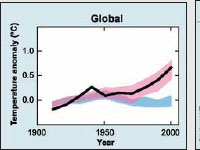
Figure A.2.1
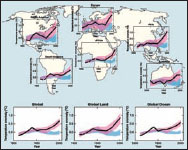
Figure A.2.2
Figure A.2.1 shows a summary of the output from Intergovernmental Panel on Climate Change (IPCC)-class atmosphere-ocean general circulation models that were run for the Fourth Assessment Report of the IPCC. The widest bar represents the prediction of climate change of the 20th century, with the range of values representing 20 different climate models. The lowest bar represents predictions for the same models if anthropogenic climate forces are not included. The black line is observed temperatures. The comparison of these two lines provides the capability to assess the ability of the models to predict history.
Figure A.2.2 moves the models to the regional or continental level. The widest band, which represents the uncertainty in the predictions, widens. The bands still match the observational records, but this comparatively crude set of graphics typifies the extent to which uncertainty information tends to be portrayed to policy makers.
________________
SOURCE: Intergovernmental Panel on Climate Change (IPCC). Summary for Policymakers, in Climate Change 2007: The Physical Science Basis. Contribution of Working Group I to the Fourth Assessment Report of the Intergovernmental Panel on Climate Change (S. Solomon, D. Qin, M. Manning, Z. Chen, M. Marquis, K.B. Averyt, M. Tignor, and H.L. Miller [eds.]), Cambridge, United Kingdom: Cambridge University Press (2007).
Atmospheric Research’s community climate model, or the Geophysical Fluid Dynamics Laboratory climate models, by swapping in different components from each model; the software is too in flexible.
Parametric uncertainty encompasses the adjustable parameters in a particular model. Model complexity and model expense limit the ability to do a full sampling of the parametric uncertainty space. There are numerous uncertainties in each model—those in observations, those stemming from
natural variability in the climate system, and those in the model components themselves. As each of these parameters is added to the model, the model becomes less flexible. Various techniques have been tried for incorporating each of the uncertainties. However, these techniques have limited use because building adjunct models is as complicated as building a climate model itself.
Example: Integrated Global System Model
The Massachusetts Institute of Technology’s (MIT’s) Integrated Global System Model (IGSM) (Figure A.2), a coupling of a human systems model and Earth-system model, illustrates how uncertainty analysis is being applied to climate models.7 The model uses several components: human activity; atmospheric, ocean, land, and ecosystem interactions; and biogeochemical exchanges. The model also runs comparatively fast. The following uncertainties are included in the IGSM: emissions uncertainty from MIT’s Economic, Emissions, and Policy Cost model; climate system response (climate sensitivity,8 rate of heat uptake by deep ocean, and radiative forcing); carbon cycle uncertainty; and trends in precipitation frequency. Climate sensitivity and ocean heat uptake, part of climate response, are a large source of uncertainty. Observational data can be used to calculate a probability distribution for climate sensitivity and the rate of ocean heat uptake. This calculation can be included in the MIT IGSM, and researchers can examine the resulting probability distribution of global average surface-temperature changes.
Explaining these uncertainties to decision makers is also a challenge that computer science may be able to help with. For example, researchers have compared the resulting global average surface temperatures with no greenhouse gas (GHG) policy intervention, or business-as-usual policies, and the resulting global average surface temperatures from implementation of GHG policy that limits carbon dioxide (CO2) concentration to about 550 parts per million. To communicate the resulting difference in temperatures and the probability of the prediction, researchers created the
_______________
7A.P. Sokolov, C.A. Schlosser, S. Dutkiewicz, S. Paltsev, D.W. Kicklighter, H.D. Jacoby, R.G. Prinn, C.E. Forest, J.M. Reilly, C. Wang, B. Felzer, M.C. Sarofim, J. Scott, P.H. Stone, J.M. Melillo, and J. Cohen, MIT Integrated Global System Model (IGSM) Version 2: Model Description and Baseline Evaluation, Joint Program Report Series (July 2005), available at http://globalchange.mit.edu/research/publications/696.
8 “Climate sensitivity” is the measure of how responsive the temperature of the climate system is to changes in radiative forcing; it is usually represented as the temperature change associated with a doubling of the concentration of carbon dioxide in the atmosphere.
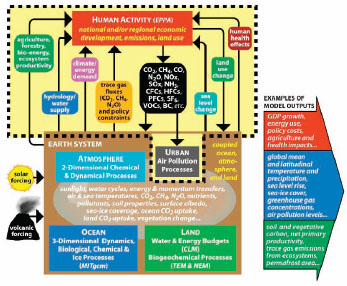
FIGURE A.2 Massachusetts Institute of Technology’s (MIT’s) Integrated Global System Model. NOTE: carbon dioxide (CO2); methane (CH4); carbon monoxide (CO); nitrous oxide (N2O); nitrogen oxides (NOX); sulfur oxides (SOX); ammonia (NH3); chloro fluorocarbon (CFCs); hydro fluorocarbons (HFCs); per fluorochemicals (PFCs); sulfur hexa fluoride (SF6); volatile organic compounds (VOCs); black carbon (BC). SOURCE: A.P. Sokolov, C.A. Schlosser, S. Dutkiewicz, S. Paltsev, D.W. Kicklighter, H.D. Jacoby, R.G. Prinn, C.E. Forest, J.M. Reilly, C. Wang, B. Felzer, M.C. Sarofim, J. Scott, P.H. Stone, J.M. Melillo, and J. Cohen, MIT Integrated Global System Model (IGSM) Version 2: Model Description and Baseline Evaluation, Joint Program Report Series (July 2005), available at http://globalchange.mit.edu/research/publications/696. Reprinted with permission.
Greenhouse Gamble roulette wheels (Figure A.3). This figure allows easy communication of prediction and uncertainty to decision makers.
Potential Contributions by Computer Scientists
Uncertainty analysis at the global scale is reasonably well understood, but increasingly there is a need to understand uncertainty at the regional and local scales. A better understanding of regional impacts of climate
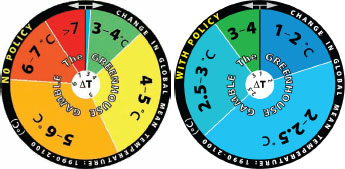
FIGURE A.3 The greenhouse gamble. Uncertainty can be represented by roulette wheels: (left) what could happen if no policies are adopted to lower greenhouse gas (GHG) emissions; (right) what might happen if GHG reduction policies are enacted. The size of each slice represents the probability that the coordinating temperature change will happen. SOURCE: Massachusetts Institute of Technology Joint Program on the Science and Policy of Global Change, available at http://globalchange.mit.edu/. Reprinted with permission.
change allows for better management of water resources, ecosystem changes, and air quality issues. The climate modeling community does not currently have the tools to sample the models for regional uncertainty information. Computer scientists are needed, for instance, to help determine what parameters in the climate system are driving uncertainty at the regional level, which are not the same parameters that drive uncertainty at the global level.
As noted in the section above entitled “Assessing Uncertainty,” several models are quite old. Simulation code dates back to the 1960s and 1970s, much of it written in Fortran. This code needs to be redesigned to take advantage of advances in computing language, software modules, and interoperability.
Expert decision making is imperative to the climate modeling process. Although researchers seek to be as objective as possible in examining data and determining probability, the number of systems involved means that much calibration is done by hand. Experts must identify and rank uncertainties at each stage of the process, but experts have limited knowledge and will focus on what is known, while the edges and boundaries of the modeling system may be left unexplored.
Scientific Workflows
Participants discussed the typical nature of scientific workflows and the importance of uncertainty analysis to their effectiveness. Uncertainty information about data collected and generated for analysis is often unavailable. When it is available, there are no standardized data structures for sharing and managing this information. Due to the complexity of uncertainty modeling, there are very few software tools that can incorporate, compute, and propagate uncertainty information. If information regarding uncertainty can be propagated somehow, there are still challenges in visualizing and disseminating the uncertainty information.
One example of the difficulty of tracking uncertainty is in the use of multiple sensing and data-collection instruments. Often more than one type of instrument, such as a camera and a point sensor, is used in the same area or space to measure the same phenomenon. A question then arises: Which measurement is more accurate, where, and at what time? Using multiple instruments introduces several types of uncertainty, including that related to the transformation that researchers apply in order to display measurements, that related to spatial registration, and that related to the temporal synchronization. In order to grapple with these uncertainties, a theory of uncertainty is developed on the basis of a formalized framework that describes how to compute uncertainty. Researchers select a measurement based on the uncertainty level of each type of uncertainty. As the uncertainty framework is built and used, the error propagation rules and methodology allow one to build workflows that can be applied to future models and calculation.
A second example of the difficulty of tracking uncertainty is in managing and tracking data. Data often come from a variety of sources and are then processed by various computing techniques. As data move from analog instrumentation to a visual representation of research findings, uncertainty generally increases. For example, visualization features may be derived or elevation and/or slope may be computed. Moreover, there may be many users of the collected data, and each one may be using a different suite of software tools to process and analyze the data.
These examples provide some sense of the complexity involved in tracking and accounting for uncertainty. Some lessons become apparent. First, uncertainty information is vaguely defined; typically it is either a range or a distribution set. Second, the complexity of uncertainty modeling using error propagation is greater than that of the underlying phenomenon itself. Third, and most importantly, scientific workflows are suitable for managing uncertainty modeling; software modules could be reused and could track how collected data are being manipulated.
Defining Workflows
The traditional objective of scientific workflows is to automate a science process leading to a science product, usually a data set or a visualization. Workflows make it easier for scientists to manipulate, communicate, and reuse or repurpose data sets. Workflows also allow the computation to be done locally, or, when managing especially large or complicated data sets, scientists can take advantage of remote computational resources. As noted earlier, workflows can be used to track and manage uncertainty propagation and need to become part of the general scientific infrastructure. Capturing the workflow and managing the computation are particularly useful if all of the calculated information, including uncertainty information, can be delivered to third parties and end users.
Workflows can become a communication mechanism for the management of uncertainty. Using dynamic visualization and the sharing of workflows, scientists can more readily engage policy makers. Workflows can be designed with sharing in mind. For example, social media concepts such as tagging and networking can be incorporated into the designs of workflows, making them more accessible.
Research Questions and Challenges
Several open questions regarding the tracking and managing of uncertainty will have to be addressed before these uncertainties can be effectively calculated and, importantly, communicated using scientific workflow mechanisms. These include the following:
• How can uncertainty and information loss due to data translations best be captured?
• How can provenance information about uncertainty methods and parameters best be gathered automatically during computations?
• How can uncertainty best be propagated in computation workows, or perhaps, how can uncertainty propagation rules best be offered for software tools without such rules?
• How can uncertainty best be delivered and presented to decision makers, who may require a customizable view so as to increase its effectiveness, as well as a universal viewer for other interested parties, who may require more widely accessible information?
• Can workflow services managing the uncertainty be integrated with other web services, such as mapping or sharing tools, to deliver uncertainty to scientists and policy makers?
Participants argued that a CS research agenda for sustainability needs to support research on the representations and propagation of uncertainty. In the past there has been little information on uncertainty. Content
managers should be encouraged to include uncertainty with data, use workflows to manage and track uncertainty, and incorporate other information-sharing services, ultimately leading to better information on which decisions can be made.
Robust Optimization Under Uncertainty
Optimization has progressed rapidly in recent decades due in part to the rapid improvement of computer systems generally and to the development of increasingly sophisticated algorithms. The solving of large-scale, linear problems, with millions of variables, is computationally feasible. However, the inclusion of and calculations regarding the uncertainty in these optimization problems is still a challenge. For policy decisions, for instance, models and calculations are run many times, and changes are made during each iteration. Because uncertainty has to be calculated at each iteration, running models that include uncertainty is extremely inefficient. The goal is to make accounting for uncertainty computationally tractable so that each model can be run faster and more efficiently.
Robust optimization is one method for coping with uncertainty in optimization problems. Robust optimization provides computational tractability and supports parsimonious modeling demands—one does not have to worry about the specifics of probability distribution. Robustness is an inherent and essential feature of many important methods across many disciplines, including machine learning and decision theory.
Robust optimization is different from sensitivity analysis. Although robust optimization and sensitivity analysis are motivated by similar factors, sensitivity analysis is a post-optimization tool; if robustness is ensured beforehand, solutions will not be overly sensitive. Robust optimization is also sometimes considered too conservative. The conservativeness relates to the uncertainty set that is used and on how large it is. An improved datadriven theory of optimization is needed. There are many approaches to building uncertainty sets, but there is the open theoretical question regarding the right way to use data in optimization problems. In some problems, when there are not enough data, the questions become these: How does one properly incorporate subjective opinion about the data? What is the right way to describe uncertainty? An additional challenge is that idealized problems tend to be studied without enough application to realworld problems. There is also the challenge of ensuring that uncertainty is acknowledged and taken into account in any decision-making process.
Theory and Methodology of Robust-Yet-Fragile Systems Analysis
Participants noted that fundamental research is needed to improve the understanding of the various trade-offs in computational methodologies,
such as efficiency versus robustness. Complexities of real systems—not the complexity of the mechanisms used to study the systems—embody these trade-offs. Some theories already exist for examining the trade-offs among robustness, fragility and efficiency. For example, researchers know that efficiency has hard limits and is bounded. Robustness and fragility have conservation laws as well, and the trade-offs between the two are tangible. Theories from other disciplines, including systems engineering, control theory, information theory, and computational complexity theory, provide complementary approaches and can be integrated into theories on robustness, fragility, and efficiency.
Efficiency and robustness exist in many dimensions, and although each in itself is reasonably well understood, a theoretical framework is needed for conveying the interactions and examining the inherent tradeoffs. Firm trade-offs exist among the following:
• Efficient use of resources (sustainability)
— Small amounts of resources consumed, small amounts of waste produced.
— Inexpensive components, small capital investment.
— Efficient processes: design, manufacture, maintenance, management.
• Robustness to perturbations
— Rejection of external disturbance and suppression of internal noise.
— Tolerance for component failures and uncertainty.
—Security against malicious attack and hijacking.
—Scalability to large system size.
—Evolvability on long timescales to large changes.
—Human actors with aligned incentives.
• Predictable, verifiable, understandable
— Limits on unintended consequences.
— Easily reproducible experiments and data.
— Models (simple and analyzable), short theorems, proofs.
— Experience that is a reliable guide to the future.9
One can start building toward a theory with comparisons across disciplines. Although efficiency limits are understood, it is very difficult, if not impossible, to reach 100 percent efficiency rates. By contrast, robust fragility is much less understood. Robustness in one part of a system may induce fragility in another. Fortunately, evolvability and robustness seem
_______________
9John Doyle, “Theory and Methodology of Robust-Yet-Fragile Systems Analysis,” presentation at the Workshop on Innovation in Computing and Information Technology for Sustainability, Washington, D.C., May 26, 2010.
to be compatible. Architectures and platforms that enable innovation well can also enable robustness well.
Examples were discussed of how new theories can be developed to encompass needed robustness requirements. Network theory might be able to help sort out what is an accident of similarity and what is deeply structural. However, the fact that reasonably well understood networks exist in one domain does not mean that these understandings translate well to another domain. There may be useful knowledge to be gained by comparing network structures and properties in different domains (for example, contrasting and comparing climate history, cell systems, and Internet architectures), but this knowledge needs to be validated first. Additionally, participants noted that a better understanding of what is meant by complexity, non-linearity, modularity, architecture, and evolvability in different domains is needed so that scientists can communicate more effectively with policy makers and with one another.
Furthermore, big data and big models mean that many things can be demonstrated by means of data or models. As computational capacity has increased, in many ways research efforts have moved from coping with impoverished data and elegant models that are not well understood to coping with massive data sets and sophisticated simulations that are not well understood. In this new environment, larger gaps between the demonstration and the reality can be unintentionally created, and unanticipated fragilities may become overwhelming.
SESSION 3: CREATING INSTITUTIONAL AND PERSONAL CHANGE WITH HUMANS IN THE LOOP
Behavioral changes at both the institutional and the individual level are needed in order to achieve sustainability objectives. Important questions in designing and developing smarter systems involve the level of information and the interface design that will induce behavior change. Human-system interaction (HSI) issues arise both for individuals in homes and offices and for administrators of larger systems and facilities. These interactions can occur at different timescales, encompassing both day-to-day decisions made by users and operators and planning decisions involving longer periods of time. Moreover, although there have been many advances in HSI, the literature is replete with failed cognitive models, serving as cautionary tales for HSI in sustainability applications.
Panelists were asked to examine the following questions in relation to sustainability challenges during their talks:
• How can data and information be presented at the appropriate granularity and time frame to be most effective? What system, application, and user factors bear on the human-system interaction design choices?
• Describe the potential impacts of the various contexts and trade-off decisions that might need to be made, including the following: the impact of context (e.g., stakeholders, and so on), the impact of large versus small groups versus individuals, the impact of income, the impact of use by or for cities versus businesses versus individuals, the role of middleware, the supply chain, and so on.
• How do human factors affecting sustainability challenges drive the use and design of technology? How can this interaction be accounted for? When are power, networking, products, and other information and communication technologies (ICTs) really needed? Discuss human choice and its impact on consumption, disposal, and reuse.
Bill Tomlinson, University of California, Irvine, examined current use and research on computing initiatives that provide information for more sustainable decision making; Shwetak Patel, University of Washington, explored the challenges of providing utility-use data to consumers; and Eli Blevis, Indiana University, examined the possibility of incorporating sustainability ideas into the design process.
Better Information for More Sustainable Decision Making
One way to use information technology to lead to more sustainable outcomes is through the provision of information to individuals and organizations to assist in decision making. Participants noted that this type of assistance can be provided at many levels. They discussed various types of tools ranging from those that can help inform comparatively simple sorts of personal decision making; to tools that can help people understand large, complex challenges and how their individual actions and behaviors might help; to tools that can assist in understanding and resolving complex challenges that require complex and/or coordinated responses.
Several examples of how IT can be used to perform small-scale sustainability-related tasks more effectively were described. They include the following:
• Cellular telephone use for coordinating the sale of fish catches. During the early 1990s, fishermen in Kerala, India, would typically have 6 to 8 percent waste from their catch. The waste was primarily due to lack of
buyers for these fish. Cell phone availability in the late 1990s quickly changed this mismatch. As they were coming ashore, fishermen could more easily locate buyers, and waste was quickly eliminated. Cell phones were not developed to tackle environmental issues, but did enable this unintended positive outcome.
• The use of various communication tools by non-profit and non-governmental organizations in coordinating activities. The Surfrider Foundation10 organizes beach cleanups using various IT infrastructures, including text messages, e-mail campaigns, and social media tools.
• Consumer tools for a smart grid. Researchers are examining ways to apply Internet-inspired architectural principles to the energy grid. For consumers, questions are being explored regarding smart appliances that automatically run when electricity is in less demand or when renewable sources are available.
Another class of tools is designed to help educate the public on their choices regarding sustainability. Examples discussed by participants range from tools for educating school-age children about ecological interdependency to those for helping consumers make more sustainable purchases at the market. The Social Code Group, which Bill Tomlinson leads, has developed several of these tools. A selection of these tools and projects was discussed:
• EcoRaft.11 This application was designed, with contributions from ecologists, to help 8- to 12-year-old children learn about ecology in the museum environment. A large monitor and several tablets represent various ecosystems. The tablets allow interaction and can be used to simulate the transplanting of species from one ecosystem to another, encouraging children to explore the interdependencies among species and the interconnections between restoration and conservation. A key aspect of EcoRaft is a button at the bottom of the main screen that would remove all species from the simulation. In science museums, the first thing that children tend to do with interactive displays is to push whatever buttons are available. In this case, the button was not labeled, which meant that current users had to guard the button or educate newcomers to the game, simulating the value of education and activism.
_______________
10Information about this organization is available at http://www.surfrider.org/.
11Bill Tomlinson et al., The EcoRaft project: A multi-device interactive graphical exhibit for learning about restoration ecology, in CHI’06, Extended Abstract on Human Factors in Computing Systems, New York, N.Y.: Association for Computing Machinery (2006). DOI: 10.1145/ 1125451.1125717.
• GreenScanner.12 This tool was developed to help consumers when making purchasing decisions to understand the environmental impact from the growing, processing, and transporting of their foodstuffs. The vision was that using cell phone cameras and large databases that linked universal product codes (UPCs) to environmental data, consumers could quickly identify which available foods had the least environmental impact. When GreenScanner was first developed as a web application in 2006, sufficiently capable hardware was not in wide use to make this tool feasible for everyday consumer use. However, as cell phones have advanced, a tool similar to GreenScanner has become commercially available through the company Good Guide.13
• Trackulous.14 This tool was designed to help people track their activities and the environmental impact of those activities. People may be aware that they often travel by airplane or car, but they might not understand the cumulative time spent doing these activities in a year or the cumulative impact that such travel can have. By tracking their activities, people can better understand their carbon footprint and where the opportunities are for lessening that footprint.
• Better Carbon.15 This web application uses collaborative filtering techniques to reduce the amount of information that a user needs to input into carbon-footprint calculators. With current carbon-footprint calculators, users have to enter a great deal of information before receiving an answer. With collaborative filtering, they can enter much less information (which is compared to similar information provided by other users) and then be provided with meaningful defaults for the additional information required.16
Participants noted that tools such as these can help individuals better understand their contributions to sustainability problems as well as to sustainability solutions. However, a complete toolbox for resolving large, complex environmental problems does not yet exist. The scale of environmental challenges on the planet today—including global climate change, biodiversity loss, sea-level rise, and various kinds of pollution—is much greater than the scale of other challenges that humans typically face. People are generally good at cooperation in small-scale tasks and at understanding and resolving smaller challenges, especially those with
_______________
12The web application, GreenScanner, is available at http://www.greenscanner.net/.
13The tool is available at http://www.goodguide.com/.
14The tool is available at http://trackulous.com/.
15The tool is available at http://www.bettercarbon.com/.
16Collaborative filtering systems are used in other contexts; for example, Amazon uses such tools to recommend products based on past purchases, and Net ix uses them to recommend movies that users might like.
smaller scales of time, space, and complexity. However, the largest and most challenging environmental problems are not at scales that people can readily understand. Examples of the complex scales involved in sustainability include the following:
• The timescale of a rise in sea level. Consider the prospect of the sea level rising, perhaps 40 centimeters, over the course of 120 years. How can the general population understand the risks and consequences?
• The geographical scale of the supply chain. Another example of a scale that is difficult to comprehend is global supply chains. Products purchased in the United States arrive through a supply chain that may begin as far away as a palm oil plantation in Sumatra. How does one communicate to the consumer the potential environmental repercussions of the manufacture, transport, and life cycle of products that they purchase?
• Climate change. The complexity of climate change stems from the large number of factors—such as cloud cover, carbon dioxide emissions, rainforest depletion—and the interaction of these factors that make up the global climate system. How can IT—and the way that sustainability information is communicated using IT—assist in developing an understanding of the increasing scales of time, space, and complexity that characterize climate change?17
There may be lessons to learn from general IT and CS approaches when it comes to these complex problems. Good architecture design can remove extraneous decision-making requirements and afford consumers the ability to select sustainable options quickly and easily. When the Internet works well, for example, users do not typically know or need to know where the information they are receiving is coming from: e-mails move through various wires, routers, and servers around the globe; web pages are populated by widgets whose data could be sourced from anywhere. One attendee suggested that analogous architectural approaches may be applicable to certain sustainability challenges.
Another big challenge in sustainability issues is the legacy and fixed nature of our utilities and infrastructure. There is a great deal of legacy
_______________
17There are several challenges in educating the public on climate and sustainability issues, one of which involves differentiating between weather and climate. It is too easy to overinterpret extremely hot or cold days. Interactive design techniques could help communicate the difference as well as the subtle scale changes, such as highlighting the shifting state of Alaskan glaciers or the sea level. The climate research community also struggles to define what is “normal” for weather and climate: “normal” from 1950 to 1980 is different from what would be considered normal from 1980 to 2010. Some advocate taking a first-order linear trend of the past 30 years as an estimate of a baseline to use to compare changes.
infrastructure in most systems that pose significant challenges. For example, one can certainly contemplate autonomous vehicles, which are much more environmentally friendly, but moving from a highway of all individually controlled vehicles to a highway of all autonomous vehicles is difficult; the upgrade path is bumpy, to say the least.
Residential Energy Measurement and Disaggregated Data
Participants discussed how better information can assist consumers in making effective changes in their use of home resources such as power, water, and gas. Current literature suggests that high-granularity or highresolution data—for example, information about the usage patterns of individual appliances—are the most useful. Participants observed that literature from the past several decades suggests that if this information were provided to consumers, a 15 to 20 percent reduction in consumption would be possible.
In the past, the technologies that collected and provided this information were typically tedious to install and required installation by trained technicians. Such difficulties make them impractical for largescale deployment. Tools were not successful in the past because too much burden was placed on the individuals who were installing them in their homes. New technologies, such as embedded systems and sensors, can make information gathering and feedback tools much more practical. An ongoing research challenge is to determine what information and interfaces work best. One cannot start answering more in-depth questions about the effectiveness of novel, engaging, and persuasive feedback applications, however, until there are more information and data from end users. Sensing and feedback work hand in hand in creating the most effective tools for consumers.
Challenges of Collecting Usage Data
Consumers, appliance manufacturers, and utility companies can all benefit from any data collected from in-home deployment of sensors. Consumers could use disaggregated data to understand their utility use and to make changes in it. By contrast, what is typically available to consumers is only simple end-of-month billing, which provides very little actionable information. If consumers knew the consumption of resources by individual devices, they might start to tailor their behavior for more efficient consumption. Use data could also help manufacturers gain a better understanding of the use of their appliances. Manufacturers do not have a lot of information on how often their appliances are used. Better
understanding of typical duty cycles could be incorporated into future designs.
To the extent that utilities are motivated to promote energy-conservation activities, they have few ways to assess or validate whether those activities are working. Relevant data for utilities would include device use over time and any regional difference in use. Currently utilities tend to use self-reporting and polling to determine whether or not their initiatives influenced consumer activities. Another challenge is that utilities have little experience in deploying technologies inside the home. Moreover, utilities do not want the added expense of installing monitoring tools in the home. Sensors that are easily deployable by end users could provide validation and verification of usage for utilities as well as for consumers.
Once validation and verification are widely available, utilities would be able to provide better incentives to customers for conservation. Additionally, the information could allow utilities to create better demand-response models. Better usage models could also be developed by researchers. One goal would be to create a national energy data corpus, which would be very useful to researchers across disciplines as well as in helping meet large-scale energy and sustainability information needs.
The research discussed in this session of the workshop focused on the creation of technology that (1) provides highly granular, disaggregated data on home energy use and (2) is deployable by end users. The traditional way of collecting such data would be to deploy a network of sensors at each outlet, light, or water fixture—a method that is cumbersome, expensive, and, as past experience shows, something that consumers are unlikely to do. This suggests the need to find an approach that is easier from the perspective of the consumer and, ideally, is a device that plugs in to a single outlet yet monitors electrical consumption or events that occur in the home at the appliance level.18 Below are examples of research being done along these lines to collect data on three main resources: power, water, and gas.
• Research is being done to examine the propagation of electrical noise over power lines to infer what devices are being activated. This research incorporates work in signal processing, machine learning, and embedded systems. These types of devices are better than smart meters, which may only provide information every 15 or 20 minutes. In certain circumstances, homeowners or researchers may want shorter time intervals.
_______________
18Tools built directly in to appliances are not particularly helpful because the timescale for replacing many in-home appliances is often measured in decades.
To provide real-time consumption, a magnetoresistive sensor was developed that attaches outside the breaker panel, but can be read inside the home. This tool has been field-tested with some success by utilities to determine whether consumers are capable of installing it.
• Measuring and tracking water usage provides similar challenges. Obviously, any sensor whose installation requires cutting into pipe will not work for consumers. A single-point water-sensing solution, attached to a washing-machine hose spigot, could look at the water hammer phenomenon that occurs when a valve is opened and closed, which could infer which water fixture was being used inside the house. Because the hot- and cold-water systems are interconnected, one could even begin to discern hot- and cold-water use with a single sensor. In apartment complexes, individual units may not have hose spigots. In that case, the hot-water heater would be another location for installing a sensor.
• Collecting gas data is much more difficult. There is not typically a good place to locate a single sensor that determines when an appliance is activated, and there are safety concerns about customer-installation of gas fixtures. However, a sensor could be installed by clipping it to the nationally mandated regulator on appliances. The acoustic vibrations of the diaphragm are linearly proportionate to flow. By measuring these vibrations, real-time consumption information can be determined. In addition, transient events that occur from the opening and closing of gas valves manifest themselves through the valve itself. This information can be used to determine exactly what appliance is being used.
Interfaces for Actionable Feedback
Participants noted that interfaces for providing the disaggregated sorts of data and feedback discussed above are critical to the successful and effective deployment of sensors. The typical “interface” is the simple electric bill and meter in homes. The meter was not designed for consumers to read, and the bill, which is for the consumer, usually provides only an end-of-cycle reading. Even the units used in the typical electric bill are not very user-friendly: do most consumers understand, for example, what a kilowatt-hour means? Water bills are typically even more aggregated; most include up to 3 months of water use. If a spike occurred in water usage due to, for instance, a leaky valve, the consumer would not have any knowledge of it until the end of the billing cycle. Clearly there are opportunities for interface design to play a role in communicating better and more actionable information. Unfortunately, there are currently only limited examples of interfaces that provide disaggregated feedback in approximately real time. One obvious example is gas-electric hybrid
automobiles, which display approximate instantaneous mileage while the car is running, as well as relative use of engine and battery. Given more information about their own driving habits in accessible and understandable fashion, consumers can (and do) alter their behavior and conserve gas, participants observed.
Participants described how research that validates the functionality of the devices described earlier has started with in-home trials. In order to evaluate the installation process, researchers have observed consumers self-installing devices. Once the devices are in place, researchers can evaluate the effectiveness of the energy-management systems provided to users. Some of the questions being asked by researchers are: Can you elicit behavior change, up to 15 to 20 percent reduction in usage, with disaggregated feedback, and does the behavior change really hold over time? As more data have been collected on how users react to various interfaces, researchers have begun to iteratively refine individual interfaces. Some of the deployed devices were also being integrated with Microsoft Hohm and Google’s PowerMeter projects.19
Before devices and systems such as those exemplified here can be deployed commercially, large-scale studies are needed. Utilities are open to participating in large-scale studies, but when deploying research technology it can be a challenge to create enough devices to do even smallscale deployments in 20 or 30 homes; research laboratories are not often equipped for production. One solution has been to commercialize the technologies being used in research settings so that devices are available from retail stores as well as directly from the utilities. For example, Belkin International, which sells a wide array of computer peripherals and other consumer electronics, recently purchased a demand-side monitoring solution developed at a university research laboratory.20
The timescales and complexity of general sustainability issues are difficult to understand. Feedback mechanisms are being developed, and there is some evidence that information does change behavior. Additional knowledge is still needed on how much this feedback will influence behaviors and what the best feedback over what timescale produces the most change.
_______________
19In June 2011, both Microsoft and Google announced the discontinuation of these projects. Both cited the slow market adoption of the services as the reason for the termination.
20For additional information, see http://seattletimes.nwsource.com/html/technologybrierdudleysblog/2011667981_uw_gets_slice_of_profs_startup.html. Examples of the Belkin products can be seen at http://www.belkin.com/conserve/.
Sustainable Interaction Design
Participants also discussed some general high-level principles regarding sustainable interaction design—the notion that the design of systems should incorporate sustainability considerations. A few design principles for sustainable interaction design, including the following, were discussed:
• The connecting of invention and disposal. Any new design should also include information on what will happen to the materials or products that it replaces.
• Encouragement of renewal and reuse. Human-computer interaction (HCI) research can play a large role by highlighting the future value of objects.
• Encouragement of quality and equality. The second and third user of any product should receive the same satisfaction as the original owner.21
A number of projects incorporate at least some aspects of sustainable interaction design, and several are described in the previous sections. Additional examples include corporate research done by SAP, Inc., and academic work done by HCI researchers at Carnegie Mellon University (CMU). SAP has developed Sourcemap,22 which provides a way to track and improve supply chains. Using an open-data platform, users can track where each of their foodstuffs comes from. For example, a catering company can provide a map showing the route by which of all of its products were shipped, or individuals can determine how far each of their breakfast items traveled. Stepgreen,23 created by CMU’s HCI researchers, is another example that allows users to track the benefits of making sustainable choices. Users can identify sustainable actions that they are already taking, such as turning off lights not being used or walking to locations less than a mile away, or they can commit to future sustainable choices. Stepgreen tracks the amount of savings in dollars and carbon dioxide emissions for each action.
Interaction design can also be used to encourage dialogues among scientists, decision makers, and citizens. Interaction designers can help bridge the gap between scientific knowledge and public perception, can build support, and can promote discourse leading toward solutions. Participants
_______________
21Eli Blevis, Sustainable interaction design: Invention and disposal, renewal, and reuse, in Proceedings of the SIGCHI Conference on Human Factors in Computing, New York, N.Y.: Association for Computing Machinery (2007).
noted that bridging this gap has been a particular challenge in climate science and that there is an opportunity for interaction design to play a role. For instance, whereas some of the previously mentioned tools can help people make more informed choices about reducing their negative impact on the climate, tools are also needed that inform people’s preparation and responses to climate change as a chronic sustainability challenge. Interaction systems are also needed to deal with the likely increase in the severity of natural disasters and crises due to climate change.24 Participants discussed the concept of a “Dashboard Earth” that could be used to provide information about what is happening and where. Interaction design can also be used to develop interactive systems that could help with orderly evacuation in a natural disaster, for example, providing the information to local, regional, national, and intergovernmental policy makers about who can go where and how many people each location can absorb. Interaction design can be used to persuade and show people how to live with fewer resources, as matters of sustainability and preparation and adaptation. The interaction design of tools like social media is needed to help persuade people and various levels of organizations to care for others in the face of climate change and its effects. Interaction design can also assist in the public discourse about and support for certain sorts of solutions and in fostering public understanding. Participants argued that all of these tools and more need to provide information at the local, regional, national, and global level and to help people respond efficiently during crises.
SESSION 4: OVERCOMING OBSTACLES TO SCIENTIFIC DISCOVERY AND TRANSLATING SCIENCE TO PRACTICE
Committee member David Culler, University of California, Berkeley, and David Douglas, National Ecological Observatory Network, led the discussion during the final session, which highlighted some of the impediments to developing and deploying innovative information technologies for sustainability challenges. Guiding questions for this session were as follows:
• What are the motivations for and impediments to applying innovative information technologies to sustainability challenges and how do they differ by domain?
_______________
24National Research Council, Adapting to the Impacts of Climate Change, Washington, D.C.: The National Academies Press (2010).
• How can large-scale science addressing real-world problems be made credible, if reproducibility is not possible?
• What lessons can be applied from the transformation of the Internet into a critical infrastructure that must avoid ossification?
• What is the appropriate mix of empiricism, innovation, and application in order for computer science to have an impact in the area of environmental sustainability?
The Energy Challenge
Participants suggested considering broad sustainability challenges in the context of the energy challenge. The interconnected nature of people’s basic resource needs, such as water, energy, and transportation, and the economic arrangements among these resources create a very complex problem. However, these interactions also mean that the energy challenge can serve as a useful proxy for sustainability challenges related to other limited resources.
The primary function of the electric grid is to deliver high-quality, low-cost power to millions of customers who are geographically distributed over thousands of miles. The fact that consumers have been able to make use of the grid without needing much knowledge about their own consumption patterns, or about where the power is coming from, has contributed to rapid economic and industrial growth. People have been able to use a comparatively inexpensive resource—energy created mostly through the burning of fossil fuels—essentially indiscriminately to expand the production of products that spur the economy. Additionally, enabling a usage model in which consumers could remain ignorant of their own consumption patterns meant that the grid has been tasked with delivering a high-quality commodity at extremely low cost. Moreover, the expectation has been that power would be delivered immediately as needed. The power grid is expected to meet these goals with minimal forecasting or anticipation of that need, except at very coarse granularity, and without inventory storage along the energy supply chain.
The current energy model is increasingly complex, with numerous sources of energy, a variety of stakeholders and consumers, and a not insignificant fraction lost during transport. A pressing sustainability challenge revolves around these questions: How can energy use be reduced, and can it be done without significant economic hardship? The following question was discussed: Where and how can computer science fit into this picture?
Figure A.4 shows the percentage of energy use in the United States by type. Each of these types represents an opportunity for reduction in
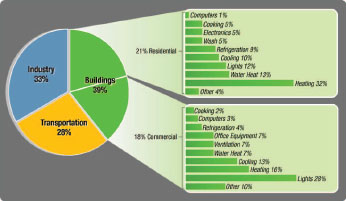
FIGURE A.4 Energy consumption in the United States, by type of use. SOURCE: Lawrence Berkeley National Laboratory.
demand. Commercial light use and residential heating make up the bulk of their respective building types, but several other smaller items make up the rest of the energy usage. Perhaps reductions in several of these “low-hanging fruit” items can contribute significantly in reducing total energy consumption.
Impediments to Changing the Energy System
Insufficient Scope and Scale of Research and Development Funding to Fuel IT-Enabled Innovation in the Electricity Sector
Challenged to consider opportunities for IT and CS research to contribute to sustainability, participants reflected on the history of IT successes and on whether those successes might offer important lessons. The enormous payoffs from IT R&D investment have been investigated by several studies of the National Research Council’s Computer Science and Telecommunications Board, including Evolving the High Performance Computing and Communications Initiative to Support the Nation’s Infrastructure (1995); Funding a Revolution: Government Support for Computing Research (1999); Making IT Better: Expanding Information Technology Research to Meet
Society’s Needs (2000); and Innovation in Information Technology (2003).25 These reports have shown how research partnerships between the federal government and industry ultimately led to the creation of many wellknown multibillion-dollar industries. These results suggest the potential sustainability payoffs from the right investments in IT.
Many of the advancements presented in the CSTB reports, such as those in processors or networking, required significant financial investment from both industry and government. The software industry spends approximately 13.5 percent of revenues on R&D, the health care industry spends about the same, and the computer hardware industry spends about half of that.26 By contrast, R&D spending by the electric utility sector is about 0.1 percent of revenues, perhaps due to the fact that the sector has been very stable, with little innovation or push for innovation, a context that seems to be changing rapidly.27
Sustainability is a large, broad-ranging problem, and apportioning limited research dollars to effective ends is a difficult challenge. One consequence of this low level of support and the resulting small number of technical researchers at utility companies is that opportunities for partnership between academic researchers and utility companies are rare.
Government funding is also limited. In 2010, the U.S. Department of Energy provided $130 million and created three different energy hubs in innovation.28 However, a workshop attendee commented that even this amount is much smaller than would be needed if a significant shift were to be made toward sustainable energy sources or if total energy consumption were to be decreased.
Misalignment of Incentives for More Sustainable Generation and Use
The energy-utility market, as described earlier, has evolved to provide a critical resource, at low price, with supply almost instantaneously
_______________
25National Research Council, Evolving the High Performance Computing and Communications Initiative to Support the Nation’s Infrastructure, Washington, D.C.: National Academy Press (1995); National Research Council, Funding a Revolution: Government Support for Computing Research, Washington, D.C.: National Academy Press (1999); National Research Council, Making IT Better: Expanding Information Technology Research to Meet Society’s Needs, Washington, D.C.: National Academy Press (2000); National Research Council, Innovation in Information Technology, Washington, D.C.: The National Academies Press (2003).
26Jill Jusko, R&D Spending: By the Numbers. Industryweek.com. January 2010. Available at http://www.industryweek.com/articles/rd_spending_by_the_numbers_17988.aspx.
27 Jusko, R&D Spending, 2010, available at http://www.industryweek.com/articles/rd_spending_by_the_numbers_17988.aspx.
28Department of Energy, “Obama Administration Launches $130 Million Building Energy Efficiency Effort,” February 12, 2010, available at http://energy.gov/articles/obamaadministration-launches-130-million-building-energy-efficiency-effort.
matched to demand. Although historically it required considerable innovation and tremendous capital investment to meet these constraints, there are additional market impediments to creating a more sustainable system. Perhaps the most obvious is that, generally speaking, utility companies have historically charged for usage by the kilowatt-hour, resulting in little economic incentive to reduce the number of kilowatt-hours used. regulation prevents vertical monopolies, but there is often an interest in owning an entire vertical market—one organization owning or operating both the production and the delivery systems—and extracting marginal profit mostly by locking customers in to the system. Participants observed that horizontal market stratification would help drive efficient markets. This limited-competition system means that the utility industry is not particularly motivated to shift technologies, which may drive up the cost of production in the short term. The question again is where the investment to drive new technologies is going to come from.
While the utility companies have little incentive to encourage reductions in energy use, consumers themselves have undervalued energy. As noted earlier, consumers have become accustomed to inexpensive power and also have little understanding of how power is produced and of the resulting environmental damage. Consumers have even less knowledge or easy insight into the energy costs of producing and transporting foods and goods. The energy cost, including the accompanying externalities such as environmental and social damage, is not easily reflected in the price of goods. If these costs were reflected directly in the price, more energy-efficient choices might be made.
Infrastructural and Organizational Impediments
Impediments to making progress on sustainability in addition to those discussed above include infrastructural and organizational realities. The scale of the sustainability problem is immense, and the infrastructure systems that bear on sustainability—such as energy, water, and food distribution—are just as massive. In addition, diversity of use within the system adds a level of complexity. The use and design of each building site and the water distribution and transportation system of each city have unique characteristics that make a one-size-fits-most solution impractical. Furthermore, the traditional production cycle does not apply; infrastructures are not projects that are developed, improved, and shipped; they are built once. Cities are developed over a span of 100 years or more, with refinements, changes, and “debugging” taking place little by little. Once these systems are rolled out, even if they do not function as well as they could, they become, in effect, stranded assets.
The market structure also creates impediments to better technological change. The market is highly fragmented; energy sources vary, and
energy use is even more dispersed. Each industry that participates in the energy market has its own unique needs, regulatory requirements, and certification programs. Individual industries and companies create their own technology standards. Unique industry and corporate technology standards also make one-size-fits-most solutions impractical. Efforts to deploy, say, monitoring and data-collection tools in these sorts of environments are challenged. Equipment used for monitoring the use of each resource system—energy, water, food—within cities becomes difficult to build and deploy. Additionally, these monitoring devices, if built in to the initial infrastructure, need to be able to collect a wide variety of data and be sturdy enough to function over long periods of time.
Research Impediments
The critical nature of the sustainability problem and energy crisis combined with their scale and complexity often means that researchers are dedicating entire careers working to address pieces of the problem. This scale and complexity mean that choosing avenues of investigation is a high-risk proposition. If a path that a researcher follows turns out to be incorrect or a dead end, the mistake can be career ending. Furthermore, these sustainability and energy problems are inherently multidisciplinary, which adds another barrier to academic work often confined to single disciplines.
In many subfields of computer science, the ultimate goals can be defined reasonably clearly, even if the description of the goal is as simple as: Make computers faster. Well-defined goals also imply a clear definition of success. While there are some goals to work toward in addressing the sustainability problem, such as decreasing the levels of greenhouse gases in the atmosphere, they tend to be less well defined (should the focus be on lowering energy use or on the use of more sustainable energy sources?) and have less clear benchmarks for success.
Potential Computer Science Contributions
In the fourth session of the workshop, participants brainstormed about potential further contributions of computer science to sustainability. Computer science is well positioned to provide technical options that could help address some sustainability challenges. Additionally, the distinctive culture, methodologies, and approaches of computer science may shed new light on methodologies, processes, and concepts that could be useful in sustainability. Speakers discussed several such cultural attributes, including the following:
• Culture of innovation. Computer scientists are used to developing and deploying new tools almost constantly and to doing these things quickly. Participants argued that this flexible, catch-all approach allows for broader ideas and more creativity.
• Large-scale systems approach. Computer scientists have experience building big things, such as massive integrated circuits, which have tens of millions of design points that need to be correct when built, and software artifacts that today measure in the millions of lines of code. Computer scientists also understand system approaches.
• Understanding of open-information systems. Computer scientists tend to understand the value of open systems and are often forced to engage with demands for system-level considerations such as compatibility and interoperability. Distributed grid management, ecosystems understanding, crisis and disaster response, and resource tracking and optimization can all benefit from open, interoperable information systems. With large amounts of data being collected, privacy and security become an issue, which, again, computer scientists have experience managing.29
• Business transformation, often with efficiency as a goal. As new technologies have become available, the computer science industry has transformed itself several times. For example, participants noted that data centers are drastically different now than they were just 2 years ago. This change has been driven partly by efficiency concerns. Furthermore, computer science has been fundamental in transforming other industries, for example, car ownership, media consumption, and banking, in interesting ways. Advances in smartphones, the Global Positioning System, and human-computer interaction have contributed to the success of shortterm car-use services, such as Zipcar; advances in telecommunications networks and file compression have made Internet video streaming a viable alternative to the video store; and computer and information security have encouraged confidence in online banking.
• Educating in a dynamic environment. Because sustainability efforts are complex, multidisciplinary problems, universities will need new ways to teach scientists and engineers to resolve these problems. Computer science has historically adapted to changes in curriculum and changes in the overall technological environment by shifting teaching techniques very
_______________
29The Internet is an example in which computer science has incorporated open-information systems, shared standards, and a complex understanding of intellectual property. Although there have been questions and debates about appropriate infrastructure, standards, and intellectual property, especially as more of the Internet has been commercialized, there is still copious knowledge that can be gleaned from the computer science community on building interdisciplinary, complex systems.
rapidly. These educational tools, developed within the computer science discipline, can help develop the next wave of scientists and engineers.
Wrap-Up Discussion
This session resulted in a wide-ranging discussion from the participants at the workshop. Several key points raised are outlined below:
• Within the information technology industry, significant innovation has been accomplished at small businesses or start-ups, which then are often acquired by large corporations. This suggests that small amounts of money could fund highly innovative projects in sustainability, given the proper organizational structure and incentive.
• Although sustainability can be viewed in many ways as a technical problem, it will not be solved through technological solutions alone. Some people conjecture that in addition to major scientific and technical breakthroughs to meet sustainability challenges, large-scale social change will be needed, perhaps even on the scale of the U.S. civil rights movement. Computer scientists can contribute tools that encourage individual participation in addressing sustainability challenges.
• Small businesses often require specialized information that can be hard to acquire. Computational techniques and technologies can help by providing ways to collect, aggregate, distribute, and analyze data, as well as techniques for communication and coordination as appropriate.30
• There are trade-offs in discussing solutions. For example, raising temperatures in server rooms may reduce cooling loads but lead to higher failure rates. These trade-offs and failure rates have to be fully understood so that the best trade-offs can be made.
• Domain scientists (such as ecologists, transportation specialists, civil and power engineers) need to share information and knowledge with people doing innovation, including computer scientists. The first step for computer science might simply be finding a better way to present these data, which would help policy makers. Decision makers need to understand the data more clearly before they can form policy.
_______________
30An example was given of a case in which a number of local coffee shops were interested in purchasing biodegradable products. Today, biodegradable cups are more expensive and are only affordable if purchased in very large quantities; IT can link companies willing to purchase and share large shipments. Also, not all biodegradable cups are biodegradable to the same extent, an information gap that could be solved with more usable data. However, computer scientists typically have little knowledge about the chemical makeup of products, and so there is also a need for coordination across multiple disciplines and industries.
WORKSHOP AGENDA
May 26, 2010
Washington, D.C.
| 8:30-8:35 a.m. | Welcome Deborah L. Estrin, University of California, Los Angeles Chair, Committee on Computing Research for Environmental and Societal Sustainability |
| 8:35-10:45 a.m. | Session 1: Expanding Science and Engineering with Novel CS/IT Methods: “The Need to Turn Numbers into Knowledge” Committee respondent: Daniel Kammen, University of California, Berkeley |
What are some example areas of efforts in sustainability and related research where the interface of disciplinary and interdisciplinary research with new methods in computer and information science can generate new innovations and knowledge? One example is the smart grid, which provides a physical and information technology medium where new levels of efficient and clean energy and information management are possible, and where new levels of data security are needed. Discussion topics range from grid management to the introduction of smart management and charging systems for low-carbon electric vehicles. Another example is ecological resilience and ecosystem function, which is the monitoring and modeling of ecological change and of the interactions related to ecological robustness and requires new tools for temporal and spatial resolution, new methods to explore the dynamics of connectivity in ecological systems, and teasing out the ranges of anthropogenic impacts.
Vijay Modi, Columbia University: “Criticality of CS and IT to Sustainability”
Robert Pfahl, International Electronics Manufacturing Initiative, Inc.: “Towards a Sustainable World Through Electronic Systems and IT”
Neo Martinez, Pacific Ecoinformatics and Computational Ecology Lab: “Numbers: Where They Come from and What to Do with Them to Live More Sustainably on Earth”
Adjo Amekudzi, Georgia Institute of Technology: “Using Social Sustainability Measures as Inputs in Planning and Design”
Thomas Harmon, University of California, Merced: “Environmental Cyberinfrastructure and Data Acquisition”
| 11:00 a.m.-1:00 p.m. | Session 2: Understanding, Tracking, and Managing Uncertainty Throughout the Science-to-Policy Pipeline Committee respondent: Thomas Dietterich, Oregon State University |
Explicit representation of uncertainty is rare in the science-to-policy pipeline. Data products resulting from fusing information from multiple instruments are often treated as exact when input to models. Outputs from predictive and simulation models are often treated as exact when input to policy making. Policy optimization for management (e.g., reserve design, fishing quotas, habitat conservation plans) often is not robust to uncertainty in the problem formulation or the objectives. Uncertainty about future decision making and imperfect implementation of policies injects additional uncertainty into planning for the future.
• What are the sources of uncertainty that should be explicitly captured?
• What methods are suitable for explicitly representing uncertainty?
• Is the technological state of the art sufficient to model the many different flavors of uncertainty present in large-scale sustainability problems? If not, what characterizes the types of uncertainty that are insufficiently modeled?
• What methods are suitable for assessing uncertainty in each stage of the pipeline? What shortcomings need to be addressed?
• Is the state of the art in human factors, interfaces, and CSCW (computer-supported cooperative work) sufficient to support the large-scale systems, models, and data sets that are necessary to tackle large-scale sustainability problems? If not, what needs are unmet?
• What are the appropriate techniques for working with uncertain data in data fusion, data assimilation, predictive modeling, simulation modeling, and policy optimization?
• Is a pipeline architecture sufficient, or do we need a fully coupled architecture in which policy questions can reach all the way back to guide data collection and data fusion?
• How can explicit uncertainty representations be integrated into scientific workflow tools?
• Are there alternatives to explicit uncertainty representations that can improve the robustness of management policies to all of these sources of uncertainty?
Peter Bajcsy, National Institute of Standards and Technology: “Instruments and Scientific Workflows”
Chris Forest, Pennsylvania State University: “Assessing Uncertainty in Climate Models”
David Brown, Duke University: “Robust Optimization under Uncertainty” John Doyle, California Institute of Technology: “Theory and Methodology of Robust-yet-Fragile Systems Analysis”
| 1:30-3:00 p.m. | Session 3: Creating Institutional and Personal Change with Humans in the Loop Committee respondent: Alan Borning, University of Washington |
Achieving sustainability objectives demands behavioral changes at the institutional and individual levels. In designing and developing smarter systems, an important question is how to embed interfaces that work. The human-system interaction literature is replete with counterexamples and numerous failed cognitive models, serving as cautionary tales. Complicating matters, human-system interaction issues arise both with regard to individuals in homes and offices and for administrators of larger systems or facilities. Further, interactions occur at different scales—on the one hand in a day-to-day time frame for users and on the other in ways that allow incorporation of feedback from the system either to the system itself or to decision makers thinking about larger-scale resource management considerations, for example.
• How can data and information be presented at the appropriate granularity and timescale to be most effective? What system, application, and user factors bear on the human-system interaction design choices?
• Describe the potential impacts of the various contexts and tradeoff decisions that might need to be made, including the impact of context (e.g., stakeholders, and so on); the impact of large versus small groups versus individuals; the impact of income; the impact of use by or for cities versus businesses versus individuals; the role of middleware, the supply chain, and so on.
• How do human factors affecting energy use drive the use and design of technology? How can this be accounted for? When are power, networking, products, and so on really needed? Discuss human choice and its impact on consumption, disposal, reuse, and so on.
Bill Tomlinson, University of California, Irvine: “Greening Through IT”
Shwetak Patel, University of Washington: “Residential Energy Measurement and Disaggregated Data”
Eli Blevis, Indiana University: “Sustainable Interaction Design”
| 3:15-4:00 p.m. | Session 4: Overcoming Obstacles to Scientific Discovery and Translating Science to Practice Committee respondent: David Culler, University of California, Berkeley |
• What are the motivations for and impediments to applying innovative information technologies to sustainability challenges, and how do they differ by domain?
• How can large-scale science addressing real-world problems be made credible, if reproducibility is not possible?
• What lessons can be applied from the transformation of the Internet into a critical infrastructure that must avoid ossification?
• What is the appropriate mix of empiricism, innovation, and application for computer science to have an impact in the area of environmental sustainability?
David Douglas, National Ecological Observatory Network: “The Role of CS in Open, Sustainability Science”
| 4:00-5:00 p.m. | Capstone Session and Plenary Discussion Deborah L. Estrin, Committee Chair Randal Bryant, Carnegie Mellon University |


