
The ability of the United States to fund, and thereby accomplish, its national security goals depends heavily on the strength of the nation’s economy. The vibrancy of that economy has in turn been shown to depend heavily on advancements in science and engineering.1 Similarly, the ability of the nation’s military to prevail during future conflicts, particularly while minimizing casualties, depends heavily on continued advances in the STEM capabilities of the workforce, as do its humanitarian and other missions.
Today, however, the activities of the Department of Defense devoted to science, technology, engineering, and mathematics are a small and diminishing part of the nation’s overall science and engineering enterprise. A consequence is that the DOD cannot significantly influence the nation’s overall STEM workforce needs—and therefore should focus its limited resources principally on fulfilling its own, often special, requirements.
As a general rule, a student must decide in the 8th grade or earlier whether to preserve the option to pursue a career in STEM fields because of the hierarchical character of mathematics (the “language” of STEM). The traditional U.S. education course takes about 8 years after the 8th grade to graduate an individual with a bachelor’s degree in science or engineering—and about 14 years to graduate an individual with a doctoral degree in one of those fields.
The historical record of forecasting the number of scientists and engineers needed to work in national security has been abysmal—due largely to inherent uncertainties in future threats and to the unpredictability of future technological advancements. It may of course be argued that this poor record of forecasting need not have been the case.
Turning to technology as it applies to the military, the ability to forecast significant advancements hardly improved from the invention of the riding stirrup to the development of stealth material. Indeed, looking back 40 years—or even 10 years—few would have predicted
_____________________
1National Academy of Sciences, National Academy of Engineering, and Institute of Medicine. 2007. Rising Above the Gathering Storm: Energizing and Employing America for a Brighter Economic Future. Washington, D.C.: The National Academies Press.
the technology that is available today in either the military or civilian spheres. Further, the pace of technological progress appears to be accelerating, not stabilizing or slowing.
Given the relatively small fraction of U.S. citizens graduating with first degrees in STEM2 and the inability to forecast the sudden increases in demand for specialized STEM workers3 to support national security needs, aligning workforce supply and demand presents a dilemma.
CHANGING FACTORS INFLUENCING THE DOD STEM WORKFORCE
Two fundamental developments, ironically both driven by advancements in science and engineering, have further complicated the already complex situation described above. The first of these is the phenomenon described by Frances Cairncross: “Distance is dead.”4 Indeed, globalization means that for many human endeavors—whether they be offshoring software development or attacking targets in Afghanistan using robots operated from Nevada—distance no longer is significant. The second fundamental change is that, for the first time in history, individuals or small groups of individuals, acting alone, can profoundly impact the lives of very large groups of people.
The revolutionary change now being experienced in both civilian and military affairs does not stop with these two groundbreaking changes, however. Other lesser but still profound changes affect the DOD’s need to obtain and retain high-quality scientific and engineering talent. Several that relate to the changed national security environment in which the DOD must operate include the following:
- A growing hazard to U.S. security is posed by failed states.5
- The danger of nuclear proliferation is increasing.6
- The utility of deterrence through the possession of superior military weapons is eroding, in part because deterrence is less effective both for failed states and for non-state actors.7
- National security demands have expanded, with the threat of conventional conflicts in such areas such as Korea, the Middle East, and possibly the Arctic region remaining very real, while terrorism introduces a vastly different type of conflict.8
_____________________
2National Science Board. 2012. Science and Engineering Indicators. Arlington, Va.: National Science Foundation, Figure O-8.
3The committee was made aware of an instance in which higher salaries for petroleum engineers led to an apparent increase a few years later in the number of graduates with degrees in that field, which, it should be noted, is dominated by the private sector and concentrated geographically in oil-producing regions such as the Alaskan North Slope. National Research Council. 2012. Report of a Workshop on Science, Technology, Engineering, and Mathematics (STEM) Workforce Needs for the U.S. Department of Defense and the U.S. Defense Industrial Base. Washington, D.C.: The National Academies Press, p. 26.
4Frances Cairncross. 1997. The Death of Distance. Boston, Mass.: Harvard Business School Press.
5U.S. Department of Defense. 2010. Quadrennial Defense Review Report. Washington, D.C.: Government Printing Office, pp. 94-95.
6The Economist. 2012. “Nuclear Security—Threat Multiplier.” Available at http://www.economist.com/node/21551465. Accessed April 5, 2012.
7Sydney D. Drell. 2007. Nuclear Weapons, Scientists, and the Post Cold War Challenge: Selected Papers on Arms Control. Hackensack, N.J.: World Scientific Publishing Company.
Other profound changes are occurring in the way that science and technology (S&T) are developed and acquired. For example:
- New technological opportunities and threats are appearing with ever-increasing frequency.9
- For many technologies, the most advanced work is no longer being conducted in the United States.10,11,12
- For most technologies, the most advanced work is no longer being conducted within the Department of Defense or its contractor community.13
- Knowledge can no longer be controlled because information penetrates porous geopolitical borders at literally the speed of light.14
The increasing importance of STEM in maintaining a strong economy and providing national security makes it imperative that the United States have available a substantial, high-quality STEM workforce. However, as compared with the youth of many other countries, American youth seem less attracted to careers in STEM fields. In the recent past this lower level of interest has been substantially offset by the attracting of foreign-born individuals to U.S. research universities and then making it possible for them to remain and contribute to this nation’s well-being and to their own quality of life. More than one-half of the doctoral degrees awarded by U.S. engineering schools go to non-U.S. citizens. Of those non-U.S. citizens who graduated with all types of science and engineering doctorates in 2004, 38 percent had left the United States 5 years later.15 The fraction of master’s degrees awarded to temporary visa holders is smaller but increasing (Figure 1).
_____________________
8Amos A. Jordan, William J. Taylor, Jr., Michael J. Meese, Suzanne C. Nielsen, and James Schlesinger. 2009. American National Security: Sixth Edition. Baltimore, Md.: Johns Hopkins University Press.
9National Research Council. 2012. A View of Global S&T Based on Activities of the Board on Global Science and Technology. Washington, D.C.: The National Academies Press.
10National Research Council. 2010. S&T Strategies of Six Countries: Implications for the United States. Washington, D.C.: The National Academies Press.
11National Research Council. 2006. Critical Technology Accessibility. Washington, D.C.: The National Academies Press.
12Naval Research Advisory Committee. 2010. Status and Future of the Naval R&D Establishment. Available at www.nrac.navy.mil/docs/2010_Summer_Study_Report.pdf. Accessed October 17, 2011.
13Defense Science Board. 2012. Report of the Defense Science Board Task Force on Basic Research. Available at http://www.acq.osd.mil/dsb/reports/BasicResearch.pdf. Accessed April 4, 2012.
14National Research Council. 2006. Critical Technology Accessibility. Washington, D.C.: The National Academies Press.
15National Science Board. 2012. Science and Engineering Indicators. Arlington, Va.: National Science Foundation, p. 3-51.
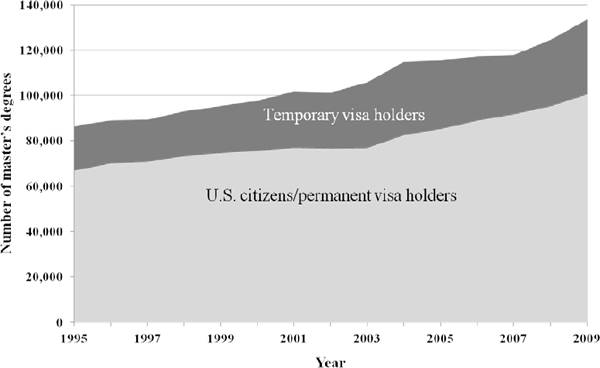
FIGURE 1 Number of master’s degrees awarded in the United States, by visa status of the recipients, 1995-2009. SOURCE: Rolf Lehming, National Science Foundation, “STEM Workforce Needs of the U.S. Department of Defense: Background Data.” Presentation to the Workshop on STEM Workforce Needs for the U.S. Department of Defense and the U.S. Defense Industrial Base, August 1, 2011, Rosslyn, Virginia.
One-quarter of those in the U.S. science and engineering workforce outside academia are foreign-born.16 But this process that has worked so well in the past for the United States in meeting its workforce needs is in jeopardy, for several reasons:
- Foreign students who remain in the United States as non-citizens after receiving a degree are excluded from defense-related work because of the associated requirements for security clearances and the rigidity attached to the overall security clearance process17 and may be excluded from certain unclassified defense work as well.
- Opportunities are increasing in many parts of the world for scientists and engineers—both U.S. citizens and non-citizens—to build productive careers in their native lands and in other countries because talent is in great demand everywhere.18
- Among the limitations to meeting STEM needs19 is that careers in STEM seem to remain generally unappealing to this nation’s young people because of such factors as
_____________________
16National Science Board. 2012. Science and Engineering Indicators. Arlington, Va.: National Science Foundation, pp. O-10 and 3-48.
17National Research Council. 2010. Critical Code: Software Producibility for Defense. Washington, D.C.: The National Academies Press.
18V. Wadhwa, A. Saxenian, R. Freeman, G. Gereffi, and A. Salkever. 2009. America’s Loss Is the World’s Gain: America’s New Immigrant Entrepreneurs. Kansas City, Mo.: Ewing Marion Kauffman Foundation.
19See element 2 of the statement of task listed in the Preface.
the extent of work required to earn degrees in these fields; the turbulence in the STEM job market; the widely held belief that jobs in these fields are low paying (the latter is not substantiated by the data, although there is evidence of slow wage growth20); and the higher-paying career paths in finance, business, law, and medicine that have been available to students with scientific and technological talent.21
- The current DOD civilian STEM workforce is an aging one due to past hiring freezes and reductions in force (Figure 2), with a disproportionate segment of physical scientists and engineers eligible to retire during the next few years (Figure 3).
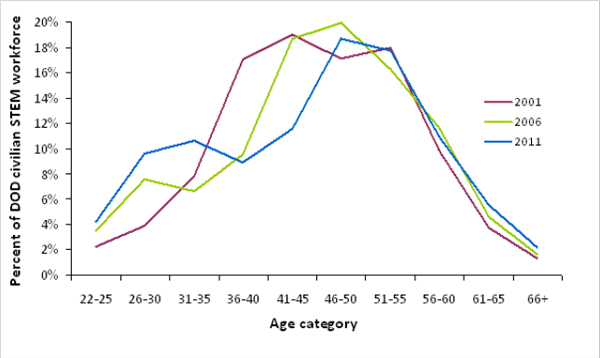
FIGURE 2 Age distribution of the Department of Defense (DOD) civilian science, technology, engineering, and mathematics (STEM) workforce, selected years: 2001, 2006, and 2011. NOTE: Figures are as of the fiscal year-end (e.g., September 30, 2011). SOURCE: Data provided by the Defense Manpower Data Center. Tabulations by the National Research Council.
- The DOD and the federal government generally are no longer an employer of choice for most young STEM workers22 as the DOD was during the Cold War when it was at the forefront of technology and when national security was a recognized major concern of almost all citizens.
_____________________
20H. Salzman and L.B. Lowell. 2007. Into the Eye of the Storm: Assessing the Evidence in Science and Engineering Education, Quality, and Workforce Demand. Madison, Wisc.: Association for Public Policy Analysis and Management.
21T. Lemieux. 2007. “The Changing Nature of Wage Inequality.” NBER Working Paper No. w13523. Cambridge, Mass.: National Bureau of Economic Research.
22C.R. Hedden. 2011. Aviation Week Young Professionals’ and University Students’ Survey. Arlington, Va.: Aviation Week, p. 13.
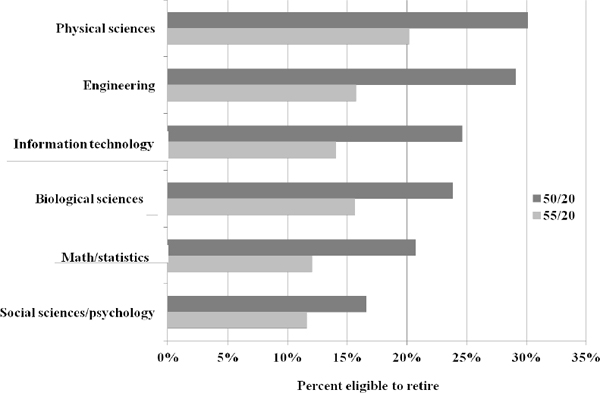
FIGURE 3 Retirement eligibility of selected occupational groups in the civilian Department of Defense workforce NOTE: 50/20 and 55/20 = 50 (55) or more years old with 20 or more years of service. SOURCE: Rolf Lehming, National Science Foundation, “STEM Workforce Needs of the U.S. Department of Defense: Background Data.” Presentation to the Workshop on STEM Workforce Needs for the U.S. Department of Defense and the U.S. Defense Industrial Base, August 1, 2011, Rosslyn, Virginia.
- The so-called defense industry is moving to diversify away from defense for economic reasons23—as well as because of the complexities of dealing with a powerful monopsonist buyer.
- Government contractors have become increasingly risk-averse, constrained as they are by increasingly complex defense acquisition laws24 and competing for fewer acquisition programs having longer acquisition cycles—the latter making the work less attractive to prospective STEM hires.25
_____________________
23Loren Thompson. 2011. “Defense Contractors Are Going to Go for the Civilian Market.” Forbes. Available at http://www.forbes.com/sites/lorenthompson/2011/11/08/market-conditions-pressure-defensecompanies-to-diversify/. Accessed April 5, 2012.
24C.J. Dunlap, Jr. 2011. “The Military Industrial Complex.” Daedalus 140(3, Summer):135-147.
25National Research Council. 2012. Report of a Workshop on Science, Technology, Engineering, and Mathematics (STEM) Workforce Needs for the U.S. Department of Defense and the U.S. Defense Industrial Base. Washington, D.C.: The National Academies Press, p. 10.
- The nation’s economy is unlikely to be able to support defense expenditures at the levels of the past,26 and the DOD’s traditional predilection is not to provide highest priority to the support of STEM activities, particularly fundamental research.27,28
- Technology today has a half-life measured in a few years, whereas major DOD development programs can take decades—thereby making it nearly impossible to move the most advanced technology into the hands of the armed forces and simultaneously limiting the job satisfaction of those involved.29
- U.S. industry as a whole is further reducing its investment in research,30 with such iconic institutions as Bell Labs virtually disappearing.
- The U.S. system of higher education finds its predominant global position threatened—among the contributory factors are declining investments in education on the part of state and local governments, rising costs, and greatly increased competition from abroad.
- The United States has, on average, one of the poorer K-12 education systems in the industrialized world—particularly in mathematics and science, in which nationwide testing showed that the average 4th grader was below proficient31—and the worst in terms of return on investment.
U.S. employers nearly unanimously cite the need for additional employees with specialty skills, including STEM workers, yet the nation’s overall unemployment rate remains high. At an event in California in early 2011, Apple’s Steve Jobs told the President that his firm had to employ 700,000 workers abroad, with Apple’s executives citing, among other factors, the ability of China to supply engineers much more rapidly than could the U.S. labor pool, including the 8,700 industrial engineers to oversee the 200,000 assembly-line workers who in China were found in just 15 days’ time.32,33 But what the United States confronts as a nation, and what the
_____________________
26Binyamin Appelbaum. 2012. “The Next War: A Shrinking Military Budget May Take Neighbors with It.” New York Times. Available at http://www.nytimes.com/2012/01/07/us/a-hidden-cost-of-military-cuts-could-beinvention-and-its-industries.html?pagewanted=all. Accessed April 5, 2012.
27National Research Council. 2008. Pre-Milestone A and Early-Phase Systems Engineering: A Retrospective Review and Benefits for Future Air Force Systems Acquisition. Washington, D.C.: The National Academies Press.
28National Research Council. 2011. Evaluation of U.S. Air Force Preacquisition Technology Development. Washington, D.C.: The National Academies Press.
29National Research Council. 2012. Report of a Workshop on Science, Technology, Engineering, and Mathematics (STEM) Workforce Needs for the U.S. Department of Defense and the U.S. Defense Industrial Base. Washington, D.C.: The National Academies Press, p. 10.
30National Science Board. 2012. Science and Engineering Indicators. Arlington, Va.: National Science Foundation, Figure O-5.
31National Science Board. 2012. Science and Engineering Indicators. Arlington, Va.: National Science Foundation; see, for example, Figures 8-1 and 8-4.
32Charles Duhigg and Keith Bradsher. “How the U.S. Lost Out on iPhone Work.” New York Times, January 21, 2012.
33Nick Wingfield. “Apple’s Job Creation Data Spurs an Economic Debate.” New York Times, March 4, 2012.
DOD confronts to an even greater extent, is a knowledge gap within the potential workforce including the STEM workforce.
Ironically, it is unlikely that the United States will suffer from an overall shortage of engineers and scientists. The reason is globalization. Today it is a relatively straightforward matter for a U.S. commercial firm to expand its STEM capacity abroad—particularly given the large numbers of STEM workers being educated elsewhere in the world, many of whom are highly qualified. Just as research laboratories move abroad,34 so too do the prototype shops that design and evaluate new concepts and so too do the production lines and eventually the maintenance facilities, in order to reap higher returns on their investment.35 Further, most of tomorrow’s commercial customers will be in the developing nations, not in the developed countries, as in the past.36 A principal result from this scenario is that the competition for quality jobs in the United States for U.S. workers will increase significantly.
DOD representatives almost unanimously state that they foresee no shortage of STEM workers in the years ahead except in a very few specialty fields,37 as the committee found in reviewing current and projected STEM workforce demands.38 Pondering the projected decline in defense spending, it is not difficult to imagine a reduction in the perceived need for STEM employees by the DOD and its contractors. The DOD’s STEM needs, as well as those of its contractors, represent a relatively modest facet of the challenge faced by the nation as a whole in today’s burgeoning, technologically driven economy. The problem is that with the rapid pace of advancement in STEM and the uncertainty of future threats, a shortage of STEM workers, particularly those with knowledge in new or rapidly changing fields, could erupt at any time.
Another complication facing national security is that the DOD and its contractors cannot simply export their work to overseas firms—although the DOD will need to do a much better job of defining exactly what jobs truly demand U.S. citizenship as a condition of employment. The maintenance of a cadre of highly capable, innovative, entrepreneurial U.S. scientists and engineers is thus critical to the health of the U.S. economy as well as to the DOD. But within this context, the DOD’s demand for scientists and engineers is sufficiently modest that fulfilling its need for numbers should be achievable. The DOD’s challenge is to fill its ranks with a suitable share of the “best and brightest” talent—particularly given many young graduates’ perception of working in government.
In reviewing the capacity of the nation’s STEM educational enterprise,39 the committee found one encouraging development: Already in place at the Naval Postgraduate School is a proven program granting master’s degrees in engineering and other technical fields to selected individuals from the military services and civilian workforce who enter the program with liberal arts credentials. Between 2007 and 2011, more than 4,000 resident students graduated from this
_____________________
34National Science Board. 2012. Science and Engineering Indicators. Arlington, Va.: National Science Foundation, Figures O-6 and O-7.
35The Economist. “China’s Economy and the WTO.” December 10, 2011.
36Asia’s spending on defense is projected to surpass that of Europe in 2012. See International Institute for Strategic Studies (IISS). 2012. The Military Balance. London: IISS.
37National Research Council. 2012. Report of a Workshop on Science, Technology, Engineering, and Mathematics (STEM) Workforce Needs for the U.S. Department of Defense and the U.S. Defense Industrial Base. Washington, D.C.: The National Academies Press.
38See element 1 of the statement of task listed in the Preface.
39See element 5 of the statement of task listed in the Preface.
program; of this number, roughly 525 matriculated with non-technical backgrounds.40 This program accomplishes its results by means of an intensive, year-round academic program that focuses on technical master’s degrees in engineering and other STEM coursework, in curricula ranging from 18 to 30 months’ duration, depending on discipline and the credentials of the incoming student. Unfortunately, there is no comparable program for imparting engineering experience on an accelerated basis.
The highly regarded SMART (Science, Mathematics, And Research for Transformation) Scholarship is a DOD STEM workforce development program that addresses the recruitment and retention of top talent for the department. SMART is a civilian scholarship-for-service program that provides full undergraduate or graduate tuition, living and books allowances, summer internships, health insurance, and other benefits in exchange for postgraduate employment within the DOD that pays back the scholarship with service on a 1-year-for-1-year basis.41 The qualification of the students is high—the 2009 cohort of 262 students had an undergraduate grade point average of 3.7. All parties find this 6-year-old program attractive, expandable, and well targeted.
There are a number of constructive steps that the DOD could take to help assure that the needed cadre of highly qualified STEM workers will be available to support national security needs. These include making the DOD a more desirable place for highly capable STEM employees to work; creating more pathways for high-quality scientists and engineers to work in the DOD; enhancing early warning of new developments being achieved in science and engineering globally by increasing the global involvement of DOD STEM employees; supporting the career growth of, and affording opportunities to, high-quality civilian government scientists and engineers as is already done for highly capable uniformed personnel; and establishing and utilizing adaptable human resources mechanisms that provide the capacity to respond to abrupt changes in STEM opportunities and needs that are competitive with industry.
Science and technology and the STEM workforce are increasingly important for the nation’s military to prevail during future conflicts. Technological surprise has proved to be decisive in many past conflicts and will likely be so in the future. The ongoing globalization of STEM will require the DOD to re-address its workforce policies and practices in order to avoid shutting itself off from access to the best and brightest talent available. The DOD is a microcosm of the larger and growing global STEM enterprise.
Finding 1: Quantity of STEM Workforce
There is no current shortage of STEM workers for the DOD and its industrial base except in a few highly specialized, though nevertheless important, subfields—such as cybersecurity and selected intelligence fields.
_____________________
40Personal communication, O. Doug Moses, Naval Postgraduate School, to Martin Offutt, National Research Council, May 23, 2012.
41Laura Adolfie, U.S. Department of Defense, Presentation to the Committee on STEM Workforce Needs for the U.S. Department of Defense and the U.S. Defense Industrial Base. Washington, D.C., June 7, 2011.
Finding 2: Quality of STEM Workforce
The STEM issue for the DOD is principally the challenge of recruiting and retaining a notable share of the top-quality talent in the available workforce, not its share of the quantity available. The decisions that government employees make are highly leveraged, impacting the efforts of very large numbers of people and enterprises in industry, academia, and elsewhere—hence, the high premium on excellence.
Finding 3: The Changing Character of the STEM Workforce
New technological advancements, often originating outside the defense sector and from abroad, are appearing at an increasing rate, placing a premium on the early identification of potentially useful technology in the global marketplace. Adapting to this environment will require transformational changes within the DOD’s management of its STEM workforce.
Finding 4: Forecasting STEM Workforce Needs
Forecasting the STEM skills needed by the DOD beyond the near term is simply not possible because of the increasing rates of advancement in science and technology and the unpredictability of military needs and defense budgets. The fickle nature of the latter can make STEM graduate work and careers in the DOD appear less reliable to prospective applicants. Flexibility and relevance in the DOD STEM workforce are paramount.
Finding 5: Attracting and Retaining STEM Workforce
For the DOD to compete with commercial firms, universities, and other employers for top STEM talent, a DOD commitment to changing its STEM workforce environment is required. The DOD, as viewed by the top STEM talent pool, must become an attractive career destination for a suitable share of the most capable scientists, engineers, and technicians, who are in great demand across the global talent marketplace. This implies, among other things, that the DOD will need to reconcile this need with its requirement for security clearances for many STEM positions.
OBSERVATIONS ON DOD’S WORKFORCE PRACTICES
On the basis of the findings presented above, the study committee offers these eight observations:42
Observation 1: Overall Core STEM Competencies
It continues to be paramount to maintain all core STEM competencies at least at a basic level in all potentially critical, emerging topical areas—within the DOD and its industrial and university ecosystem. This firm foundation will ensure that the response to technological challenges and opportunities such as may arise can be facilitated expeditiously and minimize the possibility of technological surprise.
_____________________
42Observations 2, 4, 6, and 8 identify options for overcoming limiting factors to fulfilling STEM needs (see element 3 of statement of task listed in the Preface).
Observation 2: Recruitment of Highest-Quality STEM Workforce
Reviewing and overhauling the DOD workforce recruitment policies and practices will be essential to ensure that the DOD is fully competitive with industry (not simply the “defense industry”) in recruiting the highest-quality STEM talent. The DOD can judge its recruiting competitiveness by the quality of its STEM hires, and it will have the opportunity to continue to adjust its policies and practices until its workforce quality goals are achieved.
Observation 3: Management of STEM Workforce for Highest-Quality Talent
The objective of retaining a suitable share of the highest-quality talent—that is, those at the forefront of emerging, potentially critical technical areas and those capable of moving to new critical technical areas that arise—can be achieved only through targeted STEM workforce management policies, procedures, and incentives (in short, through a business model). It is essential that the business model explicitly make careers in the DOD attractive to top STEM talent, a goal that will require explicit support, commitment, and action by the highest level of DOD leadership.
Observation 4: Opening of the STEM Workforce Pool to Non-U.S. Citizens
Accessing the most talented STEM professionals globally can be achieved by expanding the tiers of security clearance classifications and re-examining the need for security clearances in selected positions in order to permit non-U.S. citizens to enter the STEM talent pool available to the DOD and its contractors under tailored circumstances.
Observation 5: STEM Qualifications and Accountability of Key Personnel
Requiring that personnel responsible for major science and technology-intensive DOD programs have the documented STEM skills, experience, and qualifications will ensure that this segment of the workforce can execute its responsibilities at a high technical level in a globalized innovation system in which key developments will occur outside the DOD. Granting exceptions to the documented verification of the STEM qualifications required for such key appointments would be inadvisable absent high-level managerial confirmation of the appointee’s STEM qualifications at the time of appointment.
Observation 6: Unconventional Programs and Prototyping
Creating “skunk works” in the DOD industrial base, in universities, and within the DOD itself would enable targeted, unconventional, potentially disruptive programs—including prototyping for technical concept verification—that could subsequently be transitioned to an operating unit for implementation if successful, or terminated if not. A system that provides rotational assignments for individuals from government, the industrial base, and the private sector would be an attractive feature of such programs. A skunk-works culture of this type would nurture critical STEM skills within the DOD workforce while at the same time providing the exciting, challenging, and highly attractive opportunities needed to attract and retain highest-quality talent
in the DOD-related STEM workforce. It would also provide the opportunity to retain design teams that are critical to developing new systems.
Observation 7: An Agile and Resilient STEM Workforce
An agile and resilient STEM workforce—one that is attuned to the dynamism of the now-globalized science and technology enterprise and the future uncertainty of technical needs—will be best prepared to adapt to those technical needs as they arise and be most enthusiastic about continuing careers in this technical environment.
Observation 8: Upgrading of Education and Training for the Civilian DOD STEM Workforce
Providing opportunities to the civilian DOD STEM workforce for education and training, and reeducation and re-training, that are commensurate with similar opportunities afforded career military employees will enhance the career attractiveness of employment in the DOD.
The committee observes that planning for future STEM needs should be geared to flexibility and adaptability rather than to unpromising efforts at longer-term forecasting; nevertheless, certain areas do have strong near-term interest. These observations are based on a combination of apparent needs and high promise. In the aggregate they represent a preliminary attempt by the committee to address its fourth task43—an effort that may be expanded in its final report. A partial listing of areas, many of which were discussed in the committee’s August 2011 workshop,44 is presented below in alphabetical order:
- Advanced robotics (e.g., for defense manufacturing, surgery, and the dismantling of improvised explosive devices [IEDs]) and autonomous systems (e.g., unmanned aerial systems);
- Intelligence collection;
- Cyberwarfare (both defense and offense);
- Human identification, marking, and tracking;
- Human-machine interactions on human terms;
- Means of detecting and neutralizing biothreats;
- Means of negating IEDs;
- Military applications of biosciences (computation, weapons, sensors, etc.);
- Military applications of information sciences;
- Nanotechnology (e.g., innovative materials, drugs, and sensors); and
_____________________
43See element 4 in the statement of task listed in the Preface.
44National Research Council. 2012. Report of a Workshop on Science, Technology, Engineering, and Mathematics (STEM) Workforce Needs for the U.S. Department of Defense and the U.S. Defense Industrial Base. Washington, D.C.: The National Academies Press.
- Sensors for nuclear weapon detection.
As the economy of the United States is increasingly challenged in the global marketplace by the emergence of strong competitors, excellence in STEM capabilities will become even more important than it is today. Further, as the nation’s defense budget decreases, it will need to be expended more wisely by the leveraging of the capabilities of every individual and unit in the U.S. armed forces and the civilian workforce. Much of that leverage will be derived directly from advancements in the STEM fields, including those made overseas. The importance to this nation and to the DOD in particular of having available a high-quality, highly relevant, flexible, expandable STEM workforce cannot be overstated.


