
Climate change is occurring, is very likely caused by human activities, and poses significant risks for a broad range of human and natural systems. Each additional ton of greenhouse gases emitted commits us to further change and greater risks. In the judgment of the Committee on America’s Climate Choices, the environmental, economic, and humanitarian risks of climate change indicate a pressing need for substantial action to limit the magnitude of climate change and to prepare to adapt to its impacts. (National Research Council, 2011a, p. 1)
A principal message from the recent National Research Council report America’s Climate Choices, this brief summary of how climate change will shape many aspects of life in the foreseeable future emphasizes the vital importance of preparation for these changes. The report points to the importance of formal and informal education in supporting the public’s understanding of those challenges climate change will bring, and in preparing current and future generations to act to limit the magnitude of climate change and respond to those challenges. Recognizing both the urgency and the difficulty of climate change education, the National Research Council, with support from the National Science Foundation, formed the Climate Change Education Roundtable. The roundtable brings together federal agency representatives with diverse experts and practitioners in the physical and natural sciences, social sciences, learning sciences, environmental education, education policy, extension education and outreach, resource management, and public policy to engage in discussion and explore educational strategies
for addressing climate change. Roundtable chair James Mahoney noted that the importance of the roundtable lies in its broad focus on climate change education, including formal education from kindergarten through college, public understanding, and the means to develop in decision makers, from local, state, and federal government officials to business owners, the capacity to address climate change issues.
The roundtable, which is overseen by the Board on Science Education, the Board on Environmental Change and Society, and the Division on Earth and Life Studies, was charged to hold two workshops to survey the landscape of climate change education. The first explored the goals for climate change education for various target audiences (National Research Council, 2011b). The second workshop, which is the focus of this summary, was held on August 31 and September 1, 2011, and focused on the teaching and learning of climate change and climate science in formal education settings, from kindergarten through the first two years of college (K-14). This workshop, based on an already articulated need to teach climate change education, provided a forum for discussion of the evidence from research and practice regarding:
• how climate change is currently taught in school;
• how best to teach climate change in K-14 settings;
• what factors impede the teaching of climate change in schools; and
• innovations in K-14 climate change education.
The goal of the workshop was to raise and explore complex questions around climate change education, and to address the current status of climate change education in grades K-14 of the formal education system by facilitating discussion between expert researchers and practitioners in complementary fields, such as education policy, teacher professional development, learning and cognitive science, K-12 and higher education administration, instructional design, curriculum development, and climate science. In an effort to provide a common frame for the workshop participants, the steering committee based the initial assumptions about climate change on the recent National Research Council (2010) report Advancing the Science of Climate Change that climate change is already occurring, is based largely on human activities, and is supported by multiple lines of scientific evidence. Beyond this initial assumption, the workshop did not discuss, nor intend to explore, the science of climate change or related climate issues, but rather confined the discussions to informing the issues around teaching climate change in formal school settings, K-14.
To explore these topics, the steering committee structured the workshop to provide ample opportunity for discussion among expert researchers and practitioners across the K-14 formal education system. This report
BOX 1-1
Workshop Statement of Task
An ad hoc committee will plan and conduct a public workshop that will address the current status of climate change education within grades K-14 of the formal education system. The workshop will feature invited presentations and discussion. It will provide an opportunity for discussion between expert researchers and practitioners in complementary fields, such as education policy, teacher professional development, learning and cognitive science, climate change, K-12 and higher education administration, instructional design, and curriculum development. Discussions at the workshop will focus on identifying how the issue of climate change is currently taught in school; what research indicates about how best to teach climate change in K-14 settings; what factors impede teaching climate change in schools; and how to best articulate the connection between climate change education in K-12 and higher education. The committee will develop the agenda topics, select and invite speakers and discussants, and moderate the discussion.
summarizes the workshop’s presentations and discussions. Box 1-1 presents the workshop statement of task.
CONTEXT
America’s Climate Choices (National Research Council, 2011a) describes key issues the nation faces in responding to climate change and developing strategies for mitigation and adaptation, noted Charles W. (Andy) Anderson (Michigan State University) in opening the workshop. The report articulates two challenges for the formal education system: to prepare scientists, leaders, and practitioners with the needed expertise to address climate change issues, and also to prepare all citizens to become informed decision makers. The report proposes that decisions about mitigation and adaptation be viewed in a framework of iterative risk management. That is, Anderson explained, the optimal response to climate change would be “an ongoing process of identifying risks and response options, advancing a portfolio of actions that emphasize risk reductions and are robust across a range of possible futures, and revising choices related to the climate over time to take advantage of new knowledge.” The report does not call for a commitment to some particular course of action, Anderson noted. Instead, it asks for a commitment to understanding the implications of different courses of action and choosing in a deliberative way among them.
America’s Climate Choices identifies key elements of an effective national response, Anderson explained, one of which is to develop institu-
tions and processes that ensure that pertinent information is collected and that links scientific and technical analysis with public deliberation and decision making. Deliberation and decision making are critical to effective responses to climate change, Anderson emphasized, and thus it is essential to prepare all citizens to understand the risks of both action and inaction and to engage in effective deliberation about all available choices.
The vital importance of an informed citizenry is illustrated, Anderson noted, in data presented at the Roundtable on Climate Change Education’s first workshop, on the diversity of beliefs people hold about climate change. In a series of studies that examined how the American public responds to climate change information, researchers categorized the public into “Six Americas”1: the six basic response categories are “dismissive,” “doubtful,” “disengaged,” “cautious,” “concerned,” and “alarmed.” “It’s disturbing,” Anderson observed, “that between 2008 and 2010 public opinion shifted away from concerned toward dismissive.”
An even more important issue demonstrated in these studies, Anderson stressed is that public understanding of factual issues related to climate change is distinctly limited (National Research Council, 2011a). He stated that “as the evidence mounts, the controversy [about climate change] is inevitably going to die down” but noted that public deliberation becomes difficult or impossible when individuals choose their own facts, as well as their opinions and values, to interpret information. Anderson observed that in the future the controversy may shift from whether climate change is occurring to what actions need to be taken to address it and pointed to the need to prepare today’s children for a future in which the basic facts of climate change are no longer controversial, and the consequences are real.
CLIMATE CHANGE EDUCATION FOR A CHANGING WORLD
Two assumptions underlie the way many people approach the topic of climate change education, noted Daniel Edelson (National Geographic Society) in the keynote presentation: one is that such education would begin with components of the science education curriculum, and the other is that much of it would concern climate science and the dynamics of climate change. Although he supports the idea that young people need to learn about climate processes and the ethics of anthropogenic climate change, he has a different view of the best way to conceive of climate change education.
To explain his perspective, he listed educational goals that are widely

1See http://environment.yale.edu/climate/ [January 2012].
shared in the climate change education community. Every graduate of the K-14 education system should understand
• Fundamental processes that influence climate, at scales ranging from local to regional to global.
• Natural variability and natural cycles in climate.
• Human impact on the climate—that is, how the growth in human population and technology has made it possible for human activity to change climate patterns at various scales.
• How changes in climate can and do influence physical systems, ecosystems, and society.
• Why the scientific community is now convinced that anthropogenic climate change is under way.
• What the range of effects of climate change is and how likely various different scenarios of climate change are under different conditions.
These ideas, he suggested, make up the common ground for educators who may have different perspectives on how to approach climate change education. People may draw different conclusions based on how this material should be covered in schools, but these basic ideas are the foundation for informed debate and decision making and thus provide a reasonable definition of climate literacy. He believes strongly that “the future of society and earth’s ecosystems do hang in the balance, and … will depend, ultimately on our success in preparing the next generation to make good decisions [related to] climate change.”
However, Edelson does not believe it is necessary, or even desirable, to create a major component of school curricula focused on climate science and climate change to achieve this goal. His primary reason is conceptual: he believes that most of what one needs to understand in order to be climate-literate has nothing to do with climate in particular, but rather is covered by the fundamentals of earth systems science. Edelson pointed to a report published by the National Aeronautics and Space Administration (NASA) in the 1980s that played a leading role in recasting the geosciences as the study of interconnected processes that cut across the traditional disciplines of geology, oceanography, climatology, hydrology, ecology, and others and also wove in the role of human systems (NASA Advisory Council, 1988). This approach was illustrated in a figure that came to be known as the Bretherton diagram (see Figure 1-1) after its author Francis Bretherton of the University of Wisconsin–Madison.
The Bretherton report was published at a time when climate change research was “gaining traction” and was very influential in the scientific community, Edelson noted. The report was intended as a guide to
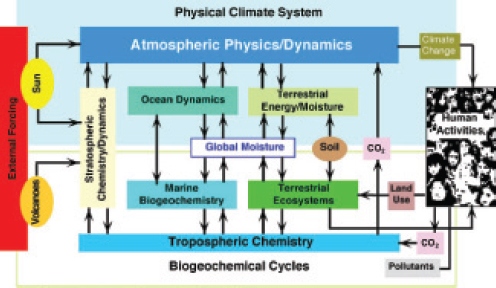
FIGURE 1-1 A diagram of the earth system proposed by the Earth System Sciences Committee, chaired by Francis Bretherton, which published the seminal report Earth System Science: A Program for Global Change.
SOURCE: Adapted from NASA Advisory Council (1988).
earth science research, and it put forth two critical principles: (1) that all earth processes and phenomena can be understood as dynamic systems that transform or transport matter and energy in accordance with the laws of chemistry and physics and (2) that all of these earth systems are interconnected, so that no system can be understood in isolation from any other. These were “paradigmatic breakthroughs,” Edelson observed, which are now uncontroversial in the earth science community and which distinguished that field from other science disciplines that tend to study systems in isolation.
More recently this approach has been diluted, Edelson explained, by a tendency in the field of earth science education for people to advocate for particular spheres. For example, a framework for ocean literacy, developed collaboratively by the National Oceanic and Atmospheric Administration (NOAA) and others, described a sequential development of understanding of ocean science (National Oceanic and Atmospheric Administration, 2004). This framework was well constructed, in Edelson’s view, but treats ocean literacy in isolation, “without regard to any other important literacies in the earth system sciences.” He suggested that this framework follows the first principle of earth systems science—the dynamic systems principle—but sets aside the principle of interconnectedness. Some of those concerned with other areas of earth systems science perceived the
framework as a challenge, Edelson explained, and responded with similar documents defining the knowledge sequence for these other areas.
The problem, for Edelson, is that “it’s not possible to teach climate science on its own so that people can understand it.” It only makes sense as part of an integrated, holistic education in earth systems science, although specific learning outcomes related to climate change would be part of that education. He commented that a shift in focus from climate change education to earth systems science education that encompasses key knowledge and understanding about climate change is necessary. Indeed, he suggested, “considering climate change education as a separate thing from overall earth system education is a waste of time.”
Edelson thinks it important for concerned scientists and educators to “raise the banner of earth systems education and use climate change as one of the reasons that it is absolutely critical.” To support this position, he cited a pragmatic example of why the climate-focused approach is not effective. In 2008, he pointed out, following a major effort by numerous groups of scientists and other stakeholders to educate the public about climate change, 72 percent of Americans believed that global warming was happening. By 2010, however, this figure had dropped to 50 percent, and the percentage of those who actively did not believe in global warming had doubled, from 17 to 36 percent (Borick, Lachapelle, and Rabe, 2011). The reason, Edelson proposed, is that the information the public had received was not connected to and embedded in larger knowledge structures. Thus, he explained, “as soon as somebody else comes along with a compelling argument that goes the other way, [people] cannot reconstruct the previous argument. They don’t have the fundamental systemic understanding of what is going on.”
Focusing on climate change in isolation places it in competition with other important education outcomes in a similar sphere, Edelson pointed out, such as study of the ocean, pollution, or even HIV/AIDS, poverty, or peace education. It is also important, in Edelson’s view, to distinguish the study of climate change, which is an observable phenomenon, from the study of such fundamental, explanatory aspects of science as evolution, for example.
The exclusive focus on climate change also creates insider and outsider views, he added. Climate change is politically charged, and conflict over the new science standards and other education issues is inevitable. Such conflict would be much easier to overcome if the debate took place among people who already had achieved the basic literacy described above. The heat and energy of such conflicts can have long-lasting impacts, and Edelson expressed concern that conflict has the potential to derail the progress of the new science education standards that specifically include references to climate science and climate change education. It is important
to remember, he noted, that “in politics you don’t win because you are right, and you don’t necessarily even win because you have a majority.”
A better approach, for Edelson, is to pursue the goal of developing geo-literacy, or the capacity to make “big decisions,” those that have big impacts (such as whether or not to drill for oil in a certain area) and that affect and are influenced by many processes and actors—such as formal democratic processes, advocacy, and public opinion. Edelson listed four components of geo-literacy:
1. reasoning about dynamic earth systems (physical, ecological, social, and technological);
2. reasoning about geographic relationships (relationships between places and systems and connections between places);
3. reasoning systematically about decisions; and
4. knowledge of specific systems and places at multiple scales.
This approach is intended to complement, not replace, other educational frameworks and standards, Edelson explained, but it provides a larger framework for integrating the key aspects of climate systems with those of human systems. It is also applicable not only to K-12 or undergraduate natural and physical science education, but also to the social and behavioral sciences curricula. It focuses on reasoning and decision making, with an emphasis on place and geographic decision making. “With the decline in geography education and social studies,” he noted, “teaching of geographic reasoning and geospatial thinking has almost disappeared.” Systematic approaches to decision making are not taught anywhere in the curriculum, Edelson noted, but people need “to be able to evaluate evidence, project consequences, weigh options and trade-offs, and use their values to make well reasoned decisions.”
Adding climate change education on top of all that is already in the curriculum, in Edelson’s view, is likely to yield a situation in which “some teachers do a great job with it, some teachers don’t understand it or don’t believe it and don’t do it at all, and a lot of people will try to squeeze it in amongst a bunch of other competing priorities.” Instead, he suggested, it would be possible to work backward from an understanding of the tasks that young people will face when they leave school and establish educational priorities that will truly prepare them. For example, Edelson emphasized, “students should be able to make well-reasoned decisions about purchases of cars and major appliances that take into account environmental impact, including climate change. They should be able to evaluate arguments for and against particular energy policies, and be able to communicate their own arguments to their elected representatives if they choose.”
DISCUSSION
Participants had questions and comments about Edelson’s proposed approach. Roberta Johnson (National Earth Science Teachers Association) asked whether Edelson was targeting a straw man, because, in practice, there are currently a very small number of courses being taught that focus on climate change. She commented that “if you are lucky enough to have an earth science class or an earth systems class, you might be doing a unit on climate change in the context of everything else you are doing.” Edelson agreed, stressing that there should be both short and long-term strategies. In the short term, he said, it is important to work within the current system and integrate climate change into the classroom whenever possible. The long-term strategy he advocates is to address the fundamental problem with earth systems understanding and to treat climate change in the context of both earth and human systems.
Cathy Middlecamp (University of Wisconsin–Madison) questioned where biology, chemistry, and physics fit into Edelson’s approach of fostering geo-literacy, and Ted Willard (American Association for the Advancement of Science) followed with a question about why focusing on geo-literacy is a better strategy than working across all science disciplines. Edelson explained that his approach is intended as a high-level organizational structure that should apply to all sciences in the curricula, pointing out that “we should be designing our education around what we want people to be able to do.”
Nancy Songer (University of Michigan) asked whether it will be possible to take a top-down approach to developing the next generation of science education standards in a way that fuses together the content and practices for all of the sciences—natural, physical, and social—so that priorities can be set through a single concerted effort. Edelson reiterated that significantly altering the current standards effort “would be counterproductive” but stressed that the education community should already be focusing on the next generation of standards beyond the current efforts. He observed that a major breakthrough could come when coordinated standards for disciplines within social studies, which currently do not exist, are developed. Rather than eliminating boundaries between disciplines, Edelson suggested that connections across disciplines should be made well in advance (of articulating standards), so that the next generation of standards is better coordinated and integrated. “I am arguing for a better developed top-level structure, a way of connecting disciplines and making sure that when we set, say, physics priorities, they are connected to earth science priorities, math priorities, and social studies priorities, for that matter.”
David Blockstein (National Council for Science and the Environment) pointed to the Bretherton diagram to ask how the definition of geo-
literacy differed from that of ecology, noting that from his perspective it was a description of ecology. Edelson responded that the diagram is a marvel for just that reason—each community sees it as a model of their own discipline. Geo-literacy, he explained, goes beyond the traditional notion of earth systems to include the physical, natural, ecological, biological, social, and technological systems.


