
The Hindu Kush-Himalayan (HKH) region extends over 2,000 km from east to west across the Asian continent spanning several countries: Afghanistan, Bangladesh, Bhutan, China, India, Nepal, and Pakistan (Figure S.1). This region is the source of numerous large Asian river systems, including the Indus, Ganges, and Brahmaputra, which provide water for over a billion people. The surface water of these rivers and associated groundwater constitute a significant strategic resource for all of Asia. Many of the countries in this region are already experiencing physical water scarcity. Existing water stress and projections of population growth have led to concern over possibilities of negative impacts from changes in the availability of water supplies in the coming decades.
Scientific evidence indicates that glaciers in the HKH region are retreating at rates comparable to those in other parts of the world, and confirms that the rate has accelerated in the past century. In this region, conventional wisdom is that glacial meltwater is an important supplement to naturally occurring runoff from precipitation and snowmelt. The watersheds of the area each exhibit complex hydrology and the magnitude of the contribution of glacial meltwater to the total water supply in these rivers is not clear and the implications of accelerated rates of glacial retreat and the resulting increase in glacial wastage for downstream populations have not been precisely characterized. Important questions about regional water security need to be addressed in the context of incomplete science and unresolved uncertainties.
The eastern and western areas of the HKH region differ in climate, especially in timing and type of precipitation, and in glacier behavior and dynamics as well. The Sutlej Valley serves as a rough dividing line, with precipitation in the eastern end of the region dominated by monsoonal activity in summer while precipitation in the western end is dominated by the mid-latitude westerlies in winter. There is evidence of glacial retreat in the eastern and central Himalayas while glaciers in the western Himalayas appear to be more stable, and may even be advancing. The HKH region is geographically vast and complex both climatologically and hydrologically, and this complexity is dynamic and possibly changing. This large spatial variability makes it very difficult to generalize observations and findings over the entire region.
The HKH region’s climate is changing. Although generally temperatures are increasing and these increases are likely to accelerate in coming decades, spatial variability and gaps in observational data mean that it remains unclear what specific manifestations of climate change will be in specific places—including where and how quickly glaciers might retreat and what the cumulative impacts on the hydrological system of the region will be. Moreover, it is difficult to separate the effects of changes in glacial wastage from other factors. These factors include changes in the timing and amounts of monsoonal rain and seasonal snowmelt, snow and ice dynamics, the effects of aerosols and black carbon,1 and the role of tectonic activity in destabilizing glaciers. In addition, water-use changes resulting from changes in population numbers and densities, livelihoods and
________
1 Black carbon refers to particulate matter derived from the incomplete combustion of a hydrocarbon.
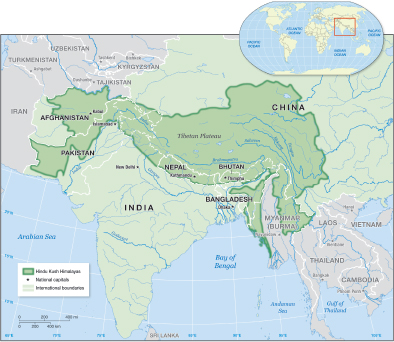
FIGURE S.1 The Hindu-Kush Himalayan region extends over 2,000 km across South Asia and includes all or parts of Afghanistan, Bangladesh, Bhutan, China, India, Nepal, and Pakistan. The region is the source of many of Asia’s major rivers, including the Indus, Ganges, and Brahmaputra.
consumption patterns, water management decisions including groundwater pumping, agricultural water-use dynamics, and the extent of pollutants will affect water availability in the region.
Despite these important uncertainties, not everything is uncertain or unknown. The National Research Council Committee on Himalayan Glaciers, Hydrology, Climate Change, and Implications for Water Security was charged with addressing questions about four aspects of water security in the region. The Committee’s overarching conclusions are that while there remains substantial scientific uncertainty, snow and glacial melt will likely continue to be important sources of water in the region and there will be several climatological, glaciological, and hydrological factors that control the rate, volume, and timing of snowmelt and icemelt. The means of adapting to change will mostly be small in nature, and adaptive solutions will be essential. Effective management institutions will also be critical and will need to operate flexibly. Monitoring systems will be critical to implementing effective adaptation solutions and improving water management
systems. The following are more specific and detailed conclusions that relate to the questions in the Committee’s charge (the full charge can be found in Box 1.1 of the main text of the report).
How sensitive are the Himalayan glaciers to changes in temperature, precipitation, and the surface energy budget?
The climate of the Himalayas is not uniform and is strongly influenced by the South Asian monsoon in the east and the mid-latitude westerlies in the west. Evidence suggests that the eastern Himalayas and the Tibetan Plateau are warming, and this trend is more pronounced at higher elevations; however, the long-term significance of this trend is not clear. Absorbing aerosols such as desert dust and black carbon may contribute to the rapid warming of the atmosphere, and model results indicate this may in turn contribute to accelerated melting of snowpack and glacial retreat.
The rate of retreat and growth of individual glaciers is highly dependent on glacier characteristics and location. In the eastern and central Himalayas, there is evidence of glacial retreat with rates accelerating over the past century. Retreat rates are comparable to other areas of the world. Glaciers in the western Himalayas appear to be more stable overall, with evidence that some may even be advancing.
What does current glaciological and climatological knowledge imply about potential changes in climate on downstream flows? What are the likely major impacts on water supplies and flood regimes?
Surface water flow is highly seasonal and varies across the region, as does the relative importance of glacial meltwater. In most instances, the annual contribution of snowmelt and rainfall to streamflow exceeds that of glacial wastage. The contribution of glacial wastage can be more important when the glacial wastage acts as a buffer against hydrological impacts brought about by a changing climate. Overall, retreating glaciers over the next several decades are unlikely to cause significant change in water availability at lower elevations, which depend primarily on monsoon precipitation and snowmelt. However, for high-elevation areas, current rates of glacial retreat, if they continue, appear to be sufficient to alter the seasonal and temporal streamflow in some basins.
Uncertainties in the role of groundwater in the overall hydrology of the region are even greater than those of surface water. Evidence suggests that sizable and extensive overdraft in the central Ganges Basin is likely to have an earlier and larger impact on water supplies than foreseeable changes in glacial wastage. For upstream populations, glacial lake outburst floods and landslide lake outburst floods are the dominant physical hazard risks. For downstream populations in the central and eastern Himalayas, floods from changes in monsoon dynamics are more likely to be important, along with changes in the timing of extreme events.
What management systems (including water supply, water demand, land use, and other institutions and infrastructure) are in place to manage climate-induced changes in regional hydrology, and how might they be strengthened?
Water resources management and provision of clean water and sanitation are already a challenge in the HKH region. The adequacy and effectiveness of existing water management institutions is a reasonable, if coarse, indicator of how the region is likely to cope with changes in water supply. Changes in seasonal stream-flow could have significant impacts on the local populations by altering water availability patterns and affecting water management decisions and policies for irrigation, municipal, industrial, and environmental use.
Current efforts that focus on natural hazards and disaster reduction in the region can offer useful lessons when considering and addressing the potential for impacts resulting from glacial retreat and changes in snowmelt processes in the region. Water management assessments have advanced over the past 5 to 10 years, though their implementation in water policies and programs is less clear; to date, there is limited penetration to lower levels of governance or support for local water managers who are most at risk. Changes to the hydrological system are inevitable and adaptation is needed at all levels of governance and throughout societies from rural household to city level. Adaptation approaches need to be flexible enough to change with changing conditions, for example, smaller scale and lower cost water management systems, because of uncertainty in impacts and the dynamic nature of future changes.
What are some of the main vulnerabilities to adjusting to changes in water supply in these downstream areas? What are the prospects for increased competition, or improved cooperation, between different downstream water users? What are some of the implications for national security in the region?
Rural and urban poor may be most at risk, in part because the poor are least likely to be able to retrofit, move, or rebuild as needed when faced with risks. Social changes in the region have at least as much of an effect on water use as environmental factors do on water supply, leading to stress. Among the most serious challenges, even in the absence of climate change, are the magnitude of conflicting demands for limited water resources, the lack of corresponding institutional capacity to cope with such conflicts, and the current political disputes among regional actors that complicate reaching any agreements on resource disputes. Although the history of international river disputes and agreement in this region suggests that cooperation is a more likely outcome than violent conflict, social conditions may have changed in ways that make historical patterns less informative about current and future challenges; populations are larger, the number of state and nonstate actors has increased dramatically, patterns of economic growth have changed, and the resource challenges are more complex. Changes in the availability of water resources may play an increasing role in political tensions, especially if existing water management institutions do not evolve to take better account of the social, economic, and ecological complexities in the region. Agreements will likely reflect existing political relations more than optimal management strategies. The most dangerous situation to monitor for is a combination of state fragility (encompassing, e.g., recent violent conflict, obstacles to economic development, and weak management institutions) and high water stress.
A WAY FO RWARD
When considering the link between humans and the environment within the context of water security in the HKH region, four themes emerge: (1) there is significant variability in the climate, hydrology, and glacier behavior as well as the demographics and water-use patterns within the region; (2) uncertainties exist and will continue to exist in both the physical and social systems; (3) to reduce and respond to this uncertainty there is a need for improved monitoring of both the physical and social systems; and (4) in the face of this uncertainty, the most compelling need is to improve water management and hazard mitigation systems.
Theme 1: There is significant variability in the climate, hydrology, and glacier behavior as well as the demographics and water-use patterns in the region. The retreat rates of Himalayan glaciers vary over time and space, with the rate of retreat being higher in the east than the west. There are confounding factors such as dust and black carbon that could affect glacial melt and in some cases increase glacial wastage. Changes in the monsoon will probably be more important than changes in glacial wastage at lower, downstream elevations. Rates of urbanization vary across the region, as does the portion of the population with access to improved water and sanitation.
Theme 2: Uncertainties exist and will continue to exist in both the physical and social systems. The impact of future climate change is uncertain but will probably accelerate rates of glacial retreat. Accelerated glacial retreat rates will have significant impacts in local, high-mountain areas but may not be important downstream unless the seasonal contribution of glacial meltwater to rivers is high or dense populations are dependent on historical flow rates. As the region’s population becomes more urbanized and standards of living change, water-use patterns will also change in ways that will be difficult to predict. Existing demographic methods also do not allow for projections at a sufficient spatial resolution to determine whether, for example, certain river basins and elevation zones will experience higher rates of population growth than others and how the demographic composition of those specific areas will change. In both the physical and social systems, stationarity—the assumption that the systems will fluctuate within a known range of variability—will no longer apply. In other words, the past is not a good basis for prediction, and past trends in the climate, hydrology, glacier behavior, population, and water use of the region will not be a viable guide for the future.
Theme 3: To reduce and respond to this uncertainty there is a need for improved monitoring of both the physical and social systems. Monitoring will need to occur on a more extensive and consistent basis. Without enhanced monitoring, the information needed to respond to
changing environmental and social conditions will be unavailable. Monitoring and research will advance understanding of both the physical and social systems in the region, and identify the various options available to respond to change in the face of uncertainty.
Theme 4: In the face of this uncertainty, the most compelling need is to improve water management and hazards mitigation systems. Existing patterns of water use and water management need improvement. Some progress has been made in improved assessments in the recent past. Going forward, improved implementation of lessons from these assessments in water policies and programs will be necessary. Options for adapting to climate change and hydroclimatic hazards are discussed in greater detail in the report. However, the people most likely to be affected by changing water security in the region are the rural and urban poor who have the least capacity to adapt to changing environmental and social conditions and hazards. Management of groundwater and demand-side management are among the areas where improvements can be made.


