
1
Introduction
While pain and suffering in another being is, strictly speaking, unknowable, yet for practical purposes there are a number of lines of evidence of their presence and intensity which deserve attention. (Paton, 1984)
This book was prepared to help scientists, research administrators, institutional animal care and use committees, and animal care staff to address the difficult questions of the presence and alleviation of animal pain and distress. The authors believe that in most experimental and husbandry situations laboratory animals need not experience substantial pain or stress and that prevention and alleviation of pain and stress in laboratory animals is an ethical imperative. That view is shared by the public and Congress. The federal Animal Welfare Regulations (Code of Federal Regulations, Title 9), Guide for the Care and Use of Laboratory Animals (NRC, 1985), U.S. Public Health Service Policy for Humane Care and Use of Animals (PHS, 1986), and policies of the American Association for the Accreditation of Laboratory Animal Care require that veterinarians and investigators identify and eliminate sources of pain and distress, except those which are essential to the research in question and approved by the institutional animal care and use committee. Those regulations and policies also require that institutions develop programs for training personnel in procedures to ensure that animal pain and distress are minimized. The purposes of this book are to increase awareness of the sources and manifestations of stress and distress in laboratory animals and to increase ethical sensitivity in those who use and care for them. (It might also, indirectly, help to reduce the number of animals needed for experimental purposes: uncontrolled pain or distress can increase variability in experimental data and so require the use of more animals in a study for it to achieve statistical significance.) If this report improves investigators' awareness of their obligations for humane care and use of their research animals, it could even reduce the replication required to establish the
generality of their scientific findings. This reduction, however, should always be consistent with the necessity to replicate and validate important scientific findings.
The book is developed around the sources and recognition of pain and distress and the pharmacologic and nonpharmacologic methods of avoiding and controlling them. It was not planned as a source of information on experimental design. Nor was it designed as a training document, although it is hoped that it will be useful for this purpose. (A recent report of the Institute of Laboratory Animal Resources might be of more direct assistance with the development of training and education programs [NRC, 1990].)
Chapters 2–4 focus on what is known about pain, stress, and distress in humans and animals. They constitute an introduction to Chapters 5–7, which provide specific recommendations for the care and use of laboratory animals.
GENERAL CONSIDERATIONS OF THE BIOLOGIC IMPORTANCE OF PAIN, STRESS, AND DISTRESS
The ability to avoid, escape from, or control pain and other inducers of stress and distress is critical to the survival and well-being of many animals (Phillips and Sechzer, 1989). Mechanisms that contribute to those abilities involve biochemical, physiologic, or psychologic changes and can be expressed behaviorally as homeostatic processes of adjusting to altered environmental conditions. Such behavioral processes can be short-term and adaptive or, as in cases of chronic pain and other potential sources of distress, can continue to the point where they become maladaptive. Maladaptive behaviors serve as important signs of distress in laboratory animals and indicate that intervention or scientific justification is required.
It is sometimes difficult to determine whether an animal is undergoing a normal process of adapting to a state of stress, for which intervention might not be indicated, or is in distress. Animal species differ in how they manifest distress, whether from pain or from other sources, and this complicates its recognition. But many signs of distress are shared by various animal species, and the tendency to highlight differences, rather than similarities, makes the task of recognizing it more complex than necessary. A comment on acute stress is in order. Under some circumstances, an animal can experience intense stress of short duration that (because it is brief) does not usually result in maladaptive behavior, although it might affect the animal's well-being adversely. Acute stress can also reduce the quality of research results. When stress is discussed in this text, the reader should consider whether the discussion applies to acute, as well as chronic, stress.
There is a lack of agreement on the meaning of such terms as comfort, well-being, discomfort, stress, fear, anxiety, pain, and distress. The terms and classification of syndromes presented here can be used provisionally and refined as additional information and understanding become available. The definitions that follow are presented as aids to the recognition of pain, environmental stressors, and the responses they produce. They should help to form the basis for the selection of
appropriate pharmacologic and nonpharmacologic approaches to the prevention and alleviation of acute stress and distress. This document assumes that an animal's state can vary across a continuum from comfort through discomfort to distress, as evidenced by the appearance of physiologic changes and maladaptive behaviors. The state of an animal depends on the nature of the stressors, the degree of stress induced, and the animal's ability to respond in such a way as to maintain or return to a state of comfort.
DEFINITIONS*
Homeostasis refers to the tendency of the body to maintain behavioral and physiologic equilibrium.
Comfort is a state of physiologic, psychologic, and behavioral equilibrium in which an animal is accustomed to its environment and engages in normal activities, such as feeding, drinking, grooming, social interaction, sleeping-waking cycles, and reproduction. The behavior of such an animal remains relatively stable without noteworthy fluctuation.
Discomfort describes a minimal change in an animal's adaptive level or baseline state as a result of changes in its environment or biologic, physical, social, or psychologic alterations. Physiologic or behavioral changes that indicate a state of stress might be observed, but are not so marked as to indicate distress.
Well-being is the absence of too much stress. It describes a positive mental state that reflects the level of welfare and comfort of an animal (Tannenbaum, 1989, p. 247). It means more than the freedom from pain and distress. (See comfort, above.)
Stress** is the effect produced by external (i.e., physical or environmental) events or internal (i.e., physiologic or psychologic) factors, referred to as stressors, which induce an alteration in an animal's biologic equilibrium. (Some potential stressors are listed in Table 1-1 and described later in this chapter.) When a covert or overt response of an animal to a stressor is adaptive, the animal returns toward a state of comfort. Responses to stressors often involve changes in physiologic function (biochemical, endocrinologic, or autonomic), psychologic state, and behavior. An animal's response can vary according to its age, sex, experience, genetic profile, and present physiologic and psychologic state. Stress might not be harmful to an animal; it might evoke responses that neither improve nor threaten an animal's well-being. In some cases, environmental alterations that induce stress also initiate responses that have potential beneficial effects (Breazile, 1987). Some stress probably is necessary for well-being, if adaptation occurs with a reasonable
TABLE 1-1 Examples of Potential Stressorsa
expenditure of energy. Whether stress and the responses or behaviors it induces should be considered adaptive should be based on professional evaluation and judgment.
Historically, the definition of stress has emphasized physiologic characteristics, especially those related to neuroendocrine systems (Cannon, 1929; Selye, 1974; Levine, 1985). However, it is now known that physiologic measures of stress might not be highly intercorrelated. Differences among physiologic measures in their relation to eliciting stimuli, time course, and adaptive implications have led most scientists to conclude that stress is not a discrete, well-defined physiologic state (Moberg, 1987). Stress remains a useful descriptor nonetheless: it provides a convenient means of identifying, describing, and summarizing important phenomena. For example, it is generally agreed that some environmental conditions or events can act as stressors, cause pronounced or persistent stress in an organism, and lead to alterations in neuroendocrine activities. The neuroendocrine changes can in some instances be severe enough to place the organism in a state of vulnerability to dysfunction or disease, although its behavior might not differ markedly from that typical of its species and might not yet have become maladaptive. Although there is no single measure or manifestation of such a state, some of the pathways and mechanisms through which it is brought about are reasonably well understood. Departures from a normal level of neuroendocrine activity can be considered as one kind of evidence of stress.
Distress is an aversive state in which an animal is unable to adapt completely to stressors and the resulting stress and shows maladaptive behaviors. It can be evident in the presence of various experimental or environmental phenomena, such
as abnormal feeding, absence or diminution of postprandial grooming, inappropriate social interaction with conspecifics or handlers (e.g., aggression, passivity, or withdrawal), and inefficient reproduction; these phenomena are described in detail in Chapter 4. Distress can also result in pathologic conditions that are not directly evident in behavior, such as gastric and intestinal lesions, hypertension, and immunosuppression. Maladaptive responses that briefly reduce an animal's distress can be reinforced and thus become permanent parts of the animal's repertoire and seriously threaten its well-being. Generally, any behavior that relieves the intensity of distress is likely to become habitual, regardless of its long-term effects on an animal's well-being. Examples of such behaviors are coprophagy, hair-pulling, self-biting, and repetitive stereotyped movements.
STRESSORS
Some potential stressors shown in Table 1-1 are described here.
• Pain results from potential or actual tissue damage. Pain can be considered a potent source of stress, that is, a stressor. It can also be considered a state of stress itself, however, and can lead to distress and maladaptive behaviors. Thus, whether pain is viewed as a kind of stress or as a stressor depends on the point of reference.
The ability to experience pain is widespread in the animal kingdom and has important survival value. For example, acute pain after injury or early in an illness prompts an organism to take evasive action. Persistent or chronic pain might lead to behaviors that spare an affected area or part. The responses to potential or actual tissue damage are components of a complex experience that has sensory qualities and affective or motivational and emotional consequences. Injury causes biologic, chemical, or physical damage to tissue that is typically associated with pain and therefore is a potential stressor. The effect of injury might be partially or completely reversible; its extent can vary from little or no effect on normal function to marked impairment.
Nociception is the peripheral and central nervous system processing of information about the internal or external environment related to tissue damage, e.g., quality, intensity, location, and duration of stimuli. Much of nociception takes place at spinal and other subcortical levels, as evidenced by the existence of spinal reflexes that do not produce awareness of pain. The encoding process can ultimately result in pain, but is qualitatively different from the perception of pain (nociperception), i.e., in the interpretation of sensory information as unpleasant. Perception of pain depends on activation of a discrete set of receptors (nociceptors) by noxious stimuli (e.g., thermal, chemical, or mechanical) and processing in the spinal cord, the brainstem, the thalamus, and ultimately the cerebral cortex. Nociceptive processing has access to areas of the brain that determine the degree of unpleasantness of a pain experience, as well as its motivational and emotional attributes. Thus, a simplified view of the pain experience includes two major components: the sensory and the affective (Price and Dubner, 1977; Gracely et al.,
1978). This view is also reflected in the definition of pain (Mersky, 1979) adopted in 1986 by the International Association for the Study of Pain: ''an unpleasant sensory or emotional experience associated with actual or potential tissue damage."
Acceptable levels of pain range from the threshold at which it is first detected to the upper limit of tolerance. The pain threshold is the point at which pain is first perceived during noxious stimulation. The pain threshold, of course, represents only minimal pain and is not commonly associated with stress or distress (Wolff, 1978). It has been shown to be essentially the same in humans and in warm-blooded vertebrate animals (Hardy et al., 1952; Vierck, 1976). (As discussed further in Chapters 4 and 5, the committee feels that the equivalence of the pain threshold across species is conceptually important for the recognition and alleviation of pain in diverse species. However, some feel that the equivalence is based on unproven assumptions about the measurement of stimuli and that similarity among species cannot be known with certainty.)
Pain tolerance is essentially the upper limit or highest intensity of pain that will be accepted voluntarily. Pain tolerance varies in a given organism under different circumstances and within and between species, depending on a number of factors, such as the experimental situation, motivation, previous painful experience, and the level of anxiety or fear. The pain sensitivity range is the difference between the pain threshold and pain tolerance (Wolff, 1978).
Although animals lack the ability to communicate their pain verbally, they can exhibit behaviors and physiologic responses similar to those of humans in response to noxious or tissue-damaging stimuli. The behaviors include simple withdrawal reflexes, vocalization, and learned responses ranging from guarding an injured limb to attempting to escape, avoid, or terminate a painful stimulus. The physiologic responses include those associated with an acute stress reaction, such as changes in blood pressure and heart rate and the activation of the pituitary-adrenal axis (see Chapter 4).
Succeeding chapters will review the stress and potential distress that can be induced by pain and the choice of pharmacologic and nonpharmacologic methods to alleviate pain and pain-induced distress.
• Anxiety and Fear are emotional states that are traditionally associated with stress. They can be adaptive, in that they inhibit an organism's actions that could lead to harm or cause it to act in ways that allow it to escape from potentially harmful situations; they can also potentiate the affective quality of pain.
Anxiety and fear are not sharply differentiated behaviorally or physiologically. The causes of anxiety are usually assumed to be less specific than the causes of fear. For example, an animal in a new environment or experiencing a novel but benign procedure might be described as anxious. Fear is more often used to describe an emotional state that results from an experienced or known danger in the immediate environment. For instance, a dog that has gone through a painful experience in a particular setting might vocalize or try to escape when placed in that setting again. Thus, fear usually refers to a focused response to a known object or
previous experience, whereas anxiety usually refers to a generalized, unfocused response to the unknown.
• Of all stressors to which laboratory animals are likely to be exposed, those caused by environmental influences—Environmental Stressors—are probably the most pervasive. They include cage or habitat design, feeding routines, handling techniques, noise, odors, investigative procedures and techniques, interactions with humans, interspecies interactions, and conspecific social interactions, including dominance-subordination relationships. Those and other undetermined stressors can interfere with animals' well-being, in ways that are sometimes manifested as an inability to express species-typical behaviors. Many other environmental stressors are elaborated in Chapter 3. The identification and control of these stressors from the animals' or species' perspective constitute good husbandry and are a primary responsibility of all who care for or use animals in a laboratory setting.
DISTRESS MODELS
Table 1-1 lists representative examples of three categories of stressors—psychologic, physiologic, and environmental. Any stressor can initiate stress in an animal and, depending on previous states and experiences, have the potential to affect homeostasis profoundly. The categories of stressors are not mutually independent, and stressors can overlap and interact within and between categories.* Interaction of several stressors can act to increase or decrease the net effect of stressors and the resulting stress. Chapters 2 and 3 describe stressors and their potential action as sources of stress and distress for laboratory animals.
DISTRESS NOT INDUCED BY PAIN
An animal's state can vary across a continuum from comfort to distress (Figure 1-1). When an animal is in a state of comfort or discomfort, homeostatic (adaptive) processes tend either to maintain the state of comfort or to return the animal toward a state of comfort. Stressors do not pose a threat to the animal as long as it can maintain an adaptive equilibrium. When that is no longer possible, the animal enters a state of distress, in which its behavior and physiology become maladaptive. No single behavioral or even physiologic measure is an unequivocal indication of distress. Distress should be inferred when there is converging evidence, rather than from a single sign. It is here that judgment and knowledge of an animal and its species-typical behaviors play an important role in determining the state of the animal.
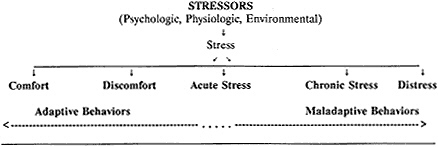
Figure 1-1 Model of distress not induced by pain. Stressors, leading to stress, can initiate various states in an animal from comfort to distress. Adaptive stress will not interfere with an animal's state of comfort or well-being. When an animal is experiencing distress, maladaptive behaviors result, varying in range and severity with increasing distress.
DISTRESS INDUCED BY PAIN
More is known about the role of pain as a stressor than about the roles of other stressors. A model of distress induced by pain is shown in Figure 1-2. The figure shows how pain initiates stress, which leads either to adaptation and comfort or to maladaptive behaviors and distress. It depicts the sensory and affective components of pain and suggests a dominant role of affect in leading to distress.
The distress models described here provide a framework for discussing the sources of stress and distress and the patterns of adaptive and maladaptive behaviors that can result (Chapter 3). An understanding of those patterns will be important for the prevention of pain and distress, for the recognition and assessment of pain and distress (Chapter 4), and for the control of pain (Chapters 5) and the control of distress (Chapter 6) in experimentation, testing, and educational projects involving animals. Chapter 7 reviews specific euthanasia techniques to be used at the termination of an experiment or when animals are in distress that cannot be alleviated; it also reviews the psychologic effects on personnel who carry out euthanasia and presents some recommendations to minimize the emotional impact on personnel involved.
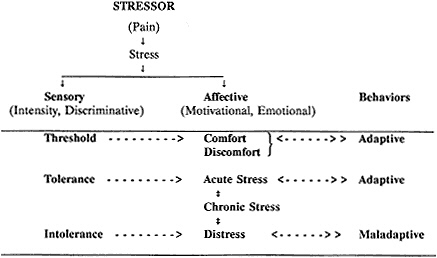
Figure 1-2 Model of distress induced by pain. Note relationship between sensory discriminative component and affective emotional component. Sensory component of pain ranges from threshold to tolerance and then intolerance. In affective components, intensity of pain can proceed from a state of comfort to distress. Arrow paths indicate flow from sensation to affect to behaviors. This is the normal case, but under some conditions, behaviors can influence affect and thus modify the sensation. Double arrows emphasize that behavior is primarily influenced by affect. (Direction of flow indicates schematized concept only, not neural pathways.)


