
6
Milk Composition
In examining the evidence concerning the influence of maternal nutrition on human milk composition, the subcommittee considered the broad spectrum of constituents of milk, the normal variation in their concentrations, and factors in addition to maternal nutrition that influence those variations. This discussion of the subcommittee's findings is not meant to be exhaustive. Rather, this chapter provides a framework for understanding how maternal nutrition can have an impact on the composition of human milk, as well as when and in what context nutritional factors are likely to be operational. Furthermore, it provides the information needed to estimate maternal nutrient requirements—the subject of Chapter 9—and provides a basis for considering some of the effects of maternal nutrition on the nursing infant's health (Chapter 7) and the effects of lactation on the mother's longer-term health and nutrient stores (Chapters 8 and 9).
CHARACTERISTICS OF HUMAN MILK
Human milk is a complex fluid that contains more than 200 recognized constituents (see Blanc, 1981). The number of recognized constituents has increased as analytic techniques have been improved. Milk consists of several compartments, including true solutions, colloids (casein micelles), membranes, membrane-bound globules, and live cells (Ruegg and Blanc, 1982). Its constituents can be broadly divided into categories; for example, aqueous and lipid fractions (see box) or nutritive and nonnutritive constituents. Many milk constituents serve dual roles (see later section ''Constituents of Human Milk with Other Biologic Functions"). Detailed discussions of human milk constituents
|
Classes of Constituents in Human Milk |
|
|
Protein and Nonprotein Nitrogen Compounds |
Carbohydrates |
|
Proteins |
Lactose |
|
Caseins |
Oligosaccharides |
|
α-Lactalbumin |
Bifidus factors |
|
Lactoferrin |
Glycopeptides |
|
Secretory IgA and other immunoglobulins |
Lipids |
|
β-Lactoglobulin |
Triglycerides |
|
Lysozyme |
Fatty acids |
|
Enzymes |
Phospholipids |
|
Hormones |
Sterols and hydrocarbons |
|
Growth factors |
Fat-soluble vitamins |
|
Nonprotein Nitrogen Compounds |
A and carotene |
|
Urea |
D |
|
Creatine |
E |
|
Creatinine |
K |
|
Uric acid |
Minerals |
|
Glucosamine |
Macronutrient Elements |
|
α-Amino nitrogen |
Calcium |
|
Nucleic acids |
Phosphorus |
|
Nucleotides |
Magnesium |
|
Polyamines |
Potassium |
|
Water-Soluble Vitamins |
Sodium |
|
Thiamin |
Chlorine |
|
Riboflavin |
Sulfur |
|
Niacin |
Trace Elements |
|
Pantothenic acid |
Iodine |
|
Biotin |
Iron |
|
Folate |
Copper |
|
Vitamin B6 |
Zinc |
|
Vitamin B12 |
Manganese |
|
Vitamin C |
Selenium |
|
Inositol |
Chromium |
|
Choline |
Cobalt |
|
Cells |
|
|
Leukocytes |
|
|
Epithelial cells |
|
and properties can be found in several recent review articles and books (e.g., Blanc, 1981; Carlson, 1985; Gaull et al., 1982; Goldman et al., 1987; Goldman and Goldblum, 1990; Hamosh and Goldman, 1986; Jensen, 1989; Jensen and Neville, 1985; Koldovskỳ, 1989; Lönnerdal, 1985a, 1986a; Picciano, 1984a, 1985; Ruegg and Blanc, 1982).
METHODOLOGIC ISSUES
Types of Variation
The concentration of the individual constituents of mature human milk have been shown to vary considerably (see Table 6-1), even when they are collected and analyzed under controlled, defined conditions. The greatest variations have been observed from woman to woman, although variations are also found in different samples obtained from the same woman (Picciano, 1984b). Milk composition changes from the beginning of a feeding to the end, diurnally, from day to day, and with the onset and progression of lactation. Examples are given later in this section.
Early investigators recognized the importance of sampling techniques in obtaining valid data on the composition of human milk and recommended collection of a total 24-hour specimen at different stages of lactation (Hytten, 1954a; Macy et al., 1945). Although such a recommendation represents the ideal approach, it is seldom feasible without interfering with the normal lactation process.
No one sampling scheme can be endorsed universally for all milk constituents. Each scheme must be designed to accommodate the variation pattern of the constituents to be measured. Failure to do this will often result in an under- or overestimation of daily secretion rates, masking possible influences of maternal nutrition.
Variation in the First Weeks Post Partum
Changes in milk composition over the course of lactation are most marked during the first weeks of lactation (see examples in Figure 6-1). Colostrum is the fluid secreted by the mammary gland immediately following parturition. It differs from mature human milk in physical characteristics and composition. The intense yellow color of colostrum is indicative of the high concentration of carotenoids, including α-arotene, β-carotene, β-crytoxanthin, lutein, and xeaxanthin. The carotene content of colostrum is about 10-fold higher than that of mature milk (0.34 to 7.57 mg/liter compared with 0.1 to 0.3 mg/liter, respectively [Patton et al., 1990]). During the colostral period, which lasts 4 to 7 days, rapid changes occur in milk composition: concentrations of fat and lactose increase while those of protein and minerals decrease.
The term transitional milk is sometimes used to describe the postcolostral period (7 to 21 days post partum), when changes in milk composition occur less rapidly than in the first few days following parturition. Mature human milk (ò21 days post partum) also exhibits variability, but to a much smaller extent than in early lactation. Data for selected nutrients (Appendix C) illustrate this point and indicate variations among studies arising from differences in analytic techniques and other experimental circumstances.
TABLE 6-1 Estimates of the Concentrations of Nutrients in Mature Human Milk
|
Nutrient |
Amount in Human Milka |
Nutrient |
Amount in Human Milka |
|
|
g/liter ± SDbb |
|
µg/liter ± SD |
|
Lactose |
72.0 ± 2.5 |
Vitamin A, REd |
670 ± 200 |
|
Protein |
10.5 ± 2.0 |
|
(2,230 IUe) |
|
Fat |
39.0 ± 4.0 |
Vitamin D |
0.55 ± 0.10 |
|
|
mg/liter ± SD |
Vitamin K |
2.1 ± 0.1 |
|
Calcium |
280 ± 26 |
Folate |
85 ± 37f |
|
Phosphorus |
140 ± 22 |
Vitamin B12 |
|
|
Magnesium |
35 ± 2 |
Biotin |
4 ± 1 |
|
Sodium |
180 ± 40 |
Iodine |
110 ± 40 |
|
Potassium |
525 ± 35 |
Selenium |
20 ± 5 |
|
Chloride |
420 ± 60 |
Manganese |
6 ± 2 |
|
Iron |
0.3 ± 0.1 |
Fluoride |
16 ± 5 |
|
Zinc |
1.2 ± 0.2 |
Chromium |
50 ± 5 |
|
Copper |
0.25 ± 0.03 |
Molybdenum |
NRi |
|
Vitamin E |
2.3 ± 1.0 |
|
|
|
Vitamin C |
40 ± 10 |
|
|
|
Thiamin |
0.210 ± 0.035 |
|
|
|
Riboflavin |
0.350 ± 0.025 |
|
|
|
Niacin |
1.500 ± 0.200 |
|
|
|
Vitamin B6 |
93 ± 8c |
|
|
|
Pantothenic acid |
1.800 ± 0.200 |
|
|
|
a Data taken from the Committee on Nutrition (1985), unless otherwise indicated. The values are representative of amounts of nutrients present in human milk; some of them may differ slightly from those reported by investigators cited in the text. b SD = Standard deviation. c From Styslinger and Kirksey (1985), a study of unsupplemented women. d RE = Retinol equivalents. e IU = International units. f From Brown et al. (1986a). g From Sandberg et al. (1981). h Standard deviation not reported; range 0.33 to 3.20. i NR = Not reported. |
|||
Variation with Length of Gestation
There are substantial differences between the milk of mothers who deliver preterm and those who deliver at full term. The subcommittee has focused on lactating mothers of full-term infants; therefore, these differences are only briefly summarized here. During the first 3 to 4 days of lactation, preterm milk (the milk secreted by mothers who delivered prematurely) has higher protein, sodium, and chloride concentrations and lower lactose concentrations than milk secreted by mothers of full-term infants. While some investigators report higher fat concentrations in preterm milk (Anderson et al., 1981; Guerrini et al., 1981),
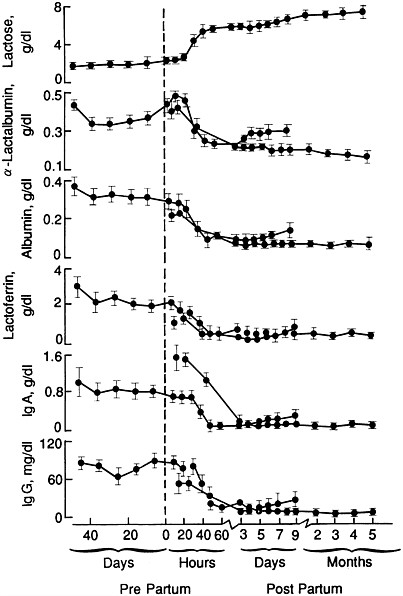
FIGURE 6-1 Changes in the concentrations of lactose and whey proteins in human milk during the progression of lactation in four women during late pregnancy and the first 5 months of lactation. Values obtained for the right and left breast of each woman were averaged and used to calculate the mean plus or minus the standard error of the mean at each period. The zero on the horizontal axis indicated the time of delivery. From Kulski and Hartmann (1981) with permission.
others do not (Bitman et al., 1983; Sann, 1981). Calcium, magnesium, and phosphorus concentrations are similar in preterm and full-term milk, as are concentrations of copper, iron, and zinc (Hamosh and Hamosh, 1987). During early lactation the milk produced by women who deliver prematurely undergoes the same changes in composition that occur after full-term pregnancies. The change occurs, however, over a longer period in mothers who deliver prematurely than in mothers of full-term infants (that is, 3 to 5 weeks compared with 3 to 5 days, respectively). The bioactive and immunologic properties of human milk also differ between preterm and full-term milk; this is discussed in detail elsewhere (Goldman, 1989b).
Variation in Content of Macronutrients (Fat, Carbohydrate, and Protein)
Lipids are among the most variable and difficult nutrients to measure accurately in human milk: among women, the total fat content of 24-hour milk samples may vary from less than 20 g/liter to more than 50 g/liter. However, Hytten (1954b) reports that the average fat content of milk secreted on the seventh day of lactation by any one woman was predictive of the average concentration in later lactation. Within one woman, the fat content of milk increases from the beginning to the end of a single nursing; it differs by as much as 20 g/liter in 24-hour collections on subsequent days, it differs from lactation to lactation in a nonconsistent manner, and it is influenced by the length of time between sample collection (the longest interval yielding the lowest fat values). These large variations complicate the measurement of total fat secreted by lactating women and, in turn, affect calculations of the energy value of milk, which are determined mainly by milk fat content.
Among the macronutrients in human milk, lactose appears to be the least variable and thus the least influenced by improper sampling. The coefficient of variation (standard deviation divided by the mean) for human milk lactose content is 7.2% compared with 13% for the total nitrogen content (which is indicative of protein content) and 25% for the fat content in total 24-hour samples (Hytten, 1954c).
Precision and Validity of Methods
There are adequate methods for quantifying many human milk constituents. Unfortunately, methods designed to study bovine milk or other biologic fluids have been inappropriately applied in the analysis of human milk, thereby providing inaccurate and unreliable information, even in some recent studies. To obtain accurate results, one must apply proper sampling, extraction, handling, and storage procedures as well as a sensitive and selective detection system. A few examples of the many problems that must be addressed are presented below:
-
Bioactive constituents. Enzymes and other bioactive constituents of human milk may alter the composition of expressed milk (Greenberg and Graves (1984), even at temperatures well below 0° C. (Berkow et al., 1984; Bitman et al., 1983).
-
Bound forms. Several of the vitamins (such as vitamin D, folate, and pantothenic acid) are secreted bound to other compounds, and they must be released before they can be completely extracted or detected. For example, accurate measurement of the total content of pantothenic acid in human milk requires double enzyme hydrolysis (Song et al., 1984).
-
Distribution in aqueous and lipid fractions. Vitamin D and its metabolites are secreted in the aqueous fraction of human milk and are attached to binding proteins (Hollis et al., 1982), but on standing they diffuse to the lipid fraction of milk. Thus, whether aqueous or lipid solvents are used should be determined by the handling procedure.
-
Other sources of measurement errors. Commercial sources of reagents such as enzymes may be contaminated with vitamins and be responsible for falsely elevated levels in milk (Song et al., 1984). Many of the water-soluble vitamins are measured by microbiological assays. Care must be taken to ensure that the vitamin to be measured is stable under the extraction method employed and that the vitamin is converted to a form that can be utilized by the test organism. For example, the folate content of human milk is likely to be underestimated unless an antioxidant is used to prevent it from being oxidized, conjugase pretreatment is performed to cleave the long-chain forms of the vitamin, heat treatment is applied to release the folate from its binding proteins before microbiological analysis, and test organisms are selected that are able to use all the forms of folate in the samples (O'Connor et al., 1990a).
The reproducibility and validity of techniques used in different studies could not always be ascertained by the subcommittee. Thus, the data on the nutrient content of human milk must be interpreted with caution. Large variations reported for many milk constituents may reflect improper sampling or analytic inaccuracies or both rather than true biologic variance.
In addition to the methodologic concerns just described, there are problems of measurement and detection specific to nonnutrient constituents, as follows:
-
The leukocytes in human milk are difficult to identify because their morphology is altered by the presence of many intracytoplasmic lipid bodies.
-
Certain constituents, such as secretory immunoglobulin A (IgA), exist in a different physical form than they do in other tissues, such as blood, and therefore require discrete detection procedures.
-
The titer of specific antibodies in human milk depends on whether the woman has recently been exposed to the relevant immunogen via the intestinal or respiratory tract.
TABLE 6-2 Origins of Nutrients in Human Milka
-
Nonspecific blocking factors in human milk may interfere with the detection of certain components by solid-phase immunoassays.
Clearly, considerable effort is required to reliably detect and quantify many of the constituents in human milk and, therefore, to determine whether changes in maternal nutrition influence the content of such constituents in milk.
There are other methodologic issues that are likely to hamper investigations of the influence of maternal nutrition on milk composition. Most recently, nutrient-nutrient interrelations have emerged as possible confounding variables. For example, a study of preterm infants indicates that zinc undernutrition could be responsible for low vitamin A levels in serum (Hustead et al., 1988). If this is also true for lactating women, supplemental vitamin A would have no effect on the vitamin A level in milk. Similarly, maternal iron deficiency in rats can cause an impairment of milk folic acid secretion that is not corrected with supplemental folic acid (O'Connor et al., 1990a).
ORIGIN OF MILK CONSTITUENTS
There are three sources of the milk constituents: some are synthesized in the mammary secretory cell from precursors in the plasma, some are produced by other cells in the mammary gland, and others are transferred directly from plasma to milk (see Table 6-2). All physiologic and biochemical phenomena that influence the composition of plasma may also affect the composition of milk. Milk composition can be modified further by hormones or other bioactive factors that are capable of influencing biosynthetic processes in the mammary gland. Metabolic changes and their relationships with milk production and composition have been well documented in studies in animals, especially cows, goats, and rats.
The mixed origin of milk constituents is well illustrated by considering the lipid components of milk. Milk triglycerides (which account for 98% of the total lipid content) are synthesized in the mammary alveolar cell. Fatty acids may be derived from the plasma (transported there from either the intestine or fat deposits), or they may be synthesized from glucose within the mammary gland. The origins of the fatty acids can be distinguished: fatty acids synthesized within the mammary gland have chain lengths of 16 carbons or less; those derived
from dietary sources (other than dairy products) and from adipose tissue tend to have longer carbon chains. The increase in prolactin level preceding and during lactation (Zinder et al., 1974) has two important effects on lipids. (1) Lipoprotein lipase activity in the mammary gland increases sharply (Hamosh et al., 1970). This enzyme hydrolyzes triglycerides and thus frees their fatty acids for transport into the cell, where they are reesterified. (2) Lipoprotein lipase activity in adipose tissue decreases (Hamosh et al., 1970). Both of these channel fat to the lactating mammary gland, where it is incorporated in the milk.
MATERNAL NUTRITION AND THE COMPOSITION OF HUMAN MILK
Three aspects of maternal nutrition could have an impact on human milk composition: current dietary intake, nutrient stores, and alterations in nutrient utilization as influenced by the hormonal milieu characteristic of lactation. Alterations in maternal nutrition that change the composition of human milk may have positive, neutral, or negative consequences to the nursing infant (see Chapter 7). When maternal nutrition is continuously compromised but the concentrations of nutrients in milk and the milk volume remain unchanged, the nutrients for milk synthesis are being furnished by maternal stores or body tissues. It has not been determined when this situation has a negative impact on the mother. Chapter 9 considers this in more detail.
As explained in the preceding section, investigators must carefully control for stage of lactation in studies to determine the effects of maternal nutrition on milk composition. Other factors that must be considered in such studies include frequency of nursing, environmental conditions (e.g., the specificity of secreted antibodies in human milk after exposure to infectious agents), and length of gestation.
Macronutrients: Protein, Fat, and Carbohydrate
Protein
Milk proteins are broadly classified as caseins and whey proteins. Caseins are phosphoproteins that occur only in milk. Molecules of casein associate in combination with calcium, phosphate, and magnesium ions in structures known as micelles. These micelles enable milk to carry a much larger quantity of calcium, phosphate, and magnesium than could be carried in a simple aqueous solution. The whey proteins, such as α-lactalbumin and lactoferrin, are synthesized in the mammary gland; other proteins (including serum albumin and several bioactive enzymes and protein hormones) are transported to the milk from plasma. In addition, dimeric IgA is produced by plasma cells in the mammary gland and is transported into the milk by specific receptors. Human
milk also contains a variety of nonprotein nitrogen-containing compounds, including amino acids, peptides, N-acetyl sugars, urea, and nucleotides.
Commonly used methods for measuring the protein content of human milk are nonspecific but often produce approximately the same results (Lönnerdal, 1985b). However, if the protein content of human milk is measured colorimetrically, an overestimation of approximately 25 to 40% is possible (Lönnerdal et al., 1987).
Using amino acid analysis, Lönnerdal and coworkers (1976c) found that the protein content of mature human milk was approximately 8 to 9 g/liter. Similar values were found using nitrogen analysis of precipitated proteins, among diverse populations, i.e., disadvantaged Ethiopian women and privileged Swedish women (Lönnerdal et al., 1976a,b) and privileged U.S. women (Butte, 1984b). The nitrogen analysis method was used in a World Health Organization collaborative study, in which mature milk was found to contain 8.8, 8.3, 8.3, 7.6, and 12 g/liter in Hungary, Sweden, Guatemala, the Philippines, and Zaire, respectively (WHO, 1985). The reasons for the much higher results from Zaire are not clear.
Methods based on amino acid analysis should yield results that reflect the sum of free and protein-bound amino acids. Nitrogen analyses of precipitated proteins exclude free amino acids and small peptides which may account for approximately 7 to 10% of the total amino acids found in human milk (Svanberg et al., 1977).
There is no convincing evidence that diet or body composition influence the total concentration of milk protein, even in communities of undernourished women (Lönnerdal, 1986b); however, the interpretation of some studies is hampered by the use of total nitrogen as a proxy measure for the total amino acid content of milk (Deb and Cama, 1962) or by the short diet periods used in metabolic studies (Forsum and Lönnerdal, 1980).
In a study of three well-nourished Swedish women, Forsum and Lönnerdal (1980) demonstrated that an increased maternal intake of protein (20% compared with 8% of energy from protein) increased total nitrogen, protein, and nonprotein nitrogen contents of mature human milk and 24-hour milk protein output. There have been reports of low concentrations of protein and altered free and total amino acid nitrogen profiles in milk of women from countries with limited food supplies: India (Deb and Cama, 1962), Pakistan (Lindblad and Rahimtoola, 1974), and Guatemala (Wurtman and Fernstrom, 1979).
The nonprotein nitrogen content of human milk is higher than that in milk of other species; the importance of this to infant nutrition and health is unknown (Carlson, 1985). Taurine, an amino acid found only in animal products, is the second most abundant free amino acid in human milk (Rassin et al., 1978). Even the milk secreted by women who ingest no animal foods contains taurine concentrations of approximately 35 mg/dl—lower than concentrations in milk secreted by omnivores (54 mg/dl) but 30 times greater than levels in bovine
milk (Rana and Sanders, 1986). Taurine functions in bile acid conjugation and may also function as an inhibitory neurotransmitter and as a membrane stabilizer.
A broad spectrum of nucleotides occurs in human milk (Janas and Picciano, 1982), but the effects of maternal nutrition on the concentrations of these nucleotides have not yet been reported.
Lipids
The lipids in milk are contained within membrane-enclosed milk fat globules, the core of which consists of triglycerides—the major energy source in milk. The globule membrane is composed mainly of phospholipids, cholesterol, and proteins.
Although there is no compelling evidence that changes in maternal fat intake influence the total quantity of milk fat, it has been shown repeatedly that the nature of the fat consumed by the mother will influence the fatty acid composition of milk (Jensen, 1989). For example, milk from four complete vegetarian women in Great Britain was found to contain five times as much C18:2 fatty acids as milk from four nonvegetarian women (31.9 and 6.9%, respectively) (Sanders et al., 1978). Finley et al. (1985) noted that, as lactation progressed, milk from both vegetarian and nonvegetarian women contained more fatty acids principally synthesized in the mammary gland (C8:0, C10:0, C12:0, C14:0) and less from the diet and adipose tissue. Chappell et al. (1985a) reported that the trans fatty acid content of human milk was directly related to maternal intake of partially hydrogenated fats and oils; in women experiencing postpartum weight loss, fat mobilized from adipose tissue also contributed trans fatty acids to human milk fat independently of current dietary intake.
In the classic study of a single subject by Insull and colleagues (1959), both the total energy and fat contents of the diet were altered. Their results demonstrated that mammary lipid synthesis was influenced by energy balance as well as by the type and amount of fat in the diet. When the subject was fed excess energy as a low-fat, high-carbohydrate diet, the investigators found that 40 to 60% of the fatty acids in milk fat had carbon chain lengths of less than 16. On a very high fat diet (70% of kilocalories as corn oil) that was adequate in energy, the combined linoleic and linolenic acid content of the milk fatty acids increased from approximately 2 to 45%, and there was a corresponding drop in the content of shorter-chain saturated fatty acids. When a low-fat, calorie-restricted diet was fed, C16 or longer-chain saturated fatty acids predominated in the milk, indicating that stored body fat was utilized for milk fat synthesis. Effects of such changes on infant health have not been studied.
Using stable isotope methodology, Hachey and colleagues (1987, 1989) confirmed the results of the study of Insull et al. (1959) showing that diet composition affects milk fat synthesis. Hachey et al. estimate that when the
mother is in energy balance, fatty acids derived directly from the diet account for approximately 30% of the fatty acids found in the milk.
There is no evidence that the concentrations of cholesterol and phospholipid in human milk can be altered by changes in the maternal diet. Indeed, milk cholesterol remains at 100 to 150 mg/liter even in hypercholesterolemic women and increases only in severe cases of pathologic hypercholesterolemia (Jensen, 1989). Since both cholesterol and phospholipids are integral components of the milk fat globule membrane, their secretion rates relate to the total quantity of fat secreted in milk, which is apparently not influenced by diet.
Studies conducted in communities where maternal undernutrition is prevalent have furnished evidence indicating that the percentage of maternal body fat may influence the concentration of fat in milk. Milk fat concentrations in The Gambia (Prentice et al., 1981) and Bangladesh (Brown et al., 1986b) were positively correlated with maternal skinfold thickness and decreased over the course of lactation. This positive relationship (R = .46) between milk fat concentration and body fat (as a percentage of ideal body weight) was likewise noted in U.S. women in late (6 to 12 months) lactation but not in early lactation (Nommsen et al., in press). Prentice and associates (1989) report that high- (>10) parity Gambian women had a decreased capacity for total milk fat synthesis and, thus, lower milk fat concentrations.
Carbohydrates
The principal carbohydrate in human milk is lactose, a disaccharide that consists of galactose joined by a β linkage to glucose. In human milk, lactose is present in an average concentration of 70 g/liter and is second only to water as a major constituent. In all species of mammals studied, milk is isotonic with plasma, which helps keep the energy cost of milk secretion low. Lactose exerts 60 to 70% of the total osmotic pressure of milk. Compared with glucose, lactose provides nearly twice the energy value per molecule (per unit of osmotic pressure). The concentrations of lactose in human milk are remarkably similar among women, and there is no convincing evidence that they can be influenced by maternal dietary factors. However, Hartmann and Prosser (1982) noted that lactose concentration in human milk decreased from 78 to 60 g/liter both 5 to 6 days before and 6 to 7 days after ovulation. Other carbohydrates and their complexes are discussed below in the section ''Nonlactose Carbohydrates in Human Milk".
Vitamins
A major factor influencing the vitamin content of human milk is the mother's vitamin status. In general, when maternal intakes of a vitamin are chronically low, the levels of that vitamin in human milk are also low. As maternal intakes of the vitamin increase, levels in milk also increase, but for
many vitamins they plateau and do not respond further to supplementation through diet or pharmaceutical preparations. Although the milk concentrations of water-soluble vitamins are generally more responsive to maternal dietary intake than are concentrations of fat-soluble vitamins, there are important exceptions. These are discussed below for specific vitamins.
Fat-Soluble Vitamins
Vitamin A. The vitamin A content of human milk comprises principally retinyl esters (96%). The concentration of this vitamin in human milk decreases over the course of lactation from approximately 2,000 to 600 µg/liter (Chappell et al., 1986; Cumming and Briggs, 1983). Concentrations of carotene, a precursor of vitamin A, are reported to differ from 0 to 320 µg/liter (Butte and Calloway, 1981; Chappell et al., 1986; Department of Health and Social Security, 1977). This wide range may reflect mainly analytic difficulties and sampling errors (Jensen, 1989). β-Carotene is stored in the mammary gland during pregnancy and is rapidly secreted into milk during the first few days of lactation (Patton et al., 1990). Several reports indicate that the amount of vitamin A in human milk decreases with maternal deficiency of the vitamin and increases with excessive intake (Ajans et al., 1965; Butte and Calloway, 1981; Hrubetz et al., 1945).
Results of supplementation trials are equivocal. In vitamin A-depleted mothers, supplementation was found to increase the concentration of vitamin A in milk in some studies (e.g., Venkatachalam et al., 1962) but to have no effect in others (Belavady and Gopalan, 1960; Villard and Bates, 1987). Chappell et al. (1985b) noted no association between reported maternal intake of vitamin A and carotene with corresponding values in the milk of well-nourished Canadian women. In contrast, Gebre-Mehdin and coworkers (1976) reported that the concentration of retinyl esters was low in milk from disadvantaged Ethiopian women compared with that in milk from Ethiopian women of higher socioeconomic status and from Swedish women.
Vitamin D. Human milk normally contains 0.5 to 1.5 µg (20 to 60 IU) of vitamin D per liter (Greer et al., 1984a). Several studies indicate that the vitamin D activity of human milk is directly related to maternal vitamin D status. Hollis et al. (1983) reported that the vitamin D concentrations in human milk drop to undetectable levels during maternal deficiency and increase following supplementation and exposure to ultraviolet light. Potentially toxic amounts (175 µg, or >7,000 IU, per liter) of vitamin D could occur in human milk following daily administration of pharmacologic doses (2,500 µg, or 100,000 IU) of vitamin D2 (ergocalciferol) to the mother (Greer et al., 1984b). The vitamin D activity of human milk is accounted for principally by vitamin D metabolites but also by vitamin D2 and vitamin D3 (cholecalciferol).
Vitamin K. The vitamin K content of mature human milk is typically 2 µg/liter (Haroon et al., 1982), and that of colostrum is approximately twice as high (von Kries et al., 1987, 1988). When mothers with low vitamin K intakes are given 20-mg supplements of vitamin K in the form of phylloquinone, milk levels of the vitamin are increased by twofold for at least 48 hours (Haroon et al., 1982; von Kries et al., 1987). However, even when the mother's vitamin K intake from food has been high or she has routinely taken supplements containing vitamin K, the amount of this vitamin obtained by the breastfed neonate in the first few days after birth may be insufficient to meet the infant's needs (see Chapter 7).
Vitamin E. Approximately 83% of the total vitamin E content of human milk is α-tocopherol. Small quantities of β-, γ, and δ-tocopherols are present as well (Kobayashi et al., 1975). Concentrations of tocopherols are high in colostrum (8 mg/liter) and decline and stabilize to 2 to 3 mg/liter in mature human milk. A single case report indicates that high maternal intakes (approximately 27 mg of vitamin E per day) resulted in an elevated plasma concentration of α-tocopherol equivalents (3.8 mg/dl compared with a normal concentration of 0.5 to 2.0 mg/dl) and a high milk content of 11 mg/liter on day 38 of lactation (Anderson and Pittard, 1985).
Water-Soluble Vitamins
Vitamin C. Bates and colleagues (1983) report that the vitamin C content of mature human milk levels off at 50 to 60 mg/liter if daily maternal intakes are equal to or exceed 100 mg (approximately the mother's Recommended Dietary Allowance [RDA] for this vitamin). When maternal vitamin C intake is relatively low, increases in intake are associated with an increased human milk content of this vitamin. These investigators also reported that the level of vitamin C in milk is 8 to 10 times that in maternal plasma.
Thiamin. There are large variations in the thiamin content of human milk between individuals and over the course of lactation. Thiamin concentrations are low in colostrum (10 µg/liter) and increase 7-to 10-fold in mature milk. Milk from mothers with beriberi contains less thiamin that that of healthy women in the same country. Infants nursed by mothers with beriberi develop the disease by 3 or 4 weeks of age (Hytten and Thomson, 1961). Pratt et al. (1951) have shown that the thiamin content of human milk can be sharply increased up to a certain limit, estimated to be 200 µg/liter.
Riboflavin and Niacin. Riboflavin content is high early in lactation and declines thereafter. The milk of well-nourished women contains riboflavin concentrations of approximately 350 µg/liter (Committee on Nutrition, 1985;
NRC, 1989). Lower concentrations found in riboflavin-deficient populations can be increased by supplementation (Bates et al., 1981). The average niacin concentration in human milk increases from 0.75 mg/liter in colostrum to approximately 1 mg/liter in mature human milk. Actual niacin levels are largely dependent on maternal intake; an observational study reported levels as high as 6 mg/liter among women who were successfully lactating (Pratt et al., 1951).
Vitamin B6. The vitamin B6 content is low in colostrum and varies between 50 and 250 µg/liter in mature milk. In the United States, levels in mature milk have been reported to be approximately 93 ± 8 (standard deviation [SD]) µg/liter, a value 10 times higher than levels in maternal serum. The vitamin B6 content of milk is directly related (R = .8) to maternal intake (Styslinger and Kirksey, 1985). Roepke and Kirksey (1979) reported drastically reduced vitamin B6 levels in milk from mothers with a long history (4 to 12 years) of oral contraceptive use before conception. Supplements of 20 mg/day were required to increase milk concentrations in those mothers and to reverse neurologic symptoms of deficiency in their infants (Kirksey and Roepke, 1981). However, the contraceptives taken by these women contained higher levels of estrogen than those that are now used in contraceptive formulations; current interrelationships among contraceptive use, vitamin B6 intake, and vitamin B6 concentrations in human milk are unknown. Further discussion of vitamin B6 in human milk is included in Chapter 9.
Folate and Vitamin B12. Folate and vitamin B12 in human milk are bound to whey proteins; therefore, maternal factors regulating protein secretion are more likely to affect milk levels of these vitamins over the short term than are fluctuations in maternal vitamin intake.
Improved methods of analysis have permitted detection of much higher folate levels in human milk than previously reported. Milk folate is quantitatively bound to folate-binding protein; folylpolyglutamates account for a considerable portion of total folate. In the United States, folate concentrations in human milk average 85 ± 37 (SD) µg/liter during the first 3 months of lactation (Brown et al., 1986a); in Japan, they average 141 ± 43 (SD) µg/liter during the first 6 months of lactation (Tamura, 1980). In apparently well-nourished women in industrialized countries, no correlation was found between maternal serum and milk folate levels (before or after maternal supplementation) (Salmenperä et al., 1986b; Smith et al., 1983; Tamura et al., 1980). However, milk folate levels were found to increase from 5 to 60 µg/liter after 4 days of oral folate supplementation of two lactating women with megaloblastic anemia resulting from dietary folate insufficiency (Metz et al., 1968). Folate levels in human milk typically increase with the progression of lactation, even as levels in maternal serum and red blood cells decrease (Smith et al., 1983). There is evidence
that folate is preferentially partitioned to mammary tissue and secreted in milk during maternal deficiency (Metz et al., 1968). As a result, the folate content of milk is maintained at the expense of the mother's folate status.
The reported vitamin B12 concentration of mature human milk from U.S. women ranges from 0.3 to 3.2 µg/liter (average, 0.97 µg/liter) (Sandberg et al., 1981). These investigators reported that the vitamin B12 concentrations were not related to maternal dietary intake and did not respond to supplementation. However, the vitamin B12 content of milk produced by complete vegetarians, generally malnourished women, or mothers who have latent pernicious anemia secondary to hypothyroidism is very low—between 0.05 and 0.075 µg/liter (Johnson and Roloff, 1982).
Biotin. The biotin content in human milk is exceedingly variable: values were reported to range from 0 to 27 µg/liter when maternal plasma concentrations varied from 142 to 1,090 ng/liter (Salmenperä et al., 1985). The biotin content of human milk increases with the progression of lactation, is directly related to maternal plasma biotin concentration (R = .21 to .44 from 2 to 6 months of lactation), and markedly increases from approximately 13 to 485 µg/liter when a daily dose of 3 mg of biotin is added to the diet (Hood and Johnson, 1980). The biotin content of human milk is hundreds of times greater than the content in maternal plasma, suggesting that biotin is actively transported from the plasma through the alveolar cell into the milk.
Pantothenic Acid. The pantothenic acid content of human milk averages about 2.6 µg/liter and is significantly correlated (R = .51) with maternal dietary intake (Song et al., 1984). These investigators found that four women receiving pantothenic acid in supplements (>1.0 mg/day) had significantly higher milk pantothenic acid values (4.8 µg/liter) than those of nonsupplemented women (2.6 µg/liter).
Major Minerals
The concentrations of calcium, phosphorus, and magnesium in maternal serum are tightly regulated. Thus, there is little reason to expect that maternal intake of these nutrients will strongly influence their levels in human milk. Two-thirds of the calcium is bound to casein; the rest forms a soluble citrate complex. Phosphorus and magnesium are also largely bound to casein. Mean concentrations of calcium, phosphorus, and magnesium in mature human milk are approximately 280, 140, and 35 mg/liter, respectively (see Table 6-1).
Electrolytes
The concentrations of electrolytes (sodium, potassium, and chloride) in milk are determined by an electrical potential gradient in the secretory cell rather than by maternal nutritional status. The average concentrations of sodium, potassium, and chloride in mature human milk (7, 15, and 12 mEq/liter, respectively) account for approximately 2, 3 and 4% of total osmoles, respectively, and are lower than their respective levels in colostrum by approximately 66, 31, and 36%, respectively (Macy, 1949). Similar values were found in more recent investigations (Picciano et al., 1981).
Although some investigators have reported that 5- to 40-fold increases in sodium and occasionally chloride levels in human milk are associated with emotional stress, mastitis, and diminished milk production in the mother (Anand et al., 1980; Arboit and Gildengers, 1980; Seale et al., 1982; Whitelaw and Butterfield, 1977), a common cause of high electrolyte levels of the milk and associated dehydration and malnutrition of infants appears to be lack of suckling or inadequate suckling (Naylor, 1981). Inadequate stimulation from suckling leads to involution of the mammary glands, which is characterized by reduction in lactose synthesis and elevated electrolyte concentrations in milk (Hartmann and Kulski, 1978). In the early stages, reinitiation of adequate suckling can reverse this process (Alpert and Cormier, 1983).
Trace Minerals
The concentrations of various trace elements in human milk may be influenced to widely varying degree by maternal nutrition.
Iron, Copper, and Zinc
The concentrations of iron, copper, and zinc in human milk are highest immediately following parturition (Cavell and Widdowson, 1964). Reported mean values for the concentration of iron in mature human milk range from 0.2 to 0.9 mg/liter (Picciano and Guthrie, 1976; Siimes et al., 1979, respectively). Siimes and colleagues (1979) pointed out that some women have very high concentrations; therefore, the median of 0.3 mg/liter is lower than the mean. The iron concentration in milk is not influenced by the mother's iron status (Dallman, 1986; Murray et al., 1978; Siimes et al., 1984).
Over the first 4 months of lactation, the concentration of copper in human milk gradually declines and then remains stable up to month 12 (Casey et al., 1989; Salmenperä et al., 1986a; Vuori, 1979). In mature milk, copper concentrations range from 0.1 to 0.6 mg/liter, but most are at the lower end of the range (Dewey et al., 1984; Picciano and Guthrie, 1976; Salmenperä et al., 1986a). There is no relationship between maternal copper status and concentrations in human milk (Lönnerdal et al., 1981). Copper secretion into
milk apparently is controlled, since milk copper concentrations are three to four times lower than serum concentrations (Lönnerdal et al., 1981).
Zinc concentrations in human milk decrease over the course of lactation. In colostrum, the zinc content is quite high (>10 mg/liter) (Casey et al., 1986). The concentration declines steeply during the first month and then declines gradually (Casey et al., 1989). Reported concentration ranges for months 1, 3, and 12 of lactation are 3 to 4, 1 to 1.5, and 0.5 mg/liter, respectively (Casey et al., 1989; Picciano and Guthrie, 1976; Vuori, 1979). Most of the evidence indicates that maternal dietary zinc intake does not influence concentrations in milk (Feeley et al., 1983; Kirksey et al., 1979; Moser and Reynolds, 1983; Vaughan et al., 1979; Vuori et al., 1980). Two reports suggest that zinc supplementation has a slight influence on milk zinc concentration in late lactation: after 6 months of supplementation with 13 mg of zinc per day (Krebs et al., 1985) and after 34 days of supplementation with 50 mg/day (Karra et al., 1989). However, the number of women in the comparison groups decreased markedly during the course of this intervention trial, making cross-sectional comparison somewhat questionable.
In summary, milk concentrations of iron, copper, or zinc appear to be maintained over different levels of maternal intake (Lönnerdal, 1986a). However, since the adequacy of maternal intake of these micronutrients has been questioned (see Chapter 4), this may place the mother at risk.
Manganese
The concentration of manganese in mature milk from women in industrialized nations declines from approximately 6 µg/liter during the first month of lactation to 3 µg/liter by the third month (Stastny et al., 1984; Vuori et al., 1980). Vuori and colleagues (1980) reported that the manganese concentration in milk may be influenced by maternal diet.
Selenium
Selenium concentrations in milk are high at the initiation of lactation (41 µg/liter) and decrease as lactation progresses (Smith et al., 1982). Mean values in mature milk (10 to 30 µg/liter) differ geographically both within countries and internationally (Kumpulainen, 1989). Mannan and Picciano (1987) report that the concentration of selenium in mature human milk is seven times higher than that in maternal plasma. These investigators also noted that the selenium concentration in human milk is directly related to maternal plasma concentration when plasma concentrations are less than 100 µg/liter. Worldwide, there are major differences in the selenium content of the soil and therefore in the local food supply. A study of rural African women living in an area where the selenium content of the diet varies with food availability indicates that milk selenium concentrations are low when maternal intake is low and also decrease
with increasing parity (Funk et al., 1990). Debski et al. (1989) reported that the milk of vegetarians in California contained high concentrations of this trace element.
The enzyme glutathione peroxidase contains selenium. Its activity in milk correlates positively with the activity of this enzyme in maternal plasma and with both the linoleic acid and selenium contents of the milk. The enzyme's presence in milk may protect milk lipids from oxidative damage (Ellis et al., 1990). This suggests that the types of fatty acids consumed by the mother and the adequacy of her energy intake may influence the form and quantity of selenium secreted.
Fluoride
Several investigators have reported mean fluoride levels of 7 to 11 µg/liter in human milk (Ekstrand et al., 1984a; Esala et al., 1982; Spak et al., 1983); the American Academy of Pediatrics (Committee on Nutrition, 1985) suggests that 16 µg/liter be used as a normative value. Reports indicate that there is relatively little effect of maternal fluoride intake on the fluoride concentration of milk. Ekstrand and coworkers (1984b) observed that when a large fluoride dose (11.25 mg) was administered to a mother, only 0.2% of the dose was transferred through her milk to the infant. Spak et al. (1983) reported no significant difference in fluoride concentration of human milk when the fluoride content of the mother's drinking water was increased fivefold (from 0.2 ppm to 1.0 ppm). Although Esala et al. (1982) reported 50% higher levels in the milk of mothers whose drinking water contained 1.7 ppm of fluoride compared with mothers in areas with drinking water containing 0.2 ppm fluoride, the total amount of fluoride delivered through the milk of mothers in both groups was small. Singer and Armstrong (1960) suggested that plasma fluoride concentrations (and thus milk fluoride concentrations) do not increase unless water fluoride content exceeds 1.4 ppm.
Iodine
Iodine is unique among the trace elements because the mammary gland avidly accumulates it. Its level in human milk correlates directly with maternal intake; major sources of iodine in the United States are bread, dairy products, iodized salt, and seafood (NRC, 1989). The mean iodine value for the milk of U.S. women in the 1980s was 178 µg/liter. In one study, iodine values in human milk were reported to be as high as 731 µg/liter (Gushurst et al., 1984). Such milk would provide more than 500 µg of iodine to the nursing infant per day. This level of intake is approximately 10 times greater than the RDA for infants (NRC, 1989). In contrast, the concentration of iodine in human milk is 20 µg/liter in northwestern Zaire, where the iodine supply to the lactating
woman is low and iodine deficiency is evident in approximately 75% of the population (Delange, 1985).
CONSTITUENTS OF HUMAN MILK WITH OTHER BIOLOGIC FUNCTIONS
Very few studies have been conducted to investigate the effects of maternal nutrition on the composition of nonnutritive substances in human milk. Research in this area is warranted, however, because of the important biologic functions of many of these substances. Briefly, these constituents have the following functions.
-
nutrient synthesis, assembly, and utilization;
-
direct protection against microbial pathogens;
-
modulation of inflammatory processes;
-
promotion of growth and maturation of selected systems by supplying inducers, such as growth factors and hormones;
-
enhancement of neural transmission;
-
catalysis (increasing the rate) of some metabolic reactions (Hamosh and Hamosh, 1988; Koldovský, 1989).
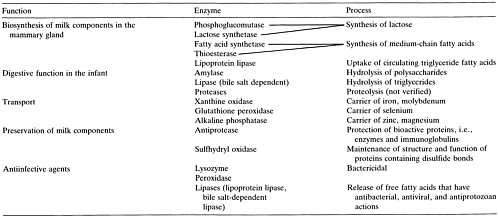
The many complex functions of milk constituents can be illustrated by describing the role of the milk protein α-lactalbumin, which constitutes approximately 25 to 30% of the total protein in human milk and thus is a major supplier of amino acids to the developing infant. It also is one of the two protein components of the system that synthesizes lactose within the mammary gland. In addition, α-lactalbumin is a metalloenzyme with calcium- and zinc-binding sites and is structurally similar to lysozyme (an antibacterial enzyme discussed below) (Hall and Campbell, 1986). Other examples of nonnutritive functions of milk proteins are given below and in Table 6-3.
TABLE 6-3 Examples of the Multiple Functions of Proteins in Human Milka
TABLE 6-4 Spectra of Antimicrobial Effects of Five Major Types of Soluble Defense Factors in Human Milka
|
|
Antimicrobial Effects of Defense Factors |
||||
|
Types of Pathogenic Microorganisms |
Lipids |
Oligosaccharides and Glycoconjugates |
Lysozyme |
Lactoferrin |
Secretory IgAb |
|
Enveloped viruses |
x |
o |
o |
o |
x |
|
Rotaviruses |
o |
o |
o |
o |
x |
|
Polioviruses |
o |
o |
o |
o |
x |
|
Respiratory syncytial virus |
o |
o |
o |
o |
x |
|
Enteric bacteria |
o |
x |
x |
x |
x |
|
Respiratory bacteria |
o |
x |
x |
x |
x |
|
Intestinal parasites |
x |
o |
o |
o |
x |
|
a From Goldman and Goldblum (1989b) with permission. x indicates a positive effect; o indicates no known effect. b IgA = Immunoglobulin A. |
|||||
Antiinfectious Agents
In human milk, there is a complex system of antimicrobial factors (Goldman and Goldblum, 1989b, 1990) (Table 6-4) with the following main characteristics:
-
The factors are biochemically heterogeneous.
-
Most of the factors are produced throughout lactation.
-
The factors are relatively resistant to the digestive processes of the infant's gastrointestinal tract.
-
Many of the factors interact in inhibiting or killing microbial pathogens.
-
The immunologic factors protect by noninflammatory mechanisms.
-
The factors of the system are common to mucosal sites and appear to protect principally the digestive tract and the respiratory system of the infant.
Nonlactose Carbohydrates in Human Milk
There is an array of moderate-chain-length carbohydrates (oligosaccharides and glucoconjugates) in human milk (Cleary et al., 1983; György et al., 1974; Holmgren et al., 1981; Kobata, 1972; Otnæss and Svennerholm, 1982; Otnæss et al., 1983; Svanborg-Edén et al., 1983). Some of these appear to be protective even though they are present in low concentrations. Nitrogen-containing sugars promote the growth of lactobacilli (György et al., 1974), the dominant bacteria in the lower intestinal tract of breastfed infants (Gyllenberg and Roine, 1957; Smith and Crabb, 1961). These lactobacilli appear to protect against the colonization of bacterial pathogens by secreting inhibitory organic compounds such as acetic acid. Specialized oligosaccharides, including monosialogangliosides and glucoconjugates, inhibit the binding of selected bacterial pathogens or their
toxins to epithelial cells by acting as receptor analogs (Holmgren et al., 1981; Otnæss and Svennerholm, 1982; Otnæss et al., 1983).
Lipids
The hydrolysis of fats in human milk appears to generate fatty acids and monoglycerides with antiviral properties (Isaacs et al., 1986; Welsh and May, 1979; Welsh et al., 1979). This process may be catalyzed by the infant's own lipases as well as by the action of bile salt-stimulated lipase from human milk in the digestive tract of the recipient infant. The action of the antiviral lipids may be limited to a few enteric pathogens such as Giardia lamblia (Gillin et al., 1983, 1985) or encapsulated coronaviruses (Resta et al., 1985).
Proteins
Many of the whey proteins in human milk have direct protective effects against infection. Lactoferrin, one of the dominant whey proteins in human milk throughout lactation (Table 6-5) (Butte et al., 1984a; Goldman et al., 1982, 1983a,b), inhibits the multiplication of siderophilic (iron-absorbing) bacteria by competing with these microorganisims for ferric iron (Bullen et al., 1978; Stephens et al., 1980). The features of lactoferrin in human milk that are responsible for its antimicrobial effect are as follows:
-
Approximately 80% is in the apo- (unconjugated) form (Fransson and Lönnerdal, 1980).
-
The protein is relatively resistant to proteolysis (Brines and Brock, 1983; Samson et al., 1980).
-
Lactoferrin appears to interact with several other host resistance factors in the inhibition or killing of bacterial pathogens.
-
Certain forms of lactoferrin that do not bind to iron may inhibit the replication of some viruses (Furmanski et al., 1989).
Antibodies are abundant in human milk throughout lactation; they are
TABLE 6-5 Concentrations of Immunologic Factors in Human Milk During Several Phases of Lactationa
|
|
Mean Concentration, mg/ml ± SD,b by Stage of Lactation |
||||
|
Factors |
2–3 days |
1 month |
6 months |
1 year |
2 years |
|
Lactoferrin |
5.3 ± 12.9 |
1.9 ± 0.3 |
1.4 ± 0.4 |
1.0 ± 0.2 |
1.2 ± 0.1 |
|
Secretory IgAc |
2 ± 2.5 |
1 ± 0.3 |
0.5 ± 0.1 |
1 ± 0.3 |
1.1 ± 0.2 |
|
Lysozyme |
0.09 ± 0.03 |
0.02 ± 0.03 |
0.25 ± 0.12 |
0.2 ± 0.1 |
0.19 ± 0.03 |
|
a From Goldman and Goldblum (1989b) with permission. b SD = Standard deviation. c IgA = Immunoglobulin A. |
|||||
|
Secretory IgA Antibodies Commonly Found in Human Milk |
|
|
Enteric Pathogens |
Respiratory Pathogens |
|
Bacteria, Toxins, Virulence Factors |
Bacteria |
|
Clostridium difficile |
Haemophilus influenzae |
|
Escherichia coli |
Streptococcus pneumoniae |
|
Klebsiella pneumoniae |
Viruses |
|
Salmonella spp. |
Influenza viruses |
|
Shigella spp. |
Respiratory syncytial virus |
|
Vibrio cholerae |
Fungi |
|
Parasites |
Candida albicans |
|
Giardia lamblia |
Food proteins |
|
Viruses |
Cow's milk |
|
Polioviruses |
Soy |
|
Rotaviruses |
|
|
From Goldman and Goldblum (1989b) with permission. |
|
directed against pathogens encountered in the environment that are common to both the mother and infant (see box above) (Goldman and Goldblum, 1989b). These maternal antibodies are of particular importance because the secretory immune system of the infant does not mature for several months after birth (Burgio et al., 1980; Hanson et al., 1983).
The main antibody in human milk is secretory IgA (dimeric IgA coupled to secretory component) Butte et al., 1984a; Goldman and Goldblum, 1989b; Goldman et al., 1982, 1983a,b). IgM and IgG are also found in human milk but in much lower concentrations (Goldman and Goldblum, 1989a). The IgA-producing cells in the mammary gland tissues originate from B cells from either the small intestine or the respiratory tract and enter the systemic circulation. Then, lactogenic hormones stimulate the B cells to travel to the mammary gland (Weisz-Carrington et al., 1978), where they are transformed to plasma cells that produce dimeric IgA. Because these B cells originate at maternal sites where exposure to environmental pathogens is high, the IgA is protective against pathogens to which the infant might be exposed.
Secretory IgA has at least three other important features: it is particularly suited to act at mucosal surfaces, since it is relatively resistant to proteolysis (Lindh, 1975); it protects by noninflammatory mechanisms (Goldman et al., 1986, 1990); and it acts in synergy with several other host resistance agents in human milk to achieve antimicrobial effects.
Lysozyme is a protein in human milk that affords protection in two different ways: it breaks down susceptible bacteria by cleaving peptidoglycans from their cell walls (Chipman and Sharon, 1969), and it acts in concert with other
components in human milk to kill microbial pathogens. High concentrations of this protein are found in human milk throughout lactation (Butte et al., 1984b; Goldman et al., 1982, 1983a,b), whereas concentrations in cow's milk are very much lower. Like many other host resistance factors in human milk, lysozyme is relatively resistant to proteolysis and to denaturation resulting from the high acidity within the stomach.
Fibronectin, a protein that enhances phagocytosis, has recently been found in human milk (Friss et al., 1988). Serum levels of this protein are higher in breastfed than in nonbreastfed infants, but that finding cannot be explained solely by the amount of fibronectin in human milk.
Very low levels of the components of the classical and alternative pathways of the complement system have been found in human milk (Ballow et al., 1974; Nakajima et al., 1977). With the exception of the third component of complement (C3), these levels are unlikely to generate inflammation.
Few studies have addressed whether the nutritional status of women affects the immunologic composition of their milk. In a study of the milk from economically privileged and underprivileged women from Guatemala (N = 86) and Ethiopia (N = 12) and privileged women from Sweden (N = 64), Cruz and associates (1982) compared the concentrations and daily output of secretory IgA and secretory IgA antibodies to somatic antigens to serotypes of E. coli. Although it was implied that the underprivileged women were more poorly nourished, indices of nutritional status were not reported. Somewhat similar studies were conducted in India by Reddy et al. (1977) and Reddy and Srikantia (1978). They found no differences in the levels of IgA, IgM, IgG, lactoferrin, or lysozyme in the colostrum from well nourished and poorly nourished women. In that study, poor nutritional status was defined by low body weight and by low weight-to-height ratios. In a study conducted in India, Narula and colleagues (1982) found lower levels of IgG but similar levels of IgA in colostrum from well nourished and poorly nourished women.
A study that more completely defined maternal nutritional status was conducted with 23 Columbian women during the first 2 months of lactation (Miranda et al., 1983). Malnutrition was characterized by lower weight-to-height ratios and by lower creatinine-height indices and serum concentrations of total proteins, albumin, IgG, and IgA. The levels of albumin and IgG in the milk were much lower in malnourished women than in well nourished women. There were also significant but less striking decreases in IgA and C4 levels in milk from malnourished women, whereas no differences were found in C3 and lysozyme levels or in specific antibodies to respiratory syncytial virus.
More recently, Robertson and coworkers (1988) investigated the effects of maternal nutrition upon the avidity of secretory IgA antibodies to E. coli polysaccharides and diphtheria toxin in human milk. Decreased avidity was found in antibodies from the malnourished group.
In summary, the effects of maternal nutritional status upon the immunologic
system in human milk remain controversial. Although some studies suggest that malnutrition may decrease the production or secretion of some of the components of the immunologic system in human milk, further investigations are needed to characterize more precisely the nutritional status of the mothers and the daily secretion of the immunologic factors.
Leukocytes
In addition to the soluble immunologic agents mentioned above, human milk contains living white blood cells (leukocytes) (Crago et al., 1979; Smith and Goldman, 1968). Neutrophils and macrophages account for approximately 90% of the white blood cells in human milk; the remaining white blood cells are lymphocytes. The neutrophils have phagocytic activity and intracellular killing power similar to those of neutrophils in human blood (Ho and Lawton, 1978; Robinson et al., 1978; Smith and Goldman, 1968; Tsuda et al., 1984) and the bactericidal power of these cells appears to be spared in malnourished women (Bhaskaram and Reddy, 1981). However, the neutrophils in milk are less motile than their counterparts in blood. Moreover, unlike blood neutrophils, they do not appear to increase many of their functions in response to bacteria or serum-derived chemotactic agents (Thorpe et al., 1986).
The morphology of human milk macrophages suggests that they are activated; indeed, that is born out by the fact that they are more motile than their precursors in blood are (Özkaragöz et al., 1988). The macrophages in human milk are involved in antigen processing and presentation to T lymphocytes and thus may serve in the recognition of foreign materials. Furthermore, these macrophages display class II major histocompatibility antigens (Leyva-Cobián and Clemente, 1984), which suggests that they may participate in the process of immunogenesis in the infant.
Thymic-dependent lymphocytes (T cells) account for the majority of lymphocytes in milk; the relative proportions of the major subpopulations of these cells may be similar to those in blood (Keller et al., 1986). Although their cytotoxic capacities are poor, they can generate certain lymphokines when stimulated in vitro (Keller et al., 1981; Kohl et al., 1980; Lawton et al., 1979). The fate of these cells in the body is not known.
In the study of Narula et al. (1982) in poorly nourished Indian women whose malnutrition was defined by a body weight/height index, the total cell counts in milk collected on the second day of lactation were significantly lower than those found in well nourished Indian women. Cell counts obtained thereafter for as long as 180 days of lactation were similar in the well nourished and poorly nourished populations. Since appropriate cytochemical studies were not performed, it was difficult to determine whether any major alterations in cell populations in milk occurred as a result of changes in maternal nutritional status. More precise studies will be required to examine this question.
Anti-inflammatory Agents
Human milk lacks inflammatory mediators or their initiating systems (Goldman et al., 1986), but it contains a host of anti-inflammatory agents including agents that double as direct protective agents, antioxidants, enzymes that degrade inflammatory mediators, antienzymes, cytoprotective agents, and modulators of leukocyte activation (Goldman et al., 1986, 1990). Some of these agents are also components of the antimicrobial system in human milk, whereas others that have antioxidant activity, such as α-tocopherol and β-carotene, are also nutrients.
Enzymes
Human milk contains numerous proteins with enzyme activity (Hamosh, 1989; Hamosh et al., 1985a; Jenness, 1979; Shahani et al., 1980) (see Table 6-6 for examples of enzymes and enzyme functions). Little is known about the effects of maternal nutritional status on the amounts or activity levels of enzymes in milk. However, it is known that the regulation of enzyme activity in the lactating mammary gland differs from that of identical enzymes in other organs. Thus, in the lactating mammary gland the activity of lipoprotein lipase, which is markedly reduced in adipose tissue by fasting, is unaffected by fasting (Hamosh and Hamosh, 1983). The major fat-digesting enzyme in human milk (bile salt-stimulated lipase) is not affected by feeding pattern or diurnal variation (Hamosh et al., 1985b) or by nutritional status of the mother (Hernell et al., 1977).
Hormones, Growth Factors, and Inducers
Human milk contains many hormones, growth factors, and inducers of certain biologic processes (see reviews by Koldovskỳ [1989] and Koldovskỳ et al. [1987]). The hormones include cortisol (Koldovskỳ [1989]), somatostatin (Werner et al., 1985), insulin (Cevreska et al., 1975), thyroid hormones, and the lactogenic hormones oxytocin (Leake et al., 1981) and prolactin (Healy et al., 1980). There is agreement among investigators concerning the measurement of most of these agents, but there is considerable disagreement regarding measurement of thyroid hormones and some others (see review by Koldovskỳ et al. [1987]). The growth factors include epidermal growth factor (Carpenter, 1980), insulin (Cevreska et al., 1975), lactoferrin (Nichols et al., 1987), and factors that are specifically derived from the mammary gland epithelium (Kidwell et al., 1987). There is laboratory evidence for the presence of activators of monocytes such as tumor necrosis factor-β (Mushtaha et al., 1989a,b). Bendich and coworkers (1984) and Tengerdy et al. (1981) presented evidence that the vitamin α-tocopherol in human milk may stimulate the immune system in the
infant. Zimecki and coworkers (1987) reported that certain protein fractions in human milk may aid in generating helper cell responses and in performing other immunoregulatory functions. Finally, the presence of anti-idiotypic antibodies in milk may act as immunizing agents; these antibodies mimic other antibodies in the infant that in turn are directed against the original stimulating microbial antigens in the mother; thus, they may be natural, safe immunizing agents (Okamoto and Ogra, 1989).
SUMMARY
A wealth of evidence indicates that human milk possesses many unique characteristics related to its content of nutrients, protective substances, and other components. Some evidence suggests that maternal and environmental influences are stronger than previously recognized and appreciated. If maternal intake of one or more nutrients is chronically low, certain nutrients and nonnutrient constituents of milk may decrease, with the potential for a negative impact on the nursing infant. There is mounting evidence that the concentrations of some constituents are preserved in milk at the expense of maternal reserves.
CONCLUSIONS
-
There is abundant evidence that women are able to produce milk with adequate content of protein, fat, carbohydrate, and most minerals even when their supply of nutrients is limited. The nutrients in human milk most likely to be present in lower than normal concentrations in response to chronically low maternal intakes are the vitamins, especially vitamins B6, B12, A, and D. Those maintained at the expense of maternal stores or tissues include the macronutrients, most minerals, and folate.
-
The kinds of fatty acids present in human milk are strongly influenced by maternal diet: the type and amount of fat in the diet and the adequacy of energy intake. However, maternal total fat and cholesterol intake have no apparent influence on the total fat and cholesterol contents of human milk.
RECOMMENDATIONS FOR CLINICAL PRACTICE
-
Encourage breastfeeding mothers to consume good sources of all essential nutrients for their own health as well as to maintain adequate concentrations of nutrients in milk. Nutrients of special concern from the standpoint of milk composition are vitamin B6 and, for complete vegetarians, vitamins B12 and D.
-
Since many nutrients are secreted in human milk at the expense of maternal reserves, give breastfeeding women dietary guidance to maintain their own health as well as that of their infants (see Chapter 9).
-
Advise lactating women to avoid excessive intake of vitamin D or iodine from pharmaceutical preparations because potentially toxic amounts of these nutrients can be secreted into human milk. There is no advantage to taking these nutrients in amounts exceeding the RDAs.
-
Reassure lactating women that occasional days with low nutrient intake by the mother are unlikely to harm the baby. The nutrient content of milk decreases relatively slowly, or not at all, with short-term decreases in dietary intake.
REFERENCES
Ajans, Z.A., A. Sarrif, and M. Husbands. 1965. Influence of vitamin A on human colostrum and early milk. Am. J. Clin. Nutr. 17:139-142.
Alpert, S.E., and A.D. Cormier. 1983. Normal electrolyte and protein content in milk from mothers with cystic fibrosis: an explanation for the initial report of elevated milk sodium concentration. J. Pediatr 102:77-80.
Anand, S.K., C. Sandborg, R.G. Robinson, and E. Liberman. 1980. Neonatal hypernatremia associated with elevated sodium concentration of breast milk. J. Pediatr. 96:66-68.
Anderson, D.M., and W.B. Pittard III. 1985. Vitamin E and C concentrations in human milk with maternal megadosing: a case report. J. Am. Diet. Assoc. 85:715-717.
Anderson, G.H., S.A. Atkinson, and M.H. Bryan. 1981. Energy and macronutrient content of human milk during early lactation from mothers giving birth prematurely and at term. Am. J. Clin. Nutr. 34:258-265.
Arboit, J.M., and E. Gildengers (letter). 1980. Breastfeeding and hypernatremia. J. Pediatr. 97:335-336.
Ballow, M., F. Fang, R.A. Good, N.K. Day. 1974. Developmental aspects of complement components in the newborn. The presence of complement components and C3 proactivator (properdin factor B) in human colostrum. Clin. Exp. Immunol. 18:257-266.
Bates, C.J., A.M. Prentice, A.A. Paul, B.A. Sutcliffe, M. Watkinson, and R.G. Whitehead. 1981. Riboflavin status in Gambian pregnant and lactating women and its implications for Recommended Dietary Allowances . Am. J. Clin. Nutr. 34:928-935.
Bates, C.J., A.M. Prentice, A. Prentice, W.H. Lamb, and R.G. Whitehead. 1983. The effect of vitamin C supplementation on lactating women in Keneba, a West African rural community. Int. J. Vitam. Nutr. Res. 53:68-76.
Belavady, B., and C. Gopalan. 1960. Effect of dietary supplementation on the composition of breast milk. Indian J. Med. Res. 48:518-523.
Bendich, A., P. D'Apolito, E. Gabriel, and L.J. Machlin. 1984. Interaction of dietary vitamin C and vitamin E on guinea pig immune responses to mitogens. J. Nutr. 114:1588-1593.
Berkow, S.W., L.M. Freed, M. Hamosh, J. Bitman, D.L. Wood, B. Happ, and P. Hamosh. 1984. Lipases and lipids in human milk: effect of freeze-thawing and storage. Pediatr. Res. 18:1257-1262.
Bhaskaram, P., and V. Reddy. 1981. Bacterial activity of human milk leukocytes. Acta Paediatr. Scand. 70:87-90.
Bitman, J., D.L. Wood, N.R. Mehta, P. Hamosh, and M. Hamosh. 1983. Lipolysis of triglycerides in human milk at low temperatures: a note of caution. J. Pediatr. Gastroenterol. Nutr. 2:521-524.
Blanc, B. 1981. Biochemical aspects of human milk—comparison with bovine milk. World Rev. Nutr. Diet. 36:1-89.
Brines, R.D., and J.H. Brock. 1983. The effect of trypsin and chymotrypsin on the in vitro antimicrobial and iron-binding properties of lactoferrin in human milk and bovine colostrum. Biochim. Biophys. Acta 759:229-235.
Brown, C.M., A.M. Smith, and M.F. Picciano. 1986a. Forms of human milk folacin and variation patterns. J. Pediatr. Gastroenterol. Nutr. 5:278-282.
Brown, K.H., N.A. Akhtar, A.D. Robertson, and M.G. Ahmed. 1986b. Lactational capacity of marginally nourished mothers: relationships between maternal nutritional status and quantity and proximate composition of milk. Pediatrics 78:909-919.
Bullen, J.J., H.J. Rogers, and E. Griffiths. 1978. Role of iron in bacterial infection. Curr. Top. Microbiol. Immunol. 80:1-35.
Burgio, G.R., A. Lanzavecchia, A. Plebani, S. Jayakar, and A.G. Ugazio. 1980. Ontogeny of secretory immunity: levels of secretory IgA and natural antibodies in saliva. Pediatr. Res. 14:1111-1114.
Butte, N.F., and D.H. Calloway. 1981. Evaluation of lactational performance of Navajo women. Am. J. Clin. Nutr. 34:2210-2215.
Butte, N.F., R.M. Goldblum, L.M. Fehl, K. Loftin, E.O. Smith, C. Garza, and A.S. Goldman. 1984a. Daily ingestion of immunologic components in human milk during the first four months of life. Acta Paediatr. Scand. 73:296-301.
Butte, N.F., C. Garza, J.E. Stuff, E.O. Smith, and B.L. Nichols. 1984b. Effect of maternal diet and body composition on lactational performance. Am. J. Clin. Nutr. 39:296-306.
Carlson, S.E. 1985. Human milk nonprotein nitrogen: occurrence and possible functions . Adv. Pediatr. 32:43-70.
Carpenter, G. 1980. Epidermal growth factor is a major growth-promoting agent in human milk. Science 210:198-199.
Casey, C.E., M.R. Neifert, J.M. Seacat, and M.C. Neville. 1986. Nutrient intake by breastfed infants during the first five days after birth. Am. J. Dis. Child. 140:933-936.
Casey, C.E., M.C. Neville, and K.M. Hambidge. 1989. Studies in human lactation: secretion of zinc, copper, and manganese in human milk. Am. J. Clin. Nutr. 49:773-785.
Cavell, P.A., and E.M. Widdowson. 1964. Intakes and excretions of iron, copper, and zinc in the neonatal period. Arch. Dis. Child. 39:496-501.
Cevreska, S., V.P. Kovacev, M. Stankovski, and E. Kamamaras. 1975. The presence of immunologically reactive insulin in milk of women during the first week of lactation and its relation to changes in plasma insulin concentrations. God. Zb. Med. Fak. Skopje. 21:35-41.
Chappell, J.E., M.T. Clandinin, and C. Kearney-Volpe. 1985a. Trans fatty acids in human milk lipids: influence of maternal diet and weight loss . Am. J. Clin. Nutr. 42:49-56.
Chappell, J.E., T. Francis, and M.T. Clandinin. 1985b. Vitamin A and E content of human milk at early stages of lactation. Early Hum. Dev. 11:157-167.
Chappell, J.E., T. Francis, and M.T. Clandinin. 1986. Simultaneous high performance chromatography analysis of retinol esters and tocopherol isomers in human milk. Nutr. Res. 6:849-852.
Chipman, D.M., and N. Sharon. 1969. Mechanism of lysozyme action. Science 165:454-465.
Cleary, T.G., J.P. Chambers, and L.K. Pickering. 1983. Protection of suckling mice from the heat-stable enterotoxin of Escherichia coli by human milk. J. Infect. Dis. 148:1114-1119.
Committee on Nutrition. 1985. Composition of human milk: normative data. Pp. 363-368 in Pediatric Nutrition Handbook, 2nd ed. American Academy of Pediatrics, Elk Grove Village, Ill.
Crago, S.S., S.J. Prince, T.G. Pretlow, J.R. McGhee, and J. Mestecky. 1979. Human colostral cells. I. Separation and characterization. Clin. Exp. Immunol. 38:585-597.
Cruz, J.R., B. Carlsson, and B. García. 1982. Studies in human milk. III. Secretory IgA quantity and antibody levels against Escherichiae coli in colostrum and milk from underprivileged and privileged mothers. Pediatr. Res. 16:272-276.
Cumming, F.J., and M.H. Briggs. 1983. Changes in plasma vitamin A in lactating and nonlactating oral contraceptive users. Br. J. Obstet. Gynaecol. 90:73-77.
Dallman, P.R. 1986. Iron deficiency in the weanling: a nutritional problem on the way to resolution. Acta Paediatr. Scand. Suppl. 323:59-67.
Deb, A.K., and H.R. Cama. 1962. Studies on human lactation. Dietary nitrogen utilization during lactation, and distribution of nitrogen in mother's milk. Br. J. Nutr. 16:65-73.
Debski, B., D.A. Finley, M.F. Picciano, B. Lönnerdal, and J.A. Milner. 1989. Selenium content and glutathione peroxidase activity of milk from vegetarian and nonvegetarian women. J. Nutr. 119:215-220.
Delange, F. 1985. Physiopathology of iodine nutrition. Pp. 291-299 in R.K. Chandra, ed. Trace Elements in Nutrition of Children. Nestle Nutrition Workshop Series, Vol. 8. Raven Press, New York.
Department of Health and Social Security. 1977. Composition of Mature Human Milk. Report on Health and Social Security. 12. Her Majesty's Stationery Office, London.
Dewey, K.G., D.A. Finley, and B. Lönnerdal. 1984. Breast milk volume and composition during late lactation (7-20 months). J. Pediatr. Gastroenterol. Nutr. 3:713-720.
Ekstrand, J., C.J. Spak, J. Falch, J. Afseth, and H. Ulvestad. 1984a. Distribution of fluoride to human breast milk: following intake of high doses of fluoride. Caries Res. 18:93-95.
Ekstrand, J., L.I. Hardell, and C.J. Spak. 1984b. Fluoride balance studies on infants in a 1-ppm-water-fluoride area. Caries Res. 18:87-92.
Ellis, L., M.F. Picciano, A.M. Smith, M. Hamosh, and N.R. Mehta. 1990. The impact of gestational length on human milk selenium concentration and glutathione peroxidase activity. Pediatr. Res. 27:32-50.
Esala, S., E. Vuori, and A. Helle. 1982. Effect of maternal fluorine intake on breast milk fluorine content. Br. J. Nutr. 48:201-204.
Feeley, R.M., R.R. Eitenmiller, J.B. Jones, Jr., and H. Barnhart. 1983. Copper, iron, and zinc contents of human milk at early stages of lactation. Am. J. Clin. Nutr. 37:443-448.
Finley, D.A., B. Lönnerdal, K.G. Dewey, and L.E. Grivetti. 1985. Breast milk composition: fat content and fatty acid composition in vegetarians and nonvegetarians. Am. J. Clin. Nutr. 41:787-800.
Forsum, E., and B. Lönnerdal. 1980. Effect of protein intake on protein and nitrogen composition of breast milk. Am. J. Clin. Nutr. 33:1809-1813.
Fransson, G.B., and B. Lönnerdal. 1980. Iron in human milk. J. Pediatr. 96:380-384.
Friss, H.E., L.G. Rubin, S. Carsons, J. Baranowski, and P.J. Lipsitz. 1988. Plasma fibronectin concentrations in breastfed and formula fed neonates. Arch. Dis. Child. 63:528-532.
Funk, M.A., L. Hamlin, M.F. Picciano, A. Prentice, and J.A. Milner. 1990. Milk selenium of rural African women: influence of maternal nutrition, parity, and length of lactation. Am. J. Clin. Nutr. 51:220-224.
Furmanski, P., L. Zhen-Pu, M.B. Fortuna, C.V.B. Swamy, and M. Ramachandra Das. 1989. Multiple molecular forms of human lactoferrin: identification of a class of lactoferrins that possess ribonuclease activity and lack iron-binding capacity. J. Exp. Med. 170:415-429.
Gaull, G.E., R.G. Jensen, D.K. Rassin, and M.H. Malloy. 1982. Human milk as food. Adv. Perinat. Med. 2:47-120.
Gebre-Medhin, M., A. Vahlquist, Y. Hofvander, L. Uppsäll, and B. Vahlquist. 1976. Breast milk composition in Ethiopian and Swedish mothers. I. Vitamin A and β-carotene
. Am. J. Clin. Nutr. 29:441-451.Gillin, F.D., D.S. Reiner, and C.S. Wang. 1983. Human milk kills parasitic intestinal protozoa. Science 221:1290-1292.
Gillin, F.D., D.S. Reiner, and M.J. Gault. 1985. Cholate-dependent killing of Giardia lamblia by human milk. Infect. Immun. 47:619-622.
Goldman, A.S., and R.M. Goldblum. 1989a. Immunoglobulins in human milk. Pp. 43-51 in S.A. Atkinson and B. Lönnerdal, eds. Protein and Non-Protein Nitrogen in Human Milk. CRC Press, Boca Raton, Fla.
Goldman, A.S., and R.M. Goldblum. 1989b. Immunologic system in human milk: characteristics and effects. Pp. 135-142 in E. Lebenthal, ed. Textbook of Gastroenterology and Nutrition in Early Infancy, 2nd ed. Raven Press, New York.
Goldman, A.S., and R.M. Goldblum. 1990. Human milk: immunologic-nutritional relationships. Ann. N.Y. Acad. Sci. 587:236-245.
Goldman, A.S., C. Garza, B.L. Nichols, and R.M. Goldblum. 1982. Immunologic factors in human milk during the first year of lactation. J. Pediatr. 100:563-567.
Goldman, A.S., R.M. Goldblum, and C. Garza. 1983a. Immunologic components in human milk during the second year of lactation. Acta Paediatr. Scand. 72:461-462.
Goldman, A.S., R.M. Goldblum, C. Garza, B.L. Nichols, and E.O. Smith. 1983b. Immunologic components in human milk during weaning. Acta Paediatr. Scand. 72:133-134.
Goldman, A.S., L.W. Thorpe, R.M. Goldblum, and L.A. Hanson. 1986. Anti-inflammatory properties of human milk. Acta Paediatr. Scand. 75:689-695.
Goldman, A.S., S.A. Atkinson, and L.A. Hanson. 1987. Human Lactation 3: The Effects of Human Milk on the Recipient Infant. Plenum Press, New York. 400 pp.
Goldman, A.S., R.M. Goldblum, and L.A. Hanson. 1990. Anti-inflammatory systems in human milk. Adv. Exp. Med. Biol. 262:69-76.
Greenberg, R., and M.L. Graves. 1984. Plasmin cleaves human beta-casein. Biochem. Biophys. Res. Commun. 125:463-468.
Greer, F.R., B.W. Hollis, D.J. Cripps, and R.C. Tsang. 1984a. Effects of maternal ultraviolet B irradiation on vitamin D content of human milk. J. Pediatr. 105:431-433.
Greer, F.R., B.W. Hollis, and J.L. Napoli. 1984b. High concentrations of vitamin D2 in human milk associated with pharmacologic doses of vitamin D2. J. Pediatr. 105:61-64.
Guerrini, P., G. Bosi, R. Chierici, and A. Fabbri. 1981. Human milk: relationship of fat content with gestational age. Early Hum. Dev. 5:187-194.
Gushurst, C.A., J.A. Mueller, J.A. Green, and F. Sedor. 1984. Breast milk iodide: reassessment in the 1980s. Pediatrics 73:354-357.
Gyllenberg, H., and P. Roine. 1957. The value of colony counts in evaluating the abundance of ''Lactobacillus" bifidus in infant faeces. Acta Pathol. Microbiol. Scand. 41:144.
György, P., R.W. Jeanloz, H. von Nicolai, and F. Zilliken. 1974. Undialyzable growth factors for Lactobacillus bifidus var. Pennsylvanicus: protective effect of sialic acid bound to glycoproteins and oligosaccharides against bacterial degradation. Eur. J. Biochem. 43:29-33.
Hachey, D.L., M.R. Thomas, E.A. Emken, C. Garza, L. Brown-Booth, R.O. Adlof, and P.D. Klein. 1987. Human lactation: maternal transfer of dietary triglycerides labeled with stable isotopes. J. Lipid Res. 28:1185-1192.
Hachey, D.L., G.H. Silber, W.W. Wong, and C. Garza. 1989. Human lactation II: endogenous fatty acid synthesis by the mammary gland. Pediatr. Res. 25:63-68.
Hall, L., and P.N. Campbell. 1986. α-Lactalbumin and related proteins: a versatile gene family with an interesting parentage. Essays Biochem. 22:1-26.
Hamosh, M. 1989. Enzymes in human milk: their role in nutrient digestion, gastrointestinal function, and nutrient delivery to the newborn infant. Pp. 121-134 in E. Lebenthal, ed. Textbook of Gastroenterology and Nutrition in Infancy, 2nd ed. Raven Press, New York.
Hamosh, M., and A.S. Goldman, eds. 1986. Human Lactation 2: Maternal and Environmental Factors. Plenum Press, New York. 657 pp.
Hamosh, M., and P. Hamosh. 1983. Lipoprotein lipase: its physiological and clinical significance. Mol. Aspects Med. 6:199-289.
Hamosh, P., and M. Hamosh. 1987. Differences in composition of preterm, term and weaning milk. Pp. 129-141 in Xanthou, M., ed. New Aspects of Nutrition in Pregnancy, Infancy and Prematurity. Elsevier Science Publishers. B.V. (Biomedical Division).
Hamosh, M., and P. Hamosh. 1988. Mother to infant biochemical and immunological transfer through breast milk. Pp. 155-160 in G.H. Wiknjosastro, W.H. Prakoso, and K. Maeda, eds. Perinatology. Excerpta Medica, Amsterdam.
Hamosh, M., T.R. Clary, S.S. Chernick, and R.O. Scow. 1970. Lipoprotein lipase activity of adipose and mammary tissue and plasma triglyceride in pregnant and lactating rats . Biochim. Biophys. Acta 210:473-482.
Hamosh, M., L.M. Freed, J.B. Jones, S.E. Berkow, J. Bitman, N.R. Mehta, B. Happ, and P. Hamosh. 1985a. Enzymes in human milk. Pp. 251-266 in R.G. Jensen and M.C. Neville, eds. Human Lactation: Milk Components and Methodologies. Plenum Press, New York.
Hamosh, M., J. Bitman, C.S. Fink, L.M. Freed, C.M. York, D.L. Wood, N.R. Mehta, and P. Hamosh. 1985b. Lipid composition of preterm human milk and its digestion by the infant. Pp. 153-164 in J. Schaub, ed. Composition and Physiological Properties of Human Milk. Elsevier, Amsterdam.
Hanson, L.A., T. Söderström, C. Brinton, B. Carlsson, P. Larsson, L. Mellander, and C.S. Eden. 1983. Neonatal colonization with Escherichia coli and the ontogeny of the antibody response. Prog. Allergy 33:40-52.
Haroon, Y., M.J. Shearer, S. Rahim, W.G. Gunn, G. McEnery, and P. Barkhan. 1982. The content of phylloquinone (vitamin K1) in human milk, cows' milk and infant formula foods determined by high-performance liquid chromatography. J. Nutr. 112:1105-1117.
Hartmann, P.E., and J.K. Kulski. 1978. Changes in the composition of the mammary secretion of women after abrupt termination of breastfeeding. J. Physiol. (Lond) 275:1-11.
Hartmann, P.E., and C.G. Prosser. 1982. Acute changes in the composition of milk during the ovulatory menstrual cycle in lactating women. J. Physiol. (Lond) 324:21-30.
Healy, D.L., S. Rattigan, P.E. Hartmann, A.C. Herington, and H.G. Burger. 1980. Prolactin in human milk: correlation with lactose, total protein, and α-lactalbumin levels. Am. J. Physiol. 238:E83-E86.
Hernell, O., M. Gebre-Medhin, and T. Olivecrona. 1977. Breast milk composition in Ethiopian and Swedish mothers. IV. Milk lipases. Am. J. Clin. Nutr. 30:508-511.
Ho, P.C., and J.W.M. Lawton. 1978. Human colostral cells: phagocytosis and killing of E. coli, and C. albicans. J. Pediatr. 93:910-915.
Hollis, B.W., B.A. Roos, and P.W. Lambert. 1982. Vitamin D compounds in human and bovine milk. Advances Nutr. Res. 4:49-75.
Hollis, B.W., P.W. Lambert, and R.L. Horst. 1983. Factors affecting the antirachitic sterol content of native milk. Pp. 157-182 in M.F. Holick, T.K. Gray, and C.S. Anast, eds. Perinatal Calcium and Phosphorous Metabolism. Elsevier, Amsterdam.
Holmgren, J., A.M. Svennerholm, and C. Ahren. 1981. Nonimmunoglobulin fraction of human milk inhibits bacterial adhesion (hemagglutination) and enterotoxin binding of Escherichiae coli and Vibrio cholerae. Infect. Immun. 33:136-141.
Hood, R.L., and A.R. Johnson. 1980. Supplementation of infant formulations with biotin. Nutr. Reports Internat. 21:727-731.
Hrubetz, M.C., H.J. Deuel, Jr., and B.J. Hanley. 1945. Studies on carotenoid metabolism. V. The effect of a high vitamin A intake on the composition of human milk. J. Nutr. 29:245-254.
Hustead, V.A., J.L. Greger, and G.R. Gutcher. 1988. Zinc supplementation and plasma concentration of vitamin A in preterm infants. Am. J. Clin. Nutr. 47:1017-1021.
Hytten, F.E. 1954a. Clinical and chemical studies in human lactation. I. Collection of milk samples. Br. Med. J. 1:175-176.
Hytten, F.E. 1954b. Clinical and chemical studies in human lactation. IV. Trends in milk composition during course of lactation. Br. Med. J.:249-253.
Hytten, F.E. 1954c. Clinical and chemical studies in human lactation. V. Individual differences in composition of milk. Br. Med. J. 1:253-255.
Hytten, F.E., and A.M. Thomson. 1961. Nutrition of the lactating woman. Pp. 3-46 in Kon, S.K. and A.T. Cowie, eds. Milk: the Mammary Gland and Its Secretion. Academic Press, New York.
Insull, W., Jr., J. Hirsch, T. James, and E.H. Ahrens, Jr. 1959. The fatty acids of human milk. II. Alterations produced by manipulation of caloric balance and exchange of dietary fats. J. Clin. Invest. 38:443-450.
Isaacs, C.E., H. Thormar, and T. Pessolano. 1986. Membrane-disruptive effect of human milk: inactivation of enveloped viruses. J. Infect. Dis. 154:966-971.
Janas, L.M., and M.F. Picciano. 1982. The nucleotide profile of human milk. Pediatr. Res. 16:659-662.
Jelliffe, D.B. 1966. The Assessment of the Nutritional Status of the Community. Monograph Series No. 53. World Health Organization, Geneva. 271 pp.
Jenness, R. 1979. The composition of human milk. Semin. Perinatol. 3:225-239.
Jensen, R.G. 1989. The Lipids of Human Milk. CRC Press, Boca Raton, Fla. 213 pp.
Jensen, R.G., and M.C. Neville, eds. 1985. Human Lactation: Milk Components and Methodologies. Plenum Press, New York. 307 pp.
Johnson, P.R., Jr., and J.S. Roloff. 1982. Vitamin B12 deficiency in an infant strictly breastfed by a mother with latent pernicious anemia . J. Pediatr. 100:917-919.
Karra, M.V., A. Kirksey, O. Galal, N.S. Bassily, G.G. Harrison, and N.W. Jerome. 1989. Effect of short-term oral zinc supplementation on the concentration of zinc in milk from American and Egyptian women. Nutr. Res. 9:471-478.
Keller. M.A., R.M. Kidd, Y.J. Bryson, J.L. Turner, and J. Carter. 1981. Lymphokine production by human milk lymphocytes. Infect. Immun. 32:632-636.
Keller, M.A., J. Faust, L.J. Rolewic, and D.D. Stewart. 1986. T cell subsets in human colostrum. J. Pediatr. Gastroenterol. Nutr. 5:439-443.
Kidwell, W.R., D.S. Salomon, S. Mohanam, and G.I. Bell. 1987. Production of growth factors by normal human mammary cells in culture. Pp. 227-239 in A.S. Goldman, S.A. Atkinson, and L.A. Hanson, eds. Human Lactation 3: The Effects of Human Milk on the Recipient Infant. Plenum Press, New York.
Kirksey, A., and J.L.B. Roepke. 1981. Vitamin B6 nutriture of mothers of three breastfed neonates with central nervous system disorders. Fed. Proc., Fed. Am. Soc. Exp. Biol. 40:864.
Kirksey, A., J.A. Ernst, J.L. Roepke, and T.L. Tsai. 1979. Influence of mineral intake and use of oral contraceptives before pregnancy on the content of human colostrum and of more mature milk. Am. J. Clin. Nutr. 32:30-39.
Kobata, A. 1972. Isolation of oligosaccharides from human milk. Pp. 262-271 in V. Ginsburg, ed. Methods in Enzymology, Vol. 28: Complex Carbohydrates, Part B. Academic Press, New York.
Kobayashi, H., C. Kanno, K. Yamauchi, and T. Tsugo. 1975. Identification of α-, β-, γ, and δ-tocopherols and their contents in human milk. Biochim. Biophys. Acta 380:282-290.
Kohl, S., L.K. Pickering, T.G. Cleary, K.D. Steinmetz, and L.S. Loo. 1980. Human colostral cytotoxicity. II. Relative defects in colostral leukocyte cytotoxicity and inhibition of peripheral blood leukocyte cytotoxicity by colostrum. J. Infect. Dis. 142:884-891.
Koldovsky, O. 1989. Hormones in milk: their possible physiological significance for the neonate. Pp. 97-119 in E. Lebenthal, ed. Textbook of Gastroenterology and Nutrition in Infancy, 2nd ed. Raven Press, New York.
Koldovsky, O., A. Bedrick, P. Pollack, R.K. Rao, and W. Thornburg. 1987. Hormones in milk: their presence and possible physiological significance. Pp. 183-196 in A.S. Goldman, S.A. Atkinson, and L.A. Hanson, eds. Human Lactation 3: The Effects of Human Milk on the Recipient Infant. Plenum Press, New York.
Krebs, N.F., K.M. Hambidge, M.A. Jacobs, and J.O. Rasbach. 1985. The effects of dietary zinc supplement during lactation on longitudinal changes in maternal zinc status and milk zinc concentrations. Am. J. Clin. Nutr. 41:560-570.
Kulski, J.K., and P.E. Hartmann. 1981. Changes in body composition during the initiation of lactation. Aust. J. Exp. Bio. Med. Sci. 59:101-114.
Kumpulainen, J. 1989. Selenium: requirement and supplementation. Acta Paediatr. Scand. Suppl. 351:114-117.
Lawton, J.W.M., K.F. Shortridge, R.L.C. Wong, and M.H. Ng. 1979. Interferon synthesis by human colostral leucocytes. Arch. Dis. Child. 54:127-130.
Leake, R.D., R.E. Weitzman, and D.A. Fisher. 1981. Oxytocin concentrations during the neonatal period. Biol. Neonate 39:127-131.
Leyva-Cobián, F., and J. Clemente. 1984. Phenotypic characterization and functional activity of human milk macrophages. Immunol. Lett. 8:249-256.
Lindblad, B.S., and R.J. Rahimtoola. 1974. A pilot study of the quality of human milk in a lower socio-economic group in Karachi, Pakistan. Acta Paediatr. Scand. 63:125-128.
Lindh, E. 1975. Increased resistance of immunoglobulin A dimers to proteolytic degradation after binding of secretory component. J. Immunol. 114:284-286.
Lönnerdal, B. 1985a. Biochemistry and physiological function of human milk proteins. Am. J. Clin. Nutr. 42:1299-1317.
Lönnerdal, B. 1985b. Methods for studying the total protein content of human milk . Pp. 25-31 in R.G. Jensen and M.C. Neville, eds. Human Lactation: Milk Components and Methodologies. Plenum Press, New York.
Lönnerdal, B. 1986a. Effects of maternal dietary intake on human milk composition. J. Nutr. 116:499-513.
Lönnerdal, B. 1986b. Effects of maternal nutrition on human lactation. Pp. 301-323 in M. Hamosh and A.S. Goldman, eds. Human Lactation 2: Maternal and Environmental Factors. Plenum Press, New York.
Lönnerdal, B., E. Forsum, M. Gebre-Medhin, and L. Hambraeus. 1976a. Breast milk composition in Ethiopian and Swedish mothers. II. Lactose, nitrogen and protein contents. Am. J. Clin. Nutr. 29:1134-1141.
Lönnerdal, B., E. Forsum, and L. Hambraeus. 1976b. A longitudinal study of the protein, nitrogen, and lactose contents of human milk from Swedish well-nourished mothers. Am. J. Clin. Nutr. 29:1127-1133.
Lönnerdal, B., E. Forsum, and L. Hambraeus. 1976c. The protein content of human milk. I. A transversal study of Swedish normal material. Nutr. Rep. Int. 13:125-134.
Lönnerdal, B., C.L. Keen, and L.S. Hurley. 1981. Iron, copper, zinc, and manganese in milk. Annu. Rev. Nutr. 1:149-174.
Lönnerdal, B., L.R. Woodhouse, and C. Glazier. 1987. Compartmentalization and quantitation of human milk protein. J. Nutr. 117:1385-1395.
Macy, I.G. 1949. Composition of human colostrum and milk. Am. J. Dis. Child. 78:589-603.
Macy, I.G., H.H. Williams, J.P. Pratt, and B.M. Hamil. 1945. Human milk studies. XIX. Implications of breastfeeding and their investigation. Am. J. Dis. Child. 70:135-141.
Mannan, S., and M.F. Picciano. 1987. Influence of maternal selenium status on human milk selenium concentration and glutathione peroxidase activity. Am. J. Clin. Nutr. 46:95-100.
Metz, J., R. Zalusky, and V. Herbert. 1968. Folic acid binding by serum and milk. Am. J. Clin. Nutr. 21:289-297.
Miranda, R., N.G. Saravia, R. Ackerman, N. Murphy, S. Berman, and D.N. McMurray. 1983. Effect of maternal nutritional status on immunological substances in human colostrum and milk. Am. J. Clin. Nutr. 37:632-640.
Moser, P.B., and R.D. Reynolds. 1983. Dietary zinc intake and zinc concentrations of plasma, erythrocytes, and breast milk in antepartum and postpartum lactating and nonlactating women: a longitudinal study. Am. J. Clin. Nutr. 38:101-108.
Murray, M.J., A.B. Murray, N.J. Murray, and M.B. Murray. 1978. The effect of iron status of Nigerian mothers on that of their infants at birth and 6 months, and on the concentration of Fe in breast milk. Br. J. Nutr. 39:627-630.
Mushtaha, A.A., F.C. Schmalstieg, T.K. Hughes, Jr., S. Rajaraman, H.E. Rudloff, and A.S. Goldman. 1989a. Chemokinetic agents for monocytes in human milk: possible role of tumor necrosis factor-α. Pediatr. Res. 25:629-633.
Mushtaha, A.A., F.C. Schmalstieg, T.K. Hughes, Jr., H.E. Rudloff, and A.S. Goldman. 1989b. Chemokinetic effects of exogenous and endogenous tumor necrosis factor- on human blood monocytes. Int. Arch. Allergy Appl. Immunol. 90:11-15.
Nakajima, S., A.S. Baba, and N. Tamura. 1977. Complement system in human colostrum: presence of nine complement components and factors of alternative pathway in human colostrum. Int. Arch. Allergy Appl. Immunol. 54:428-433.
Narula, P., S.K. Mittal, S. Gupta, and K. Saha. 1982. Cellular and humoral factors of human milk in relation to nutritional status in lactating mothers. Indian J. Med Res. 76:415-423.
Naylor, A.J. 1981. Elevated sodium concentration in human milk: its clinical significance. Refrig. Sci. Technol. 1981-2:79-84.
Nichols, B.L., K.S. McKee, J.F. Henry, and M. Putman. 1987. Human lactoferrin stimulates thymidine incorporation into DNA of rat crypt cells. Pediatr. Res. 21:563-567.
Nommsen, L.A., C.A. Lovelady, M.J. Heinig, B. Lönnerdal, and K.G. Dewey. In press. Determinants of energy, protein, lipid and lactose concentrations in human milk during the first 12 months of lactation: the DARLING Study. J. Clin. Nutr.
NRC (National Research Council). 1989. Recommended Dietary Allowances, 10th ed. Report of the Subcommittee on the Tenth Edition of the RDAs, Food and Nutrition Board, Commission on Life Sciences. National Academy Press, Washington, D.C. 284 pp.
O'Connor, D.L., M.F. Picciano, T. Tamura, and B. Shane. 1990a. Impaired milk folate secretion is not corrected by supplemental folate during iron deficiency in rats. J. Nutr 120:499-506.
O'Connor, D.L., T. Tamura, and M.F. Picciano. 1990b. Presence of folylpolyglutamates in human milk. FASEB J. 4:A915 (abstract).
Okamoto, Y., and P.L. Ogra. 1989. Antiviral factors in human milk: implications in respiratory syncytial virus infection. Acta Paediatr. Scand., Suppl. 351:137-143.
Otnæss, A.B., and A.M. Svennerholm. 1982. Nonimmunoglobulin fraction of human milk protects rabbits against enterotoxin-induced intestinal fluid secretion. Infect. Immun. 35:738-740.
Otnæss, A.B.K., A. Laegreid, and K. Ertresvåg. 1983. Inhibition of enterotoxin from Escherichia coli and Vibrio cholerae by gangliosides from human milk. Infect. Immun. 40:563-569.
Özkaragöz, F., H.B. Rudloff, S. Rajaraman, A.K. Mushtaha, F.C. Schmalstieg, and A.S. Goldman. 1988. The motility of human milk macrophages in collagen gels. Pediatr. Res. 23:449-452.
Patton, S., L.M. Canfield, G.E. Huston, A.M. Ferris, and R.G. Jensen. 1990. Carotenoids of human colostrum. Lipids 25:159-165.
Picciano, M.F. 1984a. The composition of human milk. Pp. 111-122 in P.L. White and N. Selvey, eds. Malnutrition: Determinants and Consequences. Alan R. Liss, New York.
Picciano, M.F. 1984b. What constitutes a representative human milk sample? J. Pediatr. Gastroenterol. Nutr. 3:280-283.
Picciano, M.F. 1985. Trace elements in human milk and infant formulas. Pp. 157-174 in R.K. Chandra (ed.). Trace Elements in Nutrition of Children. Nestle Nutrition Workshop Series, Vol. 8. Raven Press, N.Y.
Picciano, M.F., and H.A. Guthrie. 1976. Copper, iron, and zinc contents of mature human milk. Am. J. Clin. Nutr. 29:242-254.
Picciano, M.F., E.J. Calkins, J.R. Garrick, and R.H. Deering. 1981. Milk and mineral intakes of breastfed infants. Acta Paediatr. Scand. 70:189-194.
Pratt, J.P., B.M. Hamil, E.Z. Moyer, M. Kaucher, C. Roderuck, M.N. Coryell, S. Miller, H.H. Williams, and I.G. Macy. 1951. Metabolism of women during the reproductive cycle. XVIII. The effect of multivitamin supplements on the secretion of B vitamins in human milk. J. Nutr. 44:141-157.
Prentice, A., A.M. Prentice, and R.G. Whitehead. 1981. Breast-milk fat concentrations of rural African women. 2. Long-term variations within a community. Br. J. Nutr. 45:495-503.
Prentice, A., L.M. Jarjou, P.J. Drury, O. Dewit, and M.A. Crawford. 1989. Breast-milk fatty acids of rural Gambian mothers: effects of diet and maternal parity. J. Pediatr. Gastroenterol. Nutr. 8:486-490.
Rana, S.K., and T.A.B. Sanders. 1986. Taurine concentrations in the diet, plasma, urine and breast milk of vegans compared with omnivores. Br. J. Nutr. 56:17-27.
Rassin, D.K., J.A. Sturman, and G.E. Gaull. 1978. Taurine and other free amino acids in milk of man and other mammals. Early Hum. Dev. 2:1-13.
Reddy, V., and S.G. Srikantia. 1978. Interaction of nutrition and the immune response. Indian J. Med. Res. 66:48-57.
Reddy, V., C. Bhaskaram, N. Raghuramuhi, and V. Jagadeesan. 1977. Antimicrobial factors in human milk. Acta Paediatr. Scand. 66:229-232.
Resta, S., J.P. Luby, C.R. Rosenfeld, and J.D. Siegel. 1985. Isolation and propagation of a human enteric coronavirus. Science 229:978-981.
Robertson, D.M., B. Carlsson, K. Coffman, M. Han-Zoric, F. Salil, C. Jones, and L.A. Hanson. 1988. Avidity of IgA antibody to Escherichia coli polysaccharide and diphtheria toxin in breast milk from Swedish and Pakistani mothers. Scand. J. Immunol. 28:783-789.
Robinson, J.E., B.A.M. Harvey, and J.F. Soothill. 1978. Phagocytosis and killing of bacteria and yeast by human milk cells after opsonisation in aqueous phase of milk. Br. Med. J. 1:1443-1445.
Roepke, J.L.B., and A. Kirksey. 1979. Vitamin B6 nutriture during pregnancy and lactation. I. Vitamin B6 intake, levels of the vitamin in biological fluids, and condition of the infant at birth. Am. J. Clin. Nutr. 32:2249-2256.
Ruegg, M., and B. Blanc. 1982. Structure and properties of the particulate constituents of human milk. A review. Food Microstruct. 1:25-48.
Salmenperä, L., J. Perheentupa, J.P. Pispa, and M.A. Siimes. 1985. Biotin concentrations in maternal plasma and milk during prolonged lactation. Int. J. Vitam. Nutr. Res. 55:281-285.
Salmenperä, L., J. Perheentupa, P. Pakarinen, and M.A. Siimes. 1986a. Cu nutrition in infants during prolonged exclusive breastfeeding: low intake but rising serum concentrations of Cu and ceruloplasmin. Am. J. Clin. Nutr. 43:251-257.
Salmenperä, L., J. Perheentupa, and M.A. Siimes. 1986b. Folate nutrition is optimal in exclusively breastfed infants but inadequate in some of their mothers and in formula-fed infants. J. Pediatr. Gastroenterol. Nutr. 5:283-289.
Samson, R.R., C. Mirtle, and D.B.L. McClelland. 1980. The effect of digestive enzymes on the binding and bacteriostatic properties of lactoferrin and vitamin B12 binder in human milk. Acta Paediatr. Scand. 69:517-523.
Sandberg, D.P., J.A. Begley, and C.A. Hall. 1981. The content, binding, and forms of vitamin B12 in milk. Am. J. Clin. Nutr. 34:1717-1724.
Sanders, T.H.B., T.R. Ellis, and J.W.T. Dickerson. 1978. Studies of vegans: the fatty acid composition of plasma choline-phosphoglycerides, erythrocytes, adipose tissue, breast milk and some indicators of susceptibility to ischemic heart disease in vegans and omnivore controls. Am. J. Clin. Nutr. 31:805.
Sann, L., F. Bienvenu, C. Lahet, J. Bienvenu, and M. Bethenod. 1981. Comparison of the composition of breast milk from mothers of term and preterm infants. Acta Paediatr. Scand. 70:115-116.
Seale, T.W., O.M. Rennert, M.L. Shiftman, and P.T. Swender. 1982. Toxic breast milk: neonatal hypernatremia associated with elevated sodium in breast milk. Pediatr. Res. 16:176a.
Shahani, K.M., A.J. Kwan, and B.A. Friend. 1980. Role and significance of enzymes in human milk. Am. J. Clin. Nutr. 33:1861-1868.
Siimes, M.A., E. Vuori, and P. Kuitunen. 1979. Breast milk iron—a declining concentration during the course of lactation. Acta Paediatr. Scand. 68:29-31.
Siimes, M.A., L. Salmenperä, and J. Perheentupa. 1984. Exclusive breastfeeding for 9 months: risk of iron deficiency. J. Pediatr. 104:196-199.
Singer, L., and W.D. Armstrong. 1960. Regulation of human plasma fluoride concentration. J. Appl. Physiol. 15:508-510.
Smith, H.W., and W.E. Crabb. 1961. The faecal bacterial flora of animals and man: its development in the young. J. Pathol. Bacteriol. 82:53-66.
Smith, C.W., and A.S. Goldman. 1968. The cells of human colostrum. I. In vitro studies of morphology and functions. Pediatr. Res. 2:103-109.
Smith, A.M., M.F. Picciano, and J.A. Milner. 1982. Selenium intakes and status of human milk and formula fed infants. Am. J. Clin. Nutr. 35:521-526.
Smith, A.M., M.F. Picciano, and R.H. Deering. 1983. Folate supplementation during lactation: maternal folate status, human milk folate content, and their relationship to infant folate status. J. Pediatr. Gastroenterol. Nutr. 2:622-628.
Song, W.O., G.M. Chan, B.W. Wyse, and R.G. Hansen. 1984. Effect of pantothenic acid status on the content of the vitamin in human milk. Am. J. Clin. Nutr. 40:317-324.
Spak, C.J., L.I. Hardell, and P. de Chateau. 1983. Fluoride in human milk. Acta Paediatr. Scand. 72:699-701.
Stastny, D., R.S. Vogel, and M.F. Picciano. 1984. Manganese intake and serum manganese concentration of human milk-fed and formula-fed infants . Am. J. Clin. Nutr. 39:872-878.
Stephens, S., J.M. Dolby, J. Montreuil, and G. Spik. 1980. Differences in inhibition of the growth of commensal and enteropathogenic strains of Escherichia coli by lactotransferrin and secretory immunoglobulin A isolated from human milk. Immunology 41:597-603.
Styslinger, L., and A. Kirksey. 1985. Effects of different levels of vitamin B6 supplementation on vitamin B6 concentrations in human milk and vitamin B6 intakes of breastfed infants. Am. J. Clin. Nutr. 41:21-31.
Svanberg, U., M. Gebre-Medhin, B. Ljunqvist, and M. Olsson. 1977. Breast milk composition in Ethiopian and Swedish mothers. III. Amino acids and other nitrogenous substances. Am. J. Clin. Nutr. 30:499-507.
Svanborg-Edén, C., B. Andersson, L. Hagberg, L.A. Hanson, H. Leffler, G. Magnusson, G. Noori, J. Dahmen, and T. Söderström. 1983. Receptor analogues and antipili antibodies as inhibitors of bacterial attachment in vivo and in vitro. Ann. N.Y. Acad. Sci. 409:580-592.
Tamura, T., Y. Yoshimura, and T. Arakawa. 1980. Human milk folate and folate status in lactating mothers and their infants. Am. J. Clin. Nutr. 33:193-197.
Tengerdy, R.P., M.M. Mathias, and C.F. Nockels. 1981. Vitamin E, immunity and disease resistance. Adv. Exp. Med. Biol. 135:27-42.
Thorpe, L.W., H.E. Rudloff, L.C. Powell, and A.S. Goldman. 1986. Decreased response of human milk leukocytes to chemoattractant peptides. Pediatr. Res. 20:373-377.
Tsuda, H., K. Takeshige, Y. Shibata, and S. Minakami. 1984. Oxygen metabolism of human colostral macrophages: comparison with monocytes and polymorphonuclear leukocytes. J. Biochem. 95:1237-1245.
Vaughan, L.A., C.W. Weber, and S.R. Kemberling. 1979. Longitudinal changes in the mineral content of human milk. Am. J. Clin. Nutr. 32:2301-2306.
Venkatachalam, P.S., B. Belavady, and C. Gopalan. 1962. Studies on vitamin A nutritional status of mothers and infants in poor communities of India. J. Pediatr. 61:262-268.
Villard, L., and C.J. Bates. 1987. Effect of vitamin A supplementation on plasma and breast milk vitamin A levels in poorly nourished Gambian women. Hum. Nutr.: Clin. Nutr. 41C:47-58.
von Kries, R., M. Shearer, P.T. McCarthy, M. Haug, G. Harzer, and U. Göbel. 1987. Vitamin K1 content of maternal milk: influence of the stage of lactation, lipid composition, and vitamin K1 supplements given to the mother. Pediatr. Res. 22:513-517.
von Kries, R., M.J. Shearer, and U. Göbel. 1988. Vitamin K in infancy. Eur. J. Pediatr. 147:106-112.
Vuori, E. 1979. Intake of copper, iron, manganese and zinc by healthy, exclusively-breastfed infants during the first 3 months of life. Br. J. Nutr. 42:407-411.
Vuori, E., S.M. Mäkinen, R. Kara, and P. Kuitunen. 1980. The effects of the dietary intakes of copper, iron, manganese, and zinc on the trace element content of human milk. Am. J. Clin. Nutr. 33:227-231.
Weisz-Carrington, P., M.E. Roux, M. McWilliams, J.M. Phillips-Quagliata, and M.E. Lamm. 1978. Hormonal induction of the secretory immune system in the mammary gland. Proc. Natl. Acad. Sci. U.S.A. 75:2928-2932.
Welsh, J.K., and J.T. May. 1979. Anti-infective properties of breast milk. J. Pediatr. 94:1-9.
Welsh, J.K., M. Arsenakis, R.J. Coelen, and J.T. May. 1979. Effect of antiviral lipids, heat, and freezing on the activity of viruses in human milk. J. Infect. Dis. 140:322-328.
Werner, H., T. Amarant, R.P. Millar, M. Fridkin, and Y. Koch. 1985. Immunoreactive and biologically active somatostatin in human and sheep milk. Eur. J. Biochem. 148:353-357.
Whitelaw, A., and A. Butterfield. 1977. High breast-milk sodium in cystic fibrosis. Lancet 2:1288.
WHO (World Health Organization). 1985. The Quantity and Quality of Breast Milk. Report on the WHO Collaborative Study on Breast-Feeding. World Health Organization, Geneva. 148 pp.
Wurtman, J.J., and J.D. Fernstrom. 1979. Free amino acid, protein, and fat contents of breast milk from Guatemalan mothers consuming a corn-based diet. Early Hum. Dev. 3:67-77.
Zimecki, M., A. Pierce-Cretel, G. Spik, and Z. Wieczorek. 1987. Immunoregulatory properties of the proteins present in human milk. Arch. Immunol. Ther. Exp. 35:351-360.
Zinder, O., M. Hamosh, T.R.C. Fleck, and R.O. Scow. 1974. Effect of prolactin on lipoprotein lipase in mammary gland and adipose tissue of rats. Am. J. Physiol. 226:744-748.


