
THEORY AND LABORATORY ASTROPHYSICS
Executive Summary
-
Theory provides the basic paradigms within which observations are planned and interpreted, and without which observations degenerate into catalogs of meaningless data. A vigorous effort in theoretical astrophysics is necessary to realize the benefits from the wealth of new astronomical data expected in the 90's.
-
Laboratory Astrophysics provides the basic data required to infer the intrinsic properties of astronomical sources from astronomical observations. Enhanced support for Laboratory Astrophysics is necessary if we are to take full advantage of the Great Observatories and of the new initiatives planned for ground-based astronomy.
-
Commensurate support for Theory: NSF and NASA should support Theory at a reasonable fraction of their support for observational astronomy. DOE should support Theory insofar as it is relevant to its mission.
-
Laboratory Astrophysics initiative: NASA should establish a long-term program in Laboratory Astrophysics to support major missions. NSF Astronomy should find new funds to establish a viable program in atomic and molecular laboratory astrophysics. DOE should support Laboratory Astrophysics that is relevant to its core programs.
Table of Contents
I - INTRODUCTION
For traditional reasons Theory and Laboratory Astrophysics have been coupled together in this report. However, since they are rather separate areas with different communities and different impact, we have tried to separate clearly the science and the needs of these two communities. The vitality of both Theory and Laboratory Astrophysics is critical to the success of essentially all future astronomy.
While Arthur Eddington's famous statement that no astronomical observation can be believed until confirmed by theory may be a bit excessive, there is no question that branches of science progress most rapidly when there is a close interplay of theory, observation and experiment. When theory runs too far ahead of what can be measured, a field becomes more philosophy than science, and when data taking yields huge archives without understanding, fields go through intellectual stagnation. The success of modern astrophysics illustrates the close interdependence of observation, experiment and theory. To maintain a vital science requires a strong theoretical community commensurate with a strong experimental/observational community. A strong theoretical community does not only attempt to explain data and establish frameworks with which to analyze, but it also makes predictions about what should eventually be seen. Furthermore, theory can provide a deep and satisfying understanding of how things fit together into a coherent view of the universe as a whole. In the two science sections of this report, opportunities for the 90's and successes of the 80's, we see both the impressive opportunities that lie ahead as well as recent successes upon which we can build. In particular, we note that theory has been an important driver of our subject in many areas.
Laboratory Astrophysics plays a very different role than Theory. It provides the firm laboratory base of atomic, molecular and plasma data necessary to understand and direct observations in space. It also provides the nuclear data necessary to carry out calculations of cosmological and stellar nucleosynthesis as well as energy generation and other nuclear processes. Furthermore, high energy accelerators and other particle experiments are now not only providing the particle data necessary for calculations, but also in some cases even testing cosmological predictions. Another area of Laboratory activity has been in the determination of meteoritic abundances which play a key role in the interpretation of nucleosynthetic ideas. In the science sections of this report, each of these wide-ranging sub-areas will be discussed.
The recommendations are divided into two sections. The first, immediately following the science opportunities, will discuss funding needs. The second, at the end, will discuss policy and procedural questions. Since Theory receives significant funding from three separate agencies, NSF, DOE and NASA, while Laboratory Astrophysics receives funding from those three plus NIST, and since each receives support from different subsections within those agencies, it is obvious that policy and interagency co-operation questions are non-trivial. In particular, the argument is made that both Theory and Laboratory Astrophysics require that funding be commensurate with the levels of funding received throughout astrophysics. Furthermore, since most of this funding is for relatively small individual research grants, it is important that such individual programs are not allowed to be lost or overlooked in the zeal for large projects.
II - Science Opportunities for the 90's
Theory in the 90's
Experience suggests that many of the most exciting theoretical developments in astrophysics in the 1990's will Be in directions whose significance was at best only poorly appreciated in the 1980's. However, it is an encouraging measure of the growing maturity of our subject that there is a considerable catalog of puzzles that we know how to address and whose answers will teach us something new. The following is meant to be a representative but certainly not complete sampler of such topics.
The Large-Scale Structure of the Universe
A major occupation for theoretical astronomy in the 1990's will be the search for a world picture consistent with the observations of the large-scale structure of the Universe, as it is now and as it was in the distant past. Observations are yielding new pieces to the puzzle, advances in computer hardware and algorithms are improving our ability to explore how the pieces of the puzzle might fit together, and new ideas from particle physics are offering a variety of world pictures that the pieces might fit into. The feeling
among many workers is that the theory will be so tightly constrained by new observations in the coming decade that only one plausible picture of the cosmos will emerge. On the other hand, it is also possible that it will become clear that new physics will have to be invoked in order to achieve such a solution.
The large-scale structure of the Universe is characterized by the fractional departure of the mass density from homogeneity and the mean peculiar streaming velocity relative to the general expansion. If non-gravitational forces can be neglected, the standard cosmological model predicts a definite relation between inhomogeneity and streaming velocities. The deep galaxy redshift surveys in progress and planned will contain the information from which direct and statistical measures of the large-scale galaxy space distribution and peculiar velocity field can be derived. It will be a fascinating task to devise ways to extract this information and learn how to compare this information to the large-scale fluctuations in the galaxy space distribution, and to compare these fluctuations to those predicted by theoretical models.
Particularly exciting to theorists are the rapid advances in observations of galaxies and quasars at redshifts greater than unity, since these objects open a window onto the Universe when it was young. What is the significance of the observation that the intergalactic medium, as probed by the absorption lines in quasar spectra, was cleared of the bulk of the neutral hydrogen as early as redshift z ~ 5? Why do high redshift galaxies show indications of youth, such as alignment of optical and radio images, along with symptoms of age, such as small scatter in the Hubble diagram?
The cosmic background radiation (CBR) is the thermal radiation left over from the very early hot, dense phase of the expanding Universe. Its presence was predicted many years before its discovery, and extensive theoretical studies have shown that the structure and evolution of the very young Universe in principle can be inferred from anisotropies of the CBR. Convincing small-scale anisotropies have yet to be detected, but the observational situation is rapidly improving with the launch of the COBE satellite and with the development of sensitive detectors which can be sent aloft in balloons and rockets or used in the best ground-based sites, such as Antarctica. By conventional estimates, departures from an ideal heat bath originate in the early Universe, at redshifts z > 100. Here the theorists' tools have already been sharpened and oiled, and we are well-prepared to incorporate the anisotropy data into our growing fund of information about the Universe as it is now and at more modest redshifts.
The diffuse X-ray, γ-ray, and very high energy cosmic ray backgrounds are more enigmatic than the thermal 2.7 K background radiation (the CBR), but the observational constraints on sources are growing increasingly tight, and we may hope that in the 1990's we will understand the origins of these backgrounds, whether active galactic nuclei, events in young galaxies, or something completely new.
Because groups and clusters of galaxies are held together by gravity, it seems plausible that gravity was the dominant force in the final assembly of these systems. In the 1980's there was considerable progress in the development of analytic and numerical studies of the evolution of mass clustering in an expanding Universe. This work depends heavily on large-scale computation; this is one area where progress has been directly limited by scarce computing resources. Thus, we may expect to see considerably more progress in the 1990's as the available hardware and software continue to improve at a rapid rate. Non-gravitational forces may also play a role in the formation of groups and clusters, and the initial studies of these effects in the 80's will be greatly expanded in the 90's as computer power grows.
There is finally the great problem of understanding what the Universe is made of. The straightforward interpretation of the bulk of the observational evidence is that the mass is dominated by baryons with mean density about one tenth the critical Einstein-de Sitter value. However, since most of the mass has to be dark, it is easy to adduce theoretical arguments for exotic matter in an amount consistent with the theoretically preferred relativistic cosmology, the Einstein-de Sitter model. The problem of having baryonic matter in amounts much greater that 1/10 the critical density hinges on cosmological nucleosynthesis arguments; given the importance of such arguments, exploration of the standard theory as well as possible loopholes will continue to be important. Furthermore, new measurements of light element abundances and their evolution will further test the standard model predictions. It would be hard to overstate the impact on our subject of an unambiguous detection of dark matter, exotic or baryonic, either astronomically or in the terrestrial laboratory. And of course, a believable picture for the origin of the structure of the Universe will require convincing evidence, direct or indirect, on the nature of the dark matter.
Where will all this activity lead us? We may learn that the evolution of structure on the scale of galaxies and larger is consistent with the gravitational growth of gaussian mass density fluctuations that were present in the extremely early Universe, as predicted in the simplest inflation scenarios. However, it is also possible
that structure grew out of non-gaussian fluctuations in the mass distribution, as the result, for example, of the stress of a primeval cosmic magnetic field, or of explosions, or of the gravity of the fields of phase transitions, or of primeval isocurvature fluctuations during baryosynthesis. And it certainly is possible that none of these popular ideas from the 1980's will be found to fit the observations. The exciting point is that theorists in the 1990's will have a broad variety of scenarios to evaluate in the light of an increasingly rich network of observational clues. Furthermore, the interface with particle physics in the study of the early Universe has proven rich, and the use of cosmological arguments to constrain fundamental physics can be expected to continue to influence particle physics experiments.
Galaxies
Here, as in the study of large-scale structure, much of the theoretical activity will interact strongly with new observations. The space-based observatories planned for the 1990's, such as HST, ROSAT, GRO, EUVE, XTE, SOFIA, SIRTF, FUSE, AXAF, and ISO, are justified in large part by the theoretical concepts developed in the past two decades, and the data they will provide, together with those from the planned powerful ground-based observatories, should lead to major advances in our theoretical understanding of the Universe.
Much of the theoretical work on galaxies in the 1990's will be related to a single fundamental puzzle: Can we elucidate a coherent picture of the structure and evolutionary history of galaxies such as the one we live in? This basic question has many aspects. For example, is the dark mass in the disk and halo of our galaxy comprised of low mass gas spheres (brown dwarfs, Jupiters, gravitationally bound comets), or the remnants of massive stars, or something exotic, like axions or black holes? Did our galaxy form out of a single primeval gas cloud, or by merging of gas-rich dwarfs, or by steady or episodic accretion of matter, or by something altogether different? Did our galaxy form at high redshift when the mean density was high, or at low redshift by a large compression of gas? When did the disk of our Galaxy form? Is the galactic magnetic field primordial, or is it sustained by a dynamo? When and how did the nucleus of our galaxy form? How did globular clusters form, and how do they evolve? Can we adduce evidence that there really are black holes in nuclei of galaxies? What is the connection between quasars and galaxies? Have there been violent mergers in our Galaxy's past? What determines the Hubble type of a galaxy? How do the processes of mass exchange between stars and the interstellar medium of a galaxy on the one hand, and the accretion of intergalactic matter on the other, combine to determine the abundances of the elements in galaxies? Initial steps toward answering all these questions have been taken in the last decade, and the availability of data of higher spatial resolution and at greater redshifts in the coming decade should permit enormous strides in our understanding.
The relative brevity of this section in comparison to the previous one reflects a fundamental change in our understanding of galaxies: more and more, it is becoming clear that the study of galaxy structure is inseparable from the study of galaxy formation. There are many examples: spiral structure in galaxies is likely to be strongly influenced by recent mergers or close encounters or by infall of intergalactic gas; the structure of the orbits in and shape of the galactic spheroid and halo is likely to reflect a fossil record of the formation process rather than subsequent internal relaxation; the warps in galaxies reflect the interaction of the disk with a misaligned halo or asymmetric infall rather than an internal mode, and so forth. It is possible that the 90's may see the theoretical subject of galactic structure largely subsumed within cosmology.
Star Formation and the Interstellar Medium
The problem of star formation is central to a broad variety of problems in galactic astronomy and cosmology. For example, what does a young galaxy look like? Does the dark mass around galaxies consist of Jupiters or brown dwarfs, or does it consist of the remnants of an early generation of massive stars? Substantial progress has been made in the past decade in elucidating the process by which isolated, low-mass stars form, generally with a surrounding disk and an energetic wind. This is only a beginning, however, and many fundamental questions remain: How do the molecular clouds, out of which stars are born, form and evolve, both in structure and in chemical composition? How do massive stars form? What determines the initial mass function? How does star formation in one part of a cloud affect that in other regions of the cloud? How does star formation proceed in starburst galaxies? The goal of this research is to develop a predictive theory of star formation, and substantial progress is anticipated. The results of this research will have a substantial impact on the studies of galaxy formation described above and on the theory of planetary system formation discussed below.
Most of the volume of the ISM is occupied by gas too tenuous to be molecular. This gas exists in several different states: cold (T ~ 102K) and neutral; warm (T ~ 104K), both neutral and ionized; and hot (T ~ 106K) and ionized. The warm gas is observed to extend a kiloparsec away from the Galactic plane, and the hot gas is presumably more extensive, yet, forming a Galactic halo. The weight of this gas determines the pressure in the disk and thus determines a boundary condition for molecular clouds. Over the past decade, a variety of theories, involving supernovae, cosmic rays, and magnetic fields, have been advanced to account for the pressurization of the ISM; the increasing sophistication of the models together with the anticipated influx of new data should lead to a resolution of this problem in the 90's. The source of ionization of this gas—stars, shocks, or the cosmic EUV background—should be clarified as well. Diffuse interstellar gas has structure on scales ranging from much less than an AU to kiloparsecs, and a more coherent picture for the origin of this structure should begin to emerge.
Magnetic fields have long been recognized as playing a central role in the dynamics of the ISM, a role confirmed by recent measurements of field strengths, both in molecular gas and in diffuse atomic gas. The ISM is observed to be highly turbulent. It thus poses a complex problem in non-linear MHD (magneto-hydrodynamics), and numerical simulation is an essential complement to basic theory. The 90's should see a revolution in our theoretical understanding of the effects of the interstellar magnetic field as increasingly sophisticated algorithms and computer hardware combine to permit accurate, large scale, three-dimensional simulations of interstellar MHD processes. The fundamental question of the origin of interstellar magnetic fields will also be addressed.
The chemical evolution of the interstellar medium is intimately connected with interstellar dust, which contains most of the refractory elements in the interstellar medium. At present, the origin of this dust in not known: How much comes from evolved stars? How much from the debris of supernovae? How much from accreted interstellar gas? Laboratory studies of dust growth and destruction can aid theoretical studies of this issue.
The relativistic component of the ISM, the cosmic rays, has an important effect on the dynamics of the interstellar medium as well as on the ionization and thermal equilibrium of interstellar gas. The coming decade should see important advances in our understanding of the acceleration and propagation of the cosmic rays, driven in part by measurements of the cosmic ray composition and of the gamma ray emission associated with cosmic rays.
Stars
Perhaps the major unsolved problem in stellar astrophysics remains the solar neutrino problem. Whether this problem will be resolved with new neutrino physics, nuclear physics or stellar structure remains a mystery. However, over the next decade, much activity is bound to occur due to the new experiments, such as the gallium experiments (SAGE and GALLEX) and the D2O experiment of SNO, as well as continued operation of Kamiokande, and, of course, the chlorine experiment of Homestake.
Another central problem in stellar structure is the development of predictive theories of convection and of stellar dynamos. The last decade has seen two observational advances which suggest that considerably more progress will be made on these problems in the next decade than in the last. First, the level of stellar activity, which is the observational manifestation of stellar convection and magnetic fields, is far better characterized now than a decade ago. Second, and more important, is the advent of helioseismology, which permits the inference of the internal structure of the Sun through observations of oscillations of its surface. Extension of this technique to other stars—astroseismology—is producing valuable further clues. Finally, increasingly realistic simulations of compressible magnetoconvection are making it possible to address problems such as convective overshoot and mixing more quantitatively than ever before, and substantial progress is anticipated.
A substantial fraction of all stars are known to occur in binary systems, a factor which introduces many interesting complications. Significant problems to be addressed in this area include the role of binaries in the gravothermal collpase of dense star clusters, the evolution of the binary progenitors of Type I supernovae, the possible relationship between low mass X-ray binaries and millisecond pulsar binaries, and the general implications of magnetic fields for diverse phenomena associated with the evolution of close binary systems. It will be important in the 90's to seek to build on the progress which has been achieved in these areas in the 80's.
Following the observational stimulus and theoretical interpretation of SN 1987A, the brightest supernova in almost four centuries, we can expect a renaissance of supernova studies in the next decade. Supernova search programs are being mounted in both northern and southern hemispheres, and facilities are being
planned, both on the ground and in space, that will follow supernovae at all wavelengths. The kind of detailed data that enables accurate theoretical models to be constructed for SN 1987A will be obtained for dozens of other more distant supernovae. The 1980's saw the first steps towards providing a critical analytic link between theoretical models and observation—the development of realistic synthetic spectral codes. These efforts will reach fruition in the 1990's and be applied to a data set of increasing diversity and complexity. Many pressing issues remain to be addressed, and we can expect substantial progress on all fronts. Type I supernovae (those without hydrogen) and Type II (those with) probably have very different origins (though Type Ib may closely resemble Type II in mechanism). Understanding both is of major importance.
Pressing issues for Type Ia's include (1) the nature of the progenitor star (cataclysmic variable, white dwarfs merging by gravitational radiation?); (2) whether the explosion propagates as a subsonic deflagration or supersonic detonation; (3) the isotopic composition of the ejecta and the role of Ia's in galactic chemical evolution; (4) the γ-ray line signature of 56Co that might be observed by GRO or NAE and how that constrains the models; and (5) an adequate understanding of the explosion and radiation transport to use the objects as cosmological standard candles.
For Type II's, some issues are: (1) the explosion mechanism including possible asymmetries or jets; (2) the immediate pre-explosive history of the star, its mass loss rate, radius, and composition; (3) the nucleosynthesis; (4) the nature and magnitude of mixing during and immediately following the explosion; (5) the nature of the compact remnant, how frequently is a pulsar formed and how fast does it rotate at birth? can a supernova explosion leave a black hole behind? and (6) possible restrictions that can be placed upon the µ and τ-neutrino masses from a galactic supernova.
In all cases we would like better diagnostics of the explosion energy in order to constrain the explosion mechanism. For SN 1987A this quantity was determined because we could estimate the mass of the helium core (from the presupernova star) and thus could obtain the mass of the hydrogen envelope by when the light curve peaked and from hydrodynamic calculations. In the more general case we will not know the progenitor star and will need accurate models of the time histories of spectral line profiles in order to obtain the velocity distribution of the ejecta.
We would also like to know the frequency with which supernovae of all types occur in galaxies of all types (both a theoretical and observational issue). This is related to the more general question of how stars terminate their existence as optically luminous objects, whether by winds, novae, supernovae, or possibly silent collapse. All of these terminations are challenging problems with importance for the chemical evolution of the Galaxy.
High-Energy Astrophysics
A significant portion of the energetic radiation in the Universe is believed to originate from the accretion of matter onto collapsed objects—neutron stars, stellar black holes, and massive black holes in galactic nuclei. A major task for theorists in the 90's is to provide observers with the tools necessary to interpret observations of galactic nuclei and to determine whether massive black holes indeed lie there. Physical processes in the high-energy environment of galactic nuclei and quasars—such as relativistic shocks, particle acceleration, and e-e- pair creation—could be diagnostics of the existence and properties of a central black hole. A fundamental task is to understand the accretion process itself. If the accreting gas has even a small amount of angular momentum, it will form an accretion disk. Such a disk is like a two-dimensional star: it has an interior in which energy is generated, a photosphere in which the continuum is generated, a chromosphere in which emission lines are generated, and a corona which can produce a wind. However, in contrast to stars, accretion disks are energized not by nuclear reactions but by the release of gravitational energy. Understanding how this energy is released—the physics of the effective ''viscosity'' in the disk—is one of the major problems in theoretical astrophysics. Some steps toward the solution of this problem have been taken in the 80's, and the 90's should see significant advances.
Highly collimated outflows, or jets, often accompany accretion disks. Although much progress has been made in modeling these jets, there are still many unresolved questions associated with their origin, collimation, and stability that must be answered. The study of the interaction of such jets with the surrounding interstellar medium is a promising area for research. High resolution observations combined with increasingly realistic simulations should significantly advance our understanding of astrophysical jets.
It is worthwhile noting that almost 50% of the COS-B γ-ray sources are still not identified with known objects. Furthermore, cosmic γ-ray bursts remain a major research area. Recent observations by the Ginga
satellite of the hard x-ray emission accompanying γ-ray bursts shows evidence for both a cyclotron feature and the first harmonic. Thus, evidence is increasing that at least some of these events originate from Galactic neutron stars. During the 90's several space missions, both U.S. and foreign, will address γ-ray bursts (GRANAT, GRO/BATSE, NAE, HETE). These bursts may be the chief detectable emission of old neutron stars in our Galaxy. There is obviously room for exciting new developments. It. is also worth noting that the combination of rapid rotation and high magnetic fields thought to exist in many of the high energy sources may lead to particle acceleration beyond any energies so far achievable in the terrestrial lab.
The Solar System
The long-term stability of the solar system is one of the oldest unsolved problems in physics. The 1980's saw a rekindling of interest in this problem, sparked by at least three separate developments. First, the availability of inexpensive computing encouraged long numerical orbit integrations, both on supercomputers and special-purpose machines. Second, the tools developed by dynamicists in other areas (resonance overlap, analog mappings, etc.) began to be applied to the solar system. And perhaps most important, work on the Kirkwood gaps in the asteroid belt demonstrated that dynamical evolution over timescales of 106 years or longer was important for the present-day structure of the solar system. With this encouragement that the solar system is not boring on very long timescales, the 1990's should see a broadly based attack on the long-term dynamical stability of the solar system, with the ultimate goal of understanding to what extent the present structure of the system is determined by the requirement of dynamical longevity.
The 1990's should also see great advances in our understanding of the formation of the solar system and of the possibility of the formation of planetary systems around other stars. Much of the recent activity here is centered on the interface with the theory of star formation, which can now be used to constrain theories of formation of the planets, as well as on the application of tools developed in the study of other astrophysical disks (disk galaxies, accretion disks, etc.) to the protoplanetary disk. In the 1980's, the Voyager spacecraft offered the first close look at the structure of the outer planets, and the incorporation of this data into theories of planet formation will only be fully realized in the 1990's.
The questions of isotopic anomalies in solar system material relate solar system formation questions to nucleosynthesis and galactic evolution as well as the overall question of star formation.
Laboratory Astrophysics in the 90's
We anticipate that the 1990's will provide several significant, new windows on our universe. With the Great Observatories, we can expect an enormous amount of new data in the infra-red, optical, X-ray, and γ-ray regions of the electromagnetic spectrum. In addition, new underground detectors and ultra-high energy cosmic ray experiments will provide information on neutrinos as well as attempt to shed light on the nature of dark matter in the universe. In order to interpret this large amount of new data, laboratory measurements in molecular, atomic, nuclear, and particle physics will become increasingly important.
Molecular, Atomic and Optical Physics
Because almost all our knowledge of the Universe reaches us in the form of photons, atomic, molecular and optical physics is an essential component of research in astronomy and astrophysics. An extensive data base containing reliable values of the parameters which characterize atomic, molecular and optical processes is an integral part of quantitative theories describing astronomical phenomena. The 1990's will see the deployment of an array of powerful new instruments for astronomical spectroscopy and an unprecedented growth in the quality and range of astronomical spectroscopic data. The increasing sophistication, precision and range of observational techniques and of theoretical models create new demands for more and better data on atomic and molecular properties. There is a still greater need for a deeper understanding of atomic, molecular and optical physics so that those processes that are relevant to the interpretation and guidance of the observations are identified, subjected to laboratory investigations, and incorporated into astronomical theories.
Quantitative analyses of the spectra of astronomical sources and of the processes that populate the atomic and molecular energy levels that give rise to emission and absorption require accurate data on transition frequencies, oscillator strengths, transition probabilities, electron impact excitation, deactivation and ionization cross sections, photoionization and photodetachment cross sections, radiative and dielectronic recombination and radiative attachment rate coefficients, and cross sections for heavy particle collisions in-
volving charge transfer, excitation, and ionization and hyperfine and fine-structure transitions. Data on slow and on fast collisions are needed. If molecules are present, processes such as radiative association, rotational and vibrational excitation, ion-molecule and neutral particle chemical reactions, dissociative recombination, photodissociation and collision-induced absorption take place and must be quantitatively described. For example, even for the most simple and fundamental molecule, H2, there are great uncertainties regarding the cross sections for collisional excitation of the vibration-rotation levels from which we observe emission.
Most of the mid to far-infrared radiation in the universe originates from interstellar dust grains. Both laboratory and theoretical work is needed on the physical properties of candidate grain materials, in order to interpret absorption, emission, and polarization measurements. The study of small grains, whose sizes (5-30 Å) put them in the transition regions between large molecules and bulk grains, seems especially fruitful. For example, the optical properties of polycyclic aromatic hydrocarbon (PAH) clusters or of hydrogenated amorphous carbon (HAC) require careful laboratory study in order to interpret the infrared continuum and emission features seen from interstellar dust clouds. One of the most important problems in laboratory astrophysics is the identification of the diffuse interstellar bands. The laboratory study of small organic grains/large molecules in the 1990's could solve this long-standing problem. Laboratory spectroscopy of mixed molecular ices of astrophysical interest is another area of great potential which will help exploit the data of such missions as SOFIA and SIRTF, revealing the origin and evolution of solid matter in interstellar clouds and in the solar system. In the near and mid-IR, laboratory studies have often driven observations leading to discoveries such as frozen CO on interstellar dust.
A combination of experimental and theoretical research is required to recognize which processes are significant to astrophysical environments and to provide the data base for detailed analysis. In the past, much of the research activity in atomic and molecular physics provided spectroscopic data needed by astronomers, but that is no longer the case. The experimental and theoretical research relevant to astronomy will not be pursued in the normal progress of research in atomic, molecular and optical physics. That research is driven by more fundamental considerations which will only incidentally produce data useful to astronomy. Our ability to carry out research in laboratory astrophysics has diminished severely over the past decade and scientists with the appropriate skills and interests are becoming rare, and the decline in quality of existing laboratory equipment is a grave concern. Because the problems raised by astronomers are almost never at the forefront of research in atomic and molecular physics, funding cannot be obtained from sources that ordinarily support atomic and molecular physics. Therefore, in order to obtain the atomic, molecular and optical data that underpin many astrophysical studies, astronomy will have to provide support in a more systematic way and with a longer term perspective than it has in the past. Another important consequence of the divergence between the research directions of atomic physics and astrophysics is the need to train and provide academic positions for people active at the boundaries between the two fields. Prominent practitioners of "astro-atomic physics" are approaching retirement. Very few of their highly qualified students have found secure academic homes, as physics and chemistry departments (who, in any event, are reluctant to recognize atomic and molecular physics as high priorities) regard such people as astrophysicists, i.e., not engaged in cutting-edge physics. It is as crucial for the community to provide secure positions for such people as it is for the funding agencies to support them.
Nuclear Physics
Nuclear physics continues to provide key input to astrophysical calculations. From solar neutrinos, to stellar nucleosynthesis and energy generaton, to big bang nucleosynthesis, to understanding the mechanism for supernovae, to black hole formation, to cosmic ray propagation, nuclear physics has played an important role in the last ten years that will continue into the next decade. The 1990's are likely to see continued research in nuclear physics with application to astrophysics. Likely developments include: utilization of new techniques to measure important reaction cross sections, the measurement of key reactions in inhomogeneous big bang models, and direct and indirect measurements of reactions involving radioactive nuclei important for understanding explosive burning.
While there is strong interest from the nuclear physics community in astrophysical problems, there is a clear change of direction in nuclear physics that is likely to have an important impact on nuclear astrophysics. This new direction is towards a small number of very large facilities which focus on the frontiers of nuclear physics. In order to proceed with these new facilities in an era of nearly constant budgets, many of the older cornerstones of nuclear physics (small tandems, dynamitrons, cyclotrons) have had to be shut down. This winding down of small facilities can only be expected to continue over the next decade. It is, of course, these
small machines that have been the workhorses of nuclear astrophysics.
The last decade has also seen a significant increase in the use of large higher energy facilities in attacking astrophysical problems. The next ten years will certainly present new opportunities with the construction of the Relativistic Heavy-Ion Collider (RHIC) searching for the quark-gluon phase transition (crucial to our understanding of the big bang and potentially important in neutron stars as well), along with expanded use of present facilities.
Particle Physics
Fundamental research in particle physics has recently spawned whole subfields in astrophysics. In particular, the physics of the early universe is closely coupled to particle physics. There has also been significant interplay between particle physics and astrophysics with respect to the properties and detection of neutrinos. We can expect that the 1990's will see a wealth of new information relevant to astrophysics as new accelerators come on line. Important data has already arrived from the e-e- colliders, SLC and LEP, and new data from these will continue during the 1990's. New data at even higher energies (and therefore back in time closer to the big bang) is expected in the coming decade from the new hadron colliders—SSC in the US and LHC at CERN.
In addition, small scale experiments probing the properties of elementary particles will certainly play an important role for astrophysics. Such research, by better defining the scope and limitations of the "Standard Model," will have immediate feedback to astrophysics and should be strongly supported. As in other fields, there is the concern that in advancing to the forefront of particle physics, some facilities/capabilities that are important in addressing astrophysical questions will be forced out of operation. One important example in this context is the future availability of medium and high energy neutrino beams, which can play an important role in probing neutrino interactions and searching for possible new phenomena such as neutrino oscillations.
III - FUNDING RECOMMENDATIONS
We begin with two overall funding recommendations, and then give specific recommendations for each agency, broken down into theory and laboratory astrophysics.
-
Commensurate support for theory. NSF should establish a separate theory program funded at a level commensurate with that of other federally funded basic research in the physical sciences, at about 15% of the University grants program. NASA's support for theory, already strong, should grow with the increase in the science portion of the astrophysics budget. DOE should support theoretical astrophysics at universities and DOE laboratories insofar as it is relevant to its mission.
-
Laboratory astrophysics initiative. NASA should establish a long-term program in laboratory astrophysics to support major missions such as the Great Observatories and CRAF-Cassini. NSF Astronomy should find new funds to establish a viable program in laboratory astrophysics, to be coordinated with the Physics and Chemistry Divisions. DOE should support laboratory astrophysics, particularly atomic and low energy nuclear, insofar as it is relevant to its core programs.
Recommendations by Agency: Theory
NSF
Let us first discuss the recommendation regarding theoretical funding. In particular, we noted from interviews with physics grants officers at NSF and DOE that physics programs tend to put 15% to 22% of the operations and university grant funds into physics theory, whereas at NSF astronomy, theory was at a level of about 9% of university grants or about 3% of the overall AST annual budget. Even when capital equipment costs are removed from the total budget and only operations and university grant funds are examined, the amount (about 5%) is obviously well below that allocated for theory in physics. Furthermore, this amount has fluctuated considerably over the years in fact as well as in the interpretation of what is defined as theory. A third case is NASA which has made dramatic strides in theory support following the field committee report. Now, out of all astrophysics at NASA, approximately 10% is theory (see Table 1 and Figure 1).
Grants to individual investigators have traditionally been one of the greatest strengths of U.S. science, particularly at NSF. Theory is one area where such individual grants not tied to "major missions" are crucial. Therefore, the strength of NSF support in theoretical astrophysics is vital to our future.
*1. Theory Program. Theory is by its nature often both multidisciplinary and interdisciplinary, and therefore does not readily fit into the object-oriented classification of the Astronomy Directorate at NSF. A theorist might use the same tools to study radiative transfer in molecular clouds as in intergalactic clouds; to analyze the dynamics of accretion disks around protostars as in active galactic nuclei; or to simulate the formation of a star as of a galaxy. The best theorists often apply a variety of theoretical tools to a wide range of problems, and this broad, non-mission oriented research is particularly well-suited for NSF support. We therefore repeat the recommendation in the Field Committee Report that a separate program officer be appointed for theoretical astrophysics. We note that the separate theory program in the Physics Division of NSF has been highly successful. In order for the theory program in the Astronomy Division to be equally successful, it must be adequately funded: a level of at least 15% of the university grants program would begin to approach that in the Physics Division, and would be consistent with the recommendation of the Field Committee (which was never implemented) that the level of funding for theory be increased by about 50%.
*2. Postdoctoral Program. A postdoctoral position has long been an essential component of the training of a theoretical astrophysicist, but the small size of typical NSF grants makes it difficult for an individual investigator to hire a postdoctoral fellow. Only a very small fraction of the postdoctoral positions sought by Ph.D. graduates in theory are funded by the NSF; some go to the NASA theory centers, while many other go abroad. The problem is particularly acute in theory, for several reasons. One is that the desirable goal of allowing the fellow to work on a variety of problems, often not specified in advance, is incompatible with the usual project-oriented grant; a second is that because theorists are less closely tied to major telescopes or spacecraft, there is less chance of obtaining funding through a component of a large-budget project. We therefore recommend that the Theory Program provide funds for 5 to 10 three-year postdoctoral positions per year through grants to individual investigators and groups of investigators. Funding for these positions should be based on the scientific accomplishments of the proposers and, for those investigators who have supervised postdocs in the past, the success of the postdocs in their subsequent careers; funding should not be based on a detailed research plan for the proposed postdoctoral fellow. We also note the attractiveness of the reduced overhead rates employed in certain programs such as NSF's Research Experience for Undergraduates (REU) which are awarded as low overhead supplements to existing grants for the support of undergraduates. It would be highly desirable if a similar style program could be developed for postdoctoral researchers.
*3. Theory Programs in the National Astronomy Centers. Theoretical astrophysics provides the underlying concepts and the basic models with which data are interpreted, and it is thus an essential part of any astronomy program. We therefore recommend that the National Astronomy Centers (NOAO, NRAO and NATC) establish strong theory programs to support their user communities. The theory program should involve both a visitors program, to bring in theorists working on problems of relevance to the Center for long term visits, and joint support of permanent theoretical staff with local universities.
NASA
NASA has responded commendably to the Field Committee's recommendation that it establish a strong, broad program in theoretical astrophysics. Many of the arguments made by the Field Committee still apply. New observations from missions operating in the 90's, including COBE, HST, ROSAT, GRO, EUVE, XTE, SOFIA, AXAF, NAE, SIRTF, HETE and FUSE, are likely to "consume" a great deal of existing theory and point the way to more sophisticated modeling and interpretation; indeed, if this were not true, the missions themselves would be scientific failures. The complete wavelength coverage of these missions, from radio to γ-rays, demands the integrative effects of theory if the full scientific benefits of these missions are to be achieved. It is therefore crucial that NASA maintain and even expand its support for theoretical astrophysics in the 1990's.
NASA GRANTS
In Constant FY90 Millions of Dollars
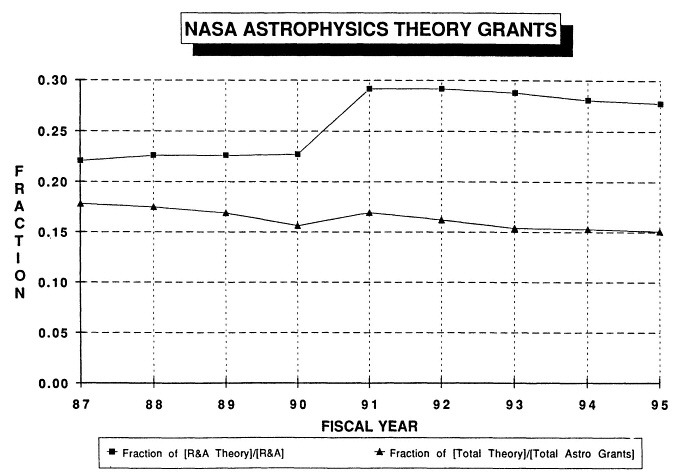
FIGURE 1
Table 1 and Figure 1 show the NASA budget for research grants to universities and national centers for FY87 through FY90. Also shown are the projections for FY91 through FY95. Note that the budget for the Astrophysics Theory Program is expected to double in FY91 and to remain constant thereafter, although this projection is not yet definite. The support for wavelength-specific theory (i.e., not including the Astrophysics Theory Program) is about 15% of the Research & Analysis budget. Funding for theory of both types is provided by the High-Energy, UV/Optical, and IR/Radio Branches. There is also support for theoretical astrophysics from the Mission Operations and Data Analysis Program. As a result, the total support for astrophysics theory by NASA somewhat exceeds 15% of the total budget for astrophysics science grants.
The specific recommendations for NASA by the Panel are as follows:
*1. NASA should expand the Astrophysics Theory Program to $4 million in FY91 (as planned) and progressively to $8 million/year by the end of the decade (in constant FY90 dollars). A mixture of large and small groups should be supported. As the funding increases, the announcements of opportunity should be issued more frequently. Exceptionally meritorious proposals should be funded for five year terms.
*2. NASA should continue to support wavelength-and mission-specific theory in both the Research & Analysis Program and the Mission Operations and Data Analysis Program so that the total support for theory (including the Theory Program) is at least 15% of the total support for astrophysics science grants. The solar and planetary divisions should continue their strong support of theory as well.
*3. NASA should continue to support theoretical astrophysics at the Space Telescope Science Institute and at NASA Centers such as Ames and Goddard. There should be at least comparable theoretical presence at any new organizations responsible for the scientific oversight of the Great Observatories (GRO, AXAF and SIRTF).
DOE
* DOE should support theoretical astrophysics at universities and the DOE laboratories insofar as it is relevant to DOE programs (e.g. particle astrophysics, nuclear astrophysics, atomic and molecular astrophysics, plasma astrophysics, computational astrophysics). The existing theoretical programs at Fermilab, Lawrence Livermore National Lab, and Los Alamos National Lab are successful examples which should be strongly supported and should be emulated at other DOE labs, such as RHIC and the SSC as they develop.
Recommendations by Agency: Laboratory Astrophysics
Theoretical and experimental laboratory astrophysics require special attention because of some unique problems.
Laboratory astrophysics is interdisciplinary. This asset can, unfortunately, lead to bureaucratic confusion and inaction when no branch, division, agency, etc. will take responsibility for research projects with applicability to several fields of astronomy.
Much of the atomic, molecular and nuclear laboratory astrophysics that is vital to astronomy is no longer at the forefront of basic research in physics and chemistry. Consequently, data for astronomy can no longer be expected as spinoffs from fundamental research supported by funding agency divisions that are not dedicated to astronomy. Laboratory astrophysics must be supported by astronomy divisions.
In the particular case of experimental laboratory astrophysics, a decade of reduced support has left the laboratory infrastructure in decay and the practitioners demoralized and, thus, leaving the field. Increased and consistent funding is needed to maintain the national capability to provide fundamental atomic, molecular and nuclear parameters required for effective use of the vast amounts of data that will be produced by the new, very expensive, ground-based and space observatories of the 1990's.
The creation of new funds expressly for laboratory astrophysics, with the goal of dealing with specific astrophysical problems, will attract more researchers in the related fields. In addition, if some of these funds are used to improve the communication between astrophysics and the related fields, such as by cross disciplinary workshops/conferences, the astrophysical problems can be brought to the attention of those most competent to do the research.
Mechanisms are needed to insure long-term stable funding for laboratory and theoretical groups interested in pursuing nuclear, atomic, molecular, and optical research related to astronomy and astrophysics.
If the decline in capabilities in laboratory astrophysics is to be reversed and the research strengthened so that the present and future needs of astronomy can be met, new funding will have to be found, dedicated to laboratory astrophysics. New researchers will be attracted to the field if sufficient long-term support can be assured and steps are taken to stimulate laboratory activities by connecting them to significant astronomical questions.
NSF
* To ensure the continued viability of laboratory astrophysics, we recommend that the NSF provide new funds in laboratory astrophysics in the divisions of astronomy, physics and chemistry with a particular emphasis on upgrading laboratory equipment and enlarging the number of graduate students entering laboratory astrophysics, including its theoretical component. Laboratory astrophysics cuts across the sub-divisions of astronomy, and the NSF should look to coordinate its support across astronomy and with physics and chemistry so that the funding of individual proposals can be provided at an adequate level.
NASA
* NASA's missions in the coming decade, in both astrophysics and in planetary sciences, will provide data of a range and quality far beyond our ability to interpret with our existing knowledge of the physics (and chemistry) of atoms, molecules, and dust grains. We recommend that NASA recognize laboratory astrophysics as a significant part of data analysis and allocate to the support of laboratory astrophysics an appropriate fraction of the funds for data analysis.
DOE
-
The primary mission of the DOE is not astrophysics. Nonetheless, much of laboratory astrophysics is related to the mission of the DOE, and the cross-fertilization of ideas between energy research and astrophysics is beneficial to both. We recommend that the DOE include the astrophysical implications of proposed research in its assessment of its scientific merit; laboratory astrophysics proposals which are related to the mission of the DOE and which are highly rated scientifically should be funded on the same basis as other highly rated DOE proposals.
-
The continued use of large higher energy facilities and the employment of new facilities like the Relativistic Heavy-Ion Collider (RHIC) for nuclear astrophysics are to be encouraged. Much of the relevant work in nuclear astrophysics, however, needs to be done on machines that are no longer regarded as being on the cutting edge of nuclear physics research. The Panel recommends that some of these more modest machines be maintained in operation and that astrophysically-oriented experiments be regarded as a key component of the research done on the machines. These machines should be available to outside users through collaborations, and would be used for nuclear physics, atomic physics, and applied physics, as well as astrophysics.
NIST
* NIST is world-renowned for the quality of the atomic, molecular, and optical research carried out in its laboratories in pursuit of its mission to maintain physical standards. Astronomers, too, are deeply involved in standards of measurement, and their ability to measure time (with the aid of millisecond pulsars) now rivals that of laboratory scientists at NIST. Both astronomers and scientists at NIST have a strong interest in the measurement of the properties of atoms and molecules, and in maintaining compilations of these data. We therefore recommend that NIST strengthen its ties to laboratory astrophysics; the astrophysical implications of the research carried out in its laboratories should be accepted as a valid subsidiary justification for the research.
All agencies
* A major need is the establishment of efficient Data Centers in the various branches of laboratory astrophysics. Until now, heroic efforts on inadequate funding have been made by a small number of people at a small number of institutions to assemble, assess and catalogue laboratory data. The work has been invaluable, but needs to be extended with a greater emphasis in ease of access and the use of electronic means of communication. This is already done in particle physics at LBL in a way that is compatible with astrophysics needs. Similarly, the Kellogg Lab at Caltech has carried out this function to date in nuclear astrophysics, but it is unclear
how long this can continue. Atomic and molecular data are not so well archived from an astrophysical viewpoint, and this needs to be remedied. We recommend that small, efficient data centers be established in atomic, molecular, and nuclear astrophysics by the appropriate agencies through the normal peer review process. The agencies should coordinate so as to avoid duplication of effort.
IV. BASIS - THE SUCCESSES OF THE 80'S
Theory in the 80's
Theory performs a number of functions in the overall enterprise of astronomy. It provides the basic paradigm within which observations are framed and without which they degenerate into a catalog of uninterpreted data. At its most satisfying, theory makes predictions that are later verified by observation. Theory can also have dramatic impact in a "post-dictive" mode by explaining previously observed phenomena. It catalyzes specific observations, which in turn stimulate new model building in a mutually interactive enterprise that drives progress in the field. Finally, theory provides much of the conceptual stimulation that invests astronomy with excitement.
In assessing the impact of theory in the decade of the 1980's, it is important to bear in mind that the big payoff of successful predictions, explanations, or guiding frameworks may be a long term process, so that the successes of the 1980's often had seeds planted earlier. Likewise, the general activity in theory in the 1980's may not bear fruit until the 1990's or beyond. In the following discussion, paragraphs marked with "*" highlight verified predictions.
The Solar System
In the solar system, the Voyager spacecraft provided dramatic proof or illustrations of a number of theoretical concepts, including tidal heating as a cause of vulcanism, and density waves and shepherd satellites in planetary rings. Further impressive accomplishments were compelling explanations of Jupiter's great red spot, the Kirkwood gaps, and the apparently chaotic rotation of Saturn's satellite Hyperon.
Observations of the vibrational spectrum of the Sun led to the new science of helioseismology, with a firm theoretical basis that was rapidly developed. Models of the rotation of the solar interior based on the observed rotational splitting in the spectrum overturned previous conceptions of rotation on cylinders, but a fully self-consistent model that will account for the 11 (22) year solar cycle is still being sought in ongoing work. Continuing studies of solar neutrinos included new suggestions of induced mixing of neutrino types and the possible effects of hypothetical new particles. This work continues within a fundamental theoretical framework laid down in the 60's and 70's. The Sun is predicted to have a magnetic heliosphere, and Pioneer 10 and the Voyagers continue to search for the heliopause.
The conceptual notion that impacts of massive extraterrestrial bodies may have led to major biological extinctions illustrates the strong linkages that can develop between apparantly unrelated disciplines, and the importance that apparently arcane theoretical studies (for example, the structure and dynamics of the Oort cometary cloud) can suddenly have for other subject areas (for example, the environmental consequences of a major impact may be similar to the effects of nuclear winter). In the broadest context, work in this area has led to the recognition that the solar system is a dangerous and unpredictable place, and that astronomical catastrophes are likely to have had a profound influence on the developments and survival of life on Earth.
The Interstellar Medium and Star Formation
Significant progress was made in the study of the interstellar medium (ISM) and star formation. Large structures in the ISM—supershells and superbubbles—with diameters of hundreds of parsecs were successfully modelled as being due to correlated supernovae in stellar associations, although for some structures—particularly the largest ones—this model has some difficulty. Observations of the diffuse ISM continue to be interpreted in light of a three-phase model developed in the 70's, in which the ISM is divided into cold (T ~ 102K), warm (T ~ 104K), and hot (T ~ 106K) phases in approximate pressure equilibrium. In the last decade, debate raged as to the pervasiveness of the hot component of the ISM and on the relative importance of magnetic fields in determining the observed structure of the ISM. The discovery of small dust grains and polycyclic aromatic hydrocarbons through infrared observations led to extensive theoretical study
of their role in the thermal and chemical balance of interstellar clouds. The theory of interstellar shocks grew to encompass shocks in which the dissipation is effected by ion-neutral collisions, of particular importance in molecular gas. Observations of H2 fluorescence confirmed theoretical calculations of the response of molecular clouds to UV radiation. The theory of acceleration of cosmic rays by shocks was put on a firmer footing, though many questions remain. A fundamental understanding of the fluctuation of pulsar radiation in terms of interstellar scintillation was developed.
A major accomplishment of the 80's was the development of a coherent picture for the formation of low-mass stars: Beginning with dense molecular cores of several  observed in many molecular clouds, the theory shows how ambipolar diffusion of weakly ionized gas leads to a collapse which commences at the center of the core and which leads to the formation of a young stellar object with properties similar to those actually observed. The magnetic field is crucial in reducing the angular momentum of the gas, but the residual angular momentum leads to formation of a disk, in agreement with infrared and submillimeter observations. Young stellar objects are observed to rotate far more slowly than would be expected if they formed from a disk, indicating that a substantial fraction of the binding energy must be dissipated. It was suggested that this dissipation is accomplished through a magnetically driven wind, thereby producing the bipolar flows which are a ubiquitous feature of low-mass star formation. The magnetic field is an essential ingredient in this entire picture, and models of magnetically supported clouds received striking confirmation at the end of the decade when direct observations of the magnetic field in molecular clouds showed approximate equipartition between the magnetic energy and the turbulent energy over a range of densities.
Stars
*The area of stellar evolution gave the most spectacular confirmation of a long-standing theoretical prediction. Supernova 1987A produced a flux of neutrinos, providing the first detection of extra-solar neutrinos. The information in those 19 detected events was not as detailed as would have been wished, but nevertheless yielded data on the time of arrival and energy spectrum of the neutrinos that was completely consistent with decades of work on the problem of gravitational collapse and neutron star formation. This observation and associated theory put important limits on the lifetime, charge, and magnetic moment of the electron neutrino. Another important prediction was that of the existence and properties of the gamma ray flux associated with the production and decay of radioactive 56Ni to 56Co and then to 56Fe. Not only were gamma rays and X-rays from SN 1987A observed, and their properties used to study the nature of the explosion and subsequent mixing, but freshly synthesized Ni, Co, and Fe were directly observed, especially in the infrared. The mass of radioactive nickel produced by the explosion was predicted ahead of time to within a factor of two. The successful interplay between theory and observation was particularly apparent in the planning of the NASA missions to observe the supernova.
Theoretical study of SN 1987A provided basic explanations of the evolution of the light curve and spectra and led to a growing confidence that the supernovae will become valid distance indicators. Estimates of the distance to the LMC based solely on SN 1987A agree with classical estimates to within about 10 percent.
A great deal of work was done on the evolution of massive stars with an attempt to incorporate mass loss from radiative driven winds self-consistently. Such work was able to account for the observed properties of a wide range of hot stars, from Wolf-Rayet stars to the nuclei of planetary nebulae. The theoretical Hertzsprung-Russell diagram was refined for comparison with the observations of globular clusters. The theoretical framework of evolution of asymptotic giant branch stars and various stages of "dredge-ups" continued to guide observations of physical and chemical properties of red-giant stars. In the context of binary star evolution, the framework associated with the notion of accretion disks provides a crucial guiding principle for both theory and observations.
* Theoretical studies of oscillating white dwarfs rejuvenated the study of white dwarf stars. Models incorporating a thin layer of hydrogen provided the first explanation of the ZZ Ceti phenomenon of variable DA white dwarfs and also predicted that an analog should exist among the helium-rich DB white dwarfs. This unexpected prediction was then verified observationally. This work has been extended to hot post-planetary nebulae, and the study of the variability along the white dwarf sequence has given rise to the subject of white dwarf seismology, which is giving information on the masses, composition, and structure of white dwarfs as well as their evolution. The latter provides a unique and independent way to determine the age of the Galactic disk.
High Energy Astrophysics
The 80's have seen major quantitative advances in the capability to compute the properties of classical nova explosions. Many aspects of dwarf novae can now be successfully accounted for in terms of a limit-cycle thermal instability associated with partial ionization of hydrogen in accretion disks. This theory is now being applied to some classes of X-ray transients, as well as to models for AGN. The observation of cyclotron lines in some gamma ray bursters was interpreted on the basis of theoretical models to mean that these bursters are magnetized neutron stars.
Theory continues to provide a major impetus to the study of a variety of collapsed objects. The general theory of gravitational collapse received support from SN 1987A, but it remains a major theoretical effort to understand the physical mechanism of supernova explosions. The 80's saw a great deal of work on accretion-induced collapse to make compact objects in close binaries. Continued study of the binary pulsar has led to more and more accurate confirmation of Einstein's theory of relativity, including the first evidence for gravito-magnetic effects in the form of geodesic precession of the pulsar spin axis, and strong new limits on the time variability of the gravitational constant.
In the study of galactic nuclei, the theoretical notion of a massive black hole with an accretion disk embedded in a dense star cluster provided the framework that continues to guide work on active galactic nuclei and quasars. Numerical and analytic models of jets had some success in accounting for the radio jets observed in extragalactic radio sources. Observations of polarized line emission in some Seyfert 2 galaxies led to a ''unified'' model for Seyfert galaxies in which the central nucleus is surrounded by an opaque torus of gas, and the object is classified as a Seyfert I or 2 depending on whether the line of sight to the nucleus misses the torus or not. This model was substantiated by X-ray observations.
Galaxies and Cosmology
The theory of galaxy mergers provided a framework to study a variety of issues involving the formation and evolution of galaxies. The shells observed in some elliptical galaxies were successfully modelled as the result of mergers. Cooling flows in clusters of galaxies were a major topic of theoretical work, with one of the central issues being the effects of the flows on the evolution of the central galaxies in the clusters. The 80's also saw a great deal of theoretical work in the area of N-body calculations aimed at understanding the dynamics of stellar clusters and galaxies. These studies provided insight into core collapse in globular clusters and the beginnings of a basis for understanding the tri-axial structure of elliptical galaxies.
* The discovery of gravitational lenses provides an excellent example of the role of theory in astronomical discoveries. Essentially all the key features of lenses were predicted theoretically, on the basis of general relativity, in classic papers by Einstein, Russell, and Zwicky in the 1930's. After the discovery of lensed quasars early in the last decade, theorists refined their calculations to the point that there is now detailed agreement between theory and observation in a number of cases. The unexpected discovery of luminous arcs in some clusters of galaxies has been successfully accounted for in terms of gravitational lensing. The cosmological implications of the observed lenses have also been worked out.
The redshift debate was all but settled in the flood of observations that verified the basic theoretical result that the Hubble flow is the only viable source of the systematic redshifts of distant galaxies and quasars. The Lyman alpha clouds along the line of sight toward quasars were studied as indicators of the intensity of the intergalactic radiation field, as probes of large-scale structure, and as sources of baryonic material. Theoretical study of the intergalactic medium showed that, with current counts, quasars are unable to ionize the intergalactic medium.
One of the most interesting challenges facing theorists in the last decade was the attempt to understand how galaxies evolved in a Universe filled with such a uniform cosmic microwave background radiation. Searches were made for ever fainter galaxies in an attempt to see if voids were filled with small galaxies, as predicted by theories of cold dark matter. The continuing null results of the search for fluctuations in the background radiation were made critically interesting by the importance attached to them by theory.
*The Sunyaev-Zeldovich effect—the distortion of the microwave background by Compton scattering in clusters of galaxies—represents a major theoretical prediction which is receiving substantial support from observation.
*The 80's saw the basic big bang model predictions further refined and verified. Of particular importance have been the verification of predictions of standard homogenous Big Bang Nucleosynthesis (BBN). The early focus of BBN was on 4He, but during the 70's, with the theoretical work showing how deuterium could be made only in the big bang, the focus turned to deuterium and its concomitant limit on the baryon density
of the Universe. The end of the 70's saw the deuterium and 3He constraints combined to predict that consistency could occur only if the abundance of primordial lithium was Li/H ~ 10-10 and if the density of baryonic matter is about 1/10 the critical density. Observations in the early 80's appear to have confirmed the predicted lithium abundance, thereby providing a strong argument that most of the Universe is made up of some form of non-baryonic dark matter. (An alternative, less favored explanation is that the density of the Universe is only 1/10 critical.) The 80's also saw a flurry of activity in examining inhomogeneous nonstandard BBN models. By the end of the decade, the robustness of the standard model was demonstrated by the failure of the efforts made to circumvent it.
*One of the most decisive verifications of an astrophysical prediction came when particle accelerator experiments at CERN in Geneva., Switzerland and at SLAC in Palo Alto confirmed that there were only three generations of light neutrinos. Theoretical calculations of the light element abundances (particularly 4He) due to BBN are inconsistent with observation if there were a large number of types of light neutrinos.
The concept of inflation was one of the most important advances in cosmology in the 80's. Inflation raised the stakes in the competition between cosmological models, by showing that at least one plausible model based on Grand Unified Theories (GUTs) could explain the observed isotropy of the universe, provide a natural explanation for why the density is near the critical value, and suggest a natural spectrum for primeval density perturbations. While it remains to be seen whether inflation proves to be correct in detail, it has greatly expanded the horizons of what cosmologists can hope to explain, and has provided the framework for much of the work on the early universe that took place in the 1980's.
The interconnection of particle physics and cosmology that developed during the 80's is illustrated by other examples as well. Astrophysical constraints set limits on the existence and properties of various particles. The physics of baryon non-conservation in the GUT theories gave the first models for the origin of the excess of matter over antimatter and for the ratio of baryons to photons in the Universe. Phase transitions predicted from particle physics played a role in the study of a variety of effects from magnetic monopoles to seeds for galaxy formation, to inhomogeneous Big Bang Nucleosynthesis. The ideas of cosmic strings, both normal and superconducting, and other topological defects launched a major theoretical industry to explore their properties and to seek connections to observed large scale structure. All this work pushes the frontiers of physics further back toward the Planck scale, the ultimate problems of quantum gravity, and the origin of the Universe.
Laboratory Astrophysics in the 80's
Atomic and Molecular Physics
Spectroscopic studies of a diverse range of atomic and molecular species at all wavelengths were carried out at the greatly enhanced level of precision made possible by lasers and they assisted in the identification of emission and absorption lines of a diverse variety of astrophysical objects. Spectroscopic measurements on carbon monoxide yielded information on CO that removed a major uncertainty in the description of the photodissociation of CO in circumstellar shells and interstellar clouds. Theoretical calculations and laboratory measurements successfully identified the source of infrared emission lines in the solar atmosphere as excited Rydberg levels of magnesium, silicon and aluminum.
Charge transfer was recognized as an important mechanism for redistributing the charge in a high excitation nebulae. Emission lines resulting from the charge transfer of multiply-charged oxygen and neon in hydrogen were predicted and found in the spectra of planetary nebulae. Experiments to measure charge transfer at low energies were designed.
A productive, mutually stimulating collaboration occurred between observers of molecular emission and absorption lines and theorists carrying out basic quantum-mechanical calculations in joint studies of the spectroscopy of possible candidate molecules. The collaboration led to the discovery and identification of interstellar cyanoethyl, butadinyl, cyclopropenylidene, dicarbon sulfide, tricarbon sulfide and protonated hydrogen cyanide and of circumstellar silicon dicarbide, silicon carbide and deuterated butadinyl.
The molecular ion  , an ion of central importance in the ion-molecule theory of interstellar chemistry, was observed in emission in the atmosphere of Jupiter. Quantum-mechanical evaluation of the potential energy surface followed by the calculation of all the energy levels and transition probabilities provided a prediction of the emission line frequencies and intensities, whose accuracy could be assessed by experimental measurements of selected transitions. On the basis of the laboratory studies, emission lines appearing in
the spectrum of Jupiter, originally labelled unidentified, were definitely attributed to  . The detection of
  is the first observational evidence for extraterrestrial
  . The interplay of theory, experiment and observation was further demonstrated by searches for interstellar
  by observations of absorption lines looking towards infrared sources.
Major strides were made in laboratory studies of chemical reactions and the first measurements were made at temperatures below 50K. The expected enhancement of the rate coefficients of many reactions of positive ions with heteronuclear molecules at low temperatures was established experimentally and incorporated into models of interstellar chemistry. A beginning was made on the identification of the products of dissociative recombination. Progress was made experimentally and theoretically in understanding the role of internal energy modes in chemical reactions.
Another area in which the three pronged attack of experiments, observations and theory has resulted in very significant gains in our understanding is that of interstellar solids. Interstellar dust and ice composition went from a field rich in speculation to one in which laboratory analog studies provided strong constraints on observations and theories. For example, these studies predicted the presence of, and guided the subsequent detection of, important ice constituents such as carbon monoxide and methanol, revealing the complex interplay between the gaseous and solid phases in molecular clouds.
Experimental studies of excitation and ionization due to electron impact were improved in accuracy and were extended to many more systems in states of high ionization. They were complemented by increasingly elaborate theoretical models which made evident the importance of resonance structures in electron impact processes. A significant contribution of theory was the recognition of the importance of dielectronic recombination at nebular temperatures. The first reliable field-free measurements of dielectronic recombination were carried out. Transition probabilities of intersystem lines of light-atomic ions of astrophysical importance were measured by using ion traps to confine the ions and detecting the exponential decay of the emission intensity from metastable levels populated by laser radiation or by electron impact.
The Opacity Project was initiated under the guidance of M. J. Seaton. The project is an international effort to exploit the development of powerful theories by applying them systematically, using fast large computers, to calculate atomic and ionic parameters such as oscillator strengths, transition probabilities, radiative and dielectronic recombination coefficients, photoionization cross sections and line-broadening parameters. The activity, though of inestimable value to a broad range of applied physics, was stimulated primarily by the demands of astrophysics. The first results from the project are appearing.
Plasma Physics
A deepening understanding of the physical processes in plasmas was developed. Particular advances were achieved in aspects of thermal conduction, plasma relaxation and beam-plasma interactions. The concept of a saturated heat flux, which has been important for evaporation of interstellar clouds, was observed and explained in laser-irradiated pellets. Inhibition of thermal conductivity by small scale fluctuations has been seen in confined plasmas and invoked in stellar coronae and galaxy cluster cooling flows. The idea that magnetically dominated plasmas relax to a minimum energy state consistent with constant total magnetic helicity was developed to interpret reversed-field-pinch devices and has been used to model extragalactic radio jets and solar coronal loops. Beam-plasma interaction experiments were instructive in interpreting observations of radio emission from pulsars and from solar and stellar flares.
Nuclear and Particle Physics
The last decade has seen significant advances in both nuclear and particle physics, which have contributed to our understanding of astrophysical phenomenon. New information on nuclear cross sections has contributed to our understanding of solar neutrino production and big bang nucleosynthesis, along with stellar evolution and nucleosynthesis. New measurements of fundamental particle properties have also provided key input to our astrophysical understanding. More detailed measurements of the nuclear reactions important to the p-p chain have solidified our confidence in the nuclear input to the standard solar model. This new work thus makes a nuclear physics solution to the solar neutrino problem less likely. Also of relevance to the solar neutrino problem, medium energy measurements of (p,n) reactions and the extracted Gamow-Teller matrix elements have provided information on neutrino capture cross sections for several of the terrestrial solar neutrino detectors. New measurements of the key reactions of the standard big bang have improved our confidence in the predictions of the abundances of light elements produced during the big bang. While significant work has also been done on the reactions of helium burning, considerable uncertainty remains
in some of the key reactions. New work with radioactive targets has also provided information on several reactions that occur during explosive burning where unstable nuclei can play a role.
Measurements of certain isotopic anomalies have also shed light on the origin of the solar system and the role of certain nuclear processes during nucleosynthesis. Detailed measurements of beta-decay strength functions for nuclei far from stability has allowed a better understanding of the path of nucleosynthesis as it approaches both the proton and neutron drip line.
In the particle physics realm, constraints on the possible modifications to the standard model of the strong and electroweak interactions, as well as better understanding of particle properties, have contributed significantly to astrophysics in the last decade. New data from SLAC and CERN has provided strong confirmation of the standard model, with the discovery of the W and Zo particles. And very recently, the detailed measurements of the Zo decay have constrained the number of possible generations (limiting any additional new quarks and leptons) to three, in excellent agreement with the bounds obtained from big bang nucleosynthesis. New high precision measurements of the free neutron lifetime have significantly reduced several key astrophysical uncertainties. These new measurements (some using advanced neutron storage-bottle technology) have direct bearing on the predictions from the standard big bang and on the rate of the p-p reaction in the solar model.
V - Agency Responses to Field Committee Report
Some of the recommendations of the Field Committee Report related to Theory and Laboratory Astrophysics have been implemented, but there has been little response to others. In general, we give higher marks to NASA than to the NSF in effectively responding to the Field Committee recommendations.
NASA has significantly increased its support of theoretical astrophysics through the Astrophysical Theory Program. This program has strengthened or catalyzed the formation of several research groups and supported a significant number of postdoctoral research associates and graduate students. The NASA Graduate Student Researchers Program has also supported a number of students working in theoretical or laboratory astrophysics. We consider this program to be highly successful.
The most significant positive development related to NSF funding is the Presidential Young Investigators program. The recipients of these awards seem to be able to ramp up to a high level of activity more quickly than investigators without these awards, and they are competitive in seeking NSF support once their PYI funding has ended.
Unfortunately, theoretical and laboratory astrophysics have not fared well within the general NSF astronomy grants program. Far from the 50% increase recommended by the Field Committee, these areas have actually lost ground. The fraction of the NSF astronomy budget going into Theory is about 1/3 the fraction going into Theory in NSF Physics. Despite the recommendation of the Theory subpanel that Theoretical Astrophysics be set up as a separate program in the Astronomy Division, similar to Theoretical Physics in the Physics Division, theory remains balkanized among different programs, to the perceived detriment of researchers who are oriented towards general physical processes rather than towards specific astronomical objects.
The DOE laboratories have made some progress in supporting work related to astrophysics, but much remains to be done in the DOE supported areas of atomic and molecular, nuclear, particle, and plasma physics as it relates to astrophysics. Support for theoretical astrophysics at the National Astronomy Centers is essentially nil, with the laudable exception of the NASA-funded Space Telescope Science Institute. The NSF Astronomy Centers seem to have ignored the Field Committee recommendations.
Advanced computing has been supported by the NSF and DOE, and most researchers now have greatly improved opportunities for large scale scientific computing. However, the strong support for supercomputer facilities has not been matched by support for more modest facilities at the individual, group or departmental level. This is unfortunate for several reasons: first, the smaller machines are far more cost-effective for many tasks than supercomputers, and in some cases now actually approach the supercomputers in speed; a second reason is that the solutions of many problems in astrophysics are more limited by lack of imagination than lack of computation, so that it is especially important to provide flexible, friendly and accessible local computing that permits working theorists to solve small and medium scale computational problems with a minimum of
effort and time.
Finally, we consider funding of institutes and workshops. The ITP at Santa Barbara has sponsored some excellent programs, but its service to the community is limited by lack of a permanent staff in astrophysics. NASA and NSF (Physics) support Aspen and other summer workshops, but more travel money must be made available if these workshops are to be made available to a broader section of the community.
Policy Recommendations for the 90's: Theory
The committee examined many possible recommendations, including such things as a new national center for Theoretical Astrophysics. However, the committee felt that at the present time the real needs in theory are for increased stable individual grant support and postdoctoral support, as mentioned under funding needs. Policy recommendations to individual agencies for Theory are given below.
NSF
*1. Establish a separate Theory Program in the Astronomy Division, as mentioned before.
*2. We recommend that the directorate of NSF responsible for education increase its funding for graduate fellowships and traineeships; this would benefit all science.
*3. The use of umbrella grants, where several theorists at a given institution combine their grants, should be an acceptable but not mandatory option in order to reduce paperwork and permit the pooling of resources. The resources to be devoted to each of the investigators on such a grant should be clearly spelled out.
*4. An "adiabatic turnoff"-i.e., a year of reduced funding-should be provided for the termination of long-term programs.
*5. Accomplishment-based proposals should be actively encouraged for senior theorists. Again, this reduces paperwork and, for the case of senior theorists, provides adequate information for evaluating the proposal.
NASA
* NASA is to be congratulated for recognizing the importance of theory in carrying out its mission. Continued support for the Theory Program, for mission-specific theory, and for theory at the NASA centers is essential if the benefits of the missions planned for the 90's are to be realized.
DOE
* DOE should support theoretical astrophysics insofar as it is relevant to its mission. The Panel notes that the DOE has used astrophysics to help justify new accelerators such as RHIC and SSC, but to date its funding of astrophysically related projects has not been enlightened. Particle astrophysics, nuclear astrophysics, plasma astrophysics and computational astrophysics are all of direct relevance to DOE's mission.
All agencies
* A policy issue which extends across the boundaries of all agencies is computational facilities. The development of major super-computing facilities through NSF and DOE has provided a major improvement in the computational environment in the last decade. However, these facilities do not satisfy all of the computational needs of the theoretical community. Moreover, recent advances in small scale computing now mean that many tasks previously requiring supercomputers can be handled on much smaller machines at a fraction of the cost with only modest losses in speed. Yet these smaller machines are often difficult for individuals or groups to acquire through individual grants. The Panel recommends that all agencies should recognize the importance of computers of a range of sizes as powerful tools for theoretical research, and that funding for powerful machines dedicated to the use of individuals, groups or departments should be increased.
Policy Recommendations for the 90's: Laboratory Astrophysics
NSF
* A coordination across directorates is essential for laboratory astrophysics because of its interdisciplinary nature. Too often we hear of important laboratory projects falling through the NSF cracks because they are "not of prime interest to the nuclear or atomic or ... communities," while at the same time Astronomy says that "this is nuclear or atomic or ..., not astronomy."
NASA
* The need for laboratory data for NASA missions goes beyond individual missions. NASA should recognize this broad requirement for laboratory data as they have done for theory.
DOE and NIST
* These agencies should recognize that acquiring laboratory atomic, molecular, optical and nuclear data relevant to astronomy is appropriate to their missions and should be supported.
VI. SUMMARY
The future of astronomy is dependent on maintaining an active and dynamic theoretical community and on making the critical laboratory measurements necessary for future observations. In this report we have attempted to show how to achieve this. The funding agencies should provide a level of funding for Theory which is commensurate with their funding for observational and experimental astronomy. Laboratory astrophysics requires new funds, particularly from NSF and NASA, in order to obtain the data that is essential for the interpretation of astronomical observations. The successes of the 1980's and the opportunities for the 1990's show that support for these programs is necessary if astronomy is to achieve its goals in the coming decade.
SOLAR ASTRONOMY PANEL
ROBERT ROSNER, University of Chicago, Chair
ROBERT NOYES, Harvard-Smithsonian Center for Astrophysics, Vice-Chair
SPIRO K. ANTIOCHOS, Naval Research Laboratory
RICHARD C. CANFIELD, University of Hawaii
EDWARD L. CHUPP, University of New Hampshire
DRAKE DEMING, NASA Goddard Space Flight Center
GEORGE A. DOSCHEK, Naval Research Laboratory
GEORGE A. DULK, University of Colorado, Boulder
PETER V. FOUKAL, Cambridge Research and Instruments, Inc.
RONALD L. GILLILAND, Space Telescope Science Institute
PETER A. GILMAN, National Center for Atmospheric Research
JOHN W. HARVEY, National Optical Astronomy Observatories
ERNEST HILDNER, National Oceanic and Atmospheric Administration
THOMAS E. HOLZER, High Altitude Observatory, National Center for Atmospheric Research
HUGH S. HUDSON, University of California, La Jolla
STEPHEN KEIL, Air Force Geophysics Laboratory
BARRY J. LABONTE, University of Hawaii
JOHN W. LEIBACHER, National Solar Observatory, National Optical Astronomy Observatories
KENNETH G. LIBBRECHT, California Institute of Technology
ROBERT P. LIN, University of California, Berkeley
BRUCE W. LITES, High Altitude Observatory, National Center for Atmospheric Research
RONALD L. MOORE, NASA Marshall Space Flight Center
EUGENE N. PARKER, University of Chicago
REUVEN RAMATY, NASA Goddard Space Flight Center
DAVID M. RUST, Johns Hopkins University
PETER A. STURROCK, Stanford University
ALAN M. TITLE, Lockheed Research Laboratories
JURI TOOMRE, University of Colorado, Boulder
ARTHUR B.C. WALKER, JR., Stanford University
GEORGE L. WITHBROE, Harvard-Smithsonian Center for Astrophysics
ELLEN G. ZWEIBEL, University of Colorado, Boulder


