
1
Introduction
STAR STUDY OBJECTIVES
In March 1988, the Assistant Secretary of the Army for Research Development and Acquisition requested from the National Research Council's Board on Army Science and Technology (BAST) a study of the future importance of advanced technologies to the U.S. Army. In response to this request, BAST initiated a study under the general title of the Strategic Technologies for the Army Report, or STAR. This report by the Study Committee on STAR (the STAR Committee) and its companion volumes constitute the results of the BAST study.
The initiating request delineated three specific objectives of the study:
-
Identify the advanced technologies most likely to be important to ground warfare in the twenty-first century.
-
Suggest strategies for the Army to consider in developing the full potential of these technologies.
-
Project, where possible, the implications of the technologies for force structure and strategy.
The study was to address a period extending at least 30 years into the future.
The STAR reports have primarily explored the influence of technology on conventional warfare in contingency situations. By agreement, the study has not addressed issues of nuclear conflict or the implications of technology for that class of warfare. However, in
certain cases the delivery systems for conventional and nuclear warheads may be similar.
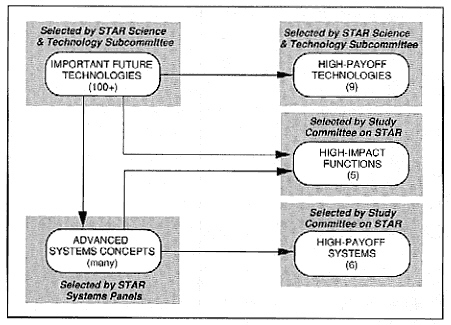
The three objectives in the initiating request have guided the entire STAR process as well as the organization of the resulting STAR volumes.1Figure 1-1 illustrates the STAR response to the first objective. More than a hundred technological specialties were identified by the nine groups of the Science and Technology Subcommittee as likely to have major advances that could be incorporated into Army systems within 30 years. The Science and Technology Subcommittee selected nine of these important future technologies for particular consideration by the Army as high-payoff technologies.
The eight systems panels included the entire range of important future technologies in their consideration of systems in which these technologies might be applied to Army functions. The STAR Committee has organized its discussion of the large number of advanced systems concepts envisioned by the systems panels by broad categories of Army function. Five of these functional categories have been selected by the Committee for their high impact on future Army operations and on technology applications. Chapter 2 reviews many of the systems concepts discussed by the systems panels for these five high-impact functions. In addition, the STAR Committee has selected six systems in which technology implementation is likely to be particularly valuable in the future to the Army. These six systems are the high-payoff systems concepts.
Chapter 3 summarizes the findings of the STAR technology groups for all the important future technologies. Chapter 4 presents the nine technologies selected by the STAR panels for their high payoff. It also relates a broad range of technologies discussed in Chapter 3 to key systems concepts from Chapter 2. Chapter 5 responds to the second point of the STAR request by suggesting a technology management strategy for the Army. The strategy calls for focusing on technology implementations in each of the five high-impact functions from Chapter 2.
Underlying the discussions of high-impact functions, either with respect to their system applications (Chapter 2) or technology management (Chapter 5), is a general perspective on the contexts in which the Army may be involved in ground warfare during the next 30 years. The remainder of this introduction summarizes this perspective and highlights key connections between it and the systems or
|
1 |
The members of the STAR panels, subcommittees, and technology groups are listed in Appendix B. The preface describes the study process. |
FIGURE
1-1 Selection of technologies and advanced systems concepts for STAR.
managerial implications that are elaborated on in subsequent chapters. Chapter 6 returns explicitly to this general perspective to consider some implications of advanced technology for Army force structure and strategy—the third and final objective set forth in the STAR request. Chapter 7 compiles and summarizes the major conclusions and recommendations from the body of the report.
CHALLENGES FOR THE ARMY IN THE NEXT CENTURY
The Defense Environment After Desert Storm
The U.S. armed forces recently completed one of the most successful campaigns in military history. After 40 days of air war, the 100-hour ground campaign that climaxed Operation Desert Storm liberated Kuwait by defeating a heavily armored and well-entrenched opponent. The number of coalition casualties from the ground offensive was far lower than anticipated.
While the technological superiority of U.S. forces and their coalition partners was an important factor, this success depended on capable soldiers, superb training and leadership, and a bold strategy that made the most of superior technology. Yet even as U.S. forces returned home from this triumph, major challenges lay ahead for the Army. The world remains unsettled by regional strife. The Army may again have to defend U.S. interests against a well-armed opponent under difficult circumstances. At the same time, new economic realities at home portend large reductions in force structure and in the acquisition of new armaments.
On the international scene, a still-evolving multipolar political order is replacing the bipolar world of the Cold War. Underlying this political order is a far greater economic interdependence among nations participating in an international market economy, which will become truly global within the next decade. Some of the defense-related implications of this political and economic interdependence can already be glimpsed in the joint coalition operations and cost sharing that accompanied Desert Shield and Desert Storm.
Another highly relevant element of this new order is the continuing and burgeoning reach of technology into every facet of civilian life. The controversies and recriminations over international technology transfer to Iraq prior to Desert Storm illustrate how readily a global market in information and technology can spawn important military consequences.
Because of these many changes, the Army will find the management of its technology development and the acquisition of hardware based on this technology to be particularly challenging over the next several decades. Concepts based on the past will require critical examination; those that do not fit the new environment must be discarded.
The technology management initiatives now under way to respond to these challenging times are highly commendable. Even so, the STAR Committee believes that a major reassessment of Army technology development strategies and implementation policies will be necessary in light of the considerations advanced in the STAR reports. To aid in that reassessment, this report begins by presenting what the STAR Committee believes will be the principal influences during the 30-year period covered by this study. The Army is encouraged to not only consider the issues as presented in the following paragraphs but, more importantly, to generate its own view of the dominating issues and to develop a plan for dealing with those issues.
Principal Influences on Technology in the Next Decades
The STAR Committee sees at least five primary influences on future technology strategies of the Army:
-
an increasing number of future technology options and sources;
-
changing military obligations;
-
diminishing funds for advanced technology;
-
requirements for closer interservice cooperation in advanced technology development; and
-
the "globalization" of commerce, with the attendant development outside the United States of some leading-edge technologies important to the Army.
Number and Source of Future Technology Options
Every STAR panel predicts there will be expanded technology options available to the Army for exploitation in its systems. These options will build on the advances of the past few decades in such areas as microelectronic devices, new kinds of materials and their fabrication techniques, computer hardware and software, data storage and display techniques, medical science applications based on biotechnology and radically improved instrumentation, and understanding of social behavior and learning.
The 1970s were the decade of the simple microcircuit chip and the large central processors, or mainframes, it made possible. The 1980s were the decade of pervasive use of these earlier technologies and of the introduction of a comparatively simple laser and simple microprocessor and the application of molecular biology.
The 1990s and early 2000s will see dramatic proliferation of capabilities that were just appearing as the 1980s ended. They will also mark the introduction of new technologies just beginning to be conceived. One example, typical of many, is the arrival of new materials whose characteristics will be formulated, with the aid of computers, physical chemistry, and biophysics, specifically for the structures and functions for which they will be used. No longer will functions of materials be constrained by accidental discovery of new forms of material, because these sciences now make possible true "designer" materials. By matching this explosion of technology in the commercial world, the pace of new military capabilities can accelerate at an equally rapid pace.
This rapid change of technology with military application will
occur despite the prospect of reduced military budgets for technology exploitation. This paradoxical result can happen if, as the STAR Committee anticipates, the military makes better use of commercial technology. In the restricted budget environments of the future, rapid movement from technology to implementation probably can be achieved only if (1) the Army focuses its resources on those technologies not being developed for the private sector and (2) the Army develops a close working association with the private sector in those areas where applications are similar. Future Army equipment must be designed, to the greatest degree possible, to be built from commercially available parts on commercially available tooling. Mobilization of the industrial base in times of crisis will require that the Army learn how to make fuller use of commercial production capacity. It must also make suitable, planned investments to ensure that a wartime force structure can be reconstituted quickly enough should the need arise.
The Changing Military Obligations of the Army
To the members of the STAR Committee, military operations in the Persian Gulf war, Panama, and Grenada represent remarkably well the wide gamut of rapid-response contingency operations to be expected for the next decades. In addition, of course, the Army must be prepared to expand its capability to meet the potential resurgence of an adversarial major power. It must also prepare for its role in strategic defense as that role evolves from ongoing political considerations. At the other end of the warfighting spectrum, low-intensity conflicts, guerilla warfare, and counter-insurgency operations continue as real possibilities, whether for U.S forces in advisory roles or as active combatants.
Despite restricted budgets, the Army must apply resources to develop more lethal armaments for both its initially deployed, highly mobile, lighter forces and its reinforcing heavy forces. The former must have sufficient combat power and mobility to take and hold ground in a contingency situation, with air support from the Air Force and Navy. The latter will remain a necessity during the next decades for conducting offensive operations against a large, well-armed, and well-armored adversary. To make the best use of the technology opportunities suggested by this report and the supporting STAR reports, the Army will need to construct scenarios it believes are representative of the timing and extent of the military operations that might occur.
For the Army to use these technologies effectively, the technical
community must have a comprehensive understanding of the Army's objectives during the coming decades. In addition, what the Army should plan to do militarily will also depend on what the technology will enable it to do. Therefore, the STAR Committee believes that the process of defining Army system requirements can be effective only if there is close cooperation between the Army's user and technology communities. Each of these communities must recognize that both will gain by achieving synergy between ''technology push'' and "requirements pull," instead of ineffectual tugging in disparate directions.
One important new element of these expected operational scenarios will be a radical increase in the extent of joint operations by U.S. forces. To a considerable degree beyond that observed today, new Army requirements must reflect the benefits (probable air superiority, control of the sea, satellite resources, etc.) and the difficulties (identification of friend or foe (IFF), electronic warfare, control of forces, etc.) of major joint operations.
The shift of attention from a large central war to limited contingency operations also brings a change in acceptance of casualties, within the military itself and in political support from the country at large. The Army must arm itself and plan for fighting limited combat missions with predictably low casualties to U.S. forces and to enemy noncombatants. In most contingency situations, national interests will be involved, but no great galvanizing principle will be at stake. Projections of casualties will be, as they recently have been, a major factor in the political decision to commit the military to warfare and in the decisions by military leaders on how to prosecute an operation once committed. By implication, technological developments that reduce the risk of casualties in either category—minimization of U.S. military casualties or of an opponents' noncombatant casualties—are of substantial value for that reason alone. More accurate operational intelligence, precision weapons, stand-off weapons platforms, protection of vulnerable rear-echelon areas, survivability of manned systems, and better treatment of the wounded are some of the more obvious areas in which this ubiquitous concern plays a role.
Diminishing Funds for Advanced Technology
The impact to the Army of constrained future financial resources cannot be overemphasized. The costs of new equipment, intended to replace fielded equipment now becoming obsolete, have skyrocketed. Even if future acquisition budgets were increasing, none of the ser-
vices, including the Army, could afford to pursue all the possibilities opened by research.
For two reasons, funds for technological research and development (R&D) will decrease even if the budget lines for Army R&D remain at their current levels. First, the federal budget lines for R&D are approximately equal to the amount invested by the defense industry for in-house R&D or industry-sponsored university research. These industry investments are directly proportional to the level of military production. Because military-related production is declining, the industry contribution to R&D will decline. Second, production work on new platforms and systems contributes to a significant amount of technological R&D as the system is moved from feasibility to demonstration and eventual production. As the introduction rate of new systems declines, this source of technology funding will decline.
Both of these indirect forms of technology funding—industry R&D and new systems introduction—are much more application-oriented than the budget line for technology research. Barring unexpected reversals in the world military climate, they appear certain to continue declining from the levels of the late 1980s. This line of reasoning argues for continuation of the current level of direct federal funding for technology research to ameliorate the effects of cuts in the indirect sources of funding. Also, it suggests a clearer focus for the remaining R&D on applicability to Army-specific needs that are unlikely to be met otherwise. The latter point will be elaborated on in Chapter 5 through a suggested implementation policy and a technology management strategy.
In addition, the Army is starting from a smaller base in its acquisition funding, compared with the other services (Figure 1-2). In the Department of Defense's (DOD) accounts for research, development, and acquisition for fiscal year 1992 (FY92), the Navy portion is 35 percent of the total and the Air Force portion is 39 percent; the Army receives only 14 percent. From fiscal year 1985 to 1992, the Army's total obligation authority for research, development, and acquisition, measured in FY92 dollars, declined by 46 percent.
The explicit use of technology to achieve cost containment (and thus be able to field more equipment per scarce dollar) may be one of the most important considerations for Army technology management. The following six applications of this focus on affordability appear straightforward and will be discussed further in Chapter 5:
-
Emphasize low-failure electronic, electromechanical, and mechanical design practice to reduce materiel and personnel support costs in
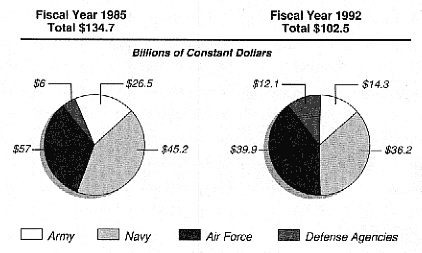
FIGURE 1-2
Changes in DOD total obligation authority for research, development, and acquisition, 1985–1992. SOURCE: U.S. Army; Office of Assistant Secretary (Research, Development, and Acquisition).
-
the field. This approach should be applied to complex support equipment, such as automated test equipment, as well as to weapon systems.
-
Increase the use of commercial practices to procure equipment to be fielded. The success of the Army experiment for the procurement of global positioning terminals, which was undertaken before the Mideast deployment, was unequivocally demonstrated by operations in Desert Storm. That program can set a pattern for much-increased use of commercial design requirements and procurement practices. It appears to the STAR Committee that a far broader range of possibilities exists for the Army to use commercial implementations of technology.
-
Plan for fuller use of commercially available capability in an emergency. An example is increased dependence on the rapidly expanding U.S. commercial air carrier fleets for rapid transport of immediately deployable forces and their equipment. The use of the Civil Reserve Air Fleet during Desert Shield operations indicates but does not fully realize this potential. Were new systems to be more oriented toward air transport in wartime, the STAR Committee believes Army capability could be greatly increased at a substantially decreased cost. The Army is already well started on this approach in its procurement of support vehicles.
-
Stimulate, through economic incentives, industry investment in flexible manufacturing equipment that can be used to produce defense items at low and fluctuating rates of manufacture. Once flexible manufacturing techniques and technology have been established through these incentives, they can be applied to profitable commercial production as well as military production.
-
Design platforms and equipment to accommodate change. The lifetimes of fielded designs, before they are replaced by the next-generation design, will most likely continue to lengthen. The designs of major platforms, for example, must allow retrofit with newer, more advanced components and subsystems, rather than delaying all improvement until the next-generation platform is fielded.
-
To augment the Army's own funding for technology R&D, seek sponsorship from the Strategic Defense Initiative Organization (SDIO) for R&D in areas where SDIO and Army needs overlap. In particular, the SDIO offers an opportunity to ensure adequate funding for Army defenses against future tactical ballistic missile threats (Figure 1-3).
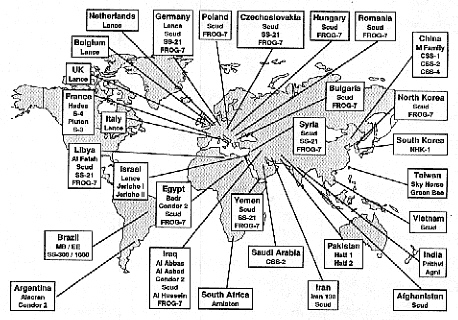
FIGURE 1-3
Tactical ballistic missile technology has already spread around the globe. (Courtesy Public Affairs Office, Strategic Defense Initiative Organization.)
The STAR Committee believes that, through whatever means the Army believes best, cost containment of technology-based systems will be of great importance. The Army should accept the challenge to find the most appropriate ways to harness technology toward this end.
Technology Program Consolidation
Duplication of effort in the technology R&D programs of the different services can be reduced by careful consolidation. The Army has already taken commendable steps in this direction through Project Reliance, which aims at achieving closer integration of these technology R&D programs. Project Reliance implements a greater degree of interservice dependence when requirements of the various services are at all similar.
The less coordinated efforts by the services to exploit directed energy for antisensor weapons provide an excellent current example of a case in which all the services would benefit from consolidated technology development and coherent central direction.
The STAR Committee believes that both the Congress and the Office of the Secretary of Defense will continue to press for more efficient use of the limited funds available to support the military technology base. Consolidation of technology programs will find many advocates. The Committee encourages the Army to continue its leadership in this area. First, the objectives cited by these higher levels are valid on their own merit. Second, there remains a considerable chance that more radical but less efficient alternatives could be forced on the services if they appear unwilling to pursue cooperative consolidation.
Globalization of Commerce
Most industrial economists acknowledge a rapid and inexorable process that is forcing the major industrial companies of the world to become global in their operations. To survive, all major industries (except perhaps those with only defense clients) will have development and manufacturing, as well as sales operations, distributed throughout the world. Most large corporate managements are well on the way to this diversification at all levels.
Global diversification will result in widespread sharing of research, development, and production technology among the internationally based elements of these diversified corporations. In circumstances where the U.S. military must rely heavily on the private sector's R&D and production infrastructure, the United States can no longer
assume, as it has in the past, a substantial domestic technological leadership.
The current technological superiority of U.S. forces, which was demonstrated to the world in Desert Storm, derived in the past from two sources: (1) the superiority of American university-based basic and applied research and (2) the Army's ability to move the technology produced by research into the field. In important areas of advanced technology, U.S. universities and private sector laboratories now share leadership with research institutions in other countries. Also, as other countries continue to match or exceed the United States in R&D prowess, an increasing number of the postgraduate students in scientific and engineering programs in the United States are foreign nationals. Many of them will eventually return to their native countries. One consequence of these changes is that the United States can no longer rely on embargo on advanced technologies to provide a breathing space before other nations have access to those technologies.
Nevertheless, the STAR Committee believes that the Army can sustain its technological edge provided it can accelerate the introduction of new technology into its fielded systems. Among the means to do this is designing major platforms for change, so that subsystem upgrades move technological advances rapidly into the installed base of fielded capability.
It is important that the Army consider the major changes now occurring in the private sector that supports the Army. Many suggestions on this topic are made by the STAR Committee in later chapters and in the supporting STAR reports. However, it is up to the Army to set its own sights on the future and, in particular, to have a program that responds to the globalization of the technology base on which it depends.
CHARACTERISTICS OF THE THREATS
To prepare for its task, the STAR Technology Management and Development Planning Subcommittee began by evaluating the likely circumstances in which the Army might need to use its technology during the coming decades. The subcommittee sought to leaven the considerable knowledge and experience of its members with the insights of a distinguished group of senior retired military officers. Two special symposia, held in November and December 1989, brought these special guests together with the STAR subcommittee. The conclusions from these symposia are abstracted here to provide the context of external factors—the factors apart from technological consid-
erations—that were used by the STAR Committee in forming its judgments, suggestions, and recommendations, which are presented in the remainder of this report.
-
The dissolution of the Warsaw Pact as a credible opposition force is permanent. Conditions inside the former Soviet Union greatly reduce the probability of a conventional NATO confrontation with it.
-
Although the threat has receded, Soviet nuclear and conventional capabilities continue to be substantial. High levels of intelligence gathering and verification of arms control agreements are still required. Also, increased turmoil between nations elsewhere in the world will require a geographic broadening of the intelligence program.
-
Future contingencies are likely to be regional, although they may occur anywhere on the globe. The scale, terrain, climate, indigenous culture, and character of the opposing force could vary widely from case to case (Figure 1-4). The plausible potential threats during the next three decades appear to be so varied that planning should not be based on the selection of one or two specific scenarios. Force structure
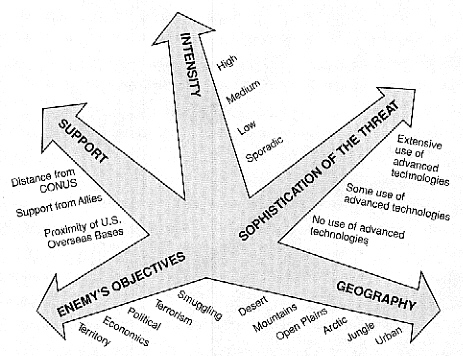
FIGURE 1-4
Spectrum of potential contingency operations.
-
planning that is based on a few specific scenarios could work against the flexibility needed to handle the range of situations the Army may face.
-
Some of the land forces that might oppose U.S. interests are both large and capable. In both the Middle East and the Far East, potential adversaries have large forces armed with modern weapons. Some of these forces could immediately threaten areas of national interest to the United States.
-
The potential for contingencies to emerge rapidly, combined with the remote locations in which the Army might have to confront them, makes timeliness of U.S. military response a far different problem than it was when reinforcement of NATO forces in mid-Europe was the dominant scenario.
-
Forward basing of U.S. troops and logistic support will very likely be severely reduced, for reasons of both domestic economics and international politics.
-
The ability to deploy ground forces will remain an essential element in guaranteeing credible projection of U.S. power and deterrence. Although the United States can reasonably expect to have naval and air superiority during the next decade, ground troop numerical superiority cannot be assumed in the initial stages of a U.S. military response. This situation increases the need for joint doctrinal planning and interoperable weapon development requirements.
-
Prospects are encouraging for important new arms agreements among the major industrialized nations on chemical, biological, and nuclear weapons. There is also likely to be renewed emphasis on the Geneva protocols for treatment of both civilians and prisoners of war. However, the regional conflicts of the next 30 years may well involve participants who threaten to, or in fact do, ignore these agreements. The threat or actual use of chemical or biological weapons, or terrorist actions such as hostage-taking and attacks on civilians, may be used by adversaries to constrain U.S. response. These nonconventional threats require imaginative technical planning for appropriate countermeasures. "In-kind" retaliation will remain inappropriate for a number of reasons, but strategies to neutralize such threats will be needed.
-
The operational performance of combat units and individual soldiers will become even more important in a world situation where both sides have access to an international market in advanced weapons technology. When the weapons on both sides are similar in technical quality, how we use our weapons will decide the outcome. In this regard, training and doctrine development will be even more important to success on the future battlefield.
CHARACTERISTICS THE ARMY WILL NEED
At these same symposia, the STAR panelists and their guest participants also considered which characteristics would be most important to the Army in meeting the threat circumstances outlined above.
-
Flexibility. The Army must be able to reconfigure itself rapidly and on demand into operating elements with maximum deployed combat effectiveness for the range of potential threats. Mobilization of reserves, and even reconstitution of a force structure to fight a major war, should be planned along a continuum of response that begins at small-scale contingencies (such as Grenada) to be met with active units, reconfigured as needed.
-
Mobile, Survivable Combat Power. Moving available U.S. forces rapidly to the point of desired force application becomes even more imperative and difficult under these anticipated conditions. Because the Army must be prepared to counter heavily armored adversaries, the remoteness and lack of road infrastructure in likely threat locations place a premium on firepower, especially survivable counter-armor firepower, that is transportable by air. Resupply into remote combat areas is another required characteristic. The need for rapid long-distance deployability will require designing systems to fit available air transport and, in the longer term, active Army participation in specifying new transport capabilities. In many situations there will be two aspects of mobility: (1) transport of personnel and material into theater and (2) battle zone mobility within theater. The range of firepower required will depend on the particular situation, but many contingency operations will require the more robust, heavier elements of the force, including tanks, armored infantry vehicles, and self-propelled howitzers, to ensure that the deployed force can accomplish its objectives while minimizing its casualties. Survivable heavy systems that can be inserted with the lighter force elements will be essential. Technology will provide the means (lighter but stronger composites, microelectronics, etc.) to make weapon systems smaller and lighter than current systems, yet at least as survivable and lethal. The ability to transport by air a small but potent force equipped with these systems will reduce the vulnerability of the "first-to-arrive" forces in a contingency operation.
-
Dependence on Reserve and National Guard Forces. Decreasing defense budgets probably will require even further reliance on the National Guard and the Reserves for first-line Army capability. It follows that this reserve capability must be rapidly available with little advance warning.
-
Joint Operations. Closely integrated and continuous joint combat operations will be far more important in contingency operations in the future than were required in past scenarios for mid-European contingencies. An increased emphasis on real-time combat interdependence will probably require modifications in many areas, including joint command, control, communication, and intelligence (C3I); weapon systems design; logistics; and fighting doctrine.
-
Prepositioning of Forces and Supplies. Limitations on transport capacity will require reliance on prepositioning forces and, more importantly, supplies. If political circumstances do not allow remote prepositioning at ground sites, prepositioned provisioning can be by ship. Shipboard provisioning may be maintained either overseas or in U.S. ports, if it is kept ready for immediate deployment. A major goal of new technology should be to reduce the currently high level of consumables expended in contingency operations.
-
Increased Real-Time Intelligence Capability. Future intelligence requirements will be geographically dispersed beyond their current focus on Europe and the Far East. Part of the slack can be taken up by technology. Human intelligence (HUMINT) and signal intelligence (SIGINT), which will be even more important for the contingency and peace-keeping operations of the future, will be more difficult to implement effectively. For example, language skills will be needed that differ from those the Army now possesses in quantity, and real-time distribution of intelligence information must be improved.
-
Improved All-Weather, Day-Night Capability. Among the most important advantages to U.S. forces will be the ability to operate effectively in all types of weather and continuously throughout the day and night. In addition to the requisite technology, this capability will depend on appropriate emphasis in doctrine and on training at both the individual and unit levels.
-
Psychological Operations. As a way to reduce combat and collateral casualties, greater understanding of techniques for psychological operations (PSYOPS) and their effectiveness will be needed. The force structure and equipment to support PSYOPS must be provided.
-
Improved Short Turnaround Cycle for Planning, Deployment, and Training. Because the nature and location of future contingencies will generally not be known with long lead times, the Army's ability to plan and train for such contingencies is necessarily restricted. Advanced simulators, knowledge bases, and other computer technology offer potential for overcoming these restrictions, at least partially.
-
Stability of the Military Institution. The symposiasts expressed concern that a precipitate downsizing of forces might undermine the Army's capacity in the short term to respond effectively to contin-
-
gency operations like those in Panama, Grenada, or the Persian Gulf. Their concern for the longer term was that the professional structure needed for a successful national mobilization, should one be necessary, might be lacking. The STAR Committee believes that technology can ameliorate these problems to some extent. Examples include wider use of computer-assisted instruction and simulation systems for training, better personnel selection and classification technology, decision-support technology to aid planners and strategists, and technology that reduces the support and logistics requirements for a given level of combat operation.
The STAR Committee emphasizes that the above descriptions of threat characteristics and of requirements for the Army to be able to meet them are not original to the STAR study. Rather, they summarize the context within which the Committee has interpreted, assessed, and integrated the findings and recommendations of the individual STAR panels. It has been the specific responsibility of the STAR Committee to formulate its report and make its final suggestions to the Army with this context clearly in mind.
A STAR VISION OF THE FUTURE
The three decades from 1960 to 1990 were undoubtedly a time of astounding technological opportunities. Furthermore, these opportunities were seized and brought to fruition in advanced Army systems. Those members of the STAR Committee whose working careers extend back 30 years and more remember the military technology of the early 1960s.
The Sidewinders and Chaparrals of that era were the technological wonders of their time. Yet they had only a half-dozen vacuum tubes to accomplish all their missile guidance. As a result, they had little capability against maneuvering aircraft or countermeasures. From our present vantage point, their military technology seems primitive. Today's Sidewinder, Chaparral, and their offspring, Stinger, have more megaflop microprocessors in them than their antecedents had vacuum tubes. These modern missiles can acquire and hit the most maneuverable aircraft under a wide range of conditions.
During this same three-decade period, today's concepts of air-land battle and high-speed maneuver became possible only by inserting new technology into heavy armored forces. The lightning left hook of the Army's heavy divisions in Operation Desert Storm demonstrated how speed, agility, accurate fire control at high speed, infrared target acquisition, and vastly improved armor have altered the
tactics of tank warfare from the slow, cautious pace of single-target attack 30 years ago.
Both aircraft and satellites were used to gather intelligence then, but lengthy delays for analysis and interpretation separated the time of data acquisition from the time when commanders in the field could use the information. By contrast, both airborne and satellite reconnaissance in the Persian Gulf war gave commanders useful information in real time. The data stream was processed, communicated, and interpreted fast enough to provide early warning of a scud missile's trajectory and to guide the counterattacks. Now the sensor assets flying high above the fray can directly affect the course of battle far below.
These examples share more than just the practical use of technologies hardly imagined possible 30 years ago. Each modern marvel occurred through the vision of Army engineers who were granted the resources and freedom, by their technology managers, to explore the possible. The recommendations on the Army's in-house R&D infrastructure in Chapter 5 are meant to promote the continuation of similar opportunities for new generations of scientists and engineers.
STAR has been asked to forecast technology and systems over a similar span of three decades. None of the study participants doubt that technology will progress as much, if not more, during this next span as it has since 1960. Despite reduced budgets, there will be ample opportunities for similar success in expanding the possible to achieve the practical.
Yet the old-timers among us wonder whether the next generation of Army visionaries will enjoy an environment that encourages and nurtures their efforts and unleashes their creativity. The business of technology development has become much more complicated; it seems more difficult now to apply technology rapidly to the needs of forces in the field. The structure as it stands today casts doubt on whether the next generation will be able to seize the opportunities offered by technology to produce similar marvels in future Army systems. The implementation strategy, focal values, and other technology management changes recommended by the STAR Committee are offered in the hope of regaining an environment that will attract and encourage a new generation, to ensure the technological dominance of U.S arms into the twenty-first century.


