
4
Automobiles
With justification, the automobile industry is viewed as a bellwether industry for many of the trends unfolding in manufacturing. Confronted with the challenges of improving fuel economy, cutting emissions, and maintaining market share in the face of rapidly expanding Japanese competition, U.S. automakers have been forced to pursue many objectives at once. Developing and incorporating advanced product and process technologies have been necessities at the same time that reduced manufacturing costs and high quality have become fundamental market requirements. Such daunting and often conflicting demands have stretched resources and skills to the limit, but the success in achieving all these objectives should not be underestimated.
Given these pressures, it would be reasonable to assume that offshore manufacturing could offer attractive advantages, particularly as an effective way to lower production costs; therefore, an analysis of these costs as they affect global site location would be expected to provide useful insights both to managers in the industry and to policymakers. Somewhat to the committee's surprise, however, the assumption appears to be false. There is no apparent trend to offshore manufacture of automobiles. In fact, the dominant trend is in the opposite direction: foreign investment has been flowing into North America on an unprecedented scale.
A brief review of developments in the industry will provide some insight into this process. Unfortunately, reliable production cost data are not available in a form that would allow a cost analysis analogous to those elsewhere in this report. Several recent studies, however, have described important trends in global automaking and include data that suggest the source of differences in production costs and the overwhelming importance of market access in site selection decisions.1
BACKGROUND
In many ways the automobile industry is a microcosm of manufacturing in general. It is often the largest single industry in countries where automobiles are manufactured. Because it is such a large component of the economy and a major employment provider, the industry has a long history of government regulation and trade protection. It also illustrates the accelerating pace of technological change: the mechanical precision, electronics, and materials technology imbedded in new cars overwhelm products of 20 years ago, but 1970 models, although more refined, were not that much different from those of the 1930s. Much of this technological change has been driven by environmental concerns, which have affected the auto industry for 20 years and are now spreading rapidly to other industries. Finally, perhaps more than any industry, automaking has been confronted with challenges to traditional concepts of effective manufacturing practices that promise to have a profound long-term effect on how and where cars are built in the next century.2
Those traditional concepts of effective manufacturing are based on "mass production," first applied to automobiles by Henry Ford. Ford used mass production to reduce production costs dramatically, thereby creating the mass market for automobiles and dominating global auto production in the early part of this century. Because of its clear advantages, mass production eventually spread to every large-scale producer worldwide but has been refined to meet the unique demands of different automobile markets.
Because the American auto market is both large and, historically at least, homogeneous, and dominated by a few large
firms, mass production in the American auto industry is volume driven. It is based on high-volume production on dedicated equipment of interchangeable parts that are assembled on an equipment-paced line by low-skilled workers with very narrowly defined tasks. Costs are minimized through economies of scale, so the need to maximize volume dictates a number of design, engineering, sourcing, and investment practices. For instance, to maximize the output of expensive stamping dies, stamping is typically performed in central locations and parts are shipped to distributed assembly plants, common parts are used in as many models as possible, purchasing decisions are based on the lowest bidder, and investments are driven by the desire to eliminate labor.
This traditional mass production system relies on dedicated equipment and equipment-paced assembly lines to keep production high, which is inherently inflexible. Imposing product differentiation on the system, as the market now demands, tends to increase the difficulty of maintaining control of the system. Some disruptions are equipment based: equipment breaks down, defects may be found only after large numbers of bad parts have been produced, and different machines produce parts at different rates, causing production bottlenecks. The system has evolved to accommodate such disruptions: high work-in-process inventories minimize bottlenecks that could stop production, long product life cycles minimize the need for die changes and other costly and time-consuming disruptions, and high scrap and rework are accepted as inevitable costs of maximizing equipment output and the pace of assembly. The costs of such solutions are overwhelmed by the economies of scale gained by maintaining output.
Traditional mass production is extraordinarily good at low-cost production of undifferentiated items. It is inherently weak, however, in many of the attributes consumers now demand, particularly consistently high quality and product differentiation. To meet these demands—attributes of their market for many years—several (not all) Japanese auto manufacturers have refined a different form of mass production, embodied in the term "lean production."3
Developed initially at Toyota and now spreading through the auto industry and others, lean production integrates the
manufacturing system to minimize waste, maximize quality and flexibility, and stimulate innovation. Lean production has turned traditional assumptions, measurements, and management of manufacturing in the auto industry upside down. Lean producers engineer flexibility into the production process (e.g., through rapid die changing); expect workers to perform multiple tasks, ensure the quality of their work, and call attention to defects to discover their source (by stopping the line if need be); work closely with suppliers to allow them to determine the most effective manufacturing processes for the parts they supply; and create engineering teams to work on product and process engineering simultaneously. The results are much higher product quality, virtually eliminating inspection and rework; lower production costs; and greater production flexibility, allowing more models to be produced with less production capacity and rapid model turnover.
As these concepts have spread from Toyota to other Japanese manufacturers and, more recently, to U.S. automakers, the competitive advantages they provide result not only in increased market share for lean producers but also redefined customer expectations. Lean production is, therefore, upping the ante of what it takes to be competitive in the automobile industry.
INTERNATIONAL MOVEMENTS OF PRODUCTION CAPACITY
Despite the size of the industry, the ubiquity of its product, and the size of the relatively few firms engaged in automobile assembly, it is only recently that international site location has been an issue for automakers and governments. Because of the history of the industry and the distinct character of demand in different markets, the auto industry has always been home market focused. Although Ford opened an assembly plant in England in 1911 and General Motors purchased Opel in 1925, both ventures were devoted to serving unique European demands and were managed largely independently from their American parents. Only in the past decade or two has the automobile industry begun to globalize; the trend is strong, but progress is still limited. In 1988 Ford was by far the most globalized of the 11 high-volume producers, but it still produced 66 percent of its
output in North America; General Motors produced 75 percent of final output in North America. All the Europeans manufactured over 80 percent of their output in Europe, and among the Japanese, only Honda produced more than 25 percent outside Japan.4 It has only been since 1982, when Honda began assembling cars in Ohio, that the level of Japanese investment abroad has grown rapidly, and the number of Japanese plants—including final assembly, engines, and component suppliers—in North America and Europe continues to rise.
Furthermore, of the 48 million vehicles produced worldwide in 1988, only about 10 percent were produced in developing countries. Although vehicles are manufactured or assembled in about 30 less developed countries (LDCs), and over 60 LDCs produce parts and components, only three—Korea, Brazil, and Mexico—have managed to export much, accounting for over 90 percent of all LDC vehicle exports.5 Additionally, it is worth noting that Korea's largest auto producer, Hyundai, opened an assembly plant in Bromont, Quebec, in 1989.
These points deserve emphasis because their implications are often lost in the general debate about U.S. competitiveness. There has been very little discernable movement of production out of North America by American producers. True, imports have captured a growing share of the domestic market, which, of course, represents offshore movement of production. And there has been some growth in Mexican production to serve the U.S. market, most notably Ford's Tracer/Escort plant in Hermosillo and Chrysler's Acclaim/Spirit/LeBaron plant in Toluca. However, from the perspective of the focus of this report— offshore movement of production to lower production costs—it simply has not happened. In fact, the only major global shift in automobile production has been Japanese investment in North America, combined with domestic shifts in production by American producers—that is, closures of outdated assembly plants; new investment to modernize existing plants; and greenfield investments, such as General Motors' Saturn plant in Spring Hill, Tennessee.
The Japanese have invested heavily in North American production, an investment that ranks as perhaps the largest scale shift of production capacity to a foreign location ever undertaken. Between 1982 and 1992 the Japanese will have opened

Four computer-controlled robots weld the underbody, one of the first steps in automobile assembly.
Source: General Motors Corporation.

After 18 pairs of robots apply spot welds to the car's unibody, workers perform detail welding. A total of 5,000 welds are used in the full-size car illustrated, 93 percent of them applied by robots.
Source: General Motors Corporation.
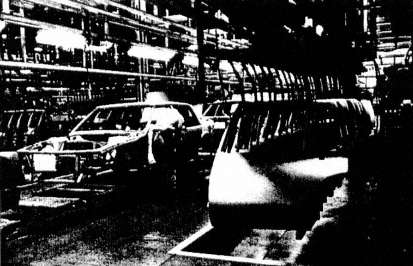
Beside the assembly line, doors move on hangers beside the bodies they will join. Front doors and the hood are then added as the “body in white” moves toward the paint shop.
Source: General Motors Corporation.

Robots are used extensively in painting operations, ensuring consistent paint application and minimizing worker exposure to the painting environment.
Source: General Motors Corporation.
eight major assembly plants, creating capacity to build over 2.5 million cars per year in North America.6 They also have created a materials and parts supplier network in the United States to raise local content over 80 percent in the next few years. Presently there are 66 Japanese-owned steel works, 20 rubber and tire factories, and more than 270 auto parts suppliers. Production equipment is also domestically sourced from U.S. and Japanese suppliers. Sixteen Japanese machine tool companies now manufacture in the United States, along with two convey-or belt manufacturers and two builders of automobile painting equipment.7
What has motivated this tremendous investment? The primary factor was the Voluntary Restraint Agreement on exports to the United States. Local production was the only way to continue to build share in the rich American market. The strengthening of the yen in foreign exchange markets reinforced the logic of local production and helped build the conviction among Japanese managers that continuing to rely on Japan as an export platform was no longer viable. A global production base was needed to increase flexibility, market awareness, and customer response. Finally, the Japanese have discovered that they can build cars and parts abroad as well as they can in Japan, and better than most of the local producers, so the risks inherent in local production, particularly those related to work force management, have proven to be minimal. In fact, a local production base provides a better means to leverage the advantages of the lean production system to customize products for different markets; to speed product introductions; and to build knowledge of, access to, and implementation of locally developed technologies.
MANUFACTURING COSTS
Although offshore movement of automobile production has, almost exclusively, been movement by Japanese producers to North America and increasingly to Europe, a brief examination of manufacturing costs will emphasize the point that the critical driver is market access. Assessing manufacturing costs in auto production, however, is extremely complicated. First, good data are difficult to find. When dollar costs are available, in-
ternational comparisons over time are virtually impossible because additional data on exchange rates, interest rates, model configurations, sources of components, and other factors are not sufficient to make appropriate adjustments. Second, understanding of costs is changing rapidly as the concepts of lean production spread through the industry. The coexistence of mass production and lean production adds to the complexity of assessing production costs in the automobile industry. Third, costs vary widely by model, options, plant age and location, and stage of the business cycle. Generalization across the industry is difficult, and averaging across the diversity of models and components is not very informative. Finally, the situation is further complicated by the high degree of government interference in the global auto market. Trade protection is rife, typically to retard market penetration by Japanese producers; safety and environmental regulations are numerous and, though slowly converging, remain inconsistent across national and state boundaries. Consequently, even more than most other industries, international cost comparisons are problematic. Nevertheless, the data that are available make it clear that automobile production costs are not strongly correlated with geography.
Why not? The main reason is that Offshore manufacturing locations have little to offer except low-cost labor, but direct labor has become a small part of manufacturing costs. Though the level varies by model size and low-volume luxury models tend to have more hand work, on average direct labor accounts for only 5 to 10 percent of automobile assembly costs, with a combined labor and load of 15 to 20 percent.8 As a source of cost savings, direct labor does not provide the same leverage as materials, although most materials are purchased parts, components, and subassemblies that have significant imbedded labor content. However, even in automotive parts production (SIC 3714), direct labor is only 15 to 20 percent of production costs and combined labor and load 30 to 35 percent;9 with parts production as well, the cost of materials offers greater leverage to reduce total costs.
That is not to say there are no opportunities to reduce labor costs. Comparisons reported in a survey of auto plants by the International Motor Vehicle Program at the Massachusetts Institute of Technology reveal broad differences in hours required
to assemble comparable cars. The average hours per vehicle in Japan in 1989 were 16.8; for Japanese plants in North America, 21.2; for American producers, 25.1; and for European producers, 36.2.10 Clearly, there is room for improvement. Just as clearly, superior performance can be achieved in North America using American labor.
The standard approach to reducing labor content has been through automation, and many American managers have explained these differences in hours per vehicle by pointing to relative levels of automation. Despite the fact that Japanese plants tend to be more automated than American and European plants—for example, in Japan 86 percent of welding steps are automated versus 76 percent in the United States and Europe11—this explanation is demonstrably inadequate, as more and more managers are realizing. According to George C. Eads, vice president and chief economist of General Motors:
... Automation has been proposed as an antidote for high developed country wage costs. It is argued (1) that only by significantly reducing the labor content of motor vehicles can companies manage to retain production in the developed countries and (2) that the only way that labor content can be reduced is through automation.... Thus far at least, the second part of this argument has not turned out to be correct, at least not in the United States.... The cost reductions achieved by North American "transplants" and Ford ... have not been obtained through increased automation but instead through improved organization and management of the production process.12
Experience corroborates this idea that management, not automation, is the key issue in cost competitiveness. General Motors spent over $40 billion in the 1980s on factory automation. Though improvements in cost and quality have been achieved, the results have not met expectations and much of the realized improvements have been due to management and organization changes, not automation. For instance, General Motors' joint venture with Toyota, the New United Motor Manufacturing, Inc. (NUMMI), achieved major reductions in costs and defects through improved organization and management, not automation.13 Similar improvements have been achieved at several Ford plants. As the concepts of lean production continue to
pervade the industry, average hours per vehicle can be expected to fall further.
As labor content continues to fall through the spread of lean production practices, the critical labor issue shifts away from cost to quality. Workers in lean production facilities are expected to perform a wider variety of tasks in cooperation with fellow workers. Such jobs are in sharp contrast to traditional mass production jobs that are narrowly defined and highly repetitive; they require higher skill and greater initiative. Although such traits are typically thought to be the preserve of advanced societies, several automakers have found workers in less developed countries, such as Mexico, to be both receptive to and highly competent at lean production practices. In fact, Ford's highest-quality plant is in Hermosillo, Mexico.14 When combined with dramatically lower wage and benefits costs, the productivity potential of low-cost workers would appear to offer an unbeatable advantage.
In reality, the advantage is quite small in relation to total production costs. Even if labor costs were zero, total costs would still be reduced only by 10 percent. High leverage for reducing production costs comes in materials and overhead, which are also dramatically reduced using lean production techniques. Given this reality, the attractiveness of low-cost labor is virtually eliminated in site location decisions, particularly since low-cost locations have few if any other attractors. Markets are small; infrastructure is often weak; supply lines are long. Consequently, auto plants are sited in LDCs to meet local content requirements, not as replacements for home market production. (Mexico, increasingly, is a unique case given recent changes in its local content regulations and the possibility of a North American Free Trade Agreement.)
EFFECT OF FUEL ECONOMY REGULATION
Although it is clear that potential production cost savings are not sufficient to overcome the advantages of producing in the large developed markets, there is an increasing risk that a certain amount of foreign production will be encouraged by the Corporate Average Fuel Economy (CAFE) regulations. All automakers must meet a standard for CAFE, currently 27.5 miles
per gallon (mpg), or pay fines of $5 per 0.1 mpg per vehicle sold. However, imports are averaged separately and treated as if manufactured by separate manufacturers, though they must meet the same standard.
As the CAFE standard has become more stringent and automakers begin to use up the credits earned in past years to meet current standards, this separate averaging of imports creates opportunities to manage production to raise a firm's CAFE through foreign production. For CAFE purposes, a domestic car must have 75 percent local content; conversely, cars with less than 75 percent local content are considered imports and averaged separately. Because most imports are small cars that typically exceed the 27.5 mpg standard substantially, automakers can minimize the adverse effects of their largest, least fuel efficient models by averaging them with the imports. They can still meet the standard for imported vehicles but without dragging down the average for domestic products.
The result is that automakers are increasingly likely to source components from abroad to lower the domestic content of their largest cars. For instance, Ford builds its Crown Victoria/Grand Marquis full-size sedans in Canada (a domestic plant for CAFE purposes). Through the 1990 model year it was classified as a domestic car; for 1991, however, Ford opted to lower domestic content under 75 percent by using door trim, instrument panels, and fuel tanks from Mexico; forged upper-front suspension arms from Germany; upper suspension links and shock absorbers from Japan; and tires from Spain. The imported components are sufficient to qualify the model as an import under CAFE regulations. Other automakers use similar strategies. For instance, Nissan maintains the local content of its Sentra subcompact, assembled in Tennessee, below 75 percent to continue its import classification for CAFE, to offset several of its low-mileage imported models.15
Two points should be noted. First, as the Ford example illustrates, LDCs have no particular advantage as a source for imported components; location depends on the level of technology of the part and the availability of qualified suppliers. Second, more stringent CAFE standards would increase the incentive to lower domestic content on a broader range of models.
The result could be greater offshore production of components, though final assembly would likely remain domestic.
SUMMARY
Although its international competitiveness is widely debated, the U.S. automobile industry is not an example of an industry moving offshore. Although Ford and General Motors have a strong presence in Europe and produce in many LDCs to meet local content requirements, the bulk of manufacturing for all automakers is still done in the home market. International site selection, for cost savings or any other reason, has not been a significant phenomenon—with one exception: the Japanese have created massive production capacity in North America and are gradually increasing their capacity in Europe.
This pattern of home market production and Japanese direct investment makes it clear that market access is the dominant motivator of site selection in the auto industry. Because only a few markets—North America, Europe, and Japan—provide the combination of skilled engineers, extensive supplier networks, and customer demand necessary to justify large-scale production, the most attractive sites for production are in those markets. Combined with the fact that the auto industry is highly regulated and confronts trade barriers in every major market, it is not surprising that relatively little production is done in LDCs.
What is surprising is the overwhelming degree to which production remains concentrated in the firms' home markets. Ford has progressed further than its competitors in crafting a truly global enterprise, and the Japanese, particularly Honda, are striving to do so. The other major firms, however, remain quite parochial, especially the Europeans. Volkswagen has a plant in Mexico and a strong presence (with Ford) in South America,16 and Volvo assembles a small number of cars and trucks in Canada, but Renault withdrew from North America when it sold American Motors to Chrysler, and Peugeot and Rover recently withdrew from North America because of poor sales. These firms are missing important opportunities to learn from diverse markets; to leverage products between markets
(e.g., as Honda is doing with the Accord coupe, which is built in Ohio and sold as a mass market model in the United States but is exported in small numbers to Japan and sold as a luxury model with higher margins); and to access and incorporate new technologies nimbly. Capturing these opportunities will provide tangible advantages in the market.


