
NORBERT WIENER
November 26, 1894-March 18, 1964
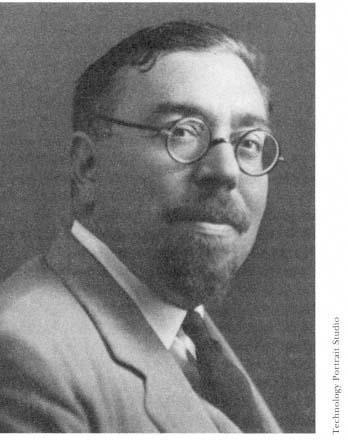
BY IRVING EZRA SEGAl
NORBERT WIENER was one of the most original mathematicians and influential scientists of the twentieth century. He developed a new, purely mathematical theory, an integral calculus for functions of infinitely many variables known as functional integration. It has been of great importance for probability and theoretical physics. Wiener made huge strides in the harmonic analysis of functions of real and complex variables. In a unified way, this resolved old problems, produced new challenges, and provided a prototype for key aspects of harmonic analysis on topological groups. In part concurrently, he developed applications of his mathematical ideas in engineering, biology, and other fields. In later life he developed a synthesis of such applications with diverse ideas represented by central parts of the work done in the twenties and thirties by Vannevar Bush, Walter B. Cannon, Alan Turing, and others.
This synthesis, which he called ''cybernetics," has since been a productive unifying philosophy in science and engineering. In the United States, it primarily epitomized his earlier contributions to communication engineering; in Britain, it had a notable impact on neurophysiology, and its delayed, but eventually enthusiastic, acceptance in the Soviet Union stimulated important mathematical developments
in control and ergodic theory. Before and while cybernetics was being developed, Wiener was a prime mover in multidisciplinary groups in these subjects. As much as anyone, he showed the importance of higher mathematics for fundamental applications, and the general scientific effectiveness of the mathematical way of thinking. At the same time, in association with his work, he elaborated philosophical and social ideas that influenced world culture.
ORIGIN
Norbert's paternal grandfather, Solomon Wiener, was a journalist and teacher of German background who worked in Poland. Norbert wrote of him that he sought to encourage the replacement of Yiddish by German among the Jews there. Norbert's father, Leo Wiener, was born in Bialystok, Poland, in 1862. Leo was related through his mother, Freda Wiener, to Leon Lichtenstein, a well-known German mathematician, as first cousin. Norbert later met Lichtenstein in Europe, and it is interesting that Lichtenstein's central interests of applied mathematics and potential theory came to be important ones for Norbert. Leo Wiener studied engineering in Berlin and medicine in Warsaw. At the age of eighteen he emigrated to the United States. He had had a plan to join in an undertaking to found a utopian community along Tolstoyan lines in Central America. which fell through when his partner backed out. However, in this connection, apparently, he disembarked at New Orleans. After a succession of employments and travels, he became professor of modern languages at the University of Missouri.
Norbert's maternal grandfather, Henry Kahn, had a department store in Missouri, to which he had emigrated from Germany. Kahn's wife came from a family named Ellinger, which had been settled in the United States for
some time. Their daughter, Bertha Kahn, married Leo Wiener in 1893. Their first child, Norbert, was born a year later on November 26, 1894, in Columbia, Missouri. The name Norbert was taken from a work of Robert Browning, the couple being thought to have met at a Browning club. Within the following year, Leo Wiener lost his position, apparently as a result of university politics. He decided to move to the Boston area in search of employment, and found an apartment in Cambridge. After a variety of positions, he obtained a part-time instructorship in Slavic languages at Harvard University. In conjunction with ancillary positions at Boston University and the New England Conservatory, among others, this provided a livelihood during the earlier years in Cambridge. Eventually he became a tenured professor of Slavic languages at Harvard University, a position he held until his retirement.
In the first volume of his unusually intimate autobiography, Norbert gave a portrait of his parents, and especially of his father. He was highly adulatory, but at the same time displayed some intellectual but principally emotional reservations He indicated that his father had placed somewhat excessive pressure on him and had not given him sufficient credit for his intrinsic merits. Instead, he felt, his father attributed his son's precocity and brilliance to his upbringing in accordance with the educational and social ideas he had espoused.
By other accounts, Leo Wiener was exceptionally original, imaginative, and productive intellectually. At the same time, he was a fine teacher and socially very broadly involved. His primary profession was that of a linguist and philologist, and he attained very high distinction in these fields. However, he developed original ideas in quite different areas, for example geology, but his theories had few followers in his day.
There is no question that Leo Wiener was quite concerned about the intellectual development of Norbert and his other children. Early on, he taught Norbert mathematics, languages, and other subjects. He put Norbert in touch with many outstanding intellects that later influenced him. A typical example of this was his taking Norbert to visit the laboratory of his friend, Walter B. Cannon. Cannon's concept of homeostasis was later to form one of the crucial pillars of Wiener's Cybernetics.
In 1898 the family had a second child, Constance. She later married Professor Philip Franklin, a mathematician at the Massachusetts Institute of Technology. A boy was born in 1900, but died in infancy. In 1901, the family visited Europe, following which Norbert entered third grade in a public school in Cambridge. However, after quickly advancing to the fourth grade, he was removed from the school by his father until he entered high school, two years later. Meanwhile, his second sister, Bertha, was born in 1902. She later married Professor Carroll W. Dodge, a botanist at Washington University in St. Louis, Missouri. Besides these two girls, the family eventually included four boys, of whom two died in infancy.
EDUCATION
In 1906, Norbert graduated from high school in Ayer, Massachusetts, and entered Tufts College to study biology and mathematics. His brother Frederick was born in the same year. In 1909, Norbert was graduated from Tufts College with a cum laude A.B. degree. He then entered Harvard Graduate School with the intention of studying zoology. However, the emphasis on laboratory work in this subject turned out to be inappropriate for him, and a year later he transferred to Cornell University, where he had been given a scholarship in the Sage School of Philosophy. He stud-
ied there with Frank Thilly, a friend of his father's from the Missouri days who had facilitated Norbert's transfer to Cornell, and Walter A. Hammond and Ernest Albee. But the work there again did not proceed really well, and a year later Norbert transferred back to the Harvard Graduate School.
However, he stayed with the subject of philosophy. He studied with Edward V. Huntington, G. H. Palmer, Josiah Royce, and George Santayana, some of the well-known philosophers of the time. He received an M.A. degree in 1912, but because of Royce's diminishing health, worked for his doctorate with Karl Schmidt of Tufts, who as a young professor was interested in mathematical logic. In 1913, Norbert was graduated from Harvard with a Ph.D. in philosophy.
In the meantime, the last child to be born to the family (in 1911) died in infancy. Norbert was living at home while at graduate school, and had responsibility for the care of his brother Frederick. Family pressures were strong and burdensome for Norbert. He was quite pleased when the traveling fellowship for which he had applied was awarded to him by Harvard. He contemplated going to Cambridge, England, to work with Russell, and to Turin to work with Peano. Hearing of Peano's decline in scientific activity and considering Russell to be quite active, he decided to go to Cambridge to pursue studies in mathematical logic.
POSTDOCTORAL YEARS
Norbert was not quite as satisfied with Russell's lectures and their meetings as he had expected. At the same time he found that despite his limited background in mathematics, he was able to pick up quickly on the mathematics lectures with which he supplemented his philosophical studies. This was particularly true of the lectures of G. H. Hardy, which Norbert found absorbing. Hardy was probably the leading
English mathematician of his day. Hardy showed less of the reserve that Wiener was sensitive to in some of his other teachers and fellow students, The support and encouragement given by Hardy to the ambitious but uncertain young man seeking a challenging direction in which he could display his intellectual prowess was probably an important factor in Norbert's becoming a mathematician.
Hardy's lectures and writings were virtual works of art as much as of science, displaying personal enthusiasm, richness of content, and unsurpassed lucidity. He showed a sincere and effective interest in talented young mathematicians, and he was not put off by eccentricity —most notably in the case of the Indian mathematician, Ramanujan, but also that of Wiener. In effect, he converted Norbert from a relatively diffuse interest in issues of broader relevance to one of concern for mathematical penetration and perfection. Hardy became somewhat in loco parentis to Norbert, and played this role intermittently for two decades afterward. However, Hardy seems never to have understood the side of Wiener that was deeply attracted to the broad issues of science and to possible applications; he even raised the question of whether Wiener's apparent concern about the latter was not a pose. From Hardy's position, somewhat that of a gentlemanly, latter-day scientific aesthete, such a pose would have been acceptable, while a true interest in applications would have been quite irrelevant. But however much Wiener's professional career depended on his prowess in pure mathematics, his later work was to display quite convincingly and effectively a profound concern for issues of external relevance. With Hardy's support, Wiener was to become better known for his work on Tauberian theorems than for his earlier and probably more innovative work on Brownian motion, which was outside the mainstream of mathematics during the twenties.
During the second semester of Norbert's fellowship year, Russell was away. As a consequence, he went to Göttingen for an extended visit. There Wiener attended the lectures of David Hilbert and Edmund Landau in mathematics, and those of Edmund Hüsserl in philosophy, before returning to Cambridge. The outbreak of World War I led to his return to the United States, where he completed a second traveling fellowship he had been awarded at Columbia University. He studied there with John Dewey, among others.
Following this, Norbert received a junior position at Harvard University. During 1915-16 he lectured there on the logic of geometry. During 1916 he served with Harvard's reserve regiment at the Officer's Training Camp in Plattsburg, New York. In 1917 he served with the Cambridge R.O.T.C. During these years he also worked variously as an instructor in mathematics at the University of Maine in Orono (1916-17); as an apprentice engineer in the Turbine Department of the General Electric Corporation in Lynn, Massachusetts (1917); and as a staff writer for the Encyclopedia Americana in Albany, New York (1917-18).
Both Norbert and his father were strongly and publicly for the Allied cause, despite their ties to German culture. Norbert expressed opposition to "Prussian militarism." He wrote frequently to individual members of his family, and in January 1918 wrote to his father as follows (in part):
I think the time has come for me to make a last try to get into military service, and I am writing to ask you for permission.... It is not that I am dissatisfied with my work nor that I have any particular love for a military career, but I hate to think of myself as less of a man than those of my friends who are in the army, and I do not care after this war to look back on myself as a slacker. I cannot be anything but ashamed of myself when I advocate a war that I do not share in.
In 1918, Norbert accepted an invitation from Oswald Veblen, who was then an officer in the Army in charge of
the computation of ballistic tables, to join him in this work at the Aberdeen Proving Ground, Maryland, as a civilian employee. Veblen's letter noted, in apparent response to Norbert's expressed inclinations, that should he prefer to do the work in a military capacity, such an arrangement might later prove possible. Indeed, Norbert enlisted in the Army as a private some months before the war ended, and continued in the same work. Two months after the war ended, Norbert felt that he was no longer needed. He sought his discharge, and this came through in February 1919.
Veblen, who was already a leading mathematician, returned to Princeton University, bringing with him various younger mathematicians who had displayed talent. Norbert would have liked to go with him but did not receive the call. Instead, he was recommended for a position in the Department of Mathematics at the Massachusetts Institute of Technology by Professor W. F. Osgood of Harvard University. Although the Institute had world renown as a school of engineering in 1919, it was then far from being a leading center of mathematical research. Norbert did not regard the recommendation as evidence of attainment of much standing as a mathematician, but he accepted the position that was offered. He remained at the Institute up to the time of his death, and his scientific interaction with it was to prove a great mutual benefit.
CENTRAL DECADE I: 1919-29
Wiener's early mathematical papers concerned mathematical logic and its relations to space, time, and measurement. In their physical and empirical concerns they foreshadow some of his mature interests. They display notable seminality and independence, and are quite interesting from a historical perspective. Their publication, in considerable
number in the Proceedings of the Cambridge Philosophical Society, was facilitated by Hardy, whose lectures Wiener was attending at the time of his first publication (in mathematics) in 1913.
Whether despite or in part because of the turbulence of the war years, the seed of Wiener's scientific innovation began to sprout vigorously soon after. His first major mathematical salient, in what is now called functional integration, began around 1919. In August 1920, in one of his many intimate letters to his sister Constance, he wrote from Paris as follows:
I have not been able so far to get in touch with Frechet. I have wired him that I am here and awaiting an answer. I find that I am making a little headway with my problem—integration in function space —and in a way that may have practical application. I define the measure of an interval in it in a way that hitches up with probability theory as it is applied in statistical mechanics, and I have been living in hopes that the Lebesgue integral which I can get from it will be good for something. At any rate, when I meet Frechet, I shall have a peach of a problem to work on.
This was the beginning of his work on a mathematical theory of Brownian motion, essentially the theory of ''Wiener space," as others have called it, and the prime example for the modern theory of functions of functions, or for functions of infinitely many variables. The physical theory of Brownian motion had earlier been studied by Einstein and Smoluchowski and was proposed to Wiener as a topic for investigation by Russell; coincidentally and again serendipitously, the problem of integration in function space had been proposed to Wiener by I. A. Barnett, a former student of E. H. Moore, one of the founders of modern American mathematics, who had initiated research on this problem. These earlier approaches were different from Wiener's and had no special relation to Brownian motion, which Russell had earlier suggested as a topic for investiga-
tion. Wiener was quick to see that the conjunction of the integration in function space idea with the normal probability law established in the physical theory of Brownian motion led to an extremely incisive and interesting mathematical development, which at the same time dovetailed beautifully with the qualitative aspects of the physical theory noted by Perrin.
During the early 1920s, Wiener sank his roots deeper into functional integration, while at the same time making significant contributions in a variety of other parts of analysis. The novelty of his Brownian motion theory was such that it was not at all widely appreciated at the time, and the few who did, such as H. Cramer in Sweden and P. Levy in France, were outside the United States. He became somewhat better known for his work in potential theory. This was a traditional field, unlike functional integration, and although his work connected most closely with work of Lebesgue, Perron, and others in Europe, it seems to have been precipitated by his attendance at the lectures of O. D. Kellogg at Harvard, which both informed Wiener and aroused his interest. In a remarkably short period of time, of the order of two years, Wiener made a series of brilliant contributions that fundamentally altered the subject, which was never the same thereafter. He developed a fruitful concept of generalized solution to the Dirichlet problem (that of the solution of the Laplace equation attaining prescribed values on the boundary of the region in question). He was led thereby to a general notion of capacity that has been essential for modern potential theory. In a beautiful epilogue to this work, he gave a precise geometrical criterion for the regularity of a boundary point relative to the Dirichlet problem.
The theory of almost periodic functions burst on the scene in the twenties with the work of H. Bohr in Copenhagen;
it seemed potentially a promising approach to the intractable Riemann hypothesis and interested Wiener for its relation to the study of vibrations. He was awarded a Guggenheim Fellowship in 1926-27 to work on the subject and arranged through Max Born, who had worked with Wiener on quantum mechanics during a visit to MIT, to spend one semester in Göttingen, and arranged with Bohr to spend the other in Copenhagen.
The eight years beginning in 1926 were to be the most eventful in Wiener's personal as well as scientific life. In 1926 he married Margaret Engemann, a graduate of Utah State College and Radcliffe, who had earlier emigrated with her family from Germany. Their first daughter, Barbara, was born in 1928, and the second, Margaret, in 1929. Although he encountered some unpleasantness in Göttingen arising from the family's espousal of the Allied cause during World War I, the visit was scientifically extremely stimulating. In particular, he gave a course on trigonometric series in this major center and was exposed to ideas of R. Schmidt, which influenced him toward his group-theoretic treatment of Tauberian theory, one of his major scientific achievements. Schmidt's approach complemented that of Hardy and Littlewood on Tauberian theorems, the two together providing the groundwork for Wiener's brilliant synthesis, ''Tauberian Theorems," a 100-page article which appeared in 1932. An even longer memoir, "Generalized Harmonic Analysis," which appeared in 1930, reflected in part his work with Bohr, provided an alternative approach to his Brownian motion theory, and connected this with the spectral analysis of functions on the line.
CENTRAL DECADE II: 1930-40
The Wiener family visited Cambridge University during 1931-32, and at Hardy's invitation, Wiener lectured on har-
monic analysis. Although the Fourier transform was a classic subject, Wiener's approach in his later book reflecting these lectures, The Fourier Integral and Certain of Its Applications, was a distinctive and seminal one. In it one can see the seed of important relations between harmonic analysis in euclidean space, a theory invariant under rigid displacements in this space, and analysis in function space, which relates to Hermite functions much as euclidean harmonic analysis relates to complex exponentials and is ultimately seen to be invariant under the group of unitary operators on a Hilbert space. The connection was to lead to "The Homogeneous Chaos," one of Wiener's most seminal papers, which facilitated harmonic analysis in Wiener space and related to the mathematical theory of Bose-Einstein quantum fields. A decade later, it led to the work of his disciples R. H. Cameron and W. T. Martin on analysis in Wiener space.
During the years 1932-33, Wiener was fortunate in having the collaboration of a brilliant young English mathematician, R. E. A. C. Paley. Following Paley's accidental death, Wiener combined their researches in an important and influential book, Fourier Transforms in the Complex Domain, published in 1934. This concerned several aspects of harmonic and stochastic analysis, especially Laplace as contrasted with Fourier integrals, an extension paralleling his earlier extension of Schmidt's work in Tauberian theory using complex methods. Comparing his own relation to Paley as somewhat similar to that of G. H. Hardy to his collaborator, J. E. Littlewood, Wiener wrote:
My role was primarily that of suggesting problems and the broad lines on which they might be attacked, and it was generally left to Paley to draw the strings tight.
In his obituary of Hardy he wrote:
I think it is fair to say that throughout their long collaboration the extremes of technical facility belong to Littlewood, but that much of the nexus of leading ideas and the philosophical unity is that of Hardy.
In general, Wiener's interest and thrust was to be primarily ideational and only secondarily technical, and enhanced precision and clarity was brought to his articles by the suggestions of a variety of mathematicians who became interested in his ideas.
Wiener's collaboration in the early thirties with E. Hopf, who came to MIT at Wiener's invitation, produced significant work for applied as well as pure mathematics, on an integral equation that bears their names. The topic could also be construed as one in complex harmonic analysis, and is exposed in Wiener and Paley's book, Fourier Transforms in the Complex Domain (1934,3). The extension of real harmonic analysis to the complex domain was one of Wiener's major secondary themes. His study of the work of Heaviside and background in communication theory made this most natural. The applications of harmonic analysis to communication theory largely concern networks and similar mechanisms. As physical objects, these have causality features not logically essential for real harmonic analysis, but which translate into complex analyticity features on Fourier transformation. The book with Paley was in significant part a rigorous and coherent treatment of the basic mathematical phenomena behind this connection. It had considerable pure as well as applied influence, being developed further in works of S. Bochner, E. Hille, and J. D. Tamarkin, among others. On the applied side, the method of factorization in the complex plane used in the treatment of the Wiener-Hopf equation has been useful for a variety of problems, including diffraction and prediction theory.
Wiener's influence was propagated by a number of students and disciples. S. Ikehara, a doctoral student from
Japan in the early thirties, developed a variant of the Wiener Tauberian theorem that was adapted to the treatment of the Riemann zeta function and led to one of the simplest proofs of the prime number theorem, to the effect that the number of primes less than n is asymptotic to n/log n. An outstanding doctoral student was Norman Levinson, who worked initially in harmonic analysis in extension of the line developed by Paley and Wiener and later made significant contributions to the theory of ordinary differential equations. R. H. Cameron and W. T. Martin were already at the postdoctoral level when they began working with Wiener in the late thirties on complex and Fourier analysis. The English mathematician H. R. Pitt came to Cambridge and worked with Wiener on analytic functions of absolutely convergent Laplace-Stieltjes transforms, in extension of the core of Wiener's Tauberian theory. Wiener also worked with R. H. Cameron on the same subject. In part this involved continuous singular measures, on which Wiener worked with Aurel Wintner, a mature German mathematician who had emigrated to the United States. Wintner shared Wiener's interest in probability, and they worked together intermittently for two decades on issues in harmonic analysis and ergodic theory.
The later thirties also saw the beginning of Wiener's espousal of what he later termed "cybernetics, or control and communication in the animal and the machine." The meaning and role of such concepts as memory and learning in machines—a precursor to the field of artificial intelligence—was explored by Wiener in association with students and colleagues. The cofounder of modern information theory, Claude Shannon, took his doctorate at MIT during this period, as did Wiener's student Brockway McMillan, who contributed to Shannon's later theory. While Wiener's ideas concerned information in the broadest context,
Shannon's work treats specifically the production and communication of information in a machine context. The work of the Shannon school has provided probably the major concrete exemplification and indication of practical relevance for Wiener's ideas. It also influenced ergodic theory, which was applied by McMillan, and led in particular to the introduction by Kolmogorov of the concept of the entropy of a flow, which has played an important role in ergodic theory ever since.
The respective ergodic theorems of G. D. Birkhoff and J. von Neumann in the early thirties established ergodic theory as a mathematical subject. Both Wiener and his colleague Eberhard Hopf at MIT were vitally interested in the physically fundamental applications of higher mathematics and became involved in the new subject. In the late thirties Wiener made significant contributions to it, including his Dominated Ergodic Theorem. This strengthened the theorems of Birkhoff and von Neumann, and illuminated the types of convergence involved in ergodic theory.
Probably Wiener's most important mathematical work of later years, and the only one comparable in depth and originality to his earlier work on Brownian motion, on real harmonic analysis, and on potential theory, was on what he termed "the Homogeneous Chaos." This work in the late thirties related ergodic theory to Wiener space Wand to harmonic analysis. The Hilbert space L 2(W) (i.e., the space of all square-integrable functionals defined on Wiener space) was shown to be the direct sum of a sequence of orthogonal subspaces K n (n = 0, 1, 2,. ), each of which was invariant under the induced unitary action on L 2(W) of the measure-preserving transformations Γ(T), arising in a natural way (first observed by B. O. Koopman) from an arbitrary orthogonal transformation T on L 2[0,1]. Even nonlinear transformations could be represented by measure-
preserving transformations on W, as Wiener emphasized in later applications, although the latter did not in general leave invariant the K n. This work exhibits in nascent form a major aspect of the equivalence of the particle and wave representations of a quantized Bose-Einstein field—the K n are what are known as the n-particle subspaces in this connection —as mathematically formulated in the fifties but ideationally going back to the beginnings of quantum field theory in the highly heuristic form given by Dirac, according to which "a Bose-Einstein field is equivalent to an assembly of harmonic oscillators." It was characteristic of Wiener's extraordinary scientific intuition that he was able to construct a basic part of quantum field theory on the basis of pure thought, starting from his theory of functional integration. However, in this work, as well as in later, related work with A. Siegel in the direction of quantum theory, the relation to physics is argued quasi-philosophically rather than objectified analytically; in particular, the quantized field itself is not modeled. Indeed, Wiener seems generally to have eschewed noncommutative operator theory—a major scientific difference between him and the man who is otherwise most similar scientifically, John von Neumann. Relatedly, whereas von Neumann systematically deployed abstract algebraic methods in the direction of modern analysis and its applications, Wiener left undeveloped some of his own insights in the algebraic direction and preferred a classical and concrete approach that had a measure of continuity with the ethos of the Hardy-Littlewood school.
During the academic year 1935-36, Wiener was visiting professor at Tsing Hua University in Peiping (now Beijing), China. He spoke Chinese and many other languages with unusual fluency, even after modest exposure to them. He published several papers in China on analysis of the Hardy-Littlewood type.
PRIORITY TO APPLICATIONS (1940-64)
Wiener had always been inclined toward applications of mathematics in science and engineering, but before World War II his central contributions had been of an essentially general mathematical nature. The war focused his interests into concrete directions, and from that time onward his contributions were primarily in the direction of applications.
The first of these was to prediction theory, which was involved in anti-aircraft fire control. This was a natural and fairly straightforward application of the theory of stochastic processes, which J. L. Doob and others in the United States had developed on a rigorous basis, following Kolmogorov's mathematical formulation of the foundations of probability theory in 1933. Unsurprisingly, in view of the exigencies of the war, Kolmogorov himself had begun to publish on prediction theory, but his work was unknown to Wiener until I chanced to mention it to him at a meeting. However, after incisive early work, Kolmogorov left the subject, while Wiener developed it rather fully, including its engineering aspects, during and after the war. His mathematical theory, which modeled deviations from the signal, or "noise," as a stationary multivariate Gaussian stochastic process, was developed jointly with the younger mathematicians E. J. Akutowicz and, especially, P. Masani. The engineering implementation was developed in collaboration with Julian Bigelow. The basic theory was given in a report published during the war; this was effectively a draft of his monograph, "Extrapolation, Interpolation, and Smoothing on Stationary Time Series," published in 1950.
This work represents a special case of the study of mechanisms as devices that effect an input-output transfer, with regard to smoothing, feedback, and stability, independently of internal dynamics. In part, cybernetics emerges naturally from this study, for which the prediction theory was
an important prototype. In principle, as Wiener stressed, similar considerations apply to the biological and social sciences as well as to the engineering and physical sciences. However, the former systems are relatively complex and lacking in symmetries, so that a general theory cannot be expected to apply to them with the same specificity as in the case of the temporally or spatially invariant models used in electrical engineering and physics. The latter were the systems to which Wiener's mathematical investigations before the war related. Correspondingly, it was the breadth and coherence of the cybernetic philosophy, and its usefulness as a guide to innovative development and experiment, that were its main contributions, rather than any difficult or incisive technical accomplishment. However, its permeation of scientific thought has been so extensive that its novel and stimulating character before and during the war cannot now be readily appreciated.
The origin of Wiener's almost uniquely comprehensive scientific identity can be traced along the following lines. He started out in biology, but felt himself to be too clumsy in experimentation and turned to philosophy. He took his doctorate in this subject, and undertook postdoctoral work directed toward logic. He seems to have turned to mathematics largely because he found he could do it relatively easily and well, and thereby make his mark in the intellectual world more readily than in other subjects. But important factors in his becoming a mathematician were Hardy's leadership and, probably, Russell's declining interest in mathematical logic.
By the middle and late thirties, Wiener had attained pure mathematical eminence, indeed a virtual world preeminence in a major part of mathematical analysis. But his concern with applications had not lapsed and indeed had been nurtured during his years at MIT by interaction with
the Electrical Engineering Department and through it with Bell Telephone Laboratories. The Bush Differential Analyzer, for example, engaged his attention and was an early prototype of the kind of development that would concern him in the forties and thereafter. His work on Fourier analysis, and especially that in the complex domain, provided a general mathematical theory that was clearly most relevant to theoretical network and filter design issues. The work of physiologist Walter B. Cannon, whose contributions revealed and concretely exemplified the importance of feedback and control in the biological context, and Wiener's joint work with Cannon's associate, Arturo Rosenblueth, would naturally have turned Wiener's thoughts toward a unified approach to these matters—and the related ones of memory and learning—in all types of time series, whether generated by physical or biological processes.
Indeed, the time was ripe for such a synthesis. Claude Shannon, who had gone from MIT to Bell Laboratories, had developed the information theory in the context of coding theory and cryptography. This important work provided a compelling illustration of cybernetic philosophy and, together with Wiener's work, served to establish information theory as a field in its own right. About a decade earlier, Alan Turing had developed an illuminating approach to constructive mathematical logic based on a computing machine tape analogy. Still earlier, some of the groundwork for a mathematical theory of information had been laid with the work of L. Szilard in statistical physics, that of R. A. Fisher on statistical estimation, and, in the context of electrical communication theory, work of Nyquist, Kupfmuller, and especially Hartley. Behavioristic psychology, developed by John B. Watson around the same time, provided a biological example of cybernetics, in addition to the theory of homeostasis already mentioned.
CYBERNETICS
Even before World War II, Wiener had begun to think in these directions, while at the same time developing his earlier mathematical work in Fourier analysis and Brownian motion. This work led to important mathematical papers, but when the war came he was quick to turn to applications along cybernetic lines, such as prediction theory and fire control. He never again returned to mathematical work at the intense and profoundly innovative level of his prewar contributions.
In the postwar period Wiener was especially interested in working along multidisciplinary lines encompassing all of physiology, psychology, communication engineering, and the like. He sponsored a seminar that included a number of the most active similarly minded scientists and engineers in the Boston area and covered a broad spectrum of questions, from theory to hardware. In particular, his postwar collaboration with the Mexican physiologist Arturo Rosenblueth led to a series of important papers in biology and medicine. In engineering this approach was exemplified in collaborations with Julian Bigelow and Y. W. Lee involving engineering development of ideas growing out of Wiener's mathematical theory.
Among others who on occasion attended the Wiener seminar were W. S. McCulloch, Walter Rosenblith, and Jerome Wiesner, as well as the brilliant but short-lived Walter Pitts. Wiener's Cybernetics, published in 1948, was in essence both a report on these multifaceted activities and a program. It made a synthesis of ideas and applications that had been set forth in a more limited and technical way in the previous decade. It proved highly stimulating in areas where these ideas had not yet penetrated and remains especially influential in fields involving the conjunction of biology and
psychology with engineering and mathematical modeling. By 1948, however, related ideas had been advanced, in part quite independently, by a number of scientists in diverse fields, from Walter B. Cannon in physiology to Dennis Gabor in optical engineering.
Wiener's later works largely consolidate, amplify, and popularize his earlier relatively theoretical work. Probably the most important was his book Nonlinear Problems in Random Theory, which made the ideas of his theory of Brownian motion and the homogeneous chaos accessible to engineers concerned with time series. He continued his earlier mathematical collaborations with E. J. Akutowicz, P. Masani, and Aurel Wintner at somewhat reduced levels.
His last works increasingly emphasized the biological and social applications of cybernetics. Homeostasis, sensory prosthesis, and the mechanism of the brain were among his favorite themes. So also was moral philosophy. His final collapse took place, fittingly enough, in a speech laboratory, representing a conjunction of several of his scientific interests. He was then in the midst of a lecture tour in Scandinavia, accompanied by his wife—whose steady and understanding support had been of incalculable benefit to him.
In perspective, cybernetics as a field in its own right has receded as its ideas were gradually absorbed in more specific forms in particular fields. It remains a universal metaphor indicative of parallels and relations between a very broad range of scientific and engineering theory and applications. As a crystallization of positivistic attitudes and initiatives concerning temporally evolving systems, it represents a significant contribution to philosophy, Wiener's first love.
BROWNIAN MOTION IN PERSPECTIVE
Wiener's most original and influential work was his theory of Brownian motion, one of the most striking mathemati-
cal developments of the twentieth century, whose implications are still being actively investigated. The idea of installing a countably additive measure in function space brought together central currents in mathematical analysis at the same time that it provided a definitive model for an important physical phenomenon. In more recent years, functional integration has played a major part in quantum field theory —although in a quite heuristic form in the physical literature—as in the path integral formalism originated by Feynman. In any event, Wiener's work in the early twenties appears, with some hindsight, to foreshadow somewhat the important and influential formulation in rigorous mathematical terms of the theory of probability by Kolmogorov in 1933. This correspondingly appears in considerable part as a synthesis of Wiener's prototypical initiative with the abstract integration theory developed during the twenties. Moreover, Wiener space remains the key example for the theory of stochastic processes and its many applications, although the current approaches to the subject are much simpler and more powerful than the original ones.
In its original and perhaps simplest form, Wiener space consists of the space C 0[0,1] of all real continuous functions on the interval [0,1] that vanish at 0. The variable continuous function (or path) in this space, which will be denoted W for brevity, is usually denoted as x(t) in connection with Wiener's theory. To begin with, Wiener measure is defined on all subsets of W that are obtainable by restricting the values x(t 1), x(t 2), x(t) at a finite number of arbitrarily given times to lie in a given region in n-dimensional space. It is uniquely determined by the assumptions, which were implicit in heuristic physical theory, that (1) the joint distribution of x(t 1), x(t 2 ), x(t n ) is normal (it is assumed the measure of all W is 1, so that the language of probability theory is applicable); and (2) if
s < t < u, then x(u)-x(t) has vanishing mean and variance u-t and is stochastically independent of x(s). What was new here was the idea of treating the entire trajectory as a point of a measure space, and, to a lesser extent, the demonstration, which was essential for the applicability of the Daniell integral, that the measure was countably additive. General theory then permitted the unique extension of the measure to a much wider class of subsets of W so as to remain countably additive, and validated all major features of Lebesgue integration theory. In particular, it became meaningful to ask the probability that a function selected at random from W was in a specified function class, e.g., continuous or differentiable.
Wiener's proof that the probability that a Brownian motion trajectory modeled in terms of W would be differentiable was 0 could not have dovetailed more closely with the qualitatively observed character of Brownian motion. To quote from Wiener:
The Brownian motion was nothing new as an object of study by physicists. There were fundamental papers by Einstein and Smoluchowski that covered it, but whereas these papers concerned what was happening to any given particle at a specific time, or the long-time statistics of many particles, they did not concern themselves with the mathematical properties of the curve followed by a single particle.
Here the literature was very scant, but it did include a telling comment by the French physicist Perrin in his book Les Atomes, where he said in effect that the very irregular curves followed by particles in the Brownian motion led one to think of the supposed continuous non-differentiable curves of the mathematicians. He called the motion continuous because the particles never jump over a gap, and non-differentiable because at no time do they seem to have a well-defined direction of movement.
It is interesting that when first established, such phenomena as continuous, nondifferentiable functions were regarded by Poincar é and some other physically oriented mathematicians as irrelevant pathology of negligible import.
The theory may appear at first glance to be somewhat special, being, e.g., nonrelativistic and involving only the elementary differential operator d/dt. However, it can be adapted so as to be invariant with respect to any given group, which may be operative on an n-dimensional manifold, and in further modified form, with d/dt replaced by an arbitrary quasi-elliptic differential operator. In some ways the theory is most cogently and invariantly formulated as the theory of a Gaussian probability in Hilbert space, the connection with Wiener's formulation deriving from the use of his stochastic integral.
More specifically, the nondifferentiability of x(t) with probability 1 meant that formal expressions such as  f(t)dx(t) where f(t) is a given smooth function on the interval [0,1], had no a priori meaning in terms of conventional definitions of the integral. This led to Wiener's introduction of the simplest prototype of the ''stochastic integral,'' which defined f(t)dx(t) as a random variable, or measurable function, on W. Such integrals arise in generalized form in the modern theory of stochastic differential equations, which has been principally developed by K. Ito. In intuitive terms, the Wiener process x(t) is the solution of the "stochastic" differential equation dx/dt = white noise; this serves indirectly to give precise mathematical meaning to the latter concept, which intuitively represents the resultant of uncorrelated random Gaussian effects in time or space.
Two decades would pass before Wiener's disciples R. H. Cameron and W. T. Martin would report that Wiener measure had strange absolute continuity or differentiability properties. They presented an analog to the theorem of Plancherel, applicable to the space L 2(W) of all square-integrable functions on Wiener space, but it too had a strange appearance.
The puzzling features of analysis in W were to be clarified a decade later by work originating in the mathemati-
cal theory of quantum fields. In purely mathematical terms, this showed that in essence analysis in W could more invariantly and effectively be regarded as a disguised version of analysis in Hilbert space H, which in the case of a finite-dimensional Hilbert space was equivalent to conventional harmonic analysis of square-integrable functions in euclidean space. The invariant Gaussian measure g on a real euclidean space H is not countably additive when H is infinite dimensional, i.e., a Hilbert space. Nevertheless, it makes correspondence to any polynomial p(x) defined on H (i.e., the usual type of polynomial applied to a finite number of coordinates in H) a linear functional E(p) = f(x)dg(x) defined by reduction to integration over these coordinates. This functional is positive on positive polynomials and has restricted growth properties. Algebraic theory of the Stone-Gelfand type then shows that there exists a Daniell-Lebesgue-type countably additive probability space Ω and an integral-preserving algebraic isomorphism between the algebra P of all polynomials on H and an algebra of random variables that is dense in L 2(Ω). This legitimizes the application of abstract Lebesgue integration theory, and in particular the Lebesgue spaces L p (H,g) are well defined, by a process of completion of P. The connection with analysis in W is now that L 2(W) is equivalent to L 2(H,g) with H taken as L 2[0,1], via a transformation that is uniquely determined by the property that it carries the Wiener stochastic integral f(t)dx(t) into the linear functional p(h) = <h,f> ≡ f(t) h(t)dt.
The absolute continuity results of Cameron and Martin are subsumed in simple and invariant form by the result that the transformation on H, y → Tx + a, where T is a continuous invertible linear transformation on H and a is a given vector, is absolutely continuous (i.e., has a bona fide Jacobian) if and only if T*T-I is a Hilbert-Schmidt
operator. The apparently strange form of the Fourier transform F in W becomes intelligible on computation of the effect on F of a transition from Lebesgue to Gaussian measure in euclidean n-space (by the unitary transformation consisting of multiplication by the square root of the ratio of the Lebesgue and Gaussian measure densities), followed by letting n → ∞, and then making the transition from Gaussian measure in H to Wiener measure in C 0[0,1].
These results, which I developed in the fifties, and which have been extended by L. Gross, show that in essence L 2 analysis in Wiener space can be regarded as the infinite-dimensional form of conventional L 2 harmonic analysis. Gaussian measure is invariant under the orthogonal group O(H) on H. This implies that for any orthogonal transformation T on H, there is a corresponding measure-preserving transformation Γ (T) on the measure space corresponding to (H,g), a correspondence emphasized by Wiener in special cases in the form of an action on W. For example, if Brownian motion is considered on the entire real line instead of the interval [0,1], as is no essential change, then W becomes invariant under the action of the translations: x(t) → x(t + s). The spectrum of this "flow" (i.e., one-parameter group of measure-preserving transformations), by which is meant the spectrum of corresponding one-parameter unitary group on L 2(W), was determined by H. Anzai and S. Kakutani, starting from the homogeneous chaos work of Wiener, exemplifying a relation to ergodic theory.
Ultimately it was seen that not only orthogonal transformations on the space of real square-integrable functions but also unitary transformations on the corresponding complex space act via an extension of Γ, which leaves invariant the homogeneous chaos decomposition of L 2(H) This complex extension can be correlated with the theory of Bose-Einstein quantum fields in such a way that the invariant
subspaces in question of L2(H) become just the so-called n-particle subspaces. However, it was not until more than a decade after Wiener's work that quantum field theory was subsumable under a clear mathematical theory, especially in its wave aspects, to which the Wiener space formulation corresponded. A heuristic treatment of particle aspects had been given by V. Fock in 1932. The mathematical formulation in the dissertation of J. M. Cook and its equivalence with the "wave" representation (which, e.g., diagonalized the quantum fields at fixed times) has been fundamental in the mathematical theory of quantum fields and especially in work on the construction of nonlinear fields.
Wiener thus intuited a major feature of Bose-Einstein quantization apparently without the stimulus of the physics of the production of particles, which he did not treat. He considered at length the mathematical treatment of light, particularly in his Generalized Harmonic Analysis, but stopped short of the quantized radiation field, which had earlier been introduced by Dirac to explain the emission and absorption of light. The path-space formulation of quantum theory proposed by R. P. Feynman around 1950 is, however, formally closely related to Wiener space. The heuristic Feynman integral was connected with the Wiener integral by R. H. Cameron and by M. Kac. In a more advanced form, this work underlies the influential "euclidean" two-dimensional model for quantum field theory established principally by E. Nelson.
HARMONIC ANALYSIS IN PERSPECTIVE
It was primarily the symmetry of temporal homogeneity that underlay Wiener's central work in stochastic and harmonic analysis, as well as his strong interest in ergodic theory, which connected with both subjects. The original Tauberian theory of Hardy and Littlewood, largely directed
toward applications in analytic number theory, has no such connection. Wiener's work in developing it foreshadowed, as he was aware, the generalization of harmonic analysis to a wide class of commutative groups, of which the groups of temporal and spatial displacements that he treated were quite special cases. He and Paley were among the first to note possibilities for such generalization, but in line with his general attitude, he found it more interesting to treat more directly applicable and less abstract matters.
The development of the theory of harmonic analysis on general locally compact commutative groups, basically complete by the mid-forties, confirmed this insight. In a way the analog of the Plancherel theory on Wiener space, which was connected with Wiener's Gaussian approach to finite-dimensional Plancherel theory, could be construed as a generalization of harmonic analysis to a different group. There is no direct analog to Lebesgue measure in a Hilbert space, but as indicated above, there is an analog to Gaussian measure. Although vector displacements do not leave this measure invariant, they change it in a simple way, and the germ of harmonic analysis based on this measure can be extracted from Wiener's treatment in Gaussian terms of harmonic analysis on the real line in his book on the Fourier integral. Thus from an abstract mathematical point of view, both of Wiener's central areas of research —integration in function space and harmonic analysis on the line—can be regarded as prototypical instances of analysis on commutative groups, of two extreme types. Moreover, this point of view has even technical cogency, as shown by the refinement of classical inequalities on the line by using ideas from analysis in Hilbert space developed by L. Gross.
Wiener's work in harmonic analysis derives from his early imprinting in the Hardy-Littlewood school of "hard" analysis, although its ultimate effect was to "soften" it consider-
ably. In essence it dealt with L l harmonic analysis on the real line R, in contrast to L 2 harmonic analysis in infinitely many dimensions, or analysis on Wiener space. L 2, the space of all square-integrable functions, is simple in that it is invariant under Fourier transformation, but L 1 is not; this is the nub of the difficulty for Wiener's prototypical result on the invertibility of an absolutely convergent Fourier series that nowhere vanishes. On the other hand, the convolution of two functions in L 1 is again in L l, which is not the case for the functions in L 2. Thus L 1(R) forms an algebra, essentially a subalgebra of the convolution algebra A of all countably additive complex-valued measures on R. The basic results of Wiener's Tauberian Theorems, and of later collaborations with Cameron and Pitt, are to the effect that an element a of A has an inverse (in A) provided its Fourier-Stieltjes transform vanishes nowhere (an obviously necessary condition) and if, in addition, the continuous singular component of a is small relative to the other components. In more classical terms, this amounts to the solubility of an integral equation of convolution type.
Wiener gave an alternative formulation of this result as it applied to L 1. If f(x) is a given element of L 1, then the finite linear combinations of its translates f(x + c), where c ranges over all of R, are dense in L l if and only if the Fourier transform off is nowhere vanishing. Wiener showed the same was true for L 2 if "nowhere vanishing"—which was meaningless for L 2 functions, since their Fourier transforms are ambiguous on sets of measure zero—was changed to "non-vanishing almost everywhere." He raised the question, which became known as "Wiener's conjecture," of whether the L 2 result also applied to Lp for other values of p. This was a natural direction of refinement of his Tauberian theory paper, but a decade later I showed that the conjecture was false for 1 < p < 2, although essentially trivially true for p > 2.
Somewhat later, A. Beurling gave an necessary and sufficient condition for the translates of a given function f to span Lp in the sense indicated, provided f was in all the L q spaces for 1 < q < ∞. Shortly afterward he reduced the Riemann hypothesis to a plausible question of spanning in L p. This remains unresolved, but the reduction confirms the potential of the direction that Wiener established for dealing with the issues in analytic number theory with which Hardy and Littlewood were most deeply concerned, and in which Wiener had a lifelong interest.
Ultimately the treatment of Tauberian theory became quite algebraic, a development foreshadowed by aspects of the work of Wiener and Beurling, but completed by the Gelfand school, myself, and others. With the realization that L 1 was a natural generalization of the group algebra of a group to the case in which the group G was the additive group of R, general locally compact groups (essentially only such admitting well-defined L 1 spaces) were studied along similar lines. The analogs of the results of Wiener and his colleagues were valid for arbitrary abelian or compact groups, but not in general.
Another algebraic direction derived from the reformulation of Wiener's basic theorem in terms of ideal theory: The closed ideal generated by a given function f in L 1 (as a convolution algebra) is all of L l if and only if the Fourier transform of f is nowhere vanishing. For an arbitrary function f in L l, every function in the closed ideal it generates evidently vanishes wherever the Fourier transform of f does; but are all such functions in this ideal? Alternatively, one may ask whether the finite linear combinations of the f(x + c) are dense in the subset of L 1 consisting of functions whose Fourier transforms vanish where that of f does—the "spectral synthesis" question. Algebraic methods show that vanishing of the Fourier transform on an open set including
the zeros of the Fourier transform of f is sufficient, and from this it is deducible that if this zero set is sufficiently simple in structure then the indicated question has an affirmative answer. But in general the answer is negative, and no explicit necessary and sufficient condition for a given set of zeroes to imply spectral synthesis for functions whose Fourier transforms have such zeroes is presently known.
Wiener's responsiveness to colleagues and scientific trends was in conjunction with his versatility the source of many shorter papers in a variety of areas not yet mentioned. Some of these include gems of insight that are still cited, such as his early work in logic. But he will probably be remembered chiefly for his work in functional integration and real and complex harmonic analysis, and aspects of ergodic and potential theory, on the pure mathematical side, and for cybernetics and rigorous excursions into statistical mechanics and the theory of light on the applied side.
PERSONAL AND SOCIAL LIFE
Wiener was at the opposite end of the spectrum from ivory tower scientists or academic philosophers. All his life he remained an intellectual whose vocation and responsibility was to contribute to civilization and society as a whole. He felt that it was his bent and duty to remain an individualist who stood apart from institutional establishments, but he faced the world steadfastly. He was elected to the National Academy of Sciences in 1933, but resigned a decade later, giving as his primary reason his opposition to prizes, special honors, and exclusivity in science. In Ex-Prodigy he wrote:
. my early rejection by Phi Beta Kappa [while an undergraduate at Tufts College] has strengthened me in a policy on the basis of which I have resigned from the National Academy of Sciences and have discouraged my
friends in attempts to obtain for me similar honors elsewhere. My reaction is essentially the same at the present day as it has been for nearly forty years—that academic honors are essentially bad, and that other things being equal, I choose to avoid them.
His reasons for resigning from the Academy are amplified in his letter of September 22, 1941, to Dr. Frank B. Jewett, then president of the Academy:
The academy operates in at least three distinct roles, and to my mind these roles are not compatible with one another....
As to the third purpose of the Society—the conveying of honors—I have no sympathy at all. I have always regarded exclusiveness as an attribute chiefly of use in selling unwanted junk to parvenus. I do not wish to belong to any scientific organization which has more than one grade of membership
As to medals, prizes, and the like, the less said of them the better. The heartbreak to the unsuccessful competitors is only equalled by the injury which their receipt can wreak on a weak or vain personality, or the irony of their reception by an aging scholar long after all good which they can do is gone. I say, justly or unjustly administered, they are an abomination, and should be abolished without exception. With these convictions I can only resign from the National Academy of Sciences and rectify the error, committed under the well-meaning appeals of my friends, which I committed in accepting membership in it.
President Jewett's reply, dated September 24, is as follows:
While I still feel you are making a mistake and that you can render better service by staying inside the Academy and using your influence to make it conform more nearly to what you think it should be, I realize that you alone must judge your desires.
I am sorry I have not been able to dig up a problem which would show you the value I see in a body like the Academy, even though it is not all I myself should like to have it. However, one cannot always produce white rabbits out of a hat on demand.
Whatever your final decision, believe me to be your friend.
On October 14, 1941, the Council of the Academy met and later telegraphed Wiener: "Resignation accepted with regret."
Wiener also thought twice about accepting the National Medal of Science, which he received two months before his death, worrying that it would erode the independence and consistency of his position. His persistent uneasy relations to authority in one form or another tend to bring to mind the complex and exceptionally close relations with his father, detailed in his autobiographical volumes. In the introduction to the first volume he wrote:
There is a great temptation to write an autobiography in the Freudian jargon, more especially when a large part of it is devoted to the very Freudian theme of a father and son conflict. Nevertheless I shall avoid the use of this terminology. Yet I cannot deny that Freud has turned over the stone of the human mind and shown a great population of pale and emotionally photophobic creatures scuttling back into their holes.
Those who knew Wiener could hardly help but be struck by the applicability of his description of his father to himself, both as regards temperament and general intellectual tendencies, and he himself wrote that ". my father, notwithstanding all the elements of conflict between us, was my ideal and closest mentor."
All his life Wiener remained essentially a youthful figure, fraternal rather than paternal in his interactions, in de facto respects, apart from his scientific seminality. He was reactive rather than judicial, instructive rather than accommodating, deeply devoted to the highest ideals of scientific detachment and truth at the same time that he was personally quite concerned about the relative quality of his achievements, future as well as past.
Wiener would on occasion become absorbed in intricate questions of technique, as shown for example by the counterexample he developed with Pitt to the invertibility of an arbitrary nonvanishing absolutely convergent Laplace-Stieltjes transform. But this was not his main concern or forte. He preferred the challenge of a qualitatively new issue, or the
synthesis of new relations between existing developments to technical perfection and organization—as, he wrote, had his father also.
Moreover, he preferred a concrete incision to an abstract envelopment, other things being equal, even though his true calling was ideational rather than technical. An instance of this was his anticipation independently of Banach of the concept and some of the theory of complete linear normed vector spaces. Following his initial paper, he seemed content to leave it to others to develop this subject, preferring more structured and applicable, if no less penetrating, areas of research. Another instance was his apparent disinterest in the algebraic methods that developed partly from his work in harmonic analysis.
The algebraic approach, initiated by M. H. Stone in the United States, greatly advanced by Gelfand and his school in the Soviet Union, and applied by myself and others to harmonic analysis and general groups, enormously simplified and greatly extended Wiener's work on the invertibility of absolutely convergent Fourier-Stieltjes transforms, including the basic Tauberian theorem. Wiener's work was catalytic in the development of this approach, and Wiener was apparently satisfied to have acted as such and was not deflected from ongoing research.
Wiener's drive, flexibility, breadth, and vision made it possible for him to make significant original contributions in subjects that he came to largely en passant. On the other hand, no one of Wiener's scientific range could be an expert on all of the subjects in which he took an interest. His work on relativity, quantum theory, light, and statistical mechanics for the most part display topical imagination more than mature scholarship. But some of this work, such as his theory of the coherency of light, has been quite significant.
His reactive and fraternal nature facilitated his personal scientific interactions, and his ideas often developed from groundwork and salients by colleagues developed shortly before he appeared on the scene. It was his unique capacity to sense the potential importance of such salients when appropriately grouped together, and to quickly envision and develop a synthesis that only in retrospect can be seen to carry earlier developments to a logical conclusion.
His autobiographical books, Ex-Prodigy (1953) and I Am a Mathematician (1956), largely mark the end of the innovative phase of his scientific career, apart from his continuing work on prediction theory and some unsystematic excursions. His main motive in writing his unusually personal yet philosophical autobiographical books was that
I wish to think out to myself what my career has meant and to come to that emotional peace which only a thorough consideration and understanding of one's past bring.
Psychosocially, Wiener was sui generis. His personality reflected passionate individualism, a broad and active involvement in society and civilization, and a restless intellectual drive. He was a colorful figure and wit, and he became the center of a large accumulation of anecdotes, which he rather enjoyed. An example, which may be well known because it occurred on more than one occasion, was that of his meeting a colleague midway between his office, where he worked regularly even after retirement, and the faculty club, where he took lunch. On disengagement following an intense conversation, Wiener turned back and said to his colleague, ''By the way, which way was I going when I met you?'' "Why, that way," said the puzzled colleague. "Oh good," Wiener replied, "in that case, I've already had lunch!"
ACADEMIC CAREER
Wiener was a generally extroverted man with many friends, and, for the most part, enjoyed exceptional scientific respect. Still, his independence from conventional disciplinary and other categories and especially outspoken perceptions, insights, and devotion to principle as he saw it fostered reservations and misunderstandings on occasion. Many awards and honors came to him, but he received relatively few invitations to outstanding academic positions such as his early work amply merited and that would have facilitated his research and increased his influence. Vestigial antisemitism may also have played some part in this, as he believed.
Among the prizes he did receive were the Bowdoin Prize (1914) from the Harvard graduate school; the Bocher Prize (1933) of the American Mathematical Society, for outstanding research in analysis, jointly with Marston Morse; the Lord and Taylor American Design Award (1949); and the ASTME Research Medal (1946). He received honorary Sc.D. degrees from Tufts University (1946), the University of Mexico (1951), and Grinnell College (1957). He was one of the first to be awarded the National Medal of Science. On this occasion, January 13, 1964, President Lyndon B. Johnson made the following citation:
For marvelously versatile contributions, profoundly original, ranging within pure and applied mathematics and penetrating boldly into the engineering and biological sciences.
Following his death, President Julius A. Stratton of the Massachusetts Institute of Technology wrote of him:
One of the world's great mathematicians, he was also one of MIT's most distinguished professors. During his forty-five years of association with this
faculty he was a symbol of fine scholarship, and indeed of the highest goals of MIT. We respected him not alone for his productive and creative mind but equally for his warmth of understanding and for his humanity.
EPILOGUE
Wiener vitalized analysis, the branch of mathematics that primarily originates in external issues, at the medium level of abstraction that held together the concrete questions that flow into it from outside with an inner, concentrated logic of its development. He was conscious of this role, and while appreciative of the trend of emphasis on internal issues (topology and algebra) in American mathematics that he largely ascribed to Oswald Veblen, expressed concern that it had gone too far, not only for relevance outside of pure mathematics but for optimal growth of this subject itself. In 1938, at the height of his pure mathematical achievements, he expressed himself as follows:
It is a falsification of the history of mathematics to represent pure mathematics as a self-contained science drawing inspiration from itself alone and morally taking in its own washing. Even the most abstract ideas of the present time have something of a physical history. It is quite a tenable point of view to urge this even in such fields as that of the calculus of assemblages, whose exponents, Cantor and Zermelo, have been deeply interested in problems of statistical mechanics. Not even the influence of this theory on the theory of integration, and indirectly on the theory of Fourier series, is entirely foreign to physics. The somewhat snobbish point of view of the purely abstract mathematician would draw but little support from mathematical history.
After the distraction of the war, during which he developed as his major contribution to the war effort his treatment of stationary Gaussian processes, he preferred to pursue potential applications of mathematics to a variety of fields in which he felt a special challenge and interest. Further systematic pure mathematical work along the lines he had
initiated he was largely content to leave to his disciples and others. In his later work, modeling life as a system, he showed how the concepts of feedback, smoothing, spectrum, and the like that were familiar in engineering and physical systems are relevant to biology and social science.
His influence reinforced and anticipated many trends in science and technology that were organized by him under the rubric of cybernetics. He was as an active proponent of the development of large-scale, high-speed computers long before the need for and potential of them was broadly recognized. Computer modeling of the brain and artificial intelligence developed in substantial part from his influence, applied within collaborative groups in the Boston area. As a scientifically charismatic figure with a considerable literary flair and, above all, a remarkable capacity for relevant theoretical innovation and synthesis, he may have been unsurpassed in his impact on the general scientific scene of his day.
His scientific career and personality were unique. Yet his works stand overall as an outstanding model in this century for a life of synthesis of pure intellectual penetration with external relevance.
I THANK J. L. Doob, P. Elias, W. T. Martin, B. McMillan, W. A. Rosenblith, and M. H. Stone for valuable communications about aspects of Wiener's works and life. This biography was based in part on biographical data prepared by Wiener for the National Academy of Sciences and supplied by the Office of the Home Secretary. Thanks are also due the MIT Archives, and especially to Ms. Kathleen Marquis for the provision of copies of Wiener's letters and other material. I thank the MIT Museum for Wiener's photograph and background information.
Wiener's collected works, exclusive of his books, have been published with commentaries by MIT Press, Cambridge, Massachusetts, edited by P. Masani, in four volumes, 1976-85. A special issue of the Bulletin of the American Mathematical Society, vol. 72, no. 1, part II (1966), was dedicated to Wiener and includes reviews of his works, organized by field.
CHRONOLOGICAL SUMMARY
|
1894 |
Born November 26 in Columbia, Missouri |
|
1906 |
H.S. diploma, Ayer High School, Ayer, Massachusetts |
|
1909 |
B.A. cum laude in mathematics, Tufts College |
|
1909-10 |
Harvard University |
|
1910-11 |
Cornell University |
|
1911-13 |
Harvard University—M.A., 1912; Ph.D., 1913 |
|
1913-14 |
Travelling Fellow, Harvard University; study with Bertrand Russell, Cambridge, England, and with David Hilbert, Göttingen, Germany; awarded Bowdoin Prize (1914) |
|
1914-15 |
Travelling Fellow, Harvard; study with Bertrand Russell and G. H. Hardy, Cambridge, England, and at Columbia University |
|
1915-16 |
Harvard University, Docent Lecturer, Department of Philosophy |
|
1916-17 |
University of Maine, Instructor in Mathematics |
|
1917-18 |
General Electric Corporation, Lynn, Massachusetts |
|
1918 |
Staff Writer, Encyclopedia Americana, Albany, New York |
|
1918-19 |
U.S. Army Aberdeen Proving Ground, Maryland |
|
1919 |
Editorial Writer, Boston Herald |
|
1919-24 |
MIT, Instructor in Mathematics |
|
1925-29 |
MIT, Assistant Professor of Mathematics |
|
1929-32 |
MIT, Associate Professor of Mathematics; Bocher Prize, American Mathematical Society (1933) |
|
1932-59 |
MIT, Professor of Mathematics; Lord and Taylor American Design Award (1949); Hon. Sc.D., Tufts College (1946), University of Mexico (1951), and Grinnell College (1957) |
SELECTED BIBLIOGRAPHY
1913 On a method of rearranging the positive integers in a series of ordinal numbers greater than that of any given fundamental sequence of omegas Messenger Math. 43:97-105.
1914 A simplification of the logic of relations. Proc. Cambridge Philos. Soc. 17:387-90.
A contribution to the theory of relative position. Proc. Cambridge Philos. Soc. 17:441-49.
1915 Studies in synthetic logic. Proc. Cambridge Philos. Soc. 18:14-28.
Is mathematical certainty absolute? J. Philos. Psych. Sci. Method 12:568-74.
1916 The shortest line dividing an area in a given ratio. Proc. Cambridge Philos. Soc. 18:56-8.
1917 Certain formal invariances in Boolean algebras. Trans. Am. Math. Soc. 18:65-72.
1920 Bilinear operations generating all operations rational in a domain Ann. Math. 21:157-65.
A set of postulates for fields. Trans. Am. Math. Soc. 21:237-46.
Certain iterative characteristics of bilinear operations. Bull. Am. Math. Soc. 27:6-10.
On the theory of sets of points in terms of continuous transformations G R. Strasboug Math. Congr., pp. 312-15.
The mean of a functional of arbitrary elements. Ann. Math. 22(2): 66-72.
1921 A new theory of measurement: A study in the logic of mathematics. Proc. Lond. Math. Soc. 19:181-205.
The isomorphisms of complex algebra. Bull. Am. Math. Soc. 27:443-45 .
The average of an analytical functional. Proc. Natl. Acad. Sci. USA 7: 253-60 .
The average of an analytic functional and the Brownian movement. Proc. Natl. Acad. Sci. USA 7:294-98 .
With F. L. Hitchcock. A new vector method in integral equations. J. Math. Phys. 1:1-20 .
1922 The relation of space and geometry to experience. Monist 32:12-60. 200-47, 364-94 .
The group of the linear continuum. Proc. Lond. Math. Soc. 20:329-46 .
Limit in terms of continuous transformation. Bull. Soc. Math. France 50:119-34 .
With J. L. Walsh. The equivalence of expansions in terms of orthogonal functions. J. Math. Phys. 1:103-22 .
A new type of integral expansion. J. Math. Phys. 1:167-76 .
1923 With H. B. Phillips. Nets and the Dirichlet problem. J. Math. Phys. 2:105-24 .
Discontinuous boundary conditions and the Dirichlet problem. Trans. Am. Math. Soc. 25:307-14 .
Differential-space. J. Math. Phys. 2:131-174 .
Note on the series  ± 1/n . Bull. Acad. Polon. Ser. A 13:87-90 .
Note on a new type of summability. Am. J. Math. 45:83-6 .
Note on a paper of M. Banach. Fund. Math. 4:136-43 .
1924 Certain notions in potential theory. J. Math. Phys. 3:24-51 .
The Dirichlet problem. J. Math. Phys. 3:127-146 .
Une condition nécessaire et suffisante de possibilité pour le problème de Dirichlet. C.R. Acad. Sci. Paris 178:1050-1054 .
The average value of a functional. Proc. Lond Math. Soc. 22:454-67 .
Un problème de probabilités denom brables. Bull. Soc. Math. France 11:569-78 .
The quadratic variation of a function and its Fourier coefficients J. Math. Phys. 3:72-9 .
1925 Note on a paper of O. Perron. J. Math. Phys. 4:21-32 .
The solution of a difference equation by trigonometrical integrals J. Math. Phys. 4:153-63 .
On the representation of functions by trigonometrical integrals. Math. Z. 24:575-616 .
Verallgemeinerte trigonometrische Entwicklungen, Göttingen Nachr., pp. 151-58 .
A contribution to the theory of interpolation. Ann. Math. 26(2):212-16 .
Note on quasi-analytic functions. J. Math. Phys. 4:193-99 .
1926 With M. Born. Eine neue formulierung de Quantengesetze für periodische und nicht periodische Vorgänge. Z. Physik 36:174-87 .
With P. Franklin. Analytic approximations to topological transformations. Trans. Am. Math. Soc. 28:762-85 .
The harmonic analysis of irregular motion (second paper). J. Math. Phys. 5:158-89 .
The operational calculus. Math. Ann. 95:557-84 .
1927 The spectrum of an array and its application to the study of the translation properties of a simple class of arithmetical functions, Part I. J. Math. Phys. 6:145-57 .
A new definition of almost periodic functions. Ann. Math. 28(2):365-67 .
On a theorem of Bochner and Hardy. J. Lond. Math. Soc. 2:118-23 .
Une methode nouvelle pour la démonstration des théorème s de M. Tauber. C. R. Acad. Sci. Paris 184:793-95 .
On the closure of certain assemblages of trigonometrical functions Proc. Natl. Acad. Sci. USA 13:27-29 .
Laplacians and continuous linear functionals. Acta Sci. Math. (Szeged ) 3:7-16 .
Une généralisation des fonctions à variation bornee. C.R. Acad. Sci. Paris 185:65-67 .
1928 The spectrum of an arbitrary function. Proc. Lond. Math. Soc. 27(2): 483-96 .
A new method in Tauberian theorems. J. Math. Phys. 7:161-84 .
Coherency matrices and quantum theory. J. Math. Phys. 7:109-25 .
1929 Harmonic analysis and group theory. J. Math. Phys. 8:148-54 .
A type of Tauberian theorem applying to Fourier series. Proc. Lond. Math. Soc. 30(2):1-8 .
Hermitian polynomials and Fourier analysis. J. Math. Phys. 8:525-34 .
Harmonic analysis and the quantum theory. J. Franklin Inst. 207: 525-34 .
1930 Generalized harmonic analysis. Acta Math. 55:117-258 .
1931 With E. Hopf. Über eine Klasse singularer integralgleichungen. Sitzber. Preuss. Akad. Wiss. Berlin, Kl. Math. Phys. Tech. 1931 , pp. 696-706 .
A new deduction of the Gaussian distribution. J. Math. Phys. 10 : 284-88.
1932 Tauberian theorems. Ann. Math. 33:1-100, 787 .
1933 With R. E. A. C. Paley and A. Zygmund. Notes on random functions. Math. Z. 37:647-68 .
A one-sided Tauberian theorem. Math. Z. 36:787-89 .
With R. E. A. C. Paley. Characters of Abelian groups. Proc. Natl. Acad. Sci. USA 19:253-57 .
With R. C. Young. The total variation of g(x + h)-g(x). Trans . Am. Math. Soc. 35:327-40 .
With R. E. A. C. Paley. Notes on the theory and application of Fourier transforms I, II. Trans. Am. Soc. 35:348-55; III, IV, V, VI, VII . Trans. Am. Math. Soc. 35:761-91 .
The Fourier Integral and Certain of Its Applications . New York: Cambridge University Press.
1934 Random functions. J. Math. Phys. 14:17-23 .
A class of gap theorems. Ann. Scuola Norm. Sup. Pisa E( 1934-36): 1-6 .
With R. E. A. C. Paley. Fourier Transforms in the Complex Domain . Am. Math. Soc. Colloq. Publ. 19. Providence, R.I.: American Mathematical Society.
1935 Fabry's gap theorem. Sci. Rep. Natl. Tsing Hua Univ. Ser. A 3:239-45 .
1936 A theorem of Carleman. Sci. Rep. Natl. Tsing Hua Univ. Ser. A 3: 291-98 .
With S. Mandelbrojt. Sur les séries de Fourier lacunaires. Théorèmes directs. C.R. Acad. Sci. Paris 203:34-36 ; Théorèmes inverses, 233-34 .
Gap theorems. C.R. Congr. Intl. Math. , pp. 284-96 .
A Tauberian gap theorem of Hardy and Littlewood. J. Chin. Math. Soc. 1:15-22 .
1937 With W. T. Martin. Taylor's series of entire functions of smooth growth. Duke Math. J. 3:213-23 .
1938 The homogeneous chaos. Am. J. Math. 60:897-936 .
With H. R. Pitt. On absolutely convergent Fourier-Stieltjes transforms. Duke Math. J. 4:420-40 .
With A. Wintner. Fourier-Stieltjes transforms and singular infinite convolutions. Am. J. Math. 60:513-22 .
With W. T. Martin. Taylor's series of functions of smooth growth in the unit circle. Duke Math. J. 4:384-92 .
The historical background of harmonic analysis. In Semicentennial Addresses . Am. Math. Soc. Semicentennial Publ. Vol. II . Providence, R.I.: American Mathematical Society, pp. 513-22 .
With D. V. Widder. Remarks on the classical inversion formula for the Laplace integral Bull. Am. Math. Soc. 44:573-75 .
1939 The ergodic theorem. Duke Math. J. 5:1-18 .
With A. Wintner. On singular distributions. J. Math. Phys. 17:233-46 .
With R. H. Cameron. Convergence properties of analytic functions of Fourier-Stieltjes transforms. Trans. Am. Math. Soc. 46:97-109 ; Math. Rev. 1(1940):13; rev. 400.
With H. R. Pitt. A generalization of Ikehara's theorem. J. Math. Phys. 17:247-58 .
1941 With A. Wintner. Harmonic analysis and ergodic theory. Am. J. Math. 63:415-26 .
With A. Wintner. On the ergodic dynamics of almost periodic systems. Am. J. Math. 63:794-824 .
1942 With G. Polya. On the oscillation of the derivatives of a periodic function. Trans. Am. Math. Soc. 52:249-56 .
1943 With A. Wintner. The discrete chaos. Am. J. Math. 65:279-98 .
With A. Rosenblueth and J. Bigelow. Behavior, purpose, and teleology. Philos. Sci. 10:18-24 .
1946 With A. E. Heins. A generalization of the Wiener-Hopf integral equation. Proc. Natl. Acad. Sci. USA 32:98-101 .
With A. Rosenblueth. The mathematical formulation of the problem of conduction of impulses in a network of connected excitable elements, specifically in cardiac muscle. Arch. Inst. Cardiol. Mexicana 16:205-65 ; Bol. Soc. Mat. Mexicana 2(1945); 37-42.
1947 With S. Mandelbrojt. Sur les fonctions indéfiniment dérivables sur une demidroite. C.R. Acad. Sci. Paris 225:978-80 .
1948 With L. K. Frank, G. E. Hutchinson, W. K. Livingston, and W. S. McCulloch. Teleological mechanisms. Ann. N.Y. Acad. Sci. 50: 187-278 .
With A. Rosenblueth, W. Pitts, and J. Garcia Ramos, and F. Webster. An account of the spike potential of axons. J. Cell. Comp. Physiol. 32:275-318; 33:787 .
Cybernetics, or Control and Communication in the Animal and the Machine . Actualités Sci. Ind. No. 1053. Paris: Hermann et Cie. Cambridge, Mass.: The MIT Press; New York: Wiley.
1949 With A. Rosenblueth, W. Pitts, and J. Garcia Ramos. A statistical analysis of synaptic excitation. J. Cell. Comp. Physiol. 34:173-205 .
1950 Extrapolation, Interpolation, and Smoothing of Stationary Time Series with Engineering Applications . Cambridge, Mass.: The MIT Press; New York: Wiley; London: Chapman & Hall.
With L. Geller. Some prime-number consequences of the Ikehara theorem. Acta Sci. Math. (Szeged) 12:25-28 .
The Human Use of Human Beings . Boston: Houghton-Mifflin.
1951 Problems of sensory prosthesis. Bull. Am. Math. Soc. 57:27-35 .
1953 Ex-Prodigy: My Childhood and Youth . New York: Simon and Schuster.
1955 On the factorization of matrices. Comment. Math. Helv. 29:97-111 .
1956 I Am a Mathematician . The Later Life of a Prodigy . Garden City, N.Y.: Doubleday.
1957 With E. J. Akutowicz. The definition and ergodic properties of the stochastic adjoint of a unitary transformation. Rend. Circ. Mat. Palermo 6(2):205-17 ; Addendum, 349.
With P. Masani. The prediction theory of multivariate stochastic processes, Part I. Acta Math. 98:111-50 .
1958 With P. Masani. The prediction theory of multivariate stochastic processes, Part II. Acta Math. 99:93-137 .
Nonlinear Problems in Random Theory . Cambridge, Mass.: The MIT Press; New York: Wiley.
1961 Cybernetics, 2nd ed. (revisions and two additional chapters). Cambridge, Mass.: The MIT Press; New York: Wiley.
1962 The mathematics of self-organizing systems. In Recent Developments in Information and Decision Processes, pp. 1-21. New York: MacMillan.
DOCTORAL STUDENTS OF NORBERT WIENER
|
1930 |
Shikao Ikehara |
Ph.D. |
|
Sebastian Littauer |
Sc.D. |
|
|
Dorothy W. Weeks |
Ph.D. |
|
|
1933 |
James G. Estes |
Ph.D. |
|
1935 |
Norman Levinson |
Sc.D. |
|
Henry Malin |
Ph.D. |
|
|
1936 |
Bernard Friedman |
Ph.D. |
|
1939 |
Brockway McMillan |
Ph.D. |
|
1940 |
Abe M. Gelbart |
Ph.D. |
|
1959 |
Donald G. Brennan |
Ph.D. |


