
CLARK WISSLER
September 18, 1870-August 25, 1947
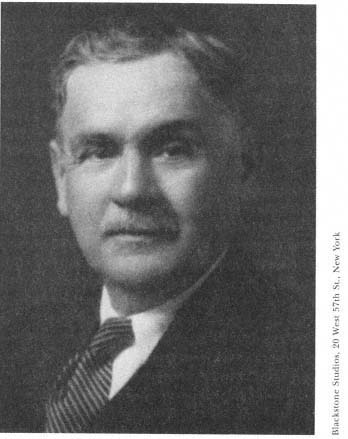

BY STANLEY A. FREED AND RUTH S. FREED
WISSLER LIVED his professional life when anthropological theory in the United States was dominated by the Boasian paradigm of historical particularism. Franz Boas (1858-1942) was chiefly concerned with studying particular cultures as distinctive units without comparing them. Wissler's theoretical ideas provided a basis for going beyond the bounds of Boasian anthropology and developing a nomothetic approach to ethnological data.
Wissler's major theoretical contributions are: 1) a noteworthy development of the concept of culture; 2) a detailed formulation, in which environmental factors are given prominence, of the nature and meaning of the culture area; 3) the age-area concept as a basis for inferential historical reconstruction; 4) the culture pattern; and 5) the universal pattern of culture, which encompasses ideas about the origin of culture, the psychological nature of mankind, and the relation of psychology and anthropology.
Wissler's contributions to the definition of culture have become standard, if largely unacknowledged. His concept of the culture area as a descriptive and classificatory device has been widely used, and the dynamic aspect of the concept was picked up thirty years later by Kroeber in his
influential Cultural and Natural Areas of Native North America.1 Wissler's ideas concerning culture and the environment have been assimilated into modern anthropological theory. Some of his influence has been largely unperceived, particularly concerning the culture pattern, later made famous by Ruth Benedict in Patterns of Culture.2 His innovative and sophisticated concept of the universal pattern of culture was misunderstood and largely overlooked for decades after he proposed it, although its classificatory aspect was routinely used in ethnographies. However, analogues of the theory can be identified today in sociobiology.
Wissler's important contributions to ethnological theory account for only part of his formidable scientific reputation. He also did ethnographic fieldwork; directed research projects of major scope, both in ethnology and archeology; built up impressive museum collections; planned exhibitions; did psychological research and founded the first psychological laboratory at The Ohio State University in 1897; encouraged the early development of dendrochronology; and during much of his career was the principal organizational figure in American anthropology. His work was of considerable interest to geographers and psychologists as well as to anthropologists.
EARLY LIFE
The eldest of seven children of Benjamin F. Wissler and Sylvania (Needler) Wissler, Clark Wissler (christened Clarkson Davis Wissler) was born in a rural house near Cambridge City in Wayne County, Indiana, on September 18, 1870. His maternal relatives came from England in the early 1700s and settled in east-central Indiana soon after the American Revolution. His paternal ancestors reached the same general area in 1808, having migrated to Pennsylvania early in the 18th century from a part of Swabia, now in Switzerland.
Wissler's father was at various times a farm laborer, farmer, carpenter, school superintendent, and editor of a country newspaper. He served in the Civil War. Wissler's first two or three years of schooling were in his father's school. His father had only a little training above the elementary school level, but he spent much of his spare time studying one subject after another. Wissler recalls that at one time his father tried to make a naturalist of him, but he was too much interested in historical events, heroes, and antiquities to spend much time on birds and animals.
Wissler remembers his mother as a handsome woman with wonderful hair. She had little schooling but was quick, hard-working, sensible, moral, exacting, capable, and everything a mother should be. Every year Wissler made a pilgrimage to the little country churchyard where she was buried. Although his mother was not particularly religious, finally ceasing even to attend church, Wissler was brought to church in infancy and childhood. It made a strong impression on him, especially the revival meetings where some people temporarily entered altered states of consciousness, ''shouting and tearing around.'' Wissler "steeled [himself] against yielding to the urge, in which I was encouraged by my parents. To this day I dislike mass emotionalism." Nevertheless, he closely observed the behavior of the chief actor and later when he "read about abnormal behavior and religious extravagance, it all sounded very real and natural."3
One of the strongest influences in Wissler's life was a neighboring farmer, a man of high intelligence but little schooling, who aroused Wissler's interest in anthropology. Wissler worked for him as a boy. An ancient Indian village site was located on his property. The farmer was interested in archeology and collected artifacts, and he encouraged Wissler to do likewise. On rainy days and Sundays
Wissler visited him. His neighbor would take one artifact after another, explain its use, and give it a technical name. "Little that I learned from him in this, my first museum, was afterward found incorrect." 4 From then on, Wissler always felt at home with a collection.
Wissler received his elementary education in Cambridge City. He graduated from nearby Hagerstown High School when he was seventeen years old. He taught in local rural schools for five years (1887-92), studying at Purdue University after the six-month school term ended. The next summer Wissler and a local school superintendent under whom he had worked opened a normal school for the training of teachers. Sixty students enrolled, giving Wissler "a real thrill, for I had a chance to teach on a higher level."5 He spent a year as principal of Hagerstown High School (189293) and then, having made up his mind to follow an educational career, boldly resigned and entered Indiana University. He majored in experimental psychology, receiving his A.B. in 1897 and his A.M. in 1899. He spent one summer at Clark University working under G. Stanley Hall. During his last two undergraduate years, he held an assistantship and conducted experiments on individual differences in mental and muscular abilities. He combined his graduate study and research at Indiana University with teaching, serving as instructor in psychology and education at The Ohio State University from 1897 to 1899.
By this time, Wissler's university experiences had made him aware that his future depended on a higher degree. Also, he married Etta Viola Gebhart on June 14, 1899, and the responsibility of marriage was an additional incentive. The couple eventually had two children, a son, Stanley Gebhart Wissler, and a daughter, Mary Viola Wissler, who for many years was a librarian at the American Museum of Natural History.
Wissler was appointed assistant in psychology (1899-1900) at Columbia University in the same year that he received his A.M. from Indiana University. A year later, he became university fellow in psychology (1900-01). He continued his graduate studies under the psychologist James McKeen Cattell, receiving his Ph.D. in psychology in 1901. From 1901 to 1903, he pursued his laboratory research on individual mental and physical differences under Cattell and also served a year (1901-02) as instructor in pedagogy at New York University.
Wissler regarded his early psychological work as important and took pride in it. He was interested in the mathematical methods used in psychology and claimed to be the first to use Pearson's correlational formula in psychological testing. His psychological work clearly influenced his approach to anthropology, which is peppered with psychological insights, as in the concept of the universal pattern of culture, the culture pattern, and the culture area. Wissler "had a feeling that [anthropology and psychology] belonged together."6 His background in psychology also influenced his later career, playing a part in his appointment to the Institute of Psychology at Yale.
Shortly after graduating from Columbia, Wissler abandoned psychology for anthropology. In later years, he was at some pains to explain his rather abrupt change of careers. He recalled his boyhood when he fell under the influence of his archeologically inclined neighbor and read everything that came to hand about Indians and antiquities. He mentioned that during his summer at Clark University he took a course from the anthropologist A. F. Chamberlain. At the University of Indiana, Wissler studied under William L. Bryan and George E. Fellows. Once Fellows took his class to Chicago to visit the University of Chicago and the Field Museum. They were given a talk by Professor Starr, an anthropologist, and saw the anthropological
collection at the Field Museum. The visit made a deep impression on Wissler. During Wissler's last year at Columbia, he took three full-term courses in anthropology taught by Boas and Livingston Farrand. Although Wissler emphasizes the intellectual influence of his mentors, especially Fellows, practical considerations were probably decisive in his choice of careers. At the time, there were more openings for anthropologists than psychologists "owing to a burst of expeditionary activity at the American Museum. Wissler received opportunities there first for field work, and then of a curatorial position."7
PROFESSIONAL LIFE
Wissler joined the American Museum in 1902 as assistant in ethnology under Franz Boas. At that time, the Department of Anthropology had been reorganized into two departments: ethnology and archeology. In 1904, Wissler was advanced to assistant curator of ethnology; by 1905, when Boas resigned from the American Museum, Wissler was listed as acting curator of ethnology. In 1906, he was named curator of the Department of Ethnology, and in 1907, when archeology and ethnology were administratively recombined, curator of the Department of Anthropology, which rank he held until his retirement in 1942. In short, he was virtual head of the Department of Anthropology at the American Museum for thirty-seven years.
At the beginning of his career in anthropology at the American Museum, he also held a position at Columbia University. He was assistant (1903-05) and eventually lecturer (1905-09) in anthropology. However, he had a short teaching career, whether because of a grievous (unspecified) illness that he contracted in 1907 or because of unpleasantness with Boas that was the residue of Boas's resignation at the American Museum. Although there were
short relapses, Wissler's health took a turn for the better about 1912. "With good medical care and the heroic efforts of my wife, I was able to hold my own....It has been a sore trial, but I accepted it as inevitable and tried to do the best I could. Really there is no just ground for complaint."8
After his health improved, Wissler wanted to do some lecturing, but an offer of an honorary appointment at Columbia came to nothing as the American Museum refused permission. However, in 1924, in the "greatest surprise" of his life, Yale University offered Wissler a research appointment in the newly founded Institute of Psychology. 9 Wissler's training and interest in psychology made him the logical anthropologist for the position. Within a few years, the Institute of Psychology was expanded into the Institute of Human Relations, and Wissler maintained an association with it until he left Yale. Wissler became professor of anthropology when the Department of Anthropology was established in 1931 under Edward Sapir. Harry L. Shapiro, Wissler's colleague at the American Museum, recounts that Wissler would go to New Haven Saturday mornings, lecture and meet with students during the day, and return to New York in the evening.10 William N. Fenton, who was a student of Wissler, recalls that at least later in his affiliation with Yale, Wissler was at New Haven two days a week and that he had anthropology students before the Department of Anthropology was founded. His teaching in later years emphasized acculturation studies and ethnohistory. Fenton emphasizes Wissler's humanity, remembered by colleagues and former students, such as J. C. Ewers, W. W. Hill, F. M. Keesing, D. G. Mandelbaum, S. Mekeel, W. Z. Park, and F. Rainey, all of whom became prominent anthropologists.11 Wissler became Professor Emeritus at Yale in 1940.
Wissler made his principal scientific and administrative contributions during the thirty-seven years that he was head
of anthropology at the American Museum. His field research, lasting only from 1902 to 1905, concerned the Dakota, Gros Ventre, and especially the Blackfoot. He published eleven monographs based on his fieldwork. He believed that a fieldworker should attempt to provide as comprehensive an ethnography as possible, and his seven publications on the Blackfoot approximate that ideal. Thereafter, Wissler directed a number of other field projects on the northern plains which made that region the best known ethnographic area in the New World at the time. In addition, he sponsored both ethnological and archeological fieldwork in other areas of the New World, especially the southwestern United States, encouraged physical anthropology, built up collections of worldwide scope, planned exhibitions, and oversaw the publication of about thirty-eight volumes of the Anthropological Papers of the American Museum of Natural History. He himself published at least 365 titles, chiefly in ethnology, but including a few in pedagogy, psychology, physical anthropology, and archeology.
Wissler developed his major theoretical ideas against the background of his Plains Indian research. His first field trip, in 1902 to the Dakota, stimulated his interest in the concept of culture. Although from reading during his student days, he "began to sense what a culture was like....the real experience came when I was offered a summer field trip.... to the Dakota Indians. I fell into the spirit of the culture [and] now had the feel of the phenomena. Some of the finest human experiences came while engaged in this work: they have always remained the most treasured."12
Definition of Culture
Wissler's interest in culture led to attempts to expand and refine its definition. He was the first anthropologist to perceive the normative aspect of culture, to define it as
learned behavior, and to describe it as a complex of ideas, all characteristics of culture that are today generally accepted. His background in psychology and pedagogy and his interest in statistics are apparent in his contribution to the definition of culture. A definition of culture as rigorous as possible was essential for a cross-cultural nomothetic approach to ethnological data. If aspects of culture are to be compared cross-culturally, culture itself must be defined.
Culture Area
Although the culture area, the best known of Wissler's concepts, was around long before Wissler, it was he who developed the full potential of the concept and advanced it to the point where it could be used analytically. In Wissler's hands, the culture area became more than just a geographical grouping of social units with similar cultures; it was a significant theory of culture change and, as he was well aware, offered an alternative to the Boasian style of anthropology. What the concept did was to shift analytical focus from the culture and history of the specific social unit to a concern with the trait-complex viewed in cross-cultural perspective. Although the usefulness of the culture-area concept has been very great for ethnology, its theoretical significance, especially for the period in which it was formulated, has been generally unappreciated.
The correspondence of a well-defined geographical area with a group of cultures that share many features is the basis of the concept of the culture area. The tribes of one culture area are prevented by physical barriers, cultural habits, and psychological characteristics from close relations with the tribes of other culture areas. The principal barriers that preserve the distinctiveness of a culture area are physical: surface, climate, fauna, and flora. Culture areas are internally dynamic. In each culture area there is
a culture center where innovation takes place and from which cultural influences diffuse to the margins of the culture area. One result is a group of typical tribes and another of marginal tribes. Wissler's view of the relation of culture and environment with its emphasis on the culture center, environment as the medium of culture growth, the selection of a limited number of the possibilites offered by the habitat, and the stability derived from social habits, attracted favorable attention from human geographers.
Culture Pattern
Wissler proposed the concept of the pattern phenomenon, or tribal pattern, to explain the rejection or the incorporation and modification of diffused trait-complexes by receiving societies. Wissler alluded to the basic idea of the pattern phenomenon in 1912. Four years later, he substantially developed the concept in his paper on the shamanistic and dancing societies of the Plains Indians and adjacent tribes, dealing especially with the processes of incorporation and modification. The pattern phenomenon refers to the fact that in a tribe or region there are dominant concepts that retard diffusion or serve to modify borrowed trait-complexes. "The conception is that in certain phases of culture each social unit develops a style, or pattern, for its traits and that borrowed traits will be worked over to make them conform to this pattern."13 Although the concept of the culture pattern, like the culture area, may have been in the air at the time that Wissler wrote, we have found little evidence that any other anthropologist had established clear priority. In any case, Wissler appears to have done with the culture pattern approximately what he did with the culture area: he developed the idea, examined its meaning, applied it to a large body of data, and incorporated it into a theory of culture change. Reviewing
Wissler's General Discussion of Shamanistic and Dancing Societies (1916), A. L. Kroeber observed, ". studies such as this are uncovering principles of broad applicability—principles of a psychology that is truly social, and that. must ultimately be. recognized by every historian or analyst of human civilization."14
Age and Area
The culture-area concept, as a theory of culture change, offers the possibility of making historical inferences. In general, new traits repeatedly originate at the culture center and diffuse outwards to the margins of the culture area in more or less concentric circles. If traits tend to spread at generally similar speeds then there will be a relation between the geographical extent of traits and their age. A widely spread trait within a culture area will in general be older than a more localized one. In his Introduction to Social Anthropology (1929), Wissler referred to the relation of time and space as "age and area"; it is often called the age-area concept. Although the age-area concept was severely criticized, much of the criticism was misdirected. While noting that the concept must be used carefully, A. L. Kroeber wrote, "[Wissler] has done enough with the age-area concept to show that it is not a mere instrument of speculation but a legitimate means of inferential reconstruction when other data fail."15
Universal Pattern of Culture
The major importance of the universal pattern of culture at the time it was proposed was probably in the context of particularism versus comparison. The culture-area concept had furnished a historical basis for cross-cultural comparison; trait-complexes could be abstracted from cultural context and compared because they were historically
connected. Historically unrelated traits can be compared because they are various manifestations of the universal pattern of culture. Although the universal pattern of culture lays a theoretical basis for the comparison of historically unrelated trait-complexes, it deals with many other matters as well, such as the origin of culture, its nature, its acquisition, and the relation of psychology and culture. It is a complex sophisticated theory, and sixty-five years after it was proposed in Man and Culture (1923), it still merits attention in any consideration of the relation of biology, psychology, and culture.
The concept of the universal pattern of culture distinguishes between culture content and pattern. Content consists of trait-complexes. Cultures differ concerning their inventories of trait-complexes, but, viewed as wholes, they are all seen to conform to a basic general plan or pattern. This plan, or outline, features nine principal subdivisions, called culture complexes, such as language, material traits, religion, and government. Each culture complex can be subdivided to the extent that one wishes, but the general scheme fits all cultures known to history.
The universal culture pattern is the essence of humanity, for culture appears only in the form of the universal pattern. By the phrase, human being, we usually mean a primate that possesses a culture conforming to this basic pattern. Thus, the universal pattern is deeply involved in what Wissler considered the fundamental problem in education, psychology, zoology, and anthropology, namely, the analysis of humanity's original biological equipment for culture. The capacity for culture, that is, for the universal pattern, is rooted in the genes. The universal pattern is an expression of inborn behavior, but the specific content is not so determined, depending instead on the nature of the environment and fortuitous events. Cultural evolution
must proceed along the lines of the universal pattern of culture. Each culture complex can be enriched or made more complex, but it cannot be transcended. All cultures are predestined to keep within the bounds of the universal pattern. Yet the universal pattern has within it the potential for wonderful flexibility and tremendous expansion, qualities which, in Wissler's view, make it nature's masterpiece.
There is a general psychophysical basis for culture, namely, the making of responses and the ability to learn, which is essentially a conditioning of responses. Besides this general basis for culture, Wissler proposed more specific psychophysical functions (responses) that are related to various culture complexes. For example, the use of tools is based on the grasping response and the power of reflection; language, on the production of vocal sounds and reflection. Reflection (thought) is the conditioning of the cause-effect response. It is basic to all culture complexes. Wissler asserts that ''The universal pattern for culture is then largely determined by the number and kind of these inborn responses. '' The details of the trait-complexes, in turn, "are largely variants in the conditioning of inborn responses." 16
Archeology and Physical Anthropology
Wissler made noteworthy contributions to archeology through his long vigorous promotion of field research over much of the New World. Among the more noteworthy investigations that he backed was work in and near New York City by A. Skinner, L. Spier, M. R. Harrington, and others; prolonged surveys and excavations in the southwestern United States by L. Spier, A. L. Kroeber. N. C. Nelson, E. H. Morris, and G. H. Pepper; the excavations and explorations of R. Olsen, W. C. Bennett, and J. B. Bird in several regions of South America; the excavations of
G. Vaillant and G. F. Ekholm in Mexico; the Ipiutak (Alaska) excavations by H. Larsen, F. G. Rainey, and H. L. Shapiro; and V. Stefánsson's work in the Arctic. Physical anthropologists were active in the Department of Anthropology during Wissler's tenure as head, most notably L. R. Sullivan, H. L. Shapiro, W. K. Gregory, M. Hellman, F. Weidenreich, and Wissler himself.
The archeological work in the Southwest deserves special attention. Jonathan E. Reyman notes that "although the Southwest was neither his area of special interest or expertise, Wissler was responsible, to a significant extent, for the early prominence of the Southwest in American archeology."17 Reyman points out that during Wissler's tenure as editor of the Anthropological Papers of the American Museum of Natural History, N. C. Nelson, A. L. Kroeber, and L. Spier published studies in that series from 1914 to 1919 that revolutionized American archeology. It is also noteworthy that Kroeber's monumental study of Zuñi social organization was published during the same period.18 Other work of great importance in Southwestern archeology was carried out by Earl Morris at Aztec Ruin and George H. Pepper at Pueblo Bonito, the reports of which were published by the American Museum under Wissler's editorship.
Wissler was responsible for the application of dendrochronology to the problem of dating sites in the Southwest. He asked A. E. Douglass if it would be possible to apply dendrochronology to wood from archeological ruins. Douglass was enthusiastic and asked for some samples. Ultimately Douglass constructed a 250-year chronology of relative dates for Aztec Ruin and Pueblo Bonito and another separate chronology of 160 years for Chaco Canyon. Douglass could not cross-identify his chronologies with living trees and therefore could not establish calendar dates.
Clark Wissler died in New York City on August 25, 1947. He received little scholarly attention after his death owing, in all likelihood, to the fact that his principal base was in a museum where he did not have the chance to build a large following among students. However, in the last decade, his work has been reappraised and his contributions more properly evaluated. Two of the greats of American anthropology, A. L. Kroeber and C. Kluckhohn, credit Wissler with "an exploratory and pioneering mind," and he left an enduring legacy.19 He was one of the three or four leading American cultural anthropologists of his time.
SOURCES AND ACKNOWLEDGMENTS
THIS MEMOIR DRAWS HEAVILY on our article, S. Freed and R. Freed, "Clark Wissler and the Development of Anthropology in the United States," American Anthropologist, 85(4) (December 1983):800-25. The various obituaries listed in that article are useful, especially, G. P. Murdock, "Clark Wissler, 1870-1947," American Anthropologist, 50 (1948):292-304. The biographical note by William W. Speth, "Clark Wissler 1870-1947,'' Geographers: Biobibliographical Studies, 7 (1983):151-154, which was written for an audience of geographers, places Wissler's scientific ideas in the context of geographical thought. J. S. Reed's doctoral dissertation, ''Clark Wissler: A Forgotten Influence in American Anthropology," Ball State University, 1980, is useful. The Department of Anthropology at Ball State University maintains the Clark Wissler papers. We thank W. N. Fenton, H. L. Shapiro, and L. Williamson for kindly reviewing and checking the manuscript, and D. D. Fowler for calling our attention to Wissler's role in the use of dendrochronology in archeology.
HONORS AND DISTINCTIONS20
HONORARY DEGREES
Indiana University (LL.D., 1929)
Yale University (M.A., 1931)
OFFICES IN PROFESSIONAL SOCIETIES
American Anthropological Association (vice-president, 1915, president, 1919-20)
American Association for Adult Education (vice president, 1937)
American Association for the Advancement of Science (vice president, 1914)
American Association of Museums (president, 1938-45)
American Museum of Natural History (dean of the council of the scientific staff, 1935-42)
Bernice P. Bishop Museum (consultant)
Carnegie Institution of Washington (advisor, research associate, 1924-33)
National Park Service (member of the Committee on the Study of Educational Problems in the National Parks, superceded by the National Park Service Educational Advisory Board, superceded by the Advisory Board on National Parks, Historic Sites, Buildings, and Monuments 1929-47)
National Research Council, Division of Anthropology and Psychology (vice chairman, 1920; chairman, 1920-21); Committee on Scientific Research on Human Migration (1926-27); Division of Medical Sciences (member); Committee for Research in Problems of Sex (1925-36).
New York Academy of Sciences (president, 1930 and 1931)
Rockefeller Foundation (advisor)
Social Science Research Council (various committees; member of the Board of Directors, 1925, 1936-38)
MEMBERSHIPS (HONORARY)
American Philosophical Society
Educational Research Association
Fellow of The Royal Anthropological Institute of Great Britain and Ireland
Michigan Academy of Sciences
National Academy of Sciences (elected 1929)
Phi Beta Kappa
Sigma Xi
MEMBERSHIPS (ADDITIONAL)
American Archaeological Society
American Psychological Association
American Society of Physical Anthropology
Association of American Geographers
NOTES
1. A. L. Kroeber, Cultural and Natural Areas of Native North America (Berkeley: University of California Press, 1947).
2. R. Benedict, Patterns of Culture (Boston: Houghton & Mifflin, 1934).
3. Clark Wissler, autobiographical statement, National Academy of Sciences, Archives, Washington D.C., 1943, pp. 3-4.
4. Wissler, autobiographical statement, p. 2.
5. Wissler, autobiographical statement, p. 7.
6. Wissler, autobiographical statement, p. 8.
7. A. L. Kroeber, in Memorial Service for Dr. Clark Wissler, unpublished data, American Museum of Natural History, Archives, p. 1.
8. Wissler, autobiographical statement, p. 9.
9. Wissler, autobiographical statement, p. 9.
10. Harry L. Shapiro, personal communication, 1983.
11. William N. Fenton, personal communications, 1988.
12. Wissler, autobiographical statement, pp. 8-9.
13. The American Indian (New York: Douglas C. McMurtrie), p. 344.
14. A. L. Kroeber. Review of Societies of the Plains Indians, ed. Clark Wissler, Science 47 (1918):243.
15. A. L. Kroeber, The culture-area and age-area concepts of Clark
Wissler, in Methods in Social Science: A Case Book, ed. Stuart A. Rice (Chicago: University of Chicago Press), 1931, pp. 263-264.
16. Wissler, Man and Culture (New York: Thomas Y. Crowell, 1923), pp. 267, 269.
17. Jonathan E. Reyman, "Note on Clark Wissler's contribution to American archeology," American Anthropologist 87(1985):390.
18. A. L. Kroeber. "Zuñi kin and clan," Anthropological Papers of the American Museum of Natural History 18(1917):39-207.
19. A. L. Kroeber and C. Kluckhohn. "Culture: A critical review of concepts and definitions," Papers of the Peabody Museum of American Archaeology and Ethnology 47(1952):151, Harvard University.
20. Wissler was somewhat casual about details such as dates. We have, therefore, checked the information about his honorary degrees and offices (other than "advisor" and "consultant") in professional societies that he gave in his autobiographical statement by telephoning the societies or from published sources. We were, however, unable to verify the item about the American Association for Adult Education.
SELECTED BIBLIOGRAPHY
1897 Imitations of children. Indiana Sch. J. 42:643-54.
1898 The interests of children in the reading work of the elementary schools Pedagog. Semin. 5:523-40.
Studies of the interests of children. Ohio Educ. Mon. 47:254-57.
1899 The child's imagination. Ohio Educ. Mon. 48:13-16.
1900 Diffusion of the motor impulse. Psychol. Rev. 7:29-38.
Some manifestations of double consciousness and their relation to hypnotism. In Hypnotism and Hypnotic Suggestion, ed. E. V. Neal and C. S. Clark, pp. 149-55. Rochester: New York State Publishing Co.
1901 The correlation of mental and physical tests. Psychol. Rev. 3 (Monograph series supplement):1-62.
1902 A review of progress in school tests. J. Pedagog. 14:203-13.
Philosophy among primitive races. Stylus 1(4):55-62.
1903 The growth of boys: correlations for the annual increments. Am. Anthropol. 5:81-88.
1904 Decorative art of the Sioux Indians. Bull. Am. Mus. Nat. Hist. 18:231-77.
With F. Boas. Statistics of growth. Report of the Commissioner on Education, U.S. Bureau of Education pp. 25-132.
1905 Symbolism in the decorative art of the Sioux. Transactions of the Thirteenth International Congress of Americanists , 1902, pp. 339-45.
Review of An Introduction to the Theory of Mental and Social Measurements, by E. L. Thorndike. Am. Anthropol. 7:118-20.
The Spearman correlation formula. Science 22:309-11.
The whirlwind and the elk in the mythology of the Dakota. J. Am. Folklore 18:257-68.
1906 Ethnic types and isolation. Science 23:147-49.
1907 Some protective designs of the Dakota. Anthropol. Pap. Am. Mus. Nat. Hist. 1:19-53.
The Douglas African Collection. Am. Mus. J. 7:67-83.
Review of Mental Development in the Child and the Race, and of Social and Ethical Interpretation in Mental Development, by J. M. Baldwin. Am. Anthropol. 9:194-96.
Review of Sex and Society, by W. I. Thomas. Am. Anthropol. 9:397-99.
Review of Handbook of American Indians North of Mexico, Part 1, ed. F. W. Hodge. Am. Anthropol. 9:403-05.
Diffusion of culture in the plains of North America. In Proceedings of the Fifteenth International Congress of Americanists , 1906, 2:39-52.
1908 Ethnographical problems of the Missouri-Saskatchewan area. Am. Anthropol. 10:197-207.
Review of The Principles of Anthropology and Sociology in Their Relation to Criminal Procedure, by M. Parmelee. Am. Anthropol. 10:461-63.
Review of The Hearing of Primitive Peoples, by F. G. Bruner. Am. Anthropol. 10:463-67.
With W. Channing. The hard palate in normal and feeble-minded individuals. Anthropol. Pap. Am. Mus. Nat. Hist. 1:283-349.
With D. C. Duvall. Mythology of the Blackfoot Indians. Anthropol. Pap. Am. Mus. Nat. Hist. 2:1-163.
Variations in growth. Am. Phys. Educ. Rev. 13:481-90.
1909 Review of The Application of Statistical Methods to the Problems of Psychophysics, by F. M. Urban. Am. Anthropol. 11:121-22.
Introduction. In The Indians of Greater New York and the Lower Hudson, ed. C. Wissler. Anthropol. Pap. Am. Mus. Nat. Hist., 3:xiii-xv.
1910 Material culture of the Blackfoot Indians. Anthropol. Pap. Am. Mus. Nat. Hist. 5:1-175.
1911 Measurements of Dakota Indian children. Ann. N.Y. Acad. Sci. 20:355-64.
Research and exploration among the Indians of the Northern Plains Am. Mus. J. 11:126-27.
The social life of the Blackfoot Indians. Anthropol. Pap. Am. Mus. Nat. Hist. 7:1-64.
1912 Review of The Old North Trail, by W. McClintock. Curr. Anthropol. Lit. 1:13-15.
Review of Social Organization of the Southern Piegan, by J. P. B. De Josselin DeJong. Curr. Anthropol. Lit. 1:15-16.
Ceremonial bundles of the Blackfoot Indians. Anthropol. Pap. Am. Mus. Nat. Hist. 7:65-289.
The Catlin paintings. Am. Mus. J. 12:89-93.
The psychological aspects of the culture-environment relation. Am. Anthropol. 14:217-25.
Stefánsson's discoveries—a tentative summary of results. Am. Mus. J. 12:205-6.
Societies and ceremonial associations in the Oglala division of the Teton-Dakota. Anthropol. Pap. Am. Mus. Nat. Hist. 11:1-99.
North American Indians of the Plains. Handbook Series no. 1. New York: American Museum of Natural History.
1913 A page of museum history: Development during the past three years of the American Museum's work on the Indians of the Southwest. Am. Mus. J. 13:127-34.
The doctrine of evolution and anthropology. J. Relig. Hist. 6:223-37.
Societies and dance associations of the Blackfoot Indians. Anthropol. Pap. Am. Mus. Nat. Hist. 11:359-460.
The relation of culture to environment from the standpoint of invention Pop. Sci. Mon. 83:164-68.
1914 The influence of the horse in the development of Plains culture. Am. Anthropol. 16:1-25.
Material cultures of the North American Indians. Am. Anthropol. 16:447-505.
1915 Costumes of the Plains Indians. Anthropol. Pap. Am. Mus. Nat. Hist. 17:39-91.
Explorations in the Southwest by the American Museum. Am. Mus. J. 15:395-98.
Riding gear of the North American Indians. Anthropol. Pap. Am. Mus. Nat. Hist. 17:1-38.
1916 Psychological and historical interpretations for culture. Science 43: 193-201.
The present status of the antiquity of man in North America. Sci. Mon. 2:234-38.
Aboriginal maize culture as a typical culture-complex. Am. J. Sociol. 2:656-61.
Structural basis to the decoration of costumes among the Plains Indians Anthropol. Pap. Am. Mus. Nat. Hist. 17:93-114.
The genetic relations of certain forms in American aboriginal art Proc. Natl. Acad. Sci. USA 2:224-26.
The application of statistical methods to the data on the Trenton Argillite Culture. Am. Anthropol. 18:190-97.
General discussion of shamanistic and dancing societies. Anthropol. Pap. Am. Mus. Nat. Hist. 11:853-76.
Harpoons and darts in the Stefánsson collection. Anthropol. Pap. Am. Mus. Nat. Hist. 14:397-443.
1917 The American Indian, an Introduction to the Anthropology of the New World. New York: Douglas C. McMurtrie.
1918 Review of An Anthropological Study of the Origin of Eskimo Culture, by H. P. Steensby. Am. Anthropol. 20:213-15.
The sun dance of the Blackfoot Indians. Anthropol. Pap. Am. Mus. Nat. Hist. 16:223-70.
Archaeology of the Polar Eskimo. Anthropol. Pap. Am. Mus. Nat. Hist. 22:105-66.
1919 Indian Beadwork. Guide leaflet no. 50. New York: American Museum of Natural History.
1920 Opportunities for coordination in anthropological and psychological research. Am. Anthropol. 22:1-12.
Arctic geography and Eskimo culture: a review of Steensby's work. Geogr. Rev. 9:125-38.
1921 Dating our prehistoric ruins. Nat. Hist. 21:13-26.
Unearthing the secrets of the Aztec ruin. Harper's Mag. 143:46-56.
1922 Pueblo Bonito as made known by the Hyde Expedition. Nat. Hist. 22:343-54.
Smoking-Star, a Blackfoot shaman. In American Indian Life, by Several of Its Students, ed. E. C. Parsons, pp. 45-62. New York: B. W. Huebsch.
1923 Notes on state archaeological surveys. Am. Anthropol. 25:110-16.
Man as a museum subject. Nat. Hist. 23:245-57.
Man and Culture. New York: Thomas Y. Crowell.
1924 Distribution of stature in the United States. Sci. Mon. 18:129-43.
The relation of nature to man as illustrated by the North American Indian. Ecology 5:311-18.
Comparative data on respiration and circulation among native and foreign born males in New York City. Anthropol. Pap. Am. Mus. Nat. Hist. 23:259-307.
1925 The museum exhibition problem. Mus. Work 7:173-80.
1926 Inheritance of the epicanthic fold. Eugen. News 11:162-63.
Indian Costumes in the United States, a Guide to the Study of the Collections in the Museum. Guide Leaflet no. 63. New York: American Museum of Natural History.
The Relation of Nature to Man in Aboriginal America. New York: Oxford University Press.
1927 Age changes in anthropological characters in childhood and adult life. Proc. Am. Philos. Soc. 66:431-38.
The culture-area concept in social anthropology. Am. J. Sociol. 32:881-91.
The Aztec Ruin National Monument. Nat. Hist. 27:195-201.
Distribution of moccasin decorations among the Plains tribes. Anthropol. Pap. Am. Mus. Nat. Hist. 29:1-23.
1928 The natives of Australia's "West." Nat. Hist. 28:114-30.
The culture area concept as a research lead. Am. J. Sociol. 33:894-900.
The lore of the demon mask. Nat. Hist. 28:339-52.
1929 Archaeology as a human interest. Wis. Archaeol. 8:119-24.
The influence of aboriginal Indian culture on American life, with reference to traces of Oriental origins. In Some Oriental Influences on Western Culture, ed. C. W. Young et al., pp. 16-25. Concord, N. H.: American Council, Institute of Pacific Relations.
Final Report of the Committee on Scientific Problems of Human Migration . Reprint and circular series no. 87 of the National Research Council 21 pp.
The conflict and survival of cultures. In The Foundations of Experimental Psychology, ed. C. Murchison, pp. 786-808. Worcester, Mass.: Clark University Press.
Anthropology. In Research in the Social Sciences, Its Fundamental Methods and Objectives, ed. W. Gee, pp. 81-111. New York: Macmillan.
The origin of man and his races. In Man and His World: Northwestern University Essays in Contemporary Thought, ed. B. Brownell, pp. 11-38. New York: Van Nostrand.
An Introduction to Social Anthropology. New York: Holt.
1930 The universal appeal of the American Indian. Nat. Hist. 30:33-40.
The antiquarian in contemporary life. Indiana Hist. Bull. 7:190-95.
Growth of children in Hawaii; based on observations by Louis R. Sullivan. Mem. Bernice P. Bishop Mus. 11:109-257.
Guide Leaflet for Amateur Archaeologists. Reprint and circular series no. 93 of the National Research Council 11 pp.
The integration of the sexes—marriage. In Human Biology and Racial Welfare, ed. E. V. Cowdry, pp. 266-91. New York: Hoeber.
Review of The Mound Builders, by H. C. Shetrone. Nat. Hist. 30: 670-71.
1931 Observations on the face and teeth of the North American Indians. Anthropol. Pap. Am. Mus. Nat. Hist. 33:1-33.
Review of Death Customs; an Analytical Study of Burial Rites, by E. Bendann. Am. Anthropol. 33:451.
1933 Ethnological diversity in America and its significance. In The American Aborigines, Their Origin and Antiquity , ed. D. Jenness, pp. 167-216. Toronto: University of Toronto Press.
1934 Review of Our Primitive Contempories, by G. P. Murdock. Nat. Hist. 34:306-7.
The rebirth of the ''Vanishing American.'' Nat. Hist. 34:415-30.
European and American Indian cultures in contact. In Race and Culture Contacts, ed. E. B. Reuter, pp. 112-23. New York: McGraw-Hill.
Anthropology. In The National Encyclopedia, vol. 1, pp. 254-64. New York.
Ethnology. In The National Encyclopedia, vol. 4, p. 195. New York.
1935 Review of Dynamics of Population, by F. Lorimer and F. Osborn. Nat. Hist. 35:178.
Social history of the Red Man. In A Handbook of Social Psychology, ed. by C. Murchison, pp. 268-308. Worcester, Mass.: Clark University Press.
Material culture. In A Handbook of Social Psychology, ed. by C. Murchison, pp. 520-64. Worcester, Mass.: Clark University Press.
Review of Anthropology in Action, by G. G. Brown and A. McD. B. Hutt. Nat. Hist. 36:272.
1936 Review of An Introduction to Nebraska Archeology, by W. D. Strong. Am. Anthropol. 38:488-90.
Distribution of deaths among American Indians. Human Biol. 8: 223-31.
The effect of civilization upon the length of life of the American Indian. Sci. Mon. 43:5-13.
Changes in population profiles among the northern Plains Indians. Anthropol. Pap. Am. Mus. Nat. Hist. 36:1-67.
Star Legends Among the American Indians. Guide Leaflet no. 91. New York: American Museum of Natural History. 28 pp.
Review of The Crow Indians, by R. Lowie. Am. Anthropol. 38:654-56.
1937 Twilight of the Old West. Nat. Hist. 39:307-17.
The Indian and the White Man's buffalo. Nat. Hist. 40:625-30.
American Indian tribal groups. In Our Racial and National Minorities: Their History, Contributions and Present Problems , ed. F. J. Brown and J. S. Roucek, pp. 37-55. New York: Prentice-Hall.
The contribution of the Indian. In Our Racial and National Minorities: Their History, Contributions and Present Problems, ed. F. J. Brown and J. S. Roucek. pp. 725-38. New York: Prentice-Hall.
1938 Depression and revolt. Nat. Hist. 41:108-12.
The enigma of the squaw-man. Nat. Hist. 41:185-89.
Sitting with the Indian judges. Nat. Hist. 41:271-74, 298, 302.
The Indian and the supernatural. Nat. Hist. 42:121-26, 154.
Indian Cavalcade, or Life on the Old-Time Indian Reservations. New York: Sheridan House.
1939 Human cultural levels. In Problems of Ageing: Biological and Medical Aspects, ed. E. V. Cowdry, pp. 83-99. Baltimore: The Williams and Wilkins Co.
Review of The Pottery of Santo Domingo Pueblo, by K. M. Chapman. Nat. Hist. 43:61.
1940 Indians of the United States: Four Centuries of Their History and Culture . New York: Doubleday.
Anthropology. In Encyclopedia Americana, vol. 2, pp. 20-22. New York.
Anthropology in America. In Encyclopedia Americana, vol. 2, pp. 22-24.
1941 Review of The Chorti Indians of Guatemala, by C. Wisdom. Nat. Hist. 47:113.
Review of And Still the Waters Run, by A. Debo. Nat. Hist. 47:178.
1942 Review of The Social Organization of the Western Apache, by G. Goodwin. Nat. Hist. 49:181.
The American Indian and the American Philosophical Society. Proc. Am. Philos. Soc. 86:189-204.
Review of Man's Most Dangerous Myth: The Fallacy of Race, by M. F. A. Montagu. Nat. Hist. 50:164.
1943 Some fundamentals in the philosophy of science museums. Mus. News 20:9-12.
How science deciphers man's past. Nat. Hist. 51:120-34.
Wheat and civilization. Nat. Hist. 52:172-81.
1944 The contribution of James McKeen Cattell to American anthropology Science 99:232-33.
The origin of the American Indian. Nat. Hist. 53:312-20.
Review of The Story of the American Indian, by Paul Radin. Nat. Hist. 53:335-36.
Review of Old Oraibi: A Study of the Hopi Indians of the Third Mesa, by Mischa Titiev. Nat. Hist. 53:336.
Review of The Navaho Door: An Introduction to Navaho Life, by A. H. Leighton and D. C. Leighton. Nat. Hist. 53:383.
1945 Corn and early American civilization. Nat. Hist. 54:56-65.
Review of The Science of Man in the World Crisis, by R. Linton. Nat. Hist. 54:100.
1946 Rice as a world food. Nat. Hist. 55:8-19.
Man and his baggage. Nat. Hist. 55:324-30.
1947 The saga of the "earth nut." Nat. Hist. 56:126-33.
The Cereals and Civilization. Science Guide, no. 129. New York: American Museum of Natural History. 63 pp.
Reviews of Changing Configuration in the Social Organization of a Blackfoot Tribe During the Reserve Period, by E. S. Goldfrank, and Observations on Northern Blackfoot Kinship, by L. M. Hanks, Jr. and J. Richardson. J. Am. Folklore 60:308-9.


