
LLOYD VIEL BERKNER
February 1, 1905-June 4, 1967
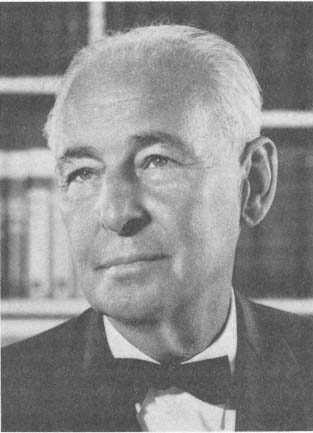

BY ANTON L. HALES
A SUPREME OPTIMIST, Lloyd Viel Berkner believed firmly that what should be done could be done. He had the ability, furthermore, to persuade others that this was so, thereby getting support for large, expensive projects. As his contemporary, Merle Tuve, wrote:
The astonishing thing about [Berkner's] lifetime of varied activities is the frequency with which his large-scale views and proposals were accepted and worked out, to the mutual benefits of his colleagues and the public which supported them, usually with public funds.1
He presented his views with vigor, yet Vannevar Bush (another contemporary) was able to observe:2
Lloyd V. Berkner was undoubtedly one of the best-liked men in the whole field of science and engineering.
He played a significant role in the scientific effort of World War II and, after it, in the explosive development of public funding for science and technology. At the same time he made major contributions to geophysics and to the development of international cooperation in science.
Frederick Seitz relates the following early illustration of the Berkner style:
As a pall bearer at Berkner's funeral service in Arlington National Cemetery, I stood next to an air admiral who had been one of Berkner's boy-
hood companions. Like all of us present he was experiencing a profound sense of loss. During one of the interludes in the ceremony, my companion said: ''It is because of Berkner that I am an air admiral. When we were in high school together he read a newspaper article stating that the Navy planned to give twenty high school students cadet training for the Air Reserve during summers and invited applicants. Berkner said to me, 'We are going to take them up on that.' I suggested that it was a pretty hopeless cause, but he felt the opportunity was important enough to be worth a try. Both of our applications were turned down, which led me to say 'I told you so.' Lloyd said, 'Look, we are going to that camp and going to do from the sidelines exactly what everyone else does. One day, two of the boys they picked will fall out, and you and I will fall in.' I followed Lloyd's lead and we did exactly what he proposed, getting up with the others at dawn and going through all the training routine. The officer in charge of the program came up to us one day after about two weeks had passed and said 'Hey! You two, come over here and get into line!' That was our admission to Naval Aviation!''3
Berkner served in the Naval Reserve until 1965, when he retired with the rank of rear admiral.
THE EARLY YEARS
Born in Milwaukee, Wisconsin, on February 1, 1905, Lloyd Berkner grew up in Sleepy Eye, Minnesota. Already at age fourteen he was an enthusiastic radio amateur with his own station, 9AWM, and before entering college set a distance-speed record—using only homemade equipment—for relay-radio communication from Connecticut to Hawaii and back.4 At the University of Minnesota, where he studied electrical engineering, he worked with the university's experimental radio station to establish WLB, one of the Twin Cities' earliest broadcast radio stations. He also joined the Naval Aviation Reserve, took flight training, and devised, installed, and flight-tested a small VHF radio-communication system for small naval aircraft. (One wonders how he found time to do all this while completing his degree!)
For a year after graduating from Minnesota in 1927, Berkner
worked on a radio-range system for the early airmail routes and on radio navigation beacons for the Airways Division of the U.S. Bureau of Lighthouses. Moving to the Bureau of Standards, he accepted an assignment as a radio engineer with the Byrd Antarctic expedition. Leaving behind his new bride, Lillian Fulks, he flew with Byrd on the first Antarctic flight—a reconnaissance mission to find a path through the ice for the ship to reach the base. Once in Antarctica, Berkner's major duty was to assist Malcolm Hanson in setting up the radio communication equipment on which the success of the expedition depended. Little America's seventy-foot antenna masts made radio communication possible with the expedition's aircraft and stations all over the world.
After the facilities at Little America were completed, Berkner returned with the ships to Dunedin to set up a station that would link Little America with the outside world. Extensive radio operations halfway round the globe to and from Antarctica represented an early epoch in long-distance radio communication and made the Byrd expedition an early "media event." Lillian joined Lloyd in Dunedin, and later the two took part in the Byrd expedition's triumphal tour of New Zealand.5
In addition to operating the relay link station for communications from Antarctica, Berkner monitored the strengths of the signals from stations in Great Britain and the United States. He reported his analysis of these data in his first scientific publication.6
On returning to the Bureau in 1930, Berkner continued his study of radio transmission conditions. He persuaded the Bureau7 to initiate a half-million dollar project for studies of the ionosphere using radio-pulse transmissions—a technique developed five years earlier by Breit and Tuve at the Department of Terrestrial Magnetism (DTM), Carnegie Institution of Washington (CIW). This was the first of his
many successes in getting order-of-magnitude funding increases for scientific research.
During this period he studied ways to determine the fine structure of the F-layer of the ionosphere, strove to develop a rationale for the prediction of long distance short-wave radio propagation conditions, and analyzed ionosphere data collected during the Second Polar Year (1932). But in the early years of the Depression, the Bureau of Standards cut the ionosphere project's funds, and the Carnegie group suggested that Berkner join DTM to continue ionospheric research on a smaller and more personal scale.
CARNEGIE INSTITUTION OF WASHINGTON, DEPARTMENT OF TERRESTRIAL, MANAGEMENT (1933-39)
In 1933 the activities of DTM centered on terrestrial magnetism. As acting director John Fleming recorded in CIW's Year Book 31: "As in the preceding year, the year July 1, 1931 to June 30, 1932 was given over largely to the statistical investigations of the accumulated observational material and to the development of the possible laboratory attack on problems in terrestrial magnetism and electricity." Research at DTM, however, was neither as circumscribed nor as pedestrian as this statement might imply.
Under Louis Bauer, DTM had completed a systematic magnetic survey of the Earth, including biological, physical, and chemical observations made at sea during the cruises of the nonmagnetic ship, Carnegie. It was the analysis of these observations and the magnetic field observations to which Fleming referred. Yet the staff published papers on all aspects of terrestrial magnetism and electricity, including the relation of magnetic phenomena to solar activity and the ionosphere. They also measured the direction of magnetism of rocks and even of sedimentary cores from the North Atlantic.
But in the thirties excitement in physics centered in the atomic or nuclear fields, and—not surprisingly—DTM physicists became involved in these fields. Begun in 1926, the atomic physics program was "a deliberate attempt to provide a new means of attack on some of the most basic problems in magnetism and physics by the development of artificial (high voltage) sources of high-energy particles and radiations" (CIW Year Book 31). These experiments included proton-proton, neutron-neutron, and proton-neutron interactions, as well as various "transmutation" phenomena. The most exciting results were achieved in 1939 when— following the discovery of nuclear fission of uranium by chemical methods (in the language of the Year Books, "atomic transmutation'')—DTM nuclear physicists were able to confirm fission of uranium under bombardment by neutrons. The possibility of a chain reaction, and of whether atomic energy in amounts of practical importance could be developed, were mentioned in Year Book 39.
The staff of DTM was a small and coherent group, all well aware of what each other was doing. It was in this environment that Berkner's scientific interests developed. Their regular conferences on ionospheric research and theoretical physics brought visitors from all over the world, and during this period, Berkner developed his appreciation of geophysics as a global science dependent on worldwide observations.
At DTM, Berkner worked on the ionosphere-sounding program, and all his papers were concerned with the ionosphere (and its relation to terrestrial magnetism, solar activity, and radio transmission) or to the development of equipment for ionospheric observation (as, for example, the continuously recording, automatic ionosphere recorder).
In 1936 Berkner and his wife visited Germany and England. In England he met Sir Edward Appleton, who then
led the British research on the ionosphere. He also attended his first international meeting, the General Assembly of the International Union of Geodesy and Geophysics at Edinburgh.
In 1938 the Berkner family spent some months at the Carnegie Magnetic Observatory at Watheroo, Australia, which proved to be a great family experience. Travelling by ship to England, they then sailed the Suez Canal route to Australia, with stops at many ports on the way. There followed nine months of life in the Australian outback while Lloyd first installed an automatic ionosphere-sounder, then worked on the records he received from it. On the way back to the United States, he lectured on aspects of ionospheric research at universities in Australia and New Zealand.
As Henry Booker wrote of this period of Berkner's career:
In the 1930s only two or three people in the world were thinking about automatic ionospheric observatories. Of these few, the one who conceived, designed, built, installed, operated, and exploited scientifically the first group of successful ionospheric observatories was Lloyd Berkner ... While this period of Berkner's career was dominated by the creation of a new style of ionospheric sounding equipment, and while this type of equipment became of great practical importance for radio communications, his personal objective in the endeavor was to further the science of geophysics ... With these sounders many ionospheric phenomena now well known were clearly recognized for the first time.8
Berkner, Wells, and Seaton published more than fifteen joint papers describing these phenomena before the outbreak of World War II.9
It is clear that in the eyes of DTM's three ionosphere researchers and of other colleagues at DTM, their research was pure, or basic, science. Yet it would be hard to argue they never had practical ends in mind. Their work on the ionosphere may not qualify as basic science according to
Vannevar Bush's definition of basic research as an endless frontier, research "performed without thought of practical ends."10 Yet basic and applied science are often linked more closely than Bush's definition implies, with the distinction left to the taste of the researcher.
In 1939 Vannevar Bush was president of the Carnegie Institution of Washington. He was also chairman of the National Advisory Committee for Aeronautics and thus had contacts with the White House staff. Convinced that war was coming and that science must play an important role in the impending conflict, he met with President Roosevelt in June 1940. Out of this meeting, the National Defense Research Committee (NDRC) was born. NDRC—later the Office of Scientific Research and Development—was to enlist civilian scientists to work in university laboratories on projects deemed by the Committee to be of importance to the war effort.
Naturally enough, some of the early projects were at DTM: development of a network of ionospheric-sounder stations in the western hemisphere, so that optimum communications frequencies could be predicted; development of a proximity fuse; and atomic fusion experiments using high-energy neutron bombardment of uranium. Long before Pearl Harbor, Berkner worked with Harry Wells on the ionosphere-sounder network and with Merle Tuve on the proximity fuse.
In 1941 Berkner spent a few months in Alaska with Lillian and his two daughters, Patricia and Phyllis, working on the installation of an ionosphere sounder at College, Alaska, which he envisaged as the first stage in the development of a complete geophysical observatory in Alaska.
When the Office of Scientific Research and Development (OSRD) was formed, Bush appointed Berkner as his assistant, but in September 1941, the Navy recalled him to ac-
tive duty to organize a radar section in the Bureau of Aeronautics. Soon thereafter he was given charge of all naval aviation electronics engineering. Berkner worked tirelessly to supply radar to Naval aircraft as fast as possible, vigorously supporting the development of airborne radar to make fighter aircrafts' protection of the fleet at night more effective.
Of Berkner's wartime work, Admiral Hall said: "The Navy benefited much from Lloyd Berkner's work then.... Although professionally demanding, he was a leader, not a cold driver. Ashore or afloat, he would suggest some idea or means of solving a problem not previously considered. He was persuasive and men liked working for and with him."11 The Navy awarded him the Legion of Merit and the Secretary of Navy's Commendation with ribbon. The British, conferring on him the Order of the British Empire, called him "a cooperative friend and forthright critic."
THE POST-WAR YEARS (1946-51)
Berkner returned to DTM in 1946 as chairman of the Section of Exploratory Geophysics of the Atmosphere. For much of the period from 1946 to 1951, however, he was on leave of absence to study the interaction between government and science, and Harry Wells managed the Section as acting chairman. In 1946, Vannevar Bush became chairman of the joint Research and Development Board created by the Departments of War and Navy,12 and Berkner was appointed executive secretary of the Board.13 As such he was responsible for the creation of committees, panels, and other mechanisms for involving the scientific and technological community in military R&D.
After this assignment he returned to DTM, but was there barely a year when he was named special assistant to the Secretary of State and granted another leave of absence.
He headed a committee that planned and programmed the Military Assistance Program for the North Atlantic Treaty Alliance, saw this program through Congress, and put it into effect.
His next stint at DTM was broken by a study, carried out with a committee of the National Academy of Sciences, of the growing impact of science on foreign policy. The report issued by that committee, Science and Foreign Relations—often called the Berkner Report—recommended the appointment of a science advisor to the Secretary of State.
In 1950, during an after-dinner speech at a conference on ionospheric physics at State College, Pennsylvania, Berkner outlined another pressing area of ionospheric research.14 He stressed that solving dynamical problems of the outer atmosphere required a major effort, suggested several directions such an effort should take, and then launched into a discussion of the evolution of the Earth and its atmosphere and the role oxygen had played in the emergence of life from the ocean. During the sixties, Berkner himself returned to his earlier interest in the study of the Earth's atmosphere.
ASSOCIATED UNIVERSITIES YEARS (1951-60)
In 1951 Berkner became the first full-time president of Associated Universities Inc. AUI is an autonomous, nonprofit corporation set up by nine northeastern universities to organize and operate a nuclear research center and provide large, complex research equipment—such as accelerators and nuclear reactors—for use by the community.
By 1951, Brookhaven National Laboratory was already well established, and the AUI trustees, in appointing a fulltime president, sought to insure a broader role for AUI in scientific management. Berkner chose to give Brookhaven only general oversight, leaving control of the laboratory in
the hands of the director. At Brookhaven during this period, new high-energy particle accelerators were developed.
In his early years at AUI, Berkner was involved in a number of defense-related studies. One of the more important of these was the M.I.T. summer study program, Project Lincoln, that led to the creation of the Distant Early Warning (DEW) line in the Arctic.
In 1954 AUI undertook responsibility for the organization of the National Radio Astronomy Laboratory at Greenbank, West Virginia. The first telescope, an eighty-five foot dish, was completed in 1958. The construction of the high-precision, fully steerable, 140-foot-diameter telescope—although beset by both financial and technical difficulties —was well under way by 1960, though it was not completed until 1963. It was during his years as AUI president that Berkner's involvement in national and international science reached its peak.
BERKNER'S ROLE IN NATIONAL AND INTERNATIONAL SCIENCE
At the Edinburgh General Assembly of IUGG in 1936, Berkner became secretary of a joint committee of IUGG and URSI (the International Union of Radio Sciences). In 1946 he was active in the discussion that led to the reorganization of IUGG and in 1948 became a member of its executive committee.
Berkner's greatest contribution to international science was his suggestion (in April 1950 at a party at Van Allen's home in honor of Sidney Chapman) that a third International Polar Year should be arranged twenty-five years after the second, instead of after the customary fifty years. Berkner argued that technologies developed during the war years would make possible more effective study of Antarctica, that 1957-58 would be a year of sun spot maximum, and —
what J. Tuzo Wilson called "the most persuasive of all"—that those present at the party would be able to participate in 1957-58 but not in 1982-83.15 Berkner envisaged a global program, not one restricted to the polar regions, and Sidney Chapman later suggested it be called the International Geophysical Year (IGY).
The International Council of Scientific Unions (ICSU) created a Special Committee for the International Geophysical Year (CSAGI) with Sidney Chapman as president, Berkner vice president, and Marcel Nicolet secretary-general. Of this group, it was Berkner who took the lead in promoting what would become the first of the great international programs in geophysics. Berkner served on the executive committee of the U.S. National Committee, recruiting Kaplan, Shapley, and Gould to act as chairman and vice chairman of the National Committee, and chairman of the Antarctic subcommittee, respectively.
As a result of the IGY and of resolutions passed at the URSI and IUGG General Assemblies in 1954 (endorsed by CSAGI later that year), which drew attention to the advantages of satellites for studying various aspects of solar activity and their effect on the ionosphere, the satellite programs of the United States and the USSR began.
When the resolutions were considered by the U.S. National IGY committee, there were differences of opinion within the committee. Berkner and Athelstan Spilhaus were vigorous advocates of a nonmilitary U.S. space program, but others doubted whether this was really science and whether it was wise for such a large expenditure to be undertaken under the aegis of the IGY committee. Eventually, in July 1955, President Eisenhower announced that there would be a U.S. space program, and not long thereafter the USSR announced a similar program.
As is well known, it was during a reception in honor of
CSAGI delegates at the Russian Embassy in Washington on October 4, 1957, that Walter Sullivan of the New York Times told Berkner TASS had announced the launch of Sputnik I. Berkner immediately announced this publicly, congratulating the Soviets on their achievement. The first U.S. satellite, Explorer I, was launched on January 31, 1958. Those who believed that the satellite program would make contributions to science were vindicated when Van Allen announced on May 1, 1958, the discovery of the first of the Van Allen radiation belts as a result of an analysis of observations from Explorer I.
The major and most enduring of IGY achievements was its demonstration that international cooperation in solving problems of global science could work. In 1959, the Antarctic program culminated with the signing of the Antarctic Treaty, which reserves the continent for peaceful and scientific purposes. By the end of IGY, furthermore, the satellite programs had also made major contributions to the understanding of the upper atmosphere. And in all of this, Berkner was highly influential.
Before the end of the International Geophysical Year, the NAS's IGY group recognized that a mechanism for scientific advice regarding the continuation of the space exploration program would be needed and made a proposal to Detlev Bronk, then president of the Academy, for the creation of a Space Science Board. The Board was created in 1958, before the establishment of NASA. As its first chairman, Berkner was, in the words of Frederick Seitz, ''a key figure in the advisory structure which guided the evolution of the new agency." 16
Berkner became president of ICSU in 1955 and was one of those responsible for the creation of the Committee on Space Research (COSPAR), the international committee for the promotion of international cooperation in space
science. Professor W. J. G. Benyon, who was president of URSI in 1954 when the satellite resolution was passed, is quoted by Odishaw as paying tribute to Berkner's role. "Berkner was a man of considerable foresight—indeed in some ways he could be termed a scientific visionary. More than anyone else he brought new life and vigor into international cooperation."17 Berkner became president of URSI in 1957.
Berkner was elected president of the American Geophysical Union (AGU) in 1959. The Union was a flourishing body but, at that time, its only publication was the Transactions. For a number of years DTM had published a journal called Terrestrial Magnetism, renamed Journal of Geophysical Research in 1950, with Merle Tuve as editor. By 1958 Tuve had grown weary of being editor,18 and Berkner, who was president-elect, and Maurice Ewing, who was president, took the opportunity to bring the journal under the control of Union-appointed editors Philip Abelson and Jim Peoples. The financial support needed for this initial phase was obtained from the National Science Foundation.
From this small start the very strong AGU publication program of today has developed. Abelson remarks that, while president, Berkner "brought about changes that made the Union the vital organization it is today. . Lloyd Berkner was a man of energy and imagination. He had a liking for people and an ability to identify talent among them. He selected grand objectives and then moved decisively, working with others to achieve the goals. Lloyd was an organization man in the best sense of the word. He understood well how much people working together can accomplish."19
One of Berkner's other activities of this time was to chair the Panel on Seismic Improvement,20 as a result of doubts about whether the monitor system proposed by the 1958
Geneva Conference was adequate. Their report, written in only three months, was the blueprint for seismology during the ensuing twenty-five years. Only recently, aided by instruments that give much more complete coverage of the seismic frequencies, have we gone beyond its original vision of processes within the Earth and what can be found out about them. Berkner's role on this panel was described to me by one of the participants: "Berkner had a larger vision of what was needed to make seismology into a modern science than many of the [other committee] members;" and by another: "Lloyd's contribution was to put things into perspective."
Berkner became a member of the Academy in 1948 and was involved in its affairs until his death in 1967. He worked through the Academy in all of his activities in international science. In 1960 he became treasurer and, according to NAS President Frederick Seitz, "revamped the Academy's investment and business operations."21
One of Berkner's Academy activities in the 1950s was to serve as co-chairman of the National Committee for Meteorology. Convinced of the need for a national center for atmospheric research, he and others made the case that led to the creation of the National Center for Atmospheric Research, supported by the National Science Foundation, in Boulder, Colorado.
From 1956 to 1959 Berkner served on President Eisenhower's Science Advisory Committee. In 1958 he returned to Antarctica, revisited the 1928-30 Byrd expedition base at Little America, and wrote a report for President Eisenhower. This report was a factor in the President's decision to continue a U.S. Antarctic program after the end of the IGY. An island in the Weddell Sea was named Berkner Island in recognition of his contributions to the development of research in the Antarctic.
GRADUATE RESEARCH CENTER OF THE SOUTHWEST
Berkner joined the board of Texas Instruments in 1957 and—in discussion with Erik Jonsson, Cecil Green, and Eugene McDermott —became aware that a number of leaders of the Southwest community, concerned about the
serious problems facing the intellectual and economic growth of the Southwest in this technological age, realized the imperative need for the generation of an intellectual and scientific climate in the region to ensure its healthy development.22
As Tuve describes Berkner's reaction to this problem:
With his typical focus on [those] events and problems forming up to trouble us some years in the future and stimulated by the geographical imbalance so readily observable in higher educational establishments and research activities in the United States, Berkner undertook in the late nineteen-fifties to alert the Midwest and the South to their shortcomings in these areas.23
Leaders in the Dallas community had set up a Graduate Research Center at Southern Methodist University to provide broad support for graduate activities, but Berkner soon became convinced that so complex a problem required more direct support. As rapidly as qualified faculty were found for the graduate school, for instance, they came under intense pressure to go to more scientifically and technologically advanced regions of the country. Berkner envisaged the creation of a community of scholars in an institution devoted to postgraduate education and research. On February 14, 1961, with the support of the community, the Graduate Research Center of the Southwest—subsequently renamed the Southwest Center for Advanced Studies—came into being.
Berkner expected the Center, with grants from federal agencies, to become self-supporting within a few years. The Center had not yet reached this goal, however, when he
suffered his first severe heart attack in June 1964, only two years after the first staff members had joined the Center. After two months in hospital and several more recuperating, Lloyd was forced to curtail his activities on behalf of the Center. Deprived of his full leadership, the Center still was not fully self-supporting in 1967, the year he died.
In 1969, after lengthy discussion, the Center became the University of Texas at Dallas, with undergraduate programs for juniors and seniors and a limited graduate program. Politically necessary though it may have been, it is my view that the decision to restrict the University to the last two years of an undergraduate program could only prevent its achieving the level of excellence Berkner and the founders of the Center envisioned.24 It will never be known if Lloyd would have succeeded in achieving his goals for the Center and the region, or whether the problem of geographical imbalance was too intractable for a short-term solution. Clearly the long-term solution is still to come.
Although he curtailed his activities on behalf of the Center, Lloyd was constitutionally unable to take things easy. Together with Lauriston Marshall, he continued studying the evolution of Earth's atmosphere, the main theme of his after-dinner speech to the ionosphere conference at The Pennsylvania State University in 1950. Their view was that Earth was formed without an atmosphere, or had lost its initial atmosphere at an early stage of its history. The present atmosphere has formed as a result of the release of gases from the interior, the three most plentiful being water, nitrogen, and carbon dioxide—most of which were removed from the atmosphere to form carbonate rocks. It is not possible for the oxygen of the atmosphere, however, to have come from the interior as oxygen, and it must have been derived in some way from the water (perhaps by photodissociation) and from the carbon dioxide (by photosyn-
thesis). Once the water was broken down, its oxygen would have recombined with the hydrogen unless the hydrogen was able to escape, so that the major source of Earth's oxygen would have had to be carbon dioxide, with the carbon deposited as fossil fuel and in sedimentary rocks. 25
These studies alone were not enough to keep Lloyd occupied. He continued to make speeches stressing the importance of technology in improving the lot of mankind, while at the same time stressing that ''no technology, however powerful, can solve the problem of an exponentially increasing population." Berkner fully embraced Francis Johnson's observation that "it must be recognized that a biological population will expand until something limits it; this can be deliberate control or it may be hunger or pestilence."26
LLOYD BERKNER, THE MAN
At the dedication of the University of Texas at Dallas's Lloyd Berkner Hall, many tributes were paid to Lloyd Berkner as a colleague. Two of those tributes describe the man so well, they are worth quoting here. Odishaw said:
For Berkner came upon you as though on a wave. A large man, large in physique, large in thought and deliberation, large in style and substance. One general trait of his not generally known [in addition to] his good judgment about people, [was] his warmth toward the young.
Or as Erik Jonsson put it:
Now permit me to look at Lloyd, the man, as my colleagues and I know him in SCAS: brilliant, kindly, good-humored, far-seeing, determined, yet patient with his fellows and a beloved friend Large of body as well as intellect, Lloyd moved easily in any segment of the diverse society and environment between the two Poles. Always he seemed to be "at home" and enjoying himself.
As I have said before, Berkner believed that what should be done could be done, and in that sense he was an optimist. But this optimism was never ill-founded. His goals
were always achievable and almost always achieved (one major exception being his unsuccessful proposal to the National Science Foundation for a national geophysical institute.27)
Berkner liked to do things quickly. His accomplishments during his short spells as executive secretary of the Research and Development Board of the Department of Defense, and at the State Department setting up the Military Aid Program for the North Atlantic Treaty Organization, attest to this. That he was aware of this innate hastiness is shown by self-deprecatory comments he made while speaking to Dael Wolfe, as quoted by Milton Lomask28:
It's a good thing they picked Alan [Waterman to direct the National Science Foundation]. He's been slow and cautious, and sometimes people have been irritated by the way he has handled things. But he has been a steady and constructive builder. Had I been director I would have moved too fast, and the Foundation would probably have been torn apart by now.
But being aware that he sometimes moved too fast did not affect Berkner's style of achieving his ends.
One factor in his success was his great ability to present a cause so cogently that others found the case difficult to refute. Another was that he enjoyed committees. He was a good committee member and an excellent chairman. He always studied the relevant papers before a meeting. He allowed discussion to continue until he thought all points of view had been expressed, then presented his own summation of the consensus. His timing and judgment were good, and in most cases his conclusion was close enough to the views of the majority that the committee found it acceptable. It was at a committee meeting of the Council of the Academy that he suffered his last, fatal heart attack.
In the years between 1964 and 1967 Lloyd was busier than some of his friends thought was good for him, but when this was put to Lillian Berkner, she replied: "When
Lloyd is doing nothing he is miserable; when he is busy he is happy and will die happy. I would not have it otherwise."
Berkner never found time to complete a Ph.D., there having always been more urgent science on his agenda, but he was awarded twelve honorary degrees (the D.Sc. from the Brooklyn Polytechnic Institute [1955], Dartmouth College [1958], and the universities of Calcutta [1957], Notre Dame [1958], Columbia [1959], Rochester [1960], and Tulane [1961]; the Ph.D. from the University of Uppsala [1956]; the LL.D. from the University of Edinburgh [1959]; and the D.Eng. from Wayne State University [1962] and Nevada's Lafayette College [1965]), and numerous other awards. His field was geophysics, and he received both the Fleming and Bowie medals of the American Geophysical Union.
More importantly, he was—and is remembered by his friends as—a man of vision.
I AM GREATLY INDEBTED to Lloyd's daughter, Patricia Berkner Booth, for providing me with a copy of an essay, "Lloyd Viel Berkner—Man of Distinction," written by Lloyd's grandson, C. Arthur Booth, in 1978; and also to Francis Johnson and Al Mitchell of the University of Texas at Dallas for making available to me copies of materials from the University's archives. My especial thanks to Professor F. Johnson for sending me a copy of the speeches made at the dedication of Lloyd Berkner Hall in 1973.
NOTES
1. Merle A. Tuve, "Lloyd Viel Berkner," Yearb. Am. Philos. Soc. (1967):110.
2. Vannevar Bush, "Lloyd Viel Berkner—A Commentary," IEEE Spectrum, 1967.
3. Frederick Seitz, dedication of Lloyd Berkner Hall, University of Texas at Dallas, 1973.
4. Francis S. Johnson, "Lloyd Viel Berkner and His Research," memorial lecture, XVIth General Assembly of the International Union of Radio Science in Ottawa, Canada, 1969.
5. C. Arthur Booth, "Lloyd Viel Berkner—A Man of Distinction," unpublished essay, 1978. A copy of this essay by Berkner's grandson is available in the NAS archives in Washington, D.C.
6. Lloyd V. Berkner, "Some Studies of Radio Transmission Over Long Paths Made on the Byrd Antarctic Expedition," U.S. Bureau of Standards Journal of Research 8(1932):265-78.
7. Tuve, "Berkner," Yearb. Am. Philos. Soc., 1967, p. 110.
8. Henry G. Booker, Berkner Hall dedication, University of Texas at Dallas, 1973.
9. The first of these was L. V. Berkner and H. W. Wells, "Report of Ionosphere Investigations at the Huancaljo Observatory (Peru) during 1933," Proc. Inst. Radio Eng. 22(1933):1102-1123.
10. See Milton Lomask, A Minor Miracle, National Science Foundation, p. 43. "Science—the Endless Frontier" was a report Vannevar Bush prepared at the request of President Franklin D. Roosevelt and submitted to President Harry Truman.
11. G. B. H. Hall, Berkner Hall dedication, University of Texas at Dallas, 1973.
12. The Department of Defense was not created until 1947.
13. Tuve, "Berkner," Yearb. Am. Philos. Soc., 1967, p. 111.
14. Lloyd V. Berkner, part B, in Proceedings of the Conference on Ionospheric Physics, eds. L. Katz and N. C. Gerson (Cambridge, Mass.: Geophysics Research Division, Air Force Cambridge Research Center, 1952), p. 14.
15. Hugh Odishaw, Berkner Hall dedication, University of Texas at Dallas, 1973.
16. Seitz, Berkner Hall dedication, University of Texas at Dallas, 1973.
17. Odishaw, Berkner Hall dedication speech, University of Texas at Dallas, 1973.
18. Abelson, Berkner Hall dedication, University of Texas at Dallas, 1973.
19. Philip M. Abelson, Berkner Hall dedication, University of Texas at Dallas, 1973.
20. At the suggestion of the State Department, a panel of distinguished seismologists was named by the Special Assistant to the President.
21. Seitz, Berkner Hall dedication, University of Texas at Dallas, 1973.
22. Lloyd V. Berkner, Graduate Education in the Southwest (Dallas, Texas: Southern Methodist University Press, 1961).
23. Tuve, "Berkner," Yearb. Am. Philos. Soc., 1967, p. 113.
24. In 1989 the Texas Legislature passed a bill authorizing the University of Texas at Dallas to accept freshman and sophomore students as well as juniors and seniors.
25. L. V. Berkner, "The Role of Oxygen," Saturday Review 49(1966): 30-34.
26. Francis Johnson, "Berkner and His Research," Memorial Lecture Series, URSI, August 27, 1969.
27. J. Merton England, A Patron for Pure Science (Washington, D.C.: National Science Foundation, 1982), pp. 307-09.
28. Milton Lomask, A Minor Miracle (Washington, D.C.: National Science Foundation, 1975), p. 109.
SELECTED BIBLIOGRAPHY
1932 Note on reception of broadcast stations at distances exceeding 12,000 kilometers. Proc. Inst. Radio Eng. 20:1324-27.
Multifrequency measurement of virtual heights of the ionized regions of the ionosphere. Assoc. Mag. Electr. Terr. Bull. 9:201-6.
1935 The ionization of the Earth's upper atmosphere. Trans. Am. Geophys. Union 16:20-26.
1936 Variations of upper atmospheric ionization. Conseil. Internal. Unions Scient., 4ème Rapp. Comm. Relations Solaires et Terrestres., pp. 101-6.
1937 The electrical state of the Earth's outer atmosphere. Sci. Mon. 45: 126-41.
1938 With A. G. McNish. The ephemeral variations of the earth's magnetism. In Cooperation in Research, Special Publication no. 501, pp. 223-47. Washington, D.C.: Carnegie Institution of Washington.
With H. G. Booker. An ionospheric investigation concerning the Lorentz polarization correction. Terr. Mag. 43:427-50.
1939 Concerning the nature of radio fade-out. Phys. Rev. 55:536-44.
Radio exploration of the Earth's upper atmosphere. In Physics of the Earth: Terrestrial Magnetism and Electricity, vol. 8, pp. 434-91. New York: McGraw Hill.
With H. W. Wells and S. L. Seaton. Ionospheric effects associated with magnetic disturbances. Terr. Mag. 44:283-311.
1940 With and S. L. Seaton. Systematic ionospheric changes associated with geomagnetic activity Terr. Mag. 45:419-23.
1941 Contributions of ionospheric research to geomagnetism. Proc. Am. Philos. Soc. 84:390-421.
1942 Radio transmission conditions from observations in the Americas. Proceedings of the American Scientific Congress, Washington, D.C., 1949, pp. 279-89.
1953 Science and national strength. Bull. At. Scientist 9:154-55, 180-81.
Science and military power. Bull. At. Scientist 9:359-65.
1954 University research and government support. Phys. Today 7(1):10-17. International scientific action: the International Geophysical Year, 1957-1958. Science 119:569-75.
1958 The role of the national laboratory in American scientific progress Phys. Today 11(4):18-22.
The support and direction of research at academic institutions. Am. Scientist 46:159-68.
1959 Government sponsorship of scientific research. Science 129:817-21. Science and Politics. Kennecott Lecture Series no. 30. Tucson: University of Arizona.
1962 Geophysics today. Trans. Am. Geophys. Union 43:159-66.
1964 The Scientific Age: The Impact of Science on Society. New Haven, Conn.: Yale University Press. 137 pp.
With L. C. Marshall. The history of oxygenic concentration in the earth's atmosphere. Disc. Faraday Soc. 37:122-41.


