Lightning Strikes Again!
|
Use more than one branch of mathematics in problem-solving Apply proportional thinking to real-life experiences Choose tools to help in problem-solving |
Suggested time allotment
One class period
Student social organization
Students working alone
Task
Assumed background: This task assumes that children have had experience in solving complex problems that are posed in the context of a map. In particular, they should have used rulers to measure distances on a map and dealt with converting from map distances to real distances. The task also assumes some familiarity with the use of a compass to find all points that are a particular distance from a given point.
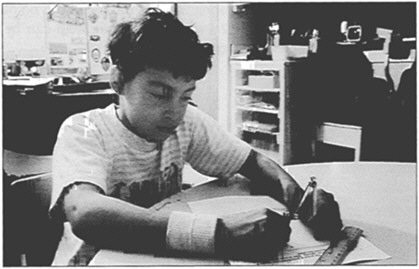
Presenting the task: Each child should have access to drawing tools (pencils, a compass, a ruler). Before passing out the student activity materials, the teacher should conduct a short discussion of lightning, focusing especially on the fact that often you see the flash of lightning before you hear the thunder clap. (Children will probably relate their own experiences of seeing a flash before hearing the rumble.) He or she should explain that the two occur simultaneously, but sound travels more slowly than light. Hence, the thunder is heard after the lightning is seen. In fact, the farther away one is from the flash, the greater is the gap between seeing and hearing. The teacher should describe one way to estimate the distance between someone and a lightning flash: Count the number of seconds between the flash and the thunderclap. That number, divided by five, is approximately the number of miles between the person and the lightning.
The teacher also can discuss safety-related issues as appropriate.
Student assessment activity: The teacher should pass out the student sheets and read the introduction as the class follows along. Discuss questions 1 and 2 as a group to be sure that the students understand the general concepts involved. The students should select tools (ruler, compass, calculator) that are appropriate to the task as they need them.
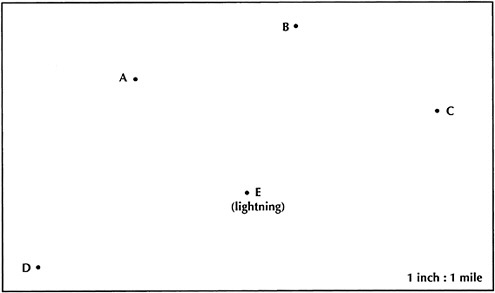
Note: if the student materials are duplicated from this book, the scale may be affected. If necessary, the teacher should redraw the figure ensuring that the distance from point E to point B on the map is 2 inches. The same map can be used without the lightning in questions 5 through 8.
Name _________________________________________ Date ____________
One way to estimate the distance from you to where lightning strikes is to count the number of seconds until you hear the thunder, and then divide by five. The number you get is the approximate distance in miles.
People are standing at the four points A, B, C and D. They saw lightning strike at point E. Because sound travels more slowly than light, they did not hear the thunder right away.
-
Who heard the thunder first? ___ Why?
-
Who heard it last? ___ Why?
-
One of the people heard it after 12 seconds. Who was it? _________ Explain your answer.
-
After how many seconds did the person at B hear the thunder? _____ Show how you know.
-
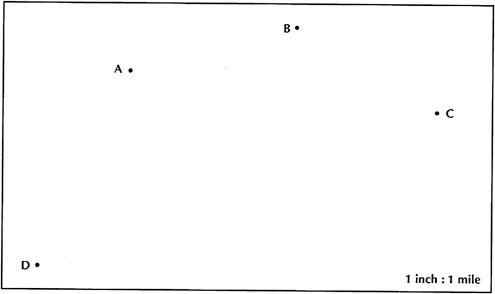
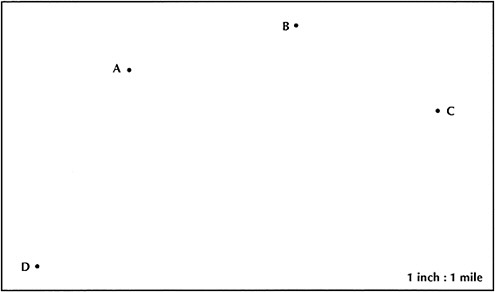
Now suppose lightning strikes again at a different place. The person at A and the person at C both hear the thunder after the same amount of time. Show on the map below where the lightning might have struck.
-
In question 5, are there other places where the lightning could have struck? _________ If so, show as many of those places as you can.
-
Lightning struck again! The person at point A heard the thunder 5 seconds after she saw the lightning. Show as many points as you can where the lightning could have struck.
-
The person at point C heard the thunder from that same lightning bolt 15 seconds after the lightning struck. Show where the lightning could have struck.
Rationale for the mathematics education community
This task involves geometry, measurement (direct and indirect), and arithmetic (particularly an application of division) in a non-standard, but interesting real-life setting. Proportional thinking is a critically important to this task because it provides the link between the map and the real-life setting. Each branch of mathematics is intertwined with the others in deriving answers to the task. The geometric part allows for multiple answers, including an entire line (or, more realistically, a segment). Although the immediate relevance of lightning depends somewhat on what part of the country one happens to live in, the phenomenon of nature will be familiar to all students.
As in several other examples in this collection, the choice of tools to use in attacking the problem is left up to each student. An array of tools should be made readily available.
The task also exemplifies the NCTM Standards because it includes questions that approach the problem setting from two directions. For example, question 3 asks for a distance, given a time, and question 4 asks for a time, given a distance. (In both instances, the distance must actually be measured on the map.)
Task design considerations: There are a number of fairly subtle points that should be mentioned in connection with the design of this task. It might be tempting to make this map less "abstract" by drawing little pictures of people on it rather than using the labeled dots. Unfortunately, that might make the map even more abstract. Suppose one draws a person about 1/8" high at D on a map whose scale is one inch for every mile. Then either the person at D is 600 feet tall or else the picture is merely a symbol for the person at D. A better alternative would be to use a "real" map — a road map, for instance — to make it less abstract.
One has to be very careful with tasks that involve quasi-real situations and be alert to students who may bring additional background information to the task. In this case, the task posits a situation in which an approximate rule of thumb is being used to make relatively rough calculations of distance. Depending on the air temperature, sound may travel at slightly different speeds, and, as a result, an answer to question 3 dif-
ferent from the expected one should be considered correct. (See the Protorubric section, below.)
Question 3 requires division of 12 by 5. The result, whether expressed as a decimal (2.4 inches) or as a fraction (2-2/5'') does not correspond to the way most rulers are marked. The student must decide if the distance 2-9/16" or 2-3/8" is the better choice.
Notice that the distances are purposely made simpler in questions 7 and 8 than they were in question 3. The idea is not to confound the relatively difficult geometric ideas with numerical distractions.
Consider the wording of questions 5 and 6. Question 5, deliberately, makes no a priori judgments or assumptions about how many places the child will mark as a possible lightning sites. Question 6 is designed as a follow-up. If the child has already indicated the perpendicular bisector of segment AC for question 5, then the proper answer to question 6 is "no." On the other hand, there is nothing wrong with answering question 5 with a single point equidistant from A and C, and in that case, the proper answer to question 6 is "yes," followed by a description of the perpendicular bisector. If, instead, question 6 were worded as "In question 5, where else could lightning have struck? Show as many places as you can," then the student who has already given a full answer to question 5 is stuck.
Variants and extensions: Changing the numbers and placement of the dots for A, B, C, D, and the lightning, and consequently altering the difficulty of the task, create immediate variants. For example, the 12 seconds can be changed to 15, which would eliminate the need for fractional numbers of miles. Or the differences in distances could be made more obvious (although one would then be assessing less sophisticated measuring skills).
Standard English units of measure were used here, but metric units could just as well have been used. Metric units would make some of the calculations more straightforward.
Protorubric
Characteristics of the high response:
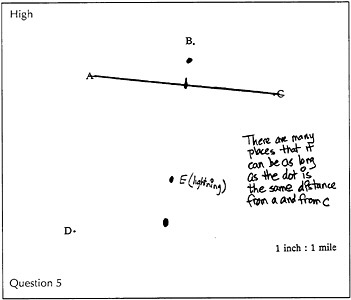
The high-level response shows that the student is making a fluent translation between the map and reality, thus demonstrating proportional reasoning. All the questions are answered satisfactorily. (Note that there may be some justification for saying that the person at D would hear the sound after 12 seconds if one uses a speed of sound different from the one implied by the rule of thumb. (See point 2 under Task design considerations, above.) If an adequate justification is provided, another answer to question 3 could be acceptable here.)
At the highest level, the perpendicular bisector of segment AC is described as the possible location for the lightning strike in question 6, although use of the geometric term is not necessary. A circle of radius 1" is drawn around point A for question 7. For question 8, the intersection points of two circles are identified as the possible spots for the last lightning bolt.
At a somewhat lower level, more than one possible location, but not all of them, are drawn for these questions.
Drawing tools (ruler, compass, etc.) are chosen and used appropriately.
Characteristics of the medium response:
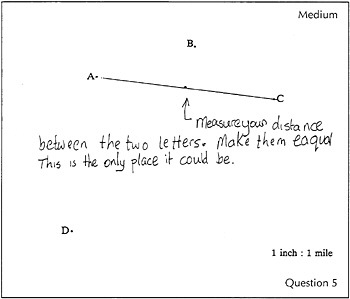
The response demonstrates that the map and its scale are generally well understood. The principal difference between the high and medium response is that the latter does not consider many possible locations for the lightning strikes. One point equidistant from A and C is found for question 5, but the answer to question 6 is "no."
Characteristics of the low response:
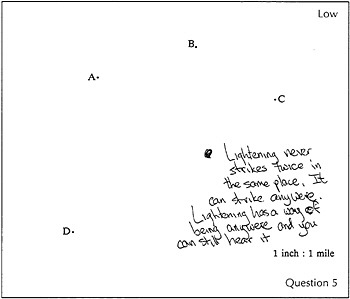
The low response is characterized by thinking that is limited to one point or one distance at a time. Thus, while question 1 through 4 may be answered satisfactorily (although with limited justifications), no points that are equidistant from A and C are found.