
2
History of the Controversy Over the Use of Herbicides
The United States has been involved for more than two decades in a controversy over the military use of herbicides in Vietnam during the Vietnam era. The controversy centers around both the use of herbicides in Vietnam and the purported health problems associated with exposure to herbicides, primarily Agent Orange and its contaminant 2,3,7,8-TCDD (2,3,7,8-tetrachlorodibenzo-p-dioxin), known scientifically as TCDD and to the general public as dioxin1 (Young and Reggiani, 1988). The controversy is further complicated by public fears over exposure to herbicides and dioxin resulting from domestic herbicide spraying, chronic exposure to dioxin of workers in the chemical industry, accidents in chemical plants that exposed workers, and dioxin released to the environment from several sources.
This chapter reviews the use of herbicides, the early history of the controversy, the concerns that Vietnam veterans have voiced about health problems they believe are related to exposure to herbicides, the Agent Orange product liability litigation, and the response to concerns of Vietnam veterans and the public by the federal government, state governments, veterans organizations, and others. The events and issues surrounding the domestic use of 2,4-D (2,4-dichlorophenoxyacetic acid) and 2,4,5-T (2,4,5-trichlorophenoxyacetic acid) and occupational exposure to 2,4,5-T and its
dioxin contaminant are also addressed in this chapter. As a result of several major events relating to dioxin exposure, the public became aware of the potential health effects of exposure to dioxin in tandem with the increased concern over possible health effects of exposure to herbicides sprayed in Vietnam. Researchers studied populations (described in this chapter) that had potential health effects from exposure to herbicides and TCDD, including production workers in chemical plants, agricultural and forestry workers, pulp and paper mill workers, and residents environmentally exposed in specific areas, such as Times Beach, Missouri; Alsea, Oregon; and Seveso, Italy. For the studies introduced in this chapter, the methodological framework is described in Chapter 7, and the results are discussed in the health outcome chapters (8-11).
MILITARY USE OF HERBICIDES IN VIETNAM
The military use of herbicides in Vietnam began in 1962, was expanded during 1965 and 1966, and reached a peak from 1967 to 1969. Herbicides were used extensively in Vietnam by the U.S. Air Force's Operation Ranch Hand to defoliate inland hardwood forests, coastal mangrove forests, and, to a lesser extent, cultivated land, by aerial spraying from C-123 aircraft and helicopters. Soldiers also sprayed herbicides on the ground to defoliate the perimeters of base camps and fire bases; this spraying was executed from the rear of trucks and from spray units mounted on the backs of soldiers on foot. Navy riverboats also sprayed herbicides along riverbanks. The purpose of spraying herbicides was to improve the ability to detect enemy base camps and enemy forces along lines of communication and infiltration routes, and around U.S. base camps and fire bases. Spraying was also used to destroy the crops of the Vietcong and North Vietnamese (Dux and Young, 1980).
Herbicide Development and Testing
Experiments with chemicals for the control of vegetative growth were first conducted around the turn of this century. The practical purpose of these early compounds was to control weeds that competed with crops for available water, nutrients, and sunlight (NAS, 1974; Buckingham, 1982). It was not until the 1940s that agricultural chemical research led to the development of a number of synthetic compounds capable of regulating or suppressing plant growth. Some compounds, when applied at high doses, killed certain plants but did not harm others; these compounds were termed selective herbicides (NAS, 1974). Two of the most successful developments during that period were the discoveries of 2,4-D and 2,4,5-T. These chemicals were effective against broadleaf plants and several crops.
Throughout World War II and after, classified military research on these chemicals and nearly 1,100 other substances was conducted at the War Research Service in Fort Detrick, Maryland (MRI, 1967). Although defoliants were not introduced into the World War II conflict, the military potential of chemicals for reducing or removing heavy vegetative growth was further investigated.
The research program at Fort Detrick involved screening and evaluation of candidate defoliants (Warren, 1968). One component of the research program was organized to solicit "the best research and industrial competencies" to develop and evaluate various chemical defoliants and formulations (U.S. Army, 1964). Compounds for military consideration were also received from private companies as part of unsolicited proposals, and from individuals working in universities in other areas of chemical synthesis. The chemicals were evaluated in terms of their effectiveness at low doses, cost, availability or capability of being manufactured in large quantities, nontoxicity to man and animals, stability in storage, and corrosive properties. For chemicals that passed initial screening tests, field trials were conducted on major vegetational types using airplane dissemination equipment. Formulations and mixtures of chemicals were evaluated at various rates, volumes, and seasons of application as a basis for selection and standardization of defoliants (U.S. Army, 1964).
In addition to research and development on chemical herbicides during the 1950s, anticrop aerial spray trials for improving the delivery equipment were also conducted. In particular, U.S. military authorities were concerned about the various time lags in defoliation evidenced by different species of plants to which the herbicides were applied (U.S. Army, 1964; Huddle, 1969). The military assessment of chemical defoliants also appears to have involved questions such as the feasibility of developing techniques by which large, slow-moving, and low-flying aircraft could traverse enemy-occupied jungle terrain without being shot down; the selection of the appropriate chemicals for particular types of foliage to be removed; and the optimum timing of spraying with regard to humidity, wind conditions, temperature, and topography of the area to be sprayed (Huddle, 1969). During this time the Hourglass spray system—the archetype for the spray equipment used initially aboard the Ranch Hand C-123s—was developed. The Hourglass, or MC-1, spray system was capable of distributing herbicide at a rate of 1 to 1.5 gallons per acre; however, after evaluation and modification, the 1,000 gallon C-123/MC-1 spray system was capable of depositing 3 gallons per acre on swaths 240 feet wide when flying at an airspeed of 130 knots and an altitude of 150 feet. In 1966, the MC-1 was replaced in all C-123s by a modular spray system designed for internal carriage in cargo aircraft (Young et al., 1978).
In June 1959, an experiment led by Dr. James Brown at Camp Drum,
New York, demonstrated the long-term effectiveness of aerially dispensed herbicides in improving visibility for military operations (Buckingham, 1982). An improvised helicopter spray system delivered a 1:1 mixture of 2,4-D and 2,4,5-T over a 4-square-mile area at a quantity of one-half gallon per acre. Evaluation of the effectiveness of the defoliants on vegetation was made one year later and again in October 1962. In 1960, no signs of regrowth had occurred in the sprayed area. Upon reexamination in 1962, it was observed that maple trees, which had been predominant in the area, appeared to be dead. Sprouting had occurred in some other species of trees, and one species appeared to have recovered from the chemicals' effects. In general, trees throughout the area had been killed, and visibility had been improved nearly 100 percent (Warren, 1968). Additional field tests in the Florida Everglades and Puerto Rico demonstrated the chemicals' defoliant activity (MRI, 1967).
By 1960, the U.S. Army had tested numerous herbicides and aerial delivery techniques (MRI, 1967). With the anticipated intensified involvement of U.S. military advisory forces in Vietnam, the large-scale use of herbicides was pursued. In 1961, the U.S. Department of Defense conducted the first operational field tests in Vietnam of 2,4-D and 2,4,5-T, the major herbicides to be disseminated in Vietnam over the next 10 years. The primary purpose of the early missions was to test the soundness of the defoliation concept as well as to measure optimum chemical concentrations and methods of delivery (Collins, 1967; Warren, 1968). Results of these early defoliation tests were mixed, and military authorities urged continued testing and evaluation of the herbicides in Vietnam (Buckingham, 1982).
A test program was conducted in Thailand during 1964-1965 to evaluate the effectiveness of aerial applications of various formulations of 2,4-D, 2,4,5-T, and other chemicals in the defoliation of jungle vegetation representative of Southeast Asia on several 10-acre plots. Aerial spray treatments were applied at rates of 0.5 to 3.0 gallons per acre, and at two- to three month intervals, to determine minimal effective rates and proper season of application. Defoliation effectiveness was measured in terms of rate, volume, canopy penetration, vegetation response, and season of application. Results of the test program showed that (1) 2,4-D and 2,4,5-T were effective for long-term defoliation, with more complete defoliation and longer duration of effective defoliation at higher rates of application; (2) best results were achieved during the rainy or growing season; (3) defoliation responses were influenced more by rate than by volume of chemical applied; (4) woody species varied in the duration and degree of defoliation; and (5) complete defoliation of all species in mixed forest types was not achieved (Warren, 1968).
Use of Herbicides in Vietnam
Phenoxy herbicides are synthetic chemical analogues of hormones found in plants that regulate the rate and pattern of plant growth; these herbicides cause aberrant growth or death of certain plant species. The types of herbicide used in Vietnam were very effective at killing certain types of tropical vegetation, and the aerial spraying of herbicides allowed for easy application over a large-area. The herbicides were applied aerially at a rate of approximately 3 gallons per acre. According to military records of Operation Ranch Hand, from August 1965 to February 1971, a total of 17.6 million gallons of herbicide was sprayed over approximately 3.6 million acres in Vietnam (NAS, 1974).
The different types of herbicide used by U.S. forces in Vietnam were identified by a code name referring to the color of the band around the 55 gallon drum that contained the chemical. These included Agents Orange, White, Blue, Purple, Pink, and Green. From 1962 to 1965, small quantities of Agents Purple, Pink, and Green were used. From 1965 to 1970, Agents Orange, White, and Blue were employed, and from 1970 to 1971, only Agents White and Blue were used in the defoliation program (Young and Reggiani, 1988).
Agent Orange was the most extensively used herbicide in Vietnam; it consisted of a 50:50 mixture by weight of the n-butyl esters of two phenoxy acids: 2,4-dichlorophenoxyacetic acid (2,4-D) and 2,4,5-trichlorophenoxyacetic acid (2,4,5-T). A synthetic contaminant of 2,4,5-T is the compound 2,3,7,8-tetrachlorodibenzo-p-dioxin (TCDD), informally known as dioxin. TCDD is an unavoidable by-product of the manufacture of 2,4,5-T and a contaminant in Agent Orange (Gough, 1986). Levels of TCDD contamination in Agent Orange ranged from less than 0.05 to almost 50 parts per million, with a mean of about 2 parts per million (NAS, 1974). An estimated 368 pounds of dioxin was sprayed in Vietnam over a six year period (Gough, 1986).
The military use of 2,4,5-T, and thus Agent Orange, was suspended by the Department of Defense in April 1970 (Young and Reggiani, 1988). Following the suspension of 2,4,5-T, the White House announced on December 26, 1970, that it was initiating an orderly yet rapid phaseout of the entire herbicide operation. On February 12, 1971, U.S. Military Assistance Command, Vietnam announced that herbicides would no longer be used for crop destruction in Vietnam and the last Ranch Hand fixed-wing aircraft (C-123) was flown. Subsequent spraying of herbicides was limited to controlled use around U.S. fire bases by helicopter or ground troops (MACV, 1972). On October 31, 1971, nearly 10 years after the herbicide program began in Vietnam, the last U.S. helicopter herbicide operation was flown (NAS, 1974). The military use of herbicides is discussed in further detail in Chapter 3.
EARLY CONCERNS ABOUT THE USE OF HERBICIDES IN VIETNAM
Early Accounts of Dioxin (TCDD)
Dioxin (TCDD) arises during the hydrolysis of tetrachlorobenzene to form 2,4,5-trichlorophenol, the industrial precursor of 2,4,5-T. TCDD is a solid that is insoluble in water and slightly soluble in fats or hydrocarbons. TCDD decays slowly in the soil under normal environmental conditions, which indicates that "its potential hazards may be very persistent" (NAS, 1974). Further characteristics of dioxin can be found in Chapter 4 on toxicology.
In 1872, two German chemists prepared the first chlorinated dioxin, but its structure was not understood until much later. In 1957, Dr. W. Sandermann of the Institute of Wood Chemistry in Hamburg published results of his synthesis of TCDD. While working on the synthesis, his laboratory assistant was exposed to the substance being tested when some of it blew into his face. He soon developed skin lesions over his entire face and decided to seek treatment from Dr. Karl Schulz, a dermatologist who treated chemical workers and had observed chloracne in some of them (Gough, 1986). After examining Sandermann's laboratory assistant, Schulz identified the skin lesions on his face as chloracne. When the laboratory assistant explained that the compound he was synthesizing was TCDD, Schulz was the first to correlate the presence of chloracne with exposure to dioxin. To further confirm this assumption, Schulz applied a TCDD solution to the skin of his forearm and noted that chloracne appeared (Young and Reggiani, 1988).
In September 1971, an early account of research on the appearance of TCDD in trace quantities in samples of 2,4,5-T was presented at a session on the origin and fate of chlorodioxins at the American Chemical Society meeting. TCDD was defined to be the most toxic of all chlorodibenzodioxins studied at that time (Young and Reggiani, 1988). Further accounts of dioxin's toxicity were presented at a meeting on "Perspectives on Chlorinated Dibenzodioxins and Dibenzofurans" sponsored by the National Institute of Environmental Health Sciences in North Carolina in April 1973. The major findings indicated "… that there was a variation of sensitivity among species, the liver was the target organ, the toxic effects were delayed after absorption, and the mechanism of teratogenesis was still incompletely understood … patterns of absorption and of distribution among organs were beginning to emerge" (Young and Reggiani, 1988).
In 1974, the National Academy of Sciences' Committee on the Effects of Herbicides in Vietnam reported that "TCDD is extremely toxic to some laboratory animals. … TCDD has been found to be teratogenic in mice; results with other laboratory animals have not been conclusive. The lethal
dose in humans is not known, nor is that required to cause birth defects, if indeed there is such an activity. TCDD is strongly implicated as the main cause of chloracne, a disease that has affected employees in some plants manufacturing 2,4,5-T or its precursor, 2,4,5-trichlorophenol" (NAS, 1974).
Concerns Over the Long-Term Use of Herbicides
Public concern over the use of herbicides in Vietnam began in 1964, even before the toxicity of TCDD was first reported. At that time, the Federation of American Scientists urged the government not to use chemical and biological weapons unless they were used first by the enemy. The federation was concerned about the use of defoliants in Vietnam because the government was not discriminating between fighting forces and civilians while using the herbicides, and that constituted biological and chemical warfare (Young and Reggiani, 1988). In January 1966, 29 scientists banded together to protest the U.S. policy on the use of herbicides and demand their complete abolition. They requested that President Lyndon B. Johnson begin discussions with the allies on adherence to the ban on the use of herbicides in Vietnam. "Even if it can be shown that the chemicals are not toxic to man, such tactics are barbarous because they are indiscriminate; they represent an attack on the entire population of the region where the crops are destroyed, combatants and non-combatants alike. [This is] … a precedent for the use of similar but even more dangerous chemical agents against our allies and ourselves" (Dux and Young, 1980).
In December 1966, the Council of the American Association for the Advancement of Science (AAAS) sent a letter to the Secretary of Defense, Robert McNamara, calling for studies of the short- and long-term consequences of the massive use of herbicides in Vietnam (Young and Reggiani, 1988). In February 1967, a second petition signed by more than 5,000 scientists, including 17 Nobel laureates, was delivered to President Johnson requesting that he end the use of herbicides in Vietnam (Dux and Young, 1980). A Department of Defense (DOD) official, responding to criticisms regarding the questionable military use of herbicides, stated that "qualified scientists, both inside and outside the government, and in the governments of other nations, have judged that seriously adverse consequences will not occur. Unless we had confidence in these judgments, we would not continue to employ these materials." Several members of the AAAS council agreed that this statement was unjustified, noting that there was insufficient evidence to arrive at this conclusion (Wolfle, 1989).
Noting the strong opposition by some of the nation's leading scientists to the military use of herbicides, the Department of Defense commissioned a study by the Midwest Research Institute (MRI) in Kansas City, Missouri, to assess whether the use of the herbicides would have a long-term ecological
impact. The MRI assessment did not include field studies or trips to Vietnam, but involved a review of approximately 1,500 scientific papers. The study, Assessment of Ecological Effects of Extensive or Repeated Use of Herbicides, was completed in December 1967 (MRI, 1967). The report could not provide conclusive answers about the long-term effects of chronic exposure to herbicides on the ecological system or on the population, and recommended further studies of the long-term effects on the environment and the population in order to assess properly the consequences of repeated use of herbicides (MRI, 1967).
In 1965, the National Cancer Institute contracted with Bionetics Research Laboratory in Maryland to investigate the possible teratogenic effects of a number of pesticides and herbicides. The study, Evaluation of Carcinogenic, Teratogenic, and Mutagenic Activities of Selected Pesticides and Industrial Chemicals, noted that among the herbicides tested on mice and rats were 2,4-D and 2,4,5-T (Bionetics, 1968). This study provided the first indication of the teratogenicity and fetotoxicity of 2,4,5-T (Lilienfeld and Gallo, 1989). The researchers determined that 2,4,5-T was teratogenic, causing malformations and stillbirths in mice when administered in high doses, and that 2,4-D was potentially harmful. This report was released to the public in 1969. Bionetics later reanalyzed the 2,4,5-T used for its initial study and revealed that the cause of toxicity was the contaminant TCDD and that 2,4,5-T itself was not teratogenic (Young and Reggiani, 1988).
Another study, Congenital Malformations, Hydatidiform Moles and Stillbirths in the Republic of Vietnam, 1960-1969, was conducted by R.T. Cutting on behalf of the government of South Vietnam and the U.S. Military Assistance Command, Vietnam (Cutting et al., 1970). Cutting examined maternity records of 22 hospitals for two time periods: the buildup of herbicide use (1960-1965) and larger-scale military herbicide use (1966-1969). He found that there were no differences in the incidence of stillbirths, congenital malformations, and hydatidiform moles between the two periods (Cutting et al., 1970; U.S. Congress, House, 1978). It was later revealed that the study was biased because of unreliable data and hospital records (Young and Reggiani, 1988).
In early 1970, the AAAS set up a commission to assess the effects of large-scale use of herbicides on the environment and population of Vietnam. The members of the Herbicide Assessment Commission (HAC) were Matthew Meselson, Arthur Westing, John Constable, and Robert Cook. In June 1970, HAC held a conference at Woods Hole, Massachusetts, with individuals who had experience with the herbicide program in Vietnam. They determined what HAC members would investigate and observe while in Vietnam, and prepared questionnaires for use in interviews of Vietnamese residents. In August 1970, they traveled to Vietnam on an inspection field trip to
examine the extent to which the herbicides had destroyed the vegetation and local food crops in areas where they had been sprayed.
After returning from Vietnam, HAC members wrote a report on the defoliation of Vietnam in which they noted that the Department of Defense had stated that the herbicides were used "for crop destruction of small, isolated crop patches along infiltration routes …" (Wolfle, 1989) and limited to areas of low population. HAC, however, found that "crops had been sprayed in an area with an estimated population of 180 persons per square kilometer and that nearly all of the food being destroyed would have been used by mountain-dwelling Montagnard civilians instead of by enemy troops" (Wolfle, 1989). The commission maintained that the military use of herbicides had been considerably more destructive than previously imagined—half of the mangrove forests had been destroyed and there were indications of serious health effects (Wolfle, 1989). The HAC members documented reports of stillbirths and birth defects in Vietnamese, noting that these adverse reproductive effects were possibly associated with 2,4,5-T (Young and Reggiani, 1988) and its contaminant, TCDD. On December 26, 1970, the White House announced that it was initiating an orderly yet rapid phaseout of the herbicide operation. The AAAS council adopted a resolution commending the U.S. government for its intention to phaseout the use of herbicides in Vietnam (Wolfle, 1989).
At the end of 1970, Congress directed the Department of Defense to contract with the National Academy of Sciences (NAS) to study the ecological and physiological effects of the widespread military use of herbicides in Vietnam. The NAS recruited a 17-member committee and 30 consultants to carry out the study. Committee members and consultants spent approximately 1,500 man-days in Vietnam in order to develop an inventory of the areas sprayed by herbicides, review the effects on various vegetation types, study the persistence of herbicides in soil, examine the effects of herbicides on animal populations in estuaries of Vietnam, and attempt to identify the effects of herbicides on resident populations exposed to them (NAS, 1974).
The resulting report, The Effects of Herbicides in South Vietnam (NAS, 1974), concludes that (1) the committee was unable to gather any definitive indication of direct damage by herbicides to human health, although there were reports from Montagnards of respiratory distress in children; (2) although attempts to assess the social, economic, and psychological effects of the herbicide spraying were less than satisfactory, the effect of herbicide spraying on the health of the Vietnamese appeared to have been smaller than feared; (3) the evidence of spraying on food crops indicated that they were highly vulnerable to the herbicides; (4) the mangrove forests were found to have been extremely vulnerable to herbicide spraying; and (5) although it was difficult to assess the damage to the inland forests because
the committee had to rely on aerial photographs, the committee concluded that most of the damage occurred in overused open or thin forests and in young secondary forests.
Public concern about the military use of herbicides during the Vietnam conflict did not end when Operation Ranch Hand terminated with the last official herbicide spraying in 1971 or with the final departure of American troops in 1975. In April 1975, President Gerald Ford issued Executive Order 11850, in which the United States renounced the first use of herbicides in war except "under regulations applicable to their domestic use, for control of vegetation within U.S. bases and installations or around their immediate defensive perimeters." In a historical account of Operation Ranch Hand, it was noted, "As long as this policy stands, no operation like Ranch Hand could happen again" (Buckingham, 1982).
CONCERNS ABOUT EXPOSURE TO AGENT ORANGE
Vietnam Veterans Return Home
Historians have noted that during the 1970s, many Vietnam veterans returned to a society that did not welcome them (Schuck, 1987). The country had been greatly divided over the war, and a strong antiwar sentiment pervaded most of the final years of the Vietnam conflict (Karnow, 1991; Spector, 1993). There were antiwar demonstrations held throughout the country during these years, and when the veterans came home, many Americans did not want to acknowledge their patriotic effort (Bonoir et al., 1984; Salisbury, 1985). There was also a lack of unanimity among veterans about their service in the Vietnam conflict. Some veterans were bitter at having served in a war they felt could not be won; however, an equal number of veterans would have returned to Southeast Asia if they were called upon by their country (Wilcox, 1989).
The returning veterans were also presented with more difficult adjustments than veterans of other foreign wars. Because of improved emergency medical care, more disabled veterans returned home. Of those discharged for disabilities during World War II, 18 percent were amputees and 3.1 percent were paralyzed; the comparable figures for Vietnam were 28.3 percent and 25.2 percent, respectively (Schuck, 1987). The returning veterans also had a difficult period of adjustment due to the fact that most of them were discharged from service one at a time. Since their tour of duty was for only one year, many veterans did not forge close attachments with each other as in earlier wars. Following the war, some veterans began to develop health problems, and in time, more veterans reported serious illness and claimed that their children were born with birth defects (Gough, 1986).
The Beginning of the Controversy
During the early and mid-1970s, a growing number of veterans began to question the possible linkage between their conditions or diseases and their exposure to herbicides, mainly Agent Orange, in Vietnam. In 1977, Maude deVictor, a benefits counselor in the Chicago regional office of the Veterans Administration (VA), was contacted by the wife of Charles Owen, a Vietnam veteran who believed his terminal cancer was the result of exposure to Agent Orange. After learning that Charles Owen had died and that the VA had refused his widow's claim for benefits, deVictor began to research the health effects of exposure to Agent Orange (Wilcox, 1989). She contacted Alvin L. Young, Major, U.S. Air Force, an expert in plant physiology, and inquired about the types of herbicides used in Vietnam. DeVictor recorded the conversation in a memorandum to the file, which explained the use and toxicity of Agent Orange and Agent Blue (DeVictor, 1977). In response to this memorandum, a line-by-line commentary was prepared by Dr. Young, and a copy was recorded in a congressional hearing (U.S. Congress, House, 1980b).
DeVictor continued her inquiries into the possible connection between Agent Orange and certain health outcomes. She began gathering statistics on veterans' exposure to Agent Orange by questioning veterans who visited her office for benefits, widows of veterans, and wives of veterans about the health of their husband and children. When the VA learned that she was carrying out this research, she was asked to cease these additional inquiries and concentrate on her assigned duties, but she continued her research on Agent Orange. Soon after, someone contacted Bill Kurtis, a local television reporter, about deVictor's inquiries on veterans' exposure to Agent Orange (Linedecker et al., 1982). On March 23, 1978, WBBM, a CBS affiliate in Chicago, aired Kurtis' documentary Agent Orange, the Deadly Fog. Subsequently, local and national media began to report on Agent Orange and veterans' complaints with more frequency (Wilcox, 1989).
Early in 1978, Paul Reutershan, a former helicopter crew chief responsible for transporting supplies to the 20th Engineering Brigade, appeared on the ''Today" show and shocked many of the show's viewers by announcing: "I died in Vietnam, but I didn't even know it." He told of how he flew almost daily through clouds of herbicides being discharged from C-123 cargo planes, and how he observed the dark swaths cut in the jungle by the spraying, and watched the mangrove forest turn brown and die (Wilcox, 1989). Even though he observed this destruction of the jungles and forests, he did not worry about his own health. He said that he was told by the Army that Agent Orange was "relatively nontoxic to humans and animals" (Wilcox, 1989). Upon returning home from Vietnam, Reutershan was diagnosed with cancer. On December 14, 1978, at the age of 28, Reutershan
died from the cancer that had invaded his colon, liver, and abdomen (Schuck, 1987).
Prior to his death, Paul Reutershan had read a news account about Maude deVictor's data correlating health problems in Vietnam veterans and exposure to Agent Orange. Convinced that he had identified the cause of his illness, he contacted Edward Gorman, a personal injury lawyer on Long Island, and requested that he file a suit in a New York State court naming Dow, Monsanto, and Diamond Shamrock (chemical companies that manufactured Agent Orange) as defendants. During this time, he also founded the Agent Orange Victims International (AOVI), and before his death, he named his colleague, Frank McCarthy, to carry on as AOVI director. Reutershan spent his remaining time alerting the public to his belief that his cancer was the direct result of his exposure to Agent Orange.
AGENT ORANGE PRODUCT LIABILITY LITIGATION
Class Action Suit
After the death of Paul Reutershan, Frank McCarthy met with the members of the AOVI and determined that Reutershan's lawsuit was an important part of its effort to alert the nation to ills caused by Agent Orange. Victor J. Yannacone, Jr., an expert in workmen's compensation claims, and in particular, toxic tort cases, was contacted and he became the prime mover of the Agent Orange litigation in its first four and a half years (Schuck, 1987). A class action lawsuit was filed on January 8, 1979, in the U.S. District Court for the Southern District of New York in Manhattan. The class consisted of Vietnam veterans, their spouses, their parents, and their children. The suit named five chemical manufacturers (others were added later) responsible for the production of the components of Agent Orange (Schuck, 1987). In May 1979, the case was consolidated into a multidistrict litigation (MDL 381) and designated In re Agent Orange Product Liability Litigation (Schuck, 1987).
The plaintiffs did not involve the federal government as a third-party defendant in the class action, in part, because of a rule of law—known as the Feres doctrine—that precludes recovery against the United States for injuries that arise out of or in the course of activity incident to military service (Jacobs and McNamara, 1986). Another reason was that the plaintiffs' felt that it would greatly protract the litigation by involving the federal government in the class action (Schuck, 1987). The chemical companies, however, sought to join the United States as a third-party defendant in the class action (Schuck, 1987).
After many preliminary proceedings, a trial date was set for May 7, 1984. Judge Weinstein, the trial judge, urged the parties to shape a settlement,
and on the eve of the trial, a settlement was reached. The settlement was approved in January 1985, after a series of hearings were held around the country to ensure that the settlement was fair and reasonable to the members of the class (Schuck, 1987). Under the settlement, the defendant chemical companies (Dow; Monsanto; Diamond Shamrock Corporation; Hercules, Inc.; Uniroyal Inc.; T-H Agricultural & Nutrition Company; and Thompson Chemicals Corporation) agreed to make available a fund of $180 million (Schuck, 1987). This fund was to be used to (1) finance a cash payment program for totally disabled veterans and survivors of deceased veterans; (2) establish a class assistance foundation to help meet the medical, social, and legal service needs of the members of the class; and (3) establish a trust fund for New Zealand and Australian class members (Jacobs and McNamara, 1986).
The product liability class action suit showed that many veterans were convinced that Agent Orange had hurt them. However, no causal relationship was ever established between the alleged health effects in Vietnam veterans and their exposure to Agent Orange because the case was settled out of court. Judge Weinstein noted that "causal connection may at some time in the future be proved. [However,] we can say that proof has not been produced in this court sufficient to go to the jury" (Agent Orange Product Liability Litigation, 1985).
CONCERNS ABOUT OTHER EXPOSURES TO 2,4,5-T AND TCDD
In the late 1890s, scientists began to develop the concept that herbicides could be produced to control the growth of certain types of plants; however, herbicides for general agricultural use were not developed for testing until 1942. In the early 1940s, the herbicidal properties of 2,4-D and 2,4,5-T were discovered. In 1945, Dow Chemical found that combining an equal mixture of 2,4-D and 2,4,5-T created a more efficient herbicide than when they were used separately (Lilienfeld and Gallo, 1989). The Department of Agriculture, under the provisions of the Federal Insecticide, Fungicide, and Rodenticide Act registered 2,4,5-T as an herbicide in 1948. Farmers recognized its usefulness for killing broadleaf plants and for controlling weeds in pasturelands to enable desirable grasses to grow. Foresters also used the herbicide to control weeds, underbrush, and shrubs in forests. Because 2,4,5-T was inexpensive and easy to use, by the early 1970s it had become one of the most widely used herbicides in the United States (Gough, 1986).
Since the early production of chlorophenols—a group of chemicals that were also contaminated with TCDD—in the mid-1930s, accidents in chemical plants have occurred, releasing dioxin (TCDD) into the environment and exposing workers, but it was not until research on the toxicity of TCDD was
reported in 1971 that this issue received public attention (Fingerhut et al., 1987). The public became aware of the potential health effects of exposure to TCDD in tandem with the increased concern over possible health effects of exposure to herbicides sprayed in Vietnam. As studies were completed that demonstrated the toxicity of TCDD in animals, scientists began to realize that numerous individuals may have been exposed to TCDD. Researchers began to study populations (described below) that had potential health effects from exposure to TCDD, including residents living near soil contaminated with TCDD in Missouri; community residents who lived near sites sprayed with herbicides such as Alsea, Oregon; workers at the Monsanto plant in Nitro, West Virginia; residents living in and around Seveso, Italy, exposed during industrial accidents; pulp and paper mill workers who were exposed during the production process; and chemical plant workers who were occupationally exposed to TCDD during the production of 2,4,5-T and other products. For the studies introduced in the following sections, the methodological framework is described in Chapter 7, and the results are discussed in the health outcome chapters (8-11).
Occupational Exposure
Production Workers
Researchers have studied production workers in U.S. chemical plants for potential health effects of exposure to TCDD. Workers in plants manufacturing phenoxy herbicides can potentially be exposed heavily in four ways: (1) manufacture of the herbicides; (2) manufacture of intermediate chemicals used in the production of herbicides and other products; (3) packaging or transporting of the finished product; and (4) general maintenance and cleaning of the chemical plant (Lilienfeld and Gallo, 1989). Zack and Gaffey (1983) wrote that exposure to dioxins "can cause chloracne, a skin disorder characterized by comedones, cysts, and abscesses. Outbreaks of chloracne have been reported among workers associated with the production of 2,4,5-T and 2,4,5-T based products. Such incidents resulting from both accidental and routine occupational exposures have been reported from several countries."
The National Institute for Occupational Safety and Health (NIOSH) Industrywide Studies Section has conducted several epidemiologic studies of workers exposed occupationally to phenoxy herbicides (Lilienfeld and Gallo, 1989). In 1978, NIOSH "initiated an effort to identify the exposed workers at all U.S. chemical plants which produced TCDD-contaminated products. As a result, the NIOSH Dioxin Registry was established. It includes demographic and work history information for all workers assigned to the production of products contaminated with certain isomers of dioxin. …
Twelve [chemical] plants were included in the NIOSH Dioxin Registry" (Fingerhut et al., 1991b). In 1991, Fingerhut and colleagues published a study, based on data from the NIOSH Dioxin Registry, that was the first analysis of mortality in the cohort of U.S. workers exposed to TCDD between 1942 and 1984 (Fingerhut et al., 1991a,b). In ongoing analyses of the same population, Calvert and colleagues examined occupational exposure to dioxin and potential health outcomes including chronic bronchitis, chronic obstructive pulmonary disease, and ventilatory function (Calvert et al., 1991) as well as hepatic and gastrointestinal effects (Calvert et al., 1992). Sweeney and colleagues (in press) examined peripheral neuropathy in workers after occupational exposure to 2,3,7,8-TCDD.
Agricultural and Forestry Workers
Farmers and forestry workers have been exposed to a variety of chemicals including pesticides, insecticides, and herbicides. Several Swedish studies were published in the late 1970s, which reported associations between exposure to herbicides and certain cancers. "In Sweden, phenoxy herbicides have been used in forestry to combat hardwoods. There has been use of a combination of 2,4-D and 2,4,5-T but unlike Agent Orange the combination has been two parts of 2,4-D and one part of 2,4,5-T" (Hardell, 1990). In 1976, Hardell began a series of studies of workers exposed occupationally to phenoxy herbicides who subsequently developed soft tissue sarcomas (Hardell, 1990). In response to these Swedish studies, the National Cancer Institute (NCI) began a study in Kansas because "it is a wheat producing state and the amounts of herbicides that are used relative to the amounts of insecticides are greater for wheat than for some other crops such as corn. Both 2,4-D and 2,4,5-T were known to have been used in Kansas. [NCI] also chose Kansas because it has a population-based cancer registry. This means that [NCI was] able to base the study on incident diagnosed cases rather than using death certificate data …" (Hoar-Zahm and Blair, 1990; see also Hoar et al., 1986). NCI has published several studies on agricultural workers and workers who apply chemicals including pesticides and herbicides in Nebraska, Minnesota, Wisconsin, and Iowa, as well.
Pulp and Paper Mill Workers
More than 650,000 persons are employed in the manufacture of paper and allied products in the United States. Approximately half of these employees work directly in the production of pulp and paper stock, and are potentially exposed to a number of chemicals during the production process (Solet et al., 1989). "The [pulp and paper] production process is complex
and varied, but generally involves breaking down wood into liquid pulp by physical and chemical means. … The nature of chemical exposures varies with the industry, depending on the type of mill and the final product. Among potential exposures are both suspected and known human carcinogens, including asbestos, wood dust, formaldehyde, chlorinated phenols, and dioxin" (Solet et al., 1989). Occupational exposures may arise at any stage in the manufacturing process from preparation of the raw wood through the production of paper or pulp products (Robinson et al., 1986). Several studies of pulp and paper mill workers have been conducted. Robinson and colleagues (1986) surveyed pulp and paper mills in Washington, Oregon, and California in order to select five paper mills to study. The pulp and paper workers in the study cohort were followed from their last date of employment through March 31, 1977. Henneberger and colleagues (1989) initiated an investigation of the mortality of workers from different operations within a pulp and paper manufacturing company. In another study of pulp and paper workers, Solet and colleagues (1989) studied records of deceased members of the United Paperworkers International Union who had died between 1970 and 1984.
Major Event Associated with Occupational Exposure to Dioxin (TCDD)
The first major event associated with extraordinary occupational exposure to TCDD was the result of an accident at Monsanto's chemical plant in Nitro, West Virginia. After the accident, several researchers studied the exposed workers for related health effects.
Nitro, West Virginia On March 8, 1949, at the Monsanto Company's chemical plant in Nitro, West Virginia, an accident occurred in the autoclave in which trichlorophenol was being manufactured. The pressure inside the autoclave increased to a level that exceeded safety limits, and the safety valve gave way, allowing the pressurized contents (trichlorophenol containing TCDD) to vent out through the chimney and into the inside of the building (Gough, 1986). This accident was later recognized as a major event in occupational and environmental health, allowing scientists to study the health effects of TCDD on a group of workers exposed in a single incident (Zack and Gaffey, 1983).
There are differing stories about what the conditions were like inside the building after the accident, but many of the workers confirmed that they had to go into the building to clean residue off the walls. As they worked on their tasks of cleaning up the area, many of the workers began to complain of health problems. A number of workers who were the most severely affected were sent to the College of Medicine at the University of Cincinnati where they were examined by physicians (Gough, 1986).
After the accident, several researchers studied the exposed workers for related health effects. In a mortality study of workers employed at the plant, Zack and Gaffey (1983) followed the plant workers who had developed symptoms of chloracne after the accident, to examine the chronic health effects of exposure to TCDD. In 1984, Suskind and Hertzberg (1984) published their study on the human health effects of 2,4,5-T and TCDD, which was "conducted to determine the long-term health effects of workplace exposure to the process of manufacturing the herbicide (2,4,5-T) … including contaminants such as 2,3,7,8-TCDD." In the study of the health status of workers with past exposure to TCDD in the manufacture of 2,4,5-T, Moses and colleagues (1984), at the request of the United Steelworkers of America, conducted a health survey of current and retired workers of the plant: "The purpose of the survey was to determine if long-term health effects related to duration and/or intensity of past exposure to 2,3,7,8-TCDD could be demonstrated in the workers. Specifically, the study aimed to investigate effects documented from past studies."
Environmental Exposures
Domestic Use of Herbicides
Spraying of herbicides in the United States has been a practice of farmers, foresters, railroads, utility companies, and certain government agencies, for many years. Farmers used 2,4,5-T to kill broadleaf plants in pasturelands. Foresters, including the U.S. Forest Service and other federal agencies having jurisdiction over national lands, forests, and parks, have used herbicides to keep down brush and undergrowth and to eliminate unwanted hardwoods in pine forests. Other reasons for using 2,4,5-T were to limit the growth of weeds along railroad tracks, next to power lines, and along highways.
In April 1970, the U.S. Surgeon General reported that the use of 2,4,5-T could be hazardous to human health (Lilienfeld and Gallo, 1989). This prompted the U.S. Department of Agriculture to suspend the use of 2,4,5-T around homes, recreation areas, lakes, and ponds, and it canceled registration for the domestic use of 2,4,5-T, except for pastures and range lands (Gough, 1986; Lilienfeld and Gallo, 1989). The Environmental Protection Agency (EPA) finally banned the use of 2,4,5-T in the United States on February 28, 1979. The two major environmental events leading up to the domestic ban of 2,4,5-T were (1) the dioxin contamination of several sites in Missouri and (2) public concern about possible health effects of the spraying of herbicides in forests around Alsea, Oregon (Dux and Young, 1980).
Major Events Associated with Environmental Exposure to Dioxin (TCDD)
Several major events have been associated with extraordinary environmental exposure to TCDD. Included among these events are spraying of waste oil contaminated with dioxin in Times Beach, Missouri; herbicide spraying near Alsea, Oregon; and an accidental explosion at a chemical plant in Seveso, Italy.
Times Beach, Missouri During the early 1970s, several incidents of accidental spraying of dioxin-contaminated waste oil in Missouri left the state with the legacy of being the "Dioxin Capital of the United States" (Yanders, 1988). Through an unusual sequence of events, several areas in Missouri were highly contaminated with dioxin. The Northeast Pharmaceutical and Chemical Corporation (NEPACCO) in Verona, Missouri, was manufacturing hexachlorophene by using trichlorophenol that contained 3 to 5 parts per million of dioxin (Gough, 1986). The process of manufacturing hexachlorophene produced three different types of waste, each containing dioxin: (1) dioxin-containing water; (2) filter clay, a fine clay in which dioxin stuck to the clay particles; and (3) "still bottoms," a highly dioxin-concentrated thick oily residue from the bottom of process vessels. The toxic waste produced during this process had to be disposed of by NEPACCO. Most of the wastewater was fed into the water-treatment system of Hoffman-Taff (a company that produced Agent Orange for the Department of Defense and shared the production facility with NEPACCO), which leaked contaminated water into the Spring River (Gough, 1986). The filter clay was buried at the production site in Verona and at a local dump by NEPACCO. NEPACCO contracted with a local company that in turn subcontracted with another company to have the still bottoms removed from the process vessels at the manufacturing plant. The subcontractor, Russell M. Bliss, owned a company that removed waste oil from various locations and later sold the oil to clients (Yanders, 1988). In 1971, Bliss removed 18,500 gallons of still bottoms and was never told that the waste was contaminated with dioxin (Gough, 1986).
Waste oil is sometimes sprayed on dirt roads and other dirt surfaces to keep down dust. In May 1971, the Shenandoah Stables, northwest of St. Louis, contracted with Bliss to have its horse arena sprayed with waste oil. Almost immediately after the waste oil was sprayed, horses and other animals in the arena became sick and died. Eventually, 62 horses died from being exposed to the waste oil (Gough, 1986). The two young daughters of the owners of Shenandoah Stables also became very sick with flu-like illnesses immediately after being in the horse arena; however, the cause of the horses' deaths and the girls' illness could not be readily determined. The Centers for Disease Control (CDC) was called in to investigate the girls' illness, but did not identify the toxicant in the soil (Gough, 1986).
Shortly after the Shenandoah Stables had been sprayed, another horse arena, Timberline Stables, near Jefferson City, Missouri, contracted with Bliss to spray waste oil in its arena. Similar events occurred at Timberline—12 horses died and children became sick (Gough, 1986). CDC was called in to investigate these events and, in 1974, identified trichlorophenol and its contaminant dioxin in the soil from both horse arenas (Yanders, 1988). After discovering that the toxic substance in the waste oil was dioxin, CDC was able to trace the dioxin back to NEPACCO. CDC and EPA led an investigation of other areas that were contaminated with the dioxin-laced waste oil. Their investigation finally led them to the town of Times Beach, Missouri.
Times Beach is a small town on the banks of the Meramac River that has miles of unpaved roads. Between 1972 and 1976, Bliss sprayed more than 23 miles of these dirt roads with waste oil. In December 1982, after analyzing the soil from the sprayed roads in Times Beach, CDC and EPA scientists revealed that the results showed concentrations of dioxin as high as 300 parts per billion. The CDC recommended that Times Beach not be inhabited because of this dioxin contamination. On February 22, 1983, in St. Louis, Anne Burford, EPA Administrator, announced that the federal government and the state of Missouri would purchase the properties in Times Beach, and the residents began to abandon the town (Gough, 1986).
After the federal government began negotiations on purchasing the properties in Times Beach, the state of Missouri established a Task Force on Dioxin to review the situation and devise a plan of action to deal with the major dioxin contamination in Missouri (Yanders, 1988). One of the recommendations of the task force was to establish a dioxin research center in Times Beach for ongoing sampling and analysis of the contaminated soil (Yanders, 1988). The CDC established a registry of dioxin-exposed residents in Missouri in order to contact them with information about health risks and to examine them if necessary (Gough, 1986). Hundreds of former residents of Times Beach and 27 other dioxin-tainted sites in Missouri have recently settled lawsuits against four companies responsible for the toxic incidents. The town of Times Beach remains abandoned (New York Times, 1992a).
Several studies have been published that examine the health of Times Beach residents who have been environmentally exposed to dioxin. A pilot study was undertaken by Webb and colleagues (1987) to "ascertain what health effects might have resulted from TCDD exposure in one small area of Missouri. … The purpose of [the] pilot study was not to resolve the questions pertaining to the human effects of TCDD, but to suggest trends that can be investigated in future studies." In another study, Hoffman and colleagues (1986) examined residents of the Quail Run Mobile Home Park because TCDD measurements there were higher than at any other residential site in Missouri. In a study on the reproductive outcomes of mothers
with potential exposure to dioxin, Stockbauer and colleagues (1988) "conducted an epidemiologic investigation to determine if adverse human reproductive outcomes are associated with exposure to soil contaminated with dioxin. The [researchers] attempted to identify all births during the period of January 1, 1972 through December 31, 1982 that had potential exposure to dioxin, based on proximity of the maternal address to a location of known TCDD contamination."
Alsea, Oregon The Alsea region of Oregon includes the Siuslaw National Forest and privately owned timberland. Until 1979, the U.S. Forest Service and timber companies routinely used helicopters to spray 2,4,5-T in the forests around Alsea in the spring to control the underbrush.
In 1977, while attending a college course at the University of Oregon, Bonnie Hill, a teacher in Alsea, learned that dioxin caused spontaneous abortions in monkeys (Gough, 1986). Hill had experienced a miscarriage in the spring of 1975 and had heard of other women in Alsea who had also experienced miscarriages in the springtime. Hill decided to survey the women of Alsea, and among eight women that she interviewed, there were a total of 13 miscarriages that also occurred in the spring during the years 1972 through 1977. She felt that the pattern of the miscarriages correlated closely with the seasonal spraying.
Hill was able to obtain the spray locations around Alsea from the U.S. Forest Service and private timber companies. After matching the spray location records with a map of the area, she documented that the sprays were close to the homes of the women who had miscarried their pregnancies. Hill contacted the EPA, which sent two scientists from the University of Colorado to Alsea to interview the women who had suffered miscarriages (U.S. EPA, 1979; Wilcox, 1989). The purpose of the investigation was to assess the rates of spontaneous abortions (miscarriages) occurring in the region centered about the Alsea basin where 2,4,5-T had been used in forest management (U.S. EPA, 1979). The results from the data collected from these women—the Alsea I study—were reviewed by experts who concluded that it was impossible to judge an association between the miscarriages and 2,4,5-T based solely on data from nine women. Consequently, EPA had the scientists from the University of Colorado design a second study, known as Alsea II. This epidemiologic study compared the pregnancy experience of the women in Alsea with women in another part of Oregon that had never been sprayed. Alsea II was severely criticized by public authorities, chemical companies, and independent scientists, who said that the study was based on incomplete data of 2,4,5-T spraying and that there were inaccuracies in the data on the incidence of spontaneous abortions (McCulloch, 1984). However, on February 28, 1979, immediately after the release of Alsea II, the EPA issued an Emergency Suspension Notice of 2,4,5-T in forestry, rights-of-way, and pastureland.
The EPA began a series of hearings on the cancellation of 2,4,5-T in March 1980. Approximately 100 witnesses testified on issues including animal tests on dioxin, epidemiologic studies of Swedish workers in the timber industry, and the miscarriages in the women of Alsea. Subsequently, the chemical companies began to cancel their registration for 2,4,5-T; eventually, 2,4,5-T disappeared from the U.S. market (Gough, 1986).
The Seveso Accident The ICMESA (Industrie Chimiche Meda Societa Anonima) chemical manufacturing plant, near Seveso, Italy, produced 2,4,5-trichlorophenol contaminated with TCDD—the intermediate compound in the manufacturing of hexachlorophene—for its parent company, the Swiss Givaudan Company (Whiteside, 1977). In July 1976, an increase of pressure in the 2,4,5-trichlorophenol reactor caused an explosion of the reaction vessel, which produced a chemical cloud that was carried southward by the wind, spreading approximately a half pound of dioxin over several square kilometers inhabited by almost 40,000 people (Bisanti et al., 1980; NRC, 1982b).
Within a couple of days of the accident, small animals and birds became sick and died—most likely from eating vegetation contaminated with trichlorophenol. Almost two weeks after the accident, the Givaudan Company conceded that the chemical fallout was contaminated with dioxin (Whiteside, 1977). At this time, the Italian authorities began to develop safety precautions for citizens in the surrounding areas. One of the first steps they took was to map out the contaminated areas (see Figure 2-1). Zone A, directly south of the plant, designated the most highly contaminated area, was evacuated and sealed off by the authorities. Zone B, which had approximately 5,000 residents, was designated as a less contaminated area. These residents were allowed to stay (except that children under 15 years of age were removed from the zone during the day) (Whiteside, 1977), although strict measures were taken with regard to food and water supplies and the use of crops, milk, and farm animals. Zone R (zone of caution or ''respect") was originally judged free from contamination, but subsequently, it was found to be slightly and unevenly contaminated; local residents in this area were allowed to stay, and only minor measures were taken with regard to food and water supplies (Bisanti et al., 1980; Young and Regianni, 1988).
To assess the health effects on the general population exposed to the dioxin that had been released into the environment, the Ministry of Health in Rome established the Technical Committee for the Seveso Accident to review all data collected between 1976 and 1981. In 1977, the National Academy of Sciences was invited by the Italian government to join in a collaborative effort to investigate the effects of the chemical contamination at Seveso (NRC, 1982b).
The Italian government cleaned up zone A by removing the highly contaminated soil in certain areas, depositing it in a plastic-lined landfill,
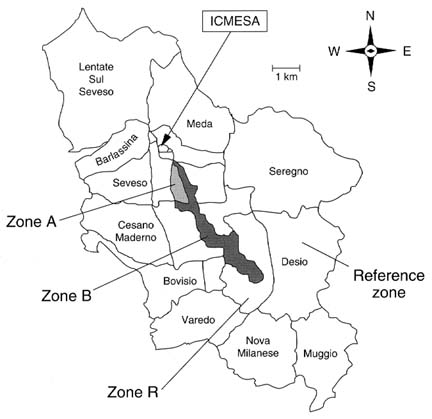
FIGURE 2-1 Area affected by the ICMESA plant accident in Seveso, Italy, in 1976. The three zones A, B, and R are indicated. Adapted from Bertazzi et al., 1989b.
and monitoring the landfill for potential leakage. Clean soil was then laid over areas previously contaminated, and trees and grass were planted. In less contaminated areas, the soil was turned over frequently because sunlight degrades dioxin in the soil. The Seveso accident provided a great deal of information regarding high level exposure of men, women, and children to dioxin, and ways to manage this type of accidental environmental exposure (Gough, 1986).
Several studies have been published that examine the health effects of the residents in the Seveso region. In one of the initial studies, Boeri and colleagues (1978) investigated the incidence of neurological disorders in the Seveso population exposed to TCDD and in a comparison group. Bisanti and colleagues (1980) chronicled the experiences from the accident to determine
the dioxin exposure of the local residents and potential health effects. In a study examining exposure to dioxin in children, Mocarelli and colleagues (1986) investigated whether the TCDD that was released to the atmosphere had any effect on the liver function and lipid metabolism of exposed children. In a 10 year mortality study of the population, Bertazzi and colleagues (1989) examined the mortality between 1976 and 1986 in the exposed population in comparison to mortality that would be expected in the general population. Pesatori and colleagues designed a cancer incidence study, 1977-1986, of the population living in the Seveso area from 1976 to 1986 (Pesatori et al., 1992).
THE FEDERAL GOVERNMENT'S RESPONSE TO PUBLIC CONCERNS
The federal government has been involved with international and domestic policy issues over the military use of herbicides and subsequent human health concerns about exposure to herbicides, particularly Agent Orange, since the onset of the defoliation program. In the late 1960s, several members of the international community became concerned over the U.S. use of herbicides in the Vietnam conflict, and on December 16, 1969, the United Nations General Assembly passed a resolution stating that "the Geneva Protocol embodies the generally recognized rules of international law prohibiting the use in international armed conflicts of all biological and chemical methods of warfare" (Dux and Young, 1980).
On December 16, 1974, the U.S. Senate consented to ratify the Geneva Protocol, which broadly sought an international commitment from all governments that they would never use chemical or biological weapons in war. A U.S. delegate had signed the protocol in 1925; however, the U.S. Senate did not give its consent to ratify the document at that time. President Richard Nixon signed it into force for the United States on February 10, 1975 (von Glahn, 1981). Chemical warfare includes additional aspects, such as the use of herbicides, not specifically covered by the Geneva Protocol. In April 1975, President Ford set forth future U.S. policy governing the use of herbicides in war in Executive Order 11850: "The United States renounces, as a matter of national policy, first use of herbicides in war except use, under regulations applicable to their domestic use, for control of vegetation within U.S. bases and installations or around their immediate defensive perimeters" (von Glahn, 1981; Buckingham, 1982).
White House
In response to the rising concern among veterans about possible health effects of dioxin exposure in Vietnam, President Jimmy Carter established
the Interagency Working Group on the Long-Term Health Effects of Phenoxyherbicides and Contaminants in December 1979. "This group's mission was to bring together knowledgeable government scientists to oversee the matters in the area of phenoxy herbicides and dioxin-related matters, to identify areas where scientific study was needed, and to report the results as soon as they became available to Congress and the public. The group reported to the Secretary of the [then] Department of Health, Education, and Welfare and to the White House Domestic Council" (AOTF, 1990). In August 1981, President Ronald Reagan renamed the working group the Agent Orange Working Group (AOWG), elevated it to be part of the Cabinet Council on Human Resources, and enlarged its scope of work. On April 11, 1985, the cabinet councils were reorganized from eight separate councils into two, the Council on Economic Policy and the Council on Domestic Policy, to which AOWG reported (AOWG, 1985, 1987).
Representatives of the Department of Health and Human Services; the Department of Defense; the State Department; the Veterans Administration; the Environmental Protection Agency; the Department of Agriculture; the Department of Labor's Occupational Safety and Health Administration; the White House Offices of Science and Technology Policy and Management and Budget; the Council of Economic Advisors; and the U.S. Congress Office of Technology Assessment (observer status) served as members of the AOWG (AOWG, 1985, 1987).
The AOWG evaluated the government's scientific research in Agent Orange and related issues (AOWG, 1985). A Science Panel was established to monitor research that the federal government was sponsoring in this area and, in addition, to provide scientific peer review of protocols and subsequent studies (U.S. Congress, Senate, 1988). These studies included the U.S. Air Force Ranch Hand Study; the CDC's Birth Defects Study, Vietnam Experience Study, Agent Orange Study, and Selected Cancers Study; the Department of Veterans Affairs' Proportional Mortality Study; and other related studies. On March 29, 1990, the Agent Orange Task Force (AOTF) was established under the Domestic Policy Council's Working Group on Health Policy to replace the AOWG (AOTF, 1990).
U.S. Congress
Congress has been following the issue of the military use of herbicides and potential health effects thought to be associated with exposure to the herbicides since 1970. Beginning in 1978, members of Congress began to raise questions about the health concerns of veterans potentially exposed to Agent Orange in Vietnam. There are three specific categories that health concerns of Vietnam veterans fall into: (1) access to health care for current problems that might be related to the exposure; (2) scientific answers to
questions about the health effects of exposure to Agent Orange; and (3) compensation for disabilities possibly related to exposure (U.S. Congress, Senate, 1989). Over the past 20 years, congressional committees have held hearings and introduced bills on this topic, and in an attempt to resolve this issue, Congress passed several laws dealing with the human health effects of exposure to Agent Orange used in Vietnam during the Vietnam era.
Hearings
The first congressional hearing related to herbicides used in Vietnam was held on April 7 and 15, 1970, by the Subcommittee on Energy, Natural Resources, and the Environment of the Senate Committee on Commerce (U.S. Congress, Senate, 1970). In the late 1970s, veterans began to ask serious questions regarding their potential exposure to Agent Orange in Vietnam (U.S. Congress, Senate, 1989). Lawmakers seeking answers to these difficult questions began to hold hearings on this issue. Since 1978, numerous hearings have been held by several committees and subcommittees to understand the complex issues concerning exposure assessment and to gather the most current scientific knowledge on the long-term health effects of exposure to herbicides and dioxin (TCDD) used in Vietnam during the Vietnam era. Lawmakers heard testimony from leading scientists, representatives of government agencies, members of veterans organizations, and individual veterans and their families. Listed in Table 2-1 are selected congressional hearings and reports on Agent Orange and dioxin.
Legislation on Agent Orange
Congress passed its first legislation that dealt with the issue of military use of herbicides in Vietnam (Public Law 91-441) on October 7, 1970. This law directed the Secretary of Defense to contract with the National Academy of Sciences to conduct a comprehensive study of the ecological and physiological dangers inherent in the use of herbicides, and of the defoliation program carried out in Vietnam.
A major focus of the Senate and House Committees on Veterans' Affairs has been to understand better the human health effects of exposure to Agent Orange used in Vietnam during the Vietnam era. Legislation on Agent Orange falls primarily into three categories: (1) health care—access to VA medical centers for veterans exposed to Agent Orange during service in Vietnam; (2) scientific research—the human health effects of exposure to Agent Orange in Vietnam, and how best to address the special needs of those veterans who may have been exposed to it; and (3) compensation—to address the issue of compensation for disabilities that might have resulted from exposure to Agent Orange in Vietnam (U.S. Congress, Senate, 1989).
TABLE 2-1 Selected Congressional Hearings and Reports on Agent Orange and Dioxin
|
Committee/Subcommittee |
Hearing Description |
Date of Hearing |
|
U.S. Senate |
||
|
Committee on Commerce Subcommittee on Energy, Natural Resources, and the Environment |
Effects of 2,4,5-T on man and the environment |
April 7 and 15, 1970 |
|
Committee on Veterans' Affairs |
Appendix on Agent Orange activities; Readjustment of Vietnam era veterans with emphasis on Agent Orange; Status of Agent Orange-related activities; Issues related to Agent Orange (adverse health effects from potential exposure to herbicides used in Vietnam); Scientific knowledge and studies regarding the long-term health effects of exposure to Agent Orange; Scientific knowledge relating to Agent Orange exposure and the concerns of veterans who may have been exposed in Vietnam; Legislative hearing on S. 1153 and Agent Orange issues |
April 10, 1979; January 25-26, 1980, and; February 21, 1980; September 10, 1980; November 18, 1981; June 15 and 22, 1983; May 12, 1988; June 22, 1989 |
|
U.S. House of Representatives |
||
|
Committee on Interstate and Foreign Commerce |
Involuntary exposure to Agent Orange and other toxic spraying |
June 26 and 27, 1979 |
|
Subcommittee on Oversight and Investigations |
Vietnam veterans' exposure to Agent Orange |
September 25, 1980 |
|
Committee on Veterans' Affairs Subcommittee on Medical Facilities and Benefits |
Herbicide use in Vietnam with the focus on Agent Orange; Testimony on Agent Orange; Scientific Community Report on Agent Orange |
October 11, 1978; February 25, 1980, and; July 22, 1980; September 16, 1980 |
|
Subcommittee on Oversight and Investigations |
Status of Agent Orange studies; Status of federal Agent Orange activities; Status of federally conducted Agent Orange studies |
May 6, 1981; September 15, 1982; May 3, 1983 |
|
Committee on Veterans' Affairs Subcommittee on Compensation, Pension, and Insurance |
H.R. 1961, Vietnam Veterans Agent Orange Relief Act; Veterans Agent Orange Exposure and Vietnam Service Benefits Act of 1989 |
April 26-27, 1983, and; July 12, 1983; May 2, 1990 |
|
Committee on Veterans' Affairs Subcommittee on Hospitals and Health Care |
Report on a mission to Vietnam; Centers for Disease Control's birth defects study; Agent Orange Studies; Scientific research on the health of Vietnam veterans; Review of the status of Agent Orange studies |
January 31, 1984; October 3, 1984; July 31, 1986; June 8, 1988; July 10, 1989 |
|
Committee on Veterans' Affairs |
CDC's Selected Cancers Study and the scientific reviews of the study |
April 4, 1990 |
|
Committee on Government Operations Human Resources and Intergovernmental Relations Subcommittee |
Review of CDC's Agent Orange study; Links between Agent Orange, herbicides, and rare diseases; Report on the Agent Orange cover-up: a case of flawed science and political manipulation Health risks of dioxin |
July 11, 1989; June 26, 1990; August 2, 1990; June 10, 1992 |
Legislation has also been enacted to appropriate funds for Agent Orange research, to provide clarification on payments received from the Agent Orange settlement fund, and to review and evaluate scientific literature regarding associations between diseases and exposure to dioxin and other chemical compounds in herbicides used in Vietnam.
Health Care Public Law 97-72, enacted on November 3, 1981, expanded eligibility for health care services to include veterans exposed to Agent Orange in Vietnam during the Vietnam era. The effect of this legislation was to provide health care for Vietnam veterans for conditions requiring treatment that resulted from exposure to Agent Orange. The veteran does not need to demonstrate any link with Agent Orange; rather, care is provided unless the condition is shown to be due to something other than exposure (e.g., congenital or developmental conditions or conditions resulting from postservice trauma; Conway, 1993). Public Law 99-166, enacted December 3, 1985, extended the program through September 30, 1989. Public Law 100-687, enacted November 18, 1988, extended the program through December 31, 1990; and Public Law 102-4, enacted February 6, 1991, extended the program through December 31, 1993.
Epidemiologic Studies Public Law 96-151, enacted on December 20, 1979, mandated the Veterans Administration to conduct an epidemiologic study of the possible health effects in Vietnam veterans of exposure to dioxin as found in the herbicides used in Vietnam. The legislation also required that the Office of Technology Assessment review and approve the protocol for the study. Public Law 97-72, enacted on November 3, 1981, expanded the scope of the epidemiologic study legislated in Public Law 96-151 to include an evaluation of the impact on the health of Vietnam veterans of other environmental factors that occurred in Vietnam; this is referred to as the "Vietnam Experience Study." To understand possible health effects experienced by women in Vietnam, Congress enacted Public Law 99-272 on April 7, 1986, directing the VA to conduct an epidemiologic study of the long-term health effects on women who served in Vietnam.
Compensation Congress enacted Public Law 98-542 on October 24, 1984, the Veterans' Dioxin and Radiation Exposure Compensation Standards Act, to address the issue of compensation for disabilities that might have resulted from exposure to Agent Orange in Vietnam. This law "provided for payment, during a two year interim period from October 1, 1984 to September 30, 1986, of disability and death benefits for Vietnam veterans with chloracne and porphyria cutanea tarda (an uncommon disorder of urinary porphyrin metabolism manifest in-patients by thinning and blistering of the skin) which became manifest within one year after service in Vietnam and the survivors of veterans with such conditions" (U.S. Congress, Senate, 1989). Public Law 98-542 also set forth a mechanism for the VA to issue
standards for determining claims for compensation based upon exposure to Agent Orange. Additionally, the law required VA to establish the Veterans Advisory Committee on Environmental Hazards. The purpose of the committee was to advise the Administrator on the content of VA regulations relating to claims for compensation based on exposure to Agent Orange. Also, the committee was to provide advice and recommendations on completed research on other administrative and legislative initiatives (Conway, 1993). Public Law 102-4, the Agent Orange Act of 1991, was enacted on February 6, 1991, to grant disability compensation payments for chloracne, non-Hodgkin's lymphoma, and soft tissue sarcoma (other than osteosarcoma, chondrosarcoma, Kaposi's sarcoma, or mesothelioma) associated with Agent Orange. This law also transferred the responsibility of reviewing the scientific literature concerning the association between herbicide exposure during Vietnam service and each health outcome suspected to be associated with such exposure from the DVA's Advisory Committee on Environmental Hazards to the National Academy of Sciences.
Appropriations In Public Law 98-181, enacted on November 30, 1983, Congress appropriated $57.4 million to CDC to conduct research on the health risks for Vietnam veterans exposed to Agent Orange. On November 18, 1988, Congress enacted Public Law 100-687 to appropriate funds to cover expenses of the U.S. Air Force Ranch Hand study. This law also required the VA to carry out an outreach program to keep Vietnam veterans (including veterans listed in the Agent Orange Registry) informed of new developments regarding Agent Orange-related information.
Agent Orange Settlement Fund Two public laws were enacted that dealt with payments received from the In re Agent Orange Product Liability Litigation settlement fund. Public Law 100-687 provided that payments to veterans or members of their families from the Agent Orange litigation settlement fund should not be considered as income for purposes of VA needs-based programs. Public Law 101-239, enacted on December 19, 1989, provided that the payments should not be considered as income in determining eligibility for the amount of benefits under any federal or federally assisted program.
National Academy of Sciences This report addresses the congressional mandate in Public Law 102-4, that the Department of Veterans Affairs contract with the National Academy of Sciences to review and evaluate the available scientific evidence regarding associations between diseases and exposure to dioxin and other chemical compounds in herbicides used in Vietnam during the Vietnam era. The National Academy of Sciences is also required to make recommendations concerning the need, if any, for additional scientific studies to resolve areas of continuing scientific uncertainty.
Office of Technology Assessment
The technical support office of the U.S. Congress is the Office of Technology Assessment (OTA). In 1979, Public Law 96-151 mandated that the OTA director review and approve plans for the VA's epidemiologic study on the possible long-term health effects resulting from exposure to dioxin-containing herbicides in Vietnam, as well as the study on women Vietnam veterans' health (U.S. Congress, Senate, 1989).
The question of the constitutionality of the congressional mandate that created the role for OTA to review VA protocols on Agent Orange studies was raised by the executive branch. The question was based on providing OTA, a congressional branch agency, veto authority over the execution of a study by an executive branch agency. The executive branch attorneys considered this a violation of the separation of powers doctrine and concluded it was unconstitutional, but legislative branch attorneys concluded that it was constitutional (Gough, 1988).
OTA assembled an Advisory Panel on Agent Orange to assist in reviewing the Agent Orange study protocols, including the CDC's Vietnam Experience Study, Agent Orange Study, and Selected Cancers Study (Gough, 1988), and the VA's Women Vietnam Veterans Health Study. OTA has also reviewed studies for VA committees, has testified at numerous congressional hearings, and was involved in the cancellation of CDC's Agent Orange Study.
General Accounting Office
The General Accounting Office (GAO) has prepared several reports on health effects of exposure to Agent Orange in Vietnam during the Vietnam era. GAO issued its first report on August 16, 1978, on the Department of Defense's use of herbicides in Vietnam and the Veterans Administration's handling of herbicide exposure disability claims submitted by Vietnam veterans (U.S. GAO, 1978). On April 6, 1979, a second report focused on the VA's response to veterans' concerns about exposure to herbicides used in Vietnam (U.S. GAO, 1979a). The report recommended that the Department of Defense, with the assistance and guidance of an appropriate interagency group, conduct a survey of long-term health effects on military personnel who served in Vietnam and possibly were exposed to herbicides.
The GAO, in its third report issued on November 16, 1979, focusing on U.S. ground troops in Vietnam, concluded that a large number of marines in the I Corps section of Vietnam from 1966 to 1969 were close to areas sprayed with Agent Orange both on the day of the spraying and within four weeks afterward (U.S. GAO, 1979b). Some Army units were also close to Agent Orange spraying (U.S. GAO, 1979b). Issued on October 25, 1982,
another GAO report reviewed the VA Agent Orange examination program, and the reliability and completeness of the Agent Orange Registry (U.S. GAO, 1982). The most recent GAO report, dated September 1990, examined the contracting practices of the CDC studies on the effects of Agent Orange on the health of Vietnam veterans (U.S. GAO, 1990). These studies include the Vietnam Experience Study, the Agent Orange Study, the Selected Cancers Study, and the Agent Orange Validation Study. This report reviewed (1) the amount of funds CDC received to do the studies, (2) how CDC used the funds it received, and (3) the contracts awarded for the studies to identify weaknesses that may have occurred in CDC's contracting and contract administration practices for the above-mentioned CDC studies (U.S. GAO, 1990).
Department of the Air Force
In 1979, the Air Force began an epidemiologic study of Ranch Hand personnel who participated in the aerial spraying of herbicides in Vietnam to determine whether they suffered long-term health effects from their exposure to Agent Orange and other herbicides. The 20 year Ranch Hand study is designed to determine whether adverse health effects exist and can be attributed to occupational exposure to Agent Orange. The health of Ranch Hand personnel is being compared to other Air Force servicemen who served in Vietnam but were not exposed to herbicides (U.S. Congress, Senate, 1989). The study consists of mortality and morbidity components, based on follow-up examination results. The following reports have been published to date:
Baseline Mortality Report (AFHS, 1983)
Baseline Morbidity Report (AFHS, 1984a)
First Follow-up Exam Results (AFHS, 1987)
Second Follow-up Exam Results (AFHS, 1990)
Serum Dioxin Level Follow-up Exam Results (AFHS, 1991b)
Mortality Updates 1984, 1985, 1986, 1989, 1991 (AFHS, 1984b, 1985, 1986, 1989, 1991a)
Reproductive Outcomes (AFHS, 1992)
A follow-up exam was conducted in 1992, and additional follow-up exams are scheduled for 1997 and 2002.
Department of Veterans Affairs
The Department of Veterans Affairs (DVA; formerly the Veterans Administration) has been involved in conducting and assessing research, and monitoring studies on the health effects of Agent Orange for almost 15
years. Its Advisory Committee on Health-Related Effects of Herbicides (whose members included government scientists, representatives of veterans organizations, and academic scientists) was in existence from June 1979 until September 1990. In October 1984, the Congress enacted Public Law 95-542, which established the Veterans Advisory Committee on Environmental Hazards. The committee had responsibility, in part, for reviewing the scientific literature relating to the health effects of exposure to Agent Orange. This function was transferred to the National Academy of Sciences following the enactment of Public Law 102-4 in February 1991.
Health Care
The DVA provides certain health care services to veterans of the Vietnam era (defined as August 5, 1964-May 7, 1975) possibly exposed to herbicides (contaminated with dioxin) used for military purposes in Vietnam. Prior to being admitted for health care services, the veteran must provide proof of service in Vietnam. Health care services are limited to hospital and nursing home care and outpatient care in DVA facilities, on a pre- or posthospitalization basis or to prevent a need for hospitalization (U.S. DVA, 1992). When a Vietnam veteran requests DVA medical care, he or she is evaluated by a physical examination and appropriate diagnostic studies, which may serve as the Agent Orange examination (U.S. DVA, 1992).
Research Efforts
The DVA's Environmental Epidemiology Service (EES) has conducted several research studies on Vietnam veterans. The Agent Orange Registry serves as a health surveillance data base; it contains 10 percent of the entire Vietnam veteran population (self-selected) and is routinely reviewed for changes in health outcome and mortality patterns. Several studies have been published on posttraumatic stress disorder among veterans in the Agent Orange Registry (True et al., 1988; Farberow et al., 1990; Bullman et al., 1991). The DVA has conducted studies on soft tissue sarcoma and military service in Vietnam (Kang et al., 1986; 1987). Several mortality studies have been conducted on Vietnam veterans using data from Army and Marine death records for the period 1965-1982 (Breslin et al., 1988) and for the period 1965-1984 (Watanabe et al., 1991), and on the Army I Corps veterans (Bullman et al., 1990). A study has been published on the morbidity and mortality experience of Army Chemical Corps Vietnam veterans (Thomas and Kang, 1990), based on rosters compiled from morning reports for all Chemical Corps units assigned to Vietnam between 1968 and 1987. Thomas and colleagues (1991) examined the mortality among women Vietnam
veterans for the period 1973-1987. For the above-mentioned studies, the methodological framework is described in Chapter 7, and the results are discussed in the health outcome chapters (8-11).
Compensation and Benefits
The Department of Veterans Affairs compensates veterans for certain diseases related to service in Vietnam and exposure to herbicides containing dioxin. Whenever the Secretary determines, on the basis of sound medical and scientific evidence, that a positive association exists between the exposure of humans to an herbicide agent, and the occurrence of a disease in humans, the Secretary prescribes regulations providing that a presumption of service connection is warranted for that disease.
The current DVA compensation policy provides that in making determinations, the Secretary shall take into account reports from the National Academy of Sciences and all other sound medical and scientific information and analysis. In evaluating any study for the purpose of making such determinations, the Secretary shall take into consideration whether the results are statistically significant, are capable of replication, and withstand peer review [38 USC 1116 (b)(2)]. An association between the occurrence of a disease in humans and exposure to an herbicide agent is considered to be positive if the credible evidence for the association is equal to or outweighs the credible evidence against the association [38 USC 1116 (b)(3)]. Proposed regulations on compensation or denial of compensation for these diseases are published in the Federal Register. The DVA solicits comments from the public before final regulations are issued.
For claims based on exposure to herbicides (containing dioxin), the DVA currently compensates for chloracne and soft tissue sarcomas (excluding osteosarcoma, chondrosarcoma, Kaposi's sarcoma, and mesothelioma) (38 USC 1116). Regulations currently proposed would compensate for peripheral neuropathy and deny compensation for lung cancer (57 FR, 2236-7, July 10, 1992). Any veteran who served in the Republic of Vietnam during the Vietnam era (defined as August 5, 1964-May 7, 1975) is presumed to have been exposed to an herbicide containing dioxin. In 1984, Public Law 98-542 authorized interim benefits for a two year period for porphyria cutanea tarda (PCT), which has since expired on its own accord. At its meeting on August 23, 1990, the Advisory Committee on Environmental Hazards did not find a significant statistical association between exposure to herbicides and PCT (U.S. DVA, 1990); the DVA does not currently compensate for PCT.
For claims based on service in Vietnam, the DVA currently compensates for non-Hodgkin's lymphoma (NHL) [38 USC 501(a)]. Service in Vietnam during the Vietnam era, together with the development of NHL
manifested subsequent to such service, is sufficient to establish service connection for this disease.
As of September 1992, DVA data indicate that 76 veterans were receiving service-connected compensation for chloracne, 339 were receiving compensation for STS, and 695 were receiving compensation for NHL. DVA does not have available data on claims in which compensation for these or other conditions was denied. Statistics maintained on pending claims for service-connected disability compensation are not broken down by the type of disability claimed (Hickman, 1993).
Outreach Activities
The DVA's Environmental Agents Service (EAS) is responsible for the development and implementation of its national medical policies and procedures regarding exposure of military veterans to possible environmental hazards, including Agent Orange.
The Agent Orange Registry (AOR), maintained by EAS, is a computerized index of Agent Orange medical examinations. The AOR was initiated by the DVA in mid-1978 to address the health concerns of Vietnam veterans and provide a data base for Vietnam veteran health surveillance. Any Vietnam veteran is eligible for inclusion in the AOR. Veterans reporting to the DVA are examined by a DVA physician, and any diagnoses made by the physician are recorded in the AOR. Between 1978 and 1982, approximately 85,000 veterans reported for an AOR exam and their diagnoses were recorded using one or more of 30 broad diagnostic categories. Beginning in 1982, International Classification of Diseases (ICD) codes were used to record any diagnosis. As of December 1991, there were 129,709 veterans on the computerized registry, whose diagnoses were recorded using ICD codes. In addition to diagnostic data, the AOR also has a variety of self-reported demographic and military characteristics (U.S. DVA, 1992).
Agent Orange Registry participants (all self-selected) are added to the mailing list to receive the Agent Orange Review, a newsletter that provides updated information about Agent Orange. The EAS also compiles fact sheets, Agent Orange Briefs, about Agent Orange and related concerns; copies of these briefs are available through the Agent Orange Coordinator at all DVA medical centers. In addition to the newsletter and the briefs, videotape programs explaining the issues surrounding Agent Orange are available at all DVA medical centers. Each medical center has a designated environmental physician and an Agent Orange Coordinator to manage its Agent Orange program (U.S. DVA, 1992). There are other information resources available to veterans, including the multivolume document Review of Literature on Herbicides, Including Phenoxy Herbicides and Associated Dioxins (U.S. DVA, 1981-1992).
Department of Health and Human Services
Centers for Disease Control
Beginning in the late 1970s, Vietnam veterans began to express their concern over the possibility that they had an increased risk of fathering babies with birth defects from their exposure to herbicides used during the Vietnam conflict. Anecdotal reports also put forth the claim that Vietnamese men who served in the conflict were at increased risks. Because of this growing concern, the CDC began a study in 1982 to determine whether Vietnam veterans were at risk of fathering babies with birth defects, utilizing a comprehensive registry of birth defects in Atlanta, Georgia (Erickson et al., 1984; U.S. Congress, Senate, 1989).
Public Law 96-151 (signed on December 20, 1979) directed the Veterans Administration to conduct an epidemiologic study to determine whether an association exists between exposure to herbicides used in Vietnam and long-term health effects. Public Law 97-72 expanded the scope of the study to include an evaluation of other environmental factors in Vietnam that may have affected the health of veterans (U.S. GAO, 1990). The VA contracted with the University of California, Los Angeles, to develop the study protocol for the epidemiologic study; however, the Office of Technology Assessment did not approve this study protocol. Due to the length of time that passed without producing an approved protocol, VA signed an interagency agreement, in January 1983, with the CDC to transfer the authority for the design, implementation, analysis, and scientific interpretation of the studies directed by Public Laws 96-151 and 97-72 (U.S. Congress, Senate, 1989; U.S. GAO, 1990). The CDC was identified as the organization most qualified to conduct the study (U.S. GAO, 1990). The CDC developed protocols for three components of this epidemiologic study: the Vietnam Experience Study (VES), Agent Orange Study (AOS), and Selected Cancers Study (SCS); OTA and AOWG reviewed and approved the protocols for these studies (U.S. Congress, Senate, 1989). The National Academy of Sciences' Institute of Medicine also reviewed the protocols for the VES and SCS and, in addition, reviewed and commented on the validation study results.
Vietnam Experience Study (VES) Health Status of Vietnam Veterans examined the possible long-term effects of military service in Vietnam. According to CDC, the VES was designed to address the concern that there may have been other factors in addition to herbicide exposure that could have adversely affected veterans who served in Vietnam, in contrast to those who served elsewhere (CDC, 1989b). In the VES, CDC used a random sample of military records to find a large cohort of U.S. Army enlisted men who had served a single tour in Vietnam and a comparison cohort of U.S. Army enlisted men who had served elsewhere. The VES had four
components, including (1) mortality assessment, (2) telephone interview, (3) medical and psychological examination, and (4) a reproductive outcome assessment (CDC, 1987, 1988a-c; U.S. GAO, 1990).
Agent Orange Study (AOS) The Agent Orange Study was designed to determine if there were differences in the health of veterans who were exposed to herbicides in Vietnam compared to Vietnam veterans who were not exposed to herbicides (U.S. Congress, Senate, 1989). ''Achieving this goal was problematic because a critical component of such a study was that there existed an accurate assessment of exposure to Agent Orange. … Thus the November 1983 protocol for the Agent Orange Study proposed an approach to estimating the opportunity for exposure to Agent Orange" (Young et al., 1986). CDC proposed to sort veterans into low-, medium-, and high-exposure categories based on pre-set criteria on which OTA and AOWG had agreed. This method was thought to be acceptable because it was assumed there would be a large group of clearly heavily exposed veterans. It was assumed that veterans would be classified based on their company location each day. CDC found there was not enough location information to use companies, and it proposed using battalions. OTA rejected this as causing potentially overwhelming misclassification. Further work with the Environmental Support Group and CDC determined that companies could be used, after all. However, when the veterans were ranked on the composite exposure scores, almost none were placed in the high- or even the medium-exposure category. CDC then proposed analyzing veterans based on their actual scores (not in categories), using regression analysis. There was so little spread in the scores, however, with almost all veterans showing no exposure, that OTA called for a reassessment of the study (Gelband, 1993). In 1986, the AOWG Science Panel Subpanel on Exposure Assessment noted (Young et al., 1986):
Additional pilot data reviewed at this time confirmed this finding, and the paucity of clearly exposed combat veterans makes it questionable whether a sufficient number can be assembled to conduct an epidemiological study of the type originally designed. It is clear from the available data that health studies designed to assess the effects of Agent Orange and its associated dioxin can be done on more appropriate populations than those identified through military records, e.g., industrial workers and commercial herbicide applicators. Recent advances in analytical chemistry may make it feasible to identify chemical (e.g., 2,3,7,8-TCDD) or biological (DNA adducts) markers that will permit a more reliable exposure assessment. This Subpanel recommends that any study of ground troops, which is dependent upon military records for the assessment of exposure to herbicides, not be conducted without an additional method to verify exposure.
CDC developed a protocol for a study to relate levels of dioxin in veterans to information from military records, which was approved by OTA
in October 1986 (U.S. Congress OTA, 1987). The study, Comparison of Serum Levels of 2,3,7,8-Tetrachlorodibenzo-p-Dioxin with Indirect Estimates of Agent Orange Exposure Among Vietnam Veterans (CDC, 1989a), also referred to as the "validation study," was designed to validate several indirect estimates of opportunity for exposure to Agent Orange among U.S. Army Vietnam combat veterans (646 veterans). The estimates, based on military records, were compared with serum levels of 2,3,7,8-tetrachlorodibenzo-p-dioxin (TCDD). CDC identified a sample of U.S. Army Vietnam veterans and asked them to have blood drawn to measure the level of TCDD in their serum. Veterans were selected from among those who served in 65 combat battalions in III Corps. For comparison, a sample of non-Vietnam U.S. Army veterans of the same era was also examined (CDC, 1989a).
OTA and AOWG reviewed the validation study and concluded that it had been properly conducted and was scientifically valid. According to the CDC, the validation study confirmed that little exposure had taken place, producing results entirely consistent with the records-based exposure scores (Gelband, 1993). In a letter to Senator Alan Cranston, Don M. Newman, chairman, Domestic Policy Council, Agent Orange Working Group, stated that the "Agent Orange Exposure Study … has proved scientifically impossible to do" (U.S. Congress, Senate, 1989).
Selected Cancers Study (SCS) The Association of Selected Cancers with Service in the U.S. Military in Vietnam examined the risk of selected cancers among veterans; in the study, the CDC investigated certain uncommon forms of cancer that had been linked in prior studies with occupational exposures to phenoxy herbicides or chlorophenols (CDC, 1990a). In the population-based study, CDC examined the risk of (1) non-Hodgkin's lymphoma, (2) soft tissue and other sarcomas, (3) Hodgkin's disease, (4) nasal cancer, (5) nasopharyngeal cancer, and (6) primary liver cancers among Vietnam veterans (CDC, 1990a-d).
Environmental Protection Agency
In 1991, the Environmental Protection Agency began a scientific reassessment of the risks of exposure to 2,3,7,8-TCDD and chemically similar compounds, collectively known as dioxin. The reassessment is part of EPA's goals for improving the research and scientific base of the agency, and incorporating improved research and science into its decisions. EPA is undertaking this project on dioxin in response to emerging scientific knowledge and information on the mechanisms of action of dioxin. After EPA's Science Advisory Board reviewed the 1985 and 1988 assessments of the human health risks associated with environmental exposures to dioxin, it suggested that EPA look carefully at the current science and use a biologically
based dose-response model for predicting various exposures to dioxin and related compounds. The report, due in 1993, will include chapters on mechanisms of toxic action; disposition and pharmacokinetics; toxicology: acute subchronic and chronic, reproductive/developmental effects, immunotoxic effects, and carcinogenicity; and epidemiology/human data (U.S. EPA, 1992a,b).
RESPONSE BY OTHERS TO PUBLIC CONCERNS
State Governments
During the 1980s, many state governments set up commissions to address Vietnam veterans' concerns about health effects related to exposure to Agent Orange and dioxin. By 1993, only a few of these commissions remained active.
One of the more active of these groups, the New Jersey Agent Orange Commission, conducted a study in cooperation with Rutgers University known as the Pointman Project. This study examined exposure levels of Vietnam veterans who were herbicide handlers. It compared blood and fat dioxin levels in pairs of exposed and nonexposed veterans (Kahn et al., 1988). In the follow-up study, Pointman II, individuals in Army and Marine infantry units and Navy riverboat units were matched with controls with regard to age, race, dates of service, and rank (Kahn et al., 1992a-c).
Several studies have been conducted on Massachusetts Vietnam veterans; one such study was a cancer surveillance of veterans from 1982 to 1988 (Clapp et al., 1991). This study examined the findings of a previous mortality study of Massachusetts veterans who died between 1972 and 1983, and utilized the Massachusetts Cancer Registry, which collects information on all cases of malignant disease diagnosed after January 1, 1982. Other states have conducted studies and published reports on Vietnam veterans; these include Hawaii, Iowa, Maine, New Mexico, New York, Pennsylvania, Wisconsin, West Virginia, and Texas.
Veterans' Advocates
The American Legion, Vietnam Veterans of America, and the National Veterans Legal Services Project were dissatisfied with the efforts of the DVA and its Advisory Committee on Environmental Hazards in their rule-making procedures to determine which adverse health effects, if any, are associated with exposure to dioxin. These veterans organizations assembled the Agent Orange Scientific Task Force—a group of independent scientists knowledgeable about scientific studies concerning the health effects of exposure to dioxin. The task force prepared a report that summarized its review of the scientific literature related to potential human health effects
of exposure to herbicides and associated contaminants (dioxins). The task force was also asked to determine which adverse health effects are associated with exposure to dioxin, using the DVA standard of determination (Clapp et al., 1990).
On October 6, 1989, Edward J. Derwinski (then Secretary of Veterans Affairs) appointed Admiral E.R. Zumwalt, Jr., as a special assistant to help him in determining whether it is at least as likely as not that there is a statistical association between exposure to Agent Orange and specific health outcomes. On May 5, 1990, Admiral Zumwalt presented his report to the Secretary of Veterans Affairs. This report reviews relevant data in accordance with DVA standards relating to the evaluation of health effects of dioxin exposure. In addition to reviewing the data, Admiral Zumwalt reviewed the work of the DVA's Advisory Committee on Environmental Hazards' Scientific Council, and the protocol and standards employed by government-sponsored studies, to assess the credibility of these studies according to generally accepted scientific practice (Zumwalt, 1990).
Australia and South Korea
Australia, New Zealand, and South Korea also sent troops to Vietnam to serve during the Vietnam era. In response to concerns of Australian veterans similar to those of American veterans about possible exposure to herbicides used in Vietnam, the Australian government conducted its own inquiries into the association between health effects and exposure to herbicides.
In October 1981, the Australian Senate Standing Committee on Science and the Environment undertook a study on pesticides and the health of Australian Vietnam veterans. This committee reviewed the use of pesticides, particularly phenoxy herbicides and chemicals containing dioxin, with reference to their ecological effects, and their effects on human and animal health, dealing primarily with the possible effects on Vietnam veterans of exposure to herbicides; it included all issues adversely affecting those who served in Vietnam. The Senate Standing Committee conducted 10 public hearings in several different cities in Australia as part of its inquiry (Australian Senate, 1982).
In May 1983, the Australian government established a commission to inquire about the use of chemical agents in Vietnam during the Vietnam era; the effects on Australian personnel of exposure to the chemical agents used; and the operation and administration of relevant Australian laws relating to claims by Australian personnel of chemical-caused disabilities (Evatt, 1985).
Approximately 4,700 South Korean veterans have filed claims with the South Korean Vietnam War Veterans Office, reporting that their medical problems appear to be related to Agent Orange. South Korea sent approximately
320,000 soldiers to Vietnam, the second largest force after the United States. South Korea has indicated a new willingness to address the Agent Orange issue by reviewing recommendations from its Veterans Office to cover health costs of alleged Agent Orange victims and possibly file legal action against U.S. chemical manufacturers (New York Times, 1992b).
National Research Council and Institute of Medicine
A number of components of the National Research Council (NRC) and the Institute of Medicine (IOM) have studied the effects of Agent Orange and other herbicide use in Vietnam. Several groups developed conclusions directly related to the issues that are currently being examined by the IOM.
The NRC first became involved in the evaluation and understanding of the health effects of exposure to Agent Orange in 1970. As mentioned above, Public Law 91-441 of 1970 directed the Department of Defense to contract with the NAS for a study of the ecological and physiological effects of the military use of herbicides in Vietnam. A committee, organized through the Assembly of Life Sciences (ALS) of the National Research Council, developed an inventory of the areas sprayed by herbicides, based on DOD log books on herbicide missions. These data were transferred to data tapes (the so-called HERBS tapes) and provide information on 6,542 spray missions that occurred from August 1965 to February 1971, using a total of 17.6 million gallons of herbicide, of which approximately 11.3 million gallons and 4,109 missions involved Agent Orange. The committee reviewed the effects on various types of vegetation, studied the persistence of herbicides in the soil, and attempted to identify effects of the herbicides on resident populations believed to have been exposed. Its investigation determined that mangrove forests were particularly vulnerable to herbicide spraying, as were standing food crops. The extent of damage to the inland forest was more difficult to estimate since, for security reasons, the committee had to rely on aerial photographs in estimating the extent of damage (NAS, 1974).
The committee was unable to determine the direct effects of herbicides on human health. Individual case reports of adverse health effects could not be substantiated, although one component of the report published eight years later (Kunstadter, 1982) reviewed hospital records on births and birth defects in Vietnam. This report remained inconclusive as to the relationship between maternal exposure to herbicides and the incidence of birth defects.
In 1979, the Air Force requested that NAS review a protocol for an investigation of the health effects of Agent Orange exposure on Ranch Hand personnel. A panel, organized by the ALS, suggested that the number of Air Force personnel exposed to Agent Orange was too small to have sufficient statistical power to detect meaningful health effects in the proposed time
frame, that the number of health end points to be followed was too large, and that the public perception of the study's credibility would suffer if it were conducted by the Air Force (NRC, 1980). The Ranch Hand study was eventually conducted by the Air Force, over a longer time period than originally intended.
In 1977, the Italian government invited the National Academy of Sciences-National Research Council to join in a collaborative effort to investigate the effects of area-wide chemical contamination at Seveso, Italy. The NAS-NRC recommended the development of a continued relationship between U.S. and Italian scientists for the purposes of exchanging scientific and technical information, conducting complementary research, and organizing conferences to examine the impacts on health and the environment. In 1980, the ALS, as part of this collaborative effort, established the Committee on Response Strategies to Unusual Chemical Hazards. This committee published the proceedings of its international workshop on plans for clinical and epidemiologic follow-up after area-wide chemical contamination, which was held in Washington, D.C., in March 1980 (NRC, 1982b).
In 1982, the NRC Commission on Life Sciences (CLS) reviewed and commented on a proposed epidemiologic study of the health effects of exposure to Agent Orange and Vietnam service in general. This report made a number of recommendations about a study protocol proposed by the Veterans Administration, including the need for separate studies of exposure to Agent Orange and of Vietnam service in general, rather than one combined study; the need for a formal review of the methods used to classify subjects according to degree of exposure to Agent Orange; and the need for quality control and other validity studies (NRC, 1982a). The protocol that the CLS reviewed was never carried out by the VA, but some of the committee's recommendations were consistent with studies that were eventually carried out by CDC.
In a series of letter reports from 1986 through 1990 (IOM, 1986a,b, 1987a-e, 1988a-e, 1989a,b, 1990a,b), the IOM advised the CDC on its conduct of studies on the health effects of Vietnam service (Advisory Committee on the CDC Study of the Health of Vietnam Veterans). These studies, mandated by Public Laws 96-151 and 97-72, were to determine the long-term health effects of veterans' exposure to herbicides (the Agent Orange Study), the possible long-term effects of military service in Vietnam (the Vietnam Experience Study), and the risk of selected cancers among veterans (the Selected Cancers Study). Although the Agent Orange Study was canceled, the IOM committees reviewed study protocols and preliminary results for the VES and SCS (IOM, 1990a,b), and their recommendations were incorporated into the analyses and final results published by CDC. The IOM advisory committee did review and comment on the validation study results that contributed to the decision not to complete the Agent
Orange Study (IOM, 1987c) but it was not asked, and did not make, a recommendation about the cancellation of that study.
REFERENCES
Agent Orange Product Liability Litigation (In re). 1985. MDL 381, 611 F Supp 1221, 1260 (DED NY 1985).
Agent Orange Task Force (AOTF). 1990. The Science Panel of the Agent Orange Task Force Status Report. Domestic Policy Council, Health Policy Working Group.
Agent Orange Working Group (AOWG). 1985. Status Report. Washington, DC: Cabinet Council Agent Orange Working Group.
Agent Orange Working Group. 1987. Science Panel Status Report. Washington, DC: Domestic Policy Council, Agent Orange Working Group.
Air Force Health Study. 1983. An Epidemiologic Investigation of Health Effects in Air Force Personnel Following Exposure to Herbicides. Baseline Mortality Study Results. Brooks AFB, TX: USAF School of Aerospace Medicine. NTIS AD-A130 793.
Air Force Health Study. 1984a. An Epidemiologic Investigation of Health Effects in Air Force Personnel Following Exposure to Herbicides. Baseline Morbidity Study Results. Brooks AFB, TX: USAF School of Aerospace Medicine. NTIS AD-A138 340. 362 pp.
Air Force Health Study. 1984b. An Epidemiologic Investigation of Health Effects in Air Force Personnel Following Exposure to Herbicides. Mortality Update: 1984. Brooks AFB, TX: USAF School of Aerospace Medicine.
Air Force Health Study. 1985. An Epidemiologic Investigation of Health Effects in Air Force Personnel Following Exposure to Herbicides. Mortality Update: 1985. Brooks AFB, TX: USAF School of Aerospace Medicine.
Air Force Health Study. 1986. An Epidemiologic Investigation of Health Effects in Air Force Personnel Following Exposure to Herbicides. Mortality Update: 1986. Brooks AFB, TX: USAF School of Aerospace Medicine. USAFSAM-TR-86-43. 12 pp.
Air Force Health Study. 1987. An Epidemiologic Investigation of Health Effects in Air Force Personnel Following Exposure to Herbicides. First Follow-Up Examination Results. Brooks AFB, TX: USAF School of Aerospace Medicine. USAFSAM-TR-87-27. 2 vols. 629 pp.
Air Force Health Study. 1989. An Epidemiologic Investigation of Health Effects in Air Force Personnel Following Exposure to Herbicides. Mortality Update: 1989. Brooks AFB, TX: USAF School of Aerospace Medicine. USAFSAM-TR-89-9. 35 pp.
Air Force health Study. 1990. An Epidemiologic Investigation of Health Effects in Air Force Personnel Following Exposure to Herbicides. Brooks AFB, TX: USAF School of Aerospace Medicine. USAFSAM-TR-90-2. 2 vols.
Air Force Health Study. 1991a. An Epidemiologic Investigation of Health Effects in Air Force Personnel Following Exposure to Herbicides. Mortality Update: 1991. Brooks AFB, TX: Armstrong Laboratory. AL-TR-1991-0132. 33 pp.
Air Force Health Study. 1991b. An Epidemiologic Investigation of Health Effects in Air Force Personnel Following Exposure to Herbicides. Serum Dioxin Analysis of 1987 Examination Results. Brooks AFB, TX: USAF School of Aerospace Medicine. 9 vols.
Air Force Health Study. 1992. An Epidemiologic Investigation of Health Effects in Air Force Personnel Following Exposure to Herbicides. Reproductive Outcomes. Brooks AFB, TX: Armstrong Laboratory. AL-TR-1992-0090. 602 pp.
Atwood PL. 1990. Agent Orange: Medical, Scientific, Legal, Political and Psychological Issues. Boston: William Joiner Center for the Study of War and Social Consequences.
Australian Senate Standing Committee on Science and the Environment. 1982. Pesticides and the Health of Australian Vietnam Veterans. First report. 240 pp.
Bertazzi PA, Zocchetti C, Pesatori AC, Guercilena S, Sanarico M, Radice L. 1989a. Ten year mortality study of the population involved in the Seveso incident in 1976. American Journal of Epidemiology 129:1187-1200.
Bertazzi PA, Zocchetti C, Pesatori AC, Guercilena S, Sanarico M, Radice L. 1989b. Mortality in an area contaminated by TCDD following an industrial accident. La Medicina del Lavoro 4:316-332.
Bionetics Research Laboratories. 1968. Evaluation of Carcinogenic, Teratogenic and Mutagenic Activities of Selected Pesticides and Industrial Chemicals. Bethesda, MD: Bionetics Research Labs. 3 vols. NTIS PB223 161 .
Bisanti L, Bonetti F, Caramaschi F, Del Corno G, Favaretti C, Giambelluca SE, Marni E, Montesarchio E, Puccinelli V, Remotti G, Volpato C, Zambrelli E, Fara GM. 1980. Experiences from the accident of Seveso. Acta Morphologica Academiae Scientarum Hungaricae 28:139-157.
Boeri R, Bordo B, Crenna P, Filippini G, Massetto M, Zecchini A. 1978. Preliminary results of a neurological investigation of the population exposed to TCDD in the Seveso region. Rivista di Patologica Nervosa e Mentale 99:111-128.
Bonoir DE, Champlin SM, Kolly TS. 1984. The Vietnam Veteran: A History of Neglect. New York: Praeger.
Breslin P, Kang H, Lee Y, Burt V, Shepard BM. 1988. Proportionate mortality study of U.S. Army and U.S. Marine Corps veterans of the Vietnam War. Journal of Occupational Medicine 30:412-419.
Buckingham WA. 1982. Operation Ranch Hand: The Air Force and Herbicides in Southeast Asia 1961-1971. Washington, DC: U.S. Air Force Office of Air Force History.
Bullman TA, Kang HK, Watanabe KK. 1990. Proportionate mortality among U.S. Army Vietnam veterans who served in Military Region I. American Journal of Epidemiology 132:670-674.
Bullman TA, Kang H, Thomas TL. 1991. Posttraumatic stress disorder among Vietnam veterans on the Agent Orange Registry: a case-control analysis. Annals of Epidemiology 1:505-512.
Calvert GM, Sweeney MH, Morris JA, Fingerhut MA, Hornung RW, Halperin WE. 1991. Evaluation of chronic bronchitis, chronic obstructive pulmonary disease, and ventilatory function among workers exposed to 2,3,7,8-tetrachlorodibenzo-p-dioxin. American Review of Respiratory Disease 144:1302-1306.
Calvert GM, Hornung RV, Sweeney MH, Fingerhut MA, Halperin WE. 1992. Hepatic and gastrointestinal effects in an occupational cohort exposed to 2,3,7,8-tetrachlorodibenzo-para-dioxin. Journal of the American Medical Association 267:2209-2214.
Centers for Disease Control (CDC). 1987. Postservice mortality among Vietnam veterans . Journal of the American Medical Association 257:790-795.
Centers for Disease Control. 1988a. Health status of Vietnam veterans. I. Psychosocial characteristics. Journal of the American Medical Association. 259:2701-2707.
Centers for Disease Control. 1988b. Health status of Vietnam veterans. II. Physical health. Journal of the American Medical Association 259:2708-2714.
Centers for Disease Control. 1988c. Health status of Vietnam veterans. III. Reproductive outcomes and child health. Journal of the American Medical Association 259:2715-2717.
Centers for Disease Control. 1989a. Comparison of Serum Levels of 2,3,7,8-Tetrachlorodibenzo-p-Dioxin with Indirect Estimates of Agent Orange Exposure Among Vietnam Veterans: Final Report. Atlanta: U.S. Department of Health and Human Services.
Centers for Disease Control. 1989b. Health Status of Vietnam Veterans. Vietnam Experience Study. Atlanta: U.S. Department of Health and Human Services. Vols. I-V, Supplements A-C.
Centers for Disease Control. 1990a. The Association of Selected Cancers with Service in the
U.S. Military in Vietnam: Final Report. Atlanta: U.S. Department of Health and Human Services.
Centers for Disease Control. 1990b. The association of selected cancers with service in the U.S. military in Vietnam. I. Non-Hodgkin's lymphoma. Archives of Internal Medicine 150:2473-2483.
Center for Disease Control. 1990c. The association of selected cancers with service in the U.S. military in Vietnam. II. Soft tissue and other sarcomas. Archives of Internal Medicine 150:2485-2492.
Centers for Disease Control. 1990d. The association of selected cancers with service in the U.S. military in Vietnam. III. Hodgkin's disease, nasal cancer, nasopharyngeal cancer, and primary liver cancer. Archives of Internal Medicine 150:2495-2505.
Clapp RW, Commoner B, Constable JD, Epstein SS, Kahn PC, Olson JR, Ozonoff DM. 1990. Human Health Effects Associated with Exposure to Herbicides and/or Their Associated Contaminants—Chlorinated Dioxins: Agent Orange and the Vietnam Veteran. A Review of the Scientific Literature. Agent Orange Scientific Task Force.
Clapp RW, Cupples LA, Colton T, Ozonoff DM. 1991. Cancer surveillance of veterans in Massachusetts, 1982-1988. International Journal of Epidemiology 20:7-12.
Collins CV. 1967. Herbicide Operations in Southeast Asia, July 1961-June 1967. San Francisco: Headquarters, Pacific Air Forces. NTIS AD-779 796.
Conway F. 1993. Memorandum to the Institute of Medicine Committee to Review the Health Effects in Vietnam Veterans of Exposure to Herbicides. Washington, DC: Department of Veterans Affairs. May 18, 1993.
Cutting RK, Phouc TH, Ballo JM, Benenson MW, Evans CH. 1970. Congenital Malformations, Hydatidiform Moles and Stillbirths in the Republic of Vietnam 1960-1969. Washington, DC: U.S. Government Printing Office. No. 903.233. 29 pp.
DeVictor M. 1977. Defoliation Operations from 1955-1969 During Vietnam War. Memorandum to the file. Chicago: Veterans Administration Regional Office.
Dux J, Young PJ. 1980. Agent Orange: The Bitter Harvest. Sydney: Hodder and Stoughton.
Erickson JD, Mulinare J, McClain PW, Fitch TG, James LM, McClearn AB, Adams MJ. 1984. Vietnam Veterans' Risks for Fathering Babies with Birth Defects. Atlanta: U.S. Department of Health and Human Services, Centers for Disease Control.
Evatt P. 1985. Royal Commission on the Use and Effect of Chemical Agents on Australian Personnel in Vietnam, Final Report. Canberra: Australian Government Publishing Service. 9 vols.
Farberow NL, Kang H, Bullman T. 1990. Combat experience and postservice psychosocial status as predictors of suicide in Vietnam veterans. Journal of Nervous and Mental Disease 178:32-37.
Federal Register. 1992. Diseases associated with service in the Republic of Vietnam. 57 (133):30707-30708.
Fingerhut MA, Sweeney MH, Halperin WE, Schnorr TM. 1987. Epidemiology of populations exposed to dioxins. In: Exner J, ed. Solving Hazardous Waste Problems: Learning from Dioxins. Washington, DC: American Chemical Society.
Fingerhut MA, Halperin WE, Marlow DA, Piacitelli LA, Honchar PA, Sweeney MH, Greife AL, Dill PA, Steenland K, Suruda AJ. 1991a. Cancer mortality in workers exposed to 2,3,7,8-tetrachlorodibenzo-p-dioxin. New England Journal of Medicine 324:212-218.
Fingerhut MA, Halperin WE, Marlow DA, Piacitelli LA, Honchar PA, Sweeney MH, Greife AL, Dill PA, Steenland K, Suruda AJ. 1991b. Mortality Among U.S. Workers Employed in the Production of Chemicals Contaminated with 2,3,7,8-Tetrachlorodibenzo-p-dioxin (TCDD). Final Report. Cincinnati, OH:NIOSH. NTIS PB 91-125971.
Gelband H. 1993. Memorandum to the Institute of Medicine Committee to Review the Health Effects in Vietnam Veterans of Exposure to Herbicides. May 11, 1993.
Gough M. 1986. Dioxin, Agent Orange: The Facts. New York: Plenum Press.
Gough M. 1988. The political assessment: a congressional view. In: Young AL, Reggiani GM, eds. Agent Orange and Its Associated Dioxin: Assessment of a Controversy. Amsterdam: Elsevier.
Hardell L. 1990. Phenoxy herbicides, cancer, and Swedish forestry workers. In: Atwood PL. 1990. Agent Orange: Medical, Scientific, Legal, Political and Psychological Issues. Boston: William Joiner Center for the Study of War and Social Consequences.
Henneberger PK, Ferris BG Jr, Monson RR. 1989. Mortality among pulp and paper workers in Berlin, New Hampshire. British Journal of Industrial Medicine 46:658-664.
Hickman JG. 1993. Letter to the Institute of Medicine Committee to Review the Health Effects in Vietnam Veterans of Exposure to Herbicides. Washington, DC: U.S. Department of Veterans Affairs, Compensation and Pension Service. April 26, 1993.
Hoar-Zahm S, Blair A. 1990. Cancer risk among agricultural workers. In: Atwood PL. 1990. Agent Orange: Medical, Scientific, Legal, Political and Psychological Issues. Boston: William Joiner Center for the Study of War and Social Consequences.
Hoar SK, Blair A. Holmes FF, Boysen CD, Robel RJ, Hoover R, Fraumeni JF. 1986. Agricultural herbicide use and risk of lymphoma and soft tissue sarcoma. Journal of the American Medical Association 256:1141-1147.
Hoffman RE, Stehr-Green PA, Webb KB, Evans RG, Knutsen AP, Schramm WF, Staake JL, Gibson BB, Steinberg KK. 1986. Health effects of long-term exposure to 2,3,7,8-tetrachlorodibenzo-p-dioxin. Journal of the American Medical Association 255:2031-2038.
Huddle FP. 1969. A Technology Assessment of the Vietnam Defoliant Matter. Report to the Subcommittee on Science, Research, and Development of the Committee on Science and Astronautics, U.S. House of Representatives. August 8, 1969. 91st Cong., 1st sess.
Institute of Medicine (IOM). 1986a. Review of the CDC Proposals for Inclusions of Semen Analysis in the Health Examinations and for Follow-up of Preliminary Data on Birth Outcomes. First Letter Report, March 1986. Washington, DC: IOM Advisory Committee on the CDC Study of the Health of Vietnam Veterans.
Institute of Medicine (IOM). 1986b. Review of CDC Mortality and Interim Interview Reports and Birth Records Review Study from the Vietnam Veterans Experience Study. Second Letter Report, September 1986. Washington, DC: IOM Advisory Committee on the CDC Study of the Health of Vietnam Veterans.
Institute of Medicine. 1987a. Review of Drafts of Introduction, and Data and Methods Chapters of the Telephone Interview Component of the Vietnam Experience Study. Part I: Self-Reported Morbidity Among Vietnam Veterans. Third Letter Report, February 1987. Washington, DC: IOM Advisory Committee on the CDC Study of the Health of Vietnam Veterans.
Institute of Medicine. 1987b. Review of Preliminary Results of the Medical and Psychological Examinations of the Vietnam Experience Study. Fourth Letter Report, April 1987. Washington, DC: IOM Advisory Committee on the CDC Study of the Health of Vietnam Veterans.
Institute of Medicine. 1987c. Review of Comparison of Serum Levels of 2,3,7,8-TCDD with Indirect Estimates of Agent Orange Exposure in Vietnam Veterans. Fifth Letter Report. Washington, DC: IOM Advisory Committee on the CDC Study of the Health of Vietnam Veterans.
Institute of Medicine. 1987d. Review of Interim Drafts of Parts A and B of the VES Study of Reproductive Outcomes and Health of Veterans' Children. Sixth Letter Report. October 1987. Washington, DC: IOM Advisory Committee on the CDC Study of the Health of Vietnam Veterans.
Institute of Medicine. 1987e. Review of the Interim Draft of Findings from the Psychological Examination Component of the VES. Seventh Letter Report, December 1987. Washington,
DC: IOM Advisory Committee on the CDC Study of the Health of Vietnam Veterans.
Institute of Medicine. 1988a. Review of Self-Reported Morbidity Among Vietnam Veterans: Results from the Telephone Interview Component of the VES. Eighth Letter Report, January 1988. Washington, DC: IOM Advisory Committee on the CDC Study of the Health of Vietnam Veterans .
Institute of Medicine. 1988b. Review of the Second Draft of the CDC Monograph on the Reproductive System of VES Subjects. Ninth Letter Report, January 1988. Washington, DC: IOM Advisory Committee on the CDC Study of the Health of Vietnam Veterans.
Institute of Medicine. 1988c. Review of the VES Monograph on Reproductive Outcomes and Health of Veterans' Children. Tenth Letter Report, January 1988. Washington, DC: IOM Advisory Committee on the CDC Study of the Health of Vietnam Veterans.
Institute of Medicine. 1988d. Review of Prepublication Drafts. I. Psychosocial Characteristics. II. Physical Health. III. Reproductive Outcomes and Child Health. Eleventh Letter Report, April 1988. Washington, DC: IOM Advisory Committee on the CDC Study of the Health of Vietnam Veterans.
Institute of Medicine. 1988e. Review of the Selected Cancers Study Analysis Plan. First Letter Report, October 1988. Washington, DC: IOM Advisory Committee on the CDC Study of the Health of Vietnam Veterans: Selected Cancers Study.
Institute of Medicine. 1989a. Review of Preliminary Data Analysis. Second Letter Report, April 1989. Washington, DC: IOM Advisory Committee on the CDC Study of the Health of Vietnam Veterans: Selected Cancers Study.
Institute of Medicine. 1989b. Review of Preliminary Data Analysis. Third Letter Report, July 1989. Washington, DC: IOM Advisory Committee on the CDC Study of the Health of Vietnam Veterans: Selected Cancers Study.
Institute of Medicine. 1990a. Review of Preliminary Data Analyses and Plans for Presentation of Final Results. Fourth Letter Report, January 1990. Washington, DC: IOM Advisory Committee on the CDC Study of the Health of Vietnam Veterans: Selected Cancers Study.
Institute of Medicine. 1990b. Review of CDC Draft Reports. Fifth Letter Report, April 1990. Washington, DC: IOM Advisory Committee on the CDC Study of the Health of Vietnam Veterans: Selected Cancers Study.
Jacobs JB, McNamara D. 1986. Vietnam veterans and the Agent Orange controversy. Armed Forces and Society 13:57-79.
Kahn PC, Gochfeld M, Nygren M, Hansson M, Rappe C, Velez H, Ghent-Guenther T, Wilson WP. 1988. Dioxins and dibenzofurans in blood and adipose tissue of Agent Orange-exposed Vietnam veterans and matched controls. Journal of the American Medical Association 259:1661-1667.
Kahn PC, Gochfeld M, Lewis WW. 1992a. Dibenzodioxin and Dibenzofuran Congener Levels in Four Groups of Vietnam Veterans Who Did Not Handle Agent Orange. The Pointman II Project. New Jersey Agent Orange Commission.
Kahn PC, Gochfeld M, Lewis WW. 1992b. Immune Status and Herbicide Exposure in the New Jersey Pointman I Project. New Jersey Agent Orange Commission.
Kahn PC, Gochfeld M, Lewis WW. 1992c. Semen Analysis in Vietnam Veterans with Respect to Presumed Herbicide Exposure. New Jersey Agent Orange Commission.
Kang HK, Weatherbee L, Breslin PP, Lee Y, Shepard BM. 1986. Soft tissue sarcomas and military service in Vietnam: a case comparison group analysis of hospital patients. Journal of Occupational Medicine 28:1215-1218.
Kang HK, Enzinger FM, Breslin P, Feil M, Lee Y, Shepard B. 1987. Soft tissue sarcoma and military service in Vietnam: a case-control study. Journal of the National Cancer Institute
79:693-699 (published erratum appears in Journal of the National Cancer Institute 1987, 79:1173).
Karnow S. 1991. Vietnam: A History. New York: Penguin.
Kunstadter P. 1982. A Study of Herbicides and Birth Defects in the Republic of Vietnam: An Analysis of Hospital Records. Washington, DC: National Academy Press.
Lilienfeld DE, Gallo MA. 1989. 2,4-D, 2,4,5-T, and 2,3,7,8-TCDD: an overview. Epidemiologic Review 11:28-58.
Linedecker C, Ryan M, Ryan M. 1982. Kerry: Agent Orange and the American Family. New York: St. Martin's Press.
McCulloch JM. 1984. Herbicides: Environmental Health Effects; Vietnam; and the Geneva Protocol. Developments During 1970. Washington, DC: Library of Congress, Legislative Reference Service.
Midwest Research Institute (MRI). 1967. Assessment of Ecological Effects of Extensive or Repeated Use of Herbicides. MRI Project No. 3103-B. Kansas City, MO: MRI. NTIS AD 824 314.
Military Assistance Command, Vietnam (MACV). Military History Branch. 1972. Chronology of Events Pertaining to U.S. Involvement in the War in Vietnam and Southeast Asia.
Mocarelli P, Marocchi A, Brambilla P, Gerthoux P, Young DS, Mantel N. 1986. Clinical laboratory manifestations of exposure to dioxin in children. A six year study of the effects of an environmental disaster near Seveso, Italy. Journal of the American Medical Association 256:2687-2695.
Moses M, Lilis R, Crow KD, Thornton J, Fischbein A, Anderson HA, Selikoff IJ. 1984. Health status of workers with past exposure to 2,3,7,8-tetrachlorodibenzo-p-dioxin in the manufacture of 2,4,5-trichlorophenoxyacetic acid: comparison of findings with and without chloracne. American Journal of Industrial Medicine 5:161-182.
National Academy of Sciences (NAS). National Research Council, Assembly of Life Sciences. 1974. The Effects of Herbicides in South Vietnam. Washington, DC: National Academy of Sciences.
National Research Council (NRC). Assembly of Life Sciences. Panel on the Proposed Air Force Study of Herbicide Orange. 1980. Review of U.S. Air Force Protocol: Epidemiological Investigation of Health Effects in Air Force Personnel Following Exposure to Herbicide Orange. Washington, DC: NRC.
National Research Council. Commission on Life Sciences. Committee on Epidemiology and Veterans Follow-up Studies. 1982a. The Effects of Exposure to Agent Orange on Ground Troops in Vietnam: A Report of the Subcommittee Appointed to Review a Protocol. Washington, DC: NRC.
National Research Council. 1982b. Plans for Clinical and Epidemiologic Follow-up After Area-Wide Chemical Contamination. Washington, DC: National Academy Press.
New York Times. 1992a. 381 Evacuees of Polluted Sites in Missouri Settle Dioxin Suits. November 8, 1992.
New York Times. 1992b. South Korea Reviews Vietnam War Role. August 22, 1992. A3.
Pesatori AC, Consonni D, Tironi A, Landi MT, Zocchetti C, Bertazzi PA. 1992. Cancer morbidity in the Seveso area, 1976-1986. Chemosphere 25:209-212.
Robinson CF, Waxweiler RJ, Fowler DP. 1986. Mortality among production workers in pulp and paper mills. Scandinavian Journal of Work, Environment, and Health 12:552-560.
Salisbury HE. 1985. Vietnam Reconsidered: Lessons From a War. New York: Harper and Row.
Schuck PH. 1987. Agent Orange on Trial: Mass Toxic Disasters in the Courts. Cambridge: Belknap Press.
Solet D, Zoloth SR, Sullivan C, Jewett J, Michaels DM. 1989. Patterns of mortality in pulp and paper workers. Journal of Occupational Medicine 31:627-630.
Spector RH. 1993. After Tet: The Bloodiest Year in Vietnam. New York: Free Press.
Stockbauer JW, Hoffman RE, Schramm WF, Edmonds LD. 1988. Reproductive outcomes of mothers with potential exposure to 2,3,7,8-tetrachlorodibenzo-p-dioxin. American Journal of Epidemiology 128:410-419.
Suskind RR, Hertzberg VS. 1984. Human health effects of 2,4,5-T and its toxic contaminants. Journal of the American Medical Association 251:2372-2380.
Sweeney MH, Fingerhut MA, Arezzo JC, Hornung RW, Connally LB. In press. Peripheral neuropathy after occupational exposure to 2,3,7,8-tetrachlorodibenzo-p-dioxin (TCDD).
Thomas TL, Kang HK. 1990. Mortality and morbidity among Army Chemical Corps Vietnam veterans: a preliminary report. American Journal of Industrial Medicine 18:665-673.
Thomas TL, Kang H, Dalager N. 1991. Mortality among women Vietnam veterans, 1973-1987. American Journal of Epidemiology 134:973-980.
True WR, Goldberg J, Eisen SA. 1988. Stress symptomatology among Vietnam veterans. Analysis of the Veterans Administration Survey of Veterans II. American Journal of Epidemiology 128:85-92.
U.S. Army. 1964. Proceedings of the First Defoliation Conference 29-30 July 1963. Fort Detrick, MD: U.S. Army Biological Laboratories.
U.S. Congress, House of Representatives. 1978. Committee on Veterans' Affairs, Subcommittee on Medical Facilities and Benefits. Hearings on Herbicide ''Agent Orange." 95th Cong., 2d sess.
U.S. Congress, House of Representatives. 1979. Committee on Interstate and Foreign Commerce, Subcommittee on Oversight and Investigations. Hearing on Involuntary Exposure to Agent Orange and Other Toxic Spraying. 96th Cong., 1st sess. June 26 and 27, 1979.
U.S. Congress, House of Representatives. 1980a. Committee on Interstate and Foreign Commerce, Subcommittee on Oversight and Investigations. Hearing on Exposure of Vietnam Veterans to Agent Orange. 96th Cong., 2d sess. September 25, 1980.
U.S. Congress, House of Representatives. 1980b. Committee on Veterans' Affairs, Subcommittee on Medical Facilities and Benefits. Oversight Hearing to Receive Testimony on Agent Orange. 96th Cong., 2d sess. February 25 and July 22, 1980.
U.S. Congress, House of Representatives. 1980c. Committee on Veterans' Affairs, Subcommittee on Medical Facilities and Benefits. Scientific Community Report on Agent Orange. 96th Cong., 2d sess. September 16, 1980.
U.S. Congress, House of Representatives. 1981. Committee on Veterans' Affairs, Subcommittee on Oversight and Investigations. Hearing on the Current Status of Agent Orange Studies. 97th Cong., 1st sess. Serial No. 97-22. May 6, 1981.
U.S. Congress, House of Representatives. 1982. Committee on Veterans' Affairs, Subcommittee on Oversight and Investigations. Hearing on Federal Agent Orange Activities. 97th Cong., 2d sess., September 15, 1982.
U.S. Congress, House of Representatives. 1983a. Committee on Veterans' Affairs, Subcommittee on Oversight and Investigations. Hearing on Federally Conducted Agent Orange Studies. 98th Cong., 1st sess. May 3, 1983.
U.S. Congress, House of Representatives. 1983b. Committee on Veterans' Affairs, Subcommittee on Compensation, Pension, and Insurance, Hearings on H.R. 1961—Vietnam Veterans Agent Orange Relief Act. 98th Cong., 1st sess. Serial No. 98-18.
U.S. Congress, House of Representatives. 1984a. Committee on Veterans' Affairs. Report on Mission to Vietnam: Agent Orange in Vietnam. 98th Cong., 2d sess. Serial No. 48. January 31, 1984.
U.S. Congress, House of Representatives. 1984b. Committee on Veterans' Affairs, Subcommittee on Hospitals and Health Care. Hearing on the Centers for Disease Control's Birth Defects Study. 98th Cong., 2d sess. October 3, 1984.
U.S. Congress, House of Representatives. 1988. Committee on Veterans' Affairs, Subcommittee
on Hospitals and Health Care. Hearing on Scientific Research on the Health of Vietnam Veterans. 100th Cong., 2d sess. June 8, 1988.
U.S. Congress, House of Representatives. 1989a. Committee on Veterans' Affairs, Subcommittee on Hospitals and Health Care. Hearing on Studies on Agent Orange. 101st Cong., 1st sess. July 10, 1989.
U.S. Congress, House of Representatives. 1989b. Committee on Government Operations, Human Resources and Intergovernmental Relations Subcommittee . Oversight Review of CDC's Agent Orange Study.
U.S. Congress, House of Representatives. 1990a. Committee on Veterans' Affairs. Hearing on the Centers for Disease Control Selected Cancers Study and Scientific Reviews of the Study. 101st Cong., 2d sess. April 4, 1990.
U.S. Congress, House of Representatives. 1990b. Committee on Government Operations, Human Resources and Intergovernmental Relations Subcommittee. Hearing on Links Between Agent Orange, Herbicides, and Rare Diseases. 101st Cong., 2d sess. June 26, 1990.
U.S. Congress, House of Representatives. 1990c. Committee on Government Operations, Human Resources and Intergovernmental Relations Subcommittee. Report on the Agent Orange Cover-up: A Case of Flawed Science and Political Manipulation. 101st Cong., 2d sess. August 2, 1990.
U.S. Congress, House of Representatives. 1992. Committee on Government Operations, Human Resources and Intergovernmental Relations Subcommittee. Hearing on Health Risks of Dioxin. June 10, 1992.
U.S. Congress, Senate. 1970. Committee on Commerce, Subcommittee on Energy, Natural Resources, and the Environment. Hearings on Effects of 2,4,5-T on Man and the Environment. 91st Cong. 2d sess. Serial No. 91-60. April 7 and 15, 1970.
U.S. Congress, Senate. 1979. Committee on Veterans' Affairs. Hearing on VA Health Resources and Appendix: Agent Orange Activities (Part I). 96th Cong., 1st sess. April 10, 1979.
U.S. Congress, Senate. 1980a. Committee on Veterans' Affairs. Hearing on Readjustment of Vietnam Era Veterans with Emphasis on Agent Orange . 96th Cong. January 25-26 and February 21, 1980.
U.S. Congress, Senate. 1980b. Committee on Veterans' Affairs. Hearing on Agent Orange Update and Appendix: Agent Orange Activities (Part II). 96th Cong., 2d sess. September 10, 1980.
U.S. Congress, Senate. 1981. Committee on Veterans' Affairs. Oversight on Issues Related to Agent Orange and Other Herbicides. 97th Cong., 1st sess. November 18, 1981.
U.S. Congress, Senate. 1983. Committee on Veterans' Affairs. Hearings on Veterans' Exposure to Agent Orange (S. 374, S. 786, S. 991). 98th Cong., 1st sess. S. Hrg. 98-511.
U.S. Congress, Senate. 1988. Committee on Veterans' Affairs. Hearing on Agent Orange Legislation and Oversight. 100th Cong., 2d sess. S. Hrg. 100-1025.
U.S. Congress, Senate. 1989. Committee on Veterans' Affairs. Report on Veterans' Agent Orange Exposure and Vietnam Service Benefits Act of 1989. 101st Cong., 2d sess. Report 101-82.
U.S. Congress Office of Technology Assessment (OTA). 1987. OTA Comments on CDC Study: "Comparison of Serum Levels of 2,4,7,8-TCDD with Indirect Estimates of Agent Orange Exposure in Vietnam Veterans." Washington, DC: OTA.
U.S. Department of Veterans Affairs (DVA). 1981-1992. Review of Literature on Herbicides, Including Phenoxy Herbicides and Associated Dioxins. 20 vols. Vol. I-II prepared by JRB Associates, McLean, VA; Vols. III-XVIII prepared by Clement International, Fairfax, VA; Vols. XIX-XX prepared by Information Ventures, Philadelphia.
U.S. Department of Veterans Affairs. 1990. Minutes of the Veterans' Affairs Committee on Environmental Hazards. Washington, DC: DVA.
U.S. Department of Veterans Affairs. 1992. Agent Orange Briefs A1-D5. Washington, DC: DVA, Environmental Agents Service.
U.S. Environmental Protection Agency (EPA). 1979. Report of Assessment of a Field Investigation of Six Year Spontaneous Abortion Rates in Three Oregon Areas in Relation to Forest 2,4,5-T Spray Practices. EPA, Epidemiologic Studies Program, Human Effects Monitoring Branch.
U.S. Environmental Protection Agency. 1992a. Workshop Review Draft of Health Assessment for 2,3,7,8-Tetrachlorodibenzo-p-dioxin (TCDD) and Related Compounds. Washington, DC: EPA, Office of Research and Development.
U.S. Environmental Protection Agency. 1992b. Dioxin Risk Assessment: Summary of Current Efforts. Presentation by William Farland to the Institute of Medicine Committee to Review the Health Effects in Vietnam Veterans of Exposure to Herbicides. June 26, 1992.
U.S. General Accounting Office (GAO). 1978. Use of Agent Orange in Vietnam. Washington, DC: GAO. CED-78-158.
U.S. General Accounting Office. 1979a. Health Effects of Exposure to Herbicide Orange in South Vietnam Should Be Resolved. Washington, DC: GAO. CED-79 22.
U.S. General Accounting Office. 1979b. U.S. Ground Troops in South Vietnam Were in Areas Sprayed with Herbicide Orange. Report by the Comptroller General of the United States. Washington, DC: GAO. FPCD 80-23.
U.S. General Accounting Office. 1982. VA's Agent Orange Examination Program: Actions Needed to More Effectively Address Veterans' Health Concerns Report to the Congress. Washington, DC: GAO. GAO/HRD-83-6; B-208995. 91 pp.
U.S. General Accounting Office. 1990. Agent Orange Studies: Poor Contracting Practices at Centers for Disease Control Increased Costs. Washington, DC: GAO. GAO/GGD-90-122BR. 30 pp.
von Glahn G. 1981. Law Among Nations: An Introduction to Public International Law. 4th ed. New York: Macmillan.
Warren WF. 1968. A Review of the Herbicide Program in South Vietnam. San Francisco: Scientific Advisory Group. Working Paper No. 10-68. NTIS AD 779-797.
Watanabe KK, Kang HK, Thomas TL. 1991. Mortality among Vietnam veterans: with methodological considerations. Journal of Occupational Medicine 33:780-785.
Webb K, Evans RG, Stehr P, Ayres SM. 1987. Pilot study on health effects of environmental 2,3,7,8-TCDD in Missouri. American Journal of Industrial Medicine 11:685-691.
Whiteside T. 1977. The Pendulum and the Toxic Cloud: The Course of Dioxin Contamination. New Haven: Yale University Press.
Wilcox FA. 1989. Waiting for an Army to Die: The Tragedy of Agent Orange. Cabin John, MD: Seven Locks Press.
Wolfle D. 1989. Renewing a Scientific Society: The American Association for the Advancement of Science from World War II to 1970. Washington, DC: AAAS. 78:899-910.
Yanders AF. 1988. The Missouri dioxin episode. In: Young AL, Reggiani GM, eds. Agent Orange and Its Associated Dioxin: Assessment of a Controversy. Amsterdam: Elsevier.
Young AL, Reggiani GM, eds. 1988. Agent Orange and Its Associated Dioxin: Assessment of a Controversy. Amsterdam: Elsevier.
Young AL, Calcagni JA, Thalken CE, Tremblay JW. 1978. The Toxicology, Environmental Fate, and Human Risk of Herbicide Orange and Its Associated Dioxin. Brooks AFB, TX: Air Force Occupational and Environmental Health Laboratory. USAF OEHL-TR-78-92. 262 pp.
Young AL, Barnes DG, Blair A, Bricker JG, Christian RS, Fingerhut M, Kang H, Keller C, Muray JE, Shepard BM. 1986. Report of the Agent Orange Working Group Science Subpanel on Exposure Assessment. Submitted to the Chairman, Agent Orange Working Group. Washington, DC: Executive Office of the President, Office of Science and Technology Policy.
Zack JA, Gaffey WR. 1983. A mortality study of workers employed at the Monsanto company plant in Nitro, West Virginia. Environmental Science Research 26:575-591.
Zumwalt ER Jr. 1990. Report to the Secretary of the Department of Veterans Affairs on the Association Between Adverse Health Effects and Exposure to Agent Orange. May 5, 1990.


