
2
Population, Land Use, and Environment: A Long History
M. Gordon Wolman
We can surmise that human beings have been altering the environment throughout the several million years they have inhabited the earth. Arti-facts testify to the distribution and intensity of these alterations. Moreover, some reconstructions of human population numbers over time suggest step-like increases in the number of people on the globe with the advent of successive major technological revolutions including the domestication of animals, the advent of agriculture, and the Industrial Revolution. Brief vignettes of the distribution of human activities at selected moments in history coupled with estimates of the kinds of impacts these activities apparently made on the environment provide a perspective on the modern scene. Despite large changes in land and environment in the past, the evidence suggests that the modern global combination of a very large population base, relatively rapid rates of population growth, and very rapid rates of technological change constitute a unique assemblage in human history, an assemblage posing new hurdles to adaptation and enhancing the rate of change.
NATURAL PROCESSES AND ANTHROPOGENIC IMPACTS
Because the earth is a dynamic system, changes to the land, water, and air caused by human activities must be seen in this dynamic context. Not only are there cycles of land formation and denudation, oscillations of continents and oceans, and movements of water and air at scales ranging from
TABLE 1 Climate and Related Conditions at Selected Times in the Past
seconds to millennia, but also slow or punctuated evolutionary changes in biota are a continuing phenomenon. Similarly, climate as well as landscape and vegetation has fluctuated greatly during the brief interval of human occupance of the earth (Table 1). Thus the impact of population numbers or of population and technological change cannot be evaluated in the absence of some knowledge of the behavior of the ''natural'' scene. Understanding the vicissitudes of the natural system is particularly important in evaluating efforts at remediation of human impacts and in assessing the degree to which particular impacts are likely to be manageable if not reversible within varying periods of time. Temporal and spatial scales, however, are interrelated. For example, as small parcels of land are changed within a forest, upon abandonment the surrounding forest may readily provide seed for regeneration. In contrast, extensive cutting of forests for agriculture may leave only small refuges of original plants and animals, reducing the likelihood of regeneration of some of the biota and increasing the duration of transformation. Human beings have altered the land at varying rates and over vastly different areas. Many of these changes can be seen in the historical record.
HISTORICAL CHANGES IN HUMAN ACTIVITIES ON THE LAND
A selection from a series of maps of land use provided by Simmons (1987) provides a base for a rapid review of the nature of the changes in the land created by human activities (Figure 1). Ten thousand years before the present (BP), shortly after rapid retreat of recent continental glaciers began, agriculture was practiced on only a tiny portion of the land. Hunting and gathering remained the principal sources of food. By 6,000 years BP, agriculture existed in the Middle East and across the continent of Europe and in South Asia. Agriculture included upland farming, irrigation in the broad bottomlands of the major river valleys such as the Nile and the Indus and the practice of floodwater farming in small valleys on semiarid hillslopes. The impact of agriculture on the upland, including deforestation and grazing, particularly on limestone terrain, has long been recognized. In Palestine, Greece, Turkey, and North Africa, soil was eroded to bedrock in many places and nearby harbors sedimented with silt (Marsh, 1864). The former harbor of Ephesus in Turkey, for example, extended well inland from the present shoreline of the Aegean Sea, the result of both human activity and climatic variability. In Palestine, the Judean hills were deforested in Roman time and to some extent before. Degradation of the uplands resulted in the development of swamps in coastal and freshwater areas. Although the goat is often blamed for grazing the land down to bare rock, many practices led to erosion in semiarid regions. In places, however, bare rock is attributable to the weathering of limestone containing no residuals from which to constitute a soil after solution of the limestone. Contrary to the view of some, the evidence indicates that "the land of milk and honey" in the desert was at best an exaggeration. Although it has been argued that the evidence of floodwater farming, extensive terracing on the uplands, and the existence of many archaeological sites in areas of the Middle East, particularly Palestine, indicate the existence of large populations, careful dating of remains suggests that populations fluctuated over periods of hundreds of years. Not all sites were occupied simultaneously (Evenari et al., 1971). Many, particularly near the Mediterranean, were related to trade routes, and it cannot be presumed that larger settlements were supported solely by local produce and pasture.
In contrast, large-scale irrigation development in the Middle East and in Asia was associated with larger populations and with greater impacts on the resource itself. In Mesopotamia, irrigation development was associated with urbanization (Adams, 1981). Early stratigraphic and archaeological records found in the Tigris basin also reveal successive periods of successful irrigation interrupted by siltation of canals and salinization of the soil, problems resulting from inadequate application of water and poor mainte-
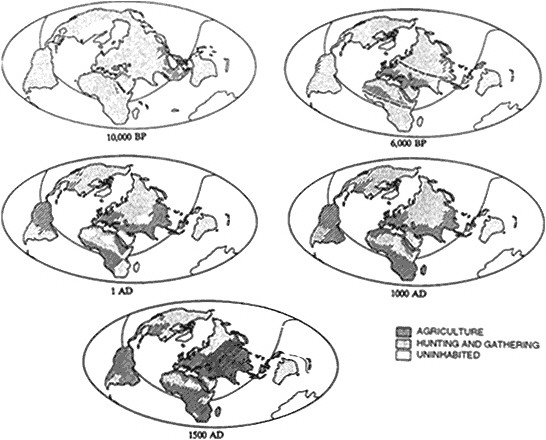
Figure 1 Spread of human modification of the earth. (See Table 1 for prevailing climatic conditions.)
SOURCE: Maps from Simmons (1987).
nance. Precisely these same problems are encountered in modern irrigated agriculture (Shanan, 1992; Whitcombe, 1972).
In the Indus valley, extensive irrigation development at Harrapa involved changes in land use, including an extensive urban center. Alternative explanations, including climatic change and mismanagement of the irrigation base, have been credited with causing the demise of this civilization (Lamb, 1982). Again, in the modern era in this region, huge irrigation developments in the nineteenth-century colonial period in India not only produced large increases in production but also, over time, were plagued with predicted problems of salinization and waterlogging. These huge irrigation systems were carefully designed and continue to operate today, although in a number of areas careful management is required to provide water while also improving drainage by lowering high water tables. Population has grown significantly, and irrigation and new crop varieties have contributed to large increases in food production (Buringh and Dudal, 1987).
The Nile valley reflects a similar alteration of the landscape over a period of thousands of years. Agriculture was initially practiced in natural riverine wetlands to the south. Over time natural systems were altered, and several thousand years ago embankments constructed on the floodplain held water in place after flooding, permitting extensive basin irrigation (Butzer, 1976). Over the centuries, salinization has not been a problem.
Large-scale irrigation in the past, and at present, transforms the landscape. Degradation by salinization and waterlogging may accompany such changes, but these effects have often been avoided or reversed with proper maintenance and operation. Little evidence suggests that the benefits of increased production associated with irrigation were historically either over-whelmed by increases in population or by deterioration of the environment. At the same time, irrigated lands have been abandoned or allowed to deteriorate as a result of a variety of factors, including war and social upheavals, devastating floods, and perhaps changes in climate (Whitney, 1984).
By 1500 agriculture had spread throughout much of the world, including Asia, Latin America, Africa, and North America (Figure 1). Brief consideration of a few localities and different farming techniques is instructive. In Europe, the landscape was completely transformed between 900 and 1900 AD (Figure 2), as forest clearing and land drainage created pastures and agricultural fields. Over time, different styles of farming characterized portions of the landscape. Stumps were left in places to regenerate trees for firewood. Hedges were planted to mark fields and contain livestock. In the present era these hedges are being removed to enlarge fields to ease mechanical tillage. In Europe and New England, soils have been improved by drainage and by application of fertilizers transforming them to their present productive agricultural condition (U.S. Department of Agriculture, 1954). Illustrative are the enormous changes that have taken place since
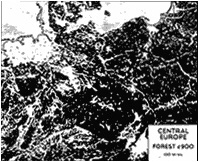
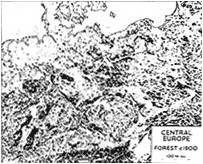
Figure 2 Change in forest cover from 900 AD to 1900 AD in Europe (cited in Darby, 1956).
European settlement in eastern North America. Originally nearly entirely forested, by the late nineteenth century virtually 80 percent of the New England landscape was in agriculture. A nearly complete reversal has occurred in the subsequent 100 years. Much of New England is again heavily forested, and in some areas forests again cover nearly 80 percent of the land (Raup and Carlson, 1941).
The transformation of the European agricultural landscape has been accompanied by increases in agricultural productivity. Whereas productivity remained relatively constant for the prior several hundred years, crop yields began to increase in the seventeenth century and, in the nineteenth century, wheat yields in England, for example, increased by about 50 percent. Truly revolutionary increases in productivity have occurred in the last 50 years with the introduction of new plant varieties and large-scale application of fertilizers, herbicides, and pesticides (Grigg, 1980). Earlier increases in productivity were a product of the reduction of fallow, increases in labor input, and the application of manure. These significant transformations in the land have supported increasingly dense populations. Intensive modern agriculture including the application of large quantities of nutrients, particularly nitrogen, as well as synthetic organic compounds, poses new problems of land and groundwater contamination (Ministry of Agriculture, Fisheries and Food, 1976).
Because padi rice production, established before 1500 AD (Figure 1), represents one of the most significant changes on the landscape in Asia, comment is warranted on the impact of such changes. The padi system includes the application of nitrogen with the use of blue-green algae (in some ways analogous to the use of legumes in Europe) and maintenance of constant water levels, particularly in coastal deltas where nutrients are delivered in suspension and solution. Heavy clay soils allow a minimum of
seepage losses of water and nutrients and, as the land is covered with water, it is not exposed to high temperature. Historically, small increases in productivity have been primarily associated with progressive increases in labor input. Patterns were apparently established in Asia and Southeast Asia in the eleventh and twelveth centuries with high rural densities in Southern China, Korea, Japan, much of Java, and parts of the Phillipines. Continuous padi agriculture is perhaps one of the best examples of continuous management of a sustainable resource. Major increases in rice productivity have occurred in the last 50 years in Japan with the application of fertilizer, new varieties, and new technology.
A very different but widespread agriculture practice, shifting cultivation or bush fallowing, has altered the landscape for centuries (Pelzer, 1945). Forest trees are felled, and stumps and trunks burned both to clear the land and to provide some fertilizer. Crops, including cereals and wheats or yams and cassava, are planted in the clearing. Forests provide shade over small plots, and no weeding is done. As weeds become prevalent and crop yields decline, new land is cleared for cultivation.
The cropping cycle in many areas is on the order of 3 to 5 years. Where population densities are low, the return cycle of cultivation might be as long as 25 years. As population densities increase, the fallow cycle shortens and grasses as well as legumes may be planted. Occasionally, but rarely, livestock may be grazed on the fallow plot.
Increasing population has been associated with shortening of the fallow period and limitation of the regenerative time provided for forest growth and restoration of the soil. Without the application of fertilizer and careful tillage and management practices, progressive reduction of the fallow period will reduce the productive capacity of the land (Grigg, 1987). Where larger areas are cleared in tropical forests underlain by heavily weathered soils, Lal (1985) and others have shown that removal of vegetation may lead not only to rapid erosion but also to degradation of the structure of the soil, as erosion by rainfall and runoff alternates with drying of the surface. A hardpan may develop that can greatly reduce the productivity of the land. Land degradation, then, is a function of clearing, the duration of fallow, and the mode of agriculture including the choice of crops. In some tropical regions, recovery of the productivity of the land may be difficult if not impossible as a result of the loss of soil, reduction of tilth, and removal of nutrients. It can be argued that the loss of productivity of the land resulting from reduction of fallow periods is directly attributable to increasing rates of population growth outstripping the land available for rotations of clearing. Reduced fallow in the absence of fertilizer or nutrient replacement does reduce potential productivity. A number of papers elsewhere in this volume debate the cause and effect relationship between population growth and land deterioration.
In the eighteenth and nineteenth centuries, the major grain regions of eastern Europe, North America, and Australia had come under development. Continuous row cropping and monoculture in these regions has led some to suggest that the land has been seriously degraded (see Larson et al., 1983). The evidence is equivocal. In the United States, as the population spread west, agricultural production increased. Conversion of grassland to agriculture, it is estimated, increased erosion of the land surface on average roughly two times the natural background (Schumm and Harvey, 1982). Such estimates must be based on the accumulation of sediments in stream valleys and not on the land itself. At the same time, climatic variations during the Holocene period have resulted in alternating periods of erosion and deposition in stream valleys (Ruhe and Daniels, 1965). Although the estimates of erosion suggest that the overall rate of erosion increased during the intensification of agriculture, there is no evidence from records of sediment transport in the lower Mississippi River that the materials eroded from the land have reached the lower portion of the river. Much sediment may well be stored throughout the river system below the fields and in the upstream portions of many of the major rivers. Storage of such material is well documented in valleys and in reservoirs throughout the Middle West and Great Plains of the United States. Large reservoirs, such as the succession of major dams and impoundments on the Missouri River, now store large quantities of sediment. Unlike the potential impact of land erosion, the impact of storage of sediment in reservoirs is seen by roughly a one-third reduction in the amount of sediment transported in the lower Mississippi River (Williams and Wolman, 1984). On the land itself, inorganic fertilizers have compensated for natural losses in natural organic material, increasing productivity and masking losses of the original material. Much debate continues over the potential impact of machinery and modern technology on the long-term structure and character of the soils in these productive regions. Similarly, although erosion has removed the upper portions of the soil in places, in the Midwest where soil horizons are deep, the impact on productivity in agriculture has been limited (Larson et al., 1983).
For the Ukraine, one of the most productive grain lands in the world, it has been suggested that continuous row-cropping has resulted in a loss of organic matter and structure and in soil fertility. Little field evidence, however, appears to support such claims (Wolman, 1985). To the extent that degradation is taking place, one may speculate that adequate management might restore fertility and structure, although yields suggest that such management has not been practiced in many areas during the last 70 years.
OFF-SITE EFFECTS OF LAND CHANGES
It is important to note, particularly in the context of the modern scene, that changes on the land cascade to the hydrologic system in rivers, lakes,
TABLE 2 Relationship of Wet and Dry Periods: Nanticoke River, Chesapeake Bay
estuaries, and the coastal ocean. As L'vovich and White (1990) have shown, human activities have significantly altered the global distribution of runoff in rivers. They estimate an increase over a period of 300 years of about 20 percent in base flow and a decrease of 16 percent in surface runoff as a result of anthropogenic activities, including deforestation for agriculture, drainage, and reservoir construction. More dramatic is a 300 percent increase in consumptive use of water in irrigated agriculture over the last 300 years. For the globe as a whole, aggregate consumptive water uses represent a modest percentage of total runoff, but the magnitudes represent large fractions of available runoff in regions such as the Colorado, Nile, and Indus basins.
At a very different scale, work by Brush (1992, personal communication) in the Chesapeake Bay region shows the close relationship between changes in land use, climatic variations, and the impact on water bodies. Some conclusions are suggested by the data in Table 2, which shows the sequence of changes in sedimentation rate, charcoal content, and ratios of pollen representing vegetation favoring dry and wetter environments. First, the bay tributaries experienced different rates of deposition of sediment, charcoal, and pollen during dry and wet periods. Second, the profile of pollen ratios indicates alternating periods of dry and wet conditions. Third, the period of European settlement from 1700 to 1980 is characterized by very high sedimentation rates, although similar sedimentation rates are also associated with earlier periods from 800 to 1300 AD, a warm period in the climatic record prior to western settlement. This warm period is also associated with a high rate of charcoal deposition. The combination of dryness, indicated by the pollen composition and charcoal, as well as the rapid
sedimentation rate suggests that natural forest fires may have occurred periodically, exposing the soil to rapid rates of erosion with sediment and charcoal transported to the depositional site in the tributary. Thus, marked natural variations as well as anthropogenic effects are seen in the record. Associations of landscape change and changes in water quality are of major importance. Currently these are referred to as on-site and off-site impacts or damages, and they are the same as those noted earlier in the Middle East. The difference lies in the extent and scale of operation on the landscape in those parts of the world where conservation farming is limited.
SOME GENERALIZATIONS FROM THE PAST
A few simple but important conclusions may be drawn from this brief review of past changes in landscape associated with human activities. First, human beings have altered much of the world's land. The most significant changes have been those associated with all kinds of agriculture. The capacity to alter the landscape has increased with technology, and land use change in many areas has accelerated (Buringh and Dudal, 1987). Roughly one-half of what might be referred to as the "usable" rural land has now been modified in one way or another. Until recently most of the increase in agricultural production has been through the expansion of land, shortening of fallow, and the increase in labor. Most of the accelerated increase in agricultural productivity in the past half century is associated with the application of fertilizers and new plant varieties. Increase in the use of herbicides and insecticides made of new synthetic organic compounds unknown in nature poses potential environmental problems not significant in the earlier historical record.
Although major transformations of the landscape in the historical record are clearly recognizable, it is much more difficult to determine the kinds, and particularly the magnitudes, of changes to the land and water associated with changes in land use. It is even more difficult to relate these to population. Transformation of European and American forest lands to agriculture, for example, is seen by some as deterioration of the environment. In contrast, most agriculturists see such changes as improvement, making wetsoils and wetlands tillable and productive. Valuing or balancing gains and losses then resulting from historical land changes is exceedingly difficult. Terraces, irrigation, forest clearance, drainage and cropping are improvements under many circumstances. Yet they also alter the environment, and some may be irreversible. Even irreversibility, however, may not be prima facie evidence of negative value, although cumulative degradation of a finite resource for which no real substitute exists poses a significant problem of value.
A very different problem arises in distinguishing between human and
natural impacts on the landscape. Climate in most of the world has fluctuated throughout much of the Holocene period. These fluctuations, well recorded in the stratigraphic record, are reflected in significant changes on the landscape in the absence of human intervention. Overgrazing or cropping may complicate the record, and make discerning the relative importance of human versus natural processes more difficult. In addition, while the archaeological record may reflect movements of population into and out of a region, the causes of migrations often remain unknown.
Distinguishing between the influence of human beings on the landscape and natural processes has become increasingly difficult as a result of recent recognition of the dynamism of landscape evolution. Earlier concepts of landscape equilibrium implied that vegetation, soil, and erosional processes achieved a relatively stable configuration under a particular prevailing climate. Additional work has demonstrated that such equilibria, if they exist, are exceedingly dynamic. Particular emphasis is placed upon the importance of disturbance of the landscape by episodic events of large magnitude such as hurricanes, fires, and floods. Each major event may result in a new potentially stable assemblage of vegetation. The sequence of changes following disturbance and the duration of an apparently stable configuration are difficult to predict. As these disturbances interact with human activities, isolation of the significance of one or the other influence is particularly difficult.
Another important element in evaluating the significance of the impact of human activities on the landscape involves the concept of recovery and resilience. Resilience refers to the ability of the landscape or ecological system to rebound from the impacts of instant or progressive change. Recovery refers to the process by which an absolute change, whether achieved rapidly or slowly, can be mitigated or reversed to return a system to its prior undisturbed state. Unfortunately, little information is available about recovery processes or about the extent to which initial conditions in the environment and in the land itself have been altered over long periods of time. Dramatic examples of erosion and soil losses where farming is practiced on very steep slopes without terracing are important and easily documented (Eckholm, 1976). They cannot be extrapolated to different settings. It is much more difficult to recognize slower or more subtle changes over time or to evaluate the likelihood that such changes can be reversed. Dregne (1991), an astute soil scientist with worldwide experience, estimates that about 70 percent of "global drylands" are degraded, with rangelands suffering the most extensive degradation. He notes, however, that, "data on land degradation are so difficult to obtain that a study in 100 countries is largely based on a few maps, a little experimental data, observation and even anecdotes" (Dregne, 1991:20–21).
Until recently, relatively little interest was expressed in the off-site
effects of changes on the landscape. While sedimentation of waterways was important historically, current interest concerns organic and inorganic substances attached to sediment particles. Metals, petroleum products, pesticides, herbicides, and all of the materials used in modern industrial societies can be found in the accumulated sediments.
A broad survey of landscape change effected by human beings throughout human history clearly demonstrates that human beings have significantly altered the natural landscape over much of the globe. In many instances such change has degraded soil and water. Elsewhere the ''made'' landscape has been made more productive, if not more diverse. Much less clear is the degree to which degradation of these resources is reversible in whole or in part. (Whether this is a desirable objective is a separate question). Even less clear is the degree to which population numbers or rates of change have been directly or indirectly the driving force behind degradative or restorative processes.
THE PAST AND THE FUTURE
Most of the experience of the past summarized here cannot be extrapolated into the future. To the extent that the dryland degradation reported by Dregne (1991) is recent and expanding, more of the same suggests further losses. Similar statements apply to exploitation of steep lands and areas denuded of vegetation and exposed to intense rainfall. Projections, paraphrasing Dubos, are not predictions. Although degradative trends are probably reversible in many regions, it is worth noting that soil conservation practice in Africa and in many parts of Latin America and Asia has probably been retreating rather than advancing in the last several decades. Social and economic factors rather than knowledge or technology appear to determine this trend (Blaikie, 1985). Under some circumstances "conservation pays," but much evidence demonstrates that conservation often "costs" someone, whether an individual farmer or a government.
While they do not discuss degradation or deterioration in the land resource, Buringh and Dudal (1987) projected changes or losses in land uses between 1975 and 2000. They note expected declines in some highly productive agricultural lands due to urban expansion, but agricultural expansion is expected to occur at the expense of forests and grazing land. Whether such conversions are viewed as positive or negative, contributions to society and the environment depends on the long-term values placed on these resources.
Limited documentation of the relation between population change and land change lends caution to extrapolation into the future of observations of yield declines where sedentary agriculture replaces shifting cultivation, where salinization and waterlogging accompany modern irrigation systems, or where agriculture replaces forests as population grows. At the same time, the
resilience or adaptability of the land surface to the ends of human beings in the past may not be a proper measure of the prospects for the future.
The modern scene is not like the past. Both the rate and the magnitude of population change are large, the magnitude unprecedented in history. Although fertility is declining in many parts of the world, the increase in world population of about I billion people in the last decade is equal to the total world population in 1800 (Raven et al., 1993). Previous population expansions have neither been as large nor have they occurred on a comparable unexpandable base. Of course, earlier generations may have perceived themselves in similar predicaments. A second factor is again one of rate and magnitude. The rate of production of new and particularly synthetic materials unknown in nature places additional burdens on the environment. These materials may accumulate, degrade, or move from place to place, altering the quality of the landscape in new ways. Third, the off-site impacts of changes on the land are recognized as increasingly important. Today the human capacity to alter the environment is on a scale equivalent to the forces of nature, a condition that did not prevail in the past (Wolman, 1990).
The absence of satisfactory historical information relating both land and population change to the many factors that influence both suggests the obvious need for comparative studies combining demography, land use, and environmental change. Measurement of land or environmental change is difficult. Moreover, quantitative and comparable measurements are needed over time, but these must be both diagnostic and yet sufficiently simple that they can be extended to a wide range of conditions. Modern technology including observations from space and the use of geographic information systems is gradually making it possible to observe changes over large areas on reasonable time scales. These spatial observations, however, must be combined with observations on the ground not only to correlate observed changes with spectral images, but also to determine the quantitative effects of various uses of the land on the land and environment.
Information about the spatial distribution of populations is essential. The impact of population growth on the land will be influenced by the distribution among rural village or urban metropolitan areas. Environmental effects have different spatial characteristics at local, regional (drainage basin), national, continental, and global scales. Measures of population must be correlative with the presumed scale of impacts.
The tenor of the present debate over projections of land change, population, and environmental degradation appears more pessimistic today than were the global food production models projected a few years ago. It is not clear whether this is due to increasing evidence of deterioration or to pessimism with respect to remedial or corrective measures. The factors affecting demographic change are enormously complex. No doubt many institutions
and conditions affect the outcome including land tenure, poverty, conversion to cash crops, the performance of the market, and transportation. The way in which these elements interact with or influence the environment is, of course, inseparable from this complexity. It should be possible to evaluate more precisely the effect of people on the land and on the environment in different settings. The case examples that follow in this volume both illustrate and explicate some of this complexity.
REFERENCES
Adams, R. McC. 1981 Heartland of Cities. Chicago: University of Chicago Press.
Blaikie, P. 1985 The Political Economy of Soil Erosion in Developing Countries. New York: Longman.
Buringh, P., and R. Dudal 1987 Patterns of land use in space and time. In M.G. Wolman and F.G.A. Fournier, eds., Land Transformation in Agriculture. New York: Wiley (SCOPE).
Butzer, K.W. 1976 Early Hydraulic Civilization in Egypt: A Study in Cultural Ecology. Chicago: University of Chicago Press.
Darby, H.C. 1956 The clearing of the woodland in Europe. Pp. 183–216 in W.L. Thomas, Jr., ed., Man's Role in Changing the Face of the Earth. Chicago: University of Chicago Press.
Dregne, H.E. 1991 Arid land degradation: a result of mismanagement. Geotimes 36:19–21.
Eckholm, E.P. 1976 Losing Ground. New York: W.W. Norton.
Evenari, M., L. Shanan, and N. Tadmor 1971 The Negev: Challenge of a Desert. Cambridge, Mass.: Harvard University Press.
Grigg, D. 1980 Population Growth and Agrarian Change: An Historical Perspective. Cambridge Geographical Studies. Cambridge, Eng.: Cambridge University Press.
1987 The industrial revolution and land transformation. In M.G. Wolman and F.G.A. Fournier, eds., Land Transformation in Agriculture. New York: Wiley (SCOPE).
Jäger, J., and R.G. Barry 1990 Climate. Pp. 335–351 in B.L. Turner et al., eds., The Earth as Transformed by Human Action. Cambridge, England: Cambridge University Press.
Lal, R. 1985 Soil erosion and its relation to productivity in tropical soils. Pp. 237–247 in S.A. El-swaify, W.C. Moldenhauer, and A. Lo, eds., Soil Erosion and Conservation. Ibadan, Nigeria: International Institute of Tropical Agriculture.
Lamb, H.H. 1982 Climate History and the Modern World. London: Methuen.
Larson, W.E., F.J. Pierce, and R.H. Dowdy 1983 The threat of soil erosion to long-term crop production. Science 219:458–465.
L'vovich, M.I., and G.F. White 1990 Use and transformation of terrestrial water systems. In B.L. Turner et al., eds.,
The Earth as Transformed by Human Action. Cambridge, England: Cambridge University Press.
Marsh, G.P 1864 Man and Nature or Physical Geography as Modified by Human Action. London: Sampson Low.
Ministry of Agriculture, Fisheries and Food 1976 Agriculture and Water Quality. Her Majesty's Stationery Office.
Pelzer, K.J 1945 Pioneer Settlements in the Asiatic Tropics. Special publication no. 25, American Geographic Society, New York.
Raup, H.M. and R.E. Carlson 1941 The History of Land Use in the Harvard Forest. Harvard Forest Bulletin no. 20, Petersham, Mass.
Raven, P.H., L.R. Berg, and G.B. Johnson 1993 Environment. Forth Worth, Tx.: Saunders.
Ruhe, R.V., and R.B. Daniels 1965 Landscape erosion—geologic and historic. Journal of Soil Water Conservation. 20:52–57,
Schumm, S.A., and M.D. Harvey 1982 Natural erosion in the U.S.A. Pp. 15–22 in B.L. Schmidt et al., eds., Determinants of Soil Loss Tolerance. Special Publication 45. American Society of Agronomy and Soil Science Society of America, Madison, Wis.
Shanan, L. 1992 Planning and management of irrigation systems in developing countries. Agricultural Water Management 22(1–2):1–234.
Simmons, I.G. 1987 Transformation of the land in pre-industrial time. Pp. 45–75 in M.G. Wolman and F.G.A. Fournier, eds., Land Transformation in Agriculture. New York: Wiley (SCOPE).
U.S. Department of Agriculture 1954 The Changing Fertility of New England Soils. Agriculture Information Bulletin No. 1333 . Washington D.C.: U.S. Department of Agriculture.
Whitcombe, E. 1972 Agrarian Conditions in Northern India, Vol. 1. The United Provinces under British Rule. Berkeley: University of California Press.
Whitney, J.W. 1984 The Geology and Geomorphology of the Helmand Basin Afghanistan: A Study of the Environmental and Geologic Processes that Affected the Survival of Desert Civilizations in Sistan. Ph.D. dissertation, University of Michigan microfilm.
Williams, G.P., and M.G, Wolman 1984 Downstream Effects of Dams on Alluvial Rivers. U.S. Geological Survey Professional Paper 1286. Washington, D.C.
Wolman, M.G. 1985 Soil erosion and crop productivity: A worldwide prospective. Pp. 9–21 in R.F. Follett and B.A. Stewart, eds., Soil Erosion and Crop Productivity. Madison, Wis.: ASA-CSSA-SSSA.
Wolman, M.G. 1990 The impact of man. EOS 71:1884–1886.


