12
TEF
Tef (Eragrostis tef) is a significant crop in only one country in the world—Ethiopia. There, however, its production exceeds that of most other cereals. Each year, Ethiopian farmers plant almost 1.4 million hectares of tef,1 and they produce 0.9 million tons of grain, or about a quarter of the country's total cereals.2
The grain is especially popular in the western provinces, where people prefer it to all other cereals and eat it once or twice (occasionally three times) every day. In that area, tef contributes about two-thirds of the protein to a typical diet.
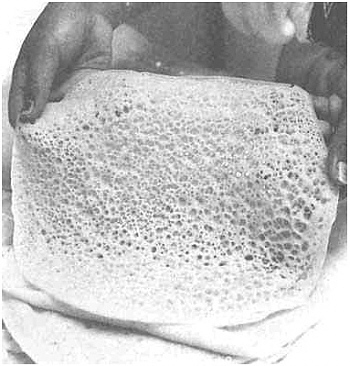
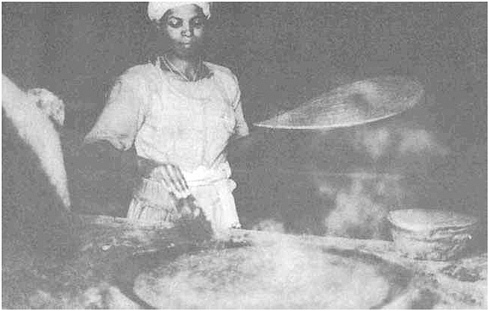
Most tef is made into injera, a flat, spongy, and slightly sour bread that looks like a giant bubbly pancake the size of a serving tray. People tear off pieces and use them to scoop up spicy stews that constitute the main meals. For the middle and upper classes it is the preferred staple; for the poor it is a luxury they generally cannot afford.
Unlike many of the species in this book, tef is not in decline. Indeed, farmers have steadily increased their plantings in recent years. The area cultivated rose from less than 40 percent of Ethiopia's total cereal area in 1960 to more than 50 percent in 1980.
Tef is so overwhelmingly important in Ethiopia that its absence elsewhere is a mystery. The plant can certainly be grown in many countries. Some has long been produced for food in Yemen, Kenya (near Marsabit), Malawi, and India, for example. Also, the plant is widely grown as a forage for grazing animals in South Africa and Australia.
Now, however, the use of tef as a cereal for humans is transcending the boundaries of Ethiopia. Commercial production has begun in both the United States and South Africa, and international markets are opening up. This is because Ethiopian restaurants have recently
become popular in both Europe and North America. Many cities (including Washington, New York, Chicago, San Francisco, London, Rome, and Frankfurt, not to mention Tel Aviv) now have restaurants that rely on injera, as well as the convivial communal dining it fosters. And only tef can make authentic injera.3
The new appreciation of tef is also extending into the research community. These days scientists in Ethiopia and a few other countries are beginning to seriously study the plant and its products.
This is all to the good. Tef has much more promise than has been previously thought. It provides a quality food. It grows well under difficult conditions, many of them poorly suited to other cereals. Even in its current state it gives fairly good yields—about the same as wheat under traditional farming in Ethiopia. And it usually produces grain in bad seasons as well as good—an invaluable attribute for poor farmers and of special benefit to locations beset by changeable conditions.
However, along with its advantages tef has serious drawbacks, mainly stemming from its tiny seeds, high demands for labor, lack of development, and difficult cultural practices. All in all, at this stage at least, it is neither easy to grow nor easy to handle.
PROSPECTS
To chart tefs future—both its course and final destination among world cereals—cannot now be done with confidence. This will become clearer as the current research efforts begin producing more results. Nonetheless, there are good reasons for optimism that tef's technical limitations can be overcome and that it can rise to be a specialty crop in a number of nations. It could happen quickly. Indeed, injera is such a fascinating food (half pancake, half pasta) that it has the potential to eventually become well-known worldwide.4
Africa
In Ethiopia, the plant's stable yield under varying conditions, as well as the grain's good storage properties, palatability, and premium prices, will likely make tef ever more attractive.5 However, although
prospects for raising its production seem good, substantial increases will probably occur only after its labor requirements are reduced.
Tef may also come to benefit other African countries, notably some that today face food-production problems. The plant's resistance to diseases, pests, and heavy soils give it special appeal.
Several of tef's relatives are valued forages in the world's arid zones,6 and tef itself might also have a future as a fodder. Indeed, in southern Africa it is already used extensively, having originally fed the horses and oxen of the Boer War almost a century ago. Tef hay is of such quality that South African farmers prefer it over all others for feeding, their dairy cattle, sheep, and horses (see page 230).
Moreover, this grass is exciting South Africans as a "quick fix" for holding down bare soil and thereby baffling erosion while more permanent ground covers establish themselves.
Humid Areas
Prospects probably low. For Africa's humid areas, tef's prospects are unknown because trials have not been conducted (or at least not reported). However, the crop comes from a relatively dry environment and probably has little or no potential in a hot and steamy one.7
Dry Areas
Good prospects. Tef is a reliable cereal for unreliable climates, especially those with dry seasons of unpredictable occurrence and length.
Upland Areas
Good prospects. Most of Ethiopia's tef is produced at moderate elevations, but it has long been common on the high plateau and is being slowly introduced to higher and higher locations. Its future contribution to the rural economy of these and other African highlands appears to be substantial.
Other Regions
Tef holds promise for many countries beyond Africa. Mexico, Bolivia, Peru, Ecuador, India, Pakistan, Nepal, and Australia might well adopt it. In addition, this plant's rapid maturity and inherent cold tolerance may open new areas of grain cultivation for high latitudes where growing seasons are short—Canada, Alaska, the Soviet Union,
and northern China, for instance. It might also become important to Israel, which has a rising Ethiopian population.8
Some observers see tef as a promising new grain for the United States as well. They point out that it is nutritious enough to be a "health" food and tasty enough to be a gourmet food.9 A company in Idaho already produces it on a commercial scale and supplies markets nationwide (see box). Tef is also being produced on farms in Oklahoma, where it is harvested by machine and sold under contracts from food companies eager to buy it.10 These experiences, limited as they are, are probably laying the groundwork for a mass-produced specialty grain that will remain a part of the American food system.
USES
Tef grain comes in a range of colors from milky white to almost black, but its most popular colors are white, red, and brown. By and large, the darker the color, the richer the flavor. Although blander in taste, the white seeds command the highest prices. However, the red and brown seeds come from plants that are hardier, faster maturing, and easier to grow. In addition, tef aficionados prefer their more robust flavor.
Tef contains no gluten—at least none of the type found in wheat. For this reason, Americans with severe allergies to wheat gluten are among those buying tef these days. Despite the seeming lack of this "rising" protein, injera is a puffy product, somewhere between a flat bread and a raised one.
In Ethiopia, tef flour goes into more than just injera. Some is made into a gruel (muk), some is baked into cakes and a sweet dry unleavened bread (kita), and some is used to prepare homemade beverages. In the United States, it is recommended as a good thickener for soups, stews, and gravies, and, at least according to one promotional pamphlet, "its mild, slightly molasses-like sweetness makes tef easy to include in porridge, pancakes, muffins and biscuits, cookies, cakes, stir fry dishes, casseroles, soups, stews, and puddings."11
As fodder, the tef plant is cheap to raise and quick to produce. Its straw is soft and fast drying. It is both nutritious and extremely palatable to livestock. Its leaf:stem ratio (average 73:27) is high, its
NUTRITIONAL PROMISE
|
Main Components |
|
Essential Amino Acids |
|
|
Moisture (g) |
11 |
Cystine |
1.9 |
|
Food energy (Kc) |
336 |
Isoleucine |
3.2 |
|
Protein (g) |
9.6 |
Leucine |
6.0 |
|
Carbohydrate (g) |
73 |
Lysine |
2.3 |
|
Fat (g) |
2.0 |
Methionine |
2.1 |
|
Fiber (g) |
3.0 |
Phenylalanine |
4.0 |
|
Ash (g) |
2.9 |
Threonine |
2.8 |
|
Vitamin A (RE) |
8 |
Tryptophan |
1.2 |
|
Thiamin (mg) |
0.30 |
Tyrosine |
1.7 |
|
Riboflavin (mg) |
0.18 |
Valine |
4.1 |
|
Niacin (mg) |
2.5 |
|
|
|
Vitamin C (mg) |
88 |
|
|
|
Calcium (mg) |
159 |
|
|
|
Chloride (mg) |
13 |
|
|
|
Chromium (μg) |
250 |
|
|
|
Copper (mg) |
0.7 |
|
|
|
Iron (mg) |
5.8 |
|
|
|
Magnesium (mg) |
170 |
|
|
|
Manganese (mg) |
6.4 |
|
|
|
Phosphorus (mg) |
378 |
|
|
|
Potassium (mg) |
401 |
|
|
|
Sodium (mg) |
47 |
|
|
|
Zinc (mg) |
2 |
|
|
|
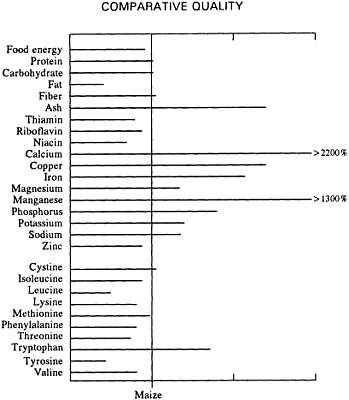
Tef has as much, or even more, food value than the major grains: wheat, barley, and maize, for instance. However, this is probably because it is always eaten in the whole-grain form: the germ and bran are consumed along with the endosperm. |
|||
|
Tef grains are reported to contain 9-11 percent protein, an amount slightly higher than in normal sorghum, maize, or oats. However, samples tested in the United States have consistently shown even higher protein levels: 14-15 percent. The protein's digestibility is probably high because the main protein fractions—albumin, glutelin, and globulin—are the most digestible types. The albumin fraction is particularly rich in lysine. Judging by the response from Americans allergic to wheat, tef is essentially free of gluten, the protein that causes bread to rise. Nonetheless, tef used in injera does ''rise" (see page 219). |
digestibility (65 percent) relatively high, and its protein content (1.95.2 percent) low but nonetheless valuable. Ethiopian farmers rely on it to strengthen their oxen at the end of winter, a time when fresh grass is unavailable but the plowing season is coming on.12
In Ethiopia, tef straw is the preferred binding material for walls, bricks, and household containers made of clay.
NUTRITION
Tef seeds appear similar to wheat in food value; however, they are actually more nutritious. There are two reasons for this: (1) the seeds are so tiny that they have a greater proportion of bran and germ (the outer portions where nutrients are concentrated); and (2) because the seeds are so small, tef is almost always produced as a whole-grain flour.13
For a grain, tef is rich in energy (353-367 kcal per 100 g). Its fat content averages about 2.6 percent.
In most samples, the protein content is as good as, or better than, that of other cereals. It ranges from 8 to 15 percent, averaging 11 percent. The protein, as in most cereals, is limited by its lysine level. Otherwise, however, it has an excellent balance of essential amino acids.14 Indeed, two nutritionists, having surveyed all the common foods of Ethiopia, commented: "[W]e want to draw attention to the high values for methionine and cystine found in tef. . . . The protein from a mixture of tef and a pulse will give a near optimal amino acid mixture with regard to both lysine and to the sulfur-containing amino acids."15
The vitamin content seems to be about average for a cereal, but making injera involves a short fermentation process, and the yeasts generate additional vitamins. The value of the grain is thus enhanced.
The mineral content is also good (average ash content 3 percent). The iron and calcium contents (0.011-0.033 percent and 0.1-0.15 percent) are especially notable. In Ethiopia, an absence of anemia seems to correlate with the areas of tef consumption, presumably due to the grain's good iron content.
AGRONOMY
Ethiopian farmers grow tef either as a staple or as a standby. As a staple, they plant it like other cereals, but they normally sow it late and harvest it well into the dry season. As a standby, they wait until their main crop—maize, sorghum, or maybe wheat—shows signs of failing. Then they sow a fast-maturing tef as a backup source of sustenance in case of disaster.
Even where other cereals offer reasonable reliability and substantially higher yields, Ethiopian farmers still include a field or two of tef. Not only does it bring them high prices, its late sowing date allows them to grow and harvest both crops.16
In Yemen, tef is known as a lazy man's crop: the farmers merely toss seed onto moist soil following flash floods and then return after about 45 days to collect the grain.17
No matter how it is grown, tef requires little care once it is established. Its rapid growth stifles most weeds; few diseases and pests attack it; and it is said to produce well without added nutrients. However, in most places tef will respond to fertilizers.18
HARVESTING AND HANDLING
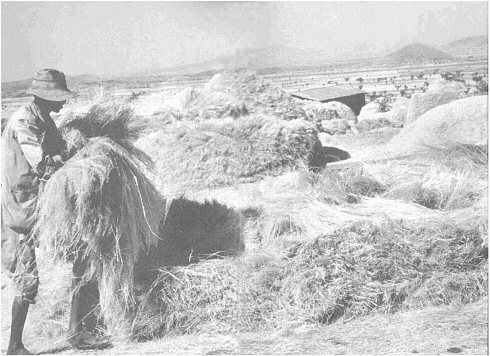
Tef threshes well with standard methods and equipment. Very early-maturing types are ready to harvest in 45-60 days; early types in 60120 days; and late types in 120-160 days.
Yields range from 300 to 3,000 kg per hectare, or even more. Although the national average in Ethiopia is 910 kg per hectare, yields of 2,000-2,200 kg per hectare are considered routinely attainable if good agronomic practices are carefully followed. Yields of 2,000 kg per hectare have been achieved on South African farms also, although storms have sometimes leveled the fields, resulting in large losses.19
The grain is easy to store and will survive for many years in traditional storehouses without damage by insects. This makes it a valuable safeguard against famine.
LIMITATIONS
The seeds are so small that this alone makes the crop hard to deal with. The fields are tedious to prepare, and it is difficult to get an even stand. Also, wind or rain can bury the minute seedling before it can establish itself. Threshing, winnowing, and grinding such tiny seeds by hand is very laborious. Handling and transporting them is also a problem because they tend to fall through any crack.
NEXT STEPS
Tef seems poised on the brink of becoming a resource for everyday foods, gluten-free specialty items, animal feeds, and erosion control. Ethiopian farmers, therefore, have much to teach nations the world over. The problem is that at this point few people have recognized tef's qualities. Activities are needed to spark interest and raise overall awareness of tefs status, potential, problems, and requirements. These could begin, for example, with conferences, monographs, newsletters, and publicity materials.
Although people in tef's homeland know more about the crop than anyone else, it is unrealistic to expect that Ethiopia can spearhead such activities, at least at present. An international global effort is called for. Luckily, tef is not a weed. Trials can be conducted in different parts of the world with little hazard. Although many countries could participate, the United States, South Africa, and Australia especially could help pioneer the selection of types for trials and eventual use worldwide.
Tef is also a challenge to the world's cereal scientists, agronomists, and food chemists. It is an interesting new cereal that few people know of at present. It seems to offer many possible benefits, but what its limits and potentials are in practice is still very uncertain.
Germplasm Collection and Evaluation
The germplasm in Ethiopia is potentially of worldwide importance. Since Ethiopia is the center of origin and the center of diversity for this crop, preserving its diversity is a prerequisite for all tef improvement. Actually, several thousand samples have already been collected. Although more undoubtedly remain, perhaps the most urgent task is to characterize the tef lines already available.
Plant Breeding
Until very recently, crossing tef was tedious. It was constrained to a few minutes at about dawn, and required supremely skillful personnel. Now, however, techniques have been developed that make the process quite straightforward and routine.
|
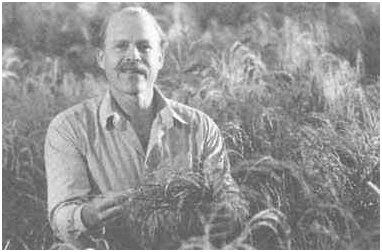
Tef Pioneers Until recently, Ethiopia's official commitment to tef research has been small compared with its investment in wheat, maize, and sorghum. However, several organizations have devoted their own efforts to boost the crop. Both the Debre Zeit Agricultural Research Centre of Alemaya University of Agriculture and the Institute of Agricultural Research at Holleta Research Station near Addis Ababa have produced high-yield strains. Some of these get so heavy with grain that the stalk collapses.* Research is now under way to develop varieties with short, stiff straw to create high-yielding tefs that can benefit from heavy fertilizer use and irrigation without collapsing. The Institute for Agricultural Research has also done research on tef with encouraging results at Debre Zeit. It has developed a variety, DZ 01-946, which has given yields of 1.78 tons per hectare. There has also been increasing international interest. In England, London University's Wye College is doing systematic breeding. In Israel, the Volcani Centre is carrying out tef research trials. And in the United States, Wayne and Elizabeth Carlson of Caldwell, Idaho, have been developing cultivars and processing techniques for farmers both domestic and foreign (see box, opposite). |
A program of tef improvement by plant breeding—combining the desirable qualities of several parents in a planned way—might well bring big advances. Objectives include early maturity, short and stiff straw, disease resistance, and higher harvest index.20 One variety created in Ethiopia has yielded 3,560 kg per hectare.
Other targets for improving the crop, especially for large-scale commercial production, include larger grain size, less shattering of seeds, and quicker drying seeds.21
Agronomy
In Ethiopia, large yield improvements can be achieved by applying techniques that are already known: careful land prepara
|
Tef in Transvaal In 1886, the Royal Botanic Gardens at Kew, England, obtained tef seed from Abyssinia and distributed it to various botanic gardens and other institutions in India and the colonies. In its first issue (1887), Kew's Bulletin of Miscellaneous Information advocated introducing the crop "to certain hill stations in India, to elevated portions of our colonial empire, and indeed to all places where maize and wheat cannot be successfully cultivated." These efforts stimulated tef trials in various parts of Africa, Asia, and Australia. As a result, many reports on the plant's performance were received. Perhaps the most effective introduction was to the Transvaal (which was not then under direct British control). Growers there found that "it makes very rapid growth, maturing in seven or eight weeks from the time of sowing, and if cut before the seed develops, a second crop can be obtained from the same stand; it makes an excellent catch-crop for hay, two successive cuttings being obtainable during the summer on unirrigated land. The plants seed heavily, our yield of seed from a small plot has been at the rate of about three-fourths ton per acre [1.875 tons per hectare]; the seedlings are not readily scorched by the intense heat of summer. On account of the soft, thin straw, it dries and cures very quickly." But despite the good results, tef took off only by a fluke. As is usually the case with new farm crops, it did not sell well when first offered. The story goes that a farmer, having more tef hay than he required, sent the surplus to the Johannesburg market. It sold poorly—none of the buyers knowing the stuff—and it finally went for animal bedding. It is softer than the ordinary bedding (normally cut from sedges and Arundinella eckloni), and a buyer |
tion, use of selected seeds, fertilization, sowing and weeding at the optimum time, and disease and pest control, for example. Yields can also be increased by mechanization. Sowing methods require special attention.
Ornamentals
There is now an explosion of interest in ornamental grasses in Europe, the United States, and Japan. With its upright, compact habit, its often brilliantly colored leaves (many color combinations are possible), and open feathery panicles, tef is exceptionally
|
selected one lot for a racing stable. Rumor has it that the stable owner found his racers eating their bedding in preference to their feed! To his surprise they also began to put on condition. Then he bought up all the tef on the market and called for more. Others soon got wind of this and the price rose. Tef was accepted and became a fodder of notable importance to the Transvaal in the early twentieth century. (For instance, during the Boer War it probably fed the horses on both sides.) "Tef has raised scores of small Transvaal farmers from poverty to comparative comfort, and has been largely instrumental in putting the dairy industry of the Witwatersrand on its feet," wrote Joseph Burtt Davy in the Kew Bulletin of 1913. "The opinion has been expressed by our farmers that 'if the Division of Botany of the Department of Agriculture had done nothing else, the introduction and establishment of tef as a farm-crop would have more than paid South Africa the whole cost of the Division for the ten years of its existence.' " In the Transvaal, as well as in other parts of South Africa, tef is often sown with its relative, weeping lovegrass (Eragrostis curvula). This perennial has been developed in South Africa into an almost incredible array of types for land protection and reclamation purposes. It is providing outstanding erosion control on toxic, dry, degraded, and infertile slag heaps and other problem sites where nothing previously would grow. As an erosion-fighting plant, weeping lovegrass is better than tef because it is a perennial whose natural staying power keeps the land covered as the seasons go by. But while tef may not be good at such a ''long-distance event," it is very good as a "sprinter." Thus tef is used to produce a fast cover that protects the site while its slower cousin is finding its legs. |
attractive. The development of selected strains might create a small but profitable market niche as an ornamental.22
Forages
In South Africa various productive races have been selected for hay production. These deserve to be exploited elsewhere. Also, it seems likely that a wealth of new types, adapted to many
different conditions, can be created from Ethiopia's broad germplasm base.
Erosion Control
It seems likely that demand will increase worldwide for nonweedy annual grasses that can serve as temporary ground covers. South Africans are now using tef as a "nurse crop" that quickly covers the ground and fosters the establishment of perennial grasses sown along with it. This should be tested elsewhere, too. In South Africa it is already used in mixtures to protect road cuts, open-cast mine workings, stream banks, and other erodible sites.23
Black Cotton Soils
Tef has evolved on the Ethiopian highlands on vertisol (black cotton) soils that frequently get waterlogged. Few other cereals can be grown there. In fact, tef is able to withstand wet conditions perhaps better than any cereal other than rice. It even grows in partly waterlogged plots, as well as on acidic soils.24
Vertisols are a problem in many parts of the tropics. They are cracking clays that regularly heave and sag and split.25 Few crop plants can withstand such soil abuse. Tef might be a savior for such sites. India, in particular, has vast areas of these "impossible" soils.
SPECIES INFORMATION
Botanical Name
Eragrostis tef (Zucc.) Trotter
Synonyms
Poa abyssinica Jacq.; Eragrostis abyssinica (Jacq.) Link
Common Names
Afrikaans: tef, gewone bruin tef (ou bruin)
Arabic: tahf
English: tef, teff, Williams lovegrass
Ethiopia: tafi (Oromo/Afar/Sodo), tafe-e (Had); t'ef, teff, taf(Amarinya, Tigrinya languages)
French: mil éthiopien
Malawi: chimanganga, ndzungula (Ch), chidzanjala (Lo)
Description
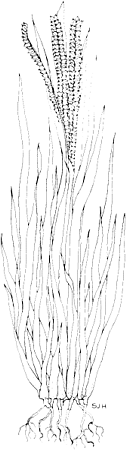
Tef is an annual tufted grass, 30-120 cm high, with slender culms and long, narrow, smooth leaves. It is shallow-rooted. Its inflorescence is a loose or compact panicle. The extremely small grains are 1-1.5 mm long, and there are 2,500-3,000 seeds to the gram.
The plant employs the C4 photosynthetic pathway, using light efficiently while having low moisture demands. It is a tetraploid with a chromosome number of 2n = 40.
Distribution
Tef was grown in Ethiopia before recorded history and its domestication and early use is lost in antiquity. Its most likely ancestor is Eragrostis pilosa, a wild species that looks very similar and has the same chromosome number. Samples claimed to be tef have been found in the tombs of the Egyptian pharaohs. The plant is still harvested in the wild—and wild tef is eaten, sometimes on a considerable scale, in mixtures with other wild grains (see wild grains chapter, page 251).
Cultivated Varieties
There are many different types of tef. The narrow panicled "muri" (rat-tailed) types and the dwarf, semi-prostrate and short-lived "dabi" types, for example. Both of these differ strikingly from the tall, loose-panicled varieties that are most commonly grown.
As noted, three main color types are recognized in Ethiopia:
-
White tef (thaf hagaiz). This slow-maturing form is grown in the cool season. It is superior for grain. However, it makes higher demands on the soil and can be grown only below 2,500 m altitude. In South Africa this type is being developed as an export grain.
-
Red and brown tefs. These are quick maturing and superior for fodder. In Ethiopia they are usually grown above 2,500 m. Elevation seems irrelevant, however, because this is the type being used in South Africa as a fodder crop.
Environmental Requirements
Daylength
The exact requirements are unknown. In South Africa the plant seeds freely between 22 and 35°S latitude (average daylength, 12 hours). In Ethiopia, the latitude is between 5°N and 10°N (daylength, 11-13 hours).
|
Bringing the Dead to Life . . . . . . Just Add Water Although the seeds of many flowering plants can survive complete dehydration, all other plant parts die when they dry. Certain plants, however, have the seemingly miraculous ability to recover from desiccation. Within hours of being watered, their leaves, stems, and sometimes even flowers spring back to life. Tissues that were brown and seemingly irreparably damaged take up a healthy green color and resume active growth once again. No one knows how many species can defy drought in this way, but it is a small number, and at least four of them are African grasses related to tef. This suggests that crossbreeding them with tef might yield hybrids combining the qualities of a good cereal with the ability to withstand the ultimate drought. This fascinating possibility of a fail-safe crop that can bounce back from complete desiccation is being studied by Australian plant physiologist Don Gaff.* So far, his biggest problem (other than getting funds for such far-out research) has been to get tef to breed with its "resurrection relatives." Fertility barriers between the species are too high for natural pollination, so Gaff has adopted a process known as "somatic hybridization." Using electrical pulses, he induces cells from the leaves to fuse as if they were normal pollen and egg cells. To accomplish this, he must first strip the cells of their cellulose walls. The fused cells resulting from this forced marriage can be regenerated into whole plants using the techniques of tissue culture. Although only at the beginning of this challenging work, Gaff has already found four eligible partners for tef. These are:
|
Rainfall
The average annual rainfall in tef-growing areas is 1,000 mm, but the range is from 300 to 2,500 mm. Tef resists moderate drought, but most cultivars require at least three good rains during their early growth and a total of 200 to 300 mm of water. Some rapid-maturing cultivars can obtain the 150 mm they need from water retained in soils at the end of the normal growing season. Most tef in South Africa is planted in the 500-800 mm summer rainfall zone.
Altitude
Tef can be grown from near sea level to altitudes over 3,000 m. It is particularly valued for areas too cold for sorghum or maize.26 It has a wider altitudinal range than any other cereal in Ethiopia. Most is cultivated between 1,100 and 2,950 m.
Low Temperature
While tef has some frost tolerance, it will not survive a prolonged freeze.
High Temperature
Tef tolerates temperatures (at its lower altitudinal range) well above 35°C.27
Soil Type
Tefs tolerance of soil types seems to be very wide. As noted, it performs well even on the black cotton soils that are notoriously hostile to crops and farmers. In fact in South Africa it is already very popular on such soils.28 Soil acidities below pH 5 are apparently no problem for tef.29