
14
Wild Grains1
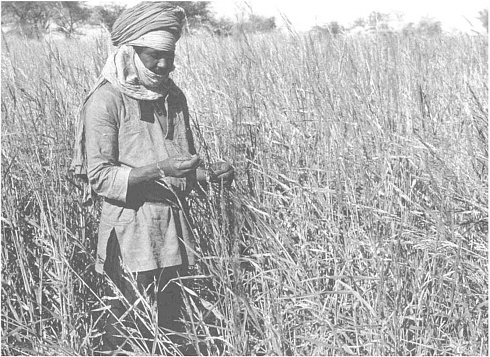
Over large areas of Africa people once obtained their basic subsistence from wild grasses. In certain places the practice still continues—especially in drought years (see boxes, pages 258 and 264). One survey records more than 60 grass species known to be sources of food grains.2
Despite their widespread use and notable value for saving lives during times of distress, these wild cereals have been largely overlooked by both food scientists and plant scientists. They have been written off as ''obsolete"—doomed since hunting and gathering started giving way to agriculture thousands of years ago. Certainly there has been little or no thought of developing wild grains as modern foods.
This deserves reconsideration, however. Gathering grains from grasslands is among the most sustainable organized food production systems in the world. It was common in the Stone Age3 and has been important almost ever since, especially in Africa's drylands. For millennia people living in and about the Sahara, for instance, gathered grass seeds on a grand scale. And they continued to do so until quite recently. Early this century they were still harvesting not insignificant amounts of their food from native grasslands.
However, in previous centuries the grains of the deserts and savannas were harvested in enormous quantities. In the Sahel and Sahara, for example, a single household might collect a thousand kilos during the harvest season.4 The seeds were piled in warehouses by the ton and shipped out of the region by the caravan-load. It was a major enterprise and a substantial export from an area that now has no equivalent and is often destitute.
|
How the Millets Arose It is not illogical to think that at least some of the wild grasses in this chapter might be turned into tractable crops for farm fields and household gardens. It has been done in the past . . . by our Stone Age forebears, no less. Between 12,000 and 6000 B.C., most of the Sahara appears to have been perfectly hospitable to humans. What is today the world's most fearsome desert then enjoyed a mild climate, winter rainfall, and an extensive grass cover. Acacia and tamarisk trees lined the many water courses. Mountainsides were verdant woodlands of myrtle, oak, hackberry, and olive, with juniper and pines at the upper altitudes.* By 10,000 B.C. people inhabited the area. A scattering of Neolithic (New Stone Age) sites across the central Sahara provide evidence that they were using sickles and grinding equipment, which suggests that they were using the grasses. By 6000 B.C. the central Sahara people were definitely collecting wild grain as well as apparently hunting wildlife and herding livestock. The vast grasslands provided game as well as limitless grazing for cattle, sheep, and goats. Shallow lakes—occupying wide, flat pans—enlarged during the rains and provided plentiful food from fish, hippopotamus, and aquatic plants, including African rice. But then, after about 4000 B.C., the region began drying out. The desert as we know it today had begun to form. Few archeological sites from this period are found, and the people apparently had been forced to leave. But before they left, they had time to domesticate some of the grasses around them during the thousands of years the rather sedentary, herding-fishing-hunting people occupied the Sahara. Several cereals seem to have arisen there. African rice, fonio, pearl millet, sorghum, and perhaps finger millet got their start this way. Those ancients did a miraculous job, considering they had no knowledge of genetics, microorganisms, chemistry, nutrition, or the myriad other sciences we now consider vital for domesticating and developing crops. Nor did they have ready access to the variety of germplasm that any scientist today would demand. If they could do it, surely we can. |
But in modern times these wild grains have been neglected and even much maligned. Various writers repeatedly refer to them as "famine foods." This is obviously wrong. Where the grains were gathered, surplus was often the rule. Wild grains were eaten even when pearl millet was in oversupply, for instance.
Modern writings also imply that the wild-grass grains were eaten only in desperation when nothing else was available. This, too, is apparently false. The harvest was large scale, sophisticated, and commercial: it must have been founded upon a keen and constant demand. Indeed, all evidence suggests that the grains were a delicacy that even the wealthier classes considered a luxury.
Remnants of this once vast and highly organized production still linger. One observer pointed out that harvests of wild grains were still being carried out in 1968, at least 60 years after they had last been major contributors to the local diet.5 However, despite its former prestige and ancient heritage, the wild-grain harvest has been declining for a century or more.
A major reason for the decline is that the once vast stands of grasses are much reduced. Partly this results from the demise of the nomads. Sedentary life encourages continuous and localized grazing so that the plants never get a chance to form grains. Partly, too, the decline results from the breakdown of traditional authority. Formerly, chieftains banned grazing animals from certain areas while the wild grains were filling out. If camels were caught there during that time, the chieftain could slaughter one of them in recompense; if goats were caught, he could kill as many as 10.
Just because wild grasses no longer contribute greatly to Africa's food does not mean they should be disregarded. Even preliminary study is likely to turn up many fascinating possibilities and perhaps much future potential. Many come from locations where burning temperatures, scant rains, and ravenous insects make the better-known grains impossible to produce. Some can populate and stabilize sand dunes—perhaps even the juggernaut dunes that threaten to bury oases, farms, villages, roads, and towns. Forged upon the unforgiving anvil of survival, these wild grasses are clearly suited to the worst of conditions.
In fact, plants like these—inured to harshness and constantly pressured by pathogens, pests, severe weather, and harsh soils—are just the sort of resources the world needs for overcoming some of its most intractable environmental problems. For example, some of Africa's wild cereals might be especially good weapons for combating desertification. Indeed, resurrecting the ancient grain-gathering industry could well be a way to defeat land degradation across the worst
afflicted areas of the Sahel and its neighboring regions. A vast and vigorous grain-gathering enterprise, for instance, would ensure that once again the grass cover is kept in place and that overgrazing is controlled once more.
Such a possibility is not inconceivable. Wild cereals might be made into an everyday food source, a famine reserve, and perhaps even a specialty export crop. This last may seem unlikely, but it should at least be considered. Today, the overall situation is different from that of a century ago. Railroads and airfreight mean that grains can now be shipped from the Sahara with much greater ease than on the backs of camels. Moreover, consumers in affluent nations are increasingly interested in buying and trying "exotic" cuisines. And many people of goodwill are highly motivated and eager to help avoid the horrendous tragedies of Sahelian drought and famine they have witnessed on their television screens in recent decades.
A similar concept is being attempted as a way to combat the destruction of tropical rainforests. In the last few years, for instance, an international trade in special tropical-forest products has begun. The object is to foster an economy based on resources of the rainforest itself. If successful, it will generate powerful local disincentives for destroying the natural environment.
In the case of the rainforest, the products are such things as wild rubber, fruits, nuts, and vegetable-ivory buttons. In the case of Africa's desertifying areas, the product might be kreb.
Kreb is perhaps the most famous food of the Sahara. A complex of a dozen or more different wild grains, it was harvested from natural meadows. Its composition varied from place to place and probably from year to year, depending on the mix of grasses that grew.
These days, given some clever marketing, "kreb from the Sahara" might sell at premium prices in Europe, North Africa, and North America, for example. It would be seen as a gourmet food that provides income to nomads and protects the earth's most fragile lands from further destruction by keeping a cover of wild native grasses on them.
Although this idea is highly speculative, subject to many limitations and uncertainties, it is not beyond reason. Mixed-grain products are not uncommon in Western supermarkets these days. For instance, in the United States a popular breakfast cereal is a grain mixture that people boil in water like rice. (It is made from conventional grains but goes by the trade name "Kashi," another word for kreb.6) And some expensive breads are made from as many as 11 different grains.
Resurrecting the production of kreb could provide food, income, and perhaps a protection against famine. It might bring substantial environmental benefits as well. Many of the wild African grains come from perennial grasses that continuously cover the soil and protect it from water and wind erosion. In addition, these plants facilitate the infiltration of rainfall and prevent rapid runoff from desert downpours early in the season, a time when annuals are still getting started and much of the soil around them is exposed and hard. Moreover, perennial crops have long growing seasons and the extra solar energy they collect normally produces good grain yields. (This is why some hybrids, including maize hybrids, have been so productive.)
Native perennials might prove to have economic benefits as well. Perennials save the vast amount of energy and labor that farmers must put in each year to move soil for planting and tilling annual cereals. Also, they save on the often large amount of grains that must be put aside each year for planting—with a perennial, those can be eaten.
Beyond their direct use as cereals, Africa's wild grasses may also have international value as genetic resources. Some are related to species used elsewhere for food or fodder and are likely to have genes of international importance—particularly because many of them have outstanding tolerance and resistance to heat, drought, drifting sand, and disease. On the other hand, some might prove weedy when taken out of the desert and introduced to more salubrious situations.
The nutritional value of wild-grass seeds has seldom been studied in detail, but those analyses that have been made indicate that protein contents are usually considerably higher than that of cultivated cereals. Several Saharan grains, for instance, have protein contents of 17-21 percent, roughly twice that of today's main cultivated cereals.7
All cereals are low in vitamins A, D, C, B, and the amino acids lysine and tryptophan. Wild grass seeds are no exception. However. some may be unusually high in food energy. Certain kram-kram seeds, for instance, apparently have about 9 percent fat and are perhaps higher in energy than any other cereal grain.8
Africa's promising wild cereals include those described below. All of these deserve the attention of food and agricultural scientists, as well as of the people involved in battling Sahelian desertification. Even the most basic studies could be extremely valuable. These include the following:
-
Tests to determine how best to plant and establish each species (seed treatments, sowing depths, planting times, and so on);
|
Harvesting Wild Grasses To most people, it probably seems inconceivable that in this age of intensive agriculture, wild grasses are still being gathered. The following (adapted from a recent FAO report) gives a sense of the ongoing importance of wild grains in different parts of Africa. Niger On their way from the wet- to the dry-season pastures, the Tuareg of Niger regularly harvest wild cereals. The grains, collectively known as ishiban, include desert panic (Panicum laetum) and shama millet (Echinochloa colona). Women do most of the gathering, and around harvest time groups of five or six women often go off for a week or so to gather wild grains (as well as fruits, gum arabic, and other wild products). They collect the grains in different ways:
Sudan The Zaghawa of the Sudan and Chad harvest many annual grasses for food and beer. These include Egyptian grass (Dactyloctenium aegyptium), desert panic, shama millet, wild tef (Eragrostis pilosa), and wild rice (Oryza breviligulata). Kram-kram (Cenchrus biflorus) and Tribulus terrestris seeds are used only during famine. The women generally use the grains for their own |
|
families, but they sell some as well. The Zaghawa spend a month or two in the areas where the wild cereals grow, often returning with three or four camel loads of grain. The various sites are visited several times, at intervals of 15-30 days. The earliest harvests usually yield the most. There is much communal cooperation. The women mentally mark off areas for themselves, cut the grass, and pile it up to dry. To foil any goats or wildlife, they cover their piles with thorny branches, and to guard against theft, they leave a symbolic stone representing each woman's clan. Livestock are barred from these areas until after the grain harvest, and herders are fined if any animals get in. It appears that the gathering actually helps maintain a good stand of wild cereals, because less useful plants (especially kram-kram) are taking over the areas where gathering is no longer practiced. Zambia The Tonga of Zambia routinely harvest the grains of wild sorghum and Egyptian grass, and during famines they also harvest species of Brachiaria, Panicum, Echinochloa, Rottboellia, and Urochloa. They supplement these wild cereals with relishes made from leaves, most of which they also usually find in the wild. These two together provide them with sources of starch, proteins, fats, vitamins, and minerals. They also use wild native plants for brooms, building material, fiber, salt, medicine, poisons, and so on. South Africa When in the 1930s the Chamber of Mines began asking about edible wild plants, its labor-recruitment offices across South Africa became overwhelmed. "We were inundated with parcels from many parts of the country containing plants or parts of plants," wrote one of the participants recently. "It became clear that a nutritionally significant part of the people's diet was being obtained from the veld." Among the grains sent in werethose from
|
-
Direct seeding trials using rain as the sole source of moisture;
-
Searches for elite specimens (those that, for instance, hold onto the ripe seed, that have bigger seed, and that best survive harsh conditions);
-
Trials on various sites (from the most favorable locations to moving sand dunes);
-
Analyses of food value (physical, chemical, and nutritional) as well as of the foods prepared from them; and
-
Multiplication of seeds or other planting materials for distribution to nomads, farmers, governments, and researchers.
DRINN
The grass known in Arabic as drinn (Aristida pungens) once provided by far the most important wild grain of the northern Sahara.9 It was extremely abundant, often growing on sand dunes but especially on bottomlands watered by runoff from higher ground. It is a tall (to 1.5 m), tufted perennial with deep roots and long leaves. Its grains are black.
Travelers crossing the Sahara in the past often wrote about drinn's value, both as a food and as forage. Duveyrier (1864) commented: "its grain is often the only food for people." Cortier (1908) referred several times to the abundance of drinn: "The hillocks of sand in all the plain," he wrote, "are embossed by enormous tufts of drinn, whose black grains at the tips of long stems swing and sweep the soil."
Even as recently as 1969, drinn was still a significant part of the diet in the Sahara oases.10 In earlier times it was an important food from the desert's edge almost to the Ahaggar (southern Algeria). It was, for instance, vital to people living a tenuous existence in the very heart of this fearsome region; the Toubou of Tibesti (northern Chad) are just one example.11 In fact, this grass was so crucial to life that desert tribes were characterized as those who cultivated cereals (the Mahboud), and those who gathered drinn (the Maloul).
Drinn is extremely drought resistant. It grows, for instance, between Touggourt and El Oued in Algeria on sand dunes where the average rainfall is less than 70 mm per year.12
PANIC GRASSES
Various Panicum species have been favored by grain gatherers the world over. Panicum miliaceum was once so popular in Europe that
it became a crop that perhaps predates wheat. Today this plant is grown extensively in the Soviet Union and Central Asia under the name proso millet.
At least seven wild Panicum species are gathered for food in Africa.13 The most important are discussed below.
Panicum turgidum
Called afezu or merkba (Arabic), this grass produces seed that closely resembles proso millet. It was once abundant across the Sahara as well as in desert lands as far east as Pakistan. It was widespread, for example, in Senegal, Mauritania, Morocco, Egypt, and Somalia and was the primary wild grass in a vast belt across the southern Sahara. Its grain was formerly gathered in large amounts, and even today it is still harvested, at least to some extent, throughout the plant's range.
This desert species grows where few crops can. It is extremely drought tolerant, thriving in dry sands in semiarid or arid areas with annual rainfalls from 250 mm down to as little as 30 mm. It is also found in semidesert shrublands and is common among the vegetation inhabiting dried-up wadis.
A deep-rooted, clump-forming perennial, this plant forms loose tussocks I m or so in diameter. It spreads by long, looping stolons, building up mats of vegetation that are extremely useful for erosion control. (Its stems fall over and root at the nodes, clamping down the soil.) It is known to colonize wind-blown sand dunes (often while they are still moving) and can protect steep slopes. The root system is extensive, penetrating to below I m as well as radiating out horizontally more than 3.4 m in plants excavated in Somalia.
Although afezu's main nonfood use is as a sand-binder, it provides some grazing for camels, goats, and other animals. Its palatability is generally low, but its ability to grow in virtual desert conditions, together with its perennial nature, gives it great value.
This plant bears its seeds on panicles that rise above the mat. They can be easily collected by holding the seedheads over a bowl and beating them with a stick. Most of the grain collected ends up in a porridge (tébik).
Panicum laetum
The grain of this particular panic grass is regarded as a special delicacy. It was an important ingredient in kreb. People still collect it for food in many parts of West Africa, sometimes on a large enough scale that it shows up in local markets. The grains are normally crushed and eaten as a porridge.
This plant, which also occurs in massive stands, ranges from Mauritania to the Sudan and Tanzania. It is an annual, often common
on black-clay soil in areas that are seasonally flooded. Animals like it, and it is especially well suited for making hay or silage. It is not highly drought tolerant, however.
Because it occurs in almost pure stands, the grain is fairly easy to collect. People sweep a small bowl or calabash through the seedheads during the period when the ripe grains are ready to fall.
Panicum anabaptistum
Little has been written about this species. However, its grains are also eaten in at least a few parts of Africa. It, too, is liked by animals and can be utilized for hay and silage. The plant prefers heavy soils and is found predominantly on wet sites. It continues producing green shoots well into the dry season, a valuable feature in any desert forage. People weave its long, dried culms (stems) into mats for their houses.
Panicum stagninum
This interesting perennial (also known as Panicum burgii) is found throughout much of tropical Africa, especially the Sudan and Central Africa. Instead of producing a useful grain, it yields a thick syrup, which is used in confections and sweet beverages that are widely enjoyed in Timbuktu and other places.
KRAM-KRAM
Along the southern fringes of the Sahara the primary wild cereal is kram-kram (Cenchrus biflorus).14 This annual grass builds massive stands over thousands of hectares of sand plains and stabilized dunes. In earlier times, it was the dominant cereal of both the Sahel and the borderland between the Sahel and the Sahara. In those days it was a more important food than pearl millet, and its grains were milled into flour and made into porridge on a vast scale. As noted earlier, some kram-kram seeds contain 9 percent fat and have perhaps the highest food energy of any cereal. They also have a notably high protein content—21 percent in one recent analysis, or about twice the level found in normal wheat or maize.
Kram-kram15 is now harvested only when other crops fail, but given some attention it might once again become a universal food for the peoples of the northern Sahel. Also, this wild plant might be converted to a useful crop. Domestication could come about quickly, particularly if its grain were enlarged by selection or cross-breeding with other Cenchrus species. The plant grows well on sandy soils. It is a reliable
KRAM-KRAM
|
Main Componentsa |
|
Essential Amino Acids |
|
|
Food energy (Kc) |
325 |
Cystine |
1.7 |
|
Protein (g) |
19.2 |
Isoleucine |
4.8 |
|
Carbohydrate (g) |
56 |
Leucine |
15.5 |
|
Fat (g) |
2.9 |
Lysine |
1.1 |
|
Fiber (g) |
2.3 |
Methionine |
2.2 |
|
Ash (g) |
10.2 |
Phenylalanine |
5.2 |
|
Calcium (mg) |
63 |
Threonine |
3.2 |
|
Copper (mg) |
0.5 |
Tyrosine |
3.2 |
|
Iron (mg) |
6.4 |
Valine |
5.5 |
|
Magnesium (mg) |
63 |
|
|
|
Manganese (mg) |
2.0 |
|
|
|
Phosphorus (mg) |
162 |
|
|
|
Potassium (mg) |
153 |
|
|
|
Zinc (mg) |
5 |
|
|
|
a Assuming 10 percent moisture. |
|||
COMPARATIVE QUALITY
|
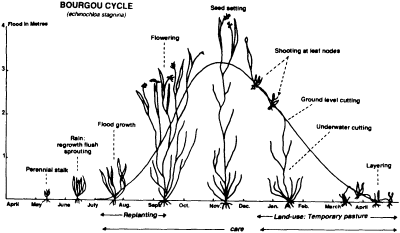
Lakes of Grass The following, taken from a 1990 report from the United Nations Sudano-Sahelian Office (UNSO), shows how a farsighted project is restoring one of the formerly important West African wild grasses. Although it emphasizes animal feed, it gives a glimpse of what could be done by developing wild grasses for food* To farmers and pastoralists in the Inner Delta of Mali, the bourgou floodplains supply a crucial source of fodder. Without these bourgoutières, the livestock would die during the dry season. Only bourgou can survive in these bottomlands that go underwater each year for months at a time. Bourgou is unique in its adaptation to these amazing conditions. As the waters rise around it, the grass grows taller and taller until (after about 3 months) its stems can reach lengths of more than 3 m. At this point bourgou is like an aquatic plant with only its flowers and seedheads sticking above the surface. Once the water level drops, cattle are given access, and as they walk through the shallows, they trample the seeds and runners into the soft ground. This ensures that the crop will survive and grow again. However, when everything has dried out, there remains on the surface a dense mat of grass, half-a-meter thick. This mat is what is used for fodder. If well managed, bourgou produces nearly 30 tons of dry matter per hectare—a sizable yield even for much more productive locations. When cut and 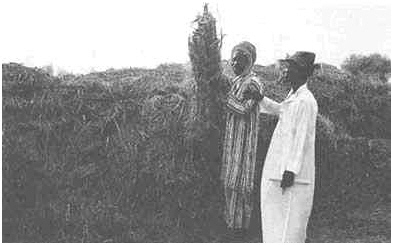 Bourgou harvest. (UN Sudano-Sahelian Office) |
source of forage, since it persists in a dry but palatable state until the next rainy period.16
On the other hand, kram-kram is vicious. It is a sandbur whose grains are enclosed in clusters (fascicles) surrounded with many sharp spines. These grab onto the fur of animals and the clothing of people. Indeed, they easily penetrate flesh and have literally been thorns in people's sides for millennia. Travelers have long complained of the plant's "troublesome nature" and "constant inconvenience," but they did admit that it was also very useful. "Many of the Tawarek, from Bornu as far as Timbuktu,'' wrote Heinrich Barth in the mid-1800s, "subsist more or less upon its seed."
When mature, the burs fall to the sand in great quantities, often clinging together in giant masses that roll along with the wind, growing as they go. People sweep them up with bunches of straw or with giant "combs." They throw them into a wooden mortar and pound and winnow away the troublesome spines, leaving behind the white, flavorful seeds.
Livestock cannot abide the prickly spikelets, but they like grazing on kram-kram both in its juvenile state and after the spiky burs have fallen off. The plant grows vigorously, and during the rainy period it can be cut several times for hay or silage. The hay must be made at times when the burs are absent, but silage can be made at any time because the fermentation softens the bristles, so that animals digest them without difficulty.
Not all forms of this plant are spiky nuisances. At least one has blunt inner spines and no outer spines at all. It has been called Cenchrus leptacanthus. If this type breeds true and if it could be developed as a crop, it would make kram-kram easier to handle and perhaps very valuable as a forage for many dry areas.17
A related species, also used as a wild cereal, is Cenchrus prieurii. It is spread throughout the Sahara from Senegal to Ethiopia (as well as India). People eat the crushed grain, mainly as porridge.
BOURGOU
Of all the grasses of the central delta of the Niger, bourgou (Echinochloa stagnina) was once the most prevalent. At one time it covered an estimated 250,000 hectares. (Much of that land, which is
flooded for part of each year, is now under cultivated rice, see Chapter 1.) The Fulani people, for example, harvested large amounts of bourgou seed for food. They also got sugar from the plant. Some of the sugar produced by photosynthesis is not converted to starch and accumulates in the stems. People used it in beverages, both alcoholic and nonalcoholic. Even today, some sugar is still extracted from bourgou and is utilized especially for making sweetmeats and a liqueur.
This grass is found typically along river banks and other moist areas, especially those of Central Africa and on the central delta of the Niger. Recently, a farsighted UN-sponsored project has begun to restore some of the old bourgou stands in the area (see box, page 264).
Although its seeds are harvested for food, bourgou today is mainly used for fodder. For this purpose, it is notably important at the beginning of the dry season. As the annual floodwaters recede, it provides the vital forage needed to fatten livestock before the dry season sets in and their drastic weight losses begin.
The genus Echinochloa is one of the larger ones in the grass family. Two more species used for food in Africa are the following.
Antelope grass (Echinochloa pyramidalis)
This native of tropical Africa, southern Africa, and Madagascar is primarily used for fodder, but is also used locally as flour.
Shama millet (Echinochloa colona)
This plant probably originated in Asia, but it has been in Africa a very long time. Today people eat its grain only in dry years, although Egyptians possibly once grew it as a cereal on farms. The plant thrives in wet, clay soils where few grasses do well (in some African languages it is called "waterstraw"). Beyond its use as a food, the plant is suitable for making hay and silage and is relished by livestock.
CROWFOOT GRASSES
At least one Dactyloctenium species is eaten in Africa. It is the so-called Egyptian grass (Dactyloctenium aegyptium). This annual of the Sahara and the Sudan is now widely naturalized in different parts of the tropics and subtropics, including North America. It has never been considered as a possible cultivated crop, but nomads and others in its homeland (as well as Australian aborigines) gather the grains for food. The plant mostly grows in heavy soils at damp sites below 1,500 m. Livestock enjoy it, and it is also suitable for making hay and silage.
SHAMA MILLET
|
Main Componentsa |
|
Essential Amino Acids |
|
|
Food energy (Kc) |
311 |
Cystine |
0.8 |
|
Protein (g) |
9.5 |
Isoleucine |
4.6 |
|
Carbohydrate (g) |
56 |
Leucine |
10.8 |
|
Fat (g) |
5.3 |
Lysine |
2.1 |
|
Fiber (g) |
11.1 |
Methionine |
1.6 |
|
Ash (g) |
7.8 |
Phenylalanine |
6.9 |
|
Calcium (mg) |
45 |
Threonine |
3.5 |
|
Copper (mg) |
0.4 |
Tyrosine |
4.3 |
|
Iron (mg) |
9.7 |
Valine |
5.8 |
|
Magnesium (mg) |
198 |
|
|
|
Manganese (mg) |
2.5 |
|
|
|
Phosphorus (mg) |
369 |
|
|
|
Potassium (mg) |
270 |
|
|
|
Sodium (mg) |
9 |
|
|
|
a Assuming 10 percent moisture. |
|||
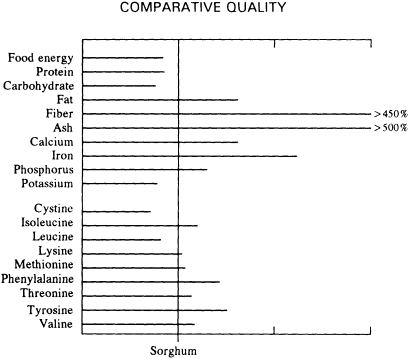
EGYPTIAN GRASS
|
Main Componentsa |
|
Essential Amino Acids |
|
|
Food energy (Kc) |
323 |
Cystine |
1.5 |
|
Protein (g) |
11.8 |
Isoleucine |
4.8 |
|
Carbohydrate (g) |
65 |
Leucine |
9.9 |
|
Fat (g) |
1.7 |
Lysine |
2.0 |
|
Fiber (g) |
4.0 |
Methionine |
3.2 |
|
Ash (g) |
7.5 |
Phenylalanine |
6.8 |
|
Calcium (mg) |
963 |
Threonine |
3.5 |
|
Copper (mg) |
0.6 |
Tyrosine |
3.7 |
|
Iron (mg) |
10.9 |
Valine |
5.8 |
|
Magnesium (mg) |
198 |
|
|
|
Manganese (mg) |
38.3 |
|
|
|
Phosphorus (mg) |
351 |
|
|
|
Potassium (mg) |
270 |
|
|
|
Zinc (mg) |
6 |
|
|
|
a Assuming 10 percent moisture. |
|||
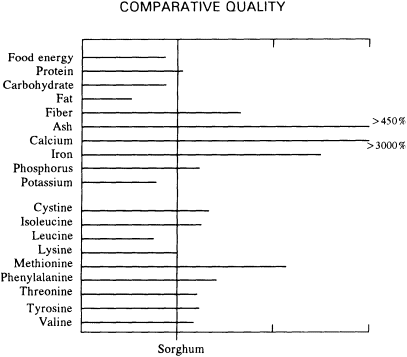
WADI RICE
|
Main Componentsa |
|
Essential Amino Acids |
|
|
Calcium (mg) |
36 |
Cystine |
1.5 |
|
Copper (mg) |
0.6 |
Isoleucine |
4.1 |
|
Iron (mg) |
15.1 |
Leucine |
8.6 |
|
Magnesium (mg) |
243 |
Lysine |
3.6 |
|
Manganese (mg) |
4.4 |
Methionine |
2.2 |
|
Phosphorus (mg) |
495 |
Phenylalanine |
5.2 |
|
Potassium (mg) |
333 |
Threonine |
3.4 |
|
Sodium (mg) |
9 |
Tyrosine |
4.8 |
|
Zinc (mg) |
4 |
Valine |
5.9 |
|
a Assuming 10 percent moisture. |
|||
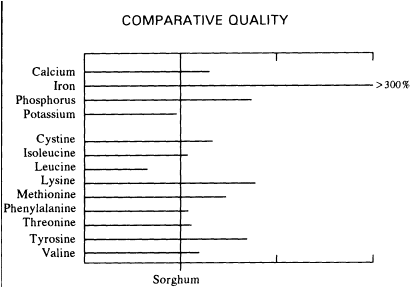
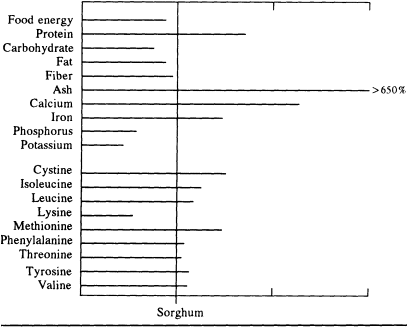
This chapter's tables and graphs show that Africa's famine-food grains can be quite nutritious. They are notably rich in those amino acids that are essential for human health but that are normally deficient in sorghum and the other common staples. Kram-kram, Egyptian grass, and wadi rice, for example, have more of the sulfur-containing amino acids than the FAO reference protein requirement. Egyptian grass and shama millet proteins are also significantly higher in threonine than those usually reported for sorghum protein. Wadi rice protein (see above) is notably better than sorghum, but it closely resembles that of common cultivated rice in its amino-acid composition.
WILD RICES
Cereals of the West and Central African savannas include two wild rices. One, Oryza barthii, is the wild progenitor of the African domesticated rice (see African rice chapter, page 17, and especially the map, page 23). An annual, it tends to grow in shallow depressions that fill with water during the rains but later dry up. It produces abundant seed and is still harvested on a considerable scale.
The second species, Oryza longistaminata, is perennial and thus requires a more continuous supply of moisture. It is a relatively shy seeder, but its grain is sometimes harvested in sufficient quantities to reach the local markets.
A third wild rice (Oryza punctata) is indigenous to eastern Africa. This so-called "wadi rice" is a freely tillering annual that grows up to 1.5 m tall, and it, too, commonly occurs in rain-flooded depressions. Its seeds are relatively large and resemble those of cultivated rice except that they have a reddish husk. In Central Sudan, where wadi rice is widespread, the grains are boiled with water or milk and eaten as a staple.
OTHER WILD GRAINS
Among other wild African grasses that are, at least on a few occasions, used as food are the following. Little or nothing is known about these or their food uses, but certain botanical tomes contain the following cryptic comments.
Urochloa mosambicensis. Central and East Africa. Grains boiled.
Urochloa trichopus. Tropical Africa. Grains sometimes eaten.
Themeda triandra. Tropical and southern Africa. Perennial grass.
Grain eaten during times of famine. Forms principal cover in fireclimax savanna areas. Used as fodder for livestock. Possibly of use in papermaking. Used a lot for thatching; bundles are sold in Ethiopian
markets for the purpose.
Latipes senegalensis. Tropical Africa. Annual grass. Seeds are eaten by desert tribes.
Eragrostis ciliaris.18 Widespread in tropics. Grains used as famine food.
Eragrostis gangetica. Tropical Africa and Asia. Grains used as famine food.
|
18 |
This and the following Eragrostis species are related to tef (see chapter 12, page 215). |
Eragrostis pilosa. Grains harvested regularly in East Africa.
Eragrostis tremula. Tropical Africa and South Asia. Grains used as famine food.
Setaria sphacelata. Eastern South Africa, South Cape, Botswana, Namibia. Perennial, robust, usually tufted grass. Of much economic importance. Different varieties or ecotypes have various uses: for hay and silage; for silage only; or just for grazing. Seeds eaten as famine food.


