


Below is the uncorrected machine-read text of this chapter, intended to provide our own search engines and external engines with highly rich, chapter-representative searchable text of each book. Because it is UNCORRECTED material, please consider the following text as a useful but insufficient proxy for the authoritative book pages.
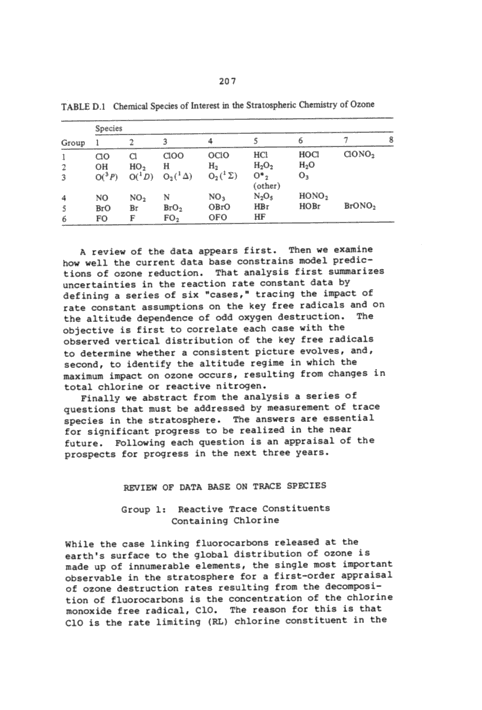
Appendix D THE MEASUREMENT OF TRACE REACTIVE SPEC I ES I N THE STRATOSPHERE: A REVIEW OF RACE NT RESULTS J.G. Anderson Harvard University INTRODUCTI ON The central objective of this report is to review critically the data base on trace species observations in the stratosphere for the specific purpose of testing predictions of global ozone depletion resulting from th release of compounds containing chlorine and nitrogen into the lower atmosphere. A corollary objective is to appraise prospects for significant advances in the next five years and to suggest a strategy for that research. Achieving the first objective in a reasonably concise document must confront the often incompatible elements of data quality, quantity, and applicability to theory. For example, a large body of data may exist on a particular radical that is of demonstrably superior quality with respect to the analytical method, but that, if not taken at the proper time of day and referenced to the local tropopause height, may be uninterpretable in terms of a modeled distribution. We will deal with the sheer volume of information by referencing the recent WMO/NASA report document, "The Stratosphere 1981: Theory and Measure- ments," whenever possible while attempting to maintain reasonable continuity in this report (Hudson et al. 1982). The species that are of interest to the stratospheric photochemistry of ozone are divided into groups and listed in Table D.1. The ordering of groups and of the species within each group in the table is rather arbitrary, but the choice seeks to represent the fact that the central objective of this report is an assessment of the effect of fluorocarbon release on stratospheric ozone. Thus, the photochemically active chlorine components are treated first. e 206 on
207 TABLE D.1 Chemical Species of Interest In the Stratospheric Chemistry of Ozone Species Group 1 2 3 4 6 l 8 5 ~ 1 C10 C1 C100 OC10 HC1 HOC1 C1ONO2 2 OH HO2 H H2 H2O2 H2O 3 0(3P) O(iD) 02(~/\) 02(~) 0*2 O3 (other) 4 NO NO2 N NO3 N2Os HONO2 5 BrO Br BrO2 OBrO HBr HOBr BrONO2 6 FO F FO2 OFO HF A review of the data appears first. Then we examine . · ~ ~ ~ _ how well the current data base constrains morel prealc- tions of ozone reduction. ~ uncertainties in the reaction rate constant data by defining a series of six "cases," tracing the impact of rate constant assumptions on the key free radicals and on the altitude dependence of odd oxygen destruction. objective is first to correlate each case with the observed vertical distribution of the key free radicals to determine whether a consistent picture evolves, and, second, to identify the altitude regime in which the maximum impact on ozone occurs, resulting from changes in total chlorine or reactive nitrogen. Finally we abstract from the analysis a series of questions that must be addressed by measurement of trace species in the stratosphere. The answers are essential for significant progress to be realized in the near future. Following each question is an appraisal of the prospects for progress in the next three years. The ~ And 1 vet in f irst summarizes The REVIEW OF DATA BASE ON TRACE SPECIES Group 1: Reactive Trace Constituents Containing Chlorine While the case linking fluorocarbons released at the earth's surface to the global distribution of ozone is made up of innumerable elements, the single most important observable in the stratosphere for a first-order appraisal of ozone destruction rates resulting from the decomposi- tion of fluorocarbons is the concentration of the chlorine monoxide free radical, C10. The reason for this is that C10 is the rate limiting (RL) chlorine constituent in the
208 major catalytic cycles (see the recent discussion by Weubbles and Chang (1981)): C1 + O3 C1O + 0 C1O + O2 C1 + O2 (RL) O + O3 C1 + O3 2o2 C1O + O2 + HOC1 + O2 (RL) C1O + HO2 OH + O3 ~ HO' + OK HOC1 + he ~ OH + C1 O3 + O3 ~ 3O2 C1 + O3 ~ C1O + O2 NO + O3 ~ NO2 + O2 C1O + NO2 + M ~ ClONO2 + M ClONO2 + he ~ NO3 + C1~ NO3 + he ~ NO + O2 >(RL) O3 + O3 ~ 3O2 C1O has thus been the focus of experimental attention since Molina and Rowland (1974) first linked fluorocarbon release to global ozone reduction. In addition, because C1O dominates the chlorine free radical system with respect to concentration, reaching nearly 1 part per billion (ppb) in the middle to upper stratosphere (its reactive partner, C1, for example, reaches only 1 part per trillion [ppt] in the stratosphere), it is amenable to a broader class of observational techniques. Four other chlorine-containing constituents are of central importance: HC1, C1, HOC1, and C1ONO2 (with possible isomeric forms). Chlorine Monoxide (C1O) Three methods have been successfully applied to the detection of stratospheric C1O (listed here in the chronological order of their application): 1. Balloon-borne in situ resonance fluorescence methods (Anderson et al. 1977, 1980; Weinstock et al. 1981). 2. Ground-based millimeter(mm)-wave emission spectroscopy of the C1O total column at 204 GHz (Parrish et al. 1981). -
209 3. Balloon-borne, mm-wave emission spectroscopy of C10 at 204 GHz (Waters et al. 1981). Aircraft-borne observations by this group had previously established an upper limit on stratosphere C10 (Waters et al. 1979). A fourth method, that of balloon-borne, laser hetero- dyne radiometry (see Menzies 1978, Menzies et al. 1981), has been applied to the problem, but ambiguities in spectral line position prevent an interpretation of the results. While a clear consensus on several aspects of the stratospheric C10 distribution has not emerged, the last two years have witnessed several crucial steps toward a first-order understanding of [C10] (where square brackets indicate concentration) at middle latitudes. We consider first results from the two balloon-borne techniques that provide a direct determination of the altitude dependence of [C10]. Figure D.1 summarizes 10 observations reported by Weinstock et al. (1981) obtained using method 1. All observations contained in Figure D.1 represent midday conditions at 32°N latitude; variations in solar zenith angle primarily reflect changes in solar declination. The in situ observations fall into two classes; 8 of the 10 define an envelope with deviations limited to about +50 percent about the observed mean; two of the observations, both obtained in July, fall clearly outside of the envelope and are not representative of the mean distribution of C10 at middle latitudes. Without independent substantiation, the two July observations cannot be included in the data base defining the mean distribution of C10. In Figure D.2, the envelope of in situ observations is superposed with the recent balloon-borne observations of Waters et al. (1981) using mm-wave emission techniques. Included in the in situ array is an observation (June 1, 1978) not included in the Weinstock et al. (1981) publication because it was obtained using an instrument with no previous flight history; the results are not at variance and are included for completeness. The consistency in both absolute magnitude and gradient between the two techniques is one of the most important results to be achieved since the last NRC report (NRC 1979). _ ~ It underscores the importance of using independent techniques to cross-calibrate observational methods for all of the key radicals involved directly in processes that control the rate of odd oxygen destruction.
210 . . ~ ~ ~''1 ' 41 30 29 _ 27 _ 26 28 2S l _ C 10 M IXING RATIO . 40 - o 39 - O 38 _ 37 V 36 _ 36 _ 34 _ 33 _ ~ 32 - X 7 O 26 SEPTEMBER X'38° W~~Y///~J 28 JULY 1976 8 DECEM BER 1976 14 JULY 1977 20 SEPTEMBER 1977 25 OCTOBER 1977 2 DECEMBER 1977 X~ 50° 16 NOVEMBER 1978 X =soo ;N X ~43 5SO 41° 41° 15 JUNE 1979 ;~: AUGUST 1979 ~! I ~: ~ [r~X 1 . ~.. 10 11 T ~_ . 1 IOK) 0/ h/ _ , , . , , , ., 1 , . . . . [CIO] / [M] . . . . . . 10 9 - - 10'. FIGURE D.1 Summary of the vertical distribution of C10 obtained between July 28, 1976, and September 26, 1979, using in situ resonance fluorescence methods (from Weinstock et al. 1981~. 50 45 40 35 LLI 30 25 C{O N SITU RESULTS ° 12/8/76 9/20/77 . 10/25/77 · 12/2/77 o 6/1/78 · 11/16/78 ° 6/1 5/79 · 8/7/79 x 9/26/77 · ·~ __ 15 lo-12 COMPARISON BETWEEN BALLCON-BORNE IN SITU AND mm-WAVE EMISS!ON RESULTS O · O ·OXe ~ _ x~ · ~ O eK · Oe ~ 0 - · O_ _ x. · 0. .-{ ~ - . . · 0. 0 ~ P. · o . 3e "* · 0 ~ . ' O ~ ~ ~ · ao ~ ~ ~ . . ~0 0 · x - 0 0 · ~ · 0 0 ~0 OD ~ X.O x ~ I t mm WAVE EM I SS ION | | DATA ~ .... 10 9 [C{O]/[M] .d 109 FIGURE D.2 Comparison between balloon-borne in situ and mm-wave emission observations of C10 (from Weinstock et al. 1981, Waters et al. 1981).
211 It also should be pointed out that while the envelope of C10 data appears to be rather well defined, the dispersion about the mean exceeds +50 percent; the cited experimental uncertainty is +30 percent. As we will see, when the results are applied to the problem of constraining model-predicted ozone reduction, this dispersion constitutes a serious impediment. In anticipation of that fact, we represent the nine in situ ~_..~l ;~r`e Atom =;~rllr" n ~ in ~ ~m~wh~t different V~JO=L VCI ~=v11= ~ ~ Call ~ _~ ~ ~ ~ way. Figure D.3 displays a composite ot the data converted to absolute concentration to eliminate the steep gradient, and in each frame a single profile is highlighted against the background array. The variety in profile shape is significant, with clear evidence of vertical structure on the order of 2 km in some cases, but nearly absent in others. In addition, the top-side shape of [C10] exhibits significant variation. We summarize next the results recently reported by Parrish et al. (1981) using the ground-based, mm-wave emission technique noted earlier (method 2), which were obtained between 10 a.m. and 4 p.m. on 17 separate days (between January 10, 1980, and February 18, 1980) at 43°N latitude from the Five College Radio Astronomy Observatory, Amherst, Massachusetts. Such ground-based observations, which employ purely rotational transitions, are affected by collisional (pressure) broadening by approximately 4 MHz/mb at stratospheric pressures. This is both a blessing, in that low-resolution altitude information can be extracted from the emission line shape, and a curse, in that one must have a first-order estimate of the shape of the emitting layer in order to obtain the absolute column concentration for the observed brightness temperature as a function of frequency. In practice, however, the balloon-borne observations have provided the information on the layer shape, and thus absolute column measurements can be extracted. It should be noted, however, that even without knowledge of the shape of the emitting layer, some information on absolute concentration can be extracted. Parrish et al. (1981) have taken the mean of seven in situ profiles, specifically those appearing in the enve- lope of Figure D.2, excluding the last profile obtained on September 26, 1979, and the June 1, 1978, data (which do not alter the conclusions to be drawn), scaled those results by 0.8, integrated the signal that would have resulted, and then overlayed that profile with the observed brightness as a function of frequency. The
212 50r 451 r ~ 40 . . 35 3C 2C 50r 45 . . ~ 40 . . ILI 35 30 25 20 JVI 451 . . ~ 40 . . ~ 35 J ~ 30 . T __ . i , ~, . ~ , . ; CtO IN ' ilTU DATA 1 i --12/8/76 _: ~ ~ ~ X 2 . . ~ : : I . _ ~. ' -i ,I ~, .. .... __ _ . __ i 1 . ~ . . .. CtO IN SITU DATA , I ~ i, 9/20/77 --i ~ I ~ 1 ' ~ I ' ~ . :. . . . ... ... .... :. .~ .. , _ . .. CtO IN SITU DATA 10/25/77 . . . . . . . . ! _' : ; ; o ~ : :~: ... . - , - .. ~ . - , to !X _ · ' ~ +*O O : ·X ., I :oj~' o to. eX, x lo8 FIGURE D.3a Composite of the C10 profiles 12/8/76, 9/20/77, and 10/25/77.
213 50 : 45 ,_ ~ 40 ~_ LIJ 35 30 2C 40 ~U 45 40 ~_ 35 30 ~ I I I i ~'~ ~ CtO IN SITU DATA - 12/2/77--- I I ~ 'I I, I I ~ ' ~x I 1 ~:.1 i 1 1 ........ __ _ :_ ' , ! . 1 CtO IN SITU DATA . 6/1i78 . 1, 1 1' i ... .... . . . CtO IN SITU DATA 11/16/7E 25 2C 107 : : . .* o ;ao X, .. . . . . . -,- e. ~ ~ ~ ~ : ~ i 0 · ' ~ o ' ~ ~x ; ~0 ~ ~ O' - ox . ~. . . , . ~ . . ., . ~. : ~ ° : ~ ~ V Xi f ! o o. ~ ,.0 ~ · ~' ~' ~ ~ 4 ~ , t4~., V ,6 q o , · X ~ , .0,; ~: ., ,' .o o- ·K ~ : ; : : 0 a ~x c. ~ , ; O K e~ ~ ~; [ClO] _ _ lo8 FIGURE D.3b Composite of the C10 profiles, 12/2/77, 6/1/78, and 11/16/78.
214 50r ~ , ~ , ~ 45t 2C- 45t ._ ~ 4C ~_ llJ Z) 3~ 3C 25 . . . .. ... _ . . . . . . . . . CtO IN SITU DATA 6/15/79 _ , V~ ~ ~ ~ , ~· . 40 .... _ ~ ~x . ~ -- I~0 ~X ex ° 35 ~__ - '_·'3- ~ ~ -- 30 ~. .o. 1, _. . .:. .-..\ D i · !X ~ , .e ,, 25 cF :~ ~_ee . ~ , ~ ', , ''''',' , ' ~ ' ', ' ~'j '' ', , 50 ~j j 1 . ;; , : .. 1 . __ _ ___,. . . . . . . : CtO IN SITU DATA 8/7/79 - - - - - - _ ~. , o . ,x ,. , I , ~io~a O eX . . . . . . . . ! ·1 1 °~ · 0 o, ex, ___ ~· e* :~ x ,' .: I ~o ~ i '°1ai, ~, : l _ __ ,! , ° ~g ... _ ~D ~ ~ O ---- - - -# ~- - ,~ 1 ~, l, I '' '1 ' ~ 20 ~! ! . : : : 50 j ~, : .. . . . _ ,, .: .. . .. : , .CtO IN SITU DATA 9/26/79 1 ~ , : . . . . . . . . I ,- ; j 45 _.. 1 . -4 · I ~ 3C . , · oi · d . _ _ ~ 1 ~ I O ' ., I t. ~X, I · . . ° - _~- ''' ' ' '' ' . v i c' ~ ,~, · &,o Do.~· ,~;;~ ,e, 25 _ . ~_ *~ ~ , ._ _ . .. . , . , . , . ~. , , ., I : ~ 20 107 [CdO] FIGURE D.3c Composite of the C10 profiles, 6/15/79, 8/7/79, and 9/26/79.
215 results are shown in Figure D.4. The first conclusion to be drawn is that substantial agreement exists with respect to absolute magnitude, since both techniques quote uncertainties of greater than or equal to 25 percent. However, it must be noted that the ground-based observa- tions were done at a latitude 10° northward of the balloon m-~,rements , and are confined to a relatively short I l e ~ ~ ~ ~ ~ a ~ ~ ~ period of time in midwinter. A broader data base and observations done in the same latitude band are clearly needed. Parrish et al. (1981) report that no single day of observation exceeded the average by more than a factor of 2.5, and tentative evidence for variations on the order of a factor of 2 in total C1O column density occurred on a time scale of a few days. An inspection of Figure D.4 indicates a point of major importance: The mm-wave, emission line shape is consistent with the distribution determined by both balloon-borne techniques. The ability of the ground-based observations to discriminate among the available model calculations is demonstrated in the three panels of Figure D.5. These figures compare the line shape that would be observed for three modeled cases: Case (a) with a mixing ratio of 2.7 ppb for total chlorine, a chemical reaction scheme comparable to that used for the previous NRC report, and an elevated stratospheric water vapor mixing ratio of 8 ppm (uniform from troposphere to stratosphere, as discussed in Logan et al. (1978)); Case (b) with 2.6 ppb for total chlorine and a "normal" mixing ratio for H2O of ~ ppm (see Sze and Ko 1981); and, finally, Case (c) with 1.3 ppb for total chlorine and 5 ppm H2O (see Crutzen et al. 1978). The point is not that those ground-based observations cast new light on the selection of a preferred combination of total chlorine and water; the determination of total chlorine (Berg et al. 1980) and H2O (see Kley et al. 1980) had established that point. Rather, the line shape resulting from the calculated distribution of C1O using chemistry consistent with the previous NRC report (Case a) is distinctly broader than that observed by the mm-wave method. This reflects the larger concentration of C1O calculated by the model at lower altitudes in the stratosphere. A reasonably thorough discussion of the experimental uncertainties associated with each of the methods discussed above appears in Chapter 1 of Hudson et al. (1982).
216 30 An ~20 LL on 1 0 LLJ an I Y O O a: ~ -10 - 1\ 1 1 1 1 1 1 1 1 1 -80 0 1 1 1 80 FREQUENCY AROUND 204.352 MHz FIGURE D.4 An overlay of the ground-based mm-wave emission data of Parrish et al. (1981) and the signal that would result from an integral of the mean of the balloon- borne in situ observations multiplied by 0.8. The mean was taken excluding the July 28, 1976, and July 14, 1977, in situ C1O profiles. C"* a 40 30 hi ~20 a: C3 > ye 10 m O O _O 40 . an :10 1 1 1 1 1 1 1 1 1 1 1 1 o Case b ~ ~ O 1 1 1 1 1 1 1 1 1 1 1 1 lo Case c 30 20 0 _ 1 1 1 1 1 1 1 1 1 1 1 1 -80 0 80 -80 0 80 -80 0 80 FREQUENCY AROUND 204.352 MHz FIGURE D.S A comparison between the ground-based mm-wave emission data of Parrish et al. (1981) and three modeled predictions: Case a from Logan et al. (1978) with 8 ppm H2 O throughout the stratosphere; Case b with 5 ppm H2 O and 2.3 ppb total chlorine from Sze and Ko (1981~; and Case c for 5 ppm H2O and 1.3 ppb total chlorine from Crutzen et al. (1978~. .,
217 Chlorine (C1) There have been no further measurements of atomic chlorine since those reported by Anderson et al. (1977), which were noted in the last NRC report. However, the ratio of [Cl]/[C10] was explicitly discussed in a recent paper (see Anderson et al. 1980); those results are summarized in Figure D.6. A more complete discussion of atomic chlorine appears in Hudson et al. (1982), along with a detailed critique of experimental uncertainties. There are several reasons for the paucity of the data in this important area. The first is that attention has been focused on its rate limiting partner, C10, and the second is that the exceedingly low concentrations of C1 make the observa- tions exceedingly difficult. It is critical that progress be made in the study of atomic chlorine, particularly in conjunction with studies of C10 and HC1. Chlorine Dioxide Radical (C100) There have been no reported observations of the radical C100 in the stratosphere, and there have been no concerted attempts to observe it. Because of its large cross section for photolysis, it is expected to exist at extremely small concentrations, well below currently available detection techniques. Symmetrical Chlorine Dioxide (OC10) The more stable form of chlorine dioxide has not been observed and at predicted concentrations of 10 to 100 cm~3 in the stratosphere will probably so remain in the foreseeable future. Hydrochloric Acid (HC1) Table D.2 summarizes the partitioning among the various chlorine compounds given our current understanding of the reactions that govern the chemical exchange of these constituents. The budget is clearly dominated by [HC1], and it has thus rightfully received a considerable amount of attention in experiments.
218 TABLE D.2 Partitioning Among Chlorine Compounds (Concentrations Correspond to Case 6 as Described in the Text) ~ = [ HC1] + [ C1O ] + [ClONO2] + [ HOC1] + [ C1] AUtitude HC1/Z C1O/Z ClONO2/E HOC1/Z C1/Z ~ 50 0.97 0.016 8.44X 10 - 0.002 0.007 0.4323 X 10⁸ 45 0.92 0.056 6.27X 10⁻⁶ 0.01 5.3 X10⁻³ 0.8258 X10⁸ 40 0.78 0.15 0.0007 0.05 2.2 X 10⁻³ 0.16477X 10⁹ 35 0.69 0.17 0.02 0.09 6.4 X 10⁴ 0.3332 X 10⁹ 30 0.72 0.10 0.10 0.06 1.4 X 10⁻⁴ 0.6692 X 10⁹ 25 0.83 0.03 0.11 0.01 3.0 X 10⁻⁵ 0.1164 X 101 20 0.95 0.008 0.034 0.001 7.5 X 10⁻⁶ 0.1098 X 101 15 0.98 0.004 0.008 0.001 2.9 X 10⁻⁶ 0.6454 X 10⁹ 10 0.98 0.004 0.001 0.009 2.07X 10⁻⁶ 0.3717 X 10⁹ 41 40 38 37 36 ~ _ ; 35 10-3 Observed 7128/76 1 218/76 1 10-2 [Cl] /[C10] 10-1 FIGURE D.6 Comparison between the observed and the calculated ratio of atomic chlorine to ClO (from Anderson et al. 1980~.
219 Four remote sensing techniques and one in situ method have been employed from balloon platforms for the detec- tion of HC1 in the stratosphere. These include (1) high-resolution, middle infrared solar absorption (see, for example, Farmer et al. 1980, Zander 1980, Buijs et al. 1980); (2) mid-infrared emission (Bangham et al. 1980); (3) pressure-modulated infrared radiometry (Eyre and Roscoe 1977); and (4) far-infrared emission measure- ments with Fourier transform techniques (Chaloner et al. 1978). The only in situ method used thus far is the base impregnated filter collection method of Lazrus et al. (1977). Results from those five data sets can best be summar- ized in two groups. First, the high-resolution middle infrared absorption data obtained by five independent research groups constitute a consistent data set that is reviewed in Figure D.7. The uniformity of these middle IR results is not reflected in the survey of the other four methods, the results of which are reviewed in Figure D.8. In particu- lar, the base impregnated filter data of Lazrus, which should provide an upper limit on [HC1], since any acidic chlorine compound should be collected, indicate signifi- cantly lower concentration in the critical 25- to 35-km altitude region. On the other hand, the pressure- modulated radiometer data lie considerably above the IR absorption data in the altitude region above 22 km. The far-infrared result of Traub lies below the band of middle IR absorption data, but well within the scatter of the results shown in Figure D.8. Given the paramount importance of HC1 in the total chlorine budget, and thus the need to understand in detail the distribution of HC1 throughout the strato- sphere, it is essential that those discrepancies be eliminated. Hydrogen Oxychloride (HOC1) Although HOC1 has been searched for in the library of middle infrared sunset absorption data at 1238 cm~1 (D.G. Murcray, University of Denver, personal communi- cation, 1981), no observable absorption has been found. This corresponds to an upper limit of 10 ppb at 25 km, which is approximately a factor of 1000 above current model predictions.
220 45 40 35 Y 30 LLI 25 20 HCt OBSERVATIONS firm BALLOON-BORNE IR ABSORPTION ZAN D E R ( 1980) - FARMER ( 1975) --- BUIJS ( 1980) WILLIAMS (1976) RAPER ( 1976) /1 1 1 /xIN it" .0'10 109 [HCt] MIXING RATIO BY VOLUME FIGURE D.7 HC1 observations from balloon-borne IR absorption spectroscopy. 45 . HC ~ MEASUREMENTS BY (A) GROUND BASED IR ABSORPTION, ZANDER (1980) ( B) PRESSURE MODULARS RADIOMETRY, EYR E etal. (1977) (C) FAR IR EMISSION' BINGHAM (1980) / (D) FILTER TRAPMENT,jLAZRUS (1977) ~ (E) FAR INFRARED EMISSION /~< \ CHANCE AND TRAUB (1980) 40 35 -25 - lol 3-10 ~ /~ (( ~ A - 109 HC] VOLUME MIXING RATIO ~o-8 FIGURE D.8 HC1 measurements by ground-based spectroscopy, pressure-modulated radiometry, far IR emission, and in situ filter collection.
221 The importance of HOC1 to our understanding of stratospheric chlorine chemistry results from the fact that it is formed by the reaction, HO2 + C10 ~ HOC1 + O2 and is thus a test of the coupling between the hydrogen and chlorine families. An unambiguous determination of its vertical concentration profile at low or middle latitudes would be of very significant value. Chlorine Nitrate (ClONO2) A single observation of chlorine nitrate has been reported (see Murcray et al. 1979). As discussed in the WMO/NASA report (Hudson et al. 1982), the measurement is an exceed- ingly difficult one, given the broad nature of the ClONO2 absorption feature and interferences from absorption bands of N2O, CH4, and H2O that mask the chlorine nitrate feature. A review of these factors lea the W~/NAbA panel to conclude that an upper limit of 1 ppb for ClONO2 between 25 and 35 km was a defensible position at this time. . Since the upper limit falls above current model predictions for chlorine nitrate in this altitude interval, the measurement cannot be used to establish whether isomers other than ClONO2 are found in the recombination reaction, C10 + NO2 + M ~ ClONO2 ~ other isomeric forms. Group 2: Reactive Trace Species Containing Hydrogen The Hydroxyl Radical (OH) Hydroxyl has been observed in the stratosphere by four independent techniques noted in the chronological order of their application: 1. Solar flux induced resonance fluorescence observed by a rocket-borne spectrophotometer (Anderson 1971, 1975), which provides a local concentration measurement by determining the change in total column emission rates as a function of altitude.
222 2. Balloon-borne in situ molecular resonance fluorescence using a plasma discharge resonance lamp to induce fluorescence. The fluorescence chamber is lowered through the stratosphere on a parachute to control the altitude and velocity of the probe (Anderson 1975, 1980). 3. Ground-based high-resolution solar absorption by a PEPSIOS (Poly-Etalon Pressure Scanned Interferometer) instrument, which resolves a single rotational line in the (0-0) band of OH at 309 nm. The total column density of terrestrial OH between the instrument and the sun is observed and is dominated by the altitude interval of 25 to 65 km (Burnett 1976, 1977; Burnett and Burnett 1981). 4. Balloon-borne laser-induced detection and ranging (LIDAR) in which a pulsed laser system coupled to a telescope is used to observe the backscattered fluor- escence from OH. The laser is tuned to the (0-1) band of the A-X transition at 282 nm and the fluorescence at 309 nm (the 0-0 band) is observed as a function of time following the laser pulse (Heaps et al. 1981). Four methods have been employed for the detection of tropospheric OH: 1. Aircraft-borne laser-induced fluorescence wherein a contained atmosphere sample is passed through an enclosed detection chamber and is probed by a pulsed laser tuned to the (0-1) band of the A-X transition at 282 nm. Fluorescence is observed at 309 nm (Davis et al. 1976, 1979). 2. Aircraft-borne laser-induced fluorescence using an "open" optical arrangement in which a telescope is used to observe the backscattered fluorescence outside the boundary layer of the fuselage, but in the near vicinity of the aircraft (Wang et al. 1981). 3. Measurements of carbon 14 labeled CO oxidation rates by OH in which the sample is drawn into a Teflon- coated vessel of 10-liter volume. All reported observa- tions were taken in the boundary layer (Campbell et al. 1979). 4. Long path (7.8 km) absorption of laser radiation at 308 nm (the Q(2) line of the A2£+, v = 0, x2~v = 0 transition). The experiment employs a double pass (3.9 km per leg) optical arrangement in which the beam is returned by a spherical mirror to a double monochrometer located at the laser (Perner et al. 1976). 1
223 Although the subject of tropospheric OH is one of central importance to the photochemical structure of the atmosphere, it cannot be dealt with in adequate detail in this document. We extract from the above work, and from tropospheric lifetime studies of methyl chloroform (see Logan et al. 1981 and references therein) that the tropospheric contribution to total column OH does not exceed 5 x 1012 cm~2 and is thus a negligible contribution to the total OH column density measured from the ground. Restricting the discussion to stratospheric OH, we first review the comparison between the in situ observa- tions and the ground-based total column measurements; second, we summarize a considerable body of new informa- tion taken from the recent ground-based observations of Burnett and Burnett (1981). For the purpose of summarizing the in situ results, Figures D.9, D.10, and D.ll present a three-panel display of (a) the upper stratosphere-mesosphere rocket data from Anderson (1975); (b) the stratosphere balloon data using in situ resonance fluorescence (Anderson 1980); and (c) a composite of the two data sets with an upper limit on the mean tropospheric OH concentration taken from the methyl chloroform lifetime studies and the tropospheric laser experiments noted above. We note several features of the profile that will be referred to throughout this section. First, the total column concentration of OH determined from an integral of the in situ observations and an estimate of the upper mesospheric profile is 6.9 x 1013 cm~2. The fractional contribution to this figure for each 15 km interval between O and 90 km is given in Table D.3. Second, the altitude interval over which the balloon and rocket data extend, 30 to 70 km, encompasses all but 13 percent of the total column concentration so that ground-based observations provide an excellent cross check on the absolute concentration determined in situ. Third, within the region between 30 and 70 km, the dominant source is O(1D) + H2O ~ 20H, and the dominant loss is OH + HO2 ~ H2O + O2. Thus the in situ observations and the comparison between the integrated in situ data and the total column observations relate primarily to the balance between these two reac- tions and do not involve in a sensitive way the question of OH reactions with nitric acid and pernitric acid. Although the ground-based data will be discussed in detail in the remainder of this section, we extract from
224 1 ~! ~ 1 1, , , 70 y - ~,, 6 0 - c: A: 50 ~ 1 1 1 1 1 1.4x1061 1, 1.4x10⁶+4xlO i'[m] ~0 1 ! 1 1 1 ~ 1 1 ! 40 1 : 1 1o6 10 OU ENCH I N G CORRECTI ON _ kR kR+kQ [m] _ j 1 1 ! 1 1 1 1 1 ROCKET BORNE I SPECTROPHOTOMETER DATA CORRECTED FOR QUENCHING OF A(22) STATE AND DIURNAL VARIATION 1 ~ ~ 1 ~ I, ! i , I a 1 . ' 1 OH CONCENTRATION (cm~3) I ' ' I ' 1! OH MIXING RATIO ' I ~ USING ABOVE!DATA a l · 1, 70 - - <, 60 - J 19 lo8 T ! ' . . - 50- . ~i , .. . 40 1 'A . ! i ~q to II 1 1 ~' 1 :b lo-lo 10-9 OH MIXING RATIO lo-8 FIGURE D.9 (a) Concentration and (b) mixing ratio of OH in the upper stratosphere and mesosphere obtained by rocket-borne spectrophotometer (Anderson 1975). Data are corrected for collisional deactivation (see German 1975, 1976) and for diurnal behavior (see Logan et al. 1978). Zenith angle at time of rocket flight was 86°; data are corrected to midday steady state condition.
225 45 40 - ~ 35 - J 30 45 _ 40 By - A 35 - ~: 30 - BALLOON- BORNE ~ IN SITU 12 JAN 1976 ( X2) 1 1 x = 80° 26 APR 1977 (X2) x= 80° ~ 1 14 JULY 1977 4: x= 41° x 20 SEPT 1977 x = 41 ° 1 1 ' 1 1 1 1 1 11 1 , , : I ! ! a ' ! ! 1 6 1071o8 OH CONCENTRATION (cm~3) - -- 1 1 1 1 1 1 ~ BALLOON- BORNE, IN SlrU ~I , 1 1 1 1 1 . 1~ ~ ~ I I ! b lo 11 lo-lo 10-9 OH MIXING RATIO 2() FIGURE D.10 (a) Concentration and (b) mixing ratio of stratospheric OH obtained in situ by molecular resonance fluorescence within a chamber lowered through the stratosphere at a controlled velocity on a parachute (Anderson 1980~.
226 that discussion the key quantity for comparison with the in situ data, the total column density of OH observed by the PEPSIOS and reported in Burnett and Burnett (1981). Based on a total of 270 observing days extending from December 1976 to December 1979, the midday abundance of OH averaged over all seasons is 5.7 x 1013 cm~2. All reported PEPSIOS observations were done at Fritz Peak, Colorado, 40°N latitude. Given the cited uncertainty of the in situ observations of +30 percent and of the total column observations of +25 percent, the observed absolute concentrations summarized in Table D.4, are consistent. We turn next to a more detailed discussion of the ground-based observations recently reported in Burnett and Burnett (1981). AS previously noted, all ground-based observations of OH were made from Fritz Peak Observatory, west of Boulder, Colorado, at 40°N latitude. All observations were taken between a solar zenith angle of 70° following sunrise through noon to a zenith angle of 70° prior to sunset. The period of observation was from 1976 to 1979, with a total of 270 observing days, which yielded 900 data sets with equal to or less than one-hour time resolution. The diurnal behavior of the column density was fit to a curve in sec X, which is characterized by an overhead sun maximum of 7.1 x 1013 cm~2 decreasing to 4.9 x 1013 cm~2 at sea X = 2 (solar zenith angle 60°). Midday abundance averaged over all seasons is 5.7 x 1013 cm~2. The following systematic departures from the mean were observed: 1. An annual increase of 1 x 1013 cm 2 in total column. 2. A gradual decrease of about 25 to 30 percent between spring and fall. 3. Diurnal oscillation observed with systematic changes of 30 to 40 percent that show a clear solar flux dependence on both a diurnal and an annual basis. The observed and predicted diurnal behavior of total column OH with respect to shape and absolute magnitude is summarized in Figure D.12. A representative data set is also shown in Figure D.13, indicating the scatter about the mean. Burnett and Burnett (1981) briefly discuss both an annual and a seasonal departure from the reported mean values. We consider first the observed year-to-year trends.
227 TABLE D.3 Contribution of Each Altitude Interval to the Integrated Column Altitude Interval 0-5 15-30 30-45 45-60 60-75 75-90 Contribution to Total Integral 1.5 X 1 ol2 3.4 X 10¹² 3.2 X 101 3 l.9X 1013 8.8 X 10¹² 4.3 X 10¹² Fraction of Integrated Total Integral Column Density 0.02 O.OS 0.46 0.28 0.13 0.06 6 9 X 1013 cm~2 TABLE D.4 Summary of the Comparison Between the Integrated In Situ Results from Balloon and Rocket Data and the Ground-Based Total Column Observation Composite of the In Situ OH Data 69X 1ol3cm-2 Uncertainty: +40 percent Conditions: Midday, 3 2 N 100 90 80 70 60 - 6 50 40 30 20 10 o Ground-Based Total Column OH 5 7 X 1013 cm-2 Uncertainty: +25 percent Conditions: Midday, 40 N Composite OH Profile - t 42~1o]2 an Bole 1.9 x 10¹³ Lit 32xl0~3 Lo l.Sx1012 1 o 1 1 1 1 . 1 , A, - ., "% , ~ , 1 , 4, ~. ,, Total Cal u mn J CO I ntegral i[OH] dz~6.9x 10 cm 105 1o6 107 OH CONCENTRATION (cm~3) FIGURE D.11 Composite of OH profile.
228 10 ,'j' z .~ lo 4 _ ,,,,,, `;_~` 0 .~~ A,, O _ ,,' o 3.0 2.0 1.0 see X a Herman \ ""of b Logan et al. \ ' c Liu - d PEPSI OS Observations e Heicklen f Shimazaki and Ogawa 2.0 3.0 FIGURE D.12 The correlation between OH total column density and solar zenith angle expressed as see X comparing the observed and modeled behavior (from Burnett and Burnett 1981~. 8 co o 7 6 LL z 5 J o Cat I 4 o 3 AM ~7 !~1 1~1 PM - . \ 1 1 1 1 1 1 1 4.0 3.0 2.0 1.0 see X 2.0 3.0 4.0 FIGURE D.13 An indication of the scatter about the mean of individual observations taken with the ground-based PEPSIOS (from Burnett and Burnett 1981~.
229 A reanalysis of the December 1976 data (from Burnett 1977) using more advanced methods for baseline determina- tion established 3.1 + 0.6 x 1013 cm~2 for a midday mean. In Figure D.14, the evolution of the monthly mean from December 1976 to December 1979 is summarized. There is an apparent increase of approximately 1 x 1013 cm~2 per year during that three-year period. Correlating such an increase to the 11-year solar cycle was suggested by Burnett and Burnett (1981), but such a dramatic change seems difficult to rationalize and will require more extensive data coverage and a far more thorough analysis of solar cycle flux variations with an associated mecha- nistic hypothesis before it can be accepted. The seasonal behavior in the total column of OH is a recurring and extremely interesting feature of the data in Figure D.14. There is the clear suggestion of a springtime maximum in OH and a fall minimum. One very important advantage to be gained from a more extensive geographic coverage with such ground-based observations would be an examination of this seasonal behavior as a function of latitude. The correlation of the dependence with other constituents such as O3, H2O, NO2, and C10 would be of significant importance. An unexpected and as yet unexplained aspect of the ground-based observations involves the appearance, particularly in the summer 1978 data set, of a zenith angle dependent pattern exemplified in Figure D.15. In particular, there is a distinct minimum in the observed column following local noon. The early afternoon decrease shows an abrupt drop of 4.5 x 1013 cm~2 with a subsequent increase of 3.5 x 1013 cm~2 followed by the conventional decrease into sunset. This feature has lead to a careful critique of the data by the authors, who believe that it is not an artifact of the data reduction or of instrumental performance. The oscillatory behavior shown in Figure D.15 persisted into the late summer of 1978, but was not apparent in the 1979 data set, which was taken with the same instrument at the same site using the same data reduction method. There was also a systematic progression of the position of the maximum and minimum as the 1978 season progressed. In summary, an analysis of (a) balloon and rocket data on OH in the stratosphere and (b) ground-based total column observations provide the following conclusions: 1. There is substantial agreement among the three techniques; the in situ data provide a consistent picture
+2- ~ + 1 A c' - 1 -2 L ~ Month Iy t seasonal i! ~1 ! ~ l l , t · ~ 1 1 1 1 1 1 ~ . 1 t 1 230 ., t a. j 1 1 , , 1 1 1 1 1 1 1 1 1 1 1 1977 , 1978 1979 1 1 1 1 1 1 i 1 1 1 1 1 1 1 1 1 1 1 1 1 1 1 1 1 1 1 Jl S N Ja Mr My Jl S N .... .... ·'~1 1' 1 1 1 11 , , .~ At tilt .1n Mr Mv Jl S N FIGURE D.14 Summary of the observed fluctuations in OH total column measured from the ground. +2 I +4F PM 1 1 1 1 2.5 2.0 1.5 1.0 secX 1.5 2.0 2.5 FIGURE D.15 Typical example of the oscillatory diurnal behavior of the OH total column, which was a characteristic signature of the summer 1978 data and does not appear to be an instrumental artifact (from Burnett and Burnett 1981~.
231 of the altitude dependence of [OH] between 30 and 70 km, implying a peak concentration at 40 km of 2.4 x 107 cm~3 and a total column density at midday of 6.9 x 1013 cm~2. The midday total column abundance determined from the ground is 5.7 x 1013 cm~2, as summarized in Table D.4. 2. There is a systematic increase of approximately 1 x 1013 cm~2 per year between December 1976 and December 1979 and a suggestion or a yearly spring Max mu and fall minimum. The spring-to-fall decrease is approximately 30 percent. 3. It is clear that knowledge of the OH distribution between 15 and 30 km, which is absent, is of the highest priority. This need results not only from the fact that HOX becomes an increasingly important component of the odd oxygen destruction rate below 30 km, but also because the photochemical partitioning of chlorine and nitrogen depends currently on the OH concentration. The Hydroperoxyl Radical (HO2) Two techniques thus far have been used for the detection of HO2 in the stratosphere: 1. Balloon-borne cryogenically captured matrix isolation followed by laboratory detection of HO2 by EPR methods. The experiment is carried out by drawing a stratospheric sample into an evacuated flask, collecting the sample on a "cold finger" at a given balloon float altitude, closing the flask, and returning it to the laboratory for analysis (Mihelcic et al. 1978). 2. Balloon-borne chemical conversion-molecular resonance fluorescence detection wherein HO2 is converted to OH by the rapid bimolecular reaction HO2 + NO ~ OH + NO2. The product OH is then detected by molecular resonance fluorescence using a microwave- sustained plasma discharge lamp to induce fluorescence in the (0-0) band of the A2£-X2E transition at 309 nm. Chemical conversion and detection are done within a chamber lowered through the stratosphere at a controlled velocity on a parachute (Anderson 1980, Anderson et al. 1980). A total of four HO2 observations have appeared in the literature, one by the matrix isolation technique, and three by the resonance fluorescence method. Those
232 observations are summarized in Table D.5, in chronological order. As noted in Table D.5, the Mihelcic sample collection was initiated immediately following sunrise at a solar zenith angle of 85°. The conversion to midday for comparison with models and other observations was carried out using the diurnal calculation of Logan et al. (1978). That correction factor is significant--a factor of 2--and attempts to account for the period over which the sample was collected. The data summarized in Table D.5 are presented graph) cally in Figure D.16. There is significant scatter evident in those observations that should not be attributed to atmospheric variability until (a) the signal-to-noise ratio of the observations is improved, and (2) simultaneous observations of photochemically related species such as OH or H2O demonstrate a correlation in concentration fluctuations. Atomic Hydrogen (H) There are no reported observations of atomic hydrogen in the stratosphere. Although atomic resonance scattering can detect concentrations of H in the range of 105 cm~3, current models predict a distribution shown in Figure D.17 so it is detectable only above 45 km. Molecular Hydrogen (H2) Molecular hydrogen has received careful attention for more than 10 years. The most comprehensive work is that by Ehhalt and coworkers (see Ehhalt et al. 1977, Schmidt 1978, Schmidt et al. 1980). The tropospheric distribution is uniform with a slight interhemispheric asymmetry at the tropopause. The average mixing ratio in the northern hemisphere is 0.576 ppm by volume, and in the southern hemisphere 0.552 ppm. Hydrogen Peroxide (H2O2) The only reported observation of H2O2 is a tentative detection by Waters et al. (1981), which is noted here primarily to indicate that an analytical technique is under development that should provide empirical evidence
233 C~ ~ ~. . _ . _ s~ X ~ C~ o .~ Ct ;> s~ C~ ~9 o o ~o U. a' £ Ct Ct ~_ a) £ ._ a~ x o Ct £ cn L~ . ._ _ o ~o C ~+! +! +i _ _ o o o _ _ _ _ _ _ _ o o o o o o _ _ _ _ _ _ X X o . . V 1 XX o o . . _ _ X X ,r, ~ ~ _ _ oo o _ _ o o o _ _ _ _ _ _ _ _ o o o o o o o _ _ _ _ _ _ _ X XX XX XX o o ~_ o (` ~ oo _ oo oo ~ ~ _ ~ ~ oo V/ o o ~o ~, _ _ ~o o - ,o _ S -- ~- - S- - X X ~X X ~X X < ~ (~, ~ o ~ ~ ~ o S ~S . ~ o _ ~ _ _ o o o o o _ ~Co O O .` 1 1 C~ 1 1 o - - ~ o o ~ o o o ~X X ° - X X ° - X X o ~oo ~ ~ ~ ', ~ o aN _ oo ~ ~ oo _ ~ ~ ~ ~o . ~=; . =; ~3 ~ ~o o o o ~o _ ~o o o o ~o o _ _ ', _ _ _ _ ~X X X X - - X X °O - - - ~C' ~._ ~ d" - oo _ ~ _ q., m) ~ _ ~1 Cs ts ~ o ~o ~o S ·C~t ~S CC ~ Co ~ ~ ~3 ~ s ~ s: o ~ ~ ~ ~ o o ~ ~ o o ~ ~ o o - u C - O C~ O _ 3, ~m D ;, :~ °~ a £ oo - o ._ - C~ Ct C~ Ct £ Ct
234 40 38 36 - ~ 34 u: J a: 9/20/77 ~1 2/2/77 30 28 X = 41 - 10/25/77 X 45° Anderson et al. X .. 50° 1979 Above Observations at 32 N Latitude 8/8/76 X # 50°-75° AM Observation 53 Lati tude Mihelcic et al. 1978 Glr - 26r 1 1 1 1 1 1 111 1 1o~1 1 1 1 1 1 1 1 1 1 1 o- 1 o HO2 MIXING RATIO 10-9 FIGURE D.16 The observed midday HO2 mixing ratio from three in situ resonance fluorescence balloon flights (chemical conversion to OH followed by resonance fluorescence) and one In situ sample collection experiment (cryogenic sampling with EPR analysis). 50 45 40 35 - LLI 30 - ct 25 20 PREDICTED ATOMIC HYDROGEN CONCENTRATION - - - 15 10 1O2 - - - - - - - - / / APPROX I MATE DETECTION I THRESHOLD OF CURRENT ~ TECHNIQUES ~ I / 103 1O4 1O5 lo6 ! / / [H] [cm 3] FIGURE D.17 Detection threshold of H atom experiment compared with predicted concentrations. H atom density is only approximate but parallels Cases 5 and 6 de- scribed in text.
235 in the near future (Figure D.18). Given that hydrogen peroxide is principally formed in the reaction HO2 + HO2 ~ H2O2 + O2 and destroyed by photolysis, it constitutes an important component of HOx chemistry and observational evidence is clearly needed. Water Vapor (H2O) The subject of stratospheric H2O is of sufficient size to preclude its treatment in this summary. The topic is, however, treated in considerable detail in Hudson et al. (1982). Group 3: Oxygen Atomic Oxygen in the Ground State t0(3P)) Atomic oxygen, 0 (3P), is of particular interest to the photochemistry of stratospheric ozone. First, it is believed to be in strict photochemical steady state with ozone through the rapid exchange reactions, Jo O3 + he 0(3P) + O (3~) ~ O( D) + O2( i) O( D) + M + O( P) + M k O( P) + O2 + M ~ O3 + M such that the ratio [O( P)]/[O31 = JO /kl[M][O2] should be obeyed throughout the stratosphere. Second, atomic oxygen is the reactive partner with ozone in the direct recombination step,
236 o(3P) + O3 ~ O2 + O2, which establishes the rate of odd oxygen destruction apart from any catalyzed recombination. Third, atomic oxygen is the odd oxygen reactant in virtually all catalytic rate limiting steps in the middle and upper stratosphere. There are six reported observations of O(3P) in the stratosphere, all obtained using balloon-borne, parachute descent, in situ atomic resonance (Anderson 1980). These results are given in Figure D.l9. Several points are readily apparent from Figure D.l9. First, there is both local structure within and absolute displacement among observed distributions that exceed, respectively, the precision and accuracy of the measure- ments. It should also be noted that the local structure does not consistently appear. For example, the profiles observed on October 25, 1977, and December 2, 1977, display a small degree of local structure, typically less than +20 percent variation over an interval of +1 km above approximately 34 km. Below that altitude, significantly greater local structure is apparent, though seldom more than +50 percent. On the other hand, the remaining four observations exhibit at least one example of major (factor of 2) variation over a +2-km interval with an increasing structural development below the 33- to 35-km interval. Although this local structure makes a detailed profile-by-profile comparison with modeled distributions difficult, a comparison with the mean of the observed O(3P) distribution can be made. Thus, in Figure D.20, we display the observed mean. Atomic Oxygen in an Excited State tO (ID)) There are no reported observations of O(1D) in the stratosphere. Singlet Delta Molecular Oxygen (o2(16)) Although there are currently no known reaction mechanisms that involve O2(1~), its predicted concentration, substantiated by a limited number of rocket observations, is such that its number mixing ratio reaches 1 ppm at 50 km (dropping by 2 orders of magnitude in the interval between 50 and 35 km), and it is thus a potentially impor
237 50 Hr ~TENTATIVE MEASUREMENT 2~J2 BY WATERS etal. (1981) 45 ll . 35 TEC H N IOUE: BALLOON- BORNE 20 mm-WAVE E MISSION 15 O-10 10-9 11 >8 [H 2023/ [M ] FIGURE D.18 Tentative measurement of H2 O2 by Waters et al. (1981) using balloon- borne mm-wave emission techniques. 50 . 4 40 E `_ 35 0(3 pa) IN SITU RESONANCE FLUORESCE. O o of Oslo Oslo 0 g 3C 2 on. O ~ ·. em. a. O D .^ O · 'I loo 00 - / - O O ~ O a:, 0 G _e · · o . 15 7 10 · 11/25/74 /& 2/7/ 75 o 10/25/77 o 12/2/77 · 11/17/78 · 6/ 1 5/79 [o (3p)] 109 lolo FIGURE D.l9 Summary of the in situ 0~3P) data obtained by atomic resonance fluorescence methods (Anderson 1980~.
238 tent minor species. Numerous rocket measurements of the infrared atmospheric system of O2(16) have been made and interpreted in terms of O2(16) concentrations. Most of these are mesospheric and auroral studies, and only a few are applicable to the stratosphere. Two rocket measurements of the day airglow in the 1.27-pm band with a rocket photometer are shown in Figure D.21 (Evans and Llewellyn 1970). They are in essential agreement. Aircraft measurements (Noxon 1968) and balloon measure- ments (Evans et al. 1969) of the integrated dayglow intensity are in agreement with these rocket measurements. Below 30 km, new balloon ascent measurements would be required to obtain good estimates of O2(16) concentrations. New measurement techniques such as photoionization mass spectrometry could be applied. O2(16) is produced by ozone photolysis and resonance phosphorescence, is quenched by molecular species, and is reasonably simple to model. Singlet Sigma Molecular Oxygen tO2(bl£)) The O2(bl7) state contains nearly 2 eV of excess energy over the 3£ ground state, but O2(bl£) is not involved in any known reaction of stratospheric significance. Interest in its vertical distribution has been confined to auroral regions; there are few measure- ments applicable to the stratosphere. Results of the only relevant rocket measurements by Wallace and Hunten (1968) are given in Table D.6. The observations have a large radiative transfer correction; hence the concentrations of O2(bl£) below 50 km are quite uncertain. Balloon ascent measurements would be required to obtain more accurate data. The main production processes are O(1D) energy transfer and resonance fluorescence. Other Electronically Excited States of Molecular Oxygen (O2*) There are no known observations of 02(3AU), 02(3£+), or O2(1£-u) in the stratosphere. These electronically excited states of O2 contain approxi- mately 4.5 eV in energy above that in the 3£g ground state, and are thus of potential importance to all of the free radical reactions in the stratosphere. The quantum
239 50 45 40 lo8 MEAN OF TH E O ( p), IN SITU RESULTS _. ...... . 15 . 107 : 1; 1 ~+ x . . . 1, x' , . 1 'X!, ' . . I ', ..: . .. x x x x . . x x , . . . . . . . . . . EX PE R I M E NTA L UNC E RTAI NTY +30% [o(3p)] 109 . . - lolo FIGURE D.20 Mean of the six in situ 0~3P) observations displayed in Figure D.l9. 60 _ ~ O2 ( ^9) Fall O O2 ( ^9) Summer 55 _ ~50 C) 45 ~: 40 0~ 35 ~ 1 1 1 1 1 0.01 0.1 1.0 10 100 MIXING RATIO (ppm) FIGURE D.21 Fall and summer profiles of O2~/\g3. The uncertainty estimate is +20 percent (Evans and Llewellyn 1970~.
240 TABLE D.6 Data Reported by Wallace and Hunten (1968) from a Rocket-Borne Spectrometer Flown on October 11, 1966, at a Solar Zenith Angle of 75.5° and at a Latitude of 33°N Concentration at Altitude ( cm~3 ) Molecule (State) 35 km 40 km 45 km 50 km 55 km 60 km o2(l~) 0.4X 10⁵ 0.5 X 10⁵ 1.8X 10⁵ 1.8X 10⁵ 1.6 X 10⁵ 1.2X 10⁵ yields from O3 photolysis, collisional deactivation rates, and reaction rates are, however, unknown. Ozone (O3) Although the sheer volume of ozone data prevents a comprehensive review of the subject in this document (see Hudson et al. 1982), new in situ results using three different techniques have recently become available. Those observations are of critical importance to the subject of trace species observations, for they signify the arrival of highly accurate (and precise) in situ methods that have sensitivity and altitude resolution sufficient for detailed analysis of those factors controlling the local production and destruction rates of odd oxygen as a function of altitude. Two of the techniques have been cross-calibrated by flying the instruments on the same gondola on three separate occasions. Those results, obtained with an open source mass spectrometer and a modified Dasibi ultraviolet absorption experiment at Palestine, Texas, 32°N latitude, are presented in Figure D.22 (Mauersberger et al. 1981). The altitude resolution is better than 0.5 km for the UV absorption method, and is approximately 1 km for the mass spectrometer. A third technique, using a "White cell" to amplify absorption within a confined volume has been developed by Anderson and coworkers, and was flown in June 1981 from Palestine, Texas. That experiment provides a vertical resolution of about 30 m with a signal-to-noise ratio greater than 100. Those results are compared with the Mauersberger et al. (1981) profile obtained at the same location and season in Figure D.23. These data provide the opportunity to examine the ratio of 0 (3P) to O3 between 28 and 40 km. Those
241 ~ ~0 - ~0~ ~ D o a, - - _ . s 4- ~ ._ ~n Z Qb. . _ ~_ . ..~_ .... . I I I I I I I I I I I I I I I i I I I I I I ~--~0~--~0~ oo r~ - o ~ Z _ o C~ U3 Ct C) oo ~ :^ ~ -- e[~] ·~ _~_ ~- 1 1 1 1 1 1 1 1 1 1 1 1 1 1 1 S: a~ C~ o o - O ~ r Z X z N Q X ,~, LL ~: C) r' ~n ~ _ O oo r~ 0 _ _ ~ ~-- - - ~'--~ q~.. . .D . o 1 1 1 1 1 1 1 1 1 1 ~ O ln (W>l) acnllllv _ E ~ ~Q O - tV O ~ . ._ ^ U' oo Ct £ o ._ Ct .p .~ ~i o ~o C) o o o o C~ _ Ct £ o C~ C~ q) a' ~9 £ ~ £ '_ o s ;> C~ ._ o .~ o C~ ~9 Ct Ct c~ .£ ao X ~ £ C) ~ _1 ~ ., . -
242 = x J°,,.I Liz En,_ In ° Lo I ~ ~ ~n O- > ~ ' ~Z z o LlJ o Z ~ - O -~ ~ ~ ~: O JO cn ~ ~ ~D ct= CE ) 1- Z LLI >~ ~ J m ~ o - , ~n ILI > Z~ Z om 0 ~ ~ ~ ~r =~= L ~ (n ~ cn lll cn 0 ~ c~ ~r ~ om~ f 1 1 o (g 1 I1J 0 L1J ~ LLJ Z , - O - 7 0 _ -~n <_ L1J C' _ ct X 7 1 .n ; 1 1 C~ ~C~ [w1] 3anllllv o N ln o0 O 8 Ct C~ a~ o C~ U. C~ Ct . 11 Ct o ° Cd C~ cn _ o.. . a: C~ ~_ mo oE ~ -o - - ~ y 3 ~ C~ ~ o ~= _ o o~ .~= - (OD o _ C~ 1 1 o C~ (D d O 3 o ._ Ct o ~ () V
243 results will be discussed at the end of the section on the relationships between observational data and predictions of models. Group 4: Reactive Trace Constituents Containing Nitrogen Nitric Oxide (NO) Concerns raised nearly 10 years ago about stratospheric ozone depletion resulting from supersonic transport flights above the tropopause placed early emphasis on measurements of NO and NO2 in the stratosphere. NO has emerged as the most extensively studied radical in the stratosphere in terms of the variety of techniques applied, the number of observations reported, and the latitude coverage available. A critique of the nitric oxide data base is thus not a question of interpreting a limited number of observations, but rather a Problem of selecting those observations that (a) are of demonstrated analytical quality, and (a) are useful for testing hypotheses in the chemical reaction schemes used in the stratospheric models. We adopt here an approach that closely parallels that taken by the WMO/NASA review committee on trace species: Only those data on NO will be accepted that have been obtained by research groups who have repeatedly applied the method and have done the laboratory calibration tests required for a defensible absolute calibration. Measurement techniques for NO can be separated into the usual categories of in situ and remote. Remote absorption techniques, however, are of little value for a detailed comparison with model calculations because remote techniques are confined to the period at and immediately following sunset/sunrise because of the very small optical depth of NO. NO is rapidly converted to NO2 at sunset by the reaction NO + O3 + NO2 ~ O and reformed rapidly from NO2 by the direct photolysis NO2 + he ~ NO + O at sunrise. Emission techniques in the infrared need not suffer from this problem, but there is an insufficient
244 data base for these methods to warrant selection at thi time. For an extensive treatment of this subject, the reader is referred to the WMO/NASA report (Hudson et al. 1982). We are left, therefore, principally with in situ s measurements to test the model-calculated NO height profile under midday conditions. Several techniques have contributed significantly to the in situ data base: balloon-borne chemiluminescence (Ridley and Howlett 1974, Drummond et al. 1977, and an extensive series of reports by Ridley and co-workers), aircraft chemiluminescence (see Loewenstein et al. 1978a,b and references therein), rocket-borne chemiluminescence (Horvath and Mason 1978), photoionization mass spectroscopy (Aiken and Mater 1978), spin flip laser absorption (Patel et al. 1974), and balloon-borne pressure-modulated radiometry (Chaloner et al. 1978). Since the techniques listed above have not been cross- calibrated to isolate unknown systematic instrumental discrepancies, on the one hand, we must explore the overall consistency of the data sets, but on the other, any detailed analysis of vertical profiles is most effectively approached by considering a given set of internally consistent results. We simply note, therefore, that within the quoted experimental uncertainties of the observations there are no large discrepancies, but only one data set is extensive enough to warrant detailed consideration with respect to the vertical profile of NO in the stratosphere, the work of Ridley and co-workers (Roy et al. 1980, Ridley and Schiff 1981, Ridley and Hastie 1981). The observations of particular interest are a series of six flights made with a chemiluminescence instrument that incorporated direct in-flight calibration procedures to eliminate the possibility of heterogeneous removal in the inlet/chamber section of the instrument. The excellent internal consistency of the data set is evident in Figure D.24. Note, in particular, the nearly coincident half-filled symbols, which represent data gathered from three differ- ent flights at 32°N in the fall, but in two different years. Also, the data taken in two flights at nearly identical latitude in the southern hemisphere and equivalent season are only slightly lower than the corresponding northern hemisphere results. As noted in Hudson et al. (1982), since differences between the results of the flights are very nearly equal to variations
245 within any one of the flights, the data present no evidence of systematic patterns over the ranges of season, latitude, and hemisphere. However, it is essential to caution against extracting statistically significant conclusions from but six observations. What can be concluded, however, is that very significant progress has been made in the analytical area: high- quality in situ observations of NO are technically feasible. It will become apparent when attempting to use these data, that differences between profiles of a factor of 2 are of considerable importance when applying the NO results to modeled distributions. Thus, in anticipation of this, we replot the data points from Figure D.24 with higher resolution in the abscissa; those results are given in Figure D.25 in terms of absolute calibration. This is the data set that will be used later to deter- mine whether the NOk data set provides a quantitative constraint on predictions of ozone depletion resulting from changes in N2O. We can quickly summarize the conclusions extracted from a consideration of the other data on NO in Figure D.26, which presents the range of observed NO as a banded region extending from the tropopause to the lower-middle stratosphere. Diurnal Variation of NO. The qualitative features that one would expect for the diurnal behavior of NO based upon the current mechanistic links partitioning the reactive nitrogen family, as summarized in the flow diagram of Figure D.27, have been confirmed: · NO decays following sunset at a rate comparable to that expected from the conversion to NO2 via NO + O3 ~ NO2 + O2 · NO increases rapidly at sunrise as one would expect from the direct photolysis of NO2 · NO increases slowly throughout the day consistent with the formation of NO + NO2 from the back conversion of N2O5, which serves as a temporary reservoir. The most extensive set of diurnal observations is from the in situ studies of Ridley and co-workers using balloon-borne chemiluminescence. The sunset measurements (Ridley and Schiff 1981) are shown in Figure D.28, and an analogous data set for sunrise is shown in Figure D.29.
246 45 40 35 E 30 25 20 15 10 10- lo NO lu S~TU BALLOON-BORNE CHEM~LUMlNESCENCE oO ,' ·\ o °~, ·~ o · ~ . S ;~,o~o o.- o §°, . {e ~ · at0 ~ ~ ·. ~ ~ - B.A. RIDLEY & COWORKERS . 10/25/77 32@N X = 55-75° ·12/12/77 34°S X = 75- 53° 12/14/77 34°S X - 75-53° ·8/12/78 51°N X - 54-37° 10/30/78 32°N X ~; 53 - 69° °11/8/78 32°N X = 55- 75° . . 10 9 NO MIXING RATIO . 8 107 FIGURE D.24 Summary of six in situ NO observations by Ridley and co-workers obtained with a chemiluminescent probe (Roy et al. 1981, Ridley and Schiff 1981, Ridley and Hastie 1981~. 50 45 40 I_ ~ 3 Y 5 I1J ~ 30 c 25 20 10 [NO] RIDLEY AND CO-WORKERS 25 OCTOBER 1977 32°N 55-75° v · 12 DECEMBER 1977 °° 34°S 7C 53U v · 14 DECEMB~R 1977 . ° v 34°S 75-53° v 3C, OCTOBER ~978 oOV 32°N 53-69° . ~ oV ~ o 8 OCTOBER 1978 · · ~g 32°N 55-75° · e`,- ~. o · 12 AUGUST 1978. ~ ~. °v v V 51°N 54-37° · . ~ v ev o · Oo Vv ~V V · · ~ .i ~ ~ ·~-~o. .- · °e V V · o ~V V ~ ~° vV V V o . . · ·o · ~ 1 38 109 K: ,0 [NO] [cm33 FIGURE D.25 Nitric oxide data of Figure D.24 converted to absolute concentration.
247 65 60 55 50 45 £ - 111 g - ~ 30 40 35 25 20 15 10 1 1111 1 1 1 1 1111 1 11T' _ R IDLEY CHEM I LUM I NESCENCE (balloon) 5 FLIGHTS 1977-78 X = 37-75° 37°N Fall, 34°S NH Summer, 51°N Summer HORVATH CHEMILUMINESCENCE (rocket) 4 Fi~lGHTS 1975-80 X= 16-61° 39°N Spring, Summer, Fall I | | | | || LOEWENSTEIN CHEMILUMINESCENCE (U2) ~60 FLIGHTS 1973-76 X <55° 11, .... 5-50°N Spring, Summer, Fall PATEL LASER IR ABSORPTION (bdloon) 2 FLIGHTS 1973-74 32-33°N Summer Foll , ...... . 1 ~ 11. 1 1 1h _ ~ 0.1 111~1~ N ~ O ~ 7~ 2 / _ _ _ _ ~ _~ ~ ~L ~r 111 111 HORVATH ':~ F'ATEL 'LOEWENSTEI N 1 1 17 _ ~ ~ ,Y ,~ 1 7 RIDLEY 11111111 . L MIXING RATIO (PPBV) 10 FIGURE D.26 In situ NO mixing ratio measurements reported by four research groups, which encompass the stratosphere and mesosphere.
248 ~ o \ NO| 0t ~ HO4OH it, hi' \ (CIONO) Go ~ ,h~ NO2 \ on FIGURE D.27 Partitioning of the reactive nitrogen family. 39 20 16 ^ ~ '' - O 8 4 o l .,.e, ,. . ~ 4 30 5;00 LOCAL T IME 5 30 6 00 FIGURE D.28 Sunset observation of NO determined in situ by Ridley and Schiff (1981 ).
249 The sunrise data were obtained in 1975, before the improved inlet and calibration procedures were added, but the asymptote in the NO mixing ratio is consistent with that obtained by the improved analytical techniques, so the temporal behavior is almost certainly representative. The detail revealed by those two data sets is superb and demonstrates in principle how such data can be used to test rates of production and destruction within any given chemical mechanism. Patel et al. (1974) have employed the laser Raman spin flip technique to the NO diurnal dependence. The results, not inconsistent with those presented above, are discussed in Hudson et al. (1982). What these diurnal data do make clear is that the rapid fall off of NO at sunset obviates the possibility of using long-path absorption techniques for detailed measurements of nitric oxide. Nitric Oxide Seasonal Variability. There is currently an insufficient data base on NO to establish any statistically meaningful seasonal dependence. However, the aircraft measurements of Loewenstein et al. (1978b) at 18 and 21 Em extending over a period of four years have revealed two significant effects. The first is a rather sharp winter minimum that lasts just 2 to 3 months at 40°N latitude in the vicinity of 21 km. The second is a rather broad summer maximum that exhibits a duration of 7 to 8 months at 40°N, 21-km altitude. The observations are summarized in Figure D.30. A similar trend has been found at 18 km, although fewer data are available at that altitude. Given that the observed winter minimum is a factor of 3 to 4 lower than the summer maximum, clearly exceeding the cited uncertainties and demonstrated reproducibility of the balloon-borne chemiluminescent technique, it is unfortunate that vertical profiles of NO at 40°N during December and January are not available. A great deal could be learned from such a data set. Vertical column (integrated) measurements of NO from aircraft (Coffey et al. 1981) include higher ratios of NO in summer than in mid-February by a factor of 1.4. However, as Figure D.30 reveals, the deep minimum occurs before mid-February. In addition, the almost certain altitude dependence of the effect may well erode the vertically integrated effect. It is crucial to point out that such a deep, short- lived minimum presents an excellent opportunity to carry out diagnostic experiments to elucidate response of the
250 ALTITUDE (km) 1 1 1 1 1 26.2 26.4 26.5 26.3 26.4 26.7 .8 1.6 > 14 tD - ~ 12 _ - o ,_ 1.0 ~ .8 z x .6 .4 .24 o 14 _ ~ co cr . . 0 oo 0 0 0 o.° ~.~eb.~1 5 00 6 00 ooo o 0 o · . 0OoOOooOO0 o~b coo HAFB MAY 15/75 ° INSTRUMENT A · INSTRUMENT B FLOAT TEMP. 224K TROPOPAUSE~ 14 km 10 ~ x' o 8 _ 6 z 4 o z _ ~ _ O I I 1 1 7 00 8 X 9:00 10:00 LOCAL TIME FIGURE D.29 Sunrise in situ measurements of NO by Ridley using two chemilumi- nescent instruments on a balloon platform at 33°N latitude. 20 16 12 8 4 o 0 1 976 · 1975 · 1974 · 1973 8 _ ~ O · ~ . · . · 4. . · ~ . - L I I I I I I I0 0 40 80 120 160 200 240 280 320360 DAY NUMBER L I I I I I I I I I I I I J F M A M J J A S O N D MONTH FIGURE D.30 Nitric oxide seasonal data (122°W, 40°N) summary at 21.3 km. The in situ NO measurements of Loewenstein et al. (1978) were obtained with a chemi- luminescent instrument flown near 40°N, 122°W, and 21.3 km.
251 NOX systems to perturbation, and the subsequent response of O3 to these changes. There is another marked seasonal/latitude dependent feature discovered by Loewenstein et al. (1978b). Specifically, above approximately 65°N latitude in the 18-km altitude aircraft flights, [NO] transits from a winter maximum to a fall minimum with a concentration excursion of more than an order of magnitude. Between 5° and 50°N latitude in contrast, the variation of NO is not large in the lower stratosphere. The vertical column data of Mankin and co-workers (see Coffey et al. 1981) exhibit very little latitude variation between 5° and 45°N latitude. Nitrogen Dioxide (NO2) Given our current Picture of the reactions that control the rate of odd oxygen production and destruction in the stratosphere, summarized in Figure C.6a of Appendix C, the concentration of NO2 is the single most important radical for determining whether we have a quantitative understanding of the odd oxygen production/destruction budget. An inspection of Figure C.6a in Appendix C reveals that the NOX catalytic cycle NO + O3 ~ NO2 + O2 NO2 + O ~ NO + O2 0 + O3 ~ O2 + O2 constitutes 60 to 70 percent of the total loss rate for odd oxygen between 20 and 35 km. We are thus particu- larly interested in the NO2 data base as a test of ozone destruction rates. The first fact that emerges from an investigation of available NO2 data is that there are no in situ observa- tions of the molecule, so that conclusions we draw will be based exclusively on remote sensing techniques. The remote sensing techniques, predominantly visible and infrared absorption, are strictly limited to the sunrise and sunset periods. This does not prevent conclusions from being drawn that are accurate to within a factor of 2 in the altitude range from 25 to 35 km, but at lower and higher altitudes the conversion of NO to NO2 at sunset dramatically shifts the ratio such that the modeled diurnal behavior becomes critically involved.
252 This is summarized quantitatively in Figure D.31, which indicates that the sunset/noon ratio of [NO2] approximates 1.5 between 20 and 35 km. Thus sunset observations of NO2 are very difficult to interpret accurately in terms of midday steady state NO2 concentration. It is also essential to realize that [NO2]90o/[NO2]30o is greater than unity primarily because of the slow build-up of NO2 during the day resulting from N2O5 decomposition. Thus we must correct the sunset observation back to midday if we are to compare them with modeled distributions close to local noon as is done for all other radicals. We select for particular attention the data set collected at 34°N latitude by infrared solar absorption (Murcray et al. 1974, Goldman et al. 1978, Blatherwick 1980) and by visible absorption (Fischer et al. 1982) because of the extensive analysis afforded the IR results and because of the existence of two independent measure- ment techniques. It is also true, as we will discuss later in this section, that seasonal and latitude data have the greatest probability of being unbiased by variability on any given day. We display in Figure D.32, therefore, the results from five different flights obtained between 1967 and 1980 using two independent methods, IR and visible absorption, all taken at sunset. Also displayed are the infrared pressure-modulated radiometer (PMR) data of Roscoe et al. (1981), which represent a time average from approximately 2 hours before local noon to sunset. We would expect these results to be about 20 to 25 percent below the sunset data, all other things being equal, because of the diurnal behavior of NO2. Figure D.32 presents the mixing ratio data, a figure identical to that which appears in the WMO/NASA report with the pressure- modulated radiometer data added, and Figure D.33 presents the same set of data expressed in terms of absolute concentrations in an expanded abscissa. Given the diurnal correction of about 25 percent to the pressure-modulated radiometer data, the extremely limited number of results in Figure D.33 yield surpris- ingly consistent results. The range in mixing ratio appears to be less than a factor of 2 using three independent experimental techniques. When one begins to probe within this factor of 2 envelope, it is advantageous to examine the absolute concentration data, which removes the gradient in NO2 with altitude and offers a more discriminating examination of the data spread, as shown in Figure D.33.
253 45 llJ C] 30 20 35 ~ _ 25 _ 15 _ - t - RATIO [NO2] AT SUNSET (90°) I TO · [NO2] AT NOON ( 30°) \ 1 1 4 6 8 10 12 R = [NO2] 90 / [NO2] 30 FIGURE D.3 1 Calculated ratio of tNO2 ~ at sunset to that at noon. 45 40 __ 30 E LL 25 20 5 0 NOR M IXING RATIO SUNSET DATa 32-33°N , LATITU DE ° ~ o O to onto x o coo to to on x Q . 0 7 DECEMBER 1967 IR ABSORPTION MURCRAY et al. 1974 9 FEBRUARY 1977 VISIBLE ABSORPTION GoLDMaN et ol. 1978 O 10 OCTOBER 1979 IR ABSORPTION BLATHERWICK et al. 1980 O 9 FEBRUARY 1979 5 MAY 1979 VISIBLE ABSORPT ION F I SC H ER 1980 1 :-10 10 9 10-8 10-7 NO2 MIXING RATIO FIGURE D.32 Summary of sunset mid-latitude NO2 data between 20 and 40 km. The midday to sunset mean reported by Roscoe et al. (1981) is included for com- pleteness.
254 When we compare these results with model calculations, it becomes clear that it is the level of detail shown in Figure D.33 that is needed to discriminate between predicted ozone reduction levels between 2 and IS percent. In addition, given the dominance of NOX catalyzed destruction of Ox, which is rate limited by NO2, factors of 2 are crucial to the question of odd oxygen balance. We summarize the higher latitude data in Figure D.34 obtained at 45° to 50°N and at 51° to 58°N. The same comments are applicable to the higher latitude data: There is a serious shortage of coverage in seasonal and diurnal dependence, but what data there are show a remarkable consistency. The most obvious feature extracted from a comparison of Figures D.30 and D.32 is that there is an indication of larger mixing ratios of NO2 at high latitude in the altitude region between 20 and 30 km where the concen- tration of nitrogen dioxide peaks. The difference between 32°N and 51° to 58°N corresponds to a 50 percent increase in mixing ratio over this latitude range. It is essential to verify this difference, and the seasonal dependence of it, preferably with the same array of cross- calibrated techniques on the same observation platform. We turn next to an exceedingly important component of our experimental picture of global NO2--the ground-based . . . . ~ ~ A ~ data set obtained by Noxon (see, tor example ~ Noxon 1Y / ~ , 1979, 1980; Noxon et al. 1979) using the visible absorp- tion technique he pioneered. Noxon reports NO2 vertical column densities that are a factor of 2 larger at night than during the day, which confirms in a semiquantitative way the conversion of NO2 to N2O5 via NO3 as outlined in our previous discussion of NO: NO NO2 he NC3 N2O5 In addition, Noxon has defined the seasonal and latitudinal morphology of stratospheric NO2 in a four- year series of data collection at four northern latitude sites. Those results are summarized in Figure D.35. The regularity of the winter minimum and summer maximum is dramatic, as is the distinct factor of 5 change in NO2 total column at latitudes of 50°N over the period of a year.
255 45 40 35 25 - . _ 10 ~ K)S NO2 (CONCENTRATION) SUNSET DATA 32°-33° N D LATITUDE . .. . . . 1 1 1 ' ' ' 1 1 ' ! 1 i 1 O ~ o ' e00 O e o ~P 8 0e O ~, O O 0 7 DECEMBER 1967 '` O IR aSSORPTION MURCRAY et al. 1974 9 FEBRUARY 1977 VISIBLE ABSORPTION GOLDMAN et al. 1978 ° 10 OCTOBER 1979 IR ABSORPTION BLATHERWICK et ol. 1980 O 9 FEBRUARY 1979 (iS 5 MAY 1979 VISIBLE ABSORPTION : FISCHER 1980 1010 'i 1~ .,, 1 . . 109 [NO2] [cm ] FIGURE D.33 Data from Figure D.32 converted to absolute concentration and presented with an expanded abscissa. The PMR data are not included. tNO23/ [m] 51- 58°N 50 4 4 ~3 [LJ ~ 3 45 2 2 o-9 lo-8 lo-7 ' ' ' ""11 ' ' ' ~ ""1 ' ' ' ""'1 ' ' ' "' NO2 SUNSET 45- 50° N (LOWER ~ SCALE) -O ACKERMAN AND MULLER 1973 22 OCTOBER 1971 1 I R ABSOR PTION | -· FONTANE LLA et al. 1975 JULY 1973 IR ABSORPTION NO2 SUNSET 51-58°N (UPPER t SCALE) ACKERMAN et ol. 1975 49 13 MAY 1974 0 IR ABSORPTION 0e 1 10 ~'° 1o 9 ' ' ' ' ' ' ' '1l -8 45-50°N tNO2] / [ m] l l l l ~ ~_ ~_ i~ ·, __ _ - . _ *- I ·KERR AND McELROY (1976)_ 22 JULY 1974 58°N · EVANS et oL 1978 _ 10 AUG 75 7 AUG 7551°N 19 AUG 75 28 AU G 76 ~ VISIBLE ABSORPTION , 1 1 1 1 Il111 1 1 1 1 1111 FIGURE D.34 NO2 sunset 45°-50°N (lower scale) and NO2 sunset 51°-58°N (upper scale).
256 It was Noxon's observations of NO2 at high latitude that first identified the extremely low NO2 concentra- tions in the polar regions (both northern and southern latitudes) with a distinct "ledge" in NO2 vertical column densities as a function of latitude at 45°N, as summarized in Figure D.36. Diurnal, Latitude, and Seasonal Dependence of Stratospheric [NO'] . Although stratospheric [NO2] depends critically on all these factors, the evolving picture can, to first order, be deconvoluted in the following way. The diurnal dependence has been examined by four independent research groups. Two groups used ground-based visible absorption (Noxon et al. 1979, Noxon 1980, Girard et al. 1978/1979, A. Girard, Office National d' etudes et de Recherches Aerospatiales, personal communication to D. Albritton, 1981). One group used aircraft-based infrared absorption (Coffey et al. 1981), and one used balloon- borne visible absorption (Evans et al. 1978). Both ground-based data sets report a factor of 2 larger NO2 column amounts at night than during the day at middle latitudes. The aircraft data of Coffey et al. (1981) shown in Figure D.37 provide an interesting picture of the sunset-sunrise asymmetry, between 40° and 50°N latitudes, confirming the ground-based data. The time dependence of the day/night conversion is highly altitude and time dependent following sunset. The obvious question, of course, is: In which altitude region does this diurnal variation appear? A first, and very informative, look at this question was reported by Evans et al. (1978), who examined the sunrise-sunset NO2 profiles in four separate flights from Yorkton, Saskatchewan (51°N). Their results are summarized in Figure D.38. The latitude and seasonal variations are convoluted, but the basic trend is captured in Figure D.39, which represents the recent aircraft observations of Coffey et al. (1981). To first order, the NO2 column increases monotonically with latitude (at least to 45°N) during summer, and follows a similar pattern to 30°N in winter. At higher latitudes during the winter, however, there is a strong divergence to much lower total column concentra- tion. This time-dependent transition between these two cases is, at least in part, exemplified by the exceedingly interesting "cliff" features discovered by Noxon and summarized previously in Figure D.36.
257 4 o 6 4 2 n 6 _ ~ _ ~ _ _ W 65° N ,! 53°N ·` _ · _ 1 49°N · .` . · 1974 · 1975 1976 · 1977 ,~_l, 1 J J A S O N D J F M A M J J J J A S O N D J F M A M J J FIGURE D.35 Seasonal variation of late afternoon NO2 at four latitudes, as given by the ground-based visible absorption spectroscopic measurements of Noxon (1979~. The abundance should be multiplied by 1.25 (Noxon 1980~. 5 4 3 2 :`, 6 _ 5 _ o 4 _ ~ 3 _ $ - z 1 o :~o:~ _W O 4/75 · 7/75 O 2/77 (103°W) ~10/76 · 3/77 ~ f f - 1 1 1 1 1 1 1 1 1 1 1 1 1 1 20 10 0 10 20 30 40 80 70 60 50 40 30 NORTH LATITUDE SOUTH FIGURE D.36 Latitudinal and seasonal variations of the late afternoon vertical column of NO2, as measured by Noxon (1979) using ground-based visible absorption techniques. The values represented by the open and solid circles should be multiplied by 1.6, and all others by 1.25 (Noxon 1980~.
258 7.0 6.0 LO o 5.0 of x O ~ ~ E z ~ ~ _ c: _ ~ A O O ~ _ 4.0 3.0 2.0 1.0 NO · Sunset Sunrise 2 Winter . 42 43 44 45 46 47 48 49 50 51 52 LATITUDE (N) FIGURE D.37 Sunrise and sunset vertical-column measurements of NO2 by Mankin and co-workers, who used an infrared absorption apparatus on an aircraft platform (Coffey et al. 1981~. 48 `3~ - - 38 25 LL I 28 15 18 i: ll Mean and Range of 4 Flights for Nitrogen Dioxide 18-1 1 August 1975 17-18 August 1975 19-28 August 1976 28-29 August 1976 Yorkton' Saskatchewan Sunrise /~ - NON, 8.1 1.8 1 8.8 VOLUME MIXING RATIO (ppbv) FIGURE D.38 The sunrise and sunset altitude profiles of NO2 reported by Evans et al. (1978) from the Canadian stratosphere flight series. The upper and lower limits indicate the maximum observed deviations from the mean. The measurements were made using a balloon-borne visible absorption apparatus.
259 In closing this brief discussion of the NO2 data base, we note a final point made by Noxon (1979, 1980) that NO2 has been observed to change by a factor of 2 within the time span of a few days, as illustrated in Figure D.40. Atomic Nitrogen (N) There are no reported observations in the stratosphere of atomic nitrogen in either its 2D or 4S states. Although atomic resonance fluorescence could detect, in situ, N atom concentrations in the 105 cm~3 range, current predictions place its expected concentration well below that, and no experiments have been attempted. The Nitrate Radical (NO3 ) The chemical link between the NOk catalytic radicals NO and NO2 and the higher oxides of nitrogen is believed to be NO3, and yet there are very few data on this important intermediate. There are no daytime observations available (the only analytical technique used thus far for NO3 iS visible absorption--a technique identical to that used for NO2). A single nighttime profile has been reported, obtained at 43°N latitude from a balloon- borne visible spectrophotometer using Venus as a light source. That profile is shown in Figure D.41. If the data in Figure D.41 are integrated, one obtains a vertical column between 20 and 40 km of 3.5 x 1013 cm~2. This figure is not inconsistent with the only other data available, that of Noxon, who estimates, based on ground-based visible absorption data, a column density of 1014 cm~2 in the spring and an upper limit in the summer of 4 x 1013 cm~2. While it may well turn out to be irrelevant due to the very different moisture level, total pressure, and hetero- geneity of the troposphere, it should be noted that NO3 currently represents an enigma to tropospheric NOX studies in that dramatically less NO3 is observed (when simultaneous NO2 measurements are made) than one would predict given current models. The implication is that a large sink for NO3 exists because the source is well established.
260 12.0 10.0 8.0 G.0 NO^ o 4.0 2.0 Summer - ~ ~ W~1~ ~ O 03# 0 10 20 30 40 50 60 LATITUDE rN) FIGURE D.39 LaUtudinal and scasona1 v~iadons of ~e bte aDernoon ~rOcd column of NO~ , as measured by ~hUn and co-wo~ers using ~rcrahtorne in~ared absorption tech~ques (CoD>y et ~.1981~. ^ ~ 12 o ~ 8 o - ABUNDANCE e ~e^\ @~^ Night e' ~ \ o e P~ 10 15 20 25 30 AP R I L ~AY FIGURE D.40 Tbe d~ly vadadon of the ~rEc~ colunn of thc ni~btdmc late aDer noon, ~nd eady morn~g NO~ at 40°N ~ Aprd and ~ay 1976 as seen by N3xon et a1 (1979), us~g ground~ased ~sible absorption SpCCtrOSCOpy. Tho abundances sho~d be nmOttl ed by 1 ~5 QNoxon 198~.
261 Dinitrogen Pentoxide (N2O5) Although dinitrogen pentoxide is recognized to be of major importance to our understanding of atmospheric NOX chemistry, and has received increasing attention from the experimental co~Tununity, there have been no new results reported beyond those presented in Hudson and Reed (1979). In that document, Evans et al. report a tentative detection of 2 ppbv at 30 km and Murcray reported an upper limit of 1.2 x 1015 cm~2 above 18 km in February. Nitrous Acid (MONO) The nitrous acid molecule, formed in the recombination reaction of OH and NO, is rapidly photolyzed in the stratosphere and thus is expected to be present at concentrations several orders of magnitude below the detection threshold of the high-resolution infrared absorption experiments. It does not possess a strong, well-defined electronic transition and is thus not amenable to resonance fluorescence techniques. Thus, although it has been searched for in the IR absorption data, there are no reported observations, and the upper limits one would extract from the data are incapable of testing our understanding of hydrogen- nitrogen oxygen photochemistry. Nitric Acid (HONO2) Nitric acid has, since the inclusion of reactive nitrogen compounds into stratospheric chemistry, been recognized as the dominant chemical "reservoir" for the oxides of nitrogen and has thus received considerable attention. Four analytical methods are currently available for the detection of HONO2, two in situ and two remote. In situ observations were first reported by Lazrus and Gandrud (1974) using a filter collection technique deployed on a balloon to determine the vertical profile of HONO2 between the tropopause and 38 km. Those observations were taken in the spring season in three consecutive years: 1971, 1972, and 1973. Those results appear in Hudson and Reed (1979). Results using a second in situ technique, a rocket-borne ion-sampling method developed by Arnold and co-workers, have been recently reported (see Arnold et al. 1980).
262 Remote observations have been reported employing both infrared absorption (Fontanella et al. 1975 and H. Fischer, personal communication to D. Albritton for the WMO/NASA report, 1980) and infrared emission (Harries et al. 1976, Evans et al. 1978, and D.G. Murcray, University of Denver, personal communication to D. Albritton for the WMO/NASA report, 1980). Although the data of Lazrus and Gandrud (1974), Harries et al. (1976), and Fontanella et al. (1975) have appeared in Previous resorts by both NASA and the NRC, we include those results with the more recent data to appraise the entire data base defining the mid-latitude, northern hemisphere vertical distribution of nitric acid. We present both the mixing ratio data in Figure D.42 (which is identical to the figure appearing in the WMO/NASA report) and the absolute concentration data in Figure D.43, the latter with an expanded abscissa (a format required for a detailed comparison with modeled distribu- tions, as we will see in the sections that follow). Given that four independent analytical techniques were employed by seven research groups, the consistency of the HONO2 data is exceptional. It remains, of course, to employ the methods simultaneously for soundings of the same air mass and to standardize the deconvolution techniques in order to establish whether the scatter represents experimental uncertainty or atmospheric variability. A particularly important point regarding the long path absorption sunrise-sunset data is that the chemical time constant of nitric acid is much longer than a diurnal period, and thus those data can be immediately inter- preted in terms of the model calculations without reference to details of the diurnal dependence. Figure D.43 constitutes the most important body of evidence available for testing our understanding of the nitric acid distribution in the stratosphere, and we will recall the figure later. However, there are other impor- tant experimental results that have been obtained for nitric acid. First, the combined seasonal and latitude scans using aircraft-borne total column infrared measurements, summarized in Figure D.44, demonstrate a notable lack of seasonal dependence in the characteristic monotonic increase in HONO2 from equator to pole, up to 40°N. This is, of course, in sharp contrast to the corresponding results for NO2.
263 1 1 1 1 1 1 1 1 1 1 1 NO3 45 40 - y ~ 35 ~30 ~r 20 lo6 BALLOON-BORNE VISIBLE ABSORPTION N I GHT OBSERVATION SOURCE: VENUS ~0 ~0 15 I I I I I I 1 1 1 1 1 1 1 1 1 1 107 [NO3] [Cm ] lo8 FIGURE D.41 Vertical distribution of NO3 in the stratosphere at night obtained by balloon-borne absorption techniques in the visible using Venus as the source. 45 4t] . _ 35 Y 30 2 ~J 5 ~: . 111~11 HNO3 Fis~her (1980) May 1979 31°N ~ Feb 1979 31°N 1 Arnold et ol. (l9vO) * Nov 1977 45°N Evans et al. (1978) -~ Jul-Aug 74-76 51°N-_ Harries et al. (1976) O Sept 1974 45°N Fontanella et al. (1975) - ~ Jul 1973 48°N _ Murcray et al. (1980) V Oct 1979 32°N _ Lazrus and Gandrud (1974) I ~ `, O Spring 1971 I I I, O Spring 1972 32°N I 1 i 20 - OSpring 1973 1 ~i_ 15 _ ~1__ 10 I--~: - T~ ::~S ~,~ 0.1 _ A _ i ~ HI_ ~ MIDLAT ITUDES ~ L_ _ r ~ ~ I ,NORTH 1~ 11 l ~ ~ VERTICAL COLUMNI l _ j ~ j5 -2 I ~ IlQ=+^nN 1n rm j 2 _ 10 1 1 1i~ ,.IiL.~1 l l l l l ~' - 1' MIXINC RATIO (ppbv) FIGURE D.42 In situ and remote measurements of the HNO3 mixing ratio at northern mid-latitudes.
264 50 45 1 1 1 1 11111 1 1 1 1 ""1 ~, 1 1 ~1 HONO2 * V~- . ~x ._ 1 1 1 1 1 107 lo8 [ HONO2] [cm ] MIDLATITUDE NORTHERN HEMISPHERE V by- O * · (8, of ~X4¢' (~ O ~ * ~ @, *+ · Ox x v06 x 0@ * ,1 1 1 1 1 1 1111 low loo In s i tu Results Lazrus and Gandrud (1974) x Spring 1971 32°N Spring 1972 32°N ~ Spring 1973 3Z~N Arnold et al. (1980) November 1977 45°N | Remote Resultsl Fontanella et al. (1975) · Ju 1 y 1973 Harries et al. (1976) O September 1974 45°N Evans et al. (1978) · July-August 1974-76 51°N Murcray et al. (1980) V October 1979 32°N Fischer (1980) ~ May 1979 31°N 48°N FIGURE D.43 Mid-latitude HONO2 data expressed in terms of absolute concentra- tion. 2.0 0.0 . HNO ~3 ;;~ · I an/ / . · Summer · ~Winter O: I I I I _I I 0 1 0 20 30 40 50 60 LATITUDE ( N) FIGURE D.44 Evidence for the lack of a seasonal variation in the vertical column density of HNO3 at latitudes less than 40°N, as measured by Coffey et al. (1981) using infrared absorption.
265 The aircraft vertical column data substantiate the general morphology of the nitric acid total column concentration first reported by Murcray et al. (1974). There is a strong increase in the vertical column density with increasing latitude, in both the northern and the southern hemispheres. Above about 60°N latitude, there appears to be a pronounced seasonal variation. In the winter at high latitudes, the vertical column concentration of HONO2 is distinctly larger than in early summer. Group 5: Reactive Trace Constituents Containing Bromine The Bromine Monoxide Radical (BrO) There are no reported observations of BrO in the stratosphere. It should be amenable to detection by laser heterodyne techniques in the middle infrared, by mm-wave emission and by in situ chemical conversion resonance fluorescence. BrO is the pivotal radical in the bromine-ozone system. Atomic Bromine (Br) There are no reported observations of atomic bromine in the stratosphere. The Bromine Dioxide Radical (BrO2) There are no reported observations of BrO2 in the stratosphere. Bromine Dioxide (OBrO) There are no reported observations of OBrO in the stratosphere. Hydrogen Bromide (HBr) No direct observations of HBr have been reported. However, a recent publication by Berg et al. (1980)
266 report observations of total bromine using neutron activation techniques applied to an activated charcoal sampling matrix deployed from both aircraft and balloon platforms. Initial results from six aircraft flights and one balloon mission in the lower stratosphere are presented for latitudes between 16° and 67°N. Five total bromine values showed substantial variability ranging from ~ + 4 ppt by volume to 40 + 11 ppt. If the assumption that HBr dominates the total bromine budget in the middle and upper stratosphere is correct, these figures should reflect the HBr concentration in that region. Hydrogen Oxybromide (HOBr) There are no reported observations of HOBr in the stratosphere. Bromine Nitrate (BrONO2) There are no reported observations of BrONO2 in the stratosphere Group 6: Reactive Trace Constituents Containing Fluorine Fluorine Monoxide (FO) There are no reported observations of FO in the stratosphere. Atomic Fluorine (F) There are no reported observations of atomic fluorine in the stratosphere. The Fluorine Dioxide Radical (FO2) There are no reported observations of FO2 in the stratosphere.
267 Fluorine Dioxide (OFO) There are no reported observations of OFO in the stratosphere. Hydrogen Fluoride (HF) Hydrogen fluoride has received considerable attention both because it possesses a strong IR absorption spectrum in the middle infrared and because it provides a very important check on the amount of fluorine released from the chlorofluorocarbons. Since the strength of the HF bond is sufficiently strong that no radical reacts with HF to any measurable degree, it is also of interest to compare ratios of HF and HC1 in the same air mass. Table D.7, taken from Hudson et al. (1982), summarizes the data, latitude, altitude range, method, and experimenter for each of the reported HF observations. The two measurements that can be most directly compared are, as in the case of HC1, the high-resolution infrared absorption measurements of Farmer et al. (1980) and Buijs et al. (1980). The techniques are identical; the results are shown in Figure D.45. Although the slopes correlated reasonably well, the Buijs results are a factor of 2 greater than those of Farmer. It is unfortunate that such a large latitude discrepancy exists between the observations (although HF should not depend sensitively on latitude). It may well be that an adjustment for tropospheric height could remedy the disparity significantly. Two additional profiles for HF have been obtained by Bangham et al. (1980) and Marche et al. (1980a), the former from balloon-borne observations at 32°N in emission and the latter from ground-based absorption measurements at 42°N. These two profiles cover different altitude regions in the stratosphere, but at the one common altitude of 30 km differ by about a factor of 5 (see Figure D.45). As was the case for HC1, however, the emission data values shown here are preliminary and, in particular, are likely to increase at the lower altitudes when a more rigorous analysis of the data is performed. Should this be the case, they may well be in agreement with the Buijs et al. (1980) data at lower altitudes. The remaining remote sensing measurements are those of Zander et al. (1981), who report total column abundances above three different float altitudes from balloon flights
268 oo _~ Ct C) o V, CO ~3 Ct o Ct CQ E~ C~ ~o 5 ._ ._ C) Ct o ._ rD o C) ._ X _~ ° a~ ° O (~\ _ oo _ _ ^ ~ cr _ _~ _ %, _ ~ O . O Ct . O - ^ - oo - oO ax ~. ~ ~ ~ ~ ~ _ _C,: ~ ~ _ ~ ~_ - ~ 0,) C~ := O ;- ~ ~ ~ Ct Ct ~ ~Ct ~Ct ~Ct ~_ ^ ~ ~ ~ ~ ~ O O O ~O O O ~ O ._ ._ ._ ._ . ~ . ~ ~ ~ ~ ~,_, ~ , _~ ~ ._ ~ 5 ~ s~ ~ ~s~ ~ C~ s~ ~ ~ O O O ~O O .= O ~ O C~ V) V~ ~C~ ,~ U) ~ V) ~ ~ "o ~ ~ ~ ~ V 5 C~ Ct ~ ·C~0C~ C~ Q) (e es~ ~t ~ ~ ~ s: ~ ~ ~ ~_~ _ ~ _ ~ _ ~ _ _ £ £ £ £ ~ ~: ~ - - £ £ £o £ £ ~ au 0 ~0 ~ O O ~ 0 0 ~ ~ 0 ~ ~0 0 ,= c<~ c<~ _ _ _ ct ~ ~c~: o z z ~ c~ z z z Z 0 0 0 0 0 0 0 0 0 ~o ax o~ ~_ oo ~ _ o I_ ~_ ~_ v, ~ ~ L ~ O ~ ~ s~ ,= ~ ~ := ~0 £- ~ ~ ~ ~ ct ~ ~e~ ce ct ~c~
269 made over a period of four years. These measurements were made at successively higher altitudes and yield increasingly larger values for the total HF burden above the balloon, which, if interpreted as a profile, produce the result shown in Figure D.46. They may also be indicative of a long-term increase in the stratospheric HF, which Zander has observed in the course of the IR absorption studies. The possibility of such an increase renders even more difficult intercomparisons between m~=cl,'^m=~= in ~ Acid hack Fired over a period of six years and clearly demonstrates the need to establish a reliable baseline profile for HF against which future measurements can be assessed. The in situ data of Mroz et al. (1977) shown in Figure D.45 are the average of four seasonal sets of measurements made in 1976. Although the shapes of the profiles are different, the total stratospheric burdens for HF that can be deduced from the data of Mroz and co-workers and of Farmer et al. (1980) appear to be in reasonably good agreement. However, the sampling technique used by Mroz and co-workers is stated to be sensitive to total fluoride, including COF2 and COFC1: Depending on the model used, this implies that as much as one third of the collected material could have been in the form of these two gases. Thus, the HF in situ results are similar to those for HC1 in that they are generally lower than the results obtained using remote sensing techniques. 11~ ~ =~11~1 -- MA ~ ~ ~ ~- HOW WELL DOES THE CURRENT DATA BASE ON STRATOSPHERIC REACTIVE TRACE SPECIES CONSTRAIN MODEL PREDICTIONS OF OZONE REDUCTION LEVELS? Progressing beyond the demonstration that the basic tenets of a given ozone reduction theory have a reasonably high probability of being qualitatively correct requires a significant advance in both the quality of the data avail- able and the manner in which those data are employed. What we mean by "demonstration that the basic tenets . . . have a reasonably high probability of being qualitatively correct . . ." is that direct observations have verified that · a given catalytic cycle enhancing the rate of ozone recombination occurs in the stratosphere, e.g., by observing NO, NO2, O and O3, or C1, C1O, O and O3;
270 50 451 An 10'11 H F BY BALLOON- BORNE INFRARED TECHNIQUES BANGHAM et a,. 1 /ff~ 1980 MROZ et al. 1977 | / / ~BUIJS et al. 1980 7: /J / FaRMER et al. 1980 / ~ / at/ ,,,,, 7~--MARCHE et al. 1980 ~x~ ,x / 10-10 HF MIX ING RATIO FIGURE D.45 Stratospheric HF profile measurements. 451 . .. 40 __ 2C it: ~ . . . . . . . . . . . ... MAY 1976 --HE PANDER 1981 i . I _ 1, __ )lo ~1 4 S 6 i8910 1 9 HF MIXING RATIO 1, i; i.: ~ ~ 1 ; 1 ., . I . I 1 1 j 1_ , - ~ ' I _ ~N I SEPTEMBER 1979 1 1 1 1 . ., ..... .... , ... ~ ~ I ..... : 1. :. 1 : OCTOBER 1978 : I 1 ! 1 ..... , , ._ 1 10~ FIGURE D.46 HF mixing ratio reported by Zander (1981~. The shaded areas were deduced from near and subhorizontal observations for each of the three flights indi- cated. Comparison with Figure D.45 indicates a marked change between 20 and 30 km.
271 · the radicals that make up a given catalytic cycle exist in approximately the model-calculated proportion to their reservoir terms; · the source molecules that are believed to augment the concentration of a given family of reactants--e.g., N2O or CH3C1, CFC13, CF2C12--penetrate the stratosphere approximately as calculated based on their assumed mechanism of destruction; and · the observed total budget comprising source, reservoir, and free radical concentrations (e.g., CH3C1, CH3CC13, CFC13, CF2C12; HC1, ClONO2; and C1, C10) is in line with modeled predictions. A review of the data base summarized earlier and treated in detail in Hudson et al. (1982) demonstrates that these criteria have been met for the nitrogen and chlorine systems throughout much of the stratosphere limited to the catalytic cycles: NO + O3 ~ NO2 + O2 C1 + O3 ~ C10 + 02 NO2 + O ~ NO + O2 C10 + O ~ C1 + O2 O + O3 ~ O2 + O2 0 + O3 ~ O2 + O2 and for the hydrogen system in the middle stratosphere for the cycles OH + O3 ~ HO2 + O2 OH + O3 ~ HO2 + O2 HO2 + O ~ OH + O2 HO2 + O3 ~ OH + O2 + O2 . 0 + O3 ~ O2 + O2 O3 + O3 ~ 3O2 The central issue is whether we have the experimental evidence to test 1. the quantitative change in ozone for a given change in the source molecule concentration given the set of reactions currently adopted in the best models of the stratosphere; and 2. whether that reaction set is complete with respect to those mechanisms that can directly affect odd oxygen. We will discover that the data currently available in large measure fail on both counts, but there are impor- tant exceptions. Demonstrating precisely why the data fail is important not only to define the limits of our current understanding of the stratosphere, but also to
272 serve as an important lesson for future measurement strategies, a topic discussed in the next section. The approach adopted here is to trace the impact of the various assumptions about the rate constants through the model-predicted free radical concentrations to the predicted ozone depletion profiles, as summarized in Figure D.47. In order to correlate the rate constant data, the free radical concentration, and the resulting ozone reduction profiles, we define the following six model cases, which encompass the major uncertainties in laboratory rate data. Case 1: A set of rate constants identical to that recommended in Hudson and Reed (1979). See Table D.8. This case references all modeled distributions to those employed in the last NRC report. Case 2: Rate constants similar to those in Case 1 with changes as tabulated in Table D.8. All of the changes are of minor significance for stratospheric modeling (although not for tropospheric modeling). Case 3: Rate constants identical to those of Case 2, except a temperature-dependent rate constant for the reaction OH + HONO2 H2O + NO3 of k = 1.5 x 10⁻¹⁴ exp(650/T) cm3 s 1 is used in place of the temperature independent rate, k = 8.5 x 10 14 exp[(0 + 100)/T] cm3 s-1 Case 4: Rate constants identical to those of Case 3, except the rate constant for the reaction OH + HO2HO2 ~ H2O + NO2 + O2 is assumed to be 5 times that of Case 2. Case 5: Rate constants identical to those of Case 4, except the rate constant for the reaction OH + HO2 ~ H2O + O2 is assumed to be twice that of Case 2. Case 6: Rate constants the same as those of Case 5, except with a "slow" formation rate for ClONO2. It is assumed in this case that other isomeric forms are rapidly photodissociated following sunrise. See Hudson et al. (1982) for details.
273 ~ ~-o =:,rl I' . ~ ~0- -~0~_ ~ a O O O O O ~ ~ ~) N - LwH] 3anlll~v ~, \ ~ ' I r ~ ~ - t -+-- + -I ~ . . O Wf? ~ . _: 1\ ' 1~ +- ~-~ 0 = tU o ~ ~_ U) O 2~o C_ ~ UO~ ~ ~0 ~ O [W~] 3anlll~v / / ~> C) o o o _ ~S ' ' ' 'mm z _ a, ~ 00 0 0 0 ro C~ - _ [W~] 3anlll1v ·= _ ~ C'2 C) _ ~ 5 C~ X o ~: o o V O ~o Li~l ' O ~ Z _ - _- Z C~ O I~J I O O ~,, _ _ ~ ._ y - O `0 Q!o ~ -_ ~ ~ O ~ I + I O O O . ~, tD O 0 m0 00- U C C~ rw~] 3anlll~v o + O + o C~ 1 It T ~ 1 T o~° <~ Z C~ o o o I I I + + + I I I O O O C~ o C) ¢D C) 5
274 - - C,3 C) _ U) V, Ct v o ~3 Ct o .~ Ct a) oo C~ o - ¢ CQ z - C~ C~ o ._ oo E_, o _ ~ _- _ +1 +1 0 +1 ~ o ~ o _ _ oo oo _ _ +1 c ~s: 1 1 0 + o S ~ ~ ~Ct X X X X ~ ._ _ _ 1 1 1 1 o o o o _ _ ~ ~ XX X ~ ~ o . . . - ° o o +1 o u~ o t_ +1 +1 1 0 0 ~ _.~ ~ _ ~ _ S~ ~ CL X X X _ _ _ _ _ _ 1. 1 1 - o o X X o ~ o o O ~ + O ~ ~4 z: O + + O O x - _~ o o - +1 o + - x - - o x oo - O + + ~ ~ O O ~ O Z + + o~ o V: ax o - z ~Q ~5 o s~ O O ~ ~ ~ ~ ~ O Z ~ ~ Z O ~ I - +1 +1 O + I _ _ D" X X c4 C~ ~ _ _ _ O O O ~_ _ X X 1 - r t O O ~ O O 0- ~ ~- + 1 +1 +1 O O O O O ~ ~ In 1 1 ~ _ X X X ~ _ _ _ _ 1 1 1 O O O _ _ _I X X O (~4 + O ~ Z O + ~ o _ O Z + + O O CC ~ ~ - . ~ C~- + i +1 O U _ ~ 1 1 1 ~- . _ X X C ~ _ _ O O _ _ X X ~ O . . - o o +1 ~ O +1 - O + _ ~ X X ao ~ _ ~ _ _ O O X X ~ 00 r ~_ O O O ~ ~) +1 o +1 =) v~ O V~ O ~ +1 00 _ t I O `_ ~ ~_ _ _ _ X X X ~ - ~ _ _ _ _ 1 1 1 1 O O O O _ _ ~_ X X X O O . . . _ c ~ax o + o ~4 - o + o o C-) + o ~ O (') + + ~ - c) O tC 0- + c) ::C ~ + + ~ _ _ O ~ ~ X ._ Ct V, ._ S: ._ o ._ U' C~ ._ X 5 . ~ ~ V) X X C~ C~ C~ o - ¢ ¢ z V: o + ~ o C: O + O + O O ~ Z Z O ~ tC - + + o o C) Z V~ C~ _ vO 1 '~ o ~ - ~ X C~ CQ 00 - o o - +1 o _~ - Dw x _ _ 1 1 o o _ _ X X ~ o oo ~ VJ o S~ o z o + o q) V~ Ct C: V~ Ct C~ C~ - o +1 o - X - - o - X V~ ~ ('1 o o - 1 + ~ O Z ~ O O + + O O
275 Briefly, these six cases can be summarized by noting that Case 1 corresponds approximately to the reaction and rate constant set used at the time of the previous NRC report. Case 2 catalogs all the refinements in reported rate constants that do not have a significant effect on the calculated distribution of any key reactive species in the stratosphere. Cases 3, 4, and 5 define the impact of, respectively, the faster low-temperature rate constant for OH + HON02, the faster overall rate for OH + HO2N02, and the faster overall rate for OH + HO2. Case 6 isolates the impact of assuming the formation of isomers other than ClONO2 in the termolecular recombination of NO2 and C10. Given that the most immediate concern of this report is an assessment of the ozone reduction resulting from the release of fluorocarbon compounds, we treat the chlorine-ozone question first. Chlorine-Induced Destruction of Ozone The [C10] Profile Figure D.48 compares the model calculated [C10] profiles for each of the six cases defined above, with the corresponding altitude dependence of ozone reduction for steady state conditions given 1976 release rates of fluorocarbons and 1979 release rates for chloroform. These results were provided by D.J. Wuebbles and J.S. Chang of the Lawrence Livermore National Laboratory. Also cited in the figure are the integrated column reduction percentages for each of the six cases. The most obvious conclusion to be drawn from Figure D.48 is that both the altitude distribution and the integrated reduction in ozone are exceedingly sensitive to the rate constants selected for the HOk reactions. This results from the quadratic dependence of [C10], the rate limiting radical in the dominant chlorine catalytic cycle: C1 + O3 ~ C10 + O + C10 + O2 C1 + O3 O3 + 0 ~ 2O2 on [OH], as noted in Appendix C. The second conclusion is that, for the diminished OH concentration in the lower
276 I I f~ \ / / ct / / n oV / \: ~ 1: - 1 1 41 C~ 1 1 o o o 1 1 o o N _ 1 1 1 1 1 1 _ - ~ ~ I3J L'J L1J ~n <: ~ ~ a ~, /r ~ // ~ // ~_ o _& O ,r, 0 ,n O [W\] ~anllllv - o aD - o ° tD 0 - o ~ ~° ~ ~ / // W// N r~ _ o o to a, rr) o - O ._ a) ~ _ ~o ·_ Cl: a) a., C O O 0~ ~U~ o 11-~m ._ · _ C~ z U) C~ X ._ s~ ~0 o ._ ao C) o o C~ o ._ Ct a' o C) o C) ._ C~ o Ct o C~ S~ o ._ c) ·-l 70 oo
277 stratosphere corresponding to Cases 4, 5, and 6, the chlorine-induced destruction of ozone is confined to the altitude region above 30 km with less than 10 percent of the integrated effect occurring at lower altitudes. The bimodal distribution in t[O3] as a function of altitude for Cases 1, 2, and 3, which results from the contribution of the catalytic cycles (see Wuebbles and Chang 1981) C1 + O3 ~ C10 + O2 ~ HOC1 + O2 HO2 + O2 ~ OH + C1 C10 + HO2 OH + O HOC1 + he O3 + O3 ~ 3O2 C1 + O3 ~ C10 + O2 C10 + NO2 ~ ClONO2 NO + O3 ~ NO2 + O2 ClONO2 + he ~ C1 + NO3 NO3 + he ~ NO + O2 O3 + O3 ~ 3O2 below 30 km, disappears entirely for Cases 4, 5, and 6, which are characterized by 10 times lower [C10] at 20 km. The isolation of chlorine-induced ozone destruction to the middle and upper stratosphere greatly simplifies the interpretation of ozone destruction by chlorine both because the chemical time constant for ozone (defined here as the ozone concentration divided by the rate of odd oxygen production) is much shorter than transport times in the middle and upper stratosphere, and thus local chemical production and destruction rates determine the ozone concentration. The cases characterized by low [C10] also represent a significant decoupling of the chlorine system from hydrogen and nitrogen in the lower s tratosPhere . Can we, based on the available C10 data, select which of the six cases most accurately reflects conditions in the real atmosphere? Figure D.49 displays Cases 1 through 6 superposed with the in situ data that comprise the envelope of observations critiqued earlier. The spread in the in situ observations is approximately +SO percent about the mean, but there is a clear indication that: (a) the measurements strongly favor the calculated distributions characterized by a rapid decrease in [C10] below 30 km; and (b) the rapid decrease in [C10] above 35 km predicted by all six model cases is not substantiated by the data. Next, in Figure D.50, we superpose the mean of the nine in situ observations shown in Figure D.49 with the balloon-borne mm-wave emission data of Waters et al.
278 SOr - - 451 401 LLI '_30 A: 25 20 ClO IN SITU DATA SUPERPOSED ON MODEL-CALCULATED . . PROFILE, EQUINOX ~°N . ~.o.O'~ . ·X ·X' X ~ , +. 4YA\-iox'~- 2 W ~4~ o o· \ \ ~\~`ox lo, o · ' o oat/ ~ to no o , a° W~; ~ , CA5~:CASE 3//J~ MODEL CALCULATIONS, SEE TEXT FOR DE=ILS SAME REACTION SET USED IN 1979 ACADEMY REPORT: CASE 2 INCLUDES ALL NEW RATE CONSTANT MEASURE MENTS SINCE 1979 EXCEPT THOSE NOTES IN CASES 3-6 CASE 3 FAST OH+HONO2-H~O ~ NO CASE 4 FAST OH-HO2NO2-PROD CASE 5 fAST OH+Ho2-H2O ~ O2 CASE 6 SLOW ClO-NO2-C10NO2 IN SITU OBSERVATIONS . . o 12/8/76 X - 55° 9/20/77 X - 4~° 10/25/77 X ° 45° · 12/2/77 X ~ 50° 0 6/ 1/78 X ' 30° · 1 1/16/78 X ~° 0 6/15/79 X * 24° · 8/17/79 X ~° x 9/26/77 X 38° ALL OBSERVATIONS PALESTINE, TX 32°N LATITUDE loo W.' [C 103 [Cm ~ FIGURE D.49 C1O in situ data superposed on model-calculated profile, equinox 30°N. CtO 45 40 Go 35 - <~ 25 l 20 15 107 COMPAR I SON OF (A) ~ MEAN OF THE IN SITU RESONANCE FLUORESCENCE DATA FROM FIGURE (B) + BALLOON BORNE mm-WAVE EM I SS 10 N DATA (C) GROUND BASED mm-WAVE EMISSION `9 DATA WITH IN SITU MEAN ~ r LIT 9 30 . 20 _ 10 U. ~- t ~ W ~" O _ J -80 o 80 FREQUENCY AROUND 204.352 MHz For a description, see the caption of Figure D.4. 108 [CtO] [cm ] 109 FIGURE D.SO Summary of the comparison between the ground-based mm-wave emission data of Parrish et al. (1980), the balloon-borne mm-wave emission data of Waters et al. (1981), and the in situ data of Anderson and co-workers.
279 (1981) and note with an inset the comparison between the mean of the in situ data and the ground-based mm-wave emission data of Parrish et al. (1981). We conclude from Figure D.50 that to first order the three independent C10 detection methods provide very consistent results. A comparison between those data, represented by the balloon-borne observations that directly observe the distribution of [C10] with altitude, and the six modeled cases is presented in Figure D.51. Taken as a whole, the data clearly support the calculations that predict the minimum C10 concentration below 30 km, i.e., Cases 4 through 6. This is a conclusion of considerable importance, not only because, if accepted, it alters the predicted ozone reduction levels very significantly (see Figure D.48), but also because it seriously constrains any proposed mechanism involving chlorine radicals in the lower stratosphere. Such a proposed mechanism might involve either a catalytic cycle that is involved directly in the recombination of odd oxygen or a reaction linking the chlorine system to another family of reactants (e.g., bromine, nitrogen, hydrogen, etc.); in either case, the factor of 10 lower C10 concentration in the lower stratosphere seriously reduces the probability that such a mechanism can be of quantitative significance. We are thus limited to Cases 4 to 6, which isolate the chlorine-induced destruction of ozone to altitudes above 30 km (where the ozone density is controlled predominantly by local chemical production and destruction). In this altitude regime, it is clear that observed [C10] exceeds the calculated distribution by nearly a factor of 3 at 40 km. The first-order importance of this can be represented by an "overlap integral" between the altitude dependence of chlorine-induced ozone destruction, A[O3] versus altitude, and the ratio of calculated to observed [C10]. This is summarized in Figure D.52. The implication of Figure D.52 is that a mechanism not currently included in the models exists that converts HC1 (the dominant form of chlorine at 40 km) to the free radical form C10. If that mechanism does not enter directly in a rate limiting process for ozone production or destruction, then Figure D.52 implies that the chlorine-induced destruction of ozone will deepen and shift to higher altitudes. If the missing mechanism does involve odd oxygen production or destruction directly, then one cannot conclude even the sign of the effect resulting from the inclusion of the mechanism.
280 CtO a CASE 1 E by Sol 45 401 L, 35 30 "- ~ 15 7 10 COMPARISON OF (A) ~ MEAN OF THE IN SITU CtO OBSERVATIONS ( B) t BALLOON BORNE mm-WAVE EMI SSI ON DATA (C)-SIX MODEL CASES FOR VARIOUS CHOICES OF RATE CONSTANTS (SEE TEXT) CASE I 1o8 [cro] [cm ] 109 FIGURE D.5 1 Superposed balloon-borne observations of C10 and the six model- calculated cases defined in the text. 50 an 10L j,,,.,, , i : i: . .~....: . . i' : i CASE 5 1~ C,,AS, E,, 6... CASE 4~= , . .... . . l -4 -3 -2 -1 0 1 ~ [03] [UNITS lOIcm3] 50 _ 40 A a_ 30 - 20 cat 10 O _ t2.~RF ... '1,.... .~ 1~! - - -at. ~ CASE 5 . . ag of , 1~1 , , , I CASE 61 , . ~I , ----1 !: ' I:, ._ ~ i .j ... ,,,,....I,,,,,,:,, RATIO OF ~I-[OBSERVED/ [CT0]CAU· | - ' , ........ FOR CASES 4-6 ! I ... . . ',.,.. ! -,. .. . . I. ~ .~,. ! -. . .:! ~ _ ~ _ ~ _ : .. . :. . . ... : :.. ~ .. .: .: . ! . , . : . ' .::: ~ . . ..... . : . :..'.''.. .. ~ . , ~ :' '' 1 - : is at' ':: . :: ' . ~ : :' ',:::: 1:: ' ~ 1 ~ .... , .... , . ., ' 1 - ! ..... ' ' I 1, 1 I , 1 2 3 4 5 RATIO [ClO]oBsERvE;[c~qcA~cuLATED FIGURE D.52 Correlation between the model-calculated altitude dependence of ozone depletion (resulting from 1976/1979 release rates, as noted in the text) and the ratio of calculated to observed tC10] in the stratosphere.
281 The [OH] Profile Given the direct relationship between the C10 concentra- tion profile and the predicted reduction in ozone, we consider next whether other observations substantiate or refute the selection of Cases 4 to 6 as those most appropriately representative of stratospheric photo- chemistry for the cases considered. The most obvious test is, of course, the correlation between calculated and observed [OH] because (a) the C10 concentration depends quadratically on [OH] below 30 km, as discussed in Appendix C; and (b) it is the HOX = OH + HO2 concentration that is altered by the various rate constant assumptions for OH + HONO2 N2O + NO3 OH + HO2NO2 ~ products OH + HO2 ~ H2O + O2 Case 3 Case 4 Case 5 Figure D.53 summarizes the constraints placed on the six cases by the available OH data, represented here by the in situ balloon-borne data. We select those data because they are consistent with the ground-based total column measurements of OH and they provide the only information available on the shape of the [OH] distribution in the stratosphere. The conclusion, however, is disappointing. The observations are insufficient in number, (absolute) accuracy, and altitude coverage to distinguish between any of the available cases. below 30 km, no data exist. In the most important region If we consider the other HOx radical, HO2, we find the same situation; the data are too scattered and of insufficient altitude coverage to test this critical question of lower stratospheric OHX (Figure D.54) . A gap of considerable importance thus exists in the case linking low C10 concentrations in the region below 30 km to low OH concentrations, which are in turn explained by exhanced HOk destruction via reactions of OH with nitric and pernitric acid. We can, of course, search elsewhere for clues regarding the destruction of OH in the lower stratosphere, most notably in the nitrogen system. Before doing this, how- ever, we turn to a brief review of the nitrogen-catalyzed destruction of odd oxygen and the perturbation of O3 resulting from the doubling of N2O.
282 501 1 1 ~ 1 1ii ~ CASE 5 ~ 45 40 ~, 35 _ c, 30 _ J 25 ~r 2O 1, ~ 1 ' 1 1. _.~ _ .. l '': ~- T- 1V . ~ CASE 4 --1 ~BORNE ~ _ /, · 9-20-77 ~ · 7-14-77 BORNE ~4~22-71 10 ~ ~RnC K F1 1o6 107 1o8 [OH] [cm 3] FIGURE D.53 Comparison between observed and calculated OH for the six model cases. Case 6 matches the profile for Case 5. Sol 4C~ 4CI E 3' y LL ~ 3( - ~ 2' 2CI "1 1C ~'0 _ __ 1 ! _ ~_ _ . _: * 9-20-7 / + 10-25-77 . x 12- 2-77 ~ I T :7SE - 3- _ 107 108 109 [HO2] [cm ] FIGURE D.54 Summary of the correlation between observed and calculated HO2 .
283 Nitrogen-Induced Destruction of Ozone The [NO2] Profile We first define, in Figure D.55, the response of ozone, as a function of altitude, to a doubling of N2O for each of the six cases, previously defined. Also included in that figure is the corresponding altitude distribution of the rate limiting radical, NO2. Cases 1 and 2 are characterized by (nearly) equal but opposite lobes in AO3 that virtually cancel when integrated. This behavior underlines the important connection between the nitrogen and hydrogen catalytic systems. Positive values of AO3 for Cases 1 and 2 below 25 km result from a decrease in the rate of Ok catalysis (not a production of odd oxygen!) by HOX for increased levels of NOX because the reaction HO2 + NO ~ OH + NO2 shifts the available HOk from the Ok catalytic rate limiting form HO2 to OH. This behavior is observed only under conditions in which there is sufficient HOX to dominate the budget of Ox and the behavior is simply one of a deepening of the ozone destruction profile with increasing NO2. Note that, as OH decreases, the con- centration of NO2 increases since NOk is removed predominantly by the recombination of OH with NO2 to form nitric acid. In Figure D.56, we present the overlay of the 32°N latitude NO2 data (corrected to midday conditions) with the six modeled [NO2] profiles. Several points are immediately apparent. First, the range in calculated NO2 is significantly smaller than that for C1O and thus, while the spread in the NO2 data is less than that for C1O, it is decidedly more difficult to extract a clear conclusion. The implication, however, is that Cases 1 to 3 correlate better with the data than do Cases 4, 5, and 6. This is obviously a point of considerable impor- tance, not only as a clue to the question of lower strato- spheric HOk and the consistency of our picture of C1O concentration below 35 km, but also from the point of view of the total odd oxygen balance. As noted in Appendix C (Figure C.6a), approximately 70 percent of the total production rate of odd oxygen between 20 and 35 km is balanced by NOk catalysis (rate limited by NO2) for a reaction rate constant set corresponding to Case 5, so differences of even +50 percent are of major import.
41 d:' As 20 _ 1O -loo 284 so Am,_ 1 1 50 45 ~ NO2 CONCENTRATION 4c to x_x CASE 1 ~40 O-0 CASE 2 ` - 3c 35 ~ ·-· CASE 3 blot ~-~ CASE 4 \~b 30 _ 0-0 CASE 5 ~ 2e ,0 - ~:: a 2C 0 ~7 1o8 109 1olO CONCENTRATION [cm 3] Cose 1 2 3 4 5 6 Predicted Ozone Reduction 0.9% 2.9% 9,2% 1 1 ~1 1 _ SUMMARY OF ABSOLUTE / OZONE DEPLETION FOR ,/ DOUBLING N2O D ~4~=~= C.~RF 3 5 ~ =4 O 1 1 1 1 1 1 1 ~1 1 -8 -7 -6 -S -4 -3 -2 -1 0 1 2 3 ~ [03] UNITS OF 104 cm~3 FIGURE D.55 (a) Calculated NO2, (b) ozone reduction as a function of altitude for a doubling of NO2, and (c) the integrated column reduction of ozone for each of the six cases defined in the text. 40 _ 35 32-33° N LAT ~ TUDE CORRECTED TO MIDDAY CONDITIONS NO2 CAB 5 CASE 4 5, 6 0 7 DECEMBER 19 7 IR ABSORPTION MURCRAY e, ol. 1974 9 FEBRUARY 1977 VISIBLE ABSORPTION GOLDMAN et o,. 1978 O JO OCTOBER 1979 tR ABSORPTIor! BLATHERWICK e! al 1980 O 9 FEBRUARY 1979 X 5 MAY 1979 VISIBLE A~SORPT ION FISCHER l9BO .~ I i I ~, ~ ~ ~ I I I: i: ' ~i,, 101 CASE 3. 109 [NO2] [cm ] FIGURE D.56 Summary of the correlation between NO2 observed at midday and the six modeled cases defined in the text. The model calculations here do not include the effect of the spherical earth on multiple scattering at large zenith angles. This effect is important below 30 km.
285 Examination of the correlation between observed and calculated middle-latitude NO is summarized in Figure D.57, using the most consistent data set available, that of Ridley and co-workers. Although Figure D.57 reflects the significantly larger data base available for NO than for NO2 (note, also, that the in situ observations were done at midday and thus do not need to be "corrected" for diurnal differences), the superposition of observations and theory is inconclusive. One cannot discriminate, based on the best available data, between NO concentra- tions corresponding to column-integrated ozone reduction figures from 1 to 12 percent. The [HONO2] Profile We consider next the correlation between calculated and observed HONO2, singling out the mid-latitude data previously presented in Figure D.57. It is clear from Figure D.58 that the nitric acid concentration below 25 km is insensitive to the particular choice of rate constants partitioning reactive nitrogen among NO, NO2, NO3, N2O5, and HONO2 because nitric acid dominates the reactive nitrogen budget. In the upper stratosphere, nitric acid is only weakly dependent on [OH], and thus there is little hope of using such data to constrain current models with respect to ozone reduction prediction. It is of considerable interest, however, to note the clear divergence between all six cases and the envelope of observations at altitudes above 25 km. This has been a persistent and unresolved feature and while the nitric acid data above 25 km are not as direct a check on the odd oxygen budget as are observations of NO and NO2, such differences are very clearly of concern. The Profile of the Ratio of [O(3P)] to [O3] We conclude this section by comparing the calculated and observed ratio of [O(3P)] to [O3]. We display in Figure D.59 the calculated ratio and the mean of the O( P) in situ observations and the most recent in situ ozone observations obtained in June (1978 and 1981) at Palestine, Texas, from Figure D.20. The in situ ozone data, discussed earlier, was obtained using three differ- ent methods that agree within the uncertainty of the techniques, which is less than 10 percent.
286 50 45 4 E 3S I_ LLI I- 3 25 20 10 [NO]: \~, l , : ~ \ · W \ .. . .... ;RIDLEY AND CO-WORKERS \ \ 25 OCTOBER 1977 \ \ 32° N 55-75° \, ~v : - 12 DECEMBER 1977 \ °> v . . . .. : 34-S 75-53- CASE 1 . an\ Hi, v j · 14 DECEMBER 1977 to ~: v 30 OC;OBER 19;8 CASE 2 . Oov ° ~ OCTOBER 1978 >; rim ~ · ~ O ~ · ~2 Ad ST In ~j < ~ ~ ~ _ ~4,_~ ", - _ ,o8 109 tNO] tcm3] . . . . FIGURE D.57 Comparison of calculated and observed NO at mid-latitude.
287 50 45 40 _ 35 by - LL ~ 30 - At: 25 20 15 10 MONO_ In_ 107 1o8 Mid latitude Northern Hemisphere Case 1 Case 6 o ho ·0 `: ~ . 0' ~ 6\o * t`1.o O * ~ ~; 1 1 1 1 1 1111 1 1 1~1 1 1 1 1 1111 109 1 o1 o [HONO2] (cm~3) In situ Results Remote Results Lazrus and Gandrud (1974) Fontanella et al. (1975) O Spring 1971 32 N ~ July 1973 48°N tic Spring 1972 32 N O Spring 1973 32°N Arnold et al. (1980) Harries et al. (1976) O September 19 74 45° N Evans et al. (1978) * November 1977 45°N ~ July-August 1974-76 51°N Mu rcray et al . ( 1 980 ) ~ October 1979 32°N Fischer (1980) · May 1979 31 o N FIGURE D.58 Comparison of calculated and observed HONO2 at mid-latitude.
288 The [0(3P)]/[O3] ratio predicted by all six cases is indistinguishable because none of the rate constants involve the exchange of 0(3P) and O3. Given that the ratio is followed over more than 2 orders of magnitude, the agreement is of considerable significance. STRATOSPHERIC TRACE SPECIES MEASUREMENTS: PROSPECTS FOR THE NEXT THREE YEARS A comparison between this paper and the trace species sections in either NRC (1979) or Hudson and Reed (1979) reveals that, while the total number of observations has not expanded dramatically in the past two years, the number of independent techniques has, in several key instances, brought much more clearly into focus a number of important questions. Those questions range from the more qualitative issues such as "typical" atmospheric variability of trace species (e.g., the newest generation of (six) in situ NO measurements exhibits much greater consistency than did previous observations, while the H2O, OH, and C10 results are characterized by sets of data that are reproducible, but for which clear exceptions exist) to the quantitative problem of constraining ozone reduction predictions by eliminating certain classes of stratospheric models (e.g., those that predict "high" [OH] and [C10] concentrations in the lower stratosphere). In this section, we discuss prospects for progress in the next three years by defining the evolving set of problems that can be directly addressed by stratospheric trace species measurements. This is done by formulating a series of questions abstracted from earlier discussions. The emphasis is placed almost entirely on photochemical mechanisms involving the higher reactive trace species that either couple the chemical families (i.e., nitrogen, hydrogen, chlorine, etc.) together by radical-radical recombination steps or enter directly into the rate- determining processes for odd oxygen production/ destruction. This bias eliminates in large measure the exceedingly important topic of satellite observations, a subject that has been recently reviewed in detail in Hudson et al. (1982). Following a statement of the questions that must be addressed by stratospheric measurements in the near future, an appraisal of the prospects for making significant progress in the next three years is presented.
289 QUESTION 1: Is the cause of the large between the observed and calculated [C10] profile above 35 km an experimental problem or is there an important mechanism missina in the models that converts chlorine to J the free radical C10? .screnancY This discrepancy is critical because it coincides in altitude with the peak in the chlorine-induced odd oxygen destruction profile (see Figure D.52). It also has a great deal in common with a similar divergence between calculated and observed [C10] below 30 km that existed at the time of the last NRC report, a situation summarized in Figure D.60. In the past two years, both the balloon-borne microwave emission data and the ground-based mm-wave emission data have confirmed the in situ results below 30 km. Of perhaps greater importance was that a plausible mechanism for the cause of the discrepancy evolved out of laboratory measurements of the reaction rate constant data for OH + HONC2 and OH + HO2NO2, as noted in the definition of Cases 3 and 4. Without a resolution to Question 1, there will remain two schools of thought on quantitative predictions of fluorocarbon-induced ozone reduction, because the latter is a sensitive function of the vertical distribution of the rate limiting radical, C10, in the chlorine-catalyzed destruction of ozone. PROSPECTS: Several advances in C10 detection methodology will, with high probability, settle the remaining questions concerning the vertical distribution of C10 at mid-latitudes. Progress is forecast in three areas. First, the cross-calibration of the balloon-borne tech- niques (which within the next two years will include in situ chemical conversion-resonance fluorescence, mm-wave emission, and laser heterodyne radiometry) will define the experimental uncertainties of the three methods. It is already clear from the intercomparison of the mm-wave and in situ methods that agreement within the cited uncertainties of +30 percent exists. Extensive labora- tory simulation work, the use of redundant instruments on each flight, and the addition of several in-flight cali- bration checks coupled with more careful control of descent velocities will reduce the experimental uncer- tainties of the in situ methods to about +10 or 15 percent. Similar figures are the planned objective of the remote techniques.
45 4n 3c Lid 3C 25 20 . . . ~ . COMPARISON BETWEEN CALCULATED: ,: AND OBSERVED [Only)]/ [03 ] .......... ~'1' ~< I X ~ ~ j ~ ~ ~ ~ . - CASE 6 MODEL CALCULATED [0(3P}] / [03] ..... X RATIO OBTAINED FROM MEAN OF ' !, ' ILL ~TU 0~3P) OBSERVATIONS I I I AND OZONE DATA FROM ' ' I ' 3/6 IN SECTION ~ OF THIS,, . REPORT . : ....... ; = ' I 1 : ' 1 . . . . . . ; '1 ' ' I ...... ~_. 5 10-5 10-4 1 o-3 10-2 [~0t P)] / [O3] FIGURE D.59 Comparison between observed and calculated [CHAP)] / t03 ~ . 40 _ 38 _ 36 _ _ 34 _ 32 _ 30 _ 28 _ 26 _ 24 I I - 1o_l1 Mean of Observations From 28 July 1 976 8 December 1976 20 September 1977 25 October 1977 2 December 1977 16 November 1978 15 June 1979 7 August 1979 ?6 Septem ber 1 97g I I 1 1 1 1 / 1 1 1 1 1 1 1 1 1 1o~1 0 X=43O 55o 41o 45o Boo Boo 24° 43o 38° ~/ _ ~ at) / Logan et al. 1978 X= 37° [C10] /[M] 10-9 FIGURE D.60 Comparison between the mean of all in situ C1O observations, ex- cluding July 14, 1977, and the calculated C1O distribution from Logan et al. (1978~.
291 The C1O distribution above 35 km must be explored with the balloon-borne mm-wave emission measurements to determine, in particular, the total C1O column density above 40 km. This is most effectively done simul- taneously with in situ observations obtained with multiple vertical scans using the reel down/reel up deployment technique currently under development. It is important to note that all the measurement techniques provide data that are easiest to interpret in the low-pressure region of the upper stratosphere, so that if the middle and lower stratospheric profiles are correct, the probability is large that the high-altitude end of the profile is correct. Second, the development of ground-based mm-wave emission techniques provides the means for obtaining much better temporal coverage to search for the occurrence of enhancements reported by the in situ methods--the only impediment currently preventing the initiation of that coverage is the serious attenuation of 204-GHz radiation by water vapor in the troposphere, which maximizes during the summer months, encompassing July when both high values were observed. Careful delineation of the diurnal behavior of C1O should also be accomplished in the next five years using both the mm-wave emission technique and the multiple vertical scan in situ technique. These results should cast light on the question of isomer formation from the reaction of C1O with NO2. This is not suggested as a substitute for direct laboratory data, but rather as a complementary approach to establish the temporal behavior of C1O as a function of altitude throughout the night and following sunrise. QUESTION 2: Is the stratosphere most accurately characterized by "high" [OH] below 30 km, as represented bv Cases 1 and 2 in Figure D.53, or by "low" [OH], as defined by Cases 4 and 5 in the same figure? From the standpoint of understanding perturbations to stratospheric ozone, this question is of unequaled impor- tance because an unequivocal answer will establish (a) whether the rate of ozone destruction in the lower strato- sphere is controlled by catalytic cycles involving HOX or NOX radicals, and (b) whether the chlorine radicals C1 and C1O have any measureable impact on the odd oxygen budget below 30 km. Without direct observations of OH (with an excellent signal-to-noise ratio) in the region
292 between 15 and 30 km, obtained simultaneously with measurements of H2O, an intolerable gap will remain in the case linking chemical perturbation to ozone reduction in the stratosphere. PROSPECTS: Two methods have been developed to extend previous OH measurements in the upper stratosphere~to lower altitudes. A lidar method, employing a pulse laser with time-resolved detection, has been initially tested in the stratosphere and should yield the first balloon- borne remote measurements in the next five years. In addition, an in situ method employing a high repetition rate (20,000 Hz) tuneable laser has been developed to determine the OH concentration in situ throughout the stratosphere with approximately 1000 times the signal-to- noise ratio of the experiments reported earlier. The in situ method also promises to provide observations of HO2 by using chemical conversion (the addition of NO) to convert HO2 to OH, followed by laser-induced fluor- escence detection of OH. This "simultaneous" detection of OH and HO2 with the same absolute calibration will establish the sum of the two major HOk species and the ratio with an altitude resolution of less than or equal to 0.5 km and a signal-to-noise ratio greater than or equal to 10 throughout the stratosphere. Development of cryogenically cooled detection chambers for the measurement of H2O by fragment fluorescence under daylight conditions should, within two years, provide the first data on the ratio of [HOX] to [H2O]. QUESTION 3: What is the mean distribution of NO' as a function of altitude between 15 and 45 km determined to an (absolute) accuracy of +10 percent throughout the day at equatorial, lower mid-latitude, and upper mid-latitude locations? Given our current picture of odd oxygen destruction rates, as summarized in Figure C.6a of Appendix C, catalytic destruction of odd oxygen by NOk constitutes at least 70 percent of the ozone budget between the tropopause and 35 km. That catalytic cycle is rate limited by NO2 at all altitudes, yet we do not have high-accuracy data on this critical radical as a function of altitude and latitude. PROSPECTS: High-accuracy/precision NO2 observations with excellent signal-to-noise ratios have not been
293 reported, but a recent experiment employing photolytic conversion of NO2 to NO followed by the chemilumi- nescent detection of NO holds promise of making a considerable contribution to this exceedingly serious shortcoming in our observational data base. A particu- larly attractive feature of the technique is that it provides a measurement of NO with the same absolute calibration, so highly precise ratios of NO to NO2 should result. In addition, on-board NO and NO2 calibrated samples should yield exceedingly accurate absolute results. There are other methods currently under study in the laboratory for both NO and NO2 including laser-induced fluorescence, double photon ionization, and double photon fluorescence. Those in situ methods may well yield the first "cause and effect" studies of the odd oxygen budget by correlating local fluctuations in NO2 and O3 in the middle stratosphere, where the loss rate of O3 is controlled almost entirely by the NOx catalytic cycle. The infrared methods that are not plagued by the restriction of sunset-sunrise geometries may also, if cross-calibrated in the same air mass, yield important results that will address Question 3. Bank "reservoir" terms HC1 and MONO' yield results within the stated experimental accuracies when applied simultaneously to the same air mass? ~infrared techniques applied to the An exceedingly important check on the models used for ozone reduction calculation comes from a comparison between calculated and observed concentrations of the chlorine and nitrogen compounds of intermediate lifetime (about a few months) in the middle and lower stratosphere. This is because these compounds, primarily HC1 and HONO2, dominate the total budget of reactive chlorine and nitro- gen in the lower and middle stratosphere and are transport controlled and thus sensitive to model assumptions regard- ing vertical and horizontal transport. PROSPECTS: An extensive series of cross-calibration - flights, wherein the major infrared remote techniques for HC1 and HONO2 detection are used to interrogate the same air mass, is scheduled for the next two years. Experiments from both Europe and North America will be included, and a standard series of deconvolution programs will be applied to the data with careful comparison of the resulting profiles.
294 This flight series should make major advances toward narrowing the experimental uncertainties in the observa- tion of both HC1 and HONO2. It has generally been found that a few carefully orchestrated observations are more effective for testing models than a large number of observations with questionable absolute calibration. It is equally true that the observation of a given trace reactant by as many independent methods (with comparably defensible absolute calibration) is essential for accep- tance by the scientific community. This joint flight of the analytical techniques for HC1 and HONO2 is in response to that fact, and the results will be applicable to a broad range of molecules that can, at present, only be observed by remote IR methods. QUESTION 5: What is the diurnal behavior of C1O, NOo, NO, OH, and HO2 as a function of altitude between the tropopause and 45 km? Although high-quality profiles of the major radicals at midday are of first-order importance, there is a great deal to be learned from the temporal behavior, under carefully controlled conditions, of the highly reactive trace species following sunrise and sunset. It is crucial in these studies to achieve altitude resolution of 1 to 2 km and to watch several related species simultaneously. PROSPECTS: The need to obtain simultaneous data on the five constituents with good altitude resolution is one of the most difficult analytical challenges currently facing the field. It will require the simultaneous deployment of three sophisticated experiments with repetitive vertical scans, concentrating on the sunset and sunrise periods. While this capability will probably be within reach in the next two to three years, considerable progress will almost certainly be made using mm-wave emission techniques to examine the diurnal behavior of C1O, IR emission techniques and chemiluminescence for NO and NO2, and balloon-borne lidar or in situ laser- induced fluorescence measurements for OH and HC2, separately deployed in each case. QUESTION 6: What is the spectral distribution of solar radiation between 180 and 240 nm as a function of altitude down to the tropopause?
295 The absence of published high-resolution data of the solar flux as a function of altitude, solar zenith angle, and wavelength is a shortcoming of major importance. Without those direct measurements, the loss rate of the critical "source" terms (e.g., CFC13, CF2C12, and CH3C1) cannot be checked. PROSPECTS: Within the next year, publication of the first high-resolution data on the penetration or solar flux in the 180- to 240-nm spectral interval should begin to eliminate a serious shortcoming on the question. If this does not clear up discrepancies in the loss rates of, for example, CFC13, then it may be necessary to consider the difficult observations of dissociation rates directly measured in situ. A discussion of the discrepancies between observed and calculated source molecules (CH4, N2O, CH3C1, CFC13, ethane) appears in Appendix C. QUESTION 7: What is the vertical distribution of C1O, NO, NOD, OH, and HO' between 15 and 45 km in the equatorial latitudes? Far too much emphasis has been placed on the analysis of mid-latitude data as a result of the concentration of experimental results on this region. However, the domi- nant region of global ozone production exists at latitudes below 30°N, and it is of first-order importance to discover whether [C1O], for example, exhibits the behavior characterized by a rapid decrease below 30 km as it does at 32°N. There are comparably important examples in the HOk and NC2 systems. PROSPECTS: Within two years, the new generation of tech- niques previously discussed should have provided the first high-quality soundings of these key radicals, hopefully with simultaneous observation of H2O and O3 with the OH and HO2 experiments. It will require, perhaps, another two years to establish with considerable confi- dence the mean distribution of those radicals, but the large observed fluctuations in H2O above the tropopause may yield valuable insight into the chemical linking between the NOk, HOk, and ClOk families by studying the covariance between these radicals. Simultaneous in situ observations of ozone may yield exceedingly impor- tant insight into the odd oxygen budget from the same series of observations.
296 QUESTION 8: What is the altitude distribution of the important intermediates, HOC1, ClONOo, HO2N22, Nit, Nigh, and MONO' in the stratosphere? The reasons that these products of radical-radical recombination reactions are important are discussed throughout this report and need not be repeated. They present a particularly difficult analytical problem, however, because they are in general large polyatomic molecules that do not possess strong electronic transi- tions, yet their predicted concentrations fall below the detection threshold of long-path IR absorption techniques. PROSPECTS: The first three molecules in this group constitute an exceedingly difficult triplet from the point of view of analytical techniques that can be applied to the stratosphere. Initial detection of ClONO2 has been reported, but the detection is marginally possible with the best IR methods available, and no method has reported observation of HOC1 and HO2NO2. Significant difficulties are predicted for progress on these molecules, but the options have not been exhausted. Double photon ionization methods and fragment fluorescence may be applicable, although the ubiquitous nature of the hydrogen, nitrogen, and oxygen fragments in pernitric acid will make such measurements difficult to interpret. Initial measurements of NC3 at night are encouraging. Attempts to detect N2O5 by thermal dissociation followed by detection of the NOk products formed have been made in the laboratory, but have not shown sufficient promise to warrant stratospheric application. It would, in addition, be exceedingly important if an unambiguous technique for detecting HONC2 in situ could be developed. This would contribute significantly to the question of the NO2, HONO2, OH chemistry of the lower stratosphere. QUESTION 9: What is the concentration of NC', NO, C10, OH and OF simultaneously determined in an air mass characterized by the very low NC: concentration observed by Noxon northward of the high-latitude ledge features, described in Figure D.34? The apparent intrusion of polar air to northern mid-latitudes in the spring represents the opportunity to test in an interesting way the nitrogen, hydrogen, and chlorine chemistry of the stratosphere.
297 PROSPECTS: The analytical techniques will be available within two years to explore in situ and simultaneously the concentration of NO, NO2, C10, OH, HO2, and O3 in the vicinity of the NO2 "ledge" reported by Noxon, based on ground-based observations of nitrogen dioxide. A detailed understanding of the free radical concentra- tion in such an event would be an exceedingly interesting perturbation experiment. QUESTION 10: Is water vapor the constituent responsible for inducing the variability in free radical concentra- tions evident in virtually all the results reported in this paper? Given the extreme sensitivity of [H2O] to the tropopause temperature and the large observed fluctua- tions of water above the tropical tropopause, it seems plausible that fluctuations in H2O, which in turn cause fluctuations in OH and HO2, constitute a starting point for observed local changes in NO, NO2, and C10. The mechanistic links are discussed both here and in Appendix C. PROSPECTS: As the signal-to-noise ratio, absolute call bration, altitude resolution, and capability to make a large number of simultaneous observations improve in the next three to four years, a wealth of information about how fluctuations in local water vapor concentrations affect the HOx, NOx, and C10x chemistry of the stratosphere will evolve. Thus correlation experiments may best be carried out in the equatorial region, where fluctuations in H2O may be the most dramatic. If local variability reported from aircraft observations well above the tropopause hold at higher altitudes, an entirely new class of correlation experiments will evolve. Such measurements hold great promise for establishing cause-and-effect links within the complex net of reactions linking the various families through radical-radical reactions. QUESTION 11: Does the odd oxygen production/destruction budget balance, based on observed concentrations of the rate limiting free radicals? Although transport times in the odd oxygen continuity equation obviate the possibility of applying a purely chemical test to the balance of local odd oxygen produc
298 . . . tion and destruction in the lower stratosphere, it is essential that we continue to press the issue of improved analytical techniques for NO2, HO2, C1O, O(3P), and Or to Quantify, as a function of altitude and latitude, the balance between production and destruction of odd oxygen. Although this approach cannot directly test cause-and-effect relationships with the odd oxygen budget and the approach is currently seriously diluted by large experimental uncertainties, it must be carefully pursued. PROSPECTS: The next two years will bring considerably . more accurate detection techniques for the major rate limiting radicals, NO2, C1O, HO2, OH, O(3P), and O3 with cross-calibration against remote techniques and limited latitude coverage. Although such techniques can never prove completeness in our definition of ozone production and loss processes, the detailed accounting will provide important evidence suggesting the altitude dependence of proposed mechanisms. REFERENCES Ackerman, M. and C. Muller (1973) Stratospheric methane and nitrogen dioxide from infrared spectra. Pure and Applied Geophysics 106-108:1325-1335. Ackerman, M., J.C. Fontanella, Do Frimout, A. Girard, N. Louisnard, and C. Muller (197S) Simultaneous measurements of NO and NO2 in the stratosphere. Planetary and Space Science 23:651-660. Aiken, A.C. and E.J.R. Mater (1978) Balloon-borne photo- ionization mass spectrometer for measurement of strato- spheric gases. Review of Scientific Instruments 49:1034-1040. Anderson, J.G. (1971) Rocket measurement of OH in the mesosphere. Journal of Geophysical Research 76:7820. Anderson, J.G. (1975) Measurement of atomic oxygen and hydroxyl in the stratosphere. Pages 458-464, Proceedings, Fourth Conference on CIAP. Symposium No. 17S. Washington, D.C.: U.S. Department of Transportation. Anderson, J.G. (1980) Free radicals in the earth's stratosphere: A review of recent results. Pages 233-251, Proceedings of the NATO Advanced Study Institute on Atmospheric Ozone: Its Variation and Human Influences, edited by A.C. 1979. U.S. Department of Transportation, Aiken. October 1-13, ~ Renort No.
299 FAA-EE-80-20. Washington, D.C.: Federal Aviation Administration. Anderson, J.G., J.J. Margitan, and D.H. Steoman (1977) Atomic chlorine and the chlorine monoxide free radical in the stratosphere: Three in situ observations. Science 198:501. Anderson, J.G., R.E. Shetter, H.J. Grassel, and J.J. Margitan (1980) Stratospheric free chlorine measured by balloon-borne in situ resonance fluorescence. Journal of Geophysical Research 85:2869. Arnold, F., R. Fabian, G. Henschen, and W. Joos (1980) Stratospheric trace gas analysis from ions: H2O and HNO3. Planetary and Space Science 28:581-585. Bangham, M.J., A. Bonetti, R.H. Bradsell, B. Carli, J.G. Harries, F. Mencaraglia, D.G. Moss, J. Pollitt, E. Rossi, and N.R. Swann (1980) New measurements of stratospheric composition using submillimeter and infrared emission spectroscopy. (Unpublished manuscript available from A. Bonetti, University of Florence, Florence, Italy.) Berg, W.W., P.J. Crutzen, F.E. Grabek, and S.N. Gitlin (1980) First measurements of total chlorine and bromine in the lower stratosphere. Geophysical Research Letters 7:937-940. Blatherwick, R.D., A. Goldman, D.G. Murcray, F.J. Murcray, G.R. Cook, and J.W. Van Allen (1980) Simultaneous mixing ratio profiles of stratospheric NO and NO2 a s derived from balloon-borne infrared solar spectra. Geophysical Research Letters 7:471-473. Buijs, H.L., G.L. Vail, G. Tremblay, and D.J.W. Kendall (1980) Simultaneous measurements of the volume mixing ratio of HF and HC1 in the stratosphere. Geophysical Research Letters 7:205. Burnett, C.R. (1976) Terrestrial OH abundance measurement by spectroscopic observation of resonance absorption by sunlight. Geophysical Research Letters 3:319. Burnett, C.R. (1977) Spectroscopic measurements of atmo spheric OH abundance. Bulletin of the Amer~can Physical Society 22:539. Burnett, C.R. and E.B. Burnett (1981) Spectroscopic measurements of the vertical column abundance of hydroxyl [OH] in the earth's atmosphere. Journal of Geophysical Research 86:5185. Campbell, M.J., J.C. Sheppard, and B.J. An (1979) Measurement of hydroxyl concentration in boundary layer air by monitoring CO oxidation. Geophysical Research Letters 6:175.
300 Chaloner, C.P., J.R. Drummond, J.T. Houghton, R.F. Jarnot, and H.K. Roscoe (1978) Infrared measurements of stratospheric composition I. The balloon instrumen t and water vapor measurements. Proceedings of the Royal Society of London, Series A 364:145-159. Chance, K.V., J.C. Brasunas, and W.A. Traub (1980) Far infrared measurement of stratospheric HC1. Geophysical Research Letters 7:704. Coffey, M.T., W.G. Mankin, and A. Goldman (1981) Simultaneous spectroscopic determination of the latitudinal, seasonal and diurnal variability of stratospheric N2O, NO and HNO3 . Journal of Geophysical Research 86 (C8):7331-7341. Crutzen, P.J., I.S.A. Isaksen, and J.R. McAfee (1978) The impact of the chlorocarbon industry on the ozone layer. Journal of Geophysical Research 83:345. Davis, P.D., W.S. Heaps, and T. McGee (1976) Direct measurements of natural tropospheric levels of OH via an aircraft borne tunable dye laser. Geophysical Research Letters 3:331. Davis, P.D., W.S. Heaps, D. Philen, M. Rodger, T. McGee, A. Nelson, and A.J. Moriarty (1979) An airborne laser induced fluorescence system for measuring OH and other trace gases in the parts-per-quadrillion to parts-per- trillion range. Review of Scientific Instruments 50:1505. Dru~Tunond, J.W., J.M. Rosen, and D.J. Hoffman (1977) Balloon-borne chemiluminescent measurements of NO to 45 km. Nature 265: 319-320. Ehhalt, D.H., U. Schmidt, and L.E. Heidt (1977) Vertical profiles of molecular hydrogen in the troposphere and the stratosphere. Journal of Geophysical Research 82: 5907-5911. Evans, W.F.J. and E.J. Llewellyn (1970) Molecular oxygen emission in the airglow. Annales de Geophysique 26:167. Evans, W.F.J., E.J. Llewellyn, and A.V. James (1969) Balloon observations of the temporal variation of th e infrared atmospheric oxygen bands in the airglow. Planetary and Space Science 17:933. Evans, W.F.J., H. Fast, J.B. Kerr, C.T. McElroy, R.S. O'Brien, D.I. Wardle, J.C. McConnell, and B.A. Ridley (1978) Stratospheric constituent measurements from project stratoprobe. Pages 55-60, Proceedings of the WMO Symposium on the Geophysical Aspects and Consequences of Change in the Composition of th e Stratosphere, WMO Publication 511. Geneva: World Meteorological Organization. _ _ ~_
301 Eyre, J.R. and H.K. Roscoe (1977) Radiometric measure- ments of HC1. Nature 226:243. Farmer, C.B., O.F. Raper, B.D. Robbins, R.A. Toth, and C . Muller (1980) Simultaneous spectroscopic measurements of stratospheric species: O3, CH4, CO, CO2, N2O, HC1, and HE at northern and southern mid- latitudes. Journal of Geophysical Research 85 (C3):1621. Fischer, H., F. Fergg, and D. Rabus (1982) Radiometric measurements of stratospheric H2O, HNO3 and NO2 profiles. Proceedings of the International Radiation Symposium, Fort Collins, Colorado, August 1980. (To be published in the Journal of the National Cancer Institute in 1982. ) Fontanella, J.C., A. Girard, L. Gramont, and N. Louisnard (1975) Vertical distribution of NO, NO2 and HNO3 as derived from stratospheric absorption infrared spectra. Applied Optics 14: 825-839. German, K.R. (1975) Radiative and predissociative 1 ifetimes of the V1 = DlDl and 2 levels of the A2£+ state of OH and OD. Journal of Chemistry and Physics 63: 5252-5255. German, K.R. (19 7 6 ) Collision and quenching cross sections in the A2£+ state of OH and OD. Journal of Chemistry and Physics 64: 4065-4068. Girard, A., J. Besson, R. Giraudet, and L. Gramont (1978/1979) Correlated seasonal and climate variations of trace constituents in the stratosphere. Pure and Applied Geophysics 117: 381-394. Goldman, A., F.G. Fernald, W.J. Williams, and D.G. Murcray (1978) Vertical distribution of NO2 in the stratosphere as determined from balloon measurements of solar spectra in the 4500 A region. Geophysical Research Letters 5:257-260. Harries, J.E., D.G. Moss, N.R.W. Swann, G.F. Neill, and P. Gildwarg (1976) Simultaneous measurements of H2O, NO2 and HNO3 in the daytime stratosphere from 15 to 35 km. Nature 259:300-301. Heaps, W.S., T.J. McGee, R.D. Hudson, and L.O. Caudill (1981) Balloon-borne Lidar Measurements of Strato- spheric Hydroxyl and Ozone, NASA Publication X-963-81-27. Greenbelt, Md.: National Aeronautics and Space Administration. Horvath, J.J. and C.J. Mason (1978) Nitric oxide mixing ratios near the stratopause measured by a rocket-born e chemiluminescent detector. Geophysical Research Letters 5:1023-1026.
302 Hudson, R.D. and E.I. Reed, eds. (1979) The Stratosphere: Present and Future. NASA Reference Publication 1049. Greenbelt, Md.: National Aeronautics and Space Administration; N80-14641-14648. Springfield, Va.: National Technical Information Service. Hudson, R.D. et al., eds. (1982) The Stratosphere 1981: Theory and Measurement. WHO Global Research and Monitoring Project Report No. 11. Geneva: World Meteorological Organization. (Available from National Aeronautics and Space Administration, Code 963, Greenbelt, Md. 20771. ) Kerr, J.B. and C.T. McElroy (1976) Measurement of stratospheric nitrogen dioxide from the AES stratospheric balloon program. Atmosphere 14 :166-171. Kley, D., J.W. Drummond, and A.L. Schmeltekopf (1980) On the structure and microstructure of stratospheric water vapor. Pages 315-327, Atmospheric Water Vapour, edited by A. Deepak, T.D. Wilkerson, and L.H. Ruhnke. New York, N.Y.: Academic Press, Inc. Lazrus, A.L. and B.W. Gandrud (1974) Distribution of stratospheric nitric acid vapor. Journal of Atmospheric Science 31:1102. Lazrus, A.L., B.W. Gandrud, J. Greenberg, J. Bonelli, E. Mroz, and W.A. Sedlacek (1977) Midlatitude seasonal measurements of stratospheric and chlorine vapor. Geophysical Research Letters 4:587. Loewenstein, M., W.J. Borucki, H.F. Savage, J.G. Borucki, and R.C. Whitten (1978a) Geographical variations of NO and O3 in the lower stratosphere. Journal of Geophysical Research 83:1875-1882. Loewenstein, M., W.J. Starr, and D.G. Murcray (1978b) Stratospheric NO and HNO3 observations in the northern hemisphere for three seasons. Geophysical Research Letters 5:531-534. Logan, J.A., M.J. Prather, S.C. Wofsy, and M.B. McElroy (1978) Atmospheric chemistry: Response to human influence. Philosophical Transactions of the Royal Society 290:187. Logan, J.A., M.J. Prather, S.C. Wofsy, and M.B. McElroy (1981) Tropospheric chemistry: A global perspective. Journal of Geophysical Research 80:7210. Marche, P., A. Barbe, C. Secroun, J. Corr, and P. Jouve (1980a) Ground-based spectroscopic measurements of HC1. Geophysical Research Letters 7:869. Marche, P., A. Barbe, C. Secroun, J. Corr, and P. Jouve (1980b) Mesures des acides fluorhydrique et chlorhydrique dans ['atmosphere par spectroscopic
303 infraroque a partir du sol. Comptes Rendus Hebdomadaires des Seances de l'Academie des Sciences, Series B 290(14):369-371. Mauersberger, K., R. Finstad, S. Anderson, and P. Robbins (1981) A comparison of ozone measurements. Geophysical Research Letters 8:361. Menzies, R.T. (1978) Remote measurements of C1O in the stratosphere. Geophysical Research Letters 6:151. Menzies, R.T., C.W. Rutledge, R.A. Zanteson, and P.D. Spears (1981) Balloon-borne laser heterodyne radiometer for measurements of atmospheric trace species. Applied Optics 20:536. Mihelcic, D., D.H. Ehhalt, G.F. Kulessa, J. Klomfass, M. Trainer, U. Schmidt, and H. Rohrs (1978) Measurements of free radicals in the atmosphere by matrix isolation and electron paramagnetic resonance. Pure and Applied Geophysics 116:530. Molina, M.J. and F.S. Rowland (1974) Stratospheric sink for chlorofluoromethanes: Chlorine-atom catalyzed destruction of ozone. Nature 249:810-812. Mroz, E.J., A.J. Lazrus, and J. Bornelli (1977) Direct measurements of stratospher~c fluoride. Geophysical Research Letters 4:149. Murcray, D.G., A. Goldman, W.J. Williams, F.H. Murcray, J.N. Brooks, J. Van Allen, R.N. Stocker, J.J. Kosters, D.B. Barker, and D.E. Snider (1974) Recent results of stratospheric trace-gas measurements from balloon- borne spectrometers. Pages 184-192, Proceedings of the Third CIAP Conference, Report No. DOT-TSC-OST-74-15. Washington, D.C.: U.S. Department of Transportation. Mllr~r~v n ~. . A Goldman . F.H. MurcraY, F. J . Murcray, L'1~ L ~_ L ~] ~ ~ · ~ · r ~ ~ · ~ r ~ and W.J. Williams (1979) Stratospheric distribution of ClONO2. Geophysical Research Letters 6:857. National Research Council (1979) Stratospheric Ozone Depletion by Halocarbons: Chemistry and Transport. Panel on Chemistry and Transport, Committee on Impacts of Stratospheric Change, Assembly of Mathematical and Physical Sciences. Washington, D.C.: National Academy of Sciences. Naudet, J.P., D. Huguenin, P. Rigaurd, and D. Cariolle (1981) Stratospheric observations of NO3 and its experimental and theoretical distribution between 20 and 40 km. Planetary and Space Science 29:707. Noxon, J.F. (1968) Day airglow. Space Science Reviews 8:92. Noxon, J.F. (1978) Stratospheric NO2 in the Antarctic winter. Geophysical Research Letters 5:1021-1022.
304 Noxon, J.F. (1979) Stratospheric NO2. II. Global behavior. Journal of Geophysical Research 84:5067-5076. Noxon, J.F. (1980) Correction. Journal of Geophysical Research 85:4560-4561. Noxon, J.F., E.C. Whipple, Jr., and R.S. Hyde (1979) Stratospheric NO2. I. Observational method and behavior at mid-latitude. Journal of Geophysical Research 84:5047-5065. Parrish, A., R.L. de Zafra, P.M. Solomon, J.W. Barrett, and E.R. Carlson (1981) Chlorine oxide in the stratospheric ozone layer: Ground-based detection and measurement. Science 211(4487) :1158-1161. Patel, C.K.N., E.G. Burkhardt, and C.A. Lambert (1974) Spectroscopic measurements of stratospheric nitric oxide and water vapor. Science -. Perner, D., D.H. Ehhalt, H.W. Patz, U. Platl, E.P. Roth, l and A. Volz (1976 ) OH radicals in the lower troposphere. Geophysical Research Letters 3:460. Ridley, B.A. and D.R. Hastie (1981) Stratospheric odd-nitrogen: NO measurements at 51°N in summer Journal of Geophysical Research 86(C4):3162-3166. . Ridlev, B.A. and L.C. Howlett (1974) An instrument for nitric oxide measurements in the stratosphere. Review of Scientific Instruments 45:742-746. Ridley, B.A. and H.I. Schiff (1981) Stratospheric odd-nitrogen: Nitric oxide measurements at 31°N in autumn. Journal of Geophysical Research 86:3167-3172 Roscoe, H.K., J.R. Frummond, and R.F. Jarnot (1981) Infrared measurements of stratospheric composition III. The daytime changes of NO and NO2. Proceedings of the Royal Society of London A 375:507. Roy, C.R., I.E. Galbally, and B.A. Ridley (1980) Strato- spheric odd nitrogen. II. Measurements of nitric oxide in the southern hemisphere. Quarterly Journal of the Royal Meteorological Society 106:887-894. Schmidt, U. (1978) The latitudinal and vertical . . . distribution of molecular hydrogen in the troposphere. Journal of Geophysical Research 83:941-946. Schmidt, U., G. Kulessa, and E.P. Roth (1980) The atmospheric H2 cycle. Pages 307-322, Proceedings of the NATO Advanced Study Institute on Atmospheric Ozone: Its Variation and Human Influences, edited by A.C. Aiken. October 1-13, 1979. U.S. Department of Transportation, Report No. FAA-EE-80-20. Washington, D.C.: Federal Aviation Administration. Sze, N.D. and M.K.W. Ko (1981) The effects of the rate of OH + HNC3 and HONO2 photolysis on the strato- - spheric chemistry. Atmospheric Environment 15:1301.
305 Wallace, L. and D.M. Hunten (1968) Dayglow of the oxygen ~ band. Journal of Geophysical Research 73:4813. Wang, C.C., L.I. Davis, Jr., P.M. Zelzer, and R. Munoz (1981) Improved airborne measurements of OH in the atmosphere using the technique of laser induced fluorescence. Journal of Geophysical Research 86:1181 Waters, J.W., J.J. Gustincic, R.K. Kakar, H.K. Roscoe, P.N. Swanson, T.G. Phillips, T. deGraauw, A.R. Kerr, and R.J. Mattauch (1979) Aircraft search for millimeter-wavelength emission by stratospheric C10. Journal of Geophysical Research 84:7034-7040. Waters, J.W., J.C. Hardy, Rep. Jarnot, and H.M. Pickett (1981) Chlorine monoxide radical, ozone and hydrogen . peroxide: Stratospheric measurements by microwave limb sounding. Science 214:61. Weinstock, E.M., M.J. Phillips, and J.G. Anderson (1981) In situ observations of C10 in the stratosphere: A review of recent results. Journal of Geophysical Research 86:7273. Wuebbles, D.J. and J.S. Chang (1981) A study of the effectiveness of the Clx catalytic ozone loss mechanism. Journal of Geophysical Research 86:9869. Zander, R. (1975) Presence de HF dans la stratosphere superieure. Comptes Rendus Hebdomadaires des Seances de l'Academie des Sciences, Series B 281(12):213-214. Zander, R. (1981) Recent observations of HF and HC1 in the upper stratosphere. Geophysical Research Letters 8(4):413-416. Zander, R., H. Lecbert, and L.D. Kaplan (1981) Concentra- tion of carbon monoxide in the upper stratosphere. Geophysical Research Letters 8(4):365-368.
