
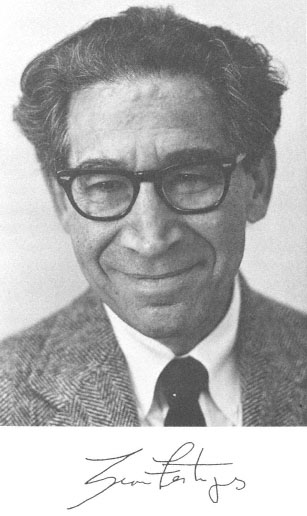
LEON FESTINGER
May 8, 1919-February 11, 1989
BY STANLEY SCHACHTER
ONE OF THE LAST TIMES Leon Festinger saw his father was in a nursing home in Brooklyn. The old man had been part of that great emigration of East European Jews in the years before the First World War. He left Russia a radical and an atheist and remained faithful to these views throughout his life. He was very sick at the time of Leon's visit, bedridden and virtually helpless. During this visit, he leaned toward his son and said, ''You know Leon, I was wrong. All my life I was wrong—there is life after death.'' Puzzled, Festinger asked him what he meant and, pointing around the room, his father answered, "This—this is life after death."
In 1988 Festinger became ill with a cancer that had metastasized to the liver and the lungs. He dealt with his cancer as a research problem. He read the literature, spoke with the experts, weighed the possible side effects of treatment, calculated the odds, and decided, untreated, to die. And in a few months he was dead. The intervening months were relatively peaceful and, though toward the end he was wasting away, painless. He worked, he wrote, he saw his friends, and, when it became clear that he could no longer go on, he died.
The memorial service at the New School was, as such
dour events go in academia, a remarkable occasion. Virtually all of his old students and many of his former colleagues and collaborators from all over the country, and indeed the world, flooded the auditorium. The eulogies were lavish and well deserved, for Leon Festinger was one of the most important psychologists of our time.
Festinger was born in Brooklyn, New York, on May 8, 1919, to Alex Festinger, an embroidery manufacturer, and Sara Solomon Festinger. He went to Boys' High School, City College, and, for graduate study, to the University of Iowa, where he worked with Kurt Lewin, a Gestalt and Field theorist who had fled the Nazis to arrive in an America where the psychological establishment, though hardly a dictatorship, was ruled by an even more dogmatic group, also convinced that it had the Truth, called Behaviorists.
Lewin and his students probably did more than any other group of scientists to mold psychology into an enterprise concerned with more than stimulus-response connections but with dynamic processes involving perception, motivation, and cognition. They did so quietly and without doing battle but largely by example—repeatedly demonstrating that it was possible to work with experimental and theoretical precision on problems of consuming human interest such as decision making, ambition, tension, level of aspiration, and the like.
Festinger honed his talents in his first work with Lewin. As an undergraduate working with Max Hertzman (Hertzman and Festinger, 1940), he had already demonstrated considerable skill working with Lewinian ideas. At Iowa, though Lewin's interests had shifted to social psychology or, as he called it, "group dynamics," Festinger, uninterested then in social psychology, continued to work on older Lewinian problems. He also turned his considerable mathematical talents to statistics and developed several of the earliest nonparametric tests (Festinger, 1946). On completing his degree,
he worked for two years as a research associate at the University of Iowa and then, during the war, for two years as senior statistician for the Committee on Selection and Training of Aircraft Pilots at the University of Rochester.
In 1945 he rejoined the Lewinian group as an assistant professor at the newly formed Research Center for Group Dynamics at the Massachusetts Institute of Technology. To round out the way stations of his academic career, he moved with the Group Dynamics Center to the University of Michigan in 1948, then to the University of Minnesota in 1951, on to Stanford in 1955, and, finally, in 1968 to the New School for Social Research where he was the Else and Hans Staudinger Professor of Psychology. In New York he met and married Trudy Bradley. By an earlier marriage he had three children, Catherine, Richard, and Kurt.
It was at MIT that Festinger's interests turned to social psychology and he launched a series of studies of social influence and communication that became a turning point in the field, for they demonstrated that it was possible to work experimentally and with theoretical rigor, on nonbanal problems of considerable social and psychological importance. This work started as almost an accident. Festinger had been directing a study of housing satisfaction in MIT married-student housing projects commissioned by the university's Department of Architecture and City Planning. The study involved the conjoint use of interviews about attitudes to MIT housing and of sociometric questionnaires, that is, measures of the social relationships within the various projects by use of questions such as "Which people here do you see most often socially?" In addition to the material of interest to the housing people at MIT, several facts emerged powerfully from the data. First, it turned out that those groups of students who were sociometrically close tended to have highly similar attitudes on the various
housing questions. Second, it appeared that those students who had deviant attitudes on the housing questions tended to be social isolates, that is, they were rarely named in answer to the sociometric questions.
These facts of the housing study were purely correlational. One could speculate endlessly, but one could say nothing about causal direction or about mechanism. Worrying through the meaning of these facts led Festinger and his students to the development of an experimental laboratory program of research that many consider the birth of systematic experimental social psychology. Their problems were many; they had to devise means of manipulating such ephemeral social variables as affection, social cohesion, group structure, deviancy, and the like; they had to devise controls to rule out alternative explanations; they had to invent means of unobtrusively measuring the effects of their manipulations on variables such as influence, exerted and accepted, and communication, its direction and intensity.
Along with Kurt Back, Harold Kelly, and John Thibaut, I was lucky enough to work with Festinger at this time, and I think of it as one of the high points of my scientific life. He was a wildly original and provocative scientist. It was a time of excitement, intense involvement, discovery, and fun. Working with Festinger was always fun. He was a great kibitzer, and he loved puzzles, problems, and games. He had little tolerance for banality or for tired ideas. We devised laboratory experiments for studying phenomena that, until then, no one had conceived of as manipulable or measurable. We discovered things no one had known before—virtually a sine qua non before Festinger thought an experiment worth doing. Festinger (1950) synthesized all of this work in his first theoretical paper in social psychology—a seminal paper concerned with informal social communication and the process, via social comparison, of establishing the correctness of one's beliefs.
Festinger's research career continued at Michigan and Minnesota, where, in a theoretical paper (Festinger, 1954) that was a tour de force, he extended his theorizing about beliefs, attitudes, and communication to the evaluation of abilities. With the support of several ingenious experiments, he demonstrated that, as with attitudes, and beliefs, the evaluation of one's abilities was also a socially determined process.
It was shortly after publication of this body of work in the 1950s that Fortune magazine nominated him as one of America's ten most promising young scientists, not psychologists, but scientists—an honor that, given its source and his political bent at the time, he managed to keep a well-hidden secret. No matter what his opinion of this particular honor, this was a prescient set of selections, for most of his fellow nominees went on to win a Nobel prize. It was this same work that led to Festinger's receiving the Distinguished Scientist Award of the American Psychological Association in 1959 and to his election to the American Academy of Arts and Sciences in that same year. He became a member of the National Academy of Sciences in 1972 and of the Society of Experimental Psychology in 1973. The honors continued throughout his career. In 1978 he received an honorary doctorate from the University of Mannheim, in 1980 he was named Einstein Visiting Fellow of the Israel Academy of Sciences and Humanities, and also in 1980 he received the Distinguished Senior Scientist Award of the Society of Experimental Social Psychology.
Festinger turned next to the development of a set of ideas for which he is perhaps best known in psychology— the theory of cognitive dissonance (Festinger, 1957). In a way the ideas of the dissonance work were a further and more basic development of his thinking about the social determinants of the evaluation of beliefs and abilities. The
key to his earlier ideas was the hypothesis that, when there were discrepancies of opinion or ability among the members of a group, pressures arose to reduce such discrepancies. Dissonance theory was an attempt to determine, at a more basic, purely cognitive level, the origin of such pressures. In essence, dissonance theory was startlingly simple. The key hypothesis is that when incompatibilities exist between two or more ideas or cognitions, pressures will arise to reduce the discrepancy.
This was hardly a new idea and, in one form or another, had already been proposed by a number of psychologists now known as "balance" theorists. What Festinger did with the idea, however, is an illustration of his almost unique genius. He pushed this idea just about as far as it could go, examining and testing its implications for a breathtaking variety of phenomena. These included an experimental examination of the cognitive consequences of forced compliance; studies in both rats and humans of the effects of insufficient reward; a field study of the effects of being wrong on the proselyting efforts of a millenial group; and on and on in a body of work that Edward Jones (1976) described as "the most important development in social psychology to date."
It was marvelous work; however, Festinger moved on. Boredom was anathema, and the moment things got dull or he found that he was repeating himself, doing some trivial variation of a spent idea, he changed his interests. Starting about 1963, while at Stanford, he developed an interest in the visual system and perception. He worked during this period on a variety of problems related to eye movements, efference, and the conscious experience of perception as well as on neurophysiological coding for the perception of color. I confess that my expertise is such that I dare not fake an attempt to evaluate this research nor, in
fact, am I able even to present a coherent synopsis of his work in these areas. I do note, however, that this work drew much attention, stirred much controversy, and attracted a talented group of students.
Finally, about 1978-79, some eleven years after he came to the New School, Festinger closed his laboratory and abandoned experimental psychology altogether. His explanation, in his own words, was (Festinger, 1983):
Four years ago I closed my laboratory which, over time, had been devoted to studying ever narrowing aspects of how the human eye moves. It is natural for me to talk as if the laboratory was at fault, but a laboratory is only a collection of rooms and equipment. It was I who conceived of and worked on narrower and narrower technical problems.
That is not a proper occupation for an aging man who resents that adjective. Young men and women should work on narrow problems. Young people become enthusiastic easily: any new finding is an exciting thing. Older people have too much perspective on the past and perhaps, too little patience with the future. Very few small discoveries turn out to be important over the years; things that would have sent me jumping and shouting in my youth now left me calm and judgmental and my lack of enthusiasm kept reminding me of that despised adjective, aging.
Having a critical perspective on the recent past [was] debilitating in other ways also. I have been actively engaged in research in the field of psychology for more than 40 years . . . . Forty years in my own life seems like a long time to me and while some things have been learned about human beings and human behavior during this time, progress has not been rapid enough; nor has the new knowledge been impressive enough. And even worse, from the broader point of view we do not seem to have been working on many of the important problems.
And so, despite his marked success as an experimentalist, Festinger moved on. His first foray outside the laboratory involved an examination of what one might learn about the "nature of man" from archeological data. He visited a number of archeological digs with French and Israeli specialists and began a systematic examination of what one could deduce and infer about man and the structure of primitive society
from archeological evidence. He published his speculations in 1983 in a book called The Human Legacy. It is an intriguing volume in which a first-rate mind trained in one discipline applies itself to the data and problems of another discipline and raises questions that, to my mind, provide one of the few nonbanal examples in the social sciences of the potential of cross-disciplinary work. For example, he notes that in some digs there is huge variability in the quality of workmanship of artifacts such as arrowheads, while in other digs such artifacts are all of similar high quality. This leads him into fascinating speculation about the development of the division of labor in primitive society. Similarly, other artifacts lead to speculation about the development of religious technology and of the role of play and of games in mankind's history. In its own way it is a marvelous book whose reception in Festinger's own professional circles bemused him no end for he was often asked by his fellow psychologists, "But what does this have to do with psychology?"
From what might be called psychosocial-archeology, Festinger moved on to a deep interest in the history of religion. He worked closely with a number of medieval and Byzantine church scholars, and eventually his interest focused on the differences between the Eastern and the Western or Roman church and the role such differences might have played in the differential development and acceptance of material technology in these two parts of the Roman empire. Festinger died before he could publish this material, but he made the same profound impression on the medieval historians as he had made earlier on the psychologists with whom he worked. Indeed, a recent book called Papacy, Councils and Canon Law in the 11th-12th Centuries is dedicated by its author Robert Somerville (1990) to the memory of Leon Festinger—surely the only time in intel-
lectual history that a specialist in canon law dedicated a book to an unrelated social psychologist.
It was an astonishing intellectual career. Whatever area he touched, he enriched. He discovered things no one knew before; he made connections no one had made before, and he did it all with an éclat and an elegance that compel one to think of his work in aesthetic as well as scientific terms. Indeed, Zajonc (1990) has compared Festinger to Picasso, and Zukier (1989) has compared him to Van Gogh. The psychological world is a different place because he lived.
REFERENCES
Festinger, Leon. 1946. The significance of difference between means without reference to the frequency distribution function. Psychometrika 11.
Festinger, Leon. 1950. Informal social communication. Psychol. Rev. 57:271-82.
Festinger, Leon. 1954. A theory of social comparison processes. Hum. Relations 7:117-40.
Festinger, Leon. 1957. A Theory of Cognitive Dissonance. Evanston, Ill.
Festinger, Leon. 1983. The Human Legacy. New York: Columbia University Press.
Hertzman, Max, and Leon Festinger. 1940. Shifts in explicit goals in a level of aspiration experiment. J. Exp. Psychol. 27:439-52.
Edward E. Jones. 1976. Preface. In Explorations in Cognitive Dissonance, eds. J. W. Brehm and A. R. Cohen. New York: Wiley.
Robert Somerville. 1990. Papacy, Councils and Canon Law in the 11th-12th Centuries. London: Variorum.
Robert Zajonc. 1990. Leon Festinger (1919-89). Am. Psychol.
Henri Zukier. 1989. Introduction. In Extending Psychological Frontiers: Selected Works of Leon Festinger. eds, S. Schachter and M. Gazzaniga, pp. xi-xxiv. New York: Russell Sage Foundation.
SELECTED BIBLIOGRAPHY
1942 A theoretical interpretation of shifts in level of aspiration. Psychol. Rev. 49:235-50.
1943 Development of differential appetite in the rat. J. Exp. Psychol. 32:266.
Studies in decision: I. Decision-time, relative frequency of judgment, and subjective confidence as related to physical stimulus difference. J. Exp. Psychol. 32:291-306.
Studies in decision: II. An empirical test of a quantitative theory of decision. J. Exp. Psychol. 32:411-23.
With D. Cartwright. A quantitative theory of decision. Psychol. Rev. 50:595-621.
1950 Informal social communication. Psychol. Rev. 57:271-82.
With S. Schachter and K. Back. Social Pressures in Informal Groups. New York: Harper & Bros.
1951 With J. Thibaut. Interpersonal communication in small groups. J. Abnorm. Soc. Psychol. 46:92-99.
1952 With A. Pepitone and T. Newcomb. Some consequences of de-individuation in a group. J. Abnorm. Soc. Psychol. 47:382-89.
1953 With D. Katz, eds. Research Methods in the Behavioral Sciences. New York: Dryden Press.
1954 A theory of social comparison processes. Hum. Relations 7:117-40.
With P. J. Hoffman and D. H. Lawrence. Tendencies toward group comparability in competitive bargaining. Hum. Relations 7:141-60.
1956 With H. Riecken and S. Schachter. When Prophecy Fails. Minneapolis: University of Minnesota Press.
1957 A Theory of Cognitive Dissonance. Evanston, Ill.: Row, Peterson.
1959 With J. M. Carlsmith. Cognitive consequences of forced compliance. J. Abnorm. Soc. Psychol. 58:203-11.
1960 With E. Aronson. Arousal and reduction of dissonance in social contexts. In Group Dynamics, eds. D. Cartwright and A. Zander, pp. 214-31. Evanston, Ill.: Row, Peterson.
1961 With J. Allyn. The effectiveness of unanticipated persuasive communications. J. Abnorm. Soc. Psychol. 62:35-40.
The psychological effects of insufficient reward. Am. Psychol. 16:1-12.
1962 With D. H. Lawrence. Deterrents and Reinforcement: The Psychology of Insufficient Reward. Stanford: Stanford University Press.
1964 Conflict, Decision and Dissonance. Stanford: Stanford University Press.
With N. J. Maccoby. On resistance to persuasive communications. J. Abnorm. Soc. Psychol. 68:359-66.
1967 Efference and the conscious experience of perception. J. Exp. Psychol. 74:1-36.
1974 With A. M. Easton. Inferences about the efferent system based on a perceptual illusion produced by eye movements. Psychol. Rev. 81:44-58.


