
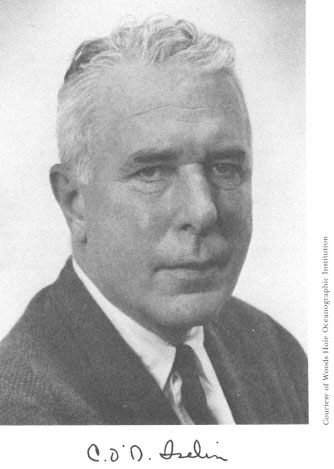
COLUMBUS O'DONNELL ISELIN
September 25, 1904-January 5, 1971
BY HENRY M. STOMMEL
FOR THREE ENCHANTED MONTHS in the summer of 1926, eight youths between the ages of twenty and twenty-three and a hired cook in the newly built 77-foot schooner "Chance" sailed the coasts of Newfoundland and Labrador as far north as Cape Chidley. Columbus Iselin, owner and skipper, was the son of a wealthy banking family much involved in the activities of the New York Yacht Club and a graduate of St. Marks and Harvard.
There was a gentlemanly tradition of oceanography at Harvard, starting with the world cruises of Alexander Agassiz (personally financed by Agassiz), and carried on vigorously by the ichthyologist Henry Bigelow through a long and productive life. Once, in 1962, when I encountered Dr. Bigelow in the library of the Museum of Comparative Zoology and told him that I had just returned from the Indian Ocean, he began to reminisce about his own adventures there in the Maldives with Agassiz in 1900. Bigelow could act effectively as an administrator and teacher. He never lost his love or ability to do abundant scientific research.
It was Bigelow who inspired the young Columbus to venture into oceanography and to make the Labrador cruise of the "Chance" into something of a scientific venture rather than a thing of pure sport. Botanical specimens were col-
lected, plankton tows were made, and two lines of hydrographic stations perpendicular to the coast were completed. Columbus wrote, and published privately, a charming account of the voyage under the title "The Log of the Schooner Chance." It is beautifully composed, evokes a sense of fun and adventure, and reveals a character sensitive to others and tolerant of pranks, a rare talent for leadership without the need to command, and a comfortable sense of mastery of the sea. For another forty years, through the shifting patterns of his career, people respected—yes, even loved— him. I cannot think of his directorship of the Woods Hole Oceanographic Institution as being similar in kind to that of other administrators whom I have known, there or elsewhere. Columbus seemed to assume the duties and role of an elder brother. He deserved loyalty and he got it. There was something magnetic about the man.
John Knowlton, one of the crew of the "Chance," kept notes on the cruise, from which he reconstructed an independent account in 1952. It confirms the early formation of Iselin's remarkable personality. "Columbus at twenty-one was not only an excellent sailor, he had a poise and fine judgement which few men acquire at any age. He had already achieved intellectual maturity whereas . . . we were . . . sometimes to be classed with the barbarians."
The Iselin log mentions engine troubles, but the Knowlton log tells how he (Knowlton) blundered into admitting seawater into the cylinders and how the Skipper patiently assisted for hours in removing the engine's head, cleaning it, and reassembling it, instead of being exasperated.
Or again, off the Straits of Belle Isle, where Iselin blithely notes the loss of half a drum of gasoline, with no hint of the immense danger of explosion, Knowlton informs us that it actually had leaked into the bilges, that the galley stove was burning as usual, "but there must have been too much
air moving and it must have been too cold to form an explosive mixture" before it could be pumped out. We sense a vision of gilded youths striving to do something useful during a vacation to a barren land normally frequented only by the poverty-stricken Newfoundlander fishermen.
Columbus O'Donnell Iselin II was born in his family's summer home at New Rochelle, New York, on September 25, 1904. His ancestors were private bankers and philanthropists in New York City since the emigration of Isaac Iselin from Basel, Switzerland, in 1801. An uncle, Oliver Iselin, defended the America's Cup on four different racing yachts from 1893 to 1903.
In January 1929 he married a childhood girl friend, Eleanor ("Nora") Emmet Lapsley. Together, they had five children: three girls and two boys.
Columbus studied under Bigelow at Harvard at a time when the latter had just completed his compendious memoir on the oceanography of the Gulf of Maine. The Bureau of Fisheries had sold the "Albatross," and Bigelow was looking around for a means of getting to sea again. Due to the salesmanship of his friend Frank Lillie, the Rockefeller Foundation underwrote the formation of the Woods Hole Oceanographic Institution, the construction of a laboratory building, wharf, and the research vessel "Atlantis." Bigelow now had his ship and captain, twenty-five-year-old Columbus Iselin. He could plan to enlarge his previous studies of U.S. coastal waters to encompass a general exploration of the western North Atlantic. Perhaps he hoped that Iselin would emulate Captain Ault of the "Carnegie," who had been both captain and scientist before she exploded during fueling at Apia, Samoa, in November 1929. Columbus brought the ''Atlantis" safely from Denmark in July 1931, doing some station work along the way under the tutelage of Franz Zorell of the Deutsche Seewarte. But
Columbus also had a family to raise, so command was turned over to Capt. Frederick McMurray, a career seaman, in less than a year. For another few cruises Columbus sailed as chief scientist to complete the hydrographic section along 30° W down to the equator, several crossings of the Gulf Stream from Bermuda to Halifax, from Bermuda to Chesapeake Bay, and across the Antilles and Florida currents. And then by the age of twenty-eight years, he more or less gave up going to sea—although still nominally ''in charge of the 'Atlantis"' issuing sailing orders to McMurray, teaching a little at MIT, and working up the data he had obtained into a monograph entitled "A Study of the Circulation of the Western North Atlantic" (August 1936). It is a well-organized, discerning, scholarly work, written in the Bigelow qualitative descriptive style. It represents a lot of work at sea, a lot of thought, and still, even today, is worth study. At the time of publication he was one month short of his thirty-second birthday, an astonishing achievement for so young a man. It was also his best scientific work and the last that he could claim as deriving entirely from his own time at sea.
The five sections (1931-32) from Bermuda to Chesapeake Bay had exhibited a variability in dynamic topography that he thought might be related to changes in transport of the Gulf Stream. This great stream is certainly the major current of the western North Atlantic and for centuries geographers had speculated on how its variability might affect the climate (and fisheries) of Europe. In framing the plans for further use of the "Atlantis" for field study, it was therefore decided to accept the invitation of the Bermuda Oceanographic Committee of the Royal Society of London to join with their Bermuda-based "Culver" and its chief scientist E. F. Thompson in a projected five-year program to observe the variability systematically. From June 1937 to January
1940 (when the program was suspended because of the war), fifteen complete sections on a line between Montauk Pt., New York, and Bermuda were occupied by "Atlantis." The burden of the station work fell on Alfred H. Woodcock, at that time attached to the technical staff of "Atlantis." Iselin wrote this material up in a "Preliminary Report on Long-Period Variations in the Transport of the Gulf Stream System" (July 1940). In the acknowledgments he does not mention Woodcock by name, although he does mention others who contributed far less, such as the man who did the dynamic calculations for him. Was this oversight an unconscious denial of the fact that he no longer got his feet wet doing science? In the sailing orders he issued to Captain McMurray during these cruises, he was curiously reluctant to name Woodcock as chief scientist, even when Woodcock was the only scientific person on board. Or had it to do with a sense of fore and aft?
As a report of the data obtained, this paper is useful. By contrast, E. F. Thompson lost heart when contemplating a summary of the corresponding "Culver" data and never published it. However, the structure of these sections is complex, with evidence of multiple streams, or waves or eddies, and Iselin was able to offer no satisfactory objective criterion for defining "the transport" of the stream. He does not make clear why he decided to choose the extremes of dynamic height on two sides of the stream to define the instantaneous transport. This is especially surprising because he shows quite clearly that a previous overly optimistic suggestion that variations in transport could be determined by time series at only two stations—one in the slope water and the other near Bermuda—could not be used. And then he proceeds to choose two stations on each section in an arbitrary way. The mechanics of the schematic "lens" model he proposes is fantasy. One senses that as a scientist he was
beyond his depth. Some obituaries mention that Iselin studied mathematics as an undergraduate, but there is no evidence of it in his work—in fact he had a distrust of any formal ideas and theoretical work that sometimes surfaced in the annual reports that he later wrote as director.
Iselin was now thirty-five years old and to succeed Bigelow as director of the institution. The coming of the war and the conversion of the institution's research to applied defense work gave him a new and fruitful opportunity for exercising his formidable gift of leadership.
In many ways the period of his first directorship (1940-50) was the high time of his career. It was now a frankly administrative role. His tolerant, humane, and kindly ability to persuade, influence, and support a motley mixture of scientists, yachtsmen, fishermen, and amateurs was uncanny. He could anticipate and understand the difficulties of doing work at sea that would confront the newly recruited academics. He had a certain knowledge about conditions at sea and the geographic distribution of various properties that proved important for those who were conducting the research. He was familiar with the customs and manners of the people of very widely different backgrounds who were assembled at Woods Hole during the war and able to maintain calm where misunderstandings could erupt. And he commanded the respect of the Navy. It is from this happy time that so many of the stories that illustrate his style of administration survive.
Two instances illustrating his human quality come to mind. The first concerns Fred Pingree, once a schoolmaster and of no research ability. It needs to be remembered that no one was ever fired during Columbus's time. We were driving back to Woods Hole from a martini lunch at the Little New Yorker restaurant in Falmouth. Puzzling over how to keep Fred usefully employed, Columbus sighed, "I just can't
let him go—why if I did, he'd return to teaching and that would be a crime against American youth."
The second instance concerns Columbus's effort to calm the furor following a break-in at the carpenter's shop. In those days, with a host of amateur woodworkers about, the carpenter had to guard his tools with the temper of a she-bear. Thus, Stan Eldredge had honed an edge as sharp as that of his plane irons. One weekend the "Atlantis" departed on one of Maurice "Doc" Ewing's hastily organized cruises. Finding himself without tools, Joe Worzel, one of Ewing's most stalwart disciples, took down a fire axe, broke the panel in the shop door, and took Stan's favorite tools to sea.
When Monday morning rolled around Stan was in a proper rage. Storming upstairs to Columbus's office, he explained the situation in heated terms, ending with, "Mr. Iselin, what should I do?" To which Columbus smoothly replied, "Well, Stan, if someone had chopped down my door with an axe and I was as mad about it as you are, I'd get an axe and chop his door down."
Some idea of the lightheartedness of his youth can be gleaned from an excerpt from a talk he gave in later years about the character of his chief engineer, a Scotsman.
. . . Harold Backus was the first person to go on the payroll of the Woods Hole Oceanographic Institution. He preceded me by at least four months. I hired him to be the chief engineer of the old "Atlantis" and I did not make a mistake.
As we sailed on our first voyage together from Plymouth, England, to Woods Hole, we ran right away into nasty weather and head winds. The galley stove would not work when the vessel heeled over on one side. . . . It was a standard Danish steamship stove and the firebox required that the ship be on even keel. Thus on the first night out of Plymouth Harold and I had to rebuild the stove, if we were ever to get hot food.
By six in the morning we had not quite finished the job, but were hungry. I went up on deck to see if anybody was at the wheel and if they
were headed roughly in the right direction. I asked . . . the watch if they wanted some breakfast. They weren't interested. Upon returning to the wardroom I first saw an aspect of the Backus Factor at work.
He had somehow found under the bunk in his cabin a very new looking blow torch, full of gasoline. I realized that I had not purchased a blow torch in Copenhagen and, of course, gasoline was not supposed to be on board below deck. Obviously the only available cooking equipment had somehow been left aboard the vessel by workmen from Burmeister and Wain, the builders.
I said nothing to Harold and wedged myself in the downwind corner of the seat in the wardroom so as to hold the frying pan above my knees while he applied the torch in an expert manner to the underside of the pan.
. . . each time the "Atlantis" returned from overhaul at the Electric Boat Company in Groton, Connecticut she always had a noticeable list to port. Harold Backus's cabin was on the port side. Knowing the stability of the vessel I could only conclude that he had close to a ton of tools under his berth. Since he could, of course, have shifted fuel or water to compensate for the list, he was obviously not at all ashamed of his latest acquisitions. It did not take the cost accountants at the Electric Boat Company long to catch on to this aspect of the Backus Factor. They simply added a small fraction to the bill for each day we were at the shipyard. When I pointed this out to Harold he was outraged. "They are already overcharging us. All I have been doing is to prevent the Institution from being robbed." The biggest piece of loot that he ever extracted from New London was a 5000 pound inclining weight which I still have as a mooring off my beach on the Vineyard. In order to get this aboard the "Atlantis" he had to start up and operate a large crane late in the night.
The story continues with an account of how Harold manipulated the revolutions-per-minute counter to covertly speed up homeward legs of cruises and of his skill in smuggling liquor during Prohibition.
One of Iselin's wartime concerns was the acoustic detection of submarines and the role of the refraction of underwater sound by the thermal stratification in the surface layers of the sea. Ewing's extensive experience in seismic surveys before the war was brought into play, and mathematical
methods were developed by physicists to trace sound rays through various stratifications.
The bathythermograph played a central role in measurement of the near-surface stratification. This important instrument had its roots in one of C.-G. Rossby's devices called an oceanograph, used in 1934 to get as nearly continuous measurement of temperature against depth near the surface as possible. Rossby put A. F. Spilhaus on to the problem of improving it. In the summer of 1939, during one of the regular occupations of the Montauk Pt. to Bermuda, the hydrographic section Spilhaus (who was something of a bird of passage in oceanography) managed to obtain a detailed B.T. section over a short segment of the Gulf Stream front. For practical use by the Navy, Ewing and others had to make important improvements. The B.T. was manufactured by the thousands for use on naval vessels.
In 1942 the work of the institution turned toward practical application of oceanographic knowledge to warfare and for the first time was busy all year round. The "Atlantis" was sent for safety to the Gulf of Mexico, where Woodcock made a detailed study of diurnal temperature fluctuations during March and April—a phenomenon of importance in understanding the anomalous "afternoon effect" in the shallow propagation of sonar waves. She was then moved to a mooring in Lake Charles for better protection. In her place the institution procured a fleet of smaller craft for local field work: the "Physalia," "Anton Dohrn," "Reliance,'' and ''Mytilus" were all used for detailed studies and experiments in the local waters of Massachusetts Bay and Vineyard Sound. Every week the environs of the institution reverberated to the sound of underwater explosives as workers of the Underwater Explosive Laboratory detonated various test devices off Naushon Island. Nonamesset Island was used as a depot for storing TNT, and a casting shed was set up there
to manufacture shaped charges. This special group occupied the third floor of the institution's only building and was initially led by E. B. Wilson and Paul Cross.
Iselin was concerned that in the heat of the war-related activity not all concern for science itself should be lost. At least for 1942 he was able to continue support for biological research in plankton (George Clarke and Mary Sears), marine bacteria (Selman Waksman and Cornelia Carey), and metabolism of marine organisms (Lawrence Irving), using materials collected before the limitations on field work were imposed. Iselin evidently hoped that in addition to war-related activity he could keep a normal program of pure scientific research going and that Woods Hole would continue to be a place where, in his own words, "all qualified investigators who are interested in the sea are welcome." This became increasingly difficult as the staff increased from ninety-three to 335 during the four war years.
One of the most astonishing developments of the studies of underwater sound transmission was W. M. Ewing's discovery of the "sound channel," the level of minimum sound velocity that permits the sounds of small explosions to be heard across entire ocean basins. Studies were made to predict sea and surf conditions for forecasting conditions likely to be encountered during amphibious operations. Jeffries Wyman and Alfred Woodcock studied low-level meteorological phenomena pertinent to aircraft carrier operations and laying smoke screens. Alfred Redfield led a staff of about twenty persons in a study of antifouling paints and fouling organisms for the Bureau of Ships—a continuation of Waksman's earlier work. Some 60,000 bathythermograph records of shallow water temperature profiles obtained in the North Atlantic were reduced to monthly charts of temperature down to 200 meters depth (Frederick Fuglister).
Most scientists caught up in the excitement of war work
would accord themselves a high score for doing as much as Iselin did as the institution's leader during these years. However, writing the director's report in 1946, Iselin was more circumspect. Viewing the results of these major investigations aimed at practical application from the perspective of a scientist, he wrote ingenuously: "The scientific advances may appear to be rather small, considering the size of the staff involved." Few laboratory directors would risk so candid a statement today.
The development of the B.T. was important for oceanography after the war because it meant that detailed data could be obtained from a ship under way. Of perhaps even more importance was the availability after the war of Loran, which improved navigation to the point where detailed surveys could be made meaningfully. The emphasis in Gulf Stream research shifted from the intractable problem of long-period variability of the Gulf Stream to studies of the detailed structure of its front. Frederick Fuglister was encouraged by Iselin to conduct this research. Fritz's training as an artist had accustomed him to visualizing form, and soon he was bringing back a series of wonderful surveys that showed us for the first time the meander and eddy structure of the Stream. Iselin's name was on their first joint paper, but Fritz did all the work and most of the thought. A close friend and colleague of mine during the late 1940s told me that he didn't think Columbus was interested in science anymore. But Columbus was clearly interested in helping others to do their work and must have gotten his satisfaction out of being a good boss.
The directorship of the institution passed to Admiral Edward H. "Iceberg" Smith, U.S. Coast Guard, in 1950. Smith had a very substantial background in practical physical oceanography dating back into the 1920s when he personally conducted the surveys made by the U.S. Coast Guard in the
Labrador Sea and Newfoundland Banks for the International Ice Patrol. No relation to the Captain Ed Smith who lost the "Titanic," he could proudly point to the likelihood that the Coast Guard's yearly surveys of the iceberg population had forestalled any further incident of the kind. He was likable, a little out of touch with the science, but a responsible administrator. During Iselin's days as director, the Woods Hole salaries were scandalously low. Smith raised them. Fuglister and I used to share coffee hour and endless discussion in those days. Iselin had a way of popping in quietly and unexpectedly, like a ghost, often catching us unaware in some private conversation. Once he came in while Fritz was happily waving around a slip of paper from Smith telling him of his first raise in salary. Columbus inquired about the merriment, and Fritz told him about the raise. "About time, too," commented Columbus—overlooking the ample opportunities he had had over the years. Columbus was made up of a strange mixture of friendly concern and aloofness. It was one of Fuglister's great sorrows that despite years of laboring on the Gulf Stream he was never once invited to Iselin's home on the Vineyard.
During the Great Depression, Columbus bought a farm on Martha's Vineyard. It was said that he bought it as a refuge from possible civil unrest, much as some academics of a later generation considered moving their families to New Zealand at the time of the Cuban missile crisis of 1962. As a result he had to commute regularly back and forth across Vineyard Sound in his small boat, "Risk." So we got accustomed to seeing him dressed in oilskins, and he himself maintained a taste of salt in his mouth long after he had finished doing actual work at sea. At exactly 5 p.m. each day Columbus would jump aboard the "Risk" and hurry home to the privacy of the Vineyard. He was thus a poor host to the various dignitaries who happened to be visiting
Woods Hole—and who found themselves stranded there for the evening or weekend. Actually this was a fine opportunity for us bachelors at the time because people like Deacon, Hidaka, Wüst, Revelle, Rossby, and Sverdrup suddenly found themselves dependent upon us for entertainment, and we relished the opportunity of discourse with such men. Columbus's social aloofness was not restricted to his employees.
An incident that illustrates Columbus's impulsiveness arose from some draft charts of the distribution of properties at 4,000 meters depth in the world ocean that Dick Stroup and I were making. The charts were on Fritz's table. We were talking about something private and were embarrassed and speechless by Columbus's sudden appearance in the room. To alleviate the awkwardness, I pointed out the sparsity of deep data in the Indian Ocean. There was a big meeting going on downstairs, I think of SCOR—the Scientific Committee on Oceanic Research, an international body. From what I can reconstruct, Columbus went directly down from our coffee break and proposed the International Indian Ocean Expedition. They must have thought he had been preparing the idea for months. On the other hand, he could play the opposite game like a master. I sat next to him once at a meeting where he spoke in an apparently offhand, tentative, free-association manner, as though the ideas were forming in his mind as the words came out. But they were all carefully written down on a pad in front of him, and he was reading them. He was an accomplished actor.
In many ways, during Smith's term in office (1950-56), Columbus remained a surrogate director. People automatically referred their ideas and plans to him as though Smith did not exist. And after Smith's departure, Columbus returned for two more years as director. One could hardly
notice the difference except in salaries and that the halls had fresh coats of paint.
The secrecy that prevailed at Woods Hole during the war had disappeared by 1950. Nearly all of the work going on was open and free. Since most of our funding came from the Navy, the new openness must have seemed problematic to Iselin. By 1956 he devised a way to continue secret military advice for the Navy by means of a so-called Project Nobska, associated with the National Academy of Sciences, meeting in Woods Hole, but not at the institution.
During his directorship Columbus had been relatively free from direct control by the Board of Trustees—in fact, he rather airily regarded the annual trustees' meeting as a somewhat tiresome formality. The war had brought a new breed of professional, academic, and industrial administrator into the institution's Executive Committee.
In 1958 Iselin was replaced as director by Paul Fye, a chemist. The internal organization of the institution was examined by a consultant in business administration. A departmental structure and a rank system in some ways similar to civil service career "ladders" was installed. The unfamiliar and painful procedure of promotion reviews was imposed. Scientists were assigned "employee numbers." For the first time they were formally invited to criticize and evaluate each other. The days of the amateur, when, for example, Hilliard Barbour came to work at Woods Hole during the war and his main concern was not the salary, but whether he might lose his Corinthian status, were gone.
The aim was to move away from Iselin's informal paternal way of doing things to a more common professional standard. Iselin's role as invisible director (which he played during Admiral Smith's tenure) was accordingly ended. The "Atlantis" was sold to an Argentine school, and an important symbolic link between him and the institution was bro-
ken. As the institution grew, there were new employees who did not even know his name: once, about 1963, when I tried to phone him, the institution's telephone operator asked, "Iselin? How do you spell it?"
I think that he was hurt by the growing anonymity. He must have felt that Harvard was shaking him off as well, despite the fact that he had lectured there for years without compensation. He had an office at the Museum for Comparative Zoology. As you ascended the stairway you'd pass a door with a frosted glass panel enscribed "Woods Hole Oceanographic Institution." He must have spent very little time there, in fact so little that at the time of the incident that I want to recall the new museum director had not made his acquaintance after two years on the job.
The commonwealth of Massachusetts used to require a regular tuberculosis test (skin test or chest X-ray) for all teachers (even Harvard professors). Evidently, Iselin's was far overdue, and for over a year he let the registered letters from the secretary of the corporation apprising him of the fact pile up unopened on his desk at home. The secretary then turned to the museum director for help, and that official, irritated by never having met Iselin, offered no help. Accordingly, the Committee on Oceanography received a notice from the secretary barring Iselin from the classroom and instructing the sergeant at arms of the faculty (perhaps an elderly Latin professor) to enforce it. Francis Birch, an old friend, phoned Columbus to tell him what had transpired and accompanied him to the infirmary for the required test. But Iselin felt that he had been treated abruptly and without appreciation for his years of gratuitous service. He was now about sixty years of age. One bright event occurred: he was invited to sail as passenger on a hydrographic cruise of "Atlantis II" from Capetown. He spent much of the time enjoying the company of the
bridge, telling some of his wonderfully perceptive stories, many about the scrapes he had been led into by his boyhood buddy Terry Keogh, perhaps about the time they established a boatyard in Lunenburg, built boats at a loss, and failed quickly because Keogh was such a good salesman.
I didn't see much of him in later years. The stress of age, of too many years on the Washington circuit, perhaps a growing sense of "being out of it," must have been at work. When he attended the dedication of the Iselin building—a large maintenance shed on the Woods Hole dock—he was heard to mutter: "They named the garage after me." Gordon Riley, who recalls seeing him at a meeting at the University of Rhode Island, says he was astonished by the transformation. To his eyes Iselin seemed thin and old, there were missing teeth, he had recently been hospitalized for alcoholism, and was unpleasantly critical of others—a thing totally uncharacteristic of the younger man.
Columbus died in Falmouth, Massachusetts, on January 5, 1971. His wife Nora died two weeks later. The funeral was on Martha's Vineyard.
What then can we say about Columbus Iselin? He was a good and generous man. He commanded respect and shouldered responsibility as a ship's captain should. He had a clear vision that oceanographic knowledge grows from measurement at sea. And he strove to build a scientific staff at Woods Hole that shared the enthusiasm he had for work on ships and the exuberance of an amateur. There was a sense of strength, selflessness, and integrity about him. He was indeed a great man, and he was overtaken by the times.
CURRICULUM VITAE
COLUMBUS O'DONNELL ISELIN
Born: September 25, 1904, New Rochelle, New York
Died: January 5, 1971, Falmouth, Massachusetts
EDUCATION
St. Marks School, 1917-22
A.B., Harvard University, 1926
A.M., Harvard University, 1928
D.Sc. (Honorary), Brown University, 1947
EXPERIENCE
Physical Oceanographer, Woods Hole Oceanographic Institution, 1932-40
Director, Woods Hole Oceanographic Institution, 1940-50 and 1956-58
Senior Physical Oceanographer, Woods Hole Oceanographic Institution, 1950-56
Henry Bryant Bigelow Oceanographer, Woods Hole Oceanographic Institution, 1958
Chairman, Department of Theoretical Oceanography and Meteorology, Woods Hole Oceanographic Institution, 1962-
HONORS
Alexander Agassiz Medal, 1943
Honorary Doctorate of Science from Brown University, 1947
Legion of Merit Medal, 1948
Henry Bryant Bigelow Chair in Oceanography, 1958
Henry Bryant Bigelow Medal, 1966
TEACHING EXPERIENCE
Assistant Curator of Oceanography, Museum of Comparative Zoology, Harvard University, 1929-48
Lecturer, Massachusetts Institute of Technology, 1936
Assistant Professor of Physical Oceanography, Harvard University, 1936-39
Associate Professor of Physical Oceanography, Harvard University, 1939-60
Professor of Physical Oceanography, Harvard University, 1960
Professor of Physical Oceanography, Massachusetts Institute of Technology, 1959-
OTHER
Member, American Geophysical Union, 1929-
Member of Corporation and Trustee, Woods Hole Oceanographic Institution, 1936-
Trustee, Bermuda Biological Station for Research, Inc., 1936-
Trustee, Marine Biological Laboratory, 1941-52
Fellow, New York Academy of Sciences, 1941
Member, American Academy of Arts and Sciences, 1944-
Member, Committee on Undersea Warfare, National Academy of Sciences, National Research Council, 1946-
Member, American Philosophical Society, 1950-
Trustee, American Museum of Natural History, 1951
Member, National Academy of Sciences, 1951-
Member, Committee on Oceanography, National Academy of Sciences, 1957-64
Member, Scientific Committee on Oceanic Research (SCOR), 1957-
Member, NATO Subcommittee on Oceanographic Research, 1959-
Member, NASCO Ocean-Wide Surveys Panel, 1962-
Member, Board of Directors, Scientific Advisory Committee, Travelers Research Center, 1963-
Board Member, American Geographical Society, 1963-
RESEARCH
Oceanic circulation, underwater acoustics, marine resources
SELECTED BIBLIOGRAPHY
1930 Recent work on the dynamic oceanography of the North Atlantic. Trans. Am. Geophys. Union (10th Annu. Meet.):82-89.
A report on the coastal waters of Labrador, based on explorations of the ''Chance'' during the summer of 1926. Proc. Am. Acad. Arts Sci. 66(1):1-37.
1932 Voyages of the "Atlantis" and its oceanographic work. The Collecting Net VII(1):1-4.
1933 Science goes to sea. Harv. Alumni Bull. (Feb. 10).
The development of our conception of the Gulf Stream system. Trans. Am. Geophys. Union (14th Annu. Meet.):226-31.
Some phases of modern deep-sea oceanography with a description of some of the equipment and methods of the newly formed Woods Hole Oceanographic Institution. Smithsonian Institution Annual Report for Year Ending June 30, 1932. Publ. 3198, pp. 251-67. Washington, D.C.: Smithsonian Institution.
1934 Temperature-salinity correlation within the Florida Current. Trans. Am. Geophys. Union (15th Annu. Meet.):208-9.
1936 A study of the circulation of the western North Atlantic. Pap. Phys. Oceanogr. Meteorol. 4(4):1-101.
The influence of the Mediterranean outflow at mid-depths in the Sargasso Sea. Trans. Am. Geophys. Union (17th Annu. Meet.):219-21.
1937 The new plans for the cooperative investigation of the North Atlantic circulation. Trans. Am. Geophys. Union (18th Annu. Meet.):222-23.
1938 The influence of fluctuations in the major ocean current on the climate and fisheries. Collecting Net 13(7):1-4.
Problems in the oceanography of the North Atlantic. Nature 14:772-76.
A promising theory concerning the causes and results of long-period variations in the strength of the Gulf Stream system. Trans. Am. Geophys. Union (19th Annu. Meet.):243-44.
1939 The influence of vertical and lateral turbulence on the characteristics of the waters at mid-depths. Trans. Am. Geophys. Union 1939:414-17.
Some physical factors which may influence the productivity of New England's coastal waters. J. Mar. Res. 2(1):74-85.
1940 Preliminary report on long-period variations in the transport of the Gulf Stream system. Pap. Phys. Oceanogr. Meteorol. 8(1):1-40.
The necessity of a new approach to the study of the circulation on the continental shelf. Trans. Am. Geophys. Union 1940:347-48.
1942 Interaction between the hydrosphere and the atmosphere. Trans. N.Y. Acad. Sci. 4(3):99-106.
1947 Preliminary report on long-period variations in the transport of the Gulf Stream system. Int. Hydrogr. Rev. 24:92-94.
1948 With F. C. Fuglister. Some recent developments in the study of the Gulf Stream. J. Mar. Res. 7(3):317-29.
Down to the sea. Phys. Today 1(4):16-20.
1949 Principal instrumentation problems of deep-sea oceanographic exploration. Instruments 22(10):898-901.
North Atlantic oceanography. Res. Rev. (Aug.):1-6.
1950 Some common characteristics of the Gulf Stream and the atmospheric jet stream. Trans. N.Y. Acad. Sci. 13(2):84-86.
1952 The Gulf Stream system. Proc. Am. Philos. Soc. 96(6):660-62.
1954 Oceanography and naval architecture. Res. Rev. (Sept.):14-19.
1955 Recent advances in our understanding of the circulation problem and their implications. J. Mar. Res. 14(4):315-22.
Oceanographic problems of the Arctic Ocean. Arctic (3/4):195-98.
Coastal currents and fisheries. Pap. Mar. Biol. Oceanogr. Deep-Sea Res. (Suppl. 3):474-78.
1956 We hope to witness the start of a hurricane. Oceanus 4(3):3-7.
1957 Matthew Fontaine Maury (1806-1873), "Pathfinder of the Seas," the development of oceanography. Newcomen Publ. in N. Amer., Princeton University Press, pp. 8-26.
Synoptic studies in oceanography. Oceanus 5(3/4):3-12.
1958 Synoptic studies in oceanography. Geophys. Monogr. 2:169-74.
1959 The basic thermal structure of the oceans. In Environmental Factors Influencing the Performance of Naval Weapons Systems, Pt. 1, pp. 9-22. (Unpublished manuscript.)
New discovery in physical oceanography. Oceanus 6(2):11-12.
Oceanography and the Bureau of Ships. Bur. Ships J. (Feb.).
Use of the ocean. (Editorial. Based on remarks at the concluding session of the First International Oceanographic Congress.) Science 130:895.
1960 The world ocean. Oceanus 6(3):5-6.
1961 An interpretation of the deep current measurements. Oceanus 7(3):9.
1962 Inshore fisheries management. Ocean us 8(3):2-6.
Oceanography. Navigation 9(3): 182-84.
1963 Improving world fisheries. 2. The oceanographer's viewpoint. Special issue on Marine Biology. AIBS Bull. 13(5):69-70.
The loss of the "Thresher." Oceanus 10(1):4-6.
1964 From Cape Town to Woods Hole. Oceanus 10(3):11-12.
Oceanographic forecasts. Oceanus 10(4):8-13.
Oceanography-Marine science. The 1964 Jennings Scholar Lectures, Fourth Lecture, Dec. 12, pp. 31-35.
Pastures of the sea. The Nation 198(18).
1965 Notes on the problem of predicting near surface temperature gradients in the open ocean. Int. Comm. Northwest Atlantic Fish., Spec. Publ. No. 6, pp. 897-900.
1967 With K. O. Emery. Human food from ocean and land. Science 157:3794.


